PART 2: His Owner Walked Away While Sky Cried With a Bullet-Shattered Jaw—75 Days Later, He Finally Learned Who Would Stay
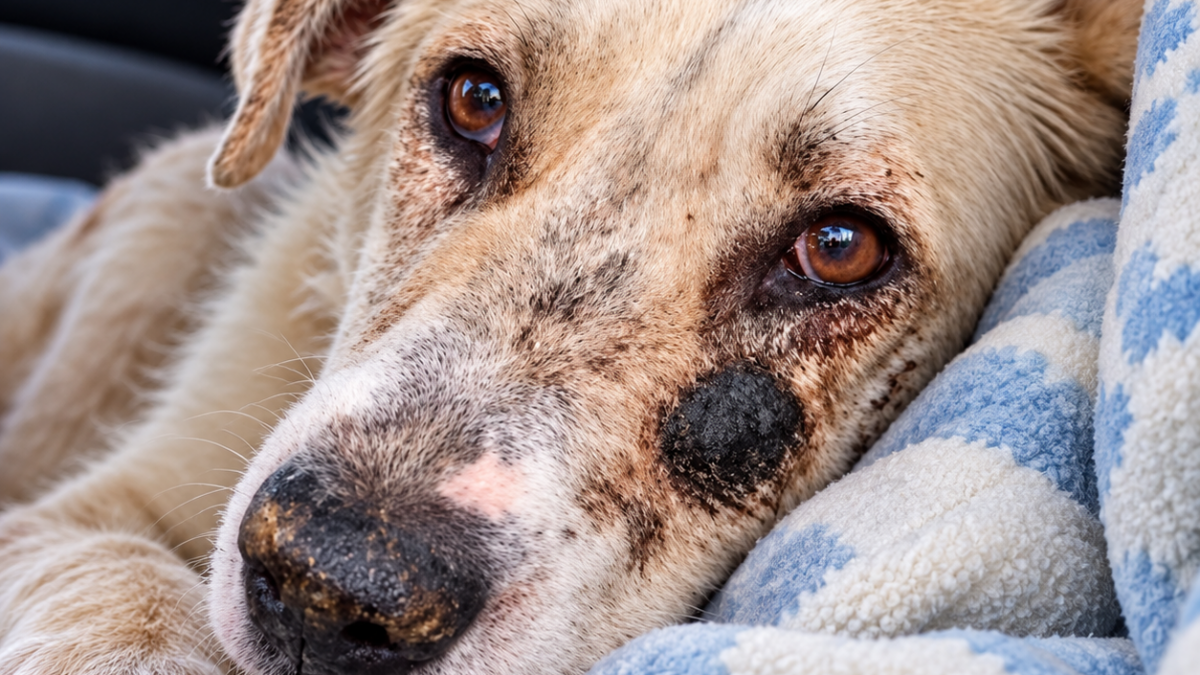
The dog’s lower jaw hung at an angle, his cheek was swollen around a bullet wound, and the tissue inside his mouth had already begun to die.
When the man Sky still recognized as his owner turned to leave, Sky tried to follow him and cried even though opening his mouth had to hurt.
I thought the five-hour surgery would be the hardest part of saving him, but the moment that nearly broke me came later, when Sky finally understood who had chosen to stay.
My name is Megan Collins, and I was thirty-seven years old when Sky came into the rescue where I worked outside Knoxville, Tennessee.
It was a gray Thursday afternoon when a battered pickup stopped beside our intake building.
A man climbed out first.
Then he opened the passenger door.
Sky didn’t jump down.
He couldn’t.
I remember seeing his eyes before I understood what had happened to his face.
He was a medium-sized shepherd mix, maybe five years old, with a tan chest, dark back, and one white patch beneath his throat.
His right cheek was swollen almost twice its normal size.
Dried blood had crusted along his muzzle.
His mouth hung partly open.
And beneath the swelling was a round wound that made my stomach tighten.
The man said, “He got shot.”
I stared at him.
“When?”
He looked toward the parking lot.
“Couple days ago. Maybe.”
“Did you take him to a vet?”
“No.”
Sky was standing now, barely.
Saliva mixed with blood and dripped onto the pavement.
I called for our veterinary technician.
“Why not?” I asked.
The man shrugged.
“Thought he’d get better.”
Sky leaned against his leg.
That was the part I still remember most clearly.
After everything, Sky pressed himself against the person he trusted.
The man stepped away.
“I can’t deal with it,” he said. “You can have him.”
We had him sign a surrender form.
I wanted to ask a hundred questions, but Sky’s condition was deteriorating in front of us.
When the man reached his truck, Sky lifted his head.
He tried to move after him.
His front paws slid on the concrete.
Then he made a sound.
Not a bark.
Not a growl.
A thin, broken cry.
The truck door closed.
Sky cried again.
The engine started.
He watched the pickup disappear through the gate.
Then he folded into himself beside my shoes.
I crouched without touching him.
“I’m sorry,” I whispered.
We rushed him to our emergency veterinary partner.
The X-rays made the room go quiet.
The bullet had shattered his lower jaw.
Several teeth were destroyed.
Small fragments of bone remained embedded around the injury, and damaged tissue inside his mouth was becoming necrotic.
Dr. Allison Reed studied the images.
“How old is the wound?”
“Several days,” she said. “At least.”
“Can you save him?”
She looked at Sky.
“We’re going to try.”
Surgery began that evening.
Five hours.
I stayed in the waiting room with my phone facedown beside me.
At 1:14 in the morning, Dr. Reed finally came through the doors.
“He made it.”
My knees almost gave out.
But she wasn’t smiling.
Part of the damaged jaw could not be reconstructed.
Several teeth had been removed.
Dead tissue had been cut away.
A feeding tube had been placed because Sky could not eat safely on his own.
“The next few days matter,” she said.
Sky survived them.
Then the next week.
Then another.
He never screamed.
Never snapped.
Never fought the hands changing dressings or flushing the wound.
Instead, he curled into the farthest corner of his kennel and turned his face toward the wall.
We fed him through the tube.
We cleaned his mouth.
We sat on the floor and talked to him.
At first, he wouldn’t look at us.
After thirty days, Sky ate soft food on his own for the first time.
I cried into my sleeve while he swallowed three careful bites.
But he still returned to the corner afterward.
Physically, he was healing.
Emotionally, he seemed to be waiting for someone who wasn’t coming back.
Then, one evening, I was filing his intake paperwork when I noticed something on the original surrender form.
One line.
One date.
And suddenly the story we had been told about Sky’s injury no longer made sense.
PART 2
The line was halfway down the second page.
I almost missed it.
Date injury first noticed: Sunday morning.
I looked at the calendar on my desk.
Sky had been surrendered Thursday afternoon.
Four days.
Not “a couple.”
Four full days during which his jaw had been shattered, his mouth had been filling with infection, and tissue had been dying inside his face.
I read the line again.
Then I looked through the glass wall into the treatment area.
Sky was sleeping with his back pressed against the kennel wall.
His feeding tube had been removed two days earlier, but the shaved patch along his neck remained.
Part of his lower jaw was gone.
When he slept deeply, the tip of his tongue sometimes slipped out on the damaged side.
Four days.
“Melissa.”
Our rescue director looked up from the opposite desk.
“What?”
“Come here.”
She rolled her chair beside mine.
I pointed.
Her expression changed immediately.
“He told us two days.”
“I remember.”
“Maybe he was guessing.”
“He wrote Sunday.”
Melissa read the rest of the surrender form.
Owner name: Dale Mercer.
Dog’s name: Sky.
Age: approximately five.
Owned since puppyhood.
Reason for surrender: unable to provide medical care.
There was another box.
Have you contacted a veterinarian regarding this condition?
He had checked No.
Melissa tapped that line.
“If that’s true, there may not be anything more here than horrible judgment.”
“If it’s true.”
She looked at me.
“You think it isn’t?”
“I think a man who watched his dog suffer with a shattered jaw for four days and then walked away while the dog cried deserves at least one person asking questions.”
Melissa leaned back.
She was quiet for several seconds.
Then she reached for the phone.
We had a relationship with the county animal-welfare investigator, a deputy named Lucas Grant.
Lucas was not the sort of person who got visibly angry.
That was probably why he was good at his job.
He listened.
Asked us not to contact Dale.
Requested copies of the surrender paperwork, intake photographs, Dr. Reed’s medical notes, and anything removed during surgery that might still exist.
That last part led us to the bullet fragment.
Dr. Reed had removed a badly deformed piece of metal from tissue near the shattered jaw.
It had been bagged, labeled, and retained with Sky’s surgical materials because any gunshot injury could potentially become evidence.
“Can you tell who fired it?” I asked Lucas later.
“Not from a piece of metal alone.”
“Can you tell whether Dale did?”
“No.”
I hated the answer.
Lucas must have seen it on my face.
“Don’t make the mistake of deciding the part we can’t prove before we prove the part we can.”
“I’m not.”
“You are.”
I folded my arms.
He softened slightly.
“Megan, Sky deserves facts. Not the story that feels most satisfying.”
I knew he was right.
There was no evidence Dale had shot Sky.
There might never be.
The wound could have come from a stranger.
A neighbor.
A hunter.
A reckless shot.
An accident.
Someone deliberately targeting him.
We didn’t know.
What we did know was that Sky had been badly injured.
We knew the injury was days old.
And we knew his owner had waited.
That became the beginning of the investigation.
For Sky, none of it mattered yet.
His world was still measured by the walls of a hospital kennel.
Day thirty-two, I sat six feet away from him with a bowl of soft food.
Dr. Reed had given us strict instructions.
Small portions.
Very soft consistency.
Nothing requiring chewing.
After every meal, his mouth had to be flushed carefully because the missing section of jaw created an area where food collected.
That would probably remain part of his life forever.
I put the bowl down.
Sky looked at it.
Then at me.
“You don’t have to eat with me watching.”
I turned slightly sideways.
That was something our behavior consultant, Jenna, had suggested.
Direct eye contact made him uncomfortable.
Facing him squarely made him retreat.
So I sat sideways.
I looked at the wall.
I talked about stupid things.
The weather.
The broken copier at the rescue.
The fact that Melissa had somehow killed another office plant.
“You’d think a woman responsible for eighty living animals could keep one fern alive,” I told him.
Sky’s ears moved.
I kept talking.
“I’m not saying you should judge her. I’m just saying if you ever see her walking toward a houseplant with a watering can, intervene.”
Behind me, I heard the bowl move.
I didn’t turn.
Sky ate.
Slowly.
His tongue had to work differently now.
Food sometimes fell from the damaged side of his mouth.
He would stop, lower his nose, and try again.
The first few days he became frustrated.
Once, he simply abandoned the bowl after two bites.
We learned to mound the food toward the stronger side.
We learned which texture he could manage.
We learned how warm he preferred it.
Sky was teaching us how his new body worked.
When he finished, I waited.
Mouth cleaning was the part he hated most.
I had to approach his face with gauze and a small syringe of warm solution.
A dog with a gunshot wound to the mouth has every reason to fear hands near his head.
The first time I cleaned him, he shook until the kennel floor rattled.
He never tried to bite.
He simply pressed himself into the wall.
That somehow felt worse.
Aggression would have meant he believed resistance could change what happened.
Sky seemed to believe it could not.
I picked up the syringe.
“Your least favorite part.”
His eyes followed it.
“I know.”
I moved slowly.
“Two minutes. Then I leave you alone.”
Sky lowered his head.
I stopped.
“Look at me.”
He didn’t.
“That’s okay.”
I sat down again.
Jenna had taught us to offer participation whenever possible.
I placed my left hand low, palm up.
Sky stared at it.
I waited.
A minute passed.
Then two.
He leaned forward.
His nose touched my wrist.
My throat tightened.
“That counts.”
I lifted the syringe.
He stayed.
I cleaned the injured side of his mouth.
He trembled.
But he stayed.
When I finished, I put everything down.
“Done.”
Sky looked at me.
Then something happened that had never happened before.
He didn’t return to the corner.
He lay down where he was.
Three feet closer to me.
I sat there until my legs went numb.
That was how trust started.
Not with a tail wag.
Not with a kiss.
Three feet.
Meanwhile, Lucas began reconstructing the four days before Sky arrived.
Dale told him Sky had been missing for almost a day.
According to Dale, Sky disappeared Saturday night and returned Sunday morning injured.
He claimed he assumed the wound was superficial.
By Monday, Sky’s face had started swelling.
By Tuesday, Sky stopped eating.
Dale said he considered veterinary care but couldn’t afford it.
On Thursday, he brought Sky to us.
Lucas asked whether he had called any clinics.
Dale said no.
That mattered because the surrender form said the same thing.
Then Lucas called veterinary hospitals within twenty miles of Dale’s address.
At the fourth clinic, a receptionist remembered the name.
Dale Mercer had called Sunday afternoon.
The clinic kept telephone intake notes.
The entry was short.
Male dog. Possible gunshot wound to face. Significant bleeding. Owner advised emergency evaluation immediately. Owner asked estimated cost. Declined appointment.
When Lucas told me, I sat very still.
“He knew.”
“He knew a clinic considered it an emergency.”
“And lied on the form.”
“Yes.”
“Why?”
“Maybe because he knew how it would look.”
I thought about Sky leaning against Dale in the parking lot.
Still trusting him.
Still trying to follow him.
“How much was the emergency exam?”
Lucas gave me a look.
“This isn’t about whether Dale was rich or poor.”
“I know.”
“People can be unable to afford major surgery. That happens. There are surrender options. Payment plans. Humane organizations. Emergency funds. What matters is what he did after being told the dog needed immediate care.”
“He waited four days.”
“Yes.”
The anger I felt then was different from the anger I had felt at intake.
Cleaner.
Less confused.
Dale had known enough to call.
He had been told enough to understand.
And still Sky waited.
But Lucas continued to caution us.
“Failure to get care can support neglect. It does not prove he caused the gunshot.”
“I understand.”
“Say it like you mean it.”
“I understand.”
“Good.”
He stood.
“Megan?”
“What?”
“Don’t let the investigation become Sky’s life.”
I looked through the treatment-room window.
Sky was awake.
Watching me.
Lucas nodded toward him.
“That dog has enough past. Give him something else.”
I tried.
Day thirty-seven, Sky walked outside for the first time since surgery.
It was late afternoon.
Dr. Reed thought five minutes of gentle movement would help.
We chose the clinic’s private courtyard.
No strangers.
No other dogs.
No cars.
Just a patch of grass bordered by a wooden fence.
When I clipped the leash to Sky’s harness, he froze.
“Okay.”
I dropped the leash.
Not completely.
I just let it lie loose.
Sky looked toward the open door.
Then back at his kennel.
The kennel was familiar.
Outside was not.
I remembered something Jenna had said.
“Sometimes the cage is frightening. Sometimes it becomes the only predictable thing left.”
I sat near the doorway.
Sky remained standing.
His tail hung low.
The afternoon sun reached across the floor and touched his front paws.
He moved backward.
I didn’t pull.
For almost five minutes, nothing happened.
Then Sky extended one paw.
Grass.
He lifted it immediately.
I smiled.
“Terrible stuff, isn’t it?”
He sniffed.
Another paw.
Then two more.
Sky stepped outside.
His body looked smaller in the open air.
The right side of his face was still shaved.
His jawline was uneven.
A thin scar ran through his cheek.
But sunlight touched his back.
He stood there.
Wind moved through the fur around his neck.
A bird called from somewhere beyond the fence.
Sky’s ears lifted.
For the first time, he looked interested in something that wasn’t pain or fear.
He took six steps.
Stopped.
Looked back at me.
I was still sitting in the doorway.
“I’m here.”
He walked another six.
Stopped.
Looked back.
Still there.
He went almost to the fence.
Then he returned.
Not to the kennel.
To me.
Sky stood beside my knee.
I didn’t reach for him.
He lowered his head.
For a moment, I thought he was going to sniff my shoe.
Instead he placed his forehead against my shoulder.
I closed my eyes.
“Okay.”
I barely whispered it.
“Okay, buddy.”
He stayed there maybe five seconds.
Then walked back toward the grass.
I cried after he went inside.
I was getting very good at crying where Sky couldn’t see me.
Day forty-one brought the first tail wag.
It was pathetic.
One movement.
Barely an inch.
I had entered carrying breakfast.
“Morning.”
Sky lifted his head.
The tail moved.
I froze.
“Did you just—”
Nothing.
I took another step.
“Sky?”
One tiny wag.
I looked through the doorway.
“Tessa!”
The veterinary technician appeared.
“What?”
“He wagged.”
She stared at me.
“You yelled my name because a dog moved his tail?”
“Yes.”
Sky’s tail moved again.
Tessa covered her mouth.
“Oh.”
Exactly.
Oh.
For a dog who had once cried after the person abandoning him, one small tail movement toward someone returning felt enormous.
He began recognizing routines.
Dr. Reed in the morning meant examination.
Tessa meant medication.
I meant food, mouth cleaning, and too much talking.
Jenna meant strange games involving treats and personal boundaries.
Sky learned that after mouth cleaning came a tiny smear of peanut butter on a silicone mat.
He learned nurses opened kennel doors without dragging him anywhere.
He learned he could retreat and no one chased him.
One afternoon, Tessa accidentally dropped a stainless-steel tray.
The crash echoed through the room.
Sky threw himself into the corner.
His breathing became rapid.
I entered but didn’t approach.
“It’s okay.”
He shook.
“No one’s touching you.”
His eyes stayed fixed on the door.
For twenty minutes, he wouldn’t move.
That was when we realized loud metallic sounds terrified him.
We didn’t know why.
Maybe they reminded him of the gunshot.
Maybe something older.
Not every fear comes with an explanation.
We adjusted.
The clinic staff stopped banging kennel latches near him.
No trays stacked while he was in the room.
No sudden handling.
The more control we gave Sky, the more curious he became.
By day forty-five, he came out of the kennel when I sat on the floor.
By day forty-eight, he followed me into the hallway.
Day fifty, he sniffed another dog through a barrier and wagged twice.
Day fifty-three, he discovered a stuffed fox.
He couldn’t grip toys normally because of the missing section of jaw.
He tried anyway.
The fox fell.
Sky stared at it.
Tried again.
Fell.
Again.
On the fifth attempt, he figured out how to hold it sideways using the stronger part of his mouth.
He carried it four feet.
Then dropped it directly into his water bowl.
Tessa laughed.
Sky startled.
Then something even stranger happened.
He bounced.
One awkward little hop.
Front paws down.
Rear end up.
A play bow.
Tessa stopped laughing.
I stopped breathing.
Sky looked between us.
Then pounced on the wet fox.
We both cried.
By then, Lucas had found another witness.
Her name was Ruth Harlan.
She lived two houses down from Dale.
Ruth was sixty-six and had known Sky since he was a puppy.
“He used to come to my fence every morning,” she told Lucas.
“What was he like?”
“Sweet. Too sweet for his own good.”
She said Dale usually kept Sky outside during the day.
Not always chained.
There was a fenced yard.
Sky had food most of the time.
He was not, in her words, “a skeleton or anything like that.”
That mattered.
We weren’t trying to turn Dale into something evidence didn’t support.
But Ruth remembered Sunday.
She heard Sky crying.
When she looked over the fence, he was lying near the porch.
His face was bloody.
She went next door.
Dale came outside.
“I told him that dog needed a veterinarian.”
“What did he say?”
Ruth hesitated.
Lucas waited.
“He said it would cost too much.”
“Anything else?”
She looked down.
“He said, ‘If he makes it, he makes it.’”
When Lucas later told me, I had to walk outside.
The rescue property backed onto a field.
I stood beside the fence until the anger passed enough that I could think.
If he makes it, he makes it.
Sky had made it because five hours of surgery, weeks of nursing care, medication, tube feeding, debridement, mouth cleaning, and dozens of people had refused to leave his survival to chance.
I wanted Dale to hear every hour.
Every bill.
Every time Sky shook.
Every time he looked at the clinic door expecting someone who never returned.
But Lucas was right.
Sky did not need to become a courtroom exhibit in my mind every day.
He needed breakfast.
He needed clean bedding.
He needed sunlight.
So I went back inside.
Sky was standing at the front of his kennel.
That was new.
“Hey.”
His tail moved.
Three times.
“Want to go outside?”
Sky stepped toward me.
The investigation could wait an hour.
We went outside.
Day fifty-eight was the first time Sky ran.
Calling it running might be generous.
We were in the courtyard.
The stuffed fox was on the grass.
I nudged it with my foot.
Sky trotted after it.
I kicked it gently again.
He followed.
Then a leaf blew across the yard.
Sky forgot the fox.
The leaf became everything.
He chased it.
Five steps.
Seven.
Ten.
His ears lifted.
His body stretched.
For a few seconds, he was not a patient.
He was a dog.
The leaf hit the fence.
Sky stopped.
Then looked back at me.
That look became part of him.
He did it constantly.
Walk ahead.
Look back.
Cross the room.
Look back.
Enter the yard.
Look back.
As though he needed proof that the person behind him had not disappeared.
Every time, I answered the same way.
“I’m here.”
I didn’t know then how many years I would say those words.
Day sixty-two, Dale called the rescue.
Melissa answered.
I knew something was wrong from her face.
She listened.
Then said, “No.”
Pause.
“No, Mr. Mercer. The surrender was permanent.”
Another pause.
“No.”
Her expression hardened.
“You signed ownership over to Haven Ridge.”
I stood.
Dale.
I could hear his voice through the phone but not the words.
Melissa looked at me.
Then back toward the treatment room.
Sky was asleep.
“What does he want?” I whispered.
Melissa covered the receiver.
“Sky.”
My entire body went cold.
“Why?”
“He heard Sky survived.”
The local newspaper had run a short article about an anonymous gunshot dog recovering at the veterinary hospital after a community fund helped cover treatment.
We hadn’t named Dale.
We hadn’t accused anyone.
But the photograph showed Sky.
Dale recognized him.
Melissa returned to the call.
“Your surrender paperwork is clear.”
She listened.
“No, covering the medical bills now does not reverse the surrender.”
Another pause.
Her eyes narrowed.
“The matter is also under review by animal welfare. You should speak with the investigator rather than us.”
She hung up.
“What did he say?”
Melissa rubbed her forehead.
“He says he only surrendered Sky because he couldn’t afford surgery. Now that Sky is better, he thinks he should get him back.”
I laughed once.
There was no humor in it.
“He walked away.”
“I know.”
“He watched that dog cry.”
“I know.”
“He left him here because he didn’t want to pay, and now that everyone else did the work, he wants him?”
“Megan.”
“No.”
“No one is giving Sky back.”
“He shouldn’t even be allowed to ask.”
Melissa lowered her voice.
“I agree. But keep your head.”
I looked through the glass.
Sky shifted in his sleep.
The fox was under one paw.
“Does Lucas know?”
“He will in thirty seconds.”
Dale came to the rescue the following afternoon.
That was the only time I came close to losing my temper completely.
His pickup entered through the public gate at 2:17.
I recognized it immediately.
So did Sky.
We happened to be in the fenced courtyard behind the intake building.
The engine sound reached us first.
Sky’s entire body changed.
His head snapped toward the parking lot.
Ears forward.
Tail low.
Then he ran to the gate.
Not away.
Toward it.
I stood frozen.
Dale got out.
Sky made a sound.
That same thin cry.
Not as painful this time.
But familiar.
He knew him.
After sixty-three days of feeding tubes, surgery, fear, healing, and people sitting beside his kennel, Sky still knew the man who had left.
That hurt in a way I hadn’t expected.
Dale saw him through the fence.
“There he is.”
He started toward us.
I stepped between them.
“Stop.”
Dale frowned.
“That’s my dog.”
“No.”
“I raised him.”
“You surrendered him.”
“Because I couldn’t pay twenty thousand dollars.”
“It wasn’t twenty thousand.”
“You know what I mean.”
He looked around me.
“Sky!”
Sky’s body leaned forward.
I could feel the leash tighten.
I hated that.
I hated that some part of him still wanted to go to the person he knew.
Then I reminded myself loyalty does not prove someone deserves it.
Dale reached toward the gate latch.
I put my hand over it.
“You can’t come in.”
“I just want to see him.”
“You’re seeing him.”
“I want my dog.”
“He isn’t yours.”
Dale’s voice rose.
“I had him five years.”
“And you waited four days with his jaw shattered.”
His face changed.
“You don’t know what happened.”
“I know a vet told you it was an emergency on Sunday.”
That stopped him.
For one second.
Then anger replaced surprise.
“Who told you that?”
“Leave.”
“I said I want—”
A second voice came from behind him.
“Mr. Mercer.”
Lucas Grant was crossing the parking lot.
Melissa had called as soon as Dale’s truck appeared.
Lucas didn’t rush.
He didn’t raise his voice.
He simply walked until he stood between Dale and the gate.
“You and I need to talk.”
“This is ridiculous.”
“You were advised not to contact the rescue regarding the investigation.”
“I’m here for my dog.”
“You no longer own this dog.”
Dale pointed toward me.
“They stole him.”
Lucas looked at the signed surrender document Melissa had brought outside.
“Your signature says otherwise.”
Dale swore.
Sky flinched.
That did it for me.
I turned away from Dale and knelt near Sky.
“Come on.”
Sky resisted for a moment.
He looked toward Dale.
Dale called him again.
“Sky!”
Sky took one step backward.
Then looked at me.
I remember that moment more clearly than the argument.
Dale was behind me.
The clinic door was ahead.
Sky looked from one to the other.
Then he walked toward me.
Not because he suddenly hated Dale.
Not because animals understand moral justice.
He simply chose the person standing closest to safety.
I opened the door.
Sky went inside.
He looked back once.
I was behind him.
“I’m here.”
He continued down the hallway.
I didn’t watch Dale leave.
I didn’t need to.
Day sixty-four, Sky was quieter.
Maybe I imagined it.
We are always in danger of assigning human stories to dogs.
Jenna reminded me of that when I said I thought the encounter had hurt him.
“We know it was stressful,” she said. “We don’t know what he thinks about Dale.”
“He recognized him.”
“Absolutely.”
“He wanted to go to him at first.”
“Yes.”
“How can he still want someone who abandoned him?”
Jenna looked at me.
“Because attachment isn’t a reward humans earn by behaving well. Sometimes it exists because it was built over years.”
That answer stayed with me.
“Then what are we doing?”
“Building something new.”
“What if the old attachment never disappears?”
“It doesn’t have to.”
She glanced toward Sky.
“Recovery isn’t deleting memory.”
I knew that from people.
I was learning it from dogs.
Sky’s last eleven days in the hospital were his best.
Day sixty-six, he learned stairs.
Two low ones leading from the courtyard.
He approached the first.
Stopped.
Looked back.
“I’m here.”
One paw.
Second paw.
Up.
He looked absurdly proud.
Day sixty-eight, he allowed Dr. Reed to examine his mouth without sedation.
She crouched.
Lifted his lip.
Checked the healing tissue.
Sky trembled slightly.
But stayed.
“Beautiful,” she said.
I looked at his uneven jaw.
“You have an interesting definition of beautiful.”
“I’m a surgeon.”
She smiled.
“I mean the tissue.”
The necrosis was gone.
The wound had closed.
The remaining bone was stable.
His weight had improved.
His bloodwork was normal.
He could eat soft meals independently.
We still had to clean the pocket along the damaged side after every meal.
That would probably never change.
“He’s going to look different forever,” Dr. Reed said.
“I think he looks like Sky.”
She looked at me.
“That sounds suspiciously like foster-failure language.”
“I’m not fostering him.”
“Not yet.”
I ignored her.
Day seventy, we removed the last temporary support material from the injured side.
Day seventy-one, Sky carried the stuffed fox all the way down the hallway.
Sideways.
One ear of the fox hanging from his mouth.
Tessa applauded.
Sky dropped it.
Looked alarmed by the applause.
Then picked it up again.
Day seventy-two, he slept with his belly partly exposed.
It was the first time I saw him do that.
A dog that sleeps curled tightly is protecting something.
A dog that sleeps stretched open is trusting the room.
Day seventy-three, Dr. Reed said the word we had been waiting for.
“Discharge.”
I should have been happy.
Instead I panicked.
“Where?”
Melissa, standing beside me, laughed.
“Usually discharge means somewhere outside the hospital, Megan.”
“I know what it means.”
“We need a medical foster.”
Sky required someone willing to clean his mouth after every meal, monitor scar tissue, continue medication, attend follow-up visits, manage his anxiety, and keep him on soft food.
Melissa looked at me.
I shook my head.
“No.”
“You haven’t heard the question.”
“I know the question.”
“You already know how to clean his mouth.”
“No.”
“He trusts you.”
“I work full time.”
“At the rescue.”
“My apartment—”
“Has a fenced yard.”
“It’s a rental.”
“The landlord allows dogs.”
“How do you know?”
“You complained about the pet deposit last year.”
“That was hypothetical.”
Melissa smiled.
“Not anymore.”
I looked toward Sky.
He was watching me.
Of course he was.
“I’ll foster him.”
“Excellent.”
“Temporarily.”
“Obviously.”
“I mean it.”
“I know.”
Dr. Reed turned away so I wouldn’t see her laughing.
Day seventy-five arrived on a Saturday.
Tessa packed his medication.
Dr. Reed printed six pages of instructions.
Melissa brought the stuffed fox.
Someone had bought Sky a new harness.
I hated that everyone looked like they knew something I didn’t.
Sky stood in the hospital lobby.
The front door opened.
Sunlight spilled across the tile.
He froze.
I crouched.
“Want to go?”
Sky looked toward the treatment hallway.
For seventy-five days, that building had been everything.
Pain.
Food.
Fear.
Safety.
Surgery.
People who stayed.
He took one step toward the door.
Then another.
Outside, my car waited.
Sky stopped beside it.
Cars were complicated for him.
The last truck ride with Dale had ended in abandonment.
I opened the rear door.
Put his blanket inside.
Placed the stuffed fox on top.
Sky looked at me.
“No rush.”
Tessa stood ten feet away crying openly.
Dr. Reed was pretending she had something in her eye.
Melissa made no attempt to hide anything.
Sky put his front paws into the car.
Paused.
Climbed in.
I closed the door.
He immediately stood.
His breathing accelerated.
I got into the driver’s seat.
Turned around.
“I’m right here.”
Sky stared at me.
We drove.
At the first traffic light, I looked in the mirror.
Sky was standing with his nose near the glass.
At the second, he sat.
At the third, he lay down.
When we turned onto my street, I realized my hands were shaking.
I parked.
Opened the back door.
Sky didn’t move.
“This is the part where you get out.”
Nothing.
“I promise there are no needles inside.”
His ears shifted.
I clipped the leash.
Sky stepped out.
My house was small.
One story.
Two bedrooms.
A narrow kitchen.
A living room with a couch I had sworn no foster dog would ever be allowed to use.
That rule lasted approximately six weeks.
The yard was the important part.
Wooden fence.
Maple tree.
Grass.
A shaded corner beside the porch.
I opened the back door.
Sky stood at the threshold.
The yard was bright.
He looked back.
“I’m here.”
He stepped outside.
One foot.
Then another.
He walked to the middle of the grass.
Stopped.
Looked around.
No kennel walls.
No hospital sounds.
No pickup.
He sniffed.
A squirrel ran along the fence.
Sky’s ears lifted.
He took three quick steps.
Stopped.
Looked back.
Still there.
“I’m here.”
He walked farther.
He did that perhaps fifteen times in the first hour.
Every few yards.
Look back.
Check.
Confirm.
I answered every time.
That first night, I put his bed beside my bedroom door.
I assumed he would want a small protected space.
Instead, Sky chose the hallway.
He curled against the wall.
Stuffed fox under one paw.
I went to bed.
At 1:03 in the morning, I woke to nails clicking on the floor.
Sky stood in my doorway.
“Hey.”
He didn’t enter.
I turned on the bedside lamp.
His eyes were wide.
“Bad dream?”
No response.
“Want to come in?”
Sky remained at the threshold.
I put my hand on the floor beside the bed.
Then closed my eyes.
Several minutes later, I heard him move.
He lay down just inside the room.
Not beside me.
Not touching.
But inside.
When I woke at six, his head was resting on my slipper.
Our mornings developed quickly.
Soft food at 6:30.
Mouth cleaning at 6:45.
Medication hidden in a spoonful of canned food.
Short yard walk.
Then work.
The first day I prepared to leave without him, Sky panicked.
I picked up my keys.
He immediately stood.
I moved toward the door.
Sky followed.
“No, buddy. I’ll be back.”
His breathing changed.
I stepped outside.
Through the window, I saw him pace.
I waited thirty seconds.
Returned.
Sky rushed toward me.
I ignored the intensity.
Put down my keys.
Sat.
Five minutes later, I tried again.
One minute.
Return.
Then three.
Then five.
We worked slowly.
Jenna helped me build a departure routine.
Sky got a food puzzle he could manage without hard chewing.
Keys no longer automatically meant abandonment.
Sometimes I picked them up and sat on the couch.
Sometimes I opened the door and closed it without leaving.
Sometimes I drove around the block.
Always came back.
One evening, after a ten-minute practice departure, I returned to find Sky lying on his bed.
He lifted his head.
Tail wagged.
But he didn’t run to the door.
It might sound insignificant.
To me, it meant the world.
He had started believing that leaving and returning could belong to the same event.
The first month at home had difficult moments.
Pickup trucks were one.
The sound of an older engine made Sky freeze.
If a truck slowed near the house, he moved away from the window.
Once, a delivery driver arrived in a truck that looked almost exactly like Dale’s.
Sky saw it.
He bolted down the hallway.
I found him wedged between my bed and the wall.
I sat on the floor.
Didn’t reach.
The truck left.
Sky stayed.
Twenty minutes later, he crawled forward.
Put his head on my knee.
I kept my hand still.
“I’m here.”
That phrase became almost automatic.
I’m here.
Not “don’t be scared.”
Fear doesn’t disappear because someone orders it to.
Not “nothing bad will happen.”
I could not promise that.
Life had already proved otherwise.
Just:
I’m here.
We’ll deal with whatever happens from this point together.
Sky’s jaw required constant care.
Every meal left residue in the missing section.
I became ridiculously skilled at cleaning it.
Warm water.
Soft gauze.
Small syringe.
Check for redness.
Check odor.
Check swelling.
At first, Sky hated it.
By month two, he would walk into the bathroom when I said, “Mouth.”
He did not enjoy it.
His expression made that clear.
But he trusted the routine.
Afterward came his reward.
A spoonful of soft pumpkin or peanut butter.
One night, I finished cleaning and said, “Done.”
Sky looked at me.
Then licked my wrist.
It was messy.
His tongue didn’t move normally.
Saliva landed on my sleeve.
I started crying.
Sky stared at me like I was unstable.
He was correct.
The legal case moved more slowly.
Lucas found no evidence that conclusively identified who fired the shot.
The bullet fragment was too damaged.
No reliable witness had seen the shooting.
Dale denied causing it.
Ruth had heard no gunshot from Dale’s property that night.
For all we knew, Sky had been injured somewhere while loose.
That part of the story remained unanswered.
At first, I hated that.
I wanted every wrong neatly attached to a name.
Real life rarely works that way.
Lucas reminded me:
“What we can prove is still serious.”
Dale had been warned by an emergency veterinary clinic that Sky needed immediate care.
He waited days.
A neighbor had urged him to get help.
He declined.
Sky’s infection worsened.
Then Dale surrendered him only when the situation became impossible to ignore.
The veterinary records documented prolonged untreated suffering.
That was enough for charges related to neglect and failure to provide necessary care.
Dale’s attorney argued poverty.
That made the case emotionally complicated.
Because money does matter.
Veterinary care can be expensive.
People delay care because they are afraid of bills they cannot pay.
I did not want Sky’s story turned into an accusation against every person who has ever struggled financially.
Dr. Reed said something that clarified it for me.
“If someone cannot afford treatment, there are still decisions.”
“Surrender earlier.”
“Yes.”
“Call rescue groups.”
“Yes.”
“Ask the clinic for options.”
“Yes.”
“Anything except leave him hurting.”
“That’s the issue.”
Dale had been offered immediate examination.
He declined.
He waited.
Then, when the dog’s face smelled of infection and Sky could no longer eat, he surrendered him.
The court would have to decide what that meant legally.
For Sky, another milestone mattered more.
He learned to run.
Really run.
It happened almost three months after he came home.
There was a fenced field behind the rescue where we exercised dogs one at a time.
Sky had been there many times.
Usually he stayed close.
Twenty feet ahead.
Look back.
Thirty feet.
Look back.
That morning, autumn had begun.
The air was cool.
Leaves moved across the grass.
Sky was stronger.
His weight had returned.
His coat shone.
The shaved patch on his cheek had grown in, though the scar remained.
The missing section of jaw gave his face a permanent crookedness.
I loved it.
I unclipped the long line.
Sky looked at me.
“Go.”
He didn’t.
“Seriously.”
He sniffed the grass.
A bird landed near the far fence.
Sky saw it.
And ran.
Not ten steps.
Not a cautious trot.
He ran the length of the field.
His legs stretched beneath him.
Ears flattened.
Tail high.
For a moment, I saw the dog he might have been before pain entered his life.
He reached the far end.
Stopped.
Turned.
Looked back.
I stood exactly where he had left me.
I lifted one hand.
“I’m here!”
Sky stared.
Then ran back.
Straight toward me.
I braced myself.
He nearly took my knees out.
He bounced sideways.
I laughed.
He ran another circle.
Looked back.
Still there.
Again.
Again.
Every time he reached a distance that once would have scared him, he checked.
Every time, I was there.
Eventually, the checks became less frantic.
He would glance instead of stop.
Then keep running.
That was the first day I understood that trust is not always the belief that no one will ever leave.
Sometimes trust is learning that the person who leaves comes back.
Dale’s preliminary hearing took place four months after Sky’s surrender.
I attended because I had handled the intake.
Sky stayed home with Melissa.
I refused to bring him anywhere near Dale.
He did not owe the court his fear.
He did not owe Dale another reunion.
The courtroom was smaller than I expected.
Wooden benches.
Fluorescent lights.
Files stacked on a clerk’s desk.
Nothing cinematic.
Dale wore a clean button-down shirt.
For a second, I barely recognized him without the truck and work clothes.
He looked ordinary.
That bothered me.
We like cruelty to look obvious.
It rarely does.
The prosecutor began with the timeline.
Saturday night: Sky reportedly disappeared.
Sunday morning: Sky returned with a gunshot wound.
Sunday afternoon: Dale called an emergency veterinary clinic.
Clinic note: possible gunshot wound, bleeding, immediate care recommended.
No visit.
Monday: Ruth observed swelling and urged veterinary care.
Tuesday: according to Dale’s own statement, Sky stopped eating.
Wednesday: no care.
Thursday: Sky surrendered to Haven Ridge.
Dr. Reed testified about the medical findings.
The prosecutor asked, “Could this injury have healed without intervention?”
“No.”
“What would have happened?”
Dr. Reed’s voice remained clinical.
“Infection would likely have progressed. Necrotic tissue would have increased. The dog could have developed systemic infection, inability to maintain hydration and nutrition, and potentially died.”
“How much pain would a complete mandibular fracture cause?”
“Severe.”
Dale looked down.
His attorney asked whether Sky could have appeared stable at first.
“Yes.”
Whether a non-veterinarian might underestimate the injury.
“Yes.”
Whether gunshot wounds can sometimes be difficult to assess externally.
“Yes.”
Then the attorney asked:
“So it is possible Mr. Mercer genuinely believed the dog would recover?”
Dr. Reed paused.
“Before speaking to a veterinary clinic, perhaps.”
The attorney’s face tightened.
“And after?”
“He was told immediate evaluation was recommended.”
The room went quiet.
The clinic receptionist testified.
Then Ruth.
Ruth seemed nervous.
She held her purse with both hands.
The prosecutor asked what she saw.
“Sky was lying by the porch. His mouth was bloody.”
“What did you do?”
“I went over.”
“Did you speak with Mr. Mercer?”
“Yes.”
“What did you tell him?”
“That Sky needed a doctor.”
“Veterinarian?”
“Yes.”
“What was his response?”
Ruth’s eyes moved toward Dale.
“He said it would cost too much.”
“Anything else?”
She swallowed.
“He said, ‘If he makes it, he makes it.’”
Dale shook his head.
His attorney objected to tone and context.
The judge allowed the statement as testimony subject to credibility.
When it was my turn, I described Thursday.
Sky’s swollen face.
Blood.
Saliva.
The surrender.
Dale walking away.
Sky crying.
The attorney asked:
“You formed a negative opinion of my client that day, correct?”
“Yes.”
“Strongly negative?”
“Yes.”
“Would you describe yourself as emotionally attached to Sky?”
“Yes.”
He looked pleased.
“So your interpretation of Mr. Mercer’s behavior may be biased.”
“My feelings are.”
A pause.
“My intake notes aren’t.”
His expression changed.
The prosecutor asked me to identify the surrender form.
Dale’s signature.
The date.
The field stating he had not contacted a veterinarian.
Then the prosecutor introduced the clinic call record.
Dale’s own form had become one of the clearest pieces of evidence against him.
That was the “revenge” people later expected me to celebrate.
A lie exposed by his signature.
But sitting in court, I felt no thrill.
I mostly thought about getting home.
Sky would be waiting by the window.
The case did not end that day.
Court rarely gives you one perfect dramatic moment.
There were continuances.
Negotiations.
More paperwork.
Dale’s attorney challenged parts of the timeline.
The prosecutor narrowed the case to what could be proved.
The shooting itself was never charged to Dale.
I was glad.
Not because I wanted him protected.
Because accusing someone of something we could not prove would have weakened everything we could.
Months later, Dale entered an agreement resolving the neglect case.
He admitted failing to obtain necessary veterinary care after being advised of the seriousness of Sky’s condition.
The court imposed probation, financial penalties, restitution toward a portion of Sky’s medical treatment, and restrictions on owning or caring for animals during the court-ordered period.
Most important to me, his surrender of Sky was confirmed as permanent.
No claim.
No return.
No second chance to walk away from the same dog.
When Lucas called with the final order, I was standing in my kitchen.
Sky was beneath the table waiting for pieces of chicken.
“So that’s it?” I asked.
“That’s it.”
“He can’t come asking for Sky again?”
“No.”
I looked down.
Sky noticed me staring and thumped his tail.
“Good.”
Lucas was quiet.
“You expected to feel more?”
“I thought I would.”
“Most people do.”
“I wanted him punished.”
“He was held accountable.”
“It doesn’t fix anything.”
“No.”
Sky stood and put his chin against my knee.
Lucas heard my voice change.
“What’s he doing?”
“Begging.”
“For what?”
“Chicken.”
“Then I suggest you address the immediate emergency.”
I laughed.
Sky got the chicken.
The law closed one part of his story.
Life kept writing the rest.
My “temporary” foster lasted six months before Melissa placed an adoption application on my desk.
I pushed it back.
“No.”
She pushed it toward me.
“Yes.”
“I haven’t decided.”
“Megan.”
“I’m serious.”
“So am I.”
“Maybe there’s a family with a bigger yard.”
“Sky hates large unfamiliar spaces until he knows them.”
“Someone who works from home.”
“He comes to the rescue with you three days a week and sleeps while you’re gone the other two.”
“A family with another dog.”
“He likes dogs but doesn’t need one.”
“You have an answer for everything.”
“Yes.”
I looked at the application.
Applicant: Megan Collins.
Dog: Sky.
Someone had already filled in his name.
“You are manipulative.”
“I am efficient.”
“What if I’m keeping him because I’m attached instead of because I’m the best home?”
Melissa’s expression softened.
“Good question.”
I looked up.
“Sky needs someone comfortable with lifelong mouth care.”
“Yes.”
“Someone who knows his triggers.”
“Yes.”
“Someone patient with his separation anxiety.”
“Yes.”
“Someone he trusts.”
“Yes.”
She leaned forward.
“Who does he look for when he walks into a room?”
I didn’t answer.
“Who does he look back for when he runs?”
I looked through the office window.
Sky was lying in the hallway.
Even asleep, he had positioned himself where he could see my desk.
Melissa tapped the form.
“Fill it out properly. I’m not letting you cheat because you work here.”
I signed it that afternoon.
The adoption became official eleven months after the day Dale surrendered him.
There was no party.
Sky hated too many people in one room.
I bought him a new blue collar.
Soft.
Lightweight.
His identification tag hung from it.
SKY COLLINS.
My phone number beneath.
I held it for a long time before putting it on him.
“Ready?”
Sky sniffed it.
I buckled it around his neck.
He shook.
The tag jingled.
Sky looked at me.
“That means if you get lost, somebody calls me.”
His tail moved.
“And I come get you.”
Another wag.
“Every time.”
I wish I could say that from then on, Sky never struggled again.
That would be a prettier story.
It would also be dishonest.
Trauma is rarely a staircase where every step goes upward.
Some weeks Sky seemed completely changed.
Then something small would bring the old fear back.
A pickup idling near the driveway.
A metallic crack from construction.
A man reaching suddenly toward his face.
Once, a firework exploded unexpectedly during a summer afternoon.
Sky threw himself against the back door.
I opened it.
He ran inside.
I found him under my desk shaking.
I sat nearby.
Two hours later, he came out.
The next morning, he was chasing a squirrel.
Both were Sky.
Recovery did not require choosing one version as the “real” one.
He could be brave and frightened.
Happy and scarred.
Trusting and cautious.
Whole without being untouched.
His mouth remained a daily reminder.
Food still collected along the damaged side.
Every meal was followed by cleaning.
At first, guests found the routine sad.
I stopped seeing it that way.
It became ordinary.
Breakfast.
Clean mouth.
Walk.
Lunch.
Clean mouth.
Dinner.
Clean mouth.
Sometimes Sky would sigh dramatically when I said, “Bathroom.”
“You have three meals a day. We have three cleanings a day. This is the arrangement.”
He would lower his head.
“Don’t act oppressed.”
Tail thump.
“You know what real oppression looks like.”
Another thump.
He learned to stand with his front feet on a bath mat while I cleaned.
When I finished, I always said:
“All clear.”
Sky would immediately walk to the kitchen for his reward.
He never forgot the order.
Years passed.
The scar softened.
The fur over his cheek returned.
His face remained asymmetrical.
The missing lower-jaw section gave him a crooked smile.
Strangers sometimes stared.
Children asked questions.
I learned to answer simply.
“He got badly hurt, and the doctors fixed what they could.”
One little boy at an adoption event looked at Sky for a long time.
“Does it hurt?”
“Not anymore.”
“Is he ugly?”
His mother gasped.
I laughed.
“What do you think?”
The boy crouched.
Sky approached him.
The boy touched Sky’s shoulder.
“No.”
“Then there’s your answer.”
Sky eventually became one of the best dogs we had around frightened rescue animals.
We discovered it accidentally.
A young hound named Maple arrived after being found beneath an abandoned porch.
She refused to come out of her crate.
We tried food.
Quiet.
Covered sides.
Time.
On day two, I was cleaning Sky’s mouth in the room next door.
Maple began whining.
Sky heard.
He walked toward her crate.
Stopped six feet away.
Lay down.
Maple became quiet.
We left them like that.
Sky didn’t stare.
Didn’t approach.
Just existed.
Twenty minutes later, Maple crawled forward.
By afternoon, she was sleeping near the crate entrance.
The next day, she came out while Sky was in the room.
Melissa watched from the doorway.
“Look at him.”
Sky was lying on his side.
Maple sniffed his tail.
“He remembers corners,” I said.
After that, we sometimes brought Sky into the quiet room with shut-down dogs.
Never as a treatment.
Never forcing interaction.
Just company.
Sky had no veterinary degree.
No training certificate.
He simply knew how to be still near fear.
Maybe we romanticized it.
Maybe he was just a calm dog.
I didn’t care.
The dogs cared.
At home, Sky changed me too.
I had lived alone for almost six years before him.
I was good at it.
Too good, maybe.
I worked late.
Ate standing at the kitchen counter.
Ignored weekends.
Told myself I liked quiet.
Sky imposed routine.
Morning walk.
Dinner at a reasonable hour.
Outside before bed.
Weekends in places where dogs were allowed.
He made me notice weather.
Rain.
Sun.
Cold.
The smell of leaves.
He had nearly died because someone treated his suffering as inconvenient.
I found myself becoming less willing to treat my own life as an inconvenience.
I started leaving work on time.
I called my sister more.
I repaired the porch chair I had been meaning to fix for four years.
Sky slept beside me while I did it.
The first anniversary of his surgery, Dr. Reed invited us to the clinic.
Tessa was still there.
When Sky walked through the lobby, she screamed.
Not loudly enough to scare him.
Almost.
“Look at you!”
Sky wagged so hard his back end moved.
He remembered her.
Tessa knelt.
Sky pressed his shoulder against her.
She buried her face in his neck.
“I fed you through a tube for three weeks and this is all I get?”
Sky licked her ear.
“There. Better.”
Dr. Reed examined his jaw.
“Stable.”
“No infection?”
“No.”
“Teeth?”
“Remaining teeth look good.”
“Anything I should change?”
“Keep doing exactly what you’re doing.”
Sky looked at me.
I smiled.
“Did you hear that? I’m medically perfect.”
Dr. Reed laughed.
“You are the patient.”
I stood.
“Fine.”
Before we left, she pulled up his original X-ray.
I had not seen it in almost a year.
The shattered jaw.
Bone fragments.
Metal.
Damage.
Then she showed me a current image.
The anatomy was still altered.
It would always be.
But the bone that remained was healed.
The inflammation was gone.
Sky was healthy.
“You know what I remember?” she asked.
“What?”
“The smell.”
I did too.
Necrotic tissue.
Infection.
Blood.
“That first night, I didn’t know if we were going to save him.”
“Neither did I.”
Dr. Reed looked through the glass.
Sky was standing beside Tessa.
Tail moving.
“You did.”
“No.”
She looked at me.
“We did.”
That mattered.
No one person saved Sky.
The rescuer who accepted the surrender.
The technicians.
The surgeon.
The donor who helped cover medication.
The volunteer who washed blankets.
The receptionist who documented Dale’s call.
The neighbor who testified.
Lucas.
Jenna.
Melissa.
Every person who did one small thing had become part of the opposite of abandonment.
Dale had walked away.
Everyone else stayed.
At two years, Sky stopped checking behind him every few steps.
I noticed gradually.
At first, his runs still had the pattern.
Go.
Stop.
Look back.
Go.
Stop.
Look back.
Then one morning, we were in the field.
Sky ran almost to the far fence before turning.
I realized he hadn’t checked once.
He came back panting.
His crooked mouth open.
Tongue hanging slightly to the side.
“You forgot something.”
Sky stared.
“You forgot to make sure I didn’t disappear.”
Tail wag.
I scratched his chest.
“Good.”
Then he ran again.
I stayed.
A year later, he did something I never expected.
He stopped following me from room to room.
For years, if I went to the kitchen, Sky went to the kitchen.
Bathroom, hallway.
Laundry, hallway.
Bedroom, bedroom.
He had to know where I was.
Then one Sunday afternoon, I walked from the living room to the kitchen.
Sky remained asleep on the couch.
I stopped.
Looked back.
Nothing.
I walked farther.
Still nothing.
I opened the refrigerator.
Usually that would summon him from another county.
No Sky.
I returned to the living room.
He opened one eye.
“You didn’t follow me.”
Eye closed.
“You don’t care where I am anymore?”
Tail thumped once.
I laughed.
The dog who once panicked if I walked out the front door had learned that I could exist in another room without vanishing forever.
Independence sometimes looks like indifference.
It isn’t.
It is trust without surveillance.
By then, Dale Mercer had disappeared completely from our lives.
His probation ended.
His court restrictions lasted their required period.
I occasionally heard his name through rescue circles.
I never looked him up.
People asked whether I wanted him to see Sky now.
Healthy.
Running.
Loved.
The question usually came with the idea that this would somehow punish him.
I didn’t.
Sky’s life was not a message for Dale.
That was important to me.
He did not need to become successful in order to prove Dale wrong.
He didn’t owe anyone an inspirational ending.
He could have remained disabled.
Fearful.
Medically complicated.
He still would have deserved care.
His happiness was not valuable because it humiliated the man who abandoned him.
It was valuable because it belonged to Sky.
That became my definition of revenge, if I had to use the word.
Dale no longer got to decide what happened next.
That was enough.
Sky turned eight.
Then nine.
His muzzle began whitening.
His running slowed slightly.
His appetite did not.
His mouth care continued.
He developed arthritis in one hip.
Nothing unusual.
Dr. Reed, who had somehow become both his surgeon and honorary aunt, prescribed supplements and later medication.
“You survived a bullet,” I told Sky. “Now we’re defeated by being middle-aged.”
He sighed.
“I understand.”
At ten, Sky began sleeping in sunny places.
He would move through the house as the light changed.
Morning by the kitchen window.
Noon beside the couch.
Late afternoon near the front door.
The dog who once hid in the darkest hospital corner now arranged his day around sunlight.
I took too many photographs.
Sky in sun.
Sky asleep.
Sky with the fox, which had been replaced three times.
Sky staring at food.
Sky running.
Sky looking back.
My favorite photograph was taken by Melissa.
We were in the rescue field.
I didn’t know she was watching.
Sky was far ahead of me.
Mid-run.
All four paws off the ground.
His head turned slightly over one shoulder.
Looking back.
I stood in the distance.
The photograph captured the exact thing I had spent years trying to give him.
Distance without abandonment.
Sky could run as far as he wanted.
Someone was still there.
When he was eleven, a new volunteer asked about his face.
I told her the short version.
Gunshot.
Broken jaw.
Surgery.
Seventy-five days.
She stared at Sky.
“He forgave people?”
I thought about it.
“I don’t know.”
“He trusts you.”
“Yes.”
“So he forgave.”
“Maybe those aren’t the same thing.”
She looked confused.
I understood.
People love forgiveness in rescue stories.
It makes suffering feel resolved.
Sky never told me he forgave Dale.
He never told me he hated him either.
Those are human ideas.
What Sky did was simpler.
He learned that one person leaving did not mean every person would.
That was enough.
His final years were ordinary.
I say that with gratitude.
There were no more dramatic rescues.
No more court.
No more investigations.
Just life.
Breakfast.
Walks.
Mouth cleaning.
Naps.
Trips to the rescue.
Field runs that became field trots.
Soft toys.
Car rides.
The occasional stolen sandwich.
One Thanksgiving, Sky managed to remove half a turkey breast from the counter despite possessing only part of a lower jaw.
I found him in the laundry room.
Turkey between his paws.
“You are a medical miracle.”
Sky chewed faster.
“Do you have any idea how much surgery was required to make that mouth functional?”
He swallowed.
“You’re using it for crime.”
No remorse.
I loved him for it.
The first serious sign of aging came when he was twelve.
He stopped halfway across the field.
Not because he was looking back.
Because he was tired.
I walked toward him.
Sky waited.
His breathing was heavier than usual.
We saw Dr. Reed the next morning.
Heart murmur.
Early.
Manageable.
Medication.
Monitoring.
Nothing urgent.
But I drove home quieter than usual.
Sky slept in the back seat.
At a red light, I looked at him through the mirror.
For years, my fear had been that Sky would think I was going to leave.
Suddenly I realized someday he would.
That is the bargain hidden inside rescue.
We save them knowing most of the time we will outlive them.
We teach them not to fear goodbye while secretly dreading our own.
Sky gave me almost two more years.
Good ones.
His heart condition progressed slowly.
The hip worsened.
He no longer ran the entire field.
But he still wanted to go.
I would open the gate.
Sky walked twenty yards.
Sniffed.
Looked back.
Not anxiously anymore.
Just checking.
I raised my hand.
“I’m here.”
He continued.
At thirteen, Dr. Reed retired from emergency surgery.
Her last week, we visited.
Sky moved slowly through the lobby.
Tessa had transferred years earlier, but several staff members remembered him.
Dr. Reed sat on the floor despite complaining about her knees.
Sky walked directly to her.
Put his head in her lap.
She touched the damaged side of his jaw.
“You gave me gray hair.”
I sat beside them.
“You were already going gray.”
“Rude.”
Sky sighed.
Dr. Reed’s eyes filled.
“I really didn’t think you were going to make it.”
Neither had I.
She kissed his head.
“You were stubborn.”
“He learned from me.”
“That explains it.”
On the drive home, Sky rested his chin on the edge of the back seat.
I talked to him the entire way.
Not because he cared.
Because I did.
The end came the following spring.
Not from his jaw.
Not from the bullet.
Not from infection.
Age took him the way age eventually takes the lucky ones.
His heart disease worsened.
Then fluid began collecting around his lungs.
Medication helped for a while.
One morning, he refused breakfast.
That had happened only twice in all our years together.
I knew.
Dr. Reed was retired, but she met us at the clinic.
The younger veterinarian examined Sky and stepped outside to review imaging.
Dr. Reed sat beside me.
Sky lay between us.
His breathing was too fast.
“I don’t want to do this.”
“I know.”
“He survived everything.”
“I know.”
“He survived because we didn’t give up.”
Dr. Reed took my hand.
“Megan.”
I looked at her.
“There’s a difference between giving up and letting go.”
I hated that sentence.
Because it was true.
We took Sky home.
I wanted his last day to belong to him.
Melissa came.
Tessa drove almost an hour.
Lucas stopped by in the afternoon.
Jenna came after work.
Not all at once.
Sky never liked crowds.
They came in pairs.
Sat on the floor.
Fed him tiny pieces of soft chicken.
Told stories.
Lucas scratched his chest.
“Still causing trouble?”
Sky’s tail moved.
Lucas looked at me.
“You know, I kept that first case file longer than I needed to.”
“Why?”
“I don’t know.”
He smiled at Sky.
“Some cases you want evidence that the ending changed.”
Sky closed his eyes.
“It did,” I said.
After everyone left, the house became quiet.
Sunlight stretched across the living-room floor.
Sky moved into it.
Of course he did.
I lay beside him.
For a long time, neither of us moved.
Then I found myself thinking about the first day.
Dale’s truck.
Sky’s swollen face.
The blood.
The sound he made when the man left.
I had spent years remembering that cry.
Suddenly, I didn’t want it to be the last thing I associated with him.
So I started listing everything that came after.
“Five-hour surgery.”
Sky’s ear moved.
“Feeding tube.”
No response.
“Thirty days until you could eat.”
Tail tip shifted.
“Seventy-five days in the hospital.”
I touched his paw.
“One stuffed fox murdered.”
Technically four.
“Thousands of mouth cleanings.”
Sky sighed.
“Yes, I know. Your favorite.”
I laughed and cried at the same time.
“The field.”
His eyes opened.
“You remember the field?”
I wanted to believe he did.
“Running.”
I stroked his shoulder.
“Looking back.”
Sky’s breathing slowed.
“And me standing there.”
I leaned closer.
“I was always there.”
The veterinarian came to the house near sunset.
Sky could no longer comfortably stand.
We placed his favorite blanket in the living room.
The blue collar stayed on.
SKY COLLINS.
I held the tag in my fingers.
The veterinarian explained the process.
I already knew.
Sedation first.
Then the final injection when Sky was deeply asleep.
“Take as long as you need.”
There is no amount of time that becomes enough.
I lay beside Sky.
His face was inches from mine.
The scar along his cheek was almost hidden beneath gray fur.
His jaw was still crooked.
Beautifully crooked.
I put my hand under his head.
“Remember the first time you ran?”
His eyes stayed on me.
“You went all the way across the field.”
I swallowed.
“Then you looked back.”
The sedative entered.
Sky relaxed gradually.
His breathing became easier.
I kept talking.
“And I was there.”
His eyes grew heavy.
“You looked back again.”
I touched my forehead to his.
“Still there.”
Sky’s eyes closed.
The veterinarian waited.
I whispered into his ear.
“You don’t have to check anymore.”
My voice broke.
“I’m here.”
The final medication went in.
Sky took one soft breath.
Then another.
Then none.
I kept my hand on him.
For years, Sky had looked back to make sure someone was still there.
So I stayed.
Afterward, I removed his collar.
I couldn’t remove the tag.
I just held it.
The house changed immediately.
Silence has weight when it replaces a dog.
The first morning without him, I woke at 6:22.
Breakfast time.
I walked into the kitchen automatically.
Reached for his bowl.
Then stopped.
For several weeks, I heard him everywhere.
Nails in the hallway.
Collar tag.
The soft sigh he made before sleep.
I still turned around in the field.
That was the hardest.
Two months after Sky died, Melissa convinced me to visit Haven Ridge.
I had taken time away.
The rescue had continued, of course.
Rescue always continues.
There was another dog in Sky’s old quiet room.
Small.
Black.
Terrified.
He was facing the wall.
I stopped outside.
For a second, I was back thirteen years.
Sky in the corner.
Face swollen.
Waiting for someone who had left.
“What happened to him?” I asked.
Melissa stood beside me.
“Owner died. Family surrendered him. He’s shut down.”
I nodded.
“What’s his name?”
“Benny.”
I sat outside the kennel.
Didn’t reach.
Didn’t stare.
Melissa watched.
“You remember how to do this?”
“Unfortunately.”
I sat sideways.
Benny didn’t move.
I started talking.
About nothing.
Weather.
Traffic.
Melissa’s inability to keep plants alive.
She looked offended.
“You’re still telling that story?”
“It worked once.”
Twenty minutes later, Benny turned his head.
Not much.
Enough.
I smiled.
“There you are.”
I did not adopt Benny.
That matters.
Sky was not replaceable.
Love does not need replacement to continue.
Benny eventually went home with a retired teacher.
I fostered other dogs after him.
Some stayed a night.
Some months.
None were Sky.
They weren’t supposed to be.
Years after Sky’s case, Haven Ridge remodeled the quiet recovery room.
We added non-slip flooring.
Lower lighting.
Sound dampening.
And a small enclosed courtyard.
Melissa asked whether I wanted to name it after Sky.
At first, I said no.
I hated memorial rooms that turned an animal into tragedy.
Then she showed me the sign she had ordered anyway.
It didn’t say:
SKY — GUNSHOT SURVIVOR.
It didn’t mention Dale.
It didn’t mention court.
It simply said:
SKY’S YARD
Underneath:
For the dogs learning it is safe to come out.
I stood there crying.
Melissa handed me a screwdriver.
“What?”
“You work here too. Put it up.”
“I’m not maintenance.”
“You complain like maintenance.”
We hung it beside the door.
The first dog to use Sky’s Yard was a shepherd mix named Otis.
He had spent months tied behind an abandoned house.
The volunteer opened the door.
Otis stepped onto the grass.
Walked five feet.
Stopped.
Looked back.
The volunteer stood in the doorway.
“I’m here,” she said.
I almost lost my breath.
She didn’t know.
I had never told her those were Sky’s words.
Or maybe they were mine.
Maybe every frightened animal needs some version of them.
Go.
Explore.
Run.
I’m here.
You can look back.
I’ll still be here.
I keep Sky’s original blue collar in a wooden box at home.
His identification tag is attached.
So is a small piece of fabric from the stuffed fox he carried out of the hospital.
I also have the discharge papers from day seventy-five.
I do not keep Dale’s surrender form.
For years, it sat in a folder with the court records.
Then one afternoon, I took it out.
Dale’s signature.
The false box saying he had never contacted a veterinarian.
The date that had exposed the timeline.
I realized I didn’t need it anymore.
The legal system needed it once.
Sky did not.
I shredded my copy.
The official records remained where they belonged.
But not in my house.
Dale had occupied enough space in Sky’s story.
The photograph on my wall is not from intake.
It is not the X-ray.
Not the surgical scar.
Not the hospital kennel.
It is the field.
Sky is running beneath a bright Tennessee sky.
His body is stretched forward.
His ears are back.
His crooked mouth is open.
His head is turned slightly over his shoulder.
Looking behind him.
And far in the background, almost easy to miss, I am standing there.
People who see the photograph usually ask the same question.
“What was he looking at?”
Me.
He was checking.
That’s all.
Making sure I hadn’t disappeared.
For a long time, I thought the saddest part of Sky’s story was the moment Dale left.
Sky crying after a man who would not turn around.
I was wrong.
That moment was terrible.
But it was not the most important one.
The important moments came afterward.
The surgeon staying five hours.
The technician feeding him through a tube.
The nurse returning every morning.
The first soft meal.
The first mouth cleaning he allowed without hiding.
Three feet closer.
One tail wag.
A doorway.
Grass.
A stuffed fox held sideways.
A car ride that ended at a home instead of abandonment.
A person leaving the room and coming back.
A gate opening.
A field.
Sky running.
Sky looking back.
Me still there.
Again.
Again.
Again.
The person who abandoned him probably believed walking away was the end of his responsibility.
Maybe he believed Sky would die.
Maybe he tried not to think about it.
I will never know.
But he did not get to write the ending.
The gunshot did not get to write it either.
The missing jaw didn’t.
The scar didn’t.
Even the seventy-five days in a hospital did not.
Sky’s ending was written slowly across thirteen years.
In breakfasts.
Sunlight.
Soft toys.
Dirty paws.
Car rides.
Medical checkups.
A blue collar.
A field.
And thousands of ordinary days when nothing terrible happened.
That was the life waiting on the other side of the hospital door.
That was where the car took him on day seventy-five.
Home.
Not immediately in his mind.
That took longer.
At first, home was only a house where the same person appeared every morning.
Then it became the place where food came.
Where no one hurt his face.
Where trucks drove past without taking him anywhere.
Where the door could close and open again.
Where someone could leave and return.
Eventually, home became the place Sky stopped checking.
He slept while I moved through other rooms.
He stayed on the couch when I stepped outside.
He ran farther across the field.
He looked back less often.
And when he did look back, I was there.
That is the part of Sky’s story I want remembered.
Not just that somebody hurt him.
Not just that somebody left him.
Dogs like Sky are too often reduced to the worst photograph ever taken of them.
The bloody face.
The swollen cheek.
The corner of a kennel.
Those pictures matter because suffering needs witnesses.
But suffering should not own the whole story.
Sky also deserved to be remembered with sunlight on his back.
Running.
His crooked jaw open in what looked almost like a grin.
Turning his head toward the person behind him.
Knowing, finally, that this time someone had stayed.


