PART 2: HIS OWNER DUMPED HIM BESIDE A COUNTRY ROAD AND DROVE AWAY—FOR EIGHT HOURS, THE OLD GOLDEN RETRIEVER REFUSED TO LEAVE
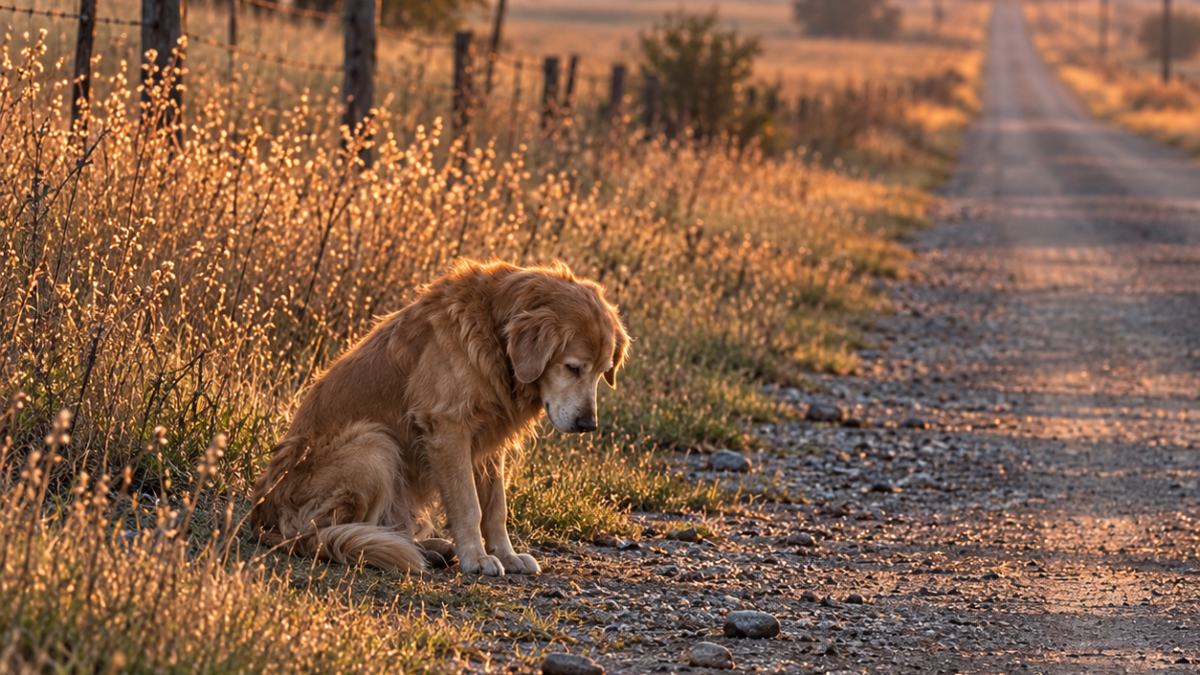
PART 2
For several seconds, neither of us moved.
He stood beside me, close enough that the fur along his chest almost brushed my shoulder.
I kept my hands resting on my knees.
Every instinct in me wanted to reach out.
I wanted to put my arm around him.
I wanted to tell him it was over.
That he was safe.
That whoever had driven away did not get to decide what happened next.
But I didn’t know him.
And more importantly, he didn’t know me.
So I waited.
His breathing was slow.
Heavy in the way older dogs sometimes breathe after standing too long.
He looked down the road one more time.
Nothing.
No headlights.
No engine.
No car turning back.
Then he lowered his head.
For one terrible second, I thought he was going to step away again.
Instead, he leaned forward.
And rested his head against my shoulder.
My eyes closed.
I didn’t plan it.
I simply sat there while the weight of his head settled against me.
Warm.
Real.
Trusting.
After several hours of watching him keep the entire world at a distance, that little bit of weight felt enormous.
“Okay,” I whispered.
His ear moved.
“I’m here.”
We stayed like that for maybe a minute.
Maybe less.
It felt longer.
Then he lifted his head and looked directly at me.
The questions I had seen in his eyes earlier seemed different now.
Not gone.
Just quieter.
I stood slowly.
He didn’t back away.
That alone felt like progress.
I picked up the blanket.
Then I started walking toward my car.
I did not call him.
I did not pat my leg.
I did not say, “Come on.”
I simply walked.
After a few steps, I heard paws behind me.
I turned slightly.
He was following.
Not close.
But following.
I walked another few yards.
He came too.
At the car, I opened the rear door.
The old dog stopped.
He stared inside.
Then at me.
I stepped back.
“It’s up to you.”
He looked into the car again.
For a second I wondered whether getting into another vehicle frightened him.
Maybe it should have.
The last car ride he had taken ended with a door opening and his entire life driving away.
I couldn’t blame him if he never trusted a car again.
He sniffed the threshold.
Paused.
Then climbed inside by himself.
Not gracefully.
He was old.
His rear legs needed a little effort.
But I never had to touch him.
He got onto the back seat.
Turned twice.
Then lay down.
I closed the door gently.
When I got behind the wheel, I looked into the rearview mirror.
His head rested on his front paws.
His eyes were closed.
Just like that.
Hours standing beside a road, waiting for someone who never returned.
Then a stranger’s back seat.
And sleep.
I drove slowly.
The radio stayed off.
About ten minutes into the drive, I looked in the mirror again.
Still sleeping.
I remember thinking, What am I doing?
I had never owned a dog.
Not as a child.
Not as an adult.
I had friends with dogs.
Customers brought dogs to my workshop occasionally.
I liked them.
But I had always considered dog ownership too much responsibility.
Walking.
Feeding.
Veterinary bills.
Travel arrangements.
Hair everywhere.
Noise.
Schedules.
I liked my life simple.
I lived alone.
I owned a small woodworking business.
My workshop was only a short drive from home.
My evenings were quiet.
Nobody depended on me once the shop closed.
That had always seemed like freedom.
Now there was an old golden retriever asleep behind me, and I had absolutely no idea what I was going to do.
Take him to a shelter?
Call animal control?
Find a rescue?
Search for the owner?
Part of me immediately rejected the last thought.
I had seen enough.
I had watched that car leave.
Maybe there was an explanation.
Maybe there was some complicated story I didn’t understand.
But I knew what I had seen.
A dog standing beside an empty road.
A car driving away.
No hesitation.
No turning back.
By the time we reached my house, the sky was nearly dark.
I parked.
The dog woke when I opened my door.
Then he sat up.
I opened the rear door.
He looked at me.
“Welcome to the least prepared dog owner’s house in the state.”
He stared.
“Temporary dog owner.”
Nothing.
“Very temporary.”
He slowly climbed down.
I watched his movement.
Stiff hips.
Slower back legs.
Definitely older.
Maybe eight.
Maybe ten.
Maybe more.
I had no idea.
He sniffed the gravel.
Then the grass.
Then stood beside my car.
“Come on.”
This time, I did call him.
He followed me toward the house.
At the front step, he hesitated.
I opened the door and went inside first.
He remained outside.
I turned.
“You don’t have to.”
He looked behind him.
There was nothing there but my yard, the road in the distance and darkness settling across the fields.
Then he stepped inside.
One paw.
Then the other.
He sniffed everything.
The entryway.
The wall.
My boots.
The furniture.
I closed the door but didn’t lock it immediately.
For some reason, even the sound of the lock felt too permanent.
I found an old mixing bowl and filled it with water.
I had no dog food.
Of course I didn’t.
So I stood in my kitchen staring into cupboards like a man who had never eaten food before.
“What can dogs eat?”
The golden retriever watched me.
“I assume you’re not going to help.”
I called a friend who owned two dogs.
She answered on the third ring.
“James?”
“I need a strange question answered.”
“That sounds promising.”
“What can I feed a dog if I don’t have dog food?”
Silence.
Then, “Why do you have a dog?”
“I don’t.”
Another silence.
“James.”
“I found one.”
“You found a dog?”
“Long story.”
“What kind?”
“Golden retriever. Older.”
“Is he hurt?”
“I don’t think so. He’s tired.”
“Take him to a vet tomorrow. Tonight, if there’s an emergency clinic and you’re worried.”
“I will.”
“For food, do you have plain cooked chicken?”
“Yes.”
“Rice?”
“Yes.”
“Keep it plain. Small amount. Nothing seasoned. And water.”
I looked at the dog.
He had lowered himself onto the kitchen floor.
“Okay.”
“And James?”
“Yeah?”
“Do not give him onions, garlic, chocolate, grapes—”
“I’m making chicken and rice, not a tasting menu.”
She laughed.
“Send me a picture.”
“No.”
“James.”
“I’ll talk to you tomorrow.”
I hung up.
The dog was watching.
“I think she likes you more than she likes me already.”
I cooked a small amount.
He ate slowly.
Not desperately.
That reassured me.
Afterward, he drank.
Then I showed him around like he had signed a lease.
“Kitchen.”
He followed.
“Living room.”
He sniffed the couch.
“No idea what the rules are yet.”
He looked at me.
“Bedroom.”
He stayed in the doorway.
I found another blanket and put it on the floor beside my bed.
“You can sleep there.”
He inspected it.
Then lay down.
That should have been the end of the night.
It wasn’t.
I got into bed around eleven.
He lay on the floor.
I turned off the light.
Ten minutes later, I heard him stand.
Paws against wood.
Slow steps.
He walked around the room.
Then lay down again.
Five minutes.
Up.
Walk.
Down.
I turned on the bedside lamp.
He froze.
“You okay?”
He looked at me.
I held one hand down over the edge of the bed.
Not reaching for him.
Just there.
He came closer.
Placed his head beneath my hand.
I rested my palm on him.
He stayed.
Eventually, he lay down with his chin still touching my fingers.
I turned the light off.
Sometime later, I woke because he was walking again.
Same pattern.
Check the room.
Check the door.
Return.
I began to understand.
He didn’t trust sleep.
Every time he closed his eyes, maybe he expected to wake somewhere else.
Or wake alone.
I don’t know.
We like to pretend we understand exactly what dogs think.
We don’t.
But fear has a language.
That night, his body spoke it clearly.
So every time he got up, I let my hand drop.
And every time, eventually, he came back.
At dawn, I finally slept properly.
When I opened my eyes later, he was sitting beside the bed.
Watching me.
For one second, I forgot he existed.
Then I nearly jumped.
“You.”
His tail moved.
Barely.
One small sweep.
I stared.
“That’s new.”
Another small wag.
I sat up.
“Good morning.”
I paused.
I still had no name for him.
I had checked for a collar the night before.
Nothing.
No tags.
No identifying marks.
Just golden fur graying around the muzzle and eyes that looked older than the rest of him.
I tried a few names.
“Buddy?”
Nothing.
“Max?”
Nothing.
“Charlie?”
He looked away.
“Ogi?”
His head turned.
I had no idea why I said it.
The name simply arrived.
Ogi.
He looked at me.
I smiled.
“Well, that settles it.”
His tail moved again.
“Ogi.”
Another wag.
I laughed.
“All right.”
That morning, before anything else, I took him to a veterinarian.
He hated the parking lot.
The moment I opened the car door, he stiffened.
I realized why.
Car.
Door.
Unknown place.
Maybe in his mind, this looked exactly like the road all over again.
I stood beside him.
“It’s okay.”
He didn’t move.
“I’m coming inside too.”
Of course he didn’t understand every word.
But tone matters.
Presence matters.
I waited.
Eventually, Ogi climbed down.
Inside the clinic, he stayed pressed close to my leg.
The receptionist looked over the desk.
“Oh, he’s beautiful.”
“He was abandoned yesterday.”
Her face changed.
“Are you sure?”
“I watched it happen.”
She looked at Ogi.
“Poor boy.”
I disliked that phrase immediately.
Not because she meant anything wrong.
But Ogi did not look like “poor boy” to me anymore.
He looked tired.
Confused.
Old.
But he had spent the night inside a house.
He had eaten.
He had slept, eventually.
He had a name.
That was already something.
The veterinarian scanned him for a microchip.
We waited.
Nothing.
No chip.
She examined his teeth.
Joints.
Heart.
Ears.
Eyes.
Skin.
“Senior dog,” she said.
“How senior?”
“Hard to say exactly. Maybe nine or ten. Possibly older.”
I looked at Ogi.
He leaned against my leg.
“Anything serious?”
“Arthritis, likely. He’s carrying some age-related stiffness. We can do bloodwork to check overall health.”
“Do it.”
She looked at me.
“Are you planning to keep him?”
“No.”
Ogi looked up.
I cleared my throat.
“I mean, I don’t know.”
The veterinarian smiled.
“I see.”
“What?”
“Nothing.”
“Everybody keeps doing that.”
“Doing what?”
“Looking at me like they know something.”
She laughed.
“We’ll do the bloodwork.”
Ogi was generally healthy for his age.
Not perfect.
Older joints.
Some dental work needed.
A few things to monitor.
But nothing explained abandonment.
No terminal diagnosis.
No catastrophic illness.
No hidden emergency that could somehow transform what I had witnessed into an act of mercy.
He was simply old.
That made me angrier.
I contacted the local shelter.
Reported finding him.
Gave the road location.
Described the vehicle as best I could.
I had not seen the license plate clearly.
I hated myself for that.
I had been too focused on the dog.
The shelter told me they could list him as found and check for reports.
I agreed.
Then they asked whether I could foster him temporarily.
I looked down.
Ogi sat beside me.
His body touching my leg.
“For how long?”
“It depends.”
That was not the answer I wanted.
“What if nobody claims him?”
“We can discuss options.”
I looked at Ogi again.
“I can keep him for now.”
The first week was difficult.
Not because Ogi misbehaved.
In some ways, that would have been easier.
He was quiet.
Too quiet.
He followed me from room to room.
If I went to the bathroom, he waited outside the door.
If I walked to the kitchen, he came.
If I stepped onto the porch, he stood at the threshold.
The real problem began when I had to leave for work.
My workshop was nearby, but I still needed to go.
On Monday morning, I put on my jacket.
Ogi immediately became alert.
Keys.
Shoes.
Jacket.
His eyes followed every movement.
I walked to the door.
He came beside me.
“I have to work.”
He stared.
“I’ll be back.”
Nothing.
I opened the door.
He tried to follow.
I gently blocked him.
“Not today.”
His whole body changed.
Tail stopped.
Head lowered slightly.
I hated it.
“I’m coming back.”
He didn’t believe me.
Of course he didn’t.
The last person who opened a car door and left had not come back.
Why should my words mean anything?
I left anyway.
It was one of the hardest drives I had ever taken, and the workshop was less than fifteen minutes away.
At ten in the morning, I went home.
I told myself I had forgotten something.
I hadn’t.
When I opened the door, Ogi was sitting exactly where I had left him.
At the entrance.
He stood.
His tail started.
Then his whole body moved toward me.
I crouched.
“I told you.”
He pressed his head into my chest.
“I came back.”
That afternoon, I returned to work.
Again, he waited.
Again, I came back.
Tuesday.
Same.
Wednesday.
Same.
Every morning before leaving, I began giving him something.
One day, an old T-shirt that smelled like sawdust and me.
Another day, a blanket.
Then a toy I bought from a pet store after standing in the dog aisle like an idiot for twenty minutes.
A sales clerk finally asked, “What kind of dog?”
“Golden retriever.”
“Age?”
“Old.”
“Chewer?”
“I don’t know.”
“Fetch?”
“I don’t know.”
She stared.
“How long have you had him?”
“Four days.”
Understanding crossed her face.
“Rescue?”
“Something like that.”
She handed me a soft toy.
“Try this.”
I brought it home.
Ogi sniffed it.
Then ignored it.
Excellent purchase.
Still, I left it beside him the next morning.
“This stays until I come back.”
I pointed to the toy.
He looked at me.
“I come back.”
Then I left.
And I came back.
Every day.
Every single time.
By Friday, when I picked up my keys, Ogi still followed me to the door.
But he was not trembling.
That difference was small.
I noticed.
The second week, I bought a leash.
Our first walk was a disaster.
Ogi apparently knew what a leash was.
He simply disagreed with my understanding of its purpose.
He pulled toward one smell.
Stopped at another.
Crossed in front of me.
Wrapped the leash around a mailbox.
Then stood staring at a bird for what felt like ten minutes.
“Ogi.”
Bird.
“Ogi.”
Bird.
“We’re walking.”
He sat down.
I stared.
He stared.
“Fine.”
We watched the bird.
I had always considered walks a method of traveling from one point to another.
Ogi considered them research.
Every blade of grass required investigation.
Every tree contained important information.
Every fence post apparently carried breaking news.
At first, I tried to move him.
Then I remembered the roadside.
I had earned his trust by not rushing him.
Why was I suddenly in a hurry?
So I stopped.
If he wanted to smell one patch of grass for three minutes, we stayed.
If he wanted to watch birds, we watched.
If he got tired, we went home.
The world seemed new to him.
Or maybe he was new to experiencing it without fear.
I will never know.
But those walks changed me.
I began noticing things I had driven past for years.
Wildflowers.
Tracks in mud.
Cloud shadows moving over fields.
The sound of wind through dry grass.
Ogi noticed everything.
I started noticing because he did.
By the third week, the toy finally mattered.
I was outside behind the house after work, repairing a small wooden bench.
Ogi lay nearby.
I took a break and threw a stick absentmindedly.
Not for him.
Just tossed it.
Ogi’s head came up.
He stood.
Walked toward the stick.
Picked it up.
Then came back.
I stared.
He dropped it near my boots.
“No.”
Tail wag.
“You’re kidding.”
I picked it up.
Threw it.
Ogi ran.
Not fast.
He was old.
But he ran.
He reached the stick.
Picked it up.
Returned.
Tail going harder.
Something inside me cracked open.
I laughed.
Out loud.
The kind of laugh you do when nobody else is around.
“Again?”
Ogi bounced slightly on his front paws.
That was enough.
I threw it again.
And again.
And again.
We played until the light began disappearing.
When we finally went inside, Ogi drank water, walked into the living room, lay on his side and immediately fell asleep.
I sat on the floor beside him.
His paws twitched while he slept.
Dreaming.
I looked at the old dog who had stood beside a road waiting for a car.
Then I looked at the stick lying near the door.
That was the first night I realized I was in trouble.
I loved him.
I didn’t say it.
Not yet.
But I knew.
By the fourth week, bringing Ogi to work seemed easier than leaving him home.
My business was small.
Custom furniture.
Tables.
Cabinets.
Chairs.
Repairs.
Nothing glamorous.
My workshop smelled like wood dust, coffee and varnish.
Ogi refused to enter the first day.
I opened the workshop door.
He stopped.
Inside, a saw sat silent.
Tools hung along the wall.
A workbench occupied the center.
Ogi looked inside.
Then at me.
“It’s okay.”
He stepped backward.
I remembered the rule.
Don’t force him.
So I left the door open.
I worked near the entrance where he could see me.
Ogi stayed outside.
For hours.
Watching.
When I moved deeper into the shop, he stood and repositioned himself so I remained visible.
Day two.
Same.
Day three, I was sanding a tabletop when I looked down and saw golden paws inside the doorway.
I stopped.
Ogi froze.
I looked away deliberately.
Kept sanding.
A few minutes later, he came farther in.
By the end of the day, his entire body was inside.
On day five, he lay near my feet while I worked.
On day seven, he had chosen a corner as his own.
I placed a bed there.
Ogi inspected it.
Then lay directly beside it on the floor.
“Of course.”
The next morning, he used the bed.
Customers noticed him.
“New dog?”
“Temporary.”
They smiled.
I had started to hate that smile.
One customer knelt.
Ogi approached carefully.
“Friendly.”
“He’s getting there.”
“Name?”
“Ogi.”
“Good name.”
I looked at him.
“Apparently.”
Soon people started coming to the shop partly to see him.
A woman picking up a repaired chair brought dog treats.
A man ordering a table scratched Ogi behind the ears for ten minutes.
A delivery driver began asking, “Where’s the supervisor?”
Ogi’s corner became part of the workshop.
His water bowl sat near the wall.
A blanket.
Two toys.
Then three.
Temporary.
Of course.
At the shelter, no legitimate owner came forward.
No missing-dog report matched him.
Nobody called with proof.
Part of me was relieved.
Another part wanted the person who abandoned him to appear.
Not because I wanted to return Ogi.
I wanted answers.
I wanted to ask:
Why?
He was old.
Was that it?
Did he move too slowly?
Did vet bills become inconvenient?
Did somebody get tired of him?
Had he become a burden after years of loyalty?
I replayed the scene constantly.
The door.
The driver.
The car leaving.
No hesitation.
I wanted the satisfaction of confronting that person.
I imagined several versions.
In one, I remained calm.
In another, I said things I would regret.
But no one appeared.
Then, during the fifth week, I decided to drive Ogi back to the road.
The idea came suddenly.
Maybe it was stupid.
Maybe cruel.
But some part of me needed to know what that place meant to him now.
I put him in the car.
By then, he climbed in without hesitation.
That change alone nearly stopped me.
When we got close, Ogi sat up.
I watched him in the mirror.
His ears moved.
His nose lifted.
Did he recognize it?
I pulled onto the shoulder near the place where I had first seen him.
The fields looked almost identical.
Different light.
Same road.
I opened the door.
Ogi climbed out.
Then stopped.
He looked down the road.
The same direction.
My chest tightened.
For several seconds, I was back there.
Hours of waiting.
The orange sky.
The old dog refusing to leave.
“Ogi.”
He kept looking.
I said nothing else.
Then he turned.
Walked toward me.
And sat.
Right beside my legs.
He leaned his body against me.
Then placed his head across my knee.
I put one hand on him.
“You’re done waiting.”
His tail moved.
He did not look down the road again.
We stayed there a few minutes.
Then I stood.
Ogi stood.
We walked back to the car together.
He climbed in.
I drove home.
That day settled something in me.
I no longer cared whether the person who abandoned him returned.
That may sound strange.
I still wanted accountability.
I still believed what had happened was cruel.
But Ogi did not need that person to finish the story.
He already had.
He chose the car with me.
He chose my house.
My workshop.
My ridiculous walks where we spent fifteen minutes investigating one tree.
I started thinking differently about revenge.
At first, I wanted someone to regret abandoning him.
Later, I realized the strongest revenge was simpler.
They had decided Ogi was no longer worth keeping.
I would spend whatever time he had left proving them wrong.
Not to them.
To him.
The sixth week brought a reality I had been avoiding.
Ogi was old.
Really old.
I noticed it most after our walks.
He tired quickly.
Sometimes his rear legs stiffened when he stood after sleeping.
He preferred shorter games of fetch.
He slept more.
At the vet, we discussed arthritis management.
Supplements.
Medication if necessary.
Healthy weight.
Gentle exercise.
Comfort.
I listened carefully.
Then asked the question I didn’t want to ask.
“How long do dogs like him usually live?”
The veterinarian paused.
“That depends on many things.”
“I know.”
“Golden retrievers average around ten to twelve years, sometimes more. But we don’t know Ogi’s exact age.”
“So maybe I got him at the end.”
“Maybe.”
I looked at him.
He was lying beneath my chair.
“That feels unfair.”
The veterinarian understood.
“You wanted more time.”
“I didn’t even want a dog six weeks ago.”
She smiled.
“That’s usually how it happens.”
I put my hand on Ogi’s head.
I had entered his life in the last chapter.
Maybe not last page.
But last chapter.
I couldn’t rewrite the chapters before me.
I could not make the car turn around.
I could not know how he had been treated during his younger years.
I could not make him six again.
What I could do was make the remaining pages good.
That changed how I lived.
I left work earlier.
Walked slower.
Said yes more.
If Ogi wanted to stop and smell a ditch, we stopped.
If he wanted to sit outside while the sun went down, I sat too.
If he fell asleep at the workshop, I worked around him.
I stopped treating time like something I owned.
Ogi’s age made it visible.
Every ordinary day was limited.
I think all days are.
We just forget.
During the seventh week, Ogi decided the floor beside my bed was no longer acceptable.
He stood beside the mattress one night.
Stared.
“What?”
He looked at the bed.
Then me.
“No.”
Tail wag.
“You have a bed.”
He continued staring.
“A very expensive bed.”
I had bought it two days earlier.
He looked at the mattress again.
I sighed.
“You are not getting up here.”
Ten minutes later, Ogi was on the bed.
I helped him because of his hips.
He lay near my feet.
I turned off the light.
Five minutes later, he moved closer.
Then closer.
Eventually, his head reached the pillow beside mine.
I opened my eyes.
“You’ve got to be kidding.”
Ogi sighed.
I put my hand on his head.
He closed his eyes.
Something about that moment felt different from all the others.
The first night, he slept near my hand because he was afraid I would disappear.
Now he slept beside me because he expected me to remain.
Fear had become habit.
Habit had become trust.
Trust had become something I could no longer pretend was temporary.
I whispered it then.
Quietly.
“I love you, old man.”
Ogi didn’t move.
Maybe asleep.
Maybe pretending.
I didn’t care.
The next morning, I called the shelter.
“I want to finalize adoption.”
The woman on the phone paused.
“Of Ogi?”
“Yes.”
“I thought you were fostering temporarily.”
“So did I.”
She laughed.
“I’ll get the paperwork ready.”
That afternoon, I signed my name.
It felt absurd that several sheets of paper could formalize something Ogi and I had already decided.
He was mine.
More accurately, we were each other’s.
The abandonment case never became the dramatic confrontation I once imagined.
I had not captured a clear plate number.
There was no microchip.
No one came forward.
There was not enough reliable information for me to point at a specific person and say, publicly, “You did this.”
That frustrated me.
But truth matters.
I refused to invent justice just because reality had denied me a satisfying villain scene.
I knew what I had seen.
I reported what I could.
Then I turned my attention to the dog who was still here.
That became important.
Because anger can become another form of abandonment.
You can be physically present while mentally living with the person who caused the pain.
I didn’t want Ogi’s remaining years filled with me obsessing over someone who drove away.
I wanted them filled with him.
By the eighth week, the workshop barely functioned without Ogi.
At least according to customers.
“Where is he?”
“Vet appointment.”
A customer frowned.
“Is he okay?”
“He’s fine.”
“Good.”
Another day, someone entered carrying a dog biscuit.
“Ogi!”
He got up from his bed.
Slowly.
Tail going.
I watched him greet people.
This dog who had once stepped backward when a stranger approached was now walking toward the workshop door when it opened.
He had learned something.
Not every arrival meant departure.
Sometimes doors opened because people were coming to him.
I decided to write down the story.
Not for publication at first.
Just for myself.
I sat at my kitchen table one night.
Ogi slept nearby.
I wrote about the road.
The car.
The hours.
The water.
The blanket.
The first step.
His head on my shoulder.
I stopped there.
My eyes filled.
Ogi got up.
Walked to me.
Placed his head on my knee.
I laughed.
“You’re doing this on purpose.”
His tail moved.
I rubbed his ears.
“You know, this whole thing is your fault.”
He leaned harder.
I kept writing.
The story did not feel like a rescue story anymore.
Not really.
I had thought I stopped to save a dog.
But Ogi had altered the structure of my life.
Before him, I hurried.
Constantly.
I worked late.
Ate standing up.
Drove fast.
Measured days in productivity.
Furniture completed.
Orders delivered.
Invoices paid.
Ogi measured time differently.
Morning smell outside.
Breakfast.
Nap.
Walk.
Workshop.
Visitor.
Sun.
Another walk.
Dinner.
Sleep near someone trusted.
His life was not less meaningful because it was simple.
If anything, mine had been less meaningful because I had complicated it beyond recognition.
One evening, I closed the shop early.
A customer joked, “Big plans?”
“Yes.”
“What?”
I pointed at Ogi.
“Walk.”
The customer smiled.
“That dog changed you.”
“I know.”
“Better?”
I looked at Ogi.
“Yes.”
The months that followed were not dramatic.
That is precisely why I treasure them.
We developed routines.
Ogi woke before me.
Every morning.
He sat beside the bed.
Watched.
Sometimes I opened one eye.
“Five more minutes.”
Tail.
“Ogi.”
Tail.
“Fine.”
We went outside.
He sniffed the same places he had sniffed the day before as if national security depended on updates.
Then breakfast.
Then workshop.
He had his own bed there now.
A proper one.
Not the rejected one from my bedroom.
Customers brought treats.
I had to start limiting them.
“You people are going to make him fat.”
Ogi disagreed strongly with this policy.
One customer gave me a wooden sign as a joke.
OGI — QUALITY CONTROL.
I hung it over his bed.
I still have it.
Some afternoons, he slept while I worked.
The saw would run.
Sander.
Hammer.
He learned which noises mattered and which did not.
When I stopped for coffee, he often woke.
Not because he cared about coffee.
Because I sometimes had a snack.
He was old, not stupid.
We returned to the road only once more.
Almost a year after I found him.
I had no plan to stop.
We were driving past.
Ogi sat in the passenger-side rear seat, head near the window.
As we approached the spot, I slowed.
He didn’t react.
I pulled over anyway.
We got out.
The road looked smaller than I remembered.
Isn’t that strange?
Places where enormous things happen often shrink later.
Ogi sniffed the grass.
Walked around.
No staring into the distance.
No waiting.
He marked a tree.
I laughed.
“Well, that’s closure.”
He walked back toward the car.
Then looked at me as if I were the one taking too long.
I stood there.
For a moment, I imagined the old car appearing.
Stopping.
Someone getting out.
Calling him by another name.
What would I do?
I knew the answer.
I would ask questions.
Proof.
Ownership records.
Why?
I would protect Ogi legally.
But emotionally?
I no longer feared he would choose them.
Not because dogs keep moral score the way humans do.
But because Ogi had built another life.
His loyalty was no longer waiting on that road.
It lived in routines.
In my workshop.
My house.
The bed he had stolen.
The hand he slept against.
We drove away.
This time, Ogi never looked back.
A year became two.
His muzzle grew whiter.
My hair did too.
I blamed him.
His arthritis worsened gradually.
We adjusted.
Shorter walks.
More rest.
Medication.
A ramp for the car.
Then a small ramp for the porch steps.
I built both myself.
Of course I did.
The first ramp was ugly.
Ogi stood at the bottom.
Looked at it.
Then at me.
“I make furniture for a living.”
He continued staring.
“This is structurally sound.”
Nothing.
“You’re insulting me.”
He placed one paw on it.
Then another.
Walked up.
At the top, he turned.
Tail wag.
“Exactly.”
The second ramp looked much better.
I had standards.
By then, Ogi had become known around town.
“The road dog.”
I disliked the nickname slightly.
Not because it was wrong.
Because he was more than the road.
People recognized him at the hardware store.
At the veterinary clinic.
Outside the café where dogs were allowed on the patio.
“Hey, Ogi!”
Tail.
He had more friends than I did.
Once, a man I barely knew approached us.
“I heard what happened to him.”
I stiffened.
People sometimes told the story incorrectly.
They added details.
Made the abandoning owner violent.
Claimed there had been abuse I had never witnessed.
I always corrected it.
“I only know what I saw.”
The man nodded.
“I heard you waited hours.”
“Yes.”
“Why?”
The question surprised me.
“I don’t know.”
“You could have called somebody.”
“I did later.”
“But why sit there?”
I looked at Ogi.
He was sniffing a flower planter.
“Because he wasn’t ready to leave.”
The man thought about that.
Then said, “Most people would have tried to grab him.”
“I almost did.”
“What stopped you?”
“He stepped back.”
That was the answer.
Ogi told me no.
For once in my life, I listened.
That little decision created everything after.
People talk about rescue as action.
Sometimes rescue is restraint.
Not forcing.
Not flooding fear with good intentions.
Giving another living thing room to decide.
Ogi taught me that on day one.
He kept teaching it as he aged.
When he no longer wanted long walks, we shortened them.
When stairs became harder, we built ramps.
When the workshop noise tired him, I created a quieter office corner.
Love was not dragging him toward the life I wanted him to have.
It was meeting him where he actually was.
That mattered more as time passed.
One winter morning, Ogi did not get up when I opened my eyes.
He was beside me.
Breathing normally.
But still.
“Ogi.”
His ear moved.
I touched him.
“Morning.”
He lifted his head slowly.
Then stopped.
I knew immediately.
Something was wrong.
He eventually stood, but his rear legs were weaker.
We went to the vet.
Arthritis flare.
Nothing catastrophic.
Medication adjustment.
Rest.
But the visit shook me.
For the first time since the road, I remembered that I could lose him.
I had always known.
Knowing and feeling are different.
That night, Ogi slept beside me.
My hand rested on his chest.
I felt each breath.
It reminded me of his first night.
Back then, I had been reassuring him I wouldn’t disappear.
Now I was afraid he would.
That fear could have ruined the time we had left.
I almost let it.
I started watching him too closely.
Every slower step.
Every longer nap.
Every skipped bite.
Every sigh.
One day, the veterinarian noticed.
“You’re anxious.”
“No.”
She gave me a look.
“James.”
“He’s old.”
“Yes.”
“How old?”
“Still impossible to know exactly.”
“That’s not helpful.”
She smiled.
“He’s doing well for a senior dog.”
“What does doing well mean?”
“It means today is good.”
I looked at her.
“Today?”
“Yes.”
“That’s all?”
“That’s all any dog has.”
I hated that answer.
Then I learned to love it.
Today was good.
So we went home and used today.
Ogi sniffed the field.
Slept at the shop.
Ate dinner.
Climbed onto my bed with help.
Good day.
Another good day.
Then another.
Not every day was perfect.
But enough were good.
Eventually, I stopped counting possible endings.
That gave us more beginnings.
Spring.
Warm weather.
Ogi lying outside the workshop door.
Summer.
Short evening walks.
Autumn.
Leaves catching in his fur.
Winter.
A coat he hated but tolerated.
Life.
People still occasionally asked whether I ever found the person who left him.
“No.”
“Don’t you wish you had?”
At first, my answer was always yes.
Later, it changed.
“I wish they had never done it.”
That was different.
I did not need confrontation anymore.
I did not need to see regret.
The person who abandoned Ogi had already lost something.
Not as punishment.
As consequence.
They missed his mornings.
His ridiculous fascination with birds.
His habit of sleeping with his head halfway off a bed.
The way he leaned against people he trusted.
His soft snore.
His excitement when someone entered the workshop.
His patience.
His stubbornness.
His old age.
His love.
They left before the best part.
I got it.
That was enough.
Sometimes people misunderstand revenge.
They think satisfaction comes from watching someone who hurt you suffer.
Maybe sometimes it does.
But with Ogi, my satisfaction came from watching the damage lose importance.
The road became smaller.
The abandonment became older.
Ogi’s life became larger.
That felt better than anger.
Years passed.
Not as many as I wanted.
More than I expected.
Ogi’s body slowed.
His spirit did not.
Even when he stopped playing fetch, he still watched the stick fly.
As if remembering.
Eventually, I stopped throwing it.
I would sit beside him in the yard.
Hold the old stick.
“Remember this?”
He sniffed it.
Then put his head on my leg.
“Yeah.”
We didn’t need the game anymore.
The memory was enough.
One evening, near sunset, I took him outside.
We sat behind the house.
Fields stretched in every direction.
Ogi lay beside me.
His fur had gone almost white around his face.
I scratched his chest.
“You know something?”
His eyes stayed closed.
“I was supposed to be somewhere that day.”
Ear movement.
“I still can’t remember where.”
I laughed.
“Probably important.”
Tail tap.
“Not as important as you.”
He opened his eyes.
Looked at me.
I thought about that man from years before.
Forty-seven.
Driving fast.
Music on.
Thinking a dog was too much responsibility.
He seemed like somebody I used to know.
Ogi had made my life more complicated.
Vet bills.
Hair.
Schedules.
Medication.
Ramps.
Worry.
Goodbyes always waiting somewhere ahead.
He had also made it bigger.
Those are not contradictions.
Love is often both.
More responsibility.
More life.
On one of Ogi’s last visits to the workshop, a young couple came to pick up a dining table.
Their little boy saw Ogi lying in his bed.
“Can I pet him?”
I said, “Ask him.”
The boy looked confused.
“How?”
“Sit nearby. Let him decide.”
The boy sat.
Ogi lifted his head.
Sniffed.
Slowly stood.
Walked toward the child.
The boy stayed still.
Ogi put his head against his shoulder.
I had to look away.
Same move.
Years later.
Ogi was still choosing.
The boy smiled.
“He likes me.”
“Yes.”
I thought, You have no idea what that means.
That evening, Ogi was exhausted.
He slept before dinner.
I let him.
No panic.
No forcing routine.
I sat near him and watched the light disappear from the windows.
My workshop felt different with Ogi sleeping in it.
Always had.
He turned spaces into home simply by trusting them.
I hope I did the same for him.
There came a point when his veterinary care became more frequent.
Nothing dramatic at first.
Age.
Joints.
Kidney values to watch.
Heart checks.
The ordinary slow accumulation of senior-dog medicine.
I followed every instruction.
Some things improved.
Some didn’t.
Time only moves one direction.
I had once wanted to find his previous owner to demand why they abandoned an old dog.
Now I understood another layer of cruelty.
Old dogs require more.
More patience.
More medicine.
More help standing.
More careful walks.
More decisions.
Some people see that and think burden.
I saw debt.
Not debt Ogi owed me.
Debt I owed him.
He had given me years.
Presence.
Routine.
Company.
Trust.
The last chapter deserved the same loyalty as the first.
You do not stop loving someone because care becomes inconvenient.
That is exactly when love stops being a feeling and becomes a practice.
So we practiced.
Medication.
Gentle exercise.
Car ramp.
Non-slip rugs.
Water close by.
Bed downstairs.
Then another bed upstairs because he still insisted on sleeping near me.
Warmth.
Patience.
Time.
Always time.
One morning, Ogi stood at the workshop entrance and would not come inside.
That was unusual.
I waited.
He looked toward the fields.
I followed his gaze.
The sun was bright.
Air cool.
I closed the workshop.
An employee asked, “Everything okay?”
“Yes.”
“You’re closing?”
“For an hour.”
I took Ogi walking.
Not far.
We reached a patch of open grass.
He sniffed.
Walked a little.
Then lay down.
I sat beside him.
Work could wait.
That had become the entire lesson.
Work could wait.
Calls could wait.
Furniture could wait.
The dog could not.
We stayed almost an hour.
Just like the road.
Only different.
On the road, I had been waiting for him to trust me.
Now I was simply sharing time he had already given.
At some point, Ogi placed his head on my thigh.
I put a hand over his neck.
“Still here.”
His tail moved.
Still here.
That became our phrase.
Years before, I had promised not to leave.
I kept it.
The ending, when it eventually came, was not dramatic.
And I am grateful for that.
Ogi grew weaker slowly enough that we could prepare, but not so slowly that suffering became the center of his life.
His veterinarian helped me understand quality of life.
Pain.
Appetite.
Mobility.
Interest.
Rest.
Dignity.
I listened.
There was no sudden revenge plot.
No former owner appearing at the door.
No courtroom.
No miracle turning him young.
Just the real ending every good rescue hopes to earn.
A loved dog becoming old in a safe place.
One night, Ogi struggled to get comfortable.
I lay beside him on the floor.
He could no longer climb onto the bed safely, and I refused to make him sleep alone after years beside me.
So I brought pillows down.
Blanket.
My hand near his head.
He rested against it.
Exactly like the first night.
Full circle.
I whispered, “Remember?”
His eyes were half closed.
“First night, you didn’t sleep.”
His ear moved.
“I didn’t either.”
His breathing stayed steady.
“You kept checking if I was there.”
I swallowed.
“I’m still here.”
Ogi’s nose pressed lightly against my palm.
That was enough.
Morning came.
He woke.
Ate a little.
Went outside.
Stood in sunlight.
I took the day off.
No guilt.
No explanation.
We sat together.
I told him things dogs probably do not care about.
How badly designed my first ramp had been.
How many customers had come to the workshop just to see him.
How I still owned the first useless toy he ignored.
How ridiculous it was that a dog I never planned to keep had become the center of my house.
“How did you do that?”
Ogi closed his eyes.
No answer.
Typical.
He stayed with me longer than anyone had a right to expect after that road.
And when the final decision eventually had to be made, I made it with the same promise that began our life together.
I would not force him to stay for me.
I would stay for him.
Those are different things.
At the clinic, I sat on the floor.
Ogi lay against me.
His breathing slow.
My hand on his head.
The veterinarian gave us time.
Lots of it.
I thought I would fall apart.
I did, later.
In that room, I felt strangely calm.
Because Ogi was calm.
He had spent his first hours with me staring at a road waiting for someone to return.
His final hours contained no waiting.
Everyone he needed was there.
I whispered into his fur.
“You can rest.”
My voice broke.
“I’m not going anywhere.”
That was true.
I stayed.
Through everything.
Until there was no more breath beneath my hand.
No more tail.
No more old dog trying to lift his head because I said his name.
Just silence.
I kept my hand there.
The veterinarian did not rush me.
Eventually, I said, “He hated being rushed.”
She smiled through tears.
“I know.”
I laughed once.
Then cried.
Afterward, I drove home alone.
That was one of the hardest drives of my life.
The rear seat was empty.
No golden head in the mirror.
No quiet breathing.
I passed the road where I found him.
I almost stopped.
I didn’t.
Ogi was not there.
He had not been there for years.
His life had moved far beyond that place.
So I kept driving.
When I reached home, his bowls were there.
Bed.
Blanket.
Leash.
The stupid toy.
Everything waiting for a dog who would not return.
I sat on the floor.
For the first time in years, the house felt like the house I had before Ogi.
Quiet.
Simple.
Empty.
I hated it.
For several weeks, I avoided the workshop corner.
Customers asked.
Some knew.
Some didn’t.
“Where’s Ogi?”
The first time, I could not answer.
Eventually, I learned.
“He passed.”
People were genuinely sad.
A delivery driver took off his hat.
One customer cried.
I realized Ogi had belonged to more people than me.
Not in ownership.
In memory.
He had entered their lives too.
Months later, I finally returned to the road alone.
Same place.
Same fields.
I parked.
Got out.
Sat in the grass.
For a long time.
No dog.
No abandoned car.
Just wind.
I remembered the hours.
Water bottle.
Blanket.
His first step.
Second.
Third.
Head on my shoulder.
I had once thought I saved Ogi from that road.
Sitting there alone, I finally understood the truth.
I did save him in one way.
I stopped.
I waited.
I gave him somewhere to go.
But he saved something in me too.
Not in the sentimental way people sometimes say animals are sent to fix us.
Ogi did not suffer so I could learn a lesson.
What happened to him was wrong.
It never needed to happen.
But once our lives crossed, he changed what I did with mine.
I stopped hurrying through everything.
I became more patient.
More willing to remain.
More willing to take responsibility for things that mattered even when they complicated my life.
That was his gift.
Not his abandonment.
Him.
I sat beside that road until sunset.
Then I stood.
Before leaving, I placed one hand on the grass where Ogi had once stood.
I did not leave flowers.
He would have eaten them.
I laughed at the thought.
Then I drove home.
The workshop sign still hangs over the old bed space.
OGI — QUALITY CONTROL.
I never took it down.
Sometimes another dog belonging to a customer lies beneath it.
I always smile.
People have asked whether I will adopt another dog.
For a long time, I said no.
Not because Ogi made me regret it.
Because losing him hurt.
Then I realized avoiding love to avoid grief is another version of driving past.
So eventually, maybe.
I don’t know.
But I know this:
If I ever do, I will sit first.
I will wait.
I will let the dog come to me.
Because an old golden retriever taught me that trust given freely is stronger than trust demanded.
And if I could say one thing to the person who left Ogi beside that road, it would not be the angry speech I imagined during those first weeks.
I would not threaten them.
I would not describe the grief they caused.
I would not even ask why.
I would say:
You missed him.
You missed the way he watched birds.
You missed how seriously he investigated every tree.
You missed the first time he carried a stick back because he wanted it thrown again.
You missed him sleeping under a workbench.
You missed the sound he made when dreaming.
You missed the way he leaned his entire body against someone once he decided they were safe.
You missed his white muzzle.
His slower walks.
His stubborn refusal to use the expensive dog bed when a human mattress existed.
You missed years of mornings.
Years of evenings.
Years of trust.
You left him because, for whatever reason, you decided life would be easier without him.
Maybe it was.
Mine became harder.
And better.
That is the only revenge I need.
Ogi was abandoned by someone who did not turn around.
But the rest of his life was spent with someone who kept coming back.
Every morning.
Every evening.
Every time.
The first person left him beside an empty road and disappeared.
I sat beside him until he was ready.
Then I took him home.
He entered my life in the last chapter of his.
And somehow, that old golden retriever turned it into the first chapter of mine.
Years after that day, I can still see him beside the road.
Standing.
Watching.
Waiting for a car that was already gone.
But that is no longer the image I choose to carry.
I see Ogi in the backyard with a stick in his mouth.
I see him asleep beneath my workbench while sawdust floats through the afternoon light.
I see him on my bed, head on the pillow, acting as though it had always belonged to him.
I see him standing at the top of the ramp I built, looking offended that I had ever doubted him.
I see him sitting beside me the second time we returned to the road, no longer watching for anyone else.
I see an old dog discovering that a door closing did not always mean abandonment because, in our house, doors opened again.
People returned.
Meals arrived.
Walks happened.
Hands stayed gentle.
Morning followed night.
He learned that.
And because he learned it, so did I.
The greatest thing I gave Ogi was not a house.
It was not food.
Not the workshop bed.
Not medicine.
Not the ramps.
Not even the adoption papers.
It was consistency.
I said I would return.
Then I returned.
Again.
And again.
Until one day he stopped wondering whether I would.
That was the moment a house became home.
And the greatest thing Ogi gave me was much the same.
Presence.
Not dramatic heroism.
Not some magical cure for loneliness.
Presence.
A dog beside my feet while I worked.
A dog waiting by the bed in the morning.
A dog stopping every twenty feet because the world smelled interesting.
A dog aging next to me.
A dog showing me that love is mostly what remains after excitement disappears.
It is repetition.
Care.
Patience.
Staying.
On the road that first day, I thought Ogi had been waiting three hours.
Then five.
Then, by the time he climbed into my car, almost eight.
Later, I realized the hours were not the important measurement.
Maybe he had been waiting much longer than that.
Waiting for someone to notice when he was afraid.
Waiting for someone not to pull when he stepped back.
Waiting for someone to understand that being old did not make him disposable.
Waiting for a person who would stay when staying became inconvenient.
I happened to be the person who stopped.
But Ogi did the harder part.
He trusted again.
He took one step.
Then another.
Then another.
And after years together, on the last day, I understood that everything important between us had followed the same pattern.
One step.
One day.
One return.
One promise kept.
Until trust became love.
Until love became home.
Until home became memory.
The road is still there.
Cars still pass.
Fields still stretch toward the trees.
Most drivers probably never notice the exact spot.
To them, it is nothing.
To me, it is the place where an abandoned old dog stood staring after someone who had decided to leave him behind.
And it is also the place where I learned that sometimes the most important thing you can do for another living being is not chase them, fix them, force them or demand that they trust you.
Sometimes you sit down.
You leave water.
You put out a blanket.
You make yourself quiet.
And you stay long enough for them to discover that not everyone leaves.
Ogi discovered that.
So did I.
The person who abandoned him got the easiest part of Ogi’s story.
Driving away.
I got the harder part.
The responsibility.
The bills.
The worry.
The slower walks.
The medications.
The ramps.
The aging.
The final goodbye.
I would choose my part again every single time.
Because I also got the mornings.
The workshop.
The stick.
The ridiculous bed theft.
The tail.
The trust.
The years.
I got Ogi.
And in the end, that old golden retriever who had once stood beside a road watching one car disappear never had to spend another day wondering whether the person he loved was coming back.
I always did.
Until the one day when it was my turn to stay beside him while he left.
And I did that too.

