PART 2: HIS OWNER DIED ON THE SIDEWALK AT 2:20 A.M.—THE DOBERMAN REFUSED TO LEAVE, THEN WAITED THREE DAYS FOR THE COP WHO PROMISED TO COME BACK
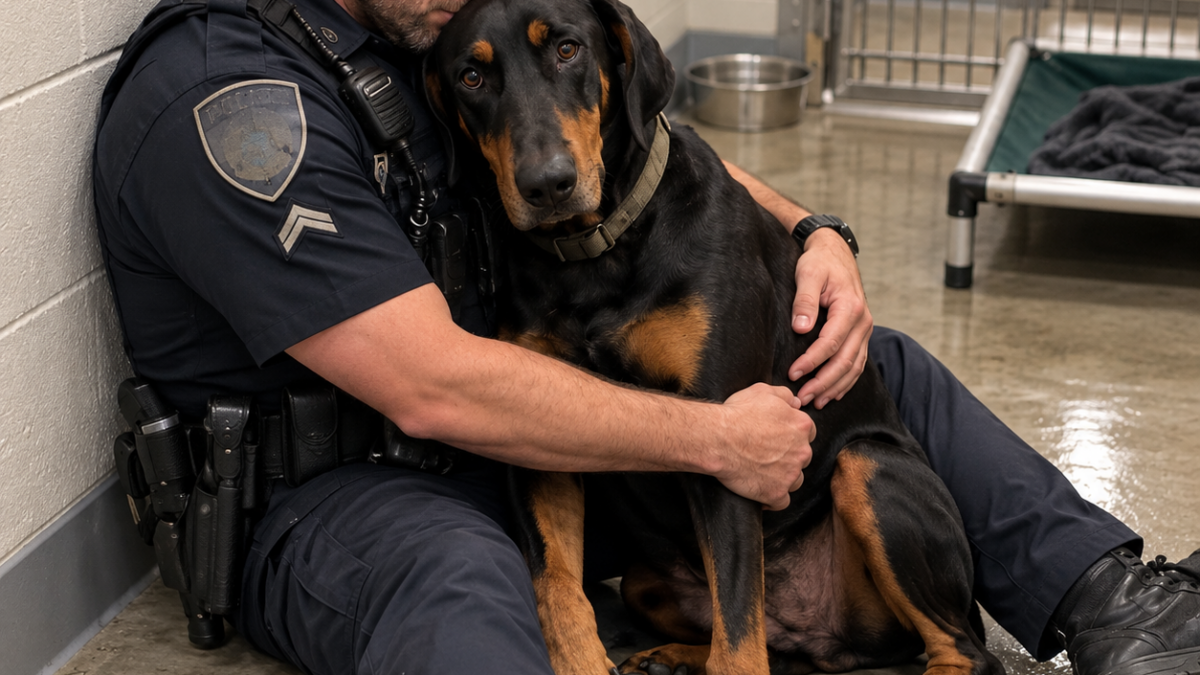
PART 2
For several seconds, I simply stood outside the kennel.
I had imagined this moment repeatedly during those three days.
In some versions, the Doberman would rush toward me.
In others, he would not remember me at all.
The second possibility bothered me more than I wanted to admit.
I told myself that would actually make things easier.
If he had forgotten me, then the promise I made on that street would have been little more than something I said to comfort myself.
I could visit once, make sure he was safe, then leave.
Go back to work.
Go back to my quiet apartment.
Go back to the life I understood.
But Rex didn’t even lift his head when I first approached.
He sat in the back corner of the kennel.
His body was upright, but everything about him looked defeated.
Head lowered.
Eyes half closed.
He wasn’t barking like several of the dogs around him.
He wasn’t jumping against the gate.
He wasn’t circling.
He was simply sitting.
Waiting.
I put one hand against the metal.
“Hey.”
Nothing.
I swallowed.
“It’s me.”
One ear moved.
I felt something tighten in my chest.
“I told you I’d come.”
His head came up slowly.
He looked directly at me.
Then he stood.
The movement was cautious.
Almost uncertain.
He took one step.
Stopped.
Another.
Then he crossed the kennel.
I crouched.
When he reached the gate, he pressed his head against the bars.
I put my hand through carefully.
Rex pushed his forehead into my palm and closed his eyes.
That was the moment I knew he remembered.
Not because I wanted to believe it.
Because his entire body changed.
His shoulders loosened.
His breathing softened.
For the first time since I had seen him beside that street, he looked as though he had stopped waiting for something terrible to happen.
A shelter employee named Maria had been watching from several feet away.
She came closer.
“He knows you.”
I kept my hand on Rex.
“We spent one night together.”
“For him, that was a big night.”
I looked at her.
“How has he been?”
She hesitated.
That hesitation worried me.
“He eats.”
“That doesn’t sound very encouraging.”
“He eats enough. Drinks. Lets us handle him. No aggression. He’s actually incredibly gentle.”
“But?”
“He waits.”
I looked back at Rex.
“What do you mean?”
Maria leaned against the kennel beside me.
“He sits near the front whenever someone comes through the main door. If a man walks past, especially someone around his former owner’s age, he stands.”
I said nothing.
“At night, he settles in the back like this.”
“Has anyone tried to adopt him?”
“A few people have met him.”
“And?”
“He doesn’t engage.”
“What does that mean?”
“He doesn’t do anything wrong. He just… doesn’t choose them.”
I almost smiled.
“Dogs don’t choose adoption applicants.”
Maria gave me a look.
“You’d be surprised.”
Rex moved closer until his chest pressed against the gate.
I rubbed the side of his face.
Maria watched us.
Then she said, “He’s been waiting for you.”
I stopped.
“For me?”
“You were there when his person died. You stayed. Then you came back.”
“I said I would.”
“Exactly.”
I looked at Rex.
He had lowered his head against my arm.
“He hardly knows me.”
Maria smiled sadly.
“Maybe he knows enough.”
I stood.
“That’s not how this works.”
“How does it work?”
“I’m a cop. I work nights. Sometimes twelve-hour shifts. Sometimes longer. I get called in. I’ve never owned a dog.”
Maria nodded as though she had heard every argument before.
“I live alone.”
Another nod.
“I don’t even know what Dobermans need.”
“That part is learnable.”
“I’m not adopting him.”
“I didn’t ask you to.”
I looked at her.
She smiled.
“But you’re already arguing against it.”
I hated that she was right.
I spent an hour with Rex that afternoon.
The shelter let me take him into a small fenced yard.
The moment the kennel door opened, he stayed beside me.
Not pulling.
Not exploring.
He followed my left leg as if someone had trained him to heel years ago.
Outside, I unclipped the leash.
“Go.”
Rex looked at me.
“You’re allowed.”
He took several steps.
Sniffed the grass.
Then turned back.
I sat on a bench.
Rex came over and stood between my knees.
I scratched his neck.
For the first time, his tail moved.
Not a full wag.
One cautious sweep.
Then another.
I laughed quietly.
“There you are.”
Rex looked toward the shelter building.
A door opened.
A gray-haired volunteer stepped outside.
Rex froze.
His ears lifted.
He took one step toward the man.
Then stopped.
The volunteer walked away carrying trash bags.
Rex stood motionless until he disappeared.
Then his head lowered again.
I knew exactly what he had thought.
For one second, he believed his owner had found him.
I sat beside him on the grass.
“I know.”
I had said those words to grieving families before.
Usually they were inadequate.
They were inadequate now too.
But I didn’t have anything better.
Before leaving, I knelt near Rex.
“I have work tonight.”
His eyes stayed on me.
“I’ll come back.”
I almost regretted saying it.
Promises become dangerous once someone believes them.
Still, I repeated it.
“I’ll come back.”
I returned two days later.
Then again.
Soon, visiting Rex became part of my schedule.
After a night shift, instead of going straight home, I drove to the shelter.
Sometimes I arrived exhausted.
Maria would see me and say, “You look terrible.”
“Thanks.”
“Coffee?”
“Please.”
Rex would hear my voice before he saw me.
His head would come up.
By the fourth visit, he was standing before I reached the kennel.
By the sixth, his tail moved immediately.
By the eighth, he made a sound.
A low, excited whine.
I stared at him.
“What was that?”
Tail.
“Are you actually happy to see me?”
More tail.
Maria walked past.
“I keep telling you.”
“Don’t start.”
She laughed.
I started taking Rex into the yard each time.
He became more confident.
He sniffed.
Walked farther from me.
Eventually chased a ball once, though he seemed confused about why humans considered that activity important.
I threw it.
Rex watched it land.
Then looked at me.
“That was expensive.”
Nothing.
“I bought that for you.”
He walked to the ball.
Sniffed it.
Walked away.
I sighed.
Maria, watching from the doorway, laughed.
“He has standards.”
The next visit, I brought a different ball.
Red.
Softer.
I rolled it instead of throwing.
Rex watched it.
Then followed.
He picked it up.
I froze.
“Bring it here.”
He stood with the ball in his mouth.
“Rex.”
He approached.
Dropped it near my shoe.
I looked at him.
“You’re kidding.”
Tail.
I rolled it again.
He went after it.
When he returned the second time, I felt unexpectedly emotional.
It wasn’t really about the ball.
It was movement.
Interest.
Play.
For days, Rex’s entire life had been waiting.
Waiting for a door.
Waiting for footsteps.
Waiting for a person who could not return.
Now, for ten seconds at a time, he was thinking about something else.
That mattered.
The shelter continued showing him to potential adopters.
I told myself that was good.
Of course it was.
He needed a home.
I did not have the kind of schedule a Doberman deserved.
That was the responsible position.
Then one afternoon, I arrived and found a family in the meeting room with Rex.
A couple in their thirties and their teenage daughter.
Good people, from the look of them.
The daughter was kneeling with her hand extended.
Rex stood several feet away.
I stopped in the hallway.
Maria saw me.
“Don’t interfere.”
“I’m not.”
“You’re making your police face.”
“I don’t have a police face.”
“You absolutely do.”
I watched.
The girl spoke softly.
“Come here, Rex.”
He looked at her.
Then toward the door.
Toward me.
His ears lifted.
I stepped backward before he saw me clearly.
Maria noticed.
“That was nice.”
“I want him adopted.”
“Do you?”
“Yes.”
She studied me.
I hated when she did that.
A few minutes later, the family left.
No adoption.
I found Rex back in his kennel.
“What happened?”
Maria crossed her arms.
“They liked him.”
“And?”
“He was polite.”
“Polite.”
“Yes.”
“That’s bad?”
“For adoption chemistry? Sometimes.”
I looked at Rex.
“He needs time.”
“They agreed.”
“So they might come back?”
“They might.”
The thought bothered me.
That bothered me more.
I drove home angry with myself.
What did I expect?
For Rex to sit in a shelter forever because I enjoyed visiting?
That would be selfish.
The next shift was ugly.
Domestic disturbance.
Two arrests.
An intoxicated driver.
A teenager missing for several hours who eventually turned up safe at a friend’s house.
By sunrise, I was exhausted.
Still, I drove to the shelter.
Rex was waiting.
I sat inside the visitation room with him.
He placed his head on my thigh.
I looked down.
“You know you’re making this complicated.”
His eyes closed.
“I had a perfectly manageable life.”
Nothing.
“I work.”
Rex breathed slowly.
“I sleep when I can.”
Nothing.
“I don’t need somebody waiting for me at home.”
His tail tapped the floor once.
I stared.
“That felt judgmental.”
Another tap.
I laughed.
Maria eventually came into the room.
She carried paperwork.
I saw it.
Immediately suspicious.
“What’s that?”
“Nothing.”
“Maria.”
“Adoption information.”
“I told you—”
“I know what you told me.”
She put the papers on the table.
“You don’t have to do anything.”
I looked at them.
Then at Rex.
“I work twelve-hour shifts.”
“We have dog walkers.”
“I’m sometimes called in unexpectedly.”
“Neighbors?”
“I barely know my neighbors.”
“Family?”
“My sister lives twenty minutes away. She has kids.”
“Kids who probably love dogs.”
“They do.”
“Interesting.”
“Stop interviewing me.”
Maria sat.
“Daniel, nobody is saying adoption is simple.”
I looked at her.
“A Doberman is not a decoration. He needs exercise, training, companionship. He’s grieving. He may have separation anxiety. He’ll need structure.”
“Exactly.”
“But you already show up.”
“That’s not the same as taking him home.”
“No.”
She nodded toward Rex.
“But it might be the beginning.”
I rubbed his neck.
“I’ve never owned a dog.”
Maria smiled.
“You keep saying that like dog owners are born with manuals attached.”
I stayed silent.
Then she said something I didn’t expect.
“His owner’s name was Robert Hale.”
I looked up.
“You found family?”
“Distant relative. A niece out of state. She confirmed Rex’s name and some history.”
My hand stopped.
“Rex was his name already?”
“Yes.”
I had learned it from a tag found later among Robert’s belongings, but hearing the details suddenly made him feel more real.
“What did she say?”
“Robert had Rex since he was a puppy. His wife died years ago. Rex was basically his family.”
I looked down at the dog.
His eyes were closed against my leg.
“Did she want him?”
“She can’t take him. Her housing doesn’t allow large dogs.”
“Did Robert have anybody else?”
“Apparently not.”
I swallowed.
So that was it.
Rex had lost the only person he had.
Not moved.
Not surrendered.
Not abandoned intentionally.
Lost.
No wonder he waited.
There was no betrayal to process.
Only absence.
That somehow felt even sadder.
Over the next week, I found myself thinking about Robert.
A man I had never known.
I pictured him clipping Rex’s leash before that final walk.
Maybe he said, “Come on, boy.”
Maybe Rex wagged.
Maybe Robert had coffee before leaving.
Maybe he planned breakfast.
Maybe he had bills on his table, laundry in a basket, ordinary things waiting for later.
Then later never came.
Police work teaches you that life can separate itself into before and after within seconds.
Rex had been standing inside that split.
One second, his owner was walking.
Next, on the ground.
No explanation.
I stopped thinking of Rex as a dog who refused to move on.
He was a dog who had never been told what happened.
Humans have funerals.
Death certificates.
Phone calls.
Words.
Dogs have absence.
That night, I dreamed of the street again.
Robert on the ground.
Rex beside him.
This time, when I tried to walk toward them, Rex looked at me and asked, in a human voice, “Are you leaving too?”
I woke at 4:13 in the morning.
I sat on the edge of my bed.
My apartment was silent.
For years, I had liked silence.
That night, it felt empty.
Three days later, I returned to the shelter.
Maria knew before I spoke.
I could tell from her face.
“Don’t.”
She smiled.
“I didn’t say anything.”
“I want to foster him.”
Her smile disappeared.
Not because she was disappointed.
Because she understood the seriousness.
“Temporary?”
“Yes.”
“Trial period?”
“Yes.”
“I’m not adopting him.”
“Daniel.”
“What?”
“You’re arguing again.”
I ignored her.
The shelter began the process.
They checked my home.
Asked about fencing.
Schedules.
Exercise.
Veterinary care.
Emergency plans.
My answers were embarrassingly incomplete at first.
“What happens if you’re held over at work?”
“My sister.”
“Has she agreed?”
“No.”
“So call her.”
I called.
My sister, Megan, answered immediately.
“What’s wrong?”
“Nothing.”
“You never call in the middle of the afternoon unless something’s wrong.”
“I need a favor.”
“What did you do?”
“Why do you assume—”
“Daniel.”
“I might foster a dog.”
Silence.
Then screaming in the background.
Her children had apparently overheard.
“What kind?”
“Doberman.”
More screaming.
Megan laughed.
“You?”
“Yes.”
“The man who once said houseplants were too demanding?”
“It was one cactus.”
“You killed it.”
“That’s irrelevant.”
She agreed to help.
My nephew Connor volunteered to walk Rex “every day for the rest of his life,” which was exactly the kind of promise nine-year-olds make without understanding calendars.
The home visit went well.
I bought bowls.
Food.
Bed.
Leash.
Harness.
Toys.
Too many toys.
I spent more money in one afternoon than I had planned to spend on myself that month.
When the trial day arrived, I barely slept.
At the shelter, Rex saw me holding the leash.
He became alert.
Maria opened the kennel.
Rex came out.
He looked around.
Then at me.
“Ready?”
Tail.
We walked toward the exit.
At the glass front door, Rex stopped.
He stared outside.
I waited.
A car passed.
His body stiffened.
The last time he had left a building with someone, perhaps Robert had been alive.
Now everything was new.
I crouched.
“No rush.”
Maria stood behind us.
Rex eventually stepped through.
At my car, he hesitated again.
I opened the back door.
He sniffed.
Then climbed in.
I drove home more carefully than I had ever driven with a human passenger.
Every few minutes, I checked the mirror.
Rex remained sitting.
Watching.
When we reached my apartment complex, he followed me upstairs.
Inside, he explored each room slowly.
Living room.
Kitchen.
Bedroom.
Bathroom doorway.
Back to the living room.
Then he stood near the front door.
I felt my chest tighten.
He was waiting.
I put his bed near the couch.
“Here.”
He sniffed it.
Then returned to the door.
That first evening, Rex spent almost three hours lying where he could see the entrance.
Every sound in the hallway lifted his head.
Footsteps.
Keys.
Elevator.
Voices.
He hoped.
Again.
And again.
Every sound could be Robert.
It never was.
I sat on the floor beside him.
“I know.”
Rex leaned against me.
At bedtime, I went to my room.
He followed.
I pointed at the dog bed I had moved there.
“That’s yours.”
He sat near the bedroom door instead.
I turned off the light.
Twenty minutes later, I opened my eyes.
Rex was still sitting.
“Come on.”
He remained upright.
I got out of bed.
Sat on the floor.
Rex looked at me.
“You’re allowed to sleep.”
Nothing.
“I’m not going anywhere.”
His ears shifted.
“I live here.”
I touched the floor beside me.
Slowly, Rex came closer.
He lay down.
Head on my thigh.
Within minutes, his breathing deepened.
I remained there.
My back hurt.
My legs went numb.
I didn’t move.
Eventually, I fell asleep too.
At 5:30, my alarm started screaming from the bed.
I nearly had a heart attack.
Rex lifted his head.
For half a second, he looked confused.
Then he saw me.
His tail moved.
That single wag made sleeping on the floor worth it.
The first week was difficult.
Every time I put on my uniform, Rex became anxious.
Maybe uniform meant nothing to him.
Leaving meant everything.
On the first morning shift after he moved in, I clipped his leash and walked him before work.
Then I came inside.
Fed him.
Changed.
Rex followed every step.
When I picked up my keys, he stood between me and the door.
“Rex.”
He looked up.
“I have to work.”
He did not move.
“I come back.”
Nothing.
I stepped around him.
He followed.
I opened the door.
Rex tried to come too.
I gently blocked him.
“Stay.”
His body stiffened.
For a moment, I saw the shelter again.
The waiting.
I almost called out sick.
That would have been ridiculous.
And worse, it would teach Rex that I could never leave.
So I knelt.
Put one hand on his head.
“I come back.”
Then I left.
My sister arrived two hours later.
She texted me.
HE IS SITTING AT THE DOOR.
I stared at my phone.
Then another message.
KIDS ARE ON THE FLOOR WITH HIM. HE’S SWEET.
Photo.
Rex beside my niece and nephew.
Not playing.
But not alone.
I worked the rest of the shift.
When I got home, I barely had the key inside before I heard movement.
The door opened.
Rex stood there.
For one second, he froze.
Then his entire body came alive.
Tail.
Ears.
He pushed against me.
I laughed.
“Hey.”
Rex leaned harder.
“I told you.”
I dropped my bag.
“I came back.”
The next day, same thing.
Then again.
Every departure created anxiety.
Every return became evidence.
I began understanding trust differently.
Trust was not Rex believing my words.
Trust was Rex collecting proof.
Daniel leaves.
Daniel returns.
Daniel leaves.
Daniel returns.
Again.
Again.
Again.
Words became unnecessary.
By the second week, the front door had lost some power over him.
Not all.
He still watched it.
Sometimes, early in the morning, I found him sitting nearby.
Listening.
Waiting for Robert.
That broke me every time.
I never tried to stop him.
Grief is not disobedience.
I would sit beside him.
Some mornings, five minutes.
Sometimes twenty.
We listened together.
Then eventually I would say, “Breakfast.”
Rex would look at me.
Stand.
Follow.
Little by little, life began pulling him forward.
The red ball helped.
I rolled it across the apartment one evening.
Rex watched.
Then looked at me.
“Remember this?”
He went after it.
Brought it back.
I laughed.
“There he is.”
Soon, ball became part of our routine.
Morning walk.
Breakfast.
My shift.
Megan checking in when needed.
Evening walk.
Ball.
Dinner.
Rex sitting near me while I watched television I wasn’t really paying attention to.
He liked having his head touched.
Not rough.
Slow strokes from forehead to neck.
Sometimes, while I talked to him, his eyes closed.
I started talking more than I expected.
About work.
About annoying paperwork.
About drivers who thought speed limits were suggestions.
About my sister.
About Robert.
Yes.
I talked about Robert.
“I never met him.”
Rex’s ears moved.
“He must have loved you.”
Rex looked toward me.
“I saw the way you stayed.”
I rubbed his head.
“You don’t do that for somebody who meant nothing.”
That mattered to me.
I did not want becoming Rex’s person to require erasing the first person.
Love is not a chair with only one seat.
Rex had loved Robert.
He could love me without betraying that.
I could care for Rex without pretending Robert never existed.
During the third week, Rex barked inside my apartment for the first time.
The doorbell rang.
Rex exploded.
One deep bark.
I nearly spilled coffee.
“What the—”
Another bark.
Megan opened the door.
Rex stood alert.
She laughed.
“He finally thinks this is his house.”
That hit me.
Not my house.
His.
The barking was annoying.
I loved it.
Connor threw his arms around Rex.
Rex tolerated this with the patience of a saint.
My niece Lily gave him three treats despite explicit instructions that two was enough.
“Lily.”
“He looked hungry.”
“He always looks hungry.”
Rex looked at me.
Traitor.
By the fourth week, I stopped referring to the arrangement as fostering.
Not consciously.
A coworker asked, “How’s your dog?”
I answered, “He’s good.”
Then froze.
My dog.
Nobody noticed except me.
Later that night, I looked at Rex asleep near the couch.
“My dog.”
His ear moved.
I smiled.
“You heard that.”
A week later, I brought Rex back to the street where Robert died.
I had debated doing it.
Maria told me not to force symbolism onto a dog.
She was right.
Still, something in me wanted to see his reaction.
We parked a short distance away.
Rex stepped out.
He sniffed the ground.
Then stopped.
His body changed.
No barking.
No panic.
But stillness.
He looked toward the sidewalk.
I knew.
He remembered something.
Maybe smell.
Maybe location.
Maybe nothing I could understand.
Rex walked slowly toward the spot.
I followed.
He stood there.
Looked around.
Then looked at me.
I crouched.
For several seconds, we held each other’s gaze.
Rex came forward.
Pressed his head against my leg.
I put both hands around his neck.
“You don’t have to wait here anymore.”
His tail moved once.
We walked back to the car.
Rex never looked behind us.
That night, he slept deeply.
No front door.
No listening.
No sitting upright.
He slept beside my bed until morning.
I don’t know whether the visit changed him.
Maybe it changed me.
It gave me permission to believe that moving forward was not abandonment.
The fifth week became the first week I saw genuine joy return.
Rex started running in the park.
Not constantly.
Dobermans are athletic, but grief had made him quiet.
That morning, I unclipped his leash inside a fenced area.
He stood.
Then another dog ran past.
Rex turned.
Something switched on.
He chased.
Not aggressively.
Playfully.
They ran a wide circle.
Rex’s body stretched into motion.
Powerful.
Fast.
Beautiful.
I laughed.
“Rex!”
He turned.
Ran toward me.
Then past.
I stood there grinning like an idiot.
An elderly woman sitting on a nearby bench watched us.
Afterward, Rex and I walked past her.
She smiled.
“Beautiful dog.”
“Thank you.”
“Doberman?”
“Yes.”
“What’s his name?”
“Rex.”
“How long have you had him?”
“About a month.”
She looked surprised.
“He watches you like he’s known you forever.”
I glanced at him.
Rex had stopped beside my leg.
The woman said, “Sometimes we find exactly who we need when we aren’t looking.”
I smiled politely.
She continued.
“You look like you needed him too.”
That irritated me.
Probably because it was true.
“I’m fine.”
She laughed.
“I didn’t say you weren’t.”
I walked away thinking about it.
Police officers get good at functioning.
Functioning is not the same as living well.
Before Rex, I worked.
Came home.
Ate.
Slept.
Repeated.
I saw my sister.
Sometimes friends.
But I kept most of life at a manageable distance.
Twelve years of seeing what people could lose had taught me, without my realizing it, not to need too much.
Need creates vulnerability.
Then Rex arrived.
Suddenly another living creature knew the sound of my key in the door.
Needed breakfast.
Needed walks.
Needed me to come home.
And I needed him waiting.
That frightened me.
It also made the apartment feel like a home for the first time.
During the sixth week, I visited Robert’s house.
The shelter had coordinated through his niece, who gave permission before the property was cleared.
I wasn’t sure why I wanted to go.
Maybe curiosity.
Maybe closure.
Maybe I wanted to understand Rex’s first life.
I took him with me.
The house was quiet.
Furniture partly covered.
Boxes along one wall.
Dust beginning to settle.
Rex stopped the second we entered.
Then he pulled.
Not hard.
But with purpose.
He moved from room to room.
Living room.
Kitchen.
Hall.
Bedroom.
His nose worked constantly.
I followed without speaking.
In the bedroom, Rex stopped beside an empty section of floor.
There was a flattened patch in the carpet.
Dog bed had probably been there.
He sat.
I looked around.
On a dresser stood several framed photographs.
Robert.
A woman I assumed was his late wife.
Rex as a puppy.
Rex younger.
Rex wearing a ridiculous holiday scarf.
Rex lying beside Robert in a backyard.
I picked up one photo.
Robert sat in a lawn chair.
Rex beside him.
One hand resting on the dog’s neck.
Both looked completely content.
My throat tightened.
This was the man from the street.
Not a body.
Not a call.
A person.
He had laughed.
Had a yard.
Loved a woman.
Raised a dog.
Had ordinary mornings.
I crouched beside Rex.
“That’s him.”
Rex looked at the photograph.
I knew dogs do not interpret photos the same way we do.
Still, I showed him.
“Robert.”
Rex’s ears lifted at the name.
I stopped.
“Robert?”
His head turned toward the hallway.
That was enough to break me.
His name mattered.
Of course it did.
I sat on the bedroom floor.
Rex pressed against me.
For a long time, I said nothing.
Robert had loved this dog.
I could feel it everywhere.
Bowls still near the kitchen.
Hooks for leash.
A worn tennis ball beneath a cabinet.
Photos.
A folded blanket with dog hair.
The tragedy was not that Rex had been unwanted.
The tragedy was that he had been deeply wanted by someone whose body failed without warning.
That distinction mattered.
Before we left, Robert’s niece told me I could take one photograph.
I chose the backyard photo.
I framed it later.
Placed it on a shelf in my apartment.
Not hidden.
Not treated as competition.
Part of Rex’s story.
The first time Rex saw me put it there, he sniffed the frame.
Then walked away.
That felt right.
Memory present.
Life continuing.
By the seventh week, adoption stopped being theoretical.
The shelter called.
“Your foster period is nearly complete.”
“I know.”
Maria said, “We have another application.”
My chest tightened.
“For Rex?”
“Yes.”
“Who?”
“A couple with Doberman experience.”
I became angry immediately.
Then embarrassed.
Of course another application existed.
Rex was adoptable.
He was healthy.
Gentle.
Beautiful.
“Are they good?”
“Yes.”
That made it worse.
Maria went quiet.
Then asked, “What do you want?”
“I want what’s best for him.”
“That wasn’t my question.”
I looked at Rex.
He was asleep.
“What if my work makes me the wrong person?”
“That is something to consider.”
“What if he spends too much time alone?”
“Then build support.”
“What if something happens to me?”
“Make a plan.”
“What if—”
“Daniel.”
I stopped.
“You’re a police officer. You evaluate risk for a living. Right now, you’re using risk to avoid making a decision.”
“That’s unfair.”
“Probably.”
Silence.
Then she softened.
“Do you love him?”
I hated how easy the answer was.
“Yes.”
“Does your life have room for him?”
I looked around.
Dog bed.
Red ball.
Water bowl.
Leash by the door.
Robert’s photograph.
“Yes.”
“Then decide from reality, not fear.”
The other family was scheduled to meet Rex two days later.
I barely slept.
The morning of the meeting, I stood in uniform in my kitchen.
Rex watched me.
I put down his food.
He didn’t move.
“What?”
He came closer.
Pressed into my leg.
My eyes closed.
“Damn it.”
I called Maria.
“I’m adopting him.”
She laughed.
“You sound angry.”
“I am.”
“At me?”
“At everybody.”
“Should I cancel the meeting?”
“Yes.”
Pause.
“Are you sure?”
I looked down.
Rex’s head was against my thigh.
“Yes.”
The official adoption process took longer than my emotional decision.
Forms.
Verification.
Home check updates.
Veterinary agreement.
I answered everything.
Signed everything.
At the shelter, on the final day, Maria put the papers in front of me.
“You understand this is permanent.”
“Yes.”
“Medical care.”
“Yes.”
“Exercise.”
“Yes.”
“Training.”
“Yes.”
“Separation planning.”
“Megan already has a key.”
Maria smiled.
“You did homework.”
“I’m a detective when motivated.”
“You’re patrol.”
“Don’t ruin the moment.”
I signed.
Rex sat beside my chair.
When the last page was done, Maria said, “Congratulations.”
I looked at Rex.
“We’re official.”
His tail began moving.
Slowly.
Then harder.
I laughed.
“You knew before I did.”
Rex leaned against me.
I thought about Robert.
Part of me wished he could know.
That someone had stayed.
That his dog had not been forgotten.
That the animal sitting beside him when he died had a home again.
I don’t know what happens after death.
Police work makes people ask questions it doesn’t answer.
But if there is any way Robert could know, I hoped he did.
The weeks after adoption became easier.
Not perfect.
Rex still sometimes waited near the door.
But less often.
The waiting changed.
Before, he listened for Robert.
Later, he listened for me.
I learned the difference.
When I worked nights and came home at dawn, Rex would be half asleep until my key turned.
Then he stood.
Tail.
Sometimes a soft bark.
I opened the door.
“There he is.”
He pushed against me.
Those greetings became addictive.
After dealing with strangers all night, walking into a room where someone was simply happy I existed felt like medicine.
I started volunteering at the shelter.
At first, once every two weeks.
Then weekly when shifts allowed.
Maria pretended this had been her plan.
“It was not.”
“Absolutely was.”
“You manipulated me.”
“I introduced you to responsibility.”
Rex came sometimes.
Not into every kennel area.
But into training spaces and events.
He became surprisingly useful around frightened dogs because he was calm.
One afternoon, I met a little mixed-breed dog named Peanut.
Terrible name.
Great dog.
Peanut had been surrendered after his elderly owner entered assisted living.
He shook whenever someone approached.
A family came to meet him.
Parents.
Two kids.
They wanted a dog but were worried because Peanut stayed in the corner.
I sat with them.
“Don’t call him.”
The father looked confused.
“How do we meet him?”
“Sit.”
We did.
Rex lay beside me.
Peanut watched.
Ten minutes.
Fifteen.
One child whispered, “He hates us.”
“No.”
“What if he never comes?”
“Then today, you show him you can wait.”
I realized the words sounded familiar.
That family sat nearly an hour.
Peanut eventually approached the little girl.
Sniffed her shoe.
She did not touch him.
Good kid.
Two visits later, they adopted him.
I watched their car leave.
Peanut looked frightened.
But he was in the back seat beside the girl.
Rex stood beside me.
I put my hand on him.
“Look what you started.”
Tail.
The shelter volunteering became important.
Every dog waiting near a door reminded me of Rex.
Every owner death.
Every surrender after illness.
Every frightened animal suddenly without the only home it knew.
I learned not to judge every surrender.
Life can be cruel to humans too.
Robert did not choose to leave Rex.
Some elderly owners lose housing.
Some people die.
Some become ill.
Some families genuinely cannot provide care after catastrophe.
There is abandonment.
And there is loss.
Animals feel both as absence.
Our job after the absence is the same.
Stay.
Provide structure.
Give them time.
One night, almost three months after I first found Rex, I woke around 2:20.
Exact time.
I checked the clock.
2:20 A.M.
Rex was beside the bed.
Sleeping.
Deeply.
Not sitting.
Not watching the door.
Sleeping.
I stared at him.
For months, 2:20 had belonged to the street.
To Robert.
To death.
Now it belonged to this room.
A sleeping dog.
My hand reached down.
Rex did not wake.
That made me smile.
Trust can be measured by how deeply someone sleeps beside you.
I lay back down.
For the first time, when I remembered that call, the final image was not Robert on the pavement.
It was Rex asleep.
That was when I knew we were healing.
Not forgetting.
Healing.
Months passed.
Rex turned nine, according to the shelter records and his previous veterinary information.
I bought him a birthday cake made for dogs.
Megan laughed at me.
“You don’t even celebrate your own birthday.”
“This is different.”
“How?”
“He has suffered.”
“So have you.”
“I didn’t ask for philosophy.”
The kids put a paper birthday hat on Rex.
He tolerated exactly six seconds.
Then removed it.
Good dog.
We took photographs.
One ended up beside Robert’s.
Two lives.
Same dog.
That mattered.
One afternoon in the park, the elderly woman who had spoken to us months earlier recognized Rex.
“Well, look at you.”
Rex went to her.
She scratched his ears.
Then looked at me.
“You kept him.”
“He kept me.”
She smiled.
“Same thing.”
Maybe it was.
Police work changed too.
Not the job.
Me.
I became more patient on certain calls.
An elderly man once refused to go to the hospital because nobody could care for his dog.
Before Rex, I might have treated that as an obstacle.
That night, I understood instantly.
“What’s the dog’s name?”
“Lucy.”
“Where is she?”
“Bedroom.”
I called animal services.
Arranged temporary care.
The man went to the hospital.
Later, he thanked me.
I thought about Robert.
What if someone had been there moments earlier?
What if his death could have been prevented?
Questions without answers.
But helping that man felt like honoring something I could not change.
Another time, we responded to a car accident where a dog was inside the vehicle.
The owner was injured.
Terrified about the dog.
I stayed until someone verified the animal was safe.
My partner said, “You never used to be the dog cop.”
“Shut up.”
He laughed.
Word spread.
Officers started calling me.
“Daniel, we’ve got a stray.”
“Call animal control.”
“He likes cops.”
“No.”
“You’re the Doberman guy.”
“I hate all of you.”
Rex had infected my professional reputation.
I pretended to resent it.
I didn’t.
At home, life became completely ordinary.
Rex developed annoying habits.
He stole my side of the couch.
Snored.
Stared while I ate.
Refused to accept that bathroom doors represented privacy.
He knew my schedule better than I did.
If I was late for our walk, he stood near the leash.
If dinner was late, he stared at his bowl, then at me, then back at the bowl with remarkable theatrical judgment.
“You ate this morning.”
Stare.
“You will survive.”
Stare.
“You’re dramatic.”
Tail.
Those were the moments I treasured most.
Not because they were extraordinary.
Because they were normal.
Rex no longer needed every day to be part of a healing narrative.
He was allowed to be annoying.
That is one of the greatest gifts safety gives.
A dog who is safe can waste energy complaining.
A dog who belongs can expect things.
Rex expected me.
That responsibility scared me less over time.
It started feeling like purpose.
Nearly a year after Robert died, his niece contacted me.
Her name was Allison.
We had spoken briefly before.
This time she wanted to meet Rex.
She lived several states away and had finally traveled back to settle the last estate matters.
We arranged to meet at Robert’s old house.
I was nervous.
I don’t know why.
Maybe because Allison represented Rex’s first family.
Part of me wondered whether she would look at me and think I had taken something that belonged to them.
Rex recognized her scent or voice.
I’m convinced of it.
The moment Allison knelt, Rex approached.
She began crying.
“Oh, Rex.”
He sniffed her.
Then leaned against her.
She held him.
“I’m sorry.”
I looked away.
After a while, we sat in the backyard.
Allison brought a box.
Inside were photographs.
Robert and Rex.
Rex as a puppy.
Rex destroying a garden hose.
Rex sleeping beside Robert’s chair.
Robert’s wife, Helen, before she died.
A family.
Allison handed me the box.
“These should be with him.”
“You keep them.”
“No.”
She shook her head.
“You’re his family now.”
I didn’t know what to say.
She looked at Rex.
“Uncle Robert loved him more than anything after Aunt Helen died.”
“I figured.”
“He worried about what would happen to Rex if something happened to him.”
That sentence hit me.
“He did?”
“All the time.”
“Did he have a plan?”
“He thought I could take him.”
She looked down.
“My landlord changed the rules. Large breeds aren’t allowed. By the time I found out what happened, Rex was already at the shelter.”
She wiped her eyes.
“I felt like I failed both of them.”
“You didn’t.”
“I should have found a way.”
I knew that kind of guilt.
Police officers see it constantly.
The things people believe they should have known.
Should have prevented.
Should have done faster.
“You didn’t cause Robert’s death.”
“No.”
“And Rex is okay.”
She looked at me.
“He’s more than okay.”
Rex lay between us in the grass.
She smiled.
“Uncle Robert would have liked you.”
I laughed.
“You don’t know me.”
“He liked people who kept promises.”
I couldn’t answer.
Allison gave me Robert’s old leash.
Brown leather.
Worn.
Rex’s name stamped into one side.
I still have it.
I didn’t use it often.
It became something else.
Memory.
Not sadness exactly.
A bridge.
Rex had not moved from one family by rejecting the first.
His first family had ended through death.
His second began because someone stayed.
Both could be true.
That evening, I placed one of the new photographs beside the original.
Rex looked up at the shelf.
I said, “You were ugly as a puppy.”
Tail.
“Ridiculous ears.”
Rex stared.
“Fine. Handsome.”
He came over.
I scratched his head.
Life continued.
The first anniversary of Robert’s death arrived.
I took Rex to the street before sunrise.
Not because I believed dogs understand anniversaries.
I needed it.
We stood near the place.
Rex sniffed.
Then sat beside me.
I thought about Robert.
A stranger whose death had redirected my entire life.
“I’ve got him,” I said quietly.
The words sounded strange spoken aloud.
Rex leaned against me.
“I’ve got him.”
Maybe I was speaking to the air.
Maybe to myself.
We stayed until sunrise.
Then went home for breakfast.
That became our private ritual.
Not every year.
Just that first one.
Afterward, I stopped feeling the need to return.
The street had done its job.
It connected two lives.
We did not have to keep living there.
Rex grew older.
Ten.
Then eleven.
His muzzle grayed.
He remained strong but slowed slightly.
Dobermans are athletic dogs, and Rex still loved walking.
But the miles shortened.
I learned his pace.
We adjusted.
At the shelter, he became almost a mascot.
Volunteers knew him.
New dogs sometimes met him under controlled circumstances because his calm temperament helped.
Maria once watched Rex lie near a terrified shepherd mix.
The shepherd stayed in a corner.
Rex did nothing.
Didn’t approach.
Didn’t stare.
Simply lay there.
Twenty minutes later, the shepherd came closer.
Maria looked at me.
“He learned from you.”
I shook my head.
“No.”
“What?”
“I learned that from him.”
She smiled.
Fair.
There were calls during those years that stayed with me.
Bad ones.
Police officers accumulate ghosts if they’re not careful.
Rex became part of how I came home from them.
Not therapy in a magical sense.
I still had difficult nights.
Still saw things I wished I could forget.
But when I came through the door, Rex had immediate priorities.
Outside.
Water.
Food.
Walk.
Attention.
He pulled me back into ordinary life.
That mattered.
After one especially difficult call involving a child, I came home after sunrise and sat on the kitchen floor.
Uniform still on.
Rex approached.
No excited greeting.
He sensed something.
He stood beside me.
Then sat.
I put my hand on his back.
We stayed there.
That was all.
No lesson.
No miracle.
Presence.
The same thing I had given him on the street.
He returned it.
Maybe that was our whole relationship.
Taking turns staying.
As Rex entered his senior years, veterinary appointments became more frequent.
Heart checks.
Bloodwork.
Joints.
Dobermans can develop serious cardiac issues, and given his age, we monitored carefully.
Every appointment scared me more than I admitted.
The first time the veterinarian mentioned an irregularity, I felt the floor disappear beneath me.
“Explain.”
She did.
Tests.
Further evaluation.
Monitoring.
Not immediately catastrophic.
But something to watch.
I sat with Rex in the car afterward.
He looked perfectly normal.
That felt offensive.
How could someone tell me his heart needed watching when that heart had carried so much?
I put my forehead against his.
“You’re not allowed.”
Rex licked my nose.
“That is not informed consent.”
Tail.
We managed his health.
Medication eventually.
Reduced intensity.
More rest.
Rex accepted aging better than I did.
Dogs usually do.
Humans spend enormous energy arguing with time.
Dogs adjust.
If a walk became shorter, Rex still smelled the grass.
If he couldn’t run as long, he lay in the sun.
If jumping onto the couch became difficult, I bought steps.
He used them.
Then one day ignored them and waited for me to help.
“You are manipulating me.”
Tail.
I helped.
Of course.
By then, Megan’s children were older.
Connor had been nine when Rex moved in.
Now he was a teenager.
He still came to walk him.
Sometimes Rex moved slower than Connor wanted.
“Let him choose.”
Connor nodded.
We all learned from him.
Patience was contagious.
One Sunday, we sat in the park.
Rex’s head on my leg.
An older man passed with a young Doberman.
The puppy bounced with impossible energy.
Rex lifted his head.
Watched.
The puppy pulled toward him.
The owner asked, “Friendly?”
“Very.”
They met.
The puppy bounced around Rex like a lunatic.
Rex stood there with the exhausted dignity of an elderly uncle.
I laughed.
“Remember when you had energy?”
Rex looked at me.
Probably offended.
The younger Doberman ran.
Rex watched.
Then lay back down.
I scratched his head.
“That’s right. Let the youth embarrass themselves.”
Those peaceful days became more valuable as his body slowed.
I knew what was coming.
Not when.
But someday.
That is the hidden contract in loving a dog.
You accept a future grief in exchange for a present relationship.
I would have signed again.
Without hesitation.
One winter night, almost exactly six years after that first call, Rex did something he had not done in years.
He sat beside the front door.
Quietly.
I noticed from the hallway.
For one terrible second, I thought he was waiting for Robert again.
“Rex?”
He looked at me.
I walked over.
Sat beside him.
His body leaned against mine.
No alert ears.
No searching eyes.
He was simply tired.
I smiled sadly.
“I remember when you used to wait here.”
Rex lowered his head onto my thigh.
“For him.”
I rubbed his neck.
“Then for me.”
His breathing slowed.
“Now you don’t have to wait for anybody.”
We stayed there until he fell asleep.
I did not move him.
That night, I slept on the floor beside him.
Just like the beginning.
His health declined gradually after that.
Nothing dramatic at first.
More fatigue.
Less appetite some days.
Longer recovery after walks.
The cardiologist adjusted medication.
We had good weeks.
Then difficult ones.
I learned a new vocabulary.
Quality of life.
Comfort.
Respiratory rate.
Fluid.
Energy.
Good days.
Bad days.
I hated every word.
I had spent years telling people after tragic calls that sometimes love means accepting what cannot be changed.
Then I became the person who didn’t want to hear it.
Maria visited once.
Rex slept beside us.
She had known him from the beginning.
“You okay?” she asked.
“No.”
“Fair.”
“I keep thinking about Robert.”
“Why?”
“He didn’t get to say goodbye.”
Maria looked at Rex.
“You might.”
“That feels worse somehow.”
“No.”
She shook her head.
“It’s a privilege. Terrible, but still a privilege.”
I looked at her.
“You can make the last part gentle.”
I knew she was right.
Still hated it.
One evening, Rex refused dinner.
That had happened before.
But this time, he also refused the ball.
The red ball.
Old now.
Faded.
I rolled it lightly.
Rex watched.
Did not move.
Something inside me understood before my mind did.
I called the vet.
We went in the next morning.
More tests.
More waiting.
The veterinarian sat with me.
Her expression told me.
His heart was struggling.
We could adjust.
Try to buy time.
But time had become expensive for Rex.
Not money.
Effort.
Breathing.
Fatigue.
I asked the question I had asked grieving owners to ask themselves.
“Is he suffering?”
The veterinarian was honest.
“He’s having more difficult days.”
“Can we fix it?”
“We can manage some symptoms.”
“That wasn’t my question.”
She looked at me.
“No.”
I stared at Rex.
He was lying beside my chair.
Eyes half closed.
I thought about the street.
How he sat beside Robert waiting for him to stand again.
How impossible it had been to explain death to a dog.
Now I was the one resisting understanding.
I whispered, “Not yet.”
The veterinarian nodded.
“We don’t have to decide this second.”
We went home.
I took three days off.
My captain did not argue.
Everybody knew Rex.
Those three days were quiet.
No bucket list.
No ridiculous feast.
Rex didn’t need a performance.
We walked short distances.
Sat outside.
Megan and the kids visited.
Maria came.
I showed Rex Robert’s photograph.
“Your first guy.”
His ears moved faintly.
I put my own hand on his chest.
“And then me.”
Tail.
Barely.
That was enough.
On the third night, Rex struggled to settle.
He stood.
Lay down.
Stood again.
Breathing harder.
I called the emergency clinic.
Then stopped.
I knew.
My sister drove us.
I sat in the back with Rex.
Just as I had stayed with him on the street.
My hand on him.
At the clinic, they made us comfortable in a quiet room.
The veterinarian explained everything.
I heard almost none of it.
Rex rested against my leg.
I had imagined this moment for years.
I thought I would panic.
Beg.
Refuse.
Instead, I looked at him and felt something clear.
Rex had spent enough of his life waiting for someone else.
I would not make him wait for relief because I was afraid of being alone.
I signed the forms.
My hand shook.
Then I sat on the floor.
Rex’s head in my lap.
I talked to him.
Not about death.
About life.
“Remember the red ball?”
Ear movement.
“You were terrible at first.”
My voice broke.
“You scared Maria.”
That was a lie.
He never did.
“You took my couch.”
Tail.
Barely.
“You made me buy dog stairs that you ignored.”
I laughed through tears.
“You made me volunteer.”
Rex’s eyes stayed on me.
“And you made me come home.”
That one ended me.
I bent down.
Pressed my forehead to his.
“Robert loved you.”
My chest shook.
“I love you.”
Rex exhaled slowly.
“You were never alone.”
The veterinarian gave the first medication.
Rex relaxed.
I continued touching him.
The second followed.
I felt his breathing become slower.
Then still.
My hand remained on his chest.
Silence.
No sirens.
No radio.
No streetlights.
No frightened dog waiting for his owner to wake.
Just me.
Holding him.
This time Rex did not have to wait beside someone he loved.
I was awake.
I was there.
I understood what was happening even if he didn’t.
And I stayed.
Exactly as I had promised.
For a long time after, I could not stand up.
The veterinarian left me alone.
Eventually, I looked at Rex’s face.
Peaceful.
I thought about Robert.
For the first time, the image of Robert lying on the pavement did not feel entirely tragic.
Because somewhere in the strange architecture of life, his ending had brought Rex to me.
Not as a reason.
Death does not need justification.
But as a connection.
Robert loved Rex first.
I loved him next.
Rex never had to choose between us.
That mattered.
I whispered one last thing.
“You don’t have to wait anymore.”
Then I went home alone.
The apartment was unbearable.
Dog bed.
Bowls.
Leash.
Red ball.
Robert’s picture.
Everything exactly where it belonged.
Except Rex.
At 2:20 the next morning, I woke automatically.
I looked beside the bed.
Empty.
That was when grief finally arrived without restraint.
I sat on the floor.
Cried until sunrise.
Police officers are not immune to grief.
We are simply trained to postpone it.
Rex had taught me not to postpone everything.
So I let it happen.
For weeks, I reached for the leash when I came home.
Heard sounds that weren’t there.
Expected the bark at the door.
Megan came often.
Connor, nearly grown, cried harder than I did one evening.
“He was my dog too.”
“I know.”
We put the red ball inside a small box with Robert’s old leash and several photographs.
Not hidden away.
Stored carefully.
The QUALITY OF LOSS is proportional to the place something occupied.
Rex had occupied almost everything.
The shelter put a photograph of him near the front desk.
Rex Morgan.
I protested.
“He had a last name?”
Maria said, “He does now.”
Underneath, a small line read:
HE WAITED. SOMEONE CAME BACK.
I stared at it for a long time.
Then laughed.
“You’re dramatic.”
“Learned from you.”
I continued volunteering.
At first, it hurt.
Every Doberman made my chest tighten.
Every grieving dog reminded me of him.
Then something shifted.
Helping became the way I carried Rex forward.
Not replacing him.
Continuing what he started.
A few months later, an elderly woman died, leaving behind a small terrier named Winnie.
Winnie sat at the back of her kennel.
Would not approach.
A volunteer said, “She won’t come.”
I sat on the floor outside.
“Then we wait.”
Twenty minutes.
Thirty.
Forty.
Winnie eventually came forward.
Sniffed my fingers.
I smiled.
“There you go.”
Maria watched from the hallway.
“You look familiar.”
“Don’t.”
She laughed.
Winnie was adopted two weeks later by a retired couple.
I watched them leave.
For the first time since Rex died, I felt something that wasn’t sadness when I thought of him.
Pride.
Not mine.
His.
His life had expanded beyond himself.
Because Rex waited for me, I learned to wait for Winnie.
Because I understood Robert’s loss, I understood the elderly man worried about Lucy.
Because Rex taught me that grief in animals deserves patience, frightened dogs received more of mine.
That is how love survives death.
Not as magic.
As behavior.
You become different.
Then other lives encounter the difference.
Years have passed since the night my radio crackled at 2:20 A.M.
I am still a police officer.
Longer than twelve years now.
I have taken thousands more calls.
Some ordinary.
Some terrible.
I no longer remember every address.
Every argument.
Every traffic stop.
But I remember that street perfectly.
The angle of the cruiser.
The cold air.
Robert on the ground.
A black-and-rust Doberman sitting beside him.
Silent.
Waiting.
I remember kneeling.
I remember Rex finally looking at me.
I remember saying, “You’re not alone.”
At the time, I had no idea whether I could keep that promise.
I did not know his name.
Did not know Robert.
Did not know I would visit a shelter three days later.
Did not know I would sign adoption papers.
Did not know a red ball would make me cry.
Did not know a dog would turn my apartment into a home.
Did not know that years later I would sit on a clinic floor holding the same animal while he took his last breath.
All I knew was that one dog was about to lose everything.
So I stayed.
That was the beginning.
People sometimes tell me I saved Rex.
I understand what they mean.
But the sentence has never felt complete.
I gave Rex a second home.
Yes.
I gave him food.
Walks.
Medical care.
A couch he stole.
A family.
I kept my promises.
But Rex changed the shape of my life.
Before him, I thought strength meant not needing much.
Do your job.
Handle your problems.
Keep moving.
Rex taught me that strength can also mean staying.
Letting someone depend on you.
Depending on them too.
Risking grief because love is worth the eventual cost.
I once believed I had no time for a dog.
The truth was that I had been spending time on things that never looked back when I left the room.
Rex looked back.
Every time.
Even in the shelter.
Especially in the shelter.
That first morning when they took him away, he stared at me until the vehicle turned.
His eyes said what I later came to understand clearly.
You promised.
Come back.
I did.
Again and again.
For years.
And when the day finally came when Rex could no longer come back to me, I stayed long enough for him to leave without waiting.
That is the ending I can live with.
Robert died unexpectedly and Rex lost the first man he loved.
Nothing can make that beautiful.
Nothing should.
But Rex’s life did not end beside that street.
He sat there because he loved someone.
Then he waited in a shelter because he did not understand absence.
Then one cop who had never owned a dog walked through the door.
Rex remembered.
He stood.
He came forward.
He placed his head under my hand.
From there, we learned together.
He learned that I returned.
I learned that being needed did not make life smaller.
He learned a new home.
I learned what home meant.
He learned to play again.
I learned to stop moving long enough to notice joy.
He learned that loving me did not erase Robert.
I learned that loving Rex did not require replacing anyone.
We carried the past.
Then we built something beside it.
That was enough.
The red ball still sits on a shelf in my home.
Faded.
Chewed.
Useless.
Robert’s photograph is beside it.
Then one of Rex and me in the park.
In Robert’s picture, Rex is young.
Black coat shining.
Head held high.
Robert’s hand on him.
In mine, Rex’s muzzle is gray.
He is leaning against my leg.
I am smiling in a way I rarely did before him.
Two men.
One dog.
Two chapters.
One life.
Sometimes, before a night shift, I stop in front of those pictures.
Not every time.
Just when I need to remember something simple.
Every call contains a life that existed before I arrived.
Every frightened person belongs to someone.
Every animal at the edge of a scene understands less than we assume.
Sometimes the job is not only arresting, directing, writing, controlling.
Sometimes the job is staying.
I learned that from Rex.
And if somewhere beyond what I understand Robert ever got the answer to the question he worried about most—What happens to my dog if something happens to me?—I hope the answer reached him.
Rex was loved.
Rex was safe.
Rex had a home.
He was not forgotten.
He never waited alone again.
And on the final night, when his tired heart could no longer carry him, there was a hand on his head.
A voice he knew.
A person beside him.
I had promised him that morning after Robert died that I would not forget.
I kept the promise.
Right to the end.

