PART 2: Her Owner Left Violet Dying at the ER and Vanished—Then We Learned She’d Been Alone for Nearly a Month
PART 2
I stepped into the hallway before answering him.
Behind the closed treatment-room doors, I could still hear the soft electronic beeping of the monitors attached to Violet.
“What did you find?”
“We’re still confirming everything,” the investigator said. “I don’t want to give you conclusions before we have documentation.”
That was his way.
Careful.
Precise.
Never giving anger more room than evidence.
“But?”
“But we’ve spoken to someone who knew the owner was away from the property for an extended period.”
My stomach tightened.
“How extended?”
“We don’t know yet.”
“Days?”
“Possibly longer.”
I leaned against the wall.
“And Violet?”
“That is what we’re trying to establish.”
I looked through the small window in the treatment-room door.
Violet hadn’t moved.
A technician sat beside her adjusting the oxygen line.
“How long would a dog have to go without proper food to reach twelve pounds?”
“That question needs to come from the veterinarian.”
“You know what I’m asking.”
“I do.”
“And?”
“We’ll call you when we have something we can prove.”
The line disconnected.
I stood there staring at my phone.
I wanted answers immediately.
I wanted someone to tell me exactly who had left Violet, how long she had been alone, who knew, who didn’t know, and why a dog had been allowed to deteriorate until almost nothing remained.
But Violet didn’t need my anger that night.
She needed stability.
So I went back inside.
The veterinarian was checking the transfusion line.
“How is she?”
“Still critical.”
“Better?”
“Too early.”
That phrase would become familiar over the next several days.
Too early.
Too early to know whether her organs would recover.
Too early to know whether the transfusion would stabilize her.
Too early to know whether her lungs had been permanently damaged.
Too early to believe the worst had passed.
I sat beside Violet.
Her breathing was shallow but regular.
Every few minutes, her nostrils flared beneath the oxygen.
I placed my hand near her front paw without touching it.
“You don’t have to know me,” I whispered. “You just have to stay.”
The technician glanced toward me.
“She reacted when you came back.”
“What do you mean?”
“Her heart rate changed slightly.”
I smiled.
“I’ll take it.”
At midnight, Violet was still alive.
At two in the morning, she was still alive.
At four, still alive.
Nobody said miracle.
Not yet.
We were afraid to give the word too much power.
By sunrise, the veterinarian finally stepped into the waiting area and sat down across from me.
“She made it through the night.”
I closed my eyes.
Not because the battle was over.
Because it wasn’t.
But twelve hours earlier, I had been afraid there wouldn’t be a morning.
“What happens now?”
“We keep going.”
Those three words became the foundation of Violet’s recovery.
We keep going.
Her first days were measured in numbers.
Temperature.
Blood pressure.
Oxygen saturation.
Red blood cell counts.
Kidney values.
Liver values.
Calories.
Fluid balance.
Weight.
Everything that should happen naturally inside a healthy dog had become something we watched deliberately.
Violet’s body had spent so long surviving deprivation that we couldn’t simply flood it with food and assume everything would correct itself.
Severely malnourished animals have to be reintroduced to nutrition carefully.
Her body needed calories desperately, but too much too fast could create additional metabolic problems.
So meals were small.
Calculated.
Frequent.
A technician weighed portions with a precision that looked ridiculous until you understood what was at stake.
The first time Violet showed interest in food, the entire room changed.
It happened on the second morning.
A technician opened a small container.
Violet’s nose moved.
“Did you see that?”
The veterinarian looked over.
The technician held the dish closer.
Violet sniffed again.
Then her tongue moved weakly toward the food.
One lick.
That was it.
The technician looked at me.
“You’re crying.”
“No.”
“You absolutely are.”
I wiped my face.
“She’s eating.”
“She licked food.”
“Today that’s eating.”
Nobody argued.
An hour later, Violet managed three more licks.
That afternoon, a few bites.
Each one mattered.
Each one said something her bloodwork couldn’t.
She wanted to live.
That didn’t mean she understood life the way we do.
I don’t pretend animals make philosophical decisions.
But bodies respond.
They reach.
They adapt.
They accept nourishment.
They try to stand.
Violet did all of those things whenever she had enough strength.
On the third day, she lifted her head when I walked into the room.
“Hey.”
Her eyes followed me.
I sat beside her.
“You’re looking nosy today.”
Her nose moved.
“That is good. Nosy dogs cause trouble.”
Her tail did not wag.
Not yet.
But she watched me.
That was different from the first day.
Then the investigator called again.
“We have a timeline.”
I stepped outside.
“How long?”
“A little under a month.”
I stopped walking.
“What?”
“The owner left the residence before traveling.”
“And Violet stayed?”
“Yes.”
“Alone?”
“That appears to be the case.”
“For almost a month?”
“We’re documenting the exact dates.”
I couldn’t speak.
The investigator continued.
“We’ve recovered messages, travel information, and statements. The owner has now spoken with us.”
“What did she say?”
“She acknowledged leaving.”
My hand tightened around the phone.
“With food?”
“She claims she believed there was enough.”
“For nearly a month?”
“That is one of the issues being investigated.”
“What about water?”
“There was access to some water, though the conditions are still being documented.”
I felt physically sick.
A month.
I imagined twenty-eight mornings.
Twenty-eight nights.
An empty house.
A hungry dog.
No one coming through the door.
At first, maybe Violet waited near the entrance.
Golden Retrievers are people dogs.
They live for footsteps.
Voices.
Hands.
Maybe she heard a car outside and lifted her head.
Maybe she went to the window.
Maybe she checked bowls.
Maybe she waited.
Then waited longer.
At some point hunger becomes more than discomfort.
The body begins consuming itself.
Fat reserves disappear.
Then muscle.
Strength fades.
Walking becomes difficult.
Temperature regulation changes.
Organ systems begin to fail.
A dog does not wake one morning suddenly weighing twelve pounds.
She disappears gradually.
Ounce by ounce.
Meal by meal.
Day by day.
“Why didn’t anyone check on her?”
“We’re asking that too.”
“Did she tell anyone the dog was there?”
“We haven’t established that clearly yet.”
“Was this planned?”
The investigator paused.
“I don’t speculate about intent.”
His restraint frustrated me.
I wanted words.
Abandoned.
Cruel.
Unthinkable.
He wanted evidence.
I would eventually appreciate that.
That morning, I didn’t.
“She nearly died.”
“I know.”
“She still might.”
“I know.”
“If she dies—”
“Our case doesn’t become stronger because you get angry.”
I stopped.
His voice softened slightly.
“Stay with Violet. Let us do our part.”
I looked through the glass door.
Violet was awake.
“Fine.”
“Document everything.”
“We are.”
“That will matter.”
He was right.
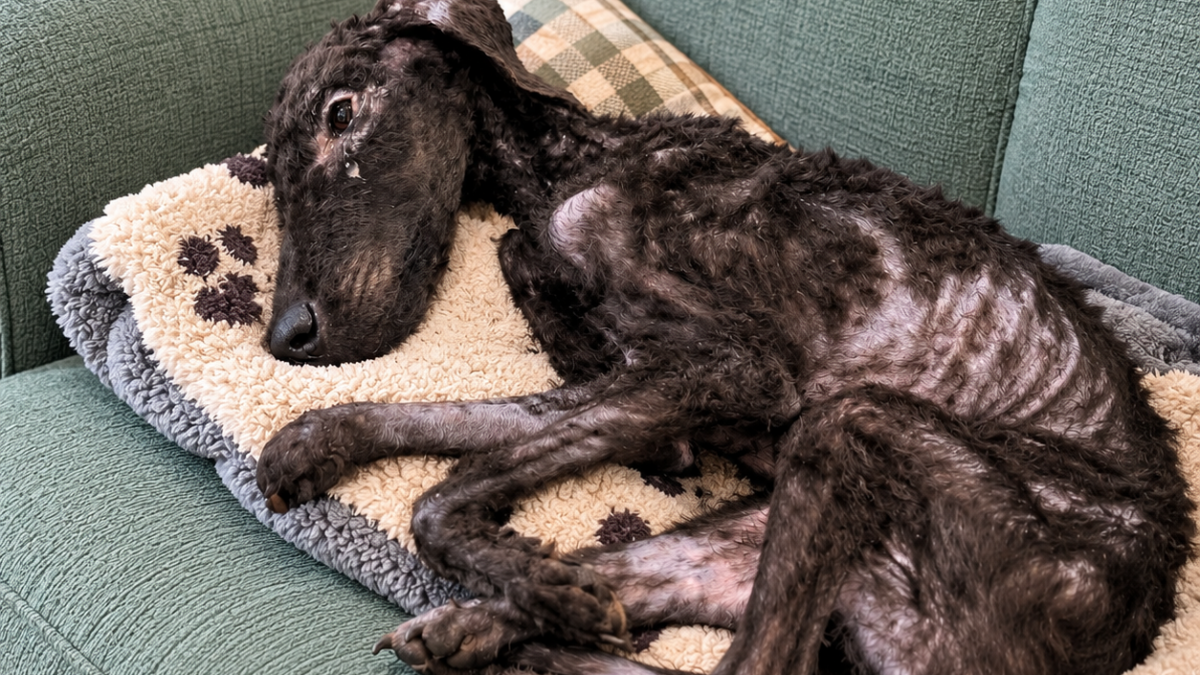
The medical team photographed Violet’s condition systematically.
Not for social media.
Not for shock.
For evidence.
Each image was clinical.
Body condition.
Prominent ribs.
Pelvis.
Muscle wasting.
Eyes.
Gums.
Skin.
Any pressure sores.
Every measurement was written down.
Every treatment recorded.
The hospital staff knew something important.
Memory becomes emotional.
Records remain exact.
If Violet survived, those records would tell what her body had endured.
If she didn’t, they would still speak for her.
By the fifth day, her transfusion had improved some blood values.
Her oxygen needs were slightly lower.
She ate more willingly.
But standing remained impossible.
We placed supportive padding beneath her and repositioned her frequently.
When an animal is this thin, even lying down can cause injury because there isn’t enough tissue protecting bones from hard surfaces.
One morning I helped the technician roll Violet gently onto her other side.
Her body weighed almost nothing.
That frightened me every time.
Golden Retrievers are not supposed to feel like this in your arms.
“She’s six?” I asked.
“That’s what the records indicate.”
I shook my head.
She looked ancient.
Not gray.
Exhausted.
There is an oldness created by suffering that has nothing to do with years.
I touched her ear.
“You’re supposed to be stealing socks at six.”
Violet blinked.
“Running through mud. Ignoring people when they call you because you’ve found something disgusting.”
The technician smiled.
“Very specific future.”
“I have plans for her.”
“Tell her.”
So I did.
Every day.
I told Violet about normal things.
Car rides.
Grass.
Tennis balls.
Soft beds.
A refrigerator opening.
The first snow.
People who would complain about her hair on the furniture and then let her sleep there anyway.
I talked because silence in hospital rooms can become unbearable.
And because Violet always seemed to listen.
The first unmistakable sign of personality arrived on day six.
I brought a clean blanket.
It was purple.
I laid it over her.
Violet sniffed the edge.
Then grabbed it weakly with her teeth.
“What are you doing?”
She pulled.
Barely.
But she pulled.
I laughed.
The technician turned around.
“Did she just steal her blanket?”
“She tried.”
“That’s a Golden Retriever.”
For the first time, I could imagine the dog underneath the illness.
Not the twelve-pound body.
Violet.
A personality.
A troublemaker perhaps.
A dog with preferences.
A dog who might one day become inconvenient in all the best ways.
The next morning, she ate almost the entire measured meal.
Afterward, she licked the bowl.
Then looked toward the technician carrying it away.
The technician laughed.
“That’s it. We’re officially being judged.”
Violet’s tail moved once.
I froze.
“Do that again.”
Nothing.
“Violet.”
Tail tap.
My hand covered my mouth.
It was ridiculous how much that tiny movement affected me.
The veterinarian walked in.
“What happened?”
“She wagged.”
The veterinarian looked at Violet.
“Well, that’s medically significant because apparently now I have to deal with all of you becoming emotional.”
We laughed.
That was the first time laughter had filled Violet’s room.
She watched us.
Tail tap.
Again.
By the end of the first week, Violet was stable enough that the conversation changed from whether she would survive the next few hours to what recovery might require.
But stable did not mean safe.
Her organs had been under extraordinary stress.
Her lungs remained vulnerable.
She had almost no muscle.
Even her heart had been forced to function in a severely depleted body.
The veterinarian explained it carefully.
“Recovery is going to take months.”
“That’s fine.”
“There will probably be setbacks.”
“Fine.”
“She cannot gain weight too quickly.”
“Okay.”
“She needs frequent bloodwork.”
“Yes.”
“Possible respiratory complications.”
I nodded.
“Anything else?”
The veterinarian smiled faintly.
“You don’t have to answer everything in half a second.”
“I’ve already decided.”
“You’re taking her?”
“If she can leave.”
“She’ll need somewhere extremely controlled.”
“She has one.”
Technically, Violet was entering foster care through our rescue.
Emotionally, I knew before she left the hospital that I would have trouble ever giving her back.
But first she had to stand.
The attempt came on day eight.
Two technicians supported her with a wide sling beneath her abdomen.
I knelt in front.
“Easy.”
Violet’s paws touched the rubber mat.
Her legs trembled instantly.
Every muscle had been stripped down by starvation.
She tried to push.
Her front legs buckled.
The technicians supported her.
“Again?” I asked.
The veterinarian nodded.
“Only if she wants to.”
Violet lowered her head.
For a moment, I thought she was finished.
Then her back paw moved.
She tried again.
One front leg straightened.
Then the other.
Her body rose.
Shaking.
Uncertain.
But upright.
“That’s it,” I whispered.
The technician holding the sling looked at me.
“Don’t distract her.”
I nodded quickly.
Violet stood for perhaps four seconds.
Then collapsed gently into the support.
I started crying.
The veterinarian sighed.
“You’re doing that a lot lately.”
“She stood.”
“For four seconds.”
“Four more than last week.”
Nobody argued.
The next attempt lasted seven.
Then nine.
Then twelve.
Progress wasn’t smooth.
Some mornings Violet looked stronger.
That afternoon she might seem exhausted.
One day her blood pressure dipped and everyone became tense again.
Another morning she refused breakfast and I immediately thought we were losing her.
Then she ate lunch.
Recovery taught me not to turn one bad hour into an ending.
Violet taught me the same thing.
Her first unsupported step came nearly two weeks after admission.
She stood on a padded mat.
The technician remained beside her.
I knelt a few feet away.
“Come here.”
Violet looked at me.
One paw moved.
Her body swayed.
“Easy.”
Another paw.
Her rear legs followed.
One step.
Then another.
She nearly fell.
The technician reached for her but stopped when Violet corrected herself.
Third step.
Then she collapsed into my lap.
I wrapped my arms around her.
“You did it.”
Violet’s head rested against my chest.
Her tail moved.
The veterinarian stood behind us.
“That’s enough for today.”
“Did you see her?”
“I was standing here.”
“Three steps.”
“I counted.”
I looked down at Violet.
“You’re showing off.”
Her eyes closed.
Three steps became five.
Five became a slow trip across the treatment room.
Eventually the sling became unnecessary.
Then came the day the hospital said she could leave.
I should have felt only relief.
Instead, I was terrified.
The hospital had oxygen.
Emergency medication.
Monitors.
Veterinarians.
Home had me.
“What if she crashes?”
“You bring her back.”
“What if I miss something?”
“You call.”
“What if—”
The veterinarian placed a hand on my shoulder.
“You’re going to be afraid for a while.”
I looked at Violet.
She was standing beside me wearing a harness that looked absurdly large despite being the smallest size we could adjust comfortably.
“She seems less afraid than I am.”
“She probably is.”
We loaded her carefully into the car.
Violet curled on a thick bed across the back seat.
I drove like I was transporting glass.
Every pothole offended me personally.
At a red light, I turned around.
“You okay?”
Violet blinked.
“You’re not dying back there, right?”
She yawned.
I laughed.
“Good answer.”
When we reached the house, I carried her inside.
She could walk, but I wanted to conserve her strength.
I had prepared the living room with rugs for traction.
Water nearby.
A low orthopedic bed.
Blankets.
A gated quiet area.
Everything unnecessary had been removed.
Violet looked around.
Then looked at me.
“This is temporary,” I said.
That was a lie.
I just didn’t know it yet.
Her first hours at home were uneventful.
That felt miraculous.
She slept.
Woke.
Drank.
Ate her measured meal.
Went outside with support.
Returned.
Slept again.
At bedtime, I placed her bed beside mine.
Violet looked at it.
Then at my bed.
“No.”
She continued staring.
“You cannot even climb.”
More staring.
“You weigh twelve pounds and somehow you’re already manipulating me.”
I lowered my mattress temporarily so she could be closer.
Violet rested her head near my hand.
I fell asleep listening to her breathe.
At 2:17 a.m., I woke suddenly.
Silence.
My heart stopped.
“Violet?”
She was deeply asleep.
I put my hand against her side.
Breathing.
I almost laughed.
That became my nightly routine.
Check breathing.
Sleep.
Wake.
Check.
Eventually Violet began waking me instead.
Usually because she was hungry.
That was a wonderful problem.
Her feeding schedule was strict.
Small meals spread through the day.
We increased calories gradually according to veterinary guidance.
Every few days, I weighed her.
The first time the scale showed a full pound gained, I photographed the number.
Thirteen.
I sent it to the veterinarian.
She replied:
Good. Slowly.
A week later:
Fourteen.
Then fifteen.
Each pound looked different on Violet.
Her face softened.
Her shoulders became less sharp.
Her hip bones no longer looked capable of cutting through the skin.
Her coat, once dry and lifeless, began changing texture.
Still, the body was only part of the recovery.
Violet’s behavior told another story.
She hated closed doors.
The first time I walked into the bathroom and shut the door, she panicked.
I heard scratching.
Then a weak bark.
I opened it.
Violet stood outside trembling.
“Hey.”
She pressed against my legs.
“I’m here.”
I didn’t understand immediately.
Then I remembered.
An empty house.
A door closing.
Someone leaving.
Weeks alone.
From that day, I began teaching her what leaving meant now.
I would step outside for five seconds.
Come back.
Ten seconds.
Come back.
Thirty.
Return.
One minute.
Return.
At first Violet waited directly against the door.
Then a few feet away.
Eventually she stayed on her bed.
But when I returned, her entire body still relaxed.
We repeated it for weeks.
A new pattern.
People leave.
People return.
Food disappears.
Food returns.
Night comes.
Morning comes.
Nothing terrible happens.
Violet was learning predictability.
One evening, about three weeks after she left the hospital, I noticed her carrying something.
“What do you have?”
She froze.
A sock hung from her mouth.
I started laughing.
“There you are.”
Violet stared.
“Drop it.”
She didn’t.
“Violet.”
She took two steps backward.
I laughed harder.
“You almost died and this is how you repay me?”
Tail wag.
She walked away carrying the sock.
I let her keep it.
That was the first thing she stole.
Soon, socks became a problem.
Shoes.
Dish towels.
One oven mitt.
She never destroyed them.
She collected them.
I would find them in her bed.
A little pile of stolen household objects.
I told the veterinarian.
She smiled.
“Normal Golden Retriever behavior.”
“It’s theft.”
“Medically encouraging theft.”
I accepted the diagnosis.
Violet’s personality grew alongside her body.
She became affectionate but not clingy all the time.
She loved being near people.
She also loved food with a devotion that made sense.
The first few weeks, she watched the kitchen carefully.
If I opened the refrigerator, she appeared.
If a cabinet moved, she appeared.
If I touched a plate, Violet materialized as if summoned.
But she wasn’t frantic.
She was attentive.
She remembered hunger.
I could see it.
One night I dropped a piece of carrot.
Violet moved so quickly that I barely saw her.
Then she froze with the carrot in her mouth as though expecting me to take it.
“Go ahead.”
She stared.
“It’s yours.”
She chewed.
Afterward, she searched the floor.
I knelt.
“There will be breakfast.”
Her tail moved.
“You don’t have to find tomorrow’s food tonight.”
That became another phrase I repeated.
There will be breakfast.
There will be dinner.
There will be tomorrow.
Violet eventually believed me.
Just when the recovery began feeling safe, the cough started.
At first it was small.
A single cough after drinking.
I noticed because I noticed everything.
The next day, two.
Then several that evening.
By morning, Violet seemed tired.
I called the clinic.
“Bring her in.”
My stomach dropped as if we were back at day one.
The veterinary team listened to her lungs.
Then listened again.
Her breathing rate was higher than normal.
The veterinarian ordered chest X-rays.
“What do you think?”
“Could be infection.”
“Pneumonia?”
“It’s possible.”
That word made my hands cold.
Violet had gained weight.
She was walking.
Her blood values had improved.
I had allowed myself to believe she was safe.
Now we were back in a room waiting for images.
The X-rays appeared.
The veterinarian studied them.
I tried reading her face.
“Tell me.”
“There are changes in the lungs.”
“How bad?”
“We need additional testing, but I’m concerned about significant respiratory compromise.”
I sat down.
Violet rested her chin on my knee.
“Hospital?”
“Maybe. Let’s see how she responds and what the bloodwork shows.”
The next hours felt exactly like the first night.
Every old fear returned.
What if her body had been damaged too badly?
What if starvation had left vulnerabilities we couldn’t repair?
What if we had only borrowed a few weeks?
Violet looked up at me.
Her tail tapped.
I hated how much trust she had in a person who could promise nothing.
The final assessment was serious respiratory failure, but thankfully her oxygen levels were stable enough with treatment that extended hospitalization was not required at that point.
Medication was prescribed.
Strict monitoring.
Rest.
Immediate return if breathing worsened.
I brought her home.
That night I did not sleep.
I counted breaths.
Again.
Again.
Again.
Violet eventually opened one eye.
“I know,” I whispered. “I’m annoying.”
She closed it.
By morning, her cough was still there.
But her appetite remained.
That gave me hope.
Violet ate breakfast.
Every bite.
Then looked for more.
“Greedy is good.”
The medication began working gradually.
The cough softened.
Her breathing improved.
At her next check, the veterinarian listened for a long time.
“Better.”
I exhaled.
“Say it again.”
“Better.”
“Are we safe?”
“I didn’t say that.”
“I know.”
She smiled.
“But we’re moving in the right direction.”
That was enough.
Another week.
Another X-ray.
Improvement.
Then another.
More improvement.
The respiratory crisis slowly receded.
Violet remained cheerful through almost all of it.
That amazed everyone.
She greeted technicians.
Stole a pen once.
Tried to follow a receptionist carrying treats.
At one appointment, a technician entered and said, “Where’s our dying dog?”
Violet stood and wagged.
I laughed.
“She has filed a complaint about your wording.”
The technician crouched.
“Look at you.”
Violet leaned into her.
Everyone at the clinic had met the twelve-pound dog.
Now each visit showed them a different version.
Eighteen pounds.
Twenty-two.
Twenty-seven.
Thirty-three.
The numbers climbed.
Slowly.
Safely.
Every new pound felt like another piece of Violet returning from somewhere far away.
Meanwhile, the legal case had moved forward.
The investigator called regularly but shared only what he could.
The owner’s statement had been documented.
Travel records supported the timeline.
Evidence from the home had been photographed.
The veterinary reports established the severity and duration of Violet’s condition.
There were questions about whether someone had been instructed to check on Violet.
Those claims were investigated.
Some didn’t hold up.
Others conflicted.
Eventually the case became clearer.
Violet had effectively been left without adequate care for nearly a month.
The owner had returned to find her critically ill.
Instead of having sought help earlier through a caregiver or boarding arrangement, she brought Violet to the emergency hospital only after the dog was already near death.
Then she left again when faced with the cost.
The investigator asked me to prepare a statement.
“What do you want me to describe?”
“Only what you observed.”
“Her condition?”
“Yes.”
“The hospitalization?”
“Yes.”
“The recovery?”
“That may become relevant for restitution and demonstrating what care was required.”
I looked at Violet.
By then she weighed more than thirty pounds.
Still thin.
But unmistakably alive.
“She looks so different now.”
“That’s why the intake records matter.”
I understood.
People might look at Violet later and underestimate what happened because recovery had changed the evidence walking around in front of them.
Photographs preserved the truth.
Twelve pounds.
Oxygen.
Transfusions.
Organ dysfunction.
Unable to stand.
Months of treatment.
A respiratory crisis.
Weekly appointments.
The cost of neglect doesn’t disappear simply because an animal survives it.
That became important when the hearing date arrived.
I did not bring Violet.
Again, she didn’t need to be there.
I carried records.
The veterinarian attended separately.
An animal-control officer sat near the front.
The owner entered with counsel.
I saw her for the first time since the hospital.
I had imagined that moment too many times.
In my imagination I always said something.
Sometimes angry.
Sometimes devastatingly calm.
Sometimes I asked how anyone could leave a Golden Retriever alone for weeks.
Sometimes I asked what Violet did to deserve it.
Sometimes I simply held up the photograph.
Reality was quieter.
I said nothing.
The investigator had been right.
A satisfying confrontation might have felt good for thirty seconds.
A strong case could protect animals for years.
So I sat down.
The prosecutor began with the timeline.
Departure date.
Return date.
Emergency-hospital admission.
Owner departure from hospital.
Attempts to contact.
Veterinary stabilization.
Animal-control involvement.
Each date was plain.
Together, they were brutal.
Then came Violet’s intake photograph.
I had seen it dozens of times.
It still hurt.
Her body on the table.
Every rib.
Sunken muscles.
The exhausted eyes.
The prosecutor asked the veterinarian, “What did she weigh?”
“Twelve pounds.”
“And what would you ordinarily expect from an adult Golden Retriever of her frame?”
The veterinarian gave a healthy range, carefully noting variation among individual dogs.
“Could an otherwise healthy dog lose that amount of body mass overnight?”
“No.”
“In several days?”
“Not to this degree under ordinary circumstances.”
“What did her laboratory findings show?”
The veterinarian described severe malnutrition, anemia, systemic compromise, and organ dysfunction.
“Was her life in danger?”
“Yes.”
“How immediate?”
“She was critically ill when presented. Without intervention, death was a serious and imminent concern.”
I watched the owner’s face.
She looked down.
The prosecutor continued.
“What treatment was required?”
“Oxygen support, transfusion therapy, fluids, nutritional management, medications, repeated blood testing, respiratory monitoring, and ongoing follow-up care.”
“And did she later experience additional complications?”
“Yes.”
The veterinarian described the respiratory failure.
Then came the sentence that changed the atmosphere.
“In your professional opinion, was Violet’s condition consistent with adequate feeding and routine care during the preceding weeks?”
“No.”
Simple.
No dramatics.
No outrage.
Just no.
The owner’s attorney asked whether underlying disease could cause weight loss.
“Yes.”
Whether some organ problems could themselves reduce appetite.
“Yes.”
Whether the veterinarian had personally observed the owner’s house.
“No.”
Whether she could state exactly how many meals Violet had missed.
“No.”
The questions were fair.
The answers mattered.
Then the prosecutor asked one final question.
“Did testing identify a previously existing disease sufficient to explain Violet’s extreme emaciation independent of prolonged inadequate nutrition?”
The veterinarian answered.
“No.”
The medical evidence stood.
Then the investigator testified.
He described the travel timeline.
Messages.
Statements.
Condition of the home.
Attempts to determine whether a caregiver had been arranged.
The owner’s admission that Violet had been left there while she traveled.
He did not call her evil.
He didn’t have to.
Facts are often stronger without adjectives.
Then I was called.
I described the hospital.
Violet on oxygen.
Her inability to stand.
Her weight.
The emergency treatment.
“What was her behavior?”
“Quiet.”
“Aggressive?”
“No.”
“Responsive?”
“Yes. She followed people with her eyes.”
“How did she respond to food?”
“At first, she could barely eat. Later she became more interested as she stabilized.”
“What did recovery require after discharge?”
I described the controlled feeding.
Frequent appointments.
Weight checks.
Medication.
Monitoring.
Then the respiratory crisis.
“How long before you felt confident that Violet would survive?”
I paused.
“Months.”
The courtroom was silent.
The prosecutor held up a more recent photograph.
Violet standing in the yard.
Healthy coat beginning to return.
More weight.
Bright eyes.
“Is that the same dog?”
“Yes.”
The defense objected to emotional framing.
The judge allowed the photograph for context regarding recovery and condition after treatment.
I looked at it.
That photograph didn’t make me angry.
It made me proud.
The twelve-pound dog had reached that yard.
Whatever happened legally, Violet had already done something extraordinary.
She had survived long enough to become evidence of her own recovery.
The owner eventually addressed the court.
She acknowledged leaving Violet while traveling.
She described poor planning.
Financial stress.
Personal circumstances.
She said she had not expected Violet to deteriorate as severely as she did.
She said she panicked at the hospital when she heard the estimated treatment cost.
I listened.
Some explanations gave context.
None changed Violet’s body.
That distinction became important to me.
Understanding why someone made a terrible decision is not the same as erasing its consequences.
The judge said something similar.
The court considered the circumstances.
It also considered the animal.
The final outcome included neglect-related consequences, financial obligations, and—most importantly to me—a prohibition on owning or keeping animals under the applicable order.
Violet would never be returned.
I heard that sentence and felt something inside me finally unclench.
The owner could not simply finish the case and acquire another dog the next morning as though Violet had been an unfortunate mistake.
There would be a record.
Restrictions.
Consequences if those restrictions were violated.
That was the revenge I had wanted without understanding its shape.
Not humiliation.
Not pain.
Prevention.
The ability to stop another animal from spending weeks in an empty house waiting for a door that never opened.
After the hearing, the investigator met me outside.
“You okay?”
“Yes.”
“You look disappointed.”
I considered it.
“I thought it would feel bigger.”
“Court?”
“The ending.”
He smiled slightly.
“It isn’t Violet’s ending.”
I looked at him.
He was right.
We had spent months talking about the owner.
The timeline.
The evidence.
The hearing.
But Violet’s life extended beyond all of it.
“What happens now?” I asked.
“To the case?”
“To Violet.”
“That sounds like your department.”
I laughed.
It was.
When I got home, Violet met me at the door.
Not gracefully.
By then she weighed more than forty pounds and had discovered that running on hardwood floors required a skill she did not possess.
She slid around the corner.
Recovered.
Then launched herself at me.
“Whoa.”
Her tail hit the wall.
I knelt.
“You have no idea what happened today.”
She grabbed my sleeve gently.
“No idea.”
I scratched her neck.
“But you’re staying.”
Violet froze.
Maybe because of my tone.
I held her face.
“No one is coming to take you back.”
Her tail moved faster.
I started crying.
Again.
“You are officially free.”
Violet licked my nose.
Then walked toward the kitchen.
Of course.
Freedom was apparently best celebrated with dinner.
That evening, I increased nothing.
No special feast.
Her diet still mattered.
Violet stared at her normal portion.
“This is legally mandated disappointment.”
She ate it anyway.
Then brought me a sock.
Life continued.
That was the best part.
The legal case ended.
Violet’s recovery didn’t need courtroom drama anymore.
She needed ordinary days.
And she got them.
Her weight eventually reached the healthy range her veterinarian wanted.
The transformation happened so gradually that I didn’t notice its full scale until one afternoon at the clinic.
Violet stepped onto the scale.
The number appeared.
The technician looked at the chart.
Then at Violet.
Then back at the chart.
“Do you remember twelve?”
I laughed.
“I wish I didn’t.”
Violet looked around for treats.
The technician pulled up her intake picture.
We put the phone beside Violet.
The difference was almost absurd.
On screen, a skeletal Golden Retriever lay flattened against a hospital table.
Beside it stood a healthy dog with a bright coat, strong legs, and an expression suggesting she had not eaten in approximately seven minutes and considered this unacceptable.
The technician covered her mouth.
“I know I saw her then, but I still don’t believe it.”
Violet nudged her pocket.
“Yes, yes.”
She gave Violet a treat.
I looked at the photograph.
There were moments when I wondered whether recovery makes people forget how close things came.
That image prevented it.
Violet had not merely been thin.
She had been disappearing.
Now she occupied space confidently.
She leaned.
She ran.
She stole.
She demanded.
She shed everywhere.
An enormous amount.
I once complained while vacuuming.
“You nearly died and now you’re trying to bury my house in fur.”
Violet wagged.
“Ungrateful.”
She rolled onto her back.
I laughed.
“Fine.”
Her fur became one of my favorite inconveniences.
There were other milestones.
The first time she ran without stumbling.
The first time she jumped onto the couch.
The first time she discovered a tennis ball.
That one changed everything.
I threw it once.
Violet stared as it rolled away.
“Go get it.”
Nothing.
I walked over.
Picked it up.
Bounced it.
Her ears lifted.
I threw again.
This time Violet followed.
Slowly.
She sniffed the ball.
Picked it up.
Then stood there.
“Bring it.”
She turned away.
“Wrong direction.”
Violet carried the ball to her bed.
I laughed.
Over the next week she learned fetch.
Or her version.
I threw.
She retrieved.
Then decided whether I deserved to have it back.
Usually not.
Soon there were tennis balls everywhere.
Under the couch.
Behind doors.
In her bed.
One in my shoe.
Violet’s entire life began filling with unnecessary objects.
I loved every one.
Her breathing normalized.
Repeat imaging improved.
Bloodwork stabilized.
Weekly veterinary visits became every two weeks.
Then monthly.
Then routine.
The first time the veterinarian said, “No need to come back until her standard follow-up,” I felt lost.
“What do I do?”
She laughed.
“Live with your dog.”
“That seems reckless.”
“Try it.”
So we did.
We went to the park.
At first, short visits.
Violet smelled everything.
Every tree was apparently a document requiring careful review.
She walked slowly.
Then farther.
One morning, she saw another Golden Retriever.
Healthy.
Big.
Feathered tail.
The other dog approached politely.
Violet froze.
I held the leash loose.
The dogs sniffed.
Then the other Golden bowed playfully.
Violet stared.
The dog bounced.
Violet moved backward.
Then suddenly forward.
Play bow.
I almost cried.
“Go.”
They ran.
Not far.
Not hard.
Violet tired quickly.
But for twenty seconds, two Golden Retrievers chased each other across grass.
No oxygen.
No IV.
No one counting breaths.
Just dogs.
Violet came back panting.
I knelt.
“You happy?”
Her mouth was open in that loose Golden Retriever expression people often call a smile.
I knew better than to assign human emotion too literally.
But she was relaxed.
Engaged.
Tail high.
Body soft.
Whatever word you use, it was good.
That afternoon she slept for four hours.
I sat nearby reading.
At one point Violet’s legs began moving in her sleep.
Running.
Dreaming perhaps.
I thought about the weeks alone inside that house.
I hoped those dreams had changed too.
The rescue eventually asked whether I was ready to list Violet for adoption.
I pretended I hadn’t heard.
“Hello?”
“I heard you.”
“So?”
“No.”
“No, you’re not ready?”
“No, she’s not available.”
There was silence.
Then laughter.
“You failed fostering again.”
“I did not fail.”
“You’re adopting her.”
“I am finalizing a long-term care arrangement.”
“That’s adoption.”
“Words are flexible.”
“Not that flexible.”
Violet sat beside me listening.
I looked at her.
“You want to stay?”
Tail wag.
“Highly scientific.”
The paperwork arrived.
I signed.
Her new legal status felt almost anticlimactic because emotionally she had been mine from the first night at home.
Still, I framed the adoption certificate.
I placed it near the photograph of Violet at a healthier weight.
I considered displaying her intake picture too.
Then decided against it.
That photograph mattered.
But I didn’t want suffering to become the first thing everyone saw when they entered our home.
Violet was more than what happened to her.
She was the dog who opened bathroom doors with her nose.
The dog who believed every visitor came specifically to see her.
The dog who once carried a loaf of bread from the kitchen without eating it because apparently theft itself was the reward.
The dog who hated the vacuum but adored the mail carrier.
The dog who slept horizontally across my bed as though geometry had been invented for her convenience.
The dog who had survived starvation and still somehow believed people were worth trusting.
That last part humbled me.
People often describe abused or neglected animals as forgiving.
I don’t know whether forgiveness is exactly what dogs experience.
But Violet did something perhaps more remarkable.
She did not allow one person’s failure to define every human being she met afterward.
She approached new people.
She accepted affection.
She sought connection.
She rebuilt expectations.
That required courage.
One year after Violet entered the emergency hospital, we returned.
Not because she was sick.
Because the staff wanted to see her.
I brought her through the same doors.
The receptionist stared.
“Violet?”
Her tail exploded.
The woman came around the desk.
“Oh my God.”
Violet leaned into her.
A technician heard the noise and emerged from the treatment area.
Then another.
Within two minutes, half the hospital seemed to know she was there.
Someone brought out the original chart.
Someone else took pictures.
The veterinarian who had treated her on the first day walked into the lobby.
She stopped.
Violet saw her.
Then walked over and pressed against her legs.
The veterinarian crouched.
“Well, look at you.”
Violet licked her cheek.
I felt my throat tighten.
The veterinarian ran her hands along Violet’s sides.
“I can’t count your ribs anymore.”
I laughed.
“She has worked hard on that.”
“I’m sure.”
Violet turned toward the treat jar.
The veterinarian smiled.
“Still hungry?”
“Always.”
“Good.”
We walked back into the treatment room.
Same table.
Different dog.
Violet jumped her front paws against it.
A year earlier, she could not stand.
The veterinarian helped lift her onto the table.
I stood beside her.
For a moment, the room felt layered with memory.
Oxygen tubing.
Transfusion bags.
The twelve-pound body.
My hand beside her paw.
Then now.
Healthy muscle.
Golden coat.
Bright eyes.
A tail thumping the cabinet.
The veterinarian weighed her.
Healthy.
Exactly where she wanted her.
She listened to Violet’s lungs.
Clear.
Heart.
Strong.
Abdomen.
Normal.
Bloodwork later returned without major concern.
The veterinarian looked at me.
“This is the part I like.”
“What?”
“Boring medicine.”
I laughed.
“I’m becoming a fan.”
We took a photograph before leaving.
Violet between the people who had saved her.
I didn’t post it with dramatic captions.
I printed it.
That picture went next to her adoption certificate.
Not the dying dog.
The survivors.
That night, Violet slept beside me.
I stayed awake longer than usual.
One year.
I thought about the version of her who had been alone.
There is a particular cruelty in abandonment that goes beyond hunger.
Dogs organize their worlds around routine.
Morning.
Food.
Door.
Footsteps.
Person.
Evening.
Sleep.
When the person vanishes, they cannot understand travel plans or return dates.
They know absence.
Violet had endured absence until her own body began disappearing.
Now her life was built on presence.
Someone was home.
Someone filled the bowl.
Someone noticed a cough.
Someone counted breaths when necessary.
Someone returned.
That was the part of her recovery no scale could measure.
Months later, I accidentally recreated one small piece of her old fear.
I had to travel overnight for a family emergency.
Violet could not come.
I arranged for someone she knew well to stay at the house.
Not visit.
Stay.
Still, the moment I carried my bag toward the door, Violet changed.
Her ears lowered.
She followed me.
Room to room.
I stopped.
My chest hurt.
She knew luggage.
Or perhaps she only understood preparation to leave.
I knelt.
“I’m coming back tomorrow.”
Violet pressed against me.
“I promise.”
I considered canceling.
The sitter arrived early.
Violet liked her.
We fed Violet together.
Walked her.
I left without making the departure dramatic.
The entire drive, I felt guilty.
The sitter sent photos.
Violet on the couch.
Violet eating.
Violet asleep.
Still, when I returned the next afternoon, her reaction broke me.
She heard the car.
By the time I opened the door, she was there.
She didn’t bark.
She simply pressed herself against me so hard I had to brace against the wall.
“I’m here.”
Tail moving.
“I came back.”
I sat on the floor.
Violet climbed halfway into my lap.
Far too large.
I didn’t care.
“You don’t have to worry anymore.”
She buried her face against my shoulder.
That night she slept touching my leg.
For weeks afterward, I practiced brief absences again.
Not because she was broken.
Because memory lives in patterns.
We rebuilt certainty one return at a time.
Then something wonderful happened.
I left for the grocery store.
When I returned, Violet wasn’t waiting at the door.
For one frightening second, I panicked.
“Violet?”
I found her on the couch.
Asleep.
She opened one eye.
Tail tap.
Then went back to sleep.
I stood there holding grocery bags and almost cried.
She hadn’t been watching the door.
She trusted the pattern.
People leave.
People return.
The house remains safe.
That, more than her weight, told me she had healed.
The owner never became a central figure in Violet’s life again.
That mattered.
There were legal updates occasionally.
Compliance checks.
Confirmation that restrictions remained active.
The investigator once called and said, “Everything is still in place.”
“Good.”
“That’s all?”
“What else should I say?”
He laughed.
“About a year ago, you had many more words.”
“I still do.”
“Growth.”
“No. Violet is lying on my foot and I can’t reach my coffee.”
He laughed harder.
After hanging up, I looked down.
Violet was sleeping across both of my feet.
“You’re ruining my reputation.”
She snored.
There it was.
The greatest revenge.
Not a dramatic punishment.
A dog too comfortable to care.
Violet’s former owner had once controlled whether she ate.
Whether someone returned.
Whether she had medical care.
That control was gone.
Permanently.
The owner faced legal consequences and lost the right, under the order, to keep another animal.
Violet received what she had always deserved.
Food.
Medicine.
A home.
And then the larger things.
Routine.
Security.
Choice.
Her own place in a family.
Years later, she still loved food more than almost anything.
Understandably.
But she stopped acting as though every meal might be the last.
At first, she cleaned her bowl perfectly.
Then checked the floor.
Eventually she began doing something I never thought I would celebrate.
She left food behind.
The first time, I stared.
Two pieces of kibble remained.
“Violet.”
She walked away.
I looked at the bowl.
“Are you sick?”
She grabbed a tennis ball.
I laughed.
“You left food.”
She wagged.
I texted the veterinarian.
VIOLET LEFT TWO PIECES OF DINNER.
The veterinarian replied:
Congratulations on having become completely irrational.
I didn’t care.
Leaving food meant abundance had become believable.
She knew the bowl would be filled again.
She did not need to consume everything because the future had stopped being uncertain.
Those two pieces of kibble were one of the happiest things I ever threw away.
As Violet got older, her story became less about recovery.
That was exactly what I wanted.
Her medical records became boring.
Annual checkups.
Vaccinations.
Dental care.
Routine bloodwork.
Normal aging.
The emergency-hospital staff stopped calling her “the twelve-pound Golden.”
She became Violet.
Some of them called her Vi.
Others called her the sock thief.
One technician still called her Miracle Girl.
I preferred Violet.
Because she did not need a tragedy attached to her name forever.
One spring morning, we returned to the park where she had first played with another dog.
The grass was wet.
Violet ran toward a puddle.
I saw it happening too late.
“No.”
Splash.
Golden fur became brown.
“Violet!”
She looked at me.
Tail wagging.
Then she rolled.
I put both hands over my face.
“You almost died.”
Roll.
“We spent months rebuilding your coat.”
Roll.
“And this is what you do?”
Violet stood.
Shook.
Mud covered my jeans.
I stared at her.
She looked delighted.
I started laughing.
There are people who might consider a muddy dog an inconvenience.
I considered it evidence.
A dying dog does not waste energy rolling in mud.
A starving dog does not choose chaos.
A frightened dog does not always surrender herself so completely to a stupid, joyful moment.
Violet had enough life to be inconvenient.
I was grateful.
We walked home filthy.
She received a bath.
She hated it.
More evidence of normal life.
On the anniversary of her rescue each year, I never celebrated the day she was abandoned.
I celebrated the day she stayed.
That distinction mattered.
The first anniversary had the hospital visit.
The second, we went hiking on an easy trail.
The third, I bought her a new bed she ignored in favor of the couch.
By then the legal case felt distant.
Not forgotten.
Simply smaller.
That surprised me.
When Violet first arrived, the owner’s actions occupied my thoughts constantly.
How could someone?
Why?
What consequence would be enough?
Eventually those questions lost power.
Not because what happened became acceptable.
Because Violet became larger than it.
Her life expanded until the worst month of it was only one chapter.
One terrible chapter.
But not the whole book.
That became the ending I wanted more than punishment.
I wanted Violet to outgrow the story.
And she did.
A visitor once saw her adoption photograph and asked, “Was she a rescue?”
“Yes.”
“What happened?”
I looked at Violet.
She was sleeping upside down near the fireplace.
Her mouth slightly open.
One paw twitching.
I gave the short version.
“She was left without proper care for almost a month and came into the hospital severely malnourished.”
The visitor looked horrified.
“That’s this dog?”
“Yes.”
“How much did she weigh?”
“Twelve pounds.”
“No way.”
I showed the intake photograph.
The visitor stared.
“Oh my God.”
Violet woke.
Walked over.
Then placed a tennis ball in the visitor’s lap.
I smiled.
“She prefers the current version of the story.”
The visitor threw the ball.
Violet chased it.
Exactly.
One winter, Violet became fascinated by snow.
The first flakes fell overnight.
When I opened the door in the morning, she stopped.
The yard was white.
Violet looked at me.
Then stepped outside carefully.
One paw.
Another.
She sniffed.
Then suddenly ran.
Full speed.
Across the yard.
Turn.
Back.
Circle.
She shoved her nose into the snow.
Sneezed.
Ran again.
I stood on the porch laughing.
“Slow down!”
She ignored me.
Her golden coat against white snow looked impossibly bright.
I remembered sitting beside her in oxygen.
Talking about the first snow.
I had promised her ordinary things.
Grass.
Car rides.
Soft beds.
Snow.
At the time, those promises had felt almost foolish because we didn’t know whether she would survive forty-eight hours.
Now I watched Violet make wild circles across the yard.
I whispered, “Told you.”
She ran toward me.
Stopped too late.
Slid into my legs.
I almost fell.
Perfect.
Absolutely perfect.
Violet aged.
That too was a victory.
Gray hairs appeared around her muzzle.
She slowed after long walks.
She preferred softer beds.
At routine visits, the veterinarian began discussing senior-dog concerns.
Joint health.
Weight management.
Screening bloodwork.
I loved those conversations.
Not the possibility of illness.
The fact that Violet had reached an age where we could worry about ordinary aging.
Once, she had nearly died because she was left alone.
Now our concern was arthritis.
Time had carried her that far.
One afternoon, years after rescue, the investigator who handled the case saw us at a community event.
He almost walked past.
Then stopped.
“Violet?”
Her tail moved.
He crouched.
She sniffed him.
“You look different.”
I laughed.
“So do you.”
“Thanks.”
Violet leaned against him.
He scratched her chest.
“I remember the photos.”
“Me too.”
“Hard to connect them.”
“I know.”
He stood.
“The restriction from her case remained effective through the ordered period. No violations we know of.”
“Good.”
He looked at Violet.
“You know, this is the part we don’t usually see.”
“What?”
“After.”
I understood.
Investigators see intake.
Evidence.
Reports.
Court.
Then the file closes.
Rescue gets the after.
The weight gain.
The couch.
The mud.
The snow.
The tennis balls.
The senior-dog gray.
I felt almost sorry for him.
“You missed the sock-stealing stage.”
“Tragic.”
“It was extensive.”
Violet wagged as though proud.
Before leaving, he looked down at her.
“You did all right, girl.”
I corrected him.
“She did better than all right.”
Violet leaned against my leg.
Much better.
The final piece of her recovery came so quietly that I almost missed it.
For years, even after everything else improved, Violet slept near doors.
Not always directly beside them.
But close enough to monitor movement.
Bedroom door.
Living-room entrance.
Front hallway.
I assumed it was simply preference.
Then one evening I found her in the deepest corner of the house.
Far from any exit.
Curled on the couch in the den.
No view of the front door.
No way to hear every outside sound.
Completely asleep.
I stood there for a long time.
Maybe it meant nothing.
Maybe I was projecting.
But I thought about the dog alone in a house.
Waiting for a door to open.
Then the dog in front of me.
Not waiting anymore.
I sat beside her.
Violet didn’t wake.
I placed one hand lightly against her side.
Steady breathing.
Warm body.
Healthy weight.
Safe.
I thought about the first day.
Her owner walking out of the emergency hospital.
Calls unanswered.
The veterinarian telling us Violet might die.
Twelve pounds.
Oxygen.
Transfusions.
The first lick of food.
The first tail movement.
Three steps.
Then home.
The cough.
Respiratory failure.
More fear.
More treatment.
Weight climbing.
Court.
The ownership restriction.
Adoption.
Snow.
Mud.
Years.
All of it existed between two sleeping dogs.
The one I had been afraid would stop breathing.
And the one so secure she no longer woke when I entered the room.
I leaned back.
“You know something?”
Violet slept.
“Your owner walked away from you.”
Her ear moved.
“But that wasn’t your ending.”
I scratched behind her ear.
“It wasn’t even close.”
Eventually she opened her eyes.
Looked at me.
Then put her head across my lap.
No drama.
No sadness.
Just comfort.
That was Violet’s answer to everything.
Not revenge through cruelty.
Not a life organized around what had been done to her.
Comfort.
Safety.
Abundance.
The right to grow old.
The person who failed Violet faced the consequences of that choice and lost the privilege of simply repeating it with another animal.
That mattered.
But Violet’s greatest victory happened somewhere else.
It happened every morning when she woke inside a home where somebody was still there.
Every time her bowl filled.
Every time I left and returned.
Every time she fell asleep without watching the door.
Every time she chose to leave two pieces of food because hunger no longer ruled her decisions.
Every muddy roll.
Every stolen sock.
Every tennis ball.
Every gray hair.
The owner had once left Violet alone for nearly a month.
Now Violet could spend ten minutes alone in a room and know with absolute certainty that she had not been abandoned.
That kind of trust takes longer to rebuild than muscle.
But she rebuilt it.
Piece by piece.
The last photograph I keep from Violet’s transformation is not the hospital image.
That one remains in her file.
Important.
Necessary.
But not final.
My favorite picture was taken years later.
Violet is lying in the middle of the living-room floor.
Sunlight across her golden coat.
Her muzzle has begun turning white.
A tennis ball rests between her paws.
Behind her is an open front door with a screen across it.
She isn’t watching it.
She isn’t waiting for anyone.
She isn’t afraid somebody will leave.
Her eyes are half closed.
Completely relaxed.
Home.
When I look at that photograph, I sometimes think about the owner disappearing from the emergency hospital.
One moment Violet had a person.
The next she didn’t.
At the time, abandonment looked like the end of everything.
It wasn’t.
It was the last moment of Violet’s old life.
Everything after belonged to her.
The hospital staff who refused to stop treating her.
The investigators who followed the evidence.
The court order that protected her future.
The people who fed her carefully when her body couldn’t handle more.
The hands that helped her stand.
The veterinarian who listened to her lungs through every setback.
And eventually the home where she no longer needed saving.
People often ask whether I think Violet knew she had been rescued.
I don’t know.
I can’t tell you what thoughts exist inside a dog’s mind.
But I know what changed.
At first, every door mattered.
Later, doors were just doors.
At first, every meal felt urgent.
Later, food could remain in the bowl.
At first, my absence frightened her.
Later, she slept while I went shopping.
At first, her body seemed to exist only to survive the next hour.
Later, she ran through snow because running felt good.
Maybe that’s what being saved looks like.
Not understanding what happened.
Understanding what happens now.
Now there is breakfast.
Now someone comes back.
Now the bed is soft.
Now the house is warm.
Now coughing means a veterinarian.
Now weakness means somebody notices.
Now no one walks away because care costs money.
Now there is tomorrow.
And tomorrow belongs to Violet.
Years after the emergency hospital, I sat beside her one evening while rain tapped against the windows.
Violet had grown old enough that getting onto the couch required a small ramp.
I bought it without hesitation.
She climbed up.
Turned twice.
Then settled beside me.
I ran my fingers through the gray fur around her face.
“You’ve gotten old.”
Violet sighed.
“That’s a compliment.”
Another sigh.
“You weren’t supposed to get this far, remember?”
Her eyes opened.
I smiled.
“You were twelve pounds.”
Tail tap.
“You couldn’t stand.”
Another tap.
“You scared everyone.”
Violet placed one paw across my leg.
I looked down at it.
Strong enough now to feel heavy.
“Best revenge in the world, isn’t it?”
She didn’t know what I meant.
Maybe that made it better.
Her life no longer needed an enemy.
The person who abandoned her was a legal file, an old memory, a name Violet did not need to carry.
Violet had breakfast tomorrow.
That was enough.
I turned off the lamp.
Rain continued outside.
Violet curled against me and closed her eyes.
No oxygen machine.
No monitor.
No emergency team.
Just an old Golden Retriever falling asleep in the place she belonged.
I put my hand on her side out of habit.
Up.
Down.
Up.
Down.
Years earlier, those breaths had been the only thing I could think about.
Would there be another?
And another?
And another?
There were.
Thousands of them.
Millions.
Enough breaths to carry Violet out of that hospital.
Across a living room.
Through respiratory failure.
Into a courtroom story she never had to understand.
Across parks.
Into snow.
Through mud.
Onto couches.
Into old age.
One breath after another until the dying twelve-pound dog became a memory that almost seemed impossible.
I stopped counting.
That may have been the final victory.
I no longer needed to.
Violet was home.
She was loved.
She was safe.
And nobody was ever walking away from her again.

