PART 2: Her Eyes Were Sealed Shut and She Could Barely Stand—Then Marty Felt a Gentle Hand for the First Time
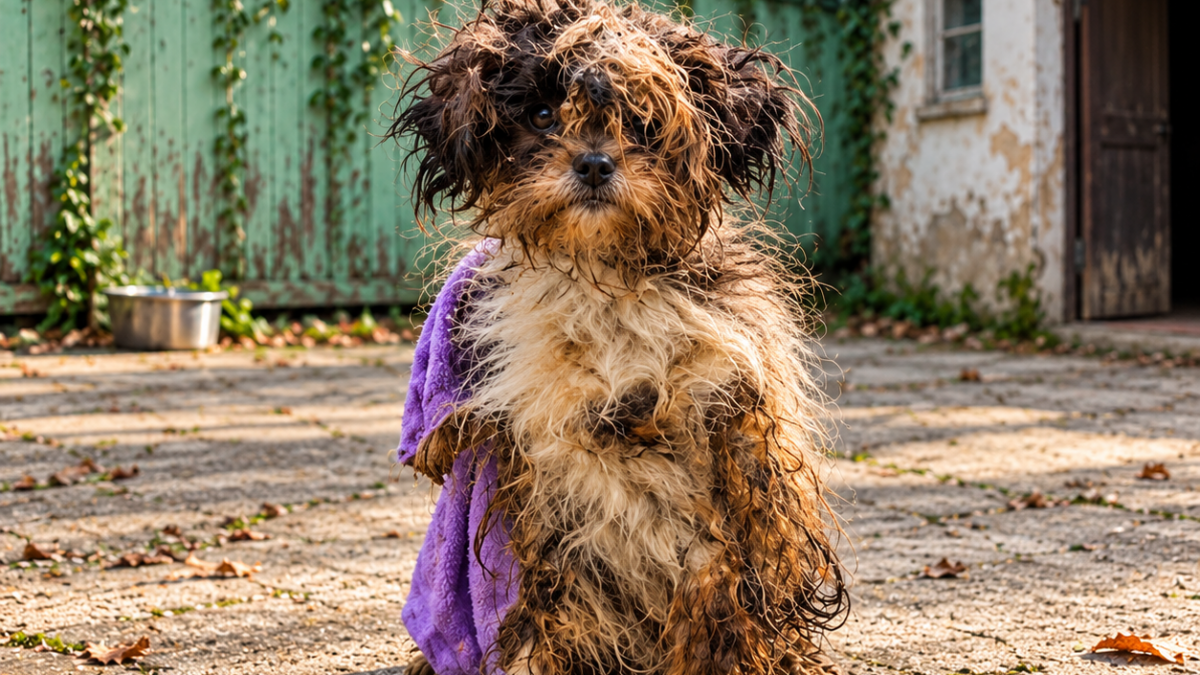
PART 2
Her eye remained open for less than two seconds.
Then she closed it again.
But two seconds was enough.
I had been with rescue animals who looked at people with fear.
Others looked at us with confusion.
Some stared through us entirely, too exhausted or traumatized to react.
Marty’s expression was different.
She looked surprised.
As if the world had suddenly appeared after being gone for so long.
Dr. Park touched my shoulder.
“Anna, I need some space.”
I stepped back.
The medical team moved quickly.
IV fluids.
Blood draw.
Temperature.
Heart rate.
Antibiotic eye medication.
Pain control.
Tests for parasites and infection.
Marty lay on the examination table beneath a heated blanket.
Without the mats, I could finally see how fragile she really was.
Her ribs rose and fell rapidly.
Her stomach was tucked so tightly beneath her body that she looked hollow.
Her paws were irritated where dirt and moisture had been trapped against the skin.
There were areas where the mats had pulled so hard that the skin beneath them had become raw.
And there were other signs.
Signs Dr. Park did not need to explain in detail.
Marty had been bred repeatedly.
Far too many times for a dog whose body had received so little care.
Dr. Park studied her.
“How old did they say she was?”
“Maybe six.”
She shook her head.
“Maybe.”
“You don’t believe it?”
“I believe nobody has been keeping careful records.”
That answer hurt more than a number would have.
A life reduced to guesses.
Age unknown.
Owner history incomplete.
Medical care almost nonexistent.
Litters unknown.
Her entire past could be summarized in transactions.
Bought.
Used.
Sold.
Used again.
Sold again.
Then nearly killed.
Dr. Park listened to her heart.
“Marty, I need you to stay with us.”
Marty’s ear moved.
Rachel stood beside me.
“Can she hear?”
“Oh, definitely,” Dr. Park said.
She spoke louder.
“You hear us, don’t you, girl?”
Marty’s tail moved.
Barely.
One weak movement against the towel.
Rachel covered her mouth.
I stared.
“Did you see that?”
Dr. Park smiled faintly.
“I saw.”
It was not a happy dog wag.
I knew that.
But when you have spent an hour wondering whether a dog will survive the night, one movement becomes enormous.
I lowered my hand near Marty’s nose.
She sniffed.
Her breathing changed.
I did not touch her until she moved her face toward my fingers.
Then I gently rested two fingers against her cheek.
Marty did not pull away.
“I’m here,” I whispered.
For the next three hours, we stayed.
Her first bloodwork came back badly.
Severe anemia.
Malnutrition.
Dehydration.
Evidence of infection.
Her liver values were concerning but not catastrophic.
Her kidneys were stressed.
She had intestinal parasites.
Her eyes were painful, but thankfully Dr. Park believed her vision might be preserved.
One eye had a small corneal ulcer.
The other was heavily inflamed.
“But she can see?” I asked.
“Probably more than she could yesterday.”
That sentence almost destroyed me.
Not because it was dramatic.
Because it was so ordinary.
Yesterday.
Yesterday, someone could have taken scissors and removed the hair from her eyes.
Yesterday, someone could have given her water.
Food.
A clean place to sleep.
Basic medicine.
Nothing that had happened to Marty required expensive technology to prevent.
Most of her suffering had been caused by neglect piled on top of exploitation.
That is what I could not stop thinking about.
Not one catastrophic injury.
Thousands of small decisions.
Don’t feed her enough.
Don’t brush her.
Don’t treat the eye.
Breed her again.
Sell her again.
Someone else can deal with it.
Until nobody did.
Around midnight, Dr. Park told us to go home.
“She needs quiet.”
“I can stay.”
“Anna.”
“I’ll sit in the corner.”
“She needs you rested tomorrow too.”
I looked at Marty.
Her eyes were closed.
For the first time, they were closed because she was sleeping, not because hair had sealed them shut.
I touched her shaved head gently.
“I’ll come back.”
Her ear moved.
I left.
I did not sleep.
At five thirty the next morning, I was already driving back.
The clinic lights were still dim when I entered.
A technician named Luis met me.
“How is she?”
He smiled.
“She ate.”
I stopped walking.
“What?”
“Not much. A few teaspoons of recovery food.”
I laughed.
Then cried.
It was ridiculous.
I had seen dogs survive surgeries, infections, broken bones.
I had watched animals run for the first time after months of rehabilitation.
Yet the idea of Marty eating three teaspoons of food made me cry in a veterinary hallway.
Luis laughed softly.
“We had the same reaction.”
Marty was awake when I entered.
Both eyes were partly open.
They looked irritated and cloudy from medication, but they were visible.
Brown.
Soft.
Much larger than I expected.
“Good morning.”
Her head lifted.
Not far.
But toward me.
I sat beside the kennel.
“Can you see me today?”
Marty stared.
Then her tail moved.
Tap.
One time.
I smiled.
“There you are.”
She sniffed my fingers through the opening.
I thought about reaching in.
Instead, I waited.
Marty moved first.
She pressed the side of her nose against my knuckle.
That was our beginning.
The next week was not a miracle montage.
Recovery almost never is.
There were good mornings.
Bad afternoons.
Moments when Marty ate eagerly.
Moments when she refused everything.
Her anemia made her weak.
Her digestion struggled with food after prolonged malnutrition.
She had diarrhea.
Her skin became itchy as it healed.
Her eyes required medication several times each day, something she hated but tolerated.
The first time Luis approached with the eye drops, she flattened herself against the back of the kennel.
He stopped.
“Okay.”
Marty trembled.
He put the medication down.
Sat on the floor.
Waited.
Five minutes passed.
Then ten.
Finally Marty moved forward.
Luis let her smell the bottle.
Then his hand.
Only when she relaxed slightly did he continue.
That became the rule.
Nothing forced unless medically necessary.
No grabbing.
No sudden restraint.
No punishment for fear.
Marty had spent too much of her life having things done to her.
We wanted recovery to be different.
Wherever possible, we gave her choices.
On day three, she stood without assistance for almost twenty seconds.
On day four, she walked four steps across the treatment room.
Then her legs shook.
I crouched nearby.
“Easy.”
Marty looked at me.
Took one more step.
Then another.
She reached me and leaned her entire tiny body against my shin.
Rachel, filming for her medical chart, lowered the phone.
“She knows you.”
“I think she knows food follows me.”
Marty wagged.
Two full movements this time.
Rachel laughed.
“Sure. Food.”
By the end of the week, she could walk from her kennel to the examination room.
Slowly.
Her shaved coat made her look strangely young.
Without the matted hair, she was a little cream-colored dog with delicate ears and disproportionately large eyes.
We still did not know her exact breed.
Maybe Maltese.
Maybe Shih Tzu mixed with something.
It didn’t matter.
What mattered was that she was still here.
On the seventh day, Dr. Park examined her again.
Her hydration had stabilized.
Her kidney values had improved.
The eye infection was responding.
The corneal ulcer was healing.
She was still dangerously thin, but her body was finally accepting nutrition.
Dr. Park took off her stethoscope.
“I think she can leave.”
My heart jumped.
“Leave?”
“Not go home-home. Shelter recovery.”
I smiled.
That was enough.
Our rescue had a quiet rehabilitation house about twenty minutes outside town.
It was not a traditional shelter.
It had six rooms.
No rows of metal kennels.
No constant barking.
Just washable floors, low beds, fenced grass, and staff trained to work with animals who needed time.
That afternoon I carried Marty outside.
Then stopped.
“You want to try?”
I lowered her carefully.
Her paws touched the pavement.
She looked around.
Cars.
Trees.
Sunlight.
Wind.
The world.
She had probably seen those things before.
But I wondered when she had last been allowed to notice them.
Marty took one step.
Then another.
A leaf blew across the ground.
She stopped.
Her head turned.
The leaf scraped along the pavement.
Marty followed it with her eyes.
Rachel whispered, “Look at her.”
Marty took another step toward it.
Then the leaf blew away.
She watched it go.
I started crying again.
Rachel sighed.
“Anna, we are never going to make it through this dog without dehydrating ourselves.”
I laughed.
Marty looked back at us.
Her tail moved.
That afternoon she arrived at the rehabilitation house.
Her room had a low bed.
Two blankets.
A water bowl.
Food.
A stuffed toy shaped like a rabbit.
She sniffed everything.
Not confidently.
But curiously.
That difference mattered.
At the shop, she had stood still because she had no strength and no options.
At the clinic, she had endured.
Now, for the first time, Marty investigated.
She sniffed the bed.
The wall.
The rabbit.
Then she walked directly to the blanket, circled twice, and lay down.
I sat on the floor.
“You approve?”
Her eyes began closing.
Within minutes she was asleep.
Her whole body relaxed.
I stayed there almost an hour.
A dog sleeping should not feel extraordinary.
But there was something about watching Marty sleep without flinching that felt sacred.
The first two weeks at the recovery house were quiet.
She gained weight slowly.
Too much food too quickly could have caused serious problems, so every meal was carefully measured.
Small portions.
More often.
High-quality nutrition.
Supplements.
Medication.
Checkups.
Marty became obsessed with chicken.
That was our first discovery about who she was beyond what had happened to her.
Not “breeding dog.”
Not “rescued dog.”
Not “meat shop dog.”
Marty.
Marty loved chicken.
She hated carrots.
She tolerated pumpkin.
She would stare at green beans with deep personal suspicion.
One afternoon Rachel offered her a tiny piece of banana.
Marty sniffed it.
Backed away.
Rachel said, “That dramatic?”
Marty stared.
I laughed.
“She has standards now.”
That became one of our favorite things.
Standards.
Preferences.
Choices.
Animals who have been deprived of control often reveal themselves slowly.
Marty began showing us who she was.
She liked blankets folded into piles.
She preferred women at first, although she gradually became comfortable with Luis and our shelter manager, Tom.
She loved warm sunlight.
She disliked metal bowls clattering.
She froze when somebody raised a broom.
That one stayed with me.
We never discovered exactly why.
We stopped sweeping near her.
She liked soft voices.
She loved being scratched behind the left ear.
The right ear, strangely, was unacceptable.
If you touched it, she would politely move her head away.
“Boundary queen,” Rachel called her.
And every time Marty moved away instead of freezing, we celebrated.
Because leaving was a skill.
For a dog who had spent her life controlled by people, walking away was power.
Around day twenty, she barked.
It happened when a squirrel climbed onto the fence.
Marty was outside with me.
She saw it.
Her whole body changed.
Head up.
Ears forward.
Tail raised.
Then:
“Woof.”
I stared at her.
Marty stared at the squirrel.
“Did you just bark?”
The squirrel ran.
Marty took two tiny running steps after it.
Then stopped.
Her legs were not strong enough for more.
But her tail went wild.
I laughed so loudly Rachel came outside.
“What happened?”
“She barked.”
Rachel put a hand over her heart.
“Marty?”
Marty barked again.
At nothing.
Possibly because we seemed impressed.
“Oh, no,” Rachel said. “We’ve created a monster.”
I sat in the grass laughing.
Marty walked over and climbed awkwardly against my thigh.
She still could not jump properly.
So I lifted her onto my lap.
This time she wanted the touch.
That mattered too.
She pressed her head beneath my chin.
I held her.
Not tightly.
Never tightly.
She sighed.
Twenty days earlier, Marty could not see my face.
Now she was sleeping against my chest beneath an open sky.
That should have been enough.
But there was something I did not know yet.
The rescue itself had started an investigation.
We had documentation from the shop.
Transfer records.
Photographs.
Veterinary evidence.
And, most importantly, names.
Marty’s history was incomplete, but not entirely lost.
The shop owner had provided the name of the person who sold her.
That man provided another name.
One transaction led backward to another.
Then another.
Eventually our investigator, Karen Morales, called me.
“Anna, I think we found the breeding operation.”
I was standing outside Marty’s room.
My stomach tightened.
“Where?”
“A property about two hours north.”
“Is it active?”
“Yes.”
“How many dogs?”
“We don’t know.”
“What do we do?”
“Nothing.”
I hated that answer immediately.
“What do you mean, nothing?”
“I mean you do nothing. I’m working with local animal control.”
“Karen—”
“If we move too quickly, they’ll hide the dogs.”
I looked through the window.
Marty was asleep in the sunlight.
“How long?”
“I don’t know.”
“Days?”
“Maybe.”
“Weeks?”
“Possibly.”
I closed my eyes.
“What if there are dogs there like Marty?”
“That is exactly why we cannot get reckless.”
She was right.
I knew she was right.
I still hated it.
That night, I sat beside Marty.
She had gained almost two pounds.
Her eyes were open and clear.
A thin layer of new fur had begun growing over her body.
She looked completely different from the dog I had carried out of that shop.
But when she slept, sometimes her legs twitched.
Sometimes she woke suddenly.
Sometimes a sound made her flatten before she remembered where she was.
I kept thinking about the property two hours north.
How many Martys?
How many dogs were still waiting for somebody to stop being impatient and build a case properly?
So I waited.
The investigation uncovered more than we expected.
The man who had originally kept Marty was named Leonard Voss.
His public business looked legitimate.
Small-scale companion dog breeding.
Online listings.
Cute photographs.
Testimonials.
Puppies posed on blankets.
Words like “family raised.”
“Loved from birth.”
“Healthy parents.”
The reality investigators alleged was different.
Dogs were moved between properties.
Females who stopped producing profitable litters were sold through informal networks.
Medical records were inconsistent.
Some dogs had no current veterinary documentation.
Former workers described overcrowding.
Minimal grooming.
Untreated dental disease.
Skin conditions.
Repeated breeding with inadequate recovery time.
But allegations were not enough.
Animal control needed current evidence.
Then a former employee agreed to speak.
Her name was Michelle.
She had worked for Voss for four months.
She told investigators she quit after watching a small female dog become sick following a litter.
According to Michelle, she begged Voss to take the dog to a veterinarian.
He refused.
“She’s done producing,” he allegedly told her. “Someone else can have her.”
Michelle thought the dog was sold.
Months later, she saw our rescue photo.
Marty.
Even beneath the mats, she recognized the pale patch on Marty’s left ear.
When Karen told me that, I had to sit down.
“She remembers her?”
“She believes so.”
“What was Marty’s name?”
Karen paused.
“Number Seven.”
I thought I had misheard.
“What?”
“That’s what they called her.”
“No name?”
“Michelle says some dogs had names. Others were tracked by numbers.”
I looked at Marty sleeping beside me.
Number Seven.
I felt something hard and hot move through my chest.
Not rage exactly.
Something cleaner.
A certainty.
Whatever happened next, that could not be the end of her story.
Two days later, animal control obtained a warrant.
I was not allowed on the property during the operation.
Thank God.
I don’t know what I would have done with my anger.
Karen called me afterward.
“They found seventeen dogs.”
I closed my eyes.
“Alive?”
“Yes.”
“All?”
“Yes.”
“Condition?”
A pause.
“Mixed.”
That word told me enough.
Some were thin.
Several had severely matted coats.
Three needed immediate veterinary treatment.
One female had an untreated mammary infection.
Another had advanced dental disease.
Puppies were found too.
The property owner was cited initially while the investigation continued.
The dogs were removed pending the legal process.
I looked at Marty.
She was chewing the ear off her stuffed rabbit.
“Marty.”
She looked up.
“They got them.”
Her tail wagged.
She had no idea.
Maybe that was mercy.
The next phase was not dramatic.
It was paperwork.
Depositions.
Veterinary reports.
Photos.
Transfer histories.
Witness interviews.
And money.
Legal cases involving animals are often slowed by a terrible practical problem: someone has to pay to care for the animals while adults argue over who legally owns them.
Our rescue took four.
Other organizations took the rest.
One of the dogs came to our rehabilitation house.
A small white female.
Estimated five years old.
She was terrified of doors.
Her name in the seizure paperwork was Female 12.
I refused to call her that.
Rachel named her Daisy.
The first time Marty saw Daisy through the gate, both dogs froze.
I watched closely.
Marty stepped forward.
Daisy stepped back.
Then Marty did something unexpected.
She lay down.
Not submissively.
Calmly.
Several feet away.
Daisy stared at her.
Marty put her head on her paws.
Five minutes passed.
Then ten.
Daisy moved closer.
I whispered, “Do you know each other?”
No response, obviously.
But Michelle later looked at a photograph.
She recognized Daisy too.
She believed Daisy had been at Voss’s property during part of Marty’s time there.
Maybe they had shared a room.
Maybe a kennel.
Maybe nothing.
We could never prove they remembered each other.
But from that day on, Daisy was calmer when Marty was nearby.
Marty, who weeks earlier had needed people to show her that safety existed, began helping another dog discover the same thing.
There is a kind of justice no courtroom can manufacture.
Watching Marty become that dog was one of them.
Around day forty-five, Dr. Park came for a full recheck.
Marty had gained significant weight.
Her bloodwork was dramatically improved.
Her eyes were healed.
Her coat had grown enough to cover her body in soft curls.
She trotted across the room.
Trotted.
Not stumbled.
Not shuffled.
Trotted.
Dr. Park knelt.
“Look at you.”
Marty went directly to her.
No hesitation.
She climbed her front paws onto Dr. Park’s knee.
Dr. Park laughed.
“Oh, now you like me.”
Rachel said, “She remembers the eye drops.”
Marty wagged.
Dr. Park scratched beneath her chin.
“She’s medically ready.”
I knew what that meant.
Adoption.
I had been waiting for that sentence.
I hated it.
Rescue people are hypocrites that way.
We desperately want animals to find homes.
Then one does, and part of us wants to hide the application.
Marty’s photo went online.
Not the rescue photo.
I refused.
Her adoption profile did not lead with the shop.
Did not lead with suffering.
The first photo showed Marty standing in grass wearing a red harness, ears lifted, eyes bright.
The description began:
Marty is a small, gentle dog who has recently discovered that couches, chicken, and sunbeams may be humanity’s greatest inventions.
We mentioned that she needed a quiet home.
Patient handling.
Regular grooming.
Ongoing veterinary care.
No breeding, obviously.
We did not market trauma.
We introduced Marty.
Applications arrived.
More than I expected.
Some were terrible.
One person wrote:
I want her because I saw where she came from. I can save her.
I put that application aside.
Marty did not need somebody who wanted to feel like a savior.
She needed a family.
Another wrote:
My kids would love dressing her up.
No.
Another family had three toddlers and two energetic dogs.
Probably not.
Then came an application from a woman named Evelyn Carter.
Sixty-two.
Widowed.
Retired elementary school librarian.
One elderly cat.
Fenced yard.
No grandchildren living in the home.
Veterinary reference going back nineteen years.
Under “Why are you interested in Marty?” she had written:
Because she sounds like she prefers quiet people, and so do I.
I laughed.
Then I kept reading.
She had owned two small senior rescue dogs previously.
Both required regular grooming.
One had chronic eye problems.
She understood medication.
She understood fear.
Her answer to “What will you do if your new dog hides from you?” was:
Make sure she has somewhere comfortable to hide and wait until she decides I’m less frightening than the furniture.
I called her.
“Ms. Carter?”
“Evelyn, please.”
“This is Anna from the rescue.”
“Oh.”
Her voice changed.
“Is Marty okay?”
That was her first question.
Not:
Did I get approved?
Not:
When can I have her?
Is Marty okay?
I smiled.
“She’s doing very well.”
“Good.”
“We’d like you to meet her.”
There was silence.
Then Evelyn whispered, “Really?”
She came two days later.
She did not wear perfume.
That sounds like a strange detail.
It wasn’t.
We had asked applicants to avoid strong scents because Marty sometimes became overwhelmed.
Evelyn remembered.
She entered slowly.
Sat in a chair.
Did not call Marty.
Did not reach.
Marty stood across the room.
Evelyn looked at me.
“What should I do?”
“Nothing.”
“Excellent. I’m very good at that.”
I laughed.
Marty watched us.
Five minutes.
Ten.
Then she approached.
She sniffed Evelyn’s shoe.
Evelyn kept her hands folded.
Marty sniffed her pants.
Then her knee.
Evelyn whispered, “Hello.”
Marty looked up.
Evelyn’s eyes filled.
She still did not touch her.
That was when I knew.
Most people believe the moment of connection is when a dog accepts a human touch.
Sometimes it is when the human proves they can resist giving one.
Marty eventually leaned against Evelyn’s leg.
Evelyn looked at me.
“Now?”
“Now.”
She lowered one hand.
Marty sniffed it.
Then pressed her forehead into Evelyn’s palm.
Evelyn began crying.
So did I.
Rachel, watching through the window, held up both hands as though surrendering.
“Again?”
“Yes,” I called.
“Of course.”
Marty went home with Evelyn three days later.
I packed her red harness.
Her medication.
Her blanket.
Her rabbit, although by then the rabbit was missing one ear and half a leg.
Evelyn said, “He’s coming.”
“Absolutely.”
Marty climbed into the carrier willingly.
That alone was a miracle.
I crouched beside her.
“You know what this is?”
She wagged.
“This is the good part.”
She stared at me.
I touched her cheek.
“You don’t get sold again.”
My voice broke.
“Ever.”
Evelyn stood quietly beside me.
I continued.
“No more cages you don’t understand.”
Marty licked my finger.
“No more being useful to somebody.”
Her tail moved.
“You just get to be annoying now.”
Evelyn laughed through tears.
“I can handle annoying.”
I kissed Marty’s head.
“Go home.”
The carrier door closed.
I watched Evelyn secure it carefully in the back seat.
Then they drove away.
I cried in the parking lot until Rachel handed me tissues.
“You know she’s okay.”
“I know.”
“You wanted this.”
“I know.”
“You are terrible at adoption days.”
“I know.”
Three hours later, Evelyn sent a photograph.
Marty was standing in the middle of a living room.
A soft bed sat nearby.
So did the rabbit.
The caption read:
She has inspected the house. I have apparently passed.
The next morning:
Marty asleep on Evelyn’s couch.
The following week:
Marty sitting in a sunbeam.
Two weeks later:
Marty in Evelyn’s lap.
Then came the picture that I printed.
Marty standing in front of a mirror.
Looking at herself.
Both eyes open.
Clear.
Bright.
No mats.
No dirt.
No infection.
Just Marty.
I printed two copies.
One went on the rescue wall.
The other stayed on my desk.
Meanwhile, the case against Leonard Voss continued.
I wish justice moved the way people imagine it does in stories.
A bad person is exposed.
Police arrive.
Door slams.
Done.
Real accountability is slower.
Voss denied neglect.
He claimed employees were responsible for grooming.
He said animals naturally became thin while nursing puppies.
He argued that some photographs were misleading.
He disputed ownership records.
He said Marty had been sold healthy.
He said he could not control what happened after she left.
Some of that mattered legally.
Some did not.
Investigators focused on the dogs found at his property.
Current conditions.
Current records.
Veterinary evidence.
Michelle testified.
Two other former workers eventually came forward.
So did customers whose puppies had arrived sick.
The local licensing authority opened a separate proceeding.
That part may have hurt Voss more than the criminal case.
His business depended on registration and permits.
Inspectors found discrepancies in records.
Vaccination documentation.
Transfer paperwork.
Breeding logs.
One notebook listed females by numbers.
Seven appeared repeatedly.
Beside it were dates.
Litters.
Sales.
A note near the final entry:
Move out.
No name.
Just Seven.
When Karen showed me a copy, I stared at it.
“I want Evelyn to see this.”
Karen shook her head.
“Not yet.”
“Why?”
“Because it’s evidence.”
I nodded.
But I memorized the page.
Not because I wanted Marty’s suffering defined by it.
Because someday, when the case ended, I wanted to tear the meaning out of that number.
At the licensing hearing, Voss appeared in a suit.
Michelle sat two rows behind me.
I had never attended a proceeding like that before.
It was administrative.
Not dramatic.
No jury.
No emotional speeches.
But everything that mattered was there.
Photographs.
Inspection reports.
Medical records.
Business files.
Animal-control testimony.
A veterinarian described one dog’s untreated infection.
Another described chronic dental pain.
Then Marty’s transfer history came up.
Voss’s attorney objected to using conditions after Marty had left his property as evidence against him.
That was fair.
The hearing officer limited that part.
I respected that.
We did not need exaggeration.
The animals found on his property were enough.
The records were enough.
Former employees were enough.
The question was not whether everyone disliked Leonard Voss.
The question was whether he had complied with the rules required to operate.
After two days of testimony, the licensing board revoked his commercial breeding permit.
Not suspended.
Revoked.
The order prohibited him from operating the facility under another business name during the disqualification period.
He appealed.
He lost.
The seized dogs were eventually released from legal hold.
All seventeen.
Every one placed.
Daisy went to a couple who owned a quiet bookstore.
They sent us pictures of her sleeping beneath the front counter.
Another female went to a veterinary technician.
Three dogs entered foster homes together because they were strongly bonded.
The puppies were adopted after medical clearance.
And Marty?
Marty knew none of it.
She was busy terrorizing Evelyn’s garden.
Apparently, after spending most of her life without choices, Marty had chosen war against petunias.
Evelyn called me laughing.
“She has dug up the same plant three times.”
“Move the plant.”
“I did.”
“And?”
“She found it.”
“That sounds personal.”
“I think it is.”
Another time Marty stole half a sandwich from the coffee table.
Evelyn sent a photograph of her hiding beneath a blanket with lettuce stuck to her whiskers.
Caption:
Suspect denies all allegations.
This was what I wanted for her.
Not gratitude.
Not permanent solemnity.
Mischief.
Ordinary problems.
A dog who had once been almost invisible beneath neglect was now creating inconvenience.
Wonderful, ridiculous inconvenience.
Six months after the adoption, Evelyn brought Marty to our reunion picnic.
I heard her before I saw her.
A bark.
Sharp.
Demanding.
Then Marty appeared at the end of a red leash.
Her coat had grown back completely.
Soft cream curls.
Professional trim.
Bright eyes.
Healthy body.
Tail high.
I crouched.
“Marty?”
She stopped.
For one terrible second, I wondered if she had forgotten me.
Then she ran.
Not fast.
Her legs were still slightly awkward.
But she ran straight into my arms.
I fell backward onto the grass laughing.
Marty climbed onto my chest and licked my face.
“Okay!”
Evelyn laughed.
“I think she remembers.”
Marty’s entire body wagged.
Rachel came running.
“No way.”
Marty turned.
Then ran to her too.
Rachel dropped to her knees.
“Look at you!”
Marty bounced between us.
I had never seen her bounce.
The dog who once could barely stand was bouncing.
People nearby clapped.
I hated that.
Not because it was cruel.
Because Marty immediately startled.
Her body dropped.
I raised one hand.
“Quiet.”
Everyone stopped.
Evelyn crouched.
“Marty.”
Marty looked at her.
Evelyn did not grab.
She opened her arms.
Marty ran into them.
That was the moment I understood the adoption completely.
When frightened, Marty no longer looked for the nearest place to disappear.
She looked for Evelyn.
Home had become a person.
Later that afternoon, Marty fell asleep in Evelyn’s lap.
I sat beside them.
“She’s different.”
Evelyn stroked Marty’s back.
“She’s still her.”
That answer was perfect.
Not fixed.
Not transformed into another dog.
Still her.
Just safe enough to show us who “her” was.
I told Evelyn the case had ended.
Not every detail.
Only what was public.
The license revocation.
The placements.
The dogs.
Evelyn listened.
Then she looked down at Marty.
“Does he know she survived?”
“I don’t know.”
“I hope he does.”
There was no anger in her voice.
I asked, “Why?”
She rubbed Marty’s ear.
“The same reason I want people who discard old books to see them restored.”
I smiled.
“That is the most librarian answer possible.”
“I know.”
She looked at Marty.
“I want him to know he was wrong about her value.”
That became my definition of revenge.
Not cruelty returned.
Not suffering balanced against suffering.
Marty living well enough to prove every person who treated her like inventory had misunderstood what she was.
A year after her rescue, Evelyn sent us a photograph on the anniversary.
Marty wore a blue sweater.
I normally dislike dogs in unnecessary clothes.
Marty loved sweaters.
She shoved her head into them herself.
The caption read:
One year of being the boss.
I printed that too.
The rescue wall gradually became covered with Marty photographs.
First day.
Day seven.
Day forty-five.
Adoption.
Six months.
One year.
Three years.
In each picture, more of her personality appeared.
At first:
A dog surviving.
Then:
A dog recovering.
Then:
A dog belonging.
Finally:
A dog who knew she belonged.
Three years after the rescue, I visited Evelyn’s house.
Marty met me at the door barking.
“Security is aggressive,” Evelyn warned.
Marty weighed eleven pounds.
I raised both hands.
“I surrender.”
Marty sniffed my shoes.
Then brought me a toy.
Not the rabbit.
The original rabbit had finally disintegrated.
Evelyn had preserved what remained of it in a drawer.
“This one is Rabbit Four.”
“There were four?”
“Five.”
“Where’s Five?”
“Under the couch.”
Marty barked at us.
“Sorry,” I said. “Private family matter.”
She wagged.
Evelyn made tea.
Marty sat between us on the couch.
I looked around.
Photographs on shelves.
Books everywhere.
A small ramp beside the sofa.
Grooming brushes neatly arranged in a basket.
Eye wipes.
Treats.
A dog bed in every room, apparently.
“She has five beds?”
“Seven.”
“Evelyn.”
“She likes options.”
I laughed.
Marty rolled onto her back.
Her stomach was round and healthy.
A pale surgical scar ran along one side.
After adoption, once medically stable, she had been spayed.
No more litters.
Ever.
I placed my hand near her.
She put one paw on my wrist.
Evelyn smiled.
“She does that when she wants you to continue.”
So I scratched her chest.
Marty closed her eyes.
I remembered the first time I saw her.
Eyes sealed.
Body hidden.
Standing in that shop.
Too weak to move.
And here she was, closing her eyes because she felt safe enough to sleep beneath a human hand.
That difference was everything.
A few months later, Michelle contacted me.
The former employee.
She had struggled after the case.
Guilt.
She kept thinking about dogs she had not helped soon enough.
I understood.
People imagine rescuers have clean consciences because we help animals.
We don’t.
We carry lists.
The dog we arrived too late for.
The cat we could not catch.
The animal we placed badly.
The signs we missed.
Michelle’s list was heavier because she had worked inside the facility.
“I should have done more,” she told me.
We met at a coffee shop.
“You did something.”
“Eventually.”
“You testified.”
“Eventually.”
“You kept records.”
“Eventually.”
She stared at her coffee.
“I knew Number Seven.”
“Marty.”
She nodded.
“Marty.”
Even hearing her correct herself mattered.
“She used to be friendly,” Michelle said.
My chest tightened.
“What was she like?”
Michelle smiled sadly.
“She would follow me during cleaning.”
“Really?”
“She liked shoelaces.”
I laughed.
“She still does.”
Michelle’s eyes filled.
“She does?”
“Yes.”
That broke her.
She covered her face.
“I thought they killed that part of her.”
I reached across the table.
“They didn’t.”
She cried for several minutes.
Then she told me something I had never known.
Once, after Marty lost a litter, Michelle had found her lying alone.
Michelle sat beside her.
Marty crawled into her lap.
“I remember thinking I should take her,” Michelle whispered.
“Why didn’t you?”
“I was scared.”
I did not tell her fear was no excuse.
She already knew.
I did not tell her it was fine.
It wasn’t.
Instead I said, “What you do next matters too.”
That was something Marty had taught me.
The past does not become good because the future improves.
But the future still counts.
Michelle began volunteering with another rescue.
Not ours.
Somewhere farther away where nobody knew her history.
She eventually became a foster.
The first dog she fostered was an elderly female who had been used for breeding.
Of course.
She sent me a picture after the adoption.
The dog was asleep on a couch.
Michelle wrote:
I stayed until she got home.
I replied:
Good.
Nothing more was needed.
Five years after Marty’s rescue, Dr. Park called me.
“She’s here.”
My stomach dropped automatically.
“At the clinic?”
“For a routine check.”
“Oh.”
Dr. Park laughed.
“You’re traumatized.”
“Yes.”
“Come over.”
When I arrived, Marty was standing on the examination table.
Standing.
Boldly.
Like she owned it.
Evelyn was beside her.
Dr. Park lifted her stethoscope.
“She bit my equipment.”
Marty had apparently attempted to steal the rubber tip.
I laughed.
“This is the same dog who wouldn’t move?”
Dr. Park looked at her.
“No.”
Then corrected herself.
“Yes.”
That stayed with me.
Same dog.
Different life.
Marty’s heart was good.
Her kidneys were good.
Her eyes had some age-related cloudiness but remained comfortable.
She had mild arthritis.
Her teeth required cleaning.
Ordinary aging problems.
I cannot explain how beautiful ordinary aging problems felt.
For a dog we once feared would not survive the night, arthritis at an old age was a privilege.
Dr. Park scratched behind Marty’s left ear.
Marty leaned into it.
Then Dr. Park touched the right.
Marty turned away immediately.
Everyone laughed.
“Still no right ear?”
“Never,” Evelyn said.
“Boundary queen.”
Marty barked.
We obeyed.
By her estimated eleventh year, Marty slowed down.
Not dramatically.
Walks became shorter.
She slept longer.
Jumping onto the couch became difficult, which was why Evelyn had added ramps.
Her coat required even more careful grooming as she aged.
Evelyn never missed it.
Not once.
Every six weeks, professional groomer.
Brushing at home.
Eyes cleaned gently each morning.
Nails trimmed.
Skin checked.
The ordinary maintenance that had been denied to Marty for years became ritual.
Evelyn once told me, “I know she doesn’t understand why I brush her.”
“Probably not.”
“But I keep thinking about how much pain those mats caused.”
Marty was asleep between us.
I said, “She understands how you make her feel now.”
That was enough.
At twelve, Marty developed heart disease.
Mild at first.
Medication helped.
Then stronger medication.
Evelyn called me after the diagnosis.
“I’m scared.”
“I know.”
“I promised her she was done suffering.”
“You kept that promise.”
“What if this hurts?”
“Then Dr. Park manages it.”
“And if she can’t?”
I knew what Evelyn was asking.
The final responsibility.
The one no adopter wants.
“Then you keep the promise a different way.”
Silence.
“I don’t want to.”
“Nobody does.”
Marty remained comfortable for another year.
Thirteen.
Maybe fourteen.
We never knew.
Her face became white.
Her hearing faded.
Her eyes clouded.
But her appetite remained outrageous.
Chicken still ruled her life.
Carrots remained offensive.
She still barked at squirrels she could barely see.
She still hated her right ear touched.
She still slept in sunbeams.
Then, one winter morning, Evelyn called.
I knew before she spoke.
“Anna.”
“I’m here.”
“She won’t eat.”
I closed my eyes.
“Is she breathing okay?”
“No.”
“I’m coming.”
Dr. Park met us at Evelyn’s house.
Marty was on her favorite blanket near the window.
Sunlight touched half her body.
She looked tired.
Not frightened.
Just tired.
Her heart was failing.
There were hospital options.
Oxygen.
Aggressive medication.
Perhaps another day.
Maybe more.
But Marty hated clinics now that she had a home to compare them with.
Evelyn looked at me.
“What would you do?”
I hated the question.
I sat beside Marty.
She lifted her head weakly.
Her tail moved once.
The same tiny movement I had seen in the clinic years before.
I started crying.
“Hey, sweetheart.”
Marty sniffed my fingers.
Pressed her nose into them.
Still Marty.
Still choosing contact.
Evelyn whispered, “I can’t make her stay because I’m afraid to lose her.”
Dr. Park lowered her eyes.
That was the decision.
We did not move Marty.
We moved around her.
Blanket.
Pillow.
Rabbit Five.
Chicken she no longer wanted.
Evelyn sat on one side.
I sat on the other.
Dr. Park explained every step.
No surprises.
No sudden restraint.
Exactly as we had promised from the beginning.
Every touch would give Marty a reason to feel safe.
Evelyn bent close.
“You were supposed to be with me for twenty years.”
Marty breathed slowly.
“I know that’s unreasonable.”
A faint tail movement.
Evelyn laughed through tears.
“Don’t agree with me.”
I put my hand against Marty’s chest.
I could feel her heart.
Fast.
Tired.
Still fighting because bodies fight even when life is complete.
I remembered carrying her from the shop.
How light she had been.
How she leaned against me because she had no strength left.
This time, when I lifted her gently into Evelyn’s lap, Marty relaxed.
Completely.
She knew those arms.
Home.
Evelyn whispered into her fur.
“You were never Number Seven.”
I froze.
I had told Evelyn the story years earlier.
Not the whole evidence file.
Just enough.
She repeated it.
“You were never inventory.”
Marty’s eyes were half closed.
“You were Marty.”
Evelyn kissed her head.
“My Marty.”
Dr. Park waited.
Then Evelyn nodded.
Marty died beneath the hand of the woman she trusted most.
No shop.
No cage.
No filthy coat.
No stranger deciding what she was worth.
Her body was warm.
Clean.
Fed.
Loved.
And when her eyes closed for the final time, nothing covered them.
I cried harder than I had expected.
After all those years, I thought I had prepared myself.
You cannot prepare for losing an animal you once watched return from the edge of death.
Evelyn held her for a long time.
Then she looked at me.
“Do you remember the first photograph?”
“Yes.”
“I hate it.”
“I know.”
“But I’m glad it exists.”
That surprised me.
“Why?”
“Because look at her.”
She touched Marty’s face.
“That picture doesn’t get to be the whole story.”
No.
It didn’t.
A week later, Evelyn gave me a package.
Inside was Marty’s original red harness.
Her favorite sweater.
And Rabbit Five.
“I can’t throw them away.”
“You don’t have to.”
“I want the rescue to have something.”
I shook my head.
“You keep them.”
She looked at me.
“Then take this.”
She handed me an envelope.
Inside was a check.
A large one.
Too large.
“Evelyn.”
“Don’t.”
“This is too much.”
“No.”
“Keep it.”
“I sold my house.”
I stared.
“What?”
“I’m moving closer to my sister.”
She smiled.
“The house is too big without Marty yelling at squirrels.”
Her voice broke.
She recovered.
“I want this used for grooming and medical care for neglected senior dogs.”
I looked at the amount again.
“This could help a lot of animals.”
“That’s the idea.”
“What do you want the fund called?”
She thought.
Then smiled.
“Not Number Seven.”
I laughed through tears.
“Agreed.”
We called it Marty’s Second Chance Fund.
Over the following years, it paid for dozens of dogs.
Matted coats.
Dental disease.
Eye infections.
Bloodwork.
Medication.
Senior dogs people had stopped investing in because they were old.
Each time we used the fund, I thought about a little dog standing beneath filthy hair, unable to see.
A dog somebody believed had no future.
The old breeding property eventually changed hands.
Voss never reopened commercially.
His license remained gone.
The civil penalties and criminal consequences followed him for years.
Some people wanted me to celebrate that.
I never did.
Accountability mattered.
Very much.
But Marty’s life taught me that punishment is not the most powerful ending.
Replacement is.
Replace fear with safety.
Hunger with meals.
Filth with care.
Use with belonging.
A number with a name.
A transaction with a family.
That was how we defeated everything done to her.
Not by making somebody else hurt.
By making sure Marty’s hurt did not become the last thing she ever knew.
Years later, a new volunteer at the rescue stopped in front of our photo wall.
Marty’s first picture was still there.
Not the worst one.
I would never display that.
It showed her on day one after grooming.
Tiny.
Shaved.
Eyes swollen.
Beside it was the photograph from Evelyn’s house.
Marty in a sunbeam.
Healthy coat.
Bright eyes.
Rabbit beside her.
The volunteer pointed.
“Is that really the same dog?”
“Yes.”
“What happened to her?”
I looked at the pictures.
“A lot.”
She waited.
I could have told her about the shop.
The breeding.
The mats.
The investigation.
The license.
The court proceedings.
Instead I said the thing that mattered most.
“She got old.”
The volunteer looked confused.
I smiled.
“That was the victory.”
Marty got old.
Old enough for heart medicine.
Old enough for ramps.
Old enough for cloudy eyes.
Old enough to slow down.
Old enough to wear out five stuffed rabbits.
Old enough to become difficult about food.
Old enough to bark at squirrels for years.
Old enough that losing her broke the heart of a woman who had loved her for most of the life that mattered.
The first time I carried Marty, I was afraid she would die before sunrise.
Instead she lived long enough for us to complain that she was stealing sandwiches.
That is not a small thing.
That is the ending.
I still have the photograph Evelyn gave me.
Marty standing in front of the mirror.
Sometimes people look at it and say she looked happy.
Maybe she was.
I try not to put human words into animals when I don’t need to.
What I know is simpler.
Her body was relaxed.
Her eyes were clear.
Her tail was up.
She had food.
She had medical care.
She had a person who would never sell her.
And when a human hand came toward her, Marty no longer braced for what might happen next.
She leaned into it.
That was enough.
More than enough.
The people who used Marty spent years deciding her value by what they could take from her.
Puppies.
Money.
Another sale.
Another transaction.
Then one day there was nothing left they wanted.
So they let her go.
They thought that meant Marty had no value left.
They were wrong.
Her best years began after she stopped being useful to them.
She became a companion.
A troublemaker.
A blanket thief.
A squirrel patrol officer.
A sandwich criminal.
A lap dog.
A reason an older widow laughed inside a quiet house again.
A reason seventeen dogs were investigated more carefully.
A reason former workers finally spoke.
A reason neglected senior dogs received medical treatment years after Marty herself was gone.
That is what they failed to understand.
They saw an exhausted body.
We eventually saw a life.
And that is why, whenever I remember the first time Marty opened that painful eye and looked at me from the clinic table, I no longer think about the shop.
I think about everything she had not seen yet.
The yard.
The sun.
The red harness.
Evelyn’s living room.
The couch she would eventually claim.
The plants she would dig up.
The squirrels she would bark at.
The woman who would hold her at the end.
Marty could not see any of it that night.
Neither could I.
I only knew that she was alive.
Sometimes that has to be enough.
You remove the mats.
You treat the infection.
You offer food.
You place your hand nearby.
And you give tomorrow a chance to arrive.
For Marty, tomorrow kept arriving.
Again.
And again.
And again.
Until one terrified little dog who had almost been reduced to a number had lived an entire second life under a name spoken with love.
Marty.
That was the name she carried home.
That was the name Evelyn whispered when she was happy.
The name written on her veterinary charts.
The name on her food bowl.
The name on the fund that still helps old dogs.
And when I think about every person who once handled her as though she were nothing more than something to use and sell, there is only one ending that feels right.
They never got Marty back.
They never got another litter from her.
They never got another dollar from her.
They never got to decide what happened to her again.
Instead, Marty spent the rest of her life learning that hands could brush without hurting, lift without taking, hold without trapping, and let go only when love finally required it.
For a dog who had once been unable even to open her eyes, she got to see enough kindness to last a lifetime.
And this time, it really was hers.
[EXPANDED ENDING — APPROX. 2,000 WORDS]
The morning after Marty died, I woke before sunrise.
For several seconds, I forgot.
Then I saw my phone on the nightstand.
Three unread messages from Evelyn.
No emergencies.
No desperate questions.
Just photographs.
The first was Marty asleep in a patch of sunlight two summers earlier, one paw resting on Rabbit Four.
The second showed her standing in Evelyn’s garden with dirt on her nose and a freshly uprooted petunia behind her.
The third was taken only a few months before she died.
Marty was curled against Evelyn’s side beneath a blue blanket, eyes half closed, completely relaxed.
Underneath the last picture, Evelyn had written:
I keep looking at her eyes.
I knew exactly what she meant.
When Marty first came to us, we couldn’t see her eyes at all.
They had been buried beneath filthy mats.
When the hair was finally cut away, those eyes were swollen, infected, painful, and uncertain.
For years afterward, every photograph of Marty somehow seemed to come back to them.
Clear.
Bright.
Curious.
Annoyed.
Sleepy.
Demanding.
Alive.
I called Evelyn.
She answered on the third ring.
Neither of us spoke at first.
Finally she whispered, “The house is too quiet.”
“I know.”
“I put her breakfast bowl down before I remembered.”
My throat tightened.
“What did you do?”
“I left it there.”
That sounded exactly right.
Grief is strange.
People think the hardest moment is death itself.
Sometimes it isn’t.
Sometimes it is seven o’clock the next morning when your body follows a routine your heart can no longer complete.
You reach for the leash.
You open the cabinet.
You look toward the bed.
You save the last piece of chicken automatically.
And then reality arrives again.
Marty had spent years creating tiny routines inside Evelyn’s house.
She slept beneath the kitchen table while Evelyn drank coffee.
She waited beside the refrigerator at noon.
At four in the afternoon, she demanded her walk.
At eight, she circled three times on the couch before choosing exactly the same spot every night.
By nine, she expected Rabbit Five.
At ten, she followed Evelyn to bed.
These habits had once seemed ordinary.
Now every one of them had become an empty space.
A week later, I drove to Evelyn’s house.
She had not moved anything.
Marty’s bed was still near the window.
Her red harness still hung beside the back door.
The ramp remained against the couch.
Rabbit Five lay in the center of the bed.
Evelyn sat down.
“I know I have to put things away eventually.”
“No, you don’t.”
She looked at me.
“People keep telling me I should.”
“People say a lot of things because silence makes them uncomfortable.”
That almost made her smile.
I sat beside her.
“Move things when you want to move them.”
“What if I never want to?”
“Then buy more storage.”
She laughed.
A real laugh.
Small, but real.
For several minutes we looked at Marty’s empty bed.
Then Evelyn said something I did not expect.
“I want to go back.”
“Back where?”
“To the rescue.”
I turned toward her.
“Are you sure?”
“No.”
“Good answer.”
She looked down at her hands.
“I can’t adopt another dog.”
“You don’t have to.”
“I don’t want another dog.”
“That’s okay too.”
“It feels disloyal.”
I understood.
“You don’t have to decide anything.”
“I don’t want to replace her.”
“You couldn’t.”
Evelyn looked at me sharply.
I continued.
“No dog could be Marty. That’s why another dog wouldn’t replace her.”
Her eyes filled.
“I just keep thinking about the first day you carried her out.”
“So do I.”
“She was almost gone.”
“Yes.”
“And then she got all those years.”
I nodded.
Evelyn wiped her cheek.
“There are others, aren’t there?”
Always.
There were always others.
Older dogs.
Neglected dogs.
Dogs whose coats had become prisons.
Dogs whose teeth hurt.
Dogs surrendered because they required medication.
Dogs who had spent their useful years producing puppies and suddenly became somebody else’s problem.
“Yes,” I said.
“There are others.”
Two weeks later, Evelyn came to the rescue.
She didn’t enter the kennels immediately.
She stood near the front desk holding a paper bag.
“What’s that?”
“Chicken.”
I stared.
“You know we have dog treats.”
“Marty would disagree.”
I laughed.
“Fair.”
The first dog Evelyn met was a thirteen-year-old terrier mix named Rose.
Rose had been surrendered after her owner entered a nursing facility.
She had cloudy eyes, arthritis, and exactly six teeth.
She was also furious about life.
When I opened her kennel, Rose barked at Evelyn like a creature ten times her size.
Evelyn looked at me.
“I like her.”
“Of course you do.”
Rose barked again.
Evelyn sat on the floor outside the kennel.
She did not reach.
Did not call.
Did not offer chicken.
She simply waited.
Twenty minutes passed.
Rose stopped barking.
Another ten.
She approached.
Evelyn placed one piece of chicken on the floor.
Rose ate it.
Then another.
By the end of the hour, Rose was sitting beside Evelyn’s shoe.
Evelyn looked at me.
“Don’t say anything.”
“I wasn’t going to.”
“You were.”
“I was thinking loudly.”
She sighed.
“I am not adopting her.”
“Of course not.”
Three days later, she adopted Rose.
I said nothing.
Mostly.
Rose lived with Evelyn for two years.
She never became Marty.
She was not supposed to.
She hated sweaters.
Loved carrots.
Despised squirrels even more passionately than Marty had.
She refused to sleep on the couch and preferred a ridiculous green cushion beside the fireplace.
Where Marty had been gentle, Rose was opinionated.
Where Marty approached strangers carefully, Rose confronted them like an unpaid security guard.
Evelyn loved her exactly as she was.
That was the final thing Marty taught her.
Rescue was not about recreating the animal you lost.
It was about allowing another animal to become entirely itself.
When Rose eventually died at fifteen, Evelyn grieved again.
But this time, she already knew something.
Grief was not proof she had made a mistake by loving.
It was proof there had been something worth missing.
Marty’s Second Chance Fund grew.
At first, it was just Evelyn’s donation.
Then people who had followed Marty’s recovery began contributing.
A woman mailed twenty dollars with a note:
For another old girl who needs her eyes cleaned.
A child sent fourteen dollars from a lemonade stand.
A retired groomer volunteered one Saturday a month.
A veterinary clinic agreed to discount dental procedures for senior rescue dogs.
Within three years, the fund had paid for treatment for thirty-eight dogs.
I kept a folder of their photographs.
Before.
After.
Not because transformations were always dramatic.
Sometimes “after” was simply a dog with clean fur.
A dog eating without dental pain.
A dog sleeping comfortably.
A dog whose nails no longer curled into its paw pads.
A dog living six good months instead of dying six painful months earlier.
One of them was a tiny brown spaniel named Pearl.
When Pearl arrived, her coat was so matted that nobody could tell where her ears ended.
She was eleven.
Heart murmur.
Severe dental disease.
One potential adopter asked why anyone would spend money on a dog that old.
I heard the question from across the lobby.
Before I could answer, Evelyn did.
“Because she’s alive now.”
The man looked embarrassed.
Evelyn continued, not unkindly.
“Old isn’t the same as finished.”
I looked at her.
She looked at me.
Neither of us needed to say Marty’s name.
Pearl received dental surgery through the fund.
Fourteen diseased teeth were removed.
Two weeks later, she ate dry kibble for the first time without crying.
A retired couple adopted her.
She lived another three years.
Three years.
For someone who believed old dogs were finished, three years might not sound like much.
For Pearl, it was more than a thousand mornings.
A thousand meals.
A thousand nights on somebody’s bed.
Time is only small when you are measuring somebody else’s life.
Marty’s former breeder never returned to commercial breeding.
His appeal failed.
The property where investigators found those seventeen dogs was eventually sold.
Years later, I happened to drive past it.
I almost missed the place.
The old kennel building had been torn down.
The fence was gone.
A family had bought the land.
There were bicycles beside the garage.
A vegetable garden where one of the outdoor runs had been.
A golden retriever slept on the porch.
I pulled over.
For a long moment, I stared.
That was the place where Marty had been Number Seven.
Where Daisy had been Female Twelve.
Where other dogs had existed as records, production histories, sales values.
Now there were tomatoes growing beside the old foundation.
A child came outside and threw a tennis ball.
The retriever ran after it.
I started crying.
Not because the property had been destroyed.
Because it had become ordinary.
No cages.
No numbered females.
No breeding logs.
Just a dog chasing a ball because somebody had thrown it for fun.
I did not knock.
The family living there did not owe Marty anything.
I drove away.
That night I called Evelyn.
“You’ll never guess where I went.”
When I told her, she became quiet.
“Was it hard?”
“Yes.”
“Did you hate him?”
I knew who she meant.
Leonard Voss.
I thought about it.
“No.”
That surprised even me.
There had been a time when I wanted him to understand every ounce of suffering Marty had experienced.
I wanted him to stand in a room powerless while somebody else decided his future.
Anger makes symmetry feel like justice.
But years had changed something in me.
“I don’t think about him much anymore.”
Evelyn exhaled softly.
“That’s probably the better punishment.”
Maybe.
But even that was not quite right.
His punishment was not my responsibility.
The courts had handled what they could.
The licensing board had handled what it could.
The rescue had taken the dogs.
The veterinarians had treated them.
The adopters had brought them home.
The rest belonged to Marty.
And Marty had done the one thing nobody who used her had planned for.
She mattered after they were finished with her.
Not because she earned money.
Not because she produced puppies.
Not because people were shocked by her rescue photographs.
She mattered while sleeping.
While stealing sandwiches.
While digging flowers.
While refusing carrots.
While demanding the left ear be scratched and the right one left alone.
She mattered when she was useful to absolutely nobody.
That was the part I wished every person who exploits animals could understand.
A living creature does not need to produce something to justify receiving care.
Years after Marty died, a package arrived at the rescue.
No return name I recognized.
Inside was a framed photograph.
Marty.
The mirror photograph.
The one where she stood looking at herself with both eyes clear.
Behind the photograph was a handwritten note from Evelyn.
I had moved closer to my sister by then and seen Evelyn less often.
The note said:
Anna,
I know this picture belongs on your wall more than mine now.
When people see Marty’s first photograph, please show them this one too.
I don’t want anyone remembering her only as the dog who suffered.
She was funny.
She was stubborn.
She once stole an entire dinner roll and hid it underneath my pillow.
She hated mornings when it rained.
She loved freshly washed blankets.
She growled at the vacuum cleaner but was afraid of the toaster.
She knew exactly which neighbor kept treats in his pocket.
She never forgave me for buying carrots twice.
Please tell people that part.
Love,
Evelyn
I read the note three times.
Then I changed the rescue wall.
Until then, Marty’s story had been displayed chronologically.
Day one.
Day seven.
Day forty-five.
Adoption.
Home.
I took the first photograph down.
Not permanently.
I moved it.
The mirror photograph became the first one people saw.
Underneath it, I put a small card:
MARTY
Beloved family dog.
Expert sandwich thief.
Professional squirrel critic.
Survivor.
Then, farther down, came the rescue photograph.
Because Evelyn was right.
The order mattered.
Marty had suffered.
But suffering was something that happened to her.
It was not who she was.
New volunteers sometimes stopped in front of the display.
They would see the healthy dog first.
Then the shaved, skeletal dog.
Then they would turn to me.
“That’s the same dog?”
“Yes.”
“How?”
There were medical answers.
Fluids.
Nutrition.
Antibiotics.
Eye treatment.
Grooming.
Time.
But the real answer was bigger.
“People stopped taking things from her.”
That was the difference.
Nobody bred her.
Nobody sold her.
Nobody demanded usefulness.
Nobody ignored pain because treating it cost money.
People started giving instead.
Food.
Medicine.
Time.
Space.
Choice.
Eventually love.
One winter afternoon, years after Evelyn had first created Marty’s fund, a young volunteer named Grace found me in the treatment room.
She was crying.
“What happened?”
She pointed toward one of the recovery kennels.
A severely neglected senior poodle had arrived that morning.
Matted.
Thin.
Terrified.
Not as bad as Marty had been.
But close enough.
Grace whispered, “How do you keep doing this?”
I knew what she meant.
How do you keep seeing what people do?
How do you remove one dog from neglect knowing ten more exist somewhere you cannot reach?
How do you avoid hating everyone?
I looked at the little poodle.
Then at Grace.
“You don’t try to save every dog tonight.”
She wiped her face.
“What do you do?”
“You help the one in front of you.”
It sounded simple.
Maybe too simple.
But that was how Marty had begun.
One dog.
One night.
One clinic.
One pair of clippers cutting away one mat at a time.
Nobody rescued Marty’s whole future that first evening.
We simply got her through the next hour.
Then the next.
Eventually the hours became years.
Grace looked toward the kennel.
“What if she doesn’t trust us?”
“Then we don’t make trust the price of care.”
That was another lesson Marty had left us.
Animals do not owe rescuers gratitude.
They do not owe kisses.
Tail wags.
Cuddles.
Transformation videos.
They are allowed to remain afraid while we help them.
They are allowed to dislike us.
They are allowed to have boundaries.
Marty’s first tail wag had felt enormous because she chose it.
Not because we required it.
Grace nodded.
She sat outside the poodle’s kennel.
No touching.
No reaching.
Just sitting.
I walked away smiling.
Months later, that dog was adopted.
Grace became her foster.
Then her adopter.
Of course.
Some patterns deserve repeating.
On the tenth anniversary of Marty’s rescue, Evelyn, Rachel, Dr. Park, Michelle, Grace, and I met at the shelter.
We did not plan anything elaborate.
No balloons.
No speeches.
Marty would have hated balloons anyway.
Instead, we prepared care packages for senior dogs going into foster homes.
Soft blankets.
Grooming brushes.
Eye wipes.
Dental chews.
Chicken treats.
No carrots.
Evelyn insisted on that.
We assembled forty packages.
At the bottom of each was a small card:
For the dogs who deserve their good years too.
We never put Marty’s rescue photo on it.
We used the mirror picture.
Marty looking at herself.
Eyes open.
At the end of the afternoon, everyone left except me.
The shelter became quiet.
I stood in front of her photographs.
Ten years.
It seemed impossible.
I could still feel the weight of her the first time I picked her up.
Or rather, the absence of weight.
The horrifying lightness of her body.
I remembered the shop owner asking impatiently:
“You taking her or not?”
As though I were deciding whether to purchase an old chair.
I remembered looking down at a dog who could not see me.
“Yes,” I had said.
At the time, I thought that yes meant we were taking Marty away from death.
Years later, I understood it differently.
Yes, Marty.
You get food.
Yes, you get treatment.
Yes, you get time.
Yes, somebody will wait when you are afraid.
Yes, you get to choose who touches you.
Yes, you get a name.
Yes, you get a home.
Yes, you get to become old.
Yes, your life still counts after somebody else decides you are no longer useful.
And finally:
Yes, people will remember you.
But not only for what was done to you.
They will remember the dog who dug up petunias.
The dog who hated carrots.
The dog who barked at squirrels.
The dog who wore blue sweaters.
The dog who learned to sleep beneath human hands without fear.
The dog who helped other frightened animals long after her own life ended.
I touched the bottom corner of the photograph.
“You did pretty well, Marty.”
The shelter was empty.
Nobody answered.
Then, from the recovery room behind me, I heard a tiny bark.
I laughed.
Of course.
There was another dog waiting.
There always would be.
So I turned away from Marty’s photograph and walked toward the sound.
That is how I choose to remember her story now.
Not ending in a clinic.
Not ending in a courtroom.
Not ending beneath a gravestone.
Marty’s story ends every time somebody opens a kennel and refuses to see an old, neglected animal as worthless.
Every time a groomer cuts away the first painful mat.
Every time a veterinarian treats a dog somebody else decided was too old.
Every time an adopter sits on the floor and waits instead of reaching.
Every time a frightened animal discovers that the next human hand is not going to hurt.
That is the revenge.
That is the victory.
The people who used Marty tried to turn her entire existence into what they could take from her.
In the end, they lost that argument completely.
Because the most valuable part of Marty’s life began only after they had nothing more to gain.
And long after the shop disappeared from her world, long after the breeding records were closed, long after the man who once listed her as a number lost the right to run his business, Marty’s name continued opening doors for dogs she would never meet.
Her fund kept paying bills.
Her story kept changing policies.
Her photograph kept teaching volunteers.
Her life kept mattering.
There are endings where the villain loses.
There are endings where the victim survives.
Marty received something better.
She became larger than what happened to her.
The dog I once carried from that shop could not see my face.
The dog who died years later knew exactly where she was.
She was in Evelyn’s arms.
She was home.
And nothing—not the shop, not the neglect, not the people who used her, not the years stolen from her—could take that final truth away.
Marty was loved.
Completely.
Without conditions.
Without a price.
And for the rest of her life, she never belonged to anyone who needed something from her again.

