PART 2: He Was Locked Behind a Bathroom Door for a Year—When I Opened It, the 4-Pound Cat Was Still Waiting to Be Saved
PART 2
I approached the bathtub slowly.
Animals who have been confined or frightened for long periods can react unpredictably when the barrier finally disappears. Fear doesn’t always look like aggression. Sometimes it looks like retreat. Sometimes freezing. Sometimes an animal appears calm simply because it has no energy left to do anything else.
I gave him every chance to tell me what he needed.
He didn’t move.
I held out my hand.
His nose shifted slightly toward it.
“Can I pick you up?”
Of course, he couldn’t answer.
But I spoke anyway.
People sometimes laugh when animal-control officers talk to frightened animals as though they understand every word.
Maybe they don’t.
But tone matters.
Patience matters.
And after what this cat had experienced, I wanted the first voice on the other side of that open door to be gentle.
I wrapped the towel around him carefully and lifted.
The weight in my arms shocked me.
I had handled kittens heavier than he felt.
His body seemed impossibly light beneath the towel.
The landlord stared.
“My God.”
I glanced at him.
“Do you know this cat?”
He nodded slowly.
“I remember seeing an orange cat when the tenant first moved in.”
My grip tightened around the towel.
“Are you sure?”
“Pretty sure. Bigger, though.”
“How much bigger?”
He looked at the animal in my arms.
“A normal cat.”
That answer stayed with me.
A normal cat.
Later, at the clinic, we would learn that this little orange tabby weighed just four pounds.
Based on his frame and previous information, the veterinarian estimated that his healthy weight had once been somewhere around twelve to fourteen pounds.
That meant the animal I was carrying represented only a fraction of the cat who had entered that apartment.
But before I could think about any of that, I needed to get him medical attention.
“Don’t touch anything in this bathroom,” I told the landlord. “Nothing gets cleaned. Nothing gets thrown away.”
He nodded.
“Is this going to be a case?”
I looked down at the cat.
“Yes.”
There was no hesitation in my answer.
“This is going to be a case.”
### The Ride Out
I carried him downstairs.
Outside, sunlight hit his face.
He squinted.
That moment affected me more than I expected.
I had no way of knowing when he had last been outdoors, or whether he had seen direct sunlight through a window during his confinement.
But as soon as the light touched him, he raised his head slightly.
I stood beside my truck and let him look around.
Cars moved along the road.
A bird landed on a utility wire.
Somewhere nearby, somebody was mowing a lawn.
Ordinary sounds.
Ordinary life.
The kind of background noise most of us stop noticing.
The cat listened to all of it.
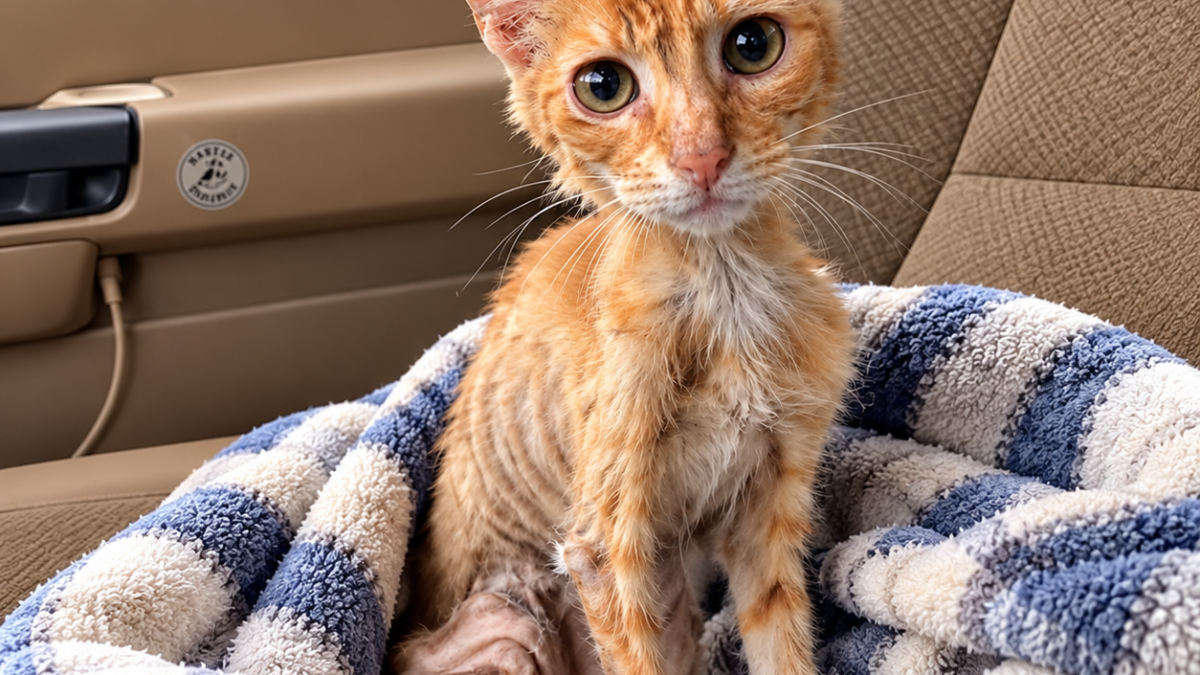
I opened the passenger door and placed the towel-covered carrier on the seat.
Before closing it, I took a photograph for documentation.
His body looked painfully small against the fabric.
But it was his expression that caught me.
Those enormous amber eyes looked directly through the carrier opening.
Not wild.
Not angry.
Just exhausted.
I remember thinking, *How long have you been waiting for somebody to look back?*
Then I drove.
I called the veterinary clinic from the road.
“I’m bringing in a severe neglect case.”
“How severe?”
“Adult male orange tabby. Extremely underweight. Four pounds, maybe less. Unknown hydration status. Unknown last proper meal.”
“We’ll be ready.”
I looked at the carrier.
“You hear that, buddy?”
He blinked.
“People are waiting for you now.”
### What the Bathroom Told Us
While the veterinary team worked on him, I returned to the apartment with another officer and began documenting the room more thoroughly.
That bathroom told its story without speaking.
The marks at the bottom of the door weren’t random.
They were concentrated.
Repeated.
There were scratches along the flooring near the threshold where the surface had been damaged over time.
The shower curtain had been pulled and torn.
The caulking around parts of the tub showed chew marks.
The toilet seat was damaged.
There was no food bowl.
No water bowl.
We checked cabinets.
Nothing.
Behind the toilet.
Nothing.
Under the sink.
Nothing.
The toilet lid had been left open.
I stood over it for several seconds.
My partner looked at me.
“You thinking what I’m thinking?”
“Probably.”
Water.
If the cat had remained alive inside that room for an extended period, that toilet might have been his most reliable source.
We photographed it.
Then I examined the door again.
The claw marks were deepest near the bottom edge.
I imagined hearing footsteps outside.
Scratching.
Waiting.
Hearing the apartment door open.
Scratching again.
A human voice nearby.
More scratching.
Then silence.
We couldn’t know how often that happened.
That mattered.
Animal investigations are built on what can be documented, not what your emotions tell you probably happened.
Still, the physical evidence was difficult to ignore.
This animal had repeatedly tried to reach the other side of the door.
And the bolt had made that impossible.
My phone rang.
The clinic.
I stepped into the hallway.
“This is Officer Hayes.”
The veterinarian’s voice was calm.
“We’ve examined him.”
I waited.
“He’s severely underweight and dehydrated, but he’s alert.”
“Can he recover?”
A pause.
“Yes. We think he has a chance.”
I closed my eyes.
A chance.
Those two words felt enormous.
“But we have to be careful,” she continued. “Very careful.”
“Refeeding?”
“Exactly.”
I knew what she meant.
When an animal has been deprived of proper nutrition for a long time, suddenly offering unlimited food can create serious metabolic problems. Recovery has to be controlled.
Small portions.
Measured nutrition.
Monitoring.
Patience.
“How much does he weigh?”
“Four pounds, two ounces.”
I stared at the bathroom door.
“Four pounds.”
“Yes.”
“Do you have an estimate of what he should weigh?”
“Based on his frame, probably somewhere between twelve and fourteen when healthy.”
For a moment, neither of us spoke.
Then she said, “He’s interested in food.”
That almost broke me.
“Good.”
“It’s a very good sign.”
### His First Real Meal
When I returned to the clinic, the cat was wrapped in a clean blanket inside a warm kennel.
A small dish sat near him.
Not overflowing.
Not a feast.
Just a carefully measured portion recommended by the veterinary team.
He sniffed it.
Then looked at us.
The technician crouched beside the kennel.
“Go ahead, sweetheart.”
He lowered his head.
Took a bite.
Chewed.
Paused.
Took another.
Nobody in the room spoke.
I had witnessed dramatic rescues before.
Animals pulled from floodwater.
Dogs carried from abandoned houses.
Litters found during freezing weather.
But there was something uniquely emotional about watching that cat eat a few spoonfuls of food.
Because to him, it wasn’t a dramatic moment.
It was dinner.
Something that should have been ordinary.
Something he should never have had to earn through survival.
He finished the portion and looked at the bowl.
The technician touched my arm.
“We can’t give him more yet.”
“I know.”
“He’s going to want more.”
“I know.”
The cat licked the bottom of the dish.
Then looked toward us.
That might have been the hardest part of the day.
Being the people who had finally rescued him and still having to say, *Not yet.*
But this time the restriction was meant to protect him.
There would be another meal.
Then another.
And another.
For the first time in a very long time, hunger had an ending.
### We Gave Him a Name
The shelter paperwork needed a temporary identification name.
Usually, we chose something simple.
A street name.
A color.
A random name somebody in the office suggested.
The technician looked at the orange tabby curled beneath his blanket.
“What about Sunny?”
I shook my head.
“Too cheerful.”
She smiled faintly.
“He deserves cheerful.”
“He does.”
I looked at him.
Outside the clinic window, afternoon light stretched across the floor.
The same sunlight he had lifted his face toward when I carried him out of the apartment.
“What about Ray?”
The technician considered it.
“Ray?”
“Like a ray of light.”
She looked at the cat.
“I like it.”
So on the medical chart, beneath the case number, somebody wrote:
**RAY — ORANGE DOMESTIC SHORTHAIR — MALE — 4.1 LB**
From that moment on, the cat behind the bolted bathroom door had a name.
Ray.
### The Investigation Deepened
Over the next several days, the medical team focused on keeping Ray stable while I focused on establishing a timeline.
The landlord provided the lease.
The tenant had moved in thirteen months earlier.
He remembered seeing the cat near a window during the first weeks of the tenancy.
A neighbor remembered him too.
“He used to sit in the living-room window,” she told me.
“Orange cat?”
“Yes. Big boy. Really pretty.”
“When did you stop seeing him?”
She thought.
“That’s hard to say.”
“Take your time.”
“Maybe last summer?”
That narrowed the timeline.
Another neighbor said she had occasionally heard scratching or movement through the adjoining wall but assumed the tenant had a pet.
“Did you ever hear crying?”
“Sometimes.”
Her expression changed as soon as she said it.
“What kind?”
“I thought it was a cat.”
“How often?”
“I don’t know. Not every day.”
She covered her mouth.
“Oh, God.”
“This isn’t your responsibility,” I told her. “I just need you to tell me what you remember.”
“I thought somebody was taking care of him.”
That sentence would come up repeatedly.
People assumed.
Someone must be feeding him.
Someone must be checking.
Someone must know.
The terrible thing about neglect is that it can hide inside ordinary walls.
No broken windows.
No emergency lights.
No crowd outside.
Just a closed door.
The former tenant was contacted.
I won’t repeat every detail of those conversations, but I will never forget the first explanation.
“He had food.”
I looked at my notes.
“Where?”
“In the bathroom.”
“We found no food bowl.”
“I took it.”
“When?”
“I don’t remember.”
“What about water?”
“The toilet.”
I stopped writing.
“You left the toilet open as his water source?”
Silence.
Then:
“He could drink.”
I felt my jaw tighten.
Training matters in moments like that.
You don’t argue.
You don’t shout.
You document.
“So you acknowledge knowing the cat was confined inside that bathroom?”
Another silence.
“I didn’t say that.”
“There was a bolt on the outside.”
“That was for a reason.”
“What reason?”
“He made a mess.”
I stared at the phone.
He made a mess.
An animal.
Locked in one room.
Without regular access to appropriate food, water, a clean litter area, movement, enrichment, or companionship.
And the explanation was that he made a mess.
I wrote the words down exactly.
### Ray’s First Week
Meanwhile, Ray kept eating.
Tiny meals.
Several each day.
At first, food consumed his attention.
The moment his foster caregiver entered the room, he would lift his head and look toward her hands.
She had cared for medically fragile animals before and understood the discipline required.
No extra scoop because he looked hungry.
No huge bowl because compassion wanted to give him everything at once.
Recovery had to happen slowly.
On day three, Ray stood at the front of his enclosure when breakfast arrived.
On day four, he gave a small meow.
His foster caregiver sent me a message.
**He spoke today.**
Attached was a photograph.
Ray was standing.
Still fragile.
Still far too thin.
But standing.
I stared at the photo longer than I expected.
The cat I had found sitting silently in a bathtub had discovered his voice again.
On day five, he began rubbing his cheek against the technician’s hand.
On day six, he climbed into her lap.
She called me.
“You need to see this.”
“Is something wrong?”
“No.”
Her voice changed.
“He’s purring.”
I stopped what I was doing.
“Really?”
“Listen.”
She held the phone near him.
At first I heard only room noise.
Then a faint vibration.
Soft.
Uneven.
But unmistakable.
A purr.
I had spent days thinking about the claw marks on that bathroom door.
The scratches.
The desperate evidence of an animal trying to escape.
Now I listened to a different sound.
One that meant he had enough safety inside him to relax.
### The Case Went to the Prosecutor
When I completed my report, it was thick.
Photographs.
Medical records.
Weight assessments.
Witness statements.
Lease information.
Images of the bolt.
Images of the damaged threshold.
Documentation of the empty bathroom.
Statements regarding the toilet as the apparent water source.
The former tenant’s own comments.
I delivered everything to the county prosecutor.
He flipped slowly through the file.
When he reached the first photograph of Ray, he stopped.
“This is the same cat?”
“Yes.”
He turned to the earlier photograph we had obtained from a neighbor—the orange cat sitting in a window months before.
Healthy.
Broad.
Thick coat.
Bright eyes.
Then back to the rescue photograph.
“This is thirteen months apart?”
“Approximately.”
He leaned back.
“You’re confident this wasn’t a cat who wandered into the apartment after it was abandoned?”
“The bathroom was bolted from the outside. Multiple witnesses place the cat with the tenant earlier in the tenancy. The tenant acknowledged the cat and acknowledged that the toilet was being used for water.”
The prosecutor’s expression hardened.
“What does the vet say?”
“Severe prolonged malnutrition consistent with inadequate nutrition over time. No underlying condition identified that would explain the weight loss.”
He closed the folder.
“All right.”
I knew what those words meant.
The case was moving forward.
### Ray Reached Five Pounds
The day Ray crossed five pounds, his foster caregiver sent us a photograph of the scale.
5.02.
One pound.
To anyone else, it might not have looked significant.
To us, it was twenty-five percent of the body weight he had carried out of that bathroom.
We celebrated carefully.
No balloons.
No giant meal.
Just extra affection and a note on his chart.
**Weight increasing. Energy improving.**
Ray started exploring.
At first he moved cautiously around the foster room.
He would approach doorways, stop, and stare through them.
His foster caregiver noticed something unusual.
“He doesn’t like closed doors.”
That made sense.
If she closed the room door completely, he became restless.
So she changed the routine.
Whenever possible, she left it open.
Not because Ray was allowed to roam the entire house unsupervised.
But because she wanted him to learn something.
Doors could open.
Doors did open.
A doorway did not automatically mean confinement.
One afternoon, she sent me a video.
Ray stood on one side of a partially open door.
He reached one paw forward and pushed.
The door swung wider.
He stepped through.
The technician laughed softly behind the camera.
“Look at you.”
Ray turned toward her.
Tail raised.
It was the first time I saw his tail held fully upright.
### Then Came the Setback
Recovery is rarely a straight line.
Two weeks after the rescue, Ray stopped finishing his meals.
His caregiver noticed immediately.
That detail mattered.
In the bathroom, nobody had cared whether he ate.
Now somebody noticed when he left two bites behind.
She called the clinic.
Within an hour, he was being examined.
Bloodwork.
Hydration check.
Temperature.
Further testing.
His digestive system was still adjusting, and his body had endured prolonged nutritional stress. The veterinarian modified his feeding plan and monitored him closely.
For two days, everyone worried.
I visited after work.
Ray was curled in a blanket.
I sat beside him.
“Come on, little man.”
His eyes opened.
“You didn’t survive that bathroom just to scare us now.”
He blinked at me.
I reached through the opening and rested one finger near his paw.
He placed his paw over it.
That was it.
A tiny touch.
But it felt like an agreement.
By the following morning, he ate.
Not much.
Enough.
By evening, he ate again.
The next day his appetite improved.
His caregiver sent me one sentence.
**He’s back.**
### The Former Tenant Came to Court
The preliminary hearing happened several weeks later.
I arrived early with the case file.
The landlord was subpoenaed.
One neighbor came voluntarily.
The veterinarian was prepared to testify if needed.
The former tenant entered with counsel.
I had spoken to him by phone.
I had read his written statements.
But that was the first time I watched him sit within sight of the photographs.
He avoided looking toward me.
The prosecutor presented the basic facts.
The lease.
The ownership history.
The external bolt.
The conditions inside the room.
Ray’s weight.
The veterinarian’s assessment.
Then the defense suggested there might be uncertainty.
Maybe the cat had a medical problem.
The veterinarian answered calmly.
“We investigated that possibility.”
“Can illness cause weight loss?”
“Of course.”
“So you cannot say starvation was the only possible explanation.”
“I can say that we found no medical condition that would reasonably explain the degree of weight loss we observed.”
The room became quiet.
The defense attorney changed direction.
“Could the cat have had access to food?”
The veterinarian looked at him.
“If adequate nutrition had been consistently available and consumed, I would not expect to see a mature cat reduced to that condition without another significant disease process.”
The prosecutor stood.
“And did you find such a disease process?”
“No.”
The prosecutor displayed a photograph of the bathroom.
No food bowl.
No water dish.
The bolt clearly visible.
Then another image.
Ray in the bathtub.
I watched the former tenant.
He looked down.
For months, Ray had been hidden behind a door.
Now the room where he had been confined was projected on a courtroom screen.
Every scratch.
Every mark.
Every detail somebody may have assumed would never matter.
It mattered now.
### The Photograph That Changed the Room
Then came the image the neighbor had provided.
Ray before.
A healthy orange cat sitting on the back of a couch near the apartment window.
Fourteen pounds, according to an old veterinary record later obtained with authorization.
Wide face.
Thick shoulders.
Bright coat.
Then the prosecutor placed the rescue photograph beside it.
Nobody needed a speech.
The contrast was enough.
Same markings.
Same eyes.
Same cat.
Almost ten pounds gone.
The judge studied the photographs.
“How much time between these images?”
“Approximately one year.”
The judge looked over his glasses.
“And the defendant controlled access to the residence during that period?”
“Yes, Your Honor.”
The defense attorney objected to the phrasing.
The judge allowed him to make his record.
But the image remained on the screen.
I kept thinking about the moment I had opened the bathroom door.
The blink.
The towel.
The weight of him in my hands.
Now a room full of people was finally seeing what had been hidden.
### Ray Learned About Windows Again
While lawyers argued over motions, Ray continued building a life.
Six pounds.
Then six and a half.
His coat began to improve.
His face slowly filled out.
He discovered a heated pet bed.
According to his foster caregiver, he initially didn’t understand it.
“He keeps sitting beside it.”
“Put a blanket on top.”
“I did.”
“What happened?”
“He stole the blanket and slept under the chair.”
I laughed.
For the first time since the case began, a conversation about Ray felt normal.
Not medical.
Not legal.
Not tragic.
Just a cat being difficult about a bed.
Three days later, she sent me another picture.
Ray was sprawled across the heated cushion like royalty.
**He figured it out.**
Next came windows.
His foster home had a wide living-room window overlooking a bird feeder.
The first time he was carried near it, his whole body became alert.
Birds moved outside.
Leaves shook in the wind.
People walked along the sidewalk.
He stared for nearly an hour.
After that, the window became his place.
Every morning after breakfast, he sat there.
His caregiver eventually placed a small padded perch beneath it.
A cat who had spent months staring at a locked door now spent his mornings watching an open world.
### The Plea Offer
The prosecutor called me nearly four months after the rescue.
“We’re discussing a plea.”
I leaned back in my chair.
“What are the terms?”
He outlined them.
The defendant would plead guilty to an animal-cruelty offense.
There would be supervised probation, court costs, restitution toward veterinary expenses, and a prohibition on owning or keeping animals for a period determined by the court.
The prosecutor would also request mandatory compliance checks if the court allowed them.
“Will there be jail time?”
“That depends on the judge and the final classification.”
I looked through the glass wall of my office.
People sometimes imagine justice as one dramatic moment.
Handcuffs.
A slammed gavel.
A confession.
Real cases are usually slower.
Paperwork.
Hearings.
Continuances.
Arguments over language.
Victims of animal neglect cannot explain what happened, so rooms, medical records, timelines, photographs, and witnesses have to speak for them.
“Do you think the plea is enough?” I asked.
“I think it creates a conviction, enforceable restrictions, restitution, and a record. And if the defendant violates those restrictions, there are consequences.”
I thought about Ray.
The goal had never been revenge.
Not really.
Anger had visited me plenty of times.
Especially when I remembered that bolt.
But anger wasn’t the finish line.
Protection was.
Accountability was.
Making sure another animal did not end up behind another locked door—that mattered.
“Take it,” I said.
### Seven Pounds
Ray reached seven pounds the same week the plea agreement was filed.
His foster caregiver celebrated with a new toy.
A stuffed mouse.
Ray ignored it.
She bought a feather wand.
Ray ignored that too.
Then he found the cardboard packaging.
That became his favorite thing in the house.
She sent me a video of him sitting inside the shipping box while the expensive toys remained untouched on the carpet.
“Financially irresponsible,” I told him during my next visit.
Ray closed his eyes.
“He has no remorse,” she said.
For the first time, we were making jokes about him.
That was healing too.
Not only for Ray.
For us.
People who work rescue cases carry images.
You learn to live with them.
Sometimes another image eventually takes its place.
For me, the picture of Ray inside that cardboard box began competing with the picture of Ray in the bathtub.
One represented what somebody had done to him.
The other represented what they had failed to take from him.
His personality.
### The Sentencing
The courtroom was fuller on sentencing day.
The prosecutor spoke first.
He did not exaggerate.
He didn’t need to.
He described the duration of the tenancy, the external locking mechanism, the physical condition of the bathroom, the lack of ordinary food and water containers, the veterinary findings, and Ray’s condition at recovery.
Then the defense spoke.
There were apologies.
Explanations.
Statements about personal problems during the year in question.
I listened.
Some of them may even have been true.
People can struggle.
People can become overwhelmed.
People can make disastrous decisions while dealing with their own lives.
But there was one fact I couldn’t stop returning to.
That bolt could have been opened.
A phone call could have been made.
A shelter could have been contacted.
Animal control could have been called.
A neighbor could have been asked for help.
A rescue group.
A veterinarian.
The landlord.
Anybody.
There were choices between struggling and locking a living animal inside a bathroom.
The judge eventually looked toward the defendant.
“Personal hardship may explain why someone fails to manage responsibilities well,” he said. “It does not make an animal invisible.”
I remember that sentence.
The court accepted the plea.
The defendant received a criminal conviction, probation, financial restitution related to Ray’s care, and a court-ordered prohibition against possessing animals during the restriction period.
The judge warned clearly that violating the order could result in additional penalties.
It wasn’t a movie ending.
Nobody cheered.
I didn’t smile.
I simply exhaled.
The metal bolt had been photographed.
The marks had been documented.
The medical records had been preserved.
The cat who could not speak had still been heard.
Outside the courthouse, the landlord caught up with me.
“Is that it?”
“For the criminal case, mostly.”
He looked relieved and troubled at the same time.
“I keep thinking I should’ve noticed.”
I shook my head.
“You found him.”
“After a year.”
“You found him.”
He looked toward the courthouse doors.
“Still feels too late.”
I understood.
“Ray doesn’t know what day you should have found him.”
He looked at me.
“He only knows the door opened.”
### Eight Pounds
At eight pounds, Ray began running.
Not gracefully.
His first attempts looked more like his back legs had received different instructions from the front.
His foster caregiver called them “Ray zoomies.”
He would sprint down the hallway, stop abruptly, turn, and race back.
The first time I saw it, I laughed so hard I had to lean against the wall.
This was the same animal I had carried out of the apartment because he barely had the strength to walk.
Now he was skidding across a hardwood floor because he had decided a shadow was suspicious.
“Slow down,” I said.
Ray accelerated.
His caregiver smiled.
“Good luck telling him that.”
His world had expanded from a bathroom to an entire house.
Bedroom.
Hallway.
Kitchen.
Living room.
Window perch.
Couch.
He inspected every corner.
Open doors fascinated him.
Sometimes he stood in the center of a doorway and looked from one room to another as if confirming that both directions remained available.
His caregiver never rushed him.
When he hesitated, she waited.
When he approached, she praised him.
When he retreated, she let him.
Trust was not demanded.
It was offered.
### The Night I Finally Cried
People had asked me whether the case made me cry.
At the apartment, no.
At the clinic, no.
During the investigation, no.
In court, no.
There was always something to do.
Then one evening, nearly six months after I first met Ray, his foster caregiver sent me a photograph.
No emergency.
No milestone weight.
No court update.
Just a picture.
Ray was asleep on a couch.
His body had filled out considerably.
One front paw rested over his face.
His belly was exposed.
His back legs stretched behind him.
Completely relaxed.
Completely unguarded.
The caption said:
**He sleeps like this now.**
I sat at my kitchen table staring at my phone.
And that was when it happened.
Because animals only sleep like that when they believe the room is safe.
When they believe nobody is about to hurt them.
When they believe they can close their eyes.
For months, I had wondered how Ray survived.
That night I realized survival was no longer the most important part of his story.
Safety was.
I put the phone down and cried.
Not because I was sad.
Because finally, I didn’t have to imagine him awake behind a locked door.
I could imagine him sleeping.
### Adoption Day Became Complicated
By the time Ray approached nine pounds, the veterinary team agreed he was medically stable enough to begin discussing adoption.
That should have been simple.
It wasn’t.
Applications arrived.
Many people had heard about his case.
Everyone wanted the famous orange cat.
Some applications were excellent.
Some were clearly emotional responses to his story.
His foster caregiver became protective.
“He doesn’t need someone who wants the story,” she told me.
“He needs someone who wants the cat.”
Exactly.
Ray was not a symbol.
He was not a social-media lesson.
He was a living animal who liked heated beds, cardboard boxes, quiet people, morning windows, and sleeping with one paw stretched across whoever happened to be closest.
His adopter needed to understand his history without making his history his entire identity.
We reviewed homes.
No young children who might overwhelm him.
No unstable housing situation.
No plan to let him roam outside.
Someone comfortable with veterinary follow-up.
Someone patient.
Then we received an application from a woman named Margaret.
She was sixty-three.
Retired librarian.
One older cat had passed away the previous year.
Quiet home.
Enclosed sunroom.
Long relationship with the same veterinary clinic.
Her written explanation for wanting Ray was only three sentences.
The last one caught my attention.
**I don’t want to rescue him from his past. You already did that. I’d just like to give him somewhere peaceful to spend his future.**
I read it twice.
Then called her.
### Margaret Met Ray
She didn’t rush toward him.
That immediately earned points.
She entered the foster room, sat on the floor, and waited.
Ray watched from beneath a chair.
Margaret pretended not to care.
She spoke with the foster technician about food.
Medical history.
Behavior.
Favorite toys.
Door sensitivity.
Ray crept forward.
Margaret continued talking.
He sniffed her shoe.
She didn’t move.
He sniffed her hand.
Still nothing.
Then Ray rubbed his face against her fingers.
Margaret’s eyes filled with tears.
But she didn’t grab him.
She simply whispered, “Well, hello there.”
Ray walked into her lap.
His foster caregiver looked at me.
I looked at her.
Nobody needed to say anything.
A few minutes later, Ray curled against Margaret’s stomach and began to purr.
She stared down at him.
“I think I’ve been selected.”
The technician laughed.
“Looks that way.”
### One Last Door
Before adoption paperwork could be finalized, Margaret invited us to inspect her home.
Everything looked good.
Then she showed me the sunroom.
Large windows.
Soft chairs.
Cat tree.
Secured screens.
Sunlight across the floor.
A perfect space.
But I noticed the door.
It had a simple interior latch.
Not a bolt.
Nothing wrong with it.
Still, Margaret noticed where I was looking.
“I read about the bathroom.”
I nodded.
“I thought about taking that door off entirely.”
“That isn’t necessary.”
“I don’t ever want him frightened.”
“He may react to closed doors for a while.”
“What should I do?”
“Let him set the pace.”
She looked at the door.
“Then it stays open.”
And from the first day Ray entered Margaret’s house, that sunroom door remained propped open.
Weeks later, she sent me a picture.
Ray was lying directly in the doorway.
Half his body in the sunroom.
Half in the hallway.
I laughed when I saw it.
A cat once trapped by a closed door had apparently decided the best place in the whole house was precisely where one room became another.
### He Returned to Fourteen Pounds
It took time.
Almost a year after his rescue, Ray stepped onto the veterinary scale.
13.8 pounds.
The technician stared.
“Do that again.”
They reset the scale.
Ray stepped off.
Then back on.
13.8.
She called me.
“You remember what the first number was?”
“Four pounds, two ounces.”
“He’s thirteen-eight.”
I leaned back.
For several seconds, I couldn’t answer.
Almost fourteen pounds.
Not overweight.
Not fragile.
Healthy.
Strong.
His coat had regained its orange shine.
His face had rounded.
His eyes no longer appeared too large for his head.
The cat in front of us looked almost exactly like the animal in the old photograph from before the bathroom.
Almost.
There was one difference.
This Ray knew what safety felt like.
### I Went Back to the Apartment
Months later, I happened to drive near the old building while handling another call.
I told myself I wasn’t going there intentionally.
Maybe I was.
The unit had been renovated.
New tenant.
Fresh paint.
New flooring.
The landlord happened to be outside.
He recognized my truck.
“Want to see something?”
I followed him upstairs.
The apartment looked completely different.
When we reached the bathroom, I stopped.
The old door had been removed.
A new one had been installed.
No bolt.
No damaged threshold.
No shredded curtain.
Nothing remained from the room where we found Ray.
The landlord pointed toward the wall.
“I made them patch every hole.”
I nodded.
“Good.”
He hesitated.
“You ever hear how the cat’s doing?”
I took out my phone.
I showed him the latest photograph.
Ray at Margaret’s house.
Nearly fourteen pounds.
Stretched across a blanket beside a sunlit window.
The landlord stared at the screen.
“That’s him?”
“That’s him.”
He smiled slowly.
“You’re kidding.”
“No.”
“He looks…”
“Normal?”
The same word he had used the first day.
He nodded.
“Yeah.”
I looked at the bathroom doorway.
Ray had fought against that door until the floor beneath it carried the evidence.
But the door was gone now.
And so was he.
### The Visit
On the anniversary of his rescue, Margaret invited me over.
I brought nothing fancy.
Just a small bag of treats approved by his veterinarian.
Margaret opened the front door.
“Someone’s waiting for you.”
I stepped inside.
Ray sat at the far end of the hallway.
For one ridiculous second, I worried he wouldn’t remember me.
Then he stood.
Tail up.
He walked toward me.
Not quickly.
Not dramatically.
Just confidently.
I crouched.
“Hey, buddy.”
He stopped in front of me.
Sniffed my hand.
Then pressed his forehead against my fingers.
I swallowed.
Margaret smiled.
“You know him?”
Ray began purring.
“I think he does.”
He walked past me toward the living room, then looked back as though expecting me to follow.
So I did.
His world was warm.
Sunlight.
Blankets.
A scratching post.
Toys beneath furniture.
Food dishes in the kitchen.
A fountain filled with clean water.
A bed near the window.
Ordinary things.
That was what made them beautiful.
Margaret poured coffee while Ray climbed onto the couch beside me.
“He still checks the doors sometimes,” she said.
“Does he?”
“If one closes, he walks over and pushes it.”
“What happens if it doesn’t open?”
“I open it.”
Every time.
Without hesitation.
I looked down at him.
His eyes were half closed.
“Good.”
Margaret sat across from me.
“I heard the court case finished.”
“It did.”
“Was there accountability?”
“Yes.”
She nodded.
“That matters.”
“It does.”
Then she looked at Ray.
“But this matters more.”
I knew exactly what she meant.
A sentence can punish what happened yesterday.
A safe home changes tomorrow.
### What Happened to the Person Responsible
People often ask what became of the person who had kept Ray behind that door.
There was accountability.
A conviction entered the record.
Financial consequences.
Court supervision.
Restrictions intended to prevent another animal from ending up in the same situation.
And there was something else.
Evidence.
A permanent record of what had happened.
The bathroom could be repaired.
The scratches could be removed.
The door could be replaced.
But the case could not be dismissed as a misunderstanding anymore.
Photographs existed.
Veterinary records existed.
Witness statements existed.
A court record existed.
For a year, Ray had been hidden.
After his rescue, what happened to him was no longer hidden.
To me, that was the most important form of justice available.
Not humiliation.
Not vengeance.
Accountability.
The person responsible could walk away from the apartment.
But not from the documented truth.
### What Ray Never Knew
Ray will never understand the courtroom.
He will never know what a prosecutor does.
He doesn’t know what probation means.
He cannot read the report that contains his name.
He has no idea people argued over photographs of him.
He never needed any of that.
What he understands is simpler.
A bowl gets filled.
Water stays clean.
When he sleeps, he wakes up safe.
When he meows, somebody hears him.
When a door closes, it opens again.
When he walks into a room, nobody forces him to stay there.
Maybe that is enough.
### The Question I Still Ask Myself
I still think about the day we found him.
Not every day.
But often enough.
Sometimes I wonder which moment was hardest for him.
The first night?
The first time he realized the bolt would not give?
The first day no food came?
The hundredth?
Was there a point when he stopped scratching?
Did he eventually begin again whenever he heard footsteps?
Did he sleep in the bathtub because it felt safer?
Did he sit there facing the door because he was waiting?
There are questions no investigation can answer.
I used to hate that.
Now I think maybe Ray is lucky not to have to answer them for us.
His job was never to explain what happened.
His job was to survive it.
We could handle the rest.
### The Last Photograph
Before I left Margaret’s house that afternoon, she stopped me near the front door.
“Wait.”
She disappeared into another room and returned with a printed photograph.
“I thought you should have this.”
I looked down.
Ray was sitting on the sunroom windowsill.
Healthy.
Broad.
Orange coat glowing in the sunlight.
One paw rested against the glass.
Behind him, the door to the hallway stood completely open.
At the bottom, Margaret had written the date.
Exactly one year after his rescue.
I held the photograph in both hands.
“I still have the first picture,” I said.
“The one from the bathroom?”
“Yeah.”
She nodded.
“Then put this one beside it.”
So I did.
They remain together.
In the first photograph, Ray weighs four pounds.
His body is fragile.
His eyes are enormous.
Behind him is the bathtub where we found him.
In the second photograph, he is nearly fourteen pounds.
Strong.
Relaxed.
Sunlight across his back.
And behind him is an open door.
Those two pictures tell the story better than I ever could.
### A Different Kind of Revenge
People sometimes want rescue stories to end with revenge.
They want the person responsible to experience the same fear the animal experienced.
They want suffering returned for suffering.
I understand the anger.
I felt it.
But after eight years in animal control, I learned that the best answer to cruelty is not more cruelty.
It is consequence.
It is evidence.
It is removing an animal from danger.
It is placing restrictions where restrictions are needed.
It is making sure somebody is watching next time.
Most of all, it is helping the animal build a life so good that the place where he suffered becomes only the smallest part of his story.
That was Ray’s revenge.
Somebody reduced his world to a bathroom.
We gave him a house.
Somebody made him search for water.
Now he has a fountain that Margaret cleans obsessively.
Somebody left him hungry.
Now his veterinarian has to remind Margaret not to give him too many treats.
Somebody closed a door and tried to make his world disappear.
Now he spends his mornings watching birds through a sunroom full of light.
And the person who thought that bathroom would hide what happened?
The room became evidence.
The bolt became evidence.
The scratches became evidence.
Ray himself became living proof.
He survived.
He recovered.
He was seen.
### One Year Later
Exactly one year after I slid back that metal bolt, I visited Ray one final time for the case file.
Officially, I needed an updated condition photograph.
Unofficially, I wanted to see him.
Margaret opened the door.
“No shoes,” she said.
I looked down.
“What?”
“I’m kidding.”
She laughed.
I shook my head.
“You’ve gotten bold.”
“Living with Ray does that.”
The famous cat was nowhere in sight.
“Where is he?”
She pointed.
A huge cardboard box sat in the middle of the living room.
Two orange ears appeared over the edge.
I laughed.
“You’re fourteen pounds again and you’re still living in garbage.”
Ray jumped out.
He walked directly toward me.
Then stopped.
His eyes met mine.
For one second, I saw the cat from the bathtub.
Not physically.
He looked nothing like that cat anymore.
But there was something familiar in the way he watched me.
I crouched.
“Remember me?”
He touched his nose to my fingers.
Then, without warning, climbed onto my knee.
Margaret smiled.
“I’d say yes.”
I scratched beneath his chin.
His purr filled the room.
Strong now.
No phone speaker needed.
No straining to hear it.
He sounded like a tiny motor.
“Look at you,” I whispered.
His eyes closed.
Fourteen pounds.
Warm.
Safe.
Loved.
### Why I Tell His Story
I don’t tell Ray’s story because I want people to remember the worst thing that happened to him.
I tell it because sometimes neglect happens where nobody is looking.
Behind apartment doors.
Inside garages.
In back rooms.
On rural properties.
In homes that look completely ordinary from the street.
And sometimes the difference between continued suffering and rescue is one person noticing that something does not make sense.
A landlord notices a bolt that was not there before.
A neighbor realizes she has not seen an animal recently.
A veterinary worker recognizes a condition that requires documentation.
An officer decides to photograph everything before touching the scene.
A prosecutor takes the file seriously.
A foster caregiver measures each small meal instead of giving in to emotion.
An adopter understands that a rescued animal needs a future, not endless reminders of its past.
None of us saved Ray alone.
The door opening was only the beginning.
### Ray’s Real Ending
The last update I received from Margaret came on a cold morning.
It was a photograph taken from her kitchen.
Ray was stretched across the back of the couch near the sunroom.
Snow covered the yard outside.
Birds crowded around the feeder.
Sunlight poured through the windows.
Ray’s eyes were closed.
His paws hung lazily over the cushion.
The hallway door behind him stood open.
Margaret wrote:
**He ate breakfast, stole my chair, yelled at a bird, and went back to sleep. Rough life.**
I laughed.
Then I saved the picture.
That is how I prefer to think about him now.
Not four pounds.
Not trapped.
Not waiting in a bathtub.
Not scratching at a door.
I think about a fourteen-pound orange cat annoyed by birds.
A cat with opinions about breakfast.
A cat who steals chairs.
A cat who sleeps without listening for footsteps.
A cat whose biggest problem is that his favorite patch of sunlight moves across the floor during the afternoon.
That is the ending he deserved.
### The Door Is Open
When I first lifted Ray from the bathtub, I remember thinking his body felt almost weightless.
Four pounds.
That number stayed with me.
Four pounds was what prolonged neglect had reduced him to.
But I no longer use four pounds to define Ray.
I think of every ounce he gained afterward.
Five pounds meant his body was responding.
Six meant the feeding plan was working.
Seven meant he was exploring.
Eight meant he was running.
Nine meant we could finally think seriously about adoption.
Ten meant his old strength was returning.
Eleven.
Twelve.
Thirteen.
And then, almost exactly what he had weighed before everything went wrong:
Fourteen.
But even fourteen pounds cannot measure what really returned.
Trust returned.
Curiosity returned.
Energy returned.
His voice returned.
His purr returned.
His ridiculous love of cardboard returned.
His ability to sleep deeply returned.
His expectation that someone would answer when he called returned.
His life returned.
I once wondered what kept him alive for so long inside that bathroom.
I still don’t know.
Maybe animals don’t think about survival the way humans do.
Maybe he wasn’t waiting for some grand rescue.
Maybe each day he simply woke up and tried again.
A little water.
A little rest.
Another scratch at the door.
Another night.
Another morning.
Until one morning, the sound he had heard so many times finally changed.
Footsteps came down the hallway.
Someone stopped outside.
A hand touched the bolt.
Metal scraped against metal.
And this time, the door moved.
There he was.
Still sitting upright.
Still watching.
Still alive.
I wish I could somehow return to that moment knowing what I know now.
I would kneel beside the bathtub and tell that four-pound orange cat everything waiting for him.
I would tell him that the first few weeks would be difficult.
That people would measure every bite because they wanted his body to heal safely.
That he would meet a veterinary technician who would celebrate his first purr.
That strangers would work to prove what happened behind that door.
That a courtroom would one day see the photographs somebody hoped would never matter.
That the bolt designed to trap him would become evidence.
That the person responsible would face consequences.
That he would discover heated beds.
Cardboard boxes.
Bird feeders.
Sunrooms.
Soft couches.
Clean water.
Regular meals.
People who noticed when he ate two bites less than usual.
I would tell him that one day a woman named Margaret would sit quietly on the floor and allow him to choose her.
I would tell him that he would walk into her lap.
That she would keep doors open for him.
That one day he would become so comfortable that he would sleep flat on his back with his stomach exposed to the room.
I would tell him he would weigh fourteen pounds again.
I would tell him that one day I would stand in a different house and barely recognize the animal I had carried out of that bathroom.
Most importantly, I would tell him something he had no reason to believe that morning.
“You don’t need to scratch anymore.”
Because the door is open.
Not temporarily.
Not by accident.
Not until somebody changes their mind.
It is open.
The bathroom is gone.
The bolt is gone.
The hunger is gone.
The waiting is over.
Ray spent nearly a year fighting to reach the world beyond one locked door.
In the end, he didn’t just reach it.
He got a whole life on the other side.
And whenever I look at that final photograph—the healthy orange cat sitting in sunlight with an open doorway behind him—I remember something this job has taught me again and again.
Sometimes survival is loud.
Sometimes it fights.
Sometimes it runs.
But sometimes survival is almost silent.
Sometimes it is a four-pound cat lifting his tired head when someone enters the room.
Sometimes it is one slow blink.
One more breath.
One more day.
Ray stayed long enough for somebody to find him.
And once we did, we made sure nobody would ever lock his world away again.
He had spent a year waiting for the door to open.
Now every door that matters leads home.

