PART 2: He Was Blind, Toothless, and Barely Standing—Then He Reached One Tiny Paw Toward Me
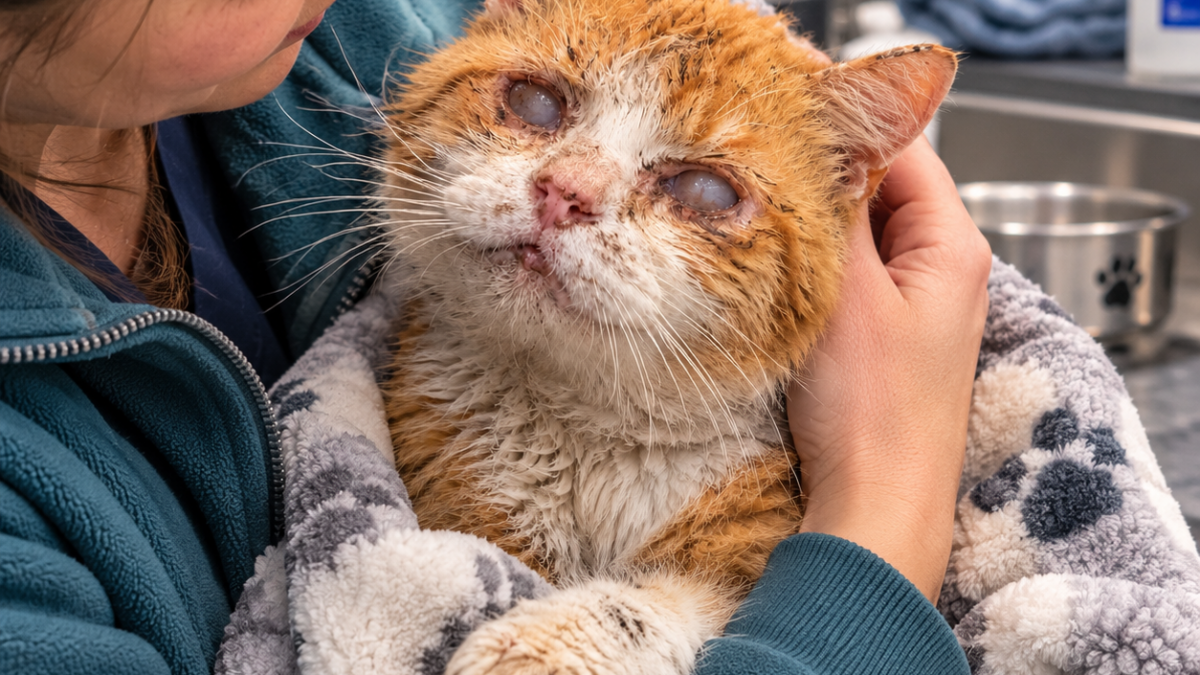
He was blind, toothless, frighteningly thin, and so weak that when I lifted him from the cold pavement, I could feel his entire body trembling against my arms.
Then, just when I wondered whether this exhausted old cat had any trust left to give, he slowly raised one tiny paw and rested it against my chest.
I did not understand what that little gesture meant yet—but before that day was over, I would make a promise that would change both of our lives.
I first saw him near the edge of a parking lot behind a row of small businesses.
It was late afternoon, cold enough that people were walking quickly from their cars to the stores without looking around much.
I almost did the same.
I was carrying a bag in one hand and reaching for my keys with the other when something orange moved near the curb.
At first, I thought it was a pile of leaves.
Then the shape tried to stand.
I stopped.
The little animal rose only halfway before his legs seemed to lose strength.
He lowered himself again.
That was when I realized I was looking at a cat.
“Hey, sweetheart.”
His head turned toward my voice, but his eyes did not seem to find me.
I moved closer.
He did not run.
That worried me immediately.
Most frightened outdoor cats create distance the moment a stranger approaches.
This one barely moved at all.
His orange-and-white coat was dirty and tangled. Some sections had clumped together so badly that the fur no longer lay flat. His body looked far too light beneath it. His shoulders seemed sharp. His legs trembled even while he was sitting.
I crouched several feet away.
He lifted his nose.
His face followed the sound of my breathing rather than my movement.
That was the first moment I suspected he could not see.
“Oh, buddy.”
I put my hand low to the ground and let him decide whether to investigate.
He did not come forward.
He seemed too tired.
So I moved slowly.
One inch.
Another.
When my fingers touched the side of his face, he flinched.
I stopped.
“Okay.”
I kept my hand still.
“You don’t know me.”
His nose moved toward my fingers.
He smelled them.
For several seconds, neither of us did anything.
Then he leaned forward just enough that the side of his cheek touched my hand.
It lasted almost no time.
But it was permission.
I carefully slid one arm beneath his chest and the other beneath his back legs.
He weighed almost nothing.
That frightened me more than anything else.
As I lifted him, his body tightened.
I expected him to struggle.
Instead, he pressed against me.
His head rested near my shoulder.
The trembling continued.
“I’ve got you.”
I did not know whether the words meant anything to him.
Maybe they were more for me.
I carried him toward my car.
Halfway there, he moved.
One small front paw lifted.
For a second, I thought he was trying to push away.
Instead, he placed it against my chest.
Just above my heart.
He left it there.
I stopped walking.
There are moments that become important only later.
At the time, they feel almost too small to name.
That was one of them.
A tired old cat.
One paw.
A stranger holding him.
Nothing dramatic.
But something in me changed.
I looked down at him.
His cloudy eyes faced somewhere past my shoulder.
“You’re not going back out there.”
The decision came before I knew what it would cost.
Before veterinary bills.
Before medication.
Before sleepless nights.
Before I knew his age, his condition, or whether he could recover.
I only knew that whatever had brought him to that parking lot had already asked enough of him.
I placed him carefully inside my car on a folded blanket.
He tried to stand.
His legs shook.
I steadied him.
“All right.”
He lowered himself.
“No more proving anything.”
I called a veterinary clinic while sitting in the driver’s seat.
They told me to bring him immediately.
I started the engine.
The heater warmed the car.
The old cat curled against the blanket.
His paw finally slipped away from my chest.
But somehow I could still feel where it had been.
And as I pulled out of that parking lot, I had no idea that the fragile animal beside me was about to teach me how much courage can exist inside a body that looks as if it has nothing left.
PART 2
The drive to the clinic took seventeen minutes.
I remember because I watched the clock almost constantly.
Not because I was worried about being late.
Nothing else mattered by then.
I was watching because every minute suddenly felt important.
At the first red light, I looked toward the passenger seat.
The cat was lying on the blanket.
His breathing was steady but shallow.
“Stay with me.”
His ear moved.
“That wasn’t a request.”
Another ear movement.
I smiled despite myself.
“You’re already difficult.”
He had not done anything difficult.
But humor was easier than admitting how scared I was.
I had rescued animals before in small ways.
A lost dog wandering near traffic.
A fledgling bird that needed to be moved out of a dangerous spot.
A neighbor’s cat that had gotten locked in a garage.
Nothing like this.
This cat looked as if life had been asking him to survive one day at a time for far too long.
At the clinic, I carried him inside.
A receptionist looked up.
Her expression changed instantly.
“Found stray?”
“Yes.”
“Just now?”
“Parking lot.”
She came around the desk.
“Let me get someone.”
Within minutes, a veterinary technician had taken us into an examination room.
They placed a thick towel on the table.
I lowered him onto it.
He tried to stand.
His legs spread slightly for balance.
The technician touched his shoulder.
He startled.
“He can’t see,” I said.
She looked toward his face.
“I think you’re right.”
She spoke softly before touching him again.
That helped.
I noticed it immediately.
If she announced where she was, he did not flinch as badly.
“Hey, buddy. I’m on your left.”
Her hand moved toward him.
This time, he stayed still.
The veterinarian came in a few minutes later.
She introduced herself as Dr. Patel.
She took one look at him and became very quiet.
Not alarmed.
Focused.
She began with the basics.
Weight.
Temperature.
Hydration.
Heart.
Lungs.
Eyes.
Mouth.
Skin.
Every new finding made the room feel heavier.
His teeth were almost entirely gone.
Not recently.
This was not something that had happened overnight.
His eyes showed severe damage, and Dr. Patel believed his blindness was complete.
His coat hid skin irritation and areas where neglected fur had pulled uncomfortably.
His body condition was extremely poor.
There were signs of infection.
He was dehydrated.
And then came the bloodwork.
Dr. Patel returned holding the results.
She pulled a chair over before speaking.
That scared me.
Doctors sit down when conversations get complicated.
“We’re also seeing blood glucose levels that are much higher than they should be.”
I knew enough to understand the word that was coming.
“Diabetes?”
She nodded.
“We need additional testing and monitoring, but yes. That’s our concern.”
I looked at the cat.
He was lying on his blanket.
His face pointed toward my voice.
“What does that mean?”
“If the diagnosis is confirmed, he’ll need ongoing management.”
“Medication?”
“Insulin.”
“For how long?”
She paused.
“Potentially for the rest of his life.”
I swallowed.
“How often?”
“Usually every twelve hours, depending on the treatment plan and how he responds.”
Every twelve hours.
Morning.
Night.
Every day.
No skipping because I was tired.
No sleeping late without planning.
No spontaneous overnight trip unless someone trained could manage him.
No deciding it was inconvenient.
Dr. Patel watched my face.
“This is a significant commitment.”
I knew what she meant.
She was not trying to discourage me.
She was being honest.
The old cat needed more than one compassionate afternoon.
He needed a system.
A schedule.
Money.
Monitoring.
Patience.
He needed someone who would still care after the emotional part of the rescue stopped feeling dramatic.
“What about the infections?”
“Treatable.”
“The eyes?”
“The blindness appears permanent.”
“His teeth?”
“We’ll assess what remains, but he has severe dental loss.”
“Can he eat?”
“Yes, with the right food and support.”
I looked down.
He lifted his head.
Not toward me exactly.
Toward my voice.
I put my hand near his nose.
He smelled it.
Then his forehead lowered against my fingers.
That was enough.
“What do we do first?”
Dr. Patel looked at me carefully.
“You’re planning to take responsibility for him?”
“Yes.”
“You understand this could be long-term?”
“Yes.”
“Expensive?”
“Yes.”
“His medical needs may change.”
“I understand.”
The truth was, I did not understand.
Not fully.
I could not.
You do not understand a life-changing responsibility in the first hour.
You agree to begin.
Then you learn.
“What do we call him?” the technician asked.
I stared.
He needed a name.
For some reason, “Bruiser” came out.
The technician smiled.
“Bruiser?”
I looked at his tiny body.
“It sounds optimistic.”
Dr. Patel laughed softly.
“Bruiser it is.”
The name was ridiculous.
He looked like the least intimidating animal in the building.
But maybe that was why I liked it.
His life had taken enough from him.
He deserved a name with some swagger.
Bruiser stayed at the clinic for treatment and stabilization.
Leaving him there was unexpectedly difficult.
The technician carried him away in a blanket.
Bruiser’s head lifted.
His paw moved once.
I nearly followed them.
Dr. Patel stopped me gently.
“He needs rest.”
“I know.”
“He’s safe.”
I looked toward the door where he had disappeared.
That word.
Safe.
I wanted to believe it for him.
“I’ll call you as soon as we have an update.”
I went home.
My house felt strange.
Nothing had changed inside it.
Yet something had.
On the kitchen counter sat the pamphlets the clinic gave me.
Feline diabetes.
Administering insulin.
Caring for a blind cat.
Introducing a medically fragile animal to a new home.
The stack looked enormous.
I made coffee.
Forgot to drink it.
I read.
Blind cats rely heavily on scent, sound, memory, and consistent environments.
Do not constantly rearrange furniture.
Talk before touching.
Keep food, water, litter, and sleeping areas easy to locate.
Use texture changes to help with navigation.
Block dangerous stairs until the cat understands the layout.
Diabetic care added another layer.
Meal timing.
Insulin storage.
Injection technique.
Monitoring appetite.
Watching for changes.
Regular veterinary checks.
The more I read, the more frightened I became.
Not of Bruiser.
Of failing him.
Around eight that evening, Dr. Patel called.
“He’s resting.”
“How is he?”
“Still very weak, but stable.”
I exhaled.
“He ate a little.”
“Really?”
“Yes.”
“With no teeth?”
“Soft food.”
I smiled for the first time in hours.
“Good.”
“We’ve started treatment.”
She explained the next steps.
I wrote everything down.
Then she said:
“Something else.”
My stomach tightened.
“What?”
“He’s surprisingly affectionate once he knows where you are.”
I laughed softly.
“Really?”
“He reached for one of the technicians.”
Of course he did.
One tiny paw.
That was Bruiser.
“I think that’s his move.”
“Apparently.”
After the call, I walked through my house.
For the first time, I saw every room from the height of a blind cat.
Table legs.
Corners.
Stairs.
Chairs moved carelessly into pathways.
A laundry basket in the hall.
Danger everywhere.
I started changing things.
Not dramatically.
Consistency mattered more than removing every object.
I chose one room as Bruiser’s first safe space.
Quiet.
Warm.
Easy to navigate.
I put down soft bedding.
Low-sided litter box.
Food and water in fixed positions.
I bought textured mats to place near important locations so his paws could tell him where he was.
I moved nothing after that.
By midnight, I was sitting on the floor staring at an empty cat bed.
“This is insane.”
The room did not answer.
Two days earlier, I had not known Bruiser existed.
Now my furniture arrangement revolved around his blindness.
The next morning, I returned to the clinic for training.
Insulin frightened me.
Needles frightened me.
Not enough to faint.
Enough that my hands shook slightly while the technician demonstrated.
She used a practice syringe first.
“Small needle.”
“Easy for you to say.”
“You’ll get used to it.”
“I don’t want to get used to stabbing my cat.”
She smiled.
“He doesn’t know he’s your cat yet.”
I paused.
“Fair.”
“Also, you’re not stabbing him.”
“You know what I mean.”
She showed me how to draw the correct amount.
How to confirm the dose.
How to handle insulin correctly.
How to give the injection safely.
How to track everything.
Meal.
Dose.
Time.
Behavior.
I wrote it all down.
Twice.
Then I practiced.
My hands became steadier.
“Good,” she said.
“That’s good?”
“Yes.”
“You aren’t just trying to prevent me from panicking?”
“Also yes.”
I laughed.
Bruiser remained at the clinic for another day.
His blood glucose required monitoring.
The infections needed treatment.
His dehydration improved.
Then Dr. Patel called.
“He can go home tomorrow if you’re ready.”
Was I ready?
No.
“I’m ready.”
The next afternoon, they brought him out wrapped in a blanket.
His coat had been carefully cleaned and trimmed where necessary.
He still looked fragile.
But he looked more like a cat and less like a collection of things going wrong.
“Hey, Bruiser.”
His ears turned toward me.
Then he did something that nearly destroyed my composure.
He leaned forward.
Straight toward my voice.
I placed one hand against the carrier opening.
Bruiser pressed his forehead into my palm.
“Oh, come on.”
The technician smiled.
“He remembers you.”
I do not know whether that was scientifically true.
I did not care.
I chose to believe it.
The first night home was difficult.
Bruiser had to map the room.
He moved slowly.
One paw forward.
Pause.
Another.
His whiskers worked constantly.
His nose worked harder.
He bumped gently against the side of the bed.
Stopped.
Changed direction.
I wanted to pick him up and carry him everywhere.
That would have made me feel useful.
It would not have helped him learn.
So I sat.
“Bed is right there.”
Bruiser moved.
“Water to your left.”
Of course he did not understand the sentence.
But my voice gave him an anchor.
He reached the water.
Smelled it.
Drank.
I almost applauded.
“Very good.”
Bruiser continued drinking.
Then he found the food.
Soft.
Easy to eat.
His tongue worked differently because of the missing teeth, but he managed.
Slowly.
He ate more than he had at the clinic.
That was my first victory.
Then came insulin.
I checked the clock.
Checked the dose.
Checked it again.
Bruiser ate.
I spoke softly.
“I’m going to touch your side.”
My fingers found the correct area.
His skin felt thin beneath the fur.
I gave the injection.
Bruiser barely reacted.
I stared at him.
“That was it?”
He continued eating.
I laughed.
“I’ve been terrified all day.”
Bruiser did not care.
By the end of the first week, our lives ran on twelve-hour increments.
7:00 a.m.
7:00 p.m.
Meals and insulin.
Everything else worked around that.
At first, the schedule felt enormous.
I set alarms.
Then backup alarms.
I wrote doses on a chart.
I kept a notebook.
DATE.
TIME.
FOOD.
INSULIN.
BEHAVIOR.
MEDICATIONS.
I turned into a small medical administration department.
Bruiser turned into the least cooperative patient in one very specific way.
Breakfast.
Once he began feeling better, he discovered hunger.
Real hunger.
Not the exhausted eating of an animal barely functioning.
Demand.
At 6:50 one morning, I heard a scratchy sound outside my bedroom.
Then a strange croak.
Bruiser could not produce a particularly impressive meow.
It sounded like someone squeezing a rusty toy.
I opened the door.
Bruiser stood in the hall.
His face pointed slightly to my left.
“Are you yelling at me?”
Croak.
“It isn’t seven.”
Croak.
“You have ten minutes.”
Bruiser stepped forward and bumped gently into my ankle.
Then he sat.
“Emotional manipulation.”
He croaked again.
By 6:55, breakfast was served.
Bruiser had won.
That was the first sign that the tiny orange cat I found outside was not simply returning physically.
His personality was appearing.
And Bruiser had a lot of personality.
He learned the room faster than I expected.
Then the hallway.
Then the living room.
Blind did not mean helpless.
That lesson took me longer than it took him.
At first, every time he walked toward a chair leg, I wanted to interfere.
“Careful.”
Bruiser changed direction himself.
Every time he approached the wall, I rushed forward.
He turned before impact.
His whiskers, memory, nose, and hearing created a world I could not see.
Ironically, the blind cat was teaching the sighted person to stop hovering.
Dr. Patel reminded me during our follow-up.
“Let him navigate.”
“What if he bumps into something?”
“He may.”
“I don’t like that.”
“He needs confidence.”
I looked at Bruiser sitting on the exam table.
“So I’m the anxious one.”
“Yes.”
“No hesitation.”
“None.”
The technician laughed.
Bruiser’s infections responded to treatment.
His coat began changing.
At first, it was difficult to notice.
Then one morning sunlight came through the window and I realized the orange fur along his back looked brighter.
Less dull.
Cleaner.
New hair was growing where damaged areas had been trimmed.
His body filled out gradually.
Not fat.
Healthy.
His trembling became less frequent.
His legs strengthened.
He could stand longer.
Walk farther.
Then came the day he climbed onto the couch.
I was sitting there reading.
Bruiser appeared beside the cushion.
He sniffed.
Placed his front paws against the edge.
I immediately leaned forward.
“Need help?”
Bruiser ignored me.
He pulled himself up.
Not gracefully.
There was some scrambling.
One back leg missed.
Then found the cushion.
He stood on the couch.
I stared.
“You did it.”
Bruiser took three steps.
Walked directly over my thigh.
Then chose the blanket beside me instead.
“Good talk.”
He circled twice.
Lay down.
For an hour, he slept.
That became his couch.
Not mine.
I learned quickly.
Then he discovered the soft chair near the window.
He could not see the sunlight.
But he could feel the warmth.
Every afternoon, he found the same spot.
He would stretch out dramatically, orange-and-white body filling as much space as physically possible.
I started calling him “the tiny lion.”
It was absurd.
Blind.
Toothless.
Diabetic.
Barely seven pounds after gaining healthy weight.
And yet he carried himself like a retired king inspecting his estate.
One afternoon, my friend Laura visited.
She had heard every Bruiser story from the beginning.
When she walked in, she whispered:
“Where is he?”
“In his throne.”
“What?”
I pointed.
Bruiser was asleep in the chair.
Laura stared.
“That is not the same cat from the picture.”
“It is.”
“He looks completely different.”
“He thinks so too.”
She approached carefully.
I stopped her.
“Talk first.”
“Hey, Bruiser.”
His head lifted.
Laura held her hand low.
Bruiser sniffed.
Then turned away.
She looked offended.
“He rejected me.”
“That’s his house.”
“He doesn’t even see me.”
“He sees with attitude.”
Twenty minutes later, Bruiser climbed onto her foot.
Laura nearly cried.
“I take back everything.”
Bruiser yawned.
That was the pattern.
Bruiser won people without trying.
He did not perform gratitude.
I loved that.
I did not want a cat spending every day emotionally thanking me for basic care.
I wanted entitlement.
I wanted him to believe breakfast would happen because breakfast was supposed to happen.
I wanted him annoyed when his blanket was moved.
I wanted preferences.
Demands.
Complaints.
A cat who expects good things is a cat who has started believing good things are normal.
Bruiser became very normal.
Extremely normal.
Painfully normal at 6:45 every morning.
Croak.
Croak.
Croak.
“Bruiser.”
Croak.
“The alarm hasn’t gone off.”
Croak.
“You cannot tell time.”
He absolutely could.
At least when meals were involved.
Diabetes created complications.
Some days, his numbers were stable.
Other times, Dr. Patel adjusted treatment.
We learned to pay attention to appetite, energy, behavior.
There were follow-up appointments.
Blood tests.
Calls.
Questions.
There were nights I lay awake convinced I had seen a change that meant disaster.
Usually Bruiser was simply sleeping in a different position.
I would crouch beside him.
“Bruiser?”
His ear moved.
“You okay?”
He opened his mouth.
Croak.
“Sorry.”
He went back to sleep.
Caring for a medically complicated animal can turn ordinary people into detectives.
Was he drinking more?
Less?
Did he eat the same amount?
Was that walk different?
Did he sleep longer?
Why is he sitting there?
Was he always sitting there?
I learned to distinguish useful observation from panic.
Mostly.
There was one genuine scare several months in.
Bruiser did not want breakfast.
That was immediately wrong.
This was a cat who considered six minutes of delay a human-rights violation.
I placed the bowl down.
He smelled it.
Turned away.
My stomach dropped.
“Bruiser?”
He lowered himself near the wall.
I called the clinic.
They had me bring him in.
Because of his diabetes and medical history, changes in appetite needed attention.
I sat in the waiting room with the carrier on my lap.
One hand pressed against the mesh.
Bruiser leaned toward it.
“Don’t do this.”
I hated how scared my voice sounded.
“We have a system.”
His paw moved against the carrier.
“You yell. I complain. You eat. I inject you. You sleep in my chair.”
Another movement.
“You’re not allowed to change the contract.”
The veterinary team evaluated him.
A gastrointestinal issue.
Treatable.
Nothing catastrophic.
I nearly hugged Dr. Patel.
“I strongly recommend you don’t,” she said, laughing.
“I wasn’t going to.”
“You moved toward me.”
“I was emotional.”
Bruiser recovered quickly.
By the next morning, he was demanding food again.
I almost cried from happiness when he yelled.
“That is the most beautiful terrible sound I’ve ever heard.”
Croak.
“Absolutely.”
Breakfast served.
Our schedule continued.
Months became a year.
Bruiser’s life settled into something I once would have thought impossible.
He knew the house.
Really knew it.
He could walk from the bedroom to the kitchen without touching a wall.
He knew where the rug changed texture near the hallway.
He knew the exact position of the couch.
If someone moved a chair, I moved it back.
Bruiser depended on consistency.
So the humans adapted.
One night, Laura shifted a footstool.
I immediately returned it.
She stared.
“It was six inches.”
“Bruiser map.”
“Bruiser map?”
“Everything has coordinates.”
“You’ve lost your mind.”
“Probably.”
She looked toward Bruiser.
He walked past exactly where the footstool had been.
Laura nodded.
“Fair.”
Then came the moment that made every difficult morning, veterinary bill, alarm, injection, and worry feel small.
It happened on a quiet night.
Nothing special.
No medical milestone.
No anniversary.
Rain against the windows.
Television low.
I was sitting on the couch with a blanket across my legs.
Bruiser was on the floor.
He had spent the day in his normal rotation.
Breakfast.
Nap.
Inspection of kitchen.
Nap.
Dinner.
Insulin.
Tiny-lion patrol.
I heard his paws approaching.
Tap against the rug.
Soft step.
Pause.
Soft step.
He reached the couch.
I expected him to climb onto his usual blanket.
Instead, he moved toward me.
Front paws against my leg.
I stayed still.
“You need help?”
Bruiser pulled himself up.
He stepped onto my lap.
My entire body froze.
He had walked over me before.
He had sat beside me.
This was different.
Bruiser turned once.
Then again.
Lowered himself.
His body settled against my stomach.
I stopped breathing normally.
“Hi.”
His head lifted.
Blind eyes facing my voice.
Then Bruiser leaned forward.
His forehead touched my chest.
Not hard.
Just pressure.
He stayed there.
And then something happened I had never felt from him before.
His body went completely loose.
No trembling.
No muscles ready to push away.
No head constantly lifting at small sounds.
He relaxed.
A deep breath left him.
Then another.
I felt a faint vibration.
Purring.
Quiet.
Uneven.
Real.
My eyes filled.
“Oh, Bruiser.”
He pressed closer.
For the first time since the parking lot, I thought about that paw against my chest.
The first day.
He had been too weak to stand.
Too frightened to understand where I was taking him.
And yet one paw had reached outward.
Now, months later, his entire body rested against me.
Trust had grown from one paw into this.
I cried silently because I did not want my voice to disturb him.
Bruiser slept in my lap for nearly an hour.
My leg went numb.
I did not move.
Not once.
When he finally woke, he stretched.
Stepped down.
Walked directly toward his food bowl.
Of course.
A life-changing emotional moment followed by a snack.
Classic Bruiser.
After that night, the lap visits became occasional.
Never guaranteed.
Bruiser had his own schedule.
Some nights he slept in the chair.
Some beside me.
Some under the table for reasons known only to him.
I stopped measuring affection.
I had learned that from him.
Trust was not owed because I gave medication.
Love was not repayment for veterinary bills.
Bruiser did not have to become cuddly to justify the work.
His life had value before he trusted me.
That mattered.
People sometimes used language that bothered me.
“Poor thing.”
I understood the sympathy.
But Bruiser stopped looking like a “poor thing” to me.
He was medically complicated.
Yes.
Blind.
Yes.
Toothless.
Diabetic.
Yes.
He was also bossy.
Funny.
Strategic.
Affectionate on his own terms.
Incredibly good at locating warm blankets.
Capable of waking from a dead sleep if a food container opened anywhere in the building.
One friend said:
“I can’t believe everything that’s wrong with him.”
I corrected her gently.
“Everything he lives with.”
She looked at me.
“What?”
“It’s not the same.”
Bruiser did not experience himself as a list of diagnoses.
He was just Bruiser.
His world worked differently.
We supported it.
That shift mattered to me.
At the beginning, every conversation was about what life had taken.
Sight.
Teeth.
Strength.
Health.
After a while, I started noticing what remained.
Appetite.
Curiosity.
Memory.
Preference.
Affection.
Stubbornness.
Adaptability.
Trust.
Bruiser had plenty left.
More than enough to build a life from.
That became the emotional revenge in his story.
Not punishment.
Not anger.
Not finding some person to blame.
We never knew exactly how Bruiser ended up outside in that condition.
I refused to invent a villain.
Maybe someone failed him.
Maybe circumstances changed.
Maybe he had lived outside for years.
Maybe several things happened.
We did not know.
What I knew was this:
Whatever had left him cold and frightened did not get the final word.
Blindness did not get the final word.
Diabetes did not get the final word.
Age did not get the final word.
His first chapter with me was not defined by what he lacked.
It became defined by everything he claimed.
My couch.
My chair.
My schedule.
My blankets.
My heart.
Especially breakfast.
Bruiser’s confidence became spectacular.
At the beginning, he waited silently for food.
By year two, if I was even slightly late, he began his campaign.
Croak.
“It’s 6:53.”
Croak.
“Seven minutes.”
Croak.
“You don’t negotiate.”
Croak.
I would get up.
Every time.
A friend once watched this happen.
“You know he’s trained you.”
“I know.”
“He can’t see the clock.”
“That’s what he wants you to think.”
Bruiser sat in the kitchen waiting.
My friend shook her head.
“He owns you.”
“Correct.”
That was another thing rescue stories sometimes miss.
A successful rescue should not leave the animal permanently grateful and quiet.
Safety creates inconvenience.
Confidence creates demands.
Healing creates personality.
Bruiser became inconvenient in the most beautiful ways.
He took the best blanket.
He protested veterinary appointments.
He learned the sound of the refrigerator opening.
He sat in doorways.
He objected if visitors stood between him and his normal route.
Once, he climbed into an empty laundry basket and refused to leave for three hours.
I moved laundry around him.
He had seniority.
His insulin routine became almost boring.
That was the goal.
Draw dose.
Check.
Meal.
Injection.
Record.
Done.
Morning.
Evening.
The extraordinary commitment became ordinary care.
That was how I knew we had built a life instead of maintaining an emergency.
Bruiser was not a rescue project anymore.
He was family.
The medical care continued.
Regular monitoring.
Adjustments.
Special attention to his food.
Watching his weight.
Keeping his environment predictable.
There were costs.
Real ones.
Some months hurt financially.
I will never pretend love makes veterinary bills disappear.
There were moments I looked at the total and felt my stomach tighten.
But I planned.
Saved.
Cut other expenses.
Asked questions.
Used resources responsibly.
Caring for him required more than emotion.
That mattered.
I never wanted our story to suggest that compassion means ignoring reality.
It means accepting reality and deciding what responsible care looks like inside it.
One afternoon, a woman at the clinic recognized Bruiser.
She had seen a rescue post about him months earlier.
“That’s him?”
I smiled.
“This is Bruiser.”
She crouched.
“He looks amazing.”
Bruiser turned his head toward her voice.
“He can’t see me?”
“No.”
She looked sad.
I knew that look.
Then Bruiser stood.
Walked toward her.
Sniffed her shoe.
Rubbed his cheek against the side of her ankle.
The woman laughed.
“Oh.”
I smiled.
“He doesn’t seem particularly concerned about your pity.”
She laughed again.
Bruiser continued his inspection.
That was him.
He never knew he was supposed to be inspirational.
Thank goodness.
He was too busy being a cat.
Years passed more quickly than I wanted.
Bruiser became older.
Or perhaps simply more obviously old.
His sleep deepened.
His steps slowed.
He still navigated confidently, but I began adding soft rugs and low beds.
The chair near the warm window remained his favorite.
He could not see the sunlight.
Still found it every afternoon.
Warmth needs no eyesight.
Sometimes I would sit across the room watching him.
Orange fur glowing.
Head tilted toward distant sounds.
The parking-lot version of him felt impossible.
Same cat.
Different world.
That comparison could still make me emotional.
I kept one photograph from his first week.
I rarely looked at it.
Not because I wanted to forget.
Because I preferred the newer ones.
Bruiser asleep upside down.
Bruiser standing beside his empty bowl looking outraged.
Bruiser inside the laundry basket.
Bruiser curled in my lap.
Bruiser with his face pressed against my arm.
Those photographs told me who he became.
Trauma deserves acknowledgment.
It should not become the only thing anyone knows about an animal.
Bruiser was more than the worst day of his life.
So much more.
One winter, we had a difficult stretch.
His diabetes became harder to regulate.
Dr. Patel adjusted his treatment carefully.
There were more visits.
More bloodwork.
More monitoring.
I hated seeing him tired after appointments.
One evening, I sat beside his bed.
“I wish I could explain all this.”
Bruiser lifted his head.
“I wish you knew why I keep bothering you.”
He sniffed my hand.
“I promise there’s a reason.”
He pressed his face into my fingers.
Maybe that was enough explanation.
Consistency.
Care.
Return home.
Bruiser might not understand insulin.
But he understood that after the clinic, we came home.
After discomfort, came his bed.
After every strange car ride, the familiar map returned.
That trust carried us through.
There were times I asked myself the difficult questions every caretaker of an aging medically complex animal eventually faces.
Was I doing this for him?
Or for me?
Was he comfortable?
Did he still enjoy his day?
Was eating still pleasurable?
Did he seek warmth?
Affection?
Routine?
Could he navigate?
Was pain controlled?
Those questions mattered more than my fear of losing him.
Love had to remain about Bruiser.
Not my refusal to let go.
For a long time, the answers remained reassuring.
Bruiser still demanded breakfast.
That alone was strong evidence.
He still found sunlight.
Still pressed into my hand.
Still climbed into my lap occasionally.
Still complained at 6:53.
So we continued.
One morning, I woke before him.
That almost never happened.
I went to the kitchen.
Prepared his food.
Waited.
Nothing.
I walked toward his bed.
Bruiser was sleeping.
Deeply.
I sat beside him.
“Morning.”
His ear moved.
Then his head lifted.
Croak.
I laughed from relief.
“There he is.”
He stood slowly.
Walked toward the kitchen.
Stopped at my leg.
Pressed his forehead against my shin.
Then continued.
I realized he had developed a greeting.
Not every morning.
Just sometimes.
A little contact before food.
One tiny acknowledgment.
It reminded me of that first paw.
Bruiser was never extravagant with gestures.
That made them powerful.
One evening, years after I found him, Laura visited again.
Bruiser was asleep across my lap.
She stood in the doorway smiling.
“Remember when he wouldn’t even stand properly?”
“Yes.”
“And now look.”
Bruiser’s paw twitched in his sleep.
Laura lowered her voice.
“You saved him.”
I looked down.
The phrase did not feel entirely right.
“I helped.”
“You did more than help.”
“Maybe.”
Bruiser breathed slowly.
“But he did a lot too.”
“What do you mean?”
“He kept trying.”
That was something people overlooked.
We celebrate rescuers because human actions are easy to narrate.
Pick up animal.
Pay veterinarian.
Give medicine.
Provide home.
But the animal has work too.
Bruiser had to eat when eating took effort.
Learn a new space without sight.
Accept injections every twelve hours.
Tolerate veterinary handling.
Map furniture.
Trust footsteps.
Trust hands.
Sleep deeply enough to rest.
Approach.
Reach.
He had participated in his own recovery every day.
I did not want to take that from him by telling the story as though he were a passive object being saved.
Bruiser was vulnerable.
He was also resilient.
Both could be true.
Laura nodded.
“He’s tougher than he looks.”
I smiled.
“Why do you think he’s named Bruiser?”
The tiny lion slept.
Years later, his name finally seemed accurate.
Not because he fought.
Because he endured.
There is toughness in accepting care after life has taught you to expect very little.
That was Bruiser’s courage.
Not aggression.
Trust.
People often think trust is soft.
It is not.
For an animal who has every reason to be cautious, trust can be one of the bravest things they do.
Bruiser’s first brave act with me was one paw.
His later brave acts looked ordinary.
Falling asleep in my lap.
Letting my hand rest against his back.
Walking toward a stranger’s gentle voice.
Entering a carrier because I asked.
Eating after a difficult clinic visit.
Returning to his routine.
Small things.
Everything important was small.
One paw.
One meal.
One injection.
One day.
Then thousands of days become a life.
That is how rescue actually works.
Not one miracle.
Repetition.
The medications work because you give them again.
Trust grows because safety happens again.
Meals matter because they appear again.
The person returns again.
Bruiser taught me to respect repetition.
I used to think kindness had to feel emotionally powerful to matter.
Bruiser disagreed.
At 7:00 every morning, kindness looked like measuring insulin correctly while half awake.
At night, it looked like checking his bowl.
Calling the vet when something changed.
Keeping furniture exactly where it belonged.
Cleaning.
Budgeting.
Showing up.
Not glamorous.
Real.
One afternoon, I rearranged part of the living room without thinking.
I moved a small side table.
Bruiser walked his usual route.
Stopped where the table normally stood.
His nose lifted.
He seemed confused.
I felt terrible.
“I’m sorry.”
I immediately returned it.
Bruiser continued.
Laura, who was helping me clean, laughed.
“You just apologized to him for interior design.”
“Yes.”
“You’re serious.”
“He has a map.”
She shook her head.
Two minutes later, Bruiser reached the restored table, brushed his whiskers against the edge, and turned exactly where he always did.
Laura stared.
“Okay.”
“Bruiser map.”
“I believe you now.”
That was our house.
Not designed around aesthetics.
Designed around a seven-pound blind king.
Visitors learned.
Do not leave bags in walkways.
Chairs return to their original place.
Speak before touching.
Food schedule is sacred.
Bruiser’s kingdom had rules.
He had survived enough chaos.
He deserved predictability.
Eventually, Dr. Patel retired.
I hated that.
She had known Bruiser from the first day.
At our final appointment with her, she sat on the floor beside him.
“Look at you.”
Bruiser sniffed her hand.
She scratched gently beneath his chin.
“You weren’t supposed to become this bossy.”
Croak.
She laughed.
“See?”
I asked:
“Did you think he’d make it this long?”
She paused.
Medical professionals choose words carefully.
“I knew he had a chance.”
“That is not what I asked.”
She smiled.
“No.”
I swallowed.
“No?”
“He was very compromised when you brought him in.”
I looked down at Bruiser.
He stood confidently on the exam-room floor.
Mapped.
Safe.
Stronger.
“How close?”
She did not dramatize it.
“He needed help quickly.”
That was enough.
I thought about the parking lot.
The moment I almost continued walking.
The tiny orange movement near the curb.
How ordinary the scene had looked from a distance.
A few minutes.
Sometimes that is the distance between futures.
I had spent years trying not to think about the alternate version.
What if I had not looked?
Not because I wanted credit.
Because the thought hurt.
Dr. Patel must have read my face.
“You stopped.”
I nodded.
“That is the version that happened.”
I smiled.
Yes.
That was the story.
Not the version that almost happened.
The one that did.
Bruiser came home.
The new veterinarian received an absurdly detailed folder.
Medication history.
Glucose records.
Food preferences.
Medical events.
My questions.
Many, many questions.
She flipped through it.
“You’re organized.”
“Terrified.”
“Same result sometimes.”
Bruiser sat beside my shoe.
She laughed.
“He seems relaxed.”
“He doesn’t know he’s medically complicated.”
“Good.”
Exactly.
Bruiser’s medical complexity belonged to us.
His job was being Bruiser.
Mine was managing the rest.
That division served us well.
As he entered his senior years, I became more aware of time.
Every birthday estimate felt strange because we never knew his exact age.
The clinic had guessed.
Street animals carry missing chapters.
I sometimes wondered about Bruiser before me.
Was he ever someone’s kitten?
Did he once have sight?
Had he slept in another home?
Did he know people before whatever brought him outside?
We could not know.
For a while, that made me sad.
Then I realized Bruiser did not need a complete biography to have a complete life now.
The missing years were real.
So were the years with me.
I could honor uncertainty without letting it steal the present.
So we celebrated an arbitrary “Bruiser Day.”
The date I found him.
His official unofficial birthday.
Every year, I bought him something he mostly ignored.
Bed.
Ignored.
Expensive toy.
Ignored.
Soft tunnel.
Ignored.
Cardboard box from the delivery?
Beloved.
Of course.
On one Bruiser Day, I bought him a luxurious heated cat bed.
He sniffed it.
Walked away.
Slept in the shipping box.
I stared.
“That cost eighty dollars.”
Bruiser curled deeper into cardboard.
“I could have found you behind a grocery store.”
No response.
Two days later, he discovered the heated bed.
It became his favorite possession.
I did not mention his initial judgment error.
A king must save face.
The warm bed became increasingly important as he aged.
His body did not regulate cold as well.
He would settle in and sleep deeply.
Sometimes I watched his paws twitch.
Dreaming.
What does a blind cat dream about?
I wondered.
Smells?
Sounds?
Memories from before he lost sight?
Sunlight if he once knew it?
Impossible to know.
But I liked seeing him dream.
Dreaming requires sleep.
Deep sleep requires safety.
Every twitching paw felt like evidence that his nervous system had finally learned:
You can rest here.
No one is asking you to stay alert.
That may have been the greatest gift we gave him.
Not survival.
Rest.
Survival is exhausting.
Bruiser had survived enough.
One night during a storm, thunder shook the windows.
Bruiser woke.
His head lifted sharply.
I spoke from the couch.
“It’s okay.”
He turned toward my voice.
Another thunderclap.
Bruiser stood.
Walked toward me.
Climbed into my lap.
Pressed his forehead to my chest.
The same place his paw had touched the first day.
I wrapped one arm loosely around him.
Not trapping.
Just contact.
“You know where I am.”
His body relaxed.
The storm continued.
Bruiser slept.
I thought:
This is what trust becomes.
Not the absence of scary things.
Knowing where safety is when scary things happen.
That idea changed me too.
Bruiser was not the only one who learned.
Before him, I treated independence like an achievement.
Handle problems yourself.
Do not inconvenience people.
Do not need too much.
Bruiser had needed a lot.
Insulin.
Money.
Time.
Help.
Veterinarians.
Routine.
And none of that made his life less worthy.
Why did humans think need reduced value?
It did not.
Dependence is part of being alive.
Children need people.
Older people need people.
Animals need people.
People need people.
Bruiser never seemed ashamed of needing breakfast.
Maybe I could learn something.
I did.
Slowly.
I became better at asking for help.
When I needed someone trained to care for Bruiser for a few hours, I asked.
When expenses became difficult, I spoke with the clinic about options rather than silently panicking.
When I was exhausted, friends helped.
Bruiser’s care became a small community.
Laura learned his schedule.
My sister learned to give injections correctly in case of emergency.
The clinic knew his name.
Receptionists would say:
“Bruiser’s here.”
As if a celebrity had arrived.
He acted like one.
At the front desk, he sometimes croaked until someone spoke to him.
“Hello, Bruiser.”
Silence.
Satisfied.
A little orange lion.
That is what he became.
Not physically huge.
Spiritually enormous.
I had found a cat who barely occupied space.
Years later, the house seemed organized around him.
His bowls.
His bed.
His map.
His medication shelf.
His alarms.
His chair.
His humans.
Bruiser had expanded.
That was our revenge against the first image.
The forgotten-looking cat at the curb became impossible to overlook.
Not because he went viral.
Not because strangers praised him.
Because in one ordinary house, he mattered every single day.
That was enough.
Eventually, age and chronic illness began making life harder.
There is no honest rescue story that avoids that forever.
Bodies change.
The goal cannot be endless survival at any cost.
The goal is life worth living.
I watched carefully.
The veterinarian helped me understand quality-of-life indicators.
Appetite.
Comfort.
Mobility.
Engagement.
Hygiene.
Rest.
Interest in routine.
Bruiser still had many good days.
Then more mixed days.
Some mornings, he yelled for breakfast.
Others, I had to encourage him.
Those quiet mornings frightened me.
I kept records.
Not because I wanted to turn his life into numbers.
Because love can make us see what we hope to see.
Records helped me stay honest.
One morning:
Ate full breakfast.
Walked house.
Slept warm bed.
Sought lap.
Good.
Another:
Ate half.
Tired.
Vet call.
Monitor.
Good enough.
We adjusted.
Bruiser kept choosing life in small ways.
Food.
Warmth.
My voice.
Lap.
Those were his votes.
One evening, he climbed onto me more slowly than usual.
His body had become lighter again with age.
Not like the first day.
But enough that I noticed.
He pressed his forehead beneath my chin.
I stroked the fur along his back.
He purred.
“Remember when you scared me half to death?”
Croak.
“I’ll take that as yes.”
I looked down.
His face was older.
Cloudy eyes unchanged.
Orange fur paler around the muzzle.
No teeth.
No sight.
Diabetes still managed.
Yet I no longer saw a list of losses.
I saw years.
Every insulin injection had purchased time.
Every veterinary check had protected time.
Every meal.
Every warm night.
Every ridiculous breakfast argument.
Time.
People sometimes ask whether caring for a special-needs animal is “worth it.”
I understand what they mean.
They are asking about difficulty.
Cost.
Heartbreak.
I cannot answer for everyone.
Circumstances differ.
Responsible care must match reality.
But for Bruiser?
I would look at the old cat sleeping on me and think:
Worth what?
The disrupted schedule?
Yes.
The money?
Yes.
The worry?
Even that.
Because the alternative was not an easier version of Bruiser.
The alternative was no Bruiser.
No breakfast complaints.
No tiny lion.
No forehead pressed to my chest during storms.
No laundry-basket occupation.
No lessons in trust.
I would choose the difficult version.
Every time.
When Bruiser’s final season came, it did not arrive as one dramatic collapse.
It came as a gradual narrowing.
Shorter walks.
Longer sleep.
Less interest in exploring.
More time in the warm bed.
More veterinary conversations.
I hated every one.
But I promised myself something.
Bruiser would never have to keep going because I was afraid to say goodbye.
That would turn love into selfishness.
So I listened.
To the veterinarian.
To his body.
To his appetite.
To his habits.
To Bruiser.
He still had good moments.
I treasured them without pretending they were permanent.
One cold morning, I prepared breakfast.
Bruiser ate almost all of it.
Then walked into the living room.
He found the couch.
Pulled himself up with effort.
I moved to help.
He managed before I reached him.
Of course.
Tiny lion.
He walked into my lap.
Turned once.
Settled.
His forehead pressed against my chest.
Exactly where the story had begun.
My hand rested over his back.
His purr was faint.
Still there.
I cried.
Not dramatically.
Quiet tears.
“Thank you.”
Bruiser slept.
There were so many things I could have said.
Thank you for trusting me.
Thank you for making me wake up on time.
Thank you for teaching me medical skills I never wanted.
Thank you for ruining spontaneous travel.
Thank you for taking my chair.
Thank you for every terrible croak.
Thank you for needing me.
Thank you for letting me need you back.
Instead:
“Thank you.”
That covered it.
Bruiser’s final chapter remained focused on comfort.
I will not turn it into something graphic or sensational.
He deserved dignity.
The veterinarian helped me make decisions based on his quality of life.
The people who loved him surrounded him with what he knew.
His bed.
His blanket.
My voice.
The familiar scents of home.
No street.
No cold curb.
No uncertainty.
That was what mattered.
Whatever fear Bruiser had known before I found him, he did not face his last season alone.
He knew hands that announced themselves before touching.
He knew where his food lived.
He knew the sound of my footsteps.
He knew the warm chair.
He knew my lap.
He knew home.
And I believe, in the only way a cat needs to know anything, that he knew he belonged.
Afterward, the house became painfully quiet.
I turned off the 7:00 a.m. insulin alarm.
That broke me.
Such a small thing.
Delete alarm?
My phone asked.
I stared at the screen.
That alarm had controlled my life for years.
Morning and evening.
Every twelve hours.
I had complained about it.
Scheduled around it.
Woken to it.
Rushed home for it.
Now I would have given anything to hear it and have somewhere I needed to be.
I pressed delete.
Then cried.
The chair near the window remained empty.
I did not move it.
Bruiser map.
For weeks, I still stepped around his invisible pathways.
I returned the footstool to its exact place even though no blind cat was coming through.
Muscle memory.
Love memory.
I found one of his hairs on a blanket.
Kept the blanket.
My sister said nothing.
Everyone understood.
The medical shelf was hardest.
Syringes.
Logs.
Supplies.
I donated what could safely be used.
Disposed of what needed proper disposal.
Kept one notebook.
The first.
The early pages were anxious.
Questions everywhere.
Times highlighted.
Dose double-checked.
Later pages became calm.
7:00.
Ate well.
Insulin.
Good energy.
Simple.
Routine.
That notebook told the story almost better than photographs.
At first, Bruiser had been an emergency.
Then he became a schedule.
Then family.
That progression was rescue.
Months later, Dr. Patel—already retired—sent me a note after hearing about Bruiser.
It was short.
She wrote that she still remembered the tiny orange cat who arrived barely able to support himself and somehow developed the attitude of an animal ten times his size.
I laughed through tears.
That was him.
Tiny lion.
She ended with:
**He got to be a cat. That’s the victory.**
I read that sentence repeatedly.
He got to be a cat.
Not a patient.
Not a rescue case.
Not a tragedy.
A cat.
Hungry.
Bossy.
Warm.
Annoying.
Loved.
That was exactly what I had wanted without knowing how to say it.
Bruiser’s life did not become meaningful because he suffered.
I would erase the suffering if I could.
His life mattered before anyone helped him.
The happy part was not that hardship made him inspirational.
The happy part was that hardship stopped defining every day.
He got boring mornings.
Arguments over breakfast.
Naps.
Visitors.
Rainstorms from inside a warm house.
He got years where nothing terrible happened.
Do people understand how beautiful “nothing terrible happened” can be?
For an animal who once seemed to expect every touch to bring uncertainty, ordinary peace was enormous.
That was Bruiser’s revenge.
Not against a person.
Against the future his condition seemed to predict.
He was blind?
Then we built him a map.
No teeth?
Then we gave him food he could eat.
Diabetic?
Then every twelve hours, we showed up.
Weak?
He became strong enough to climb onto the couch.
Frightened?
He learned to sleep in my arms.
Forgotten?
He became impossible to forget.
Every limitation received an answer.
Not always a cure.
An accommodation.
That distinction changed how I understand compassion.
We are obsessed with fixing.
Some things cannot be fixed.
Bruiser never regained sight.
He never grew new teeth.
His diabetes required care for the rest of his life.
Still, his life became good.
A good life does not require a perfect body.
It requires needs being met.
Pain addressed.
Safety.
Choice.
Connection.
Comfort.
Bruiser taught me that more clearly than anyone ever had.
A year after losing him, I volunteered with the rescue that had helped connect me with resources during his care.
I did not immediately adopt another cat.
Bruiser was not an empty position.
No animal could “replace” him.
But I could help.
Transport.
Cleaning.
Sitting quietly with frightened cats.
I became very good at that.
One volunteer asked:
“How do you have so much patience?”
I laughed.
“I had a blind diabetic teacher.”
She thought I was joking.
I was not.
One afternoon, an older cat arrived.
Not orange.
Gray.
Not blind.
Very shy.
He stayed at the back of his enclosure.
Would not approach.
I sat several feet away.
Did nothing.
The volunteer beside me whispered:
“Should we try treats?”
“Later.”
“How long do we sit?”
“As long as he needs.”
After twenty minutes, the gray cat moved forward.
One paw.
Then another.
I felt something inside my chest.
Bruiser.
Not because the cats were alike.
Because patience traveled.
The lesson had outlived the teacher.
That became his legacy.
Not a viral story.
Not a dramatic rescue.
A person who had learned to wait.
A clinic staff who remembered him.
Friends trained to respect blind-cat pathways.
A rescue volunteer who understood special-needs animals were not automatically hopeless.
Small ripples.
Bruiser would have cared about none of them.
He would have wanted breakfast.
Appropriate.
I kept his favorite blanket.
Sometimes I still hold it.
The fur is long gone.
The scent too.
Memory remains.
But the object I value most is not the blanket.
It is a photograph Laura took without telling me.
Bruiser is in my lap.
His forehead against my chest.
My hand resting on his back.
His eyes closed.
My face is not fully visible.
Only my chin.
That is fine.
The photograph is about him.
He looks relaxed.
Completely.
If you saw only that picture, you would never know the parking lot.
You would never know the infections.
Blindness.
Diabetes.
The first frightened weeks.
You would see an old orange-and-white cat sleeping.
That is why it is my favorite.
His happiest photographs require no explanation.
That is what safety looks like.
Boring to strangers.
Everything to the animal living it.
People still ask me about Bruiser when his story comes up.
They say:
“That must have been so hard.”
Yes.
It was.
Then:
“I don’t think I could give injections every twelve hours.”
Maybe they could.
Maybe not.
Then:
“Wasn’t it heartbreaking knowing he was blind?”
At first.
Then I realized Bruiser did not wake every morning grieving sight.
He woke wanting breakfast.
That changed my perspective.
We humans sometimes mourn for animals in ways animals themselves may not.
Bruiser adapted.
I needed to adapt too.
He did not need me standing over him thinking:
Poor Bruiser.
He needed me thinking:
Where is the bowl?
Is the furniture stable?
Is his insulin correct?
Is he comfortable?
Practical love.
He taught me practical love.
That may be the best kind.
When I think back to the moment I first held him, I remember his weight.
So little.
I remember the trembling.
His dirty fur.
His head following sound because his eyes could not.
Then that paw.
It still gets me.
One small paw against my chest.
At the time, I interpreted it as asking for help.
Maybe it was not.
Maybe he was balancing.
Maybe he was frightened.
Maybe he simply reached toward warmth.
We should be careful not to invent thoughts animals cannot tell us.
But here is what I know.
I felt that paw.
I stopped.
I made a decision.
Whatever Bruiser intended, his gesture changed me.
Sometimes meaning happens between two beings even when they understand the moment differently.
Bruiser did not have to consciously ask:
Please save me.
He only had to exist in front of me.
That was enough reason to help.
Years later, his final lesson is the one I carry most.
A life does not have to be easy to be valuable.
A body does not have to function perfectly to contain joy.
Need does not erase dignity.
And rescue does not mean turning someone into what they were before everything went wrong.
Sometimes there is no “before” available.
You work with now.
Bruiser’s now was blind.
Bruiser’s now needed insulin.
Bruiser’s now ate soft food.
Bruiser’s now required predictable furniture.
Fine.
Then let’s build a good life around that now.
We did.
And he took that life and made it completely his.
The best chair.
The warmest bed.
Breakfast early.
Human lap available upon request.
Tiny lion.
Sometimes I imagine what Bruiser would think if he knew people considered him inspiring.
He would probably croak.
Then walk toward the kitchen.
That makes me smile.
His greatest achievement was not inspiring anyone.
It was becoming secure enough not to care.
He did not need to prove resilience.
He did not perform recovery.
He simply lived.
That was enough.
The world does not need every rescued animal to become a symbol.
Sometimes it is enough for the animal to become sleepy.
Full.
Comfortable.
Annoyed because dinner is late.
Safe.
Bruiser got that.
And when I miss him most, I do not picture the first day.
I picture 6:53 a.m.
Dark bedroom.
Me asleep.
Then:
Croak.
Silence.
Croak.
“Bruiser.”
Croak.
“Seven minutes.”
Croak.
“I know you’re blind, but somehow you’ve become a clock.”
More croaking.
I get up.
He wins.
Breakfast.
Injection.
He eats.
Then walks toward the warm chair as if managing a household staff is exhausting.
That is Bruiser to me.
Not the fragile cat the world almost overlooked.
The bossy old king who expected breakfast on schedule.
I wish I could hear that terrible little voice one more time.
But grief does not make me regret choosing him.
It proves the choice mattered.
If I had known on day one how much responsibility was ahead, I would still have picked him up.
If someone had shown me the bills, the alarms, the injections, the worry, the eventual heartbreak, I would still have carried him to the car.
Every version of that decision ends the same.
Bruiser comes home.
Because the hard parts did not cancel the good ones.
They made the good ones possible.
Every twelve-hour alarm led to another morning.
Every appointment protected another afternoon in the sun.
Every injection bought him more ordinary days.
Every careful choice helped turn survival into life.
That was worth it.
All of it.
I sometimes return to the area where I found him.
Not intentionally.
It is simply part of town.
The businesses have changed slightly.
One sign replaced.
New paint.
Same curb.
The first time I passed after Bruiser was gone, I had to pull over.
I sat in the car.
Looked toward the spot.
Nothing there.
Just pavement.
People walking.
Cars.
Ordinary.
It struck me how little the physical place remembered.
Places rarely remember us.
We remember them.
For everyone else, it was a parking lot.
For me, it was the location where my life divided into before Bruiser and after.
I sat there for a few minutes.
Then said aloud:
“You did pretty well, old man.”
A woman walking past looked at me through the windshield.
I probably looked ridiculous.
I smiled.
Bruiser would not have cared.
On the drive home, I realized something.
The day I found him, I thought he looked like a cat the world had forgotten.
That phrase bothered me now.
The world is too large to remember individuals.
People remember.
Families remember.
Communities remember.
The question is not whether “the world” cares.
The question is whether someone who can help notices.
That day, I noticed.
Then Dr. Patel noticed.
The technicians noticed.
My friends noticed.
Bruiser’s world became smaller and kinder.
That was enough.
You do not have to make everyone care.
Sometimes one reliable person changes the entire geography of an animal’s life.
Street becomes car.
Car becomes clinic.
Clinic becomes home.
Floor becomes couch.
Fear becomes routine.
One paw becomes an entire sleeping body.
That sequence remains miraculous to me even though nothing supernatural happened.
No miracle cure.
No sight restored.
No diabetes disappearing.
Just care.
Medicine.
Time.
Consistency.
And a cat willing to try again.
The quietest kind of miracle.
Bruiser never needed someone to promise that everything would become perfect.
He needed someone to promise:
I will manage what we can.
I will show up.
Your breakfast will come.
Your medicine will come.
Your bed will stay where you expect it.
My voice will tell you where I am.
And when the world feels uncertain, you can find me.
That was the promise.
We kept it.
Near the end of his life, Bruiser no longer raised one paw to my chest.
He did something better.
He walked toward me without hesitation.
Blind.
Confident.
He knew the route.
That difference contains the whole story.
At first, I carried him because he could barely stand.
Later, he found me on his own.
At first, my arms were somewhere frightening but warm.
Later, they were home.
At first, one paw asked a question I could not understand.
Years later, his entire body knew the answer.
Yes.
You are safe here.
And that, more than anything, is what I wanted to give him.
Not sight.
I could not.
Not youth.
Impossible.
Not perfect health.
We never had it.
Safety.
Belonging.
The right to be an old cat without having to fight for every meal.
The right to need care without being treated like a burden.
The right to occupy the best chair.
The right to yell for breakfast.
The right to sleep deeply.
Bruiser had those things.
For years.
That is our happy ending.
Not that I rescued a blind, toothless, diabetic cat.
That description is true but incomplete.
I met Bruiser when he was weak.
I watched him become strong enough to be demanding.
I met him frightened.
I watched him become confident enough to take over my house.
I met him when his world seemed to contain mostly uncertainty.
I watched his world shrink into familiar pathways filled with warm beds, food, trusted voices, and hands he knew.
He never saw my face.
That used to make me sad.
It does not anymore.
Bruiser knew me in ways that had nothing to do with sight.
My footsteps.
My voice.
The sound of the food container.
My scent.
The shape of my lap.
The place over my heart where he once put one tiny paw.
Maybe being known has never depended as much on seeing as we think.
Bruiser knew where home was.
He knew who came when he called.
He knew which chair belonged to him.
He knew that when thunder came, my voice was nearby.
He knew breakfast arrived.
He knew warmth.
He knew rest.
And in the end, that was enough knowledge for a good life.
I used to tell his story beginning with everything he did not have.
No sight.
No teeth.
No strength.
Poor health.
Now I tell it differently.
Bruiser had an incredible ability to adapt.
A fierce appetite.
A ridiculous sense of timing.
A talent for claiming comfortable furniture.
A tiny terrible voice.
A forehead he loved pressing against people he trusted.
And a heart brave enough to risk closeness after a life that had given him plenty of reasons to stay guarded.
That is Bruiser.
That is the cat I remember.
If there was ever any revenge in his story, it was simply this:
Whatever had made him look forgotten did not get to keep him that way.
The street lost him.
Fear lost him.
Hunger lost him.
Cold lost him.
Loneliness lost him.
And a warm little house gained a king.
A blind orange king who could not see his kingdom but knew every inch of it.
A toothless king who demanded breakfast.
A diabetic king whose servants arrived every twelve hours with medicine.
A fragile king who once barely stood but eventually marched through the hallway like he owned the deed.
And maybe he did.
At least emotionally.
I still have the chair.
I still keep it in nearly the same position.
Not because Bruiser needs his map anymore.
Because part of me does.
Some nights, when the house is quiet, I sit there.
I remember the weight of him in my arms.
Then the growing strength.
The first couch climb.
The first lap.
That forehead against my chest.
I remember how his body stopped trembling.
That might have been the moment I knew we had succeeded.
Not cured.
Succeeded.
He finally believed nothing was about to happen.
No need to brace.
No need to search for escape.
No need to stay alert.
Just sleep.
That is the image I want to leave with.
Not the cat I found.
The cat he became.
Warm.
Full.
Loved.
Curled against someone he trusted.
Because sometimes saving a life does not mean performing a miracle.
Sometimes no miracle is available.
Sometimes you cannot restore sight.
You cannot replace missing teeth.
You cannot erase chronic illness.
You cannot rewrite the years that came before.
But you can give medicine every twelve hours.
You can learn.
You can adapt a house.
You can place a warm bed in the right spot.
You can speak before touching.
You can show up tomorrow.
Then again.
Then again.
Until one day, a frightened animal stops wondering whether you are going to disappear.
That is what happened with Bruiser.
The tiny cat who once reached one uncertain paw toward my heart eventually fell asleep against it.
And after everything life had taken from him, I think that was the one thing he deserved most.
Not a perfect life.
A life where he finally knew he was home.

