PART 2: He Waited at the Airport for More Than Two Years—Every Time the Doors Opened, Rafa Still Looked for the Man Who Left Him
PART 2
I didn’t approach him immediately.
That was the first decision I made correctly.
Everything inside me wanted to walk over, clip a leash around his neck, put him in our van, and say, “You’re done waiting.”
But rescue doesn’t work that way.
Especially not with a dog who had spent more than two years building his entire life around one location.
To us, the airport was a terminal.
To Rafa, it was the last place where his person had existed.
Taking him away too quickly might feel less like rescue and more like another abandonment.
Daniel stood beside me holding a bag of dog food.
“You think he’ll come?”
“I don’t know.”
“You said people feed him.”
“Feeding isn’t the same as trusting.”
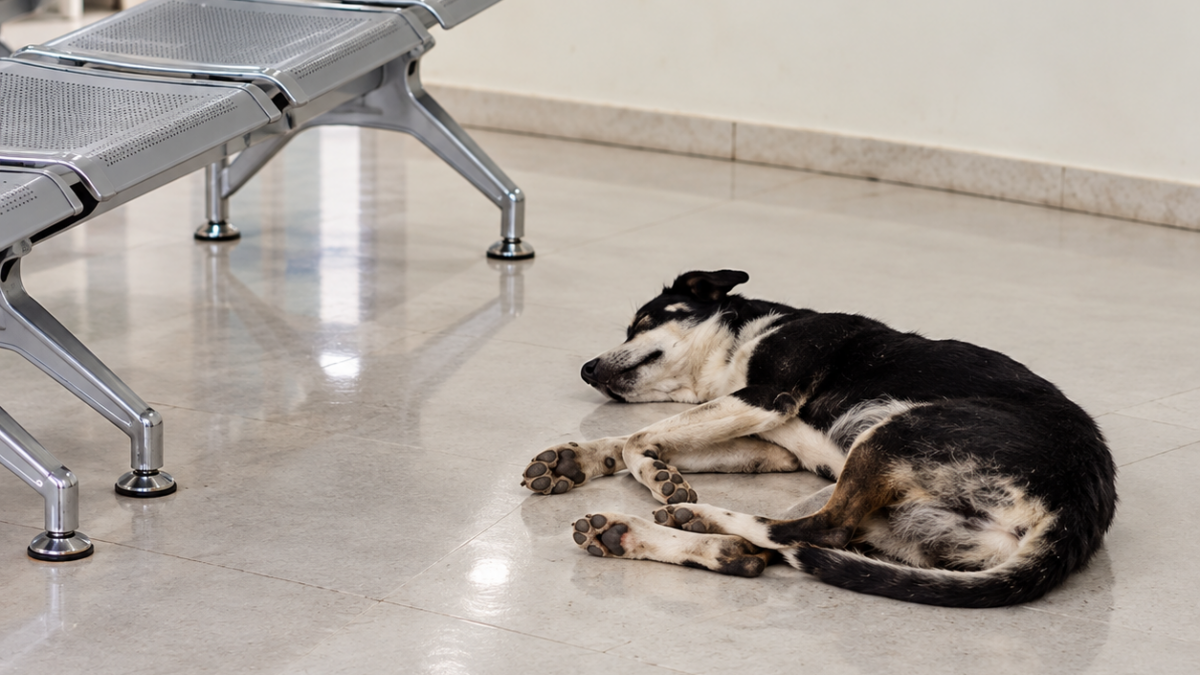
Rafa returned to his corner.
He circled twice and lay down.
People stepped around him as casually as if he were part of the architecture.
A cleaner pushing a cart noticed us.
“You came for Rafa?”
I turned.
“You know him?”
The woman laughed softly.
“Everybody knows him.”
Her name was Teresa.
She had worked nights at the airport for almost six years.
She leaned on the handle of her cleaning cart and looked toward Rafa.
“He likes chicken better than dry food.”
“That’s useful.”
“He doesn’t like people grabbing his collar.”
“Also useful.”
“He’ll let me touch him sometimes.”
“How long have you been feeding him?”
“Almost since he started staying here.”
“You remember when he arrived?”
Teresa’s expression changed.
“I remember when he stopped leaving.”
That sentence stayed with me.
“What does that mean?”
“At first he followed cars. Ran through the parking area. Someone said he came with a passenger who left on a flight.”
“Did you see that?”
“No. I only heard it.”
“So we don’t know exactly how he was abandoned?”
“We know he had a man.”
“How?”
Teresa pointed toward the terminal.
“One of the baggage workers remembers them. Said the man came with luggage and Rafa. Dog kept following him. Worker told him dogs weren’t allowed in certain areas. Man tied Rafa outside for a while.”
My stomach tightened.
“And then?”
“Man went inside.”
“With the luggage?”
“Yes.”
“Did he come back?”
“No.”
Daniel muttered something I won’t repeat.
Teresa continued.
“People thought maybe somebody else was coming for the dog.”
“Nobody did?”
She shook her head.
“For the first few days Rafa stayed near the entrance. Then he started sleeping over there.”
She pointed toward the wall.
“He would follow men who looked similar?”
“Especially at first.”
“How long before everyone realized no one was coming?”
“A week. Maybe two.”
“And no one took him?”
“People tried.”
“Who?”
“Airport workers. A local shelter. One man brought a rope.”
“What happened?”
“He panicked. Ran into the parking lot. Almost got hit.”
I looked at Rafa.
“So everyone stopped forcing it.”
“We fed him. Tried to build trust.”
“Why has he remained here two years?”
Teresa gave me the answer I already knew.
“Because every time someone moved him, he came back.”
Daniel looked toward the road.
“How far?”
“Once somebody got him almost three miles away.”
“And?”
“Next morning he was here.”
I stared.
Three miles.
Through traffic.
Back to the same doors.
Teresa smiled sadly.
“He always comes back.”
The automatic entrance opened.
Rafa lifted his head.
Not the arrivals doors this time.
He lowered it again.
I sat on the pavement about fifteen feet from him.
Daniel opened the chicken Teresa had suggested.
“You realize we drove all this way to sit on airport concrete.”
“Yes.”
“My back is going to file a complaint.”
“Be quiet.”
He handed me a piece.
I tossed it halfway between Rafa and me.
Rafa looked at it.
Then at me.
Nothing.
Another piece.
Closer to him.
Still nothing.
Teresa chuckled.
“He knows strangers use food to catch him.”
Smart dog.
“That complicates things.”
“He’s had two years to learn.”
I placed a piece near my own knee.
Then stopped paying attention.
That was deliberate.
I talked to Teresa.
We discussed his routine.
He usually disappeared briefly early in the morning, probably to relieve himself somewhere away from the crowds.
He returned before the heaviest flight schedule.
He slept during quiet periods.
He recognized several workers.
He seemed healthiest when those workers pooled money to buy proper dog food.
Nobody knew his vaccination status.
Nobody knew if he had a microchip.
Nobody knew his exact age.
Most estimated five or six.
“What happens during storms?” I asked.
Teresa looked toward the parking area.
“He gets under the service stairs if the wind is bad.”
“Cold weather?”
“We put cardboard and blankets there.”
“You know those aren’t enough.”
“I know.”
Her voice became defensive.
I softened mine.
“I’m not criticizing you.”
“It feels like it.”
“I’m not. You kept him alive.”
She looked at Rafa.
“We tried.”
“You did more than the person who left him.”
Teresa wiped at one eye.
“That stupid dog breaks my heart every night.”
Rafa stood.
I thought he was leaving.
Instead, he took one step toward the chicken.
Stopped.
Another.
Daniel whispered, “Don’t move.”
“I know.”
Rafa sniffed the first piece.
Ate it.
Then the second.
Then he stopped about six feet from us.
I lowered my eyes.
Direct staring can feel threatening.
He took another piece.
Five feet.
Three.
Then he stopped.
The arrivals doors opened.
Everything we had accomplished vanished in one second.
Rafa spun.
He ran toward the terminal.
“Damn it,” Daniel whispered.
People emerged.
Rafa searched.
A tall man in a gray jacket came through.
Rafa froze.
His tail began moving rapidly.
He approached.
The man noticed him.
“Hey, buddy.”
Rafa moved closer.
For one terrible second, I thought maybe this was the person.
The man scratched Rafa’s head.
Then a woman called from farther down.
“Michael!”
The man smiled.
“Sorry, buddy.”
He walked away.
Rafa followed four steps.
Then stopped.
Watched him leave.
Daniel looked away.
I couldn’t.
Rafa returned slowly.
Not to us.
To his wall.
He lay down.
“You see that every day?” Daniel asked Teresa.
“Every day.”
That night we didn’t rescue Rafa.
We stayed.
There is a difference.
We gave him food.
Sat nearby.
Let him smell us.
Daniel walked around the airport talking with workers.
I collected names and timelines.
If we were going to relocate Rafa, I wanted local authorities and airport management involved.
A dog cannot legally just be “claimed” because a story is sad.
We needed to make sure no legitimate owner existed, verify abandonment status, check for a microchip, and coordinate with whoever had jurisdiction.
At nearly midnight, an airport security supervisor named Mr. Alvarez came outside.
“You’re the rescue people?”
“Yes.”
“I’ve been told you want to take Rafa.”
“If we can do it safely and legally.”
He nodded.
“Please.”
That surprised me.
“You’re supportive?”
“He’s a good dog. But this is dangerous.”
“Traffic?”
“Traffic. Disease. People. We’ve had passengers complain. Others try to hug him. Kids chase him. Someone tried to steal him once because of the online videos.”
My stomach turned.
“Steal him?”
“Put him in a car. Teresa stopped them.”
Teresa raised both hands.
“I may have yelled.”
Mr. Alvarez smiled.
“She definitely yelled.”
I looked toward Rafa.
“He’s famous now.”
“Unfortunately.”
That word mattered.
Fame is not safety.
Millions of views do not equal one committed home.
Thousands of shares don’t keep a dog from being hit by a vehicle.
Virality had made Rafa visible.
It had also made him vulnerable.
Mr. Alvarez gave us access to a small service area where we could work away from passengers.
“Can we bring him there?”
“If he follows.”
I looked at Teresa.
She smiled.
“He’ll follow me.”
Twenty minutes later, Teresa walked toward the service entrance carrying chicken.
Rafa followed at a cautious distance.
I stayed behind him.
Daniel remained to the side.
No one blocked his exit.
Teresa entered the fenced service yard.
Rafa stopped at the gate.
She sat.
“Come on, foolish boy.”
His ears lifted.
She tossed chicken.
He stepped through.
Daniel quietly closed the gate.
Rafa noticed.
His head snapped around.
His body stiffened.
“No,” I whispered. “Nobody touch him.”
He paced.
Once.
Twice.
He returned to the gate.
Sniffed.
Looked toward the terminal.
Then began whining.
Not loud.
Low.
Persistent.
Teresa covered her mouth.
“He wants back.”
“I know.”
Rafa scratched at the gate.
The arrivals doors were visible in the distance through the fence.
A flight had apparently landed.
Passengers began appearing.
Rafa paced faster.
His whining became a cry.
Daniel looked at me.
“Rachel.”
“I know.”
For several minutes, Rafa seemed to forget all of us.
He stared toward those doors.
A man walked through.
Then another.
Rafa jumped against the fence.
My chest hurt.
Two years.
Two years of repetition had become ritual.
Doors open.
Search.
Hope.
Disappointment.
Wait again.
It wasn’t just loyalty anymore.
It was his entire behavioral world.
Teresa sat near him.
“Rafa.”
He ignored her.
“Rafa, baby.”
Nothing.
I moved closer but stayed several feet away.
“I’m sorry.”
His ears flicked.
“We’re going to ask you to do something really hard.”
Daniel glanced at me.
I kept talking.
“You’re going to have to leave without him.”
Rafa cried again.
“You’re going to have to stop waiting before you understand why.”
I knew he couldn’t comprehend the words.
Maybe I was speaking for myself.
“We can’t bring him back, Rafa.”
His body shook.
“But we can take you somewhere people stay.”
That first night, we did not put him directly into the van.
We placed an open crate in the service yard with bedding inside.
Food near the entrance.
Water.
Then we waited.
At 2 a.m., Rafa finally entered halfway.
At 2:40, fully.
At 3:15, he lay down.
The crate door remained open.
We wanted his first decision to be voluntary.
I slept sitting against the service building wall.
Daniel slept in the van.
Teresa finished her shift but refused to leave.
By sunrise, Rafa had moved from the crate back to the gate.
He watched morning passengers arrive.
Teresa approached him.
“I’m going home now.”
Rafa looked at her.
She crouched.
For the first time since we arrived, Rafa allowed someone to wrap both arms around him.
Teresa began crying.
“You stupid, loyal, beautiful dog.”
Rafa licked her chin.
She laughed through tears.
“You better not walk back here.”
That was our fear.
Even if we transported him far away, would he try to return?
We decided his first destination would be a secure temporary foster home with high fencing and controlled exits.
No chance to bolt.
No busy roads nearby.
No open gate.
Mr. Alvarez coordinated the paperwork.
Local animal services scanned Rafa.
No microchip.
Not registered in their active lost-animal system.
Public notices about the dog had been circulating for years.
No verified owner had come forward during that time.
The legal abandonment process had already effectively been documented through local authorities and the airport’s long record.
I asked for copies of everything.
Dates.
Reports.
Statements.
Pictures.
I didn’t know then how important that file would become.
At 9:20 that morning, we prepared to leave.
Teresa put Rafa’s old water bowl in the van.
“For him.”
I took it.
“Come visit him someday.”
“You’re taking him far.”
“We’ll send updates.”
She nodded.
Mr. Alvarez held the crate steady.
Daniel sat inside the van.
We didn’t force Rafa into it.
Teresa walked into the crate first with food.
Rafa followed.
She stepped out the second door.
I closed it gently.
Rafa turned.
Confusion.
Then panic.
He pushed his nose against the bars.
Teresa put her fingers through.
“I’m sorry.”
Rafa whined.
“You can’t live here forever.”
His paws pressed against the crate door.
Teresa cried harder.
Daniel started the engine.
Rafa looked toward the airport.
I sat beside the crate.
As we pulled away, his head turned toward the rear window.
Terminal.
Doors.
Workers.
Passengers.
All shrinking.
Rafa stood until the airport disappeared.
Then he paced inside the crate.
Whined.
Turned.
Looked behind us.
For nearly forty minutes, he would not settle.
I kept one hand near the crate.
“It’s okay.”
He ignored me.
“You’re not being abandoned.”
Still pacing.
“We’re with you.”
Eventually exhaustion won.
Rafa lay down.
But he kept his face pointed toward the back of the van.
Daniel looked at me through the mirror.
“You think he knows we’re not taking him back?”
“Yes.”
“Do you think he hates us?”
“Probably.”
“Good start.”
I almost smiled.
The temporary foster home belonged to my friend Anna.
She had helped rehabilitate anxious rescue dogs for years.
Her property had a secure six-foot fence around the yard, a double-gate entry, quiet rooms, and two calm dogs named Charlie and Olive.
When we arrived, Anna came outside.
She didn’t approach the crate.
“Give me the summary.”
“Male. Five or six maybe. Lived around airport more than two years. Strong location attachment. Friendly with known people, cautious with strangers, potential flight risk.”
“Medical?”
“Unknown beyond basic field exam.”
“Food?”
“Motivated, but suspicious when used for capture.”
“Dogs?”
“Reportedly tolerant.”
“Triggers?”
“Airport doors.”
Anna looked at me.
“That’s a new one.”
“Very.”
We moved the crate into a quiet room.
Opened it.
Then everyone left.
No welcoming committee.
No excitement.
No crowd.
Rafa stayed inside for twenty minutes.
Then thirty.
Finally, I saw one paw appear.
Then his nose.
He stepped out.
The room had a bed.
Water.
Food.
A blanket.
Nothing else.
Rafa sniffed the walls.
The door.
The floor.
Then he returned to the crate.
Anna whispered from the hallway.
“That’s fine.”
“Yes.”
“You staying?”
“For a while.”
“You look like you haven’t slept.”
“I slept against an airport wall.”
“That does not count.”
“It counts badly.”
We took Rafa to a veterinarian that afternoon.
He had no major emergency condition, which felt miraculous.
Mild underweight.
Old scars.
Parasites.
Dental disease.
Skin irritation.
Evidence of long outdoor living.
But nothing that couldn’t be treated.
The veterinarian estimated him around six.
“So half his remembered adult life may have been at that airport,” I said.
“Possibly.”
The number hurt.
Half.
Imagine spending half your adult life waiting in one place for somebody who decided to continue theirs without you.
Rafa tolerated bloodwork.
Vaccinations.
Examination.
But the moment a sliding clinic door opened, his head snapped toward it.
I noticed.
So did the veterinarian.
“Sound association?”
“Probably.”
“He may improve when the environment changes.”
“I hope.”
“Don’t expect two years of conditioning to disappear in two days.”
“I know.”
Again.
I knew.
Knowing does not make patience easier.
The first week at Anna’s was difficult.
Rafa ate.
Drank.
Slept.
But every morning he walked the perimeter fence.
He searched gates.
He tested corners.
If a car stopped outside, he went alert.
If a man’s voice sounded from the road, Rafa ran toward the front.
When Anna’s husband, Mark, returned from work on the third evening, Rafa sprinted to the window.
Mark stepped inside.
Rafa froze.
For several seconds, he stared.
Then disappointment seemed to pass through him.
He walked away.
Mark looked at me.
“That was rough.”
“Yes.”
“Does he do that with every man?”
“Not every one. Mostly men around a certain height and build.”
“What did the owner look like?”
“We don’t know for certain.”
Mark crouched.
Rafa stayed across the room.
“Then we’ll let him figure out I’m boring.”
That was exactly what Rafa needed.
Boring kindness.
Predictable kindness.
The same meal times.
Same voices.
Same bed.
Same people returning through the same door.
At the airport, doors meant strangers and disappointment.
At Anna’s house, we wanted the front door to begin meaning something else.
People leave.
People come back.
The first breakthrough happened on day eight.
Anna went to the grocery store.
Rafa watched her leave.
He stood at the window for nearly forty minutes.
When her car returned, Rafa saw it.
His tail moved.
Anna entered.
Rafa ran toward her.
Not past her.
Toward her.
He jumped once, caught himself, then pressed his head against her leg.
Anna looked at me.
“Did he just…”
“Yes.”
“He knew I came back.”
I felt my throat tighten.
“Do it again tomorrow.”
She laughed.
“Buy groceries?”
“Leave and come back.”
That became part of Rafa’s recovery.
Not staged dramatically.
Just ordinary life.
Anna left for twenty minutes.
Returned.
Mark went to work.
Returned.
I left after visits.
Returned the next day.
Rafa began learning a new pattern.
Departure did not always mean forever.
At two weeks, we introduced him to Charlie and Olive.
Charlie was a calm black Lab mix who believed conflict was exhausting.
Olive was an elderly shepherd who ignored almost everyone.
Rafa met them one at a time through fencing.
Tail neutral.
Sniff.
Pause.
Charlie wagged.
Rafa wagged back.
Within three days, all three could share the yard.
That was when we saw the first glimpse of Rafa the playful dog.
Charlie ran after a tennis ball.
Rafa watched.
Second throw.
Rafa followed.
Third throw.
Rafa ran beside him.
By the fifth throw, Rafa was trying to steal the ball.
Anna laughed.
“There you are.”
Rafa spun.
Charlie chased.
Rafa raced around the yard with his mouth open.
No terminal.
No sliding doors.
No suitcases.
For several minutes, no waiting.
Just running.
I recorded a short video for Teresa.
She called immediately.
“That’s Rafa?”
“That’s him.”
“He runs?”
“Apparently.”
“I never saw him play.”
I became quiet.
“Never?”
“Not like that.”
She sniffed.
“I thought maybe he didn’t know how.”
“He knew.”
“He just didn’t have anyone.”
That sentence nearly ended me.
By week three, Rafa had discovered beds.
Real dog beds.
At the airport, he had slept on cardboard, old blankets, concrete, pavement.
At Anna’s, he had choices.
One bed in the living room.
One in the hallway.
One in the quiet foster room.
For some reason, Rafa preferred the smallest one.
He curled his body until half his legs hung off the side.
“Why?” Anna asked.
“Maybe small feels safe.”
Charlie walked by and stared at him.
Anna laughed.
“Charlie wants to know why he gets the expensive bed.”
“He has two others.”
“Charlie doesn’t believe in property rights.”
Rafa rolled onto his back.
That mattered.
A dog sleeping exposed on his back is a dog who, at least in that moment, does not believe he must protect his vulnerable side.
I sent another photograph to Teresa.
Her reply came quickly.
I have never seen him sleep like that.
Every new behavior told us how much of Rafa had been hidden by waiting.
He was playful.
Affectionate.
Quiet indoors.
Good with dogs.
Polite around food.
He learned “sit” within days.
He loved riding in the car.
That surprised me.
After being abandoned at a transportation hub, I thought moving vehicles might stress him.
Instead he pressed his nose against the window and watched everything.
Maybe motion felt different when someone stayed beside him.
At one month, his health had improved.
Parasites treated.
Weight up.
Coat brighter.
Dental cleaning completed.
His eyes looked less tired.
But the airport had not left him completely.
One afternoon, Anna took him for a walk near a shopping center.
Automatic glass doors opened.
Rafa froze.
Then pulled toward them.
Hard.
Anna stopped.
“Rafa.”
He ignored her.
A group of people came through.
He scanned faces.
Anna called me.
“Airport behavior.”
I drove over.
By then Rafa had settled, but he kept staring at the doors.
I sat beside him on a low wall.
“Okay.”
Anna frowned.
“Okay?”
“We found the thing.”
“You sound happy.”
“I’m not. But now we know sliding doors generalize.”
“So what do we do?”
“Build a new association.”
We started carefully.
Not with crowded terminals.
Quiet storefront.
Distance.
Treats only after Rafa looked away from the doors voluntarily.
No dragging.
No flooding him with crowds.
At first, he could only handle thirty seconds.
Then a minute.
Then five.
Over weeks, the doors became less powerful.
People emerged.
Rafa noticed.
But he stopped scanning every face.
That felt enormous.
Then the story changed again.
A message arrived on our rescue page.
I was sitting at the office when I read it.
My name is Adrian. Rafa was my dog. I saw the videos. I need to talk to you.
I stared at the screen.
Read it twice.
Then a third time.
Daniel walked in.
“You’re doing the face.”
“What face?”
“The one before paperwork.”
I turned the monitor.
He read.
“Son of a—”
“Don’t.”
“He left him for two years.”
“We don’t know if this is really the owner.”
“Ask.”
I replied carefully.
Please provide proof of prior ownership, including photographs, veterinary records, identifying information, and details about Rafa that can be independently verified.
The answer came an hour later.
Photographs.
A younger Rafa.
Same markings.
Same face.
A man beside him.
Airport baggage visible in one photo.
My stomach turned.
It was probably him.
Adrian.
The man Rafa had searched for through thousands of passengers.
He wrote:
I had to leave the country unexpectedly. I thought someone would take care of him. I couldn’t come back. I never knew he stayed there that long.
Daniel read over my shoulder.
“Bull.”
“Maybe.”
“Rachel.”
“We need facts.”
The local documentation from the airport told part of the story.
No designated caretaker had ever appeared.
No one had contacted authorities to arrange placement.
No food provision.
No veterinary care.
No attempt to recover Rafa documented in more than two years.
I asked Adrian directly:
Who did you arrange to care for Rafa after you left?
His answer:
A friend was supposed to pick him up.
Name?
A pause.
Then a name.
We tried to locate the friend.
He eventually responded.
His version was different.
“Adrian asked if I could maybe take the dog,” the man told us by phone.
“Did you agree?”
“No. I told him my landlord didn’t allow pets.”
“Did he ask you to pick Rafa up from the airport?”
“He mentioned it. I said I couldn’t.”
“Did you ever believe responsibility for Rafa had been transferred to you?”
“No.”
“Did Adrian know that?”
“Yes.”
I took notes.
The call ended.
Daniel leaned back.
“So he knew.”
“It appears that way.”
“What does Adrian want now?”
That question had been sitting in my stomach.
I sent another message.
What are you requesting regarding Rafa?
The answer took three hours.
I want to see him. He was my dog.
Not “I want him back.”
Not yet.
I forwarded everything to the appropriate local authority and our legal adviser.
Rafa’s abandonment had been documented long enough that his ownership status had already transferred through the lawful rescue process.
Adrian could not simply appear after two years and claim him.
Still, I worried.
Not legally.
Emotionally.
What would happen if Rafa saw him?
Would two years disappear?
Would Rafa run back?
Would all our progress become irrelevant in one second?
Anna asked the harder question.
“Would seeing him help Rafa?”
“I don’t know.”
“Then why consider it?”
“Because maybe Rafa deserves an answer.”
“He’s a dog, Rachel.”
“I know.”
“He doesn’t need closure the way humans imagine it.”
“I know.”
“Do you?”
That stopped me.
Maybe part of me wanted to see the reunion.
Wanted proof.
Would Rafa recognize him?
Would he be happy?
Would he reject him?
That curiosity was human.
It was not necessarily in Rafa’s interest.
So we sought advice from a veterinary behaviorist.
Her answer was cautious.
“A reunion could cause significant arousal and potentially reinforce the attachment pattern you are trying to reshape. Unless there is a concrete welfare reason, I would not stage it merely for emotional resolution.”
That settled it.
We did not turn Rafa’s trauma into a reunion video.
I wrote Adrian:
Rafa is safe and has been legally placed in rescue care after documented abandonment lasting more than two years. Based on professional behavioral guidance, we will not arrange a meeting solely for emotional closure. You may provide any relevant medical history or information that could benefit his future care.
His response came quickly.
That’s unfair. He loved me.
I stared at those words.
Then wrote:
That is exactly why leaving him without confirmed care was so damaging.
I did not send anything angrier.
I didn’t need to.
He replied:
You don’t know what I was going through.
He was right about one thing.
I didn’t.
People can face immigration problems.
Family emergencies.
Financial collapse.
Legal trouble.
Illness.
Fear.
Life can become impossible quickly.
But hardship explains decisions.
It does not erase responsibility.
If you cannot return for an animal, you find someone who can.
You confirm.
You call.
You surrender.
You ask for help.
You do not leave a dog at an airport and assume loyalty will solve the problem.
Adrian stopped responding.
For several weeks, that seemed to be the end.
Then one of Rafa’s old airport videos went viral again.
This time, a page reposted it with our rescue update.
Millions more views.
Adrian appeared publicly in the comments.
He claimed Rafa had not been abandoned.
He said he had been forced to travel.
Said a friend had betrayed him.
Said rescue organizations were using his dog for attention.
The story became messy.
Exactly what I didn’t want.
People attacked him.
Others attacked us.
Strangers invented details.
Some claimed Adrian had died years ago.
Others claimed he was wealthy.
None of that mattered.
I posted one factual statement through the rescue:
Rafa remained at the airport for more than two years without verified owner-provided care. Local authorities documented his status, and he was lawfully transferred into rescue placement. He is currently safe, medically cared for, and progressing in foster care. We will not share private placement details or arrange public confrontations.
Then I stopped reading comments.
Rafa didn’t need an internet war.
He needed dinner.
That night I went to Anna’s.
Rafa met me at the door.
Tail wagging.
He carried a rope toy.
“Hey.”
He dropped it.
I threw.
He ran.
Anna came into the room.
“Internet exploding?”
“Yes.”
“Rafa aware?”
“He has issued no statement.”
“Smart.”
Rafa returned with the rope.
I looked at him.
All those people arguing about ownership.
About betrayal.
About who was right.
Rafa cared about the rope.
That grounded me.
His recovery didn’t happen online.
It happened here.
In a living room.
In ordinary days.
By the sixth week, we began reviewing adoption applications.
Hundreds arrived.
Too many.
The viral story had created the illusion that popularity solves homelessness.
It doesn’t.
Popularity creates volume.
Quality still requires work.
One application said:
“We want Rafa because he is famous and would be perfect for our social channels.”
No.
Another:
“We have a large property and he can live outside with our farm dogs.”
No.
Another:
“Our kids saw him online and won’t stop asking.”
No.
Kind people.
Wrong reasons.
Rafa had spent enough time being a symbol.
He needed to become somebody’s dog.
Then I opened an application from a couple named Emily and Nathan Brooks.
Nothing dramatic.
Married twelve years.
Both in their forties.
Emily worked partly from home as an accountant.
Nathan was a physical therapist.
They had one adult daughter in college and two dogs: Pepper, nine, and Scout, four.
Fenced yard.
Excellent veterinary history.
Previous rescue experience.
They wrote:
We do not expect Rafa to be grateful or instantly attached to us. We understand he may have separation-related behaviors because of his history. We are willing to work with a veterinary behavior professional if needed. We would like to meet him only if the rescue believes our home fits what he needs.
I read that paragraph twice.
No “poor baby.”
No “we will save him.”
No claim that love fixes everything.
I called.
Emily answered.
“Hello?”
“This is Rachel from Harbor Animal Rescue.”
“Oh.”
Her voice changed.
“Is this about Rafa?”
“Yes.”
“I promise we’re normal.”
I laughed.
“That remains to be determined.”
She laughed too.
We talked for nearly an hour.
I asked about travel.
“If both of you need to leave town, what happens?”
“My sister stays at our house.”
“Not boarding?”
“Possible if he handles it, but we’d prefer familiar surroundings.”
“How long is he alone on a normal day?”
“Usually no more than three hours.”
“What if he develops destructive separation anxiety?”
“We get professional help.”
“What if he never becomes comfortable with airports?”
“We don’t take him to airports.”
“What if he becomes attached to one of you and anxious when that person leaves?”
“We work on it.”
“What if he never completely stops looking at doors?”
Emily became quiet.
“Then we make sure the important door is the one we come back through.”
I wrote that down.
They visited Anna’s house the following weekend.
Nathan was roughly the same height as several men who triggered Rafa’s searching behavior.
I warned them.
“Do not call him.”
Nathan nodded.
“I’ll ignore him.”
“Not dramatically.”
“How does one ignore a dog dramatically?”
“You’d be surprised.”
Emily sat on the couch.
Nathan stood near the kitchen talking to Anna.
Rafa entered.
Saw Emily.
Sniffed.
Then saw Nathan.
He froze.
My chest tightened.
Nathan kept talking about traffic as though Rafa didn’t exist.
Rafa stared.
Then approached.
One step.
Another.
Sniffed Nathan’s shoe.
Nathan did nothing.
Rafa walked around him.
Then looked at his face.
Nathan still didn’t reach.
Rafa’s tail moved once.
I exhaled.
Ten minutes later, Rafa brought Nathan the rope toy.
Nathan looked at me.
“Am I allowed?”
“Yes.”
He tossed it.
Rafa ran.
That was visit one.
Visit two included their dogs.
Pepper ignored Rafa.
Scout wanted to play immediately.
Rafa was cautious for five minutes.
Then the yard exploded into running.
Emily watched.
“Is he always that fast?”
“He has two years of missed zoomies.”
Nathan laughed.
By the third visit, Rafa leaned against Emily.
By the fourth, he slept while Nathan sat three feet away.
The home inspection went perfectly.
Two dog beds.
Then three after they learned Rafa liked options.
Secure fence.
Double-gated side entrance.
Quiet neighborhood.
No busy airport nearby.
The kitchen had glass doors leading to the backyard.
That worried me briefly.
Automatic?
No.
Just ordinary hinged doors.
Good.
Nathan noticed me checking.
“You really hate doors now.”
“I have developed opinions.”
Before finalizing adoption, we did a trial weekend.
Rafa left Anna’s house in Emily and Nathan’s car.
I expected him to be anxious.
Instead, he jumped in beside Scout.
Anna stood in the driveway.
Her eyes filled.
“Don’t start.”
“You’re crying.”
“No.”
“You’re absolutely crying.”
“He’s been here seven weeks.”
“That’s enough to love him.”
She looked at me.
“You know what’s strange?”
“What?”
“I thought the hard part would be getting him to stop waiting for the old owner.”
“And?”
“The hard part was teaching him it was okay to expect us back.”
That was exactly right.
Rafa did well the first night.
Ate dinner.
Explored.
Slept in the hallway outside Emily and Nathan’s room.
Second day, Nathan left for work.
Rafa stood at the front window.
Emily texted me.
He’s watching.
I replied:
Don’t distract immediately. Let him observe. Stay normal.
Twenty minutes later:
Still watching.
Forty minutes:
He finally lay down.
Three hours later, Nathan’s car returned.
Rafa heard it.
Ran to the door.
Nathan entered.
Rafa jumped.
Tail whipping.
He made a strange whining sound and pressed against Nathan’s legs.
Emily recorded only five seconds, then put her phone away.
She sent the clip privately.
I watched Rafa greet a man coming home.
Not a stranger coming through terminal doors.
Not a resemblance.
Not hope followed by loss.
His person had left.
His person came back.
That distinction was becoming real.
The trial weekend became one week.
Then two.
Rafa settled beautifully.
He loved Scout.
Respected Pepper.
Followed Emily during the day.
Waited for Nathan near the front window around five.
But the waiting looked different.
He wasn’t frantic.
He wasn’t scanning strangers.
He seemed to know which car mattered.
On the fifteenth day, I arrived with the adoption contract.
Emily opened the door.
Rafa ran to me.
He greeted me happily.
Then returned to Nathan.
Perfect.
I sat at their kitchen table.
“We can finalize.”
Emily covered her mouth.
Nathan exhaled.
“You sure?”
“Yes.”
Rafa lay under the table.
I read through the medical history.
Behavioral notes.
Microchip registration.
Follow-up requirements.
Training recommendations.
Then I reached the signature lines.
Emily signed.
Nathan signed.
I signed for the rescue.
And just like that, Rafa had parents.
Not airport workers who fed him because somebody had to.
Not temporary rescuers.
Not a foster house.
A family legally responsible for tomorrow.
I looked under the table.
“Rafa.”
He lifted his head.
“You have no idea what just happened.”
Nathan smiled.
“He got insurance last week. He’s more official than some adults.”
I laughed.
We took a family photograph.
Emily.
Nathan.
Pepper.
Scout.
Rafa in front.
He refused to look at the camera.
Exactly right.
That night, I called Teresa.
“Ready?”
“For what?”
“He’s adopted.”
Silence.
Then a sob.
“Really?”
“Really.”
“Good people?”
“Very.”
“Dogs?”
“Two siblings.”
“Inside?”
“Inside.”
“Bed?”
“Several.”
She laughed through tears.
“He has a mom?”
“Yes.”
“And dad?”
“Yes.”
“Oh, Rafa.”
She cried openly.
I let her.
After a minute, she said:
“Can I see him?”
“We can arrange that.”
Three months later, Teresa visited.
We debated whether bringing Rafa anywhere near the airport was wise.
Absolutely not.
So she came to his home.
Nathan opened the door.
Teresa stepped inside.
Rafa appeared from the hallway.
He stopped.
His ears rose.
Teresa whispered:
“Rafa?”
His whole body changed.
He ran.
Teresa dropped to her knees.
Rafa hit her chest.
She wrapped her arms around him and cried into his neck.
“You remember me.”
His tail beat against the floor.
“I fed you terrible chicken for two years.”
Rafa licked her face.
Emily cried.
I cried.
Nathan pretended not to.
Even Pepper looked emotionally inconvenienced.
Teresa pulled back.
“You look fat.”
Rafa wagged.
“He is not fat,” Emily said.
“Healthy fat.”
“We prefer ‘well nourished.’”
Teresa looked around.
Photos on the wall.
Dog beds.
Toys.
Water bowls.
A backyard.
She stood.
“This is his?”
“All of it,” Nathan said.
Teresa covered her mouth again.
For years, she had watched Rafa wait while other people went home.
Now she was standing inside his home.
That mattered more than any viral update.
The most unexpected part came six months after adoption.
Adrian contacted us again.
Not publicly.
Privately.
He wrote:
I know you don’t want me involved. I just want to know if he’s okay.
I stared at the message for a long time.
Part of me wanted to ignore it.
Part of me wanted to send every photograph.
Show him what he had lost.
Rafa asleep beside Nathan.
Rafa running with Scout.
Rafa in a ridiculous raincoat Emily bought.
Rafa lying beneath the Christmas tree.
That would have been the revenge version of me.
Look what you gave up.
Look who replaced you.
Look how happy he is without you.
But that would make Rafa’s happiness into a weapon.
He deserved better.
So I answered with one sentence:
Rafa is safe, healthy, and permanently placed with a loving family.
Adrian replied:
Thank you.
Nothing else.
That was enough.
I never told Emily and Nathan until much later.
There was no reason to bring old uncertainty into Rafa’s home.
His life had moved forward.
A year after adoption, something happened that showed me how far.
Nathan had to fly across the country for a family funeral.
Emily worried.
“Will seeing luggage trigger him?”
Maybe.
We planned carefully.
Nathan packed in a separate room.
Rafa still noticed.
Suitcase.
Shoes.
Different routine.
He followed Nathan closely.
The morning Nathan left, Rafa stood beside the front door.
Nathan knelt.
“I’m coming back.”
Those words.
I was there because Emily had asked me to help observe.
Nathan rubbed Rafa’s chest.
“Two days.”
Rafa licked his hand.
Nathan left.
For an hour, Rafa stayed near the window.
Then he walked away.
Ate breakfast.
Played with Scout.
Slept.
That night he checked Nathan’s side of the bed.
Then settled beside Emily.
Next day, normal.
The third afternoon, Nathan returned.
His car pulled in.
Rafa heard it.
He sprinted.
When Nathan opened the door, Rafa exploded with joy.
Barking.
Whining.
Tail going so hard his entire body bent.
Nathan dropped his bag and knelt.
“I told you.”
Rafa pressed against him.
Nathan looked at me over Rafa’s back.
“He waited.”
“Yes.”
“But he knew.”
I nodded.
That was the difference.
There are kinds of waiting.
One is hope with no promise.
The other is trust built by repetition.
Rafa had spent two years practicing the first.
His family taught him the second.
Nathan left.
Nathan came back.
Emily left.
Emily came back.
Doors opened.
People returned.
Suitcases did not always mean abandonment.
Air travel did not always mean forever.
That might have been Rafa’s greatest recovery.
Two years passed.
Then three.
Rafa became wonderfully ordinary.
He loved morning walks.
Hated baths.
Slept with his head upside down off the couch.
Stole Scout’s toys even when identical toys sat beside him.
Barked at delivery drivers.
Knew the sound of Emily opening cheese from three rooms away.
Developed a strange friendship with Pepper, who tolerated him mostly because he learned not to touch her bed.
At night, Rafa slept wherever the family was.
That detail always got me.
At the airport, he slept alone because he believed one person might return.
At home, he slept among people because he knew they were already there.
When Rafa was approximately nine, Pepper died.
Old age.
Kidney failure.
Nathan called me.
“Rafa’s looking for her.”
Of course he was.
Loss had shaped him once.
I worried what another disappearance would do.
But this time, Rafa had been present.
He had smelled Pepper after she passed.
He had seen Emily and Nathan grieve.
Nobody vanished without explanation.
For several days, Rafa checked Pepper’s bed.
Then gradually stopped.
Scout stayed close.
Rafa recovered.
Grief still hurt him.
But grief was no longer abandonment.
There is a difference.
On the fourth anniversary of his adoption, Teresa visited again.
Rafa remembered her immediately.
She brought chicken.
Emily laughed.
“He has a diet.”
“One day.”
“Small amount.”
Teresa looked at Rafa.
“Your mother is strict.”
Rafa sat between them.
Mother.
The word landed softly.
No one corrected it.
Later, Teresa and I sat on the porch.
“I used to think loyalty was always beautiful,” she said.
“What changed?”
“Rafa.”
I waited.
“People kept saying, ‘Look how loyal he is. Two years waiting.’”
She shook her head.
“I hated it.”
“Why?”
“Because everybody admired the loyalty, but the loyalty was hurting him.”
I understood.
Faithfulness is beautiful when someone deserves it.
When they protect it.
Return it.
Honor it.
Otherwise loyalty can become a cage without bars.
Rafa had not been noble because he suffered.
He had been a dog doing the only thing his heart understood.
The beauty came later.
When he learned loyalty could be mutual.
A person leaves in the morning.
Comes back at night.
A dog waits.
Door opens.
The same person returns.
Again.
Again.
Again.
Trust is built out of completed promises.
Around year five, Rafa slowed slightly.
Not much.
Gray appeared around his muzzle.
His veterinarian estimated he might be ten or eleven.
Airport life had aged him physically, but his health remained good.
Mild arthritis.
Dental work.
Nothing unusual.
Emily bought steps for the couch.
Rafa refused them.
He continued jumping until one day he missed.
Nathan said, “Steps.”
Rafa stared.
“Steps.”
Rafa walked away.
The next evening, when nobody was watching, he used them.
Dogs have pride too.
One rainy Sunday, I visited.
Rafa was asleep between Emily and Nathan on the couch.
Scout occupied the floor.
Rain tapped against the windows.
I sat across from them.
Emily whispered:
“You know what I think about?”
“What?”
“The airport.”
“So do I.”
“Not the sad part.”
“What then?”
“All those people.”
I waited.
“Thousands of people walked past him.”
“Millions, probably, over two years.”
“And now he hates when we have more than six people over.”
I laughed.
“That is progress.”
Rafa opened one eye.
Then closed it.
Nathan rubbed his ear.
“I still don’t understand how someone could leave him.”
I looked at Rafa.
“Maybe we don’t need to.”
Nathan nodded.
For years I had thought understanding the abandonment would help.
Eventually I realized some questions do not deserve permanent space.
Why didn’t Adrian return?
Why didn’t he confirm care?
Why did Rafa have to wait so long?
There were explanations.
No explanation could give those years back.
Better to invest attention in the years Rafa still had.
And he had many.
His sixth adoption anniversary came with a backyard dinner.
No large party.
Rafa preferred family.
Emily cooked.
Nathan grilled.
Their daughter came home with her husband.
Scout was older now too.
Rafa spent most of the evening moving between people, collecting pieces of approved food.
At sunset, he lay near Nathan’s feet.
I watched.
No searching.
No staring beyond the fence.
No concern that someone else might be coming.
Everyone he cared about was already there.
The revenge the user wanted—if there was one—was this.
Not Adrian suffering.
Not public humiliation.
Not some dramatic punishment.
Rafa stopped waiting for him.
That was the only revenge that mattered.
The person who had once occupied Rafa’s entire world became unnecessary.
Rafa did not live angry.
He lived full.
That is more complete than revenge.
Years later, when Rafa’s muzzle had turned almost entirely white, Emily called me.
He had collapsed briefly after a walk.
We met at the veterinary hospital.
Heart disease.
Manageable for a while.
Medication began.
Shorter walks.
Less heat.
Regular monitoring.
Rafa accepted every change except the reduced treats.
He considered that medically unjustifiable.
For almost a year, he remained stable.
Then fluid started building.
Medication increased.
Good days.
Bad days.
Emily kept a calendar.
Eating.
Walking.
Sleeping.
Breathing.
Joy.
I hated that calendar because I knew why it existed.
We were no longer measuring recovery.
We were measuring quality of life.
Rafa was probably thirteen.
Maybe older.
There was no exact birthday.
The airport had erased too many early records.
But age itself felt like victory.
The dog who had spent years exposed to traffic, weather, disease, and strangers had become old.
Old because people finally protected tomorrow.
One evening, Nathan called.
“Can you come?”
I knew.
No explanation needed.
I drove to their house.
Rafa was lying on his favorite rug.
Emily sat beside him.
Scout, now very old himself, slept nearby.
Rafa lifted his head when I entered.
Tail.
One slow movement.
I sat.
“Hey, airport dog.”
Emily smiled through tears.
“We haven’t called him that in years.”
“I know.”
I scratched his chest.
Rafa leaned slightly.
His breathing was labored.
Medication no longer controlled the heart failure well.
The veterinarian had explained options.
Hospitalization might buy a little time.
Maybe.
But Rafa hated clinics now that he was older.
He wanted home.
Emily whispered:
“I promised him we wouldn’t make him spend his last night waiting somewhere.”
That sentence broke me.
The veterinarian came to the house.
Same one who had managed his heart disease.
She examined him gently.
Listened.
Then looked at Emily and Nathan.
“It’s time.”
Emily covered her face.
Nathan stared at the floor.
I looked at Rafa.
This dog had once spent two years unable to understand why one person did not return.
Now three people sat around him because none of us could imagine letting him leave alone.
Before the medication, Nathan brought Rafa a small piece of chicken.
Rafa ate it.
Slowly.
Emily laughed through tears.
“Of course.”
Rafa looked at her.
She held his face.
“You never have to wait again.”
His ears moved.
Nathan put one hand along his back.
“We’re right here.”
I touched his paw.
The veterinarian gave the first medication.
Rafa relaxed.
His breathing eased.
His eyes became heavy.
Emily kissed his forehead.
“You have a mom.”
A tear dropped onto his fur.
“You have a dad.”
Nathan swallowed hard.
“You have a brother.”
Scout lifted his head as if hearing his name.
“You have a home.”
Rafa’s eyes closed.
I thought about airport doors.
Sliding open.
Closing.
Opening.
Closing.
Thousands of strangers.
One dog searching.
For years, he had believed love was somebody who might appear in the next crowd.
He died knowing something better.
Love was the people who were already beside him.
The final medication went in.
Rafa’s heart stopped quietly.
No airport noise.
No suitcase wheels.
No announcements overhead.
No strangers passing.
Home.
Afterward, Emily kept one hand on him for a long time.
Nathan cried without trying to hide it.
Scout moved closer and rested near Rafa’s legs.
I sat there thinking about promises.
The day we removed him from the airport, I had whispered:
“We can take you somewhere people stay.”
I couldn’t guarantee that literally.
Nobody stays forever.
People die.
Dogs die.
Children grow up.
Families change.
But the promise had meant something more.
We would not disappear without care.
We would not leave him wondering if his existence mattered.
We would make departure different from abandonment.
And we had.
Weeks after Rafa died, Emily invited me back.
On the wall near the living room was a framed photograph.
Not an airport photograph.
Not Rafa looking sad.
Not Rafa waiting.
It showed Rafa running through their backyard with Scout.
Mouth open.
Tail high.
Nathan in the background.
Emily told me:
“I don’t want the airport picture here.”
“Good.”
“I want people to know who he became.”
I stared at the photo.
“That’s who he was too.”
She nodded.
On the shelf beneath the photograph sat a small object.
Rafa’s old airport water bowl.
The one Teresa had given us years ago.
I had forgotten Emily had it.
“You kept that?”
She smiled.
“Teresa gave it to us on her second visit.”
“Why?”
“She said he should have something from the people who loved him before we knew him.”
That was true.
The airport had been abandonment.
But it had also been Teresa.
Taxi drivers.
Vendors.
Cleaners.
Security workers.
People who fed him.
Filled his water.
Put blankets beneath the stairs.
Stopped strangers from taking him.
They were never replacements for a home.
But they formed a bridge long enough for us to reach him.
I called Teresa after Rafa died.
I couldn’t say it immediately.
She knew from my silence.
“No.”
“I’m sorry.”
“How old?”
“Old.”
She cried.
“That’s good.”
I understood what she meant.
Old was good.
Old meant he had time.
She asked one question.
“Was he home?”
“Yes.”
“With them?”
“All of us.”
“Good.”
Then she said something I wrote down afterward.
“I used to watch him look through every crowd. I’m glad the last faces he saw were people he already knew.”
That became the sentence I remembered most.
Months passed.
Then one day I had to fly for a rescue conference.
I hadn’t been back to Rafa’s airport in years.
My flight connection changed unexpectedly.
When I saw the airport name on the screen, my chest tightened.
I landed there in the afternoon.
Different terminal section.
Renovations.
New signs.
New shops.
But I recognized the arrivals doors.
I stood nearby with my suitcase.
People came through.
A child ran toward her grandmother.
Two men hugged.
A woman cried as someone in military uniform approached.
Drivers held signs.
Exactly as before.
I walked outside.
The wall where Rafa used to sleep had been repainted.
No cardboard.
No bowl.
No dog.
Just travelers.
A young security employee stood nearby.
“Can I help you?”
I hesitated.
“Did you ever hear about a dog named Rafa?”
He smiled.
“The airport dog?”
“Yes.”
“My supervisor told me about him.”
That surprised me.
“He wasn’t working here then?”
“No. Before my time.”
“What do people say?”
“That he waited forever, then some rescue took him and he got adopted.”
I smiled.
“That’s basically right.”
“You knew him?”
“Yes.”
The employee looked impressed.
“Was he really here two years?”
“More.”
“Why?”
I looked toward the doors.
Because he loved someone.
Because he didn’t understand abandonment.
Because animals can build entire worlds out of one memory.
Because no one was able to convince him soon enough that loyalty should not require suffering.
Instead, I said:
“He thought somebody was coming back.”
The employee nodded.
“That’s sad.”
“It was.”
“Did the owner ever come back?”
“No.”
I paused.
“But Rafa stopped needing him to.”
The employee didn’t understand why that mattered so much.
That was okay.
I walked to the place where Rafa had slept.
For years, the ending I imagined for his story was a reunion.
His owner appears.
Rafa runs.
Music swells.
Everything forgiven.
That would have made a good video.
It would also have been the wrong ending.
Rafa’s life did not need to reward the person who left him.
His loyalty did not need to be validated by that man finally returning.
The satisfying ending was that somebody else came.
We did.
Then Anna.
Then Emily.
Then Nathan.
Then a whole family.
The airport doors opened again.
I watched the crowd.
For just a second, I could picture him.
Head up.
Ears alert.
Tail beginning to move.
Searching.
But memory continued.
I pictured another door.
A front door in a quiet house.
Nathan’s car pulling into the driveway.
Rafa running.
The door opening.
The right man stepping through.
Again.
Again.
Again.
That was how the old story had finally been overwritten.
Not erased.
Outnumbered.
Two years of waiting.
Then many more years of people returning.
Two years of concrete floors.
Then rugs, beds, couches, grass.
Two years watching families go home.
Then his own family.
Two years believing one person was everything.
Then discovering love could come from many directions.
Teresa.
Anna.
Charlie.
Olive.
Emily.
Nathan.
Pepper.
Scout.
Me.
That is the part viral videos usually cannot capture.
A rescue looks dramatic when someone clips on a leash.
But Rafa was not rescued completely the day we drove him away from the airport.
That was only geography.
Real rescue happened slowly.
The first time Anna left and came back.
The first time Rafa ran to greet Nathan.
The first night he slept without watching a door.
The first suitcase that did not become abandonment.
The first time a man left for a flight and returned exactly when promised.
The first year he stopped reacting to automatic doors.
The first evening he chose the couch instead of the front window.
The first moment we realized he no longer searched unfamiliar faces.
That was recovery.
People had once called Rafa the world’s most loyal dog.
I never liked that description.
Loyalty was not the tragedy.
The tragedy was that his loyalty had nowhere safe to land.
Eventually it did.
That is why the most satisfying ending to Rafa’s story was not watching the man who abandoned him suffer.
It was watching that man become irrelevant.
For more than two years, Rafa gave him every opening door.
Every arriving flight.
Every unfamiliar face.
Every night.
Every morning.
Then one day, without knowing it, Rafa stopped.
He started waiting for Nathan’s car instead.
He learned Emily’s footsteps.
He slept beside Scout.
He recognized his own driveway.
His own bowls.
His own bed.
His own people.
The old owner had once been the center of Rafa’s entire world.
Years later, he was only a name in an old rescue file.
Rafa had become too loved to keep building his life around somebody who chose not to return.
That was the revenge.
A happy dog who no longer looked for him.
A full bowl he had no part in filling.
A warm bed he had no claim to.
Birthday photographs he wasn’t in.
A gray muzzle he never got to see.
Years of loyalty given instead to people who earned it.
And when Rafa’s final day came, he did not die watching a door.
He did not die searching a crowd.
He did not die wondering why someone had failed to return.
He closed his eyes while his mother held his face, his father kept a hand on his back, his old canine brother lay nearby, and I held the paw that had once carried him through an airport night after night.
For the first time in his long story, nobody Rafa loved was going anywhere.
He was the one leaving.
And this time, he did not have to leave alone.
I stood at the airport for another minute before picking up my suitcase.
The automatic doors opened.
People came through.
I smiled.
Then I walked away.
Because Rafa had taught me something I didn’t understand when I first went there to rescue him.
Sometimes loyalty is not about how long you wait.
Sometimes it is knowing who is worth waiting for.
And sometimes the greatest act of love is finally walking away from the door that never opened for you—and finding the home where someone always opens it when you come back.



