PART 2: HE TOOK EVA HOME TO DI3 SOMEWHERE WARM—TEN DAYS LATER, THE PUPPY EVERYONE FEARED THEY’D LOSE OPENED HER EYES
PART 2
“Do it again,” I whispered.
The technician made another gentle sound.
Eva’s ear twitched.
Just once.
Then again.
I leaned closer to the glass.
“Eva?”
Nothing.
I said her name again.
Her body remained still.
But that tiny ear movement had transformed the entire room.
For two days, we had been looking for evidence that Eva’s brain was still finding its way through the swelling and trauma.
Now we had something.
Small.
Inconsistent.
But something.
The veterinarian cautioned us immediately.
“Don’t read too much into one response.”
I nodded.
“Of course.”
But I was already reading everything into it.
Because when you have spent hours preparing yourself for death, the smallest sign of life feels enormous.
The man who had found Eva called again that evening.
“How is she?”
“She reacted to a sound.”
Silence.
Then he said, “What does that mean?”
“We don’t know yet.”
“But it’s good?”
“It’s better than no reaction.”
He breathed out slowly.
“I knew she was still in there.”
I wanted to say he could not have known that.
None of us could.
But I understood what he meant.
He had carried her from the road expecting her to die.
He had spent an entire night watching for her chest to stop moving.
Instead, she had survived until morning.
Then another.
Now one ear had moved.
Sometimes people call animals stubborn as if stubbornness is a flaw.
With Eva, stubbornness started to look like survival.
The days after that were painfully slow.
She did not suddenly wake up.
She did not sit up.
There was no dramatic moment where every doctor smiled and announced that she would be fine.
Instead, her recovery came in fragments.
A response to sound.
A slight movement.
A better neurological reaction.
Then a period of nothing.
We learned not to celebrate too loudly.
Brain injuries are unpredictable.
Swelling can change.
Seizures can appear.
Functions can return unevenly.
The medical team explained everything carefully.
I listened.
Then I asked the same question every day.
“Is she still fighting?”
One doctor finally smiled.
“She’s still here.”
That became enough.
On day four, Eva moved one leg.
It might have been reflexive.
We did not know.
On day five, she reacted when someone touched her.
On day six, her breathing looked stronger.
On day seven, the swelling appeared more controlled.
Every improvement was followed by a warning.
“She’s not out of danger.”
“Neurological recovery takes time.”
“We still don’t know the extent of the damage.”
Those warnings mattered.
But hope had already entered the room.
And once hope enters, it is very difficult to remove.
By the tenth day, I had become used to visiting Eva without expecting anything dramatic.
I walked into the hospital that morning thinking about medication, bloodwork and another conversation with the doctors.
A technician met me in the hallway.
Her face looked strange.
“What happened?”
She smiled.
“Come with me.”
My stomach dropped.
Smiles can be good.
But in hospitals, they can also be the expression people wear when they are trying not to cry.
I followed her.
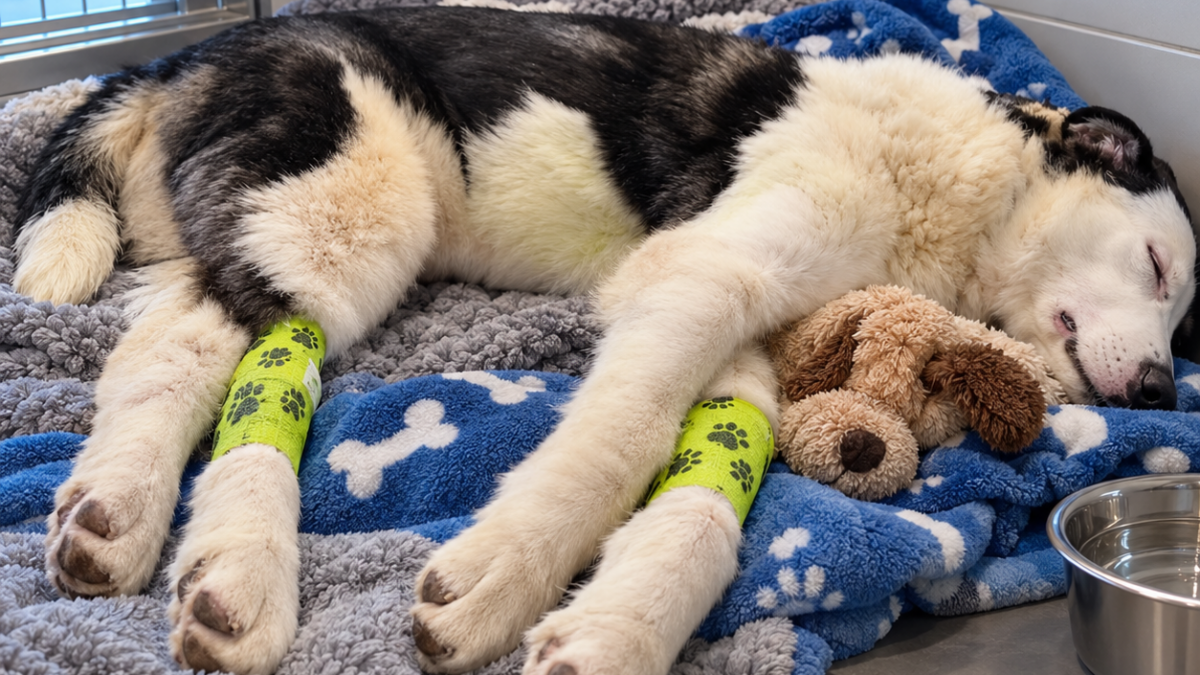
Eva was in her enclosure.
For one second, she looked the same.
Then I saw it.
Her eyes were open.
I stopped walking.
“No.”
The technician laughed softly.
“Yes.”
I moved closer.
Eva’s gaze was unfocused.
She did not look normal.
She looked confused.
Weak.
Still very sick.
But awake.
“Eva?”
Her ears moved.
The technician touched my shoulder.
“She woke up earlier.”
I stared at her.
“Fully?”
“As much as we can say right now.”
I crouched beside the enclosure.
“Hey.”
Eva’s head shifted slightly.
My eyes filled.
“You came back.”
That sentence was not medically accurate.
She had been alive the whole time.
But emotionally, that was exactly what it felt like.
The puppy we had been speaking around for ten days had returned to the room with us.
She was awake.
The news spread quickly through everyone involved in her rescue.
The man who found her answered my call immediately.
“What happened?”
“She woke up.”
He said nothing.
“Did you hear me?”
“Yes.”
His voice broke.
“She woke up?”
“Yes.”
He started crying.
Not loudly.
Just enough that I could hear him trying to breathe.
“I thought she was going to die on my floor.”
“I know.”
“She was so cold.”
“I know.”
“I wrapped her in a blanket because I didn’t know what else to do.”
“You gave her a night she needed.”
“I didn’t save her.”
“You didn’t leave her.”
He became quiet.
Sometimes rescue begins with expertise.
Sometimes it begins with the refusal to walk away.
He had not known how to treat skull fractures.
He had not known about brain swelling.
He had not known Eva needed intensive neurological care.
He had only known that a puppy should not die beside a road.
That instinct had been enough to keep her story moving forward.
Eva waking up was not the end of the danger.
In some ways, it was the beginning of a different kind of uncertainty.
Now we could see what the injury had taken.
She struggled to move normally.
Her front leg did not bear weight the way it should.
Her balance was poor.
Sometimes she seemed unsure of where sounds were coming from.
The team began talking about rehabilitation.
“Daily therapy?” I asked.
“Yes.”
“For how long?”
“We don’t know.”
Another answer I was learning to accept.
Recovery did not have a schedule.
Eva did.
Her body would decide how quickly we moved.
The first therapy session was almost painfully simple.
The rehabilitation specialist supported her.
Eva tried to stand.
Her front leg barely participated.
She shifted weight away from it immediately.
“Come on, baby.”
The therapist moved carefully.
“No forcing.”
Eva trembled.
“Just let her feel the position.”
She placed the paw where it needed to be.
Eva pulled away.
Again.
Again.
Again.
I hated watching it.
Not because anyone was hurting her.
Because effort looked exhausting.
A healthy puppy should be fighting to escape a lap.
Chewing shoes.
Chasing things.
Getting into trouble.
Eva was learning how to place one paw on the floor.
The contrast made me angry.
I still did not know exactly how she had ended up beside the road.
None of us did.
Maybe she had been hit.
Maybe she had fallen or suffered some other trauma before being abandoned there.
The scans showed what happened to her skull.
They could not tell us the entire story of how.
That uncertainty prevented me from attaching blame to a person I could not identify.
But it did not stop me from feeling furious about the fact that she had been left there unconscious.
Whatever had happened, someone had driven past her.
Maybe many people had.
The man who stopped had assumed she was dying.
Others may have made the same assumption and continued.
He stopped.
That difference was everything.
Eva slowly improved.
She began moving around her hospital enclosure.
At first, the movements looked awkward.
She would shift her body.
Try to stand.
Lose balance.
Try again.
Sometimes she seemed frustrated.
That made me happy.
Frustration meant she wanted something.
A puppy with no energy does not get frustrated.
A puppy who wants to move does.
“Go ahead,” I told her once. “Be mad.”
Eva made a small sound.
“Yes. Exactly.”
The therapist laughed.
“You’re encouraging bad behavior.”
“I’m encouraging life.”
Within days, Eva began showing more personality.
She disliked certain exercises.
She liked gentle voices.
She responded strongly to food.
That last one became useful.
We used small rewards during therapy.
“Weight on the leg.”
Eva leaned away.
“No.”
She stared at the treat.
“Come on.”
Her paw touched down.
“Good.”
Treat.
She learned quickly.
Not perfectly.
But quickly.
Her front leg gradually began accepting more weight.
Then something frightened us.
After Eva was discharged from intensive hospital care, we thought the worst part might finally be behind us.
She was still fragile.
Still in rehabilitation.
Still under close medical supervision.
But she was out.
I remember thinking, We made it.
That thought lasted until the seizure.
It happened suddenly.
One moment Eva was resting.
The next her body stiffened.
I froze.
“Eva?”
Then the movement began.
My heart dropped.
“No. No, no, no.”
We followed the instructions we had been given.
Keep her safe.
Do not restrain her unnecessarily.
Time the seizure.
Clear the area.
Call the veterinarian.
The episode felt endless even though it was not.
When it stopped, Eva looked exhausted.
I sat on the floor near her.
My hands were shaking.
“Not again.”
The hospital wanted her evaluated.
We went back.
The familiar doors that had once meant rescue now triggered fear.
Every step into that clinic carried memories.
Coma.
Brain swelling.
Machines.
Uncertainty.
The veterinarian examined Eva carefully.
“With her history of traumatic brain injury, seizures are a concern.”
“Does this mean she’s getting worse?”
“Not necessarily.”
“But it can happen again.”
“Yes.”
I hated that answer.
“What do we do?”
“We monitor. We treat if needed. We watch patterns.”
I looked at Eva.
She was tired but awake.
The fact that she was awake should have comforted me.
Instead I had been thrown emotionally back to day one.
That is something people rarely explain about recovery.
A setback does not only create new fear.
It reactivates old fear.
One seizure and suddenly I was looking again at the unconscious puppy behind glass.
I had to remind myself:
This is not day one.
Eva is stronger.
She is awake.
She is here.
The medical team adjusted the plan.
We became more vigilant.
For a while, every odd movement made me panic.
If Eva twitched in sleep, I watched.
If she stared too long in one direction, I watched.
If she moved strangely, I watched.
Eventually, one of the veterinarians told me something I needed to hear.
“You cannot turn her entire life into seizure surveillance.”
I looked at her.
“What if I miss one?”
“You stay observant. You follow the plan. But she also needs to be a puppy.”
I glanced at Eva.
She was sniffing a corner of the room.
“A puppy?”
“Yes.”
“She almost died.”
“I know.”
“She has brain damage.”
“I know.”
“She had a seizure.”
“I know.”
The veterinarian smiled slightly.
“And she is still a puppy.”
That sentence changed me.
I had been so focused on keeping Eva alive that I had forgotten survival was supposed to lead somewhere.
Not to endless medical fear.
To life.
We kept monitoring.
We continued therapy.
The seizures did not become the dominant feature of her life.
Over time, they stopped.
But another question emerged.
Vision.
Eva often seemed uncertain in ways we could not explain entirely through balance.
She turned toward sounds more reliably than movement.
She sometimes bumped into things on one side.
A specialist evaluated her.
The conclusion was difficult.
Her vision was severely impaired.
In one eye, she could likely perceive little more than shadows.
I sat with the veterinarian after the examination.
“Will it improve?”
“We can’t promise that.”
“Does she see me?”
“Maybe outlines. Movement. Contrast. It is hard to know exactly.”
I looked at Eva.
She turned toward my voice.
I waved my hand.
No obvious response.
Then I spoke.
“Eva.”
Her ears moved immediately.
She looked toward me.
My chest tightened.
“She knows where I am.”
“Yes.”
“How?”
“Hearing. Smell. She’s already adapting.”
That word again.
Adapting.
I was beginning to understand that Eva’s recovery would not be measured by returning to some perfect version of what she might have been before the injury.
We did not know who Eva was before.
We only had the puppy in front of us.
The question was not:
Can we make her normal?
The question was:
Can Eva build a good life with the body she has?
The answer slowly became yes.
Her hearing sharpened into one of her greatest tools.
She tracked voices.
Footsteps.
Doors.
Food bowls.
The faint jingle of a leash.
Her nose did the rest.
She learned routes by scent.
She mapped spaces through repetition.
At first, we kept everything consistent.
Water here.
Food here.
Bed here.
No random objects in walking paths.
We spoke before touching her.
“Eva, it’s me.”
Her ears would move.
Then she relaxed.
She learned quickly.
The first time she walked across a room without hesitation, I nearly cried.
She did not walk perfectly.
Her gait had a slight awkwardness.
But all four legs worked.
Including the front leg we had spent so many sessions encouraging her to use.
“Look at you.”
Eva kept moving.
She found the person calling her.
Then she pushed her nose against a hand.
One of the therapists smiled.
“She doesn’t need to see everything.”
I looked at her.
“No.”
She only needed enough information to move through the world.
Sound.
Smell.
Memory.
Touch.
Trust.
We humans are visually obsessed.
We imagine darkness as emptiness.
Eva did not live in emptiness.
She lived in sound.
The click of shoes.
The rhythm of familiar breathing.
The difference between one person’s footsteps and another’s.
She lived in scent.
Food.
Grass.
People.
Other animals.
Blankets.
Home.
Eventually.
But before home, there was one question we all tried not to discuss too loudly.
Who would adopt her?
Everyone loved Eva.
Loving a hospitalized puppy is easy.
Adopting a puppy with neurological history, impaired vision and previous seizures is different.
That requires commitment.
Medical follow-ups.
Patience.
A safe environment.
Understanding.
Possibly more expenses.
Possibly future complications.
People would visit.
Ask about her.
Say how adorable she was.
Then hear the full history.
Coma.
Skull fractures.
Brain swelling.
Seizure.
Visual impairment.
Therapy.
Suddenly the conversation became quieter.
I did not blame them.
I wanted the right family.
Not a family moved by sympathy for three days.
A family ready for years.
Eva needed someone who would love the puppy she actually was, not the puppy they hoped she would become.
We had already seen what happens when people fall in love with imagined recovery.
You start waiting for a disabled animal to become nondisabled before you allow yourself to call the story happy.
I refused to do that to Eva.
She was already worthy.
She did not need full vision to earn a home.
She did not need a perfect neurological exam.
She did not need to erase every scar from the accident.
She needed people who could say:
This is Eva.
And this is enough.
While we waited, her personality grew.
She was affectionate.
Curious.
Determined.
She liked following voices.
She sometimes walked into furniture and then acted offended at the furniture.
The first time it happened, I rushed toward her.
“Oh!”
Eva backed up.
Sniffed.
Then walked around the chair.
I froze.
The therapist laughed.
“She solved it.”
“I thought she hurt herself.”
“She’s fine.”
Eva continued.
That was the beginning of my learning not to rescue her from every inconvenience.
People caring for disabled animals sometimes overhelp.
We mean well.
We see risk everywhere.
We start removing every opportunity for the animal to problem-solve.
Eva needed safety.
She also needed independence.
So we made environments safe without making them empty.
We let her discover.
A low object.
A turn.
A different texture under her paws.
A doorway.
A familiar scent.
She built confidence.
When she encountered something new, her nose worked furiously.
Her ears rotated.
Then she decided.
Move.
Wait.
Turn.
Ask for help.
I started admiring her decision-making.
She had gone from unconscious beside a road to actively interpreting the world.
Every choice felt miraculous.
One afternoon, the man who found her came to visit.
He had not seen her in person since the early days.
When he entered, Eva was walking.
He stopped.
I watched his face.
He covered his mouth.
“That’s her?”
I smiled.
“That’s her.”
Eva heard his voice and turned.
He crouched.
For a moment, he did not speak.
Then he whispered, “Hey, little girl.”
Eva walked toward him.
Slowly.
Her nose lifted.
She reached him.
Sniffed.
Then pressed against his leg.
He started crying.
“She remembers me?”
“Maybe the scent. Maybe the voice.”
He put both hands gently around her.
“I thought you were going to die.”
Eva leaned against him.
He laughed through tears.
“I took you home to die.”
I sat nearby.
“You took her home so she wouldn’t die alone.”
He looked at me.
“I should have brought her to you immediately.”
“You were scared.”
“I wasted a night.”
“She survived the night.”
“But what if—”
I interrupted gently.
“You cannot rewrite that part forever.”
He looked down.
“I thought there was nothing anyone could do.”
“You learned otherwise.”
He nodded.
Then he looked at Eva.
“Never again.”
That mattered to me.
Not because he had done something cruel.
He hadn’t.
He had made the best decision he understood in a frightening situation.
But he had learned.
If he ever found another injured animal, he would seek medical help immediately.
Eva’s story had already changed what one person would do next time.
That is how rescue ripples outward.
He stayed for almost an hour.
Eva rested beside him.
Before leaving, he touched her head.
“Live a long time, okay?”
Eva licked his hand.
He laughed.
“I’ll take that as yes.”
Soon after, a family came to meet her.
We had heard interest before.
This felt different.
They asked different questions.
Not:
Will she ever be normal?
They asked:
What makes her nervous?
Where does she sleep best?
What signs should we watch for if she has another seizure?
How should furniture be arranged?
Does she follow voices well?
Does she need lights on at night?
What kind of therapy should continue?
How do we introduce her to new spaces?
I sat there listening.
Those questions told me more than any promise could.
They were not shopping for a perfect puppy.
They were preparing for Eva.
One member of the family sat on the floor.
Eva heard the movement.
Her ears turned.
The person spoke softly.
“Hi, Eva.”
Eva sniffed.
Walked closer.
Stopped.
The person held out a hand without grabbing her.
Eva made the final choice.
She stepped forward.
Sniffed the hand.
Then moved closer.
That was enough for me to feel hope again.
The family returned more than once.
They learned her routines.
Watched therapy.
Asked about medication history.
Practiced calling her from different positions.
Learned how she used scent.
One afternoon I said, “She may never see more than shadows through that eye.”
The woman who would become part of her family looked at Eva.
“That’s okay.”
I waited.
She continued.
“She doesn’t need to see us perfectly to know us.”
I had to look away.
That was the sentence.
The one I had been waiting to hear.
Not:
We can handle her disability.
Not:
We feel sorry for her.
Not:
Maybe she’ll improve.
She doesn’t need to see us perfectly to know us.
That was love before adoption papers.
We began planning the transition.
For a puppy with Eva’s neurological and visual history, moving environments needed to be thoughtful.
New smells.
New acoustics.
New furniture.
New pathways.
We recommended consistency.
The family prepared.
They sent photographs of the house layout.
They moved dangerous obstacles.
Created a clear path between bed, food and water.
Used textured rugs to help Eva identify certain locations.
They chose predictable spots.
They even discussed the sound of their footsteps.
I laughed.
“You don’t have to walk artificially.”
“We just want her to know where we are.”
“She will.”
Eva was better at adaptation than any of us gave her credit for.
The day she went home, I expected to be happy.
Instead, I felt sick.
Rescue is strange.
You work desperately to get an animal well enough to leave.
Then leaving hurts.
I knelt beside Eva.
“You’re going.”
Her ears turned.
“To your home.”
She leaned against my knee.
I swallowed.
“Don’t do that.”
She pushed closer.
I laughed weakly.
“You’re making this difficult.”
The family waited.
They understood.
I had watched Eva unconscious.
Watched her ear move.
Watched her wake.
Watched her seizure.
Watched her therapy.
Watched her learn to navigate.
Now I had to watch her leave.
That was the goal.
Still hurt.
I touched her head.
“You know what home means?”
Of course she didn’t.
Not yet.
But she would.
They carried her carefully to the car.
I stood there longer than necessary.
The vehicle pulled away.
For a few seconds, the road looked terribly empty.
Then I reminded myself:
Eva had once been found beside a road with nowhere to go.
Now a road was taking her somewhere.
That difference was everything.
The first update came quickly.
She was exploring.
Slowly.
Cautiously.
But exploring.
The family sent a video.
Eva stood inside her new house.
Her nose worked constantly.
She took several steps.
Stopped at a rug.
Sniffed.
Turned toward a voice.
Walked forward.
I watched the video three times.
Then five.
Then again.
The next update showed her finding the water bowl.
The family celebrated like she had won an award.
I understood.
When a disabled animal learns a route independently, the smallest thing feels huge.
Soon Eva learned where her bed was.
Then the kitchen.
Then the back door.
Then the place where one family member usually sat.
She followed voices.
If someone called from another room, her ears moved first.
Then her body.
She started navigating with growing confidence.
The family learned not to move furniture unnecessarily.
They learned to announce themselves before touching her if she was sleeping.
They learned which sounds startled her.
Which voices comforted her.
Which scents drew her immediately.
Eva learned them too.
Within weeks, the home stopped being new.
It became mapped.
Not visually.
Internally.
A collection of distances, textures, smells and sounds.
Home does not require sight.
It requires predictability.
Safety.
Return.
One person leaves.
They come back.
A door closes.
It opens again.
Food arrives.
Water remains.
Hands are gentle.
Beds stay where expected.
Eva built home from repetition.
Her seizures did not return.
Every seizure-free week relieved us.
Then another.
Then another.
Her doctors remained cautious.
Traumatic brain injury can have lasting effects.
But Eva was doing well.
She continued walking on all four legs.
The front leg that once needed daily therapy now supported her.
Not perfectly every second.
But enough.
She ran short distances.
The first time the family sent a video of that, I laughed out loud.
“Slow down!”
Eva, obviously, did not listen.
She followed another family member through the room.
Turned too wide.
Corrected.
Kept going.
No hospital enclosure.
No machines.
No therapist supporting her chest.
Just Eva.
Moving because she wanted to.
Her vision remained limited.
That did not disappear.
One eye gave her little more than shadows.
The other could not compensate normally.
But the family stopped talking about what Eva could not see.
They talked about what she could find.
She could find her bed.
She could find people.
She could find the kitchen suspiciously well.
She could find dropped food with supernatural accuracy.
She could find the warmest spot in a room.
She could find whoever was laughing.
She could find arms.
That became one of my favorite things.
When someone sat on the floor and called her, Eva turned.
Listened.
Walked toward the voice.
Then she would push into them.
Every time I saw it, I remembered the unconscious puppy.
Her skull fractured.
Her brain swollen.
People whispering around her because nobody wanted to say death too loudly.
And now she was choosing whose lap to climb into.
That was the revenge.
Not revenge against an identified person.
We never had one.
Not revenge against the road.
Roads have no intent.
It was revenge against the ending everyone had feared for her.
The man who found Eva thought her story would end that night on a blanket in his house.
Her body answered:
No.
The doctors warned us she might not survive the swelling.
Eva answered:
No.
We worried she might never wake.
She opened her eyes.
We worried the leg might never support her.
She walked.
We worried seizures might define her future.
They stopped.
We learned her vision would remain badly damaged.
Eva learned the house anyway.
The world kept telling us what she had lost.
Eva kept showing us what remained.
That was her form of defiance.
Not dramatic.
Not angry.
Persistent.
One day, I visited her new home.
I deliberately stayed quiet at first.
I wanted to see what she would do.
Eva was resting.
The family told me not to move.
I stood near the doorway.
Eva’s head lifted.
Her nose moved.
Her ears turned.
I said nothing.
She stood.
Took several steps.
Paused.
Sniffed again.
Then came toward me.
My eyes filled.
“Eva.”
The moment I spoke, her entire body changed.
Her tail started.
She moved faster.
I dropped to my knees.
She reached me and pushed into my chest.
I laughed and cried.
“You remember.”
Her family smiled.
“Of course she remembers.”
I buried my face against her fur.
“You’re supposed to forget hospitals.”
Eva licked my chin.
I pulled back.
“You look good.”
She looked better than good.
She looked alive in a way she never could inside a clinic.
There is a difference between medically stable and at home.
Hospitals save bodies.
Homes reveal personalities.
Eva had become playful.
Bossy in small ways.
Affectionate.
Curious.
She knew where everyone was most of the time.
When she didn’t, she stopped and listened.
One family member called.
“Eva!”
Her ears rotated.
She turned immediately.
Another voice came from the kitchen.
Eva changed direction.
Everyone laughed.
“She’s deciding who sounds more useful.”
The kitchen won.
Of course.
I followed her.
Eva reached the room.
Sniffed.
Found her bowl area.
I stared.
“She knows every inch.”
“Almost.”
“She sees more than we thought?”
Her family shook their heads.
“No. She just knows home.”
That phrase stayed with me.
She just knows home.
Sight was not the thing telling Eva where she belonged.
Memory did.
Love did.
Repetition did.
The floor beneath her paws.
The sound of familiar people.
The smell of her blankets.
The direction of the kitchen.
Home had become a sensory map written across her entire body.
We spent the afternoon together.
At one point Eva fell asleep.
Completely relaxed.
I watched her chest rise.
Fall.
Rise.
Fall.
It transported me back to the beginning.
The man who found her had watched those breaths because he thought one would be the last.
Now I watched them because I knew Eva was simply sleeping.
There is a profound difference between monitoring breathing out of terror and noticing it out of peace.
I looked at her family.
“She sleeps deeply.”
They smiled.
“She knows she’s safe.”
That may be the greatest medical outcome no scan can measure.
Safety.
The nervous system learns it slowly.
A body that has known trauma often remains alert.
Eva had been unconscious during much of the worst medical period, but pain leaves traces we cannot always identify.
New places startled her.
Sudden sounds sometimes made her freeze.
Her family learned not to rush.
“Eva, it’s okay.”
A familiar voice.
A familiar hand.
Then release.
They did not treat every startle like catastrophe.
They simply helped her orient.
Sound.
Scent.
Touch.
Home.
The more secure she became, the more adventurous she became too.
That created new problems.
Good problems.
She wanted to explore farther.
The family had to puppy-proof areas Eva had suddenly decided were interesting.
She learned to climb onto things we did not expect.
Her limited vision did not reduce her curiosity.
If anything, her nose increased it.
Once she discovered an open bag and managed to investigate it before anyone noticed.
Her family sent me a photo.
Eva looked extremely pleased with herself.
The message underneath read:
“Neurologically impaired, visually impaired, and apparently a professional thief.”
I laughed for five minutes.
That was exactly the kind of update I wanted.
Not:
Eva survived another crisis.
Instead:
Eva stole something.
Ordinary misbehavior is one of the greatest privileges a rescued animal can earn.
It means life has become safe enough for trouble.
I began telling people that when they asked about her.
“How is Eva?”
“Badly behaved.”
They looked alarmed.
Then I smiled.
“Which is excellent.”
Her personality filled the space where medical fear used to live.
That is how I knew the story had changed permanently.
At first, every sentence about Eva began with injury.
Later, sentences began with what she had done that day.
She found a new toy.
She followed someone into the kitchen.
She slept in a ridiculous position.
She bumped into a chair, backed up and glared in the general direction of it.
She demanded attention.
She learned a new route.
She walked across grass.
She chased a sound.
She curled into a lap.
Those sentences were the real ending being written day by day.
The man who found her received updates too.
Eventually, he visited again.
This time, not at the hospital.
At Eva’s home.
He stood outside for a moment before entering.
“You okay?” I asked.
He nodded.
“I’m just thinking about the first night.”
We went inside.
Eva heard us.
Her ears turned.
He spoke.
“Hey, girl.”
Eva stood.
Walked toward him.
He bent down.
She pushed against his chest.
He wrapped his arms around her.
I watched his face.
He cried again.
“I’m sorry,” he whispered into her fur.
I moved closer.
“For what?”
“I thought she had no chance.”
“You gave her one.”
“I brought her home to die.”
“You brought her off the road.”
“I waited.”
“And then you got help.”
He looked at Eva.
“I should have known.”
“How?”
He didn’t answer.
I continued.
“None of us knew she would survive.”
He stroked her ears.
“But she did.”
“Yes.”
He smiled.
“She did.”
That was when I realized Eva had not only recovered physically.
She had rewritten the guilt of the person who found her.
He had spent months believing he nearly failed her by assuming she was dying.
But Eva’s life was evidence of something else.
His compassion mattered even before he understood medicine.
He stopped.
He carried her.
He gave her warmth.
He kept looking at her long enough to notice she was still fighting.
Then he sought help.
Would faster medical care have been better?
Of course.
But guilt was not going to change the first night.
Knowledge would change the next one.
He had learned.
So had all of us.
Never assume stillness means there is nothing left.
Never assume a badly injured animal cannot recover.
Never assume disability destroys quality of life.
Never mistake a prognosis for a verdict.
Never let fear of an imperfect outcome become an excuse not to try.
Eva had taught all of that simply by surviving.
Her medical team remained part of her life through follow-ups.
Each visit felt less terrifying.
At one appointment, a doctor who had seen her during intensive care walked into the room.
She stopped.
“Is that Eva?”
I laughed.
“Yes.”
The doctor crouched.
Eva turned toward the voice.
“Oh my goodness.”
She examined her.
Watched her walk.
Checked neurological responses.
Asked about seizures.
None.
Asked about appetite.
Excellent.
Asked about mobility.
Improving.
Asked about navigation.
Remarkable.
The doctor leaned back.
“I remember when we were just trying to keep her alive overnight.”
“So do I.”
She touched Eva gently.
“You gave us trouble.”
Eva sniffed her hand.
I said, “She still does.”
The doctor smiled.
“Good.”
That word carried more weight than she probably knew.
Good.
Not critical.
Not guarded.
Not uncertain.
Good.
When we left the hospital, Eva walked through the door herself.
I stopped.
A memory flashed.
The first transfer.
Her unconscious body.
People moving quickly.
Machines.
Fear.
Now she was walking out.
I had to turn away.
The family noticed.
“You okay?”
“Yes.”
I looked back at Eva.
“Just remembering.”
That is the strange thing about trauma stories.
The present can be beautiful while the past appears suddenly beside it.
A doorway.
A smell.
A certain tone of voice.
You see then and now at once.
Maybe that is why transformation feels so powerful.
Not because the past disappears.
Because the contrast becomes visible.
Eva’s scars were not all visible.
Most of hers were neurological.
A little uncertainty in one direction.
Limited vision.
A history of seizures.
A gait that had taken work.
But the contrast was still there.
Then:
Unconscious beside a road.
Now:
Walking through a home toward familiar voices.
Then:
Multiple skull fractures.
Now:
Pressing her head into a family member’s hands.
Then:
Brain swelling.
Now:
Learning routes.
Then:
Coma.
Now:
Refusing to sleep because someone opened food.
Then:
A front leg that needed daily therapy.
Now:
Four paws moving across the floor.
Then:
Shadows in one eye.
Now:
A world mapped through sound and smell.
The body does not need to return to its original shape to produce a beautiful recovery.
Sometimes healing means becoming skilled at living differently.
Eva became skilled.
That was the word.
Not merely adapted.
Skilled.
She could navigate by sound with astonishing precision.
If two people called from different rooms, she identified direction.
If someone entered quietly, her nose often detected them before they spoke.
If furniture stayed where expected, she moved confidently.
If something changed, she slowed.
Investigated.
Adjusted.
Her family became good at giving her information without overwhelming her.
“Step.”
“Door.”
“Here.”
“Eva.”
Short cues.
Consistent voices.
She learned.
They learned.
Home became cooperation.
One evening, I stayed long enough to watch the family’s nighttime routine.
Eva knew it.
Food.
Outside.
Water.
Quiet.
Then bed.
When one person stood, Eva heard the movement.
She followed.
No leash pulling.
No confusion.
Just routine.
At the sleeping area, she circled once.
Lay down.
Another family member covered part of her with a blanket.
Eva sighed.
I nearly cried again.
The family laughed at me.
“You cry every time you visit.”
“I knew her when she was unconscious.”
“That’s your excuse forever?”
“Yes.”
Fair enough.
Before leaving, I crouched beside Eva.
She lifted her head.
I touched her.
“Goodnight.”
She licked my fingers.
“Keep causing problems.”
Her tail moved against the bed.
That became my blessing for her.
Keep causing problems.
Steal socks.
Demand food.
Bump into things and blame them.
Wake people too early.
Follow the wrong voice.
Interrupt conversations.
Take the best blanket.
Be inconvenient.
Because dead puppies are never inconvenient.
Living puppies are.
The right to inconvenience someone is a privilege of belonging.
Eva had earned it.
As months passed, the seizures remained absent.
Every time someone asked, I answered cautiously.
“No recent seizures.”
Not:
Cured.
Brain injuries demand humility.
We learned to celebrate without making promises.
Eva did not need guarantees.
She needed good days.
Then more good days.
Eventually, good days became the majority.
Her family stopped counting seizure-free intervals obsessively.
They still monitored.
They still knew what to do.
But fear moved out of the center.
That was healing for them too.
Caregivers can become trapped in emergency mode.
A disabled animal improves, but the human remains psychologically inside the first crisis.
Eva’s family had to learn to trust her body again.
Slowly.
One afternoon, she stumbled.
Everyone froze.
Eva stood.
Shook herself.
Continued.
The family looked at each other.
Months earlier, that would have triggered immediate panic.
Now someone said, “She’s fine.”
That was progress.
Not neglect.
Discernment.
They had learned the difference between Eva being Eva and Eva needing medical attention.
That confidence gave her more freedom.
She moved farther.
Explored.
Played.
The first time she ran after a sound outside, the family sent me another video.
She was clumsy.
Fast.
Joyful.
I watched her body working.
All four legs.
Her head angled slightly toward the sound.
Tail up.
She changed direction.
Nearly ran into something.
Corrected.
Kept going.
I thought about the coma.
Ten days.
Ten days between being found unconscious and opening her eyes.
At the time, ten days felt endless.
Now they seemed like a narrow bridge between two lives.
One where we knew only her injuries.
One where we got to know Eva.
That distinction matters.
When she was unconscious, everyone talked about her body.
When she woke, we met her personality.
Injury information tells you what an animal survived.
It does not tell you who the animal is.
Eva was affectionate.
Persistent.
Food motivated.
Curious.
Occasionally stubborn.
Braver than we deserved.
Those things were not visible on a CT scan.
And they became the most important parts of her.
At another follow-up, someone new at the clinic asked, “Is she the puppy with the skull fractures?”
Before I could answer, one of the original technicians said, “That’s Eva.”
The correction was small.
I loved it.
Not the skull-fracture puppy.
Eva.
Names restore individuality.
Trauma creates labels.
Burn victim.
Hit-by-car case.
Brain injury.
Blind dog.
Coma puppy.
Rescue animal.
Those labels are useful for records.
Not for life.
Eva was more.
Her family knew that.
They did not introduce her by diagnosis.
They said, “This is Eva.”
Then visitors figured out the rest.
Some noticed her vision immediately.
Others did not.
If someone reached toward her too quickly, the family would explain.
“Talk first.”
“Why?”
“She doesn’t see well.”
Then they moved on.
No dramatic biography unless someone asked.
Eva deserved interactions not always dominated by the worst day of her life.
That became another satisfying part of the ending.
Her tragedy stopped entering every room before she did.
Sometimes she was simply the dog who wanted attention.
Sometimes the dog under the table.
Sometimes the dog who found a snack.
Sometimes the dog asleep on the couch.
That is recovery.
When your trauma becomes one fact about you instead of the only fact people know.
One year after Eva was found, we marked the date quietly.
No huge event.
No dramatic ceremony.
The family sent a photograph.
Eva asleep in someone’s arms.
The message read:
“One year since someone thought she was coming home to die.”
I stared at it.
Then I wrote back:
“She did come home. He just had the wrong home.”
That sentence stayed with me.
The man who found Eva had taken her home because he wanted her final hours to contain warmth.
He believed it would be her last home.
Instead, it was only the first safe place in a chain of safe places.
His home.
The rescue clinic.
The intensive care hospital.
Rehabilitation.
Then family.
Safety had passed her forward from one set of hands to another until she reached permanence.
Maybe rescue is often like that.
No single person owns the miracle.
One person stops.
Another transports.
Another diagnoses.
Another treats.
Another rehabilitates.
Another adopts.
The animal travels through a network of people choosing not to look away.
Eva’s life was built that way.
That made the idea of revenge seem smaller and smaller.
At the beginning, anger wanted a target.
Who left her?
Who failed to stop?
Was someone responsible?
Could they be found?
But the available facts did not give us a person to punish.
Inventing one would have been dishonest.
So the only revenge we could truthfully offer Eva was the kind life sometimes gives naturally.
The opposite outcome.
If abandonment meant she was supposed to disappear, she became remembered.
If injury meant she was supposed to stop moving, she learned to walk.
If brain trauma meant she was supposed to remain unreachable, she learned every voice in a household.
If limited sight was supposed to make the world too frightening, she mapped it another way.
If the road was supposed to be the end, it became chapter one.
That was enough.
More than enough.
The family eventually told me something that made me laugh.
Eva had developed a habit of locating whoever was eating.
Vision or no vision.
Room changes or no room changes.
If food existed, Eva knew.
“One eye sees shadows, but somehow she can detect a sandwich through three walls.”
I laughed.
“Medical miracle.”
“Selective neurological recovery.”
Eva barked in the background.
“She heard you.”
“Tell her I’m impressed.”
The family held the phone closer.
“Eva!”
Her ears moved.
I said her name.
A sound came through the speaker.
Then movement.
“She’s looking for you.”
My chest tightened.
Even through a phone, familiar sound mattered.
Eva’s world was full of voices.
I wondered sometimes what the world felt like to her.
Humans fear losing sight because we imagine our visual world disappearing.
Eva had never explained her world.
She simply inhabited it.
Maybe sound was as rich to her as color.
Maybe scent carried distances we could not perceive.
Maybe shadows were enough to tell her where daylight came from.
Maybe she did not spend one second grieving a version of vision she could not remember.
That thought helped me stop grieving it for her.
We have to be careful not to mourn on behalf of animals who are busy living.
Eva was busy.
She had routes.
People.
Meals.
Play.
Naps.
Veterinary checkups.
Occasional mischief.
Her quality of life spoke for itself.
One day, during another visit, I intentionally moved to a different chair.
Eva entered the room.
Paused.
Her nose worked.
She turned toward where I usually sat.
Stopped.
Listened.
I said, “Wrong place.”
Her head snapped toward me.
She walked across the room.
Found me.
Pressed into my leg.
I laughed.
“Cheater.”
Her family said, “She doesn’t need eyes. You’re loud.”
“That’s hurtful.”
Eva climbed partly onto me.
I wrapped my arms around her.
I felt her skull beneath the fur.
Strong now.
Healed as much as it would heal.
I remembered the scans.
Multiple fractures.
Swelling.
Words that once sounded like a death sentence.
Now I was kissing the same head.
“You are ridiculous.”
Eva licked my face.
“And rude.”
Her tail wagged.
That was our conversation.
There are no machines in that memory.
No doctors.
No prognoses.
Just Eva being annoying.
I treasure it.
As she matured, some people assumed her early injury would make training impossible.
That proved wrong.
Training simply required adaptation.
Sound cues worked beautifully.
Consistent verbal markers.
Textures.
Scent.
Routine.
Her family taught her boundaries and safety commands.
Eva learned.
Sometimes faster than sighted dogs.
Because everyone communicating with her had to be intentional.
No vague pointing.
No relying solely on visual gestures.
Clear information.
Eva responded to clarity.
That is useful beyond dog training.
She became particularly good at orienting toward a family member’s voice.
One command meant stop.
Another encouraged her forward.
Another warned of a step.
Her confidence increased.
People who met her later sometimes did not realize the extent of her impairment until told.
“She’s mostly blind?”
“Pretty much.”
“But she walked right to me.”
“You talked.”
“Oh.”
That simple exchange happened repeatedly.
Eva changed people’s assumptions without trying.
Disability does not always look like helplessness.
Sometimes it looks like competence developed along another path.
Her family became protective of that distinction.
If someone tried to scoop Eva up immediately because they felt sorry for her, they stopped them.
“Let her walk.”
“But she can’t see.”
“She knows the space.”
“What if she bumps into something?”
“She adjusts.”
That trust mattered.
Overhelping can become another form of limitation.
Eva needed assistance when she needed it.
Not constant control.
The first time I watched her family calmly let her navigate around a new object, I knew she had found the right home.
They loved her enough not to underestimate her.
That is rarer than it sounds.
Love can become fear.
Fear can become restriction.
Restriction can become a life smaller than the animal actually needs.
Eva’s family chose thoughtful freedom.
Safe.
Supervised.
But real.
She flourished.
One rainy afternoon, thunder rolled.
Eva startled.
Her body stiffened.
One family member spoke immediately.
“Eva.”
Her ears turned.
“It’s okay.”
Another thunderclap.
Eva moved toward the voice.
Found the person.
Leaned.
No panic.
No frantic confusion.
Sound had frightened her.
Sound also guided her back.
That felt symbolic.
The same sense she relied on for navigation could lead her into fear or out of it depending on what she heard.
So the family made their voices safe.
Again.
And again.
Maybe all animals learn us that way.
Not through what we mean.
Through repetition.
Tone.
What follows our footsteps.
What happens when hands arrive.
Eva learned:
These footsteps bring food.
That voice means outside.
This voice means come closer.
This smell is home.
This hand does not hurt.
That knowledge rebuilt the world.
There were still medical uncertainties.
We never pretended otherwise.
Traumatic brain injuries do not come with guarantees.
A future seizure remained possible.
Age might change her mobility.
Vision could shift.
But uncertainty exists in every animal’s life.
Eva’s was simply more visible.
Her family did not let possible future problems erase present joy.
That became one of the healthiest choices they made.
They prepared.
Then lived.
Preparation without obsession.
Monitoring without fear.
Love without pretending risk did not exist.
A mature kind of hope.
The opposite of the desperate hope we had inside intensive care.
Back then, hope meant:
Please survive tonight.
Now hope meant:
May she have many ordinary years.
That is an enormous transformation.
One evening, the man who first found her sent me a message.
He had driven past the place where Eva had been lying.
He said he had to pull over.
He remembered the blanket.
Her body.
The certainty that she was dying.
Then he looked at the latest photo of Eva standing inside her family’s home.
He wrote:
“I keep thinking how close I was to never knowing who she would become.”
I understood.
That is the tragedy behind every animal who is not found in time.
Not only the life lost.
The personality never known.
The habits.
The favorite bed.
The ridiculous food obsession.
The people they might have loved.
The future invisible inside an injured body.
Eva had looked like an ending beside the road.
She was actually full of unwritten years.
None of us could see them.
She carried them anyway.
I answered him:
“You stopped long enough to give those years a chance.”
That is what happened.
No mythology necessary.
He stopped.
Eva breathed.
Then people acted.
Sometimes a life is saved by a sequence of ordinary decisions.
Stop the car.
Pick up the puppy.
Keep her warm.
Ask for help.
Transfer her.
Scan her.
Watch her.
Treat her.
Wait.
Do therapy.
Try again.
Adopt her.
Keep showing up.
No single decision looks magical.
Together they create a transformation people later call a miracle.
Eva’s miracle was labor.
Medicine.
Compassion.
Time.
And her own stubborn biology refusing to quit.
She deserved credit too.
A year after adoption, I saw Eva move through the house almost effortlessly.
She turned at the correct doorway.
Crossed a rug.
Avoided a chair.
Stopped beside a person.
Then climbed into their arms.
I had seen videos.
Still, watching it in person affected me differently.
I whispered, “You know this whole place.”
Her family smiled.
“She knows where everything is.”
Eva settled.
I touched one ear.
The same kind of ear that had moved when a sound gave us the first hint of neurological response.
I remembered that moment.
“Do you know what this ear did?”
The family laughed.
“What?”
“It scared all of us half to death.”
Eva’s ear flicked beneath my finger.
“Two days without much response, and then this moved.”
I flicked my own finger slightly.
“We thought it was the biggest thing we had ever seen.”
Someone looked at Eva.
“And now?”
I smiled.
“Now the biggest thing is that she doesn’t need us to celebrate every movement.”
That was true.
At first, every physical act was an event.
Ear twitch.
Eye opening.
Leg movement.
Standing.
Walking.
Now she could cross a room without anyone applauding.
Normalcy had returned so completely that miracles became routine.
There is something beautiful about stopping the applause.
It means survival no longer has to perform.
Eva could simply exist.
No one clapped when she drank water.
No one cried every time she stood.
No one documented every step.
She had earned privacy from inspiration.
She was family.
That may be the deepest form of acceptance.
Not constantly telling an animal how brave she is.
Letting her be annoying instead.
One afternoon Eva was sleeping in a place everyone needed to walk through.
Someone tried to move around her.
She did not budge.
Another person said, “Eva, move.”
Nothing.
“She’s asleep.”
“She’s pretending.”
They called again.
Eva’s ear moved.
Everyone laughed.
“She heard you.”
Eva remained exactly where she was.
I said, “Neurological recovery looks excellent.”
That finally got a laugh loud enough to wake her.
She lifted her head.
Then went back to sleep.
Perfect.
I sometimes compare that image with her hospital enclosure.
In both, Eva lies still.
But context changes everything.
Stillness in intensive care terrified us.
Stillness at home meant comfort.
We often judge behavior without context.
A dog lying motionless can be dying.
Or sleeping because she trusts the room.
Eva experienced both.
That contrast may be the most powerful image in her story.
The man who found her once watched her breathe because he expected death.
Her family now watches her sleep and expects breakfast.
Expectation changed.
That is what safety does.
It makes tomorrow ordinary.
The most satisfying ending I can give Eva is not that she became perfectly healthy.
She didn’t.
Her vision remained impaired.
Her medical history remained real.
Her skull had suffered fractures.
Her brain had swollen.
She had experienced a coma and seizure.
Those things mattered.
But they became history instead of destiny.
There is a difference.
History travels with you.
Destiny controls where you can go.
Eva carried history.
She chose routes anyway.
Or maybe choice is too human a word.
She followed life.
Food.
Voices.
Warmth.
Affection.
Curiosity.
The things dogs have always followed.
One evening, her family called me on video.
“Watch.”
They set the phone where I could see a hallway.
Someone moved to another room.
Then called.
“Eva!”
Her head lifted.
She listened.
Stood.
Walked down the hallway.
At an intersection, she paused.
Another call.
She turned correctly.
Kept going.
Reached the room.
Then disappeared into someone’s arms.
The family laughed.
“So?”
I could barely speak.
“That’s incredible.”
“We do it all the time.”
“I know.”
“Then why are you crying?”
“Because I remember when she couldn’t wake up.”
Silence.
Then someone said softly, “We forget sometimes.”
I smiled.
“Good.”
“What?”
“Forget.”
I wiped my face.
“Not the care instructions. Forget the tragedy sometimes.”
They understood.
A family should not wake every morning feeling obligated to remember the worst day of their dog’s life.
Eva does not need a memorial while she is alive.
She needs breakfast.
Play.
Safe movement.
Love.
The past matters when it informs care.
It does not deserve every morning.
So they forgot sometimes.
They forgot she was supposed to be extraordinary.
Then Eva reminded them by doing something ridiculous.
That is exactly how life should work.
There is one question people still ask me.
“What if the man had left her on the road?”
I do not like answering.
The probable possibilities are obvious.
But dwelling on them feels like standing too close to a cliff.
Instead, I answer differently.
“He didn’t.”
That is the fact that matters.
He stopped.
He believed she was dying.
But he stopped.
He carried her.
He gave her warmth.
Then he noticed life continuing.
And eventually brought her to people who could do more.
Humans make imperfect decisions inside frightening moments.
Sometimes compassion arrives before knowledge.
That happened with Eva.
The goal should not be to shame imperfect compassion.
It should be to turn it into better action.
That is why I tell people:
If you find an animal badly injured, seek veterinary or rescue help as quickly as possible.
Do not assume there is nothing to be done.
Eva looked like nothing could be done.
We were wrong.
Her survival does not mean every animal can be saved.
It means we should not make that decision from the side of the road when professional assessment is possible.
Eva taught us that.
She taught the man who found her.
She taught me.
She taught her family.
Her story changed future behavior.
That is another form of justice.
Not revenge.
Prevention.
The next animal found unconscious might reach a clinic sooner because someone remembers Eva.
That matters.
More than anger.
More than dramatic punishment.
Prevention means suffering does not have to repeat in order for a lesson to stick.
Eva herself, thankfully, does not care about any of these philosophical conclusions.
She cares about food.
I cannot emphasize that enough.
Her family jokes that vision impairment has somehow strengthened her ability to detect packaging.
A wrapper opens.
Eva appears.
A refrigerator door.
Eva appears.
A plate touches a table.
Eva is already there.
I once said, “She can barely see shadows.”
Someone replied, “She sees calories.”
That became a family joke.
I loved it.
Humor is another sign that trauma no longer dominates.
You do not joke during intensive care.
You joke when everyone expects the dog to be around tomorrow.
Laughter is confidence.
Eva had given us that.
Years after the road, I hope the strongest memories are no longer the hospital.
I hope they are ordinary.
The sound of her paws.
The way she turns toward a voice.
The spot she chooses to sleep.
Her obsession with food.
The family member she manipulates most easily.
The moments she walks directly into open arms.
Those are the images worth carrying.
But if I ever need to remember how far she came, I go back to the beginning.
A man beside a road.
A tiny puppy.
No movement.
A blanket.
A quiet house.
A person preparing himself to witness death.
Hours passing.
The puppy still breathing.
That is where the story turns.
Not at the hospital.
Not when she woke.
The first turn came when someone noticed she had not stopped breathing.
Sometimes hope begins as observation.
Still here.
Still breathing.
Still warm.
Still possible.
Then people build from there.
Eva gave us tiny evidence.
An ear.
An eye opening.
A paw.
Weight on a leg.
Four steps.
A route through a room.
Every stage said the same thing.
Still possible.
When she eventually reached the family that would become hers, they did not ask whether she would ever become the puppy she was before the road.
They had never met that puppy.
They loved the one in front of them.
That may be the most important part of her entire story.
Love did not require restoration.
Eva did not have to undo the injury to become worthy of belonging.
She arrived with history.
The family made room.
Not despite her differences.
With them.
The house was changed.
Routines adapted.
Voices became guides.
Furniture stayed predictable.
Knowledge replaced fear.
Then all those accommodations became invisible.
They became life.
One evening, I watched Eva walking toward her family again.
She paused.
Listened.
Someone called.
Her head turned immediately.
She moved faster.
Found the person.
Pressed herself against them.
I stood back.
Nobody needed me.
That hurt a little.
Then it felt wonderful.
Rescue should end with being unnecessary.
Not emotionally forgotten.
But functionally unnecessary.
Eva no longer needed the hospital team to keep her alive.
She no longer needed daily therapy to remind that front leg how to bear weight.
She no longer needed me watching every breath.
She needed her family.
And she had them.
That was success.
Someone once asked whether Eva understood what had been done for her.
I said I had no idea.
Gratitude is another human story we place on animals.
Eva does not owe gratitude.
She did not ask to be injured.
Care was something she deserved, not a favor requiring repayment.
If she loves her family, good.
If she sleeps through their emotional speeches, also good.
Her job is not to be grateful.
Her job is to live.
She does that extremely well.
That distinction matters to me because rescue stories can accidentally make suffering seem worthwhile if the animal becomes inspirational enough.
Eva’s suffering was not worthwhile.
It should never have happened.
Her recovery is beautiful despite the injury, not because the injury was necessary.
If we could erase every fracture and still have Eva, I would.
Without hesitation.
But we cannot.
So we honor what came after without romanticizing what came before.
That keeps the story honest.
A bad thing happened.
People responded.
Medicine helped.
Eva survived.
A family adapted.
Life continued.
That is enough.
On a later anniversary, the family sent another video.
Eva was moving through the house.
No dramatic music.
No hospital photographs.
No text.
Just her.
She walked down a hallway.
Stopped at a doorway.
Turned toward someone speaking.
Then hurried into the room.
A person opened their arms.
Eva found them.
I watched once.
Then again.
I thought about the line from her early prognosis.
Multiple skull fractures.
Brain swelling.
Critical.
Transfer.
Intensive care.
Those were once the most important words.
Now the important words were simpler.
Eva.
Home.
Come here.
Good girl.
Dinner.
Bed.
Family.
Words get smaller when life gets better.
I like that.
Crisis uses large language.
Survival.
Trauma.
Neurology.
Prognosis.
Family life uses small language.
Come.
Stay.
Eat.
Sleep.
Love.
Eva crossed from one vocabulary into the other.
That may be the cleanest way I can describe her transformation.
There is one final scene I return to more than any other.
I was visiting.
Eva was in another room.
Someone asked, “Do you want to see something?”
I said yes.
They did not call her.
Instead, I began talking normally.
Eva’s ears must have picked up my voice.
We heard paws.
Slow at first.
Then quicker.
She appeared in the doorway.
Paused.
Her head tilted.
“Eva?”
The moment I said her name, she moved directly toward me.
I sat on the floor.
She came into my arms.
No hesitation.
No confusion.
No sight needed.
I held her.
Her heart beat against me.
Strong.
Regular.
Alive.
I thought about the man who once carried that same little body into his home because he believed he was giving her a warm place to die.
I thought about two days in intensive care.
The ear movement.
Ten days before waking.
The front leg.
The seizure.
The vision test.
The shadows.
The adoption.
Then I looked at the puppy in my arms.
No.
Not the puppy.
The survivor.
No.
That label felt incomplete too.
Eva.
Just Eva.
I whispered, “You were never supposed to make it this far.”
Her tail moved.
I corrected myself.
“Actually, maybe you were.”
Not because fate had planned suffering.
I do not believe that.
Because once Eva was given the chance, she kept using it.
Breath after breath.
Step after step.
Sound after sound.
She built a life from what remained.
The road did not get her.
The coma did not keep her.
The fractures did not stop her.
The seizure did not define her.
The shadows did not make her world empty.
And the family who adopted her did not ask for a perfect dog.
They asked for Eva.
That is the ending.
Not revenge in the way people imagine revenge.
No villain forced to watch.
No courtroom.
No punishment invented to make the story dramatic.
The facts did not give us that.
And Eva did not need it.
Her revenge was that every prediction of an ending became a beginning.
The blanket meant for her last night became the first warmth of a new life.
The hospital enclosure became a place she walked out of.
The front leg that needed daily therapy became one of four legs carrying her through her home.
The eye that saw only shadows did not prevent her from finding the people she loved.
The puppy everyone feared would never wake learned the sound of her family.
And now, when someone calls her name from across the house, Eva turns toward the voice.
She listens.
She chooses a direction.
Then she walks.
Past the furniture she has memorized.
Across the floors she knows.
Toward the people who know exactly how to reach her.
They open their arms.
And Eva finds them every time.
The man who found her once thought he was giving her somewhere warm to die.
He was wrong.
He was giving her the first safe night on a road that eventually led home.
And Eva, who could once do nothing except keep breathing, turned that one night into an entire life.

