PART 2: He Survived 32 Days Beneath a Collapsed Warehouse—When We Reached Him, He Was Still Protecting a Tiny Kitten
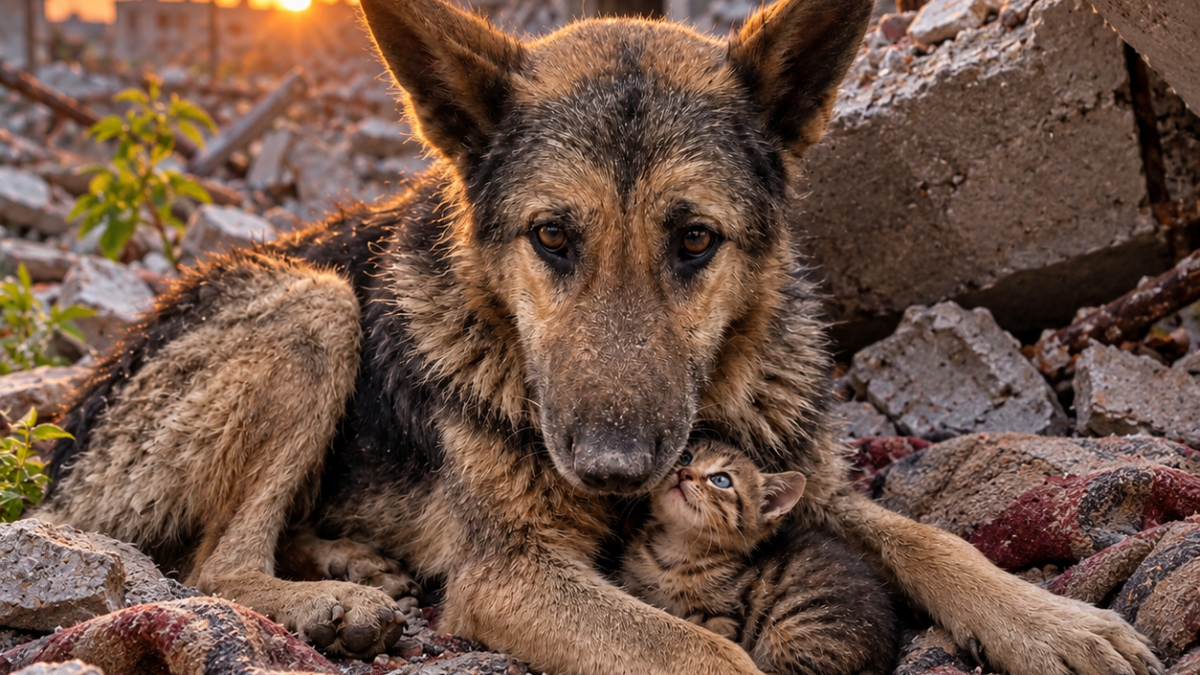
For thirty-two days, a German shepherd survived in a pocket of darkness beneath concrete and twisted steel, and when I finally crawled deep enough into the collapsed warehouse to reach him, I discovered he had spent that entire nightmare protecting a life much smaller than his own.
I had worked search and rescue for nine years, crawled through buildings everyone else wanted to run from, and learned never to promise a miracle where physics had already made one unlikely, but the sound I heard beneath those ruins changed the way I understood survival.
Then my flashlight reached the back of that narrow void, and I saw the old shepherd curled around a kitten so small that his entire body fit between the dog’s front legs—and what happened after that would expose why those animals had been inside the condemned warehouse in the first place.
My name is Samuel Reed. I was thirty-two years old when the call came in, and I had been with an Ohio search-and-rescue unit for nine years.
The warehouse sat outside Millbrook, near an industrial stretch that had been dying slowly for more than a decade. Half the buildings were vacant, the railroad spur had stopped operating, and weeds grew through parking lots that had once held hundreds of workers’ cars.
The old Carver Textile warehouse was the worst of them.
Three stories.
Cracked brick.
Rusted beams.
A roof that sagged visibly from the street.
The city had condemned it years earlier and scheduled demolition before winter ended.
But demolition never came.
On November 17, after two days of relentless rain, part of the structure gave way.
By dawn, almost the entire east side had collapsed inward.
At first, nobody believed there could be anything alive inside.
The building was officially vacant.
Then neighbors began talking.
They had heard barking there for months.
Not every night.
Not loudly.
But enough that several people remembered it once the building came down.
Our team was called after a firefighter examining the debris heard what he thought might have been movement beneath one section.
For three days, we searched.
Nothing.
No clear bark.
No thermal signature strong enough to trust.
No movement from the cameras we pushed into the safest gaps.
My team leader, Captain Luis Moreno, finally stood beside me near the eastern wall and said quietly, “Sam, we may be chasing settling debris.”
I looked at the pile.
Concrete slabs rested at impossible angles. Rebar twisted through everything. Rainwater continued to drip into the voids.
“I know.”
“We’ve got people in dangerous positions.”
“I know.”
He put a hand on my shoulder.
“We don’t risk a rescuer for a sound nobody can confirm.”
He was right.
That was the worst part.
Then, just before sunset on the third day, our thermal camera registered something again.
Weak.
Intermittent.
Far beneath a section near an old loading bay.
Luis stared at the screen.
“What do you think?”
“Heat.”
“Could be trapped moisture.”
“Could be.”
He knew my answer already.
The following morning, we created a controlled access route into the deepest stable section.
I clipped my line.
Checked my radio.
Then crawled.
Three feet.
Ten.
Fifteen.
The passage narrowed until my shoulders nearly touched both sides.
“Samuel, status?” Luis asked through the radio.
“Stable so far.”
My flashlight cut across dust, concrete, rusted metal, and old insulation.
Then I stopped.
Something had moved.
I held my breath.
There.
A sound.
Not a bark.
A tiny scrape.
I crawled another several feet.
The void widened barely enough for me to turn my head.
My light moved left.
Broken pipe.
Concrete.
Wood.
Then right.
Two eyes reflected back at me.
I froze.
A German shepherd lay beneath a tilted slab, thin enough that his once-powerful body looked folded into itself.
Alive.
I whispered, “Hey, buddy.”
His ears moved.
That was when I saw his front legs.
Something was between them.
At first, I thought it was debris.
Then the dog lowered his head and licked it.
A kitten.
Tiny.
Gray-and-white.
Almost motionless.
My heart stopped.
I moved the light away so I wouldn’t blind them.
The shepherd watched me.
He didn’t growl.
Didn’t try to crawl away.
He only tightened his body around the kitten.
I radioed:
“Luis.”
“Go.”
“I have two live animals.”
Silence.
Then:
“Repeat.”
“German shepherd. Adult. And a kitten.”
Another silence.
“How?”
“I don’t know.”
The kitten made a sound.
Barely audible.
One small meow.
The dog lowered his head again and touched his nose to the kitten’s back.
That image has never left me.
Not because it was dramatic.
Because it was gentle.
Thirty-two days later, after records, security footage, weather reports, and witness statements were pieced together, we would learn how long those animals had actually been trapped through a series of partial structural failures that began nearly a month before the final collapse brought emergency crews to the site.
But in that moment, I knew none of that.
I knew only this:
The dog was exhausted.
The kitten was alive.
And a slab weighing several tons stood between them and daylight.
I whispered into the darkness:
“You waited long enough.”
Then I called my team.
“Let’s bring them out.”
PART 2
The first problem was that I could reach them.
The second problem was that reaching them did not mean I could move them.
People imagine rescue as a moment.
You crawl in.
Find the survivor.
Carry them out.
Real rescue work is usually an argument with gravity.
The slab above the dog had settled against two steel beams and a section of masonry. Move the wrong piece and the void could disappear.
I stayed where I was.
“Luis, I need structural.”
“Already moving.”
The shepherd watched every movement I made.
His ears were low.
His breathing shallow.
I extended my hand a few inches.
He did not come toward me.
Fair.
I wouldn’t have trusted me either.
“You don’t know what I’m doing here.”
The kitten moved.
The shepherd immediately lowered his head.
Licked its ear.
Then its face.
Slowly.
Patiently.
I had worked with rescue dogs.
Owned dogs.
Loved dogs.
But I had never seen that kind of focus under conditions like those.
The German shepherd was barely holding himself together.
Yet every few moments, he checked the kitten.
## **1. The Water**
While we waited for the structural team, I looked around the void.
That was when I noticed a pipe.
An old line had cracked during the collapse.
Water dripped slowly from one joint.
Below it sat a shallow depression in broken concrete.
A tiny pool had formed.
There was our first answer.
Water.
Not much.
But enough.
The dog had been able to reach it.
I saw wet marks near his paws.
The kitten likely survived partly because the shepherd had kept it warm.
Food was another question.
Maybe rodents.
Maybe old animal food already inside.
Maybe almost nothing.
Survival does not always require a satisfying explanation.
Sometimes bodies keep going longer than we expect.
## **2. The Dog Wouldn’t Leave the Kitten**
A veterinarian arrived at the command area and talked me through what we needed.
Warmth.
Controlled fluids.
No large meal.
Careful handling.
When enough stabilization was installed, I crawled closer.
“Hey.”
The shepherd’s eyes tracked me.
“Can I see your friend?”
I reached toward the kitten.
The dog moved his head between my hand and the kitten.
Not snapping.
Not growling.
Blocking.
“I understand.”
I radioed outside.
“He won’t let me take the kitten.”
Luis answered:
“Can you move them together?”
“Maybe.”
I removed my outer rescue jacket slowly.
Placed it on the ground.
Then nudged it toward the dog.
The shepherd smelled it.
I moved my hand away.
Waited.
Then I slid the jacket closer to the kitten.
The dog watched.
Eventually, he allowed the kitten to rest partly on the fabric.
Good.
One inch.
Then another.
We were negotiating.
## **3. Atlas**
Luis asked whether we needed a name for communication.
I looked at the dog holding up a tiny life under what felt like half a building.
“Atlas.”
“What?”
“Call him Atlas.”
Luis laughed quietly over the radio.
“Of course you would.”
Atlas.
The name stayed.
The kitten became Pip before we even got him out.
One of our medics said anyone small enough to fit between Atlas’s paws deserved a tiny name.
## **4. The First Attempt**
Two hours after I entered the void, engineers cleared a slightly wider route.
I wrapped Pip in my jacket.
Atlas immediately tried to follow.
His legs gave way.
I caught him.
He was lighter than he looked.
Far too light.
His body shook against my arms.
I whispered:
“Easy.”
He looked toward the bundle containing Pip.
I moved it closer.
His nose touched the fabric.
He relaxed slightly.
That was when we understood.
Atlas would not cooperate unless Pip remained with him.
So that became the plan.
Not dog first.
Not kitten first.
Together.
## **5. Twenty Feet**
The first twenty feet took nearly forty minutes.
I crawled backward.
Pip against my chest.
Atlas supported on a fabric sling.
Two rescuers deeper in the passage helped guide his body.
Every few feet, Atlas tried lifting his head toward Pip.
I lowered the kitten.
Let Atlas smell him.
Then continued.
At one point, concrete shifted somewhere above us.
Dust fell.
Everyone froze.
My radio went silent.
I could hear Atlas breathing.
Then Pip meowed.
One tiny sound.
Atlas lifted his head.
Even in that moment.
Even with the building groaning around us.
He checked the kitten.
I remember thinking:
Stay with me, old man.
All of you.
Just stay.
## **6. Daylight**
When we reached the opening, the outside light was brutal.
We covered Atlas’s eyes partially with cloth.
Pip remained wrapped.
The moment Atlas smelled fresh air, his nose moved rapidly.
Then the wind touched him.
He stopped.
Rescuers stood around the opening.
Firefighters.
Medics.
Police.
Engineers.
People who had spent days assuming nothing living could still be down there.
Nobody cheered.
I’m glad.
The moment was too fragile.
We placed Atlas on a stretcher.
Pip in a warmed carrier directly beside him.
As soon as the carrier moved more than a few feet away, Atlas tried to rise.
“Keep them together,” I said.
The veterinarian nodded.
“They stay together.”
## **7. The Ambulance**
Animal emergency transport arrived.
I rode with them.
Technically, I didn’t need to.
Luis told me that twice.
I ignored him.
Atlas lay under blankets.
Pip remained in a heated box beside his head.
Every time the kitten made a sound, Atlas’s ear moved.
The veterinarian, Dr. Megan Patel, checked his heart.
“He’s severely dehydrated.”
“Pip?”
“Worse.”
“Will they make it?”
She didn’t answer immediately.
That is never a good sign.
“Atlas has a chance.”
“And Pip?”
“He has a chance too.”
I learned years ago that “a chance” is sometimes the most honest hope anyone can offer.
## **8. The First Night**
Atlas weighed forty-seven pounds.
A healthy German shepherd his size should have been closer to seventy-five.
His coat hid the loss.
Bloodwork showed severe dehydration, anemia, and nutritional deficiencies.
His paw pads were worn.
There were old scars beneath his coat.
Nothing graphic.
Enough to suggest the warehouse had not been kind even before the collapse.
Pip weighed less than two pounds.
Too young to have survived that environment alone.
Megan examined him for almost an hour.
Respiratory infection.
Dehydration.
Low body temperature.
But no major fracture.
“Somebody kept him warm,” she said.
We both looked through the glass at Atlas.
No mystery there.
## **9. Atlas Refuses Food**
The first night, Atlas barely ate.
That worried everyone.
Then Megan placed Pip’s warming crate near him.
Pip moved.
Meowed.
Atlas lifted his head.
Megan offered a small amount of food again.
Atlas ate.
Slowly.
He kept looking toward Pip.
Megan looked at me.
“He needs the kitten.”
“Seems mutual.”
## **10. Thirty-Two Days**
The number came later.
At first, we thought Atlas and Pip had been trapped only since the main collapse.
Four days.
That alone would have been extraordinary.
Then the investigation began.
A building inspector found older photographs.
The warehouse had not failed all at once.
Thirty-two days before our rescue, a section of the lower east floor partially collapsed during an earlier storm.
Nobody reported it officially.
A neighbor had photographed fallen masonry near the loading bay.
Security footage from a business across the road showed Atlas entering the warehouse before that event.
A smaller animal appeared behind him.
Not Pip.
A cat.
Then the camera lost sight of them.
The east section was never inspected after the partial failure because the property owner claimed nobody had access to the interior and assured the city that the site was secured.
It wasn’t.
By the time the final collapse brought emergency crews, Atlas had likely already been trapped in a progressively shrinking section of the building for nearly a month.
Pip, based on his age, had probably been born inside.
That meant another cat had been there.
We didn’t know what happened to her.
Not yet.
## **11. The Warehouse Was Not Empty**
Neighbors began talking.
Once people saw the rescue footage, memories appeared everywhere.
A woman across the street said:
“There were always dogs around there.”
Plural.
A delivery driver remembered leaving food near a side entrance.
Two teenagers said they had seen cats entering a broken window.
A man named Douglas Pike had called the city months earlier because he heard barking at night.
The complaint had been logged.
Then closed.
Reason:
**No visible animal observed from public access point.**
That line became important later.
## **12. Who Owned the Building?**
Carver Textile Properties LLC.
Registered agent:
Martin Vale.
Fifty-eight.
Real-estate investor.
Martin had purchased the warehouse during foreclosure six years earlier.
He never renovated it.
Never demolished it.
Never maintained it beyond the minimum needed to avoid some fines.
The city had issued citations.
Broken fencing.
Structural concerns.
Open access points.
Debris.
Martin disputed most of them.
Paid some.
Ignored others until deadlines.
He insisted no animals belonged to him.
That was possible.
The question was whether he knew animals were living inside.
## **13. Atlas Had a Microchip**
Day three at the hospital gave us our first major surprise.
Atlas had a microchip.
The initial scanner missed it because the chip had migrated lower toward his shoulder.
Registration:
**Major.**
Owner:
**Thomas Avery.**
Address in Dayton.
Phone disconnected.
Megan looked at me.
“Major?”
I stared through the window.
Atlas—Major—was asleep with Pip’s carrier touching his bed.
“We need to find Thomas.”
## **14. Thomas Avery**
Thomas was seventy-one.
Retired Army mechanic.
He answered my second call.
“Hello?”
“Mr. Avery?”
“Yes.”
“My name is Samuel Reed. I’m with an Ohio search-and-rescue team.”
Pause.
“Am I in trouble?”
“No, sir.”
I smiled despite myself.
“I’m calling about a German shepherd named Major.”
Silence.
Not ordinary silence.
The kind where a person stops breathing.
“Say that again.”
“Major.”
His voice changed.
“My Major?”
“How long has he been missing?”
“Three years.”
I sat down.
## **15. The Dog Who Disappeared**
Thomas had owned Major from puppyhood.
After Thomas’s wife, Elaine, died, Major became his constant companion.
Then Thomas had a medical crisis.
He spent weeks in rehabilitation.
His nephew, Corey, agreed to care for Major.
When Thomas came home, Corey said Major had escaped from the backyard.
They searched.
Posters.
Online groups.
Shelters.
Nothing.
Thomas never stopped wondering.
“Where is he?”
“In a veterinary hospital.”
“Alive?”
“Yes.”
Thomas cried.
A seventy-one-year-old man I had never met cried into the phone while I sat in a hospital hallway.
“Can I see him?”
“Yes.”
“When?”
“As soon as the veterinarian clears a visit.”
“Today.”
## **16. Thomas Meets Major**
Thomas arrived with a cane.
Major was still weak.
When Thomas entered the room, the dog’s head lifted.
That was all.
Then Thomas whispered:
“Major.”
The change was immediate.
Major tried to stand.
Megan stopped him gently.
Thomas moved instead.
He knelt as far as his knees allowed.
Major pushed his nose toward him.
Thomas placed both hands around the dog’s face.
“I looked for you.”
Major whined.
Thomas pressed his forehead to his.
“I looked for you, boy.”
Pip meowed from the warming crate.
Major turned his head.
Thomas noticed.
“That yours?”
I laughed.
“Apparently.”
## **17. Corey**
Thomas called his nephew.
I was present.
“Major’s alive.”
Whatever Corey said made Thomas’s face change.
“No.”
Pause.
“They found him.”
Longer pause.
“In Millbrook.”
Thomas looked toward me.
Then:
“You said he ran away.”
I could not hear Corey.
Thomas’s voice became colder.
“Did he?”
That question opened another door.
## **18. Corey’s Story**
Corey eventually admitted Major had not simply escaped.
Thomas’s hospitalization lasted longer than expected.
Major was large.
Energetic.
Corey lived in a small rental.
The landlord threatened fees.
Corey panicked.
A friend told him about an empty warehouse where people sometimes left unwanted animals because food was occasionally placed there.
So Corey drove Major to Millbrook.
Left him near the warehouse.
And told Thomas the dog escaped.
Three years earlier.
Thomas listened to the confession with tears in his eyes.
Then hung up.
I expected anger.
He said only:
“He let me search.”
That was the part that hurt most.
For three years, Thomas had blamed himself for not being home.
For not checking the fence.
For not finding Major.
And Corey had watched.
## **19. Major Did Not Go Home Yet**
Thomas wanted Major immediately.
Megan said no.
Not yet.
Major needed medical stabilization.
Thomas agreed.
Then asked:
“What about the kitten?”
I looked at him.
“What about him?”
“If Major won’t leave him, neither will I.”
That solved a problem we hadn’t discussed yet.
Pip had a home too.
Potentially.
## **20. Pip Improves**
Pip surprised everyone.
Day one: barely moving.
Day three: lifting his head.
Day five: angry.
That was a good sign.
He hissed at Megan.
Bit a technician’s glove.
Tried climbing the carrier wall.
Megan smiled.
“He’s officially rude.”
Major watched from his bed.
Pip escaped the warming crate once.
Wobbled across the floor.
Walked directly to Major.
Then collapsed against his front paw.
Major lowered his head.
Licked him.
No one in the room spoke.
## **21. Why Major Protected Him**
We never knew exactly.
Maybe Major had known Pip’s mother.
Maybe she had been living inside the warehouse with him before the collapse.
Maybe Major found Pip after she disappeared.
Maybe protection simply happened.
Animals form bonds without consulting our need for narrative.
We knew only that when I found them, Major had made himself a wall around Pip.
That fact was enough.
## **22. The Other Cat**
Search crews returned to the warehouse after the live rescue.
Not recklessly.
The structure remained dangerous.
Remote cameras were used.
Eventually, we found signs of multiple cats.
Food containers.
Bedding.
Old bowls.
Someone had created makeshift feeding stations.
That meant the warehouse wasn’t just shelter animals discovered on their own.
Someone was maintaining a colony.
Who?
A woman named Maria Santos.
## **23. Maria**
Maria worked nights at a bakery three blocks away.
For two years, she fed stray cats around the warehouse.
She also fed Major.
She called him “Soldier.”
“He always waited until the cats ate.”
“You knew he lived there?”
“Yes.”
“Why didn’t you call a shelter?”
“I tried.”
She showed us messages.
She had contacted two rescues.
Both full.
Animal control once attempted to catch Major.
He disappeared deeper into the building.
Maria continued feeding him.
She had also contacted Martin Vale.
The property owner.
Twice.
That mattered.
## **24. Martin Knew**
Maria’s messages were clear.
**There is a German shepherd and several cats living inside your building. The side entrance is open and the structure is unsafe. Please secure the site after animals are removed.**
Martin replied:
**Not my animals. Do not trespass.**
Three weeks later:
**I’m still seeing the dog inside. Someone needs to remove him before the building comes down.**
Martin:
**City issue. Stop contacting me.**
He knew.
## **25. The City Knew Too**
The city had complaints.
Maria’s.
Douglas Pike’s.
A council assistant had forwarded an email to property enforcement.
An inspector visited.
Could not enter because of structural concerns.
Sent Martin an order requiring professional evaluation and securing access points.
Martin’s attorney requested additional time.
Then another extension.
Meanwhile, animals remained inside.
Responsibility became complicated.
No single person created everything.
Corey abandoned Major.
Martin failed to secure a dangerous property despite warnings.
City bureaucracy moved slowly.
Rescues were full.
Neighbors heard barking but assumed somebody else knew.
That is how tragedies often grow.
Not one monster.
A chain of people each doing less than enough.
## **26. Thomas and Corey**
Thomas refused to see Corey for weeks.
Corey called.
Texted.
Wrote letters.
Thomas ignored everything.
One afternoon at the hospital, Thomas sat beside Major.
Pip slept against Major’s stomach.
Thomas said:
“My sister keeps telling me he’s sorry.”
“Corey?”
“Yes.”
“Are you going to talk to him?”
“No.”
Then:
“Not yet.”
That distinction mattered.
## **27. Major Walks**
Day twelve.
Major stood without assistance.
Only for a few seconds.
Then sat.
Thomas cried.
Major looked annoyed.
Day fourteen, five steps.
Day sixteen, across the room.
Pip followed.
Not gracefully.
But determined.
The dog and kitten moved like an old married couple who had survived something neither wanted to discuss.
## **28. The First Time Outside**
Megan chose a quiet hospital courtyard.
Major stepped through the door.
Stopped.
Wind.
Sun.
Grass.
His body went still.
Not fear.
Processing.
Thomas stood beside him.
“Come on.”
Major took one step.
Pip was in Thomas’s arms.
Major looked at the kitten.
Then moved.
Five feet.
Ten.
He lowered his head.
Smelled grass.
Then sneezed.
Thomas laughed.
The first laugh I had heard from him.
## **29. The Viral Photo**
Someone from the hospital took a photograph with permission.
Major lying in the grass.
Pip curled between his paws.
Thomas sitting beside them.
It spread quickly.
People called Major heroic.
Thomas hated that word.
“He’s a dog.”
“He protected Pip.”
“Yes.”
“That’s pretty heroic.”
Thomas shook his head.
“He was being Major.”
Maybe that was more meaningful.
## **30. Corey Appears**
Corey came to the hospital without permission.
I happened to be there.
He stood at the end of the hallway.
Thirty.
Maybe thirty-two.
He looked exhausted.
Thomas saw him.
Stopped.
Major saw him too.
The dog’s reaction was immediate.
Body stiff.
Head low.
No barking.
No lunging.
Just tension.
Megan stepped between them.
Corey whispered:
“Major.”
Major moved behind Thomas.
That answered enough.
Thomas looked at Corey.
“Leave.”
“Uncle Tom—”
“Leave.”
“I’m sorry.”
Thomas’s voice shook.
“You let me think I lost him.”
Corey started crying.
“I thought I couldn’t—”
“No.”
One word.
Thomas pointed toward the door.
Corey left.
No dramatic fight.
No threats.
Only consequence.
Sometimes being rejected by the person you betrayed hurts more than shouting ever could.
## **31. Martin Vale Makes a Statement**
Martin’s attorney released a public statement saying the property owner was not responsible for animals “unlawfully occupying” the condemned warehouse.
Technically sophisticated.
Emotionally disastrous.
The statement became public.
People were furious.
Thomas read it.
Then said:
“Don’t fight on the internet.”
Good advice.
Investigators did the fighting with documents.
## **32. The Insurance Inspection**
An insurance inspector had visited the warehouse six months before collapse.
His report included photographs.
One showed Major in the background.
That meant Martin’s management company had received photographic documentation of the dog.
Another page identified “evidence of animal habitation.”
The recommendation:
**Remove animals and secure access immediately.**
No evidence that had happened.
Now the knowledge issue became difficult to deny.
## **33. The Partial Collapse**
Structural engineers reconstructed the timeline.
Thirty-two days before rescue, part of the loading-bay floor failed after heavy rain.
The failure likely trapped Major in a lower section.
Pip’s mother may have been inside.
Over the next weeks, additional material shifted.
Then November 17’s major collapse sealed the remaining accessible openings.
That explained why neighbors stopped hearing barking several weeks earlier.
Major had not merely been in the warehouse for thirty-two days.
He had been trapped in a progressively closing void.
That fact made my stomach turn every time I imagined it.
## **34. How Did Pip Survive?**
Megan had a theory.
Major likely shared whatever water he could access indirectly simply by keeping Pip near the drip source.
Pip may have nursed briefly from his mother before she disappeared.
Afterward, warmth became the biggest issue.
A kitten that young cannot regulate body temperature well.
Major’s body heat mattered.
When we found them, Pip was tucked against the warmest part of his chest.
Instinct.
Luck.
Bond.
Whatever word we choose, it worked.
## **35. Major Comes Home**
Six weeks after rescue, Megan cleared Major to leave the hospital.
Thomas arrived in a clean blue pickup.
Back seat covered with blankets.
Pip had his own carrier.
Major approached the vehicle.
Stopped.
Thomas opened both doors.
“No rush.”
Twenty minutes later, Major climbed in.
Thomas looked at me.
“Three years.”
“What?”
“I’ve been waiting three years to drive him home.”
He cried before he finished the sentence.
## **36. Pip’s Decision**
At Thomas’s house, Pip had a separate room initially.
Megan insisted.
Slow introduction.
Parasite control.
Vaccines when appropriate.
Safety.
Pip disagreed.
The second night, he escaped the room by squeezing through an opening Thomas thought was impossible.
He crossed the hallway.
Found Major’s bed.
Curled against him.
Thomas sent me a photograph at 1:14 a.m.
Caption:
**Your kitten has broken parole.**
## **37. Thomas Renames Pip**
Pip remained Pip.
Thomas tried serious names.
“Churchill.”
No.
“Patton.”
Absolutely not.
“Winston.”
Pip knocked over a water glass.
Thomas surrendered.
“Pip.”
Correct.
## **38. Major’s Nightmares**
Major struggled during sleep.
Paws moving.
Whining.
Waking suddenly.
Thomas sat nearby.
Never grabbed him.
Never startled him awake.
He would simply speak.
“You’re home.”
Major’s eyes opened.
Thomas repeated:
“You’re home.”
Eventually the nightmares became less frequent.
Not gone.
Less.
## **39. Pip Never Feared Darkness**
That surprised me.
Pip had spent his earliest weeks under debris.
Yet he slept in boxes.
Under furniture.
Inside closets.
Major did not.
Major wanted open rooms.
Clear exits.
He hated closed basement doors.
Same event.
Different nervous systems.
Trauma does not produce one predictable behavior.
## **40. The Investigation Into Corey**
Corey faced an animal-abandonment investigation related to leaving Major years earlier.
The statute and evidence complicated things because of time.
I won’t pretend every bad act automatically becomes a dramatic criminal case.
Law does not work that way.
But Corey’s confession mattered in civil and administrative proceedings.
More importantly, Thomas finally knew the truth.
Sometimes truth is the consequence available when time limits others.
## **41. Corey’s Letter**
Thomas eventually read one letter.
Corey wrote that he had been twenty-seven, broke, afraid of losing his apartment, overwhelmed, and too ashamed to ask for help.
He heard people fed animals at the warehouse.
He convinced himself Major would survive there until somebody took him.
Then he lied.
One lie became three years.
Thomas folded the letter.
“Do you believe him?” I asked.
“Yes.”
“Does that help?”
“No.”
Fair.
Understanding is not forgiveness.
## **42. The City Hearing**
The warehouse collapse triggered a public hearing.
Not glamorous.
Fluorescent lights.
Folding chairs.
Documents.
Residents spoke.
Douglas Pike said:
“I called about barking.”
Maria presented emails.
An inspector described delayed access orders.
Martin Vale’s attorney argued compliance timelines.
Then Thomas asked to speak.
He held a photograph of Major.
No dramatic anger.
“My dog was left there by somebody I trusted.”
He looked toward Martin.
“That part is not your fault.”
Then he continued:
“But you were told animals were in your building.”
Silence.
“You didn’t have to love them.”
He placed the photograph down.
“You just had to open the door long enough for someone who did.”
That line made the local paper.
## **43. The Investigation Into Martin**
Authorities reviewed building-code violations, failure to secure a condemned structure, and other regulatory issues.
Separate civil claims developed.
Martin’s insurer disputed coverage for some losses because warnings had been documented.
The city issued significant penalties.
Demolition and cleanup costs were assessed through the legal process.
No movie-style arrest.
No dramatic handcuffs.
Accountability is often financial, regulatory, and painfully boring.
It still matters.
## **44. Martin Tries to Blame Maria**
During one hearing, Martin’s attorney suggested unofficial feeding encouraged animals to remain.
Maria looked devastated.
Later she asked me:
“Did I make it worse?”
I thought carefully.
“You kept animals fed.”
“But if I hadn’t—”
“Major might have left earlier.”
“Exactly.”
“Or he might have starved earlier.”
She looked down.
We do not get to rerun life with different variables.
Maria’s mistake, if any, was believing food alone solved a structural problem.
She learned that.
The city later created a formal process for reporting animals inside condemned buildings.
That came partly because she kept speaking.
## **45. Major Learns Stairs Again**
Thomas’s house had four porch steps.
Major struggled.
So Thomas built a ramp.
Badly.
It was too steep.
His neighbor looked at it and said:
“You trying to help the dog or launch him?”
Thomas rebuilt it.
Major used version two.
Pip used it as a racetrack.
## **46. The Yard**
Major loved the yard.
Not running.
Not at first.
He walked the fence.
Smelled every corner.
Then lay beneath a maple tree.
Pip stalked leaves.
Sometimes Pip attacked Major’s tail.
Major tolerated this with the patience of a saint.
Eventually, when Pip became too annoying, Major placed one paw over him.
Thomas called it “parental discipline.”
## **47. Pip Grows**
The tiny kitten became a cat.
Fast.
Gray-and-white coat.
Yellow eyes.
Long legs.
At six months, he still slept against Major.
At one year, still.
Major occasionally tried moving.
Pip followed.
Some bonds refuse to acknowledge species.
## **48. The First Anniversary**
One year after the rescue, our team visited Thomas.
Luis came.
Megan.
Maria.
Even Douglas.
Major greeted everyone.
Pip ignored us.
Cats understand celebrity differently.
Thomas made chili.
Too much chili.
We sat in the yard.
Luis looked at Major.
“I was ready to stop searching.”
I knew.
He looked at me.
“You weren’t.”
“I almost was.”
That is true.
I do not like stories where rescuers become supernatural heroes who always know.
I didn’t know.
I had doubt.
We all did.
The thermal image gave us one more reason.
That was enough.
## **49. Luis’s Guilt**
Luis carried guilt for considering ending the search.
I told him:
“You were protecting the team.”
“Still.”
“You made the correct decision based on the information.”
“Then why does it feel wrong?”
“Because we know the outcome now.”
Hindsight is cruel.
Major did not need Luis punished for being cautious.
Major needed the team alive enough to rescue him.
## **50. The Warehouse Comes Down**
After months of legal and engineering work, the remaining warehouse was demolished safely.
No animals were found inside beforehand.
Rescue groups conducted sweeps.
Maria helped relocate the cat colony.
The place that had stood dangerous and empty for years became a cleared lot.
Thomas refused to attend.
“Nothing there I need.”
Correct.
## **51. The Development Deal**
Martin had planned to sell the property to a logistics developer after demolition.
The investigation complicated that.
Liens.
Cleanup costs.
Insurance disputes.
The sale collapsed.
People online celebrated.
Thomas didn’t.
“His money doesn’t give Major his years back.”
That became Thomas’s consistent view.
Consequences mattered.
Revenge did not.
## **52. Major’s Old Age**
Major was estimated to be ten or eleven when rescued.
Three years later, age became obvious.
Gray muzzle.
Arthritis.
Hearing loss.
He still followed Thomas everywhere.
Pip, now a large cat, followed Major.
A procession.
Thomas to kitchen.
Major behind.
Pip behind Major.
Thomas called them “the union.”
## **53. Corey Returns**
Three years after Major came home, Corey asked Thomas for a meeting.
This time, Thomas agreed.
Neutral place.
A park.
I was not there, but Thomas told me.
Corey apologized without explaining first.
That mattered.
“I left him.”
“I lied.”
“I watched you search.”
“I was ashamed and made it worse every day I stayed quiet.”
Thomas listened.
Then asked:
“Why now?”
Corey said:
“Because I’m tired of asking you to forgive a version where I wasn’t responsible.”
Thomas did not forgive him that day.
But he didn’t walk away either.
## **54. Major Sees Corey Again**
Months later, Thomas allowed Corey to visit.
Major was old.
He saw Corey.
Stopped.
Smelled the air.
No obvious fear this time.
Corey knelt.
Did not call him.
Major approached on his own.
Smelled Corey’s hand.
Then walked away.
Corey cried.
Thomas said:
“That’s more than you earned.”
Harsh.
True.
## **55. Repair**
Corey started helping Thomas.
Groceries.
Yard work.
Veterinary trips.
He never became Major’s caretaker.
Thomas kept that boundary.
Repair did not require pretending the original harm had not happened.
That distinction matters.
## **56. The City Changes Policy**
Millbrook passed updated procedures for condemned buildings after the collapse.
Property owners were required to document animal sweeps when credible reports existed.
Emergency access protocols improved.
Rescue organizations were added to notification lists.
It was not a grand reform.
But it was something.
Major and Pip became part of the training materials.
No dramatic headline.
Better procedure.
That is how tragedy should change systems when possible.
## **57. Maria’s Rescue Group**
Maria eventually started a small nonprofit with two other volunteers.
Not a shelter.
A trap-neuter-return and emergency-feeding group.
She called it Safe Passage.
Thomas donated.
So did Martin Vale.
That surprised everyone.
## **58. Martin’s Donation**
The donation was anonymous initially.
Then records made it known.
People debated whether it was image repair.
Maybe.
Thomas said:
“Money still buys cat food.”
I liked that.
Motives do not have to be pure for useful actions to matter.
Martin never publicly apologized directly to Thomas.
But he funded part of the city’s animal-removal program for condemned structures.
Was that remorse?
I don’t know.
It was better than nothing.
## **59. Major’s Health Crisis**
At around fourteen, Major developed heart problems.
Thomas called me.
“You’re not the vet.”
“No.”
“I know.”
“Then why are you calling?”
“I needed someone who knew him from the hole.”
I understood.
Megan examined Major.
Medication.
Monitoring.
Limited exertion.
He could still have good time.
Thomas asked the hardest question.
“How much?”
Megan answered honestly.
“We measure quality, not calendar.”
## **60. Pip Becomes His Nurse**
As Major slowed, Pip changed too.
He stopped attacking his tail.
Slept closer.
Groomed Major’s ears.
When Major struggled to stand, Pip waited nearby.
Thomas sent me videos.
The kitten Major once kept alive had become the cat that never left his side.
There is no scientific need to romanticize that.
But I did anyway.
## **61. The Winter Storm**
A winter storm knocked out power.
Thomas’s furnace stopped.
He had a fireplace.
Major lay near it.
Pip curled against him.
Thomas laughed when he called me.
“Apparently we’re reenacting their origin story, but with electricity expected back by morning.”
“Keep the house warm.”
“I know.”
“And don’t let Pip near the fireplace.”
“I know.”
“Thomas.”
“I raised children.”
“You raised one child.”
“Still counts.”
## **62. The Photograph**
My favorite photograph of Major was taken that winter.
Not under rubble.
Not thin.
Not being carried out.
He is asleep beside the fireplace.
Pip sprawled across his back.
Thomas’s socked feet visible in the corner.
Nothing heroic.
Nothing dramatic.
Safety.
That is the photograph I kept.
## **63. People Wanted a Movie Ending**
News producers contacted Thomas repeatedly.
Documentaries.
Interviews.
Online channels.
He declined most.
“They want the hole.”
“What?”
“They want the concrete. The drama.”
He looked at Major sleeping.
“They don’t want three years of dog hair.”
He was right.
But the dog hair was the important part.
## **64. Rescue Stories Should Become Boring**
That became something I started telling new volunteers.
If a rescue story ends well, eventually it should become boring.
Medication.
Food.
Walks.
Vet bills.
Ruined rugs.
Cat hair.
Dog hair.
Ordinary arguments over whether Pip is allowed on the kitchen counter.
Safety is repetitive.
That repetition is the victory.
## **65. Major’s Last Summer**
Major’s final summer was slow.
He no longer walked the full fence.
He made it to the maple tree.
Lay down.
Thomas brought water.
Pip sat beside him.
Sometimes Corey visited.
Sometimes Maria.
I came twice.
Major still recognized my voice.
His tail moved when I said:
“Hey, Atlas.”
Thomas frowned.
“He has a name.”
“He had two.”
“Major.”
“Atlas in the hole.”
Thomas smiled.
“Fine.”
## **66. Why I Still Called Him Atlas**
Because that was who I met.
Major belonged to Thomas.
Atlas belonged to that impossible void.
A dog carrying more than his own survival.
Names can mark chapters.
Thomas understood eventually.
## **67. Pip Leaves the Yard**
Pip was an indoor cat by then.
Mostly.
He had a secured porch enclosure.
One day a latch failed.
Pip escaped.
Thomas panicked.
Major stood at the door.
Pip returned twenty minutes later.
Major sniffed him.
Then walked away.
Thomas called me:
“I aged five years.”
“Secure the latch.”
“Already replaced the entire door.”
Reasonable.
## **68. Corey Builds the New Ramp**
Major’s old ramp needed replacing.
Corey offered.
Thomas allowed it.
That mattered more than the ramp.
Corey built it correctly.
Major used it without hesitation.
Thomas stood beside his nephew.
“Good work.”
Two words.
Corey looked as though he had been given a medal.
Repair is strange.
## **69. The Last Emergency Visit**
Major stopped eating one morning.
Megan had retired from full-time practice but still consulted.
The new veterinarian found advanced organ disease.
Treatment could buy limited time.
Hospitalization.
Stress.
Thomas asked:
“Will he understand why we’re doing it?”
“No.”
“Will it make him comfortable?”
“Maybe temporarily.”
Thomas looked at Major.
Then Pip.
“Home.”
## **70. One Last Week**
Major rallied briefly.
Chicken.
Sunlight.
Short walk.
Pip sitting on him.
Thomas took no videos.
He told me:
“I’m tired of looking at life through a phone.”
Good.
He watched instead.
## **71. The Call**
Thomas called early.
“Sam.”
I knew.
“Do you want me there?”
“Yes.”
I drove.
Megan came too.
Major lay under the maple tree.
Thomas had carried him outside on a blanket.
Pip sat beside his front paws.
Exactly where he had been all those years ago.
Only reversed.
Now Pip was healthy.
Major was tired.
## **72. Major and Pip**
Megan prepared everything.
Thomas asked for a few minutes.
We stepped back.
Pip groomed Major’s face.
Major opened his eyes.
Touched his nose to Pip’s head.
I had to turn away.
Thirty-two days beneath concrete.
A kitten barely alive.
An old shepherd making himself into warmth.
Years later, the kitten had grown.
The dog had become old.
Still together.
## **73. Goodbye**
Thomas sat beside Major.
“You came home.”
His voice broke.
“You took the long way.”
Major breathed slowly.
Thomas put one hand on his chest.
Pip pressed against the other side.
Megan gave the medication to relax him.
Major’s body softened.
The maple leaves moved above us.
No concrete.
No steel.
No darkness.
Only open sky.
Thomas whispered:
“You can stop watching over everybody now.”
Major’s breathing slowed.
Then stopped.
Pip remained beside him.
No dramatic reaction.
He simply stayed.
## **74. Pip After Major**
For weeks, Pip searched.
Major’s bed.
The back door.
The maple tree.
Thomas worried.
Then Pip began sleeping on Thomas’s bed.
A new routine.
Not replacement.
Adaptation.
Life rearranging itself around absence.
## **75. Corey Stays**
Corey visited more after Major died.
Thomas let him.
They repaired the porch.
Cleaned the garage.
Argued about baseball.
Never became what they were before.
Maybe better.
Because now the relationship included truth.
## **76. Thomas Forgives Him**
A year later, Thomas told Corey:
“I forgive you.”
Corey cried.
Thomas added:
“That doesn’t mean it was okay.”
“I know.”
“That’s why I can say it.”
That was Thomas.
No sentimental shortcuts.
## **77. Pip Becomes Old**
Years passed.
Pip became a broad, lazy gray-and-white cat.
He lost the skinny kitten look completely.
Thomas joked:
“Major would be embarrassed.”
Pip ignored him.
He still slept on the old dog bed.
No one removed it.
## **78. The Warehouse Lot**
The old warehouse lot became a municipal storage and green-buffer site.
Not a luxury project.
Not a memorial.
Trees planted along the road.
Drainage improved.
Fence repaired.
Thomas drove past once.
Didn’t stop.
“Nothing there anymore.”
Exactly.
## **79. The Public Plaque**
The city wanted to install a plaque honoring Major.
Thomas refused.
“Put the money into animal control.”
They did.
A small fund was created for emergency extraction of animals from unsafe structures.
That felt more appropriate.
## **80. The Revenge People Wanted**
People wanted Martin ruined.
Corey punished forever.
City officials fired.
A dramatic villain.
Real life gave us something messier.
Corey admitted what he did and lost years with Thomas.
Then spent years trying to repair them.
Martin paid significant costs, faced regulatory consequences, lost the original development deal, and later funded animal-safety work.
The city changed policy.
Nobody got a perfect ending.
But the animals became safer.
That mattered more.
## **81. Major’s Revenge**
If you still want to call something revenge, call this revenge:
Corey left Major somewhere he thought nobody would trace back to him.
Three years later, Major came home.
Martin ignored warnings because the animals inside were “not his problem.”
Major’s rescue forced every warning into public record.
The warehouse owner wanted the property cleared cheaply.
Instead, neglect cost him far more than responsible action would have.
The city closed complaint files without finding the animals.
Major’s case changed how those complaints were handled.
Nobody needed violence.
Truth was expensive enough.
## **82. The Rescue Team**
Luis retired before I did.
At his farewell dinner, somebody mentioned Major.
Luis looked at me.
“You still think you were right to crawl in?”
“No.”
He seemed surprised.
“You don’t?”
“I think we were lucky the structure held.”
“Good answer.”
Then he smiled.
“Still glad you did.”
Me too.
## **83. Search and Rescue Is Not Certainty**
People sometimes tell me:
“You knew they were alive.”
No.
I didn’t.
I suspected.
That difference matters.
Rescuers are not fortune tellers.
We assess risk.
Evidence.
Probability.
Sometimes we stop.
Sometimes we continue.
Major’s story should not become an excuse to ignore safety.
It should become a reminder that weak evidence still deserves careful evaluation.
## **84. The Thermal Camera**
The image that kept us searching was barely visible.
One unstable warm shape.
It could have been water.
Insulation.
Rodents.
Anything.
I keep a copy of the frame.
Not because it looks impressive.
It doesn’t.
Because sometimes hope enters as bad data you refuse to dismiss too quickly.
## **85. Pip’s First Meow**
I still hear it.
Under concrete.
Tiny.
Almost nothing.
That sound told me Pip was alive.
But Atlas already knew.
He kept licking the kitten before I saw movement.
He believed in that little body before I did.
## **86. What Major Did Not Do**
People say:
“He could have escaped.”
Maybe.
I don’t know.
The void may not have offered a route.
We should not invent choices the evidence cannot prove.
What we do know is that Major positioned himself around Pip.
Repeatedly checked him.
Shared the limited safe space.
Kept him warm.
That is enough.
## **87. Why Facts Matter**
The real story is powerful.
It doesn’t need exaggerated heroics.
No thirty-two days without a drop of water.
There was water.
No supernatural survival.
There was a pipe.
No certainty Major consciously chose sacrifice.
There was observed protection.
Truth does not weaken the story.
It makes the story trustworthy.
## **88. Maria’s Lesson**
Maria once told me:
“I thought feeding them was enough.”
It wasn’t.
But feeding them mattered.
She learned to escalate.
Report.
Document.
Follow up.
Get organizations involved.
Safe Passage eventually helped hundreds of animals.
Failure became experience.
That is useful.
## **89. Douglas’s Lesson**
Douglas called once.
Then assumed somebody handled it.
After Major, he became the kind of neighbor who followed up.
Repeatedly.
Annoyingly.
City workers knew his name.
Good.
Systems sometimes need annoying people.
## **90. Thomas’s Lesson**
Thomas blamed himself for trusting Corey.
Eventually he stopped.
“You can’t live checking whether everybody who says they’ll help is lying.”
True.
Trust makes society possible.
Betrayal belongs to the betrayer.
Responsibility for what happens after truth appears belongs to all of us.
## **91. Corey’s Lesson**
Corey spoke once at a community animal-care program.
Not as a hero.
As a warning.
He said:
“I thought asking for help would make me look irresponsible, so I did the most irresponsible thing possible.”
That sentence was honest.
Sometimes shame creates the behavior we are trying to hide from.
## **92. Martin’s Lesson**
I never knew whether Martin felt remorse.
He once told a reporter:
“I treated the building like paperwork instead of a place where living things could get trapped.”
That was closer to accountability than his first statement.
Maybe people can learn.
Maybe consequences teach what empathy failed to teach.
## **93. Pip’s Last Years With Thomas**
Thomas lived long enough to see Pip become thirteen.
The cat slept on his chest.
Ruined curtains.
Stole food.
Ignored expensive beds.
Thomas once told me:
“I thought Major brought me home a kitten.”
I corrected him.
“You brought Major home.”
“No.”
He shook his head.
“Major brought Pip. Pip stayed.”
Fair.
## **94. Thomas Dies**
Thomas died at seventy-nine.
Pip went to Thomas’s daughter, Sarah.
Corey offered to take him.
Sarah said no.
Not cruelly.
Just boundaries.
Corey understood.
Pip lived another year and a half.
Safe.
Warm.
Never under concrete again.
## **95. Pip’s Final Photograph**
Sarah sent me the last photograph.
Pip on a windowsill.
Old.
Gray fur mixed with white around his face.
Sunlight.
Behind him, framed on the wall, a photograph of Major.
I sat looking at it for a long time.
## **96. The Story Outlived Them**
Major gone.
Thomas gone.
Pip gone.
Warehouse gone.
Still, the policies remained.
Safe Passage remained.
The rescue fund remained.
Corey’s talks remained.
Our training presentation still used the case.
Lives end.
Effects continue.
## **97. The Image Everyone Remembers**
People remember Major under concrete with Pip.
I understand.
That was the photograph we never actually took.
No camera could capture the first moment clearly.
It exists mostly in my memory.
Flashlight.
Dust.
Two eyes.
Paws.
Tiny kitten.
Major’s tongue moving across Pip’s fur.
That is enough.
## **98. My Memory Is Not a Photograph**
Memory changes.
I know that.
So I keep reports.
Measurements.
Radio logs.
Veterinary records.
Facts.
But some things are not in the report.
How quiet Major looked.
How carefully he touched Pip.
How small that meow sounded.
How every rescuer outside went silent when they emerged.
Those details belong to memory.
## **99. The Longest Thirty-Two Days**
When people say Major survived thirty-two days, they imagine a countdown.
Major didn’t know the number.
Neither did Pip.
There was no calendar underground.
Only:
Dark.
Water.
Rest.
Noise.
More darkness.
A kitten.
Warmth.
Wait.
Survival happens one hour at a time, not as a number.
## **100. The First Day Home Matters More**
Thomas once said:
“Everybody asks about the thirty-two days.”
Then he pointed toward Major sleeping on the porch.
“Nobody asks about day thirty-three.”
I never forgot that.
Day thirty-three.
Treatment.
Day forty.
First grass.
Day sixty.
Home.
Day one hundred.
Pip attacking his tail.
Year two.
Maple tree.
Year four.
Old age.
Those days mattered too.
## **101. Rescue Begins After Rescue**
Pulling Major from the warehouse looked heroic.
Keeping him alive afterward was quieter.
Veterinary staff.
Thomas measuring medication.
Physical therapy.
Slow feeding.
Nightmares.
Ramps.
Appointments.
Recovery is mostly maintenance.
That is where love proves itself.
## **102. The Dog and the Kitten**
Major and Pip became symbolic online.
People called them proof animals have compassion.
I am careful with scientific claims.
But I saw behavior.
Major maintained close physical contact.
Protected Pip’s position.
Checked him.
Reacted when Pip moved away.
Continued bonding after rescue.
Whatever word you choose, the relationship was real.
## **103. What I Believe**
I believe Major’s body kept Pip alive.
I believe Pip gave Major something to focus on.
Maybe purpose matters physiologically.
Maybe not.
But I saw Major eat better when Pip was near.
Stand when Pip moved.
Follow when Pip cried.
They survived together.
That is enough for me.
## **104. The Final Time I Saw Major**
Under the maple tree.
Old.
Weak.
Pip beside him.
Thomas holding his head.
No rubble.
No flashlight.
No radio.
I whispered:
“Good job, Atlas.”
Thomas heard.
He didn’t correct me.
Major opened one eye.
That was our goodbye.
## **105. Why I Still Do the Work**
Search and rescue can make you cynical.
Too many calls where you arrive late.
Too many buildings that win.
Too many families waiting outside.
Major did not erase those memories.
But he gave me one I can place beside them.
A reminder that probability is not certainty.
That small signs matter.
That patience matters.
That sometimes beneath what looks completely finished, something is still waiting.
## **106. I Do Not Call Him a Miracle**
Miracle is a word people use when they don’t know how something happened.
We know pieces.
Water.
Shelter void.
Body heat.
Luck.
Search technology.
Engineering.
Veterinary medicine.
People.
Major.
Pip.
No need to erase any of those by calling it magic.
The reality is more impressive.
## **107. Thirty-Two Days Later**
Thirty-two days after Major’s rescue—not the collapse, the rescue—Thomas sent me a photograph.
Major on a couch.
Pip asleep on his stomach.
Caption:
**Neither understands personal space.**
I laughed.
That photograph became my mental ending for years.
## **108. Then I Changed My Mind**
After Major died, I realized the true ending was not the couch either.
It was the system changing.
Corey telling the truth.
Thomas reclaiming his dog.
Pip growing old.
Maria organizing.
The city rewriting procedure.
Martin paying attention.
People learning.
A rescue matters most when it reduces the chance another rescue is needed.
## **109. The Empty Lot Today**
I drove past the old warehouse site recently.
Trees along the fence are taller.
Drainage ditch repaired.
No concrete ruin.
No rusted loading bay.
No barking.
Just wind.
I stopped for a minute.
Not long.
There was nothing to see.
That felt good.
## **110. The Thing I Hear**
Sometimes, when a search site goes quiet, I still hear Pip’s first meow in my head.
Tiny.
Ridiculous.
Impossible.
It reminds me to listen.
Not forever.
Not recklessly.
But carefully.
## **111. What Major Taught Me**
Strength is not always escaping.
Sometimes strength is staying near something smaller when you are barely surviving yourself.
But I am careful even with that sentence.
Major did not owe Pip heroism.
He did not owe anyone sacrifice.
What makes the act beautiful is precisely that nobody could have demanded it.
## **112. What Pip Taught Me**
Being small does not mean being passive.
Pip fought too.
He breathed.
Ate.
Moved.
Meowed.
Followed Major.
Grew.
Survival belonged to both of them.
## **113. The Story People Want**
People want a villain and revenge.
We had failures.
Corey.
Martin.
City delays.
Full rescues.
Neighbors assuming someone else would act.
But the strongest ending was not punishment.
It was correction.
Corey lost trust and had to rebuild it honestly.
Martin faced consequences and changed some behavior.
The city changed procedures.
Thomas got the truth.
Major got home.
Pip got a life.
That is enough.
## **114. The Line Thomas Said**
The sentence I remember most from Thomas came years later.
We sat beside Major under the maple.
He said:
“For three years, I thought losing him was the worst part.”
“What was?”
“Believing he was gone because I failed him.”
He looked at Major.
“Truth hurt more for one day.”
Then:
“Lie hurt for three years.”
I think about that often.
## **115. Major’s Real Revenge**
Here it is, if you insist.
Corey believed leaving Major at the warehouse erased responsibility.
It didn’t.
Martin believed ignoring messages kept the animals outside his responsibility.
It didn’t.
The city believed closing complaints ended the problem.
It didn’t.
Reality waited.
Under concrete if necessary.
Then came back into the light.
## **116. The Best Part**
The best part was never the courtroom.
Never the hearing.
Never the headlines.
It was Thomas yelling from his kitchen:
“Pip, get off the counter!”
Major lying in the doorway.
Pip ignoring him.
Normal life.
That is where rescue should end.
## **117. The Final Morning Under the Maple**
When Major died, sunlight came through the branches in broken patches.
One landed across his face.
I noticed because the first time I saw him, my flashlight was the only light he had.
Then, an old dog beneath open sky.
No slab above him.
No need to protect himself from falling concrete.
No need to keep Pip warm.
Pip was grown.
Thomas was there.
Everything that needed to be true in that moment was true.
## **118. The Sentence I Never Said**
I wanted to tell Major:
You did it.
But survival is not a test.
There was nothing he needed to prove.
So I said:
“Good job.”
Simple.
Dogs deserve simple.
## **119. If I Could Return to the Void**
I would crawl back to that first moment.
Not to change it.
Just to tell myself:
They come out.
Both of them.
The dog gets home.
The kitten grows.
The old man gets his truth.
The people responsible face what they avoided.
The story becomes larger than the rubble.
Keep crawling.
## **120. The Ending**
Thirty-two days beneath concrete sounds like the story.
It isn’t.
The story is what came after.
Major survived long enough to feel grass.
To hear Thomas call his real name.
To sleep on a couch.
To raise a kitten that eventually became too large to fit between his paws.
To grow old beneath a maple tree.
Pip survived long enough to become annoying, healthy, heavy, spoiled, and deeply loved.
Thomas survived long enough to know that the dog he had mourned for three years had never stopped trying to live.
Corey survived his own shame long enough to admit what he had done.
A city survived a failure long enough to change a rule.
And I survived enough difficult searches afterward to keep one memory beside the bad ones.
A flashlight moving through darkness.
A German shepherd lifting his head.
A tiny gray-and-white body between his paws.
One weak meow.
And a dog looking at me as if he had been waiting for someone—anyone—to finally reach them.
When I think about Major now, I don’t picture the concrete.
I picture the maple tree.
I picture Pip asleep against his chest.
I picture Thomas sitting nearby.
I picture an old dog who no longer had to hold the world up.
The first time I saw him, he was curled around something smaller than himself, using the last of his strength to keep another life warm.
The last time I saw him, that kitten had grown into a strong cat, Thomas had one hand resting on Major’s shoulder, and sunlight covered the ground around them.
For a dog who had spent thirty-two days beneath collapsed concrete, there could have been no better ending.
He came out of the darkness.
He went home.
And when his life finally ended years later, he was not waiting beneath ruins.
He was lying under an open sky, beside the two lives that had become his family.

