PART 2: He Spent Seven Years Locked in a Dark Barn—When I Opened the Door, He Did Something None of Us Were Ready For
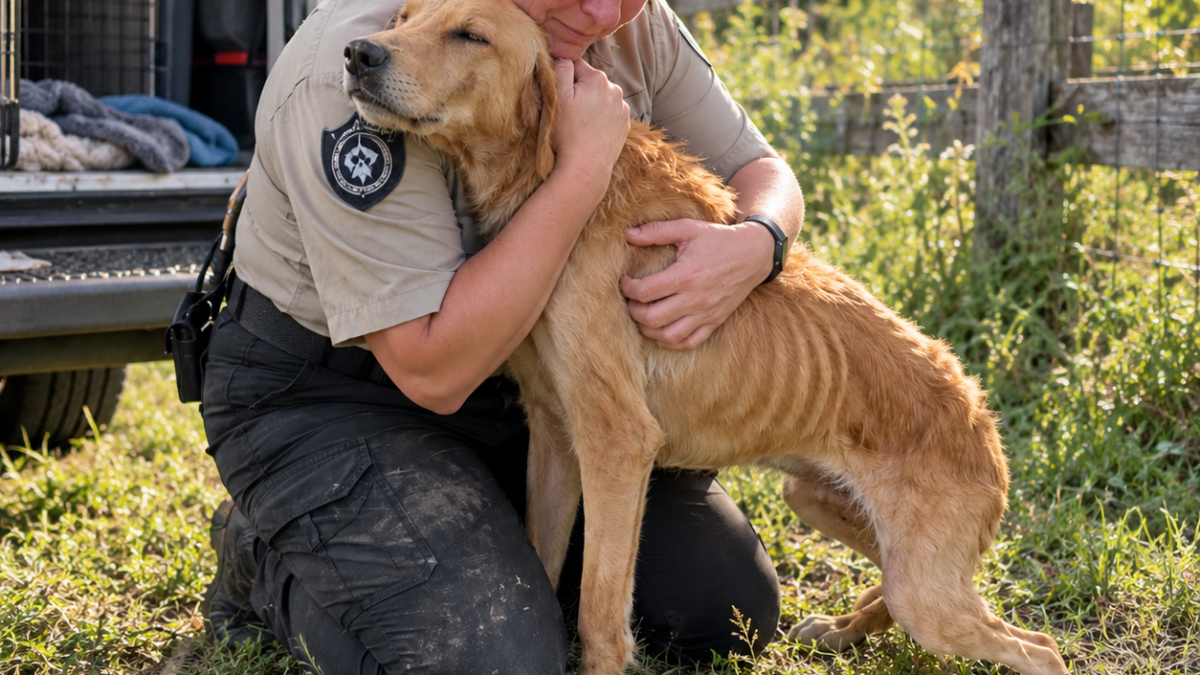
For seven years, he lived behind a chained barn door where sunlight reached him only through cracks between warped wooden boards, and by the time I found him, darkness was the only world he seemed to understand.
I had spent seventeen years as an animal-control officer in East Texas and thought I had already seen every form of neglect a person could leave behind, but nothing prepared me for the pair of eyes staring at me from inside that barn.
Then I cut through the old chain, pulled the door open, and watched a dog face something so ordinary that the rest of us had forgotten it could ever feel like a miracle.
My name is Rachel Corbett. I was forty-two years old that November morning, and the call came just after seven while a cold fog still covered the pine fields outside our county office.
The man on the phone introduced himself as Robert Carter.
He had purchased an old farm two weeks earlier and had been clearing brush behind the house when he discovered a barn almost completely hidden by vines, fallen limbs, and waist-high weeds.
“The door’s chained,” he told me. “There’s a padlock on it.”
“Is the building occupied?”
“I thought it was empty.”
“What changed your mind?”
Robert went silent for a moment.
“I heard scratching.”
Ten minutes later, my partner Frank Delgado and I were headed toward County Road 214.
Robert met us beside a rusted gate.
He was in his late fifties, wearing work gloves and an old denim jacket. He looked pale.
“You haven’t opened it?” I asked.
“No.”
“Good.”
He led us behind the farmhouse.
The barn stood about fifty yards beyond a line of pecan trees. Its roof sagged in the middle. Boards had warped away from the frame, and one corner leaned badly enough that I wondered how the building was still standing.
A thick chain looped through the two front doors.
The padlock was brown with rust.
Robert pointed toward a gap between two boards.
“I looked through there.”
I approached slowly.
At first, I saw nothing.
Only darkness.
Then something moved.
Two eyes appeared.
I stopped.
“Frank.”
He came beside me.
The eyes remained fixed on us.
A faint scraping sound came from inside.
Then silence.
I crouched near the opening.
“Hey, sweetheart.”
No barking.
No growling.
No movement toward me.
Just those eyes.
Frank exhaled.
“There’s definitely a dog in there.”
Robert stared at the chained doors.
“How could anything still be alive?”
I didn’t answer because I had the same question.
We documented everything before touching the chain.
Then Frank brought bolt cutters.
The first attempt barely marked the metal.
The second shifted one link.
On the third, the rusted chain broke and dropped into the dead grass.
The sound from inside stopped completely.
I put one hand against the barn door.
“Easy.”
The hinges screamed when I pushed.
A narrow blade of morning sunlight cut across the dirt floor.
The dog retreated.
I saw him clearly for the first time.
He was a large shepherd mix, though starvation had reduced him to a narrow frame beneath a coat that hung in dirty mats. His nails were badly overgrown. His ears flattened against his head, and his body shook as the light widened.
But he didn’t run.
He stared at the sunlight.
That detail still follows me.
Not at us.
At the light.
I opened the door another foot.
Sunlight spread across the barn floor.
The dog squinted.
His eyes closed.
Then opened.
Closed again.
Frank whispered, “He can’t handle the brightness.”
I lowered myself to the ground.
“Take your time.”
The dog shifted forward.
One paw entered the strip of sunlight.
He jerked it back.
Robert covered his mouth.
I stayed still.
“You’re okay.”
The dog tried again.
This time his paw remained there.
Then the other.
His entire body began trembling harder.
For one terrible second, I thought he was collapsing.
But something else was happening.
He lifted his face.
Sunlight touched his muzzle.
His eyes closed.
He stood there breathing.
Just breathing.
As if warmth itself were something he had remembered from another lifetime.
Then he took another step.
And another.
Until his front paws crossed the threshold.
Beyond the barn was wet November grass glittering beneath the clearing fog.
The dog stared at it.
Frank and I said nothing.
Robert began crying quietly behind us.
The dog lowered his head toward the grass.
His nose touched the first blade.
And then he did something none of us expected.
PART 2
He dropped to his knees.
At first I thought his legs had given out.
I moved forward instinctively, but Frank caught my sleeve.
“Wait.”
The dog wasn’t collapsing.
He was rubbing his face into the grass.
Slowly.
Carefully.
Almost experimentally.
His nose moved through the wet blades, and when the dew touched his face, he froze. Then he pushed his muzzle deeper and inhaled.
For seventeen years, I had watched dogs rush from crates, yards, flooded houses, abandoned trailers, and roadside ditches. I had seen frightened animals sprint toward open space as though freedom were something their bodies recognized before their minds did.
This was different.
He did not rush.
He investigated every inch.
A paw.
A smell.
A patch of sunlight.
A leaf.
The breeze.
He moved like an animal entering the world for the first time.
Robert whispered behind me, “My God.”
The dog rolled onto one shoulder.
Then his back.
His legs lifted awkwardly into the air.
Frank laughed once, but the sound broke halfway through.
The dog rubbed himself against the grass.
Not gracefully.
Not playfully in the normal way.
There was something almost solemn about it.
Like he had spent years remembering the idea of the earth without being sure it still existed.
When he finally stood, he looked toward me.
I extended one hand.
He approached.
Slow.
Uncertain.
He stopped three feet away.
His nose moved.
Then he came closer.
He smelled my fingers.
I didn’t touch him.
He made that decision.
His forehead pressed lightly against my palm.
I swallowed.
“Okay,” I whispered. “We’ve got you.”
I didn’t yet know his name.
I didn’t know who had locked that barn.
I didn’t know how seven years could disappear behind a chained door without someone stopping it.
And I had no idea that the answer would eventually involve an old photograph, a neighbor who had carried a secret for years, money changing hands on a property everyone claimed was abandoned, and a man who would stand in a courtroom insisting the dog had been “better off where he was.”
That morning, none of that mattered.
The dog was outside.
For the first time in seven years, that was enough.
## **1. What Was Inside the Barn**
Frank stayed with the dog while I went inside.
The smell hit harder once the doors were fully open.
Old straw.
Rotting wood.
Animal waste.
Damp soil.
Something sour from years of trapped air.
The barn had once held farm equipment. Rusted hooks remained along one wall. Broken tools lay near a workbench. Several feed sacks had deteriorated into shredded fabric.
At the back was the space where the dog appeared to have lived.
A shallow depression in the dirt.
Old burlap.
A cracked plastic bucket.
An overturned metal pan.
And beneath a hole in the roof, a second container had collected rainwater.
That explained part of the survival mystery.
Food was harder.
Mouse droppings covered parts of the barn.
Bird nests filled the rafters.
There were signs the dog had eaten whatever entered.
But seven years?
I didn’t believe chance alone had kept him alive that long.
Then I noticed something near the rear wall.
A board had been damaged close to the ground.
Not from inside.
From outside.
There were scratches in the soil beneath it.
I knelt.
The gap was barely two inches high.
Something had been pushed through there repeatedly.
Frank called from outside.
“Rachel?”
“Yeah?”
“You need to see this.”
I walked back out.
The dog was lying on the grass.
Robert stood several yards away.
Frank held a faded aluminum bowl.
“Found it behind the barn.”
The bowl contained old dried residue.
Dog food.
Not ancient.
Weeks old, maybe months.
Someone had been feeding him.
Not enough.
Not regularly.
But someone had known.
That changed everything.
## **2. We Called Him Blue**
We needed to transport the dog immediately.
He was severely underweight.
His coat hid how thin he really was, but once he stood in full daylight, there was no mistaking it.
His hips showed.
His shoulders were sharp.
His back legs trembled after only a few minutes upright.
We used a soft slip lead.
The moment Frank lifted it, the dog flinched.
Not violently.
He simply flattened his body.
I lowered the lead.
“No rope.”
Frank nodded.
We brought a transport crate instead.
The dog took one look at it and backed toward the barn.
That made my chest tighten.
Confinement.
No.
Not again.
Robert disappeared into the farmhouse and returned carrying an old quilt.
“My wife put this in my truck.”
We spread it across the back of our transport van and opened both rear doors.
No crate.
No enclosed compartment.
Just the quilt.
I sat inside.
The dog watched.
“Your choice.”
Ten minutes passed.
Then he climbed in.
His legs shook badly.
I moved to one side.
He lay down.
The quilt was blue.
Frank looked at me.
“We need something for the intake form.”
“We can call him Unknown Male.”
Frank shook his head.
“That sounds like a body at the morgue.”
Robert said, “Blue.”
I looked at the quilt.
Then at the dog.
“Blue?”
Robert shrugged.
“It’s the first soft thing he’s probably had in years.”
The dog closed his eyes.
Blue became his name.
## **3. Dr. Hannah Lee**
Our county contract veterinarian was Dr. Hannah Lee.
Hannah had the unusual ability to sound calm even while everybody around her was panicking.
When we carried Blue into the clinic on the quilt, that calm disappeared for exactly one second.
She stared.
Then recovered.
“Exam room three.”
We transferred him onto a padded mat.
He refused the table.
Hannah didn’t insist.
She sat on the floor.
“Hey, Blue.”
He watched her.
She examined him slowly.
No sudden movements.
No collar around his neck.
No lifting unless necessary.
Severe malnutrition.
Dehydration.
Anemia.
Chronic skin irritation.
Ear infection.
Long nails.
Muscle wasting from prolonged inactivity.
Arthritis far beyond what she expected for his apparent age.
Old pressure sores.
Several broken teeth.
The worst thing, however, was not any single medical problem.
It was the condition of his legs.
Hannah moved his rear limb gently.
Blue didn’t protest.
“That’s not good.”
“What?”
“His joints haven’t been moving normally for years.”
“Can he recover?”
“Some.”
“Run?”
She looked at him.
“Maybe.”
That word mattered.
Maybe.
Not no.
## **4. His Eyes**
We worried about his eyes because of his reaction to sunlight.
Hannah examined them carefully.
“Damage?”
“Not exactly.”
She switched off the overhead lamp.
Blue visibly relaxed.
“Think of someone walking out of a dark theater after three hours.”
“Multiply it by seven years?”
“Something like that.”
His vision still worked.
But his eyes had adapted to low light.
Bright environments overwhelmed him.
For the first week, we kept his room dim.
Curtains partly closed.
Soft lamps.
Outdoor time only at dawn and late afternoon.
Nobody wanted the first gift of freedom to become painful.
## **5. The First Meal**
Hannah warned us not to let him eat freely.
A severely malnourished animal can become seriously ill if food is restored too quickly.
We started with small measured portions.
Blue inhaled the first serving.
Then stared at the empty bowl.
Hannah waited twenty minutes.
Second portion.
Gone.
Then he began licking the floor.
I sat beside him.
“There’s more tomorrow.”
Of course he didn’t understand.
Animals who have known hunger don’t believe tomorrow because somebody promises it.
Tomorrow has to happen repeatedly.
## **6. The First Night**
I stayed late.
Not because Blue medically needed me.
Hannah had staff.
But every time I stood, Blue’s head lifted.
At nine thirty, I told myself I would leave at ten.
At ten, I moved it to ten thirty.
At ten forty-five, Hannah walked past.
“You have a house.”
“I remember.”
“Do you?”
Blue was lying on the blue quilt.
I stood.
His eyes opened.
I sat again.
Hannah sighed.
“I’m turning off the lobby lights.”
“Fine.”
At eleven twenty, I finally stood.
Blue lifted his head.
I crouched near him.
“I’m coming back.”
He watched.
“You don’t believe me.”
Fair.
“I’ll prove it.”
The next morning, I arrived at six forty.
Blue was awake.
When I entered, his tail moved once.
One slow sweep across the quilt.
That was the beginning.
## **7. Robert’s Farm**
While Blue stabilized, we investigated.
Property records showed Robert had bought the farm from a holding company owned by a man named Dale Mercer.
Dale was fifty-one.
The farm had originally belonged to his uncle, Everett Sloan.
Everett had lived there for nearly forty years.
Seven years earlier, he moved away.
According to Dale, Everett had become too old to maintain the property and had gone to live with relatives near Dallas.
The farmhouse remained mostly vacant.
Dale managed it.
Collected occasional lease payments from cattlemen using the back pasture.
Paid taxes.
Eventually sold it.
So the farm had not truly been abandoned.
That mattered.
Somebody had been managing the property.
Somebody had access.
Somebody had chained the barn.
## **8. Everett**
We found Everett in an assisted-living community outside Tyler.
He was eighty-one.
When I called, his voice was clear.
“Mr. Sloan, my name is Rachel Corbett. I’m an animal-control officer.”
Pause.
“What happened?”
Interesting response.
Not “Why are you calling?”
What happened?
“I’m asking about a dog found at your former farm.”
Silence.
Then:
“What dog?”
“A large shepherd mix.”
Longer silence.
“Brown?”
“Yes.”
“White around the chest?”
“Yes.”
Everett breathed out.
“That would be Samson.”
Blue had a name.
Samson.
“How old is he?”
Everett didn’t answer immediately.
“Eleven? Twelve?”
“Was he your dog?”
“Yes.”
I closed my eyes.
“Mr. Sloan, when did you last see him?”
Silence.
“Before I left.”
“Seven years ago?”
“Yes.”
My hand tightened around the phone.
“What arrangements did you make for Samson?”
“Dale said he’d handle things.”
“What does that mean?”
“I thought he took him.”
“Where?”
“I don’t know.”
“Did you ask?”
“I was sick.”
His voice became defensive.
“I had a stroke. I wasn’t thinking about a dog.”
I let the silence sit.
Then:
“Did you know Samson remained locked in the barn?”
Everett sounded genuinely shocked.
“What?”
## **9. One Story Becomes Two**
Everett claimed he had never locked Samson in the barn permanently.
He said Samson sometimes slept there during storms, but otherwise lived around the farmhouse.
When Everett’s health failed, Dale agreed to take responsibility for the property and the dog.
According to Everett:
“I told him find Samson a home.”
“Did you give him money?”
“Yes.”
“How much?”
“Some.”
“How much?”
“Five thousand.”
I stopped writing.
“For the dog?”
“For everything. Feed. Vet. Rehome him.”
“Do you have documentation?”
“My daughter might.”
Now the story had changed.
Blue had not simply been forgotten by an old man who walked away.
Someone had been paid to care for him.
## **10. Dale Mercer**
Dale came to our office voluntarily.
He wore expensive boots, clean jeans, and the expression of someone irritated by paperwork.
“Samson was aggressive.”
That was his opening defense.
I had not accused him of anything yet.
“Aggressive how?”
“He bit.”
“Who?”
“People.”
“Which people?”
“Farm workers.”
“Names?”
“I don’t remember.”
“Was there a veterinary report?”
“No.”
“Animal-control report?”
“No.”
“Medical treatment for any bites?”
“Not that I know of.”
I looked down at the file.
“Your uncle says he paid you to rehome Samson.”
Dale leaned back.
“My uncle remembers things how he wants.”
“Did he give you five thousand dollars?”
“That money was for the farm.”
“Was any of it intended for Samson?”
Dale paused.
“Maybe.”
That word would return later.
## **11. “He Was Better Off There”**
I asked directly:
“Did you put Samson in the barn?”
Dale looked out the window.
“He kept coming back.”
“That isn’t my question.”
“He wouldn’t stay with anybody.”
“Who did you try?”
“People.”
“Names?”
“I don’t remember.”
“Did you contact shelters?”
“No.”
“Rescues?”
“No.”
“Veterinarians?”
“No.”
“Then how did you try?”
Dale’s jaw tightened.
“He was my uncle’s dog. He knew the barn.”
I felt my patience thinning.
“Did you chain the door?”
“I secured it.”
“For seven years?”
“I checked on him.”
There.
The room went completely still.
I looked directly at him.
“You checked on him?”
Dale realized what he had admitted.
His attorney was not present because he had chosen to speak voluntarily.
He stood.
“I’m done.”
Before leaving, he said something I would hear repeated in court months later.
“You people are making it sound worse than it was.”
I said nothing.
Dale continued:
“He was better off there than getting put down somewhere.”
Then he walked out.
## **12. Better Off**
That phrase followed me back to the clinic.
Blue was outside in a shaded courtyard.
Hannah had spread several rubber mats across the concrete because his feet were tender.
He stood near a patch of grass.
Sunlight reached only half the yard.
Blue kept himself mostly in shadow.
I sat beside him.
“Apparently you were better off.”
He looked at me.
“Good to know.”
His tail moved.
I scratched beneath his chin.
He leaned forward.
Anger does not help an animal heal.
But sometimes anger keeps humans from looking away.
## **13. The Person Feeding Him**
The bowl behind the barn remained unexplained.
We canvassed neighboring properties.
Most homes were far apart.
East Texas rural roads do not give you convenient witnesses every fifty feet.
Then we met seventy-six-year-old June Holloway.
June lived nearly a mile from the farm.
She knew Everett.
She knew Dale.
And she knew Samson.
The moment I showed her Blue’s photograph, her face changed.
“He’s alive.”
“You knew he was there?”
Her eyes filled.
“Yes.”
My stomach tightened.
“How long?”
“Years.”
I had to keep my voice steady.
“Tell me everything.”
## **14. June’s Secret**
June noticed Samson inside the barn about six years earlier.
She had been walking a fence line looking for a missing goat when she heard him.
At first, she assumed Dale kept the dog there temporarily.
She called.
Dale told her Samson was dangerous.
“He said not to go near him.”
“Did you believe him?”
“At first.”
A few weeks later, June returned.
She heard scratching.
She pushed food beneath the damaged board.
Samson ate.
After that, she came whenever she could.
Sometimes every few days.
Sometimes once a week.
Dry dog food.
Table scraps.
Water during drought.
She never opened the barn.
“Why?”
The question came out harder than I intended.
June lowered her head.
“I was afraid.”
“Of the dog?”
“Dale.”
That surprised me.
“Why?”
“He told me it was private property. Said if I kept trespassing, he’d call the sheriff.”
“Did you call animal control?”
She began crying.
“No.”
“Why?”
“I thought Dale was feeding him too.”
“But you knew the door stayed locked.”
“Yes.”
“June.”
“I know.”
Her hands shook.
“I know what I should have done.”
I softened.
Guilt was already doing more than I could.
“Your food probably kept him alive.”
“That doesn’t make what I didn’t do right.”
No.
It didn’t.
But humans are rarely purely brave or purely cowardly.
June had failed to make one phone call.
She had also kept a dog alive for six years.
Both could be true.
## **15. The Photographs**
June had photographs.
Not because she had documented abuse.
Because she sometimes photographed wildflowers and fences during walks.
Samson appeared in the background of several images.
One from six years earlier showed his face through a barn opening.
Another from four years earlier showed Dale’s truck parked beside the building.
A third, dated two years earlier, showed the chain clearly.
That mattered.
Dale could not say he believed Samson had escaped.
He had visited.
He knew.
## **16. Robert Finds the Ledger**
Two weeks after the rescue, Robert called.
“I found something.”
“What?”
“A ledger.”
Inside the farmhouse office, behind an old filing cabinet, he discovered a notebook containing property expenses.
Fuel.
Fence repair.
Taxes.
Feed.
There were several entries in Dale’s handwriting:
**Dog feed – barn**
Then gaps.
Months.
Sometimes nearly a year.
One entry:
**Samson – 40 lb**
Another:
**Barn lock replaced**
Date: five years earlier.
That line did more than make me angry.
It gave the case structure.
The barn had not remained accidentally locked.
Someone had replaced the lock.
## **17. Blue Hears His Old Name**
I brought June to the clinic.
She stood outside the courtyard.
Blue saw her.
He didn’t move at first.
Then June whispered:
“Samson?”
His ears lifted.
She cried immediately.
“Samson.”
Blue stood.
Walked toward her.
Slowly.
June crouched.
“I’m sorry.”
Blue smelled her hands.
Then licked one.
June broke down.
“I should have gotten you out.”
I looked away.
Some apologies are for ourselves.
Animals do not need our moral speeches.
Blue wanted the smell of the woman who had brought food.
That was enough.
## **18. Samson or Blue**
We debated changing his name back.
Hannah tried both.
“Samson?”
Head lift.
“Blue?”
Tail.
“Samson?”
Ear.
“Blue?”
Tail again.
Frank laughed.
“He votes Blue.”
June smiled through tears.
“Everett named him Samson because he thought it sounded strong.”
I looked at the dog.
“He’s strong enough without carrying the old name.”
So Blue stayed Blue.
## **19. First Real Bath**
We waited almost three weeks before bathing him fully.
His skin was too fragile at first.
When Hannah approved it, we used warm water and a shallow tub.
Blue panicked when he saw the enclosed bathing area.
So we changed plans.
We carried buckets outside.
Warm water.
Sunlight filtered through shade cloth.
No closed room.
It took forty minutes.
Mud came out.
Old debris.
Matted fur.
Underneath, Blue’s coat was not brown as we thought.
It was black along the back with rich tan sides and a white chest.
Frank stared.
“You’ve been hiding a whole dog.”
Blue sneezed water onto him.
“Thank you.”
## **20. Touch**
Blue learned human touch in pieces.
Chin first.
Then shoulders.
Chest.
Back was harder.
If a hand moved over his spine too quickly, he flinched.
We never forced it.
By the end of the first month, he would rest his head on my knee.
By month two, he leaned against Frank.
Hannah remained his favorite because she carried chicken.
Professional ethics apparently had limits.
## **21. Running**
Hannah warned us not to expect a normal gait.
Seven years of confinement had changed Blue’s body.
Physical therapy started with simple movements.
Standing.
Weight shifting.
Short walks.
Water therapy later.
At first, Blue could walk only a few minutes before his hind legs weakened.
He hated stopping.
That was the strange part.
Once he discovered outside, he wanted more.
More grass.
More smells.
More distance.
He had spent seven years with almost none.
Now every path seemed urgent.
## **22. The Meadow**
Robert invited us back to the farm after investigators finished documenting the property.
Not near the barn.
To the front meadow.
I hesitated.
Would the place frighten Blue?
Hannah said:
“Let him decide.”
We brought him.
The moment he stepped from the van, he smelled the air.
His body became still.
He knew.
Whether through scent or geography, he knew the farm.
He looked toward the distant barn.
Then away.
That mattered to me.
He chose the meadow.
Blue walked into tall grass.
Ten feet.
Twenty.
Thirty.
Then, unexpectedly, he tried to run.
It wasn’t graceful.
His rear legs did not coordinate well.
But he accelerated.
Frank shouted:
“Easy!”
Blue ignored him.
He made perhaps fifteen yards before stumbling.
I ran forward.
Blue stood before I reached him.
Then tried again.
June, watching from a distance, laughed and cried at the same time.
For the first time in seven years, Samson ran on his own land.
Not far.
But enough.
## **23. Dale Tries to Reclaim Him**
That was when the case took another turn.
Dale’s attorney sent a letter.
He claimed ownership of Blue.
I read it twice because I thought I misunderstood.
Dale argued that his uncle had transferred responsibility for Samson to him and that Blue therefore remained his property.
After seven years in the barn.
Now he wanted him back.
Frank stared at the letter.
“This is a joke.”
It wasn’t.
Dale’s lawyer requested the dog be held pending a property determination.
That meant we could not adopt Blue out.
Not yet.
I was furious.
Blue was sleeping on my office floor when I got the news.
I looked at him.
“No.”
He opened one eye.
“No chance.”
## **24. Why Dale Wanted Him**
It made no emotional sense.
Then Robert gave me the answer.
Dale was facing potential civil liability in the property sale.
The contract stated the farm was transferred free of undisclosed animal holdings and hazardous conditions.
Blue’s discovery created questions.
If Dale admitted abandoning him, the property representations looked worse.
If he claimed Blue was still owned and intentionally housed there, he could try to frame the situation as a legitimate arrangement gone wrong.
It was not a good argument.
But it explained the sudden concern.
Blue had become evidence.
## **25. The Hearing**
A temporary custody hearing was scheduled.
Dale attended.
Everett joined remotely because of health limitations.
June testified.
Robert testified.
I testified.
Hannah provided medical findings.
The judge asked Dale:
“When did you last physically see the dog before he was removed?”
Dale hesitated.
“Several months.”
I almost turned in my chair.
Several months.
Not years.
Several months.
The judge asked:
“And at that time, did you observe him inside the barn?”
“Yes.”
“Was the door secured?”
“Yes.”
“Did you release him?”
“No.”
“Why?”
“He was dangerous.”
“Did you document dangerous behavior?”
“No.”
“Obtain professional evaluation?”
“No.”
“Provide veterinary care?”
“No.”
“Attempt rehoming?”
“I tried.”
“With whom?”
“I don’t remember.”
The judge looked at the file.
“Seven years is a long time not to remember.”
Temporary custody remained with animal services.
Dale did not get Blue.
## **26. Blue’s Reaction to Doors**
Blue feared closing doors.
Not open doors.
Closing ones.
If he entered a room and somebody pulled the door shut, his breathing changed.
He looked for exits.
So every indoor space used for him had two options when possible.
Gate open.
Door cracked.
No trapping.
Recovery is often about returning control.
Not telling an animal there is nothing to fear.
Letting them discover they have choices.
## **27. The Volunteer Named Emily**
Emily Shaw was a thirty-four-year-old physical therapist who volunteered with our shelter on Saturdays.
She had experience with senior dogs.
Blue adored her.
Maybe because she never rushed him.
She sat on the ground and read books.
Not to him intentionally.
She just liked reading during breaks.
Blue started lying beside her.
One Saturday, Emily stopped.
Blue pawed the book.
She laughed.
“You object to chapter twelve?”
He pawed again.
That relationship became important.
## **28. Emily’s Ranch House**
Emily lived outside town on three fenced acres.
No children.
One elderly cat who ignored dogs.
Her previous dog had died the year before.
I saw where this was going before she admitted it.
“I’m not adopting him.”
“Of course not.”
“He needs special care.”
“You’re a physical therapist.”
“For humans.”
“Convenient overlap.”
“He has legal issues.”
“Temporary.”
“He likes me because I bring chicken.”
“So do most husbands.”
She glared.
Then Blue placed his head in her lap.
I smiled.
“Terrible luck.”
## **29. Everett’s Daughter**
Everett’s daughter, Susan Sloan, found the financial records he had mentioned.
A canceled check.
Five thousand dollars payable to Dale.
Memo line:
**Samson care / farm transition**
There it was.
Dale had accepted money specifically connected to the dog.
Susan also found text messages from seven years earlier.
Everett:
**Please make sure Samson goes somewhere good. He won’t understand why I’m gone.**
Dale:
**I’ll handle him.**
Two weeks later:
Everett:
**How’s Samson?**
Dale:
**Fine. Settling in.**
Months later:
Everett:
**Can I get a picture?**
No response.
Then:
**He’s with a family outside Longview.**
That family did not exist.
## **30. Everett Learns the Truth**
We showed Everett the evidence.
He cried.
Not dramatically.
Quietly.
“I believed him.”
I said nothing.
“He told me Samson had kids to play with.”
Everett looked old in a way he hadn’t during our first call.
“I stopped asking because it hurt.”
Then he said:
“I abandoned him too.”
“Dale locked the barn.”
“I trusted Dale instead of checking.”
That distinction mattered legally.
Emotionally, Everett did not care.
“I should have checked.”
Maybe.
But illness limits people.
Dependence complicates responsibility.
The investigation focused where the evidence led.
## **31. Dale’s Story Changes Again**
Confronted with the check and texts, Dale changed his explanation.
He claimed the family he had found returned Samson.
“When?”
“About six months later.”
“Who returned him?”
“I don’t remember.”
“Why put him in the barn?”
“Temporary.”
“How temporary?”
Dale stared at me.
“Things got away from me.”
Seven years.
One of the longest “temporary” periods I had ever heard.
## **32. The Barn Lock**
The ledger entry about replacing the lock became critical.
Dale said the old chain had broken and he needed to secure equipment.
“What equipment?”
He couldn’t identify any valuable equipment still in the barn.
Robert’s purchase inventory listed mostly rusted tools.
No tractor.
No machinery.
No reason for a heavy new lock.
Except Blue.
## **33. The Feed Receipts**
Investigators obtained some of Dale’s old farm-store receipts through records he voluntarily submitted during the property dispute.
Dog food appeared sporadically.
Three bags one year.
Two another.
Nothing consistent.
Enough to support June’s memory that Dale occasionally fed Blue.
Not enough to provide proper care.
Dale had not forgotten the dog.
That defense disappeared.
He knew Blue was alive.
He chose the barn.
Repeatedly.
## **34. The Hardest Question**
People asked why Blue didn’t bark enough for neighbors to notice.
Maybe he did.
The nearest occupied house was far away.
The barn was behind the farmhouse.
Rural properties absorb sound.
And eventually, animals stop doing things that never change their circumstances.
That idea bothered me most.
At the clinic, Blue rarely barked.
Months passed before we heard a full one.
## **35. His First Bark**
A squirrel caused it.
Naturally.
Blue was outside with Emily.
The squirrel ran along the fence.
Blue stared.
The squirrel stopped.
Blue barked.
One deep sound.
Everybody in the courtyard froze.
Blue looked startled by himself.
Then barked again.
Frank came running from inside.
“What happened?”
“Squirrel.”
He stared.
“That’s it?”
Blue barked a third time.
Frank smiled.
“Good boy.”
From then on, Blue discovered his voice.
Delivery truck?
Bark.
Bird too close?
Bark.
Frank arriving late?
Apparently bark-worthy.
The dog who spent years almost silent became opinionated.
We loved every annoying second.
## **36. Criminal Review**
The county prosecutor reviewed the case for animal-neglect charges and related financial issues surrounding the money Everett gave Dale.
I stayed careful in public.
No accusations beyond documented facts.
No emotional campaigns.
The internet had already discovered Blue’s story after Robert shared a photograph of him touching grass for the first time.
It spread quickly.
People wanted names.
We did not provide them.
Legal process matters.
So does safety.
## **37. The Viral Photograph**
The photograph showed Blue standing half in sunlight.
Barn behind him.
Eyes closed.
One front paw in grass.
Robert had taken it from several yards away.
He posted:
**The first morning after seven years in darkness.**
Technically, we could not prove Blue had never seen daylight during every second of those seven years.
So I asked Robert to change the wording.
He did.
The revised caption:
**The morning we opened the barn where Blue had been confined for years.**
Truth over drama.
The image was powerful enough.
## **38. People Offered Money**
Donations arrived.
More than we needed for Blue.
We created a restricted medical fund.
When his expenses were covered, we asked donors to allow excess funds to support other long-term neglect cases.
Most agreed.
Blue’s suffering began helping animals he would never meet.
I liked that better than revenge.
## **39. Dale’s Public Statement**
Dale eventually released a statement through an attorney.
He said the story had been “sensationalized.”
He said Blue had food.
Water.
Shelter.
He emphasized that Blue survived.
That sentence made Hannah furious.
“Survival is not the standard.”
She was right.
An animal staying alive does not prove adequate care.
It proves the animal stayed alive.
There is a difference.
## **40. June Gets Harassed Online**
Some people discovered June had known about Blue.
They attacked her online.
Coward.
Complicit.
Monster.
I hated it.
June had failed to report.
She had also fed him for years.
People wanted clean categories.
Hero.
Villain.
Reality is messier.
I issued a statement without identifying her:
**Please do not harass witnesses or private citizens. Cooperation with investigators matters more than online punishment.**
June kept helping Blue.
That mattered.
## **41. Emily Becomes Foster**
When Blue was cleared for foster placement, Emily took him.
Not adoption.
Not yet.
The case still prevented final transfer.
She brought him home on a Friday afternoon.
He refused to enter the house.
The doorway stopped him.
Emily sat on the porch.
Forty minutes.
Then Blue placed one paw inside.
Pulled it back.
Tried again.
Emily did nothing.
Eventually he crossed.
The hardwood floor scared him.
Too smooth.
She covered pathways with rugs.
Blue walked from rug to rug.
By evening, he reached the living room.
## **42. His First Bed**
Emily had purchased an expensive orthopedic dog bed.
Blue ignored it.
He slept on the floor beside the back door.
Night two, same.
Night three, Emily moved the bed beside the door.
Blue slept next to it.
Night four, one paw on it.
Night five, half his body.
By week two, he occupied the entire thing.
Emily texted:
**Apparently this $140 object has been approved.**
## **43. The Ceiling Fan**
Blue had never seen a ceiling fan.
Or at least not for years.
Emily turned it on.
Blue stared upward.
Then backed out of the room.
She turned it off.
For weeks, the fan remained still.
One day she turned it on at the lowest speed while Blue was outside.
When he came in, he noticed.
Stopped.
Then continued walking.
Tiny victories.
## **44. Television**
The television confused him too.
Especially horses.
A western came on.
Horse crossed the screen.
Blue stood.
Walked behind the television.
Looked.
Returned.
Horse gone.
He stared at Emily as though she had hidden livestock in the wall.
She laughed until she cried.
Those ordinary discoveries became the happiest part of his rehabilitation.
## **45. Rain**
Rain was complicated.
The barn roof had leaked.
During the first heavy storm at Emily’s house, Blue woke from a nap and began pacing.
Rain hit the metal porch roof.
Same sound.
Emily opened the back door.
Not to send him outside.
To show him he could choose.
Blue approached.
Looked at the rain.
Then turned around.
Returned to his bed.
That was the first storm he chose to spend indoors.
## **46. The Case Moves Forward**
Prosecutors eventually filed charges supported by the investigation.
I won’t turn legal details into theater.
There were counts connected to prolonged neglect and financial questions associated with funds provided for Samson’s care.
Dale pleaded not guilty.
That was his right.
The court process began.
Blue remained with Emily.
## **47. Dale Comes to Emily’s Road**
One evening, Emily called me.
Her voice was tight.
“There’s a truck parked across from my driveway.”
“What truck?”
“I think it’s Dale’s.”
My stomach dropped.
“Stay inside.”
Blue stood beside her.
The truck remained for approximately ten minutes.
Then left.
No confrontation.
No words.
But because custody litigation and a criminal case were active, the incident was reported.
Dale said he had been driving through the area.
Emily lived on a dead-end rural road.
The court later added conditions limiting contact with the foster placement.
That was enough.
No dramatic showdown.
Just a boundary.
## **48. Blue Learns the Fence**
Emily’s yard was fenced.
The first few weeks, Blue rarely moved more than twenty feet from the house.
Then curiosity expanded.
The oak tree.
Fence line.
Garden.
Small pond.
One morning Emily looked outside and couldn’t see him.
She panicked.
Then found Blue lying in a patch of sunlight fifty yards from the house.
Not hiding.
Sunbathing.
She sent me the photograph.
The dog who once squinted at daylight now chose the brightest place in the yard.
I saved that one too.
## **49. Robert Returns**
Robert visited.
Blue remembered him.
Not strongly.
But enough.
Robert crouched.
“Hey, buddy.”
Blue smelled him.
Tail wag.
Robert looked toward me.
“I still think about that door.”
“So do I.”
“I almost didn’t check.”
“What do you mean?”
“I thought the scratching was raccoons.”
That possibility chilled him.
“If I’d ignored it…”
“But you didn’t.”
Another lesson.
Guilt loves alternate timelines.
Reality is the one where Robert stopped.
## **50. The Trial**
The trial began nearly eleven months after Blue’s rescue.
By then, he had gained twenty-three pounds.
His coat shone.
His legs remained stiff, but he could jog short distances.
Emily had become his person.
Everyone knew it.
The courtroom heard testimony from Everett.
June.
Robert.
Hannah.
Me.
Investigators.
Property records and financial documents were introduced.
The prosecution focused on pattern.
Not one forgotten weekend.
Not one mistake.
Years.
Knowledge.
Repeated access.
A replaced lock.
Occasional feed.
No veterinary care.
No meaningful exercise.
No rehoming.
No professional assessment supporting claims of aggression.
## **51. Everett Testifies**
Everett appeared by video.
He looked directly toward Dale on the screen.
“I trusted you.”
Dale’s attorney objected to emotional framing.
The judge redirected.
Everett described the check.
The request to rehome Samson.
The messages.
The claim Samson lived with a family.
The prosecutor asked:
“Did you authorize Mr. Mercer to confine Samson permanently in the barn?”
“No.”
“Did you believe Samson was living there?”
“No.”
“Would you have accepted that arrangement?”
Everett’s voice broke.
“No.”
## **52. June Testifies**
June was terrified.
Hands shaking.
But she testified.
She admitted everything.
Knowing Blue was there.
Bringing food.
Failing to call authorities.
Dale’s attorney attacked that.
“You believed the dog was alive for years and did nothing?”
June swallowed.
“I fed him.”
“That was not my question.”
“No.”
“You did not call animal control?”
“No.”
“Then how can you blame my client?”
June looked toward Dale.
“I don’t blame him for what I failed to do.”
The courtroom quieted.
Then she continued:
“I blame him for locking the door.”
That ended the exchange better than any lawyer could have.
## **53. Hannah’s Testimony**
Hannah explained Blue’s medical condition.
The muscle wasting.
Chronic joint problems.
Malnutrition.
Dental disease.
Skin issues.
The defense emphasized that Blue had survived.
Hannah responded:
“Survival does not indicate adequate welfare.”
The attorney asked:
“Could a dog living outdoors develop some of these conditions?”
“Yes.”
“Could an old dog develop arthritis?”
“Yes.”
“Could weight loss occur with age?”
“Yes.”
“Then none of these conditions proves my client caused them.”
Hannah remained calm.
“No single condition tells the entire story.”
She looked toward the jury.
“The pattern does.”
## **54. Dale Takes the Stand**
Dale testified.
His attorney likely believed he needed to explain.
Dale said he feared Samson.
He claimed the dog had behaved unpredictably.
The prosecutor asked:
“Did you seek training?”
“No.”
“Veterinary evaluation?”
“No.”
“Behaviorist?”
“No.”
“Shelter placement?”
“No.”
“Rescue placement?”
“No.”
“Did you purchase food?”
“Sometimes.”
“Did you visit?”
“Yes.”
“How often?”
“I don’t remember.”
“Yearly?”
“More.”
“Monthly?”
“Sometimes.”
The prosecutor paused.
“So you repeatedly saw Samson inside the barn?”
“Yes.”
“Over a period of years?”
Dale hesitated.
“Yes.”
“Did you ever let him out?”
Silence.
“Mr. Mercer?”
“No.”
## **55. The Sentence That Changed the Room**
Then Dale said it again.
“He was better off there.”
The prosecutor stopped.
“Better than what?”
“Than being euthanized.”
“Who told you euthanasia was the only alternative?”
“Nobody.”
“Did any shelter refuse him?”
“I didn’t call.”
“Any rescue?”
“No.”
“Any veterinarian recommend euthanasia?”
“No.”
“Any trainer evaluate him?”
“No.”
“So the choice you describe as the only alternative was never actually presented by a professional?”
Dale said nothing.
The prosecutor sat down.
## **56. Verdict**
The jury deliberated for several hours.
I waited with Frank.
Emily stayed home with Blue.
That was intentional.
He did not need to become a courtroom prop.
When the verdicts came back, Dale was found responsible on multiple counts supported by the evidence.
Not everything the prosecution sought.
Enough.
I felt no desire to celebrate.
Relief.
That was all.
Because a guilty verdict does not restore seven years.
It does not strengthen damaged joints.
It does not teach an old dog what puppyhood felt like.
Justice can acknowledge theft.
It cannot return time.
## **57. Sentencing**
At sentencing, the judge focused on duration.
Repeated decisions.
The fact that alternatives existed.
The money accepted for Samson’s care.
The false representation to Everett.
Dale received legal penalties, restitution obligations, supervised conditions, and a lengthy restriction on owning or being responsible for animals.
Financial issues connected with the care money were addressed through the applicable proceedings.
More importantly for Blue:
Dale’s ownership claim ended.
Permanently.
## **58. Emily’s Application**
The day legal custody finally cleared, Emily arrived at my office with an adoption form already completed.
I stared.
“I thought you weren’t adopting him.”
“I changed my mind.”
“When?”
“About eleven months ago.”
Frank laughed from the next desk.
I reviewed her application theatrically.
“Do you have adequate housing?”
“Yes.”
“Fenced yard?”
“Yes.”
“Veterinary plan?”
“Yes.”
“Experience with special-needs dogs?”
She stared.
“Rachel.”
“References?”
“Rachel.”
“Reason for adoption?”
Emily had written:
**Because he already lives in my house, sleeps on my furniture, supervises my gardening, and has rejected every suggestion that he belongs anywhere else.**
Approved.
## **59. Adoption Day**
We held no giant ceremony.
Blue disliked crowds.
Just Emily.
Me.
Frank.
Hannah.
Robert.
June.
Everett joined by video.
Emily signed.
I placed the certificate beside Blue.
“Official.”
He sniffed it.
Then stepped on it.
Frank said:
“Strong legal opinion.”
Everett watched from the screen.
“Can I say something?”
Emily lifted the tablet toward Blue.
Everett whispered:
“Samson.”
Blue’s ears moved.
Everett smiled sadly.
“You got a better name now?”
Blue’s tail wagged.
Everett laughed.
“I’ll take that as yes.”
## **60. Everett’s Apology**
Everett asked Emily if he could visit.
She hesitated.
Then agreed.
He arrived with his daughter.
Blue approached cautiously.
Everett sat.
No reaching.
No calling.
Just waiting.
Eventually Blue smelled his hand.
Everett began crying.
“I’m sorry, boy.”
Blue stood there.
No cinematic forgiveness.
No dramatic collapse into his arms.
He smelled Everett.
Then walked toward Emily.
That was important.
Blue’s past had arrived.
Blue chose his present.
## **61. The Barn Comes Down**
Robert decided the old barn was unsafe.
He asked whether anyone objected to demolition.
Investigators had finished.
No legal reason remained to preserve it.
Before demolition, he invited us back.
I stood in front of the doors.
Chain gone.
Lock gone.
Light poured through both sides now because boards had been removed.
It looked smaller than I remembered.
Maybe terrible places shrink once their power is gone.
Robert asked:
“Want anything from it?”
“No.”
Then I reconsidered.
One board from the doorway.
Not for Blue.
For the shelter.
Later, Frank made it into a small bench.
No plaque.
No dramatic display.
Just wood that once helped form a wall now used as somewhere people could sit.
I liked that transformation.
## **62. Blue Never Returned to the Barn**
We did not bring him.
Some people suggested it for a symbolic photo.
Absolutely not.
Animals do not owe us dramatic closure.
Blue had already left.
That was enough.
## **63. The First Full Run**
A year and a half after rescue, Blue ran farther than anyone thought he would.
Emily was in the yard.
A rabbit appeared.
Blue took off.
Not fast by healthy-dog standards.
But faster than he had ever moved.
Across the grass.
Around an oak.
Nearly to the fence.
Emily screamed:
“Blue!”
He stopped.
Looked back.
Tongue out.
Tail high.
She laughed so hard she had to sit down.
Later, she sent me a video from her security camera.
I watched it twelve times.
Seven years in a barn.
Now chasing rabbits.
Unfair to the rabbit.
Beautiful for Blue.
## **64. His Favorite Thing**
Sunlight.
Not food.
Not toys.
Sunlight.
Every morning, Blue searched the house for the brightest patch.
Living room floor.
Kitchen.
Porch.
Bedroom.
Wherever sunlight landed, Blue followed.
Emily eventually moved his bed throughout the year as the angle changed.
Visitors thought she was ridiculous.
She was.
Correctly.
## **65. The Dark Room**
One day, during a storm, the electricity failed.
The house became dim.
Emily found Blue standing near the back door.
Body tense.
She opened it.
Lightning flashed.
Rain poured.
Blue looked outside.
Then returned to the living room.
Emily lit candles.
Sat beside him.
Power returned two hours later.
When the lamps came on, Blue relaxed instantly.
That was when Emily realized darkness still mattered.
Healing doesn’t erase memory.
It teaches the body that memory is not the present.
## **66. His First Toy**
Blue ignored toys for months.
Balls.
Ropes.
Stuffed animals.
Nothing.
Then Hannah gave him a stuffed yellow duck.
Blue smelled it.
Walked away.
Ten minutes later, he returned.
Picked it up.
Carried it to his bed.
Emily messaged:
**WE HAVE A TOY. THIS IS NOT A DRILL.**
The duck survived three weeks.
Then Blue discovered destruction.
Progress.
## **67. June Visits Often**
June became part of Blue’s life.
At first out of guilt.
Later because Blue liked her.
She visited every month.
Brought treats.
Too many.
Emily complained.
June ignored her.
One afternoon, Blue fell asleep with his head on June’s shoe.
She stared down.
“I don’t deserve this.”
Emily answered:
“He isn’t grading you.”
That helped.
## **68. Robert’s Farm Changes**
Robert renovated the farmhouse.
Cleared the brush.
Restored fences.
The barn location became an open field.
He planted two live oaks nearby.
When people asked why, he simply said:
“Needed trees.”
No plaque.
Good.
Blue didn’t need a monument to darkness.
He needed a life.
## **69. Dale After Court**
People asked what happened to Dale.
He completed the sentence and conditions imposed by the court.
The property dispute ended.
He could not own animals during the restriction period.
His relationship with Everett never recovered.
Some clients learned about the case and stopped doing business with him.
Others didn’t.
Life continued.
I was satisfied with that.
Accountability, not destruction.
Blue did not need Dale miserable forever.
Blue needed Dale powerless to put him back behind a locked door.
That happened.
## **70. “Revenge”**
Online commenters called the verdict revenge.
I never did.
Revenge would have required us to center Dale.
Blue deserved better.
The real victory was simpler.
Dale said Blue was safer locked away.
Blue learned to run.
Dale said Blue was dangerous.
Blue became gentle enough to visit a local senior center with Emily.
Dale said nobody would want him.
Emily adopted him.
Dale tried to claim ownership.
A court ended that claim.
Every lie became smaller as Blue’s life became larger.
That was enough.
## **71. Senior Center**
Blue never became a certified therapy dog.
Emily didn’t need him to.
But the senior center where she volunteered allowed calm pets during outdoor events.
Blue went once.
Then again.
He loved older people.
Perhaps their slow movements felt safe.
One man named Arthur sat with Blue for an hour.
Barely spoke.
Just rested a hand on Blue’s shoulder.
When Blue left, Arthur asked:
“Coming back?”
Emily said yes.
Blue had another routine.
## **72. Arthur**
Arthur had dementia.
Some weeks he remembered Blue’s name.
Others not.
He always recognized the dog.
“Black dog.”
Close enough.
Blue sat beside him.
No demands.
No questions.
There is value in companionship that does not require memory to be perfect.
Blue, of all dogs, seemed built for that.
## **73. The Newspaper**
A local reporter asked to write a one-year follow-up.
Emily agreed only if the piece focused on rehabilitation rather than graphic details of confinement.
The headline:
**After Years in a Dark Barn, Blue Chooses the Sun**
Good headline.
Accurate.
The photograph showed Blue asleep in a sunbeam.
Not the barn.
Not bones.
Not suffering.
Life.
## **74. Hannah’s Rule**
Hannah began telling new veterinary interns:
“Never confuse quiet with okay.”
Blue had been quiet.
People interpret silence as acceptance.
It isn’t.
Some animals protest.
Some shut down.
Behavior needs context.
Blue taught us that too.
## **75. Frank Retires**
Frank retired three years after Blue’s rescue.
At his small retirement gathering, Emily brought Blue.
Frank crouched slowly.
His knees were worse than Blue’s by then.
“Remember me?”
Blue leaned against him.
Frank looked at me.
“I still remember cutting that chain.”
“So do I.”
He scratched Blue’s chest.
“Best thing these hands ever did.”
Probably.
## **76. The Broken Chain**
We had kept one piece of the original chain as evidence.
After the case ended, it was scheduled for disposal.
Frank asked if he could have a link.
I said no.
Evidence rules.
Later, after formal release, the chain was returned to the appropriate property owner.
Robert chose to recycle it.
Good.
No trophies.
No romanticizing the object that kept Blue inside.
Let it become something else.
## **77. Blue and Children**
Emily’s niece Sophie was afraid of large dogs.
Blue terrified her initially simply by existing.
He never approached.
Sophie sat across the room.
Over several visits, distance shrank.
Eventually she offered a treat.
Blue took it gently.
A year later, Sophie lay on the floor reading beside him.
Emily sent me a picture.
Seven years labeled dangerous.
Now teaching a child not all big dogs were frightening.
Life enjoys contradictions.
## **78. His Birthday**
Nobody knew Blue’s exact birthday.
So Emily chose the rescue date.
“Gotcha Day,” some people call it.
Emily disliked the phrase.
“It sounds like kidnapping.”
So they called it Sun Day.
Every November, Blue got chicken, a new toy, and an absurd amount of attention.
The first Sun Day, rain.
Second, bright.
Third, perfect cool weather.
Blue spent the afternoon in grass.
## **79. Blue Gets Old**
Time eventually became the only thing we couldn’t fight.
Blue was probably twelve when rescued.
Maybe eleven.
Maybe older.
After four good years with Emily, age caught him quickly.
Arthritis worsened.
His hearing faded.
Cataracts began.
That irony hurt.
He had regained the world only to slowly lose parts of it again.
But this time, loss happened inside safety.
That difference mattered.
## **80. The Ramp**
Emily built ramps.
One for the porch.
One for the car.
Blue hated both initially.
Then accepted them.
She placed rugs across every slippery floor.
Raised his bowls.
Bought a support harness.
He continued following sunlight around the house.
Just slower.
## **81. The Farm Visit**
In Blue’s fifth year with Emily, Robert invited them to the farm for a picnic.
The barn was gone.
I worried.
Emily asked Blue.
Not literally.
She loaded him into the car.
If he showed distress, they would leave.
Blue stepped out.
Smelled the air.
Looked toward the field where the barn had stood.
Then walked toward the oak trees Robert planted.
He lay beneath one.
Sunlight moved across his back.
No fear.
No obvious recognition.
Maybe he knew.
Maybe not.
Again, we did not need symbolism from him.
But all of us felt it.
## **82. Robert Says Goodbye Early**
Robert sat beside Blue.
“You were the first thing I found on this farm.”
Blue slept.
Robert laughed.
“Not exactly what the real-estate brochure promised.”
Emily smiled.
Robert’s eyes watered.
“I’m glad you got out.”
Blue opened one eye.
Then closed it.
Good enough.
## **83. June’s Final Visit**
June’s health declined before Blue’s.
Her daughter began driving her.
On one visit, June could barely walk.
Emily brought Blue to the porch.
June sat.
Blue approached.
Placed his head in her lap.
June stroked him.
“You remember food through the wall?”
Nobody answered.
She smiled.
“I hope not.”
Then:
“I hope you remember this instead.”
Blue fell asleep.
June died several months later.
Her daughter asked if a photograph of Blue could be placed at the memorial table.
Emily agreed.
No one told the full story there.
They didn’t need to.
## **84. Everett Dies**
Everett died the following year.
Susan called me.
“My dad kept Blue’s picture by his bed.”
I didn’t know.
“He never stopped feeling guilty.”
I was quiet.
“Rachel, do you think Blue forgave him?”
“I don’t know if dogs think about forgiveness the way we do.”
Susan sighed.
“What do you think?”
“I think Blue moved on.”
Maybe that was more merciful than forgiveness.
## **85. Blue’s Health Changes**
At seventeen—or somewhere near it—Blue developed kidney disease.
Manageable at first.
Diet.
Fluids.
Medication.
Then a mass was discovered near his liver.
Hannah was retired but reviewed the records as a favor.
Aggressive treatment might buy time.
Possibly months.
At a cost to comfort.
Emily asked me:
“What would you do?”
I refused to answer immediately.
“You have to decide what Blue would choose if he understood the tradeoff.”
She cried.
“He’d choose the sun.”
That became the plan.
Comfort.
Sunlight.
Food he liked.
No unnecessary hospital stays.
## **86. The Last Summer**
Blue’s last summer was slow.
He could no longer run.
He walked.
Sometimes only to the oak tree.
Then lay down.
Emily placed a water bowl outside.
A fan on the porch.
Soft bed.
Yellow duck number twelve beside him.
Yes, there had been twelve.
Blue had become a professional duck destroyer.
He stopped destroying them near the end.
That was how Emily knew he was tired.
## **87. Frank Visits**
Frank came one afternoon.
Older.
Gray.
Walking with a cane.
Blue heard his voice.
His head lifted.
Frank sat beside him.
“You look about how I feel.”
Blue’s tail moved.
Frank laughed.
“Remember the barn?”
I wished he hadn’t asked.
Then he corrected himself.
“Never mind.”
He rubbed Blue’s chest.
“Remember the grass.”
Better.
## **88. The Last Good Day**
Blue had one extraordinary day in October.
Ate breakfast.
Walked farther than usual.
Barked at a squirrel.
Carried the yellow duck outside.
Lay in sunlight for hours.
Emily called me.
“I think he’s getting better.”
We both knew.
Sometimes near the end, animals give you a day that feels like a gift.
We let it be one.
## **89. The Morning After**
The next morning, Blue would not stand.
Emily found him on his bed.
Breathing slowly.
He tried lifting his head when she entered.
Couldn’t.
She called the veterinarian.
Then me.
I drove out.
The sun was rising when I arrived.
Of course it was.
Blue lay near the glass door.
A rectangle of morning light reached his front paws.
Emily sat beside him.
“I moved the curtain.”
I nodded.
## **90. One More Time Outside**
The veterinarian examined him.
The answer was clear.
His body was failing.
Emily asked:
“Can we take him outside?”
“Yes.”
We used his support blanket.
Four of us carried him carefully.
Not to the car.
To the yard.
We placed him beneath the oak.
Sunlight covered part of his body.
Blue smelled the air.
His eyes opened.
For a moment, he looked more awake.
Emily lay beside him.
“You remember this?”
Not the barn.
The sun.
The grass.
Life.
## **91. Goodbye**
The veterinarian administered medication to make Blue comfortable.
He relaxed.
His head rested against Emily’s leg.
I sat near his front paws.
Frank had once said Blue stepped out of the barn as though entering sacred ground.
Years later, that sentence returned to me.
Maybe freedom had been sacred to him.
Maybe sunlight.
Maybe choice.
The veterinarian prepared the final medication.
Emily whispered:
“You don’t have to go back anywhere dark.”
That broke me.
Because she was right.
Blue’s last memory would not be darkness.
It would be warmth.
Grass.
Emily’s hand.
Birds in the oak.
The smell of open air.
One slow breath.
Then another.
Then stillness.
The dog who spent seven years locked inside a barn died beneath an open sky.
## **92. After Blue**
Emily left his bed in place for months.
The sun moved across it every morning.
No dog.
Just light.
Eventually she donated the bed to a senior rescue.
Not because she was “moving on.”
Because another old dog needed it.
That felt like Blue.
## **93. The Yellow Duck**
Emily kept the final duck.
It sits on her bookshelf.
One wing missing.
Blue had managed one last small act of destruction before retirement.
Good dog.
## **94. The Oak Tree**
Robert planted another oak at the farm after Blue died.
I told him not to make it a memorial.
He said:
“It isn’t.”
“Then why?”
“Shade.”
Fair.
Sometimes the simplest answer is best.
## **95. What Happened to Dale**
People asked again.
Did Dale regret it?
I don’t know.
He never contacted me.
Never contacted Emily.
Never publicly apologized as far as I know.
For years, that bothered some people.
They wanted the final chapter to include remorse.
Life doesn’t guarantee that.
Accountability cannot force conscience.
The court imposed consequences.
His ownership rights ended.
Blue was protected.
That was our responsibility.
Dale’s conscience was his.
## **96. The Satisfaction People Wanted**
People wanted a dramatic revenge ending.
Property seized.
Fortune destroyed.
Public humiliation.
That isn’t how I see it.
Here is the ending that satisfied me.
Dale said Blue needed confinement.
Blue spent his final years choosing where to sleep.
Dale said nobody could safely handle him.
Children read beside him.
Dale said a barn was good enough.
Blue lived in a house with rugs laid down specifically so his old feet would not slip.
Dale claimed he would be unwanted.
Emily built her life around him.
Every claim lost meaning.
Blue did not need revenge.
His life contradicted the man who confined him.
## **97. Seven Years Versus Six**
Blue spent roughly seven years in the barn.
He lived nearly six years after rescue.
People sometimes say:
“That’s so unfair. He should’ve gotten seven more.”
Yes.
It was unfair.
Nothing changes that.
But we make a mistake when we measure rescued lives only against what was stolen.
Blue did not experience his final six years as compensation.
They were simply his life.
Morning.
Food.
Rain.
Sun.
Squirrels.
Emily.
Duck toys.
June.
Frank.
Robert.
Grass.
The years mattered because he lived them.
Not because they balanced a scale.
## **98. The Photograph on My Desk**
I keep one photograph of Blue.
Not the first.
Not inside the barn.
Not thin.
Not frightened.
The photograph shows him about three years after rescue.
Black-and-tan coat shining.
Gray beginning around the muzzle.
He is lying on Emily’s lawn.
Sunlight across his face.
Eyes closed.
Nothing dramatic.
That is exactly why I chose it.
## **99. The Barn Door**
I remember opening the door more clearly than almost anything in my career.
The hinges.
The darkness.
The narrow line of light.
Blue backing away.
That first paw.
The way he withdrew it.
Then tried again.
People think rescue is opening a door.
Sometimes it is.
But opening the door is only an invitation.
The animal still has to believe the world outside is survivable.
Blue did.
Eventually.
## **100. What He Taught Me**
Before Blue, I believed resilience meant endurance.
Surviving.
Holding on.
After Blue, I understood that survival is only one part.
Resilience can also mean curiosity returning.
A dog smelling grass.
Learning toys.
Barking at squirrels.
Choosing sunlight.
Trusting a woman with a book.
Sleeping through rain.
Running fifteen clumsy yards because his body finally has somewhere to go.
## **101. Quiet Animals**
Blue changed how I evaluate quiet animals.
A quiet dog is not necessarily calm.
A silent animal is not necessarily comfortable.
Sometimes silence means:
Nothing I do changes anything.
That lesson changed my work.
I asked different questions afterward.
Not:
“Why isn’t he reacting?”
But:
“What happened when reacting stopped working?”
That is a better question.
## **102. June’s Lesson**
June taught me something too.
People fail in complicated ways.
She should have called sooner.
She knew that.
But if we reduce her to that failure, we erase years of food pushed beneath a board.
Her fear and her kindness existed together.
Humans are inconvenient that way.
The useful ending was not attacking her.
It was making sure next time she would call.
She told me before she died:
“If I ever hear scratching behind a locked door again, I’m calling first and asking questions later.”
That mattered.
## **103. Everett’s Lesson**
Everett trusted family.
Too much.
His illness made him dependent.
He believed words because checking was difficult.
His mistake had consequences.
But the evidence did not show he intentionally wanted Blue confined for years.
That distinction matters.
Accountability should follow facts.
Not emotion.
## **104. Dale’s Lesson**
I don’t know what Dale learned.
Maybe nothing.
But everyone watching learned something simple.
Temporary neglect becomes long-term neglect one day at a time.
Nobody wakes up planning seven years.
One day.
Then another.
Then excuses harden into routine.
That is why intervention matters early.
## **105. Robert’s Choice**
Robert could have ignored the scratching.
He didn’t.
That one small act changed Blue’s life.
People sometimes believe rescue requires extraordinary courage.
Often it requires curiosity.
Stop.
Listen.
Look through the crack.
Make the call.
## **106. Frank’s Bolt Cutters**
Frank still jokes that his greatest professional accomplishment involved a twenty-dollar pair of bolt cutters.
Not true.
But I understand.
That broken chain was the simplest physical action in the entire story.
The complicated part came afterward.
Medical care.
Evidence.
Patience.
Law.
Trust.
Home.
But none of it happens without the first cut.
## **107. Emily’s Patience**
Emily never tried to make Blue “normal.”
That was why he became comfortable.
If he disliked doors, she left them open.
If hardwood scared him, rugs.
If darkness scared him, lights.
If rain sounded wrong, she sat nearby.
She adapted the environment instead of demanding the dog prove recovery.
That is love in a form people underestimate.
## **108. The Sun**
Of all the things Blue loved, sunlight stayed first.
Even near the end.
Emily once rearranged her living room furniture because the couch blocked Blue’s morning sun patch.
Her sister told her she was ridiculous.
Emily said:
“He waited seven years. The sofa can move.”
Correct.
## **109. The Final Sun Day**
A year after Blue died, Emily invited a few of us over on the rescue anniversary.
No party.
Coffee.
Robert came.
Frank.
Hannah.
We sat beneath the oak.
At one point, sunlight moved across the lawn.
Nobody said anything.
We all noticed.
Emily smiled.
“He’d be right there.”
Yes.
He would.
## **110. The Story People Tell**
People simplify Blue’s story now.
“Dog locked in dark barn for seven years finally sees sunlight.”
That’s true enough.
But incomplete.
The important part was not that he saw sunlight once.
It was that sunlight became ordinary.
Morning after morning.
Year after year.
Until nobody in Emily’s house thought twice about finding him asleep in a bright patch on the floor.
That is what freedom should become.
Ordinary.
## **111. The Moment I Still See**
I still see Blue at the threshold.
The barn behind him.
Grass ahead.
His paw entering the light.
Pulling back.
Trying again.
Sometimes I think that second contains his entire story.
Fear.
Memory.
Choice.
Courage.
Not loud courage.
Not cinematic courage.
One paw.
Then another.
## **112. If Blue Could Have Understood Me**
I would have told him:
The door is open.
Nobody is closing it.
The grass is yours.
The sun is yours.
There is food tomorrow.
And the next day.
And the next.
You will have a bed.
A woman named Emily.
A yellow duck you will destroy.
An oak tree.
A ramp.
People who know your name.
You will get old.
That last part is important.
You will get old.
## **113. Old Age Was the Victory**
When I think about Blue now, I do not think first of the barn.
I think of his stiff old legs.
That may sound strange.
But old age was proof.
He had time.
Enough to gray.
Enough to slow.
Enough to need help standing.
Enough to complain when breakfast was late.
Enough to become ordinary.
An old dog is sometimes the most beautiful rescue story there is.
## **114. The Ending**
Seven years in darkness did not disappear when we opened that door.
They remained in his body.
His joints.
His fear of closing doors.
His reaction to storms.
His need for light.
Healing was not forgetting.
Healing was building a life larger than the memory.
By the end, Blue’s world contained more than a barn.
It contained Emily’s house.
The oak.
The meadow.
June’s treats.
Frank’s voice.
Robert’s farm.
Hannah’s chicken.
Children.
Squirrels.
Rain seen safely through glass.
Sunlight moving across a living-room floor.
And grass beneath his paws.
The last time I touched him, just before he died, sunlight covered the side of his face.
I placed my hand on his shoulder.
His eyes were closed.
No trembling.
No squinting.
Just warmth.
I remembered the first morning.
That terrible barn.
The doors opening.
Blue staring at daylight as though he had almost forgotten the world could be bright.
Then I looked at the old dog beneath the oak and understood something I had spent seventeen years in animal control without truly learning.
Freedom is not only getting out.
Freedom is knowing nobody is going to put you back.
Blue learned that.
Slowly.
One doorway.
One bowl.
One patch of grass.
One morning at a time.
And when his life finally ended, it did not end behind a chain.
It ended outside, beneath an open sky, with the person he loved holding him and sunlight warming the same face that had once recoiled from it.
Seven years had been taken from him.
We could never give those years back.
But the final years were his.
Entirely his.
And no locked door ever decided his life again.

