PART 2: He Spent 8 Years Chained to One Dirty Corner—Then One Hug Made Him Stop Scratching
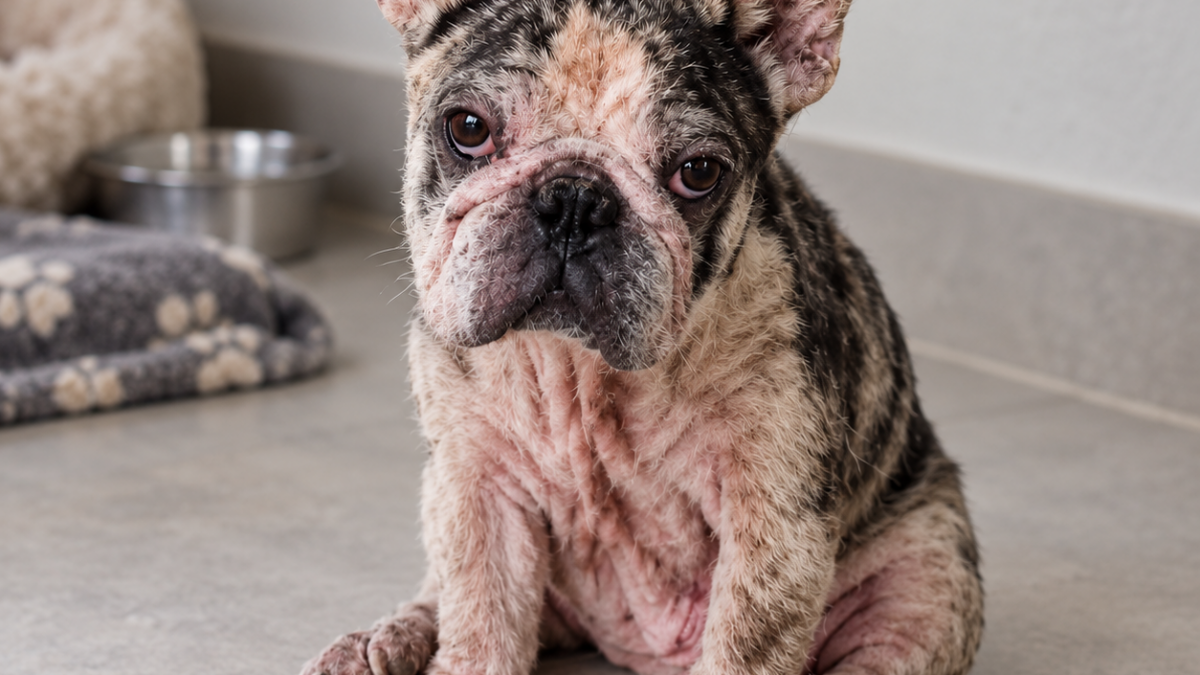
PART 2
For several seconds, none of us spoke.
I could feel Bama breathing against me.
His body was warm.
Too warm, actually.
His fur smelled like damp concrete, infected skin, and old dirt.
But I didn’t move.
Neither did he.
His head rested beneath my chin.
The chain lay slack across the floor.
Dana lowered her camera.
Mr. Lewis whispered:
“Wow.”
I looked down.
Bama’s eyes were closed.
His back leg, the one that had been scratching almost continuously, was relaxed against the tile.
“Does he do this with people?” I asked.
Mr. Lewis shook his head.
“I’ve never seen anyone sit with him.”
That hurt more than I expected.
“How old is he?”
“Owner says around eight.”
Dana looked at me.
“So this may be all he’s ever known.”
I tightened my arms around him slightly.
Bama sighed.
A deep, exhausted sound.
Like a dog who had been waiting years to exhale.
Then we heard a truck.
Mr. Lewis immediately turned.
“That’s him.”
A dark pickup pulled into the driveway.
The driver door opened.
A man in his late forties stepped out.
Heavy boots.
Work pants.
Baseball cap.
He looked toward us.
“What the hell are you doing back there?”
Dana stood.
I stayed seated beside Bama.
“Are you Bama’s owner?”
“Who’s asking?”
I identified our rescue organization and explained that a welfare complaint had been made.
His expression hardened.
“My dog is fine.”
I looked at Bama.
“No, he isn’t.”
“He’s got food.”
“He has severe untreated skin disease.”
“He’s always had bad skin.”
“His nails are severely overgrown.”
“He doesn’t like getting them cut.”
“He appears underweight.”
“He eats.”
“He can barely move.”
“He’s lazy.”
That word.
Lazy.
I looked down at the chain.
“You keep him chained here all day?”
“He’s an outside dog.”
“There isn’t an outside here. There’s six feet of tile.”
He stepped closer.
“He’s my dog.”
I stood slowly.
Bama immediately began scratching again.
The owner pointed.
“See? He does that all the time. Nothing helps.”
“Has a veterinarian examined him?”
“He doesn’t need a vet every time he itches.”
“How long has he had this skin condition?”
“Years.”
Dana stopped taking notes.
“Years?”
The man shrugged.
“Comes and goes.”
It had not “come and gone.”
The sores were chronic.
The skin was thickened in places.
There were old scars beneath newer wounds.
This dog had been suffering for a very long time.
I looked at the owner.
“When was the last time Bama was taken off this chain?”
“He gets loose sometimes.”
“That wasn’t my question.”
He stared at me.
I repeated it.
“When was the last time you intentionally took him off this chain?”
His jaw tightened.
“Don’t remember.”
That answer told me almost everything.
Animal control arrived twenty minutes later.
We had called before entering the property.
Officer Ramirez had been handling cruelty cases longer than I had been rescuing animals.
The moment he saw Bama, his face changed.
He photographed everything.
Then he asked the owner the same questions.
Food?
Water?
Veterinary care?
Exercise?
Length of tethering?
Medication?
The answers became less convincing each time.
Finally, Ramirez crouched beside Bama.
“Can you stand him up?”
The owner pulled on the chain.
Bama struggled.
His front legs straightened first.
His back end lagged behind.
When he finally stood, his spine curved oddly.
His hind legs trembled.
He took two steps.
Then sat.
Ramirez looked at me.
I already knew.
This dog wasn’t simply neglected.
His body had physically adapted to confinement.
Ramirez stood.
“I’m placing the dog under emergency protective seizure pending veterinary assessment.”
The owner’s face went red.
“You can’t take my dog.”
“I can when there’s probable cause that an animal is suffering from untreated illness or neglect.”
“He’s fine!”
Ramirez pointed at Bama.
“Look at him.”
“He’s old.”
“He’s eight.”
“That’s old enough.”
“No. It isn’t.”
The owner stepped forward.
Dana moved beside me.
Ramirez raised one hand.
“Sir, do not interfere.”
For several seconds, no one moved.
Then the man spat into the dirt beside the driveway.
“Take him.”
Just like that.
No goodbye.
No question about where we were going.
No request to visit.
Nothing.
Take him.
I returned to Bama.
The chain was padlocked through his collar.
The owner had to bring the key.
It took him five minutes to find it.
I wondered how long it had been since he’d used it.
When the lock finally opened, the chain dropped onto the tile.
Bama looked down.
Then at me.
He didn’t move.
“Come on,” I whispered.
Nothing.
I took one step backward.
His front paw moved.
Then the other.
He reached the edge of the tiled alcove.
Grass began three feet beyond it.
Bama stopped.
He stared at the ground.
Dana covered her mouth.
“He doesn’t know.”
I knelt in the grass.
“It’s okay.”
Bama stretched one paw forward.
Touched it.
Pulled back.
Then tried again.
His paw sank slightly into the soft ground.
He sniffed.
One step.
Two.
The chain wasn’t pulling him back.
He looked behind himself.
Nothing.
No metal.
No wall.
No limit.
Bama took another step.
Then another.
His legs trembled so badly that I thought he might fall.
But he kept moving.
By the time we reached the rescue van, everyone was crying.
Except Bama.
He simply looked confused.
Freedom can be frightening when you’ve never had it before.
### 1
The veterinary exam lasted almost three hours.
Dr. Hannah Reed had treated hundreds of rescue cases.
She rarely looked surprised anymore.
Bama surprised her.
The first problem was his skin.
Severe mange.
Secondary bacterial infection.
Environmental allergies.
Chronic inflammation.
Multiple self-inflicted wounds from scratching.
His skin was so uncomfortable that he’d likely been living with constant itching and burning for years.
Then came the nails.
Several had grown so long they changed the angle of his paws.
One dewclaw had nearly curled into the skin.
His teeth were worn.
His ears were infected.
His body condition was poor.
But the most serious damage wasn’t visible.
Dr. Reed watched him walk across the exam room.
Three steps.
Pause.
Four steps.
Sit.
She frowned.
“Let’s get X-rays.”
The images told the rest of the story.
His spine showed degenerative changes.
Muscle wasting surrounded his hips and hindquarters.
His knees were unstable.
Years without normal movement had weakened everything designed to support him.
“How bad?” I asked.
Dr. Reed didn’t answer immediately.
“That depends on what you mean.”
“Will he walk normally?”
“Possibly better. Maybe not normally.”
“Will he hurt?”
“We can manage pain.”
“Can he recover?”
She looked at Bama.
“He can improve.”
That wasn’t the same thing.
But it was enough.
Bloodwork showed more problems.
Anemia.
Dehydration.
Poor nutrition.
Abnormal liver values.
Signs that his internal systems had spent years under stress.
Dr. Reed sat beside me.
“He needs time.”
“How much?”
“Months.”
“Then he gets months.”
“He may need physical rehabilitation.”
“He’ll get it.”
“Medication. Special food. Frequent bloodwork.”
“Yes.”
She smiled slightly.
“You know I’m listing expenses, right?”
“I know.”
“Okay.”
Bama lay on a blanket beside us.
A blanket.
That alone seemed to confuse him.
He repeatedly stood, turned, and lay partly on the floor instead.
Like softness was something he didn’t understand yet.
Dr. Reed reached down.
“Poor guy.”
Bama looked up at her.
Then began scratching.
I sat beside him and wrapped one arm around his chest.
The scratching stopped.
Dr. Reed watched.
“Interesting.”
“He did that earlier.”
“Stops when you’re holding him?”
“Yes.”
She examined his skin again.
“Part of it is physical. Definitely. But stress can intensify compulsive scratching.”
“So hugging him helps?”
“Maybe.”
I looked at Bama.
“Guess you’re stuck with hugs.”
His tail moved.
Barely.
But I saw it.
The first wag.
### 2
Bama stayed at the hospital for eight days.
The first two were mostly medical stabilization.
Medication for mange.
Antibiotics.
Anti-inflammatory treatment.
Ear medication.
Nail trimming done carefully because the quicks had grown long.
High-quality food divided across several meals.
Pain management.
Fluids.
The first meal disappeared in seconds.
Dr. Reed laughed.
“Not picky.”
Bama licked the empty bowl.
Then looked at me.
“You want more?”
His tail moved.
We couldn’t overfeed him too quickly.
His body needed time to adjust.
But food became the easiest way to make him happy.
Chicken.
Beef.
Rice.
Veterinary diet.
Pumpkin.
He ate everything.
One technician offered him a small piece of banana.
Bama stared at it.
Sniffed.
Ate it.
Then stared at her hand.
She laughed.
“You liked that?”
He did.
By day four, the staff had created a list on the whiteboard.
**THINGS BAMA LIKES**
Chicken.
Banana.
Peanut butter.
Warm towels.
Megan.
That last one embarrassed me.
I pretended it didn’t.
Bama still didn’t know how to play.
A technician rolled a ball toward him.
He watched it pass.
Someone squeaked a toy.
He flinched.
We stopped immediately.
Nobody wanted to overwhelm him.
His world had been six feet wide.
Everything outside that space was new.
Doors.
Hallways.
Carpet.
Stairs.
Voices.
Leashes.
Open rooms.
Grass.
Birds.
He reacted to each one as though trying to understand whether it could hurt him.
The leash was especially difficult.
The first time we attached one to his harness, he froze.
Not because he was stubborn.
Because something connected to his body had meant one thing his entire life.
Restraint.
I crouched.
“This is different.”
Of course he couldn’t understand the words.
But maybe he understood tone.
I walked backward.
Bama followed one step.
The leash remained loose.
Another.
Still loose.
By the end of that session, we’d walked twelve feet.
The technicians applauded.
Bama looked terrified by the applause.
So everyone immediately stopped.
Progress with traumatized animals isn’t linear.
Sometimes celebration is another frightening sound.
We learned.
He learned.
Together.
### 3
The cruelty investigation continued while Bama recovered.
Officer Ramirez interviewed neighbors.
What emerged was worse than I’d expected.
Bama had been bought as a puppy.
At first, according to one former neighbor, he lived inside.
Then he chewed furniture.
So he was put outside.
Later, he dug beneath the fence.
So he was chained.
Then apparently nobody ever bothered to bring him back.
One neighbor remembered seeing him as a young dog running around the yard.
Another said:
“He used to bark whenever people walked past.”
“When did that stop?” Ramirez asked.
The man thought about it.
“Years ago.”
That’s what neglect does.
People sometimes think the saddest sound in rescue is crying.
It isn’t.
Sometimes it’s silence.
The owner, whose name was Gary Haskins, insisted Bama had always been “difficult.”
“He tore things up.”
“He scratched.”
“He jumped.”
“He pulled on the leash.”
In other words, he had behaved like a young dog.
Haskins had responded by shrinking Bama’s world until there was nothing left to destroy.
Nothing left to chase.
Nothing left to explore.
Eventually, almost nothing left to want.
Ramirez found no veterinary records for the previous six years.
None.
No vaccines.
No skin treatment.
No examination.
Nothing.
When asked why, Haskins said:
“He was healthy enough.”
That phrase would come back later.
### 4
After eight days, Bama was released to our medical foster facility.
Not a normal foster home yet.
He wasn’t ready.
The facility was quiet.
Only four dogs.
Large fenced yard.
Rubber flooring.
Low beds.
No stairs.
His first room had a mattress against one wall.
A thick orthopedic dog bed.
Dana and I carried him inside.
Bama stopped at the doorway.
He looked at the bed.
Then at us.
I tossed a treat onto it.
He stretched his neck.
Ate the treat.
But kept his paws on the floor.
Another treat.
Farther in.
One paw.
Then another.
He climbed onto the mattress.
And froze.
His whole body became rigid.
I sat beside him.
“It’s yours.”
He looked down.
Pressed one paw against the fabric.
It sank.
He lifted it.
Pressed again.
Dana laughed softly.
“He thinks it’s moving.”
Bama slowly lowered his body.
His belly touched the bed.
He immediately stood again.
We waited.
He tried once more.
This time, he stayed.
Head up.
Eyes wide.
Like the mattress might suddenly disappear.
I reached over and stroked his shoulder.
“You can sleep there.”
His head lowered.
Ten minutes later, he was asleep.
Not curled tightly.
Not pressed against a wall.
Stretched out.
Fully.
For perhaps the first time in his life.
I took a picture.
Not for social media.
For me.
Because I wanted proof that some moments were real.
### 5
Physical therapy began the following week.
Bama hated it.
At first.
Exercises required him to use muscles that had been neglected for years.
Weight shifting.
Slow controlled walking.
Gentle range-of-motion work.
Short hydrotherapy sessions.
The underwater treadmill was our biggest challenge.
Bama stared at the tank.
Absolutely not.
His entire body said it.
“I don’t blame you,” I told him.
The therapist, Jenna, smiled.
“We can go slower.”
We spent the first session standing beside the empty treadmill.
Second session, Bama stepped inside without water.
Third session, an inch of water.
Fourth session, movement.
He panicked.
We stopped.
Fifth session, three steps.
Sixth, ten.
By week four, Bama could walk for several minutes with water supporting his weight.
His hind legs became slightly stronger.
He still tired quickly.
But now, when tired, he recovered faster.
The most important change was in his face.
He began looking around.
Not down.
Bama had spent his life staring at tile.
Now he watched birds.
Cars.
People.
Leaves moving in the wind.
One morning, he saw a squirrel.
He froze.
The squirrel ran.
Bama’s ears lifted.
His body leaned forward.
Then he attempted what I can only describe as the world’s slowest chase.
Three fast steps.
Then he sat down.
I laughed.
Bama looked back at me.
And for the first time, his mouth opened in a relaxed grin.
I laughed harder.
“You almost had him.”
His tail wagged.
### 6
Two months after rescue, the mange was gone.
Completely.
That sentence felt impossible.
The angry skin had softened.
New fur covered much of his chest and sides.
Some scars remained.
They always would.
But Bama no longer scratched himself bloody.
His medication had controlled the allergies.
His infections had cleared.
His nails were slowly returning to a healthier shape.
His weight improved.
His blood values stabilized.
Dr. Reed entered the foster room one afternoon carrying his latest lab results.
“Good news.”
I stood.
“How good?”
“Liver values significantly improved.”
“And the anemia?”
“Resolved.”
I hugged Bama.
He accepted hugs now like they belonged to him.
Dr. Reed smiled.
“Remember the first night?”
“I do.”
“I honestly wasn’t sure how much improvement we’d get.”
Bama looked up at her.
She scratched his head.
“You’re stubborn.”
His tail thumped.
I corrected her.
“Resilient.”
“Same thing with better marketing.”
### 7
Then the case took a turn.
Gary Haskins requested Bama back.
I thought I’d misunderstood Ramirez when he called.
“He what?”
“He’s challenging the seizure.”
“Why?”
“He says Bama is his property and the conditions weren’t severe enough to justify permanent forfeiture.”
I looked across the room.
Bama was asleep on his bed.
His bed.
Soft blanket beneath him.
“Severe enough?”
“I know.”
“His body is permanently damaged.”
“I know.”
“He didn’t take him to a vet for six years.”
“I know.”
“He left him chained in a six-foot space.”
“Megan.”
I stopped.
Ramirez continued.
“This is why we document.”
“When’s the hearing?”
“Three weeks.”
“I’ll be there.”
“You may be asked to testify.”
“Good.”
That came out harder than I intended.
### 8
For three weeks, I tried not to think about court.
I focused on Bama.
He started going on real walks.
Short ones.
Five minutes.
Then seven.
Then ten.
He learned that leashes could mean adventure instead of imprisonment.
The first time he reached the end of a quiet trail, we sat beneath a tree.
Bama smelled the grass.
Then rolled.
Actually rolled.
His back hit the ground.
Legs in the air.
He twisted from side to side.
I stared.
Then laughed.
“What are you doing?”
He sneezed.
Rolled again.
Grass clung to his healing fur.
For eight years, Bama had lived on tile.
Now he was rolling in grass like he’d invented it.
I recorded fifteen seconds.
Then put my phone away.
Some things are better experienced than captured.
### 9
The forfeiture hearing was held in a small county courtroom.
Haskins arrived wearing a clean shirt.
He looked different away from the house.
Ordinary.
That bothered me.
People want cruelty to have a face you can recognize.
Usually it doesn’t.
Haskins sat beside an attorney.
Officer Ramirez testified first.
Photos appeared on a screen.
Bama’s chain.
The tile.
The dirty water.
The skin wounds.
The overgrown nails.
Then Dr. Reed testified.
She explained his condition in clinical terms.
Chronic dermatologic disease.
Muscle atrophy.
Orthopedic degeneration.
Spinal weakness.
Deconditioning.
Abnormal laboratory values consistent with prolonged neglect and poor nutrition.
Haskins’s attorney asked:
“Doctor, can you say with absolute certainty that every one of these conditions resulted solely from tethering?”
“No.”
“So some may have been age-related?”
“Some.”
Haskins leaned back.
His attorney smiled slightly.
Then Dr. Reed continued.
“But an eight-year-old dog should not have this degree of muscle wasting without an underlying cause. His confinement significantly contributed.”
The smile disappeared.
“Can mange occur in cared-for dogs?”
“Yes.”
“So mange itself does not prove neglect.”
“Untreated mange lasting long enough to cause this degree of secondary infection is a welfare concern.”
“Could Mr. Haskins have believed the condition would resolve?”
“For years?”
Silence.
Dr. Reed looked at him.
“I would find that difficult to believe.”
Then came my turn.
I described Bama.
His scratching.
His inability to walk normally.
The chain.
The first hug.
Haskins’s attorney asked:
“You became emotionally attached to this dog, correct?”
“Yes.”
“So you would prefer that he remain with your organization.”
“I would prefer he never return to the conditions we found him in.”
“That wasn’t the question.”
“Yes. I want him safe.”
“You’ve posted positive updates about his recovery?”
“Yes.”
“You’ve raised donations using his story?”
“Our rescue accepts donations for medical care.”
“So there’s a financial incentive to keep him.”
I stared at him.
“No.”
“You received funds because people saw Bama.”
“The funds paid for Bama.”
“But your organization benefited.”
I felt my temper rise.
Then I looked at the judge.
Calm.
Evidence.
Not anger.
I answered:
“His treatment cost more than the donations specifically attached to his case.”
The attorney moved on.
Then the judge asked me something himself.
“What happened when the chain was removed?”
I looked toward Haskins.
Then back at the judge.
“He didn’t understand he could walk away.”
The courtroom went silent.
The judge nodded.
That was all.
### 10
Haskins testified last.
He said he loved Bama.
He said Bama preferred being outside.
He said the chain was necessary because Bama escaped.
He said he fed him every day.
He said he didn’t realize the skin problem was severe.
He said money had been tight.
Some of that might even have been true.
Then the county attorney asked:
“When did you last take Bama on a walk?”
Haskins paused.
“I don’t remember.”
“A year ago?”
“Maybe.”
“Two years?”
“Could be.”
“Five?”
“I said I don’t remember.”
“When was his last veterinary visit?”
“I don’t know.”
“Do you have any records?”
“No.”
“Did he sleep on a bed?”
“He had something out there.”
Photographs showed otherwise.
“Where?”
Haskins looked irritated.
“It got dirty.”
“So you removed it?”
“Yes.”
“Did you replace it?”
“I planned to.”
“How long ago?”
No answer.
The attorney walked to the evidence table.
Held up the chain.
Heavy.
Rusty.
Stained.
“Was this Bama’s chain?”
“Yes.”
“How long was he attached to it each day?”
“He was a yard dog.”
“That wasn’t my question.”
Haskins shifted.
“Most of the day.”
“Night?”
“Yes.”
“So most days, twenty-four hours?”
“If I wasn’t doing something with him.”
“What did you do with him?”
“I fed him.”
That answer ended the argument better than anything we could have said.
### 11
The judge ruled Bama permanently forfeited.
Haskins would not get him back.
I didn’t realize I was holding my breath until Dana squeezed my arm.
The judge also referred the documented neglect to the county prosecutor for further review.
Haskins looked furious.
As we left the courtroom, he passed us in the hallway.
“This is ridiculous,” he said.
I kept walking.
He called after me.
“You think you saved him?”
I stopped.
Dana whispered:
“Megan.”
I turned.
Haskins looked straight at me.
“He would’ve been fine.”
Fine.
The word hit me.
I walked closer, but stayed several feet away.
“No.”
His expression hardened.
“He was alive.”
“That’s not the same thing.”
For once, Haskins had nothing to say.
I walked away.
### 12
Bama became legally adoptable the following week.
Everyone assumed I would adopt him.
I almost did.
I loved him.
Still do.
But loving an animal doesn’t automatically mean your home is the best home.
I lived in a second-floor apartment.
Bama’s knees hated stairs.
I worked irregular rescue hours.
He needed routine.
Space.
Quiet.
Someone present more often.
So we searched.
Applications came in quickly after his story spread locally.
Some people wanted him because they felt sorry for him.
I rejected those.
Bama didn’t need pity.
He needed commitment.
One family had three energetic young dogs.
Too much.
Another lived in a third-floor condo.
No.
Another wanted him as an “outside companion.”
Absolutely not.
Then I met Ellen and Mark Sullivan.
Both in their early sixties.
Their children were grown.
They lived in a ranch-style house.
No stairs.
Fenced backyard.
They’d recently lost their senior Labrador.
Ellen had experience with arthritis care.
Mark worked from home.
They came to the foster facility.
Bama was asleep when they arrived.
I told them:
“Don’t call him. Let him decide.”
They sat on the floor.
Mark talked quietly to me.
Ellen ignored Bama entirely.
Five minutes passed.
Then Bama stood.
Walked toward them.
Sniffed Mark.
Moved to Ellen.
She held out one hand.
Bama touched it with his nose.
Then walked away.
She smiled.
“That’s enough.”
That answer mattered.
She didn’t expect instant gratitude.
Didn’t need him to perform rescue-dog affection.
She respected his pace.
Twenty minutes later, Bama returned.
This time he sat beside her.
Ellen didn’t touch him.
She simply stayed.
Bama leaned.
Just slightly.
His shoulder against her arm.
Ellen looked at me.
Tears in her eyes.
“Can I?”
I nodded.
She wrapped one arm gently around him.
Bama closed his eyes.
No scratching.
No tension.
Just stillness.
I knew.
### 13
They visited four more times.
Mark brought bananas because he’d read they were Bama’s favorite.
That almost disqualified him because Bama quickly learned Mark was easy to manipulate.
But otherwise, they were perfect.
Before adoption day, they sent photos of their house.
Orthopedic beds in three rooms.
Rubber-backed runners across slippery floors.
Ramp at the back step.
Water bowls.
Raised food station.
A basket of toys Bama probably wouldn’t understand for months.
Mark had even installed a camera so they could monitor him when they left.
I stared at the pictures.
Dana smiled.
“You’re crying.”
“No.”
“You absolutely are.”
“Dust.”
“Inside?”
“Very aggressive dust.”
### 14
Adoption day was harder than the court hearing.
I packed Bama’s medication.
Food.
Harness.
Favorite blanket.
Medical files.
The first banana toy he’d eventually learned to carry.
He stood beside me.
Healthy fur covered most of his body now.
He still walked stiffly.
Probably always would.
But he walked.
Without a chain.
Ellen knelt.
“Ready?”
Bama looked at me.
That nearly broke me.
I hugged him.
For a long time.
“You’re okay.”
His head rested against my chest.
“Go.”
He didn’t.
I laughed through tears.
“Bama. Seriously.”
Mark opened the car.
A thick bed covered the back seat.
Bama approached.
Stopped.
Then climbed in.
I closed the door.
Ellen hugged me.
“We’ll take care of him.”
“I know.”
“No. I mean it.”
“I know.”
They drove away.
I stood in the parking lot until the car vanished.
Then I cried like an idiot.
### 15
The first update came forty-seven minutes later.
A photograph.
Bama lying in the middle of their living room.
Not on the bed.
On the rug beside it.
Mark wrote:
**He doesn’t trust the big bed yet.**
I replied:
**Give him time.**
That evening:
Another photo.
Two front paws on the bed.
Next morning:
Half his body on it.
Two days later:
Bama completely stretched across the orthopedic mattress.
Ellen wrote:
**We may need a second bed because apparently this one belongs entirely to him.**
I laughed.
Then saved the picture.
### 16
Bama discovered toys slowly.
At first, he didn’t understand them.
Mark rolled a soft ball.
Bama watched.
Ellen gave him a stuffed duck.
Bama sniffed.
Walked away.
Then one morning, Mark woke and found the duck in Bama’s bed.
No one had seen him carry it.
The next night, it was there again.
A week later, Bama began sleeping with his chin on it.
He never played tug.
Never destroyed it.
Just kept it.
The dog who had spent eight years without possessions had chosen one thing to be his.
A yellow stuffed duck.
### 17
Food remained Bama’s greatest joy.
His family had to learn boundaries.
Because Bama believed every edible object on Earth belonged to him.
Chicken?
Yes.
Rice?
Yes.
Carrots?
Yes.
Blueberries?
Yes.
One day Mark sent me a video.
Bama sat in the kitchen staring at a piece of broccoli.
Mark said:
“You sure?”
Bama stared.
“Really?”
Stare.
Mark gave it to him.
Bama chewed.
Paused.
Then spit it onto the floor.
I called immediately.
“He has standards now.”
Mark laughed.
“Apparently.”
That mattered too.
Bama could reject food.
Think about that.
An undernourished dog who once ate anything placed before him had become secure enough to decide:
No thanks.
### 18
The criminal case against Haskins moved slowly.
Months passed.
He was eventually charged under local animal cruelty and neglect statutes.
Nothing about the process felt dramatic.
Paperwork.
Continuances.
Hearings.
Reports.
Evidence.
That’s how justice usually looks.
Not like television.
But one detail changed the case significantly.
A former tenant contacted Officer Ramirez after seeing Bama’s story.
The man had lived with Haskins years earlier.
He had photographs.
Bama as a young dog.
Same corner.
Same chain.
Different collar.
The photos were dated.
Seven years earlier.
They proved this wasn’t a temporary arrangement.
This was Bama’s life.
The prosecutor now had a timeline.
Seven years of visual evidence.
Neighbors extended it to eight.
I looked at the oldest photograph.
Bama was young.
Muscular.
Full coat.
Bright eyes.
Standing at the end of that chain.
The tile around him was cleaner.
His body was healthy.
But the chain was already there.
I thought about everything between that image and the day I found him.
The slow muscle loss.
The first skin irritation.
Nails getting longer.
Joints getting weaker.
Years passing.
Haskins seeing him every day.
And doing nothing.
Cruelty isn’t always one terrible act.
Sometimes it’s eight years of deciding not to act.
### 19
At sentencing, Haskins accepted a plea agreement.
Some people were angry.
They wanted jail.
I understood.
But the agreement included something I cared about more.
He was prohibited from owning animals for several years.
Required to reimburse part of Bama’s medical costs.
Placed on probation.
Ordered to complete animal welfare education.
Subject to compliance checks.
And the neglect conviction became public record.
The prosecutor read a statement describing Bama’s condition.
Haskins stood quietly.
The judge asked:
“Do you understand that providing food alone does not satisfy the duty of care?”
“Yes.”
“Do you understand that chronic untreated disease constitutes suffering?”
“Yes.”
“Do you understand why you are prohibited from possessing animals during the term of this order?”
He hesitated.
Then:
“Yes.”
I watched from the back row.
No triumph.
No celebration.
Just relief.
Because another dog wouldn’t take Bama’s place on that chain tomorrow.
That was enough.
### 20
After court, Haskins came toward me.
Officer Ramirez noticed.
Stayed nearby.
Haskins stopped several feet away.
“How is he?”
The question surprised me.
“Bama?”
“Yeah.”
I studied his face.
“Good.”
He nodded.
“Still scratching?”
“No.”
Pause.
“Walking?”
“Yes.”
Another nod.
Then he said:
“I didn’t know it was that bad.”
I could have destroyed him with words.
I wanted to.
For a second, I imagined listing everything.
The sores.
The curled nails.
The damaged knees.
The spine.
The organ stress.
The way Bama didn’t understand grass.
Instead, I asked:
“When would it have been bad enough?”
He looked confused.
“What?”
“If eight years wasn’t enough for you to notice, when would it have been enough?”
He didn’t answer.
I continued.
“When he couldn’t stand?”
Silence.
“When he stopped eating?”
Nothing.
“When he died?”
His face changed.
I wasn’t yelling.
That made it worse.
“He couldn’t tell you,” I said. “So you had to notice.”
Haskins looked down.
For the first time, he seemed smaller.
Then he said:
“I fed him.”
There it was again.
The defense he had built everything around.
I nodded.
“You kept him alive.”
He looked at me.
“But you didn’t give him a life.”
Then I walked away.
### 21
Bama’s real life began slowly.
His family didn’t push him.
The first month, he mostly slept.
Years of hypervigilance and discomfort had exhausted him.
Now he could rest.
He slept in the bedroom.
Living room.
Kitchen.
Sometimes directly in doorways.
Mark joked:
“He spent eight years unable to choose where to lie down. Now he chooses the least convenient place possible.”
Exactly.
Choice.
That was the word.
He could choose.
Inside or outside.
Bed or rug.
Chicken or broccoli.
Sun or shade.
Walk or nap.
Affection or space.
Every ordinary choice was something he’d been denied.
### 22
Then came rain.
The first heavy storm after adoption terrified him.
Ellen called me.
“He won’t go outside.”
“That makes sense.”
“What should we do?”
“Don’t force him.”
Bama stood at the back door.
Rain hammered the yard.
Mark opened it.
Bama backed away.
They waited.
Eventually, he used an indoor pad.
No punishment.
No frustration.
No dragging him outside.
The next storm, he stepped onto the covered porch.
Third storm, onto wet grass for thirty seconds.
Months later, he walked in light rain without fear.
Healing isn’t erasing memory.
It’s teaching the body that memory doesn’t control the present.
### 23
His biggest breakthrough came almost a year after rescue.
Ellen sent me a video.
No caption.
I opened it.
Bama was in the backyard.
A tennis ball lay beside him.
Mark picked it up.
Tossed it five feet.
Bama watched.
Then stood.
Walked after it.
Picked it up.
I gasped.
He turned.
Carried it back.
Dropped it.
Mark screamed:
“He did it!”
Bama jumped at the noise.
Then wagged.
Mark laughed.
“Sorry! Sorry!”
He threw it again.
Bama retrieved it.
Not fast.
Not gracefully.
But he played.
At nine years old, Bama learned what a game was.
I watched the video six times.
Then cried.
### 24
The rescue organization later used Bama’s case in educational workshops.
Not his identity at first.
Just the medical evidence.
We showed how chronic tethering affects animals physically and psychologically.
How lack of movement contributes to muscle loss.
How untreated skin disease becomes unbearable.
How social deprivation changes behavior.
How “he has food and water” is not a complete standard of welfare.
Bama became proof.
Not because we wanted his suffering remembered.
Because maybe another animal could avoid it.
### 25
Two years after adoption, I visited.
Bama recognized my voice before he saw me.
I entered the living room.
He lifted his head.
For one second, he stared.
Then stood.
Slowly.
And walked toward me.
His tail began moving.
Then faster.
“Hi.”
He pressed his head against my stomach.
I hugged him.
He leaned.
Exactly as he had in that dirty corner.
But everything else was different.
Clean fur.
Healthy skin.
Soft collar.
Strong smell of oatmeal shampoo.
No chain.
No bleeding.
No scratching.
Ellen laughed.
“He remembers you.”
“I hope so.”
Mark entered carrying snacks.
Bama immediately abandoned me.
“Traitor.”
Mark held up a banana.
Bama sat.
I stared.
“He sits on command?”
Mark looked offended.
“Madam, this is an educated dog.”
Bama received banana.
Of course.
### 26
We went outside.
Bama had a favorite spot beneath a maple tree.
A raised cooling bed.
His yellow duck.
Water bowl.
The yard was large enough that he could wander.
But Bama rarely went far from the house.
Freedom doesn’t always create a desire to escape.
Sometimes freedom means knowing you can leave and choosing to stay.
I watched him walk toward the fence.
Stop.
Sniff.
Turn.
Return to Ellen.
She stroked his head.
I thought about the six-foot chain.
The strange thing was that Bama now had far more space—
yet spent much of his time close to his people.
Not because he was trapped.
Because he belonged.
### 27
His joints continued causing problems.
There was no magical cure.
Years of damage remained.
He needed anti-inflammatory medication.
Joint supplements.
Occasional physical therapy.
Weight management.
Ramps.
Some mornings were stiff.
Some walks ended early.
That is important to say.
Rescue doesn’t always restore an animal to what they would have been without neglect.
Sometimes the damage is permanent.
Bama paid for someone else’s choices every day.
But pain management gave him comfort.
Exercise gave him strength.
And love gave him something medicine couldn’t.
Reason to engage with the world.
### 28
At ten years old, Bama discovered car rides.
He had previously associated cars with veterinary appointments.
Mark changed that.
First ride:
Five minutes around the block.
Second:
Drive-through chicken.
Third:
A quiet park.
Soon Bama stood beside the garage whenever Mark picked up the keys.
They bought him a ramp for the SUV.
Bama climbed in.
Sat behind the passenger seat.
Looked out the window.
One weekend they drove to a lake.
Ellen sent a picture.
Bama standing at the shoreline.
Water touching his paws.
Blue sky behind him.
I stared at it for a long time.
Eight years of tile.
Then this.
### 29
That photograph became one of my favorites.
Not because it was dramatic.
Because it showed scale.
Bama had once known a six-foot radius.
Now there was a horizon.
Nothing between him and the distance except his own choice.
### 30
Three years after rescue, Mr. Lewis contacted me.
The neighbor who had originally called.
He asked:
“Can I see him?”
I talked to Ellen and Mark.
They agreed.
Mr. Lewis came to their house.
The moment Bama saw him, there was no obvious recognition.
That hurt Mr. Lewis.
I could tell.
He sat on the patio.
Bama eventually approached.
Mr. Lewis offered a treat.
Bama took it.
Then leaned against his leg.
The older man started crying.
“I should’ve called sooner.”
No one knew what to say.
He repeated it.
“I should’ve called sooner.”
I sat beside him.
“You called.”
“After years.”
“You still called.”
“I watched him.”
“Yes.”
“I thought someone else would do something.”
There it was.
The dangerous sentence.
Someone else.
Bama rested his head on Mr. Lewis’s knee.
The man stroked him.
“I failed you too.”
Bama didn’t know what guilt was.
He simply accepted the affection.
Mr. Lewis later began volunteering with our rescue.
Not every week.
But often.
He became the person who checked on welfare reports.
The person who said:
“I’ll go.”
Sometimes remorse is useless.
Sometimes it changes behavior.
His did.
### 31
Bama’s story affected local policy too.
Not immediately.
Nothing changes that quickly.
But officers, rescuers, and residents began pushing for stronger anti-tethering language.
Public meetings.
Draft ordinances.
Arguments.
Some people said:
“Dogs have always lived outside.”
Others said:
“My grandfather chained dogs and they were fine.”
Fine.
That word again.
I testified once before the county committee.
I didn’t show emotional videos.
I showed medical records.
Muscle wasting.
Spinal changes.
Chronic skin disease.
Photographs of the physical environment.
Then one photograph after rescue.
Bama walking across grass.
I said:
“This is what long-term confinement can cost.”
Months later, new restrictions passed.
Not a total ban.
But limits.
Minimum tether length.
Time restrictions.
Shelter requirements.
Prohibitions during extreme weather.
Access standards.
Not perfect.
Better.
Bama would never know.
But somewhere, another dog might spend fewer hours on a chain because he existed.
### 32
Mark joked that Bama became “politically influential.”
Ellen said:
“He’d trade all his influence for a sandwich.”
True.
Bama remained unimpressed by legacy.
He cared about naps.
Food.
Car rides.
Sunny patches.
His duck.
People.
Especially Ellen.
She became his person.
If she left a room, Bama noticed.
If she sat, he settled nearby.
If she was sick, he stayed beside the bed.
The dog who had once been accused of not liking affection became almost embarrassingly affectionate.
He didn’t hate touch.
He had simply rarely received the right kind.
### 33
When Bama turned eleven—or at least when we estimated he did—his family held a birthday party.
No hats.
Ellen knew better.
There was a dog-safe cake.
Bananas.
Chicken.
Two rescue friends.
Me.
Dana.
Dr. Reed.
Mr. Lewis.
Bama spent most of the party sleeping.
Perfect.
At one point, Dana looked around.
“Remember the tile?”
I nodded.
Dr. Reed said:
“I didn’t think we’d get this many good years.”
Ellen heard.
She touched Bama’s back.
“How many are we getting?”
Dr. Reed smiled.
“As many as he’ll give us.”
### 34
Age eventually caught up.
Not suddenly.
Slowly.
Walks shortened.
Ramps became essential.
His hearing faded.
His eyes clouded slightly.
Some mornings, Mark supported his rear with a sling.
But his skin remained healthy.
His appetite remained legendary.
And his ability to locate chicken from three rooms away never declined.
### 35
One winter morning, Ellen called me.
“Megan.”
I knew from her voice.
“What happened?”
“He couldn’t stand today.”
My chest tightened.
“Is he at the vet?”
“Yes.”
I drove there.
Dr. Reed examined him.
Arthritis.
Spinal progression.
General weakness.
But no catastrophic event.
Medication adjustment helped.
He stood the next afternoon.
For another year, he continued.
Slower.
Still happy.
That distinction mattered.
Old isn’t the same as suffering.
Disability isn’t automatically misery.
Bama still wanted food.
Wanted affection.
Wanted sunlight.
Wanted to ride in the car.
Wanted to sleep beside Ellen.
He still wanted his life.
So we supported it.
### 36
During that final year, Bama developed a strange habit.
Every evening, he carried the yellow duck to bed.
The same toy he’d first claimed years earlier.
Its color had faded.
One wing had been repaired twice.
Mark offered to replace it.
Bama rejected the new duck.
Old duck or nothing.
Some attachments make no logical sense.
That’s true for humans too.
### 37
I visited one afternoon in early fall.
Bama was lying beneath the maple tree.
His face had gone almost completely gray.
I lowered myself beside him.
“Hey, old man.”
He opened one eye.
His tail moved.
I rested my hand on his shoulder.
His skin was soft.
Healthy.
No sores.
No scabs.
Nothing bleeding.
I remembered touching him the first day.
Feeling heat and inflammation beneath my fingers.
Eight years of irritation.
Now peace.
I whispered:
“You did okay.”
His tail moved again.
No.
Not okay.
Better than okay.
He had survived long enough to become old in a home that loved him.
That’s a victory rescued animals don’t always get.
### 38
A few months later, Bama’s health declined quickly.
He stopped wanting long walks.
Then short ones.
He ate less.
That frightened us more than anything.
Bama refusing food was serious.
Dr. Reed found advanced internal disease unrelated to the old mange but likely complicated by age and years of earlier physical stress.
There were treatment options.
But they were aggressive.
Low chance of meaningful benefit.
Ellen asked:
“What would you do if he were yours?”
Dr. Reed looked at Bama.
“He deserves comfort.”
Everyone understood.
### 39
We had one more week.
Maybe that sounds cruel.
It wasn’t.
Pain medication worked.
Bama ate chicken.
Banana.
Even half a cheeseburger Mark absolutely wasn’t supposed to give him.
He lay in the sun.
Mr. Lewis visited.
Dana visited.
I visited.
No crowds.
No tragedy ceremony.
Just people sitting with a dog.
Giving back a little of the time he had lost.
### 40
On his final morning, Bama lay on his orthopedic bed in the living room.
Not a hospital.
Not tile.
Not a cage.
Home.
Ellen sat beside his head.
Mark beside his back.
I sat on the floor.
The yellow duck rested between his paws.
Dr. Reed came to the house.
Bama was tired.
But calm.
Ellen whispered:
“You’re a good boy.”
Mark cried openly.
I held Bama’s paw.
The same dog who once had to test grass because he didn’t understand it.
The same dog who froze on his first bed.
The same dog who learned to retrieve a ball at nine.
The same dog whose life had been measured in six feet.
Now surrounded by people.
Loved.
Safe.
Free.
Dr. Reed gave the medication.
Bama’s breathing slowed.
Ellen kissed his forehead.
And then, quietly, he was gone.
No chain.
No pain.
No scratching.
No fear.
### 41
For weeks afterward, I couldn’t look at his first photograph.
The contrast hurt too much.
Then Ellen sent me something.
Two pictures side by side.
First:
Bama in the dark corner.
Thin.
Bald patches.
Chain across the floor.
Second:
Bama at the lake.
Healthy coat.
Standing in sunlight.
Open water behind him.
Beneath them she wrote:
**Same dog. Different definition of life.**
I printed it.
It hangs in our rescue office.
### 42
People often say Bama’s story is about forgiveness.
I don’t think it is.
Bama didn’t need to forgive anyone.
He didn’t understand courts.
Or ownership.
Or sentences.
Or guilt.
His story is about responsibility.
Someone failed him.
Someone else noticed.
Then someone acted.
That’s the chain I prefer to remember.
Not the metal one.
The human one.
Neighbor.
Rescuer.
Officer.
Veterinarian.
Foster.
Adopter.
One person connected to another until a dog who had spent eight years alone finally had an entire community standing behind him.
### 43
Gary Haskins never owned another dog during the period I followed the case.
His court restriction was enforced.
Animal control checked.
No replacement appeared in Bama’s old corner.
Eventually, the house was sold.
The new owners removed the metal ring from the wall.
Mr. Lewis sent me a photograph.
The tile was gone too.
They tore out the entire alcove.
Built a small covered patio.
I stared at the image.
Nothing remained.
No chain.
No ring.
No stained floor.
Good.
Some places don’t deserve memorials.
### 44
But Bama deserved one.
We created a small assistance fund in his name.
Not huge.
Not flashy.
The Bama Fund helps older neglected dogs with dermatology care and mobility rehabilitation.
The first recipient was a twelve-year-old shepherd with severe skin disease.
The second was a chained hound with arthritis.
The third was a little terrier whose nails had grown into his paw pads.
Each time we approve treatment, I think:
He would want chicken.
Not legacy.
Still, he has both.
### 45
Several months after Bama died, Ellen visited the rescue.
She carried something.
The yellow duck.
I recognized it immediately.
“You kept it.”
She nodded.
“I thought you should have it.”
I touched the worn fabric.
“No.”
She looked surprised.
“That belongs at home.”
“Megan—”
“Bama chose it in your house.”
I handed it back.
“He should keep something there.”
Ellen started crying.
So did I.
She took the duck home.
It now sits beside his framed photograph.
Exactly where it belongs.
### 46
Years have passed since the day I first sat beside Bama on that filthy tile.
I still remember everything.
The smell.
The chain.
The scratching.
His overgrown nails.
His quiet eyes.
I remember thinking:
How can a dog still be this gentle after this?
But the memory that returns most often isn’t the worst one.
It’s the first hug.
The moment I wrapped my arms around him.
And the scratching stopped.
At the time, I thought I was comforting him.
Maybe I was.
But now I think something else happened too.
For one tiny moment, Bama discovered that a human hand could exist without moving a chain.
That touch could mean comfort.
That closeness didn’t have to mean control.
That someone could hold him without keeping him.
### 47
Eight years is a long time.
Long enough for a puppy to become an old dog.
Long enough for muscles to waste.
Long enough for skin to scar.
Long enough for someone to forget the sound of a leash clip that means “walk” instead of “stay.”
We couldn’t give Bama those years back.
No rescue could.
That’s the hardest truth.
Happy endings don’t undo what came before.
But they can change what comes after.
Bama had only a handful of truly free years.
I wish he’d had twelve.
Fifteen.
A lifetime.
He didn’t.
What he did have was real.
Grass.
Beds.
Bananas.
Car rides.
A lake.
A yellow duck.
A family.
Choice.
Love.
### 48
And there was one final piece of justice I didn’t understand until much later.
Haskins once said:
“He would’ve been fine.”
Fine meant alive.
Fine meant food in a bowl.
Fine meant not dead yet.
Bama taught everyone who followed his story how low that standard really was.
His case became part of welfare training.
His medical images educated officers.
His story helped strengthen tethering rules.
His rehabilitation fund treated other dogs.
The chain meant to reduce his world to six feet ended up expanding protection for animals he would never meet.
Haskins had wanted Bama forgotten in a corner.
Instead, people remembered.
That’s the part that feels like justice.
### 49
If you asked Ellen what Bama loved most, she’d probably say bananas.
Mark would say car rides.
Dana would say warm blankets.
Dr. Reed would say food in general.
Mr. Lewis would say people.
I’d say something different.
Bama loved being included.
He loved being wherever his family was.
Kitchen.
Living room.
Backyard.
Car.
Porch.
Didn’t matter.
After eight years of being physically separated from life, he wanted to be inside it.
That was all.
### 50
Sometimes I imagine his first home differently.
I picture someone noticing his scratching the first week.
Taking him to a vet.
Walking him.
Trimming his nails.
Letting him sleep on a bed.
Teaching him fetch when he was young.
Taking him to a lake before his spine hurt.
But rescue work doesn’t let you live in imaginary pasts for long.
There is always another animal in the present.
Another call.
Another address.
Another question:
Can you help?
Bama’s answer to that question became the reason I always try.
### 51
A newer volunteer once asked me:
“Was Bama your favorite rescue?”
I told her no.
Not because he wasn’t special.
Because favorites create the wrong idea.
Every animal feels enormous while you’re fighting for them.
Every life becomes the center of the room.
But Bama changed how I understood neglect.
Before him, I thought rescue was mostly about removing danger.
After him, I understood deprivation itself can be danger.
No movement.
No touch.
No stimulation.
No medical care.
No choice.
An animal can survive all of that.
But survival alone is not welfare.
### 52
The last time I visited Ellen and Mark, years after Bama was gone, the orthopedic bed still sat in the corner.
No dog used it.
I asked why they kept it.
Ellen said:
“I don’t know.”
Mark answered:
“I do.”
She looked at him.
He shrugged.
“He waited eight years for a bed. I’m not in a hurry to move it.”
No one said anything after that.
We didn’t need to.
### 53
Bama’s old chain is not displayed anywhere.
People asked whether we kept it.
Officer Ramirez retained it through the legal case.
Afterward, I was offered the chance to take it for educational purposes.
I said no.
I didn’t want Bama represented by the thing that restrained him.
I wanted the lake photograph.
The bed.
The ball.
The duck.
The grass.
That’s who he became.
### 54
So if someone asks me about the dog who spent eight years chained inside a dark corner, I tell them the truth.
Yes.
That happened.
His body was damaged.
His skin was painful.
His nails were neglected.
His muscles weakened.
His joints suffered.
He had almost no understanding of comfort or freedom.
But that’s not where I stop.
I tell them about the day the chain fell.
The first paw touching grass.
The first warm bed.
The first banana.
The first tail wag.
The first real walk.
The first ball he brought back.
The lake.
The family.
The final years.
Because cruelty was only part of Bama’s life.
It did not get to own his ending.
### 55
For eight years, Gary Haskins controlled where Bama could move.
Six feet.
That was his world.
By the end of Bama’s life, there wasn’t a chain long enough to measure where he’d been.
Veterinary rooms.
Walking trails.
Backyards.
Courtrooms indirectly changed because of him.
A lake.
Family trips.
His home.
People’s hearts, if you want to get sentimental.
I usually don’t.
But Bama earned sentiment.
### 56
I sometimes think back to the moment Haskins said:
“Take him.”
He meant it dismissively.
Like Bama was a problem being removed.
He had no idea what he was giving away.
Not money.
Not property.
A dog who would later comfort a widowed couple.
Teach rescuers patience.
Teach neighbors courage.
Change local policy.
Help fund medical care for animals after his death.
Become the center of a family’s home.
Haskins threw away what he never bothered to understand.
That may have been his greatest punishment.
Not the fine.
Not probation.
Not court.
He had Bama for eight years—
and never actually knew him.
### 57
Ellen and Mark knew him.
They knew he hated broccoli.
Loved bananas.
Snored after long walks.
Preferred sleeping diagonally across beds.
Carried one toy but ignored ten others.
Liked rain only from inside.
Loved warm towels.
Was afraid of loud applause.
Leaned hard into hugs.
And would follow Ellen from room to room even when walking hurt.
That’s what love is made of.
Specific things.
Attention.
Knowing.
### 58
Bama was never “just grateful.”
I hate that phrase about rescue dogs.
He had preferences.
Bad moods.
Fear.
Stubborn moments.
He once refused physical therapy because someone had rearranged the room.
He stole an entire chicken breast off Mark’s plate.
He barked at a vacuum for twenty minutes.
He woke Ellen at 4:30 a.m. because he wanted breakfast.
He was not a symbol.
He was a dog.
That’s what made saving him matter.
### 59
The most satisfying ending wasn’t seeing his former owner punished.
It was seeing Bama become inconvenient.
That sounds strange.
But think about it.
For eight years, he was expected to occupy almost no space.
In his new home, he blocked doorways.
Spread across beds.
Left fur on rugs.
Needed medications on schedule.
Required ramps.
Demanded food.
Interrupted television.
Took up room.
And his family loved every inch of it.
He was finally allowed to exist fully.
### 60
That’s the ending I want people to remember.
A dog once confined to six feet eventually slept sideways across an entire living room.
A dog who had never known a soft bed became so spoiled he had several.
A dog who ate every bowl like it might be his last eventually rejected broccoli.
A dog whose chain had defined every movement eventually stood at the edge of a lake with nothing pulling him backward.
A dog who may never have been hugged stopped scratching the first time someone held him.
And later—
he lived in a home where hugs became so ordinary nobody counted them anymore.
That was Bama’s revenge.
Not anger.
Not violence.
Not someone else suffering the way he did.
His revenge was becoming happy in spite of everything meant to reduce him.
His former owner lost the right to control his life.
The chain disappeared.
The court record remained.
Other animals gained protection.
And Bama?
Bama got the one thing he had been denied almost his entire life.
A life that belonged to him.
When he woke up in his final home, there was no metal scraping against tile.
No wall six feet away deciding where the world ended.
No raw skin tearing beneath his nails.
No empty corner.
There was a soft bed.
A family nearby.
A yellow duck against his chest.
A backyard beyond the door.
And whenever he wanted to walk toward someone he loved—
nothing pulled him back.
For eight years, chains defined Bama’s life.
In the end, they didn’t get to define his story.
Love did.
**THE END**



