PART 2: He Spent 13 Years Finding the Missing—Then Was Left in a Shelter Until I Found the One Name He Never Forgot
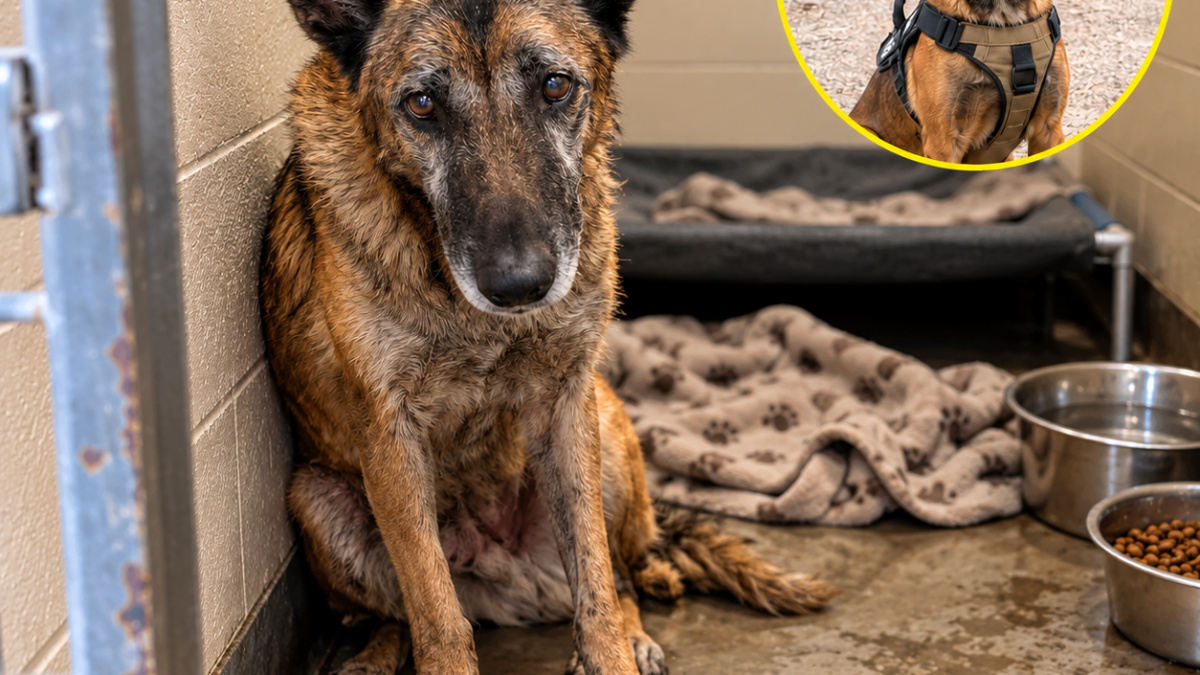
For thirteen years, Ranger had searched forests, riverbanks, collapsed buildings, and freezing fields for people who needed to be brought home—but when his own working life ended, nobody came back for him.
By the time he reached our shelter, the old Belgian Malinois no longer barked when footsteps approached his kennel, because he seemed to have learned that every set of footsteps eventually kept walking.
Then I opened a forgotten service file and found the same man standing beside Ranger in photograph after photograph, and one question changed everything: what if this old dog hadn’t stopped waiting for life—what if he was still waiting for him?
I had worked at the shelter for eleven years when Ranger arrived.
His intake sheet was painfully ordinary.
Male Belgian Malinois.
Thirteen years old.
Retired search-and-rescue dog.
No current handler available.
Senior.
Arthritis.
Mild hearing loss.
That was almost everything.
There was nothing on the paperwork explaining how a dog who had apparently spent his life serving beside human beings ended up alone in a county shelter.
Ranger didn’t behave like most newly surrendered dogs.
He never paced.
Never barked for attention.
Never pressed against the kennel door when volunteers passed.
He sat in the farthest corner with his front paws together and his head lowered.
The first afternoon, I opened his kennel and crouched sideways.
“Hey, old man.”
One ear moved.
That was all.
I put down a piece of chicken.
He looked at it.
Then at me.
He didn’t eat until I left.
We assumed he needed time.
Days became a week.
A week became three.
Ranger ate enough to maintain himself, allowed us to leash him, and walked politely through the exercise yard.
But there was no joy in him.
When a car door slammed in the parking lot, he lifted his head.
When a man’s voice carried through the lobby, he looked toward it.
Then he lowered his head again.
It happened so often that I finally noticed the pattern.
He wasn’t afraid of men.
He was listening for one.
One rainy Tuesday morning, I went digging through the records transferred with him.
Most were administrative.
Vaccinations.
Training certifications.
Deployment dates.
Then I found an older folder.
Inside were newspaper clippings and photographs.
The Ranger in those pictures barely looked like the dog sitting in kennel twelve.
He was young, muscular, eyes bright, body leaning forward as if the world always contained something important just beyond the frame.
In one article, Ranger had helped locate an eight-year-old boy who had been missing in dense woodland for almost three days.
Another documented a search after flash flooding.
Another showed him beside rescuers outside a partially collapsed building.
And in nearly every photograph, the same man stood beside him.
Tall.
Square shoulders.
Dark uniform.
One hand usually resting somewhere near Ranger’s neck.
The name printed beneath the pictures was **Daniel Mercer**.
Handler.
Search-and-rescue officer.
Partner.
I kept reading.
One old interview quoted Daniel describing Ranger as “the most dependable partner I’ve ever had.”
Another said they had worked together for almost nine years.
Nine years.
Hundreds of training sessions.
Long drives.
Night searches.
Storms.
Missing children.
Lost hikers.
People who went into the wilderness and didn’t come home until Ranger found them.
Then the records changed.
Four years earlier, Daniel Mercer had retired after an injury.
After that, his name almost disappeared.
I closed the folder and walked toward kennel twelve.
Ranger was sitting in his usual corner.
“Daniel,” I said softly.
Ranger’s head snapped up.
Not slowly.
Not like an old dog.
Instantly.
His ears rose.
He stood.
For the first time in weeks, he walked all the way to the kennel door.
My heart started pounding.
I whispered the name again.
“Daniel.”
Ranger looked past me toward the hallway.
Waiting.
That was the moment I understood.
This dog had spent his whole life finding people.
And maybe, after four silent years, there was still one person he had never stopped trying to find.
So I picked up the phone.
And started looking for Daniel Mercer.
PART 2
Finding Daniel should have been easy.
That was what I thought.
He had worked publicly.
His name appeared in newspaper archives.
There were photographs, department records, commendations, interviews.
I assumed I would make two phone calls, reach somebody who knew him, and have an answer by lunch.
Instead, I spent the next three days learning how completely a person can disappear without actually going missing.
The search-and-rescue unit Ranger had served with had been reorganized several years earlier.
Personnel changed.
Numbers changed.
Records moved to another county office.
The first administrator I reached had never heard of Daniel.
The second recognized the name but had no current contact information.
“He retired around four years ago,” she said.
“I know.”
“I think medical retirement.”
“Do you know where he went?”
“No.”
“Family?”
“I couldn’t release that even if I had it.”
“Could you forward him a message?”
“If we have an address.”
“Do you?”
A pause.
“Maybe an old one.”
I took whatever she would give me.
Not the address.
Just a promise that she would send my number if she could locate something legitimate.
Then I called the regional emergency-management office.
Then a retired officer listed in one of Ranger’s reports.
Then another.
The first number was disconnected.
The second belonged to someone else.
The third reached a man named Frank Delaney.
There was silence after I said Ranger’s name.
Then:
“Ranger?”
“Yes.”
“Daniel’s Ranger?”
My throat tightened.
“Yes.”
“Where is he?”
“At our shelter.”
Another silence.
This one felt different.
“What do you mean shelter?”
“He was surrendered to us.”
“By who?”
“I’m still trying to establish that.”
“How long has he been there?”
“Almost a month.”
Frank swore quietly.
Then:
“Is he okay?”
“Physically? For thirteen, not terrible. Arthritis. Some hearing loss. He’s underweight but not severely.”
“And otherwise?”
I looked toward the kennel wing.
“He waits.”
Frank didn’t speak.
“Do you know how to reach Daniel?”
“Not anymore.”
“Why?”
Frank exhaled.
“Daniel stopped talking to most of us.”
“When?”
“After the accident.”
“What accident?”
“You don’t know?”
“No.”
I sat down.
Frank told me.
Four years earlier, Daniel and Ranger had been involved in a winter search for two hikers missing after a storm.
The terrain was steep.
Ice everywhere.
During the operation, Daniel slipped near a ravine.
He fractured his pelvis and injured his back badly enough that returning to field duty became impossible.
Ranger remained physically unharmed.
Daniel spent months in rehabilitation.
Eventually he accepted medical retirement.
“What happened to Ranger?”
“That’s where it gets complicated.”
Of course it did.
Frank explained that Ranger technically belonged to the regional service organization, not Daniel personally.
Working dogs were department assets.
When a handler retired, arrangements depended on policy, health, age, and management.
Daniel wanted Ranger.
Everybody knew that.
“But?”
Frank sighed.
“But Daniel wasn’t in shape to care for a working Malinois then.”
“He was already nine.”
“Still a lot of dog.”
“So they separated them?”
“Temporarily. That was the idea.”
My stomach tightened.
“What happened after?”
“Ranger got assigned to lighter work with another handler.”
“For four years?”
“Not exactly.”
Daniel’s injury worsened.
There were surgeries.
Rehabilitation.
He moved.
Then his wife died.
I closed my eyes.
“When?”
“About two years after retirement.”
“Did he ever ask about Ranger?”
Frank laughed once, without humor.
“Every time I spoke to him.”
That sentence hit me.
“What did people tell him?”
“At first, that Ranger was still working. Later, I didn’t know.”
“You stopped knowing where the dog was?”
“The program shifted dogs between units. Ranger got older. I retired too. People moved.”
I gripped my pen.
“Daniel believed Ranger was being cared for?”
“Yes.”
“Did he know Ranger ended up here?”
“No chance.”
I looked toward kennel twelve.
Ranger was lying down now.
But his head remained lifted.
“Frank, where is Daniel?”
“I don’t know.”
“Somebody has to.”
“He sold the old house.”
“Phone?”
“Changed.”
“Email?”
“He stopped answering.”
“Children?”
“One daughter. Claire.”
“Can you reach her?”
“I might have an old number.”
“Please try.”
“I will.”
Before hanging up, Frank said something that stayed with me.
“Don’t get Daniel’s hopes up unless you’re sure it’s Ranger.”
“It’s Ranger.”
“No.”
His voice sharpened.
“I mean unless you’re sure Daniel can actually have him.”
I went quiet.
Frank continued.
“Daniel’s health isn’t what it used to be. I don’t know his living situation. I don’t know if he can manage a thirteen-year-old Malinois.”
I hated him for saying it.
Because he was right.
Finding Daniel did not automatically mean home.
Rescue teaches you to stop confusing emotional reunions with responsible placement.
Ranger deserved both if possible.
But emotion could not replace reality.
That afternoon, I sat inside Ranger’s kennel.
He stayed in the corner.
I did not say Daniel’s name.
I was afraid of giving him hope I had not earned.
Instead I opened the old file.
One newspaper photograph showed Ranger and Daniel after locating the missing boy.
The child was wrapped in an emergency blanket in the background.
Daniel was kneeling beside Ranger.
His forehead almost touching the dog’s.
Under the image, the caption read:
**K9 Ranger and Officer Daniel Mercer after Tuesday’s successful recovery operation.**
I looked at the dog in front of me.
“You brought people home.”
One ear moved.
“Let’s see if we can return the favor.”
The next day, Frank called.
“I found Claire.”
My heart jumped.
“And?”
“She answered.”
“Did you tell her?”
“Yes.”
“What did she say?”
Frank was quiet.
“Nothing for a while.”
“Frank.”
“She cried.”
I swallowed.
“Is Daniel alive?”
“Yes.”
Relief hit so hard I had to sit down.
“Where?”
“About ninety miles from you.”
“That’s it?”
“Yeah.”
“Can I call him?”
“No.”
My excitement stopped.
“Why?”
“Claire wants to talk to you first.”
“Fine. Give her my number.”
“She’ll call.”
Claire called that evening.
Her voice was careful.
Professional at first.
“Is this Megan?”
“Yes.”
“I’m Claire Mercer.”
“Thank you for calling.”
“You have Ranger?”
“Yes.”
“Are you certain?”
I opened the file in front of me.
“Belgian Malinois. Male. Thirteen. Search-and-rescue certification number ending 4817. Served with Daniel Mercer for about nine years.”
Claire inhaled sharply.
“That’s him.”
“I believe so.”
“He’s alive.”
“Yes.”
Another long silence.
Then I heard her crying.
Quietly.
“I’m sorry.”
“You don’t need to apologize.”
“My dad thinks he died.”
I went still.
“What?”
“He thinks Ranger died?”
“Not exactly.”
She collected herself.
“He thinks Ranger was retired somewhere years ago, but nobody could tell him where. At some point Dad started assuming the worst.”
“Why didn’t he keep looking?”
“He did.”
“Then?”
“My mother got sick.”
Claire’s voice changed.
“She had cancer. Dad was still recovering from surgeries. Everything became hospitals. Physical therapy. Mom’s treatment. Insurance. Moving to a smaller house.”
She paused.
“When she died, he stopped doing almost everything.”
I looked at Ranger’s picture.
“Does he still talk about Ranger?”
“Yes.”
“How often?”
“Enough.”
I closed my eyes.
“Then why don’t you want me calling him?”
“I didn’t say I don’t.”
“You told Frank not to give me the number.”
“Because I need you to understand my father.”
“Okay.”
“He walks with a cane. Some days he uses a walker. His back hurts constantly. He lives alone, though I’m twenty minutes away.”
I wrote everything down.
“House?”
“Small one-story place.”
“Yard?”
“Fenced.”
That mattered.
“Financially?”
“He’s okay.”
“Can he drive?”
“Yes, short distances.”
“Veterinary care?”
“I can help.”
Claire stopped.
“You’re interviewing me.”
“I’m evaluating whether this reunion can become a safe placement.”
Her voice softened.
“Good.”
That surprised me.
“Good?”
“I was afraid you were going to put Dad on camera, make some emotional video, and hand him a dog he physically couldn’t care for.”
“I don’t do that.”
“I’m glad.”
Neither of us spoke for a moment.
Then Claire said:
“He would give everything to have Ranger back.”
“Would you support it?”
“If the veterinarian says Ranger doesn’t need more physical care than Dad can manage, yes.”
“What if he does?”
“I’ll help.”
“Daily?”
“Yes.”
“Without resenting it?”
Claire laughed through tears.
“Megan, my father spent half my childhood disappearing into storms because somebody else’s kid was missing. I can drive twenty minutes to give an old dog medication.”
I liked her immediately.
We arranged a visit.
But first, Ranger needed a full veterinary assessment.
Dr. Lewis had already examined him at intake.
I asked for more.
Bloodwork.
Mobility evaluation.
Pain management.
Senior screening.
If Ranger was going to Daniel, I wanted to know exactly what Daniel would be taking on.
The results were better than I feared.
Arthritis in his hips and lower spine.
Some muscle loss.
Mild dental disease.
Slight hearing impairment.
No major organ failure.
No serious neurological problem.
Heart sounded good.
He needed anti-inflammatory management, joint support, controlled exercise, better nutrition, and regular senior monitoring.
“He’s thirteen,” Dr. Lewis said.
“I know.”
“He isn’t going hiking.”
“Daniel isn’t either.”
“Perfect match.”
I smiled.
“Can an older man with a cane handle him?”
Dr. Lewis looked at Ranger.
“He’s not behaving like an active-duty Malinois anymore.”
That was true.
Ranger walked slowly.
He did not pull.
He responded to leash pressure.
His explosive working-dog energy had softened into deliberate movement.
“But,” Dr. Lewis added, “reunion excitement could change that temporarily.”
“We’ll manage it.”
“Then medically, I see no reason he couldn’t live in a quiet home with support.”
I called Claire.
“Bring him.”
She cried again.
The visit was scheduled for Saturday.
I slept badly Friday night.
Not because I doubted Ranger.
Because I was terrified of one possibility nobody wanted to say aloud.
What if he didn’t remember Daniel?
Four years is a long time.
Dogs remember scent and relationships in ways we do not fully understand, but no one could promise a cinematic recognition.
What if Daniel came in expecting his old partner and Ranger simply sniffed him like any stranger?
Would that destroy him?
I warned Claire.
“You need to prepare him.”
“I have.”
“What did you tell him?”
“That Ranger may have changed.”
“And?”
“That he may not react immediately.”
“And Daniel?”
“He told me I was an idiot.”
I laughed.
“Good sign.”
“He said, ‘That dog will know me before I reach the door.’”
Saturday morning arrived gray and cold.
I brought Ranger into our quiet visitation room before opening hours.
No crowd.
No volunteers gathered with phones.
No balloons.
No cameras.
I had banned everyone except Dr. Lewis, Claire, Daniel, and me.
This was not content.
This was theirs.
Ranger sniffed the room.
Then lay beside my chair.
At 9:07, a car pulled into the lot.
Ranger’s head lifted.
I froze.
He could not see the parking area from where we were.
Car doors closed outside.
Ranger stood.
His entire posture changed.
Not dramatic.
But unmistakable.
Ears forward.
Head high.
Weight shifted toward the door.
My heart hammered.
Footsteps approached.
One set light and quick.
Claire.
The other slower.
Uneven.
Tap.
Step.
Tap.
Step.
Cane.
Ranger moved toward the door.
Not running.
Focused.
I whispered:
“Easy.”
He ignored me.
The hallway door opened.
Claire entered first.
She looked at Ranger and covered her mouth.
He glanced at her.
Then looked past her.
Daniel stepped into view.
He was in his late sixties.
Taller than I expected despite the cane.
Gray hair.
Broad shoulders narrowed by age and injury.
He stopped.
Ranger stopped.
For two seconds, nothing happened.
Then Daniel whispered:
“Ranger.”
The dog transformed.
I had never seen anything like it.
His ears shot up.
His mouth opened.
A sound came out.
Not a bark.
Not a whine.
Something between them.
Then Ranger moved.
Fast.
Faster than I had seen him move in a month.
I grabbed the loose leash only to prevent him from slipping.
Daniel dropped his cane.
“Ranger!”
Ranger reached him.
Pressed his entire body against Daniel’s legs.
Daniel nearly fell.
Claire grabbed her father’s arm.
I moved forward.
Daniel waved us away.
“No.”
His voice broke.
“I’ve got him.”
He lowered himself awkwardly to one knee.
I wanted to stop him.
Then Ranger buried his head against Daniel’s chest.
Daniel put both arms around him.
And the old search dog began making sounds.
Soft.
High.
Broken.
The kind of sounds animals make when emotion seems to overwhelm the rest of the body.
Daniel was crying.
Not quietly.
His face was buried in Ranger’s neck.
“You old son of a gun.”
Ranger pawed at him.
“You know me.”
Ranger licked his face.
Daniel laughed and cried at the same time.
“You know me.”
Claire turned away because she was crying too.
I did not even try to hide mine.
Ranger pulled back just enough to look at Daniel.
Then pushed into him again.
Daniel whispered:
“I’m sorry.”
That changed the room.
“I’m sorry I didn’t find you.”
Ranger’s tail moved so hard his entire rear end shifted.
Daniel held his face.
“I tried.”
Ranger licked his chin.
“I swear to God, I tried.”
No one spoke.
I had imagined this reunion.
I was wrong about almost every detail.
I thought Ranger would bark.
He didn’t.
I thought Daniel would call commands.
He didn’t.
I thought the recognition would be explosive.
It was intimate.
Like four missing years collapsing into physical contact.
Daniel finally sat on the floor because kneeling hurt.
Ranger immediately lay against his hip.
The same place, Claire later told me, he had always chosen after deployments.
I gave them almost an hour.
At some point, I brought water.
Nobody touched it.
Daniel ran his hands over Ranger’s shoulders.
“You got skinny.”
I nearly laughed.
Ranger looked better than Daniel gave him credit for.
“You got gray.”
Ranger sneezed.
Daniel smiled.
“Yeah, me too.”
Eventually practical reality had to return.
I sat opposite Daniel.
“We need to talk.”
He nodded.
“I’m taking him.”
Claire sighed.
“Dad.”
“I am.”
“I know. Let her talk.”
Daniel looked at me.
“I’m listening.”
I explained Ranger’s medical needs.
Arthritis.
Medication.
Controlled exercise.
Senior bloodwork.
Possible future mobility decline.
No long hikes.
No stairs if avoidable.
Weight management.
Daniel nodded at every point.
“I have no stairs.”
“Good.”
“Fenced yard.”
“Claire told me.”
“Veterinarian six miles away.”
“You already called one?”
Daniel looked offended.
“I started calling yesterday.”
Claire laughed.
“He bought a dog bed.”
“Three.”
I stared.
“Three?”
“Living room. Bedroom. Porch.”
“Dad, Ranger has never cared about dog beds.”
“He’s thirteen now.”
Ranger was sleeping with his head on Daniel’s shoe.
I smiled.
“He might surprise you.”
Then I asked the uncomfortable question.
“What happens on days your back is bad?”
Daniel looked at Claire.
“She comes.”
Claire nodded.
“What if she can’t?”
“My neighbor, Tom. Retired deputy. Ranger knows him too, or did.”
“Professional dog walker as backup?”
“If necessary.”
“Medication?”
“I manage my own. I can manage his.”
“Emergency vet costs?”
“Covered.”
“Transportation?”
Claire raised her hand.
“Me.”
I looked at Daniel.
“One more.”
He waited.
“If Ranger becomes unable to walk without significant assistance, you may physically struggle to handle him.”
His face changed.
Not anger.
Pain.
“I know.”
“What then?”
“I ask for help.”
That answer mattered.
Men like Daniel often found asking harder than doing.
“You mean that?”
He looked down at Ranger.
“I failed him once because I believed people who said they had it handled.”
“You didn’t fail him.”
Daniel’s eyes rose.
“You don’t know that.”
“I know you were injured.”
“I should have found him.”
“You were recovering.”
“I should have found him.”
“Your wife was sick.”
“I should have found him.”
There was no arguing with guilt.
So I stopped.
“Then don’t fail him now by pretending you can do everything alone.”
Daniel stared at me.
Claire went very still.
Finally he nodded.
“Fair.”
Ranger went home with Daniel that afternoon.
Not immediately.
There was paperwork.
Medical-release forms.
Adoption transfer.
Legal confirmation because Ranger’s ownership history was unusually complicated.
But eventually, after thirteen years of searching for people and four years separated from the person who mattered most, Ranger walked out our front door.
Daniel beside him.
The symbolism was almost too perfect.
An old search dog finally found the man he had been waiting for.
But their real story began after the reunion.
That is the part people often leave out.
Reunions are easy to love.
Ordinary life afterward is where promises are tested.
The first night, Ranger would not sleep on any of the three beds Daniel bought.
Of course.
He slept beside Daniel’s bedroom door.
Claire sent me a photograph.
Ranger stretched across the floor.
One expensive orthopedic bed visible three feet away.
Caption:
**$189. UNUSED.**
I replied:
**WELCOME TO DOG OWNERSHIP.**
Daniel called the next morning.
“He keeps following me.”
“Good.”
“Bathroom too.”
“Normal.”
“He never did that before.”
“He was working before.”
“He used to wait outside.”
“He’s retired.”
Daniel paused.
“So boundaries are retired too?”
“Apparently.”
Ranger rediscovered Daniel’s routines quickly.
Morning coffee.
Medication.
Short walk.
Breakfast.
Daniel reading at the kitchen table.
Ranger lying beneath it.
At first, Daniel tried using old commands.
“Place.”
Ranger stared at him.
“Down.”
Ranger remained standing.
Daniel called me.
“He’s ignoring me.”
“He’s thirteen.”
“He heard me.”
“Maybe retirement includes selective hearing.”
Daniel grumbled.
Claire later told me Ranger obeyed instantly when Daniel opened the refrigerator.
Some skills do not fade.
Within two weeks, something else changed.
Daniel did.
Claire noticed first.
She called me.
“My dad is walking more.”
“With Ranger?”
“Every morning.”
“How far?”
“Not far. Around the block.”
“Is that safe?”
“His physical therapist says yes.”
That mattered.
Daniel had stopped regular walks after his wife died.
Pain made movement difficult.
Grief made effort pointless.
Ranger needed controlled exercise.
So Daniel walked.
Slowly.
Cane in one hand.
Ranger’s leash in the other.
The dog who had once crossed wilderness searching for strangers now took fifteen-minute laps around a suburban block.
Daniel considered that humiliating at first.
Then a neighbor recognized Ranger.
An older man stopped.
“Is that the search dog?”
Daniel straightened.
“Yes.”
“Ranger?”
The dog looked over.
The neighbor smiled.
“I remember him from the flood search.”
Daniel touched Ranger’s neck.
“Yeah.”
That evening, Claire told me her father talked for forty minutes about old missions.
He had not discussed search-and-rescue work in years.
Ranger did not simply return to Daniel’s house.
He reopened rooms inside the man that had been shut.
One month later, Daniel brought Ranger to the shelter for a follow-up.
I barely recognized the dog.
Not physically.
His arthritis remained.
His muzzle remained gray.
But his eyes.
That empty distance was gone.
Ranger entered the lobby and immediately looked for Daniel when the leash changed hands.
Daniel rolled his eyes.
“He thinks I’m going to disappear.”
I looked at him.
“So do you.”
Daniel went quiet.
Fair.
Dr. Lewis checked Ranger.
Weight up slightly.
Muscle stable.
Pain control working.
Bloodwork good.
Then Ranger did something I had never seen at the shelter.
He stole a biscuit from Dr. Lewis’s coat pocket.
Dr. Lewis stared.
“Did the decorated search-and-rescue dog just rob me?”
Daniel looked proud.
“He’s adapting to civilian life.”
The second month brought the first problem.
Daniel fell.
Not badly.
He caught his foot on the edge of the patio and went down.
Claire was not there.
Ranger was.
Daniel later told me what happened.
He hit the ground and swore.
Ranger immediately came to him.
Not panicked.
Focused.
Old training surfaced.
He stood near Daniel’s chest.
Daniel tried to push himself up.
Couldn’t.
His phone was inside.
For a moment, he lay there realizing exactly how vulnerable living alone had made him.
Then Ranger did something Daniel had not asked him to do in years.
He went to the back door.
Barked.
Three times.
Paused.
Barked again.
The neighbor, Tom, heard.
He looked over the fence.
Saw Daniel down.
Help arrived.
Claire called me that evening.
“Ranger saved him.”
Again.
I sat silently.
“Is Daniel okay?”
“Bruised. Angry.”
“Of course.”
“He keeps saying Ranger knew.”
“He probably recognized distress and reverted to trained behavior.”
“That’s the professional answer.”
“Yes.”
“What’s the personal answer?”
I looked toward the shelter dogs.
“Ranger spent thirteen years finding people who needed help.”
Claire laughed softly.
“Apparently retirement didn’t take.”
Daniel was furious at the attention.
“I tripped.”
“You couldn’t get up,” I told him when he called.
“I would have.”
“When?”
“Eventually.”
“Ranger disagreed.”
Silence.
Then Daniel said:
“He always hated waiting.”
Interesting.
I thought about those weeks at the shelter.
He had done almost nothing but wait.
Maybe that was why it hurt.
Ranger knew how to search.
Waiting without purpose was harder.
Daniel agreed to wear an emergency alert device after the fall.
Claire called it Ranger’s revenge.
“For what?”
“For Dad pretending he doesn’t need help.”
I liked that kind of revenge.
Not humiliation.
Accountability born from love.
Then the larger truth about Ranger’s path into the shelter began emerging.
I had continued digging.
Not because Daniel asked.
Because I needed to understand how a decorated working dog could move from public service into near anonymity.
The chain was mundane.
That made it worse.
After Daniel’s injury, Ranger was reassigned.
Later, because of age, he moved into semi-retirement with another handler.
That handler left the unit unexpectedly.
Ranger transferred again.
Records were incomplete during an organizational merger.
At some point, he was placed with a contractor who housed retired working dogs.
The contractor lost funding.
Dogs were redistributed.
Ranger went to a temporary foster.
The foster developed health problems.
Eventually Ranger entered municipal shelter custody through a general surrender process with almost none of his working history attached.
No single person decided:
Abandon the hero dog.
There was no villain standing at a gate.
There was something more believable.
Every person assumed the next person knew.
Every agency assumed the record followed.
Every transfer turned Ranger slightly more into paperwork.
Asset number.
Senior Malinois.
Owner unavailable.
By the time he reached us, Daniel’s name was buried four years deep in an old file.
That realization made me angrier than a simple villain would have.
Because systems fail quietly.
No dramatic cruelty required.
Just enough handoffs.
Enough missing information.
Enough nobody asking one extra question.
I called the retired administrator whose signature appeared on one transfer document.
She remembered Ranger.
“I thought he went to a permanent retirement home.”
“He didn’t.”
She became quiet.
“Is he okay?”
“He is now.”
“I’m sorry.”
That word appeared again and again.
Sorry.
The former handler.
Sorry.
The contractor.
Sorry.
A unit supervisor.
Sorry.
Nobody had meant for Ranger to disappear.
He disappeared anyway.
Daniel learned parts of this later.
His reaction surprised me.
I expected rage.
He sat at his kitchen table with Ranger beneath it while I explained what I found.
“So nobody dumped him?”
“Not exactly.”
“Nobody stole him?”
“No.”
“Just paperwork.”
“Transfers. Staff changes. Funding. Bad communication.”
Daniel stared out the window.
“That’s worse.”
“I thought you might say that.”
“If one bastard had done it, I’d know who to hate.”
“Yes.”
“But this?”
He shook his head.
“Everybody did their job until somehow nobody did.”
Exactly.
Daniel looked down.
Ranger was asleep on his shoe.
“What happens to other dogs?”
That question changed everything.
“I don’t know.”
“Working dogs.”
“Depends on agency.”
“Retired ones.”
“Policies vary.”
“What if the handler dies? Gets injured? Moves?”
“I don’t know.”
Daniel’s old professional instincts surfaced.
“Find out.”
I laughed.
“What?”
“You heard me.”
“I run a shelter.”
“And you have a phone.”
“You are retired.”
“So?”
“So you don’t command me.”
Ranger opened one eye.
Daniel pointed.
“He outranks you.”
I looked at the dog.
“Unfortunately, true.”
What began as anger became a project.
Daniel contacted former colleagues.
I contacted shelters.
Claire handled spreadsheets because neither Daniel nor I could agree on basic technology.
We discovered wide variation.
Some agencies had excellent retirement plans.
Handler adoption options.
Veterinary support.
Lifetime tracking.
Others relied on informal arrangements.
When people changed, history could disappear.
Daniel became obsessed.
“This can’t happen again.”
I reminded him that we could not redesign every department.
“No.”
He tapped the table.
“But we can create a contact bridge.”
That became the Ranger Registry.
Nothing governmental.
Nothing grand.
A voluntary network connecting retired working-dog handlers, agencies, rescue groups, and shelters in our region.
If a dog with identifiable service history entered a shelter, staff could check the registry.
If a retired handler wanted updates or first consideration for adoption, the contact remained.
If the handler died or became unable to care for the dog, backup contacts were listed.
Veterinary requirements.
Retirement plans.
Not perfect.
But better than hoping a folder survived every transfer.
Daniel became its loudest advocate.
The man who had withdrawn from almost everyone now called police chiefs, fire departments, SAR groups, and K9 coordinators.
Claire said he became unbearable.
“He calls people at eight in the morning.”
“Professional hours.”
“He’s retired.”
“Tell him.”
“I tried.”
Ranger attended some meetings.
That helped.
It is difficult to argue that senior working dogs do not deserve better tracking while one sits beside the table wearing a faded service collar.
One department chief looked at Ranger and said:
“We already take care of ours.”
Daniel replied:
“So did we.”
Silence.
Then:
“Until we didn’t.”
That line eventually became the reason several agencies joined.
No accusation.
Just humility.
Systems are strong until circumstances expose their gaps.
Ranger had fallen through one.
Now his story filled it.
That was the justice arc I had not expected.
No courtroom.
No revenge fantasy.
No one fired publicly.
Instead, Ranger’s disappearance became embarrassing enough that people changed procedures.
His old records were digitized.
Retirement contacts verified.
Transfer forms updated.
One regional organization adopted a requirement that retired K9 placement records include handler notification whenever possible.
Small changes.
Boring changes.
The kind that prevent heartbreak.
I began thinking about revenge differently.
At first, I wanted someone punished for leaving Ranger at the shelter.
Then I learned nobody had deliberately done it.
The satisfying answer became making carelessness harder to repeat.
Ranger’s revenge on a system that forgot him was becoming impossible to lose again.
Not just him.
Others.
The first real test came eight months later.
A shelter three counties away received an eleven-year-old German Shepherd named Rex.
Intake noted:
“Possible former working dog.”
Normally that might have meant nothing.
A volunteer remembered the registry.
One email.
We found a retired fire investigator named Luis Moreno who had handled Rex for seven years.
Luis thought Rex had gone permanently to another retired handler after his own housing changed.
That placement had fallen apart.
Nobody told him.
When the shelter called, Luis drove four hours.
Rex recognized him.
Not as dramatically as Ranger recognized Daniel.
He sniffed.
Paused.
Then leaned his entire body against Luis’s legs.
Luis adopted him.
Daniel received the photograph.
He stared at it.
Then looked at Ranger.
“Well.”
Ranger was asleep.
Daniel cleared his throat.
“It works.”
Claire told me he cried after I left.
He denied it.
Of course.
A year after Ranger left the shelter, we held a small gathering.
Not a fundraiser.
Not exactly.
People from participating agencies came to review the registry program.
Daniel hated ceremonial events, so naturally Claire created one.
She brought a cake.
For humans.
A smaller dog-safe one for Ranger.
Ranger ate his with the efficiency of a retired professional.
Daniel stood beside him.
His cane had been replaced by a slightly sturdier one.
He was moving better.
Not cured.
Pain remained.
But physical therapy and daily walks had strengthened him.
Claire told me his doctor credited Ranger for part of that.
Daniel said the doctor was “sentimental.”
I said the same thing about Daniel.
He ignored me.
During the gathering, Frank Delaney arrived.
The old colleague who had helped us find Claire.
Daniel had not seen him in years.
For a moment, they stood several feet apart.
Then Frank looked at Ranger.
“You ugly old bastard.”
Ranger wagged.
Daniel said:
“He looks better than you.”
Frank laughed.
Then the two men hugged.
Briefly.
Awkwardly.
The way men who spent decades in jobs that rewarded emotional restraint often do.
Ranger moved between them.
Frank crouched.
“Remember me?”
Ranger sniffed him.
Then accepted chicken.
Frank looked offended.
“That’s it?”
Daniel smiled.
“You weren’t his favorite.”
“Clearly.”
Old stories came out.
Missions I had only seen in paperwork became real.
The missing boy.
The flooded campground.
An elderly man with dementia located near a creek.
A teenager found after a winter night in the woods.
Each story ended with somebody coming home.
“That dog found twenty-six live subjects during his career,” Frank said.
I stared.
“Twenty-six?”
“Documented direct finds. More assists.”
Daniel scratched Ranger’s neck.
“Twenty-seven.”
Frank frowned.
“What?”
Daniel looked at me.
“He found me.”
Nobody spoke.
Then Frank nodded.
“Fair.”
That line became impossible for me to forget.
Ranger had found twenty-six people during his official career.
After retirement, he found Daniel again too.
Not by scent.
Not across terrain.
By surviving long enough for an old file to be opened.
Maybe Daniel also found Ranger.
Both interpretations were true.
Two years into their reunion, Ranger’s age began showing more sharply.
Fourteen becoming fifteen is not kind to large working dogs.
His hips weakened.
Walks shortened.
Daniel bought a mobility harness.
Ranger hated it.
The first time, he stood completely still.
Daniel pulled gently.
“Move.”
Ranger stared.
“Ranger.”
Nothing.
I watched from the porch.
“He’s protesting.”
“He wore tactical gear for a decade.”
“This harness has ducks printed on it.”
Daniel looked down.
Claire had bought it.
Tiny yellow ducks.
Daniel groaned.
“That’s the problem.”
We found a black one.
Ranger accepted it.
Dignity apparently mattered.
Daniel’s own mobility challenges created an almost comic problem.
Two old partners.
One cane.
One support harness.
Claire called them “the slowest tactical unit in America.”
Daniel threatened to disown her.
Ranger wagged.
Their morning walks became shorter.
End of driveway.
Mailbox.
Sometimes one block on good days.
But they still went.
If Daniel delayed, Ranger stood by the door.
If Ranger slept late, Daniel waited.
Each adjusted around the other.
The partnership had changed from searching wilderness to navigating old age.
Still partnership.
Then Daniel was hospitalized.
Pneumonia.
Nothing connected to the old injury.
But at his age, serious.
Claire called me.
“Ranger can’t come.”
“Of course.”
“He’s refusing dinner.”
My stomach tightened.
“How long has Daniel been gone?”
“Two days.”
“Bring Ranger to me if needed.”
“I want him home.”
“Then I’m coming.”
I drove to Daniel’s house.
Ranger lay beside his chair.
The house smelled wrong without Daniel.
Dogs know routines more than calendars.
Ranger kept looking toward the door.
I sat beside him.
“Daniel is coming back.”
His ears shifted.
I said the name.
Ranger looked toward me.
That old reaction still there.
“Daniel.”
He stood.
Walked toward the door.
My heart cracked.
“I know.”
For three days, I stayed part-time while Claire handled hospital visits.
Ranger ate if I sat beside him.
Barely.
On day four, Claire called.
“Hospital says maybe tomorrow.”
“What about a visit?”
“What?”
“Can Daniel see Ranger?”
“They don’t allow animals.”
“Ask.”
“Megan.”
“Ask.”
She did.
The hospital denied it.
Then a nurse heard the story.
Then another.
Then somehow the unit supervisor learned Daniel was a retired search-and-rescue officer and Ranger was his former K9 partner.
Rules are rules.
But sometimes rules contain supervised exceptions.
They allowed a brief visit outside near a covered patient-discharge courtyard.
Claire brought Daniel down in a wheelchair.
I brought Ranger.
The moment Ranger saw him, his pace changed.
Old.
Arthritic.
Still determined.
Daniel opened both hands.
“Hey.”
Ranger reached him.
Rested his head in Daniel’s lap.
Daniel closed his eyes.
For ten minutes, nobody needed to speak.
A nurse watching from the doorway cried.
Afterward Daniel ate his full lunch for the first time in days.
So did Ranger.
Claire said:
“This is ridiculous.”
“Yes.”
“They’re codependent.”
“Probably.”
“Can two senior citizens qualify for separation anxiety?”
“Apparently.”
Daniel came home two days later.
Ranger slept beside his bed.
Daniel recovered.
Slowly.
The registry continued growing.
One story became five.
Then eleven.
Not all ended in reunion.
Sometimes the original handler had died.
Sometimes they could not take the dog.
Sometimes the retired dog was already well placed and moving again would be unfair.
But information survived.
History mattered.
Service mattered.
And no dog was treated as anonymous if we could prevent it.
Then came the call we knew would eventually come.
Ranger was almost sixteen.
He stopped finishing breakfast.
Daniel noticed immediately.
Of course he did.
Veterinary exam.
Bloodwork.
Imaging.
A mass.
Likely cancer.
Advanced.
The options were limited.
Surgery would be extremely hard on him.
Chemotherapy might buy time but uncertain quality.
Palliative care could keep him comfortable for a while.
Daniel listened.
Asked questions.
Then called me.
“Megan.”
His voice told me everything.
I drove over.
Ranger was asleep on the porch.
Daniel sat beside him.
The afternoon was warm.
His cane leaned against the chair.
“What did they say?”
He told me.
I sat.
For a long time, neither of us spoke.
Then Daniel said:
“I spent years thinking I’d never get him back.”
I looked at Ranger.
“You got two.”
“Two and a half.”
“Good years.”
“The best.”
Ranger opened one eye.
Daniel reached down.
“He found people for thirteen years.”
“Yes.”
“And I lost four with him.”
“You didn’t choose that.”
“I know.”
That surprised me.
Daniel had finally stopped punishing himself.
Maybe not completely.
Enough.
“What do I do?”
He wasn’t asking medically.
“You already know.”
He nodded.
“Comfort.”
“Yes.”
“Food if he wants it.”
“Yes.”
“Walks if he wants them.”
“Yes.”
“No heroics for me.”
I looked at him.
“For Ranger?”
“For me.”
He rubbed Ranger’s ear.
“I don’t keep him here because I’m afraid of the empty house.”
That was love too.
Knowing when staying becomes suffering.
Ranger had good weeks.
Then good days.
Daniel stopped using the word “fight.”
I appreciated that.
Ranger was not fighting cancer for our inspiration.
He was living while comfortable.
When comfort narrowed, decisions narrowed.
Claire visited daily.
Frank came once.
Tom next door brought cooked chicken.
Ranger suddenly developed selective standards and rejected regular food while accepting chicken.
Daniel accused him of manipulation.
Ranger had earned it.
The final morning came quietly.
Ranger did not get up.
His breathing was calm but shallow.
Daniel called the mobile veterinarian.
Then me.
Then Claire.
I arrived to find Ranger lying on his favorite blanket in the living room.
Not one of the expensive beds.
The blanket.
Daniel sat on the floor beside him despite his back.
Claire on the other side.
Ranger’s old service collar rested nearby.
Daniel had kept it all those years after the reunion.
Faded black nylon.
Metal tag scratched.
K9 RANGER.
Daniel put one hand beneath Ranger’s chin.
“You remember the McAllister boy?”
Claire looked confused.
Daniel smiled.
“Eight years old. Lost almost three days. Ranger found him under a fallen pine.”
Ranger’s ear moved.
“You hated helicopters.”
Another ear movement.
“You loved that stupid red ball.”
Tail tap.
Daniel laughed.
“You bit Frank once.”
I looked at him.
“What?”
“Not really. Got his sleeve during training.”
Frank had never told me.
Daniel continued talking.
Missions.
Road trips.
Hotel rooms.
Training grounds.
Snow.
Rain.
People found alive.
People they could not save.
Years.
He gave Ranger back his whole life in words.
Maybe for himself.
Maybe for the dog.
Maybe both.
Then Daniel said:
“You waited for me.”
His voice broke.
Ranger’s eyes opened.
“I’m sorry it took so long.”
I looked down.
No one interrupted.
Daniel leaned closer.
“You don’t have to wait anymore.”
That sentence shattered all of us.
Claire covered her mouth.
I looked away.
Daniel placed his forehead against Ranger’s.
“I found you.”
Technically, I had found Daniel.
Technically, old records did.
Technically, Frank and Claire completed the chain.
But Daniel’s words were right in the only way that mattered.
They had found each other.
Again.
The veterinarian explained every step.
Daniel listened.
Asked whether Ranger would feel fear.
“No.”
Pain?
“We’ll prevent it.”
Daniel nodded.
He kept one hand on Ranger.
Claire kept another.
I touched Ranger’s shoulder.
When the sedative began working, his body relaxed.
Daniel whispered the old working phrase he had used at the end of searches.
“Good find, Ranger.”
I started crying.
Later Claire told me what it meant.
After Ranger located someone, Daniel would kneel beside him, reward him, and say:
Good find.
Two words that meant:
You did your job.
You brought them home.
You can rest.
Ranger’s breathing slowed.
Daniel whispered:
“Good find.”
Again.
“Good find, partner.”
Ranger died with his head resting across Daniel’s leg.
No kennel.
No strange hallway.
No waiting for footsteps that passed.
Home.
Partner beside him.
Exactly where he should have been.
The days afterward were difficult.
I worried about Daniel.
Claire did too.
The house became quiet.
Too quiet.
Ranger’s bowls remained for a week.
Then Daniel washed them.
The beds stayed longer.
All three.
Even the one Ranger barely used.
Claire offered to remove them.
“No.”
So she didn’t.
Grief needs its own pace too.
A month later, Daniel came to the shelter.
Alone.
He carried Ranger’s old service collar.
I thought he was bringing it to me.
Instead, he handed me an envelope.
Inside was a check.
I stared at the amount.
“Daniel.”
“Registry.”
“This is too much.”
“No.”
“Keep some.”
“No.”
“For what?”
He looked toward the kennel hallway.
“Retired working dogs.”
We created a small assistance fund.
Not just tracking.
Medical support for senior service dogs whose retired handlers needed help.
Mobility harnesses.
Medication.
Diagnostics.
Temporary foster care during handler hospitalization.
Transport.
Practical things.
We named it the Ranger-Mercer Partnership Fund.
Daniel hated the name.
Claire and I overruled him.
“Partnership,” I said.
“That’s what this was.”
He looked at Ranger’s collar in his hands.
Then nodded.
“Fine.”
The first recipient was a retired bomb-detection Labrador named Grace whose handler had been hospitalized after heart surgery.
The fund paid for three weeks of foster boarding with someone trained to manage working dogs.
Grace went home when her handler recovered.
Daniel received the photo.
He stared for a long time.
Then put it on his refrigerator.
One photo became many.
Rex with Luis.
Grace.
A retired bloodhound named Duke.
A German Shepherd named Ava whose former deputy handler needed help with expensive arthritis medication.
Daniel kept every picture.
His refrigerator became ridiculous.
Claire sent me a photograph.
Caption:
**THE MAN WHO CLAIMS HE HATES SENTIMENTAL STUFF.**
Daniel called five minutes later.
“Your conspiracy with my daughter needs to stop.”
“It won’t.”
Years later, Daniel’s own health declined.
But he remained involved.
Phone calls.
Advice.
Registry reviews.
Stories.
New volunteers loved him because he could turn any five-minute question into a forty-minute lecture.
I loved him because he complained about everyone wasting time while becoming the biggest volunteer time sink we had.
One afternoon, a young officer brought a two-year-old Malinois to meet him.
The dog was beginning SAR training.
Name: Echo.
Daniel sat in a chair while Echo approached.
He sniffed Daniel’s hands.
Then sat.
Daniel’s face changed.
For one second, I saw the younger man from the photographs.
Uniform.
Forest.
Ranger beside him.
Daniel scratched Echo beneath the collar.
“Work clean,” he said.
The officer smiled.
“What?”
Daniel looked at him.
“Never lie to your dog.”
The officer became serious.
Daniel continued.
“If you ask for something, mean it. If he gives it, reward it. If he tells you something, listen. Partnership only works if both sides matter.”
I thought of Ranger in kennel twelve.
Telling us through silence.
Waiting.
Listening.
Recognizing one name.
Daniel looked at Echo.
“And when he retires, know where he is.”
The young officer nodded.
“Yes, sir.”
Daniel’s revenge had become instruction.
That may have been the most satisfying ending of all.
A system lost Ranger.
His story taught the next generation not to.
Years after Ranger died, I still keep one photograph at the shelter.
Not the famous search photo.
Not the reunion.
The reunion photograph exists, but it is private.
Claire took it from the doorway.
Daniel on the floor.
Ranger pressed against him.
I will never post it.
Some moments deserve not to become content.
The photograph I display publicly is quieter.
Daniel sitting on his porch about a year after Ranger came home.
Cane leaning against the chair.
Ranger lying beside him.
Neither looking at the camera.
Just two old partners watching the yard.
Under it is a small plaque.
**K9 RANGER
13 YEARS OF SEARCH AND RESCUE SERVICE
26 DOCUMENTED LIVE FINDS
AND ONE FINAL PARTNER FOUND AGAIN**
People stop and read it.
Sometimes they ask:
“What does the last line mean?”
Then I tell them.
A shortened version.
Enough.
The retired search dog.
The shelter.
The old file.
Daniel’s name.
The reunion.
The registry.
The fund.
People usually say:
“That’s incredible.”
It is.
But not because fate magically fixed everything.
It almost didn’t.
If I had not opened that folder.
If Frank’s number had been completely lost.
If Claire had changed her name.
If Daniel had moved again.
If Ranger had arrived without his old service ID.
If he had died before somebody asked one more question.
That frightens me.
So I resist calling it destiny.
Destiny lets systems off the hook.
It suggests everything worked because it was supposed to.
No.
Everything worked because somebody looked.
Somebody called.
Somebody kept records.
Somebody answered.
Somebody chose to act.
That distinction matters.
Ranger had spent thirteen years finding people because trained teams trusted his nose enough to follow where it led.
At the shelter, Ranger gave me a different kind of signal.
One name.
Daniel.
His body changed.
His eyes changed.
He walked to the door.
I could have called it coincidence.
Instead, I followed.
That was the lesson.
Sometimes rescue begins when you stop assuming the file tells the whole story.
The most painful part of Ranger’s life was not that people hated him.
Nobody did.
He was admired.
Decorated.
Loved.
He disappeared anyway.
That can happen when affection is not backed by responsibility.
Good intentions are fragile.
Systems matter.
Names matter.
Phone numbers matter.
Backup plans matter.
Knowing where the dog goes after retirement matters.
Ranger taught us that.
And because he did, another retired working dog will be less likely to sit anonymously in a kennel while the person who once loved him assumes he is gone forever.
When I think about Ranger now, I return to the morning in kennel twelve.
Before Daniel.
Before the reunion.
Before any of us knew the ending.
I said one name.
“Daniel.”
Ranger lifted his head.
His whole body seemed to wake.
For weeks, we thought he had stopped hoping.
We were wrong.
Hope had simply become very specific.
He did not want another volunteer.
Another walk.
Another blanket.
Another treat.
Those things mattered.
But none were the thing he was waiting for.
He was waiting for the person whose footsteps he remembered.
The hand that had rested against his neck after hundreds of searches.
The voice that had sent him into forests and called him back.
His partner.
Four years is a long time.
But apparently not long enough.
The final irony still moves me.
Ranger spent his working life finding people who were lost.
At the end, Ranger was the one who got lost inside a system.
And the man who had once depended on him to find strangers became the person Ranger needed us to find.
Maybe that is why Daniel’s last words to him were perfect.
Good find.
Ranger had found children.
Hikers.
Flood victims.
Elderly people who wandered away.
People whose families had been waiting beside phones.
Twenty-six documented lives brought back toward home.
But the final person connected to Ranger’s story was Daniel.
The partner who thought he had lost him.
The man who had stopped expecting anything good to return after injury and grief took so much.
Ranger came home and gave Daniel morning walks.
Responsibility.
Old stories.
Old friends.
A reason to answer calls.
A reason to build something useful from anger.
Then, when Ranger’s own body finally failed, Daniel did the hardest thing a partner can do.
He stopped asking Ranger to search.
He stopped asking him to stay.
He told him the mission was over.
You found me.
You can rest.
That is the ending I keep.
Not Ranger alone in kennel twelve.
Not Daniel alone in a quiet house.
I remember the porch.
Two old bodies.
One cane.
One gray muzzle.
The yard in front of them.
No sirens.
No missing-person call.
No harness.
No command.
Nothing left to prove.
For thirteen years, Ranger’s job had been bringing people home.
In the end, after everything and everyone else, someone finally did the same for him.
[EXPANDED ENDING — APPROX. 2,000 WORDS]
For thirteen years, Ranger’s job had been bringing people home.
In the end, after everything and everyone else, someone finally did the same for him.
But what stayed with me most was what happened after Ranger was gone.
For the first few weeks, Daniel barely came to the shelter.
I understood.
His house had gone quiet again, and I think walking through our doors without Ranger beside him felt too much like admitting that the reunion had ended.
Claire called me often.
“He’s okay,” she would say.
Then, after a pause:
“He says he’s okay.”
There was a difference.
Daniel still attended physical therapy.
He still checked the Ranger Registry records from home.
He still argued with Claire about whether she was updating spreadsheets correctly.
But she told me he had stopped taking the morning walk around his block.
That worried me.
For two and a half years, Ranger had given Daniel a reason to open the front door every morning.
Rain.
Cold.
Pain.
Bad back.
It didn’t matter.
Ranger needed to walk.
So Daniel walked too.
Now the leash hung beside the door with nobody attached to it.
One morning, I drove to his house.
Daniel opened the door wearing sweatpants and an old search-and-rescue sweatshirt.
“You’re uninvited.”
“I know.”
“I have coffee.”
“Good.”
“That was not an invitation.”
I walked in anyway.
Ranger’s three beds were still exactly where they had been.
Living room.
Bedroom doorway.
Porch.
The bowl was gone.
The leash was not.
Daniel saw me looking.
“Don’t.”
“I didn’t say anything.”
“You were about to.”
“No.”
“You have a face.”
“I have several.”
He grunted.
We drank coffee at the kitchen table.
For several minutes, neither of us mentioned Ranger.
Then Daniel asked:
“How many dogs are in the registry now?”
“Seventy-three.”
His eyebrows lifted.
“That many?”
“Across participating agencies.”
“How many retirement contacts need updating?”
“Eleven.”
“Why eleven?”
“People move.”
“That’s exactly how this starts.”
“I know.”
“Give me the list.”
I smiled.
There he was.
Not healed.
Grief does not work like a wound that closes and disappears.
But useful again.
That mattered to Daniel.
He had spent his adult life believing usefulness and identity were nearly the same thing.
His injury had taken his job.
His wife’s death had taken the person who knew him outside the job.
Losing Ranger the first time had taken the last living connection to a whole era of his life.
Getting Ranger back had restored some of that.
Losing him again could have emptied it.
Instead, Ranger left Daniel with work.
Not search-and-rescue work.
Something quieter.
Daniel began calling every outdated contact personally.
“Hello, this is Daniel Mercer.”
Pause.
“Yes, that Daniel Mercer.”
Pause.
“No, Ranger passed.”
Another pause.
“Thank you.”
Then:
“I’m calling because your retired K9 contact information is six months out of date.”
That was how Daniel grieved.
By making sure nobody else disappeared.
Within a year, the Ranger Registry doubled.
Then came a case that changed Daniel more than all the others.
A twelve-year-old Labrador named Scout entered a rural shelter two counties away.
His intake paperwork described him simply as:
Senior male Labrador. Possible former service dog. Owner hospitalized.
A volunteer noticed a faded tattoo inside his ear.
The registry search matched it to an old wilderness search unit.
Scout’s former handler was a woman named Denise Parker.
She had retired six years earlier.
She had believed Scout was living with another team member after her own medical problems made keeping him impossible.
The team member had died unexpectedly.
Scout passed to a family friend.
Then another relative.
Eventually the chain broke.
Different details.
Same pattern.
Daniel called Denise himself.
I was in the office when he did.
He put the phone on speaker only because his hearing had worsened and Claire wanted to help.
“Ms. Parker?”
“Yes?”
“My name is Daniel Mercer.”
Silence.
Then:
“Ranger’s handler?”
Daniel looked surprised.
“Yes.”
“I read about the registry.”
He cleared his throat.
“We found Scout.”
There was no sound on the other end.
Daniel waited.
“Ms. Parker?”
A broken inhale.
“Scout?”
“Yes.”
“Alive?”
“Yes.”
The woman started crying.
Daniel closed his eyes.
For a moment, Ranger’s reunion was happening again through somebody else.
Denise could not take Scout back permanently.
Her health had deteriorated badly.
That broke her heart.
But because the registry existed, she got something she otherwise might never have had.
A goodbye.
Scout’s adoptive family drove him to Denise’s assisted-living residence.
They spent an afternoon together.
She fed him chicken.
Brushed his old coat.
Held his face.
Told him he had been a good boy.
Then Scout went back to the family who would care for him.
Denise called Daniel afterward.
“Thank you.”
Daniel answered:
“We just followed the paperwork.”
She laughed through tears.
“No.”
“You gave me back one afternoon I thought I’d lost forever.”
After the call, Daniel sat very still.
I asked:
“You okay?”
He stared at the phone.
“Ranger got me two years.”
“Yes.”
“She got four hours.”
“Yes.”
He nodded slowly.
“Still matters.”
“It does.”
That became the next lesson.
A reunion did not have to end in adoption to matter.
Sometimes the right outcome was permanent return.
Sometimes a visit.
Sometimes information.
Sometimes a photograph proving a dog was safe.
Sometimes closure.
The registry stopped being about one ideal happy ending.
It became about preventing unnecessary uncertainty.
No retired handler should spend years wondering.
No old working dog should become anonymous if a history could still be recovered.
Daniel understood that better than anyone.
On the second anniversary of Ranger’s death, Claire brought Daniel to the shelter.
She carried a small wooden box.
“What’s that?” I asked.
Daniel answered:
“None of your business.”
Claire rolled her eyes.
“It’s Ranger.”
I stopped.
Not all his ashes.
Daniel kept most at home.
But he had decided to place a small portion beneath the tree near the shelter’s training field.
The same tree where retired working dogs sometimes rested during registry events.
Daniel did not want a ceremony.
Naturally, six people showed up.
Frank.
Claire.
Dr. Lewis.
Me.
Tom from next door.
And Mariah, one of our newest volunteers, who had never met Ranger but handled registry paperwork.
Daniel held Ranger’s old service collar.
The black one.
Not the duck harness.
Claire had tried to bring that too.
Daniel had threatened to leave.
We stood under the tree.
Nobody knew what to say.
Finally Frank cleared his throat.
“He found twenty-six.”
Daniel shook his head.
“Twenty-seven.”
Frank smiled.
“Right.”
Daniel knelt with difficulty.
Claire immediately reached for him.
“I’m fine.”
“You’re seventy-two.”
“I know my age.”
He placed the small container beneath the soil.
Then Ranger’s tag.
Not the full collar.
Just the old metal tag.
K9 RANGER.
The letters were scratched almost smooth.
Daniel covered it.
Pressed the earth flat.
Then rested one hand there.
“Good find,” he whispered.
That was all.
No speech.
No applause.
Exactly right.
A plaque came later.
Claire ordered it without telling him.
Daniel complained about the wording for two weeks.
Then visited the tree three times in one month.
The plaque read:
RANGER
SEARCH PARTNER.
LIFETIME OF SERVICE.
THE DOG WHO BROUGHT PEOPLE HOME—AND TAUGHT US NOT TO LOSE THE ONES WHO SERVED.
Years continued.
Daniel became slower.
His cane eventually became a walker on difficult days.
Then, reluctantly, a wheelchair for longer events.
He hated every transition.
But he kept working.
At seventy-four, he still reviewed registry records.
At seventy-five, he trained volunteers on retirement histories.
At seventy-six, he stopped driving.
Claire drove him.
At seventy-seven, he began forgetting little things.
Names.
Dates.
Where he had put his glasses.
But never Ranger.
Never the missions.
Never the boy under the fallen pine.
Never the winter ravine.
Never the sound Ranger made when they reunited.
Memory is strange that way.
Some things fade from the edges.
Others remain carved into the center.
One afternoon, I visited Daniel at home.
His refrigerator was still covered in photographs of retired working dogs reunited with handlers or placed safely through the network.
Rex.
Grace.
Duke.
Ava.
Scout.
Dozens more.
At the center was Ranger.
Not the reunion.
The porch photograph.
Daniel in the chair.
Ranger on the ground beside him.
“Why that one?” I asked.
Daniel looked at it.
“Because nothing is happening.”
I smiled.
“Exactly.”
He pointed at the picture.
“We spent years doing things.”
“Searches.”
“Training. Certifications. Deployments. Briefings. Driving all night.”
He leaned back.
“That picture is the first time I remember looking at him and realizing neither of us had another job to do.”
I looked again.
Just two old partners.
Resting.
Daniel smiled.
“Turns out that was the job.”
“What?”
“Being there.”
I didn’t answer.
Some truths become simpler with age.
Daniel died two years later.
Claire called me early one morning.
His health had been declining.
Still, the call hurt.
“He went peacefully,” she said.
I sat on the edge of my bed.
“I’m sorry.”
“He had Ranger’s collar beside him.”
That undid me.
Not because I believed Daniel needed the collar to find Ranger somewhere beyond life.
I don’t know what happens after.
I don’t pretend.
But the collar had become the physical shape of a relationship that defined nearly half his adult life.
Partner.
Loss.
Return.
Goodbye.
Claire asked:
“Would you come tomorrow?”
“Of course.”
Daniel’s memorial was not large.
Family.
Old officers.
Search-and-rescue teammates.
Shelter staff.
People from the registry program.
Several retired handlers.
One came with his old shepherd.
Another with a Labrador.
Dogs were everywhere.
Daniel would have complained.
Then secretly loved it.
Frank spoke.
Claire spoke.
I didn’t plan to.
Then Claire called my name.
So I stood.
I looked at the room.
At people who knew Daniel as officer.
Father.
Husband.
Handler.
Volunteer.
I said:
“When Ranger came to our shelter, we thought he had stopped waiting for anything.”
My voice shook.
“Then I found Daniel’s name.”
People smiled.
“Most of you know what happened next.”
I looked at Claire.
“But I think the reunion is actually the least important part now.”
The room became quiet.
“Because if the story had ended with one old dog finding one old handler, it would have been beautiful.”
I glanced toward the retired dogs lying near their handlers’ feet.
“But Ranger and Daniel refused to let it end there.”
I talked about the registry.
The fund.
Scout.
Grace.
The retirement protocols.
The officers who now had backup contacts.
The dogs whose histories would not disappear.
“Daniel spent years blaming himself because he didn’t know where Ranger went.”
I paused.
“Then he spent the rest of his life making sure other handlers had a better chance of knowing.”
That was Daniel’s redemption.
Not because he had truly failed Ranger.
But because guilt became responsibility instead of punishment.
After the service, Claire handed me a folder.
“Dad wanted you to have this.”
Inside were copies of Ranger’s original reports.
Newspaper articles.
Registry notes.
Photographs.
And one handwritten page.
Daniel’s writing had become shaky.
It said:
If a dog serves people his whole life, people owe him more than a retirement date. We owe him a name that stays attached to him. We owe him records that do not disappear when employees change. We owe him a plan when the handler cannot take him. We owe him enough respect that nobody has to find him by accident. Ranger deserved that before we built it. The next dog should not have to wait.
Below that:
Good find.
I kept the page.
We framed a copy beside Ranger’s photograph.
The original stayed in the registry archive.
Years later, new volunteers sometimes ask me:
“Did Ranger really remember Daniel after four years?”
I tell them what I saw.
I do not claim to know exactly what existed inside Ranger’s mind.
I tell them:
Daniel entered.
Ranger heard his voice.
His posture changed.
He crossed the room faster than I had ever seen him move.
He pressed himself against Daniel and made sounds none of us had heard before.
Then he lay in the place beside Daniel where he had apparently always rested after work.
They can decide what to call that.
Memory.
Scent recognition.
Attachment.
Love.
For me, the label matters less than what followed.
Ranger went home.
Daniel started walking again.
Old friends returned.
A broken retirement system improved.
Other dogs found their people.
And when Ranger died, he was not waiting anymore.
That is the image I carry.
Daniel on the floor beside him.
Claire nearby.
Ranger’s head across Daniel’s leg.
No kennel bars.
No transfer paperwork.
No missing contact.
No unanswered question.
Daniel whispering:
“Good find, partner.”
For thirteen years, Ranger searched for people who could not find their own way home.
For four more, through no choice of his own, he became the one nobody knew how to return.
Then an old folder opened.
One name survived.
One phone call led to another.
A retired colleague remembered a daughter.
A daughter remembered a father who still remembered a dog.
And a chain that had once failed Ranger reversed itself.
Person by person.
Call by call.
Until Daniel walked through our shelter door.
That is why I no longer believe Ranger’s story is really about coincidence.
It is about what happens when somebody refuses to stop at the first missing piece.
The intake sheet said:
Senior Malinois.
Former search-and-rescue dog.
No current handler.
It would have been easy to accept that as the whole truth.
But there was an older truth underneath.
A partner.
A name.
A history.
A promise nobody had intentionally broken but everybody had allowed to disappear.
We found it because we kept looking.
Ranger spent his life teaching humans to do exactly that.
When someone is missing, you search.
You follow clues.
You check again.
You do not assume silence means there is nobody left to find.
And maybe, in the end, Ranger gave us one final search lesson.
The person he was waiting for was not gone.
The connection was not gone.
The story was not over.
We simply had to keep searching long enough to find the way back.
Years after Ranger and Daniel were both gone, I stood beneath the tree where Ranger’s tag was buried.
A young Malinois was training in the field nearby.
Fast.
Sharp.
Full of life.
His handler threw a toy.
The dog raced after it.
For a moment, I saw Ranger in him.
Not because they looked identical.
Because of the partnership.
The way the dog checked back.
The way the handler watched him.
Trust moving in both directions.
The young handler eventually walked over.
“You knew Ranger?”
“Yes.”
“My instructor tells his story.”
I smiled.
“Which part?”
“The shelter.”
Of course.
“He says we’re supposed to have retirement plans before the dogs get old.”
“That’s a good instructor.”
The young man looked toward his Malinois.
“I already added my sister as backup contact.”
“Good.”
“And my department keeps personal retirement agreements now.”
“Even better.”
He called his dog.
The Malinois turned immediately and ran toward him.
Full speed.
The handler touched his collar.
“Come on, partner.”
They walked away.
I remained beneath Ranger’s tree.
That was when I finally understood the fullest ending.
Ranger never knew about the registry.
He never knew policies changed.
He never knew his name became a lesson taught to handlers who had not even joined service when he retired.
Dogs do not need legacy.
Humans do.
We need to turn regret into something useful.
Ranger only needed one thing at the end.
Daniel.
And he got him.
Two and a half ordinary years.
Morning walks.
Three unused dog beds.
Biscuits stolen from Dr. Lewis.
A black mobility harness because yellow ducks were beneath his dignity.
A porch.
A quiet house.
A partner.
No mission.
No search.
Just home.
That is enough for me.
The dog who spent thirteen years bringing strangers back to the people who loved them eventually became old, forgotten in a system, and almost lost himself.
But he was not lost forever.
We found the name.
We found the man.
And after a lifetime of searching for everyone else, Ranger finally heard the words he had earned more than any dog I have ever known:
“Good find, partner.”
And this time, nobody asked him to keep searching.


