PART 2: He Should Have Weighed 80 Pounds—When We Found Raider at Just 18, What Was Inside His Stomach Broke Us
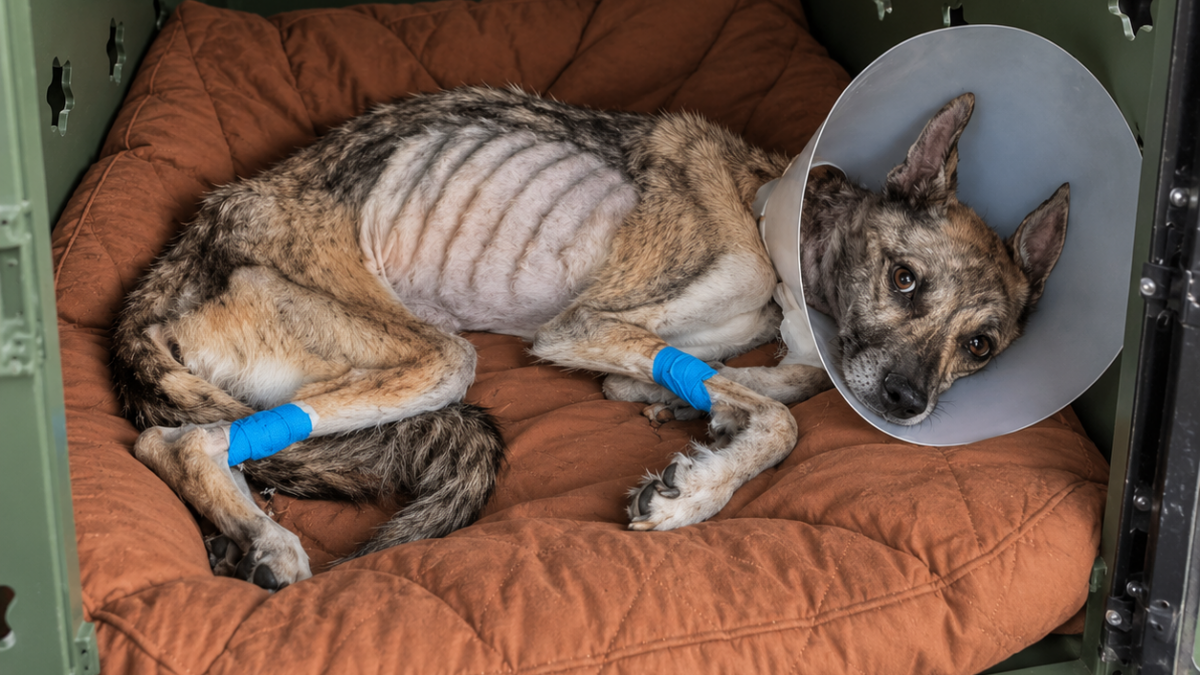
PART 2
I stared at her.
“What do you mean?”
She glanced back through the surgical doors before answering.
“We found rubber bands. Pieces of plastic. Hair. Other debris. Some of it was tangled together badly enough that it absolutely needed to come out.”
My stomach turned.
“So that was why he was starving?”
She shook her head.
“No.”
That single word changed everything.
The obstruction had made Raider’s condition worse, but it hadn’t created the body we’d seen on the examination table.
A blockage could explain vomiting, discomfort, poor absorption, and why he might stop eating for a period of time.
It could not explain the degree of long-term wasting Raider had endured.
The veterinarian pulled off her gloves.
“This happened before the obstruction became severe. He was starving long enough to start eating things that weren’t food.”
For a few seconds I couldn’t speak.
There is something almost easier about believing an illness caused suffering like that.
Illness doesn’t make a choice.
A tumor doesn’t look at a dog and decide not to fill his bowl.
An obstruction doesn’t watch an animal lose ten pounds, then twenty, then thirty, then forty.
People can.
I looked through the narrow window in the door.
Somewhere beyond it, Raider was still under anesthesia while the team worked to finish the procedure.
“How long would it take for a dog his size to get down to eighteen pounds?”
The veterinarian didn’t give me a precise answer, because there wasn’t one.
Metabolism, age, prior health, activity, access to water, and dozens of other factors could change the timeline.
But she said something I never forgot.
“Long enough for someone to notice.”
That sentence followed me for months.
Long enough for someone to notice.
Raider had not vanished overnight.
He had disappeared by inches.
A little less muscle over his shoulders.
A narrower waist.
Hips becoming visible.
Ribs beginning to show.
Energy fading.
Strength disappearing.
Eventually a dog who should have been close to eighty pounds became an eighteen-pound skeleton still trying to stay alive.
And somewhere during that decline, hunger became so consuming that rubber and plastic began to look like possibilities.
I walked outside because suddenly the clinic felt too small.
It was late afternoon, and cars were moving along the road as if nothing extraordinary was happening.
People stopped at the traffic light.
Someone carried groceries from a trunk.
A teenager laughed into a phone.
Ordinary life continued.
Inside the building, a dog was undergoing surgery because he had apparently become desperate enough to eat garbage.
I stood beside my car and cried.
Not loudly.
I was too angry for that.
I kept seeing Raider’s eyes.
He hadn’t growled when we handled him.
He hadn’t snapped when we touched his painful stomach.
He hadn’t even resisted when the technicians placed the catheter.
He had simply endured.
That frightened me more than aggression would have.
Dogs learn patterns.
They learn which sounds mean dinner.
Which drawer holds the leash.
Which footsteps belong to someone they love.
And sometimes they learn that crying doesn’t bring help.
Raider behaved like a dog who had learned that lesson.
When I returned inside, surgery was still underway.
One of the technicians handed me a cup of coffee I didn’t remember asking for.
“Any word?”
“Not yet.”
We waited.
Twenty minutes.
Then forty.
Then nearly an hour.
Every time the surgical doors moved, I looked up.
Finally the veterinarian came out again.
This time she looked tired.
But she smiled.
“He’s out.”
I almost dropped the coffee.
“He made it?”
“He made it through surgery.”
There was a deliberate caution in her wording.
Through surgery was not the same as safe.
Raider had survived anesthesia and the removal of the foreign material, but now his body had to recover from the procedure while also recovering from prolonged malnutrition.
His heart had been asked to keep working with almost nothing supporting it.
His blood pressure remained a concern.
His body temperature needed help staying normal.
His digestive system had to begin functioning again.
And feeding him presented its own danger.
People often assume the solution to starvation is simple.
Give food.
Give lots of it.
But after severe deprivation, suddenly flooding the body with calories can create dangerous metabolic shifts. Raider’s meals had to be measured carefully, introduced gradually, and monitored closely.
Everything had to be slow.
Everything except our hope.
That arrived all at once.
A few hours after surgery, I was allowed to see him.
He was lying beneath warming blankets with an IV line attached to one leg.
His eyes were partly open.
“Hey, Raider.”
One ear moved.
I smiled despite myself.
“You scared us.”
His eyes shifted toward my voice.
Then his nose moved.
That tiny gesture shouldn’t have felt important.
But with Raider, tiny things became milestones.
Breathing steadily.
Lifting his head.
Keeping his blood pressure up.
Showing interest in food.
Surviving another hour.
I placed my hand near his paw.
“You don’t know this yet,” I whispered, “but your old life is over.”
At the time, I meant that he wouldn’t be hungry anymore.
I didn’t know how complicated keeping that promise would become.
The next morning I arrived before seven.
Raider had survived the night.
His blood pressure had dipped once, but the team stabilized him. He was weak and uncomfortable, yet alert enough to follow movement around the room.
The veterinarian prepared his first tiny feeding.
It looked absurdly small.
After everything he’d endured, every instinct in me wanted to place a huge bowl in front of him.
Instead there was only a carefully measured amount of food.
Raider smelled it.
His entire expression changed.
His eyes widened.
He tried to lift himself too quickly and immediately stumbled.
“Easy,” the technician said, supporting his chest.
Raider stared at the food.
I will never forget that stare.
It wasn’t excitement.
It wasn’t the happy anticipation most dogs show before dinner.
It was panic.
He was afraid the food might disappear.
When the bowl reached him, he lunged weakly toward it.
The technician stopped him.
“Slow, buddy.”
Raider tried again.
Every movement said the same thing.
Eat now.
Before someone takes it.
Eat everything.
Before it disappears.
I had to turn my face away for a moment.
The technician noticed.
“It gets you, doesn’t it?”
I nodded.
“You can tell what they remember without knowing exactly what happened.”
She sat beside Raider while he ate.
A little food.
A pause.
Another little bit.
He searched the empty dish afterward.
Then he checked the floor.
Then beneath the blanket.
There was nothing.
I crouched beside him.
“More later.”
Of course he didn’t understand the words.
But I wanted him to hear the tone.
There will be another meal.
That became one of the most important lessons Raider had to learn.
Food would come again.
And again.
And again.
He didn’t need to swallow everything in sight because hunger was no longer an emergency.
The first week was terrifying.
Some mornings he looked stronger.
By afternoon he would seem exhausted.
His blood pressure fluctuated.
His digestion had to be watched.
His surgical incision needed monitoring.
He slept for long stretches, then woke suddenly and looked around as if he needed to confirm where he was.
Whenever someone entered carrying food, he became alert.
Whenever someone walked away with an empty dish, his eyes followed.
But something else began happening.
Raider started noticing people for reasons that had nothing to do with food.
On the fourth day, I sat beside his kennel answering messages while he rested.
I felt something touch my sleeve.
I looked down.
Raider had pushed his nose through the opening.
“You need something?”
His nose touched me again.
I opened the kennel carefully and sat on the floor.
He leaned forward.
For one terrifying second I thought he was collapsing.
Then I realized he was putting his head against my chest.
I stopped breathing.
He stayed there.
A dog who had every reason to distrust people was choosing contact.
I wrapped one arm around him carefully.
“You’re allowed to want things now,” I whispered.
His eyes closed.
That afternoon Raider took six steps without assistance.
The next day he took eleven.
Within a week, he could walk outside for several minutes.
His legs still looked painfully thin, but the change in his posture was unmistakable.
He had begun looking ahead instead of only down.
And with strength came personality.
The first time Raider barked at me, I laughed so hard I scared the receptionist.
He had been waiting for his breakfast, and apparently we were thirty seconds behind schedule.
I entered the recovery room carrying his bowl.
Raider looked at me.
Then at the bowl.
Then back at me.
“I’m coming.”
“Woooorrr.”
I froze.
One technician looked around the corner.
“Did he just complain?”
Raider did it again.
“Rrrr-woo.”
The entire room laughed.
There he was.
The dog beneath the bones.
Opinionated.
Impatient.
A little dramatic.
Very alive.
“Excuse me,” I said, setting down his controlled portion. “Somebody found his voice.”
After that, Raider became a talker.
If breakfast was late, he announced it.
If someone stopped scratching behind his ears too soon, he complained.
If he saw his leash and we didn’t immediately open the kennel, he produced an offended sound that made everyone laugh.
It was impossible not to love him.
But while Raider was healing, another part of his case was moving forward.
Because dogs don’t arrive at eighteen pounds without questions.
The rescue had documented everything from the moment he came into our custody.
His weight.
Photographs.
Veterinary examinations.
X-rays.
Surgical records.
Laboratory results.
Body-condition scores.
Statements from the people who had found him.
The foreign material removed from his digestive tract was photographed and preserved in the medical record.
Animal-control officers requested copies.
Then an investigator called me.
“I need you to walk me through exactly what you saw when he arrived.”
I did.
Every detail.
The scale.
The trembling.
The visible spine.
His desperate reaction to food.
The surgery.
The veterinarian’s assessment.
When I finished, the investigator was quiet.
Then he asked, “In your experience, could this have happened in two or three days?”
“No.”
He asked, “A week?”
“I can’t give you a medical timeline. The veterinarian needs to answer that.”
“Fair.”
I appreciated that he wasn’t asking us to exaggerate.
The truth was already bad enough.
Our veterinarian later provided the medical assessment.
Raider’s condition was consistent with severe prolonged malnutrition.
There was no evidence that a sudden mystery illness alone had caused his extreme body condition.
And the objects removed during surgery told their own bleak story.
Still, proving neglect was not the same as feeling certain it had occurred.
Legal accountability required evidence.
Records.
Witnesses.
A timeline.
Who had custody?
Who knew his condition?
Was food available?
Had veterinary care been sought?
Were there attempts to surrender him?
Had anyone asked for help?
Those questions mattered.
I wanted consequences immediately.
The investigator wanted a case that could survive scrutiny.
One afternoon, while Raider slept beside my chair, I admitted how angry I was.
The investigator had stopped by to photograph Raider’s recovery.
“He almost died,” I said.
“I know.”
“Someone watched that happen.”
“We’re working on it.”
“That doesn’t feel like enough.”
He lowered his camera.
“It has to be enough until we can prove more.”
I hated that answer.
Later, I understood it.
Justice built only from anger collapses easily.
Justice built from evidence is harder to escape.
So we documented everything.
Meanwhile Raider kept recovering.
Eighteen pounds became twenty-one.
Then twenty-four.
Then twenty-eight.
The numbers sounded small compared with where he needed to be, but each one represented something remarkable.
His body was accepting nourishment.
His muscles were returning.
His coat began losing its dry, brittle appearance.
His wounds healed.
One morning I noticed something especially ordinary.
Raider stretched.
Front legs forward.
Chest down.
Back end in the air.
A normal dog stretch.
I stared at him until he looked at me as if I were strange.
“You have no idea what you just did, do you?”
He sneezed.
Three weeks earlier he had barely been able to stand.
Now he was stretching because he’d slept comfortably.
That afternoon we brought him a soft toy.
It was a blue stuffed animal with long ears.
Raider sniffed it.
Then looked at me.
I moved it across the floor.
Nothing.
I squeaked it.
His ears lifted.
I squeaked it again.
He stepped forward.
Then something changed.
He dropped his front legs, bounced once, grabbed the toy, and shook it.
Everyone in the room cheered.
Raider stopped instantly, startled by the noise.
Then he ran—or what counted as running for him at that point—straight toward me with the toy hanging from his mouth.
I laughed until I cried.
It wasn’t because playing with a stuffed toy was extraordinary.
It was because Raider finally had enough energy to waste some.
For a starving animal, every calorie serves survival.
Heartbeat.
Breathing.
Body temperature.
Movement.
There is nothing left for silliness.
Play meant Raider’s body was beginning to believe there might be a tomorrow.
But recovery wasn’t a straight line.
One night his blood pressure dropped again.
I received the call just after midnight.
“We’re monitoring him closely.”
I sat upright in bed.
“Is he crashing?”
“Not right now.”
Those three words were supposed to reassure me.
They didn’t.
I drove to the clinic.
Raider looked tired.
Too tired.
The familiar fear returned immediately.
I sat beside him while the veterinary team adjusted treatment.
“You are not doing this,” I told him softly.
His eyes opened.
“No. Absolutely not. You finally learned how to yell at us for breakfast. You don’t get to quit now.”
His tail tapped once against the bedding.
I don’t know whether Raider understood anything beyond my voice.
But I kept talking.
I told him about grass.
About car rides.
About soft beds.
About the ridiculous number of toys people had already donated for him.
I told him someday he would walk into a kitchen and smell dinner without wondering whether it would be his last meal.
I told him someday a person would say his name and he would hear love instead of uncertainty.
“You haven’t even had the good part yet,” I whispered.
Raider slept.
By morning, his numbers improved.
Two days later, he barked at me because breakfast was late.
I had never been happier to be yelled at.
Around that same time, investigators found something important.
A neighbor had photographs.
Not photographs taken specifically of Raider.
Ordinary pictures.
A birthday gathering.
A backyard barbecue.
A photo of a repaired fence.
Raider appeared in the background.
In one image months earlier, he was thin but still recognizably strong.
In another, taken later, his ribs were visible.
Then there was a third.
His hips protruded.
His abdomen was sharply tucked.
The progression existed accidentally in other people’s memories.
The neighbor had also noticed Raider searching trash containers.
“I thought maybe he was just one of those dogs who got into everything,” she told investigators.
“Did you ever see him being fed?”
“Not toward the end.”
“Did you notice his weight?”
“Yes.”
“Did you say anything?”
The woman reportedly went quiet.
That answer haunted me almost as much as Raider’s condition.
People had noticed.
Maybe not everyone understood how severe it was.
Maybe some assumed someone else would handle it.
Maybe somebody believed it wasn’t their business.
But Raider’s body had been visible.
The starvation had been visible.
That changed something in me.
Neglect survives easily inside the sentence, “It’s probably fine.”
The investigation continued.
Raider, thankfully, didn’t know any of that.
His world was becoming beautifully simple.
Breakfast.
Walk.
Nap.
Dinner.
People.
Toys.
More walks.
One afternoon I took him outside and sat beneath a tree near the clinic.
He lowered himself onto the grass.
For several minutes he just smelled the air.
Then a leaf moved in the breeze.
Raider stared at it.
The leaf rolled.
He pounced.
Missed.
Looked confused.
Then pounced again.
I laughed.
“You’re learning how to be a dog.”
He grabbed the leaf.
It immediately crumbled.
Raider looked betrayed.
“You can’t eat that.”
He stared at me.
I pointed toward him.
“Especially you.”
He sneezed and rolled onto his side.
I rested my hand against his chest.
For the first time, I couldn’t count his ribs instantly.
They were still visible.
But there was beginning to be something over them.
Something living.
Growing.
Returning.
By the time Raider reached thirty-five pounds, we began discussing foster placement outside the clinic.
That conversation scared me more than I expected.
The clinic had become safe because everything was controlled.
His meals.
Medication.
Activity.
Monitoring.
A home would introduce unpredictability.
What if he swallowed something dangerous again?
What if food insecurity triggered guarding?
What if he panicked when left alone?
What if normal household sounds frightened him?
What if someone expected too much too quickly?
We needed a foster who understood that saving Raider medically was only half the job.
A woman named Claire volunteered.
She had fostered difficult medical cases before and lived alone with an older dog named Murphy.
The first meeting happened in a fenced yard.
Raider walked in wearing a red harness that still looked too large around his chest.
Claire crouched sideways rather than approaching directly.
“Hi, Raider.”
He stopped.
Murphy sniffed from a distance.
Raider looked at me.
I could almost hear the question.
Is this safe?
I walked him closer.
Claire offered her hand.
Raider smelled it.
Then he moved past her and inspected the yard.
“That good?” Claire asked.
“Very.”
Twenty minutes later he lay near her feet.
An hour later he rested his chin on her shoe.
Claire looked at me.
“I think he can come home.”
The word home made my throat tighten.
His first night with Claire revealed how deeply hunger had shaped him.
She called me around ten.
“He’s okay,” she said immediately. “Don’t panic.”
I panicked anyway.
“What happened?”
“I opened a cabinet.”
“And?”
“He heard the bag inside.”
Raider had rushed into the kitchen and begun searching frantically.
Not aggressively.
Desperately.
When Claire closed the cabinet, he paced.
She opened it again.
He stared.
Inside were bags of rice, pasta, flour, and snacks.
Raider sat beneath them and refused to leave.
Eventually Claire brought his bed into the kitchen.
“He’s sleeping in front of the cabinet now,” she said.
I closed my eyes.
Food had become security.
If Raider could see where food lived, perhaps part of him believed he could prevent it from disappearing.
“What are you going to do?”
“Leave the bed there tonight.”
I smiled.
That was why we had chosen Claire.
She wasn’t going to force Raider to behave like a dog who hadn’t experienced starvation.
She was going to help him learn that starvation was finished.
Over the following weeks, she established a schedule.
Breakfast at the same time.
Lunch at the same time.
Dinner at the same time.
Small snacks during training.
The cupboard opened regularly.
Food entered Raider’s bowl.
The cupboard closed.
Then it opened again later.
Nothing vanished forever.
Slowly he stopped sleeping in the kitchen.
First he moved to the doorway.
Then the hallway.
Then, one night, Claire sent me a photograph.
Raider was sleeping upside down on the sofa.
Four legs in the air.
Mouth slightly open.
A ridiculous picture.
I stared at it for several minutes.
A dog sleeping like that isn’t guarding himself.
He isn’t protecting his stomach.
He isn’t waiting for danger.
He is simply asleep.
I saved the photograph.
Raider reached forty pounds.
Then forty-seven.
His training began.
Sit.
Stay.
Come.
Leave it.
“Leave it” mattered more for Raider than most dogs.
Anything on the ground could trigger old survival habits.
Food wrappers.
Plastic.
Rubber.
Trash.
Things that once might have filled his stomach now had to become irrelevant.
Claire worked patiently.
She would place a safe object on the floor.
“Leave it.”
Raider stared.
Then looked at her.
“Good boy.”
Treat.
Again.
“Leave it.”
Look away.
Treat.
Week after week.
Eventually he could walk past dropped food wrappers outside.
Then plastic bags.
Then trash near sidewalks.
He wasn’t perfect.
No dog is.
But he was learning something profound.
He no longer had to eat whatever the world left behind.
The world would feed him.
At fifty pounds, Raider discovered tennis balls.
This became everyone’s problem.
He wanted tennis balls constantly.
He carried them through the house.
He dropped them into Claire’s lap.
He placed them on Murphy’s bed.
He once carried two simultaneously and spent fifteen minutes trying to pick up a third.
Claire sent me the video.
I laughed until I had tears in my eyes.
“He’s greedy,” she said.
“Good.”
“For tennis balls.”
“Even better.”
But while Raider was growing stronger, the case against the person responsible for his condition was also strengthening.
Veterinary records had been reviewed.
Witness statements had been taken.
Photographs established a progression.
Investigators had reconstructed enough of Raider’s recent history to conclude that his condition had not been hidden or sudden.
Then came the question everyone kept asking me.
“What’s going to happen to the person who did this?”
I had learned to answer carefully.
“That’s for the legal process to determine.”
Privately, I wanted something harsher.
I wanted whoever had watched Raider shrink to eighteen pounds to see every photograph from his intake.
I wanted them to understand what starvation looks like after the fur is no longer thick enough to hide it.
I wanted them to see the rubber bands and plastic removed from his body.
I wanted them to hear the panic in his breathing when food was taken away.
I wanted them to watch Claire sit beside a kitchen cabinet because a starving dog’s memory wouldn’t allow him to sleep anywhere else.
I wanted consequences that felt equal to his suffering.
But there is no legal sentence that can return months of hunger to a dog.
There is no court order that gives back the nights he spent searching for something edible.
So I learned that revenge, if you want to call it that, had to mean something different.
Raider’s revenge would not be suffering.
It would be evidence.
Recovery.
A permanent record.
A life so visibly transformed that nobody could pretend his condition had been inevitable.
Several months after Raider’s rescue, I was asked to attend a hearing connected with the neglect case.
I sat in a hallway holding a folder thick with records.
Inside were photographs I hated looking at.
Raider at eighteen pounds.
His ribs.
His spine.
His sunken face.
Surgical documentation.
Weight charts.
Medical notes.
The foreign objects.
One page listed each recorded increase in body weight.
18.
21.
24.
28.
31.
35.
40.
47.
52.
I kept looking at those numbers.
They were more powerful than anger.
They showed what happened once Raider received ordinary care.
Not extraordinary medicine forever.
Not some miracle diet.
Food.
Safety.
Veterinary treatment.
Consistency.
Care.
Each pound made the old excuses smaller.
The hearing itself was far less dramatic than people imagine courtrooms are.
No one shouted.
No one slammed a fist against a table.
Documents were introduced.
Questions were asked.
Answers were given.
The veterinarian described Raider’s condition professionally.
Severe emaciation.
Muscle wasting.
Prolonged malnutrition.
Foreign-body ingestion.
Emergency surgery.
Risk associated with anesthesia due to his condition.
When asked whether the foreign material fully explained Raider’s weight, she said no.
When asked whether his condition would have been visually obvious before he reached eighteen pounds, she explained that substantial weight loss and muscle wasting would have developed progressively.
The room was silent.
Then photographs were shown.
I watched the person connected to Raider’s former care look toward the screen.
For the first time, I wondered what it was like to see the result from the outside.
Not a dog you walked past each day.
Not a bowl you forgot or chose not to fill.
Not a problem becoming gradually easier to ignore.
A photograph.
Frozen in time.
Eighteen pounds.
Nothing to rationalize.
Nothing to look away from by walking into another room.
The legal process eventually resulted in findings of neglect and restrictions intended to prevent another animal from being placed in the same circumstances.
There were financial penalties and requirements connected to the case.
To some people, that sounded too small.
To others, the most important part was the restriction on future animal ownership.
For me, the moment that mattered came outside the hearing room.
The investigator closed his folder and said, “This case exists because everyone documented what happened.”
I nodded.
“I wanted something bigger.”
He understood what I meant.
“They always do.”
I looked at Raider’s intake photograph again.
Then I thought about the dog who now screamed at Claire because she was holding a tennis ball.
Maybe accountability didn’t have to feel dramatic to matter.
Maybe sometimes the most important victory was ensuring the neglect could no longer be denied.
Raider reached sixty pounds.
His face changed first.
The hollow spaces disappeared.
His eyes seemed softer because they were no longer surrounded by sharp bone.
His chest widened.
His shoulders developed muscle.
His coat became glossy.
People who had seen only his intake photographs sometimes failed to recognize him.
One volunteer walked into the foster yard and asked, “Where’s Raider?”
I pointed toward the enormous dog chasing a tennis ball.
She stared.
“No.”
“Yes.”
“That is not Raider.”
Raider ran toward us carrying the ball.
His body collided gently with her legs.
She covered her mouth.
“Oh my God.”
He dropped the ball.
She crouched.
He licked her face.
She began crying.
Raider immediately stole the ball back.
That was becoming his response to emotional situations.
Take the ball.
Run.
At sixty-six pounds, he started hiking short trails.
At seventy, the veterinarian reduced some of his restrictions.
At seventy-four, he could run across Claire’s yard without looking fragile.
At seventy-seven pounds, he returned to the clinic for a full examination.
The same technician who had covered him with the warming blanket on his first day was working.
She came into the room and stopped.
Raider stood beside me wearing a blue collar.
Muscular.
Bright-eyed.
Tail moving hard enough to hit the cabinet.
The technician whispered, “Are you kidding me?”
Raider recognized her voice.
He walked over.
She knelt and pressed her face against his neck.
“I remember when I could put my hand around your waist.”
Raider licked her ear.
The veterinarian entered with his old chart.
She weighed him.
Seventy-eight pounds.
For a few seconds nobody said anything.
Then she smiled.
“There you are.”
I felt tears coming before I could stop them.
That number had been mentioned on Raider’s first day.
Close to eighty pounds.
That was roughly where his frame should have been.
Back then, eighty sounded impossible.
Now he stood at seventy-eight, impatient because someone had placed treats on the counter.
The veterinarian listened to his heart.
Checked his abdomen.
Examined his surgical area.
Looked at his gums.
Ran bloodwork.
Everything we had once watched minute by minute was now ordinary.
Healthy.
Stable.
Alive.
“He’s ready,” she said.
I knew what she meant.
Adoption.
I should have been thrilled.
Instead I felt something twist in my stomach.
Raider had belonged emotionally to everyone who helped save him.
But loving a rescue means eventually accepting that recovery is supposed to lead somewhere beyond you.
Claire and I began reviewing applications.
There were many.
People had heard Raider’s story.
Some wanted him because they felt sorry for him.
Those were not automatically bad people, but sympathy alone wasn’t enough.
Raider needed structure.
Training.
Patience.
A home that understood his food history.
Someone who would continue “leave it” training.
Someone who wouldn’t create chaos around meals.
Someone who saw Raider as a dog, not a tragedy.
Then we met Daniel and Marissa.
They lived outside town on a few fenced acres.
Their previous dog had died at fourteen.
They had waited almost a year before considering another.
During the first meeting, Daniel didn’t immediately kneel or call Raider.
He sat on a bench.
Raider approached when he was ready.
Sniffed Daniel’s shoes.
Then his hands.
Then walked away.
Daniel smiled.
“Apparently I passed the first inspection.”
Marissa laughed.
“Or failed it so badly you’re irrelevant.”
Raider returned carrying his tennis ball.
He placed it directly in Daniel’s lap.
Claire looked at me.
That was promising.
Daniel picked up the ball.
“Can I throw it?”
“You may regret asking that,” Claire said.
He threw.
Raider brought it back.
Again.
Again.
Again.
Twenty-six throws later, Daniel was still smiling.
“I can do this all day.”
Claire whispered, “He shouldn’t have said that.”
Raider dropped the ball again.
The next test involved food.
We explained Raider’s history.
The cabinet sleeping.
The scavenging.
The surgery.
His early panic when bowls were removed.
Marissa listened without interrupting.
Then she asked something that made me pay attention.
“What does he need us not to do?”
Not, “What problems does he have?”
Not, “Is he aggressive?”
Not, “Will he ruin anything?”
What does he need us not to do?
Claire answered carefully.
“Don’t tease him with food. Don’t change his schedule suddenly if you can avoid it. Don’t leave dangerous things where he can swallow them. Don’t punish him for old survival behaviors. Redirect them.”
Marissa nodded.
“We can do that.”
The adoption wasn’t immediate.
There were multiple visits.
A home check.
Another meeting.
An overnight trial.
Then a weekend.
Each time Raider returned to Claire happy.
Each time he also greeted Daniel and Marissa with more confidence.
Finally came the day.
I arrived at Claire’s house early.
Raider’s belongings were arranged near the door.
Bed.
Bowls.
Medication records.
Training notes.
Toys.
An absurd quantity of tennis balls.
Claire stood in the kitchen pretending she wasn’t crying.
“You okay?”
“No.”
“Me neither.”
Raider walked between us carrying a ball.
He had no idea why the humans were malfunctioning.
When Daniel and Marissa arrived, Raider ran to the door.
His tail exploded into motion.
That helped.
We went through the paperwork.
Emergency contacts.
Feeding schedule.
Veterinary information.
Microchip details.
Training instructions.
Then there was nothing left to explain.
Daniel clipped the leash to Raider’s collar.
I knelt.
Raider came immediately.
I put both hands around his face.
For a moment, I saw the eighteen-pound dog again.
Not because he looked anything like him.
Because his eyes did.
Same dog.
Different life.
“You did it,” I whispered.
Raider licked my chin.
“You actually did it.”
Daniel gave us time.
I pressed my forehead gently against Raider’s.
“When somebody opens a cabinet now, you don’t have to worry.”
His tail moved.
“There will always be food.”
He sneezed directly into my face.
I laughed through the tears.
“Beautiful moment ruined. Thank you.”
Claire hugged him next.
Then Daniel opened the car door.
Raider jumped onto the back seat.
No hesitation.
No fear.
He immediately discovered a tennis ball waiting there.
I looked at Daniel.
“Bribery?”
“Strategic preparation.”
Raider grabbed the ball.
The door closed.
I expected watching him leave to hurt.
It did.
But it also felt completely different from losing him.
We weren’t watching Raider disappear.
We were watching him go home.
A month later I received a photograph.
Raider was lying on a couch between Daniel and Marissa, upside down, legs in the air.
Another showed him running through their yard.
Another showed him asleep beside the pantry.
I laughed when I saw that one.
Apparently some habits become traditions.
Then came a video.
Daniel was preparing Raider’s dinner.
Raider sat several feet away.
The bowl went down.
“Wait.”
Raider waited.
His body was relaxed.
No frantic movement.
No panic.
Daniel looked at him.
“Okay.”
Raider walked to the bowl and began eating.
Walked.
He didn’t lunge.
He didn’t inhale everything in terror.
He ate.
Paused once.
Looked around.
Then continued.
I replayed the video five times.
That was the moment I understood Raider’s greatest recovery wasn’t visible on the scale.
He had learned there would be another meal.
Months passed.
His updates became less medical.
Raider went hiking.
Raider destroyed a stuffed duck.
Raider stole Daniel’s place in bed.
Raider refused to come inside because it had snowed.
Raider discovered sprinklers.
Raider barked at a plastic lawn deer for ten uninterrupted minutes.
Normal problems.
Wonderful problems.
Then, almost a year after his rescue, we held a small fundraiser for the organization.
Daniel and Marissa brought Raider.
I saw him before he saw me.
He stepped out of their vehicle at nearly eighty pounds, broad-chested and glossy, wearing a green bandana.
For one second I simply stared.
People say transformation photographs are unbelievable.
They’re right.
Memory is strange.
I remembered logically how thin he had been, but standing there looking at the dog he’d become made the original version seem impossible.
Then Raider spotted me.
His entire body changed.
His ears lifted.
His tail began moving.
Daniel released the leash.
Raider ran.
I barely had time to crouch before seventy-nine pounds of dog slammed into me.
I fell backward laughing.
“Raider!”
He climbed halfway onto my chest.
“You weigh too much now!”
He licked my face.
People around us laughed.
I held him by the shoulders.
“You know that’s the nicest complaint I’ve ever made about you?”
He barked.
That same ridiculous talking bark he’d discovered at the clinic.
I looked at Daniel.
“He still does that?”
“Every day.”
“Good.”
Later that afternoon, someone displayed a board showing rescue transformations.
Raider’s intake picture was among them.
Eighteen pounds.
Beside it was a recent photograph.
Seventy-nine.
The contrast stopped people.
Some stared for a long time.
A woman beside me whispered, “That can’t be the same dog.”
Raider happened to be standing nearby.
I pointed.
“That’s him.”
She looked from the photograph to Raider.
Her eyes filled.
“How?”
It was such a simple question.
How do you rebuild something that damaged?
Medicine.
Food.
Patience.
Evidence.
Routine.
People who refuse to look away.
But there was another answer.
Raider.
We gave him the opportunity.
He did the surviving.
He endured surgery when his body barely had enough strength for anesthesia.
He learned to stand again.
Walk again.
Play again.
Trust again.
He taught himself that a bowl could become empty without becoming a disaster.
He learned that a hand reaching toward him might carry a leash or a toy instead of taking something away.
He learned that cabinets reopen.
Meals return.
People come back.
Homes can be safe.
That evening Daniel was loading their car when the animal-control investigator who had worked Raider’s case appeared.
He hadn’t seen Raider in several months.
He stopped beside me.
“Is that him?”
I smiled.
“That’s him.”
Raider approached.
The investigator crouched and scratched his chest.
“Hard to believe.”
“I know.”
He looked toward Raider’s photograph on the display.
Then back at the living dog.
“The restrictions from the case are still in place,” he told me.
I understood what he meant.
The person responsible wasn’t going to quietly acquire another dog and repeat the same situation without consequences.
For months I had imagined revenge as something dramatic.
A courtroom revelation.
A sentence that would make everyone gasp.
A punishment equal to seeing Raider at eighteen pounds.
Life rarely works that neatly.
Instead, we got something quieter.
A documented case.
Legal consequences.
Restrictions.
A permanent record.
And a dog who survived long enough to stand in front of his own before-and-after photographs.
That became enough for me.
Not because what happened to him mattered less.
Because Raider’s life mattered more than my anger.
He had already spent too much of his existence defined by what someone failed to give him.
He didn’t deserve to spend the rest of it being introduced only as the dog who was starved.
He was Raider.
He loved tennis balls.
He hated rain.
He made strange noises when dinner was late.
He slept upside down.
He believed every car ride should end somewhere interesting.
He could locate a dropped treat faster than any animal I had ever met.
He adored Marissa.
He followed Daniel into the garage even though power tools frightened him.
He liked sleeping beside the pantry, not because he feared food would disappear anymore, but apparently because he had decided the kitchen was objectively the best room in the house.
His story had begun with what had been taken from him.
It deserved to end with what he’d gained.
A year after his adoption, Daniel invited me over for Raider’s “birthday.”
Nobody knew Raider’s real birthday, so they used the date of his rescue.
When I arrived, Raider greeted me at the gate carrying a tennis ball.
“You remembered me.”
He dropped the ball at my feet.
I threw it.
He raced across the yard.
There was power in his stride now.
Real muscle.
His paws kicked dirt behind him as he turned.
He grabbed the ball and came back at full speed.
For a second I saw two dogs at once.
The one on the steel table who could barely lift his head.
And this one.
Running.
I remembered the veterinarian’s words from that first afternoon.
If we operate, he may not tolerate it.
If we wait, we may lose him anyway.
I remembered standing outside the clinic believing we might be witnessing the final hours of a dog nobody had protected soon enough.
Now Raider dropped the ball against my shoe and barked because I wasn’t throwing it quickly enough.
“Okay, okay.”
I threw it again.
Daniel came outside carrying a small dog-safe birthday cake.
“Don’t show him that yet,” I said.
“Why?”
Raider abandoned the tennis ball.
His nose lifted.
Too late.
He ran toward Daniel.
“Sit,” Daniel said.
Raider sat.
“Wait.”
He waited.
I noticed the detail immediately.
His eyes were on the cake.
His body was excited.
But he waited.
Daniel placed a piece in Raider’s bowl.
Raider remained sitting.
“Okay.”
He walked forward.
Again, walked.
No panic.
No desperate swallowing.
No fear that someone would change their mind.
After a few bites, Raider actually stepped away to drink water.
Then he returned and finished.
Such a small thing.
Such an enormous thing.
I looked at Claire, who had also come.
She knew exactly what I was thinking.
“He knows,” she said.
“Knows what?”
“That there’ll be more tomorrow.”
I looked at Raider.
He finished his cake and immediately retrieved his ball.
Maybe that was the whole story.
There would be more tomorrow.
For months before his rescue, tomorrow may have meant another empty stomach.
Another weakening day.
Another search through garbage.
Another night of hunger.
Then tomorrow changed.
Another measured meal.
Another walk.
Another pound.
Another toy.
Another person saying his name gently.
Another chance.
That was how Raider rebuilt his life.
Not through one miraculous moment.
Through thousands of ordinary promises that were finally kept.
Feed him.
Come back.
Walk him.
Come back.
Leave the room.
Come back.
Open the cupboard.
Feed him.
Come back tomorrow.
Again.
Again.
Again.
Dogs notice consistency more than speeches.
Raider didn’t need us to explain love.
He needed us to demonstrate it until his body stopped expecting abandonment.
Near sunset, the temperature dropped.
Everyone went inside except me.
I stayed in the yard with Raider.
He lay beside my chair chewing his tennis ball.
The light turned orange over the trees.
I ran my hand along his back.
There was muscle beneath my palm.
No sharp spine.
No frightening hollowness.
Just a healthy dog.
“Do you know what you looked like when I met you?”
Raider continued chewing.
“Eighteen pounds.”
He glanced at me.
“That’s what the scale said.”
He dropped his ball.
I picked it up.
“There were people who didn’t think you’d make it.”
His ears lifted.
“I wasn’t sure either.”
I threw the ball.
Raider exploded across the grass.
I laughed.
“Show-off.”
He brought it back.
Again.
I threw.
Again.
Eventually he became tired and lay at my feet.
Daniel opened the back door.
“You staying for dinner?”
I looked down at Raider.
The word dinner caused his ears to lift instantly.
I laughed.
“He heard you.”
Daniel smiled.
“He always does.”
Raider stood.
Then he paused.
Instead of running inside immediately, he looked back at me.
I don’t pretend dogs understand human stories the way we do.
Raider didn’t know about court records.
He didn’t know what investigators had written.
He didn’t know photographs of his skeletal body had been entered as evidence.
He didn’t know people had argued about consequences.
He didn’t know his recovery had changed the way some of us would respond forever when we saw an animal becoming too thin.
He only knew his life now.
And maybe that was better.
“Go on,” I told him.
Raider turned and trotted toward the house.
Halfway there he stopped.
Daniel opened the door wider.
Warm light spilled across the porch.
Raider went inside.
I followed.
His food bowl waited in its usual place.
Daniel measured dinner.
Raider sat.
Waited.
Received the command.
Then ate slowly while people talked around him.
Nobody stared.
Nobody worried that his heart might stop.
Nobody watched the clock between blood-pressure readings.
Nobody counted ribs.
It was simply dinner.
I stood in the doorway and realized that ordinary was exactly what we had fought for.
Not a heroic ending.
Not a dramatic final scene.
A dog eating dinner in a warm house without being afraid.
That was the victory.
And there was one final part of Raider’s story I never expected.
Several weeks later, animal control contacted our rescue about another dog.
Different address.
Different circumstances.
A neighbor had reported that the animal appeared severely underweight.
Normally people hesitate.
They wonder whether they’re overreacting.
They tell themselves maybe the dog is old.
Maybe it is sick.
Maybe the owner already knows.
This neighbor had seen Raider’s story.
She later told an officer, “I kept thinking about that eighteen-pound dog. I decided I’d rather be wrong than stay quiet.”
She wasn’t wrong.
The second dog needed help.
He wasn’t in Raider’s condition yet.
That was exactly the point.
He didn’t have to become Raider before someone acted.
When I heard that, I sat at my desk for a long time.
Maybe Raider’s story had reached further than we knew.
Maybe every person who had seen his intake photograph and felt uncomfortable would recognize the next dog sooner.
Maybe someone would ask a question.
Make a call.
Knock on a door.
Offer food.
Contact authorities.
Do something before eighteen pounds.
People sometimes ask me what I think Raider’s life would have looked like if rescuers had arrived a week later.
I don’t answer.
I don’t want to imagine it.
His body had already used almost everything available to survive.
His digestive system was obstructed.
His blood pressure was unstable.
His muscles were disappearing.
There may not have been another week.
But Raider didn’t die as the dog who weighed eighteen pounds.
That’s not his ending.
The last time I visited him, he weighed just under eighty.
He met me at the gate with a tennis ball.
He complained when I stopped scratching his ears.
He stole my seat when I stood up.
He tried to convince Daniel that he had never been fed before in his entire life approximately twelve minutes after dinner.
And when I opened the pantry to put away a bag of treats, Raider looked inside.
He looked at me.
Then he walked away.
I froze.
“Raider.”
He kept walking toward the living room.
I stared at the open pantry.
Once, he had been unable to sleep unless he could guard food.
Now he didn’t even need to watch me close the door.
I followed him.
Raider had climbed onto his bed and was chewing his tennis ball.
I sat beside him.
“You really did it.”
He placed one paw on my leg.
I thought of the day we met.
An eighteen-pound body.
A warm blanket.
A dangerous surgery.
Rubber bands.
Plastic.
Hair.
A veterinarian telling us that the objects in his stomach explained only part of what had happened.
And I remembered the question that had made me the angriest.
How could somebody watch a dog reach that condition?
I still don’t have an answer that satisfies me.
Maybe there isn’t one.
But I do know what happened afterward.
People stopped looking away.
A veterinary team took the risk.
Rescuers documented everything.
Investigators followed the evidence.
A foster taught him that food returned.
A family gave him a home.
And Raider did the hardest part.
He stayed.
He stayed through surgery.
He stayed through weakness.
He stayed through fear.
He stayed long enough to learn that hands could be gentle and bowls could be full.
He stayed until his ribs disappeared beneath healthy muscle.
He stayed until the photographs of the starving dog looked almost impossible beside the dog standing in front of us.
I rubbed the side of his neck.
“You know what the best revenge was, Raider?”
His tail thumped.
“It wasn’t what happened in court.”
Another thump.
“It wasn’t the fines.”
He leaned against me.
“It wasn’t even knowing they couldn’t just do this again without consequences.”
Raider rested his head across my knee.
“The best revenge was this.”
A warm room.
A healthy body.
A family nearby.
Dinner already eaten.
Breakfast guaranteed.
Tomorrow waiting.
Raider closed his eyes.
For a dog who had once eaten plastic because his stomach was empty, there was something almost unbelievable about watching him fall asleep beside an open pantry and not care what was inside it.
I rested my hand on his shoulder.
This time, there were no bones pressing sharply into my palm.
Only strength.
Only warmth.
Only Raider.
And for the first time since the day I met him, I didn’t think about the eighteen-pound dog he had been.
I looked at the dog sleeping peacefully beside me and thought about the life still ahead of him.
A life filled with meals he would never have to beg for.
Tennis balls he would probably destroy.
Walks that would last too long.
Furniture he wasn’t technically supposed to sleep on.
People who would always come back.
And thousands of tomorrows he once almost didn’t have.
Raider had spent too long disappearing.
Now, finally, he was here.
Completely.
Safely.
Home.

