PART 2: He Locked a Puppy in Darkness for 8 Months—Then Tried to Take Him Back After We Saved His Life
For eight months, a puppy cried behind a door no one was supposed to open.
The first time I reached for him, he flinched so violently that I realized kindness itself had become something he was afraid of.
I thought getting him out of that room would be the hardest part, but I had no idea how far one man would go to keep the truth buried behind that door.
The call came from a woman I had never met.
She had been searching the neighborhood for her missing cat when she heard something that made her stop walking.
At first, she thought it was another animal somewhere behind one of the houses. The sound was faint, almost swallowed by the walls around it, but when she stood still and listened again, she heard it clearly.
A puppy was crying.
Not barking.
Not whining for attention.
Crying.
She followed the sound toward a small building behind a house and found a closed door.
When she asked the owner what was inside, he brushed her off.
“It’s just my dog.”
Something about the way he said it made her uneasy.
She stayed nearby long enough to hear the crying again.
Then she called us.
By the time I arrived, the afternoon heat had settled over the neighborhood, but the small room behind the house felt strangely cold when I stepped toward it. There was almost no light coming through the cracks.
The smell reached me before I saw him.
Damp concrete.
Urine.
Infected skin.
A heavy, sour smell that told me an animal had been living in conditions no young dog should ever know.
Then the door opened.
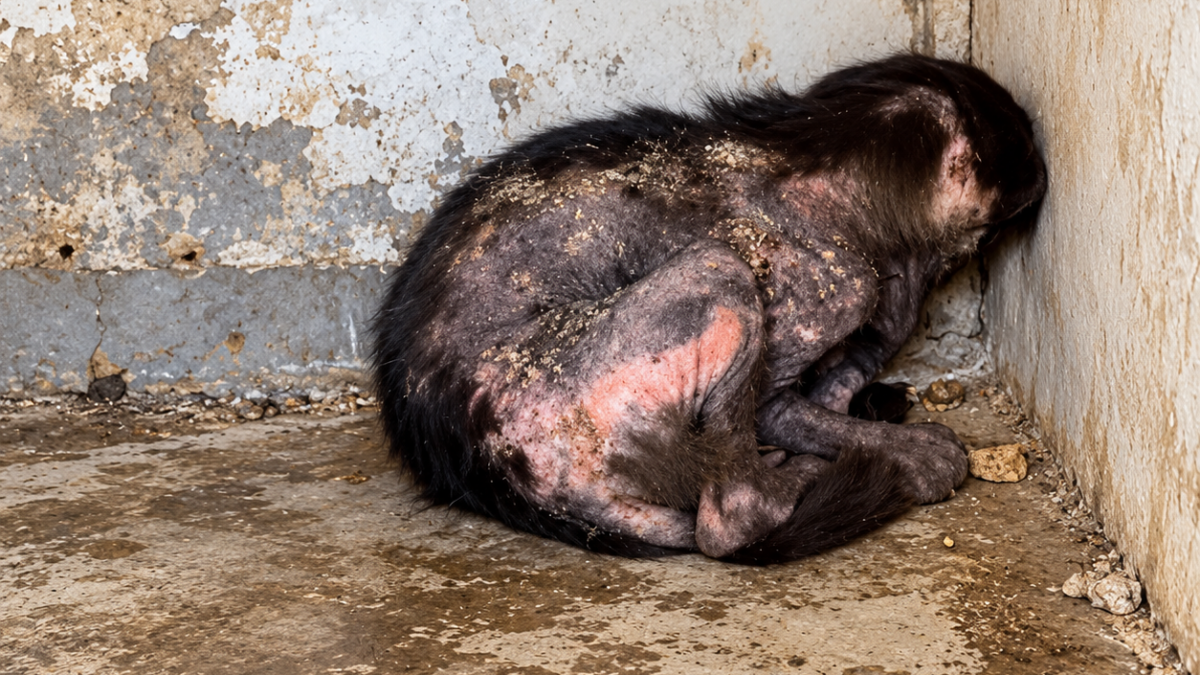
For several seconds, I could barely make out the shape curled near the wall.
He was smaller than I had imagined.
His skin was covered in severe mange. Large areas of his body had lost their fur completely, and the exposed skin underneath was thickened, inflamed and raw. His ribs showed beneath his damaged coat.
But it was his face that stayed with me.
His eyes opened slowly.
He looked toward us without lifting his head.
“Hey, baby,” I whispered.
He didn’t move.
I crouched several feet away.
My instinct was to reach for him, to tell him with my hands that he was safe now, but when I slowly extended one hand, his entire body tightened.
He tried to shrink farther into the wall.
I stopped immediately.
That reaction told me more about his life than any explanation his owner could have given.
This puppy was terrified of being touched.
I later learned that his name was Koda.
He had been placed in that room when he was about one month old.
One month.
I kept repeating those words in my head.
At one month old, puppies are supposed to be learning what the world feels like. Grass beneath their paws. Human voices. Warm beds. Toys. Other dogs. Sunlight.
Koda had learned darkness.
While other puppies were running through yards, he had been staring at the same walls.
While they were learning that hands could bring food and affection, he had learned to pull away when a hand moved toward him.
Eight months had passed like that.
I looked at his eyes again and became worried that the darkness had affected his vision.
“He needs a veterinarian right now,” I said.
The owner stepped between us.
“You’re not taking him.”
I thought I had misheard him.
I looked down at the puppy whose skin was infected and whose body was weak from neglect, then back at the man standing in front of me.
“He needs medical treatment.”
“He’s my dog.”
“He’s sick.”
“I said no.”
My stomach tightened.
Every minute we spent arguing was another minute Koda stayed in that room.
I tried reasoning with him.
Then pleading.
Then explaining what could happen if the infections became worse.
Nothing moved him.
Finally, he named a price.
For a second, I could only stare at him.
He wanted money.
Money in exchange for allowing a suffering puppy to leave the room where he had kept him for most of his life.
Everything inside me wanted to refuse.
Everything inside me wanted to tell him he didn’t deserve a single cent.
But then I looked past him.
Koda was still curled against the wall.
Justice could come later.
Koda might not have that kind of time.
So I paid.
The moment the man stepped aside, I went back into the room.
This time I didn’t reach for Koda immediately.
I sat near him.
“You don’t know me yet,” I whispered. “That’s okay.”
His eyes stayed on me.
“We’re leaving.”
When I finally lifted him, his body became rigid in my arms.
He didn’t understand that the door was opening for him.
He didn’t know that the darkness he had grown up inside was about to be left behind.
As I carried him toward the vehicle, sunlight touched his face.
Koda blinked hard and turned his head against my chest.
I held him gently.
For eight months, a closed door had been his whole world.
Now, for the first time, he was on the other side of it.
And while I drove toward the veterinary hospital with his frail body beside me, I made myself one promise.
No matter what happened next, no one was ever going to lock Koda away in darkness again.
PART 2
The veterinary clinic was less than an hour away, but that drive felt longer than almost any trip I had ever made.
Every few minutes, I glanced toward Koda.
He lay on a blanket in the passenger seat, too exhausted to stand. Whenever the vehicle moved over a bump, his body tensed. He didn’t understand the vibration beneath him, the passing cars, the changing light through the windows or the sound of the air conditioner.
Everything was new.
That realization broke my heart in ways I hadn’t expected.
To me, we were simply driving down an ordinary road.
To him, the world was suddenly enormous.
At one traffic light, a motorcycle passed beside us.
Koda lifted his head.
His ears moved slightly.
For several seconds, he stared through the glass as though he were trying to understand what he was seeing.
Then his head slowly lowered again.
“You’ll have time,” I told him. “You’ll get to see everything.”
I wasn’t sure whether I was trying to reassure him or myself.
At the clinic, the veterinary team was already waiting.
The moment they saw him, their expressions changed.
One of the technicians covered her mouth.
Another immediately began preparing the examination area.
The veterinarian knelt beside Koda and carefully inspected his skin.
“This has been going on for a long time,” she said quietly.
I already knew that, but hearing a professional say it made the reality heavier.
They ran blood work, checked his hydration, examined his eyes and took samples from his skin.
The results confirmed what his body had already told us.
Severe mange.
A fungal infection.
A bacterial infection.
Dehydration.
Malnutrition.
Extreme exhaustion.
The infections had spread across so much of his skin that treating him would take time.
His eyes, thankfully, still responded to light.
“We need to watch his vision,” the veterinarian explained. “But right now, the bigger issue is getting his body stabilized.”
I stood beside the examination table while Koda remained almost completely still.
He didn’t fight anyone.
That worried me more than if he had.
A healthy frightened puppy might bark or struggle.
Koda simply endured.
It was as if he had learned long ago that resisting changed nothing.
The veterinarian placed a small bowl of food near him.
He sniffed once.
Then turned his face away.
“He hasn’t eaten since we got him out,” I said.
“We’ll give him time.”
Time.
That word would become one of the most important parts of Koda’s recovery.
Medicine could kill mites.
Antibiotics could fight bacteria.
Antifungal medication could help his damaged skin.
Fluids could correct dehydration.
But there was no injection for trust.
No pill could teach him overnight that hands were safe.
No treatment could instantly replace eight months of isolation.
That evening, I sat on the floor near his kennel.
I didn’t touch him.
I didn’t call his name repeatedly.
I simply stayed there.
Every once in a while, his eyes moved toward me.
I would look away so he didn’t feel pressured.
Minutes passed.
Then an hour.
“You don’t have to like me yet,” I told him quietly. “You just have to keep going.”
He closed his eyes.
I stayed until the clinic staff told me they needed to settle him for the night.
Before I left, I placed my fingers near the bars of the kennel.
Not inside.
Just close enough that he could see them.
“Tomorrow,” I whispered.
He didn’t respond.
But he was alive.
That was enough for the first night.
### The Man Behind the Door
I barely slept.
Every time I closed my eyes, I saw that room.
I saw Koda pressed against the wall.
I saw the owner standing there telling me I couldn’t take him.
And I remembered the money leaving my hand.
By morning, anger had replaced some of the helplessness.
I had paid because I wanted Koda out immediately.
But paying did not erase what had happened.
It did not turn neglect into innocence.
I called the neighbor who had found him.
“Did you take pictures?” I asked.
There was a pause.
“Yes.”
“How many?”
“A lot.”
“Keep every one of them.”
She had photographed the outside of the room, the interior after the door opened, Koda’s condition and even some of the discarded food containers nearby.
She also had messages from the owner.
Those messages mattered.
When she had first questioned him about the crying, he had admitted the puppy had been kept there for months.
He had written that Koda was “fine.”
I stared at that word when she sent me the screenshot.
Fine.
Koda was in a veterinary hospital with severe skin disease, dehydration and infections.
Fine.
His body was so depleted that he refused food.
Fine.
He had been hidden in darkness during nearly his entire puppyhood.
I saved everything.
Then I contacted the local animal welfare authorities.
I gave them the veterinary records we had so far, the photographs and the neighbor’s statement.
I also told them about the payment.
The person I spoke with asked the same question I had already asked myself.
“Why did you pay him?”
“Because if I had walked away to argue about money, that puppy would still be behind that door.”
There was silence on the line.
Then the officer said, “I understand.”
That was the beginning of something I didn’t yet realize would follow Koda’s recovery for months.
At that point, I wasn’t thinking about revenge.
I was thinking about protection.
If this man had kept one puppy like that, what would stop him from getting another?
### Day Three
On Koda’s third day at the hospital, I brought boiled chicken.
The veterinarian warned me not to expect too much.
I tore off a tiny piece and placed it near him.
Koda sniffed.
Then looked at me.
His eyes were clearer than they had been on the first day, but his body remained tense.
I moved my hand away.
The chicken stayed on the blanket.
A minute passed.
He leaned forward.
My heart started pounding over something that would have looked ridiculous to anyone else.
He sniffed again.
Then he ate it.
One small piece.
“That’s it,” I whispered. “Good boy.”
Koda froze at the sound of my voice.
I immediately lowered my tone.
“Okay. No excitement.”
I placed another piece down.
He ate that one too.
I smiled all the way home.
The next morning, he refused again.
Recovery was like that.
One step forward.
Half a step back.
Some days his skin looked less inflamed.
Other days he scratched until we needed to adjust his treatment.
Sometimes he allowed a technician to approach without shrinking away.
Other times a sudden movement sent him scrambling toward the back of the kennel.
We stopped measuring progress in days.
We measured it in moments.
The first time he drank without waiting for everyone to leave.
The first time he slept while someone sat nearby.
The first time he sniffed my shoe.
The first time he didn’t flinch when I moved my hand.
Those were victories.
Small victories, but real ones.
### Seven Days
A week after his rescue, I sat on the floor with a small bowl in my lap.
Koda watched me from several feet away.
“Want to try something?” I asked.
His head tilted slightly.
That tiny movement almost made me laugh.
It was the first genuinely puppy-like thing I had seen him do.
I picked up a small piece of food.
Instead of placing it on the floor, I held it between my fingers.
Koda stared.
I kept my hand completely still.
He took one step.
Stopped.
Another.
Stopped again.
I could see the conflict inside him.
Food meant something good.
My hand meant uncertainty.
For eight months, no one had taught him that the two could belong together.
I waited.
He stretched his neck forward until his nose touched my fingers.
Then he pulled back.
I didn’t move.
He tried again.
This time he took the food.
For a second, I forgot to breathe.
Koda chewed.
Then looked at my hand.
I offered another piece.
He took it faster.
The veterinary technician watching from the doorway smiled.
“You’re in trouble now,” she whispered.
I looked at her.
“Why?”
“He’s starting to like you.”
I turned back toward Koda.
For the first time since I had met him, something inside his eyes looked different.
Not relaxed.
Not fully trusting.
But curious.
Curiosity meant he had begun to believe the world might contain something other than fear.
### The Phone Call
Two days later, my phone rang.
I recognized the number immediately.
Koda’s former owner.
I almost didn’t answer.
Then I thought about the investigation.
I turned on the recording function allowed for documentation in our circumstances and answered calmly.
“What do you want?”
“I want to know where the dog is.”
“He’s receiving veterinary treatment.”
“You paid me for him, right?”
“Yes.”
“Then why are people asking questions around my house?”
There it was.
Not How is he?
Not Is he alive?
Not Is he getting better?
His concern was himself.
“Because people saw the condition he was living in.”
“You’re making trouble.”
“No. I’m documenting what happened.”
“He was my dog. I could keep him where I wanted.”
I gripped the phone tighter.
“He had infections across his body.”
“He had a skin problem.”
“He had several untreated medical conditions.”
“He wasn’t dying.”
I closed my eyes.
There are moments when anger becomes so sharp that you have to choose every word carefully.
“Koda should never have had to get close to dying before someone helped him.”
The line went quiet.
Then he said something that changed the entire situation.
“If this becomes a problem for me, I’ll say you stole him.”
I sat up straighter.
“You took money from me.”
“No paperwork.”
The threat was obvious.
He believed the lack of formal paperwork gave him leverage.
What he didn’t know was that the neighbor had taken photographs when the exchange happened.
What he didn’t know was that another person had been present.
And what he definitely didn’t know was that I had immediately documented the payment in my rescue records with the exact date, location and reason.
“You can say whatever you want,” I told him. “But Koda is not going back into that room.”
His voice hardened.
“We’ll see.”
The call ended.
I stared at the screen.
Then I drove directly to the clinic.
### The First Tail Wag
Koda didn’t know any of that was happening.
He didn’t know a man was threatening to claim him again.
He didn’t know photographs of the room were being reviewed.
He didn’t know investigators were asking neighbors what they had heard.
His world was still small.
Food.
Medicine.
Blankets.
My voice.
On the twelfth day, I entered the treatment area carrying his breakfast.
“Koda.”
His head lifted.
Then his tail moved.
Once.
I stopped.
His tail moved again.
It wasn’t a big wag.
It barely lifted from the blanket.
But I saw it.
The technician behind me saw it too.
“Oh,” she said softly.
I put the bowl down and crouched.
“Koda?”
His tail moved three times.
I laughed.
Then I cried.
I didn’t mean to.
It simply happened.
The dog who had once tried to make himself invisible when I reached toward him was happy to see me.
For the rest of that day, I didn’t care about the owner’s threats.
I didn’t care about the paperwork.
I didn’t care about anything except those three small movements of Koda’s tail.
They were proof that the dog inside that damaged body was beginning to come back.
### The Knock at My Door
By the third week, Koda’s skin had improved dramatically.
Thin patches of fur were beginning to appear where there had once been only irritated skin.
His appetite had returned with almost comical enthusiasm.
He started recognizing the sound of food bowls.
The first time he barked because breakfast was taking too long, the entire clinic celebrated.
“There’s the puppy,” the veterinarian said.
He still had a long way to go psychologically.
Unexpected noises frightened him.
Closed doors made him nervous.
If someone stood between him and an exit, he sometimes froze.
We made a rule.
Koda would always have a visible way out.
No one cornered him.
No one forced affection.
If he walked away, we let him.
That freedom slowly changed him.
Then one afternoon, the clinic called me.
“You need to come here.”
My stomach dropped.
“What happened?”
“Koda is okay.”
I exhaled.
“Then what is it?”
“His former owner is outside.”
I was in my vehicle before the call ended.
When I arrived, he was standing near the entrance.
A staff member had locked the inner door.
He saw me and walked forward.
“You’ve caused enough trouble.”
I stopped several feet away.
“What are you doing here?”
“I want the dog.”
“No.”
“I never signed anything.”
“You accepted money.”
“That doesn’t mean anything.”
“It means you surrendered him.”
He pointed toward the clinic.
“He’s worth more now.”
For a moment, I genuinely wondered whether I had heard him correctly.
“What?”
“He looks better. People told me you fixed him.”
Fixed him.
As if Koda were a damaged appliance.
“You don’t get him back.”
“He belongs to me.”
I felt something cold settle inside my chest.
He wasn’t there because he missed Koda.
He wasn’t there because he regretted what he had done.
He was there because the sick, nearly hairless puppy he had hidden away was becoming healthy, and now Koda had value again.
“You had eight months,” I said.
His face tightened.
“What?”
“You had eight months to care about him.”
I stepped closer.
“Eight months to feed him properly. Eight months to get him medical treatment. Eight months to open that door and let him feel sunlight. You had every opportunity to act like he mattered.”
People inside the clinic were watching through the glass.
His voice rose.
“I said he’s mine.”
“And I’m telling you that he will never be locked in your room again.”
He moved another step toward me.
At that moment, a vehicle pulled into the parking area.
The animal welfare investigator stepped out.
The timing could not have been better.
The man’s expression changed.
The investigator approached us.
“I was hoping to speak with you.”
Koda’s former owner looked from him to me.
“You planned this.”
“No,” I said. “You did.”
He stared at me.
I pointed toward the clinic.
“The day you left a sick puppy behind a closed door, you started this.”
### Thirty Days
Koda remained at the hospital for almost one month.
The day we finally received permission to take him home, I brought a new blanket for the ride.
The dog I carried out of the hospital was almost unrecognizable compared with the puppy I had carried in.
He was still thin.
His fur hadn’t completely grown back.
He still required medication.
But his eyes were brighter.
His body was stronger.
And when I opened the vehicle door, he tried to climb inside by himself.
“You remember this?” I asked.
He sniffed the seat.
Then looked at me.
I lifted him carefully.
During the drive home, he sat upright for several minutes.
He watched buildings pass.
Trees.
Motorcycles.
People.
A child riding a bicycle.
A dog walking on a leash.
Every few seconds his head moved toward something new.
I remembered the first drive.
He had barely had the strength to lift his head.
Now the world was moving past his window, and he wanted to see all of it.
When we reached my home, I carried him inside.
I had prepared a quiet room.
The curtains were open.
Sunlight covered part of the floor.
There was a thick dog bed in the corner, several blankets, food, water and two simple toys.
Koda stood in the doorway.
He didn’t enter immediately.
I wondered if the room reminded him of the place we had rescued him from.
Then I realized my mistake.
The door behind him was almost closed.
I opened it completely.
Koda looked at the doorway.
Then at me.
Finally, he walked inside.
He stepped onto the bed.
His paws sank into the soft cushion.
He jerked back.
I laughed gently.
“It’s okay.”
He sniffed the bed.
Then stepped onto it again.
One paw.
Two.
Three.
Four.
He turned in a circle.
Then another.
Finally, he lowered himself onto the cushion.
His entire body seemed to melt.
I sat against the opposite wall and watched him.
Within minutes, he fell asleep.
That image became one of my favorites.
A dog who had spent eight months sleeping on a hard floor was lying on a bed so soft that half his face disappeared into it.
No chains.
No dark walls.
No locked door.
I could have watched him sleep all night.
### Learning to Be a Dog
The next challenge was introducing Koda to the other dogs.
I had expected fear.
What I hadn’t expected was confusion.
When one of my calm adult dogs approached, Koda stared at him as if he had never seen another dog before.
His tail stayed low.
My dog sniffed his shoulder.
Koda looked at me.
Then back at the dog.
The older dog wagged.
Koda didn’t know what to do.
He had missed the social education puppies normally receive.
He hadn’t learned how to read play invitations.
He didn’t understand toys.
He didn’t know why dogs chased balls.
The first time I rolled a tennis ball across the floor, Koda watched it go.
Then he looked at me as though I had done something pointless.
I rolled it again.
Nothing.
My other dog ran after it, grabbed it and brought it back.
Koda watched carefully.
I rolled it a third time.
This time, Koda followed.
He didn’t chase.
He walked.
When the ball stopped, he sniffed it.
Then walked away.
“That’s fine,” I said. “We have time.”
A week later, I found the tennis ball in Koda’s bed.
I had no idea when he had carried it there.
That night, I placed another toy nearby.
The next morning, both were in his bed.
Soon he began collecting toys.
Not necessarily playing with them.
Collecting them.
Balls.
Soft animals.
Rope toys.
If another dog moved one, Koda followed and brought it back.
It became his little treasure pile.
Perhaps after growing up with nothing, he liked knowing certain things belonged to him.
I never stopped him.
### The Investigation
While Koda learned about toys, the investigation continued.
The neighbor gave a formal statement.
So did another resident who had heard crying from the room for months.
The veterinary clinic submitted its medical report.
Photographs were organized by date.
Then investigators returned to the property.
What they found strengthened the case.
The room had been cleaned after our rescue.
But not well enough.
There were still signs of prolonged confinement.
Marks.
Old waste in corners.
No proper bedding.
Poor ventilation.
No meaningful access to daylight.
The owner insisted Koda had been sick only “for a little while.”
The medical assessment contradicted him.
The damage to Koda’s skin was consistent with a condition that had been worsening over time.
Then another detail emerged.
A neighbor remembered seeing Koda as a very young puppy.
After that, the puppy had disappeared from view.
People had assumed he had been given away.
He hadn’t.
He had simply been moved behind the door.
When I heard that, I felt sick.
Everyone had been living ordinary days while Koda grew up in darkness only a short distance away.
People drove to work.
Children walked to school.
Families ate dinner.
Rain fell.
Seasons changed.
And behind one door, a puppy waited.
### His First Walk Outside
Koda’s first real walk was only a few yards.
I carried him to a quiet patch of grass and lowered him carefully.
His paws touched the ground.
He froze.
Grass moved beneath him in the breeze.
Koda lifted one foot.
Then another.
He sniffed.
For several minutes, that was all he did.
I kept the leash loose.
A bird landed nearby.
Koda’s head snapped toward it.
The bird hopped.
Koda leaned forward.
It flew away.
Koda jumped backward.
Then looked at me.
I laughed.
“You’ll get used to birds.”
The next day, he walked farther.
Then farther again.
A week later, he discovered leaves.
He chased one blowing across the yard.
I nearly cried from happiness.
That might sound dramatic to someone who had never met him.
But I remembered the puppy against the wall.
Seeing that same dog chase a leaf because the wind moved it felt like watching someone return from a place I had feared he might never escape.
He started following my other dogs.
They taught him things I couldn’t.
How to sniff along a fence.
How to stretch in the sun.
How to race through the yard for no reason.
How to lie together after playing.
One afternoon, I found Koda sleeping with his head resting on another dog’s back.
I took a photograph.
Then I sat down because my knees suddenly felt weak.
Eight months alone.
And now he had a friend.
### The Threat
Just when life began feeling peaceful, the former owner contacted me again.
This time the message was short.
**Give me my dog back or I’ll come get him myself.**
I read it twice.
Then sent it directly to the investigator.
I didn’t respond.
Ten minutes later, another message arrived.
**You think those people can stop me?**
My protective instinct immediately took over.
For the next several days, I changed our routine.
Koda was never outside unsupervised.
The gates stayed locked.
Neighbors knew what was happening.
The clinic had copies of the messages.
The investigator warned the man directly not to approach the property.
That should have ended it.
It didn’t.
Three nights later, one of my dogs began barking shortly after midnight.
Not normal barking.
Alarm barking.
I sat up.
Another dog joined.
I checked the camera covering the gate.
A person was standing outside.
My heart started pounding.
Koda heard the dogs and woke.
He looked toward me.
I quietly moved him into the safest room in the house.
“Stay here.”
His expression changed the moment I closed the door partially.
I saw panic.
I immediately opened it again.
“No closed doors,” I whispered.
I positioned a baby gate instead.
He could see me.
Then I went back to the camera.
The person outside had moved closer.
I recognized him.
Koda’s former owner.
I called the authorities.
I did not go outside.
I did not confront him.
I had promised Koda safety, not another scene of chaos.
From the camera, I watched the man test the gate.
Once.
Then again.
The dogs inside erupted.
He stepped backward.
Several minutes later, headlights appeared at the end of the road.
The man began walking away.
He didn’t get far.
Officers stopped him before he reached his vehicle.
From inside the house, I watched through the monitor.
I felt no satisfaction yet.
Mostly I felt anger.
He had come to my home in the middle of the night for a dog he had neglected for eight months.
Not because Koda loved him.
Not because Koda missed him.
Because he could not stand losing control.
That night destroyed whatever argument he had left that he simply wanted to resolve an ownership dispute.
Now there was documentation of the threat.
Documentation that he had been told to stay away.
And footage showing him at my gate after midnight.
The next morning, the investigator called me.
“This helps.”
“I wish it hadn’t happened.”
“I know.”
I looked across the room.
Koda was chewing the edge of his new blanket.
For the first time, I smiled.
He had finally discovered that blankets could be toys too.
### The Hand He Once Feared
About two months after his rescue, Koda did something that stopped me completely.
I was sitting on the floor answering messages when he walked across the room.
I expected him to pass me.
Instead, he stopped.
Then placed his chin on my knee.
I didn’t move.
Koda looked up.
Slowly, I lowered my hand toward his head.
Months earlier, that movement would have sent him backward.
This time he stayed.
My fingers touched the fur between his ears.
Koda closed his eyes.
I stroked his head.
Once.
Twice.
Then he leaned into my hand.
I had to look away because tears blurred my vision.
People often describe rescue as if the most dramatic moment is taking an animal out of danger.
Sometimes it is.
But for me, the most important moment came much later.
It was that quiet afternoon when Koda voluntarily placed his head beneath the same kind of human hand he had once feared.
Trust is not something you take from a frightened animal.
It is something they give you.
Koda had finally decided to give me a little more of his.
### The Hearing
Several months after the rescue, I received notice that I might be required to provide a statement regarding Koda’s condition and the circumstances in which he had been surrendered.
By then, his former owner had changed his story several times.
First, Koda had never been seriously ill.
Then Koda had become ill suddenly.
Then he claimed he had been planning to seek treatment.
Then he said we had pressured him into surrendering the dog.
The evidence didn’t move with his stories.
Photographs stayed the same.
Veterinary records stayed the same.
Messages stayed the same.
The video from my gate stayed the same.
And Koda’s condition on the day we found him could not be rewritten.
When I entered the hearing room, I saw the man sitting across the space.
He looked at me once.
I looked away.
I had expected anger.
Instead, I felt strangely calm.
I had spent months imagining what I might say if I ever had the chance.
But when the moment came, I didn’t need a speech.
I described the room.
The smell.
Koda’s skin.
The way his body tightened when I reached toward him.
The refusal to release him.
The money.
The treatment.
The threats afterward.
Then the veterinarian spoke.
She explained Koda’s infections.
His dehydration.
His condition.
The time required for some of the damage to develop.
The former owner’s representative tried to suggest that mange could worsen rapidly.
The veterinarian agreed that skin disease could become severe.
Then she added something important.
“But the animal’s physical condition was not our only concern. His behavioral response was also consistent with prolonged deprivation and lack of normal social exposure.”
I looked down at my hands.
That sentence hurt more than I expected.
A damaged coat could grow back.
Koda’s missing puppyhood never could.
The neighbor spoke next.
She explained how she had found him while searching for her cat.
How she heard crying.
How she followed the sound.
How she had asked questions.
Then photographs appeared.
The room.
Koda.
The walls.
The floor.
I had seen all of them before.
But one image made my stomach twist.
Koda was looking directly at the camera.
His eyes looked empty.
I thought about the dog currently sleeping on my couch at home.
They barely seemed like the same animal.
Then the former owner spoke.
He said he had made mistakes.
He said he had been busy.
He said money had been difficult.
He said he had never intended for Koda to suffer.
For one brief moment, I wondered if he was finally going to acknowledge what he had done.
Then he added, “But they took advantage of the situation and turned everyone against me.”
There it was.
Even now, he was the victim in his own story.
The investigator asked him a simple question.
“If you could not provide care for the dog, why didn’t you ask someone for help?”
He had no answer.
“Why didn’t you surrender him earlier?”
Silence.
“Why was he kept in a dark room for months?”
He shifted in his chair.
“I didn’t think it was that bad.”
The veterinarian looked down.
The neighbor stared at him.
I felt the last piece of anger inside me become something colder.
He had not failed to notice Koda’s suffering.
He had simply decided it wasn’t important enough to change.
### The Decision
The final outcome did not arrive with shouting or dramatic music.
It came in paperwork.
Orders.
Restrictions.
Consequences.
The authorities upheld Koda’s surrender and confirmed that his former owner had no legal claim to take him back.
The man was held accountable for the documented neglect under the applicable animal welfare process, ordered to comply with penalties and costs connected with the case, and restricted from simply replacing Koda with another vulnerable animal without oversight.
The exact legal language mattered to the authorities.
To me, one sentence mattered more than everything else.
**Koda was not going back.**
I read it twice.
Then a third time.
My hands shook.
For months, I had known in my heart that I would never return him.
Now the threat was finally over.
The owner could argue.
He could blame me.
He could tell people whatever version of the story made him comfortable.
But he could no longer walk into my life and claim Koda as property he wanted back because the dog had become healthy.
The door had closed on him.
For once, it was a door Koda was safe on the other side of.
### The Money
There was still one thing that bothered me.
The money.
I hated remembering that I had handed it to him.
Some people told me I should have refused.
Others said paying him rewarded his behavior.
I understood both arguments.
But I knew what I had seen that afternoon.
Koda needed medical care.
A prolonged argument might have delayed his rescue.
If I had to make the decision again with the same information, I would still choose the puppy.
Months later, the financial penalties and obligations imposed through the case far exceeded what he had demanded from me that day.
When I learned that, I didn’t celebrate.
But I did think about the expression on his face when he held out his hand for payment.
He had believed Koda’s suffering was something he could turn into money.
In the end, that decision became one more documented piece of the story he could not escape.
That was as close to revenge as I ever wanted.
Not violence.
Not humiliation.
Not destroying someone’s life.
Accountability.
He had treated Koda like something disposable until the dog became useful to him again.
Now Koda was beyond his reach.
### Three Months
By Koda’s third month with us, most of his fur had returned.
The change was astonishing.
His coat softened.
The inflamed skin disappeared.
His ribs became less visible.
His eyes looked larger because he no longer kept his head lowered.
And his tail seemed to be in constant motion.
He developed habits.
Every morning, he waited outside my bedroom.
If I slept too long, he scratched once at the door.
Not hard.
Just enough.
Breakfast.
That was his message.
He loved chicken.
He loved sleeping under a fan.
He hated bath time.
He was suspicious of umbrellas.
He collected toys in his bed.
And for reasons none of us understood, he became obsessed with plastic watering cans.
The first time he saw me watering plants, he followed me across the yard and tried to bite the stream of water.
I laughed so hard I had to put the watering can down.
Koda sneezed.
Shook himself.
Then attacked the water again.
Watching him play made something inside me ache.
There was a younger version of Koda who should have had these moments.
A two-month-old Koda.
A three-month-old Koda.
A four-month-old Koda.
Those months were gone.
I couldn’t give them back.
So I tried to make every month ahead of him matter.
### The Door Test
One afternoon, I noticed Koda standing in front of a storage-room doorway.
The room was dim.
For weeks, he had avoided dark rooms completely.
If lights were off, he stayed near the entrance.
This time, he took one step inside.
Then stopped.
I watched from several feet away.
He looked back at me.
“You don’t have to,” I said.
His ears moved.
Then he took another step.
And another.
He sniffed a cardboard box.
Walked around a chair.
Then came back out.
His tail wagged.
I realized I had been holding my breath.
A few days later, he went inside again.
Eventually, the darkness itself stopped frightening him.
But I never closed the door while he was inside.
Maybe someday it wouldn’t matter.
Maybe one day a closed door would become nothing more than a closed door.
Until then, I didn’t need to test him.
Healing was not about forcing Koda to prove the past no longer hurt.
Healing was giving him enough safety that the past stopped controlling every choice he made.
### The Man Returned One Last Time
I thought the legal decision would be the end.
For several weeks, I heard nothing.
Then one afternoon I saw a familiar vehicle stop across the road.
I was in the yard with Koda.
My body tightened immediately.
Koda noticed.
His tail stopped.
The man got out.
He did not enter the property.
He had been warned about that.
He stood beside his vehicle and looked through the fence.
Koda was beside me.
For a few seconds, neither man nor dog moved.
I wondered whether Koda recognized him.
Then the former owner called his name.
“Koda.”
My dog froze.
A low sound came from his throat.
I had never heard him make that sound before.
“Koda,” the man called again.
Koda took one step backward.
Then another.
He pressed against my leg.
That was all I needed.
I placed my hand on his shoulder.
“You’re okay.”
The man stared.
“He remembers me.”
I looked at him.
“Yes.”
His expression changed slightly, as though he expected me to say something more.
I didn’t.
Then he asked, “Does he ever miss the old place?”
The question stunned me.
“No.”
He looked toward Koda.
“You don’t know that.”
I almost laughed, but there was nothing funny about it.
“You want to know what he does now?”
The man said nothing.
“He sleeps on a bed. He plays with other dogs. He eats until he’s full. He goes outside every day. He has toys. He follows me around the house. He gets excited when he sees his leash.”
The man’s jaw tightened.
“And when a door closes unexpectedly, he still gets nervous.”
His eyes moved away.
I continued.
“That came from you.”
Silence.
“He’s getting better. But some things take longer.”
The man finally looked at me.
“You think you’re better than me.”
“No.”
I kept my voice steady.
“I think Koda deserved better than what you gave him.”
For a moment, he looked as though he wanted to argue.
Instead, his eyes returned to Koda.
“Koda.”
My dog moved behind my legs.
That was his answer.
The man stood there another few seconds.
Then he got into his vehicle.
He never came back.
### The Revenge I Had Imagined
There had been nights when I imagined telling him exactly what I thought of him.
There had been moments when I wanted him to feel the fear Koda had felt.
I wanted him to understand what eight months in a dark room meant.
But by the time he disappeared from our lives, I no longer needed any of that.
Koda had already delivered the only verdict that mattered.
Given a choice between the man who once owned him and the person who had helped him heal, Koda had chosen where he felt safe.
He had hidden behind me.
Not because I trained him to.
Not because anyone commanded him to.
Because he knew.
Dogs may not understand legal documents.
They understand safety.
They understand fear.
They understand who feeds them when they’re hungry, who sits beside them when they’re sick and who lets them walk away when they’re afraid.
Koda remembered.
And this time, memory protected him.
### Six Months
Six months after the rescue, we returned to the veterinary clinic for another examination.
The staff gathered around him.
One technician stared for several seconds.
“This is really him?”
I laughed.
Koda wagged his tail and immediately searched her pockets for treats.
She knelt.
“You wouldn’t even look at me the first week.”
Koda licked her face.
The veterinarian examined his skin.
Healthy.
His weight.
Normal.
His eyes.
Clear.
His blood work had improved.
His infections were gone.
“You have a healthy dog,” she told me.
I looked at Koda.
He was trying to climb onto a chair because someone had left a bag of treats there.
“A badly behaved healthy dog,” I said.
The veterinarian laughed.
“I’ll take that.”
So would I.
I would take stolen socks.
Chewed blankets.
Muddy paws.
Barking at breakfast.
Toys scattered across every floor.
All of it.
Because those were problems created by a dog who felt safe enough to be mischievous.
The puppy we found behind the door had barely had the strength to object to anything.
This Koda had opinions about everything.
### His First Storm
Not every milestone was easy.
During his first major thunderstorm, Koda panicked.
The electricity flickered.
The house briefly became dark.
Koda ran.
I found him trembling beneath a table.
I sat several feet away.
Thunder rolled again.
He pressed himself lower.
The darkness was temporary.
He didn’t know that.
To him, darkness had once lasted months.
I turned on a battery lamp.
Soft light filled the room.
Koda looked toward it.
“You see?” I whispered. “The light comes back.”
I stayed on the floor until the storm ended.
Eventually, he crawled toward me.
His body leaned against my side.
I placed a blanket over part of him.
Hours later, when the electricity returned fully, Koda was asleep with his head on my leg.
The next storm was easier.
The one after that easier still.
Healing again.
Not erasing fear.
Teaching the body that fear no longer predicts what happens next.
### The Missing Cat
Months after Koda came home, the neighbor who had discovered him visited us.
She had eventually found her cat.
He had been trapped several streets away inside an unused garage and returned home unharmed.
When she stepped into my yard and saw Koda running with the other dogs, she stopped.
Her eyes filled immediately.
“That can’t be him.”
Koda ran toward us.
Then slowed when he saw someone unfamiliar.
He sniffed her hand.
She crouched.
“I heard you crying,” she whispered.
Koda tilted his head.
She laughed through tears.
“I was looking for my cat, and I found you.”
I thought about the randomness of it.
If her cat had not disappeared that day, would she have walked near that house?
Would she have stopped?
Would she have heard Koda?
How much longer would he have stayed behind the door?
A week?
A month?
Another year?
I didn’t like thinking about it.
The neighbor scratched gently behind Koda’s ear.
“He looks happy.”
“He is.”
She looked at me.
“I almost walked away when the owner told me it was just a dog.”
I shook my head.
“But you didn’t.”
That mattered.
Sometimes rescue begins with nothing more dramatic than one person deciding a sound shouldn’t be ignored.
### One Year
On the anniversary of the day we found Koda, I drove him near the veterinary clinic.
We didn’t have an appointment.
I simply wanted to visit.
Koda jumped out of the vehicle before I could properly prepare his leash.
He knew the place.
He pulled me toward the entrance.
A year earlier, I had carried him through those doors because he was too weak to walk confidently.
Now he dragged me inside.
One of the technicians recognized him immediately.
“Koda!”
His whole body wagged.
Not just his tail.
His shoulders.
His back.
Everything.
He ran toward her.
I stood near the doorway and remembered the first week.
The little dog who wouldn’t eat from my hand.
The puppy who became rigid when touched.
The frightened eyes watching every movement.
Now Koda was demanding treats from three people at once.
Someone brought out his old intake photograph.
We placed it beside him.
The room became quiet.
I hated that photograph.
But I also understood why it mattered.
It showed where he had started.
Thin.
Nearly hairless.
Exhausted.
Afraid.
Beside that image stood a muscular young dog with a thick coat and bright eyes.
Koda sniffed the picture.
Then tried to lick it.
Everyone laughed.
I crouched beside him.
“That was you.”
He wagged.
Of course he didn’t understand.
Maybe that was a gift.
He didn’t need to understand the photograph.
He only needed to live beyond it.
### The Life He Was Supposed to Have
Koda became a dog who loved mornings.
At sunrise, he wanted outside.
He raced through wet grass.
He chased insects.
He barked at birds that refused to respect his authority.
He learned to play tug.
He finally understood tennis balls.
Too well.
Once he discovered fetch, I regretted teaching him.
He would drop the ball at my feet.
I would throw it.
He would return.
Again.
Again.
Again.
If I stopped, he pushed the ball against my leg.
One evening I counted.
Forty-three throws.
Koda was still ready for number forty-four.
I was not.
“You spent eight months doing nothing,” I told him. “Are you trying to make up for all of it tonight?”
He dropped the ball again.
Apparently, yes.
He loved car rides.
He loved sleeping in sunlight.
He loved meeting gentle dogs.
He became confident around visitors, although he still preferred people who allowed him to approach first.
He never completely lost his caution around unfamiliar hands.
I stopped viewing that as damage.
It was simply part of who he was.
Koda did not owe the world immediate trust.
Trust had to be earned.
He had taught me that.
### What Justice Looked Like
People sometimes asked whether I felt the former owner had been punished enough.
I never knew how to answer.
What amount of punishment equals eight months of a puppy’s life?
How do you calculate the value of sunlight he never saw?
Games he never played?
Human contact he never learned to trust?
You can’t.
There is no sentence that gives those months back.
That was why revenge had stopped mattering to me.
Accountability mattered.
Prevention mattered.
Making sure another puppy didn’t disappear behind another door mattered.
But Koda did not heal because someone else suffered.
Koda healed because people showed up for him every day.
A veterinarian touched infected skin gently.
A technician cleaned wounds.
A neighbor refused to ignore crying.
Other dogs taught him how to play.
I sat on floors and waited until he came closer.
That was what rebuilt him.
Not rage.
Consistency.
### The Closed Door
Nearly two years after his rescue, something happened that I never expected.
I was cleaning a room when Koda walked inside behind me.
Without thinking, I pushed the door closed so another dog wouldn’t carry off the cleaning cloth.
The latch clicked.
I froze.
Koda looked at the door.
My heart dropped.
I immediately reached for the handle.
Then stopped.
Koda walked toward the door.
Sniffed underneath it.
Turned around.
And lay down.
That was all.
No shaking.
No panic.
No desperate searching for escape.
He simply lay on the floor and watched me clean.
I stared at him.
“Koda?”
His tail thumped once.
I opened the door anyway.
He didn’t move.
For a moment, neither did I.
Then I sat beside him.
“You did it.”
He rolled onto his side.
I rubbed his chest.
Maybe he had forgotten.
Maybe he hadn’t.
Maybe the sound of a door closing no longer automatically meant abandonment because hundreds of doors had opened again since then.
That is the strange thing about safety.
Repeated often enough, it can become a memory too.
### Home
Today, when I look at Koda, the first thing I notice is not what happened to him.
It is who he became afterward.
He is stubborn.
Funny.
Greedy around chicken.
Terrible at respecting personal space.
Completely convinced my bed belongs to him.
He still collects toys.
He still loves soft blankets.
If I leave a new dog bed unattended, he claims it before anyone else has a chance.
Sometimes I watch him sleeping with his legs stretched across the couch and remember the first place I saw him.
That dark room feels impossibly far away.
But I never want to forget it completely.
Because forgetting would mean forgetting what he survived.
One evening, I sat outside while the sun went down.
Koda was lying in the grass.
The sky had turned orange.
A breeze moved through the trees.
Another dog barked somewhere in the distance.
Koda lifted his head.
Then lowered it again.
He was completely relaxed.
I walked over and sat beside him.
He immediately leaned against me.
My hand rested on his head.
The same kind of hand he had once recoiled from.
I thought about that first day.
His body pressed against the wall.
His eyes barely open.
The owner refusing to let us leave.
The money.
The hospital.
The first piece of chicken.
The first tail wag.
The threats.
The night at my gate.
The hearing.
The day the decision became final.
So many moments had carried us from that room to this patch of grass.
Koda looked up at me.
I scratched behind his ear.
“You know something?” I said. “You won.”
His tail moved.
He didn’t know what I meant.
That was fine.
Winning for Koda was never about a courtroom.
It was never about his former owner losing money or losing control.
Winning was this.
Grass beneath his body.
Sunlight on his face.
Food waiting inside.
Friends nearby.
A soft bed.
A door that could open whenever he wanted.
And someone he trusted sitting beside him.
### The Last Time I Thought About Revenge
For a long time, I believed the most satisfying ending would be seeing the man who neglected Koda suffer the way Koda had suffered.
I imagined anger.
Public humiliation.
A dramatic confrontation where I finally said everything I had held inside.
But eventually I understood something.
The man who locked Koda away had wanted control.
He decided when Koda ate.
Where he slept.
Whether the door opened.
Whether he received medical care.
Even after Koda was rescued, he tried to reclaim that control.
He threatened us.
He came to the clinic.
He came to my gate.
And in the end, he lost the one thing he seemed to value most.
Control.
He could not lock Koda away again.
He could not order me to return him.
He could not erase the photographs.
He could not silence the neighbor.
He could not change the veterinary records.
And he could not make Koda choose him.
That was enough.
The strongest revenge was not destroying him.
It was watching Koda become everything that dark room was designed to prevent him from becoming.
Healthy.
Confident.
Curious.
Loved.
Free.
### Koda’s Choice
One final moment made everything clear to me.
We were walking one morning when we passed a building with a metal door similar to the one from Koda’s old room.
He slowed.
I noticed immediately.
His ears lowered.
For a second, his body became tense.
I didn’t pull the leash.
I didn’t tell him to hurry.
I waited.
Koda stared at the door.
Then he looked toward the path ahead.
Sunlight stretched across the pavement.
Several yards away, one of his dog friends was waiting.
Koda looked back at me.
I smiled.
“You choose.”
He stood still for another moment.
Then he walked away from the door.
Not running.
Not panicking.
Just walking.
Toward the sunlight.
Toward his friend.
Toward home.
I followed him.
And for the first time, I realized that Koda had been making that choice every day since we rescued him.
The past was behind him.
The world was ahead.
### Epilogue
The room where Koda once lived no longer exists in the form he knew.
The property changed.
The door was eventually removed.
When I learned that, I felt something I hadn’t expected.
Relief.
It was only wood and hinges.
Still, I was glad.
There would be no second Koda behind it.
No puppy crying in the same darkness.
No animal learning that four walls were the entire world.
Koda, meanwhile, has no interest in the past.
He wakes every morning expecting breakfast.
He stretches.
He shakes himself.
He searches for whichever toy he slept beside.
Then he follows me outside.
Sometimes he stands still for a moment when the sunlight reaches him.
He closes his eyes.
His nose lifts slightly.
The first time I saw him do that, I remembered the day I carried him out of the dark room and sunlight touched his face.
Back then, he had turned away from it.
Now he stands beneath it voluntarily.
Maybe that is the ending I had been looking for all along.
Not a broken man.
Not revenge written in anger.
A dog standing in the sun.
Koda had spent the first eight months of his life behind a closed door, afraid of the world and afraid of the hands that reached toward him.
Now he runs toward me when I call.
He sleeps wherever he wants.
He has friends.
He has toys.
He has grass beneath his paws.
He has sunlight.
He has a home.
And every night, before I go to sleep, I see him curled comfortably on a bed he once wouldn’t have known how to use.
Sometimes his favorite tennis ball is beside him.
Sometimes another dog is sleeping against his back.
Sometimes one paw hangs ridiculously over the edge.
I switch off the light.
The room becomes dark.
Koda doesn’t panic anymore.
Because now he knows something he didn’t know as a puppy.
Darkness is temporary.
The door will open again.
Morning will come.
And when it does, he will still be home.

