PART 2: He Heard the Price to Save His 17-Year-Old Cat and Walked Out—Then I Saw What He Left Beside Her
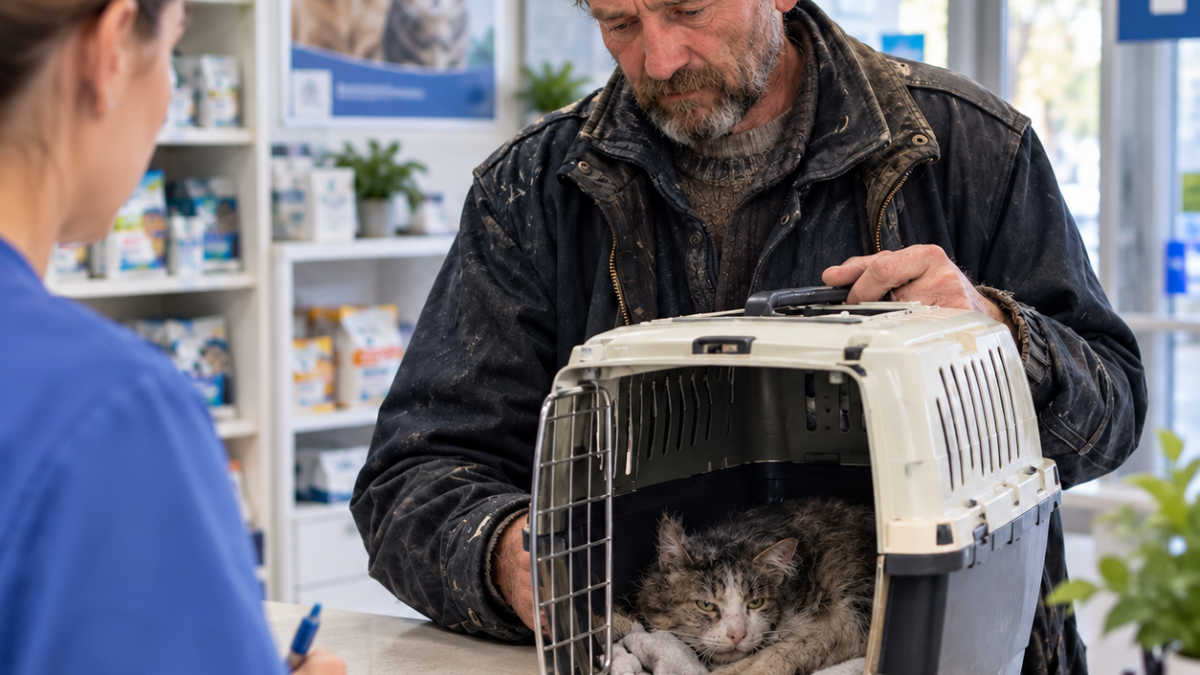
He heard the price of saving his cat, looked at her one last time, and walked out of my clinic without another word.
For several furious seconds, I thought I had just watched a man abandon an animal who had trusted him for almost seventeen years.
Then I turned toward the counter and noticed the photograph he had left behind—and suddenly, nothing about that morning made sense anymore.
It was raining hard when he came in.
Not the dramatic kind of storm that rattles windows, just a cold, miserable October rain that soaked through jackets and made everyone entering the clinic leave muddy footprints behind them.
The man looked to be in his mid-fifties.
His jacket was old enough that the cuffs had begun to fray. His shoes were wet. In one hand, he carried a battered plastic carrier whose door had been repaired with a piece of wire.
He set it carefully on the counter.
“My cat hasn’t eaten in two days.”
His voice was barely louder than the rain against the windows.
I opened the carrier.
Inside was one of the frailest cats I had seen in months.
She was small.
Far too small.
Gray-and-white fur hung around her body in dull, tangled strands. Her face was narrow, her eyes half-closed, and every breath caused her thin abdomen to rise with visible effort.
I slid my hands beneath her.
She felt almost weightless.
“What’s her name?”
The man hesitated.
“Musia.”
Something changed in his face when he said it.
Not embarrassment exactly.
More like the name carried too much history to say casually.
“How old is she?”
Another pause.
“Seventeen.”
That made me look at him.
Seventeen was old for any cat, but old did not automatically mean finished.
I carried Musia into the examination room.
Her temperature was high.
Her gums were pale.
She was badly dehydrated.
Her breathing concerned me most.
I listened to her chest again.
Then again.
“When did this start?”
“She stopped eating two days ago. Yesterday she started hiding.”
“Any coughing?”
“A little.”
“Vomiting?”
“No.”
“Medications?”
He shook his head.
I explained that she needed blood work and imaging. At minimum, I wanted to stabilize her with fluids, oxygen support, medication for nausea and pain, and additional testing to determine what was making breathing so difficult.
He listened without interrupting.
Then came the part of veterinary medicine I have never learned to enjoy.
The estimate.
I wrote down a range.
I explained what was essential immediately and what could wait until we knew more.
He stared at the paper.
“How much?”
I repeated the amount.
His eyes remained fixed on the number.
“I don’t have that.”
“We don’t necessarily have to do everything at once.”
He still didn’t look up.
“We can start with the most urgent things. Let me stabilize her. Then we can decide what comes next.”
Musia moved weakly on the towel.
One paw reached toward the edge of the table.
The man’s face tightened.
He turned away.
“I’m sorry.”
I thought he was speaking to me.
Then I realized he was looking at Musia.
He touched two fingers to her head.
Very gently.
“I’m sorry, Mouse.”
Before I could respond, he walked toward the door.
“Sir—”
He didn’t stop.
The door opened.
Cold air rushed inside.
Then he was gone.
For several seconds, I stood there stunned.
I had seen people decline treatment before.
Sometimes because they truly could not afford it.
Sometimes because they didn’t understand how serious the situation was.
And yes, sometimes because they simply didn’t want to spend money.
I thought I knew which kind of person had just walked out.
I was angry.
Then my receptionist called my name.
“Doctor?”
She pointed toward the counter.
The man had left an old blue blanket.
Folded on top of it was a photograph.
I picked it up.
Musia was in the picture.
But not the thin, exhausted Musia lying in my treatment room.
This Musia was young and round, with bright eyes and thick fur.
Beside her sat the same man.
He looked at least fifteen years younger.
He was smiling.
Really smiling.
On the back, written in faded black ink, were three words.
**Musia. First winter. 2009.**
I looked through the glass door toward the parking lot.
The man was already gone.
Then I noticed something else beneath the photograph.
A single folded piece of paper.
On it, in shaky handwriting, he had written:
**Please don’t let her suffer because I failed her.**
I stopped being angry.
And I ordered my technician to start treatment.
For the next several hours, we worked on Musia.
And just after six that evening, when I thought I finally understood what had happened that morning, the clinic door opened again.
The same man stepped inside.
This time, he was carrying an envelope.
And his left hand was missing something it had been wearing earlier.
His wedding ring.
PART 2
He stood just inside the door, soaked from the rain.
For a second, nobody said anything.
My receptionist, Carla, looked at me.
I looked at him.
He held the envelope with both hands.
“Is she alive?”
That was the first thing he asked.
Not what we had done.
Not how much it cost.
Not whether anyone was angry with him.
“Yes,” I said.
His knees seemed to weaken.
He grabbed the edge of the counter.
“She’s alive?”
“She’s very sick. But yes.”
He lowered his head.
I watched his shoulders move once.
Then again.
He was crying.
Quietly.
Almost as though he was trying not to inconvenience anybody with that either.
I walked around the counter.
“Where did you go?”
He opened the envelope.
Inside were several twenty-dollar bills, some smaller notes, and loose coins.
“I sold what I could.”
I looked at his left hand.
The pale stripe where his wedding ring had been was obvious.
“You sold your ring?”
He closed the envelope.
“It wasn’t enough.”
“Why didn’t you tell me?”
“Tell you what?”
“That you were going to find money.”
His expression was almost confused.
“Would it have changed the price?”
“No.”
“Then there wasn’t anything to say.”
There was no accusation in his voice.
That somehow made the answer harder to hear.
I took him into an empty examination room.
“My name is Dr. Morgan.”
“Daniel Bell.”
“Mr. Bell, leaving Musia here without telling us what you were doing could have created a serious problem.”
“I know.”
“Why did you do it?”
He looked toward the treatment-room door.
“Because if I took her home, she’d die with me.”
His voice broke on the last word.
“And if I left her here, maybe you’d be angry enough to save her.”
I didn’t know what to say.
Daniel placed the envelope on the table.
“There are three hundred and twelve dollars.”
I didn’t touch it.
“The estimate was more than that.”
“I know.”
“Where did the money come from?”
“My ring. A watch. Some tools.”
“You sold your tools?”
He shrugged.
“I don’t use them much anymore.”
There was something about the way he said it that made me realize there was a much larger story sitting in front of me.
“Sit down.”
“I’m wet.”
“I don’t care about the chair.”
He sat.
I brought him coffee.
For several minutes he held the paper cup without drinking from it.
Then I asked the question that had been bothering me all day.
“Seventeen years?”
He nodded.
“You’ve had Musia seventeen years?”
“Almost.”
“What happened in 2009?”
For the first time that evening, the faintest smile appeared.
“I found her under a grocery-store cart.”
“Seriously?”
“She was maybe six weeks old. Somebody had left a cardboard box by the cart return. There were three kittens inside.”
“What happened to the others?”
“A woman took one. A store employee took another.”
“And you took Musia.”
“I wasn’t supposed to.”
“Why not?”
“My wife said we didn’t need a cat.”
He smiled more clearly now.
“What did your wife say when you brought her home?”
“She called me an idiot.”
“Did she keep the cat?”
“She slept with Musia on her pillow that night.”
I laughed.
Daniel looked down at the coffee.
“My wife was Elena.”
“Was?”
He nodded.
“She died fourteen months ago.”
“I’m sorry.”
He looked at the floor.
“She had been sick a long time.”
Now the old jacket made sense.
The worn shoes.
The ring.
Maybe even the way he seemed smaller than his age.
“When Elena got sick,” he continued, “Musia barely left her bed. At the end, when my wife couldn’t get up anymore, that cat stayed beside her almost every hour.”
He swallowed.
“After Elena died, Musia started sleeping on her side of the mattress.”
He smiled without humor.
“For three months I didn’t have the heart to move her.”
The room became very quiet.
“Why are things so difficult financially?”
He straightened slightly.
It was almost defensive.
“I worked maintenance for a manufacturing plant for twenty-three years.”
“Past tense?”
“Plant cut half its staff in March.”
“You lost your job.”
“Then my health insurance changed. Then the rent went up. Then my truck needed a transmission.”
He gave a tired little laugh.
“Life doesn’t always send one bill at a time.”
No, it doesn’t.
I looked through the small window into treatment.
Musia was receiving fluids and oxygen.
Our initial tests had shown severe infection and dehydration. There were changes in her lungs that worried me, but nothing yet told me we had reached the end.
She still had a chance.
“Daniel, I need to tell you something.”
He braced himself.
“Her condition is serious. I’m not going to promise she’ll recover.”
“I understand.”
“But I also don’t believe she’s beyond treatment.”
His eyes filled again.
“Then use the money.”
“We’ve already started.”
He stared at me.
“What?”
“We started after you left.”
“You didn’t know I was coming back.”
“No.”
“Then why?”
I thought about the photograph.
The blanket.
The sentence on the paper.
Please don’t let her suffer because I failed her.
“Because Musia needed help.”
He covered his mouth with one hand.
I continued before he could argue.
“The clinic has a small emergency-care fund. It won’t cover everything, but it gives us room.”
“No.”
“What?”
“No charity.”
“It’s not charity.”
“It sounds like charity.”
“It’s a medical fund created for exactly this kind of situation.”
“I’ll repay it.”
“We can discuss that later.”
“I’ll repay every dollar.”
“Daniel.”
“Every dollar.”
I recognized the expression.
Pride mixed with fear.
Pride is strange.
It can keep a person standing.
It can also make them refuse the hand keeping them from falling.
“Fine,” I said. “You can contribute what you’re able to contribute.”
“All of it.”
“We’ll talk about it after Musia is stable.”
He looked unconvinced.
Then a technician knocked.
“Musia’s more alert.”
Daniel stood so quickly coffee spilled onto his sleeve.
“Can I see her?”
I hesitated.
“Two minutes.”
“I’ll take one.”
We brought him into treatment.
Musia lay inside an oxygen enclosure.
Her eyes were partially open.
Daniel approached slowly.
“Hey, Mouse.”
One ear moved.
That tiny movement nearly destroyed him.
“Hey.”
He crouched beside the enclosure.
“I’m here.”
Musia lifted her head perhaps half an inch.
Then let it fall.
Daniel pressed his fingers against the clear wall.
“You don’t have to do anything.”
His voice shook.
“You hear me? You just rest.”
Musia blinked.
Daniel stayed exactly one minute.
Then he stood.
“Thank you.”
That night, I went home thinking the hardest part of the story was behind us.
I was wrong.
The following morning, a video appeared online.
It had been filmed from across our waiting room.
Apparently, one of the customers sitting near the window had recorded Daniel leaving the clinic.
The video was only seventeen seconds long.
It showed Daniel walking quickly toward the door.
It showed me calling after him.
It showed Musia still lying on the examination towel behind the glass partition.
The caption read:
**MAN ABANDONS DYING 17-YEAR-OLD CAT AFTER HEARING VET BILL.**
By lunchtime, thousands of people had seen it.
By afternoon, the number was much higher.
I knew because our clinic phone would not stop ringing.
Some callers wanted to donate.
Some wanted information.
Some wanted Daniel’s name.
A few wanted his address.
We gave them nothing.
Absolutely nothing.
Carla entered my office holding her phone.
“You need to see this.”
“I already have.”
“No. The comments.”
“I don’t want to.”
“You need to.”
She showed me.
People were furious.
Not concerned.
Not curious.
Furious.
They had watched seventeen seconds of somebody’s worst day and decided they understood seventeen years of his life.
They called him heartless.
They called him selfish.
They said people like him should never be allowed to own animals.
Someone wrote that he had probably neglected Musia for years.
That one made my jaw tighten.
I had seen the photograph.
I had seen the blanket.
I had seen Musia respond to his voice.
Whatever had happened that morning, neglect over seventeen years was not the story our evidence told.
“Who’s running the page?”
Carla scrolled upward.
A local community account called **Metro Watch Now**.
I had seen their posts before.
Car accidents.
Arguments in parking lots.
Neighborhood disputes.
Anything capable of creating outrage before anyone had enough information to understand it.
“Did they contact us?”
“No.”
“Did they contact Daniel?”
“Not that I know.”
“Send them a message. Tell them the video contains private medical circumstances and that the caption is materially incomplete. Ask them to remove it.”
Carla looked at me.
“Do you think they will?”
They didn’t.
Instead, twenty minutes later, Metro Watch Now posted another update.
**VET CLINIC REFUSES TO EXPLAIN WHY MAN WAS ALLOWED TO WALK OUT AFTER DUMPING SICK CAT.**
That was when anger returned.
But this time, I knew exactly where it belonged.
Not with Daniel.
With people who knew they didn’t have the full story and published it anyway because rage traveled faster than truth.
I called him.
He answered after six rings.
“Hello?”
“Daniel, have you been online today?”
“No.”
“Good.”
Silence.
“Why?”
“There is a video.”
“What video?”
I explained.
He said nothing for so long I thought the call had dropped.
“Daniel?”
“I’m here.”
“The clinic has not released your name.”
“They’ll find it.”
“We’re doing what we can.”
“They’ll find it.”
“Please don’t respond publicly.”
He laughed once.
It was a hollow sound.
“I don’t even have one of those accounts.”
“Good.”
“Is Musia okay?”
Even then.
That was what he asked.
“She’s stable.”
“That’s all I care about.”
But the internet cared about something else.
It wanted a villain.
And by the following day, it had found Daniel’s name.
Someone recognized him from the video.
Then someone found an old public photograph.
Then someone posted the apartment building where he lived.
I called him immediately.
“Don’t go outside if people are there.”
“No one’s here.”
“Good.”
“My landlord called.”
My stomach sank.
“What did he say?”
“Asked if I had abandoned a cat.”
“What did you tell him?”
“That it wasn’t what happened.”
“And?”
“He said he doesn’t want trouble around the property.”
“Daniel, listen carefully. Do not argue with anyone. Save every message. If somebody contacts you, take a screenshot.”
“Why?”
“Because we’re going to correct this.”
He was silent.
Then he said, “Don’t.”
“What?”
“Don’t put my life online.”
“I’m not going to.”
“People want a story.”
“I want the truth.”
“Truth becomes a story too.”
He wasn’t wrong.
So I asked him what he wanted.
“Save Musia.”
“That’s happening.”
“Then leave everything else alone.”
I wanted to respect that.
For forty-eight hours, I tried.
Meanwhile Musia slowly improved.
Her fever decreased.
Her breathing became easier.
She began responding to touch.
On the third morning, she licked a tiny amount of food from a spoon.
I sent Daniel a photograph.
Thirty seconds later my phone rang.
“She ate?”
“About half a teaspoon.”
“That’s eating.”
“Technically.”
“Then say she ate.”
I smiled.
“She ate.”
He laughed.
A real laugh.
It was the first one I’d heard from him.
By afternoon, however, things outside the clinic had become uglier.
A man appeared at the front desk asking whether we were “hiding the cat abandoner.”
Carla told him to leave.
Another person taped a handwritten sign near Daniel’s apartment building.
Someone called his former employer.
Someone contacted the manager of the motel where he occasionally picked up repair work.
Daniel lost two days of temporary work because the manager “didn’t want publicity.”
That changed things.
This was no longer simply an embarrassing video.
A false narrative was beginning to cost him what little income he still had.
I called him again.
“Daniel, I need your permission to say something publicly.”
“No.”
“You’ve lost work.”
“I’ll find more.”
“People are telling lies about you.”
“People tell lies every day.”
“They’re saying you neglected Musia.”
Silence.
That mattered.
“I took care of her.”
“I know.”
“Seventeen years.”
“I know.”
“She ate before I did some weeks.”
His voice had changed.
Not angry.
Hurt.
“I know.”
He breathed heavily.
“What would you say?”
“Only what you approve.”
“No medical details about Elena.”
“Agreed.”
“No address.”
“Obviously.”
“No pity.”
I paused.
“Define pity.”
“Don’t tell people I’m some poor old man who needs saving.”
“You’re fifty-six.”
“Exactly.”
I almost laughed.
“Anything else?”
“Tell them Musia was loved.”
“I can do that.”
“And tell them I came back.”
“I can definitely do that.”
The clinic’s statement went online that evening.
I kept it simple.
We explained that the video circulating did not show the full sequence of events.
We confirmed that Musia’s owner had left her in our care during an acute medical crisis.
We stated that he returned the same day after attempting to raise money for treatment.
We stated that he had remained in contact with our medical team.
And with Daniel’s permission, we included one sentence:
**The medical history and our direct observations are consistent with a senior cat who has been deeply loved for many years.**
We did not mention the ring.
We did not mention the tools.
We did not mention his wife.
We did not mention the note.
I thought that would end it.
Instead, Metro Watch Now responded.
They accused us of “damage control.”
They said we were protecting a paying customer.
The irony was almost impressive.
Daniel had arrived with barely enough money to cover the first diagnostics, and they were portraying him as somebody whose wealth had bought our silence.
Then the page administrator made his biggest mistake.
He posted:
**If the clinic has proof he came back, show it.**
Carla entered my office smiling.
Not a cheerful smile.
The kind people make when somebody has just demanded the exact evidence you were hoping to introduce.
“Do we have proof?”
I looked toward the security monitor.
Every entrance to the clinic was timestamped.
Daniel had entered at 8:17 that morning.
He had left at 8:42.
He had returned at 6:08 p.m.
Carrying the envelope.
Our cameras recorded all of it.
“We do.”
We did not publish it immediately.
First, I called Daniel.
“Remember when you told me you didn’t want pity?”
“Yes.”
“How do you feel about evidence?”
“What evidence?”
“The clinic cameras.”
Silence.
“They recorded me coming back?”
“Yes.”
“With the money?”
“Yes.”
“And the morning?”
“Yes.”
I could hear him thinking.
“What would people see?”
“You walking out. You returning. Nothing inside the treatment rooms.”
“Will they see my face?”
“Yes.”
He sighed.
“It’s already everywhere anyway.”
“I won’t post anything without permission.”
Another long silence.
Then:
“Can you show the part where I came back without showing the envelope?”
“Why?”
“I don’t want people counting my money.”
That sentence told me everything about how deeply the public spectacle had humiliated him.
“Yes.”
“Then do that.”
We posted thirty-one seconds.
No dramatic music.
No captions calling anybody a hero.
No insults.
Just two timestamps.
**8:42 A.M.**
Daniel leaving.
**6:08 P.M.**
Daniel returning.
Then one sentence:
**Context matters.**
The post spread faster than the original.
By the next morning, the comments beneath Metro Watch Now had changed completely.
People asked why the page had never contacted the clinic.
They asked why it had claimed abandonment as a fact.
They asked why it had posted Daniel’s identity.
The administrator tried to defend himself.
He said the video “looked obvious.”
That line became his undoing.
Because looking obvious is not the same thing as being true.
Then the woman who had filmed the original clip came forward.
Her name was Rebecca Lane.
She admitted that she had sent the video privately to Metro Watch Now.
She said she had written:
**I think this man just walked out after hearing the cost. I don’t know what happened afterward.**
Metro Watch Now had removed the words:
**I think.**
And:
**I don’t know what happened afterward.**
They had turned uncertainty into certainty.
Concern into accusation.
A fragment into a verdict.
Rebecca was furious.
“I never said he abandoned the cat,” she wrote publicly. “I said I didn’t understand what I had just seen.”
For the first time, Metro Watch Now deleted one of its posts.
Not the original.
The defensive one.
That didn’t help.
Screenshots existed.
People had saved everything.
Local businesses that advertised on the page began asking questions.
Two temporarily paused their advertising.
The administrator finally contacted our clinic.
His tone had changed.
He wanted to “clear up the misunderstanding.”
I asked whether he meant his misunderstanding or the one he had caused for tens of thousands of other people.
He did not appreciate the distinction.
“We reported what the video showed.”
“No,” I said. “You reported what you decided it meant.”
“We’re willing to add an update.”
“The update already exists.”
“We can interview you.”
“No.”
“Daniel?”
“Absolutely not.”
“People deserve to hear both sides.”
I almost laughed.
“They deserved that before you published the first side.”
He went quiet.
I continued.
“You do not have permission to contact my staff for comments. You do not have permission to enter private areas of this clinic. And if Daniel asks us for documentation regarding the false claims published about him, we will preserve every relevant record.”
That last sentence mattered.
Because by then, Daniel had spoken with a legal-aid attorney.
Not because he wanted money.
Because someone had contacted his landlord again.
This time, the landlord had sent Daniel a written warning claiming that the publicity associated with him was “disturbing other tenants.”
The attorney’s first instruction was simple.
Save everything.
So we did.
Posts.
Messages.
Timestamps.
Screenshots.
The original caption.
The edited follow-ups.
The demands for Daniel’s identity.
The comments in which the administrator encouraged people to “find out who this guy is.”
Daniel hated all of it.
“I don’t want a lawsuit,” he told me.
“You may not need one.”
“Then what am I doing with all this?”
“Making sure they can’t rewrite what they did.”
He looked at Musia through the glass.
She was standing now.
Unsteady, but standing.
“People already believe something new.”
“That doesn’t mean the damage disappears.”
“No.”
He looked at me.
“But Musia’s getting better.”
“Yes.”
“Then I’d rather spend my energy there.”
That was Daniel.
He never seemed interested in winning anything that did not involve his cat coming home.
By day five, Musia was eating small meals.
By day six, she no longer required continuous oxygen.
By day seven, I let Daniel hold her.
He sat in a chair with the blue blanket across his lap.
We placed Musia on top.
She smelled him.
Then pressed her forehead against his chest.
Daniel closed his eyes.
“Hey, Mouse.”
Musia began to purr.
It was faint.
Almost drowned out by the equipment around us.
But it was there.
Daniel bent his head over her.
“I thought I lost you.”
I turned away.
Some moments belong to the people inside them.
Two days later, we performed additional imaging.
The infection was responding.
Her blood values were improving.
She had chronic age-related issues that would require management, but Musia was not dying that week.
When I told Daniel, he stared at me.
“You’re sure?”
“No veterinarian uses that word as often as clients want us to.”
“Doctor.”
“Her response is much better than I expected.”
He exhaled.
“When can she come home?”
“If she keeps improving, possibly tomorrow.”
His expression changed.
He should have been thrilled.
Instead, he looked worried.
“What?”
“Home.”
“What about it?”
“My apartment.”
I waited.
“My landlord gave me until the end of the month.”
My stomach dropped.
“Because of the posts?”
“He says that’s not the reason.”
“What reason did he give?”
Daniel smiled bitterly.
“Month-to-month lease.”
“Do you have somewhere to go?”
“I’ll manage.”
“With Musia?”
“I said I’ll manage.”
There it was again.
Pride.
That stubborn wall he built whenever help got close enough to feel like humiliation.
“Daniel.”
“No.”
“I haven’t offered anything yet.”
“You’re about to.”
“Maybe.”
“I don’t need a fundraiser.”
“I didn’t say fundraiser.”
“No interviews.”
“I didn’t say interviews.”
“No sad photograph of me holding Musia while somebody tells strangers I’m homeless.”
“You’re not homeless.”
“Not yet.”
I leaned against the counter.
“Could you stop arguing with things I haven’t said?”
He almost smiled.
“Probably not.”
The next day, Musia went home.
Or rather, she went back to Daniel’s apartment for the remaining three weeks of his lease.
We sent medication.
Special food.
A low-sided litter box donated by our clinic.
Daniel paid the $312 he had brought.
I tried to return some of it.
He refused.
Our emergency fund covered a large portion of the rest.
Then something unexpected happened.
Small envelopes began arriving.
Not hundreds of dollars.
Ten.
Twenty.
Five.
Sometimes no return address.
Each contained a note.
**For the next Musia.**
**For an old pet whose person is struggling.**
**Please help someone before they think walking away is the only option.**
One envelope contained exactly twelve dollars and sixty-three cents.
The note said:
**This is what my daughter saved from her allowance. She said Musia needs treats.**
I put that one on my bulletin board.
We did not give the money directly to Daniel.
He would have hated that.
Instead, with his permission, we expanded our emergency fund.
That became important sooner than I expected.
A month after Musia came home, Daniel arrived for a follow-up carrying her in the same battered carrier.
She had gained weight.
Her coat was cleaner.
Her eyes were brighter.
She was still seventeen.
Still fragile.
But she looked like a cat who had decided she wasn’t finished.
“Look at you,” I said.
Musia hissed at me.
I laughed.
Daniel smiled.
“She’s feeling better.”
“I can tell.”
“She bit me yesterday.”
“Excellent.”
“That’s your professional opinion?”
“For a cat who barely lifted her head a month ago? Absolutely.”
I examined her.
Her lungs sounded better.
Her hydration was good.
Her weight was up nearly half a pound.
Then I asked Daniel where they were living.
He hesitated.
“I found a room.”
“Allows cats?”
“Obviously.”
“Stable?”
“For now.”
“What does that mean?”
“It means stop asking questions.”
I knew better than to push too hard.
Then Carla knocked on the door.
“There’s someone asking for Daniel.”
His face tightened.
“Who?”
“A man named Evan Cross.”
I knew the name.
The administrator behind Metro Watch Now.
Daniel’s expression went flat.
“What does he want?”
“He says to apologize.”
I looked at Daniel.
“I can tell him to leave.”
For several seconds, Daniel said nothing.
Then he placed Musia back in her carrier.
“No.”
“No?”
“I want to hear it.”
Evan Cross looked nothing like I expected.
He was younger than Daniel.
Early forties.
Expensive coat.
Expensive watch.
A phone constantly in his hand.
He entered my office with the expression of someone accustomed to controlling conversations.
Daniel sat beside me.
Evan extended his hand.
Daniel did not take it.
Evan lowered it.
“Mr. Bell, I want you to know none of this was personal.”
Daniel stared at him.
That was perhaps the worst possible opening.
Evan continued.
“We received a video from a member of the public. Our page reports community concerns.”
“You wrote that I abandoned my cat.”
“Based on what we saw.”
“You didn’t see me come back.”
“We didn’t have that footage.”
“You didn’t ask.”
Evan shifted.
“Things move quickly online.”
Daniel nodded.
“So you moved quickly.”
“Yes.”
“And you were wrong quickly.”
I had to look down to hide my reaction.
Evan cleared his throat.
“We corrected the story.”
“No. The clinic corrected the story.”
“We shared their correction.”
“After businesses stopped advertising.”
The room went quiet.
Evan looked at me.
I gave him nothing.
He turned back to Daniel.
“What would you like us to do?”
That question surprised all of us.
Daniel looked at Musia’s carrier.
Then at Evan.
“Take down the post.”
“We can do that.”
“All versions.”
“Okay.”
“Stop using my photograph.”
“Fine.”
“And post that you never contacted the clinic before saying I abandoned her.”
Evan’s jaw tightened.
“That wording sounds accusatory.”
Daniel almost laughed.
“Interesting.”
“What?”
“You didn’t mind accusatory wording when it was about me.”
Evan said nothing.
Daniel continued.
“I don’t want your money.”
Nobody had mentioned money.
That told me legal discussions had already happened behind the scenes.
“I don’t want an interview. I don’t want people following me. I don’t want to be your redemption story.”
Evan shifted again.
“What do you want?”
Daniel pointed toward the hallway.
“That emergency fund.”
I turned toward him.
He had never mentioned this to me.
“You raised money from my humiliation,” Daniel said. “Maybe not directly, but that post brought attention to your page. People shared it. Advertisers appeared beside it.”
Evan frowned.
“That’s not how—”
“I don’t care how your business works.”
Daniel’s voice stayed calm.
“If you genuinely believe this was an honest mistake, put something behind the apology.”
“What are you suggesting?”
“Donate what you would have paid me for an interview.”
Evan looked confused.
“To the clinic?”
“To animals whose owners hear a price they can’t afford.”
For the first time, Evan had no answer.
Daniel stood.
“That’s what I want.”
He picked up Musia’s carrier.
Then he looked at Evan one final time.
“And the next time you get seventeen seconds of somebody’s life, maybe wait eighteen before you decide who they are.”
He walked out.
I stayed seated.
Evan looked at me.
“Did he rehearse that?”
“No.”
“He should have.”
Despite everything, I almost laughed.
Metro Watch Now removed the posts that afternoon.
Two days later they published a correction.
Not perfect.
But clear.
They acknowledged that the original video lacked significant context.
They acknowledged they had not contacted Daniel or the clinic before publishing the accusation.
And they announced a donation to our emergency-care fund.
Daniel never asked how much.
I told him anyway.
“Five thousand dollars.”
He nearly dropped his coffee.
“Five thousand?”
“Apparently guilt has a budget.”
He smiled.
“Good.”
“That’s all you have to say?”
“What do you want me to say?”
“You just turned the worst week of your life into medical care for animals you don’t know.”
Daniel shrugged.
“Seems better than being angry forever.”
That should have been the ending.
It wasn’t.
Because three months later, Daniel called me at 1:12 in the morning.
I wasn’t on duty.
He had my number because Musia’s age and recent illness made me nervous enough to break one of my usual rules.
I answered immediately.
“Daniel?”
His breathing sounded strange.
“Something’s wrong.”
“With Musia?”
“No.”
That woke me fully.
“With me.”
“What happened?”
“I can’t stand up right.”
“Call emergency services.”
“I don’t want—”
“Daniel.”
Silence.
“Call them now.”
“What about Musia?”
“I’ll handle Musia.”
“Promise?”
“Yes.”
That was the only reason he agreed.
Daniel had suffered a serious cardiac event.
He survived.
Barely.
While doctors treated him, Musia came back to my clinic.
The irony wasn’t lost on me.
Months earlier, Daniel had left Musia with me because he believed it was the only way to save her.
Now an ambulance had taken him away, and Musia was waiting for him.
For two days she barely ate.
She sat inside her carrier facing the door.
The behavior worried me because I knew exactly what it looked like.
Waiting.
I sat beside her after closing.
“He came back for you.”
Musia stared at the door.
“He will again.”
I hoped I wasn’t lying.
On the third day, Daniel’s condition stabilized.
On the fourth, I arranged a video call.
Daniel looked awful.
Pale.
Exhausted.
Hospital gown.
Tubes.
Machines.
Musia was on my desk.
“Mouse.”
Her head snapped toward the phone.
Daniel smiled.
“There she is.”
Musia walked toward the screen.
She sniffed it.
Then rubbed her face against the corner of the phone.
Daniel started crying.
“So now we’re even.”
I frowned.
“What?”
He looked at me through the screen.
“She scared me. I scared her.”
“That’s not how medical accounting works.”
“It should be.”
Musia purred.
Daniel stayed in the hospital for eleven days.
Then came rehabilitation.
Then restrictions.
He could not immediately return to physical work.
He had already been barely getting by.
This time, however, he did something different.
He accepted help.
Not easily.
Not gracefully.
But he accepted it.
A local senior-pet rescue organization helped temporarily with Musia’s food.
A housing nonprofit helped him find a small apartment with manageable rent.
The emergency fund covered one of Musia’s follow-up tests.
Daniel complained about every bit of assistance.
Then used it.
Growth does not always look elegant.
Sometimes it looks like a stubborn man muttering, “I’ll pay this back,” while signing a form that keeps him and his cat together.
Months passed.
Musia turned eighteen.
Daniel brought a tiny paper hat to the clinic.
She hated it.
We took a picture anyway.
In the photograph, Daniel was smiling.
Musia looked furious.
I printed two copies.
One for him.
One for our wall.
Below it, Carla wrote:
**Musia, age 18. Still in charge.**
Daniel pretended to complain.
He secretly loved it.
The emergency fund grew.
Metro Watch Now’s donation attracted others.
But the most important change was not financial.
We created a protocol.
When an owner faced an emergency estimate they could not afford, we stopped asking only:
“What can you pay?”
We also asked:
“What is happening at home?”
Do you need time?
Transportation?
A payment option?
A rescue partner?
A lower-cost referral?
Help prioritizing what must happen today?
We could not save every animal.
We could not erase the cost of medicine.
We could not make every impossible situation possible.
But we could stop assuming that an empty wallet meant an empty heart.
Daniel taught me that.
Not deliberately.
He would have hated the idea of being anybody’s lesson.
One afternoon, almost a year after Musia first arrived, a young woman came into the clinic carrying a sick tabby.
She was maybe twenty-two.
Her hands shook.
When I gave her an estimate, her face changed exactly the way Daniel’s had.
“I don’t have that much.”
“We can start with what is urgent.”
“I can’t.”
She began crying.
“I’m sorry.”
Then she turned toward the door.
“Wait.”
She stopped.
For one strange second, it felt like time had folded.
I saw Daniel again.
Wet shoes.
Old jacket.
A photograph on the counter.
This time I knew better.
“Don’t leave because you’re ashamed.”
The young woman looked at me.
“I’m not judging you.”
She cried harder.
“I just lost my job.”
“Okay.”
“My mother is sick.”
“Okay.”
“I have forty-seven dollars until Friday.”
“Okay.”
She stared at me.
“Why do you keep saying okay?”
“Because none of those things tell me you don’t love your cat.”
Her knees almost gave way.
I pulled out a chair.
Then I opened the emergency-fund paperwork.
The fund paid part of the cat’s treatment.
The owner paid what she could.
The cat recovered.
Two months later, an envelope arrived with twenty dollars inside.
The note read:
**For the next person who almost walks out.**
I pinned it beside the twelve-dollar allowance note.
That was the moment I understood what Musia’s story had become.
Not a story about a man who walked away.
A story about what happens when somebody is given a reason to come back.
There was still one piece of the story I didn’t know.
The wedding ring.
I assumed Daniel had sold it.
For almost two years, I never asked.
Then one December afternoon, he walked into the clinic carrying Musia for her routine exam.
She was nineteen.
Nineteen.
She moved more slowly now.
Her kidneys required monitoring.
She had arthritis.
Her hearing wasn’t what it used to be.
But her eyes were bright.
Her appetite remained legendary.
And she still objected loudly whenever I examined her ears.
“Good news,” I told Daniel. “She’s still judgmental.”
“That’s how we know she’s healthy.”
When I finished the exam, I noticed something on his hand.
His wedding ring.
I stared at it.
He noticed.
“Oh.”
“I thought you sold that.”
“I did.”
“Then how do you have it?”
He smiled.
“The pawnshop owner saw the clinic story.”
I waited.
“He held it.”
“For how long?”
“Almost four months.”
“Why?”
“He said his wife would haunt him if he sold another man’s wedding ring while that man’s cat was in the hospital.”
I laughed.
“So you bought it back?”
“Eventually.”
“Why didn’t you tell me?”
Daniel shrugged.
“It wasn’t your ring.”
Fair enough.
He twisted it once around his finger.
“Elena picked it.”
“Your wife?”
“She said the first one I chose was ugly.”
“Was it?”
“Extremely.”
We both laughed.
Then his expression softened.
“She would have liked you.”
“I think I would’ve liked her.”
“She would’ve argued with you about the bill.”
“I’m sure.”
“Then paid you in homemade bread.”
“I might have accepted that.”
“Her bread wasn’t that good.”
I laughed again.
Daniel looked at Musia.
“Elena would’ve been furious that I walked out.”
“You came back.”
“She still would’ve been furious.”
“Probably.”
“Then she’d have cried when she saw the video.”
“Probably.”
“Then she’d have yelled at that internet guy.”
“Definitely.”
Daniel smiled.
For a few moments, we sat quietly with the memory of a woman I had never met.
Musia climbed clumsily into his lap.
Daniel steadied her.
“Easy, Mouse.”
She curled against him.
Her old blue blanket was folded inside the carrier.
Still the same blanket.
Washed a thousand times.
Faded almost white at the edges.
Some things survive because people keep choosing not to throw them away.
Musia reached twenty.
Nobody at our clinic expected it.
Neither did Daniel.
For her twentieth birthday, we held no public event.
Daniel hated attention, and Musia hated strangers.
So after closing, six clinic employees gathered in the break room.
Carla brought tuna.
I brought a ridiculous gold cardboard crown.
Daniel brought the photograph from 2009.
We placed the old photo beside Musia.
Young Musia.
Round.
Bright-eyed.
All four paws tucked beneath her.
Then I looked at the elderly cat sitting in front of us.
Her body had grown thin again with age.
Her face was white around the muzzle.
She walked slowly.
But she was there.
Twenty years.
Daniel touched the photograph.
“You know what I remember about that day?”
“What?”
“Elena kept saying we weren’t keeping her.”
Carla laughed.
“How long did that last?”
“About forty minutes.”
Musia smelled the tuna.
“Twenty years later,” I said, “I think the cat won.”
“The cat always won.”
That night, after everyone left, Daniel stayed behind.
He looked unusually serious.
“Can I ask you something?”
“Of course.”
“When her time comes…”
He stopped.
I knew what he was asking.
“Yes.”
“Here?”
“Here.”
“With me?”
“Absolutely.”
“No back room.”
“No back room.”
He nodded.
“Thank you.”
Neither of us said more.
With old animals, love eventually requires a kind of courage that no one wants to practice.
You spend years trying to keep them.
Then one day, keeping faith with them means knowing when not to ask for more.
Musia’s decline began the following spring.
Slowly.
She lost interest in jumping.
Then in playing.
Then in food.
We adjusted medication.
Changed her diet.
Managed her arthritis.
Treated nausea.
For a while, she rallied.
Daniel carried her outside on warm afternoons and sat with her beneath a tree near his apartment.
He sent me photographs.
Musia wrapped in the blue blanket.
Musia asleep in sunlight.
Musia staring angrily at a squirrel.
Then came the morning when Daniel called.
He didn’t need to explain.
I heard it in his voice.
“It’s today.”
I closed my eyes.
“Bring her in.”
“I don’t know if I can.”
“Yes, you can.”
“What if I’m wrong?”
“Then we’ll examine her and go home.”
“What if I’m right?”
“Then you won’t be alone.”
They arrived thirty minutes later.
Daniel had Musia wrapped in the old blanket.
Not inside the carrier.
In his arms.
She looked impossibly small.
Almost like the cat I had first lifted from that towel years earlier.
But there was one enormous difference.
That first morning, Daniel had believed money forced him to face Musia’s illness alone.
Now half the clinic came quietly to say goodbye.
Carla kissed Musia’s head.
One technician cried openly.
Another brought Daniel water.
I examined Musia.
Her body was tired.
Her numbers had worsened dramatically.
Her breathing was becoming difficult again.
Daniel watched my face.
“Tell me.”
I sat beside him.
“If she were mine…”
I hate that sentence.
But sometimes it is the clearest language we have.
“If she were mine, I would let her rest today.”
Daniel nodded.
Immediately.
As though he had needed permission to accept what he already knew.
“Okay.”
Then his face crumpled.
“I’m sorry.”
He pressed his forehead against Musia’s.
“I’m sorry, Mouse.”
I put my hand on his shoulder.
“Daniel.”
He looked at me.
“Don’t apologize for this.”
“I promised Elena I’d take care of her.”
“You did.”
“I walked out on her.”
“Then you came back.”
His eyes filled.
“I almost failed her.”
“No.”
I shook my head.
“You were terrified. You were broke. You made a desperate decision. Then you spent the next three years proving what that decision did not mean.”
He looked down.
Musia’s paw rested against his wrist.
“She got twenty years,” I said.
Daniel laughed through tears.
“She was stubborn.”
“Wonder where she got that.”
He gave me a look.
Even then.
Even in that room.
A tiny spark of humor.
That was Daniel too.
We dimmed the lights.
No rushing.
No noise.
No strangers.
Daniel held Musia inside the blue blanket.
He placed the 2009 photograph beside her.
“I found you in a grocery cart,” he whispered.
Musia’s eyes were half-closed.
“You weren’t supposed to come home.”
He stroked her face.
“Elena said one night.”
His voice cracked.
“You stayed twenty years.”
I prepared everything.
Daniel kissed Musia between the ears.
“Tell her I tried.”
That sentence broke me.
He meant Elena.
I stepped away for a moment because I couldn’t see clearly.
When I returned, Daniel was still whispering.
Things I was not meant to hear.
Memories.
Names.
Promises.
Twenty years compressed into a few quiet minutes.
When the time came, Musia was warm.
She was wrapped in the same blanket Daniel had left beside her on the worst morning of his life.
His wedding ring rested against her fur as he held her.
She was not alone.
She was not frightened.
And Daniel did not walk away.
He stayed until the very end.
Afterward, nobody rushed him.
An hour passed.
Maybe more.
Eventually he placed the old photograph on the table.
“Can she have this?”
“You want it to stay with her?”
He nodded.
“First day and last day.”
I swallowed.
“Yes.”
Then he changed his mind.
He picked it up again.
“No.”
I waited.
“Elena would yell at me.”
“Why?”
“She’d say that’s the only copy.”
I laughed through tears.
Daniel smiled.
“I’ll keep it.”
Before leaving, he stood at the counter where he had once placed the sick seventeen-year-old Musia.
He looked at the emergency-fund notices on the wall.
By then, the program had a name.
We had resisted naming it after Musia while she was alive because Daniel said it was “embarrassing enough that the cat already had more followers than he did.”
Now he touched the small sign.
**THE MUSIA FUND**
Emergency assistance for senior and special-needs pets whose families need temporary financial support.
Daniel stared at it.
“How many?”
“How many what?”
“Animals.”
I checked our latest count.
“In three years?”
“Yes.”
“One hundred eighty-seven cases received some kind of assistance.”
His eyes widened.
“One hundred eighty-seven?”
“Some got ten dollars. Some got much more.”
“Still.”
“Still.”
He touched the edge of the sign.
“Because of her?”
“Because of a lot of people.”
“But it started with her.”
“Yes.”
Daniel nodded slowly.
Then he said something I have never forgotten.
“That’s a pretty good revenge.”
I looked at him.
“Against who?”
He gave me a tired smile.
“That morning.”
I understood.
Not against Evan.
Not against strangers online.
Not against his landlord.
Not against anyone.
Against the morning that had tried to reduce Musia’s seventeen years of love to one unpaid bill.
Against the seventeen-second video that had tried to reduce Daniel’s life to one frightened exit through a door.
Against the idea that people can be measured by the worst-looking moment of their lives.
Musia had outlived all of it.
The post.
The anger.
The accusations.
The rent notice.
The shame.
She lived three more years after strangers online had already spoken about her as though she were practically gone.
And Daniel, the man they called heartless, spent every one of those years arranging medication, cleaning litter boxes, warming food, carrying her to appointments, paying what he could, and accepting help when pride told him not to.
That was his answer.
He didn’t need to destroy the people who had judged him.
He simply lived long enough for their version of him to become impossible to believe.
But there was one final consequence.
Several months after Musia died, our clinic received a letter from Evan Cross.
Metro Watch Now was shutting down.
The page had slowly lost advertisers after several other stories were challenged for being published without adequate verification.
Musia’s case had been the first one people remembered.
Evan wrote that he was leaving local media.
Then, at the bottom, he added:
**I still think about Mr. Bell. I built a story around the moment he walked out. I never asked why he came back.**
Enclosed was a check.
Ten thousand dollars.
For the Musia Fund.
Carla looked at me.
“Do we take it?”
I called Daniel.
He was quiet when I told him.
“Ten thousand?”
“Yes.”
“Does he want his name on anything?”
“No.”
“Does he want publicity?”
“No.”
“Then take it.”
“You’re sure?”
Daniel laughed.
“Doctor, if that man wants to spend ten thousand dollars learning a lesson, don’t interrupt his education.”
That was Daniel.
I laughed so hard I had to put the phone down.
The donation paid for emergency treatment for eleven animals in its first year alone.
One was a twelve-year-old dog whose owner had recently lost her husband.
Another was a kitten belonging to a young father working two jobs.
Another was an elderly orange cat whose owner arrived with twenty-three dollars and apologized every thirty seconds for not having more.
That last owner reminded me so much of Daniel that I had to leave the room for a moment.
When I returned, I told him the same thing I wished I had known to tell Daniel immediately.
“Money is part of medical care. It is not a measurement of love.”
He looked at me.
Then at his cat.
“Thank you.”
Years have passed since that rainy October morning.
The counter has been replaced.
Carla retired.
The treatment room has new equipment.
Even the front door is different.
But the photograph is still in my office.
Daniel eventually had another copy made for me.
Musia.
2009.
Young.
Round.
Bright-eyed.
Daniel sitting beside her.
Both of them completely unaware of the twenty years ahead.
On the back, beneath the original words, Daniel added another line.
**She stayed. So did I.**
Whenever a frightened owner sits across from me and asks what happens if they cannot afford everything at once, I think about that sentence.
She stayed.
So did I.
Because that is what the seventeen-second video never showed.
It showed a door closing.
It did not show seventeen years before it.
It did not show Daniel feeding Musia when his own refrigerator was nearly empty.
It did not show the nights she slept beside his wife.
It did not show the old blanket.
The wedding ring.
The tools he sold.
The envelope in his hands when he came back through the rain.
It didn’t show the next three years either.
Medication at sunrise.
Follow-up appointments.
An eighteenth birthday.
A nineteenth.
Then an impossible twentieth.
It did not show Daniel holding her when she became old enough that love could no longer make her body young again.
And it certainly did not show the one hundred eighty-seven animals that received help because one frightened man had once believed he had no good choices left.
That’s the danger of judging someone from a single moment.
Sometimes a person walking away is abandoning responsibility.
Sometimes they’re running toward the only solution they can imagine.
You cannot always tell the difference from seventeen seconds.
I know that now.
And I know something else.
The morning Daniel left my clinic, I thought the saddest thing in the room was a seventeen-year-old cat lying sick on a towel.
I was wrong.
The saddest thing was a man who loved her so much that he believed disappearing from her life might be the only thing he could still give her.
Fortunately, that wasn’t how their story ended.
He came back.
Musia came home.
The people who judged him were forced to confront the truth.
The page that turned his worst moment into entertainment eventually helped pay for other animals to receive care.
And a frightened old cat who could barely lift her head lived long enough to become the name on a fund that kept other families from facing the same impossible choice.
Some people would call that forgiveness.
Some would call it justice.
Daniel called it revenge against the worst morning of his life.
I think he was right.
Because the best answer to a moment that tries to define you is not always anger.
Sometimes it is simply what comes next.
A return through the door.
A cat recovering.
A wedding ring bought back.
Three more birthdays nobody expected.
A photograph that survives twenty years.
And a little sign on a veterinary-clinic wall carrying one old cat’s name.
**THE MUSIA FUND.**
Every time I pass it, I remember the man who walked out before I could stop him.
But I no longer remember the door closing first.
I remember it opening again.

