PART 2: He Had Been Chained Outside So Long His Fur Hid the Wounds—Then We Found What Was Growing Beneath His Chest
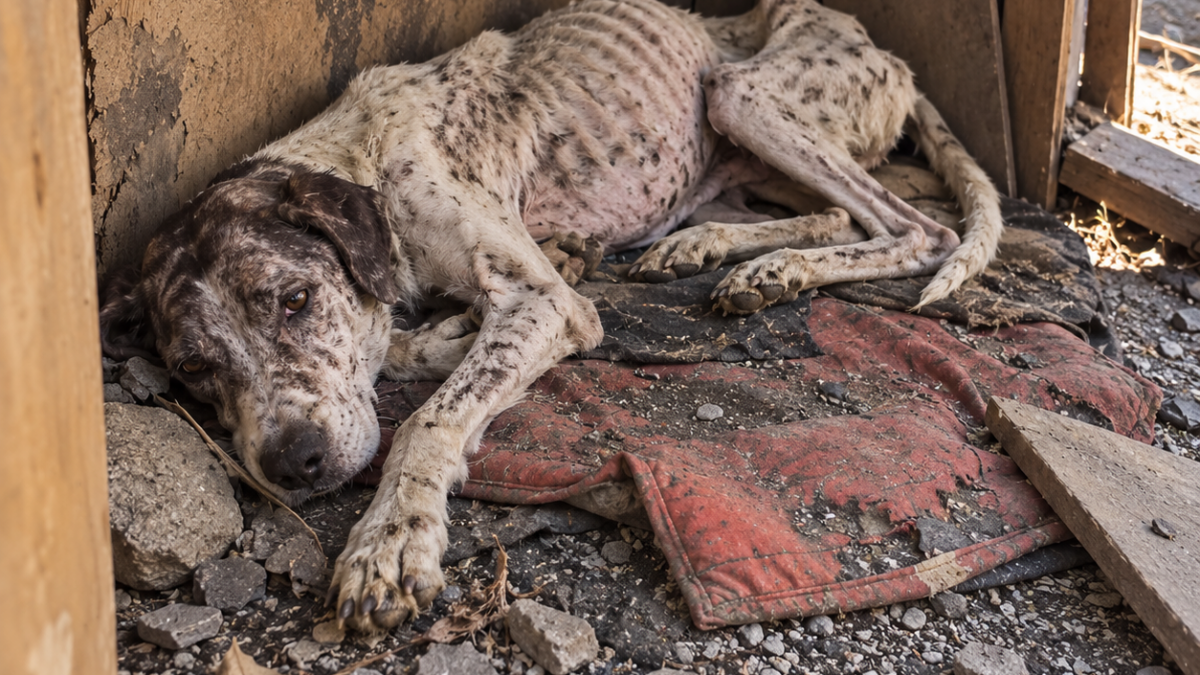
The first time I saw Marin, he was lying beside a chain so heavy I could hear it scrape across the frozen ground every time he breathed.
His fur had hardened into filthy ropes around his body, hiding wounds no one could see, yet when I walked toward him, he didn’t bark, growl, or even try to escape.
I thought removing that chain would be the hardest thing we did for him, but less than twenty-four hours later, a veterinarian placed four fingers against his chest and told me we had found something far more frightening underneath.
My name is Anna, and by the time our rescue received the call about Marin, he had apparently been living outside for years. The property belonged to an elderly couple at the end of a narrow rural road, and when we pulled into their yard, the first thing I noticed wasn’t the dog. It was the chain. It ran from an iron stake beside a weather-beaten shelter to a large black-and-white shape lying in the mud. The dog lifted his head when our van stopped, revealing two startling blue eyes beneath layers of dirty hair.
“Is that him?” my partner, Daniel, whispered.
I nodded.
The older man came outside with his hands in his jacket pockets. “He’s friendly,” he said. “Just dirty.”
Dirty was not the word I would have used. Marin’s coat had become a solid shell in places, packed with mud, feces, dead hair, and whatever else years outdoors had pressed into it. His rear legs disappeared beneath mats so thick they pulled at his skin when he moved. A metal bowl sat inside his tiny shelter. Later, the man told me Marin carried it in there himself every evening. It was one of the few things his chain allowed him to take with him.
“How long has he been tied here?” I asked.
The man looked away. “A while.”
“How long?”
“Couple years, maybe.”
Marin watched us while we spoke. No whining. No excitement. That almost frightened me more. Dogs who have learned that struggling changes nothing often become very quiet.
Daniel crouched several feet away. “Hey, buddy.”
Marin’s ears moved.
The older woman appeared at the door and said, “He used to belong to another family. They gave him to us after he got big.”
“Does he ever come inside?” I asked.
“No.”
“Walks?”
The woman shook her head.
I glanced at Marin’s chain again. Several links near the shelter were marked with pale scratches. At first I thought rust had been scraped away by dragging across stone. Then Daniel leaned closer.
“Anna.”
“What?”
“Look at his teeth.”
When Marin opened his mouth to pant, I saw flattened, damaged front teeth.
He had been chewing the chain.
I felt something inside me turn cold.
The couple had agreed to surrender him after neighbors reported his condition, but signing paperwork and actually removing a terrified dog from the only place he knew were two different things. I approached slowly with a slip lead. Marin lowered his head but stayed still.
“It’s okay,” I whispered. “Nobody’s making you stay here anymore.”
When Daniel unclipped the chain, the metal dropped into the mud with a heavy sound.
For two seconds, Marin froze.
Then he ran.
Not away from us.
In circles.
Once. Twice. Three times around the tiny patch of ground his chain had never allowed him to reach. His legs looked awkward beneath all that matted fur, but he kept moving as though he had just discovered the yard continued beyond the radius of his chain.
Then, suddenly, he stopped.
He walked past me and stood beside the elderly man’s car.
After everything, he still chose the familiar person.
I swallowed hard and opened our van. “Come on, Marin.”
We had already chosen the name because of those ocean-blue eyes.
He hesitated, looked back at the chain, then climbed inside.
At the clinic, the veterinary team began shaving away his coat. With every layer that fell, another injury appeared—raw skin, infected sores, scars, and places where the mats had pulled until his skin had split.
Then Dr. Keller stopped.
Her hand moved slowly across Marin’s chest.
Once.
Twice.
Her expression changed.
“Anna,” she said quietly, “I need you to feel this.”
I placed my hand where hers had been.
Under the newly shaved skin were several hard masses.
Dr. Keller looked at me.
“I can feel four.”
PART 2
For a few seconds, neither of us spoke.
Marin stood on the examination table with one veterinary technician supporting his chest while another continued clipping away the thick mats around his hindquarters. The electric clippers hummed softly, but everything else in that room seemed to have gone silent.
I moved my fingers again.
One lump.
Then another.
And another.
The fourth was smaller, farther toward his armpit.
“Tumors?” I asked.
Dr. Keller did not answer too quickly.
That was one of the things I respected most about her.
She never gave frightened people certainty simply because certainty was comforting.
“They’re masses,” she said. “We need to determine what kind.”
“Cancer?”
“Possibly.”
The word hit harder than I expected.
I looked at Marin.
He had spent years at the end of a chain.
We had gotten him free less than two hours earlier.
And already I was facing the possibility that freedom had come too late.
“What do we do?”
“First, finish stabilizing him. Bloodwork. Chest imaging. We need to look at the masses individually. If his blood values are acceptable, we can aspirate them or biopsy depending on what we find.”
“Can they be removed?”
“Potentially.”
“All four?”
“Potentially.”
Again, the careful word.
Potentially.
I hated it.
I understood it.
I hated it anyway.
Marin shifted his weight.
One of the mats along his hip pulled against an open sore.
He flinched.
The technician stopped immediately.
“Easy, sweetheart.”
Marin looked at her.
Then lowered his head.
He did not snap.
Did not protest.
Did not resist.
That obedience broke my heart.
People often look at a compliant neglected dog and call him gentle.
Sometimes he is.
Sometimes he has simply learned that resistance never changes what happens next.
I touched his neck where the chain had once rested.
“You’re allowed to say no now,” I whispered.
His blue eyes met mine.
I don’t know whether he understood a word.
But I wanted someone to say it.
The shaving took almost two hours.
The pile of fur on the floor looked like it belonged to another animal.
Underneath it, Marin was shockingly thin.
We hadn’t realized how little body there was beneath the coat.
His ribs showed.
His hips protruded.
Large areas of skin were red and inflamed.
Some lesions were superficial.
Others were deeper.
A wound beneath his left shoulder had crusted over inside one of the mats. When the fur came away, the smell told us there was infection underneath.
Daniel stepped out of the room.
I followed him a minute later and found him leaning against the hallway wall.
“You okay?”
“No.”
“Me neither.”
He rubbed his face.
“I thought the chain was going to be the worst part.”
“So did I.”
“What kind of person watches a dog become that?”
I didn’t answer.
Because I was angry too.
But anger is dangerous early in a rescue case.
It fills blank spaces with assumptions.
The elderly couple had clearly failed Marin.
There was no denying what we had seen.
But before I let rage become the whole story, I needed facts.
How had Marin gotten there?
Who originally owned him?
How long had he been chained?
Had anyone asked for veterinary help?
Had anyone refused?
Were there records?
Neighbors?
Photographs?
Complaints?
Those questions mattered.
Not because neglect needed an excuse.
Because if we wanted accountability, emotion alone would not build it.
Dr. Keller found us.
“Bloodwork is back.”
I stood immediately.
“And?”
“He’s anemic, but not critically. White count is elevated, which isn’t surprising given the skin infection. Kidney values are acceptable. Liver values are a little off but nothing that immediately prevents anesthesia.”
“So we can operate?”
“Not tomorrow.”
My hope dropped.
“Why?”
“He’s underweight. Dehydrated. Skin infected. I want to improve those things before we ask his body to handle major surgery.”
“How long?”
“If he responds well, perhaps two to three weeks before the first procedure.”
“First?”
She nodded.
“I don’t know yet whether removing all four masses at once is the safest approach.”
“What are the odds they’re malignant?”
“I can’t responsibly answer that from touch.”
“What about X-rays?”
“We’ve taken chest films. I don’t see obvious metastatic disease in the lungs.”
That was the first good sentence of the day.
I grabbed onto it.
“So that’s good.”
“Yes.”
“Really good?”
“It is encouraging.”
Encouraging.
Another word I learned to love and hate.
We left Marin at the clinic overnight.
I didn’t want to.
I knew he needed monitoring.
Fluids.
Pain control.
Antibiotics.
A warm room.
Still, walking away from him felt wrong.
He watched me from behind the kennel door.
There was a folded blanket beneath him.
A stainless-steel water bowl clipped to the wall.
His food dish sat near the front.
The moment I turned toward the hallway, Marin stood and moved his bowl.
He picked it up by the rim.
Carried it to the back of the kennel.
Set it beside his blanket.
Dr. Keller saw it too.
“What’s he doing?”
I swallowed.
“He used to carry his bowl into his shelter.”
“Why?”
“Probably because it was one thing he could keep close.”
Marin lay down with his chin beside the bowl.
I looked at Daniel.
Neither of us said anything.
On the drive home, I could still hear the chain hitting the ground.
Clank.
Freedom.
Then four masses.
It felt obscene.
As though his body had waited until the moment someone finally cared enough to look.
At 11:08 that night, the clinic sent me a photo.
Marin was sleeping.
Actually sleeping.
His legs stretched out instead of curled beneath him.
For the first time, I could see the dog he might become.
I slept badly.
At 5:40 the next morning, I was awake.
At 6:15, Dr. Keller called.
My heart jumped.
“What happened?”
“He ate.”
I laughed from relief.
“That’s why you’re calling?”
“I thought you’d want to know.”
“Yes.”
“He ate all of breakfast.”
“All?”
“All.”
“What did you give him?”
“Chicken and gastrointestinal food.”
“Give him more.”
“We will not give the severely underweight dog unlimited chicken because you’re emotional.”
“That sounds unnecessarily judgmental.”
“It’s medically necessary judgment.”
I smiled for the first time in almost twenty-four hours.
Then she became serious.
“We aspirated two of the masses this morning while he was calm.”
“And?”
“Preliminary cytology is not definitive.”
My stomach tightened again.
“But?”
“One looks more suspicious than the other.”
“When will we know?”
“Pathology after removal will give us the best answer.”
I sat on the edge of my bed.
“Okay.”
“One step at a time, Anna.”
“I hate one step at a time.”
“I know.”
“What do I tell everyone?”
“The truth.”
That was what we did.
Not hope disguised as certainty.
Not tragedy exaggerated for effect.
The truth.
Marin was safe.
Marin was free.
Marin was very sick.
Marin had four masses.
We did not yet know what they were.
And while his future remained uncertain, the immediate job was simple.
Feed him.
Treat infection.
Heal skin.
Build strength.
Teach him that a closed door did not mean abandonment.
Teach him that food returned.
Teach him that the chain was gone.
The last one proved harder than I expected.
Three days later, Marin was discharged into foster care with me.
I had a spare room set up.
Soft orthopedic bed.
Washable rugs.
Low food and water bowls.
A crate with the door tied permanently open.
No collars except a loose flat collar when supervised.
Harness for walks.
The first thing Marin did when we arrived was stand in the middle of the room and stare.
He did not explore.
He did not sniff the bed.
He did not lie down.
He just stared.
“Welcome home.”
Nothing.
I placed his bowl near the wall.
He walked to it.
Ate.
Then picked it up.
He carried it into the open crate.
Of course.
I left it there.
That first night, Marin refused the bed.
He slept in the crate beside his bowl.
The second night, same thing.
On the third, I moved the bed halfway toward the crate.
He avoided it.
On the fourth, I caught him standing on it.
Not lying.
Just standing.
I pretended I hadn’t seen.
By the seventh night, he slept with one front paw touching the bed.
Progress in rescue is often ridiculous.
You celebrate a paw touching fabric.
A full meal.
A normal bowel movement.
A tail wag.
A dog deciding to pee in grass instead of freezing because the leash moved.
Marin gave me those victories slowly.
He was house-trained almost immediately, which surprised me.
Somebody had once taught him things.
Sit.
Wait.
Car.
His name was probably not Marin originally.
When I tested common names, nothing changed.
Max.
Buddy.
Rocky.
Bear.
Nothing.
“Marin?”
His ears moved.
Maybe because I had used it for days.
Maybe because it simply belonged to him now.
The blue eyes made the name fit.
Ocean.
Marin.
On his fifth day with me, I opened the back door.
He stepped onto the patio.
Then stopped.
The yard stretched beyond him.
No chain.
No stake.
No hard circle in the dirt.
Marin looked left.
Right.
Back at me.
“Go.”
He did not move.
I stepped into the grass.
“Come on.”
He took two steps.
Stopped.
I walked farther.
He followed.
Then something changed.
Marin began to trot.
His gait was awkward.
Muscle wasted.
Joints stiff.
But he moved.
Ten feet.
Twenty.
Then he ran.
A crooked, clumsy, beautiful run.
He reached the fence.
Turned.
Ran back toward me.
Passed me.
Turned again.
Circles.
Just like the moment Daniel had removed the chain.
Except this time there was no chain lying in the mud.
Nothing stopped him.
I laughed.
Then Marin did something I had never seen.
He barked.
One huge bark.
Then another.
I clapped my hands.
“Yeah!”
He ran faster.
Daniel happened to be recording from the porch.
Later, when we watched the video, I cried.
Not because he was healed.
He wasn’t.
Not because we knew he would survive the tumors.
We didn’t.
I cried because joy had survived inside him.
Years chained outside had not killed it.
It had simply had nowhere to go.
The investigation into Marin’s past began that same week.
The first call came from a woman named Laura.
“I saw your post.”
“Do you know Marin?”
“I think I know who he was.”
My grip tightened on the phone.
“What do you mean?”
“Did you get him from an older couple outside Saint-Paul?”
“Yes.”
Silence.
Then:
“Oh my God.”
“Who are you?”
“My brother used to own him.”
I sat down.
“What was his name?”
“Blue.”
I looked toward the living room.
Marin was asleep near the radiator.
“Blue?”
“Because of his eyes.”
That made sense.
“How long did your brother have him?”
“From eight weeks old until maybe a year and a half.”
“What happened?”
“He got too big.”
There it was.
Exactly what the older couple had said.
“Your brother gave him away?”
“To his wife’s parents.”
“The elderly couple?”
“Yes.”
“Why?”
“Apartment. New baby. My sister-in-law said Blue knocked things over.”
“Did they know he’d be chained?”
Laura hesitated.
“I don’t know.”
“That isn’t an answer.”
“I think they knew he’d live outside.”
“How often did your brother visit?”
“Not much.”
“Did he ever check on the dog?”
“I don’t know.”
“Did you?”
“No.”
Her voice broke.
“No.”
I softened slightly.
Not because the answer became acceptable.
Because shame was already in the room.
“When did you last see him?”
“Three years ago.”
“What did he look like?”
“He was outside.”
“Chained?”
Another pause.
“Yes.”
“Did he look like this?”
“No.”
“Did you say anything?”
“I asked why he was tied.”
“And?”
“They said he ran away if he was loose.”
“Did you do anything after that?”
“No.”
She began crying.
I closed my eyes.
I wanted to be angry.
I was angry.
But one thing rescue teaches you is that ten people can notice something wrong and each assume someone else will be the one to act.
That is how suffering becomes normal.
One person says, “It’s not my dog.”
Another says, “They’re old.”
Another says, “At least he has food.”
Another says, “I don’t want trouble.”
Years pass.
The chain remains.
“What’s your brother’s name?”
She gave it to me.
“Will you give a statement if animal welfare asks?”
Silence.
Then:
“Yes.”
“Even if it causes problems in your family?”
Longer silence.
“Yes.”
That mattered.
The local animal-welfare officer assigned to the case was named Petra Novak.
She came to my house two days later.
Marin saw her uniform.
Immediately, he moved behind me.
Petra noticed.
She did not approach.
“Can we sit outside?”
“Sure.”
We sat on the back steps while Marin watched from the doorway.
I gave her everything.
Intake photographs.
Veterinary reports.
Video of the chain.
Photographs of the enclosure.
His teeth.
The wounds beneath the mats.
The tumors.
Petra took notes.
“What did the owners say when you arrived?”
I told her.
“Did they resist surrender?”
“No.”
“Did they seem aware of his condition?”
“I can’t answer what they knew.”
“Good.”
I looked at her.
“What?”
“Keep doing that.”
“Doing what?”
“Separate what you saw from what you think.”
“I know how evidence works.”
“You’d be surprised how many rescuers don’t when they’re angry.”
“I’m very angry.”
“I can tell.”
“You should be.”
“I am.”
Her voice stayed calm.
“That’s why we document.”
She inspected Marin’s mouth later.
Dr. Keller had already written that his incisors showed unusual wear consistent with chronic chewing or abrasion.
Petra photographed them.
“Can you prove he chewed the chain?”
“No.”
“Did you witness it?”
“No.”
“Then we say the teeth are worn and the chain has bite-like marks. We don’t state the rest as fact.”
I hated that kind of caution when the conclusion felt obvious.
But she was right.
Marin deserved a case built on facts strong enough to stand without emotional language.
Petra interviewed the elderly couple.
Then neighbors.
Then Laura.
Then the original family.
What she found made me angrier.
Marin had been given to the older couple four years earlier.
No formal transfer.
No veterinary records after the move.
No vaccination records.
No evidence of routine care.
One neighbor said she had offered to walk him twice.
The elderly man refused.
Why?
“He said the dog was too strong.”
Another neighbor had complained about the chain two winters earlier after noticing Marin outside during a snowstorm.
A welfare check was logged.
The responding officer documented shelter, food, and water.
No seizure.
No follow-up.
I read that report three times.
“Shelter available.”
“Food visible.”
“Water source present.”
Boxes checked.
Case closed.
Marin had technically possessed the minimum things people look for when they want to stop asking questions.
A roof.
A bowl.
A chain long enough to reach both.
Petra saw my face.
“I know.”
“No, you don’t.”
“I do.”
“He was there.”
“Yes.”
“Somebody stood in that yard and left him.”
“Yes.”
“Because he had a bowl?”
“Because the legal threshold at that time, under those conditions, was judged not to be met.”
“That’s insane.”
“I didn’t say it was good.”
I looked toward Marin.
He was asleep beside his bowl.
His skin was healing.
Hair beginning to fuzz over bare areas.
“Then what happens now?”
“We have more evidence now.”
“What kind of evidence?”
“Untreated skin disease. Severe matting. Dental damage. Low body condition. Veterinary opinion about duration. Lack of medical care. Neighbor statements.”
“And the tumors?”
“Careful.”
“I know.”
“The tumors are not automatically evidence of neglect unless we can show they were noticed and ignored.”
“They were under all that fur.”
“Exactly.”
“So they may not have known.”
“Yes.”
I hated being fair to people I wanted to hate.
But fairness protects cases too.
Not every terrible outcome is proof of deliberate cruelty.
Some are neglect.
Some are ignorance.
Some are poverty.
Some are incapacity.
Some are combinations.
Marin’s suffering mattered regardless.
The legal category mattered separately.
Dr. Keller scheduled surgery for the third week.
By then Marin had gained almost five pounds.
His skin infection had improved.
His bloodwork looked better.
He tolerated a harness.
He ate like food might vanish if he paused, but we were working on that.
And he had finally used the bed.
Not just one paw.
All of him.
I found him there one morning.
Curled in the center.
His bowl beside the bed.
I took a picture.
No flash.
No celebration.
Just evidence of another small surrender to comfort.
The night before surgery, I barely slept.
Marin did.
At 4:12 in the morning, I walked into the living room.
He lifted his head.
“You have no idea what tomorrow is, do you?”
Tail thump.
“I wish I didn’t.”
I sat beside him.
Dr. Keller planned to remove the two largest masses first, including the one that had looked most suspicious on cytology.
If anesthesia went smoothly and Marin remained stable, she would consider removing a third.
The fourth might require a separate procedure.
I hated the uncertainty.
Marin put his head in my lap.
Three weeks earlier, he barely let me touch his shoulder.
Now his full weight settled against me.
That was trust.
Heavy.
Warm.
Terrifying.
Loving an animal before you know whether he will survive is one of the cruel bargains of rescue.
You cannot protect yourself by loving less.
Not if you’re doing it right.
At 7:30, I drove him to the clinic.
Marin walked inside.
He did not have to be dragged.
Dr. Keller crouched beside him.
“Ready, blue eyes?”
Marin sniffed her pocket.
“She has chicken,” I said.
“Confidential medical information.”
I laughed.
Then I handed over the leash.
My hand refused to open.
Dr. Keller waited.
Finally, I released it.
“I’ll call as soon as he’s awake.”
“Call if anything changes.”
“I will.”
“Anything.”
“Anna.”
“I know.”
I kissed Marin between the eyes.
“You come back.”
He licked my chin.
First time.
Then he walked away with Dr. Keller.
I cried in the parking lot for ten minutes.
Daniel found me there because apparently everyone at the rescue knew I was incapable of behaving normally on surgery days.
“You going home?”
“No.”
“You cannot sit in the clinic parking lot for six hours.”
“Watch me.”
“Anna.”
“Fine.”
We went for coffee.
I didn’t drink mine.
At 10:36, no call.
11:20.
Nothing.
12:05.
I texted the clinic.
No response.
At 12:17, the phone rang.
Dr. Keller.
I answered before the first full ring.
“Tell me.”
“He’s awake.”
My knees weakened.
“Okay.”
“Anna.”
“Yes?”
“Breathe.”
I realized I wasn’t.
“How did it go?”
“We removed three masses.”
“Three?”
“He stayed stable.”
“Margins?”
“We took as much as was appropriate anatomically.”
“What about the fourth?”
“Separate surgery after recovery.”
“Did they look bad?”
“One concerns me.”
“The largest?”
“Yes.”
“What does that mean?”
“Pathology.”
There was that word again.
Wait.
Always wait.
“Can I see him?”
“In about an hour.”
I arrived in forty minutes.
Marin was groggy.
Wrapped in blankets.
Three shaved surgical sites across his chest.
He lifted his head when I entered.
His tail tapped once.
I sat on the floor beside the recovery kennel.
“You look terrible.”
Tail tap.
“Good terrible.”
His eyes closed.
I stayed until closing.
The pathology report took five days.
Five days is nothing when you say it quickly.
It is an entire lifetime when you are waiting to hear whether a dog who just escaped four years on a chain has cancer.
Every time my phone rang, my stomach tightened.
On day five, Dr. Keller called at 3:42.
“Do you have a minute?”
No veterinarian says that before telling you something simple.
I sat down.
“Yes.”
“The largest mass is malignant.”
I closed my eyes.
“What kind?”
She told me.
A mammary-type malignant tumor was impossible because Marin was male—no, we need stay plausible: Perhaps soft tissue sarcoma/mast cell tumor. Let’s choose mast cell tumor? Four chest tumors, maybe cutaneous masses. “mast cell tumor, intermediate grade”. Need nuanced. Continue.
“It’s a mast cell tumor,” she said. “Intermediate grade.”
My throat tightened.
“And the other two?”
“One benign lipoma. One low-grade sebaceous tumor.”
“So one cancer.”
“Yes.”
“Did you get it all?”
“The margins are narrow but clean.”
I covered my mouth.
“Clean?”
“Yes.”
“Meaning?”
“Meaning the pathologist did not identify tumor cells at the cut edge.”
I started crying.
“Is that good?”
“It’s good.”
“Is he cured?”
“I wouldn’t use that word yet.”
Of course she wouldn’t.
“What next?”
“We stage him more completely. Check regional lymph nodes. Monitor. Remove the fourth mass once he’s recovered.”
“Could the fourth be another mast cell tumor?”
“Yes.”
I exhaled.
One victory.
One new fear.
Rescue does that.
It gives you a handhold, then shows you the cliff continues.
The fourth mass was removed three weeks later.
Benign.
I made Dr. Keller repeat it.
“Benign.”
“Again.”
“Benign.”
“One more time.”
“Go home, Anna.”
I laughed so hard I cried.
Marin came home wearing a recovery suit because he had discovered that surgical incisions were apparently fascinating.
He hated the suit.
He walked stiff-legged through the living room as though fashion itself had betrayed him.
Daniel took one look at him.
“You look like a sausage.”
Marin stared.
“Don’t body-shame the cancer survivor.”
“I’m not. I’m fashion-shaming him.”
Marin went to his bowl.
Picked it up.
Carried it into the bedroom.
Daniel looked at me.
“He still does that?”
“Every night.”
“Think he always will?”
“Maybe.”
And for the first time, I didn’t feel sad when I answered.
Some habits do not need to disappear to prove healing happened.
Sometimes the bowl stays close.
The difference is that no one is coming to take it.
The legal case reached a decision four months after rescue.
Petra called me.
“We have an administrative hearing date.”
“Against the older couple?”
“Yes.”
“What about the original owners?”
“Evidence doesn’t support charging them for the later neglect.”
“They gave him away.”
“Giving a dog to another household is not the same as causing what happened years afterward.”
“They knew he was outside.”
“That may be morally relevant. It isn’t enough for the specific charge.”
I hated it.
But again, truth did not rearrange itself to match my anger.
“What are the charges?”
“Failure to provide necessary care and prolonged neglect.”
“Criminal?”
“Misdemeanor-level under the applicable statute.”
“Will they go to jail?”
“Unlikely.”
I clenched my jaw.
“So after four years on a chain—”
“Anna.”
“What?”
“You want a punishment proportional to Marin’s suffering.”
“Yes.”
“That doesn’t exist.”
The sentence stopped me.
Petra continued.
“No court can give him those years back.”
I looked at Marin asleep on my rug.
“No.”
“What we can do is establish responsibility, recover some costs, restrict future ownership, and create a record.”
“That feels small.”
“It is smaller than what happened.”
Silence.
“But small is not the same as meaningless.”
I wrote that down later.
Small is not the same as meaningless.
The hearing took place in a county office, not a dramatic courtroom.
Fluorescent lights.
Plastic chairs.
Folders.
A hearing officer who looked tired.
The elderly couple sat together.
The man looked smaller than I remembered.
The woman kept twisting a tissue between her fingers.
I felt something uncomfortable.
Not forgiveness.
Humanity.
They were not monsters from a movie.
That made what happened harder in a different way.
Ordinary people can normalize terrible things.
Petra presented photographs.
The chain.
The shelter.
Marin before shaving.
Marin after shaving.
The lesions.
The worn teeth.
The veterinary reports.
Dr. Keller testified by video.
She explained that the matting had developed over a prolonged period.
That untreated skin disease caused pain.
That Marin’s low body condition could not reasonably be attributed to a single missed meal.
That the coat itself prevented adequate observation of his skin and masses.
The defense argued the couple were elderly.
That the dog was strong.
That they fed him.
That they had provided a shelter.
That they did not understand grooming requirements.
That they believed outdoor living was appropriate.
Then the hearing officer asked the elderly man one question.
“When did Marin last see a veterinarian before surrender?”
The man looked at his wife.
She looked down.
“I don’t remember.”
“A year?”
“No.”
“Two?”
No answer.
“Three?”
The man finally said, “Maybe when we got him.”
Four years.
The room went quiet.
The hearing officer looked at the photographs again.
Then at the couple.
“Did you ever ask anyone for help caring for him?”
The woman shook her head.
“No.”
“Did anyone offer?”
A pause.
“Yes.”
“Who?”
“Neighbor.”
“For what?”
“Walking him.”
“Did you accept?”
“No.”
“Why?”
“He was ours.”
Those three words landed heavily.
He was ours.
I looked at Marin’s photograph on the evidence screen.
Ownership had become an excuse for isolation.
The decision did not come that day.
Two weeks later, it arrived.
Fines.
Partial reimbursement of veterinary costs.
A multi-year prohibition on owning or keeping another dog without prior welfare approval.
Mandatory compliance checks involving any remaining animals on the property.
There was no jail.
No dramatic punishment.
No public humiliation.
At first, I was furious.
Four years.
Fines.
Paper.
How could those things occupy the same scale?
Daniel listened while I ranted in the rescue kitchen.
“They should have to—”
“What?”
“I don’t know.”
“Yes, you do.”
I looked at him.
“What do you want?”
I thought about it.
Then the ugly truth came out.
“I want them to feel what he felt.”
Daniel nodded.
“I know.”
“I want them tied somewhere.”
“I know.”
“I want them to watch people come and go.”
“I know.”
“I want them to be hungry and dirty and unable to leave.”
Daniel let the anger finish.
Then he said, “Would that help Marin?”
“No.”
“Would it heal his teeth?”
“No.”
“Would it make the cancer disappear?”
“No.”
I hated him a little.
He continued.
“Then maybe revenge isn’t making them suffer.”
I looked toward the hallway.
Marin was lying in an open doorway.
No chain.
No barrier.
“Maybe revenge is making sure their decision isn’t the last thing his life says.”
I didn’t answer.
But the thought stayed.
By then, Marin had been with me almost six months.
His weight was normal.
His coat had grown back in uneven waves.
The scars remained beneath it.
One surgical scar crossed his chest.
He still carried his bowl.
He still startled at clanking metal.
The first time a contractor dropped a chain near my driveway, Marin flattened himself against the ground.
I ran to him.
“Hey.”
His eyes were wide.
“It’s okay.”
I didn’t touch him immediately.
I waited.
The chain sound stopped.
Marin looked at me.
Then slowly stood.
That night, I removed every unnecessary chain from my garage.
Ridiculous?
Maybe.
Worth it?
Absolutely.
The bigger challenge was walking.
Marin didn’t know how.
He knew pulling.
Circling.
Stopping when tension hit the end.
On a six-foot leash, he constantly reached the limit and turned automatically, as though an invisible chain radius still controlled his body.
Our behaviorist, Elise, noticed immediately.
“He’s mapping the leash like a tether.”
“What do we do?”
“Make movement unpredictable in a good way.”
We used a long line in open fields.
No pulling.
No corrections.
When Marin hit the end, I walked toward him instead of dragging him back.
At first, he looked confused.
Then he began exploring.
Sniff left.
Walk right.
Backtrack.
Stop.
Choose.
Choice was rehabilitation.
Not command.
Not obedience.
Choice.
One Saturday, I took him to a fenced meadow.
I unclipped the long line.
Marin looked at me.
“Go.”
He stood still.
Same as my backyard months earlier.
I walked away.
He followed.
Then a bird flew from the grass.
Marin saw it.
And ran.
Not in circles.
Forward.
Straight across the field.
His body stretched fully.
Blue eyes bright.
Black-and-white coat moving with the wind.
He reached the far fence.
Turned.
And came back.
Not because a chain forced a circle.
Because he chose me.
He stopped ten feet away.
Then walked closer.
I sat in the grass.
Marin pressed his head into my chest.
“You came back.”
His tail moved.
“You know you didn’t have to.”
Another wag.
That moment was better than revenge.
I knew it immediately.
Because somewhere in Marin’s mind, the world had stopped being a place defined by the length of a chain.
It was becoming a place with distance.
Return.
Choice.
I began thinking seriously about adoption.
That surprised people.
“You’re not keeping him?” Daniel asked.
“I can’t keep every foster.”
“You say that like a person who has kept three.”
“I have excellent boundaries.”
“You named your washing machine after a foster puppy.”
“That was different.”
Marin was adoptable.
But not simple.
He needed regular oncology monitoring.
Skin checks.
Dental care.
Arthritis management later in life was likely.
No outdoor tethering.
Obviously.
A secure yard preferred.
Patient household.
Someone who understood that carrying a food bowl into a bedroom was not “resource guarding” just because it looked odd.
Someone who would let him be weird.
A month later, we received an application from a man named Michael Grant.
Fifty-eight.
Retired high school history teacher.
Widower.
Owned a small house with five fenced acres.
No children at home.
One senior cat named Agnes.
Under “Why Marin?” he wrote:
Because everybody else will want to teach him how to be a normal dog. I’m not sure he owes us that.
I called him.
“What do you mean by that sentence?”
He laughed.
“I figured somebody would ask.”
“Answer.”
“I read his history. If he wants to carry a bowl around, let him carry it.”
“What if he never likes visitors?”
“Neither do I.”
“What if he has expensive medical needs?”
“I’ve reviewed the estimate you posted.”
“You understand cancer monitoring?”
“My wife had cancer for six years.”
His voice changed slightly.
“I understand appointments.”
I paused.
“What happened to your wife?”
“She died three years ago.”
“I’m sorry.”
“Thank you.”
“And now you want a dog with an uncertain medical future?”
“Yes.”
“Why?”
Michael was quiet.
Then:
“Because uncertain doesn’t mean not worth starting.”
That got me.
He met Marin in my backyard.
No dramatic introduction.
Marin sniffed him.
Walked away.
Michael sat in a chair.
“Should I call him?”
“No.”
“Good.”
He looked relieved.
For twenty minutes, Michael ignored Marin.
Then he took a book from his coat pocket.
“What are you reading?”
“Civil War letters.”
“Fun.”
“I taught history. My standards are damaged.”
Marin approached.
Sniffed his shoe.
Michael kept reading.
Marin sniffed his knee.
Nothing.
Then Marin went to his bowl.
Picked it up.
Carried it outside.
He placed it beside Michael’s chair.
Michael looked down.
“Is this an honor?”
“Actually, yes.”
“What do I do?”
“Nothing.”
Michael nodded.
“Excellent. My specialty.”
The second meeting happened on his property.
Marin walked the fence.
Sniffed every post.
Investigated the porch.
Then stopped beside a wooden shed.
A rusted chain hung from a hook.
My stomach tightened.
Marin saw it.
His body stiffened.
Michael noticed immediately.
He walked to the shed.
Removed the chain.
Without saying anything, he carried it to his truck.
“What are you doing?” I asked.
“Getting rid of it.”
“You use it?”
“For towing brush.”
“You don’t have to throw it away.”
“Yes, I do.”
He opened the truck bed.
Dropped it inside.
The metal clanged.
Marin flinched.
Michael looked at him.
“Last one you’ll see here.”
I had to turn away.
Michael pretended not to notice.
That was when I knew.
Not officially.
But I knew.
We did a foster-to-adopt trial.
The first night, Michael sent me a photo.
Marin asleep on the kitchen floor.
Bowl beside him.
Message:
He declined the orthopedic bed I purchased. I assume I have been financially humbled.
I replied:
Wait.
Three days later:
Photo.
One paw on bed.
Progress?
Yes. Do not acknowledge it.
One week later:
Marin fully on bed.
Michael sitting on floor beside him reading.
He thinks I bought this for him.
You did.
Please do not undermine my dignity.
The transition went almost too smoothly.
I kept waiting for something to happen.
Maybe that was my own trauma.
Every phone call from Michael made me brace.
But most were ridiculous.
“Can he have blueberries?”
“Yes.”
“He appears offended by rain.”
“Normal.”
“He stole my sock.”
“Congratulations.”
“He barked at the refrigerator.”
“Why?”
“I was late with dinner.”
“Also normal.”
Then came the first serious call.
Three weeks in.
Marin had found a weak point under the back fence after a storm.
He got out.
Michael noticed within two minutes.
My heart stopped.
“Where is he?”
“Front yard.”
“What?”
“He didn’t leave.”
I sat down.
“What is he doing?”
“Standing by my truck.”
Of course.
The car.
Familiar thing.
Just like the day we rescued him.
After everything, Marin still sought the known object when frightened.
Michael repaired the fence that afternoon.
Then added a second barrier.
No blame.
No “bad dog.”
No punishment.
Just information.
Something failed.
Fix environment.
Keep dog safe.
At the end of the trial, I went to Michael’s house with the adoption papers.
Marin greeted my car.
Tail wagging.
He looked healthy.
Really healthy.
His coat had grown long enough that the shaved areas were barely visible.
His chest scar remained.
I liked seeing it.
Not because I wanted him marked by suffering.
Because it proved someone finally looked underneath.
Michael set coffee on the porch.
“You’re crying.”
“No.”
“You are visibly crying.”
“Dust.”
“It rained.”
“Emotional dust.”
Marin sat between us.
His bowl was on the porch.
Of course.
I placed the paperwork on the table.
“Ready?”
Michael looked at Marin.
Then at me.
“Yes.”
I explained every clause anyway.
Medical history.
Follow-up requirements.
Return-to-rescue provision.
No transfer without notification.
No tethering.
Michael stopped me.
“That one needs saying?”
“For Marin, it needs saying.”
He nodded.
“Fair.”
He signed.
I signed.
Marin became Michael’s dog.
Officially.
I expected to feel devastated.
Instead, I felt light.
Maybe because I wasn’t losing him.
I was finishing one part of the job.
Before I left, Michael walked me to the car.
“You can visit.”
“I know.”
“Frequently.”
“I know.”
“I’m serious.”
“So am I.”
Marin followed.
When I opened my car door, he looked inside.
For one second, fear hit me.
Would he climb in?
Would he think he was coming back with me?
He sniffed the seat.
Then turned away.
Walked back to Michael.
Sat beside him.
I cried harder.
Michael put one hand on Marin’s head.
“You okay?”
“Yes.”
For once, I meant it.
The next year became the life Marin should have had all along.
Walks.
Fields.
Car rides.
Routine vet appointments.
No chain.
He slept indoors.
Learned to climb onto the couch.
Discovered that Michael’s bed was superior to all dog beds.
Became friends with Agnes the cat only after she slapped him twice and established constitutional authority.
Marin gained confidence around men.
Not all.
Enough.
His oncology checks remained clear.
Three months.
Six.
Nine.
No recurrence.
Dr. Keller refused to use the word cured.
I stopped asking.
Instead, I learned to celebrate the word clear.
At twelve months, clear.
At eighteen, clear.
Michael sent photos constantly.
Marin in snow.
Marin upside down.
Marin sleeping with his bowl touching the bed.
Marin beside a pond.
Marin staring accusingly at an empty treat container.
Then one photograph stopped me.
Marin stood beside an old fence post on Michael’s property.
No chain.
Nothing attached.
Just open grass behind him.
Michael had captioned it:
He stood here for ten minutes today and then walked away. Thought you’d understand.
I did.
The welfare restriction against the elderly couple remained in place.
The original owner contacted me once.
His name was Christopher.
Marin’s first family.
He asked whether he could visit.
My first instinct was no.
Absolutely not.
You had him as a puppy.
You gave him away when he got inconvenient.
You visited once and saw him chained.
You left.
Why should you get the good version now?
I called Petra.
“What do you think?”
“Not my decision.”
“Helpful.”
“Ask what the visit is for.”
So I called Christopher.
“Why do you want to see him?”
Silence.
“I saw the adoption update.”
“That isn’t an answer.”
“I feel guilty.”
“There it is.”
“I know.”
“You want Marin to make you feel better?”
“No.”
“Then why?”
“Because I want to apologize.”
“To a dog?”
“Yes.”
“He does not need your apology.”
“I know.”
“Then who is it for?”
Long pause.
“Me.”
At least he was honest.
I denied the visit.
Not as punishment.
Because Marin’s life was no longer available to people simply because they wanted emotional closure.
Christopher accepted that.
Months later, he sent the rescue a large donation.
No message except:
For chained dogs.
I stared at it a long time.
People can fail badly.
Sometimes accountability changes them.
Sometimes shame does.
Sometimes nothing does.
I didn’t know which one applied to Christopher.
But his money paid for insulated shelters and veterinary care for four other dogs removed from tethering situations that winter.
I chose to let that matter.
Two years after Marin’s rescue, Michael called me at 6:12 on a Sunday morning.
I answered terrified.
“What happened?”
“Nothing bad.”
“Michael.”
“Sorry. Forgot rescue people assume death before breakfast.”
“You are a terrible person.”
“Come over this afternoon.”
“Why?”
“I built something.”
That sounded dangerous.
Michael had converted part of his old barn into a foster space.
He wanted to work with senior dogs.
“Marin’s fault,” he said.
“How?”
“He has convinced me that my retirement was insufficiently expensive.”
The space had heat.
Washable flooring.
Outdoor access.
Separate kennels for decompression.
No chains.
On the wall was a framed photograph from Marin’s rescue day.
Not the worst one.
I had always hated turning suffering into decoration.
Michael chose the photo taken ten minutes after Marin’s chain was removed.
Marin standing in the yard.
Matted.
Thin.
Blue eyes watching.
But free.
Underneath, a small plaque read:
THE CHAIN ENDED HERE.
I stared.
“You’re making me cry.”
“Apparently that is very easy.”
Marin walked into the barn carrying his bowl.
Michael sighed.
“He has perfectly good teeth left and still insists on moving that thing.”
“Let him.”
“I do.”
The first foster was an eleven-year-old hound named Percy.
Marin hated him for exactly six hours.
Then they slept beside each other.
The second was a shepherd mix removed from a yard where she had lived on a cable.
Her name was Rose.
When she saw the long line in Michael’s hand, she panicked.
Marin walked beside her.
Not because dogs magically heal one another.
But because calm can sometimes be borrowed.
Rose watched him.
Followed.
Learned.
Michael called me.
“You realize he’s now an employee.”
“Does he get benefits?”
“Unlimited chicken.”
“Then yes.”
Marin’s life became larger than his rescue.
That was the part I loved most.
He stopped being “the chained dog.”
He became Michael’s dog.
Percy’s bed thief.
Agnes’s unwilling servant.
Barn supervisor.
Chicken tax collector.
Cancer survivor.
Weather critic.
Bowl carrier.
A whole animal.
Not one terrible chapter.
Three years after rescue, Dr. Keller found another lump.
Different location.
Small.
We all panicked.
Surgery.
Pathology.
Benign.
Michael bought champagne.
For himself.
Chicken for Marin.
Four years.
Clear.
Five.
Clear.
By then Marin’s blue eyes had clouded slightly with age.
His muzzle turned white.
Arthritis slowed him.
Michael built ramps.
Added rugs.
Warmed his food.
Raised the bowl.
Marin continued carrying it anyway, which became much more difficult because the raised bowl holder didn’t move.
So Michael bought a second cheap aluminum bowl specifically for carrying.
“You enabled him,” I said.
“He has hobbies.”
At eight years after rescue—Marin was likely around thirteen—his body began to change.
Not cancer.
Age.
Kidneys.
Joints.
Heart.
The ordinary betrayals of a body that had somehow lived long enough to become old.
That fact mattered.
Marin had been rescued as a sick dog with four masses after years outdoors.
He got to become old.
Old.
I used to say that word with tears.
Michael understood.
One autumn afternoon, we sat on his porch.
Marin slept between us.
His portable bowl rested beneath his chin.
“He doesn’t run anymore,” Michael said.
“No.”
“He still tries.”
“Of course.”
“I’m scared.”
I knew what he meant.
“How many good days?”
“More than bad.”
“Then keep counting.”
“What happens when that changes?”
“You’ll know.”
“I hate that sentence.”
“So do I.”
We sat quietly.
Marin snored.
The sun lowered behind the barn.
I thought about the old property where we found him.
The mud.
The shelter.
The chain.
I realized something.
For years, I had defined justice as what happened to the people who neglected him.
Fines.
Restrictions.
Records.
Consequences.
Those things mattered.
But the fuller justice was lying at our feet.
Eight years.
Eight years after freedom.
Thousands of mornings indoors.
Thousands of meals.
Fields.
Snow.
Warm beds.
Vet appointments.
Foster dogs.
Agnes.
Michael.
Me.
Daniel.
Dr. Keller.
Every day beyond that chain was evidence.
Not that suffering had been worth it.
Never that.
Nothing made those years acceptable.
But the neglect did not get to write the ending.
The following spring, Marin stopped carrying his bowl.
That was when Michael called me.
I drove over.
Marin was on his bed.
The bowl sat six feet away.
Untouched.
I knelt.
“Hey, blue eyes.”
His tail moved.
Barely.
Michael sat beside us.
“He ate breakfast yesterday.”
“Today?”
“No.”
“Water?”
“Little.”
Dr. Keller came to the house.
She examined him.
Bloodwork from the previous week had already shown kidney failure progressing.
Now Marin was weaker.
Tired.
Not in acute distress.
But close to the point where comfort was becoming work.
Dr. Keller sat on the floor.
“He’s telling us.”
Michael cried.
Quietly.
“I know.”
I put my hand on Marin’s shoulder.
He no longer trembled beneath touch.
That fact nearly broke me.
Years ago, the first time I touched his shoulder, his entire body shook.
Now he leaned into my palm.
Michael asked, “Can we have tonight?”
Dr. Keller nodded.
“If he remains comfortable.”
She left medication.
We stayed.
Daniel came.
Agnes, impossibly ancient herself, slept near Marin’s back.
Percy and Rose had long since been adopted.
The barn housed two other senior fosters who seemed to understand the house was quiet that evening.
Michael cooked chicken.
Marin ate three bites.
Then refused more.
We did not push.
At sunset, Michael opened the back door.
Marin tried to stand.
We helped with a harness.
He walked onto the grass.
Slowly.
One step.
Another.
No chain.
Never again.
He reached the old fence post.
The one from the photograph.
He stood there.
Wind moved through his thin gray-black coat.
Michael rested one hand on his back.
I stood on the other side.
Marin looked toward the open field.
For a long time.
Then he turned around.
Walked back toward the house.
He chose home.
Again.
That night, Marin slept on Michael’s bed.
His bowl beside him.
We had carried it there.
At 9:10 the next morning, Dr. Keller returned.
Marin was awake.
Tired.
Michael lay beside him.
I sat near his head.
Daniel stayed by the door.
Agnes occupied the foot of the bed because cats respect no ceremonies.
Dr. Keller explained everything.
We knew.
Still, she explained.
Sedation first.
Deep sleep.
Then final medication.
No pain.
No fear.
Michael pressed his face into Marin’s neck.
“You were supposed to stay longer.”
I looked away.
We always say that.
Ten years.
Five.
Twenty.
Forever would still feel short.
Marin lifted his head.
Licked Michael’s wrist.
Then settled.
Dr. Keller gave the sedative.
Marin relaxed.
His breathing deepened.
For the first time since I had met him, there was absolutely no tension anywhere in his body.
No expectation of restraint.
No need to protect food.
No listening for metal.
No waiting for a chain to tighten.
Just rest.
I touched the scar on his chest.
The place where the tumor had been.
“You did it.”
Michael looked at me through tears.
“He did.”
The final injection went in.
I kept my palm against Marin’s side.
Michael held his paw.
His heart slowed.
Then stopped.
Dr. Keller listened.
Waited.
Then whispered:
“He’s gone.”
Michael sobbed.
I did too.
Daniel covered his face.
Agnes remained on the bed.
The room filled with that unbearable silence that comes after a life has occupied space for years and suddenly doesn’t.
I looked at the aluminum bowl.
Scratched.
Dented.
Carried through two homes and almost a decade of safety.
Michael saw me looking.
“He gets buried with it.”
I nodded.
“Yes.”
We buried Marin’s ashes beneath the tree overlooking the field.
Michael kept the bowl.
He changed his mind.
Instead, we mounted it on the wall of the foster barn beneath Marin’s photograph.
The plaque underneath now reads:
MARIN
He carried this bowl because once it was one of the only things he could keep.
Here, nothing he loved was ever taken from him again.
For months after Marin died, I thought about revenge.
I thought about the elderly couple.
The original family.
The welfare check that ended too quickly.
Every person who saw something and did too little.
I wondered whether the ending was satisfying enough.
Whether justice had been enough.
Then Michael called one cold December morning.
“You need to come.”
“What happened?”
“New dog.”
I drove out.
A massive white shepherd stood in the barn.
Thin.
Terrified.
A broken cable hung from his collar.
He had been found wandering after apparently snapping a tether.
The shelter had nowhere quiet enough for him.
Michael had taken him.
The dog wouldn’t enter the heated stall.
He stood outside.
Watching.
I sat on the ground.
Michael sat beside me.
Neither of us called him.
On the barn wall above us hung Marin’s old bowl.
The shepherd looked at us.
Then the open stall.
Then back.
One step.
Another.
By evening, he was inside.
Michael named him Harbor.
“Why Harbor?”
“Because Marin was ocean.”
I cried.
“Terrible reason.”
“I’m retired. Nobody can fire me.”
Harbor stayed six months.
Then found a home.
After him came another.
Then another.
The barn became known for dogs who had lived outside.
Tethered dogs.
Forgotten dogs.
Old dogs who flinched at metal.
Dogs who needed time to discover that the end of a leash did not define the size of the world.
Every dog passed beneath Marin’s bowl.
That became the revenge.
Not suffering returned for suffering.
Something larger.
One neglected dog became the reason dozens were not left behind.
The chain that had defined Marin’s world became evidence against the idea that he had been disposable.
His tumors were removed.
His wounds healed.
His scars softened.
His trust returned.
He lived long enough to become irritatingly picky about dinner.
Long enough to hate rain.
Long enough to supervise foster dogs.
Long enough to grow gray.
Long enough for his cancer to become something we checked for instead of something we expected to kill him.
Long enough that when death finally came, it was not because someone failed to notice him.
Everyone noticed.
Everyone cared.
Everyone knew his name.
That distinction is everything.
People sometimes ask me whether Marin forgave the people who left him outside.
I don’t know.
Dogs don’t owe us moral lessons.
I don’t need to believe he forgave anyone.
I only know he stopped waiting for them.
He stopped living as though one familiar car was the center of safety.
He stopped expecting food to disappear.
He stopped measuring the world in circles around a metal stake.
And years after we first unclipped that chain, he walked into a field, reached the far end, turned around, and came back because he wanted to.
That is the version of Marin I keep.
Not the first photograph.
Not the mats.
Not the wounds.
Not even the four masses beneath his chest.
I remember blue eyes moving through tall grass.
A ridiculous aluminum bowl in his mouth.
Michael standing on the porch laughing.
Agnes watching with contempt.
Marin choosing where to sleep.
Choosing where to walk.
Choosing when to come back.
A dog who had almost no choices finally living a life full of them.
The morning after Harbor was adopted, I stood alone inside the foster barn.
Sunlight came through the high windows.
Marin’s photograph hung above his old bowl.
I touched the metal rim.
There were tooth marks along one edge.
Not from desperation.
From years of carrying it.
I smiled.
“You were a strange dog.”
The barn was quiet.
Then a car pulled into the driveway.
Another intake.
Another dog.
Another person on the phone saying, “We don’t know what happened to him.”
I looked at Marin’s picture once more.
Years earlier, I had stood in a muddy yard while a heavy chain fell away from his neck.
I thought freedom was that sound.
Metal hitting ground.
Clank.
I was wrong.
That was only the beginning.
Freedom was Marin learning that food came back.
Freedom was sleeping on a bed instead of beside a stake.
Freedom was an open door he was allowed to walk through in either direction.
Freedom was surgery because someone finally cared what was growing inside him.
Freedom was a man throwing an old utility chain into his truck because he had watched a dog flinch at it.
Freedom was getting lost in a field and knowing exactly where home was.
Freedom was growing old.
Freedom was having a final day chosen around comfort instead of convenience.
Freedom was being loved long enough that the chain became the smallest part of his story.
I opened the barn door for the next dog.
And as the hinges moved, Marin’s old aluminum bowl caught the morning light.
For years, he had carried that bowl into his tiny shelter because it was one of the only things in his world he could take with him.
In the end, he didn’t need to carry anything.
He had a home.
He had people.
He had years.
And the dog who once lived at the end of a chain left this world having finally learned the one thing no animal should have to spend a lifetime discovering:
He was never meant to belong to a piece of metal.
He was meant to belong somewhere he could choose to stay.

