PART 2: He Feared Every Human Hand for 9 Years—Then One Storm Made Rocky Choose Who He Trusted
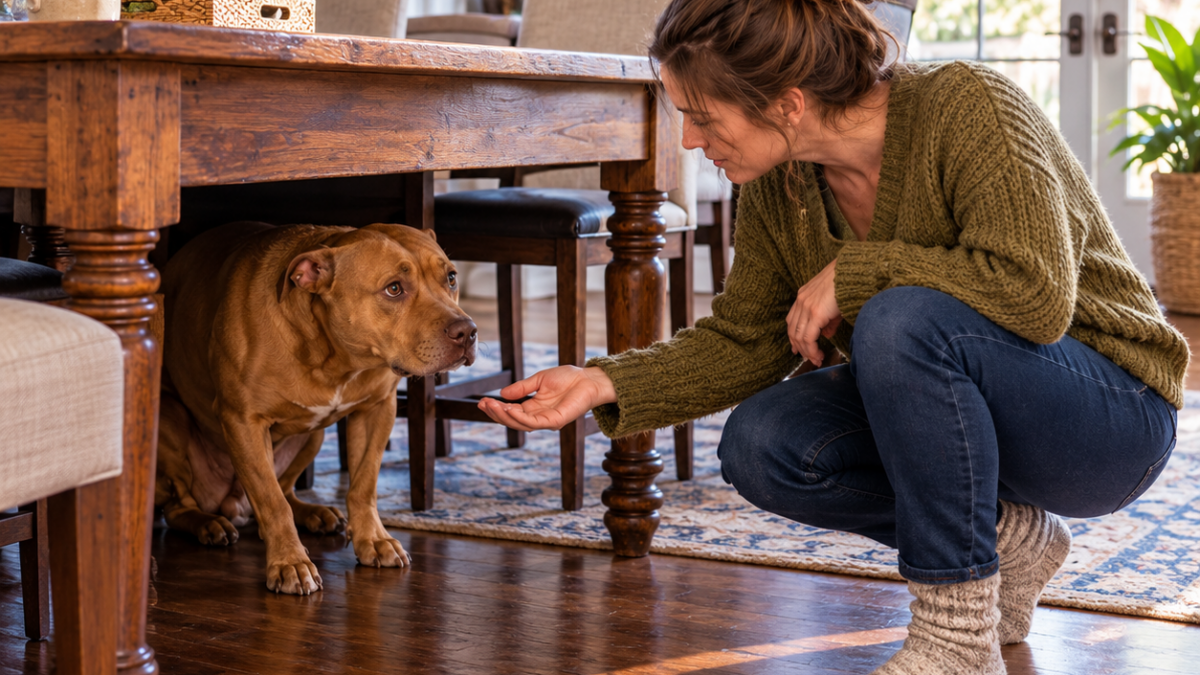
PART 2
Another thunderclap shook the windows.
Rocky flinched so hard his paws slipped on the hardwood.
I still didn’t move.
Every instinct inside me was screaming to reach forward, to gather him against my chest, to show him that nothing in this house could hurt him.
But Rocky had spent nine years being shown things by people who believed they knew what was best for him.
So I waited.
He stared at my right hand.
Then he looked at my face.
His breathing came in short, frightened bursts.
Behind me, Jessica stood motionless in the kitchen doorway.
She had tears in her eyes, but she understood.
Neither of us spoke.
Rocky took one step.
Then another.
Lightning turned the windows white.
Thunder followed almost instantly.
Rocky closed the last few inches between us.
And then the dog who had spent nine years learning to fear human hands slowly lowered his head and rested his chin on my knee.
I broke.
There is no other way to describe it.
I covered my face with both hands and started crying.
Not loudly.
I didn’t want to frighten him.
But I couldn’t stop.
Rocky immediately raised his head, and for one terrible second I thought my movement had ruined everything.
So I lowered my hands again.
“I’m okay,” I whispered. “I’m right here.”
He stared at me.
Then, very carefully, he put his chin back on my knee.
Jessica turned away and covered her mouth.
The storm kept raging outside.
Inside our dining room, something impossibly small was happening.
Rocky was not suddenly healed.
He was not transformed.
He wasn’t wagging his tail or licking my face.
He was still terrified.
But for the first time since we had met him, Rocky had decided that being close to a human might be safer than being alone.
I didn’t touch him.
For almost twenty minutes, I just let him rest there.
Eventually Jessica sat on the floor several feet away.
Rocky looked at her but didn’t retreat.
She whispered, “Good boy.”
His ears twitched.
That was all.
Later that night, after the worst of the storm had moved east, Rocky returned beneath the table.
But something had changed.
He no longer pressed himself against the wall.
He lay near the edge.
Close enough that one gray paw remained visible in the kitchen light.
Jessica and I went upstairs shortly after midnight.
Neither of us slept much.
At six the next morning, I came downstairs expecting to find Rocky tucked into his corner.
Instead, he was standing in the kitchen.
I froze halfway down the staircase.
Rocky froze too.
For several seconds we simply stared at one another.
Then he lowered his head.
I turned my body sideways the way Marta had taught us.
“Morning, buddy.”
Rocky walked away.
But he didn’t run beneath the table.
He went to his water bowl.
I stood there smiling like an idiot.
Jessica came down behind me.
“What?”
I pointed.
“He’s drinking while I’m in the room.”
She looked at Rocky.
Then she looked at me.
Her entire face softened.
“Oh.”
That tiny moment became our celebration.
Not a hug.
Not a tail wag.
A dog drinking water while a man stood fifteen feet away.
When you love a frightened animal, your definition of victory changes.
By the end of that morning, Rocky had eaten half his breakfast while Jessica sat at the kitchen counter.
He refused the rest when I entered.
That was okay.
We had promised ourselves before bringing him home that we would never measure his progress against the dog we wished he could be.
Only against the dog he had been yesterday.
And yesterday, Rocky would not have eaten with either of us in sight.
That afternoon, Jessica called the shelter.
Marta answered.
When Jessica told her what had happened during the storm, the other end of the line went silent.
Then Marta said, “He touched Lucas?”
“His chin. On Lucas’s knee.”
Another silence.
“Jessica, nobody at the shelter has ever seen him voluntarily touch a person.”
I felt my throat tighten again.
Marta asked us to keep doing exactly what we had been doing.
No pressure.
No sudden celebration.
No trying to turn one brave moment into ten.
“Trust is his decision,” she said. “You just keep making it possible.”
Before hanging up, however, Marta hesitated.
“There’s something else.”
Jessica put the phone on speaker.
“What?”
“We posted that Rocky had been adopted.”
My stomach tightened.
The shelter routinely shared successful adoptions online.
There was nothing unusual about that.
But Marta’s voice had changed.
“A woman contacted us this morning. She says she thinks she knows him.”
Jessica looked at me.
“Knows him how?”
“She used to work at a veterinary clinic about forty miles north of here. She said she recognized his face.”
“That seems impossible.”
“I thought so too.”
Marta paused.
“Then she described the scar under his left shoulder.”
Jessica looked toward Rocky.
When the shelter had shaved a small patch of fur for bloodwork, we had noticed a narrow crescent-shaped scar.
It wasn’t visible in most photographs.
“How would she know that?” I asked.
“She says she treated him years ago.”
The room suddenly felt colder.
“What was his name?” Jessica whispered.
“Not Rocky.”
Marta took a breath.
“She knew him as Rook.”
Rocky was standing beside the water bowl.
At that name, one of his ears moved.
Jessica noticed it too.
Neither of us said anything for a moment.
Marta continued.
“The woman’s name is Dana Keller. She says there may still be veterinary records.”
I looked at Rocky.
He had stopped drinking.
“What happened to him?”
“I don’t know yet,” Marta said. “But Dana sounded upset.”
“How long ago?”
“About seven years.”
The mathematics landed hard.
Rocky was approximately nine.
Whatever Dana remembered had happened when he was young.
Jessica sat down.
“Did she say who owned him?”
Another pause.
“Yes.”
I could tell Marta didn’t want to say the name.
Finally she did.
“Calvin Rusk.”
The name meant nothing to me.
Not yet.
Marta explained that Rusk had operated a small protection-dog training business outside Cedar Grove.
He bought dogs.
Trained some.
Sold some.
Boarded others.
The business had changed names twice over the years.
Dana claimed Rocky had been brought into her clinic three times within eleven months.
Different injuries.
Different explanations.
A damaged paw supposedly caused by a fence.
A broken tooth supposedly caused by a training toy.
A shoulder injury supposedly caused by a fall.
The clinic had documented everything.
One veterinarian had filed a concern with county animal control.
Nothing came of it.
“Why?” I asked.
“Apparently there wasn’t enough evidence to establish what happened,” Marta said. “And Rusk stopped using that clinic.”
I looked down at my own hands.
The same hands Rocky had stared at during the storm.
“What does Dana think happened?”
“She wouldn’t speculate over the phone.”
That answer told me more than speculation would have.
Jessica asked, “Can we speak to her?”
“I gave her your number only after she agreed to let me ask you first. She said she’ll wait for your permission.”
“Give it to her.”
After the call ended, Jessica and I sat quietly.
Rocky had returned to the dining room.
Not underneath the table.
Beside it.
That distinction would have been enough to make us happy an hour earlier.
Now I looked at him and imagined him seven years younger.
No gray muzzle.
No hollow eyes.
Maybe once he had run toward people.
Maybe once he had believed hands meant food, scratches behind the ears, a leash leading somewhere exciting.
Something had taught him otherwise.
I felt anger rise so quickly that it frightened me.
Jessica saw it.
“Lucas.”
I said nothing.
“Don’t.”
“Don’t what?”
“Go somewhere in your head that Rocky doesn’t need you to go.”
I looked at her.
“If that man—”
“We don’t know what happened yet.”
“We know enough.”
“No. We know Rocky is afraid. We know a veterinary worker remembers him. We know there were concerns.”
She came closer.
“What Rocky needs today is the same thing he needed yesterday.”
I exhaled.
“A safe house.”
“And two people who don’t become unpredictable when they’re angry.”
That sentence landed exactly where it needed to.
I looked at Rocky again.
His eyes were on us.
Watching.
Always watching.
I lowered my voice.
“You’re right.”
Jessica touched my arm.
“He doesn’t need revenge today.”
At the time, neither of us understood how important that word would become.
Dana called at seven that evening.
Her voice was calm but hesitant.
“I’m sorry if I’m opening something you weren’t prepared for.”
“We want to know,” I told her.
She explained that she had worked as a veterinary technician at Brookfield Animal Clinic from 2017 until the clinic closed in 2022.
She remembered Rook because of his temperament.
“He wasn’t afraid the first time,” she said.
I closed my eyes.
“What was he like?”
“Sweet.”
One word.
That was all it took.
“He was about two, maybe a little younger. He leaned against my leg while I checked his paw. Kept trying to lick my elbow.”
Jessica wiped her eyes.
I looked beneath the table.
Rocky was listening to the sound of our voices.
Dana continued.
“The second time he came in, he was different.”
Different.
That word hurt more than I expected.
“He wouldn’t let us approach from the front. If someone lifted an arm, he dropped to the floor.”
“What happened?”
“Rusk said the dog had become difficult during training.”
“What does that mean?”
“He wouldn’t explain.”
Dana told us the veterinarian documented bruising beneath Rocky’s fur and the broken tooth.
A report was made.
Rusk insisted everything was the result of ordinary working-dog training.
There were no witnesses willing to contradict him.
Months later Rocky returned with the shoulder injury.
By then, Dana said, he had changed completely.
“He crawled under the exam bench.”
My eyes moved to the dining room table.
“He stayed there until Rusk dragged him out by the leash.”
Jessica made a small sound beside me.
I clenched my jaw.
Dana went quiet.
“I’m sorry.”
“No,” I said. “Keep going.”
That was the last time the clinic saw him.
Until the shelter photograph appeared online.
Dana had no idea what happened during the years between.
We thanked her.
Before hanging up, she said there was one more thing.
“Some of the old clinic records were transferred to another practice when we closed. If animal control needs them, I can help locate them.”
“Why would animal control need them now?”
Dana hesitated.
“Because Calvin Rusk still trains dogs.”
I felt the anger return.
“He still has animals?”
“Yes.”
“How many?”
“I don’t know.”
After the call, I went outside.
The storm had cleaned the sky.
Everything smelled like wet leaves and cold earth.
I stood on our back porch with both hands gripping the railing.
Nine years.
Nine years of Rocky expecting pain.
And somewhere forty miles away, the man possibly responsible was still taking money from people to train their dogs.
Jessica stepped outside.
“I know what you’re thinking.”
“Do you?”
“You want to drive to Cedar Grove.”
I looked at her.
She was right.
“I want to look him in the eye.”
“And then what?”
“I don’t know.”
“That’s the problem.”
My hands tightened around the railing.
“You heard Dana.”
“I did.”
“He was sweet.”
“I heard her.”
“He used to lick her elbow.”
Jessica’s face crumpled for a second.
Then she steadied herself.
“I know.”
I looked through the kitchen window.
Rocky was standing in the doorway.
Watching us.
Jessica lowered her voice.
“You told him you’d keep showing up.”
“I will.”
“Then start there.”
So I did.
For the next four days, we said nothing publicly.
We did not contact Calvin Rusk.
We did not become investigators.
We focused on Rocky.
That turned out to be harder and more meaningful than anything I could have done in anger.
Rocky began sleeping outside the table at night.
First beside one leg.
Then halfway between the dining room and kitchen.
He started following Jessica from room to room at a distance.
If she walked upstairs, he waited at the bottom until she disappeared, then climbed three steps before retreating.
One afternoon, I was sitting on the living room floor reading when I heard the soft click of his nails.
Rocky entered.
I kept my eyes on the book.
He walked behind the couch.
Stopped.
Moved another few feet.
Then lay down twelve feet from me.
I read the same paragraph for forty minutes because I was too afraid to turn the page.
Two days later, he accepted a piece of chicken from Jessica’s open palm.
She sat frozen for almost a minute afterward.
“Did that happen?” she whispered.
“Yes.”
“He touched my hand.”
“I saw.”
Her smile trembled.
Rocky chewed the chicken and looked confused by our reaction.
We laughed.
And for one second, his tail moved.
Just once.
A tiny tap against the floor.
Jessica gasped.
Rocky immediately looked behind himself, as if surprised by his own tail.
That made us laugh harder.
He retreated beneath the table.
We didn’t care.
We had seen it.
The first tail wag.
The following Monday, our veterinarian, Dr. Elaine Porter, examined him.
She agreed to do the appointment differently.
No crowded waiting room.
No lifting him onto a metal table.
No strangers surrounding him.
We entered through a side door.
Dr. Porter sat on the floor and spent twenty minutes pretending Rocky wasn’t there.
Eventually he approached close enough for her to examine him in stages.
She found old injuries.
A poorly healed rib.
Damage to one canine tooth.
Arthritis in his left shoulder that was more severe than expected for his age.
A narrow band of scar tissue around part of his neck.
None of it alone proved abuse.
Dr. Porter made that clear.
“Bodies tell us what happened,” she said. “They don’t always tell us who did it.”
But her expression said she understood why we were asking.
She took copies of the old clinic records Dana had helped locate.
Then she compared them.
The shoulder.
The tooth.
The dates.
The notes.
Finally she looked at us.
“This is almost certainly the same dog.”
Jessica rubbed Rocky’s chest with the back of two fingers.
He had recently begun allowing that kind of touch.
“So what do we do?”
Dr. Porter closed the folder.
“You let professionals handle the investigation.”
She gave us the number of a county animal-control investigator named Denise Mallory.
I called her from the parking lot.
Denise listened quietly.
Then she asked me to email everything.
Before hanging up, she said, “Do not contact Mr. Rusk.”
“I wasn’t planning to.”
That was a lie.
She must have heard it in my voice.
“Mr. Bennett, I mean that.”
I looked at Jessica.
“All right.”
“If there is something there, approaching him can make it harder for us to document it.”
That got through to me.
“I understand.”
“Good. And one more thing.”
“What?”
“If he contacts you, save everything.”
At the time, I thought she was being overly cautious.
Three nights later, someone knocked on our front door.
Rocky was lying beside the dining room table.
The knock sent him upright.
Not unusual.
Then a man’s voice came through the door.
“Anybody home?”
Rocky stopped breathing.
I swear that is what it looked like.
His entire body locked.
His eyes widened.
His mouth closed.
Then he backed away so quickly he struck the wall.
Jessica looked at me.
Another knock.
“Mr. Bennett?”
Rocky disappeared under the table.
Not crawled.
Not retreated.
Disappeared.
I walked to the front window.
A dark pickup sat at the curb.
On the driver’s door were the words:
RUSK K9 SERVICES.
My stomach dropped.
Calvin Rusk stood on our porch.
He looked to be in his early fifties.
Heavy jacket.
Work boots.
Baseball cap.
Nothing about him looked extraordinary.
That was somehow worse.
I had imagined a monster.
Monsters are easy.
The man outside looked like someone who could stand behind you at a hardware store and complain about the price of lumber.
Jessica whispered, “Call Denise.”
I nodded.
Then I opened the door but kept the storm door locked between us.
“Can I help you?”
Rusk looked past me.
“I think you have my dog.”
Every muscle in my body tightened.
“No.”
“Pit bull. Gray face. Name’s Rook.”
“His name is Rocky.”
Rusk smiled.
Not kindly.
“You can call him whatever you want. He’s mine.”
“He was legally adopted from the county shelter.”
“Mistake.”
He pulled a folded photograph from his jacket.
Through the glass I could see a younger Rocky standing beside a training platform.
His muzzle was dark.
His body was muscular.
And his tail was high.
He looked alive in a way I had never seen.
My anger became something colder.
“How did you get this address?”
“Doesn’t matter.”
“It matters to me.”
“He belongs to me.”
Behind me I heard Jessica dialing.
Then Rusk made a clicking sound with his tongue.
Rocky began scratching frantically against the dining room floor.
I turned.
His body was flattened beneath the table.
Rusk heard it.
“There he is.”
He smiled again.
“Rook.”
Rocky whimpered.
The sound went straight through me.
“Leave.”
Rusk’s expression changed.
“I’m not leaving without my dog.”
“You abandoned him.”
“You don’t know anything about it.”
“I know he spent eight months in a shelter.”
“That wasn’t supposed to happen.”
The sentence hung there.
I stared at him.
“What was supposed to happen?”
He realized too late that he had said too much.
His eyes hardened.
“That’s between me and the shelter.”
“No. You showed up at my house.”
I heard Jessica behind me.
“Lucas, Denise says deputies are coming.”
Rusk glanced over my shoulder.
Then he stepped closer to the glass.
“You people think every scared dog needs a therapist.”
I felt heat rise into my face.
“Get off my property.”
“He was a working dog.”
“He’s a family dog now.”
“He was trained to work.”
“Then why is he terrified of you?”
For the first time, Rusk lost his smile.
“You have no idea how difficult that animal was.”
Something inside me nearly snapped.
I unlocked the storm door.
Jessica grabbed my arm.
“Lucas.”
That one word stopped me.
I remembered Rocky watching us on the porch days earlier.
I remembered my promise.
I closed the lock again.
Rusk laughed softly.
“Smart wife.”
Then he made a sharp whistle.
From beneath the table came a broken cry.
Jessica spun around.
“Stop it!”
Rusk’s eyes flicked toward the sound.
And he looked pleased.
Not surprised.
Pleased.
That was the moment I knew.
Not legally.
Not in a way a court could accept.
But in my bones.
This man knew exactly what Rocky feared.
And he enjoyed knowing he still had the power to cause it.
I leaned close to the glass.
“You are never getting near him again.”
Rusk’s smile disappeared.
“We’ll see.”
Red and blue lights appeared at the end of the street.
His face changed immediately.
He backed away.
Two sheriff’s cruisers stopped at the curb.
Deputies approached.
Rusk tried to turn the situation around.
He said we had stolen his property.
He said the shelter had adopted out a valuable trained dog without authorization.
He produced photographs.
The deputies asked me for Rocky’s adoption documents.
Jessica already had them ready.
The paperwork listed Rocky as legally transferred after the required hold period following his recovery from an abandoned rental property.
Owner unknown.
No microchip.
No active license.
No response to public notices.
Rusk’s claim immediately raised an obvious question.
If Rocky was his dog, why had he never claimed him?
One deputy asked exactly that.
Rusk’s answer changed twice.
First he said he had not known where Rocky was.
Then he said an employee had been responsible for recovering him.
Then he claimed he had been dealing with a family emergency.
The deputy took notes.
Finally he told Rusk that any ownership dispute would have to be handled through legal channels.
He also told him he was no longer welcome on our property.
“If you come back without a court order or an invitation, you may be arrested for trespassing.”
Rusk looked at me.
“This isn’t finished.”
The deputy stepped between us.
“It is for tonight.”
Rusk returned to his truck.
Rocky remained under the table long after the taillights vanished.
I sat on the floor.
The old distance between us had returned.
Six feet.
Then five.
Then four.
He would not look at me.
“It’s okay,” I whispered.
Nothing.
“He’s gone.”
Rocky trembled.
I wanted to destroy something.
I wanted Rusk to feel one fraction of the fear he had put into that dog.
Instead, I sat there.
For three hours.
At nearly one in the morning, Rocky finally crawled forward.
Not all the way.
Just enough that his nose appeared beyond the table leg.
I put my hand flat on the floor.
He stared at it.
Then he placed one paw over my fingers.
That broke me harder than the storm had.
Because I understood what he was saying in the only language he had.
You let him leave.
You did not give me back.
Jessica sat beside me.
Rocky kept his paw on my hand.
The next morning, I called Denise.
She had already heard about the visit.
When I told her what Rusk had said, especially the sentence about Rocky not being “supposed” to reach the shelter, she became very quiet.
“Did anyone record the conversation?”
Jessica had.
Our doorbell camera had captured most of it.
Denise asked us to preserve the original file.
Then she said something I had not expected.
“Mr. Bennett, Calvin Rusk has been on our radar before.”
“How long?”
“Years.”
“Then why does he still have dogs?”
“Because suspicion and evidence are different things.”
I hated the answer.
But I understood it.
There had been complaints.
Dogs with unexplained injuries.
Former customers alleging excessive punishment.
Employees quitting suddenly.
Animals disappearing from training records.
But nothing had held together long enough for prosecutors to build a case.
Witnesses backed away.
Customers accepted refunds and signed agreements.
Employees feared lawsuits.
Records vanished when businesses changed names.
Denise said the old veterinary files mattered.
Rusk’s appearance at our house mattered.
But neither was enough.
Then she told me about a man named Noah Pierce.
He had worked for Rusk almost six years earlier.
“He contacted us once,” Denise said. “Then he stopped cooperating.”
“Why?”
“He was nineteen. Rusk threatened to sue him and told him he’d never work with animals again.”
“Can you call him?”
“We have.”
“And?”
“He hasn’t answered.”
I looked at Rocky.
“What do you need from him?”
“The truth.”
Three days later, I received a message from a number I didn’t recognize.
Are you Rocky’s adopter?
I showed Jessica.
“Send it to Denise.”
I did.
She called immediately.
“Don’t respond yet.”
An hour later she called back.
The number belonged to Noah Pierce.
With Denise’s approval, I replied.
Yes.
His next message arrived almost immediately.
Is he safe?
I looked beneath the table.
Rocky was sleeping with his head resting on one paw.
For the first time since Rusk’s visit, his body looked loose.
Yes, I wrote. He’s safe.
Three dots appeared.
Vanished.
Appeared again.
Then Noah sent four words.
I owe him something.
We met two days later at the animal-control office.
Noah was twenty-five now.
Thin.
Nervous.
He kept rubbing his palms against his jeans.
When Denise introduced us, he couldn’t look at me.
Finally he asked, “Can I see a picture?”
I showed him one from that morning.
Rocky was lying in a patch of sunlight beside our kitchen window.
Noah stared at it for a long time.
“He got old.”
“So did the rest of us.”
His mouth twitched, but he didn’t smile.
Then his eyes filled.
“I thought he was dead.”
Jessica leaned forward.
“Why?”
Noah swallowed.
And told us.
He had been eighteen when Rusk hired him.
He loved dogs.
He thought working at a training facility would be his first step toward becoming a professional handler.
At first, Rusk seemed demanding but competent.
Then Noah began noticing what happened when clients left.
Training became punishment.
Dogs that froze were punished for refusing.
Dogs that resisted were punished for aggression.
Dogs that became too frightened to respond were punished for being “shut down.”
Rocky—then Rook—had been one of them.
“He was happy when I met him,” Noah said.
I closed my eyes.
Those words again.
Happy.
“He’d chase tennis balls for hours. If you sat on the ground, he’d climb into your lap.”
Jessica began crying silently.
Noah stared at his hands.
“Rusk wanted him to be a protection dog. Rook didn’t have the temperament.”
“What does that mean?” I asked.
“He was friendly. Too friendly, according to Calvin.”
My stomach twisted.
Noah said Rusk believed fear could be turned into obedience.
When Rocky hesitated, the methods became harsher.
Noah did not describe everything.
I was grateful.
I didn’t need images in my head that I could never erase.
What mattered was simple.
Rocky’s gentleness had been treated like a defect.
His trust had been punished out of him.
“Why didn’t you stop it?” I asked.
Jessica looked at me sharply.
Noah didn’t defend himself.
“I should have.”
“You were there.”
“I know.”
“He was two years old.”
“I know.”
His voice broke.
Denise intervened.
“Lucas.”
But Noah shook his head.
“No. He gets to ask.”
He looked at me for the first time.
“I was a kid who wanted a job more than he wanted to admit what he was seeing. Every week I told myself I’d quit next week. Every week I told myself maybe I was exaggerating.”
His eyes reddened.
“Then one afternoon Rook wouldn’t come out of a kennel.”
The room went silent.
“Calvin told me to get him.”
Noah swallowed.
“I walked inside. Rook crawled behind me and pressed himself against my legs.”
I could barely breathe.
“He picked you.”
Noah nodded.
“And I handed him over.”
He wiped his face.
“I have hated myself for six years because of that.”
No one spoke.
Finally Jessica asked, “What happened afterward?”
Noah reached down beside his chair.
He lifted a battered black laptop bag onto the table.
“I started saving things.”
Training logs.
Photographs.
Copies of invoices.
Internal messages.
Short videos recorded on an old phone.
A spreadsheet listing dogs by name, customer, training objective, and outcome.
Beside several names were words like FAILED, RETURNED, DISPOSED, or TRANSFERRED.
Rocky’s old name appeared there.
ROOK.
Under outcome were two words.
REMOVE OFFSITE.
No destination.
No customer.
No explanation.
But there was a date.
Six months later, according to property records Denise had already obtained, the house where Rocky was eventually found abandoned had been rented by one of Rusk’s former employees.
The same employee had disappeared from the area after owing months of rent.
Rocky had apparently spent years passing between people connected to Rusk before eventually being left behind.
Noah had more.
He had kept copies because, in his words, “I knew someday somebody would ask what happened to those dogs.”
“Why didn’t you give this to animal control six years ago?” I asked.
His face fell.
“I tried.”
He had contacted an officer.
Then Rusk somehow learned.
A lawyer sent Noah a letter accusing him of stealing proprietary records and threatening damages.
Noah panicked.
He stopped answering investigators.
Changed jobs.
Moved.
Put the laptop in a box.
And tried to forget.
“Then I saw Rocky’s adoption picture.”
He looked at me.
“I realized he survived what I was too scared to talk about.”
Denise took possession of the materials.
From that moment, everything changed.
The investigation was no longer about an old frightened dog.
The records suggested a pattern.
Denise warned us again not to contact Rusk.
This time I meant it when I agreed.
Weeks passed.
Rocky changed too.
Slowly.
Painfully.
Beautifully.
He started spending mornings in the living room.
He learned that the refrigerator opening often meant cheese.
He discovered the ridiculous pleasure of lying directly over the heating vent.
He became fascinated by squirrels but seemed unsure what he was supposed to do about them.
He would stare through the window, look at me, then stare outside again.
The first time he picked up a toy, Jessica nearly dropped her coffee.
It was a blue stuffed elephant she had bought before we adopted him.
For twenty-three days, Rocky had ignored it.
Then one morning he walked over, sniffed it, and gently took one ear in his mouth.
Jessica whispered, “Lucas.”
“I see.”
“Don’t move.”
“I’m not moving.”
Rocky carried the elephant three feet.
Dropped it.
Looked startled.
Picked it up again.
Then his tail wagged.
Once.
Twice.
Three times.
I laughed.
Rocky froze.
I clamped both hands over my mouth.
He stared at me.
Then picked the elephant up again.
Jessica started crying.
“Everything makes us cry now.”
I whispered, “Apparently.”
One month after Rocky came home, he allowed me to touch the side of his neck.
He approached while I was sitting on the floor.
I held my hand low.
He sniffed my fingers.
Then turned slightly and pressed his shoulder against my knuckles.
I moved one finger.
He stayed.
I scratched once.
Stopped.
Rocky leaned back into my hand.
That was his permission.
From then on, we let him write the rules.
A touch lasted only as long as he wanted.
If he moved away, we stopped.
If he returned, we continued.
He learned that walking away did not make anyone angry.
That may have been the most important lesson of all.
Meanwhile, the case against Rusk grew.
We knew very little because Denise could not share an active investigation.
Then, one Thursday morning in December, she called.
“Turn on the local news.”
My stomach tightened.
Jessica opened her laptop.
A helicopter shot showed a rural property outside Cedar Grove.
Animal-control vehicles lined the driveway.
Sheriff’s deputies stood near a training building.
Kennel doors were open.
Dogs were being carried and led toward transport vans.
Eleven of them.
Eleven.
Jessica covered her mouth.
Rocky was sleeping beside the couch.
The reporter said authorities had executed a search warrant as part of an investigation involving alleged animal cruelty and licensing violations.
No names had been officially released.
We didn’t need one.
I recognized the sign outside the property.
RUSK K9 SERVICES.
The camera showed a man in a dark jacket speaking angrily with investigators.
Calvin Rusk.
For months, I had imagined what I would feel if authorities finally walked onto his property.
Triumph.
Satisfaction.
Maybe even joy.
I felt none of those things.
I looked at the dogs being loaded into vans.
One had to be coaxed from a kennel.
Another flattened himself when a deputy raised a leash.
All I could think was:
How many Rockys are in those vans?
Jessica sat beside me.
“They got them out.”
I nodded.
“That’s enough for today.”
It should have been.
But Calvin Rusk was not finished.
Three days later, a process server knocked on our door.
Rusk had filed a civil claim demanding Rocky’s return.
He alleged the shelter had unlawfully transferred valuable personal property.
He claimed Rocky had been stolen years earlier.
He claimed he had recently discovered where the dog was.
He wanted immediate possession pending litigation.
Jessica read the document twice.
Then she looked at me.
“He’s trying to take him.”
“No.”
“Lucas—”
“No.”
Rocky was asleep under the Christmas tree.
He had discovered that the low branches created another sheltered space, but unlike the dining table, he did not hide there.
He slept on his side.
Exposed.
Safe.
I looked back at the papers.
“He is not getting this dog.”
We hired an attorney.
The shelter joined the case because its adoption process was being challenged.
County records showed Rocky had been found abandoned.
Public notice had been made.
The statutory hold had passed.
No owner had come forward.
Rusk’s attorney argued that a stolen dog remained stolen property regardless of how much time had passed.
Our attorney asked for proof that Rocky had ever been stolen.
Rusk produced photographs and old training records proving he once possessed Rocky.
That part was undeniable.
What he could not produce was a theft report.
No police report.
No insurance claim.
No notice to local shelters.
No public posting.
No veterinary inquiry.
Nothing.
Then Noah’s spreadsheet became relevant.
ROOK.
REMOVE OFFSITE.
Rusk’s attorney called it meaningless internal shorthand.
Our attorney asked what it meant.
Rusk claimed he couldn’t remember.
Then another record surfaced.
An email.
Written by Rusk.
Sent to the employee who had later rented the house where Rocky was found.
The language was cold.
Rook is done here. Take him when you leave tonight. I don’t want him back on the property.
Noah had saved the message.
I read it three times.
Jessica read it once and walked out of the room.
I found her in the backyard crying.
“He threw him away.”
I put my arm around her.
“He tried to.”
She shook her head.
“Look at him now.”
Rocky was standing inside the patio door watching us.
His tail gave one uncertain wag.
“He tried to erase him,” she said.
I looked at the gray face behind the glass.
“He failed.”
The civil hearing took place in January.
We left Rocky home with Marta.
There was no reason to make him endure a courthouse.
Rusk sat across the aisle in a dark suit.
He looked smaller without the truck, the business sign, the property, the whistle.
Still, when he turned and saw me, he smiled.
That same thin smile from our porch.
I felt my hands close into fists.
Jessica laid her fingers over mine.
“Rocky,” she whispered.
One word.
Enough.
The judge reviewed the records.
Rusk’s attorney argued.
Our attorney responded.
The shelter’s attorney explained the intake procedure.
Then the judge asked Rusk a simple question.
“When did you first report this dog missing?”
Rusk shifted.
“I believed an employee had taken him.”
“That is not what I asked.”
Silence.
“When did you report the dog missing?”
“I did not file a formal police report.”
“Did you contact animal control?”
“No.”
“Local shelters?”
“No.”
“Veterinary offices?”
“No.”
“Did you make any effort to recover him?”
Rusk looked toward his attorney.
“Not formally.”
The judge picked up the email.
“Yet this message from your account appears to instruct an employee to remove the dog and states that you did not want the animal returned to your property.”
Rusk said the message was being taken out of context.
The judge asked for the context.
He could not provide one.
Twenty minutes later, the request for Rocky’s return was denied.
The judge found no basis for disturbing the completed shelter adoption.
Rocky remained ours.
Jessica squeezed my hand beneath the table.
I thought I would feel victorious.
Instead I felt something quieter.
Relief.
Pure, exhausting relief.
Outside the courtroom, Rusk approached us.
His attorney tried to stop him.
He ignored her.
“You think this makes you heroes?”
I said nothing.
“You took a ruined dog and turned him into a sob story.”
Jessica stepped forward.
“No.”
Rusk looked at her.
“You ruined him.”
The hallway went still.
His attorney closed her eyes.
Rusk realized what Jessica had done.
Two sheriff’s deputies standing nearby had heard every word.
So had Denise.
Rusk corrected himself immediately.
“That’s not what I meant.”
Jessica’s voice stayed calm.
“It sounded clear.”
His attorney took his arm.
“We’re leaving.”
Rusk looked at me.
I had imagined this moment.
In my imagination I said something devastating.
Something that would make him feel small.
Something worthy of all the anger I had carried.
Instead, I thought about Rocky placing one paw over my hand.
I said, “You don’t get to scare him anymore.”
That was all.
Rusk walked away.
The criminal investigation continued.
The eleven dogs seized from his property were placed in temporary foster care while the case moved through court.
Some recovered quickly.
Others didn’t.
One elderly shepherd refused to eat unless nobody was in the room.
A young mixed breed panicked at the sound of metal gates.
Another dog had no idea how to walk through a doorway without being pulled.
When Denise told us that, I understood something that made my stomach turn.
Rocky had never been unusual.
He had been one chapter in a pattern.
That knowledge changed my anger.
I stopped wanting revenge in the way I had first imagined it.
I did not want Rusk frightened.
I did not want him hurt.
I wanted him stopped.
Completely.
Permanently, if the law allowed it.
No more dogs.
No more frightened employees.
No more customers dropping off beloved animals and assuming the person behind the gate knew best.
No more animals learning that obedience and terror were the same thing.
The prosecutor eventually filed multiple charges based on the current conditions investigators documented, combined with records and witness statements establishing a longer pattern.
I won’t pretend the process was fast.
It wasn’t.
Months passed.
There were motions.
Delays.
Hearings.
Arguments over evidence.
Rusk denied deliberately harming any animal.
His attorney said the state was criminalizing legitimate working-dog training.
Several former clients defended him.
They said he had produced disciplined dogs.
They said protection training could look harsh to outsiders.
Those claims deserved to be answered with evidence, not anger.
And that was what prosecutors did.
Veterinarians testified about injuries.
Investigators testified about conditions at the property.
Former employees described methods they had witnessed.
Business records contradicted explanations Rusk had given over the years.
And then Noah testified.
I attended that day.
Jessica stayed home with Rocky.
Noah looked terrified when he entered the courtroom.
Rusk watched him from the defense table.
For a moment I saw the nineteen-year-old Noah must once have been.
The kid who had wanted a job.
The kid who had known something was wrong but had been too afraid to stand against a man who controlled his paycheck and future.
The prosecutor asked him why he had kept the files.
Noah swallowed.
“Because I knew what we were doing wasn’t training anymore.”
Rusk’s attorney objected.
The judge instructed Noah to describe what he personally observed rather than characterize it.
So he did.
Calmly.
Specifically.
No exaggeration.
No dramatic language.
That made his testimony more powerful.
He described dogs freezing.
Dogs hiding.
Dogs becoming less responsive over time.
He described Rocky as a young, affectionate dog who gradually began avoiding human contact.
Then the prosecutor showed the jury an old photograph.
Rocky at approximately two years old.
Standing beside Noah.
A tennis ball in his mouth.
Tail high.
Eyes bright.
I stared at the picture.
My chest hurt.
That dog existed.
Not the dog beneath our table.
Not the trembling animal from the shelter.
This Rocky was leaning against Noah’s leg.
Trusting him.
The prosecutor asked, “Do you recognize this dog?”
Noah’s voice cracked.
“Yes.”
“What was his name?”
“Rook.”
“Is that the dog later adopted under the name Rocky?”
“Yes.”
“What changed?”
Rusk’s attorney objected again.
The judge allowed Noah to describe his observations.
Noah stared at the photograph.
“When I started there, if you opened his kennel, he ran toward you.”
He took a breath.
“By the time he left, if you opened his kennel, he ran away.”
No one in the courtroom moved.
The prosecutor waited.
Then asked, “Why did you leave your job?”
Noah looked directly at Rusk.
“Because one day I realized the dogs were afraid of me too.”
I will remember that sentence for the rest of my life.
During cross-examination, Rusk’s attorney attacked Noah’s credibility.
Why wait six years?
Why keep company records?
Why stop cooperating with the first investigation?
Wasn’t he an angry former employee?
Hadn’t he stolen proprietary information?
Noah answered every question.
“Yes, I waited.”
“Yes, I was afraid.”
“Yes, I should have spoken sooner.”
Then the attorney asked, “So you expect this jury to trust the memory of a man who admits he failed to act at the time?”
Noah looked toward the jury.
“No.”
The lawyer paused.
Noah continued.
“That’s why I kept the records.”
The prosecutor did not smile.
Neither did I.
But something shifted in the room.
Facts did what rage could not.
They stayed.
Rusk took the stand in his own defense.
That decision surprised everyone.
He spoke confidently.
He described decades of experience.
He insisted difficult dogs required firm correction.
He accused former employees of misunderstanding advanced training.
He said society had become too sentimental about animals.
Then his attorney asked about Rocky.
Rusk called him “unstable from the beginning.”
My hands tightened.
He said Rocky lacked confidence.
Was inconsistent.
Failed training objectives.
Had been transferred to an employee because he was unsuitable for professional work.
The prosecutor stood for cross-examination.
“Unsuitable?”
“Yes.”
“Yet you filed a civil action describing him as a valuable trained dog?”
Rusk hesitated.
“He had value.”
“As what?”
“A dog.”
“You sued the Bennetts to recover an allegedly unstable dog you had ordered removed from your property years earlier?”
Rusk’s jaw tightened.
“I wanted my property returned.”
The prosecutor lifted the old email.
“You wrote that you did not want him returned.”
“That was temporary.”
“For how long?”
Rusk said nothing.
“Eight years?”
No answer.
Then came the question that destroyed him.
The prosecutor played our doorbell recording.
Rusk’s voice filled the courtroom.
He was standing on our porch.
You people think every scared dog needs a therapist.
Then my voice.
He was a working dog.
Why is he terrified of you?
Then Rusk’s response.
You have no idea how difficult that animal was.
The recording continued.
His whistle.
Rocky’s cry from inside our house.
Jessica shouting, Stop it!
The prosecutor froze the recording.
“What was that whistle?”
“A command.”
“For a dog you had not seen in approximately eight years?”
Rusk shifted.
“Old training habit.”
“What command?”
Silence.
“Mr. Rusk, what did that whistle tell Rocky to do?”
“It depended.”
“On what?”
“The training context.”
“There was no training context on the Bennetts’ front porch.”
Rusk’s attorney objected.
Overruled.
The prosecutor asked again.
“What response did you expect?”
Rusk stared ahead.
“I didn’t know how he would respond.”
“But you did it anyway.”
“Yes.”
“You watched him react.”
No answer.
“And then you smiled.”
Rusk’s attorney objected again.
The prosecutor pointed to the video.
“The jury can see the recording.”
The judge allowed it.
The video played again.
There it was.
That smile.
Small.
Brief.
But unmistakable.
For months I had wondered if I had imagined its cruelty because I hated the man.
I hadn’t.
The jury could see it too.
The trial lasted nine days.
Then came deliberations.
Jessica joined me for the verdict.
We sat in the second row.
Noah sat behind us.
Dana Keller, the former veterinary technician, sat beside him.
Denise stood near the back wall.
The jury entered.
I could hear my heartbeat.
The clerk read the verdicts.
Guilty on multiple counts tied to the current animals.
Guilty on additional animal-welfare violations.
Guilty on record-related offenses connected to his kennel operation.
Not every count resulted in conviction.
That mattered to me.
Justice was not supposed to be a story where everything went perfectly because we wanted it to.
It was supposed to be evidence weighed carefully.
But the result was enough.
More than enough.
Rusk would no longer operate his training business.
His animals had already been removed.
At sentencing, the judge imposed fines and restitution, probation following a period of confinement, and a lengthy prohibition against owning, training, boarding, or commercially handling animals.
The exact numbers mattered less to me than one sentence.
“You will not operate an animal-training facility during the prohibition period.”
Jessica squeezed my hand.
I closed my eyes.
No more.
That was the revenge I had wanted without understanding it.
Not pain returned for pain.
A locked gate.
Empty kennels.
No frightened dog waiting for footsteps.
Rusk addressed the court before sentencing.
He never apologized to Rocky.
He never apologized to any dog.
He said he had been misunderstood.
He said changing cultural standards had turned accepted training methods into crimes.
The judge listened.
Then said something I will never forget.
“Control obtained through fear is not proof of trust.”
I thought about the storm.
Rocky’s chin on my knee.
His paw over my hand.
No.
Fear could make an animal obey.
It could make him freeze.
Hide.
Disappear.
Trust was different.
Trust could not be forced.
That evening, we drove home in silence.
Rocky met us at the door.
That was new.
He had started doing it about two months earlier.
Not every day.
But often enough that I still smiled whenever I saw him waiting.
His tail wagged.
Actually wagged.
Not the tiny uncertain movement from those first weeks.
A full, loose sweep.
Jessica knelt.
Rocky walked to her and pressed his head against her chest.
Then he came to me.
I sat on the floor.
He sniffed my jacket.
Courthouse.
Strange people.
Strange rooms.
Maybe he smelled all of it.
I scratched gently behind his ear.
“You won.”
Jessica looked at me.
I corrected myself.
“No.”
I smiled through tears.
“You got away.”
That mattered more.
The following spring, the eleven dogs removed from Rusk’s property were formally released for adoption or long-term sanctuary placement after the legal process concluded.
Not all of them became traditional family pets.
That was another lesson Rocky taught us.
Rescue does not always mean turning a traumatized animal into somebody’s idea of normal.
One shepherd needed a quiet sanctuary with experienced handlers.
Another dog bonded with a veterinary technician and went home with her.
Two younger dogs recovered quickly and were adopted into families.
A brindle female named Hazel went to Noah.
When he told us, I stared at him.
“You’re adopting one?”
He nodded.
“If they approve me.”
“They will.”
“I’m not sure they should.”
That stopped me.
“Why?”
He looked down.
“Because of what I did back then.”
I understood.
For months Noah had helped investigators.
Testified.
Turned over every record he had.
Apologized to people who had never asked him to.
But guilt had become its own cage.
I said, “Rocky doesn’t need you to spend the rest of your life under a table.”
Noah looked up.
I almost laughed at the expression on his face.
“That’s annoyingly profound.”
“Rocky taught me.”
Hazel went home with Noah two weeks later.
He sent us a photograph.
She was lying on his couch with all four paws in the air.
The caption beneath it contained only three words.
She chose upstairs.
Jessica laughed so hard she cried.
By summer, Rocky had become a different dog.
Not the dog he had been at two.
We would never get that version of him back.
Trauma is not a stain you wash out until someone returns to factory condition.
Some things stayed.
Rocky still disliked sudden movements.
Men wearing heavy work boots made him nervous.
Metal chains were difficult.
Sharp whistles were worse.
Thunder remained complicated.
But now fear was only part of him.
It was no longer all of him.
He loved cheese.
Hated bananas.
Snored loudly enough that we occasionally paused the television to make sure the sound was actually coming from the dog.
He developed an obsession with a patch of afternoon sunlight near the front window.
He discovered that squirrels were clearly suspicious but apparently too dangerous to confront.
He slept with the blue elephant tucked between his paws.
And, somehow, he became convinced that my side of the bed belonged to him.
The first time I came upstairs and found him sprawled across my pillow, I stared.
Jessica looked over her book.
“What?”
“He’s in my spot.”
“Looks like his spot.”
“I bought the mattress.”
“Take it up with him.”
I pointed at Rocky.
He opened one eye.
Then closed it.
Jessica smiled.
“Good luck.”
I slept on approximately eleven inches of mattress that night.
I had never been happier to lose an argument.
The dining room table remained Rocky’s safe place.
We never removed it.
At first, I had thought healing would mean he stopped going underneath.
Eventually I understood that was wrong.
Healing meant he could go there without believing he had to stay.
If the vacuum startled him, he might retreat beneath the table.
Ten minutes later, he came back out.
If visitors became too loud, he went there.
We told people to leave him alone.
He returned when he was ready.
Choice.
That was the foundation of everything.
One afternoon Marta visited.
Rocky had not seen her since the adoption.
She entered carefully and sat on the couch.
Rocky watched from the hallway.
Marta did not call him.
Did not approach.
After twenty minutes, Rocky walked into the room.
Marta’s eyes filled immediately.
“Oh, sweetheart.”
He stopped.
She kept her hands in her lap.
Rocky sniffed the air.
Then walked closer.
Marta whispered, “Look at you.”
He sniffed her shoe.
Then her knee.
Finally he stood beside her.
She looked at me.
“Can I?”
I shrugged.
“Ask him.”
So she lowered one hand.
Rocky examined it.
Then nudged her fingers with his nose.
Marta began crying.
“You remember me.”
Maybe he did.
Maybe he didn’t.
It didn’t matter.
She scratched beneath his chin.
Rocky’s eyes softened.
“He never let me do this.”
I sat across from them.
“You kept him alive long enough to let us try.”
Marta shook her head.
“We almost gave up finding him a home.”
“But you didn’t.”
“No.”
She smiled at Rocky.
“Neither did he.”
A year passed.
Then, almost exactly twelve months after the storm that changed everything, another storm rolled toward our town.
I knew it was coming before the first thunder.
Rocky began pacing.
His ears flattened.
He followed me from the kitchen to the living room.
Jessica turned down the television.
“We should close the curtains.”
I did.
Thunder rumbled in the distance.
Rocky looked toward the dining table.
Then at me.
I sat on the floor in the same place I had sat a year earlier.
Not because I expected him to repeat the moment.
Because routines helped him.
“You can go under there,” I said.
Rocky looked at the table.
Lightning flashed.
He flinched.
Then thunder rolled over the house.
Rocky took two steps toward his old hiding place.
Stopped.
Turned around.
And came to me.
No crawling.
No trembling inch by inch.
He simply walked over and sat beside me.
Jessica lowered herself onto the floor on his other side.
Rocky leaned against us.
I felt his weight against my ribs.
A solid seventy pounds.
Warm.
Alive.
Safe.
Another thunderclap rattled the window.
Rocky flinched but stayed.
I laid my hand on the floor.
Not on him.
Just there.
The way I had on those first nights.
Rocky looked down.
Then placed his paw over it.
Exactly as he had after Rusk came to our house.
Jessica saw it.
Neither of us said anything.
We didn’t have to.
I thought about all the hands Rocky had known.
Hands that dragged.
Hands that punished.
Hands that demanded.
Hands that believed fear was the same thing as obedience.
Then I thought about the night I had sat six feet away and promised him something that seemed almost meaningless at the time.
I’ll just keep showing up.
That promise had changed both of us.
People sometimes asked whether Rocky forgave humans.
I never liked the question.
Forgiveness was too complicated a word to put on a dog.
Rocky never owed humanity forgiveness.
He didn’t owe Rusk forgiveness.
He didn’t owe Noah forgiveness.
He didn’t even owe Jessica and me trust.
What he gave us was not repayment.
It was a gift.
A choice he made again and again.
Come closer.
Stay.
Try once more.
That was enough.
Two years after we adopted Rocky, the county shelter renovated part of its oldest kennel wing.
Jessica and I donated what we could.
Noah helped organize volunteers.
Dana convinced a veterinary supplier to contribute equipment.
They created three small rooms designed specifically for elderly and severely frightened dogs.
Quieter lighting.
Solid walls between kennels.
Soft bedding.
Spaces where dogs could retreat without disappearing completely.
Marta called me before the rooms opened.
“We need a name for the quiet wing.”
I laughed.
“No.”
“You don’t even know what I was going to say.”
“Yes, I do.”
She laughed too.
Eventually we agreed.
Not the Rocky Memorial Wing.
He was very much alive and would have objected to that terminology if he understood English.
A small plaque outside the rooms simply said:
ROCKY’S ROOM
Below it:
For dogs who need time.
The day it opened, we brought Rocky after the shelter had closed to the public.
He walked slowly through the hallway where he had once spent eight months.
I wondered if he remembered.
His body became cautious.
His tail lowered.
Jessica looked at me.
“Maybe this was a mistake.”
I almost agreed.
Then Marta appeared.
She sat on the floor.
Rocky saw her.
His ears lifted.
He walked toward her.
Not quickly.
But willingly.
She held out one hand.
Rocky pressed his head into it.
Marta laughed through tears.
“Show-off.”
We walked him to the new rooms.
Inside the first one was an elderly hound named Walter.
Walter had been found wandering beside a highway.
He was terrified of doorways.
When people entered his room, he faced the wall.
Rocky stood outside the glass.
Walter looked at him.
Rocky looked back.
For several minutes, neither moved.
Then Walter approached the gate.
Marta whispered, “That’s the closest he’s come when people are nearby.”
Rocky sniffed beneath the door.
Walter sniffed back.
Something about the moment hit me harder than I expected.
Rocky could never understand that a room had been created partly because of him.
He could never know that evidence connected to his life had helped remove other dogs from danger.
He could never understand court rulings, training licenses, restitution, or probation.
He did not know people had gathered in a courtroom and finally said that what happened to dogs like him was wrong.
He just knew another scared dog was behind a door.
And he stayed.
That was Rocky.
He had every reason to become dangerous.
He didn’t.
He had every reason to hate.
He didn’t.
He had every reason to stop looking for goodness in people.
For a while, maybe he did.
But somewhere beneath that table, beneath the fear and scars and nine years of disappointment, there was still a dog willing to ask one last question.
Are you different?
Jessica and I spent the rest of his life answering it.
Not with words.
With mornings.
With quiet rooms.
With open hands.
With permission to walk away.
With cheese from the refrigerator.
With the ridiculous blue elephant we eventually replaced three times because he loved it so much.
With vet visits where nobody forced him onto a table.
With walks at quiet hours.
With nights when thunder rolled across the sky and we sat on the kitchen floor because that was where he wanted us.
Rocky grew old.
Older than anyone expected.
At twelve, arthritis slowed him.
At thirteen, the stairs became difficult.
I built a shallow ramp to the back porch.
The first version frightened him.
So I rebuilt it wider.
Jessica laughed.
“You know most people would just buy a dog ramp.”
“Most people haven’t spent three years negotiating infrastructure projects with Rocky.”
He stood nearby watching me work.
“He’s the client,” I added. “Very demanding.”
Rocky wagged his tail.
At fourteen, his muzzle became almost completely white.
His hearing faded.
Thunder finally lost some of its power simply because he couldn’t hear it as well.
We joked that age had defeated the storms for him.
But other changes were harder.
He slept longer.
Walked slower.
Sometimes he stood in the kitchen and seemed to forget why he had entered.
Dr. Porter told us his heart was still strong but his body was aging.
“Keep doing what you’re doing.”
So we did.
On warm mornings, I carried his bed onto the porch.
Rocky lay in the sun while I drank coffee.
Sometimes I thought about the photograph Noah had shown in court.
Young Rocky.
Tennis ball.
Bright eyes.
For years I mourned the dog he might have been.
Eventually I stopped.
Because doing that quietly diminished the dog he had become.
Rocky was not a damaged version of some better animal.
He was Rocky.
Complicated.
Funny.
Stubborn.
Gentle.
Brave in ways most people would never understand.
The fear was part of his story.
It was not his identity.
One October morning, almost six years after we adopted him, Rocky did not get up for breakfast.
I knew immediately.
There are moments when the heart understands before the mind agrees.
He was fifteen.
Maybe older.
We never knew his exact birthday.
I knelt beside his bed.
“Hey, buddy.”
Rocky opened his eyes.
His tail moved once.
Jessica came downstairs.
She stopped on the last step.
“No.”
One word.
The same word I had once said when papers arrived demanding Rocky’s return.
But this time there was no attorney.
No judge.
No fight we could win by refusing.
Dr. Porter came to the house that afternoon.
Rocky hated the clinic less than he used to, but we would not make his final hours happen somewhere he had once been afraid.
We carried his bed into the dining room.
Beside the table.
His table.
Rain tapped softly against the windows.
Not a storm.
Just rain.
Jessica lay on one side of him.
I sat on the other.
Dr. Porter examined him quietly.
Cancer.
Advanced.
A mass we had not known was there had begun bleeding internally.
Surgery at his age offered almost no realistic chance of meaningful recovery.
We could buy hours.
Perhaps a painful day.
Not time.
Jessica pressed her forehead against Rocky’s.
“I’m not ready.”
Neither was I.
Rocky looked at us.
Still trusting.
That was the cruelest gift.
Years earlier, he would have hidden from human hands when he hurt.
Now he leaned into them.
I thought about begging for treatment.
Another scan.
Another hospital.
Another specialist.
Then I remembered the lesson Rocky had taught me on his first night.
Love was not always reaching.
Sometimes it was wanting nothing.
Not another hour.
Not another day.
Not another moment purchased for ourselves at his expense.
Dr. Porter gave us time.
Jessica fed Rocky tiny pieces of cheese.
He ate two.
Refused the third.
We laughed and cried because even then, apparently, his standards remained high.
I picked up the blue elephant.
The fourth blue elephant.
Most of one ear was missing.
I placed it beside him.
Rocky rested his chin on it.
Then I put my hand on the floor.
The same way I had six years earlier.
Rocky looked at it.
Slowly, with what little strength he had left, he moved one paw.
Placed it over my fingers.
I stopped breathing.
Jessica sobbed.
“Oh, Rocky.”
I bent over him.
For the first time in his life with us, I wrapped both arms around him without waiting.
Because this time he leaned into me before I could ask.
I whispered into his white fur.
“You were right to be afraid.”
My voice broke.
“You were right about a lot of people.”
Rocky breathed slowly.
“But you gave us a chance anyway.”
Jessica’s hand rested against his cheek.
I kissed the top of his head.
“Thank you.”
Dr. Porter waited until we nodded.
Rocky died with Jessica’s hand beneath his cheek and his paw resting over mine.
No fear.
No kennel.
No stranger pulling him somewhere he did not want to go.
Just home.
The house became unbearably quiet afterward.
His bowl stayed beside the refrigerator for three weeks because neither of us could move it.
The blue elephant remained beside my chair.
For months I woke at night expecting to hear his nails against the floor.
Sometimes I would come downstairs and look automatically toward the dining table.
Empty.
That was the hardest part.
The place that had once represented his fear had become the place where I expected to find him.
Jessica and I never replaced the table.
We probably never will.
A month after Rocky died, Marta asked us to visit the shelter.
I almost refused.
I wasn’t ready to see dogs.
Especially frightened ones.
Jessica convinced me.
When we arrived, Marta walked us toward Rocky’s Room.
Walter had been adopted months earlier.
A new dog occupied the first space.
Her name was Annie.
Ten years old.
Brown coat.
Thin face.
Terrified of people.
She lay against the far wall.
When I entered the hallway, she watched my hands.
Immediately.
My chest tightened.
Marta saw my expression.
“She’s been here five months.”
I almost laughed because life has a cruel sense of symmetry.
Jessica knelt outside the room.
“Does she let anyone near her?”
“Sometimes.”
“Has anyone applied?”
Marta looked at us.
“One couple.”
“What happened?”
“They wanted a dog that would cuddle with their grandchildren.”
Jessica nodded.
Not Annie.
I stood there for a long time.
Then I opened the door.
Marta said, “Lucas, you don’t have to—”
“I know.”
I entered.
Sat on the floor.
Several feet away.
Annie pressed herself harder against the wall.
I put my hands in my lap.
I didn’t call her name.
I didn’t reach.
I didn’t expect anything.
Jessica sat outside the doorway.
Minutes passed.
Annie watched me.
Finally I whispered the words I had once spoken to another frightened dog beneath another table.
“I’m not going to force you to love me.”
Jessica began crying.
I continued.
“I’m not even going to ask you to trust me.”
Annie’s ears moved.
I looked down at my hands.
“I’ll just keep showing up.”
She did not come to me that day.
Or the next.
That was fine.
I knew something now that I had not known before Rocky.
The greatest thing a human hand can offer a frightened animal is not touch.
It is restraint.
It is patience.
It is the promise that nothing will be taken simply because we are strong enough to take it.
Rocky spent the first nine years of his life learning that hands could cause pain.
He spent the last six discovering they could carry food, build ramps, hold toys, open doors, scratch old ears, sign adoption papers, and lie quietly on the floor asking for nothing in return.
Calvin Rusk had once believed fear made a dog obedient.
Maybe it did.
But he never understood the difference between obedience and trust.
I did.
Rocky taught me.
Fear made Rocky hide beneath a table.
Trust made him crawl out.
Fear made him freeze when a man whistled.
Trust made him place his paw over my hand.
Fear had controlled almost half his life.
But it did not get the final word.
Rocky did.
And the last thing he taught me was the lesson I will carry for the rest of mine:
Sometimes the most powerful way to prove someone wrong is not to punish them.
It is to become everything they convinced another living soul could never exist.
Safe.
Gentle.
Patient.
And still there when the storm is over.

