PART 2: For Weeks, the Old Dog Waited in a Rain-Soaked Bus Shelter—Then I Sat Down and Refused to Leave Him
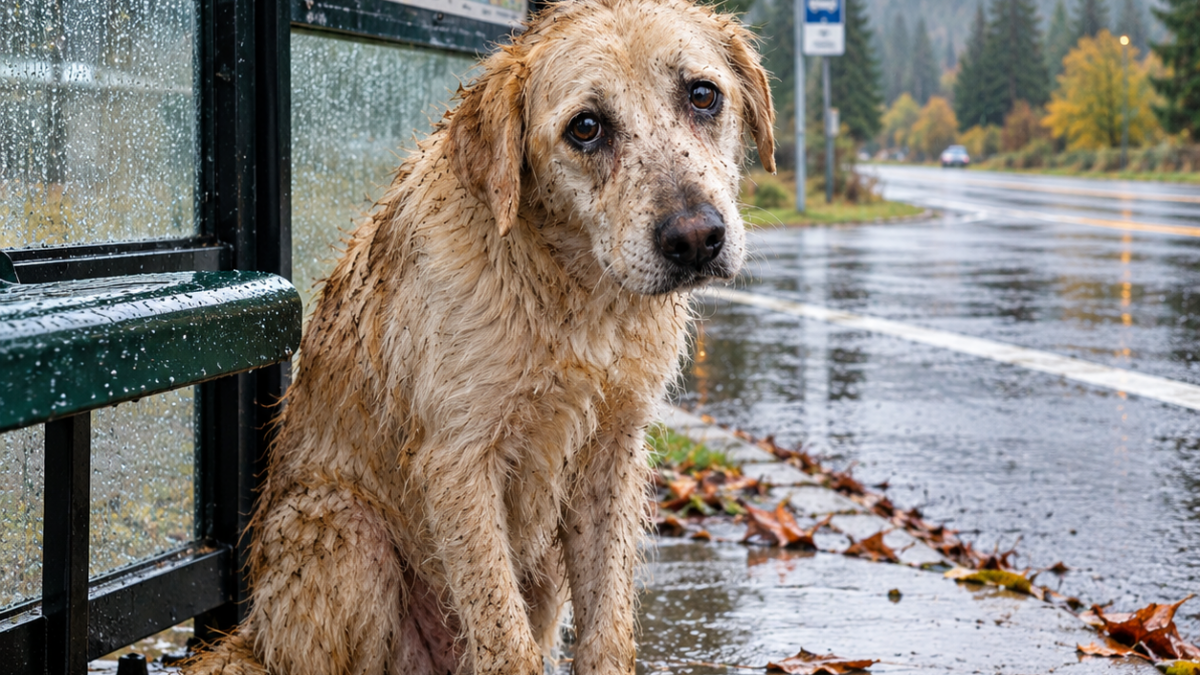
PART 2
I looked at her through the rain.
“What do you mean?”
Melissa adjusted the blanket around the dog’s shoulders.
“I mean this dog didn’t wander away yesterday.”
She ran her hand lightly over his back, careful not to startle him.
“He’s been underfed for a while. His nails are overgrown. There’s matting around his hind legs. And look at the pads.”
I crouched beside the van.
His paws were cracked and raw in places, but not in the way I would have expected from a dog that had simply traveled miles through the woods.
“What am I looking at?”
“Some wear. Not enough for what I’d expect if he’d been roaming a long distance.”
“So?”
Melissa looked toward the bus shelter.
“So maybe he didn’t travel very far.”
The dog’s eyes moved between us.
I felt cold despite my raincoat.
“You think someone left him there?”
“I’m saying we don’t know yet.”
That became a phrase I heard many times over the next several weeks.
We don’t know yet.
At that moment, all I knew was that I didn’t want to watch the van disappear without knowing where he was going.
“Can I follow you?”
Melissa smiled.
“I was hoping you would.”
The rescue operated out of a converted veterinary building twenty minutes away.
It wasn’t fancy.
The lobby smelled like disinfectant, wet towels, dog food, and coffee.
There were handmade blankets stacked against one wall and photographs of adopted dogs covering another.
A veterinarian named Dr. Aaron Kim was waiting when we arrived.
The old dog froze as soon as we carried him inside.
“Easy,” Dr. Kim said.
He didn’t approach immediately.
He lowered the lights.
Then he sat on a rolling stool several feet away.
“What’s his name?”
“No name yet,” Melissa said.
I looked at the windows.
Rain streaked the glass.
“Rain,” I said without thinking.
Melissa looked at me.
“What?”
“If he needs something for the chart. Rain.”
The old dog looked toward my voice.
Dr. Kim wrote it down.
“Rain it is.”
That was how he got his name.
Not because I thought it was poetic.
Not because I imagined some beautiful symbolic meaning.
It was simply raining when I found him, and I couldn’t keep calling him “the dog.”
Later, that name would feel like it had always belonged to him.
At first, though, Rain didn’t seem to belong anywhere.
Dr. Kim examined him slowly.
Very slowly.
He checked his eyes.
His teeth.
His ears.
His heart.
His abdomen.
His joints.
Rain tolerated everything with the exhausted stillness of an animal that had learned resistance was useless.
That bothered me more than growling would have.
A dog who growls is still telling you what he wants.
Rain barely seemed to believe wanting mattered.
“Approximately ten to twelve years old,” Dr. Kim said.
“Is he sick?” I asked.
“Malnourished. Dehydrated. Arthritic. He has a skin infection under some of this matting. His teeth need attention, but nothing I’m seeing right now suggests we’re dealing with an immediate terminal condition.”
Relief came so fast my knees felt weak.
“So he’ll be okay?”
Dr. Kim looked at me.
“I didn’t say that.”
My relief stopped.
“With senior dogs in this condition, we need bloodwork. We need to see how his kidneys and liver are functioning. We need to warm him slowly, rehydrate him carefully, and feed him in controlled portions.”
“Why controlled?”
“Because giving too much food too quickly to a severely undernourished animal can create its own problems.”
I looked at Rain.
Even basic kindness had rules when someone had been neglected long enough.
Melissa pulled a scanner from a drawer.
“Microchip first.”
She passed it over his shoulders.
Nothing.
Along his back.
Nothing.
Chest.
Nothing.
“No chip.”
“What happens now?” I asked.
“We file a found-dog report,” Melissa said. “County animal services gets notified. We post through the proper lost-pet channels. Legally, there’s a holding period.”
My stomach tightened.
“What if whoever did this comes back for him?”
Dr. Kim stopped writing.
“If someone proves ownership, that doesn’t automatically mean we hand over a neglected animal without questions.”
“So there are questions.”
“There are going to be a lot of questions.”
I stayed until almost nine that night.
I didn’t mean to.
At first I told myself I’d wait until Rain was settled.
Then until his bloodwork came back.
Then until he ate something.
The blood results weren’t catastrophic.
His kidney values were a little concerning but potentially consistent with dehydration.
His liver looked acceptable.
He was mildly anemic.
Nothing that explained away the condition he was in.
Which meant his body had probably become this thin for the simplest and cruelest reason.
Not enough food.
They put him in a quiet room away from the loudest kennels.
A thick blanket went beneath him.
Another over him.
Melissa placed food near the bed.
Rain smelled it.
Then looked toward the door.
“Why won’t he eat?”
“Stress,” she said. “Fear. New place.”
I sat on the floor.
Rain watched me.
“I’m still here.”
His ears moved.
After ten minutes, he ate three bites.
Then stopped.
Melissa grinned.
“Well, apparently you’re part of the treatment plan.”
I should have gone home.
Instead I laughed.
“That seems medically questionable.”
“Most of rescue is medically questionable until it works.”
Rain ate two more bites.
That night I drove home alone.
I had lived alone for six years.
Not tragically.
Not dramatically.
My marriage had ended politely, which in some ways was worse.
No affair.
No screaming.
No great betrayal I could point to.
Just two people who had spent seventeen years gradually becoming better at being roommates than spouses.
My daughter, Sophie, was twenty-four and living in Portland.
She called often.
Visited when she could.
My house was not lonely all the time.
But it was quiet enough that I noticed silence.
That night the silence felt enormous.
I made tea and didn’t drink it.
At 11:42 p.m., I texted Melissa.
**How is he?**
She answered two minutes later.
**Sleeping. Ate a little more. You can breathe.**
I stared at those words.
You can breathe.
I hadn’t realized I wasn’t.
The next morning, I went to work at the county records office and accomplished almost nothing.
I kept seeing Rain through scratched bus-shelter glass.
At lunch, I called the rescue.
“He’s stable,” Melissa said.
“Has anyone claimed him?”
“No.”
“Any missing reports?”
“Nothing matching him.”
“Can I come after work?”
She laughed.
“You really think I’m going to say no?”
I arrived at five twenty.
Rain was standing when I entered his room.
Not enthusiastically.
But standing.
“Hey.”
His tail didn’t move.
I sat down.
“You’re allowed to pretend you don’t care.”
He watched me.
I opened a paperback book I had brought.
For thirty minutes, I read without really reading.
Then I felt something touch my shoe.
Rain had moved closer.
His nose rested against the toe of my boot.
I didn’t reach for him.
Eventually he lay down there.
That became our routine.
I worked.
I visited Rain.
I sat.
He moved closer.
On the fourth day, his tail moved for the first time.
One sweep.
So faint I almost thought I imagined it.
Melissa saw it from the doorway.
“Oh, there it is.”
“What?”
“That dog’s still in there.”
The next day, he allowed me to scratch behind his ear.
The day after that, he took a treat from my hand.
A week later, he walked outside on a leash.
The first time we passed a road, he stopped.
His whole body stiffened.
A bus went by.
Rain dropped flat to the ground.
I knelt beside him.
“It’s okay.”
He began trembling.
Melissa, who was walking with us, frowned.
“Interesting.”
“What?”
“That reaction.”
“He’s scared of traffic.”
“Maybe.”
“No maybe about it. Look at him.”
“I mean maybe traffic isn’t what he’s afraid of.”
I looked at her.
“What else?”
“The sound of a bus?”
Rain remained pressed to the wet grass.
We waited until the road was quiet.
Then I led him back inside.
That night, I kept thinking about the shelter.
I wanted to know how long he had been there.
So the next Saturday I drove back.
The rain had stopped for the first time in days.
The bus shelter looked smaller in daylight.
Just four walls, a bench, a roof, and a cracked route map.
I searched around the edges.
There were flattened patches of dirt behind the structure.
An old plastic food container under blackberry vines.
A paper coffee cup filled with rainwater.
Nothing useful.
Then a city bus stopped.
The driver opened the door.
“You waiting?”
“No. Actually, can I ask you something?”
He looked at me.
“About the old dog that was here.”
The driver’s expression changed.
“You got him?”
“You saw him?”
“Couple times.”
My pulse jumped.
“How long?”
He thought.
“First time? Maybe two weeks ago.”
Two weeks.
“You’re sure?”
“Pretty sure. Cream-colored old guy?”
“Yes.”
“Yeah. He’d sit back in that corner. Thought somebody from one of the houses owned him.”
“Did you ever see anyone with him?”
The driver shook his head.
“Sorry.”
“Was he here every day?”
“Not every trip. But enough.”
I thanked him.
Before he closed the doors, he said, “There’s another driver, Denise. Morning route. She fed him once.”
“Can I talk to her?”
He wrote down the transit office number.
That phone number opened the first real door.
Denise remembered Rain clearly.
“I saw him the first Monday of the month,” she told me.
That was eighteen days before I found him.
“He was cleaner then.”
My stomach turned.
“Cleaner?”
“Still thin, but not covered in mud.”
“Was he wearing a collar?”
Silence.
Then:
“Yes.”
I stood up from my kitchen table.
“What kind?”
“Dark green. Maybe canvas.”
When Rain arrived at the rescue, he had no collar.
“Did you see a person?”
“No. But I assumed somebody lived nearby.”
“Anything else?”
Denise hesitated.
“There might be footage.”
“What footage?”
“The buses have cameras.”
Within an hour I was speaking with transit security.
They couldn’t simply hand me recordings.
But because Rain’s case had now been flagged by county animal services as possible abandonment, an officer could request them.
I called Melissa.
Melissa called animal services.
By Monday morning, Officer Leah Ramos was involved.
Leah had spent nine years investigating neglect and cruelty complaints.
She wasn’t dramatic.
She spoke in dates and facts.
“I’ve requested footage from the route,” she told me.
“Will it show who left him?”
“I don’t know.”
“When will we know?”
“When we know.”
I almost laughed.
There it was again.
We don’t know yet.
The rescue holding period passed.
Nobody claimed Rain.
No missing-dog report matched him.
No social-media posts.
No frantic owner.
No one looking.
I should have been relieved.
Instead, I felt angry.
How could nobody be looking?
Two days later, Leah called me.
“Claire, can you come to the rescue tomorrow morning?”
“Why?”
“I want to show you something.”
“What?”
“Tomorrow.”
I barely slept.
When I arrived, Leah was sitting with Melissa in the office.
A laptop was open.
Rain was asleep in the next room.
Leah pointed to a chair.
“We have bus-camera footage from eighteen days before you found him.”
My heart began pounding.
She pressed play.
The view came from the front of a county bus approaching Rain’s shelter at 6:14 a.m.
Rain wasn’t there yet.
The bus stopped.
A passenger got off.
Doors closed.
The bus continued.
“Nothing,” I said.
“Watch the next one.”
Footage from 7:03.
A dark SUV was parked on the shoulder behind the shelter.
My hands went cold.
The bus approached.
A man stood beside the SUV.
Rain was on a leash.
Even through the rain-distorted windshield image, I recognized him.
His coat was cleaner.
His body was still thin.
And around his neck was a green collar.
The man walked Rain into the shelter.
Then removed the leash.
Rain stood there.
The man returned to the SUV.
“What is he doing?”
Nobody answered.
The SUV pulled away.
Rain ran after it.
The bus camera captured him leaving the shelter and racing along the shoulder.
Then the bus turned.
The image ended.
I stared at the black screen.
“No.”
Leah clicked another file.
7:47 a.m.
The next bus approached.
Rain was back inside the shelter.
Alone.
He was sitting in the corner.
Exactly where I had found him eighteen days later.
I covered my mouth.
“Oh my God.”
“He came back,” Melissa whispered.
The realization hit all three of us.
Rain had chased the vehicle.
Lost it.
And returned to the last place where the man had stood beside him.
Then waited.
For eighteen days.
Maybe believing the person would come back.
The anger I felt was almost physical.
“Can you read the plate?”
“Not from this camera.”
“So that’s it?”
“No.”
Leah closed the laptop.
“Transit has an intersection camera about half a mile east. We’re requesting footage from the same time.”
“Find him.”
She looked directly at me.
“That’s the plan.”
I glanced toward Rain’s room.
“What kind of person does that to an old dog?”
Leah’s voice softened.
“Sometimes people abandon animals because they’re cruel. Sometimes because they’re desperate. Sometimes because they’re sick, poor, overwhelmed, or ashamed.”
“That makes it okay?”
“No.”
“Then I don’t care why.”
“You might.”
“I won’t.”
She studied me.
“Claire, if we find whoever did this, the truth may not fit the story you already have in your head.”
I didn’t answer.
At that point, I wanted a villain.
Someone simple.
Someone I could hate without complication.
Rain had waited in the rain for nearly three weeks.
I wanted the person responsible to feel every cold night he had endured.
But revenge is easy in your imagination.
Reality usually arrives carrying paperwork.
Three days later, the plate was identified.
The SUV belonged to a man named Robert Hale.
Sixty-two years old.
Address twelve miles away.
I searched his name online before Leah could tell me not to.
He owned a small roofing company.
There were photographs.
Robert at a fishing derby.
Robert beside a pickup truck.
Robert at a community barbecue.
And in a photograph from three years earlier, Robert was kneeling beside a younger, healthier Rain.
I knew it immediately.
Same face.
Same cream coat.
Same dark eyes.
The caption read:
**My best friend, Buddy. Twelve years and counting.**
Buddy.
Rain had a name before us.
A life.
A person.
My anger became something sharper.
Leah called that evening.
“We confirmed ownership through veterinary records.”
“So Robert Hale abandoned him.”
“We’ve interviewed him.”
“What did he say?”
“I can’t discuss everything during an active investigation.”
“Did he admit it?”
“Claire.”
“Did he?”
A pause.
“Yes.”
My fingers tightened around the phone.
“Why?”
Another pause.
“His wife died seven months ago.”
I said nothing.
“Buddy—Rain—was originally her dog.”
Still nothing.
“Robert’s business failed this summer. His house is in foreclosure. He told us he’d been living out of the SUV intermittently.”
I leaned against the kitchen counter.
“He could have taken him to a shelter.”
“Yes.”
“He could have called a rescue.”
“Yes.”
“He left an elderly dog at a bus stop.”
“Yes.”
“Then none of the rest changes that.”
“No,” Leah said. “It doesn’t.”
But it changed something anyway.
Not forgiveness.
Not yet.
Just the shape of my anger.
Robert told investigators that Rain had begun needing veterinary care he couldn’t afford.
His wife, Evelyn, had made him promise before she died that he would look after Buddy.
For months, he tried.
Then everything collapsed.
Debt.
Business.
House.
His own depression.
He began sleeping in the SUV.
A friend told him shelters might euthanize an old dog nobody wanted.
So instead of asking, Robert convinced himself that leaving Buddy at a bus stop near homes would give someone a chance to find him.
He removed the collar because his name and phone number were attached.
Then drove away.
“I thought somebody would take him that morning,” he told Leah.
Somebody didn’t.
Not that morning.
Not the next.
Rain waited.
Robert admitted that he drove past the shelter once two days later.
Rain was still there.
He didn’t stop.
That fact erased most of the sympathy I had briefly felt.
When Leah told me, I had to sit down.
“He saw him?”
“Yes.”
“He knew Rain was still there?”
“Yes.”
“And left again?”
“Yes.”
“Then he made the choice twice.”
Leah didn’t argue.
Charges were filed for animal abandonment and neglect under state and county statutes.
The case became public.
A local news station picked it up.
They called Rain “the bus-stop dog.”
People became furious.
Too furious.
Someone posted Robert’s address.
Another person threatened to burn his remaining work truck.
I hated what he had done, but I hated that too.
I contacted the reporter.
“Please tell people to stop.”
“You’re defending him?”
“No.”
“Then what are you saying?”
“I’m saying Rain doesn’t need another act of cruelty committed in his name.”
That quote ran that evening.
It didn’t stop everyone.
But it helped.
Meanwhile, Rain kept healing.
He didn’t care about court documents.
He cared about breakfast.
He cared about blankets.
He cared about a squeaky green frog Melissa brought him.
Most of all, he cared about whether I was coming back.
By the third week, he recognized the sound of my car.
Melissa caught him waiting by the front window.
“You have a problem,” she told me.
“What problem?”
“Your dog is waiting for you.”
“He’s not my dog.”
Rain saw me through the glass.
His tail began moving.
Melissa folded her arms.
“Sure.”
I had not planned to adopt a dog.
Especially not a senior dog.
Senior dogs come with arithmetic.
You look at them and understand immediately that your time will probably be measured in years instead of decades.
Maybe less.
I had spent years becoming comfortable with my quiet house.
Adopting Rain would mean medication.
Veterinary bills.
Rugs on slippery floors.
Walks in Washington rain.
Eventually, grief.
I knew all of that.
Then one evening I left the rescue at seven.
Rain followed me to the door.
Melissa held his leash.
“I’ll see you tomorrow,” I told him.
I opened the door.
Rain stopped.
His body went rigid.
The same look returned.
The bus shelter look.
Don’t leave.
I closed the door again.
“Damn it.”
Melissa smiled.
“That usually means the dog won.”
I filled out the foster application that night.
Temporary, I told myself.
I would foster him through the legal case.
Temporary lasted six days.
Rain entered my house on a Saturday afternoon.
He stood in the living room for almost five minutes without moving.
I had bought him a bed.
Two, actually.
One in the living room.
One beside my bed.
Raised bowls.
A waterproof coat.
Arthritis supplements.
A ridiculous number of treats.
Rain ignored all of it.
He walked to the front door and lay down.
I sat beside him.
“You know you’re allowed farther inside.”
He watched the door.
The first night, he slept there.
The second too.
On the third night, I woke at 2:18 a.m. and found him standing beside my bed.
“You okay?”
He stared at me.
I patted the mattress before remembering he probably couldn’t jump.
So I got down on the floor.
Rain lay beside me.
His head rested against my shoulder.
We slept there until morning.
After that, the front door stopped being his bed.
Two weeks later, he claimed my couch.
Within a month, he had trained me to leave one cushion empty.
Sophie came from Portland to meet him.
“This is the dog?”
“This is Rain.”
She crouched.
Rain sniffed her.
“You named a Washington dog Rain?”
“I was under stress.”
“That’s like naming a Florida dog Humidity.”
Rain leaned against her knee.
Sophie’s face changed.
“Oh.”
“Exactly.”
“He’s staying, isn’t he?”
“Probably.”
“Mom.”
“Fine. Yes.”
I officially adopted him four days later.
His records still carried his original name, Buddy Hale, but I asked whether I should change Rain back to Buddy.
I tried it at home.
“Buddy?”
His ears moved.
I felt guilty.
That name belonged to him.
But so did Rain now.
For several days I used both.
Eventually, I settled on Rain at home and kept Buddy noted in his medical file.
A life does not have to erase the one before it.
It can carry both.
The legal case moved more slowly than Rain’s recovery.
Robert’s attorney argued he had not intended for the dog to suffer.
He had left Rain at a public transit shelter precisely because he believed someone would find him.
The prosecutor’s response was simple.
He returned two days later.
He saw Rain was still there.
And he drove away.
That became the center of the case.
Not the first terrible decision.
The second one.
The moment he knew.
I attended the sentencing hearing because I was Rain’s legal adopter by then and had submitted veterinary costs and a statement about his condition.
Robert entered the courtroom looking much older than the photographs online.
He had lost weight.
His jacket didn’t fit properly.
For months, I had imagined seeing him.
I imagined rage.
Satisfaction.
Maybe even saying something cruel.
Instead, when he walked in, I felt tired.
He looked toward me.
Then saw Rain’s green collar in my hand.
I had brought it from the evidence bag after investigators released it.
The collar Robert had removed before leaving him.
His face collapsed.
Not theatrically.
His mouth tightened.
He looked down.
When he was allowed to speak, he stood before the judge.
“I loved that dog.”
I almost laughed.
Not because it was funny.
Because I couldn’t understand how the sentence could exist beside what he had done.
Robert continued.
“My wife loved him more than anybody. She made me promise.”
His voice broke.
“I failed her.”
The judge interrupted.
“You also failed the animal.”
“Yes, ma’am.”
“Why did you not surrender him?”
“I was ashamed.”
“Why did you not stop when you saw him still waiting two days later?”
That was the question.
Robert stood silent for several seconds.
Finally he said:
“I was a coward.”
The courtroom remained still.
He did not say he forgot.
Did not blame Rain.
Did not claim poverty made the decision inevitable.
He said:
“I knew if I stopped, I’d have to face what I had done. So I kept driving.”
For months, I had wanted him to admit exactly that.
When he did, it didn’t feel like victory.
It felt horrible.
The judge imposed fines, probation, restitution toward Rain’s veterinary expenses, mandatory counseling, community service through an approved non-animal-care program, and a prohibition on owning or caring for animals during the term ordered by the court.
The abandonment conviction became part of the public record.
Robert’s attorney asked that some financial penalties be reduced because he was already insolvent.
The judge adjusted payment schedules, not accountability.
Then the prosecutor read part of my victim-impact statement.
I had written it the night before.
I had rewritten it seven times.
It said:
“When I first found Rain, he did not understand why people approached him unless they were eventually going to leave.
He watched doors.
He watched cars.
He watched me stand up.
The damage was not just hunger or wet fur or infected skin.
Someone taught him that being left behind was normal.
The consequence I care about most is that Rain no longer believes that.”
Robert began crying.
I watched him.
Part of me wanted to enjoy it.
I didn’t.
After court, he approached me in the hallway.
A deputy stayed nearby.
Robert stopped several feet away.
“Is he okay?”
For one second, I considered walking past him.
Then I thought about Rain.
“Yes.”
Robert closed his eyes.
“Does he still hate cars?”
“Sometimes buses.”
He swallowed.
“I’m sorry.”
“I’m not the one you owe that to.”
“I know.”
He looked at the collar in my hand.
“Evelyn bought that.”
I said nothing.
“She picked green because she said it looked good against his fur.”
His voice shook.
“Could you… could you not throw it away?”
My anger returned.
“You removed it so nobody could find you.”
“Yes.”
“You drove past him.”
“I know.”
“He waited eighteen days.”
Robert’s face twisted.
“I know.”
“No. You know the number. You didn’t watch him do it.”
He began crying harder.
I stepped closer.
“Every bus came, and he looked up.”
Robert covered his mouth.
“Every person stood there and left. He watched them. When I found him, I stood up once and he panicked because he thought I was leaving too.”
“I’m sorry.”
“You don’t get to make me carry your forgiveness.”
He looked at me.
“I’m not asking.”
“Good.”
I held the green collar tighter.
“But I’ll tell you one thing.”
He waited.
“He sleeps on my couch now.”
Robert closed his eyes.
“He has a bed he ignores. He eats too fast. He snores. He steals socks. He has a raincoat he hates.”
A broken laugh escaped him.
“And when I leave the house, I always come back.”
Robert nodded.
“Thank you.”
I walked away.
That was my revenge.
Not hurting him.
Not humiliating him.
Not destroying what remained of his life.
He already had to live with the fact that the dog he abandoned had been saved by someone who did what he had been too afraid to do.
Stay.
Rain did not recover in a straight line.
Some mornings he seemed like a different dog.
Others, something small brought the old fear back.
A bus braking.
A car door closing.
Rain against windows.
One afternoon, almost four months after I adopted him, I took him to a park.
A county bus stopped across the street.
Rain froze.
I felt the leash tighten.
His breathing quickened.
I crouched.
“You don’t have to go anywhere.”
The doors opened.
People stepped off.
Rain watched.
Doors closed.
The bus drove away.
He remained beside me.
Then he looked up.
I gave him a treat.
“That’s it.”
The next week, we returned.
Another bus.
Less trembling.
A month later, Rain watched one pass without stopping.
I cried afterward in my car.
Not because it was dramatic.
Because healing often looks embarrassingly small from the outside.
A dog watches a bus.
A dog finishes breakfast.
A dog sleeps through the night.
A dog stops waiting beside the door.
Those things became our milestones.
Spring arrived.
Rain’s coat thickened into a soft cream color I had never imagined existed beneath the mud.
He gained eleven pounds.
His ribs disappeared.
His skin infection cleared.
His arthritis remained, but medication helped.
His eyes became brighter.
People who met him for the first time called him gentle.
They had no idea how much courage went into becoming gentle again.
One April morning, Melissa called.
“We have something strange.”
“What?”
“The bus shelter.”
My stomach tightened.
“What about it?”
“Transit wants to replace it.”
“Okay.”
“They heard Rain’s story.”
The old shelter was scheduled for removal during a road-improvement project.
Transit staff had seen the news reports.
Denise, the driver who had first given Rain food, asked whether part of it could be preserved.
A month later, one scratched side panel from the shelter appeared in the rescue lobby.
A small plaque was attached.
No photographs of Robert.
No dramatic story.
Just:
**RAIN’S STOP**
**For every animal still waiting to be seen.**
Beneath it was a shelf where people could leave food, blankets, leashes, and donations for abandoned animals.
I brought Rain to the dedication.
There were about thirty people.
Too many for him at first.
He stayed close to my leg.
Then Denise approached.
“You probably don’t remember me,” she said.
Rain smelled her hand.
She began crying.
“I gave you half my breakfast sandwich once.”
I looked at her.
“You fed him?”
“Egg. No bacon.”
“Apparently that bought you lifetime membership.”
Rain leaned into her.
Later, I walked him toward the glass panel.
He stopped.
I worried the smell or shape might trigger something.
Instead, he sniffed it.
Then walked past.
Just like that.
The place that had once been his whole world had become nothing more than an object behind him.
That might have been the happiest moment of all.
A year passed.
Then another.
Rain slowed with age.
His hearing faded.
His arthritis worsened.
But he became more confident.
He developed opinions.
Strong ones.
Breakfast should happen at 6:15.
Rain should never be expected to walk on wet grass if a dry sidewalk was available.
My daughter’s boyfriend was suspicious for exactly three visits, then acceptable after sharing turkey.
Thunderstorms required the hallway rug.
Vacuum cleaners were unnecessary acts of aggression.
And every evening at seven, Rain expected me on the couch.
If I sat at the kitchen table too long, he stood in the doorway and stared.
“You’re bossy for somebody I found living in public transportation infrastructure.”
Tail wag.
“Fine.”
I always moved.
Eventually, people stopped asking me about the court case.
They asked about Rain instead.
That was how I wanted it.
I didn’t want the worst thing that happened to him to become the most important thing about him.
He was more than an abandoned dog.
He was stubborn.
Funny.
Quiet.
Obsessed with cheese.
Terrible at catching treats.
Afraid of inflatable holiday decorations for reasons nobody understood.
He liked women more quickly than men.
He slept with one paw touching my foot.
He never learned to fetch.
He loved sitting near windows during rain.
That last one surprised me.
At first, every storm made me anxious for him.
I assumed rain itself would frighten him.
It didn’t.
He would lie beside the warm living-room window and watch droplets race down the glass.
Sometimes I sat beside him.
“Different from the bus shelter, huh?”
His eyes would close.
No cold concrete.
No traffic.
No waiting.
One November afternoon, almost three years after I found him, Robert Hale sent a letter through the county prosecutor’s office.
I almost threw it away unopened.
Instead, I read it.
He wrote that he had completed counseling and community service.
He had moved into a small apartment.
He was working for another roofing company.
He had not owned another animal.
Most of the letter wasn’t about him.
It was about Evelyn.
He described the day she brought Buddy home as a puppy.
How Buddy used to sleep beneath her sewing table.
How he stayed beside her during chemotherapy.
How, on her final week at home, Buddy barely left the bedroom.
Then Robert wrote:
**I abandoned the last living thing that connected me to my wife because looking at him reminded me that she was gone and that I had failed at everything else too. That explanation does not excuse it. I understand that now. I thought getting rid of the reminder would make the grief smaller. It made me the kind of man my wife would not have recognized.**
I stopped reading.
Rain was asleep beside my chair.
Robert continued:
**I do not expect forgiveness. I only hope he has forgotten the bus stop.**
I looked at Rain.
I didn’t know whether dogs forget in the same way people do.
I hoped not everything had disappeared.
Because forgetting wasn’t the victory.
Being safe despite remembering was.
I wrote one response.
Only four sentences.
**Rain is safe. He is loved. He does not wait by the door anymore when I leave. And yes, I always come back.**
I never heard from Robert again.
Years later, Rain became very old.
Old enough that stairs became difficult.
Old enough that sleeping occupied most of his day.
Old enough that when strangers met him, they lowered their voices instinctively.
Sophie got married.
Rain attended the backyard ceremony wearing a blue bow tie and slept through half the vows.
When Sophie later had a baby, Rain approached the bassinet once, sniffed carefully, and then positioned himself beneath it as though he had been assigned security detail.
“He can barely hear,” Sophie whispered.
“He can still supervise.”
Rain turned his gray face toward us.
We laughed.
Those years were the answer to everything that happened at the bus shelter.
Not the conviction.
Not the fine.
Not the headlines.
Years.
Ordinary years.
Rain got what abandonment had tried to steal from him.
Time.
One winter, Dr. Kim told me Rain’s kidneys were beginning to fail.
Slowly.
We adjusted his diet.
Added medication.
Gave fluids when necessary.
I knew what it meant.
I had always known this day would come.
That is the contract you sign when you love an old dog.
You know the ending is closer.
You sign anyway.
Rain gave me another eight good months.
Then one September morning, he didn’t want breakfast.
That scared me more than anything.
Rain always wanted breakfast.
I sat beside his bed.
“Buddy?”
I rarely called him that anymore.
His eyes opened.
His tail tapped once.
I touched his head.
“You tired?”
He rested his chin against my hand.
The gesture hit me harder than I expected.
Years earlier, he had looked through bus-shelter glass waiting for someone.
Now I was the one afraid of being left.
Dr. Kim came to the house that afternoon.
Rain hated clinics less than he once had, but I wanted his final hours to happen somewhere familiar.
Sophie drove up from Portland.
Melissa came too.
Rain lay on his favorite blanket beside the living-room window.
Outside, rain began falling.
Of course it did.
Soft Washington rain.
The kind that seems capable of lasting forever.
I sat on the floor.
Rain’s head rested in my lap.
Dr. Kim examined him.
Then looked at me.
“We can keep trying to buy a little time.”
“How much?”
“I can’t tell you.”
“Will it be good time?”
He was quiet.
That was the answer.
I looked down at Rain.
His breathing was tired.
Not panicked.
Just tired.
Years earlier, someone had made a decision for him because facing his suffering was inconvenient.
I would not make a decision for myself now because facing mine was unbearable.
I bent down.
“You waited long enough once.”
Rain’s eyes moved toward me.
“You never have to wait again.”
Sophie began crying.
So did Melissa.
I had promised Rain something the day I adopted him.
I had never spoken it aloud.
No more being left.
Not in a bus shelter.
Not at a clinic.
Not when he became old.
Not at the end.
So I stayed.
My hand rested beneath his chin.
Rain took one slow breath.
Then another.
Dr. Kim gave the medication.
Rain’s body softened.
Outside, tires hissed along the wet street.
For one second, the sound transported me back to that roadside shelter.
Cold glass.
Wet concrete.
A frightened old dog watching strangers come and go.
But Rain wasn’t there anymore.
He was home.
His bed was beneath him.
His people surrounded him.
My hand was under his chin.
His final breath was so quiet I almost missed it.
Then he was still.
I pressed my forehead against his.
Nobody rushed me.
Nobody said anything.
I stayed a little longer.
Because that was how our story had begun.
I stayed.
The rescue held a small memorial for him two weeks later.
Nothing elaborate.
They added another line beneath the plaque at Rain’s Stop:
**He waited for someone to stay. Then he taught us why staying matters.**
Rain’s green collar hangs beside my front door now.
Not the one I bought him.
The original one.
Evelyn’s.
The collar Robert removed before leaving him at the shelter.
For years, I wondered whether keeping it was strange.
Eventually I understood why I did.
It represents two truths at once.
Someone failed Rain terribly.
And someone loved him before that failure.
Lives are complicated that way.
People are too.
I never forgave Robert for leaving Rain.
I no longer needed to hate him either.
Consequences had been given.
Rain had been protected.
And the best revenge against the worst thing that happened to him was that it did not get to define the rest of his life.
He was not the dog abandoned at a bus stop.
He was my dog.
Sophie’s old babysitter.
Melissa’s favorite senior.
Denise’s breakfast-sandwich thief.
A terrible fetch player.
A professional couch hog.
A creature who grew old watching rain from the safe side of a warm window.
Sometimes I still drive that road.
The original shelter is gone now.
A newer one stands in its place.
Clean glass.
Bright lighting.
A bench that doesn’t leak rust.
Every time I pass it, I remember that first afternoon.
Rain in the corner.
Paws tucked beneath him.
Eyes following every person.
I remember standing up.
I remember his face changing because he thought I was leaving.
And I remember sitting back down.
For years, I believed that was the moment I saved him.
I know better now.
That moment changed my life too.
I had spent years becoming very good at leaving things before they could hurt me.
A marriage.
Friendships.
Plans.
Even grief.
Rain taught me that sometimes the brave thing is not moving forward.
Sometimes it is sitting down beside something frightened and letting it learn that you are not going anywhere.
The afternoon I found him, I thought the old bus shelter was where his story had almost ended.
It wasn’t.
It was simply the last place where he ever had to wait alone.
Because one rainy afternoon, I stopped.
I looked into those enormous tired eyes.
And instead of passing through like everyone else, I stayed.
Years later, when Rain took his final breath in my arms while rain moved softly down the warm window beside us, I realized he had spent the rest of his life returning that gift.
He stayed with me too.
And even after he was gone, somehow, he still did.
Years passed, and eventually the story people remembered about Rain changed.
At first, everyone knew him as the old dog from the bus shelter.
People would recognize me at the grocery store and ask, “How’s that bus-stop dog doing?”
Strangers who had seen the local news would stop us during walks.
“Is that Rain?”
Sometimes they wanted to hear about the abandonment case.
Sometimes they wanted to tell me what they thought should have happened to Robert.
Some were angry.
Some were surprisingly sympathetic.
A few wanted the story to remain simple.
Bad man.
Abandoned dog.
Good woman.
Rescue.
Justice.
But life rarely stays that clean.
And Rain deserved to become more than the worst thing someone had ever done to him.
So when people asked how he was doing, I stopped talking about the bus shelter first.
I told them he had discovered cheese.
I told them he snored.
I told them he had become convinced that my couch had been purchased specifically for him.
I told them he had developed an irrational hatred of inflatable Christmas decorations and once refused to walk past a seven-foot snowman for ten straight minutes.
I told them he was terrible at catching treats.
I told them that if breakfast was three minutes late, he stood in the kitchen and stared at me with the weary disappointment of a retired school principal.
That was Rain.
Not a headline.
Not evidence.
Not a courtroom exhibit.
Not the dog somebody left behind.
My dog.
By the fourth year after I found him, most of the scars nobody could see had softened.
Not disappeared.
Softened.
There was a difference.
Rain no longer panicked when I picked up my car keys.
For the first year, that sound had changed him instantly.
His ears would lower.
He would follow me to the front door.
If I stepped outside without him, he would stand behind the glass until my car disappeared.
Melissa once told me not to make too much of it.
“A lot of dogs hate being left.”
“I know.”
“But?”
“But he doesn’t just hate it.”
She looked at me.
“He expects it to be permanent.”
That was exactly it.
So I created rituals.
Whenever I left, I said the same thing.
“I’m coming back.”
Not “be good.”
Not “see you later.”
Always the same three words.
I’m coming back.
At first, they meant nothing to him.
Words are cheap when life has taught you otherwise.
But then I came back.
Every time.
Twenty minutes later.
Three hours later.
After work.
After the store.
After dinner with Sophie.
I came back.
Eventually, Rain stopped standing at the door.
Then he stopped following me into the hallway.
One afternoon I picked up my keys and found him still asleep on the couch.
I stood there staring at him.
He opened one eye.
“That’s it?” I asked.
His eye closed again.
I laughed so hard I started crying.
It was one of the happiest insults I had ever received.
Trust had finally become boring.
That was what I wanted for him.
Not some dramatic moment where he suddenly understood that he was safe.
I wanted safety to become so ordinary he didn’t have to think about it anymore.
Robert’s sentence eventually ended.
He completed his community service.
Finished the counseling ordered by the court.
Paid restitution in installments.
The prohibition on owning or caring for animals remained in effect for the period the judge had imposed.
I heard updates occasionally through Leah because Robert’s case had become one of those files people in rescue circles remembered.
He never opened another boarding operation.
Never worked professionally with animals again.
His old roofing company was gone.
The house he had shared with Evelyn was sold through foreclosure.
For a long time, that gave me a certain satisfaction.
Then, gradually, it didn’t.
Punishment matters.
Consequences matter.
But I discovered there is a strange emptiness in building your happiness around another person’s downfall.
Rain certainly didn’t care where Robert lived.
He didn’t care whether Robert had money.
He didn’t care whether strangers hated him.
Rain cared whether there was chicken in the refrigerator.
Rain cared whether I was sitting in the right spot on the couch.
Rain cared whether the front window was open three inches so he could smell the yard.
He had moved on long before I did.
The letter Robert sent several years after the trial forced me to confront that.
I almost didn’t open it.
The county prosecutor’s office forwarded it because Robert had been instructed not to contact me directly without permission.
The envelope sat on my kitchen counter for two days.
Finally, one rainy evening, I opened it.
Rain was asleep at my feet.
Robert wrote about Evelyn.
Not as an excuse.
That surprised me.
He wrote about how she had brought Buddy home when he was barely eight weeks old.
How she carried him inside zipped halfway into her winter coat because it had been snowing.
How Buddy slept beneath her sewing table while she worked.
How he learned the sound of the garage door and would race through the house whenever Evelyn came home.
How, when she became sick, he stopped sleeping in the living room and began spending every night beside her bed.
Robert wrote:
He stayed with her when I couldn’t stand to watch what cancer was doing to her.
I stopped reading for several minutes.
That sentence made me angry.
Not because I thought it was false.
Because I thought it was probably true.
Robert admitted he began avoiding the bedroom near the end.
He would tell Evelyn he was checking something in the garage.
Answering business calls.
Buying groceries.
Anything to escape the sight of the person he loved disappearing.
But Buddy stayed.
After Evelyn died, Buddy continued sleeping beside her side of the bed.
Robert hated it.
Every time he saw the dog there, he remembered the final months.
Then his roofing business collapsed.
Bills accumulated.
His house went into foreclosure.
He began sleeping in his SUV some nights because he could no longer afford utilities consistently.
Buddy developed arthritis.
Then dental problems.
Then stomach trouble.
Robert wrote that every new need felt like proof that he was failing again.
He convinced himself he had no choices left.
The sentence that mattered most came near the end.
I know now that being overwhelmed did not remove my choices. It only made the right choice harder. I chose the easy thing for myself and made it the cruelest thing for him.
I stared at those words.
Rain shifted under the table.
His paw touched my foot.
Robert continued.
I left him at the shelter because I told myself somebody would find him quickly. Two days later I drove past. He was still there. He saw my SUV. I know he saw it because he stood up. I slowed down. I almost stopped. Then I kept driving. That is the moment I cannot forgive myself for.
I had known he returned.
Leah told me.
The prosecutor established it in court.
But reading Robert’s own description felt different.
Rain had seen the SUV.
He stood.
He thought Robert had come back.
And Robert drove away again.
My anger returned so suddenly I had to put the letter down.
I walked to the window.
Rain woke and followed me.
Rain did not know why I was upset.
He simply pressed his shoulder against my calf.
I looked down.
“You still do that, huh?”
Tail thump.
He had spent years healing from that moment.
Robert had apparently spent years trapped inside it.
For the first time, I understood something I had resisted.
Consequences were not only the judge’s sentence.
Sometimes consequences were memory.
Robert finished his letter by writing:
I do not expect you to forgive me. I do not expect Buddy to remember me kindly. I only hope he lived long enough to understand that somebody came back for him.
I cried then.
Not for Robert.
Not exactly.
For Evelyn.
For Rain.
For the strange and terrible ways grief can turn a person inward until another living creature becomes collateral damage.
I did not forgive Robert.
I still don’t know exactly what that word would mean in a situation like ours.
But I stopped needing him to remain a monster.
That was freeing.
I wrote back through the prosecutor.
Only four sentences.
Rain is safe. He is loved. He no longer waits beside the door when I leave. And yes, I always come back.
I never heard from Robert again.
That was enough.
Rain grew older.
Properly older.
The kind of old that feels almost sacred when you remember there was a time you thought the dog might not survive another week.
His muzzle turned white.
His hearing faded.
His back legs weakened.
I put carpet runners across the hallway because hardwood became difficult for him.
I built a ramp to the back porch.
When the first ramp was too steep, I built another one.
Sophie came over, looked at my increasingly elaborate system of rugs and ramps, and said, “You realize this house belongs to him now.”
“It was always heading that direction.”
Rain stood beside her holding one of my socks.
She pointed.
“And he’s a thief.”
“That’s unproven.”
Rain walked away with the sock.
Sophie laughed.
By then, she was married.
Rain attended the wedding in my backyard wearing a blue bow tie Melissa had ordered online.
He slept through half the ceremony.
During the vows, he woke long enough to sneeze loudly.
Everyone laughed.
Sophie looked down at him and said, “Thank you, Rain.”
He went back to sleep.
Two years later, Sophie had a daughter.
My granddaughter, Emma.
I was nervous introducing them.
Rain had always been gentle, but he was old, partially deaf, and easily startled.
So we were careful.
Sophie sat on the couch holding Emma.
Rain approached slowly.
He sniffed the blanket.
Then Emma made one tiny squeaking sound.
Rain froze.
He looked at me.
“It’s okay.”
He leaned forward again.
Sniffed.
Then, without ceremony, he lay down beneath the bassinet.
That became his spot whenever Emma visited.
He never guarded aggressively.
Never fussed.
He simply positioned himself nearby.
Once, when Emma was a toddler, she dropped half a cracker on his back.
Rain didn’t move.
She stared at him.
Then patted his side.
“Doggie.”
Rain sighed.
I laughed.
“You waited all those years for this?”
He looked at me with the exhausted expression of an old man surrounded by unreasonable young people.
Those were the years I treasured most.
Nothing dramatic happened.
That was the beauty of them.
Rain got ordinary days.
He got spring mornings when sunlight fell across the living-room carpet.
He got summers beneath the maple tree.
He got Thanksgiving scraps Sophie pretended not to give him.
He got Christmas mornings with wrapping paper stuck to his paws.
He got thunderstorms curled beside my bed.
He got hundreds of breakfasts.
Thousands of naps.
Slow walks.
Vet appointments.
Ear scratches.
Bad television.
Visitors.
Quiet.
Life.
The person who left Rain at that bus shelter had stolen eighteen days from him.
I could not give those days back.
But Rain got years afterward.
Years mattered more.
The old bus shelter itself eventually disappeared.
The county replaced it during a road project.
By then, Rain’s story had become part of local rescue history.
Denise, the bus driver who had given him food while he waited, asked the transit department to save one of the old scratched glass panels.
Somehow, they agreed.
The rescue installed it in their lobby.
Beneath it was a small donation shelf.
The plaque read:
RAIN’S STOP
For every animal still waiting to be seen.
People left blankets there.
Dog food.
Cat food.
Leashes.
Gift cards.
Sometimes envelopes containing five dollars.
Sometimes five hundred.
The rescue used those donations for emergency pickups, food, and veterinary costs.
When Rain was still healthy enough, I brought him there once a month.
He liked the staff.
He liked Melissa best.
He liked the treat jar even more.
Visitors would see the plaque, then see Rain lying nearby, and whisper:
“That’s him?”
Melissa always answered the same way.
“Not anymore.”
At first I didn’t understand.
Then she explained.
“He’s not the dog who’s waiting anymore.”
That sentence stayed with me.
By the time Rain reached what Dr. Kim estimated was sixteen or seventeen, his kidneys began showing their age.
At first the changes were minor.
More water.
More frequent trips outside.
Slight weight loss.
We changed his diet.
Added medication.
Then fluids.
I learned how to administer subcutaneous fluids at home.
The first time, I was terrified.
“I’m going to hurt him.”
Dr. Kim smiled.
“You found this dog half-starved in a bus shelter and somehow convinced him to trust the world again. You can handle a needle.”
“That is completely different.”
“It really isn’t.”
Rain stood patiently while I fumbled.
Afterward, I gave him chicken.
He forgave me instantly.
For eight months, we managed.
Some weeks were good enough that I convinced myself he might continue forever.
That is one of love’s more irrational habits.
You know exactly how biology works.
Then you look at someone you cannot imagine losing and decide perhaps biology will make an exception.
Rain stopped climbing onto the couch.
So I put a bed beside it.
Then he stopped walking to the bedroom every night.
So I slept downstairs sometimes.
Sophie noticed.
“Mom.”
“What?”
“You’re sleeping on an air mattress beside him.”
“He gets confused upstairs.”
“You’re sixty-one.”
“I’m aware.”
“Your back isn’t.”
Rain lifted his head.
I pointed at him.
“See? He agrees with me.”
Sophie sat on the floor.
She rubbed behind his ears.
“How much time?”
I hated that question.
“Dr. Kim doesn’t know.”
“And you?”
“I don’t know either.”
She looked at me.
“Yes, you do.”
I turned away.
Because children, even adult children, sometimes know exactly where to press.
The truth was I had started measuring things.
How long Rain took to stand.
How much breakfast remained in the bowl.
How many good hours followed the tired ones.
Whether his tail moved when I entered the room.
Whether he still wanted to walk to the mailbox.
Whether he looked comfortable or simply present.
There is a difference between keeping someone alive and keeping them living.
I knew that professionally.
Emotionally, I wanted to forget.
Then came a September morning when Rain refused breakfast.
Not slowed down.
Not ate half.
Refused.
I placed the bowl closer.
He turned his face away.
My heart began pounding.
Rain had been interested in food on nearly every day I had known him.
Even at his oldest.
Even sick.
“Hey.”
His eyes opened.
“Come on.”
I stirred a little chicken into the food.
Nothing.
Cheese.
Nothing.
I sat beside his bed.
“Buddy?”
I almost never called him that anymore.
But the old name came out.
His ears moved faintly.
I put my hand beneath his chin.
He rested his head there.
That gesture had become one of our private languages.
For Rain, it meant trust.
For me, it meant stay.
I called Dr. Kim.
He came to the house that afternoon.
By then, Sophie was driving up from Portland.
Melissa arrived before her.
She entered quietly.
Rain’s tail moved twice when he smelled her.
“Oh, old man,” she whispered.
She sat beside him.
“You really made us work for you, didn’t you?”
Rain closed his eyes.
Outside, rain began tapping against the windows.
Of course it did.
Melissa noticed too.
She laughed through tears.
“Seriously?”
I looked outside.
“Apparently he wanted atmosphere.”
Dr. Kim examined him on the living-room rug.
Rain’s kidneys had worsened.
His body temperature was slightly low.
His gums were pale.
His heart still worked.
His lungs still worked.
That was almost the problem.
Bodies do not always fail all at once.
Sometimes the question is whether you wait for suffering to make the decision obvious.
Dr. Kim sat beside me.
“We can hospitalize him.”
“What would that do?”
“IV fluids. Medication. We may get some improvement.”
“For how long?”
“I can’t promise.”
“Days?”
“Possibly.”
“Weeks?”
“Maybe.”
“Months?”
He didn’t answer immediately.
I looked down at Rain.
“Would he be scared?”
“At first, probably.”
That was enough to make my chest hurt.
A clinic kennel.
Strangers.
Doors.
Waiting.
I knew Rain tolerated veterinary care now.
But I also knew what safety meant to him.
Home.
My voice.
The couch.
The window.
My hand.
“What would you do?” I asked.
Veterinarians hate that question because they understand its weight.
Dr. Kim looked at Rain for a long time.
Then at me.
“If he were mine, I would ask whether I’m buying time for him or buying time for myself.”
That sentence broke me.
I went into the kitchen.
Sophie followed.
“I can’t do this.”
“Yes, you can.”
“No.”
“You can.”
“He trusted me because I didn’t leave.”
“You’re not leaving.”
“It feels like it.”
She grabbed both my hands.
“Mom, staying doesn’t mean making him stay.”
I stared at her.
She was crying too.
“You taught me that loving someone sometimes means not making their pain about your fear.”
I laughed once through the tears.
“When did you get so annoyingly wise?”
“You.”
“I regret everything.”
She hugged me.
Behind us, Rain shifted on his blanket.
I went back.
I sat beside him.
He raised his head with effort.
I put my palm beneath his chin.
“There you are.”
His cloudy eyes found mine.
I thought about the bus shelter.
The first time I stood up.
The panic in his face because he thought I was going to leave like everyone else.
I remembered sitting back down.
I remembered telling him:
I’m still here.
All those years later, I said it again.
“I’m still here.”
His tail tapped the blanket.
“You waited enough in your life, okay?”
My voice broke.
“You don’t have to wait for me to be ready.”
Sophie covered her mouth.
Melissa looked down.
Rain breathed slowly.
“I’m never going to be ready.”
I stroked his face.
“So you don’t have to stay for that.”
Dr. Kim prepared the medication.
Before he began, I asked everyone for a minute.
Nobody moved far.
They simply gave us quiet.
I leaned against the couch.
Rain rested against me.
Outside, the rain grew steadier.
Cars passed on the street.
Their tires made that same soft hiss against wet pavement that I had heard the day I found him.
For a moment, memory folded over itself.
I could see that scratched shelter again.
The wet road.
The evergreen trees.
Rain in the corner.
Thin.
Matted.
Watching every person.
Waiting.
I wished I could somehow reach backward through time and tell that dog what was coming.
A warm bed.
A ridiculous raincoat.
Cheese.
Sophie.
Emma.
A couch.
A backyard.
Christmases.
Summers.
Thousands of times the front door would open and I would come back through it.
I wished I could tell him:
This isn’t where you end.
But maybe that would have ruined something.
Rain didn’t need promises that afternoon.
He needed someone to stay.
That was all.
Maybe that had always been all.
When Dr. Kim gave him the first medication, Rain relaxed.
The tension left his legs.
His breathing became easy.
He looked almost younger.
I held his face.
“You’re a good boy.”
I hated how small the words sounded.
How could language possibly contain sixteen years of a life?
“You’re such a good boy.”
Rain’s nose moved against my wrist.
Then his head became heavier in my hand.
Sophie knelt on the other side.
Melissa touched his paw.
Dr. Kim gave the final medication.
I kept talking.
Not because Rain needed to understand.
Because I needed my voice to be the last thing connecting us.
“No more bus stops.”
His breathing slowed.
“No more waiting.”
One breath.
“I’m right here.”
Another.
“I’m not leaving.”
Then a final, quiet exhale.
Rain became still.
Nobody spoke.
I waited for some dramatic feeling.
A break.
A wave.
Something.
Instead, the room simply became different.
One second he was there.
The next second the same body remained beneath my hands, but Rain was gone.
I lowered my forehead to his.
And I stayed.
Dr. Kim didn’t rush.
Melissa didn’t move.
Sophie sat beside me.
Outside, the rain continued.
After a while, I realized something.
Rain’s head was still resting in my palm.
The same way it had rested there so many times.
I laughed through tears.
“Of course.”
Sophie whispered, “What?”
“He always had to have the last word.”
We cried and laughed together.
That mattered.
I didn’t want Rain’s final room filled only with grief.
His life had been too funny for that.
Too ordinary.
Too full.
When it was finally time for Dr. Kim to take him, I wrapped Rain in the blanket he had slept on for years.
Then I changed my mind.
“Wait.”
I removed it.
Sophie looked at me.
“What?”
“He hates that blanket.”
She laughed.
Rain had indeed spent years pushing that particular blanket off his bed.
So I chose the soft blue one instead.
“Better.”
Melissa smiled through tears.
“He’d approve.”
After everyone left, the house was unbearable.
His bowls were still in the kitchen.
His medication sat beside the coffee maker.
A half-eaten bag of treats was in the cabinet.
One of his hairs was stuck to the sleeve of my sweater.
I found myself listening for his nails against the hallway floor.
Nothing.
That night I almost slept downstairs out of habit.
Then I looked at the empty bed beside the couch.
I couldn’t.
I went upstairs.
At 2:18 a.m., I woke up.
That was the time Rain had first come to my bedside during his earliest nights in the house.
For years, I had forgotten the exact number.
Suddenly I remembered.
I sat on the edge of the bed.
“I’m here,” I said into the dark.
There was no tail.
No footsteps.
Nothing.
Grief is strange that way.
You spend years teaching a dog that you always come back.
Then one day, he is the one who doesn’t.
The rescue held a memorial two weeks later.
I expected maybe ten people.
More than sixty came.
Denise came.
Leah came.
Dr. Kim.
Former volunteers.
Families whose animals had been helped by donations to Rain’s Stop.
One man brought a photograph of a hound whose emergency surgery had been partly funded through those donations.
“She’s alive because people gave after hearing about him,” he told me.
A woman brought an old terrier wrapped in a blanket.
“This one was found at a gas station,” she said. “Rain’s story is why I stopped.”
I had to turn away.
Melissa stood near the old bus-shelter glass panel.
When everyone quieted, she uncovered a new line beneath the plaque.
It now read:
RAIN’S STOP
For every animal still waiting to be seen.
And beneath it:
He waited for someone to stay. Then he taught us why staying matters.
I touched the words.
“That’s too much.”
Melissa shook her head.
“It’s exactly enough.”
Rain’s ashes came home in a simple wooden box.
I placed them near the living-room window.
For weeks, I kept his bowls where they were.
Sophie never told me to move them.
Nobody did.
Eventually, one morning, I washed them.
I cried harder washing those bowls than I had during the memorial.
Then I donated them.
Except one.
The raised water bowl.
I kept that.
I also kept Rain’s green collar.
The original one.
Evelyn’s collar.
The one Robert removed before leaving him.
It hangs beside my front door now.
For years, that collar made me angry.
It symbolized abandonment.
Concealment.
Cowardice.
Eventually it came to mean something more complicated.
Evelyn had bought it because she loved Buddy.
Robert had removed it because he was ashamed.
Investigators found it because the truth refused to stay hidden.
I kept it because all those things could be true at once.
Rain’s life had love before me.
It had betrayal before me.
And then it had love again.
We do not always get to choose what enters our story.
We choose what gets the final chapter.
People sometimes ask whether I forgave Robert.
I don’t have a satisfying answer.
I never told him what he did was okay.
It wasn’t.
I never decided that grief erased responsibility.
It didn’t.
He abandoned a vulnerable old dog.
Then he returned, saw that dog still waiting, and drove away again.
The court held him accountable.
That was right.
But somewhere along the way, I stopped believing hatred was part of Rain’s justice.
The best revenge was not Robert’s ruined business.
Not the conviction.
Not the fines.
Not his public shame.
The best revenge was Rain sleeping peacefully while rain hit a warm window.
It was Rain getting old.
It was Emma dropping crackers on his back.
It was Sophie laughing at his bow tie.
It was his ridiculous fear of inflatable snowmen.
It was every time I picked up my keys and he didn’t panic.
It was every time he ate a full bowl.
Every safe night.
Every ordinary morning.
Every year nobody managed to steal from him.
Robert had treated Rain like a problem he could abandon beside a road.
Rain answered by becoming unforgettable.
Not because he suffered.
Because he lived.
Several months after he died, I drove the old route again.
I hadn’t planned to.
My hands simply turned the wheel that direction.
The new bus shelter stood where the old one had been.
Clear glass.
Metal bench.
Clean roof.
Someone was waiting inside.
A teenage boy with headphones.
No dog.
No muddy paws.
No frightened eyes.
I pulled onto the shoulder farther ahead.
For a while, I sat in the car.
Rain had spent eighteen days there.
At one point, eighteen days felt like the whole story.
Now they seemed so small compared with everything that came after.
I walked back to the shelter.
The boy glanced at me suspiciously.
“I’m not waiting for the bus,” I said.
“Okay.”
I almost laughed.
Teenagers have a remarkable ability to make emotional pilgrimages feel ridiculous.
I stood near the corner where Rain had once curled against the wall.
Nothing remained.
No mark.
No sign.
No evidence that an old cream-colored dog had once watched every opening door and wondered whether this time someone would choose him.
Maybe that was good.
Places do not owe us monuments.
The rescue had the glass panel.
I had the collar.
And I had everything else.
I remembered the first bowl of water.
The first cautious step.
The way Rain’s expression changed when I stood.
The instant I realized he thought I was leaving.
Then the choice.
I sat back down.
For years, people told me I saved Rain because I stopped that afternoon.
I believed them for a while.
Now I think that story is incomplete.
Rain arrived in my life when I had become extremely good at protecting myself from attachment.
My marriage had ended.
My daughter had built her own life.
I worked.
I came home.
I told myself peace and solitude were the same thing.
Rain did not allow that lie to survive.
He needed me to come back.
Again.
And again.
And again.
Until coming back became part of who I was.
Then, eventually, he needed me to love him enough to let him go.
That was the harder lesson.
Staying is not always physical.
Sometimes staying means remaining present while someone leaves.
It means not turning away because you cannot bear the ending.
Robert had driven away from Rain’s suffering.
At the end, I refused to.
That mattered to me.
It still does.
On rainy evenings now, I sometimes sit beside the living-room window.
Rain’s box is on the shelf.
His green collar hangs near the front door.
The couch cushion he claimed belongs to me again.
I still leave it empty sometimes.
Old habits.
Outside, water slides down the glass.
Headlights move across the street.
And every once in a while, for half a second, I imagine I hear his nails behind me.
I know better.
But I turn around anyway.
There is nobody there.
And somehow, that no longer feels entirely empty.
Because Rain left behind evidence.
Not the kind Leah once collected for a case.
Better evidence.
A daughter who stops for strays now because she learned from him.
A granddaughter growing up hearing stories about an old cream-colored dog.
A rescue shelf that fills with blankets every winter.
Families whose animals received help because someone donated in Rain’s name.
Denise still keeps dog treats in her bus.
Melissa still tells new volunteers about patience.
And me.
A woman who once thought she had built a perfectly acceptable life around not needing anyone.
Rain changed that.
His entire life turned because one person stopped walking long enough to notice him.
Mine did too.
That is what I think about most.
Not the abandonment.
Not Robert.
Not the court.
Not even the eighteen days.
I think about the moment inside that shelter when I stood.
Rain looked at me.
And I understood.
He had seen this before.
People arrived.
People waited.
People left.
So I sat back down.
That tiny decision became years.
A home.
A family.
A goodbye.
A life.
The bus shelter had once been the place where Rain believed he might be forgotten.
In the end, it became the place where he was finally seen.
And on his last afternoon, while Washington rain moved softly down my living-room window and his gray head rested in my hand, I understood the promise I had actually made all those years ago.
It had never been:
I will save you.
I could not promise that.
It had never been:
Nothing bad will ever happen again.
Nobody can promise that either.
The promise was simpler.
I will not make you face it alone.
I kept that promise.
From the wet concrete of an abandoned bus shelter to the warm rug beneath my living-room window.
From his first frightened step toward a bowl of water to his final quiet breath.
I stayed.
And perhaps that is why, even now, I cannot drive past a bus stop in the rain without looking inside.
Because somewhere, there may be another pair of tired eyes watching people come and go.
Another frightened animal that has already learned too much about being left.
Another life waiting on something as small as one person choosing not to walk away.
Rain taught me that rescue does not always begin with heroism.
Sometimes it begins with sitting down.
Sometimes it begins with silence.
Sometimes it begins by offering water and asking for nothing in return.
And sometimes an entire life changes because, when everyone else is passing through, one person decides to stay.



