PART 2: FOR SIX MONTHS, BELLE VISITED MY DYING FATHER AT 2:00 P.M.—THE DAY AFTER HE DIED, SHE WAS STILL WAITING WITH HER LEASH
PART 2
The first visit was supposed to last fifteen minutes.
It lasted forty-three.
I remember the number because Martine eventually looked at the clock, looked at my father, looked at Belle curled against his bed, and said, “I am officially very bad at enforcing rules.”
Dad smiled.
“You’re improving with age.”
Martine rolled her eyes.
“Don’t make me regret this.”
Belle had recognized him before we even reached Room 214.
That part still amazes me.
The hallway smelled nothing like home. Disinfectant. Laundry detergent. Coffee from a vending machine. Medicine. Plastic. Hundreds of people passing every day. If Dad’s scent existed there, it had to be buried under everything else.
Yet the moment we turned onto his floor, Belle changed.
Her head came up.
Her nose worked frantically.
Then she pulled.
“Belle, easy.”
She ignored me.
She moved faster, claws clicking against the polished floor, long ears bouncing.
A nurse stepped aside.
Someone laughed.
“Looks like she knows where she’s going.”
She did.
At Room 214, Belle stopped so suddenly I nearly walked into her.
The door was partly open.
Dad was sitting up in bed.
For half a second, neither of them moved.
Then Belle made a sound I had never heard before.
Not a bark.
Not a whine.
Something deep and broken between the two.
Dad covered his mouth.
“Belle.”
That was all it took.
She pulled me through the doorway.
I dropped the leash.
Belle rushed toward the bed, front paws lifting as if she intended to jump right onto him.
“Wait,” Claire said.
But Dad was already reaching.
“Come here, girl.”
I helped Belle place her front paws against the edge of the mattress.
Dad put both hands around her face.
She licked him.
His cheeks.
His chin.
His hands.
Everywhere.
Dad laughed and cried at the same time.
“Okay. Okay. I missed you too.”
Belle’s tail hit the bedframe so hard it sounded like someone knocking.
Claire turned away.
I didn’t.
I watched.
After months of trying to make Dad comfortable with pillows, medications, television, books, phone calls, family visits and food he barely wanted, Belle did something none of us had managed.
She made him look like himself.
Not a patient.
Not a man with a chart hanging outside his door.
Dad.
Belle’s person.
Martine stood quietly in the hallway.
When she finally came in, Belle looked at her.
Martine held out her hand.
“Hello, troublemaker.”
Belle sniffed.
Then immediately returned to Dad.
Martine smiled.
“I see where I rank.”
Dad stroked Belle’s ears.
“Below me.”
“Enjoy it.”
That first visit established everything.
Two o’clock.
Every day we could manage it.
At first, Claire and I alternated.
Then neighbors volunteered.
Our cousin Luc took Tuesdays.
A retired friend of Dad’s took Thursdays.
But most days, one of us drove Belle to the hospital ourselves.
The strange part was how quickly Belle learned the schedule.
Maybe she recognized our habits.
Maybe dogs understand patterns more precisely than we realize.
By the end of the second week, at around one thirty every afternoon, Belle became restless.
She walked toward the front door.
Back to the kitchen.
Back to the door.
If the leash wasn’t taken down by one forty-five, she stared at whoever was home as if filing a formal complaint.
One day, Claire called me laughing.
“You need to see this.”
“What?”
“She brought me the leash.”
Belle had pulled it from the hook near the door.
“Seriously?”
“Completely.”
From then on, it became part of the ritual.
At 1:50, Belle waited beside the door.
At 1:55, leash.
At 2:00, Dad.
The hospital staff started expecting her.
The security guard at the side entrance would look at the clock.
“Right on time.”
Belle ignored him.
Martine began keeping a small towel near the nurses’ station in case Belle came in with wet paws.
One young nurse named Julie pretended she disliked dogs.
Within a month, she was carrying treats.
“I’m not giving them to her.”
“Then why are they in your pocket?”
“For emergencies.”
“What kind of emergency requires dog biscuits?”
She glared at me.
“Mind your business.”
Belle won everybody eventually.
But Dad remained the center.
Every visit followed almost the same pattern.
Belle entered.
Found him.
Tail.
Licks.
Then she settled.
Sometimes on the chair, if we helped her up.
Sometimes beside the bed.
Eventually, after a doctor approved it and we placed a clean blanket over the mattress, Belle lay next to Dad.
That became his favorite.
She pressed against his left side the way she used to lie against his foot during the evening news.
Dad would stroke the long ears.
Then they would both sleep.
At first, I thought the visits were mainly for Belle.
I was wrong.
Dad changed too.
His appetite improved slightly on Belle days—which became every day.
He complained less before two o’clock because he wanted to be ready.
If physical therapy was scheduled around then, he cooperated.
“I have somewhere to be.”
“You’re already here,” the therapist said.
“My dog isn’t.”
Sometimes he asked us to bring something from home.
Belle’s blanket.
An old tennis ball.
A photograph.
Once, absurdly, one of his slippers.
“Why?”
“She likes sleeping on it.”
“Dad, Belle sleeps anywhere.”
“Bring the slipper.”
I brought the slipper.
Belle ignored it.
Dad laughed at me for carrying a slipper through the hospital.
That was worth the trip.
For a while, the routine made the entire situation feel sustainable.
We knew Dad was sick.
We understood his prognosis in broad terms.
But people become good at living between bad news and the next test.
Two o’clock gave every day structure.
Morning.
Lunch.
Belle.
Evening.
Night.
Again tomorrow.
Dad’s illness stopped being the only clock in the room.
Belle created another one.
Then, about three months into the visits, the hospital changed infection-control procedures.
A seasonal respiratory outbreak had spread through several units.
Restrictions tightened.
Visitors reduced.
Pets stopped.
The notice went up on a Monday morning.
NO ANIMAL VISITS UNTIL FURTHER NOTICE.
Claire photographed the sign and sent it to me.
My stomach dropped.
Dad had not seen it yet.
Belle obviously had not.
I called Martine.
“Tell me that doesn’t apply to Room 214.”
She sighed.
“It applies everywhere.”
“For how long?”
“I don’t know.”
“What are we supposed to tell Dad?”
“I’ll talk to him.”
“That’s not what I asked.”
Silence.
Martine was usually patient with me.
That day, she wasn’t.
“What do you want me to do? Ignore infection control?”
“I want you to fix it.”
“I’m a nurse, not the hospital director.”
“You created the visits.”
“Yes, and now the situation changed.”
I hated her answer because it was reasonable.
Reasonable answers are often the worst when you are desperate.
At 1:48, I stood in Dad’s kitchen.
Belle sat beside the door.
Leash between her teeth.
I couldn’t move.
She wagged.
“Not today.”
The tail stopped.
Belle stared.
I took the leash from her.
Put it back on the hook.
She immediately pulled it down again.
My throat tightened.
“Belle.”
She walked to the door.
I called Claire.
“What do I do?”
Claire went silent.
Then said, “Take her for a walk.”
“That’s not going to fool her.”
“I know.”
At two o’clock, Belle was standing beside the car.
I opened the rear door.
She jumped in.
I drove.
Not to the hospital.
Just around the village.
Belle stood in the back seat watching every turn.
When I passed the road that usually led toward the city, she whined.
I nearly turned.
I didn’t.
That evening, Dad called.
“Where was she?”
No greeting.
No how are you.
Where was she?
I explained.
Dad went quiet.
“She’s okay?”
“She’s fine.”
“Did she wait?”
I lied.
“No.”
He knew.
“You’re terrible at lying.”
“I got that from you.”
“Bring her tomorrow.”
“I can’t.”
“Then figure something out.”
He hung up.
I sat in his kitchen with Belle’s head against my knee.
At 8:30 that night, Martine called.
“I may have something.”
I stood.
“What?”
“There’s a courtyard outside Dad’s floor.”
“I know.”
“Staff access only.”
“Okay.”
“There’s a covered walkway with windows.”
My mind moved faster.
“Can Belle be outside?”
“Potentially.”
“And Dad?”
“Inside the glass.”
I hated it immediately.
Then loved it.
“When?”
“Tomorrow. Two.”
Of course.
We arranged it.
Dad wore a mask and sat in a wheelchair inside the closed corridor.
Belle stood outside the glass.
For several seconds, she could not understand.
She could see him.
Couldn’t smell him properly.
Couldn’t touch him.
She jumped once against the glass.
Dad put his palm against the window.
Belle’s nose pressed to the other side.
Claire started crying.
I looked away.
Dad smiled.
“Hey, girl.”
Belle pawed at the glass.
For twenty minutes, they stayed like that.
It was worse than a normal visit.
Better than none.
We did it for nine days.
Rain once.
Cold twice.
Belle didn’t care.
At 2:00, she saw Dad.
Then the outbreak eased.
Rules changed again.
Martine called at 10:00 in the morning.
“Bring the dog inside today.”
I told Dad myself.
He said nothing.
“What?”
Still silence.
Then I heard him crying.
Quietly.
“Dad?”
“I’m here.”
“Belle will be there at two.”
“I heard you.”
That afternoon, Belle nearly pulled me off my feet when the side door opened.
She ran the hallway.
Martine shouted, “Walking speed!”
Belle ignored hospital policy.
Dad had made himself sit upright despite being weaker than the week before.
The reunion was louder than the first.
Belle cried.
Dad cried.
Even Julie, the nurse who definitely did not like dogs, left the room wiping her eyes.
For the next several months, we protected two o’clock like sacred ground.
Doctors learned.
Therapists learned.
Other family members learned.
“Don’t schedule anything at two.”
Why?
“Belle.”
That was enough.
As Dad became weaker, Belle became gentler.
At first she climbed toward him.
Later, she waited for us to lift her.
Then she stopped trying entirely.
She seemed to understand that his body hurt.
She would enter, sniff him carefully, then lie beside him without bouncing.
Her head always landed near his hand.
Dad’s hand automatically found her ear.
Even when he was half asleep.
Sometimes that was all the visit was.
Dog breathing.
Dad breathing.
Two bodies near each other.
No conversation.
Those were the days I understood Martine best.
“You know,” she told me once, “families think visits have to be productive.”
“What does that mean?”
“Talking. Encouraging. Saying important things.”
“Isn’t that good?”
“Sometimes.”
She looked through the door at Dad and Belle asleep.
“Sometimes being there is the important thing.”
Six months passed.
Room 214 changed.
Flowers came and died.
Cards accumulated.
Dad lost weight.
His hair thinned.
His voice became softer.
The parking lot remained gray.
Belle remained punctual.
Then the doctors asked Claire and me to come without her one morning.
That was when we knew.
We sat in a small consultation room.
A doctor we had known for months closed the door.
I hated him for closing it.
Doctors do not close doors to tell you good things.
He spoke carefully.
Dad’s body was no longer responding the way they hoped.
There were options for comfort.
Less focus on treatment.
More focus on pain.
Time.
I asked the question everyone eventually asks.
“How much?”
He shook his head.
“We can’t know exactly.”
“Days?”
“Possibly.”
“Weeks?”
“Possibly.”
“Months?”
He did not answer quickly enough.
Claire started crying.
I stared at the table.
My first thought was irrational.
Belle.
Who was going to tell Belle?
That afternoon, at 1:56, Dad was sleeping.
Belle entered.
Her nails clicked against the floor.
Dad did not wake.
Belle stopped.
Usually she immediately approached.
This time she stood beside the bed.
Stared.
Then looked at me.
“He’s sleeping.”
Belle returned her eyes to Dad.
I touched his shoulder.
“Dad.”
His eyes opened slowly.
The moment he saw Belle, he smiled.
“There she is.”
Belle’s tail moved.
Dad lifted one hand.
She placed her head underneath it.
He whispered, “Good girl.”
That was the beginning of the final stretch.
Dad knew.
We told him.
Not because he needed telling.
He had known before us.
“I’m tired,” he said.
Claire held his hand.
“We know.”
“No.”
Dad shook his head.
“Different tired.”
I understood.
Later, when Claire stepped out, Dad asked me to stay.
Belle was beside him.
He stared at the ceiling.
“You take her.”
“What?”
“When I’m gone.”
My throat closed.
“We don’t need to talk about that.”
“Yes, we do.”
“Claire and I will figure it out.”
“No.”
His voice strengthened.
“You.”
I looked at Belle.
“Why me?”
“She listens to Claire.”
“That seems like a reason Claire should take her.”
Dad almost smiled.
“She worries about you.”
“Belle?”
“Yes.”
“That’s ridiculous.”
Dad looked at me.
“You think dogs only attach to one person?”
I didn’t answer.
He continued.
“She watches the door when you leave.”
“So?”
“She checks your chair at home.”
I had noticed.
Never admitted it.
Dad scratched Belle’s ear.
“Keep her routine.”
“I work.”
“Change things.”
“Dad.”
“You asked me once why she was different after your mother died.”
I looked at him.
“I didn’t ask that.”
“You thought it.”
Maybe I had.
Dad continued.
“I was lonely.”
His voice cracked.
“Belle gave me somewhere to put the love that had nowhere to go.”
I swallowed hard.
“She’ll have that problem soon.”
I looked at Belle.
Dad whispered, “Don’t let her spend the rest of her life waiting.”
I could not answer.
“Promise.”
“Dad.”
“Promise me.”
I nodded.
“I promise.”
He relaxed.
Then smiled faintly.
“And don’t let Claire feed her from the table.”
I laughed despite everything.
“You feed her from the table.”
“I’m dying. I have exemptions.”
That was Dad.
Even then.
A few days later, something happened that frightened all of us.
Belle refused to leave Room 214.
Visit over.
Leash on.
I said, “Come on.”
She stayed beside Dad.
I gently pulled.
Belle planted all four paws.
“Belle.”
Nothing.
Dad opened his eyes.
“Go home.”
Belle stared at him.
“Go with him.”
She lay down.
I looked at Martine.
“What do we do?”
Martine crouched.
“Give her a minute.”
We did.
Five minutes.
Ten.
Dad whispered, “Belle.”
Her ears moved.
“I’m okay.”
It was a lie.
Dogs hear lies differently.
Belle stayed.
Finally Dad lifted his hand and pointed toward the door.
“Home.”
Belle stood.
Slowly.
Walked with me.
At the door she looked back.
Dad waved.
Belle left.
That night, she slept in his chair.
The next day, 1:50, leash.
Still.
Every day.
No matter how difficult the previous visit had been.
At one point Dad could no longer sit up.
Then no longer speak much.
But Belle came.
At 2:00, her nose found his hand.
One afternoon, he didn’t open his eyes at all.
Belle lay beside him.
At 2:37, Dad’s fingers moved.
Barely.
They touched her ear.
Belle’s tail tapped once.
That was enough.
Martine stood in the doorway.
“He knows she’s here.”
“How can you know?”
“I don’t.”
She looked at me.
“But neither do you.”
Fair.
The final day began quietly.
No dramatic emergency.
No alarms.
Claire and I arrived early because Dad’s breathing had changed overnight.
Martine met us.
Her eyes told us.
“How long?”
“I don’t know.”
That phrase had followed us for months.
This time I did not ask again.
At 1:30, Belle was still at home with our cousin Luc.
I called him.
“Bring her.”
“She’s already at the door.”
“Of course.”
“Leash in her mouth.”
I closed my eyes.
“Bring her now.”
Belle arrived at 1:52.
Eight minutes early.
Hospital security opened the side entrance without checking anything.
Everyone knew her.
Julie was waiting with the towel even though Belle’s paws were dry.
Martine met us in the hallway.
“Slowly.”
Belle pulled.
At Room 214, she stopped.
Dad’s eyes were closed.
His breathing was shallow.
Belle walked in.
No excitement.
No confusion.
She went directly to the bed.
We lifted her carefully.
She curled against Dad’s left side.
Exactly where she had learned to lie.
Dad did not move.
Belle sniffed his face.
Then his hand.
She licked his fingers once.
Claire began crying.
I stood beside the bed.
“Dad. Belle’s here.”
Nothing.
“Two o’clock.”
The wall clock changed.
1:59.
2:00.
Belle settled.
Dad’s breathing changed slightly.
A deeper breath.
Then another.
His fingers moved.
I swear they did.
Maybe reflex.
Maybe not.
They touched Belle’s head.
Belle lifted her face.
Dad’s eyes opened.
Only partly.
He looked toward her.
His mouth moved.
No sound came at first.
Then the faintest whisper.
“Belle.”
Her tail began moving against the blanket.
Dad smiled.
A tiny smile.
Then his eyes closed.
For nearly an hour, Belle remained beside him.
We did too.
At 3:11, Dad took his last breath.
No dramatic machine alarm.
No shouting.
Just one breath.
Then none.
Claire held his right hand.
I held his left arm.
Belle’s head rested against his ribs.
For a few seconds, nobody moved.
Then Belle lifted her head.
She sniffed Dad’s face.
Licked his hand.
Waited.
I could feel my body beginning to shake.
“Dad.”
Nothing.
Belle nudged him.
Once.
Then again.
Claire made a sound beside me.
I will never forget it.
Belle stood carefully.
Her nose moved over Dad’s shirt.
His neck.
His hand.
She looked at us.
Then back at him.
This was the moment I had feared.
How do you explain death to a dog?
You can’t.
But maybe scent explains something words cannot.
Martine did not rush us.
No one did.
Belle eventually lay down again.
Head on Dad’s leg.
We stayed another forty minutes.
When it was time to leave, I picked up her leash.
“Belle.”
She did not move.
I remembered Dad’s promise.
Don’t let her spend the rest of her life waiting.
I crouched.
“Come on, girl.”
She looked at Dad.
Then at me.
I touched her face.
“Home.”
The same word Dad had used days earlier.
Belle stood.
At the doorway, she looked back once.
Then left with me.
That night, the house was unbearable.
Everything smelled like Dad.
His jacket.
His chair.
Coffee tin.
Tools.
Shoes.
Belle moved room to room.
Bedroom.
Kitchen.
Garage.
Front door.
Back to bedroom.
She searched.
We let her.
At midnight, she lay beside Dad’s chair.
At 3:00, I woke on the couch and found her still there.
At 7:00, she was near the bedroom door.
At 10:00, she ate half her breakfast.
I told myself that was something.
Claire came around noon.
Neither of us spoke much.
The funeral home called.
Relatives called.
Paperwork started.
Death creates administrative noise around emotional silence.
At 1:30, Belle stood.
Walked toward the front door.
I froze.
Claire saw.
“No.”
Belle looked at the leash hook.
At 1:45, she began pacing.
At 1:52, she sat.
At 1:57, she stood again.
My chest hurt.
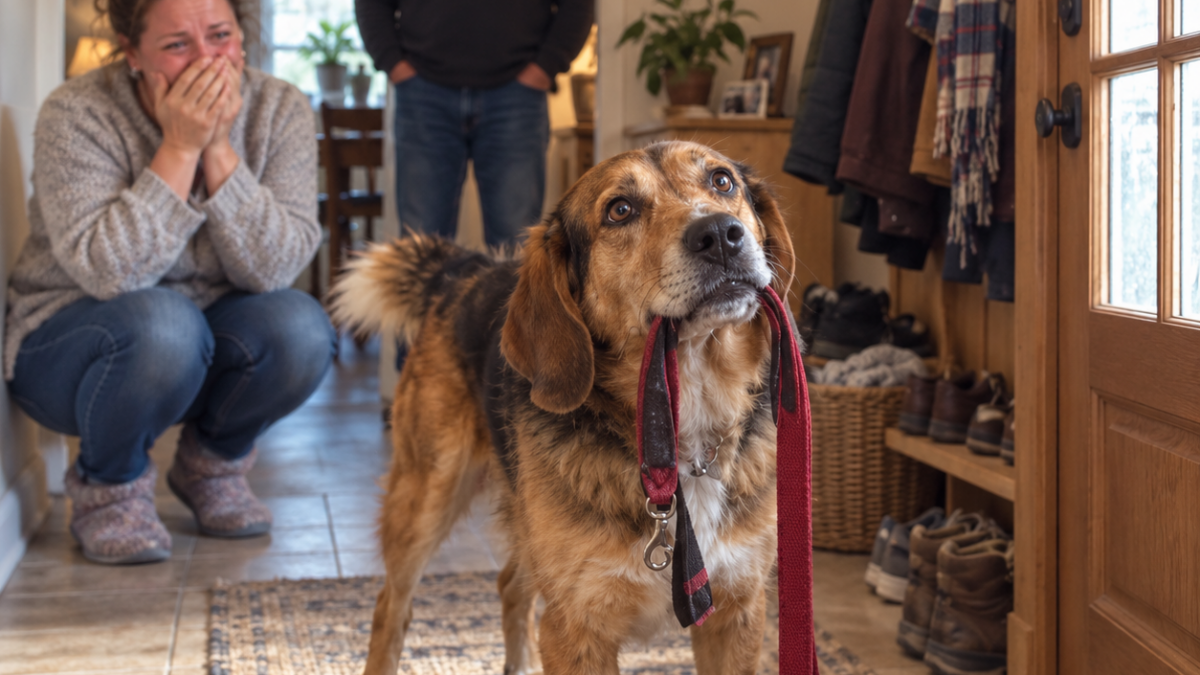
Then, at 1:59, Belle reached up, pulled the leash from the hook with her teeth, and turned toward me.
Exactly as she had every day for six months.
Claire covered her mouth.
I could not move.
Belle walked closer.
Placed the leash at my feet.
Then looked at the door.
“No, Belle.”
Her ears lifted.
“He’s not there.”
She picked the leash up again.
Claire whispered, “She doesn’t know.”
I looked at the clock.
2:00.
Belle scratched the door.
Once.
I broke.
I sat on the floor and cried harder than I had in the hospital.
Because Dad had died yesterday.
But Belle’s world had not received the message.
For her, it was two o’clock.
And two o’clock meant Dad.
She pushed the leash into my hand.
I remembered his voice.
Keep her routine.
Don’t let her wait forever.
I stood.
“Get your coat.”
Claire stared at me.
“Where are we going?”
“The hospital.”
“Are you sure?”
“No.”
But I clipped Belle’s leash.
The moment she heard the metal click, her tail moved.
That almost destroyed me.
We drove to the hospital.
Belle stood in the back seat.
Alert.
Hopeful.
She recognized every turn.
At the side entrance, she began whining.
I almost turned around.
Claire touched my arm.
“We have to.”
Inside, the security guard saw us.
His expression changed.
“Oh.”
I nodded.
He knew.
Everyone knew.
“I’m sorry.”
“Thank you.”
Belle pulled toward the hallway.
He looked at her.
“Does she…”
“No.”
He swallowed.
“Go ahead.”
We reached Dad’s floor.
Martine was at the nurses’ station.
She saw Belle.
Then the leash.
Then us.
Her eyes filled instantly.
“Oh, Belle.”
Belle pulled toward Room 214.
I looked at Martine.
“We didn’t know what else to do.”
Martine glanced toward the room.
Dad’s bed had been stripped.
The room was technically empty, waiting for cleaning and another patient.
A hospital administrator I barely knew was standing nearby.
He noticed.
“I’m sorry, but the room is no longer—”
Martine turned.
“Five minutes.”
“Martine.”
“Five.”
“The animal exception was for the patient.”
Martine stepped closer to him.
Her voice stayed calm.
“This is part of the patient’s family.”
The administrator hesitated.
“I understand emotionally—”
“No.”
Martine shook her head.
“You understand policy. I’m asking you to understand grief.”
Silence.
Belle pulled toward Room 214.
The administrator looked at her.
Then at us.
Finally he said, “Five minutes.”
Martine nodded.
“Thank you.”
She opened the door.
Belle rushed inside.
Then stopped.
Empty bed.
No Dad.
She stared.
Her body went still.
She sniffed.
The floor.
Chair.
Bedframe.
Bathroom doorway.
Back to bed.
She looked behind the plastic visitor chair.
Then at us.
Where is he?
That was what her whole body asked.
Claire started crying.
I knelt.
Belle returned to the bed.
Nose against the mattress.
The sheets were gone, but scent remained.
She sniffed intensely.
Then gave one quiet whine.
Martine left the room and returned holding something.
Dad’s old hospital blanket.
Not the official bedding.
A small fleece throw Claire had brought from home months earlier.
“We forgot to return this yesterday.”
She handed it to me.
I unfolded it.
Belle immediately pushed her nose into the fabric.
Dad.
She knew.
Her entire body softened and collapsed onto the floor beside it.
I sat.
Claire sat.
Martine closed the door.
Five minutes became twenty.
Nobody interrupted.
Belle lay with her head on the blanket.
No pacing.
No scratching.
No searching.
Just stillness.
Eventually, she sighed.
Deep.
Long.
Then closed her eyes.
Martine whispered, “Let her.”
We did.
When Belle finally stood, she sniffed the room one more time.
Then walked toward the door herself.
No pulling.
No looking back.
At home, she carried Dad’s blanket to his chair.
She slept there that night.
The next afternoon, I watched the clock.
1:50.
Belle stayed asleep.
1:55.
Nothing.
1:59.
Her eyes opened.
My heart stopped.
She stood.
Walked toward the hallway.
Then stopped halfway.
Looked at the front door.
Looked at Dad’s chair.
I waited.
Belle walked to the chair.
Climbed onto the blanket.
Lay down.
No leash.
That was when I knew something had changed.
Not that she understood death the way we did.
But she understood absence differently.
Dad was not waiting in Room 214.
She no longer had to go find him.
The next several weeks were hard.
Grief does not end because a dog stops carrying a leash.
Belle ate inconsistently.
She slept more.
Sometimes she stood in Dad’s garage, staring at the workbench.
Sometimes she waited near the door when a car slowed.
The habit of hope takes time to fade.
Dad had told me to take her.
So I did.
At first, that meant moving into his house.
I told myself it was temporary.
There was paperwork.
Sorting.
Repairs.
A property to manage.
But the real reason was Belle.
I could not take her out of the house immediately.
Too much had already vanished.
So I stayed.
My apartment sat mostly empty.
Work became inconvenient.
Life became complicated.
Dad would have enjoyed that.
Claire visited constantly.
Belle loved her.
But at night, Belle chose the hallway near my room.
Not outside Dad’s anymore.
Mine.
The first time I noticed, I stood in the doorway.
She looked up.
“You know there’s a bed in the living room.”
Tail.
“You’re ridiculous.”
She put her head down.
I went to bed.
Sometime after midnight, I woke.
Belle was still there.
Dad’s words returned.
She worries about you.
Maybe he had been right.
Morning routines changed.
Dad had been a coffee-at-six-thirty person.
I was not.
Belle disagreed.
At 6:31 the first week, she stood beside my bed.
I opened one eye.
“No.”
Tail.
“It’s Saturday.”
Tail.
“I don’t care what he used to do.”
Belle stared.
I got up.
That was how Dad continued rearranging my life after death.
Through a dog.
Coffee.
Walk.
Breakfast.
Work.
Belle created structure I had not asked for.
I started understanding what Dad meant when he said she gave him somewhere to put love.
Grief creates energy with nowhere to go.
You want to call someone who no longer has a phone.
Buy something they no longer need.
Ask a question they cannot answer.
Belle needed things.
Food.
Exercise.
Veterinary care.
Company.
That gave my grief direction.
One morning, I sat in Dad’s kitchen while Belle ate.
I looked at his empty chair.
Then at her.
“You did this for him too, didn’t you?”
Belle kept eating.
That was answer enough.
Martine stayed in touch.
Not because hospitals normally call families months later.
Because Martine was Martine.
She asked about Belle.
One day, she said something unexpected.
“We miss her.”
“At the hospital?”
“Several patients ask where the dog is.”
I laughed.
“Belle barely interacted with anyone except Dad.”
“You didn’t notice.”
“What?”
“She did.”
Martine told me that during hallway walks to Room 214, Belle had developed a small following.
An elderly woman in Room 208 always waited near her door.
A man recovering from surgery asked nurses what time “the brown dog” was coming.
One patient with dementia apparently smiled every afternoon when Belle passed.
“She had a route,” Martine said.
“She had Dad.”
“And everyone between the door and your dad.”
I thought about that.
Then Martine said, “Bring her sometime.”
I immediately said no.
“Why?”
“She’ll think Dad is there.”
“Maybe.”
“I’m not doing that to her.”
“Fair.”
We left it.
But several weeks later, I changed my mind.
Not for Martine.
For Belle.
At exactly two o’clock.
I’m still not sure why.
Maybe I wanted to reclaim the hour.
For months, two o’clock had belonged to hospital visits.
After Dad died, it became the hour I dreaded.
Every day at 1:59, part of me watched Belle.
Would she fetch the leash?
Would she wait?
Would she remember?
She never did again.
But I did.
One Sunday, at 1:45, I took down the leash.
Belle looked up.
“Want to go somewhere?”
Tail.
We drove to the hospital.
Not through the old side entrance.
The main entrance.
I wanted everything slightly different.
Belle recognized the building.
Her body tensed.
I crouched beside her outside.
“We’re not looking for him.”
She sniffed my hand.
“We’re just visiting.”
Martine met us.
No Room 214.
Instead, she took us to a small family lounge on another floor.
A retired teacher named Monsieur Perrin sat in a wheelchair near the window.
He had been in the hospital for weeks.
His wife lived too far away to visit daily.
Martine had told him about Belle.
“Only if he wants,” she said.
Belle approached slowly.
Monsieur Perrin held out his hand.
She sniffed.
Then placed her chin on his knee.
The man’s face changed.
I recognized it immediately.
Dad.
Not literally.
The expression.
Relief.
The temporary disappearance of being a patient.
He rubbed Belle’s ear.
“What a beautiful girl.”
Belle’s tail moved.
I looked at Martine.
She smiled.
After twenty minutes, we left.
Belle seemed calm.
At the door, she looked back.
Not toward Room 214.
Toward Monsieur Perrin.
We returned the next Sunday.
Then again.
Eventually the hospital developed a small formal animal-visitation program with local volunteers.
Belle was evaluated.
Health check.
Temperament assessment.
Cleanliness rules.
Insurance.
Paperwork.
Everything humans need before allowing something simple.
She passed.
Mostly.
The evaluator noted that Belle was “highly scent motivated.”
I laughed.
“That’s the polite version.”
Belle began visiting patients.
Not daily.
Not because I wanted to turn her into a symbol.
Once or twice a week.
Often at two.
The hour changed.
It stopped meaning only Dad.
It became Belle’s working hour.
She moved through hallways with calm confidence.
Some patients wanted to pet her.
Some only watched.
One woman cried into Belle’s fur for ten minutes.
Belle stood.
No impatience.
No trying to escape.
Just there.
I finally understood what Martine had meant.
Presence.
That was Belle’s gift.
Not tricks.
Not miracles.
Presence.
Dad had needed it.
Now other people did too.
A few months after Dad died, Room 214 had another long-term patient.
A man named André.
He had been admitted after a serious stroke.
His daughter happened to meet Belle in the hallway.
“Can she visit my father?”
We asked.
Belle entered Room 214 again.
I almost couldn’t breathe.
Different sheets.
Different person.
Different photographs.
Same window.
Same gray parking lot.
Belle stopped just inside.
For one second, her nose lifted.
I watched every muscle.
Then she walked toward André.
No searching.
No confusion.
She placed her head against his hand.
I looked at the corner where Dad’s plastic visitor chair used to sit.
Something inside me loosened.
The room did not belong to Dad anymore.
That hurt.
It also helped.
Life had continued.
Another family needed that bed.
Another daughter sat where Claire had sat.
Another person stared at the parking lot.
Another dog stood beside the bed.
Grief hates replacement.
Healing learns continuity.
Belle visited André several times.
His daughter told me he spoke more on dog days.
Maybe coincidence.
Maybe motivation.
We didn’t turn it into science.
It was simply good.
The hospital administrator who had once given us five minutes became one of Belle’s strongest supporters.
I teased him about it.
“You nearly threw us out.”
“I did not.”
“You absolutely did.”
“I was following procedure.”
“Martine bullied you.”
He sighed.
“Martine bullies everyone.”
True.
When the therapy-dog program received formal approval, he sent Claire and me a copy.
At the bottom he had handwritten:
Sometimes policy has to catch up with what people already know.
I framed that note beside Dad’s photograph.
It felt like revenge in the only way I eventually wanted it.
Not against a person.
Against the idea that love stops mattering because somebody dies.
Dad died.
Belle did not stop loving him.
We did not ask her to.
Instead, we helped that love become movement.
Visits.
Comfort.
Routine.
Something useful.
Grief took a ritual and tried to turn it into an empty hour.
Belle filled the hour again.
That was our revenge.
About six months after Dad’s death, I finally sold my apartment.
Claire stared at me.
“You’re staying in the house.”
“Yes.”
“Because of Belle?”
“Partly.”
“Dad would be unbearable about this.”
“I know.”
“He’d say he planned it.”
“He probably did.”
The blue shutters needed painting.
The garage was full of tools nobody had sorted.
Dad’s coffee machine sounded like farm equipment.
The gate Belle used to escape through still didn’t close perfectly.
I repaired it.
Then felt guilty.
Dad had meant to do it for years.
Belle watched.
“You’re not getting out anymore.”
Tail.
“You had your fun.”
She sniffed the repaired latch.
Then looked disappointed.
Home gradually became mine without stopping being his.
That mattered.
I did not want to live inside a memorial.
Dad would have hated that.
We moved furniture.
Painted one room.
Kept other things.
His chair stayed.
Not because nobody could use it.
Because Belle did.
Every evening, she still slept near the left side.
Some habits outlive explanation.
One year after Dad died, Claire and I did not plan a ceremony.
We went to the cemetery in the morning.
Belle came.
Dogs were allowed on a leash.
She sniffed Dad’s stone.
Then the grass.
Then something far more interesting several feet away.
Claire laughed.
“That’s insulting.”
“No.”
I smiled.
“That’s healthy.”
We stood.
Talked about Dad.
Belle sat between us.
At 1:50, I looked at my watch.
Claire noticed.
“You still do that?”
“Every day.”
“Me too.”
At 1:59, Belle was not waiting beside a door.
She was sniffing leaves.
At two, she looked up because I said her name.
That was enough.
Later that afternoon, we took her to the hospital.
Martine had arranged a visit with several long-term patients.
Nobody knew why the date mattered except us.
At Room 214, we passed without stopping.
I looked through the open doorway.
A woman sat beside her husband.
He was sleeping.
She held his hand.
I kept walking.
Belle did too.
That might have been the most important moment of the year.
We kept walking.
Afterward, Martine brought us coffee.
“You okay?”
I nodded.
“Belle?”
I looked down.
Belle had fallen asleep beneath my chair.
“Better than us.”
Martine smiled.
“Dogs are often smarter about grief.”
“Meaning?”
“They don’t argue with the fact that time is moving.”
I thought about that.
Dogs remember.
Clearly.
But they also smell the next thing.
Walk toward the next voice.
Eat the next meal.
Sleep when tired.
Humans build houses inside the past and then wonder why the windows won’t open.
Belle had grieved Dad.
She may have grieved him forever in some canine way.
But she did not stop living.
I tried to follow.
Two years passed.
Belle turned ten.
Gray appeared around her muzzle.
She slowed slightly.
Not much.
Still followed scents like a detective with poor impulse control.
Still barked at delivery trucks.
Still believed gates existed mainly as puzzles.
Hospital visits reduced to once a week.
Then every other week.
I did not want her entire life to be service.
She was a dog.
She deserved walks, mud, naps, bad decisions.
She got all of them.
At home, she developed a strange habit.
At almost exactly two o’clock on hospital-visit days, she still found her leash.
Not every day anymore.
Only days when I had laid out the small therapy-dog bandana on the counter.
She knew.
I once deliberately hid it.
Belle stared at the cupboard.
“How?”
Tail.
“Are you reading calendars?”
She sneezed.
I gave up.
One afternoon, a young nurse stopped me in the hallway.
“You’re Belle’s person?”
That phrase surprised me.
I had always thought Dad was Belle’s person.
“Yes.”
“My grandfather met her last year.”
“What was his name?”
“Henri.”
I remembered.
Very thin man.
Could barely speak.
Always rubbed Belle’s white tail tip.
The nurse smiled.
“He died in January.”
“I’m sorry.”
“Thank you.”
She crouched and stroked Belle.
“He talked about her at home.”
I swallowed.
“He got home?”
“For three months.”
“That’s good.”
“It was.”
Her eyes filled.
“He told everyone the hospital had one good employee.”
I smiled.
“Belle?”
“Yes.”
“Martine will be furious.”
The nurse laughed.
That interaction stayed with me.
Dad’s relationship with Belle had overflowed into lives he never met.
That is strange.
A man adopts a difficult young dog because his house is lonely after his wife dies.
Years later, he gets sick.
A nurse bends a rule.
Dog visits.
Dog becomes known.
Man dies.
Dog returns.
Hospital starts program.
Another patient goes home telling stories about the dog.
Nothing planned.
Meaning rarely arrives in straight lines.
Dad used to say he only went to the shelter to “look.”
He had no idea what he was starting.
Neither did I.
By Belle’s eleventh year, her hips stiffened.
The veterinarian prescribed medication.
Hospital visits became shorter.
One day, after thirty minutes with patients, Belle sat down in the hallway and refused to move.
I crouched.
“Tired?”
She looked at me.
Martine came out.
“She’s retiring.”
“What?”
“She’s old enough.”
“Don’t say old around her.”
Belle’s ears moved.
Martine smiled.
“She’s earned retirement.”
I looked at Belle.
The thought hurt unexpectedly.
Another ending.
Another routine changing.
“I’m not ready.”
Martine shrugged.
“Not your decision.”
She was right.
We reduced visits further.
Then stopped regular visits entirely.
Belle became an honorary guest.
If we went, it was because she seemed eager.
No more schedule.
No obligation.
At home, two o’clock became ordinary again.
Mostly.
One rainy afternoon, months after her retirement, I noticed Belle standing near the door.
Leash in her mouth.
I froze.
It was 1:58.
My heart dropped back years.
“Belle?”
Tail.
I checked the counter.
No bandana.
No planned visit.
She pushed the leash toward me.
For one irrational second, I thought she had remembered Dad’s hospital ritual exactly.
Maybe she had.
Or maybe she simply wanted a walk.
I chose the simpler answer.
“Okay.”
We went outside.
Rain.
Mud.
Belle sniffed every wet bush.
At 2:20, she attempted to chase a pigeon.
I laughed so hard I cried.
Maybe grief had trained me to see ghosts in schedules.
Belle was just alive.
That was enough.
As she aged, Dad’s promise returned to me.
Don’t let her spend the rest of her life waiting.
I began understanding it differently.
He had not only meant the hospital door.
He meant life.
Don’t freeze her around my absence.
Don’t turn loyalty into a prison.
Love me.
Remember me.
Then move.
Belle did.
So did I.
Claire eventually married and moved farther away.
She visited often.
Her children knew Belle as the family dog who had “worked at a hospital.”
They heard the Room 214 story repeatedly.
Too repeatedly, according to Claire.
I didn’t care.
One Christmas, her son drew a picture.
Dad in a hospital bed.
Belle beside him.
A big clock showing 2:00.
I nearly lost it.
“Why two?”
He looked confused.
“That’s when Belle went.”
Of course.
Stories become facts in families.
Children inherit events they never witnessed.
Dad’s two o’clock became part of our mythology.
Belle’s twelfth year was harder.
Her hearing faded slightly.
Vision too.
Nothing dramatic.
Just age.
She slept more.
The long-eared, restless, difficult rescue dog had become an old lady who preferred sunlight on the kitchen floor.
I moved her bed near Dad’s chair.
Not for sentiment.
Because that was the warm spot.
Or so I told myself.
She still barked at delivery trucks.
Slower bark.
Same outrage.
Still wanted walks.
Shorter.
More sniffing.
Less distance.
I adjusted.
The first time I carried her up the front steps, my chest tightened.
She had always climbed them easily.
I remembered carrying Dad’s things from the hospital.
Another body becoming dependent.
Another lesson in care.
Love changes shape as bodies do.
When someone is young, love looks like play.
Later, medication.
Ramps.
Slower mornings.
Lifting.
Cleaning.
Waiting.
Dad had taught me that through sickness.
Belle taught me again.
One evening, Belle stopped eating halfway through dinner.
I sat beside her bowl.
Old fear.
Dad had done the same near the end.
“No.”
Belle looked at me.
“Finish.”
She did not.
I called the vet.
The diagnosis was not immediately terrible.
Age-related digestive issue.
Medication.
Diet change.
She improved.
I felt foolish for panicking.
The veterinarian said, “You’ve been through loss with her.”
“Yes.”
“Every symptom will feel bigger.”
That was true.
Grief can turn vigilance into superstition.
You think if you watch closely enough, maybe nothing can surprise you again.
Life does not make that deal.
Belle recovered.
For another year, she lived well.
Thirteen.
A good age.
Not enough.
Never enough.
The hospital held a small retirement celebration for Martine around then.
Thirty-plus years.
Claire and I brought Belle.
Martine cried the moment she saw her.
“You’re both ancient.”
“Speak for yourself.”
Belle moved slowly toward her.
Martine crouched carefully.
Belle placed her head on her knee.
Someone took a photograph.
Behind them hung a board showing the hospital’s animal-visitation program.
Dozens of pictures.
Dogs.
Cats.
One rabbit.
Belle’s photograph was in the corner.
Her first official badge beside it.
Martine looked.
“You see what you started?”
I said, “Dad started it.”
Martine shook her head.
“Your dad needed her. Belle did the rest.”
We drank bad hospital coffee.
Perfectly appropriate.
At one point, Martine pulled me aside.
“I kept something.”
My stomach tightened.
“What?”
She reached into her bag.
A small envelope.
Dad’s handwriting.
My name.
I stared.
“Where did you get this?”
“He gave it to me a few days before he died.”
“What?”
“He told me not to give it to you until I retired.”
“That makes no sense.”
“It made sense to him.”
“Why?”
“He said you’d turn grief into a job if he gave it too early.”
That sounded exactly like Dad.
My hands shook opening it.
The letter was short.
Dad hated writing.
He wrote:
If you are reading this, Martine finally escaped that hospital.
Take care of Belle, but don’t make her responsible for taking care of you forever.
She stayed for me when I needed her.
You stay for her while she needs you.
After that, let her be a dog.
And you be a man with a life.
Stop checking the clock at two.
Love,
Dad
I laughed.
Then cried.
Then laughed again.
Martine watched.
“He knew you.”
“Unfortunately.”
I folded the letter.
Belle was sleeping beneath a chair.
At 2:07 that afternoon, I checked the clock.
Then caught myself.
I stopped.
Dad’s revenge.
He was still bossing me around years later.
Belle’s final year was gentle until it wasn’t.
That is often how old age works.
Months of manageable decline.
Then one week, something changes.
She stopped wanting long walks.
Then short walks.
Her breathing became different.
Bloodwork.
Scans.
More questions.
The veterinarian spoke carefully.
A mass.
Advanced.
Options limited.
Comfort.
Time.
All the old words.
Different body.
Same helplessness.
I drove home with Belle asleep in the back seat.
At a red light, I looked at the clock.
1:59.
I almost laughed.
Of course.
I pulled into Dad’s driveway at 2:03.
Belle woke.
I opened the door.
She did not immediately get out.
I lifted her.
She was lighter than I expected.
I carried her inside.
Dad had once asked me to keep her routine.
Now there was no routine left to protect except comfort.
For two weeks, Claire and I rearranged our lives around Belle.
Medication.
Food she liked.
Short time in the garden.
Sunlight.
Dad’s chair.
No hospital.
No heroic final tour.
She had already given enough.
One afternoon, she found the old leash.
Not by carrying it.
She simply stood beneath the hook.
Looked up.
Then at me.
“Walk?”
Tail.
Small.
I clipped it on.
We went outside.
Belle made it to the end of the lane.
Sniffed one bush for an unreasonable amount of time.
I waited.
Dad’s voice came back.
Ten minutes because a cat passed three hours ago.
I smiled.
“Take your time.”
We turned back.
Halfway, Belle stopped.
I picked her up.
No argument.
Her head rested against my chest.
I carried her home.
That evening, Claire sat with us.
“We’re close.”
“I know.”
“How do you know?”
I looked at Belle.
“She’s tired.”
Different tired.
Dad’s words.
The next morning, the veterinarian came to the house.
Same house Dad had shared with Belle for years.
Blue shutters.
Garage.
Chair.
No Room 214.
No hospital smell.
Belle lay on Dad’s old blanket.
I sat beside her.
Claire on the other side.
Before the vet began, I looked at the clock.
1:41.
For one second, I wanted to wait.
Until two.
Because that had been their time.
Then I remembered Dad’s letter.
Stop checking the clock.
I laughed through tears.
“What?”
Claire asked.
“Dad.”
She understood.
We did not wait.
Belle did not need ritual anymore.
She needed rest.
I put my hand under her head.
“You did good.”
Her eyes stayed on me.
“You waited for him.”
My voice broke.
“Then you stayed with me.”
Tail.
Barely.
“You helped people you didn’t know.”
I scratched behind her ear.
“You terrorized delivery drivers.”
Claire laughed.
Belle breathed slowly.
“You escaped the gate seventeen times.”
“Twenty-one,” Claire corrected.
“Seventeen confirmed.”
Belle’s eyes closed.
I whispered, “You don’t have to wait anymore.”
The veterinarian gave the medication.
Belle relaxed.
Her breathing softened.
Then stopped.
No drama.
No fear.
Just stillness.
I sat there for a long time.
Dad’s chair beside us.
Dad’s blanket beneath her.
Dad’s letter upstairs.
For years, I had wondered whether Belle understood his death.
Now I wondered whether, wherever dogs carry memory, she still remembered the hospital hallway.
Room 214.
Two o’clock.
His hand.
Maybe.
Maybe not.
It no longer mattered.
What mattered was that she had lived after him.
Really lived.
Not merely waited.
That was the promise.
We kept it.
After Belle died, I expected 1:59 to become unbearable again.
It didn’t.
The first day after, I happened to be in the garage.
I checked my watch.
2:11.
I had missed it.
I smiled.
Dad would have approved.
The hospital called a few weeks later.
Not because anything was wrong.
They wanted permission to place Belle’s photograph near the entrance to the animal-visitation program.
The administrator—the same man who had once given us five minutes in Room 214—called personally.
“We’d like to name the visitor lounge after Jean and Belle.”
I sat down.
“That seems excessive.”
He laughed.
“That sounds like something your father would say.”
“How do you know?”
“Martine warned us.”
Of course.
I agreed on one condition.
No giant portrait.
No dramatic plaque.
Just something small.
They chose a simple framed photograph.
Dad in Room 214.
Belle beside him.
Both asleep.
Below it:
JEAN & BELLE
Sometimes being there is enough.
Martine chose the words.
I could not improve them.
At the dedication, a new therapy dog arrived.
Young Labrador.
Completely unprofessional.
Pulled toward everyone.
Knocked over a paper cup.
Belle would have judged him harshly.
A little girl in a wheelchair laughed.
The Labrador put his head on her lap.
Her mother cried.
I stood at the back.
Claire beside me.
The clock on the wall read 1:58.
I noticed.
Claire noticed me noticing.
“Don’t.”
“I didn’t say anything.”
“Dad told you to stop.”
“I know.”
1:59.
The little girl stroked the Labrador.
2:00.
Nothing magical happened.
No sign.
No music.
No ghostly bark.
A nurse walked past.
Someone’s phone rang.
The Labrador sneezed.
Life continued.
I think that was the point.
For six months, two o’clock had meant my father and Belle.
Then for years, I let it mean loss.
Eventually, it became a time on the clock again.
That was not betrayal.
That was healing.
The hospital program continued.
More animals.
More families.
More patients who needed something ordinary in a place where life had become clinical.
A dog beside the bed.
A cat purring.
A rabbit on someone’s lap.
Presence.
Dad never intended to change hospital policy.
Belle certainly didn’t.
They simply needed each other.
Martine bent a rule.
Then the rule changed.
That is how some good things begin.
Not with speeches.
With one nurse looking at one photograph and saying:
Bring her tomorrow at two.
Years later, I still live in Dad’s house.
The blue shutters are darker now because I repainted them.
The gate closes properly.
The garage is organized badly, which would horrify him.
Dad’s chair is still here.
Not because nobody uses it.
I do.
That took years.
The first time I sat there after Belle died, I felt guilty.
Then ridiculous.
Furniture is for sitting.
Dad would have said that.
Some evenings, I drink coffee there.
Belle’s white-tipped tail no longer brushes past.
No long ears.
No leash hanging from the hook.
I kept the leash.
Not displayed.
Just in a drawer.
The hospital badge is beside it.
Dad’s letter too.
Sometimes Claire’s children ask for the story.
They know the beginning.
Dog visits Grandpa every day.
Grandpa dies.
Dog waits with leash.
That is the part people remember because it hurts.
I always tell them the rest.
Belle went back.
She found the empty room.
She learned he was not there.
She came home.
She stopped waiting.
She stayed with us.
She helped strangers.
She grew old.
She stole food.
She barked at vans.
She escaped the yard.
She lived.
That is the ending.
Not the leash at 1:59.
People love freezing stories at the moment of greatest pain because pain is dramatic.
But Dad specifically asked us not to freeze Belle there.
Don’t let her spend the rest of her life waiting.
So I refuse to tell her story as if waiting was all she did.
Belle loved my father.
Deeply.
She searched for him.
She waited for him.
She visited him every day for six months.
Then he died.
And Belle kept living.
That was not a failure of loyalty.
It was the fulfillment of it.
Dad had rescued her from a shelter after Mom died.
Belle rescued him from a lonely house.
Then illness took him away.
Belle stayed with me.
In a way, the love moved.
Mother to Dad.
Dad to Belle.
Belle to me.
Belle to strangers in hospital beds.
Strangers to their families.
Nothing replaced anything.
It expanded.
That is what I understand now.
Grief tells you love has nowhere to go.
It lies.
Love can change direction without forgetting where it began.
Belle proved that every afternoon she entered a room that was not 214 and rested her head against someone who was not Dad.
She did not love Dad less.
She simply had more to give.
And if there was any revenge in this story, it was against the emptiness death tried to leave behind.
Death emptied Room 214.
Belle walked back in.
Death emptied Dad’s chair.
Belle slept beside it.
Death took away our two-o’clock ritual.
We built another.
Death eventually took Belle too.
The hospital kept opening its doors to other animals.
Loss never got the final word.
Life did.
Presence did.
Routine did.
Love did.
Sometimes I still hear Dad’s old joke.
“If I ever disappear, don’t call the police. Ask Belle to find me.”
For years, that line broke my heart.
Now it makes me smile.
Because Belle did spend months trying to find him.
At the door.
In his chair.
In Room 214.
In the smell of his blanket.
Then, eventually, she stopped looking in places.
Maybe she found him somewhere else.
In habit.
In safety.
In the fact that she expected people to return.
In the way she trusted me.
In the way she placed her head on the knees of strangers who needed company.
I do not know.
Dogs do not explain these things.
They simply live them.
The photograph at the hospital remains my favorite.
Dad is sleeping.
Belle is asleep against him.
Nothing dramatic.
No one looking at the camera.
No visible illness except the hospital bed.
Her long ear lies across his arm.
His hand rests on her back.
If you did not know the story, you might see only a man and his dog taking a nap.
Maybe that is exactly why it matters.
Their relationship was not extraordinary because Belle waited at 1:59 after he died.
It was extraordinary because of thousands of ordinary moments before that.
Coffee.
Garage.
Evening news.
Left foot.
Bedroom door.
Walks.
Meals.
Trouble.
Love.
The hospital ritual mattered because it preserved those ordinary moments when illness had taken almost everything else away.
At two o’clock, Dad stopped being only a patient.
Belle stopped being only a dog waiting at home.
They became themselves again.
For a while.
Every day.
Six months.
Then one final time.
And the morning after death tried to break the ritual, Belle stood at the door with the leash between her teeth.
I once thought that was the saddest image of my life.
It isn’t anymore.
Now I see it differently.
Belle was keeping an appointment.
She did not know Dad had left time behind.
We took her back.
We let her see the empty room.
We gave her his blanket.
We sat while she understood whatever dogs are capable of understanding.
Then, when Belle stood and walked toward the door on her own, we followed.
That was the real turning point.
Not her waiting.
Her leaving.
She left Room 214.
She came home.
And eventually, she taught me to do the same.
Not leave Dad behind.
Leave the room where grief kept insisting he was supposed to be.
There is a difference.
For years after, whenever I passed the hospital, I imagined Room 214.
Then gradually I began thinking about the family lounge.
The therapy dogs.
Martine’s terrible coffee.
The patients Belle visited.
Dad’s picture in the hallway.
The building grew larger in memory.
It stopped being only the place where he died.
That happened to our house too.
At first, every room said Dad.
Then Belle.
Then both.
Then us.
Now it says home.
Loss took people and animals from it.
Life kept filling the rooms.
That is how I know we kept Dad’s promise.
Belle did not spend the rest of her life waiting.
Neither did I.
And somewhere in a hospital outside Limoges, at almost exactly two o’clock on many afternoons, another dog still walks through the doors to sit beside someone who needs to feel like a person again.
Most of those patients have never heard of Jean.
Many have never heard of Belle.
They don’t need to.
The good thing continued without requiring everyone to know where it started.
Dad would have liked that.
Belle would have been more interested in whether anyone had biscuits.
And me?
I finally stopped checking the clock.
Mostly.

