PART 2: For Seven Years, He Waited at the Same Bus Stop for a Man Who Never Came Home—Then One Spring Evening Changed Everything
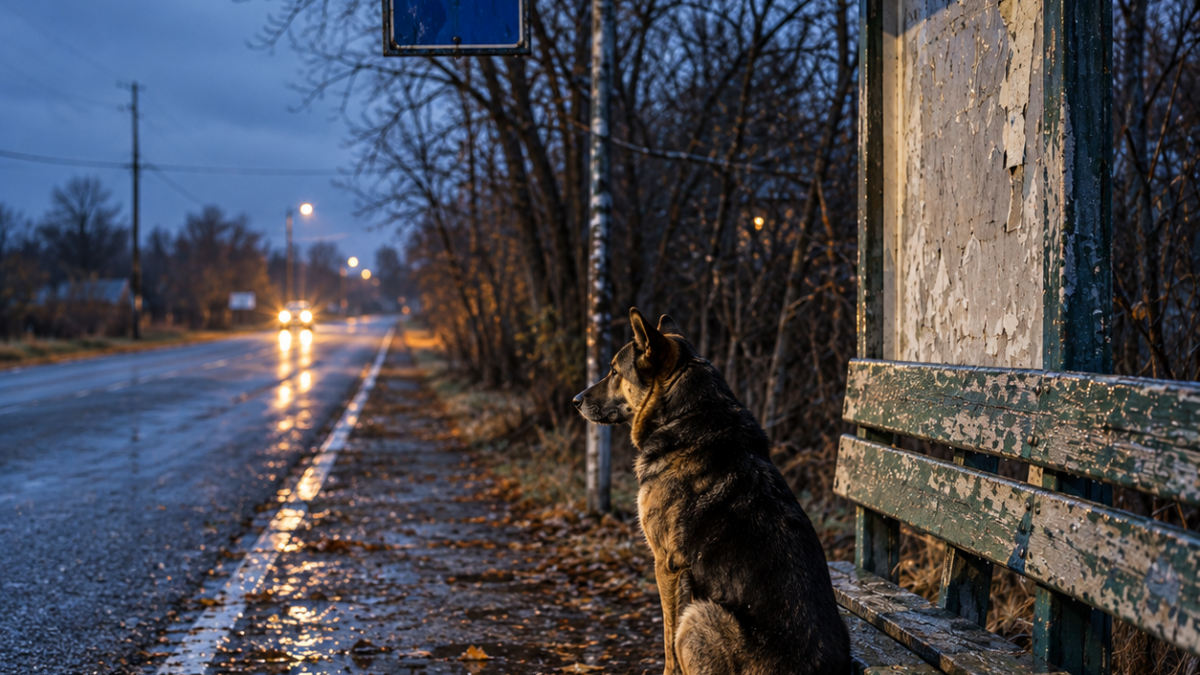
For seven years, an old dog walked to the same bus stop every evening and waited for a man who was never coming home.
By the time I met him, his muzzle had turned gray, his legs shook when he stood, and almost everyone in our village had stopped believing anything could make him give up that vigil.
Then, one spring evening, a bus pulled in at exactly six o’clock—and what happened when the door opened made the entire village fall silent.
My name is Alina, and I first noticed Baron during my second week teaching at the village school.
I had seen him before, of course.
Everyone had.
He was a large shepherd mix, black across the back with reddish-brown legs and a wide chest that hinted at how powerful he must once have been.
But age had softened him.
His muzzle was almost completely gray, one ear drooped more than the other, and when he stood after sitting too long, his hind legs trembled.
Every evening, shortly before six, Baron appeared at the old bus stop near the main road.
He always sat in the same place.
Beside an old wooden bench where green paint peeled away in long curls.
Then he looked down the road.
And waited.
At first, I assumed someone fed him there.
Then I noticed the routine.
A bus would appear around the bend.
Baron would rise.
His ears would lift.
He would take two or three careful steps toward the road and stare through the windows as the bus slowed.
The doors would open.
Passengers would step down.
Baron inspected every face.
Then the doors closed.
The bus pulled away.
And Baron returned to the bench.
The first time I watched it happen, I asked an elderly woman beside me, “Whose dog is that?”
Her expression changed.
“Nicolae’s.”
“Where is Nicolae?”
She looked at Baron.
“He’s been gone seven years.”
I thought she meant he had moved away.
Then she told me.
Seven years earlier, Nicolae had left home one morning to travel into the city.
Baron had walked him to the bus stop, as he always did.
Before boarding, Nicolae bent down, scratched behind the dog’s ears, and said the same thing he had said dozens of times before.
“I’ll be back tonight. Wait for me.”
Baron watched him climb aboard.
Nicolae smiled through the window.
The bus left.
That afternoon, there was a terrible accident on the highway.
Nicolae never came home.
But Baron did not understand why.
At six that evening, he went to the bus stop.
The bus arrived.
Nicolae wasn’t on it.
Baron waited for the next one.
And the next.
Finally, after the last bus disappeared around the bend, Baron walked home.
The next evening, he returned.
Then again.
Days became weeks.
Weeks became months.
Relatives tried taking him into their homes.
Baron escaped.
Neighbors locked gates.
He found ways around them.
Someone once drove him several miles away, hoping a new environment might break the habit.
By sunset, Baron was gone.
The next morning, they found him sleeping beneath the old bus bench.
Eventually the village stopped trying to make him forget.
People began taking care of him instead.
Drivers brought scraps.
The bakery left fresh water.
During winter, someone put straw behind the shelter.
But Baron belonged to one thing more strongly than he belonged to any house.
A promise.
Every evening, he waited.
I told myself it wasn’t my business.
Then winter came.
One night the temperature dropped so low that frost covered the inside of my windows.
At almost nine, I realized Baron had not passed my house on his way back from the station.
I put on my coat and went looking for him.
I found him curled beneath the bench.
Snow had collected across his back.
“Baron?”
His eyes opened.
He tried to stand.
He couldn’t.
I wrapped my coat around him and lifted him.
I expected him to be heavy.
He wasn’t.
That frightened me more than anything.
The veterinarian examined him that night and spoke quietly.
“His heart is weak. His joints are badly worn. He doesn’t have endless time left.”
I looked at Baron.
“How long?”
The veterinarian shook his head.
“Nobody can tell you that.”
After that, I stopped letting him make the trip alone.
Every afternoon, shortly before five, Baron would stand at my gate and look at me.
I would put on my coat.
“All right, old man.”
Then we walked together.
Slowly.
Sometimes it took nearly an hour to cover a distance I could walk in ten minutes.
But Baron never turned around.
Winter finally loosened its grip.
The snow disappeared.
The first wildflowers appeared beside the road.
And then, one evening in early April, Baron and I were sitting beside the old bus stop when the six o’clock bus came around the bend.
Baron stood.
The doors opened.
A man stepped down carrying a worn brown suitcase.
He looked at Baron.
Then he froze.
Because tied around the handle of that suitcase was an old leather collar.
And stamped into the metal tag was one name.
BARON.
PART 2
I stood so quickly that the bench creaked beneath me.
Baron did not move.
The stranger didn’t either.
For several seconds, they simply stared at each other.
The man was perhaps forty-five.
Tall.
Thin.
Dark hair beginning to gray at the temples.
There was something about his face that felt familiar, though I knew I had never seen him before.
Then Baron took one step forward.
His nose lifted.
Another step.
The man lowered the suitcase.
“Baron?”
The dog’s entire body changed.
His ears rose.
His tail moved once.
Just once.
The man covered his mouth.
“Oh, God.”
Baron approached him slowly.
The stranger crouched.
“I didn’t know.”
His voice cracked.
“I swear I didn’t know you were still here.”
Baron sniffed his hands.
Then the man’s jacket.
Then the suitcase.
When his nose reached the leather collar tied to the handle, he stopped.
He inhaled deeply.
And let out a sound I had never heard from him.
Not a bark.
Not a whine.
Something lower.
Something that seemed to come from a place far older than language.
The man began crying.
Baron pressed his head against his chest.
I stood a few feet away, unsure whether I had the right to interrupt.
Eventually the man looked at me.
“Are you Alina?”
That startled me.
“Yes.”
He wiped his face.
“I’m Mihai.”
The name meant nothing to me.
Then he said:
“Nicolae was my father.”
Everything inside me went still.
Baron remained pressed against him.
I looked at the man’s face again.
Now I saw it.
The same eyes from the faded photograph hanging inside Nicolae’s old house.
The same square jaw.
The same crooked left eyebrow.
“You’re Nicolae’s son?”
Mihai nodded.
“I’ve been living in Spain.”
“For seven years?”
“Longer.”
“Why didn’t anyone tell me you existed?”
He gave a tired smile.
“Probably because my father and I weren’t speaking when he died.”
Baron lifted his head at the word father.
Mihai stroked his ears.
“I’m sorry, buddy.”
I sat again.
Mihai joined me.
Baron placed himself between us.
For several minutes, none of us spoke.
The bus pulled away.
Normally Baron would have watched it until it disappeared.
That evening, he didn’t.
He stared at Mihai.
“How did you know where to find him?” I asked.
“A bus driver.”
“Which one?”
“Petru.”
I knew Petru.
He had been driving that route for decades.
“He sent me a letter.”
“A letter?”
Mihai nodded.
“My father’s sister gave him my address.”
He opened the suitcase.
Inside were several old sweaters, a stack of photographs, a pocketknife, papers bound with string, and a folded brown coat.
Baron’s nose went immediately toward the coat.
Mihai noticed.
“That was his.”
Baron buried his face in it.
My throat tightened.
“Where did you get these things?”
“My aunt kept them.”
“All these years?”
“She said she couldn’t throw anything away.”
He touched the old collar.
“And this?”
Mihai looked ashamed.
“I took it with me when I left home.”
“Why?”
“Because Baron was mine first.”
I looked at him.
Mihai smiled sadly.
“When I was sixteen, I brought home a shepherd puppy someone was giving away behind the market.”
Baron’s ears twitched when he heard Mihai say puppy.
“My father said we didn’t need a dog.”
I almost laughed.
“That seems to be a recurring story.”
“He complained for maybe three days. Then Baron started sleeping beside his chair.”
Mihai rubbed the dog’s neck.
“When I left Romania, Baron stayed with Dad.”
“Why did you leave?”
His hand stopped moving.
“Because I was twenty-eight and angry.”
“At your father?”
“At everything.”
He looked toward the road.
“My mother had died. Dad and I fought constantly afterward. He wanted me to stay here. I wanted a different life.”
“What was the last thing you said to him?”
Mihai stared ahead.
“You don’t need to know that.”
The answer told me enough.
He had come home carrying more than a suitcase.
Baron rested his chin on Mihai’s knee.
Mihai looked down.
“Of course you remember me.”
Baron’s tail moved again.
“You remember everybody.”
That evening, Baron did something he had never done in all the months I had known him.
He left the bus stop before the final bus.
At 6:23, Mihai stood.
“I should go see the house.”
Baron stood too.
I expected him to remain beside the bench.
Instead, he followed Mihai.
I walked behind them.
Baron moved slowly.
But there was purpose in his steps.
At Nicolae’s old gate, he stopped.
The house had been empty for years except for occasional visits from relatives.
Mihai unlocked it.
The hinges groaned.
Baron stared inside.
Then he walked across the threshold.
Mihai switched on a lamp.
Dust floated through the air.
The furniture was covered with sheets.
A clock had stopped at 11:17.
Baron went directly to an old armchair beside the window.
He sniffed it.
Turned twice.
Lay down.
Mihai stood in the doorway.
“I remember that.”
“What?”
“He used to sleep there when Dad watched television.”
Baron sighed.
Mihai sat on the floor beside him.
I quietly moved toward the door.
“You don’t have to leave,” he said.
“I think I do.”
He understood.
Before I walked away, I looked back.
Mihai was leaning against the chair.
Baron’s head rested on his leg.
For the first time since I had met him, Baron was inside Nicolae’s house after sunset.
The next afternoon, however, he was waiting at my gate again.
Five o’clock.
I opened it.
“You still want to go?”
Baron looked toward the road.
Mihai appeared behind him.
“I tried to stop him.”
“You can’t.”
“I figured that out.”
So the three of us walked.
At the bus stop, Baron resumed his familiar position.
When the six o’clock bus arrived, he inspected the windows.
Mihai watched him.
“He still thinks Dad might get off.”
“I don’t know what he thinks.”
“I do.”
“How?”
“Because I spent seven years thinking I might somehow get another chance to speak to him.”
That silenced me.
Mihai sat on the bench.
“I knew he was gone. I knew it intellectually. But sometimes I’d see a number from Romania and think maybe…”
He stopped.
“Maybe what?”
“Maybe the accident had been a mistake. Maybe he would answer. Maybe I’d hear his voice.”
Baron lowered himself beside us.
Mihai looked at him.
“I guess we’re both stupid.”
“No.”
I shook my head.
“You’re both grieving.”
He gave me a strange look.
“Seven years?”
“Grief doesn’t read calendars.”
That became our routine.
Mihai planned to stay only one week.
He stayed two.
Then three.
He repaired the roof on Nicolae’s house.
He cleared weeds from the yard.
He found an old red ball beneath a cabinet.
Baron stared at it for almost a minute.
Then, to everyone’s astonishment, he nudged it with his nose.
Mihai laughed.
“He used to chase that thing until Dad hid it.”
Baron pushed it again.
He couldn’t run anymore.
But for five minutes, he became younger.
So did Mihai.
The village noticed.
People stopped at the gate.
Some remembered him.
Some didn’t.
Everyone knew Baron.
One afternoon, Petru the bus driver came by.
He and Mihai embraced.
“You should’ve written sooner,” Petru said.
“I didn’t know what to write.”
“Anything.”
“I thought nobody wanted to hear from me.”
Petru looked toward Baron.
“He did.”
Mihai’s face changed.
Petru immediately regretted it.
But Mihai nodded.
“I know.”
Then spring brought another change.
A black SUV appeared beside the bus stop.
A man stepped out wearing polished shoes that looked absurd against the muddy shoulder of the road.
His name was Radu Ionescu.
I knew him by reputation.
He had grown up in a neighboring town, made money in construction, and recently begun buying roadside properties throughout the district.
Two weeks earlier, his company had purchased an abandoned parcel beside the bus stop.
At first, I thought nothing of it.
Then survey markers appeared.
A sign followed.
COMING SOON: IONESCU MARKET & FUEL STOP
The village needed a small market.
Nobody objected.
Then Radu approached Baron.
He crouched several feet away.
“So this is the famous dog.”
I disliked the word famous immediately.
Baron ignored him.
Radu took out his phone.
“Can I get a picture?”
“Of the station?”
“Of the dog.”
“No.”
He looked at me.
“Excuse me?”
“He’s not an attraction.”
Radu laughed.
“Everyone photographs him.”
“That doesn’t mean you need to.”
He stood.
“You’re the teacher, right?”
“Yes.”
“Alina Popescu.”
“Yes.”
“I heard you look after him.”
“I do.”
He looked around.
“This whole area is going to change.”
“How?”
“We’re improving it.”
He pointed to the old shelter.
“That thing will have to go.”
My stomach tightened.
“The bus stop?”
“The structure. It’s practically falling apart.”
“The buses still stop here.”
“We’ll build a new shelter farther down.”
Baron lifted his head at the word shelter.
Radu continued.
“Better lighting. New benches. Maybe a sign telling Baron’s story.”
“No.”
He frowned.
“No what?”
“No sign turning his grief into advertising.”
“That’s not what I said.”
“You were thinking it.”
He smiled.
“You don’t know what I think.”
Unfortunately, over the next month, I learned exactly how he thought.
Radu saw Baron as an opportunity.
People had begun coming from nearby towns after photographs of the old dog spread online.
Nothing huge.
A few visitors on weekends.
They brought food.
They took pictures.
Some sat quietly beside him.
Radu saw traffic.
He proposed a branded memorial shelter.
BARON’S STOP — Sponsored by Ionescu Market.
He showed the design to the village council before speaking to me.
There was a large company logo.
A decorative silhouette of a shepherd.
A donation box.
And a plaque describing Baron’s loyalty.
Nicolae’s name appeared once.
Small.
The company’s name appeared six times.
I attended the council meeting.
“No.”
Radu leaned back in his chair.
“You don’t own the dog.”
“No.”
“You don’t own the shelter.”
“No.”
“Then why are you acting as if you decide everything?”
“Because Baron cannot tell you he doesn’t want to spend his final years sitting beneath an advertisement.”
One council member coughed to hide a laugh.
Radu’s expression hardened.
“I’m offering to replace a dangerous structure at my expense.”
“Replace it with a bus shelter.”
“That’s exactly what I’m doing.”
“No. You’re building a billboard with a roof.”
Mihai sat behind me.
I heard him laugh quietly.
Radu looked toward him.
“And you are?”
“Nicolae’s son.”
The room changed.
Radu had not known.
Mihai continued.
“If you’re using my father’s name in advertising, you should probably speak to me.”
Radu recovered quickly.
“Of course. That’s why we’re discussing it.”
“No. You’re presenting a finished design.”
“We can revise details.”
“Remove the company name.”
Radu smiled.
“Then why would my company pay?”
Mihai shrugged.
“Exactly.”
The proposal was postponed.
I thought that would be the end.
It was the beginning.
A week later, someone reported Baron to animal control.
The complaint said:
Elderly dog routinely left outdoors for many hours in rain, snow, and extreme cold. Appears neglected and unsupervised.
An officer came to my house.
I showed him Baron’s shelter.
Food.
Water.
Veterinary records.
Medication.
Blankets.
The insulated sleeping area Mihai had built.
Then I explained the bus stop.
The officer scratched his chin.
“I’ve heard about this dog.”
“Everybody has.”
“He chooses to go?”
“Every day.”
“Can you physically keep him from leaving?”
“Yes.”
“Then why don’t you?”
That question was harder than it sounded.
“Because he’s old. Because the walk matters to him. Because taking away the one routine he has followed for seven years would not automatically be kindness.”
The officer looked at Baron.
Baron stared toward the gate.
It was 4:51.
The officer checked his watch.
“Does he really leave at five?”
“Watch.”
At 4:58, Baron stood.
At 5:00, he walked to the gate.
The officer laughed softly.
“All right.”
He reviewed the veterinarian’s letter confirming Baron could continue gentle activity as tolerated.
The complaint was closed.
Three days later, another appeared.
This one claimed Baron was aggressive toward passing children.
That was ridiculous.
Baron had spent years being hugged by children waiting for school buses.
The school principal wrote a statement.
Parents signed another.
Complaint closed.
Then came a third.
Unsanitary conditions around the station.
That one led to an inspection.
Again, nothing.
Mihai looked at me.
“You think it’s Radu.”
“I don’t know.”
“You know.”
“I suspect.”
“Same thing.”
“No.”
I was careful.
If Radu wanted a public fight, I would not give him one without evidence.
Then he made a mistake.
He offered Mihai money.
Ten thousand euros.
“For what?” Mihai asked.
We were sitting at Nicolae’s kitchen table when he told me.
“For permission to use Dad’s story. Baron’s image. Family photographs.”
“What did you say?”
“No.”
“Immediately?”
“I asked if he wanted the old man’s jacket too.”
Despite myself, I laughed.
“He didn’t appreciate it.”
“What exactly does he want?”
“He’s planning a tourist stop.”
I stared.
“A tourist stop?”
“Small café. Souvenirs. Postcards. A bronze dog.”
I almost dropped my cup.
“Souvenirs?”
“Apparently grief looks profitable from his side of the table.”
Mihai’s sarcasm hid real anger.
Then he became serious.
“He also said something else.”
“What?”
“If we don’t cooperate, he’ll move forward without us.”
“How?”
“He says Baron is part of local history. Public story.”
“Baron is alive.”
“I mentioned that.”
“What did he say?”
Mihai looked at me.
“He said not for much longer.”
The room went silent.
I felt anger move through me so quickly that I had to put both hands flat on the table.
“What exactly did he mean?”
“I think he meant Baron’s old.”
“That’s not an excuse.”
“I know.”
Mihai’s jaw tightened.
“I wanted to hit him.”
“But you didn’t.”
“No.”
“Good.”
“Wasn’t easy.”
“Still good.”
Violence would have given Radu exactly what people like him love.
A distraction.
A way to make the story about our behavior instead of his.
So we did something much more effective.
We started keeping records.
Every proposal.
Every message.
Every complaint.
Every inspection.
Every date.
Petru helped.
So did the veterinarian.
So did the school.
Then an elderly former council clerk named Sorina heard what was happening.
She came to Nicolae’s house carrying a cardboard folder.
“You people are arguing about the bus stop?”
“Apparently,” I said.
She placed the folder on the table.
“Then you might want this.”
Inside was a copy of an agreement from thirty-two years earlier.
The bus shelter had not been built by the council.
Nicolae and three neighbors had built it after several schoolchildren were forced to wait in winter rain.
Nicolae had supplied most of the wood.
More importantly, the narrow strip of land beneath the shelter had been transferred to the municipality under a specific condition:
It was to remain a public transit waiting area.
Mihai read the document twice.
“Can it be moved?”
Sorina adjusted her glasses.
“Probably, if the municipality follows the proper process.”
“Can Radu tear it down because he bought the adjacent parcel?”
“No.”
“Can he build on the shelter’s footprint?”
“No.”
I looked at Mihai.
For the first time in weeks, he smiled.
But Sorina raised a finger.
“Don’t get excited yet.”
“Why?”
“Old records are messy. Someone needs to verify the current land registry.”
We did.
The record still existed.
The shelter was public land.
Radu’s new parcel ended precisely eighteen inches behind it.
He didn’t own the stop.
Not one board.
Not one nail.
He had been presenting designs as though demolition were inevitable.
It wasn’t.
We still said nothing publicly.
That mattered.
Radu assumed we had no leverage.
He became bolder.
One Monday morning, workers arrived before sunrise.
I was leaving for school when Petru called me.
“Get to the station.”
“What happened?”
“Now, Alina.”
I drove.
A small excavator was parked beside the shelter.
Two workers had removed part of the side panel.
Baron stood twenty feet away, confused.
Mihai was already there.
Radu’s site manager held papers.
“You can’t do this,” Mihai said.
“We have authorization to clear unsafe structures adjacent to the construction zone.”
“That isn’t your structure.”
“It interferes with site access.”
“Stop.”
The manager shook his head.
“We’ve been instructed—”
“Stop.”
I walked between them.
“Do you have written municipal authorization specifically identifying this bus shelter?”
He looked at me.
“We have a site permit.”
“That’s not what I asked.”
Radu arrived ten minutes later.
He stepped out of his SUV looking irritated.
“What is this?”
Mihai held up the land record.
“This is the part where you stop.”
Radu barely glanced at it.
“My lawyers reviewed the parcel.”
“Then they should review it again.”
“This shelter is unsafe.”
“Then the municipality can repair it.”
“It blocks access.”
“Not our problem.”
Radu looked toward the workers.
“Continue.”
I took out my phone.
“I wouldn’t.”
He stared at me.
“Are you threatening me?”
“No.”
“I’m informing you that the municipality, police, and land office have all been contacted.”
That was true.
Sorina had taught us something useful.
Never argue about property boundaries when an official record can do it for you.
Within thirty minutes, a municipal officer arrived.
Then another.
Work stopped.
By noon, the excavator was gone.
By evening, the entire village knew.
Radu released a statement claiming there had been a “technical misunderstanding.”
Mihai read it aloud at the kitchen table.
“Technical misunderstanding?”
I laughed.
“Apparently that’s what we call taking a wall off something you don’t own.”
But Radu wasn’t finished.
He changed tactics.
He posted photographs of Baron online.
Some showed him lying beneath the old shelter in winter.
Others showed his thin body.
The caption read:
LOYALTY OR NEGLECT? IS IT TIME TO STOP ROMANTICIZING AN ELDERLY DOG’S SUFFERING?
That one hurt.
Because underneath the manipulation was a question I had asked myself many times.
Was I helping Baron?
Or was I allowing a ritual that had become physically difficult because it made humans feel something beautiful about loyalty?
The post spread.
People argued.
Some defended us.
Some accused us.
Others said Baron should be confined indoors permanently.
A regional news page contacted me.
I refused an interview.
Then the veterinarian called.
“I saw the post.”
“I know.”
“How are you?”
“Angry.”
“Good. But listen carefully.”
“I’m listening.”
“We need to ask the question anyway.”
My anger cooled.
“What question?”
“Is the walk still good for Baron?”
I closed my eyes.
Of course.
That was why I trusted her.
She didn’t care whether Radu was cruel.
She cared about the dog.
“Can you see him today?”
“Bring him.”
The examination took nearly an hour.
Heart.
Lungs.
Joints.
Pain assessment.
Blood work.
Baron tolerated everything with the exhausted patience of an old dog who had long ago accepted that humans occasionally do ridiculous things.
Then the veterinarian sat beside me.
“He should not be walking several hundred meters every day anymore.”
I stared at her.
“At all?”
“Not without assistance.”
“What does that mean?”
“Some days he can walk part of it. Some days he shouldn’t.”
I looked at Baron.
He rested his head on my shoe.
“If I keep him home?”
“Emotionally, I can’t predict how he’ll respond.”
“What would you do?”
“I’d preserve the routine but change the physical burden.”
Mihai, who had come with us, leaned forward.
“How?”
The veterinarian smiled.
“Get creative.”
We did.
The next afternoon, Baron arrived at the bus stop in a red wooden wagon.
Mihai found it in Nicolae’s shed.
It had once been used to carry sacks of potatoes.
He repaired the wheels.
I added a blanket.
Baron hated it.
For approximately forty seconds.
Then he realized the wagon was moving toward the bus stop.
He sat upright like a king.
Children followed us down the road laughing.
Petru slowed his bus and honked.
Baron barked once.
It was the first bark I had heard from him in months.
Someone filmed it.
The video spread far wider than Radu’s post.
But this time the caption wasn’t about neglect.
It was:
WHEN HIS LEGS COULDN’T MAKE THE WALK ANYMORE, HIS VILLAGE MADE SURE HIS HEART STILL COULD.
I hated how sentimental the wording was.
I also cried when I read it.
Donations arrived.
We refused money for Baron.
Instead, Mihai suggested using it to repair the bus shelter.
The council approved.
Local carpenters volunteered.
The original bench remained.
Everything else was reinforced carefully.
New roof.
Wind panels.
Safer flooring.
No company branding.
No souvenir stand.
One small plaque was placed beneath the roof.
It read:
THIS SHELTER WAS BUILT BY LOCAL FAMILIES FOR EVERYONE WHO NEEDED A SAFE PLACE TO WAIT.
No mention of Baron.
No mention of Nicolae.
That was deliberate.
It remained a bus stop.
Not a monument.
Radu was furious.
He appealed the construction boundary.
He complained about access.
He argued that visitors created traffic problems.
Some of those concerns were legitimate.
So we addressed them.
No roadside parking.
No organized tours.
No donation stalls.
No commercial use of Baron’s image through the village.
We took away every reasonable argument he had.
Then the municipality reviewed his construction plans more closely.
That was where the real consequences began.
The unauthorized attempt to alter the shelter triggered a broader permit review.
Inspectors discovered that part of his planned access lane crossed public drainage land.
Another portion conflicted with the setback required from the bus turnout.
His project wasn’t canceled.
But he had to redesign it.
That cost him months.
Then came fines for the unauthorized work already performed near the shelter.
Nothing dramatic.
Nothing theatrical.
Just paperwork.
Professional fees.
Delayed approvals.
Exactly the kind of consequences a man like Radu understood.
He blamed us.
Mihai shrugged.
“You should’ve checked where your property ended.”
Radu pointed at him.
“You think this is funny?”
“No.”
Mihai looked at the bus shelter.
“I think it’s avoidable.”
That was the closest thing to revenge we needed.
Radu had tried to turn Baron into advertising.
Instead, Baron became the reason every document connected to Radu’s project was examined carefully.
He had wanted attention.
He got it.
Just not the kind he had planned.
Meanwhile, Baron was changing.
Mihai had been in the village for nearly four months.
At first, Baron still watched every bus.
Then something subtle happened.
He began looking at Mihai between arrivals.
Sometimes, when a bus left, Baron did not immediately return his eyes to the road.
He leaned against Mihai instead.
One evening, the six o’clock bus arrived.
Three people stepped off.
None was Nicolae.
Baron watched.
The doors closed.
The bus left.
Normally he would have settled down again.
Instead, he turned.
He looked at me.
Then at Mihai.
Then toward home.
Mihai whispered:
“Baron?”
The dog began walking away from the station.
We stared after him.
“Is he sick?” I asked.
Mihai caught up.
Baron continued.
He stopped once, waiting for us.
So we followed.
That was the first time in seven years Baron left before the last bus without being carried.
The next evening, he stayed longer.
The evening after that, he left after two buses.
There was no clean pattern.
No miracle.
Grief doesn’t end according to a schedule either.
But something was loosening.
Then Mihai found an old videotape.
He discovered it inside a cabinet in Nicolae’s bedroom.
On the label, in faded handwriting:
Mihai + Baron, summer 2004.
We found an old player at the school.
That Saturday, I joined Mihai in Nicolae’s living room.
Baron slept on the rug.
The video flickered onto the screen.
A younger Mihai appeared.
Twenty-something.
Longer hair.
Laughing.
A young Baron raced around the yard.
Then Nicolae’s voice came from behind the camera.
“Baron! Here!”
The dog on the rug woke instantly.
His head rose.
Mihai froze.
On-screen, young Baron ran toward the camera.
Nicolae laughed.
“Good boy.”
The old Baron stood.
His legs shook.
He walked toward the television.
Nicolae’s voice came again.
“Come here, Baron.”
The old dog pressed his nose against the screen.
Mihai covered his face.
I reached for the remote.
“Turn it off?” I asked.
“No.”
His voice was barely audible.
“Please.”
The video continued.
Nicolae talked behind the camera.
Ordinary things.
“Stop digging.”
“Leave that chicken alone.”
“Mihai, he’s stealing your shoe.”
Laughter.
Nothing important.
Everything important.
Baron lay down in front of the television.
His eyes remained open.
He listened.
At the end of the tape, Nicolae’s face finally appeared when Mihai took the camera.
He was younger.
Stronger.
Annoyed at being filmed.
“Enough.”
Mihai’s younger voice laughed.
“Say something.”
“What?”
“Anything.”
Nicolae looked into the camera.
Then smiled.
“Come home before dark.”
The image shook.
The tape ended.
Mihai sat completely still.
Then he began sobbing.
Not quietly.
Not politely.
Seven years collapsed.
I moved toward him.
He shook his head.
“I’m okay.”
He wasn’t.
But sometimes okay is not the immediate goal.
Sometimes the goal is simply not being alone while you’re not okay.
Baron walked over.
Mihai dropped to his knees.
“I’m sorry.”
He held Baron’s face.
“I’m so sorry.”
I knew he wasn’t talking only to the dog.
Later that evening, Mihai finally told me about the last argument.
His father had wanted him to return from Spain after his mother became ill.
Mihai couldn’t.
He had a contract.
Debt.
A girlfriend.
A life he was afraid to lose.
By the time he came home, his mother had died.
Nicolae was furious.
“You were too busy for your own mother.”
Mihai answered with the cruel efficiency only family can achieve.
“You spent your whole life making this village your excuse for never doing anything.”
Nicolae told him to leave.
Mihai left.
He never apologized.
Months became years.
Pride hardened.
Then Nicolae died.
“The last message I got from him,” Mihai said, “was three weeks before the accident.”
“What did it say?”
He took out his phone.
He had kept a photograph of the old message.
Baron still waits at the gate when he hears your name.
That was all.
“He was trying to tell me to come home.”
“Maybe.”
“I ignored it.”
“You can’t change that.”
“No.”
“Then what can you change?”
Mihai looked toward Baron.
“I can stop leaving.”
The next morning, he called his employer in Spain.
He arranged to sell his small apartment there.
He wasn’t staying because he thought Nicolae would want it.
He wasn’t staying because Baron required punishment for his guilt.
He stayed because, for the first time, he chose where he wanted his life to be.
Summer arrived.
Baron’s health stabilized.
Not improved.
Old age doesn’t reverse itself.
But he was comfortable.
The wagon became famous in the village.
At five o’clock, he would stand beside it.
Sometimes he walked the first hundred yards.
Then he stopped.
We lifted him in.
Children occasionally took turns pulling.
Mihai insisted on checking the wheels every day.
“He’s more maintenance than my car.”
Baron ignored him.
Radu’s market eventually opened.
Smaller than originally planned.
Farther back from the road.
No giant Baron sign.
No branded memorial.
For several weeks, he avoided us.
Then one afternoon, something unexpected happened.
A delivery driver left a gate open behind the market.
A small terrier belonging to one of the workers escaped.
The dog ran toward the road.
A bus was approaching.
Baron saw the terrier before any of us did.
He was lying beside the shelter.
Suddenly he barked.
Loud.
Sharp.
Again.
The terrier hesitated.
Mihai ran.
He caught the small dog just before it reached the pavement.
The worker came running.
So did Radu.
He looked at Baron.
The old dog had already lowered his head again.
Radu stood there for a long moment.
Then said:
“Thank you.”
Mihai looked at him.
“Thank him.”
Radu almost smiled.
He crouched several feet from Baron.
“Thank you, old man.”
Baron did not react.
That would have been too easy.
Real reconciliation is rarely cinematic.
Radu didn’t become our friend.
We didn’t forget what he had done.
But the hostility cooled.
A week later, a pallet of timber arrived at the municipal yard.
No invoice.
No advertising.
High-quality treated wood.
The note said:
For future repairs to the public shelter. No logo required.
Mihai recognized the supplier.
Radu’s.
“Are we accepting it?” I asked.
Mihai looked at the wood.
“Does it come with his name?”
“No.”
“Then wood is wood.”
That was the end of the war.
Not forgiveness.
Not friendship.
Just boundaries restored.
Autumn came.
Baron turned fifteen, according to the best estimate anyone had.
Maybe sixteen.
Nobody knew exactly.
His birthday was officially declared the day Mihai had brought him home as a puppy.
Mihai baked him a ridiculous meat cake.
Baron ate too much and spent the night snoring.
By December, he could no longer walk to the station at all.
The wagon handled the entire journey.
On very cold days, I argued against going.
Baron argued back by standing beside the wagon.
Eventually we compromised.
We moved the wagon into Nicolae’s old shed.
Petru did something beautiful.
On dangerous winter evenings, he altered his route by less than a hundred yards and stopped briefly outside Nicolae’s gate.
No passengers complained.
At six o’clock, the bus would slow.
Petru opened the doors.
Baron sat on the porch wrapped in a blanket.
He looked at the bus.
Petru waved.
Then continued.
The ritual survived without hurting him.
That winter, Baron stopped expecting every bus.
I could see it.
He still watched.
But the desperation was gone.
He no longer tried to stand each time the doors opened.
Sometimes he slept through an arrival.
That would have been unimaginable before Mihai returned.
One evening in February, Petru came inside after his route.
He brought an old bus ticket.
“I found this in a box at the depot.”
Mihai examined it.
Date: seven years earlier.
The day Nicolae died.
“Why do you have this?”
“After the accident, police returned some belongings through the company.”
Mihai’s face tightened.
“Was this his?”
“Seat twelve.”
Petru nodded.
“He always sat by the window.”
Baron sniffed the ticket.
Nothing dramatic happened.
It was paper.
Old paper.
But Mihai placed it inside the frame with Nicolae’s photograph.
“I used to think I needed something big,” he told me.
“What?”
“Some final message from Dad. Some letter saying he forgave me.”
“Did you find one?”
“No.”
“Then what changed?”
He looked at the photograph.
“I realized ordinary things were the message.”
The repaired chair.
The dog.
The house kept standing.
The voicemail never deleted.
A bus ticket.
A coat.
A sentence on an old tape:
Come home before dark.
Spring returned.
This time Baron did not go to the bus stop every day.
Some evenings he stayed on the porch.
At first, that frightened me.
I thought it meant he was failing.
The veterinarian smiled when I told her.
“Maybe he’s tired.”
“That’s not what I mean.”
“I know.”
She looked at Baron.
“Or maybe he doesn’t need to anymore.”
I wanted to believe her.
Then came April 17.
I remember the date because it was exactly one year after Mihai stepped off the bus.
The weather was warm.
Baron had eaten breakfast.
He slept most of the afternoon.
At 5:30, he woke.
He looked toward the wagon.
Mihai noticed.
“Want to go?”
Baron’s tail moved.
We took him.
The bus stop was quiet.
Wildflowers had returned beside the ditch.
The repaired shelter glowed in the late sun.
Baron lay on his blanket.
At six, Petru’s bus came.
It stopped.
The doors opened.
One passenger stepped down.
Then another.
Then nobody.
Baron watched.
Petru leaned out.
“Evening, Baron.”
The dog blinked.
The doors closed.
But Petru didn’t leave immediately.
He looked at Mihai.
Mihai nodded.
Petru reached toward the dashboard.
A voice came through the bus speakers.
Rough.
Older.
Familiar.
“Baron! Come here!”
My breath caught.
Mihai had given Petru the audio from the videotape.
Nicolae’s voice.
Baron’s head rose.
The recording continued.
“Good boy.”
Baron stared at the bus.
Then something happened that made every person there cry.
He did not try to stand.
He did not pull toward the road.
He did not search the windows.
He listened.
His tail moved slowly against the blanket.
Once.
Twice.
Then he turned his head away from the bus.
Toward Mihai.
Mihai knelt.
Baron placed his head in his lap.
Petru shut off the recording.
Nobody spoke.
The bus doors closed.
For seven years, Baron had watched every bus leave.
That evening, he didn’t.
He kept his eyes on Mihai.
When the bus disappeared around the bend, Baron remained still.
Mihai whispered:
“You want to go home?”
Baron’s tail moved.
We pulled the wagon away from the station.
Baron never looked back.
That was the last evening he waited.
Not because he forgot Nicolae.
Not because loyalty expired.
Not because Mihai replaced his father.
Something simply changed.
Maybe Baron’s body had finally accepted what his heart had resisted.
Maybe Nicolae’s voice released him from a promise he had taken too literally.
Maybe I’m giving human meaning to a dog’s behavior.
I don’t know.
I only know what happened next.
Baron stopped waking at five.
He stopped standing by the gate.
He slept beside Mihai’s chair instead.
Sometimes he lay near Nicolae’s coat.
Sometimes on the porch.
Sometimes beneath the kitchen table where Mihai complained he was always in the way.
“He waits seven years for my father,” Mihai said one evening, “and now his greatest purpose is blocking the refrigerator.”
“Progress.”
Baron sighed.
We laughed.
Those next months were the happiest I ever saw him.
He was old.
Very old.
But he was no longer waiting.
There is a difference between resting and waiting.
I hadn’t understood that until Baron taught me.
Waiting keeps part of you pointed toward somewhere else.
Resting means you have arrived.
Baron had arrived.
Summer became autumn.
His heart weakened further.
The veterinarian adjusted medication.
We stopped pretending time was unlimited.
One night in October, Baron refused dinner.
Mihai called me.
I came immediately.
Baron was lying beside Nicolae’s chair.
His breathing was shallow.
The veterinarian came to the house.
After examining him, she looked at us.
“We’re close.”
Mihai sat on the floor.
“Tonight?”
“Maybe. Maybe tomorrow.”
“Is he hurting?”
“Not significantly right now.”
“Can we keep him here?”
“Yes.”
So we did.
Nobody took Baron to a clinic.
Nobody put him in a strange room.
We opened the window slightly.
Cold autumn air entered.
Mihai placed Nicolae’s brown coat beside him.
I brought the old blanket from the wagon.
Petru arrived after his final route.
Sorina came.
The veterinarian stayed longer than she needed to.
We didn’t gather like an audience.
We came and went quietly.
Around eleven, Baron opened his eyes.
Mihai stroked his head.
“Hey, old man.”
Baron looked at him.
Mihai swallowed.
“I need to tell you something.”
I almost left.
He shook his head.
“Stay.”
So I stayed.
Mihai leaned closer.
“I spent years thinking Dad died angry with me.”
His hand trembled against Baron’s fur.
“Maybe he did. Maybe he didn’t.”
He breathed in.
“But you waited for him.”
Baron’s eyes remained open.
“And then you waited for me too.”
Mihai’s voice broke.
“I just didn’t know it.”
Baron’s tail moved once.
“Thank you.”
Mihai pressed his forehead against Baron’s.
“And I’m sorry it took me so long to come home.”
Shortly after midnight, Baron fell asleep.
His breathing became slower.
Mihai remained beside him.
At 1:17 in the morning, Baron let out one long breath.
Then another.
Then none.
There was no panic.
No struggle.
Just stillness.
Mihai kept his hand on Baron’s head.
Nobody spoke.
After a while, Petru looked at the clock.
1:17.
He whispered:
“That’s the time Nicolae’s old clock stopped.”
We all turned toward the living room clock.
The one that had been frozen for years at 11:17, not 1:17.
Petru looked embarrassed.
“Sorry. I remembered wrong.”
For some reason, that made us laugh.
Quietly.
Through tears.
It was perfect.
Because life doesn’t need supernatural signs to make love real.
Baron did not need Nicolae to stop a clock.
He had already done something far more extraordinary.
He waited.
He survived.
And eventually, he allowed himself to go home.
We buried Baron on a small hill behind Nicolae’s house.
Not beside the bus stop.
That mattered to Mihai.
“He spent enough time there.”
Under a cherry tree, we placed a simple stone.
No dramatic poem.
No talk of eternal waiting.
Just:
BARON
A GOOD DOG WHO ALWAYS KNEW THE WAY HOME
Radu came to the burial.
He stood far back.
After everyone left, he approached Mihai.
“I brought something.”
A small brass plate.
Mihai looked suspicious.
“No company logo.”
Radu held it up.
It was blank except for one line.
WAITING IS LOVE, BUT COMING HOME IS LOVE TOO.
Mihai stared at it.
“Did you write this?”
Radu shrugged.
“My wife.”
Mihai laughed.
“It’s too sentimental.”
“That’s what I told her.”
They attached it to the back of the stone.
The part facing the cherry tree.
Not visitors.
That felt right.
After Baron died, the village expected the bus stop to become a memorial.
Mihai refused.
“So did I.”
It remained what Nicolae had originally helped build.
A place where people waited for buses.
Children sat there with backpacks.
Old women rested on the bench.
Workers stood beneath the roof when it rained.
Visitors occasionally asked where Baron’s statue was.
There wasn’t one.
“What about the famous dog?” they asked.
People pointed toward Mihai’s house.
“He’s buried up there.”
Some were disappointed.
They expected spectacle.
But Baron had never needed a statue.
He had the bench.
The route.
The stories.
The people who remembered.
Radu’s market became successful.
To his credit, he never again used Baron in advertising.
One corner near the entrance had a water bowl.
Above it was a tiny sign.
FOR DOGS WAITING WITH THEIR PEOPLE.
No logo.
No explanation.
I never asked whose idea it was.
Mihai stayed.
He repaired Nicolae’s house fully.
He began restoring old furniture for work.
He married three years later.
Her name was Ana.
On their wedding day, he placed a small photograph of Nicolae and Baron on an empty chair at the reception.
Not because grief needed to dominate the celebration.
Because absence and joy can exist in the same room.
A year later, Mihai and Ana adopted a dog.
A scruffy brown puppy abandoned near a warehouse.
I laughed when I saw him.
“What did you name him?”
Mihai looked offended.
“Not Baron.”
“I didn’t ask that.”
“Aurel.”
The puppy chewed my shoelace.
“Your father would approve.”
“He’d complain for three days.”
“Then let the dog sleep beside his chair.”
Mihai smiled.
“Exactly.”
Aurel never waited at the bus stop.
He had no reason to.
He ran there with children.
Chased leaves.
Tried to steal sandwiches.
Once he urinated on Radu’s expensive sign.
Mihai apologized.
I didn’t.
Years passed.
Petru retired.
On his final day driving the route, the village gathered at the old station.
He stopped the bus.
Opened the doors.
Then sat there longer than necessary.
I climbed aboard.
“You all right?”
He nodded toward the empty place beside the bench.
“I keep expecting him.”
“So do I.”
Petru smiled.
“Funny thing.”
“What?”
“I used to feel sorry for him.”
“Baron?”
“Yes.”
“Why?”
“Because he waited seven years.”
He looked down the road.
“Now I think maybe we misunderstood.”
“How?”
“Maybe waiting wasn’t the whole story.”
I knew exactly what he meant.
People who heard about Baron always focused on the same thing.
Seven years.
Seven winters.
Seven springs.
A dog waiting for a man who would never return.
But when I thought of Baron, that wasn’t what I remembered first anymore.
I remembered the evening he turned away from the road.
I remembered him following Mihai home.
I remembered him asleep beneath the kitchen table.
I remembered the way his tail moved when he heard Nicolae’s voice.
I remembered the final months when five o’clock came and went without him standing at the gate.
Baron’s loyalty was beautiful.
But his release was beautiful too.
That distinction changed me.
For years afterward, whenever I taught children about stories, I sometimes used Baron without naming him.
I asked:
“What makes an ending happy?”
They gave predictable answers.
“The hero wins.”
“The bad person loses.”
“Everyone lives.”
“Nobody gets hurt.”
Then I asked:
“What if the hero doesn’t get back what he lost?”
They became quiet.
“What if he gets something different?”
One child said:
“Then maybe that’s still happy.”
Exactly.
Baron never got Nicolae back.
Mihai never got to apologize to his father.
I never got more years with Baron than time allowed.
Radu never undid the damage he caused when he tried to turn grief into business.
Nothing erased the accident.
Nothing erased seven years.
And yet the ending was not tragic.
Because endings are not measured only by what returns.
Sometimes they are measured by what finally stops hurting.
Radu learned that attention has consequences.
He tried to use Baron as a marketing tool.
Instead, his own actions brought scrutiny to his project, delayed his permits, cost him money, and forced him to confront the difference between honoring a story and exploiting it.
Mihai learned something harder.
He could not repair his final argument with Nicolae.
But he could refuse to repeat it.
He could come home.
He could stay.
He could care for the dog his father loved.
He could build a life in the place he had once escaped.
And Baron?
Baron got the ending I think he deserved most.
Not a miracle.
Not Nicolae stepping off a bus after seven impossible years.
Something quieter.
He got to stop waiting.
Several years after Baron’s death, I found an envelope inside my mailbox.
No return address.
Inside was a photograph.
The old bus stop.
Winter.
Snow around the bench.
Someone had written on the back:
I heard the story about the dog who waited here. I came expecting to feel sad. Instead, I called my father after five years of not speaking to him. Thank you.
I never learned who sent it.
I showed Mihai.
He read it twice.
Then handed it back.
“Dad would’ve hated this.”
“What?”
“Becoming inspirational.”
I laughed.
“He would’ve complained.”
“For at least three days.”
We stood beneath the cherry tree.
Baron’s stone was weathered now.
The brass plate behind it had darkened.
Aurel ran through the grass.
Mihai crouched and brushed leaves from the inscription.
A GOOD DOG WHO ALWAYS KNEW THE WAY HOME
“I used to think Baron was waiting for Dad,” he said.
“He was.”
“Yeah.”
He looked toward the road.
“But maybe, in the end, Dad left him there for me.”
I didn’t answer.
Some thoughts don’t need agreement.
They need room.
The six o’clock bus passed in the distance.
Neither of us looked toward it.
That was how I knew the story had finally ended.
For seven years, Baron believed the most important thing in the world was staying where Nicolae had told him to wait.
And perhaps, for those seven years, it was.
But loyalty is not only refusing to move.
Sometimes loyalty means carrying love forward after the person who gave it to you is gone.
Sometimes it means opening the gate.
Sometimes it means getting into an old red wagon because your legs no longer work the way they once did.
Sometimes it means letting a son come home years too late and loving him anyway.
And sometimes the greatest act of faith is not waiting for the past to return.
It is turning away from the empty road and following the people who are still beside you.
Baron spent seven years waiting at that bus stop.
People called him faithful.
People called him heartbreaking.
People came from other towns just to see him.
But if you ask me what made Baron extraordinary, I will not tell you about the rain.
Or the snow.
Or the hundreds of buses he watched arrive without Nicolae.
I will tell you about one spring evening.
The doors closed.
The bus drove away.
Nicolae was not on it.
Baron listened to the voice he had loved for almost his entire life.
Then, for the first time, he turned his back on the road.
He looked at Mihai.
And he went home.
That was Baron’s real ending.
Not seven years of waiting.
One final journey home.

