PART 2: FOR MONTHS, THIS MASTIFF WAS CHAINED SO SHORT HE COULDN’T LIE DOWN—WHEN I CUT HIM FREE, HIS FIRST MOVE STOPPED ME COLD
PART 2
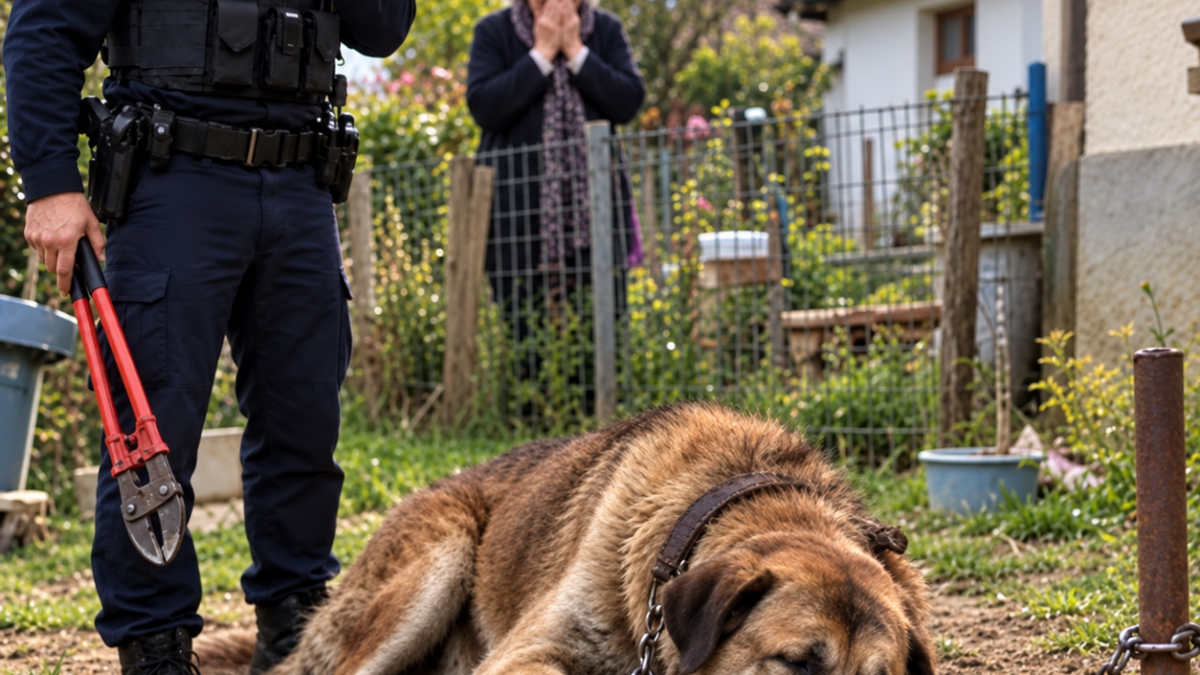
For a few seconds, nobody moved.
Not me.
Not Monique.
Not the second officer who had arrived while I was cutting the chain.
We just stood there staring at him.
The dog’s breathing was slow and uneven.
His body looked strange on the ground, almost as if lying down was something he had forgotten how to do.
His front legs were stretched awkwardly.
His rear legs stayed partly bent.
He tried once to shift his hips, then stopped.
His eyes remained closed.
Monique started crying.
“Oh my God.”
I put down the bolt cutters.
“He’s okay.”
She shook her head.
“No. I mean… he finally…”
“I know.”
He finally lay down.
It sounds like nothing.
Dogs lie down thousands of times in their lives.
On floors.
Couches.
Beds.
Grass.
Mud.
Across doorways when you’re trying to walk through them.
It should be one of the most ordinary things a body does.
For this dog, it had become freedom.
I crouched beside him.
“Hey.”
One ear moved.
That was all.
I touched the side of his neck carefully.
His skin was hot beneath the collar.
Too hot.
When I slid two fingers beneath the thick leather, I felt raw irritation.
The collar had rubbed for so long that the hair underneath had thinned badly.
I did not remove it immediately.
Not until animal welfare arrived and we documented everything.
That part matters.
When you are angry, your first instinct is to fix.
Cut.
Remove.
Throw away.
But if a case may become evidence, you have to think beyond the next five minutes.
Photographs.
Measurements.
Chain length.
Stake height.
Collar condition.
Body condition.
Water.
Shelter.
Ground.
Everything.
A suffering animal cannot explain what happened.
Sometimes the scene has to speak for him.
My partner began photographing the chain.
I measured from the stake to the collar.
Again.
Then again.
I wanted the number correct.
Short.
Far too short.
Monique stood behind us wiping her face.
“Can I bring water?”
“Yes.”
She ran toward her house.
The dog opened his eyes briefly.
He looked at me.
Then closed them again.
I said quietly, “You can sleep.”
My partner heard me.
“He’s out.”
“Wouldn’t you be?”
He looked at the post.
“Months?”
“That’s what the neighbor says.”
He swore under his breath.
I didn’t stop him.
I was thinking worse.
Animal welfare arrived twenty minutes later with a veterinarian technician and a transport vehicle.
The technician’s name was Camille.
She approached slowly, kneeling several feet away.
“Has he tried to stand?”
“No.”
“Any aggression?”
“None.”
“Eating?”
“Unknown.”
“Water?”
“Neighbor’s bringing some.”
Camille looked at the dog.
Then at the chain.
Her expression changed.
“You measured this?”
I handed her the number.
She stared.
“He couldn’t lie down.”
“No.”
“How long?”
“We’re establishing that.”
She looked back at him.
“Jesus.”
Monique returned with a large bowl.
We poured fresh water.
The dog smelled it.
His eyes opened.
He lifted his head.
Then tried to rise.
His front legs pushed.
His rear legs barely responded.
The whole body trembled.
“Don’t,” Camille said softly.
She slid the bowl closer.
“You don’t have to stand.”
For a moment, he seemed confused.
He kept trying.
Maybe he had learned that water required standing.
Maybe everything required standing.
Finally he lowered his head enough to drink while lying down.
That was another small moment I never forgot.
He took several long pulls.
Stopped.
Breathed.
Drank again.
Camille touched his shoulder.
“He’s dehydrated.”
“How bad?”
“We’ll know more at the clinic.”
She examined his gums.
Checked his heart rate.
Ran hands carefully along his spine and legs.
When she touched the swollen rear limb, the dog flinched.
Not snapped.
Flinched.
Camille stopped immediately.
“Pain.”
“Joint?”
“Could be several things. Edema. Chronic standing. Circulatory problems. Infection. Pressure damage.”
She looked at his feet.
The pads were cracked.
Toenails overgrown.
There were sores higher up the limbs where swollen tissue had begun rubbing.
“How old?”
I asked.
Camille checked the teeth.
“Maybe five? Six? Hard to tell in this condition.”
That hurt more than if she had said twelve.
He wasn’t old.
His body looked old because someone had made basic comfort impossible.
Animal welfare staff brought a stretcher.
We tried encouraging him to stand once more.
He pushed up.
Front legs.
Then rear.
One rear paw folded underneath.
His body tipped.
I caught his shoulder.
“Easy.”
He leaned against me.
Heavy despite how thin he looked.
We decided not to make him walk.
Four of us lifted the stretcher around him.
The moment the fabric supported his body, he sagged into it.
No resistance.
No panic.
We carried him toward the transport van.
Halfway there, a man’s voice came from behind the house.
“What the hell are you doing?”
The owner.
I turned.
He was in his forties.
Work clothes.
Angry before he had even reached us.
The dog’s head lifted.
His body tightened.
That reaction told me something the owner’s words never could.
Not proof of abuse.
But information.
The dog knew that voice.
And he did not relax when he heard it.
The man pointed at the stretcher.
“Put my dog down.”
I stepped between him and the animal.
“Sir, we need you to stay back.”
“This is private property.”
“We’re aware.”
“You can’t take him.”
The animal welfare officer approached.
“We’re removing the dog pending veterinary assessment.”
“For what?”
I stared at him.
“For what?”
He looked past me at the broken chain.
“He’s fine.”
That sentence.
Exactly what Monique said he had told her.
He’s fine.
Camille’s face hardened.
The dog was lying on a stretcher because his legs could barely hold him.
His collar had rubbed his neck raw.
His body was thin.
His limbs swollen.
And this man looked at all of that and repeated:
“He’s fine.”
The animal welfare officer said, “He requires immediate veterinary care.”
“He eats.”
“That’s not the issue.”
“He’s a guard dog.”
“Guard dogs are still required to receive appropriate housing, movement, water, medical care and humane restraint.”
The owner looked at me.
“I bought him. He’s mine.”
I felt my jaw tighten.
Ownership is one of those words people sometimes use as if it grants permission instead of responsibility.
A dog is yours.
That means you owe him more.
Not less.
I kept my voice professional.
“We’ll take your statement.”
“I’m not giving a statement.”
“That’s your choice.”
“You cut my chain.”
“Yes.”
“You destroyed my property.”
I looked at the chain on the ground.
Then at the dog.
“That will be documented too.”
He probably expected me to argue.
I didn’t.
Arguments feel satisfying.
Evidence works better.
He continued.
“He sleeps standing sometimes.”
My partner looked at me.
I saw the disbelief in his face.
Camille said, “Dogs do not choose to stand for months because they prefer it.”
The owner snapped, “You don’t know how long he’s been like that.”
Monique spoke from behind the fence.
“I do.”
Everyone turned.
She was pale.
But standing straight.
The owner stared at her.
“You.”
Monique swallowed.
Then said, “Yes. Me.”
“Mind your business.”
She shook her head.
“I tried.”
Her voice trembled.
“I tried minding my business.”
She pointed toward the stretcher.
“And every night I woke up thinking about that dog standing because I knew something was wrong.”
The owner stepped toward her.
I moved immediately.
“Stay where you are.”
He stopped.
Monique continued.
“I watched him morning, noon and night.”
“You spying on me?”
“I watched a dog who couldn’t lie down.”
“You don’t know anything.”
“I know I never saw him on the ground.”
The owner looked at me.
“She’s crazy.”
Monique surprised all of us.
She reached into her pocket.
“No.”
She took out her phone.
“I have pictures.”
The yard went quiet.
I looked at her.
“What pictures?”
“I started taking one every day.”
The owner’s face changed.
Monique’s hands shook as she unlocked the phone.
“Because I thought maybe I was imagining it.”
She held it toward me.
Photograph.
The dog standing beside the post.
Timestamp.
Morning.
Another.
Same dog.
Same position.
Different day.
Another.
Rain.
Dog standing.
Another.
Night.
Dog standing beneath an outdoor light.
Another.
Mud.
Another.
Cold.
Another.
Weeks.
The owner’s voice lowered.
“You photographed my property?”
I ignored him.
“How many?”
Monique swallowed.
“Forty-three.”
Forty-three photographs.
The veterinary record would later matter.
Our measurements mattered.
The physical evidence mattered.
But those photographs built a timeline.
That quiet woman who had spent weeks losing sleep had done the smartest thing she could have done.
She documented.
My partner took her information.
The animal welfare team loaded the dog.
Before the doors closed, I touched his head.
“I’ll check on you.”
His eyes opened.
Then the van carried him away.
I remained to complete the scene investigation and speak with the owner.
He gave us little.
The dog’s name, apparently, was Titan.
He had owned Titan for approximately four years.
Why the short chain?
“He pulls.”
Why permanently attached?
“He gets out.”
Why no proper kennel?
“He destroys things.”
Why no veterinary treatment for swollen legs?
“They swell when it rains.”
That answer made the animal welfare officer look away.
Not because she believed him.
Because she needed a second.
We asked about food and water.
He showed us an overturned plastic container several feet beyond Titan’s reach.
When asked how often the dog was brought inside, he claimed “sometimes.”
Monique said she had never seen it.
The owner insisted she couldn’t see everything.
Fair.
That part remained disputed.
I wrote only what could be supported.
The temptation in cruelty cases is to let outrage fill the blanks.
Don’t.
Facts are powerful enough when the facts are bad.
We left the property with the broken chain secured as evidence.
The metal post remained.
I remember looking at the bare circle before I got into my patrol car.
Perfectly round.
Not from design.
From limitation.
Titan had carved the boundaries of his entire life into the dirt with his feet.
Forward.
Back.
Turn.
Shift.
Again.
Months of movement.
Now the circle was empty.
I drove to the clinic after my shift.
Technically, I didn’t need to.
I told myself I wanted an update for the report.
That was partly true.
Mostly, I wanted to see whether Titan was lying down.
The receptionist led me to the treatment area.
Camille was there.
“How is he?”
She exhaled.
“Complicated.”
My stomach tightened.
“Critical?”
“Not in immediate danger of dying.”
That helped.
“But?”
She showed me the chart.
I am not a veterinarian.
Half the terminology meant nothing to me.
So she translated.
Severe muscle wasting.
Dehydration.
Anemia.
Chronic skin irritation beneath the collar.
Swelling in the rear limbs.
Joint stiffness.
Damage caused or worsened by prolonged standing and lack of normal movement.
Pain.
Fatigue.
Overgrown nails.
Parasites.
Several small untreated wounds.
“He’s exhausted,” she said.
“Can he recover?”
“We think so.”
“Walk normally?”
“Too early to say.”
“Lie down?”
Camille looked at me.
“He’s been lying down since he got here.”
I felt something in my chest release.
“Sleeping?”
“Mostly.”
“Eating?”
“Small amounts.”
“Good?”
“Very.”
She walked me toward his enclosure.
Titan was on a thick orthopedic mattress.
Not standing.
Not alert.
Not guarding.
Sprawled on his side.
One front leg stretched forward.
His back legs supported with cushions.
He looked enormous in the bed.
Bigger than he had in the yard.
Maybe because I was finally seeing his full body instead of a vertical shape around a post.
I crouched outside.
“Hey, Titan.”
His eyes opened.
His tail moved.
Once.
Against the mattress.
I froze.
Camille smiled.
“That’s new.”
“He didn’t wag earlier?”
“Not for me.”
I looked at him.
“You remember me?”
Tail again.
I reached through the bars.
Titan sniffed my fingers.
Then pressed his nose against them.
I stayed for twenty minutes.
Maybe thirty.
When I stood, Titan tried to lift his head.
“You sleep.”
He lowered it.
That night, I dreamed about chains.
Not dramatic nightmares.
Just metal sounds.
A chain pulling tight every time I tried to sit.
I woke at three in the morning with my shoulders aching because I had been sleeping rigidly.
For half a second, I thought:
Months.
I got out of bed.
Walked to the kitchen.
Lay flat on the living-room floor.
My wife found me there.
She stood in the doorway.
“What are you doing?”
“Nothing.”
“You are lying on the floor at three fifteen in the morning.”
“I’m aware.”
“Bad call?”
I looked at the ceiling.
“Yes.”
She came down beside me.
I told her about Titan.
About the chain.
About the way he collapsed when it broke.
She listened.
Then asked, “Are you going back?”
“To the clinic?”
“Yes.”
“I need information for the case.”
She smiled faintly.
“Of course.”
I went the next afternoon.
And the next.
Not every day.
But often.
Titan’s first week of recovery was not dramatic.
That is one thing stories often get wrong.
You cut the chain.
The music swells.
The dog runs into freedom.
No.
Titan slept.
A lot.
His body had been surviving stress so long that once he finally felt safe enough to stop standing, it seemed to demand repayment.
Hours.
He ate.
Drank.
Received treatment.
Went outside briefly with support.
Then slept again.
On the third day, Camille tried helping him stand for a short rehabilitation session.
I happened to be there.
Titan pushed himself up.
His front half rose first.
His rear legs lagged.
A sling supported his hips.
“Easy.”
He stood.
Immediately, his body assumed the same position I had seen in the yard.
Neck slightly raised.
Back legs stiff.
Weight forward.
Camille loosened the sling slightly.
“Take a step.”
Titan didn’t.
She guided him.
One paw moved.
Then another.
When he reached the edge of the room, he stopped.
There was no chain.
Yet he did not go farther.
I looked at Camille.
“Why did he stop?”
“Habit.”
He turned.
Almost exactly as he would have turned around the stake.
One small circle.
Then stopped.
It was as if the chain remained inside him.
Camille crouched.
“Come on.”
Nothing.
She placed a treat a little farther.
Titan sniffed.
One step.
Pause.
Another.
Then he reached it.
We praised him like he had crossed a mountain.
Maybe he had.
Physical freedom is immediate.
Psychological freedom takes longer.
For months, Titan had known exactly how far the world extended.
A few feet.
Now the room had no limit he understood.
At the end of the session, Camille guided him back to the mattress.
Titan stood over it.
Did not lie down.
“Come on,” she said.
He stayed standing.
Five seconds.
Ten.
Thirty.
His legs began trembling.
“He doesn’t know how,” I said.
Camille looked at me.
“I think he’s afraid.”
“Of lying down?”
“Of what happens when he tries.”
That hit harder than expected.
The chain was gone.
His body still expected resistance.
Camille slowly guided his front legs forward.
Supported his chest.
Encouraged his hips down.
Titan stiffened.
Then, suddenly, he folded.
Mattress beneath him.
Nothing pulled.
Nothing tightened.
He looked startled.
Then his head dropped.
I swallowed.
That became part of therapy too.
Not only walking.
Lying down.
Getting up.
Turning freely.
Stretching.
Normal movements had to be relearned.
On the fifth day, he rolled onto his chest by himself.
Day six, he changed sides in his sleep.
Day seven, Camille sent me a short video.
Titan lying on his back.
Four legs in the air.
I laughed in my patrol car.
My partner glanced over.
“What?”
I showed him.
He stared.
“That’s the same dog?”
“Yes.”
“Looks dead.”
“He’s sleeping.”
“Upside down?”
“Apparently.”
My partner smiled.
“Good.”
The legal side moved slower.
Cases do.
Veterinary assessments were collected.
Monique’s photographs were formally copied and verified.
Animal welfare inspectors documented the property.
Statements.
Measurements.
Owner interview.
Records.
We learned Titan had not been taken to a veterinarian in years.
The owner had obtained him as a young dog.
There had been earlier complaints about barking.
Nothing serious enough to trigger removal at the time.
That bothered Monique.
“If someone had come sooner—”
I stopped her.
“You called when you understood.”
“I waited.”
“You tried speaking to him.”
“I should have called immediately.”
“Maybe.”
She looked at me.
That was not the comforting answer she expected.
So I continued.
“But guilt doesn’t help Titan now. Evidence does. You brought evidence.”
She looked toward the empty neighboring yard.
“I still wake up.”
“At night?”
“Yes.”
“Thinking he’s standing?”
She nodded.
I understood.
I sometimes did too.
I gave her the clinic update.
“He sleeps.”
Monique smiled through tears.
“Really?”
“A lot.”
“Good.”
“Very good.”
When Titan had been at the clinic about ten days, staff moved him to a rescue rehabilitation center outside the city.
The place had indoor rooms, fenced grass runs and physical therapy facilities.
I visited on my day off.
Titan recognized my voice before I reached his room.
I heard one deep bark.
First bark I had ever heard from him.
I stopped.
A volunteer smiled.
“That’s for you.”
“For me?”
“He doesn’t bark much.”
Titan stood inside the pen.
Stronger.
Still thin.
Back legs still swollen but better.
Tail wagging.
Not one movement.
Repeated.
Side to side.
I entered.
He came toward me.
Slow.
Awkward.
But he came.
I crouched.
Titan pushed his massive head into my chest.
I almost fell backward.
“Okay.”
He leaned harder.
“Apparently we’re friends now.”
The volunteer laughed.
“He likes men more than we expected.”
I looked at Titan.
That mattered.
Sometimes abused animals fear people who resemble those who hurt or neglected them.
Titan had not generalized his experience that way.
Or perhaps he had been starved for human contact as much as movement.
The volunteer told me something else.
“He loves beds.”
I smiled.
“I’m not surprised.”
“No. I mean loves them.”
She showed me.
Three beds in the room.
One orthopedic mat.
One raised cot.
One giant cushion.
“Why three?”
“We gave him choices.”
“Which does he use?”
“All of them.”
Titan walked from one to another throughout the day.
Lie on cushion.
Get up.
Move to mat.
Stretch.
Later cot.
As if he was making up for lost time.
That became everyone’s favorite thing about him.
Choice.
He wanted options.
The center started sharing progress with us.
Two weeks: walking farther.
Three: swelling reduced.
Four: beginning hydrotherapy.
The first water session did not go well.
Titan hated the pool.
A dog who had survived months chained to a post apparently drew the line at water.
Camille—who came to assist with the transition—stood beside the tank.
“You’re ninety pounds of drama.”
Titan tried backing away.
I was visiting.
“He heard you call him dramatic.”
“He is.”
We started slower.
Shallow water.
Treats.
No forcing.
Within several sessions, Titan tolerated it.
Eventually, he learned the buoyancy let him move his rear legs without carrying full weight.
The first time he took several smooth steps underwater, the rehabilitation team cheered.
Titan looked mostly interested in the treat.
That was fine.
He didn’t need to understand symbolism.
We did enough of that for him.
By the second month, his body had changed.
Muscle returned slowly across his back and shoulders.
The swelling in his hind legs decreased.
His coat improved.
The raw skin under his old collar healed.
A soft harness replaced neck restraint entirely during rehabilitation.
Nobody wanted pressure near that area unless necessary.
One afternoon, Titan was released into a large fenced run.
No leash.
No chain.
Just grass.
I stood with the rehabilitation specialist near the gate.
Titan walked out.
Stopped.
Looked around.
The field was maybe thirty meters across.
For most dogs, ordinary.
For Titan, impossible.
He took three steps.
Stopped.
Looked back.
I said, “Go.”
His ears moved.
Another few steps.
Then he turned in a small circle.
The old circle.
I felt my stomach tighten.
The specialist said quietly, “Give him time.”
Titan sniffed.
Walked farther.
Five meters.
Stopped.
Ten.
Then something changed.
He lifted his head.
A breeze came across the field.
He smelled something.
Started walking toward it.
Not circling.
Straight.
He reached the far side.
Thirty meters from us.
I realized I was holding my breath.
Titan turned.
Then ran.
Not fast.
His back legs were not ready for fast.
But it was a run.
Uneven.
Heavy.
Joyful.
Toward us.
His ears bounced.
Tail high.
He crossed the entire field.
When he reached me, he almost knocked me over.
I grabbed his shoulders.
“Easy!”
He licked my face.
The specialist laughed.
“Looks like he found the edge.”
I looked across the run.
No bare circle.
No stake.
No boundary except a fence far enough away that Titan could choose how to use the space inside.
That night, I sent the video to Monique.
She called immediately.
“He ran?”
“Yes.”
“He really ran?”
“Yes.”
She cried.
I let her.
Then she said, “Can I visit?”
I hadn’t expected the question.
“Of course.”
A week later, Monique met Titan properly for the first time.
She had watched him for months through a fence.
Had called authorities.
Had photographed him.
Had lost sleep over him.
But she had never touched him.
At the rehabilitation center, she stood outside the run looking terrified.
“What if he remembers the neighborhood?”
“Maybe he remembers your voice.”
“I never spoke to him much.”
“Then he’ll meet you now.”
Titan approached.
Monique froze.
He sniffed her hand.
She whispered, “Hello.”
His tail moved.
Then he leaned against her.
Monique bent over him.
Her hands buried in his coat.
“I’m sorry.”
I heard it.
So did the volunteer.
Titan did not care.
He pressed harder.
Monique cried into his neck.
“I should have called sooner.”
I said, “Monique.”
She shook her head.
“No. Let me say it.”
She touched Titan’s face.
“I’m sorry you stood there while I kept wondering whether it was bad enough.”
That sentence stayed with me.
Bad enough.
People wait because uncertainty feels safer than involvement.
Maybe the dog is okay.
Maybe the owner knows better.
Maybe it’s temporary.
Maybe someone else will call.
Monique had waited too.
Then she acted.
Titan survived long enough for that decision to matter.
Not every animal does.
Monique became one of the rescue’s most reliable volunteers after that.
Not because I suggested it.
Because she asked.
“I want to do something.”
She started with laundry.
Blankets.
Towels.
Cleaning.
Then walking smaller dogs.
Titan was still too strong for her physically once he recovered.
But she visited.
Always brought him a soft treat.
Never too many.
He adored her.
The owner’s case finally reached a formal hearing several months later.
I will not pretend it was dramatic like television.
No packed courtroom.
No shouting.
No surprise confession.
Real accountability is often paperwork in plain rooms.
Veterinary evidence.
Photographs.
Measurements.
Witness testimony.
Timeline.
The defense argued the dog had food and water.
That Titan was difficult.
That the chain was necessary because he escaped.
That swelling had developed recently.
The photographs contradicted much of that.
Veterinary assessment did the rest.
The question was not whether Titan was loved.
Law cannot measure love.
The question was whether his basic welfare had been neglected and whether the restraint caused prolonged suffering.
That could be measured.
The ruling removed ownership rights permanently.
Fines followed.
Restrictions on future animal ownership were imposed for a defined period under the applicable process.
The exact consequence mattered.
But not as much as I thought it would.
For months, I had imagined satisfaction.
The owner hearing the decision.
Realizing he lost Titan.
Maybe shame.
Maybe anger.
When it happened, I felt mostly tired.
The owner walked out.
He never asked to see Titan.
That told me enough.
Monique stood beside me outside.
“Is that it?”
“For the case?”
“Yes.”
“Mostly.”
She looked disappointed.
“I thought I’d feel better.”
“So did I.”
“What now?”
I looked at my phone.
There was a photograph from the rehabilitation center.
Titan asleep upside down on two beds at once.
I showed her.
“This.”
She laughed.
That was the real answer.
Legal consequences protect.
They matter.
They establish that cruelty is not private simply because it occurs behind a fence.
But punishment cannot give Titan back the months he stood.
Recovery could give him something else.
Time not standing.
Time choosing.
Time sleeping.
Time running.
We focused on that.
By month four, Titan was medically cleared for adoption discussions.
This became complicated.
Everyone loved him.
Large dog.
Mastiff mix.
Strong.
History of neglect.
Some ongoing arthritis risk.
Needed space.
Needed patient people.
Not someone who wanted a dramatic rescue dog for two weeks.
The rescue received applications.
Some were rejected immediately.
One applicant wanted him as a “property security dog.”
No.
Another planned to keep him mainly outdoors.
No.
Someone said, “He’s used to being outside.”
The adoption coordinator ended that conversation quickly.
Titan had been used to suffering too.
Familiar does not mean appropriate.
Then came a couple named Elise and Marc.
Mid-fifties.
No children at home.
Large fenced property.
They had previously owned two giant-breed rescue dogs.
Both had died of old age.
They did not ask, “Is he protective?”
They asked:
“How are his joints?”
“What flooring helps him?”
“Does he sleep through the night?”
“How does he react to being alone?”
“Does he guard food?”
“What does he do when frightened?”
“Where does he like being touched?”
“What does he hate?”
Good questions.
When they met Titan, they did not rush toward him.
Marc sat on a bench.
Elise stood quietly.
Titan approached.
Sniffed.
Then walked away.
They let him.
Five minutes later, he returned.
Marc held out his hand.
Titan sniffed.
Elise said, “Hello, big man.”
Tail.
The adoption coordinator looked at me.
I knew that look.
Promising.
They visited again.
Then again.
Titan liked Marc.
But he adored Elise.
Within three visits, he began putting his head in her lap.
One afternoon, she sat on the grass.
Titan walked over and, with no warning, tried to sit on her.
All of him.
She disappeared beneath ninety pounds of mastiff.
We laughed.
She said, “Apparently personal space is over.”
Titan licked her face.
That was nearly the decision.
But the rescue still checked everything.
Home visit.
Fence.
Vet references.
Schedule.
Sleeping arrangements.
Transportation.
Backup care.
Elise showed the team the room they had prepared.
Large bed.
Actually, two.
I laughed.
“Good.”
She looked confused.
“Why?”
“He likes choices.”
So they bought a third.
The adoption day came five months after I cut the chain.
I went.
Monique went.
Camille came after her shift.
Several volunteers gathered.
Titan wore a wide padded harness.
No chain.
Never again if unnecessary.
The rescue director handed the paperwork to Marc and Elise.
They signed.
Titan stood near the door.
Restless.
Ready.
I crouched.
“Hey.”
He came over.
Pressed his head against me.
I ran both hands over his face.
“You’re leaving.”
Tail.
“With them.”
Titan looked toward Elise.
Tail faster.
Traitor.
I smiled.
“That’s good.”
Monique knelt carefully.
Titan licked her chin.
She laughed through tears.
“Don’t ever stand that long again.”
I said, “I don’t think he plans to.”
Elise attached the leash to his harness.
They walked toward the exit.
At the doorway, Titan stopped.
Looked back.
My throat tightened.
Then he turned forward.
And left.
Not dragged.
Not removed.
Not carried.
He walked out.
I watched until the car disappeared.
Monique stood beside me.
“Think he’ll be okay?”
“Yes.”
“How do you know?”
“I don’t.”
I smiled.
“But I think he gets beds.”
She laughed.
He did.
The first update arrived that night.
Photograph.
Titan asleep on the living-room couch.
Not one of the three beds.
Of course.
Caption:
“We bought three orthopedic beds. He chose the sofa.”
I laughed so hard my wife came into the room.
“What?”
I showed her.
She smiled.
“That dog has excellent judgment.”
Second update.
Titan discovered the kitchen.
Third.
He did not like the vacuum cleaner.
Fourth.
He spent twenty minutes lying in the sun on the terrace.
Lying.
In the sun.
I stared at that photograph a long time.
He was stretched completely flat.
Front legs forward.
Back legs extended.
Head on the ground.
No tension.
No chain.
Full body touching the earth.
The simple shape of a resting dog.
That image became more important to me than the running video.
Freedom is sometimes measured in distance.
Sometimes in stillness.
Titan finally had both.
A month later, Elise sent another photograph.
Titan on his back.
Again.
She wrote:
“He sleeps like this every night.”
Monique printed it.
Kept it on her refrigerator.
Six months after adoption, Titan returned to the rescue for a checkup.
I arranged to be there.
He looked different.
Not physically dramatic.
His weight was healthy.
Muscle stronger.
But his face.
That was what changed.
He looked awake.
Interested.
Demanding.
He saw me.
Ran.
This time properly.
Back legs working.
Body powerful.
He hit me in the chest.
I stumbled.
“You’re heavier.”
Tail.
“Much heavier.”
He pushed under my arm.
Marc laughed.
“He does that to everyone.”
“You’ve ruined him.”
Elise answered, “Completely.”
Good.
Titan had routines now.
Morning walk.
Breakfast.
Nap.
Garden.
Another nap.
Evening walk.
Couch.
He slept indoors.
Always.
Sometimes by the fireplace.
Sometimes beside the bed.
Sometimes in the doorway where everyone had to step over him.
Apparently freedom included becoming inconvenient.
I approved.
His legs were not perfect.
Never would be.
Chronic strain had consequences.
He had stiffness in cold weather.
Needed supplements.
Occasional medication.
Weight management.
Moderate exercise.
But he was comfortable.
Functional.
Happy.
One day, Marc sent me a video.
Titan walked into the yard.
Stopped.
Looked around.
Then lowered himself.
Slowly.
Deliberately.
He rolled onto his side.
Then onto his back.
Four legs in the air.
Grass underneath.
Stayed there.
Marc’s voice behind the camera said, “Hard day, buddy?”
Titan sneezed.
I watched the video three times.
Then sent it to Monique.
Her response:
HE CAN LIE DOWN ANYWHERE HE WANTS.
Exactly.
That became the sentence I thought of whenever someone asked about the case.
What happened to the owner?
There were consequences.
What happened to Titan?
He can lie down anywhere he wants.
That was better.
The old property changed hands eventually.
The metal stake was removed.
I drove past months later.
Did not intend to stop.
But I did.
The bare circle was still visible in the grass.
Fainter.
New growth coming through.
I stood at the fence.
Monique came outside.
“You see it?”
“Yes.”
“Grass is coming back.”
I nodded.
Green shoots inside the circle.
The earth healing in the simplest possible way.
No ceremony.
No one reseeding it dramatically.
Rain.
Sun.
Time.
Eventually, the boundary Titan had carved into the dirt disappeared.
That mattered to me.
For a while, you could still see exactly where he had been allowed to exist.
Then the yard forgot.
Titan did not.
Not completely.
Elise told us he sometimes froze if a chain rattled unexpectedly.
A bicycle chain.
A gate chain.
Metal dragged over concrete.
His body stiffened.
They never forced him through it.
Calm voice.
Distance.
Time.
He recovered.
Trauma does not vanish simply because circumstances improve.
But it can stop controlling every minute.
They also discovered Titan hated being tethered even briefly.
At the vet, if a leash pulled tight against the harness, he panicked.
So they trained slack-leash walking.
No tying him outside.
No leaving him attached to anything.
Adaptation.
Not because the world owed Titan a life without discomfort.
Because his history gave specific information about how to care well.
People sometimes say rescued dogs should “get over it.”
I hate that phrase.
Bodies remember.
Care learns around memory.
Titan got better.
Not by forgetting.
By accumulating thousands of experiences in which freedom remained real.
Lie down.
Nothing tightens.
Walk farther.
Nothing stops you.
Sleep.
Nobody forces you up.
Food comes.
Water stays.
People leave and return.
A leash guides but does not trap.
A collar is soft.
A hand reaching means affection.
Day after day.
Evidence.
That is how trust returns.
Monique continued volunteering.
Eventually, she became the person new volunteers were told to talk to about documentation.
“Take pictures,” she would say.
“Write dates.”
“If something feels wrong, don’t only complain online. Report it.”
People listened.
She did not become obsessive.
She became useful.
One afternoon, I met her at the rescue.
A young dog had arrived with an embedded collar.
Monique looked shaken.
“I hate this.”
“I know.”
“She’s friendly.”
“Most are.”
“Why?”
I shrugged.
Dogs do not owe us bitterness.
That may be one of the most humbling things about them.
The young dog leaned into Monique’s hand.
Monique closed her eyes.
Later, she said, “Titan changed my life.”
I answered, “Mine too.”
Not in some dramatic way.
I stayed a police officer.
Still handled burglaries and arguments.
Still wrote reports.
Still complained about paperwork.
But I noticed animal calls differently.
A barking complaint might conceal neglect.
A dog “always outside” deserved another question.
A neighbor saying “something feels wrong” deserved listening before dismissal.
Not every concern became abuse.
Most didn’t.
But Titan taught me that quiet cruelty thrives when everyone waits for spectacle.
There was nothing spectacular about him standing.
That was the problem.
Standing looks normal.
Until you realize he cannot stop.
Months later, I gave a short training presentation to younger officers about animal welfare scenes.
I showed no graphic photographs.
I showed one picture.
The bare circle.
Metal stake center.
Nothing else.
I asked, “What do you see?”
One officer said, “Dog run.”
Another said, “Tether point.”
Another, “Worn ground.”
Then I showed the chain length measurement.
Silence.
I explained.
“He could stand.”
Pause.
“He could not lie down.”
You could see their expressions change.
The lesson was not “be emotional.”
The lesson was “observe mechanics.”
Length.
Reach.
Water placement.
Shelter access.
Body condition.
Behavior.
Facts reveal cruelty that emotion alone cannot prove.
Titan became part of how we taught that.
Not his suffering for spectacle.
His case for precision.
Several years passed.
Titan aged.
He stayed with Marc and Elise.
They sent updates less often.
That was good.
A rescued dog’s life should eventually become too ordinary to require reporting.
Birthday.
Vet check.
Christmas sweater.
Mud.
Sleep.
The best rescues become boring.
One winter, I received a photograph of Titan under a blanket beside a wood stove.
Gray appearing around his muzzle.
Message:
“Cold weather makes his hips stiff, but otherwise he’s doing well.”
I wrote back:
“Tell him he’s dramatic.”
Elise replied:
“He says that’s police propaganda.”
Another year.
Titan turned ten, approximately.
Maybe eleven.
No one knew exactly.
He had lived more years free than chained by then.
I liked that milestone.
No official celebration.
I simply calculated.
The bad period no longer occupied the majority of the story.
That matters.
Trauma feels enormous because it concentrates pain.
But time can surround it.
One terrible year.
Then six good ones.
The mathematics of memory changes.
The chain becomes a chapter.
Not the whole book.
When Titan was older, he stopped running long distances.
He still walked.
Still chose couches.
Still loved lying in sunlight.
His favorite position remained completely stretched on one side, legs extended as far as possible.
Elise once joked, “He sleeps like he’s proving a point.”
Maybe he was.
One summer afternoon, they invited Monique and me to their home.
Titan was twelve or so.
Gray.
Slower.
Massive head unchanged.
He came to the gate.
Saw us.
Tail.
Not explosive.
Steady.
I entered.
Titan leaned into me.
Heavy.
Familiar.
“Hey, old man.”
He looked up.
I scratched the healed area where the old collar had once rubbed his neck.
No scar I could clearly see now.
Just fur.
Monique sat in the grass.
Titan went to her.
Then, with great effort, lowered himself across her feet.
Monique started laughing.
“You’re crushing me.”
Titan sighed.
Refused to move.
I said, “He waited months for this privilege.”
She rubbed his side.
“Fine.”
We spent the afternoon talking.
Marc brought coffee.
Elise showed us photographs.
Titan at the sea for the first time.
Titan asleep in a hotel.
Titan stealing bread.
Titan wearing a raincoat.
Titan sitting in snow.
A life.
Ordinary photographs.
That is what I wanted.
Not evidence.
Memory.
There is a difference.
The original photographs Monique took were evidence.
They preserved suffering so someone could act.
These new photographs preserved living.
Titan lying down became such an ordinary sight that nobody thought to celebrate every time anymore.
That may have been the greatest success.
At one point, Titan stood.
Walked several yards into the shade.
Turned three times.
Then lay down.
None of us said anything.
I noticed the silence.
Years earlier, that movement would have made us cry.
Now it was just Titan finding a comfortable spot.
Perfect.
That evening, before leaving, I stood near their gate.
Elise joined me.
“Do you ever think about that first day?”
“Sometimes.”
“What part?”
“The sound of the chain breaking.”
She looked toward Titan.
He was sleeping.
“What did he do?”
I realized she knew the story but had never heard every detail from me.
“He lay down.”
“That’s all?”
“That was everything.”
She nodded slowly.
“I think he still does that.”
“What?”
“Uses sleep like a celebration.”
I laughed.
She was right.
A few months later, Titan’s health began declining.
Age.
Arthritis.
Nothing connected directly enough to the old case to blame responsibly.
Bodies age.
Large dogs especially.
Marc kept me updated.
Mobility support.
Medication.
Good days.
Bad days.
The same vocabulary every loving owner eventually learns.
When Titan stopped managing stairs, they installed a ramp.
When the ramp became difficult, they rearranged life to one level.
Beds everywhere.
Couches available.
Garden access easy.
Choice maintained as long as possible.
That word again.
Choice.
It had defined his recovery.
It defined his aging too.
One evening, Elise called.
Her voice told me before her words.
“We’re close.”
I sat down.
“How bad?”
“He had a rough night.”
“Pain?”
“Yes.”
“Eating?”
“A little.”
“Can he get comfortable?”
Long silence.
“Not really.”
That was the phrase that brought everything back.
Cannot get comfortable.
The entire case had begun because Titan could not lie down.
Now, after years of freedom, his body itself was taking comfort away.
Cruel symmetry.
“What does the vet say?”
“Tomorrow morning.”
I closed my eyes.
“Are you staying home?”
“Yes.”
“Do you want us there?”
Another pause.
“Maybe later.”
Fair.
Titan’s ending belonged to the people who had become his family.
Not the police officer who cut a chain.
Not the neighbor who called.
We were part of his past.
Marc and Elise were his home.
The next morning, I received a message.
Not yet.
Titan had rallied slightly.
Ate chicken.
Went into the garden.
Lay in the sun.
They postponed.
Not denial.
The vet agreed.
One good day.
Then another.
Then the bad days returned.
A week later, the decision came.
This time, Elise asked whether Monique and I wanted to visit the evening before.
We went.
Titan lay on a giant cushion near the patio door.
His breathing was slow.
He lifted his head when he heard us.
Tail.
One movement.
Enough.
I sat beside him.
“Still causing trouble?”
His eyes closed again.
Monique touched his paw.
She did not apologize this time.
Years earlier she had said, I’m sorry I waited.
Now she said:
“Thank you.”
I looked at her.
“For what?”
She kept her eyes on Titan.
“For making me stop waiting.”
That sentence was better.
Titan had changed her.
He had changed me.
He had changed policy at the rescue.
Training at our station.
Maybe other dogs benefited.
Again, not because suffering was necessary.
It wasn’t.
But once something terrible happened, people chose what to do with the knowledge.
We tried to make it useful.
Marc sat near us.
“He likes this spot.”
The patio.
Sunset light.
Soft cushion.
“Can he still get outside?”
“With help.”
We carried him later.
Not because he needed to prove anything.
Because the evening air was warm and he wanted to smell.
Four adults around one old dog.
We placed him on the grass.
Titan stood with support.
Then looked around.
Slowly.
Carefully.
He lowered himself.
No fear.
No hesitation.
Chest to grass.
Hip down.
Head between paws.
That movement.
Again.
The same movement that began his freedom.
This time, natural.
Chosen.
He lay there while the sun dropped.
Monique sat beside him.
I stood a little away.
No speeches.
Eventually, Titan slept.
Deeply.
That was the final image I carried before leaving.
Not the chain.
Not the bare circle.
An old dog asleep on grass because he chose that exact place.
The next morning, Titan died peacefully at home with Marc and Elise beside him.
The veterinarian came to the house.
He was on his favorite bed.
No restraints.
No fear.
Elise’s message afterward was simple:
“He was lying down.”
I stared at those words.
Then I cried.
Eleven years as an officer had taught me how to maintain composure around strangers’ pain.
Titan had always been able to get past it.
He was lying down.
The first day, freedom meant being able to lower his body to the dirt.
The last day, love meant letting him remain at rest.
There was no more fitting ending.
Monique came to my house that evening.
She held something.
An old photograph.
One of the forty-three.
Titan standing by the post.
She looked at it.
“I don’t want this anymore.”
“You should keep your records.”
“The case is long over.”
“Then destroy it.”
She shook her head.
“I thought I would.”
She handed it to me.
“What do you want me to do?”
“I don’t know.”
I looked at the photograph.
Titan upright.
Thin.
Eyes tired.
Chain tight.
Bare dirt.
Evidence.
Then I opened my phone.
Found Elise’s last picture.
Titan stretched on his bed.
Sleeping.
I placed the images side by side.
Monique covered her mouth.
I said, “This one doesn’t get the last word.”
She nodded.
We shredded the old printed photograph.
Not the official evidence.
That remained where legal records belong.
But Monique’s personal copy.
We tore it until the image disappeared.
Then I printed the last one for her.
Titan sleeping.
She put it on her refrigerator.
Exactly where the upside-down sleeping photograph had lived years earlier.
Months later, Marc and Elise donated Titan’s three orthopedic beds to the rescue.
All washed.
Clean.
One enormous.
A new mastiff mix took it immediately.
The rescue sent us a picture.
Young dog asleep across the whole thing.
Monique replied:
“Good.”
I thought about ownership again.
The old owner had once said, I bought him. He’s mine.
Marc and Elise never spoke that way.
They said, “Titan chose the couch.”
“Titan needs the ramp.”
“Titan doesn’t like this.”
“Titan wants outside.”
Real care listens.
Possession commands.
That difference may be the entire story.
If I had to reduce the case to one lesson, it would not be about punishment.
It would be about noticing.
Monique noticed that a dog never lay down.
Such a small observation.
No blood.
No dramatic attack.
No screaming.
Just absence of one normal behavior.
Why doesn’t he lie down?
That question opened everything.
Sometimes cruelty hides inside what is missing.
No bowl.
No shelter.
No movement.
No rest.
No medical care.
No choice.
The job is to see the absence.
Then act.
Years after Titan died, I still drive past that neighborhood occasionally.
Monique still lives there.
The old property has new owners.
Young family.
They have a dog.
Small black mutt.
The first time I saw it, my stomach tightened.
The dog was outside.
No chain.
Running.
Then it flopped onto the grass.
Rolled.
Stayed there.
I laughed alone in the patrol car.
The bare circle is gone.
Completely.
You would never know a metal post stood there.
Never know a dog spent months measuring life in feet.
Grass.
Flowers near the fence.
A child’s plastic ball.
The earth moved on.
That is good.
Places should heal too.
But I remember.
Not because I want to hold onto anger.
Because remembering changes behavior.
If another neighbor calls and says, “I know this sounds strange, but I never see that dog lie down,” I listen.
That is Titan’s legacy to me.
Listen before spectacle.
Measure.
Photograph.
Ask.
Check.
Cruelty does not always announce itself loudly.
Sometimes it stands quietly in a backyard until everyone stops seeing it.
The day Titan died, I went home and lay on my living-room floor again.
Same place as years before.
My wife found me.
She did not ask why this time.
She simply lay beside me.
We stared at the ceiling.
After a while she said, “You know what’s strange?”
“What?”
“He probably spent more of his life lying down than not after you found him.”
I thought.
She was right.
Years.
Couches.
Beds.
Grass.
Carpet.
Sunlight.
Hotel floors.
Beach sand.
Snow.
Patio.
His final bed.
The chain had lasted months.
Freedom lasted years.
That mattered.
Trauma had felt enormous because of its intensity.
But it did not get the majority.
Love did.
Choice did.
Rest did.
Maybe that is the most satisfying revenge against cruelty.
Not making another person suffer.
Making sure cruelty becomes the shorter chapter.
Titan spent months unable to lie down.
Then he spent years choosing exactly where to sleep.
He stole couches.
Ignored expensive beds.
Blocked doorways.
Rolled onto his back.
Took up too much space.
Pressed his enormous body against people he trusted.
Became gloriously inconvenient.
That was victory.
And if I could go back to that March afternoon and speak to the exhausted dog beside the metal post, I would not tell him everything.
I would not tell him about the hearing.
He wouldn’t care.
I would not tell him about fines.
Or ownership restrictions.
Or paperwork.
I would tell him this:
One day, you will have three beds and choose the couch.
One day, someone will complain because you take up too much room.
One day, you will lie in grass so long people will have to wait for you.
One day, you will sleep on your back with your legs in the air.
One day, the sound of someone walking toward you will mean affection instead of another hour of standing.
One day, you will run farther than this entire yard.
And one day, when your body finally grows old, you will leave this world lying down in a home where nobody would ever dream of tying you to anything.
But on that first day, I knew none of that.
I only knew the chain was too short.
So I cut it.
Metal broke.
Titan stood.
Then his front legs folded.
His chest touched the earth.
His hips lowered.
And the huge dog who had spent months forced upright closed his eyes beside my boots.
At the time, I thought I was watching exhaustion.
Now I understand I was watching trust.
He did not run because freedom was not yet about distance.
Freedom was rest.
The right to stop.
The right to put his whole body down.
The right to sleep without pain pulling him back to his feet.
Years later, after every legal document had been filed, every wound healed, every new bed destroyed or ignored, every run completed, every photograph collected, that remained the moment I remembered most.
The first thing Titan did with freedom was not escape.
He rested.
And after everything people had taken from him, rest was the one thing he had been waiting for longest.

