PART 2: For Four Months, This Shelter Dog Wouldn’t Let Go of a Pink Teddy Bear—Then a Mother Saw the Photo and Started Crying
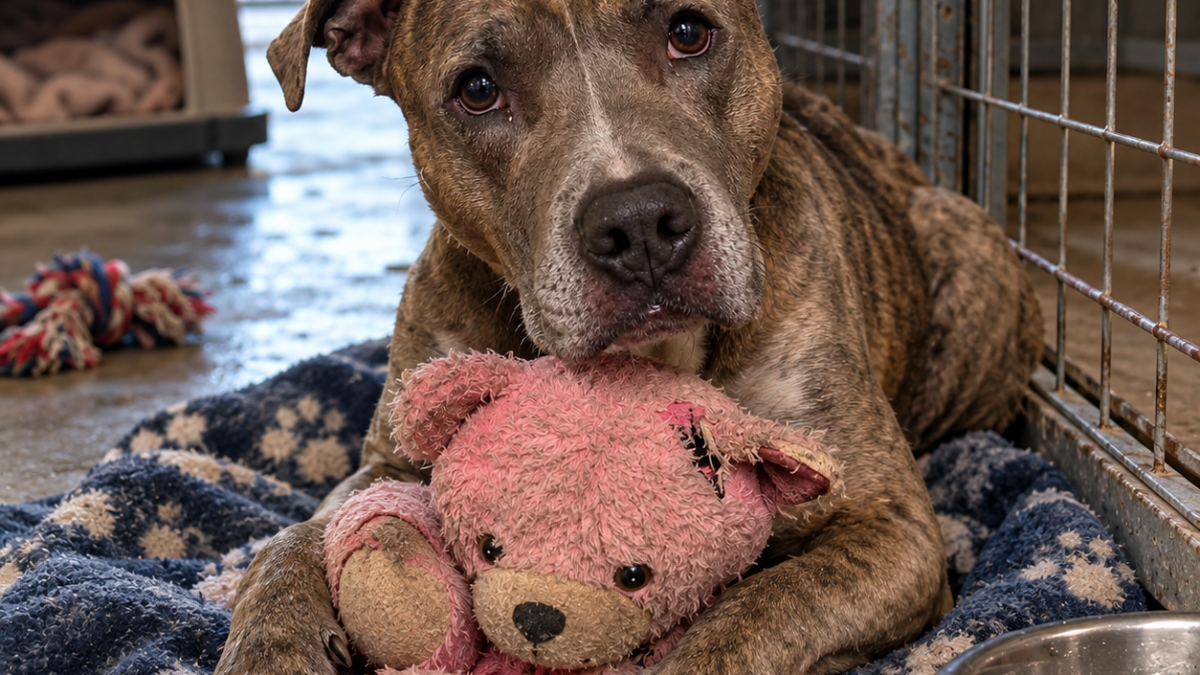
For four months, the pit bull in kennel 18 carried the same battered pink teddy bear everywhere, and no one at our shelter could understand why he protected that worn-out toy more carefully than his own food.
I thought it was simply the last familiar thing he had managed to keep after ending up alone on the street, until one photograph of him traveled across town and reached a mother who went completely silent the moment she saw it.
Three days later, she stood outside our shelter with tears running down her face and said seven words that changed everything: “That bear belonged to my little girl.”
My name is Rachel Morgan, and I work at a county animal shelter in western Pennsylvania. Part of my job involves intake, part involves adoption counseling, and part involves telling the stories of animals that arrive without anyone able to explain where they came from.
That was how I met the dog we eventually named Orion.
We found him on a cold morning in late October.
One of our animal-control officers called shortly after sunrise and told me a large brown-and-white dog had been sitting near the intersection of Westbrook Avenue and Miller Road for nearly an hour.
He wasn’t wandering.
He wasn’t chasing cars.
He wasn’t looking for food.
He was simply sitting beside the curb as though he had chosen that exact place and had no intention of leaving it.
When my coworker Daniel and I arrived, the first thing I noticed was not the dog’s dusty coat or the small scrape on one paw.
It was the toy in his mouth.
A little pink teddy bear.
Faded almost gray in places.
One ear missing.
A crooked line of white stitching across its belly.
Daniel crouched several feet away.
“Hey, buddy.”
The dog looked at him.
No growl.
No barking.
No attempt to run.
He simply tightened his jaw slightly around the bear.
We offered food.
He came closer.
We offered water.
He drank.
He allowed Daniel to slip a leash over his head.
But when Daniel reached toward the teddy bear, the dog immediately stepped back.
Daniel raised both hands.
“All right. You can keep it.”
And he did.
He carried that bear into the van.
Through intake.
During his veterinary examination.
Into kennel 18.
Over the following weeks, we realized the bear was not merely a toy.
When Orion ate, he placed it beside his bowl and picked it up the moment he finished.
When he slept, the bear stayed between his front paws.
When volunteers cleaned his kennel, he moved the bear to the opposite side and stood over it until they finished.
Once, a new volunteer carried it away with his bedding because she assumed it needed washing.
Orion began pacing immediately.
Not barking.
Not acting aggressively.
Just walking back and forth, looking toward the laundry room with a kind of quiet panic that made me return the toy before the wash cycle even started.
Our veterinarian, Dr. Karen Ellis, had worked with shelter animals for more than twenty years.
She watched Orion curl around the bear one afternoon.
“I’ve seen dogs attach themselves to objects,” she said. “Blankets. Toys. Things with familiar smells.”
She paused.
“But this feels different.”
“How?”
Karen studied him.
“He acts like it means somebody.”
That sentence stayed with me.
Because Orion did something else.
Every time the shelter entrance opened, he lifted his head.
Whenever a child laughed in the lobby, he stood.
Whenever a family passed his kennel, his eyes searched behind them.
It felt less like he was waiting for an adopter and more like he believed someone specific was eventually going to walk through our door.
Four months passed.
Nobody claimed him.
No useful microchip.
No missing-dog reports that matched.
No old veterinary record.
Nothing.
So one Tuesday evening, I photographed him.
Orion sat quietly in the back of kennel 18 with the pink teddy bear between his paws.
I posted the picture with one short caption:
This dog was found alone at an intersection four months ago. Since that day, he has never spent a single night without this pink teddy bear. We don’t know his story, but we think someone might.
Then I went home.
By the next morning, hundreds of people had shared it.
By the following evening, thousands.
People guessed everything.
Maybe the bear belonged to an old owner.
Maybe Orion had found it after being abandoned.
Maybe it reminded him of another animal.
None of us knew.
Then, three days after I posted the photograph, the shelter phone rang.
I answered.
A woman whispered:
“Is the dog with the pink bear still there?”
“Yes.”
Silence.
Then I heard her trying not to cry.
“My name is Claire Bennett.”
I grabbed a pen.
“All right, Claire.”
“That teddy bear belonged to my daughter.”
I stopped writing.
“What?”
“She carried it everywhere. It disappeared the same day she was taken to the hospital.”
My stomach tightened.
Claire’s voice became softer.
“There was a dog at the intersection that day.”
Another pause.
“We never found him afterward.”
I looked through the office window toward kennel 18.
Orion was lying with the bear beneath his chin.
Claire inhaled shakily.
“I need to see that dog.”
“When?”
“Today.”
Then she asked one final question.
“Does he still have the bear?”
“Yes.”
Claire started crying.
“Please don’t take it away.”
“We won’t.”
PART 2
I had handled hundreds of strange phone calls during my years at the shelter.
People calling because they believed their neighbor’s cat was secretly theirs.
People claiming a dog recognized them from another state.
People insisting an animal in one of our photographs belonged to a relative who had died twenty years earlier.
Most calls ended with a misunderstanding.
This one felt different.
I stood and walked toward kennel 18.
Orion lifted his head.
“Buddy,” I whispered, “I think somebody finally knows your bear.”
His tail touched the blanket once.
Just once.
I know that means nothing scientifically.
But I remember it.
1. Claire Arrives
Claire reached the shelter fifty-two minutes later.
I know because I checked the clock almost constantly.
She walked through the front door wearing a gray winter coat, dark jeans, and the expression of someone who had spent the entire drive rehearsing what she would say and then forgotten every word.
“Rachel?”
“Yes.”
“I’m Claire.”
I held out my hand.
She didn’t notice.
She was already unlocking her phone.
“I need to show you something.”
The first photograph showed a little girl sitting on a living-room rug.
Curly brown hair.
Yellow pajamas.
Wide smile.
Both arms wrapped around a bright pink teddy bear.
I immediately recognized the missing ear.
Then the white stitches.
Same toy.
Claire swiped to another photograph.
The little girl was asleep in a car seat with the bear under her chin.
Another showed the bear at a birthday party.
Another at a hospital waiting room.
Another at the beach.
“How long did she have it?”
“Since she was two.”
“How old is she now?”
“Eight.”
“What’s her name?”
“Lily.”
Claire’s thumb hovered over the screen.
“My mother bought that bear at a little shop that doesn’t even exist anymore.”
She enlarged a photograph.
“See the stitches?”
“Yes.”
“Our washing machine tore the seam when Lily was four. My mother repaired it with white thread because it was all she had.”
No doubt remained.
The bear in Orion’s kennel was Lily’s.
I motioned toward a small conference room.
“Sit with me.”
Claire sat.
I closed the door.
“Tell me what happened.”
She stared at her phone.
For a moment, she couldn’t.
Then the story began.
2. The Afternoon at Westbrook Avenue
Five months earlier, Claire and Lily had walked to the neighborhood library.
It was a Saturday.
The kind of warm fall afternoon where parents convince themselves winter is still far away.
Lily wore a yellow sweater and carried Teddy beneath one arm.
They checked out four children’s books and walked home along Westbrook Avenue.
At Miller Road, the pedestrian light was red.
Claire remembered holding Lily’s hand.
Then her phone rang.
Her husband, Mark.
She looked down.
Only for a second.
Claire would tell me later that guilt can stretch one second into years.
Across the street, a birthday balloon had become caught beneath a hedge.
Purple.
Lily loved purple.
She stepped forward.
Claire felt her fingers slip away.
Then came the sound.
Tires against pavement.
Claire looked up.
A dark sedan was approaching far too quickly.
“Lily!”
She reached forward.
Too far away.
Then a dog moved.
A large brown-and-white dog burst from beside the bus shelter.
He ran straight toward Lily.
Claire remembered seeing his shoulder make contact with her daughter.
Not violently.
Enough to knock Lily sideways onto the grass beside the sidewalk.
The sedan swerved.
It struck the base of a road sign.
Then continued.
Claire ran.
“Lily!”
Her daughter was crying.
Frightened.
Scraped from falling.
But conscious.
The dog stood between Lily and the street.
Body rigid.
Watching the disappearing car.
Then Lily reached toward him.
“Mommy, the dog.”
Claire put both arms around her daughter.
People rushed from nearby stores.
Someone called emergency services.
A man grabbed a first-aid kit from his truck.
In the confusion, Lily’s teddy bear lay several feet away.
The dog walked over.
Picked it up.
Held it.
Claire remembered that detail because Lily pointed at him.
“Teddy.”
Then paramedics arrived.
Because Lily had fallen and was shaken badly, they recommended evaluation at the hospital.
Claire climbed into the ambulance.
She assumed the dog belonged to someone nearby.
By the time Mark returned to the intersection later that evening, the dog was gone.
So was the bear.
3. The Search
The next morning, they searched.
Mark drove through the neighborhood.
Claire posted in local groups.
They called animal control.
Asked at the veterinary clinics.
Visited nearby streets.
Lily had only two questions.
“Where’s the dog?”
And:
“Does he still have Teddy?”
Claire could answer neither.
For weeks, Lily drew pictures of him.
A brown-and-white dog with an enormous pink bear.
Sometimes she drew him beside their house.
Sometimes beside her bed.
One picture had words written in uneven second-grade handwriting:
THANK YOU DOG. COME HOME.
Claire showed me the photograph.
I stared at it for a long time.
Then I asked the obvious question.
“When exactly did this happen?”
She gave me the date.
I opened Orion’s intake record.
He had been found twenty-seven days later.
Same intersection.
Same toy.
Neither of us spoke.
Claire understood first.
“He went back.”
“We can’t know exactly where he was during those weeks.”
“But you found him there.”
“Yes.”
“With Teddy.”
“Yes.”
She pressed her hand over her mouth.
“He waited.”
I didn’t answer.
Because perhaps he had.
4. The Reunion with Claire
Before taking Claire into the kennel area, I called Karen and Daniel.
I wanted another staff member present in case Orion reacted unexpectedly.
Claire stood behind the observation window.
Orion was sleeping.
The teddy bear rested beneath one paw.
Claire started crying instantly.
“That’s him.”
“You’re sure?”
“Yes.”
No hesitation.
“I remember his face.”
Orion’s ear moved.
Claire whispered:
“Buddy?”
He woke.
His head rose.
Then he saw her.
His posture changed so quickly that even Karen inhaled.
Orion stood.
The bear rolled away from his paws.
That was the first thing that struck me.
Four months of guarding it.
Four months of keeping it within inches.
And he left it where it fell.
He walked toward the kennel door.
His tail began moving.
Claire crouched.
“Hi.”
Orion made a soft sound deep in his throat.
Not a growl.
A whine.
Claire’s shoulders began shaking.
I opened the kennel carefully.
Orion stepped out.
He did not look at me.
Did not look at Daniel.
He walked directly to Claire.
Then pressed the top of his head against her chest.
Claire wrapped both arms around him.
“Oh my God.”
Orion leaned harder.
She buried her face against his neck.
“Where have you been?”
The dog had no answer.
But he stayed.
5. We Call Lily
Claire wanted Lily there immediately.
Karen advised against rushing.
“Let’s make sure Orion is calm after this reunion.”
“He is.”
“I know. But Lily is a child. Excitement can change everything.”
Claire nodded.
She understood.
Instead, she called home.
Mark answered.
Claire put the phone on speaker.
“Is Lily there?”
“Why?”
“Just get her.”
I could hear movement.
Then:
“Mom?”
“Hi, baby.”
“Where are you?”
Claire looked at Orion.
“I found somebody.”
Silence.
“Who?”
Claire started crying again.
“The dog.”
I heard Lily gasp.
“The dog dog?”
“Yes.”
“The one from the street?”
“Yes.”
“Does he have Teddy?”
Claire looked at the kennel.
The bear was still where Orion had left it.
“Yes.”
There was a strange little sound from the phone.
Half cry.
Half laugh.
“Mom, bring him home.”
Claire closed her eyes.
“We have to do things the right way.”
“No.”
Everybody in the room smiled.
“Lily.”
“No. Bring him.”
6. Lily Walks In
The next afternoon, Claire returned with Mark and Lily.
Lily stopped just inside the lobby.
I recognized her immediately from the photographs.
Same curls.
Same enormous brown eyes.
She clutched Claire’s hand.
“Where is he?”
“We’re going slowly,” Claire reminded her.
“I know.”
“Let him come to you.”
“I know.”
“You cannot run at him.”
“I know, Mom.”
The frustration in her voice sounded wonderfully normal.
We brought Orion into our quiet visitation room.
The teddy bear lay beside him.
Lily entered.
Orion stood.
The room fell completely silent.
For several seconds, neither moved.
Then Lily whispered:
“Buddy?”
Orion’s tail began moving.
Fast.
His entire rear end followed.
He took one step.
Then another.
Lily crouched.
Orion crossed the room.
He pressed his face against her shoulder.
She wrapped her arms around him.
And then the sound came.
A child crying with relief.
Not fear.
Not pain.
Relief.
“I knew you were real,” she whispered.
Orion licked her cheek.
Lily laughed through tears.
Then she saw the bear.
“Teddy!”
She reached.
Every adult in the room watched Orion.
He had guarded that toy from everyone else.
Lily’s fingers touched it.
Orion opened his mouth.
Released it.
Immediately.
She hugged the bear against her chest.
Then looked at Orion.
“You kept him.”
Claire had to turn away.
So did Daniel.
7. What Lily Remembered
Lily remembered the incident differently than Claire.
Children often do.
She remembered the purple balloon.
She remembered her mother yelling.
Then:
“Buddy hit me.”
Claire laughed through tears.
“He moved you.”
“He bonked me.”
“All right.”
“And then he stood over me.”
“What do you mean?” I asked.
Lily demonstrated using her hands.
“He stood like this.”
She described Orion positioning himself between her and the street while she was on the ground.
Claire nodded slowly.
“I remember that.”
“You never told me.”
“I didn’t think about it.”
The chaos had blurred details.
Lily remembered another thing.
“He licked my ear.”
Claire smiled.
“You were crying.”
“He made it wet.”
Orion had no defense against the accusation.
8. Why Was He There?
The question became: where had Orion come from before that day?
No microchip.
No tags.
No reports.
But now that we had a clearer timeline, we started asking businesses around Westbrook Avenue.
A convenience-store manager remembered him.
“Brown-and-white pit bull?”
“Yes.”
“He was around here after that thing with the kid.”
“For how long?”
“Couple weeks at least.”
“You fed him?”
“Somebody did. Deli lady, maybe.”
We found the deli employee.
Her name was Norma.
She remembered Orion well.
“He sat near the bus shelter every afternoon.”
“With the bear?”
“Always.”
“Did he leave?”
“Sure. Dogs wander.”
“But he came back?”
“Every day.”
Norma had placed water behind the deli.
Sometimes food.
Orion took it.
Then returned to the intersection.
Another man remembered seeing him sleeping beneath the bus shelter during rain.
A school-bus driver saw him at 7:00 each morning for almost two weeks.
Always near the same place.
Always with the toy.
It seemed impossible not to interpret.
He was waiting.
9. Adoption Is Not Automatic
Everyone assumed the Bennett family would take Orion home immediately.
Emotionally, yes.
Legally and responsibly, we still had work to do.
Orion had no known vaccination history.
No established home behavior.
We didn’t know his reaction to children running, food handling, loud noises, strangers entering the home, or other animals.
Claire looked offended when I explained this.
“He saved her.”
“I know.”
“He loves her.”
“I know.”
“So why—”
“Because loving Lily does not automatically tell us how he will handle every situation.”
Mark put a hand on Claire’s shoulder.
“She’s right.”
Claire exhaled.
“I hate when people are right while I’m emotional.”
I smiled.
“We’ll move quickly. But carefully.”
The Bennetts visited daily.
Lily read books beside Orion.
Mark practiced leash walking.
Claire learned how Orion responded to feeding.
Orion passed every assessment better than expected.
Gentle with food.
Calm with visitors.
No reaction when toys were handled—except the pink bear, unless Lily touched it.
That detail still fascinated Karen.
10. The Name Debate
“His name is Hero,” Lily announced.
Claire immediately objected.
“We are not calling him Hero.”
“Why?”
“Because that sounds like a movie dog.”
“He is a hero.”
Mark suggested Scout.
Lily refused.
Daniel suggested keeping Orion.
“What does Orion mean?” Lily asked.
“A constellation.”
“That’s dumb.”
Daniel looked personally injured.
Eventually, the paperwork stayed Orion.
Lily called him Buddy.
Mark sometimes called him O.
Claire eventually called him Honey when she thought nobody heard.
Dogs survive multiple identities better than humans.
11. The Driver
Then the story shifted.
During Claire’s original description, one detail bothered me.
The car never stopped properly.
“Did police identify the driver?”
Mark’s expression changed.
“The car, yes.”
“Driver?”
“No.”
The vehicle belonged to a local man named Travis Cole.
Two days after the incident, police located it behind an industrial building.
Travis claimed someone had used it without permission.
There were no useful witnesses.
Claire had seen the car but not the driver clearly.
The investigation stalled.
“He nearly changed our daughter’s life forever,” Mark said, “and then just disappeared behind a story.”
Claire placed a hand on his arm.
“We said we weren’t doing this today.”
“I know.”
But now Orion’s story was drawing public attention.
And attention has a strange way of shaking loose memories.
12. The Second Post
With Claire’s permission, we shared a follow-up.
Carefully.
We did not identify anyone connected with the traffic investigation.
We simply posted the reunion.
Orion.
Lily.
The pink bear.
The factual account that the dog had helped move Lily away from an approaching vehicle and had been found weeks later near the same intersection.
The post spread farther than the original.
Hundreds of thousands of views across reposts.
Local news called.
Claire initially said no.
Lily said yes.
Claire said absolutely not.
Lily said:
“But people should know Buddy.”
Eventually Claire agreed to one short local interview without discussing the driver.
That interview changed everything.
13. Eric Remembers the Car
A man named Eric Palmer worked at an auto-body shop ten miles away.
He saw the television clip.
Then called police.
Five months earlier, Travis Cole had brought in a dark sedan with damage along the passenger side and front quarter panel.
That alone meant little.
But Eric remembered the timing.
He also remembered Travis refusing to provide insurance information.
Cash job.
Quick.
No paperwork.
Eric refused.
Then there was the passenger.
A young woman.
Blonde.
Upset.
Eric remembered her saying:
“You should have stopped.”
Travis told her:
“Drop it.”
Eric had not connected the conversation to Lily’s incident at the time.
Now he did.
14. Melissa
The passenger was Melissa Grant.
Travis’s girlfriend at the time.
Police contacted her.
She refused to speak.
Then hired an attorney.
That usually sounds suspicious in stories.
In real life, hiring an attorney is simply a legal right.
The investigation paused again.
Claire became frustrated.
“They finally find someone and she says nothing?”
“She may be scared.”
“Lily was scared.”
“I know.”
Claire looked toward Orion sleeping beside the sofa in the shelter visiting room.
“I spent months thinking I did something wrong because I looked at my phone.”
“That’s different.”
“Fear makes people quiet too long.”
That observation became important.
15. Claire Writes a Letter
Claire asked the detective whether she could contact Melissa.
He advised against direct pressure.
So Claire wrote a letter and gave it to investigators to forward if appropriate.
One paragraph.
No threats.
No accusations.
My daughter is alive and doing well. I am not asking you to protect anyone or punish anyone. I only want to know what happened that afternoon so I can stop replaying it in my head. If you know something, please tell the truth.
Two days later, Melissa agreed to an interview.
16. The Truth About the Car
Melissa had been in the passenger seat.
Travis drove.
They were arguing.
Not about Lily.
Not about anything important in hindsight.
A relationship argument.
Travis was driving too fast.
Melissa saw Lily step toward the road.
She shouted.
Travis reacted late.
Orion moved first.
The car swerved.
After they passed the intersection, Melissa screamed at Travis to stop.
He continued.
Several blocks later, they pulled behind a warehouse.
Melissa wanted to call police.
Travis insisted nobody had been hit.
He told her stopping would only “make everything worse.”
The following day, he reported the vehicle used without permission.
Melissa stayed silent because she believed Lily had only suffered a minor fall.
One day became a week.
A week became a month.
The longer she waited, the harder the truth felt.
Then she saw Orion.
The teddy bear.
Lily hugging him.
And silence became unbearable.
17. Claire Doesn’t Celebrate
When the detective told Claire, she did not smile.
She cried.
“I knew somebody saw her.”
Mark asked:
“Is Travis being arrested?”
The detective said the evidence had to be reviewed.
That frustrated Mark.
Claire surprised me.
“No.”
Everyone looked at her.
“I mean—I want accountability.”
She wiped her eyes.
“But I don’t want us turning into people who enjoy watching somebody’s life fall apart.”
She looked at Orion.
“He protected Lily. I don’t want his story becoming about hate.”
That decision shaped everything that followed.
18. Orion Goes Home
Meanwhile, Orion’s adoption was approved.
The day he left the shelter, kennel 18 looked strangely empty.
Lily arrived wearing a purple hoodie.
She carried the pink bear.
Orion wore a new blue harness.
We took the official adoption photograph.
Claire signed.
Mark signed.
Lily insisted on signing too.
Beneath her parents’ names, she wrote:
LILY BENNETT — SISTER
Then she drew a heart.
When they opened the car door, Orion hesitated.
Cars still made him nervous.
Mark waited.
No pulling.
No forcing.
Eventually Orion climbed into the back seat.
Lily sat beside him.
She placed Teddy between them.
The car drove away.
I stood in the parking lot until it disappeared.
19. Orion’s First Night
Claire sent a message at 2:11 a.m.
I assumed something was wrong.
Instead:
He refuses the $170 dog bed.
Attached was a photograph.
Orion asleep outside Lily’s bedroom door.
Pink bear under his chin.
I replied:
Congratulations. You own a dog.
The next morning Claire found Lily asleep on the hallway floor beside him.
Apparently she had opened the door at midnight, seen him there, and decided he looked lonely.
Claire moved a blanket over both.
That became the first of many household rules Orion quietly destroyed.
20. Traffic
The first significant problem emerged during walks.
Orion froze whenever vehicles approached too closely.
His body lowered.
Tail tucked.
He sometimes tried moving onto grass even when the sidewalk was safe.
Claire’s first instinct was comfort.
Their trainer, Caroline Hayes, explained that reassurance could help but forcing exposure would not.
“Distance first.”
They walked quiet streets.
Rewarded calm behavior.
Watched cars from far away.
No busy intersections.
No Westbrook Avenue.
For weeks, progress was measured in feet.
Then blocks.
Healing is boring that way.
No montage.
No miracle.
Just repetition.
21. Lily’s Nightmares
Lily still woke from nightmares.
Claire hadn’t mentioned that during the adoption process because she didn’t think it involved Orion.
It did.
The first night Lily woke crying after he came home, Claire reached the room and found Orion already beside the bed.
He had pushed the door open.
He sat near Lily.
No barking.
No pacing.
Just presence.
Lily reached down.
“I’m okay, Buddy.”
Claire stood in the doorway and watched.
After that, Orion’s bed moved inside Lily’s room.
The expensive bed finally found a purpose.
Mostly.
He still preferred the rug.
22. Teddy Goes to Grandma
The bear was deteriorating.
Claire’s mother, Ellen, was horrified.
“This stitching is barely holding.”
“You did the stitching.”
“Six years ago.”
She repaired Teddy again.
No new ear.
Lily refused.
“He’s supposed to have one ear.”
Ellen reinforced the belly.
Added fresh stuffing.
Washed only parts carefully.
When she returned the bear, Orion smelled it for almost a minute.
Then took it.
Walked to Lily.
Placed it beside her.
For the first time since we found him, he left the room without it.
Claire called me.
“He gave it back.”
“Maybe he knows he doesn’t have to guard it anymore.”
We both understood that was interpretation.
We allowed ourselves one.
23. The Evidence Against Travis
Melissa’s statement gave police direction.
They reviewed old phone records through proper legal channels.
Messages between Melissa and Travis remained backed up.
One sent shortly after the incident read:
I didn’t see the kid. The dog came out of nowhere.
Another:
Don’t tell anyone I was driving.
Another:
Nobody got hurt so leave it alone.
Those words mattered.
Not because they proved intention to harm Lily.
They didn’t.
They proved awareness afterward.
The legal case strengthened.
24. The Public Gets Angry
When news of the reopened investigation became public, social media turned ugly.
People posted Travis’s workplace.
Photographs.
Family information.
Threatening comments.
Claire called me furious.
“This is not what I wanted.”
The shelter posted a statement:
Please do not contact, threaten, harass, or target anyone connected with this case. Orion’s story is about protection, truth, and responsibility. Let the appropriate authorities handle the legal process.
Some people listened.
Others didn’t.
The internet is not famous for restraint.
Claire refused additional interviews for several months.
“I’m not turning Lily into entertainment.”
Good.
25. Orion’s New Routine
Life at the Bennett house became ordinary.
That mattered more than the investigation.
6:30 a.m. — Orion waited outside the kitchen.
6:35 — breakfast.
7:15 — Lily left for school.
7:16 — Orion watched from the front window.
3:42 — school bus arrived.
3:43 — Orion lost his mind with happiness.
Claire sent videos.
Tail.
Spinning.
Whining.
Then Lily through the door.
Orion pressing against her.
Every day.
Same reunion.
As if she had been gone for four months instead of seven hours.
26. The Pink Bear on the Shelf
Eventually Lily placed Teddy on her bedroom shelf.
Orion watched.
Did nothing.
For months, that would have been impossible.
He no longer needed to sleep with it.
Sometimes he smelled it.
Sometimes Lily brought it down.
But he did not panic if it disappeared from view.
Karen smiled when I told her.
“The object stopped being his security.”
“What replaced it?”
She looked at me like the answer was obvious.
“People.”
27. The Court Process Begins
Travis faced charges related to leaving the scene, false statements, and driving-related offenses supported by the evidence.
His attorney emphasized that Lily had not been struck directly by the vehicle.
True.
The prosecutor emphasized that Orion’s intervention did not erase the driving or the decision to leave.
Also true.
Claire hated the slow process.
Court dates moved.
Hearings delayed.
Lawyers argued over wording.
Nothing looked like television.
Justice often resembles calendars more than dramatic speeches.
28. Lily Does Not Testify
The prosecutor told Claire Lily’s testimony might help clarify parts of the event.
Claire asked whether it was necessary.
“Probably not.”
Then no.
Some people criticized that choice online.
Claire ignored them.
Her daughter had already lived the event.
She did not owe strangers a performance of trauma.
Melissa could testify.
Claire could testify.
Records existed.
Lily stayed in school.
That was the right decision.
29. The Intersection Again
Almost a year after Orion came home, road construction forced Claire onto Westbrook Avenue.
She realized too late.
Orion was in the back seat with Lily.
As the intersection appeared, his head rose.
Claire saw him in the mirror.
His body stiffened.
“Mark.”
“I see him.”
Lily placed a hand on Orion’s shoulder.
The car slowed.
Nobody spoke.
They passed the bus shelter.
Orion watched through the window.
Then sat.
Lily whispered:
“You don’t have to wait there anymore.”
Claire pulled into a parking lot two blocks later because she was crying too hard to drive safely.
30. Therapy Dog
Caroline, Orion’s trainer, noticed his unusual calm around children.
One afternoon after a training session, a nervous six-year-old boy asked to pet him.
Orion sat.
Waited.
The boy touched his back.
Then hugged him.
Orion remained perfectly still.
Caroline looked at Claire.
“Have you considered therapy work?”
Claire laughed.
“Our dog is afraid of traffic.”
“That doesn’t disqualify him.”
“Isn’t therapy work stressful?”
“It can be. That’s why we see if he enjoys it.”
They trained slowly.
No pressure.
Orion learned calm greetings.
Elevator noises.
Medical equipment.
Wheelchairs.
Unusual movement.
He surprised everyone.
He passed his evaluation.
Lily insisted the pink bear come to the first visit.
It stayed clipped to a bag.
31. The First Hospital Visit
The pediatric rehabilitation center welcomed Orion.
He wore a blue therapy vest.
Lily accompanied Claire.
A boy named Noah sat near the window and refused to participate in physical therapy that morning.
Orion entered.
Noah looked up.
“Is that the bear dog?”
Claire blinked.
Apparently staff had told him.
“Yes.”
Noah pointed at Teddy.
“Why does he have that?”
Lily answered:
“He was waiting for somebody.”
Noah looked at Orion.
“Did they come back?”
Lily smiled.
“Yes.”
Noah touched Orion’s head.
Later, he completed part of his session with Orion nearby.
Claire cried in the parking garage.
Orion slept in the back seat.
Heroic work is exhausting.
32. Travis’s Plea
Months later, Travis chose a plea rather than continue toward a fully contested trial.
He accepted responsibility for several charges.
There were driving-license consequences.
Financial penalties.
Probationary requirements.
Restitution associated with recognized costs.
Community obligations.
Mark expected to feel satisfied.
He didn’t.
“I thought I’d feel more.”
Claire understood.
“What would ‘more’ look like?”
“I don’t know.”
“Lily is upstairs doing math homework with the dog asleep on her foot.”
Mark looked toward the ceiling.
Claire continued:
“That’s more.”
33. The Apology Letter
Travis wrote a letter.
Claire received it through legal channels.
She left it unopened for three weeks.
Then one night, she read it.
Later, she told me only one part.
“He said he convinced himself that because Lily was okay, leaving didn’t matter.”
That reasoning bothered me.
Outcome replacing responsibility.
Orion’s presence had saved Travis from a far worse outcome too.
That did not make his choices safe.
Claire kept the letter.
Not because she forgave him.
Because she wanted Lily to decide someday whether she cared to read it.
34. Ranger
Years might have passed with Orion’s earlier life remaining a mystery.
Then Samuel Price saw a local feature about Orion’s therapy work.
He called our shelter.
“I think that dog belonged to my brother.”
We had heard versions of that claim before.
I asked for photographs.
Samuel sent six.
There was no doubt.
Same facial markings.
Same small scar above the left eye.
Same white patch on the chest shaped like a comma.
The dog’s original name had been Ranger.
Samuel’s brother Henry had been a retired firefighter.
Henry adopted Ranger as a young dog.
They were inseparable.
Then Henry developed cancer.
Samuel lived two hours away and visited when he could.
After Henry died, a relative agreed to keep Ranger temporarily.
Several weeks later, Ranger disappeared through a gate.
At least that was the story.
They searched.
Posted flyers.
No result.
Months later, Ranger appeared at Westbrook Avenue.
35. Henry’s Dog
Samuel visited the Bennetts.
Orion—Ranger—met him at the door.
Samuel knelt.
“Ranger?”
The dog froze.
Tail moved.
Samuel’s face collapsed.
“Hey, boy.”
Orion walked forward.
Smelled him.
Then leaned against him.
Samuel cried into the dog’s neck.
Lily stood nearby holding Teddy.
“Was Ranger his name?”
“Yes.”
“Is Orion wrong?”
Samuel laughed.
“No.”
“Buddy?”
“No.”
“So he has three names.”
“Looks that way.”
She considered this.
“Four if you count Bear Dog.”
Claire groaned.
36. Henry’s Firehouse Patch
Samuel brought a photograph of Henry sitting on his porch with Ranger beside him.
Lily stared at it.
“He was a firefighter?”
“Thirty-one years.”
“Did Ranger go to the station?”
“Sometimes.”
Samuel handed her Henry’s old firehouse patch.
“Keep it.”
Lily’s eyes widened.
“I can’t.”
“I want you to.”
She placed it beside the pink bear on her bedroom shelf.
A piece of Henry.
A piece of Lily.
Both tied to the same dog.
37. Why Orion Might Have Acted
People asked whether Ranger’s life with a firefighter explained his behavior at the intersection.
Maybe he had been exposed to emergency scenes.
Maybe Henry trained him informally.
Samuel shook his head.
“He was never a working dog.”
Did Henry teach him to react around danger?
“Not intentionally.”
So we avoided turning coincidence into fact.
Maybe Orion moved because Lily’s motion triggered him.
Maybe he sensed danger.
Maybe he simply reacted faster than the adults.
We never knew.
The truth was extraordinary enough.
38. Claire’s Guilt
Claire continued blaming herself.
Even years later.
“If I hadn’t looked at my phone.”
I heard the sentence many times.
One afternoon, I finally asked:
“How many times have you crossed streets with Lily?”
“Thousands.”
“How many times have you looked away for one second?”
She stared.
“I don’t know.”
“Exactly.”
Parents are not machines.
A single lapse can matter.
That does not mean Claire intentionally placed Lily in danger.
Therapy eventually helped her separate responsibility from endless self-punishment.
Orion helped too.
Not because dogs erase guilt.
Because life with him kept moving forward.
39. Lily’s School Essay
In fourth grade, Lily wrote an essay titled:
Someone Brave
It was about Orion.
Claire sent me a photograph.
Most of it was childlike.
Misspellings.
Big emotions.
Then the final line:
Brave doesn’t mean you aren’t scared. It means you move when someone needs you more than you need to hide.
I printed it.
It hung near my shelter desk for years.
40. Orion Changes Other Dogs’ Lives
The viral story brought visitors to our shelter.
Some came wanting Orion.
Too late.
He was adopted.
So we introduced them to other dogs.
A twelve-year-old hound named Benny went home after 214 days.
A shy shepherd mix named June finally found a family.
A black pit bull named Marcus, who had been overlooked for months, was adopted by a retired couple who originally came “just to see where the bear dog stayed.”
Over the next year, eleven long-term shelter dogs found homes after their adopters first discovered us through Orion.
Orion never knew.
Dogs rarely know the size of their influence.
41. The Bear Retires
Teddy eventually stopped traveling everywhere.
It stayed on Lily’s shelf.
Then, when Lily was eleven, she moved it into a small glass-front display case with Henry’s firehouse patch and Orion’s therapy certificate.
Claire laughed.
“You made a museum?”
“It’s history.”
Orion lay on the rug below.
Lily looked down.
“You’re history too.”
His tail moved.
“Still alive history.”
42. Melissa Visits
Years after the legal case ended, Melissa asked Claire if she could apologize in person.
Claire considered it.
Then agreed to meet at a coffee shop.
Melissa cried.
She explained fear.
Shame.
How each day of silence made the next day harder.
Claire did not say:
“It’s okay.”
Because it wasn’t.
She said:
“Thank you for finally telling the truth.”
Melissa nodded.
Sometimes closure is not forgiveness.
Sometimes it is simply ending the lie.
43. Travis Writes to Lily
When Lily was twelve, Travis asked permission to send her a short letter.
Claire spoke with Lily’s therapist.
Then with Lily.
Lily wanted to read it.
Travis wrote:
I am sorry I drove too fast. I am sorry I did not stop. I am sorry I lied. I know a dog did what I should have done—he stayed.
He did not ask forgiveness.
That mattered.
Lily read the letter twice.
Then put it in a drawer.
Claire asked:
“Do you want to answer?”
“No.”
“Are you angry?”
Lily thought for a long moment.
“Not today.”
That was enough.
44. Orion’s Therapy Career
For five years, Orion worked as a therapy dog.
Not constantly.
A few visits each month.
He sat with children learning to read.
Visited patients during rehabilitation.
Helped calm frightened kids before difficult appointments.
One boy refused to speak to adults after a traumatic event but whispered entire conversations to Orion.
We never claimed Orion cured anyone.
Therapy animals do not replace professionals.
But presence matters.
A dog does not ask you to explain yourself correctly.
Orion simply stayed.
That became his specialty.
45. Retirement
Age arrived slowly.
Gray around the muzzle.
Then more.
Orion began standing carefully after long naps.
His hips became stiff.
Karen recommended fewer therapy visits.
Lily objected.
“He likes them.”
“He does.”
“But?”
“He gets tired.”
Lily looked at Orion.
He was asleep under a chair.
“All right.”
His final official therapy visit happened at the same pediatric center where he had started.
Staff made a certificate.
Orion cared primarily about the chicken treats.
Appropriate priorities.
46. His Final Workday
A little girl asked Lily:
“Why is he leaving?”
“He’s old.”
“Will he be okay?”
“Yes.”
“What will he do?”
Lily smiled.
“Sleep. Eat. Boss us around.”
The child hugged him.
“Good job, Orion.”
His tail moved.
Retirement began.
47. The Ramp
Mark built a wooden ramp from the porch to the yard.
Orion refused to use it.
For three days, he stubbornly attempted the stairs.
Then one morning, he used the ramp.
From that point onward, he acted as though the stairs had never existed.
Lily painted a sign:
ORION EXPRESSWAY
Claire claimed it ruined the porch aesthetic.
Mark installed it anyway.
48. Teddy Returns to the Floor
One afternoon, Teddy fell from Lily’s shelf.
Orion woke.
Walked over.
Smelled it.
Then picked it up.
The Bennetts froze.
Years had passed since he regularly carried it.
Orion walked into the living room.
Placed Teddy beside his bed.
Curled around it.
Claire sent me a photograph.
No words.
I understood.
Maybe age revived old habits.
Maybe the smell remained comforting.
Maybe the toy was simply familiar.
We didn’t need to know.
49. Samuel Says Goodbye
Samuel visited when Orion was very old.
He sat on the floor beside him.
“Hey, Ranger.”
Orion opened one eye.
Tail moved once.
Samuel laughed and cried at the same time.
“I should’ve found you.”
Lily was sixteen.
She sat opposite him.
“You did.”
“Too late.”
“No.”
Samuel looked at her.
“You found him now.”
Adults spend enormous energy measuring when things should have happened.
Children often understand that now still matters.
Samuel stroked Orion’s head.
“Henry would be proud.”
Lily nodded.
“I know.”
50. The Diagnosis
Orion developed cancer late in life.
The diagnosis did not come as a dramatic shock.
He had been slowing.
Losing weight.
Eating less.
Tests gave the answer.
Treatment options existed.
Aggressive treatment offered limited likely benefit at his age.
The Bennetts chose comfort-focused care with veterinary guidance.
Pain management.
Favorite food.
Short walks.
Sunshine.
No unnecessary stress.
Nobody wanted to turn his final months into a fight he could not understand.
51. One Good Summer
Orion had one last beautiful summer.
He spent mornings beneath a maple tree.
Lily read near him.
Mark grilled on weekends and saved approved pieces of chicken.
Claire bought an orthopedic bed he actually used.
For once.
Teddy sometimes stayed beside him.
Sometimes not.
The family stopped photographing every moment after a while.
Claire said:
“I realized I was watching through my phone.”
So she put it down.
Good.
Memory does not require proof.
52. The Last Good Week
The final good week began with Orion barking at a squirrel.
Claire nearly cried from happiness.
He ate breakfast.
Walked around the yard.
Followed Lily into the kitchen.
Stole part of a sandwich.
Everyone celebrated the theft.
“Terrible behavior,” Mark said.
Then gave him another bite.
Rules change near endings.
53. The Call
Claire called me early on a Thursday.
“Rachel?”
One word.
Her tone told me.
“I’m coming.”
Karen came too, though she had technically retired from full-time shelter work by then.
Orion lay near the living-room window.
His breathing was labored.
Lily was seventeen now.
She sat on the floor beside him.
The pink bear rested near his paws.
I knelt.
“Hey, Bear Dog.”
His eyes opened.
Tail moved.
Barely.
Enough.
54. The Decision
Karen examined him.
Quietly.
Then explained:
“We can take him to the clinic.”
Lily immediately shook her head.
“No.”
Claire looked at Karen.
“Would it change anything?”
“Probably not the outcome.”
“Would it make him more comfortable?”
“Not more than we can here.”
Then home.
That decision was simple.
Not easy.
Simple.
Lily placed Teddy beneath Orion’s chin.
He smelled it.
Then looked toward her.
“You saved me once,” Lily whispered.
Her voice broke.
“You don’t have to save anybody anymore.”
Claire began crying.
Mark placed both hands over his face.
I stared at the floor.
55. Goodbye
The first medication relaxed him.
Orion’s body softened.
His breathing became easier.
Lily rested one hand on his shoulder.
Claire touched his paw.
Mark sat behind them.
The pink bear remained between Orion’s front legs.
I thought of kennel 18.
Four months.
The bear.
The waiting.
The photograph.
One open shelter door after another.
He had spent so much of his life staying.
Now everyone stayed for him.
Karen gave the final medication.
One breath.
Another.
A long quiet exhale.
Then stillness.
Nobody moved.
Outside, a school bus passed.
Somewhere down the block, a dog barked.
Ordinary life continued.
Inside the Bennett living room, a family said goodbye to the dog who had changed all of them.
56. Teddy
Lily kept the bear.
There was never any question.
It returned to the shelf beside Henry’s patch and Orion’s therapy certificate.
Later, when Lily went to college, Teddy went with her.
Claire laughed when she told me.
“She is eighteen years old carrying that ridiculous bear to college.”
I said:
“That bear has accomplished more than most people.”
Fair.
57. Lily’s Future
People assumed Lily would become a veterinarian.
She didn’t.
She studied emergency management and community safety.
When someone asked why, she said:
“Because seconds matter.”
One second looking away.
One second to react.
One dog moving.
One witness deciding years later to stop staying silent.
Orion taught her that without ever intending to.
58. The Orion Room
Our shelter renovated several years after Orion died.
Kennel 18 disappeared.
The old row was converted into larger spaces and one quiet adoption room for nervous dogs.
Claire donated toward the project.
Lily helped choose the name.
THE ORION ROOM
On one wall hangs the original photograph.
Orion sitting behind the kennel door.
Pink bear between his paws.
Beneath it:
SOMETIMES WAITING IS ITS OWN KIND OF LOYALTY.
No dramatic explanation.
People ask.
We tell them.
59. The Question Everyone Asks
“Did Orion know the bear belonged to Lily?”
I don’t know.
“Did he intentionally wait at the intersection for her?”
I don’t know.
“Did he understand that he saved her?”
I don’t know.
Those answers disappoint some people.
They want certainty.
I prefer truth.
Here is what I know.
Orion was present when Lily moved toward danger.
He moved toward her.
The car missed her.
He stayed beside her afterward.
He picked up her toy.
He remained around the intersection for weeks.
When we found him there, he still had it.
He kept it for four months.
He recognized Claire strongly.
He reacted to Lily.
He surrendered Teddy to her immediately.
Those are facts.
They are enough.
60. The Driver Years Later
Travis eventually completed every legal obligation.
His license restrictions ended according to the process.
He found other employment.
People sometimes asked Claire whether that angered her.
“No.”
That surprised them.
“Shouldn’t there be more consequences?”
Claire answered:
“Consequences should have an endpoint.”
She did not want Travis destroyed forever.
She wanted him held responsible.
She wanted him to understand.
Whether he did was partly his problem.
Her job was raising Lily.
That perspective kept the story from becoming poisoned by revenge.
61. What “Revenge” Looked Like
If somebody insists on calling part of Orion’s story revenge, then this is the only version I accept.
The lie failed.
The truth surfaced.
The driver who believed silence would protect him eventually had to acknowledge what happened.
The witness who stayed quiet eventually spoke.
The official record changed.
And Orion?
Orion never spent another night waiting at a bus shelter.
He had a fenced yard.
A child who loved him.
A family.
Therapy work.
An old-age ramp with a ridiculous sign.
Chicken stolen from sandwiches.
A couch.
A warm room.
And enough ordinary years to become elderly.
That was victory.
62. Old Age Is the Best Ending
Animal-rescue stories often focus on dramatic beginnings.
The roadside.
The shelter.
The frightened animal.
The reunion.
But after years in this work, I have learned that the most beautiful photograph is often the least dramatic.
An old dog sleeping.
Gray muzzle.
Soft bed.
Medication on the kitchen counter.
A family complaining that he snores.
Why?
Because he got there.
He became old.
Nothing ended his story early.
Orion deserved old age.
63. The Photograph
I still have the original photograph.
Not the social-media crop.
The raw file.
Kennel 18.
Fluorescent shelter lights.
Orion sitting slightly off-center.
Pink bear between his paws.
Eyes on me.
When I took it, I remember thinking:
Someone needs to see this dog.
I thought I meant potential adopters.
I was wrong.
One person needed to see him.
Claire.
That photograph traveled through thousands of screens until it reached the one woman who could identify what Orion had refused to leave behind.
People complain about social media.
Often correctly.
But that week, an algorithm became a bridge.
64. Claire’s Message
Years after Orion died, Claire sent me a message on the anniversary of the original post.
You thought you were posting a shelter dog. You were posting the missing piece of our family.
I stared at it.
Then another message appeared.
Thank you for noticing that he was waiting.
I replied:
He made it impossible not to notice.
65. What I Remember Most
People assume the reunion is what I remember best.
Lily entering.
Whispering “Buddy.”
Orion walking toward her.
Teddy changing hands.
Yes.
I remember all of that.
But another moment stays stronger.
Before Claire called.
Before I knew Lily existed.
I was cleaning kennels one morning.
A child laughed in the shelter lobby.
Orion immediately stood.
Bear in his mouth.
He stared toward the hallway.
Waited.
The child left.
Not Lily.
Orion slowly returned to his blanket.
Put the bear down.
Lay beside it.
At the time, I thought:
Whoever you’re waiting for isn’t coming.
I was wrong.
She simply hadn’t found him yet.
66. Two Sides of the Same Search
That is the strangest part when I think about it now.
Orion was waiting near Westbrook Avenue.
Then in our shelter.
Meanwhile, Lily asked her mother:
“Did they find the dog?”
Two searches happening at once.
Neither side knew where the other was.
Between them sat one faded pink bear.
A toy worth maybe ten dollars when new.
Worth nothing at a thrift store.
Worth everything in this story.
67. Henry
I think about Henry too.
The retired firefighter who had loved Ranger before he became Orion.
Henry never knew what his dog eventually did.
Samuel believed Henry would have been proud.
I think so too.
But not because Orion behaved like a movie hero.
Because Orion stayed.
Henry had apparently taught him what home felt like.
That memory of belonging may have mattered after he became lost.
We can never prove it.
But I like the thought.
68. Three Names
Ranger.
Orion.
Buddy.
Three names.
Three chapters.
Ranger belonged to Henry.
Orion belonged to the period when nobody knew where he came from.
Buddy belonged to Lily.
People sometimes ask which was his “real” name.
All of them.
Lives change.
Names can change too.
69. Lily Returns
When Lily was twenty-one, home from college, she visited the shelter.
She walked into the Orion Room.
A nervous hound was inside with an adoption counselor.
Lily waited.
Afterward, she stood beneath Orion’s photograph.
Teddy was in her backpack.
She had brought it without telling anyone.
I laughed.
“You still travel with that thing?”
“Not usually.”
She took it out.
Faded almost completely.
White stitches.
One ear.
I held it.
It felt lighter than I expected.
“This caused a lot of trouble.”
Lily smiled.
“Good trouble.”
Then she looked at Orion’s picture.
“I barely remember the street now.”
That sentence surprised me.
“Really?”
“I remember pieces.”
She touched the glass.
“But I remember him at home better.”
That may have been the best thing she ever told me.
The frightening day no longer owned the memory.
Home did.
70. The Bear Goes Back to the Shelter for One Day
For the shelter’s renovation anniversary, Lily loaned Teddy to us for a single display event.
We placed it beneath Orion’s photograph.
People came.
Some knew the story.
Some didn’t.
Children stared at the battered toy.
One boy asked:
“That’s the real bear?”
“Yes.”
“Why is it ugly?”
His mother was horrified.
I laughed.
“It had a busy life.”
The boy nodded.
Reasonable.
At the end of the day, Lily took Teddy home.
We never turned it into a permanent artifact.
It belonged with her.
Just as Orion eventually had.
71. Why We Never Cleaned Up the Story Too Much
Over the years, people retold Orion’s story.
Some versions became exaggerated.
They said he stood at the intersection for four straight months.
Not true.
He was at the shelter for four months.
They said the car struck him.
No evidence.
They said Lily was critically injured.
Also untrue.
She was evaluated and recovered physically.
They said Orion dragged her twenty feet.
No.
He knocked or pushed her sideways toward the grass.
The real story was already extraordinary.
It did not need inflation.
That mattered to me.
Because when we exaggerate rescue stories, we accidentally suggest ordinary loyalty isn’t enough.
It is.
Truth is enough.
72. The People Who Helped
Orion’s story is often told as though it involved one dog and one girl.
Actually, it involved dozens of people.
The person who called animal control.
Daniel.
Karen.
Norma at the deli.
The convenience-store manager.
Eric at the body shop.
Melissa eventually telling the truth.
Investigators.
Caroline.
Therapy staff.
Samuel.
Henry years earlier.
Claire.
Mark.
Lily.
Even Travis, eventually accepting responsibility through the legal process, became part of the ending.
Lives are rarely saved by one moment alone.
Usually they are carried forward by many small choices.
73. The Choice That Mattered First
Still, the first choice was Orion’s.
Whatever his reasons.
Whatever instinct moved him.
He saw a little girl moving toward danger.
He moved too.
Everything after that exists because he did.
The bear.
The waiting.
The shelter.
The photograph.
The reunion.
The investigation.
The therapy visits.
The old dog sleeping near Lily’s bed.
One movement.
One second.
74. Claire’s Last Story About Orion
The last time Claire and I talked about him for any length of time, she told me a detail I had never heard.
During Orion’s final year, Lily had gone away for three days on a school trip.
Orion was too old to react dramatically.
But every afternoon around the time Lily normally came home, he moved to the front window.
Waited.
Then went back to sleep.
On the third day, the school bus stopped.
Lily stepped off.
Orion stood so quickly Mark had to steady him.
When she entered the house, the old dog walked toward her.
Slowly.
Tail moving.
Lily knelt.
“Were you waiting?”
Claire watched from the kitchen.
She said:
“I think he spent his entire life waiting for people he loved.”
Henry.
Lily.
Maybe others.
But by then, the difference was simple.
This time, the person always came home.
75. The Real Ending
If I had to end Orion’s story in one place, I would not choose the courtroom.
Not the viral post.
Not the reunion.
Not even his final morning.
I would choose an ordinary evening at the Bennett house.
Lily was about thirteen.
Homework scattered across the floor.
Claire cooking dinner.
Mark watching television too loudly.
Orion asleep near the couch.
Teddy sitting on the shelf upstairs.
Nothing happening.
Nobody in danger.
Nobody searching.
Nobody waiting beside a road.
Just home.
That is what rescue is supposed to become.
Ordinary.
76. The Teddy Bear
The pink bear still exists.
Lily keeps it.
It is almost impossible to imagine the toy as bright pink now.
The fabric is worn thin.
One ear missing.
Stitching repaired more than once.
If someone found it in a donation bin, they might throw it away.
But objects do not become valuable because of fabric.
They become valuable because of what they carry.
Teddy carried Lily’s childhood.
Then Orion carried Teddy.
For weeks near an intersection.
For months inside a shelter.
Then the photograph carried Orion’s story back to Claire.
Strange chain.
But true.
77. What Orion Never Understood
Orion never understood any of the complicated parts.
He did not know what a viral post was.
He did not know the difference between a witness statement and a court filing.
He did not understand why strangers recognized him.
He did not know he had inspired people to adopt shelter dogs.
He did not know a room would eventually bear his name.
He knew simpler things.
Lily’s voice.
Claire opening the refrigerator.
Mark’s footsteps.
The back door.
Chicken.
His bed.
The yard.
The bear.
Home.
Maybe that was enough.
78. What I Learned
Before Orion, I thought objects animals carried were mostly comfort items.
Sometimes they are.
After Orion, I became more careful.
When a frightened dog arrives with an old blanket, we keep it if it is safe.
When a surrendered cat hides beside a familiar towel, we don’t immediately replace it because ours looks cleaner.
Smell matters.
Memory matters.
Familiarity matters.
We cannot always know what an object represents.
We don’t have to.
Respect can exist without understanding.
79. Another Dog in Kennel 18
Before renovation removed the old kennel, another dog eventually occupied number 18.
Her name was Daisy.
She had no bear.
No viral story.
No heroic past.
Just an eight-year-old mixed breed whose owner entered assisted living.
She waited seventy-six days.
A couple came because they had heard Orion’s story.
They met Daisy.
Took her home.
No headlines.
No massive post.
Just one old dog leaving a shelter.
I thought Orion would have approved.
80. Heroism Is Often Quiet
People call Orion a hero.
I don’t object.
But the word can become too shiny.
Heroism is often pictured as dramatic action.
Sometimes it is.
Other times it is carrying a broken toy.
Waiting.
Standing beside someone frightened.
Returning to the same place.
Letting go when the right person comes back.
Orion’s loudest act happened in seconds.
Most of his story was quiet.
81. Lily’s Version
Years later, I asked Lily:
“If you had to tell Orion’s story in one sentence, what would you say?”
She thought.
Then:
“He found me before I found him.”
I smiled.
“That’s good.”
“I know.”
Still Lily.
82. The Driver’s Part Gets Smaller
At first, Travis occupied a huge part of the story.
The speeding.
The departure.
The lie.
The investigation.
Over time, his role shrank.
That felt right.
Orion’s life grew larger.
Therapy work.
Family.
Old age.
Lily growing up.
Eventually Travis became only one chapter.
That is what healing does when it succeeds.
The person who caused fear stops being the center.
83. Orion’s Last Photograph
My favorite photograph of Orion was not the kennel picture.
It was taken about six months before he died.
He is asleep on the Bennett porch.
Gray muzzle.
One paw hanging over the edge of his bed.
Lily’s sneaker visible beside him.
Teddy nowhere in the frame.
No clues.
No symbolism.
Just an old dog sleeping.
To me, that photograph says everything.
Safe enough to sleep deeply.
Old enough to be gray.
Loved enough that nobody needed proof anymore.
84. What Lily Told a Child
During one of Orion’s final therapy visits, a child asked:
“Did he really save you?”
Lily answered:
“Yes.”
The child looked at Orion.
“Was he scared?”
Lily paused.
“I don’t know.”
Then:
“But being scared doesn’t mean you can’t help.”
That became another sentence I kept.
85. The Day the Shelter Door Opened
I sometimes replay Claire entering the shelter.
Gray coat.
Phone in hand.
Eyes red.
She had driven across town hoping she wasn’t wrong.
Imagine that.
Months after your child nearly loses something precious.
Months after a dog disappears.
You are scrolling.
A photograph appears.
A pink bear.
One missing ear.
White stitches.
And suddenly the impossible thing becomes possible.
Claire told me later she almost dropped her phone.
She enlarged the image twenty times.
Then called her mother.
Her mother said:
“That’s Teddy.”
No hesitation.
Then she called us.
86. That Phone Call
I have answered thousands of shelter calls.
Most blur together.
That one does not.
“Is the dog with the pink bear still there?”
“Yes.”
“That bear belonged to my daughter.”
I still hear it.
There are sentences that divide a story into before and after.
That was one.
87. If the Photo Had Not Spread
People ask what would have happened if Claire never saw the post.
Orion still would have been adopted eventually.
He was gentle.
Handsome.
Good with people.
Maybe the bear would have gone with him.
Maybe not.
Lily might have grown up believing the dog disappeared forever.
Melissa might never have spoken.
Samuel might never have recognized Ranger.
The Orion Room would have another name.
So much depended on one photograph traveling farther than I expected.
That is unsettling.
And beautiful.
88. The Final Lesson
I don’t believe every event happens for a reason.
Working in animal rescue makes that belief difficult.
Some things happen because people make poor choices.
Some because accidents happen.
Some because nobody acts soon enough.
But meaning can be built afterward.
That happened with Orion.
A frightening day became a reunion.
A missing dog became a family dog.
A worn toy became a clue.
A shelter photograph became a bridge.
A painful legal process produced truth.
A lost firefighter’s dog became a child’s protector.
Not destiny.
Choices.
One after another.
89. The Bear in Lily’s College Room
Claire once sent me a photograph from Lily’s college dorm.
Laptop.
Books.
String lights.
And on a shelf above her desk:
Teddy.
Still there.
I enlarged the picture.
One ear.
White stitching.
Same bear.
Claire wrote:
Some things apparently never retire.
I replied:
Neither does loyalty.
Cheesy.
True.
90. Orion’s Story Without Orion
Years after his death, the shelter still receives messages.
People say they adopted an older dog because of him.
Someone kept a frightened rescue’s old blanket because they remembered Teddy.
A teacher used Lily’s essay in a classroom discussion about courage.
A therapy-dog organization once asked permission to mention his story.
Orion had been gone for years.
Still moving through people’s choices.
That is one definition of legacy.
91. The Strange Thing About Memory
I barely remember what I ate for breakfast the day we found him.
I cannot remember what jacket Daniel wore.
I don’t remember which van we used.
But I remember the bear.
Orion sitting beside the curb.
Pink against brown-and-white fur.
I remember Daniel saying:
“You can keep it.”
Such a small sentence.
We had no idea how important that decision would become.
If Daniel had forced the bear away, maybe Orion still would have been okay.
But the photograph would never have existed.
The clue might have disappeared.
Respecting the thing he cared about helped preserve the path home.
92. Never Take Away the Only Familiar Thing
That became an informal rule at our shelter.
If an animal arrives with a safe familiar object, we keep it.
Ugly blanket?
Keep it.
Chewed toy?
Keep it.
Old towel?
Keep it.
We can wash around it.
Replace later.
But first?
Let them have something that smells like before.
Sometimes before was painful.
Sometimes it was love.
We rarely know which.
Orion taught us not to assume.
93. The Bear Was Never the Hero
People focus on Teddy.
Understandable.
But the bear did nothing.
It was fabric.
Orion gave it meaning.
Lily gave it meaning.
Claire recognized it.
The photograph connected them.
Objects become powerful because living beings build stories around them.
That is why the final moment that matters is not Orion holding Teddy.
It is Orion releasing it.
Lily touched the bear.
He let go.
The waiting ended.
94. Letting Go
That is what I think about now.
Orion holding on for months.
Then letting go in seconds.
Maybe because he recognized Lily.
Maybe because her scent belonged with the toy.
Maybe because the context changed.
Whatever the mechanism, the symbolism was almost too perfect.
He did not need to guard the clue after the person returned.
Humans could learn something from that.
Sometimes an object gets us through the waiting.
Then, eventually, we no longer need it to carry the whole weight.
95. Claire Stops Asking What If
Years later, Claire told me she no longer replayed the intersection every night.
“Therapy?”
“Yes.”
“Time?”
“Yes.”
“Orion?”
“A lot.”
She smiled.
“I finally stopped asking what if the dog hadn’t been there.”
“What do you ask now?”
“I don’t.”
That was progress.
96. Mark’s Version of Gratitude
Mark never became publicly emotional about Orion.
At least not often.
His love looked practical.
Built the ramp.
Bought medication.
Cleaned muddy paws.
Drove to therapy visits.
Lifted Orion into the car when his hips failed.
Slept downstairs during his final month.
After Orion died, Mark removed the ramp.
Then put it back.
Claire asked why.
“I’m not ready.”
So it stayed another six months.
Grief looks different in every house.
97. Lily’s Final School Essay
Before graduating high school, Lily wrote another essay.
This one was about responsibility.
She did not mention Travis by name.
She wrote:
A good outcome does not turn a bad choice into a good one, and a bad beginning does not decide how the rest of a life has to end.
Claire sent it to me.
I knew exactly where both halves came from.
Travis.
Orion.
98. The Shelter’s New Volunteer
A young volunteer once asked me:
“Why did Orion keep the bear?”
I said:
“We don’t know.”
She looked disappointed.
“So the whole story is a mystery?”
“Partly.”
“Doesn’t that bother you?”
“No.”
Not anymore.
Some uncertainty keeps us honest.
Orion did not need a human explanation to make his behavior meaningful.
99. The Last Time I Held Teddy
The last time I personally touched the pink bear was at the shelter anniversary.
Lily handed it to me.
The fabric was thinner than paper in one place.
I ran a finger over the white stitches.
Ellen’s old repair.
Then Lily took it back.
Carefully.
I almost said:
“Take good care of it.”
Then laughed.
That bear had already survived more than enough.
100. The Ending He Earned
So if somebody asks me for the ending, this is what I tell them.
Not the traffic case.
Not the sentence.
Not the social-media numbers.
Not even the therapy-dog certificate.
I tell them Orion became old.
His face went gray.
His hips hurt.
He needed a ramp.
He slept longer.
He stopped carrying the bear.
He learned the sound of Lily’s school bus.
He waited by the window because he knew she came home.
Every day.
That is the ending.
A dog who once waited beside a road eventually learned that waiting could end with a familiar car pulling into the driveway.
A familiar door opening.
A girl calling:
“Buddy!”
And a home.
101. One Last Ordinary Evening
The final photograph Claire ever sent me while Orion was healthy enough to stand easily showed nothing dramatic.
Dinner table in the background.
Lily doing homework.
Mark’s shoes near the couch.
Orion asleep.
No teddy bear.
No therapy vest.
No one crying.
Caption:
He is snoring so loudly we can’t hear the TV.
I replied:
Perfect.
And it was.
Perfect.
Because after everything, Orion did not spend his life as “the hero dog.”
He became annoying.
Loved.
Old.
Ordinary.
Family.
102. Why I Still Tell His Story
I don’t tell Orion’s story because I think every shelter dog has a hidden heroic past.
Most don’t.
They don’t need one.
An animal does not have to save a child to deserve a home.
I tell the story because of the waiting.
Because we nearly misunderstood his attachment to the bear as a strange habit.
Because one photograph found the right person.
Because truth surfaced slowly.
Because a dog who lost one home still chose to protect someone else.
And because eventually, after all that uncertainty, he got to stop waiting.
103. If I Could Speak to Orion
I sometimes imagine what I would tell him if animals understood all our explanations.
I would say:
You were Ranger first.
Henry loved you.
You got lost.
You found Lily.
You kept Teddy.
We found you.
Claire saw you.
Lily came back.
You got a home.
You helped other children.
You helped other shelter dogs.
You became old.
You were never forgotten again.
That would be the whole thing.
Then Orion would probably ignore me and look for chicken.
Also appropriate.
104. The Pink Teddy Bear Today
Teddy remains with Lily.
Not displayed publicly.
Not owned by the shelter.
Not sold.
Not turned into merchandise.
It belongs to the girl who carried it first.
That matters.
Sometimes people asked Claire to donate it to an animal-welfare museum or local display.
She always said no.
“It’s Lily’s.”
Correct.
The object that connected thousands of strangers was still, at heart, one child’s toy.
105. The Truth About Viral Stories
Most viral stories disappear quickly.
People cry.
Share.
Move on.
Orion’s life continued after people stopped paying attention.
That is the part social media rarely shows.
Medication.
Vet visits.
Homework.
Vacuuming dog hair.
Rainy walks.
Training setbacks.
Aging.
Those ordinary years were more important than the week everyone knew his name.
106. Fame Meant Nothing to Orion
The local television station once filmed him.
Orion spent most of the interview trying to smell the camera operator’s snack.
Lily laughed.
The reporter asked:
“Does he know he’s famous?”
Lily said:
“He knows that man has cheese.”
Best answer.
107. The Dog at the Intersection
Sometimes I drive through Westbrook Avenue.
The bus shelter has been replaced.
The old traffic sign is gone.
Crosswalk lights upgraded.
Nothing looks exactly the same.
That comforts me.
Places are allowed to change.
The intersection does not have to remain frozen as the scene of one frightening afternoon.
Cars pass.
Children walk to school.
People buy coffee.
Life goes on.
108. The Bench
Years after Orion died, Claire quietly donated a bench near the community walking path.
No giant memorial.
Just a small plaque:
FOR ORION — WHO KNEW WHEN TO STAY.
I sat there once.
Watched dogs pass.
I thought about the phrase.
Stay.
Shelter dogs hear that command.
Orion turned it into a life.
He stayed near Lily.
Stayed near the intersection.
Stayed with Teddy.
Stayed with patients.
Stayed beside her bedroom.
Until finally the family stayed beside him.
109. One Dog, Many People
Henry loved him first.
Samuel remembered him.
Norma fed him.
Daniel picked him up.
Karen treated him.
I photographed him.
Claire recognized the bear.
Lily gave him a home.
Caroline trained him.
Children trusted him.
Mark carried him when he grew old.
No single person owns Orion’s story.
That may be why it lasts.
110. The Sentence I Keep Coming Back To
Years ago, Karen looked at Orion curled around Teddy and said:
“It acts like a memory.”
She had no idea how right she was.
The bear was memory.
Of Lily.
Of the intersection.
Maybe of safety.
Maybe simply scent.
But memory nonetheless.
Then Orion built new ones.
Enough new memories that eventually he could sleep without the bear.
That may be what healing looks like.
Not erasing the old memory.
Surrounding it with better ones.
111. The Final Truth
For four months, everyone asked why Orion refused to let go of a worn pink teddy bear.
We thought the mystery was the bear.
It wasn’t.
The real mystery was why a dog who had already lost one home, one person, and then the little girl he had protected still believed somebody might come back.
Maybe dogs do not think in those terms.
Maybe he simply followed scent and habit.
But when Lily entered that room and whispered “Buddy,” Orion did not hesitate.
He walked toward her.
He let go of the bear.
And from that day forward, he never had to wait for her at an intersection again.
That is the part I remember.
Not the driver.
Not the courtroom.
Not the internet.
A little girl.
An old stuffed bear.
A dog crossing a quiet room.
And four months of waiting ending in a single step toward home.

