PART 2: For 22 Hours, an Old Hound Stood in Rising Floodwater—What Rescuers Found on Her Back Stopped Them Cold
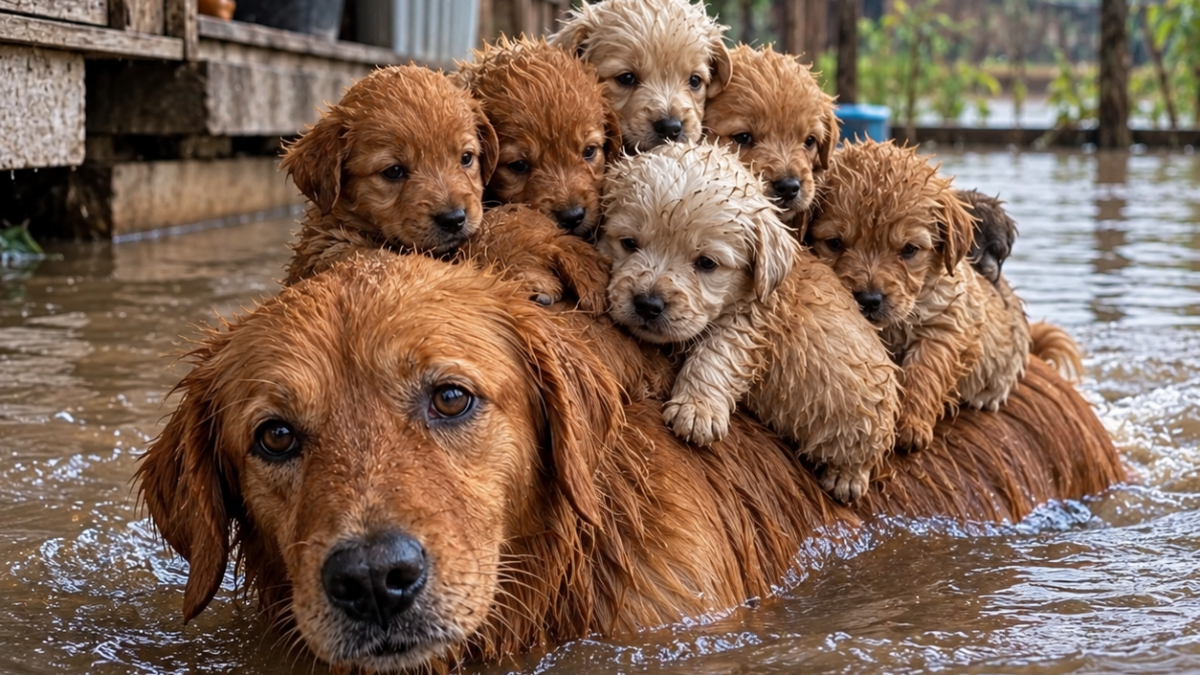
For nearly twenty-two hours, an aging golden hound stood inside a flooded North Carolina barn while the water climbed higher around her, refusing to move from the one place everyone had told her was already lost.
By the time our rescue boat reached that property, the barn roof was barely visible above an endless sheet of brown water, and I was prepared to find nothing alive inside except whatever hope the owner had been forced to leave behind.
But when my flashlight reached the back wall and I saw what Copper had somehow kept above the water all night, every person in that boat stopped speaking—and before the week was over, we would learn the flood had buried more than roads, fences, and homes.
My name is Megan Cole. I was forty-one years old that fall, and I had spent fifteen years with county fire and water rescue in eastern North Carolina.
Flood calls were nothing new to us.
What happened in Oak Ridge was different.
The forecast had called for heavy rain.
Three to five inches.
Localized flooding.
Nothing pleasant, but nothing our farming communities hadn’t handled before.
Then the storm stalled.
Rain hammered the same stretch of county for hour after hour, and by midnight the creeks had climbed over their banks. By sunrise, roads were disappearing. Pastures became lakes. Farmhouses that had never flooded in fifty years suddenly had water approaching the porches.
Evacuation orders went out before breakfast.
That was when I first heard the name James Bennett.
James was sixty-three and lived on a small cattle property outside Oak Ridge with an old golden hound named Copper.
Copper had once been a hunting dog.
By the time I met her, she was nearly eleven, gray around the muzzle, stiff in the hips, and far more interested in sleeping near James’s boots than chasing anything through the woods.
She had also recently given birth to seven puppies.
They were only a few weeks old.
Eyes barely open.
Still sleeping most of the day inside a deep nest James had built from hay and old quilts in the rear corner of his barn.
When county rescue reached James’s property during the first evacuation, the water was already moving across the driveway.
James loaded what he could.
Medication.
Documents.
One small bag.
Then Copper.
He got her into the rescue boat.
They were halfway toward higher ground when Copper heard something.
According to the crew, she stood so suddenly the boat shifted.
Then she jumped.
Straight into the water.
“COOPER!”
James almost went after her.
Two firefighters grabbed him.
Copper swam toward the barn.
James screamed that the puppies were still inside.
He had thought another farm worker had moved them earlier.
No one had.
The crew tried to turn around.
They couldn’t.
The current had become too strong near the barn entrance, and another surge was coming down from the creek.
James begged them.
“I’ll go.”
They refused.
“You won’t make it.”
“Copper’s there.”
“We’ll come back.”
“When?”
“As soon as we can.”
James stared at the barn disappearing through the rain.
One rescuer told him the only thing anyone could say.
“Copper knows that barn. She’ll find high ground.”
But the water never stopped rising.
For the next twenty-two hours, James Bennett sat in an emergency shelter staring at his phone every time it rang, while I worked with a second rescue team trying to reach the farms that had been cut off overnight.
By the following afternoon, the rain finally eased enough for us to attempt James’s property.
From the boat, Oak Ridge no longer looked like farmland.
Fence posts vanished under brown water.
Tree tops rose where driveways had been.
A tractor floated against a shed.
Then we saw the Bennett barn.
Only the upper walls remained above water.
“That’s it,” our navigator said.
We tied off against a beam and forced open the side door.
Water rushed around my thighs as I entered.
The barn was almost completely dark.
I called:
“Copper!”
Nothing.
Then again.
“Copper!”
A sound came from the far wall.
Not a bark.
A weak whine.
I raised my flashlight.
And stopped.
Copper was standing against the back wall.
Water reached halfway up her body.
Her legs were shaking so badly I don’t know how she was still upright.
Her paws were swollen and scraped.
Her head hung low.
But across her shoulders and broad back, packed together on the highest dry section of hay she had managed to hold them against, were seven tiny puppies.
Dry.
Warm.
Alive.
Every single one.
And as I moved toward her, Copper lifted her exhausted head and did something I will remember until the day I die.
She looked past me toward the barn door.
As if she was still waiting for James to come back.
PART 2
I had seen animals survive floods before.
Dogs on rooftops.
Cats trapped inside attics.
Horses swimming through broken fencing.
Cattle standing on narrow rises of land while water moved around them.
But I had never seen anything like Copper.
At first, I couldn’t understand exactly how she’d done it.
The hay pile behind her had been soaked halfway through.
The bottom bales were floating.
A broken feeding platform had drifted against the wall and lodged there at an angle.
Copper had apparently climbed onto it sometime during the night.
Then, as the water rose, she had somehow kept the puppies on the highest part of her body and the remaining dry hay.
One puppy was curled between her neck and the wall.
Two rested over her shoulders.
Four were pressed against the broad center of her back.
Copper herself was soaked.
Shivering.
Barely standing.
The puppies weren’t.
“Don’t rush her,” I said.
Our team member, Nate Holloway, stepped behind me.
“Is she aggressive?”
“I don’t know.”
Copper watched us.
No growling.
No barking.
Just exhaustion.
I crouched as much as the water allowed.
“Hey, girl.”
Her ears moved.
“Copper?”
That did it.
Her head lifted.
James had told dispatch her name.
“Copper.”
Her tail moved once beneath the water.
Tiny.
Almost invisible.
Then her knees buckled.
I lunged forward.
Nate caught her chest before she slipped completely beneath the surface.
The puppies squeaked.
“Easy!”
Copper tried to stand again.
She couldn’t.
I got one arm beneath her.
She was lighter than I expected.
“Get the basket.”
Nate shouted toward the doorway.
Another rescuer brought in a plastic transport bin lined with thermal blankets.
We had no normal animal crate large enough for Copper and seven puppies.
So we improvised.
I began moving the puppies one by one.
The first was a tiny golden female.
Then a darker male.
Another golden.
Two with white paws.
One nearly red.
And the smallest, a little male with a white stripe on his forehead.
Every time I lifted one from Copper’s back, she turned her head to watch.
“She’s counting them,” Nate whispered.
Maybe she was.
Maybe not.
But by the seventh puppy, she stopped struggling.
I wrapped them together.
Copper leaned against me.
“Come on, mama.”
We half-carried, half-floated her toward the door.
She fought us once.
Not to get away.
To turn back.
“Copper, they’re with us.”
I pointed toward the bin.
She saw movement.
Heard the puppies.
Only then did she allow us to guide her out.
The boat ride back took thirty-five minutes.
Copper lay on the deck beneath three blankets.
The puppies were tucked in a warming box beside her.
Every few minutes, Copper tried to raise her head.
I kept one hand on her shoulder.
“They’re right here.”
Her eyes closed.
Then opened again.
She looked toward the box.
“Still here.”
I said it every time.
By the time we reached the temporary veterinary station, James Bennett had already been notified.
He arrived less than ten minutes after us.
I heard him before I saw him.
“Copper?”
He came through the emergency shelter doors wearing borrowed boots and a county rain jacket.
His face looked ten years older than the man in the photograph dispatch had given us.
“Copper!”
Her eyes opened.
That dog could barely lift her head.
But when she heard him, her tail hit the blanket.
Once.
Twice.
James dropped to his knees.
“Oh, girl.”
Copper tried to stand.
He stopped her.
“No. No, sweetheart.”
His hands went to her face.
“I’m here.”
She licked his wrist.
Then James looked toward the puppies.
“All?”
“Seven,” I said.
His mouth opened.
Nothing came out.
“All seven.”
He covered his face with both hands.
I had seen grown men lose homes without crying.
Seen people stand in front of burned buildings in complete silence.
But James collapsed emotionally right there.
Not dramatic.
Not loud.
His shoulders simply folded.
“I left them.”
I crouched beside him.
“You were evacuated.”
“I left them.”
“You were forced out because the current was dangerous.”
“Copper went back.”
“Yes.”
“I didn’t.”
I looked directly at him.
“If you had jumped from that boat, we’d probably have been looking for you too.”
He shook his head.
“She stayed twenty-two hours.”
“She did.”
“And I was sitting in a school gym.”
“Because you were evacuated.”
“It doesn’t feel different.”
I understood guilt.
Facts rarely defeat it immediately.
So I didn’t argue more.
Dr. Avery, the veterinarian coordinating flood rescues, stepped out.
“James?”
He stood.
“I’m James.”
“Copper’s going to need treatment.”
“How bad?”
“She’s exhausted. Dehydrated. Her paws have significant irritation and some minor injuries. Her body temperature is low.”
James swallowed.
“Can you save her?”
“We’re going to do everything she needs.”
“And the puppies?”
“Strong, considering.”
“Considering what?”
Dr. Avery smiled faintly.
“Considering their mother just kept them dry through a flood.”
That was when James cried again.
Copper remained at the temporary veterinary facility for three days.
The first night was the hardest.
Her body had been pushed far beyond normal fatigue.
She needed fluids.
Warming.
Pain management.
Treatment for her paws.
Monitoring for infection.
The puppies needed formula supplementation because Copper was too depleted to feed them properly at first.
James refused to leave.
The shelter staff found him a folding chair.
At midnight, he was still beside her.
At two, still there.
At four, asleep sitting upright with one hand on the edge of Copper’s blanket.
When I came back after another rescue shift, he woke immediately.
“How long was I out?”
“Maybe an hour.”
“She okay?”
“Dr. Avery says stable.”
James nodded.
Then looked embarrassed.
“I didn’t thank you.”
“You don’t need to.”
“I do.”
“No.”
He looked at me.
“You went back.”
I thought about Copper in that barn.
“We all did.”
“No.”
He shook his head.
“You went when I couldn’t.”
That sentence bothered me.
Because it made the story too simple.
Brave rescuer.
Helpless owner.
Hero dog.
Reality was messier.
James had tried to stay.
The evacuation team had physically stopped him from risking his life.
Copper acted on instinct, attachment, or both.
We reached her because the water finally allowed us.
Everybody’s choices were constrained by something.
The storm.
The current.
Time.
Fear.
That mattered later.
Especially when the public decided it needed someone to blame.
At first, the story spread because of a photograph.
One of our younger firefighters had taken it after rescue.
Copper on a blanket.
Seven puppies pressed against her.
James kneeling beside them.
He sent it to his mother.
His mother sent it to a church group.
Someone posted it publicly.
Within six hours, it was everywhere.
**MOTHER DOG SAVES SEVEN PUPPIES IN NORTH CAROLINA FLOOD.**
Then:
**OLD HOUND STANDS 22 HOURS IN FLOODWATER TO SAVE HER LITTER.**
Then the headlines got worse.
**OWNER EVACUATES, DOG REFUSES TO ABANDON PUPPIES.**
That wording changed everything.
Suddenly James was not an evacuated farmer.
He was the man who “left.”
People commented without knowing anything.
Why didn’t he take the puppies?
I would never leave my animals.
He doesn’t deserve that dog.
Copper had more loyalty than her owner.
Thousands of people.
Strangers.
Certain.
James saw the comments.
I wish he hadn’t.
He was sitting beside Copper when I found him staring at his phone.
“Stop reading.”
He didn’t look up.
“They’re right.”
“No.”
“I forgot the puppies.”
“You were told the farm worker had moved them.”
“Should’ve checked.”
“You were evacuating in a flood.”
“Still.”
“James.”
He looked at me.
“What?”
“The same internet saying you don’t deserve Copper also believes I carried all seven puppies on my head while swimming through the barn.”
He blinked.
“What?”
“Headline from some site in Florida.”
For the first time in three days, he laughed.
A weak laugh.
But real.
“Did you?”
“No.”
“Disappointing.”
“Extremely.”
I took his phone.
“Stop reading.”
He let me.
That should have been the end of it.
It wasn’t.
A local property developer named Reed Mallory gave an interview.
At the time, I barely knew his name.
Most people in Oak Ridge did.
Mallory owned land along the creek north of James’s farm.
Two years earlier, he’d begun building a private equestrian community called Riverbend Estates.
Large lots.
Custom homes.
Private roads.
Artificial ponds.
The project had been controversial because of drainage concerns.
I knew none of that yet.
In the interview, Mallory was asked about flooding around Oak Ridge.
He said:
“This was an unprecedented weather event. Unfortunately, some property owners failed to follow evacuation guidance early enough, and some animals were left in unsafe structures.”
No names.
But everybody understood.
James saw the clip.
His face went pale.
“That man.”
“What about him?”
“He knows.”
“Knows what?”
James looked at me.
“Why the water came so fast.”
That was the moment the flood story changed.
I sat beside him.
“What are you talking about?”
James lowered his voice even though nobody was near us.
“Riverbend.”
“The development?”
He nodded.
“Last spring they changed drainage above my south pasture.”
“Changed how?”
“Built a berm. Regraded the creek side.”
“Legal?”
“They had permits for some of it.”
“Some?”
James stared toward Copper.
“I complained to the county three times.”
My attention sharpened.
“What did you say?”
“Water was backing up differently after storms.”
“Did anybody inspect?”
“One guy came.”
“What happened?”
“Nothing.”
I had no role in engineering.
No role in permitting.
No authority over Riverbend.
But I knew enough to recognize when a person had documentation.
“Do you have copies?”
“At the house.”
The house was still inaccessible.
“Anywhere else?”
James thought.
“Email.”
We used my phone.
He signed into his account.
Search:
**Riverbend drainage.**
There they were.
Three emails.
April 8.
May 17.
August 2.
Photographs attached.
One showed a new earthen berm near a creek channel.
Another showed water standing in James’s pasture after an ordinary storm.
One email read:
**This property never held water here before grading began upstream. I am concerned the new berm and drainage ditch are redirecting runoff toward the Bennett farm and neighboring parcels.**
County response:
**Complaint received. Forwarded to development services.**
Second:
**Site reviewed. No immediate violation observed.**
Third:
No response.
James stared at the messages.
“I told them.”
I wasn’t ready to say they caused the flood.
A stalled storm dumping record rain can overwhelm almost anything.
But James had raised a question long before disaster.
And the man who owned the development was now publicly talking about farmers failing to prepare.
That bothered me.
I forwarded nothing.
Not my investigation.
Instead, I told James:
“Save those.”
He looked at me.
“Why?”
“Because if you’re right, somebody qualified needs to review them.”
News coverage moved on for about forty-eight hours.
Then a drone operator changed everything.
His name was Ethan Cole.
No relation to me.
He had been volunteering with emergency management to map flooded roads.
On day four, he flew over the creek north of James’s property.
The footage showed water spread across Riverbend’s construction zone.
One section of the creek looked strange.
A broad wall of soil cut across what appeared to be an old overflow path.
Water had piled behind it.
Then cut around the lower edge.
The bypass channel pointed almost directly toward the Bennett farm.
Ethan wasn’t an engineer.
Neither was I.
He uploaded the footage to the county’s emergency mapping team.
An engineer saw it.
Then another.
Within twenty-four hours, state environmental officials arrived.
Mallory’s public tone changed.
His company released a statement:
**Riverbend Estates complied with all known permits and construction requirements. Any suggestion that project activity contributed materially to this extraordinary flood event is premature and unsupported.**
Fair enough.
Premature.
Maybe.
Then state engineers found the first problem.
An emergency grading change had been made three months earlier.
The approved drainage plan called for a culvert and overflow channel.
The culvert had been delayed.
Instead, a temporary berm was built.
The berm was supposed to have a controlled break section for high water.
It didn’t.
Documents said it existed.
Drone footage showed it did not.
Then came the second problem.
A construction access road crossed an old drainage swale.
The plan required two temporary pipes beneath it.
Only one was installed.
Debris clogged it during the storm.
Water backed up.
No one claimed Riverbend caused the entire flood.
The rainfall alone was catastrophic.
But preliminary modeling suggested the blocked drainage and berm could have increased local water depth and speed across several downstream farms.
Including James’s.
The investigation became official.
Mallory stopped giving interviews.
James didn’t celebrate.
He stood beside Copper’s treatment area and said:
“Doesn’t change what she went through.”
“No.”
“Doesn’t bring the barn back.”
“No.”
“Doesn’t make me feel better.”
“No.”
He looked at me.
“You’re not very good at revenge speeches.”
“I’m a rescue captain.”
“Fair.”
Copper improved.
That mattered more.
On day four, she stood without assistance.
James was there.
So was I.
Dr. Avery removed the support sling.
“Easy.”
Copper’s rear legs shook.
She planted one front paw.
Then the other.
Stood.
James put his hand under her chest.
“I’m here.”
She took one step.
Then another.
The puppies squeaked from their warming pen.
Copper turned.
Her whole body changed.
She tried to reach them.
Dr. Avery laughed.
“Apparently we’re done resting.”
Copper reached the pen.
The puppies crawled toward her.
Seven tiny bodies.
She lowered herself carefully.
They climbed over her legs.
One tried to nurse.
Another crawled beneath her chin.
Copper closed her eyes.
James sat beside her.
For several minutes, nobody spoke.
That photograph never went online.
James asked me not to take one.
I didn’t.
Some moments don’t need proof.
Within a week, floodwater began receding.
Oak Ridge looked wrecked.
Fields covered in mud.
Fences down.
Dead appliances on roadsides.
Hay ruined.
Feed spoiled.
Homes gutted.
The Bennett barn remained standing but damaged.
The lower walls had shifted.
Half the hay was gone.
Tools floated into neighboring fields.
James’s house had taken eighteen inches of water.
Not destroyed.
Bad enough.
He stood on the porch the first day we brought him back.
I went with him because emergency management was still restricting access.
He opened the door.
Mud line across the walls.
Furniture overturned.
Family photographs soaked.
He stared.
“You okay?”
“Yeah.”
He wasn’t.
We walked through the house.
Kitchen.
Bedroom.
Living room.
Then the mudroom.
Copper’s old bed floated upside down.
James stopped.
He bent slowly.
Picked it up.
Mud poured from the fabric.
“She hated this bed.”
I smiled.
“Why?”
“Too expensive.”
Copper apparently preferred an old feed sack.
James laughed once.
Then cried.
People think disaster grief is always about the house.
It’s often the stupid things.
A dog bed.
A coffee cup.
A photograph that stuck to another photograph.
The ordinary objects proving life existed before everything changed.
Volunteers arrived the next day.
Dozens.
Some had seen Copper’s story.
James hated that.
“I don’t want charity because people feel sorry for dog.”
A church volunteer named Ruth looked at him.
“We’re not here because we feel sorry.”
“Then why?”
“Because your house has mud in it.”
That ended the argument.
They cleaned.
Pulled drywall.
Moved furniture.
Washed salvaged items.
A youth group repaired fencing.
Someone donated hay.
Someone else feed.
One farmer loaned James a tractor.
None of them asked for a viral photo.
That mattered.
Copper and the puppies stayed at Green Valley Veterinary Hospital until the farm was safe.
James visited twice every day.
Morning.
Evening.
Always.
He brought the same old cap.
Copper started recognizing his truck by sound.
When he arrived, she stood.
At first slowly.
Then faster.
By week two, she could walk normally for short distances.
Her paws healed.
The puppies gained weight.
They became chaos.
Seven tiny hounds crawling everywhere.
One chewed Dr. Avery’s shoelace.
Another fell asleep inside a towel basket.
James named them because the shelter needed identifiers.
The smallest male with the white forehead:
Ridge.
The dark male:
Boone.
Two gold females:
June and Daisy.
White-pawed male:
Finn.
Red female:
Maple.
Last male:
Scout.
“Why those names?” I asked.
James shrugged.
“Sound like dogs.”
Solid reasoning.
Copper tolerated all seven with saintly exhaustion.
Then adoption questions started.
Hundreds.
Everyone wanted a “Copper puppy.”
That phrase bothered Dr. Avery.
“They’re not souvenirs.”
James agreed immediately.
The rescue organization handling placement created strict applications.
Fenced yard preferred.
Veterinary references.
Home checks.
Return-to-rescue clause.
No breeding.
No impulse adoptions.
Copper would remain with James.
That was never in question.
The puppies would leave only when old enough and medically ready.
But before any adoption happened, Riverbend’s investigation escalated.
State officials obtained construction records.
A former site supervisor named Lucas Hale came forward.
He had quit Riverbend four months before the flood.
He told investigators that the temporary berm had been installed to keep equipment access dry while waiting for materials.
The drainage break was supposed to be cut before hurricane season.
It wasn’t.
Why?
Schedule.
Riverbend wanted model homes completed before a major sales weekend.
Lucas produced texts.
One from the project manager:
**Leave berm until final grade. We can’t lose access again.**
Another:
**Pipes arrive next month. Make current setup work.**
No one wrote:
Flood the farms.
Real negligence rarely sounds villainous.
It sounds practical.
Temporary.
Save time.
We’ll fix it later.
The phrase that causes disasters is often not “I don’t care.”
It’s:
“It’ll be fine.”
Mallory personally had not sent those messages.
But internal emails showed he pushed repeatedly to avoid delays.
Again, not proof he ordered illegal grading.
But enough to widen scrutiny.
Then a county inspector’s report surfaced.
He had identified the missing overflow cut in June.
The correction deadline passed.
The file had been marked pending.
No follow-up occurred.
James read the report at his temporary housing table.
His hands shook.
“They knew.”
I sat across from him.
“Someone knew.”
“They knew.”
“James.”
“How many times did I email?”
“Three.”
“And they told me no immediate violation.”
He pushed the papers away.
“Copper stood in water twenty-two hours because somebody wanted to sell houses faster.”
“Careful.”
He looked at me angrily.
“What?”
“We don’t know that’s the whole cause.”
“Look at it.”
“I am.”
“You’re defending them?”
“No.”
“Then what?”
“I’m telling you not to let anger make you say something the evidence hasn’t finished proving.”
He stared at me.
I thought he might ask me to leave.
Instead he sat back.
“You’re annoying.”
“Frequently.”
“Fine.”
That became our pattern.
James wanted accountability.
I wanted him not to destroy himself chasing it.
The state eventually released its findings six months later.
The storm was the primary cause of the regional flooding.
Record rainfall exceeded design capacity across the county.
But in the Bennett Creek sub-basin, unauthorized or incomplete construction features at Riverbend materially worsened localized flooding.
The temporary berm obstructed overflow.
The missing culvert reduced drainage.
The access road redirected water.
Modeling estimated water at James’s barn rose between fourteen and twenty-three inches higher than it likely would have under the approved drainage plan.
Fourteen to twenty-three inches.
I kept thinking about Copper’s body.
Water halfway up her sides.
If the modeling was right, without those construction problems she might still have been wet.
Still trapped.
But perhaps able to stand on the platform without water covering half her body.
Maybe the puppies could have stayed in the hay.
Maybe Copper would not have spent twenty-two hours holding herself upright until her legs nearly failed.
James read the number.
Then closed the report.
“That’s enough.”
“What do you mean?”
“Enough for what?”
“To know I wasn’t crazy.”
That surprised me.
I thought he wanted punishment.
He wanted proof that the changes he’d noticed were real.
Riverbend faced significant consequences.
Stop-work order.
Required drainage reconstruction.
Environmental penalties.
Civil claims from downstream property owners.
Insurance disputes.
Lost sales.
Mandatory restoration work.
The county launched its own review after failing to follow up on inspection findings.
Two employees were disciplined.
Inspection tracking procedures changed.
Mallory gave one final interview after the findings became public.
He looked tired.
No polished sales backdrop.
No hard hat.
Just a table.
“We relied on our project team and contractors,” he said. “That does not excuse failures that occurred under our project. We should have corrected the drainage issues sooner.”
Then:
“I also regret comments suggesting individual farmers were responsible for losses during evacuation.”
James watched from his rebuilt kitchen.
Copper lay beside his boots.
“That’s you,” I said.
“I know.”
“How does it feel?”
He thought.
“Smaller than I expected.”
“What did you expect?”
“Fireworks.”
“Disappointing.”
“Little.”
Copper snored.
James smiled.
“She’s better revenge.”
“How?”
He scratched her ear.
“She’s still here.”
The civil case took another year.
James did not become rich.
That’s not how flood claims work.
After lawyers, repair costs, insurance offsets, and shared settlements, he received enough to cover remaining barn reconstruction, lost equipment, and some future drainage improvements.
More importantly, Riverbend funded creek restoration and downstream mitigation as part of settlement terms.
The illegal berm disappeared.
Two proper culverts went in.
The old overflow swale was reopened.
Wetland buffers were restored.
The next major storm came two years later.
Heavy.
Not catastrophic.
James stood beneath his porch watching the creek.
I happened to be there because we had become friends by then.
We watched water rise.
Then spread into the restored overflow channel exactly where engineers said it should.
James said nothing.
The water crossed the low field.
Not the barn.
“That’s what it used to do,” he finally whispered.
I looked at him.
“What?”
“Before Riverbend.”
Copper, older now, slept inside.
James watched the water move safely away.
“That.”
That was the revenge.
Not Mallory ruined.
Not angry speeches.
Water flowing where it was supposed to.
A barn still dry.
Animals sleeping through rain.
But I’m getting ahead.
The puppies became local celebrities despite everyone’s best efforts.
Adoption day was chaos.
Ridge went to a retired firefighter named Dan and his wife.
Boone joined a family with a fifteen-acre property.
June went to a veterinary technician.
Daisy to a teacher with two older children.
Finn went to a young couple who had recently lost an elderly hound.
Maple stayed local with a dairy farmer.
Scout went to Nate Holloway—the rescuer who had helped me carry Copper out of the barn.
When Nate submitted an application, I laughed.
“You?”
“What?”
“You said you didn’t want a dog.”
“I changed my mind.”
“After the flood?”
“Scout peed in my boot.”
“And that created attachment?”
“Apparently.”
Scout adored him.
Six puppies left over two days.
James cried each time.
Then Ridge was last.
The smallest.
The one with the white stripe.
His adopters were coming Saturday.
Friday night, James called me.
“Can you come over?”
Copper and Ridge were sleeping together in the reconstructed barn office.
James sat on a feed bucket.
“What’s wrong?”
“Nothing.”
“That’s convincing.”
He looked at Ridge.
“Should’ve kept one.”
“You still can.”
“No.”
“Why?”
“Seven homes waiting. Good homes.”
“Ridge’s family hasn’t taken him yet.”
James shook his head.
“I promised myself I wasn’t gonna let the flood make me hold onto everything.”
That was insightful.
Disaster creates hoarding of people, objects, animals, time.
After losing control, letting go feels dangerous.
“Do you want Ridge?”
James thought a long time.
“No.”
“Then what’s the problem?”
“I want the day before tomorrow.”
I understood.
He wanted one more night where the entire story was still intact.
Copper.
Last puppy.
Barn rebuilt.
Before another goodbye.
So we sat.
Ridge woke.
Climbed into James’s lap.
Copper watched.
James rubbed his ears.
Saturday, the adopters came.
An older couple named Sarah and Mike Evans.
Their previous dog had died at fourteen.
They lived forty minutes away.
They promised visits.
James walked Ridge to their car.
The puppy looked back.
James almost broke.
Then Copper walked beside him.
She touched Ridge’s face.
Ridge licked her muzzle.
The couple placed him inside.
Car drove away.
James stood in the driveway until it disappeared.
Copper remained beside him.
Then James said:
“That’s it.”
I expected sadness.
Instead Copper turned.
Walked toward the house.
James followed.
That was the lesson.
Life continues.
Copper’s story didn’t end after the flood either.
She became famous enough that strangers sometimes arrived at the farm uninvited.
That stopped quickly.
James put up a sign.
**PRIVATE FARM. COPPER IS RETIRED.**
I loved it.
A pet food company offered money for an advertisement.
James refused.
A national morning show wanted Copper flown to New York.
Absolutely not.
A filmmaker wanted dramatic reenactment footage inside the barn.
James laughed.
“No.”
“Why not?”
“Because Copper don’t care about television.”
Correct.
One offer he accepted.
Oak Ridge Elementary asked if Copper could attend a flood-preparedness fundraiser.
The event supported emergency animal evacuation trailers.
James said yes.
Copper lay on a blanket while children read books beside her.
No stage tricks.
No costumes.
No dramatic music.
Just an old dog sleeping.
They raised enough money for two livestock transport trailers and dozens of portable pet crates.
The following hurricane season, those trailers moved thirty-seven animals before roads flooded.
That mattered more than any commercial.
James later told me:
“That’s Copper’s real story.”
“Trailers?”
“No.”
“Then what?”
“Next time, nobody says we’ll get them later.”
That line stayed with me.
County emergency management changed animal evacuation procedures after Oak Ridge.
Farms with litters, elderly animals, or limited mobility could pre-register.
Livestock trailers staged earlier.
Veterinary volunteers joined evacuation planning.
Rescue teams received updated maps of barns and kennels.
The phrase “animals can wait” disappeared from formal briefing language.
Not because humans mattered less.
Because delayed animal evacuation often led humans to refuse evacuation or return into dangerous areas.
Copper had taught us that the hard way.
James became part of the planning committee.
He hated meetings.
“You caused this,” he told me.
“I didn’t appoint you.”
“You told them I had opinions.”
“You do.”
“Private opinions.”
“Not anymore.”
His first meeting lasted three hours.
He called afterward.
“I’d rather stand in floodwater.”
“Too soon.”
“Fair.”
But he kept attending.
At one meeting, an emergency manager said:
“We can’t plan for every animal.”
James answered:
“No. But we can stop pretending people will leave them.”
Silence.
Then nodding.
Policy shifted.
Years passed.
Copper slowed.
At thirteen, arthritis worsened.
At fourteen, hearing faded.
James built ramps.
She refused the first one.
He rebuilt.
Still refused.
Nate came over with Scout.
Scout used the ramp.
Copper watched.
Then used it.
James stared.
“She needed peer review.”
I laughed.
Copper still loved the barn.
Even after everything.
That surprised me.
I assumed she would avoid it.
Instead she slept inside whenever James worked.
Maybe dogs don’t assign buildings guilt.
The barn was where her puppies were born.
Where James stored feed.
Where sunlight came through the western boards in the afternoon.
The flood belonged to one day.
The barn belonged to years.
That distinction helped me.
One anniversary, a reporter asked James:
“Do you think Copper remembers those twenty-two hours?”
James looked toward her.
She was asleep in a patch of hay.
“I hope not.”
The reporter smiled awkwardly.
“People usually say animals remember.”
“Maybe.”
James shrugged.
“But I don’t need her to remember for story to matter.”
Exactly.
Humans often want animals to carry trauma because it makes our narratives more powerful.
Copper had carried enough.
Let her forget.
At fourteen and a half, she developed kidney disease.
Manageable at first.
Diet.
Medication.
More water.
Then heart disease.
Dr. Avery, still her veterinarian, warned James:
“We’re balancing things now.”
“I know.”
“Some medication helps one issue and complicates another.”
“I know.”
“Quality of life.”
“I know.”
James hated those words.
Everybody does.
Copper still had good days.
She walked to the mailbox.
Slept in barn sun.
Visited Maple and Scout occasionally.
The puppies were adults now.
Large.
Different.
But whenever one visited, Copper became alert.
Scout visited most.
Nate lived close.
Scout had inherited Copper’s golden coat but not her calm temperament.
He remained ridiculous.
At nine years old, he still behaved like a puppy near mud.
Copper tolerated him.
Barely.
One afternoon Scout lay beside her.
Their heads touched.
Nate took a photograph.
This one James allowed.
It hung in his kitchen.
Copper old.
Scout gray beginning.
Two generations.
No flood.
No barn water.
Just family.
Then Copper stopped eating.
Not entirely.
Less.
James switched foods.
Chicken.
Rice.
Eggs.
She accepted some.
Then none.
He called Dr. Avery.
Tests showed progression.
“How long?” James asked.
“Days? Weeks?”
“Could be.”
“Months?”
Dr. Avery looked at him.
“Maybe not.”
James stared at Copper.
The same guilt from the flood returned.
I saw it.
“What?”
He shook his head.
“Nothing.”
“James.”
“I left once.”
My chest tightened.
“This is not the same.”
“I know.”
“Do you?”
He looked at me.
“Feels like if I decide—”
He stopped.
“You’re not abandoning her.”
“I know.”
“You’re staying.”
He looked toward Copper.
“She stayed.”
“Yes.”
“Twenty-two hours.”
“Yes.”
“I should be able to—”
“No.”
My voice sharpened.
He looked surprised.
“You don’t repay suffering by creating more suffering.”
Silence.
“You love her?”
He nodded.
“Then don’t make her prove endurance again.”
James covered his face.
That was the hardest conversation we ever had.
Not the flood.
Not Riverbend.
That.
Because guilt can disguise itself as loyalty.
James thought staying with Copper meant forcing every possible day.
It didn’t.
Sometimes staying means being there when the day becomes the last one.
Dr. Avery came to the farm three mornings later.
Copper had stopped standing.
She lay on an old quilt near the barn doorway.
James chose the barn.
At first I questioned it.
Then understood.
Sunlight.
Hay smell.
Wind through the boards.
Her place.
Not the flood.
Her home.
Nate arrived with Scout.
Only for a few minutes.
Scout approached Copper.
Sniffed.
Then lay down.
Copper opened her eyes.
Tail moved once.
Scout pressed his nose against hers.
Nate cried.
He didn’t hide it.
Then took Scout away.
James sat beside Copper.
I sat several feet back.
Dr. Avery waited.
James whispered:
“You remember Ridge?”
Copper breathed.
“Boone?”
Another breath.
“June. Daisy. Finn. Maple. Scout.”
He smiled through tears.
“Seven.”
His hand rested on her shoulder.
“You kept all seven.”
I looked away.
James continued.
“Everybody says I saved you.”
He shook his head.
“That’s not right.”
Copper’s eyes opened.
“You came back for what mattered.”
His voice broke.
“Then you taught me to do same.”
That was true.
After the flood, James stopped postponing things.
He repaired his relationship with his younger brother after eight years of silence.
Started visiting his daughter more often.
Made a will.
Planned animal evacuation.
Accepted help.
Joined community meetings.
He said Copper had taught him that waiting until later is sometimes a luxury.
“You don’t have to stand anymore,” he whispered.
Her breathing slowed.
“I’m here.”
The exact words he’d said at the veterinary station years earlier.
“I’m here.”
Copper died with her head in James’s lap.
Dry.
Warm.
Home.
No flood.
No fear.
Seven puppies grown.
A man who had never stopped loving her sitting exactly where he needed to be.
Afterward, James remained in the barn for nearly two hours.
Nobody rushed him.
I left once.
Brought coffee.
He didn’t drink it.
Finally he said:
“I thought revenge would feel different.”
I sat beside him.
“What revenge?”
“Riverbend.”
“That was years ago.”
“I know.”
He looked toward the creek.
“They paid. Fixed drainage. County changed rules.”
“Yes.”
“Still lost Copper.”
“That’s not connected.”
“Everything feels connected today.”
Grief does that.
It drags every loss into the same room.
I said:
“Do you want to know what I think your revenge was?”
He looked at me.
“What?”
“The next flood.”
He frowned.
“The one two years after.”
“What about it?”
“Water went through the restored channel.”
He nodded.
“Barn stayed dry.”
“Yes.”
“Scout slept through the storm at Nate’s house.”
Another nod.
“County trailers moved animals before roads closed.”
James stared.
“Nobody had to repeat Copper’s night.”
I touched the barn floor.
“That’s revenge.”
He thought for a long time.
Then smiled faintly.
“You’re getting better at speeches.”
“Don’t tell anyone.”
Copper was buried on the hill behind the barn.
Not beside the creek.
James chose the hill because it stayed dry.
The seven puppies’ families were invited.
All came.
Ridge.
Boone.
June.
Daisy.
Finn.
Maple.
Scout.
Seven adult dogs.
Different sizes.
Different lives.
All gathered on the farm where they had once fit across Copper’s back.
People cried.
Dogs did not understand ceremony.
Scout chased a butterfly.
Maple stole a sandwich.
Ridge rolled in grass.
That was better.
James placed no giant monument.
One flat stone.
**COPPER**
**SHE STAYED**
I asked:
“That’s all?”
“Enough.”
He was right.
One year after Copper died, the county opened a new emergency animal staging facility.
Portable kennels.
Generator.
Feed storage.
Small veterinary treatment area.
High-ground location.
The county wanted to name it after Copper.
James resisted.
Eventually agreed to a small plaque inside.
Not outside.
No spectacle.
It read:
**COPPER RESPONSE CENTER**
**Created in memory of the animals and people who taught Oak Ridge that evacuation plans must include every life depending on us.**
James approved because it wasn’t only about Copper.
The first time the center activated, a tropical storm threatened the county.
Not historic.
Still serious.
Seventy-two dogs.
Twenty-one cats.
Nine goats.
Fourteen horses coordinated through satellite lots.
Two litters of puppies.
One elderly hound.
James volunteered.
Of course.
I found him carrying crates.
“You’re seventy.”
“Sixty-nine.”
“Close enough.”
“You’re rude.”
“You have people for this.”
“I’m people.”
Fair.
A young volunteer asked him:
“Are you Copper’s owner?”
James stopped.
“Was.”
The girl smiled.
“My mom told me that story.”
James looked uncomfortable.
“Probably exaggerated.”
“She said Copper saved seven puppies.”
“That part’s true.”
“Did she really stand twenty-two hours?”
“About.”
The volunteer stared.
“That’s incredible.”
James looked toward the rows of animals safely sheltered before the storm.
“No.”
He pointed.
“This is.”
That is how the story should end.
Not with a dog standing in rising water.
With animals never having to.
Riverbend eventually finished construction years later under revised plans.
Fewer homes.
Larger buffers.
Restored drainage.
New ownership group.
Mallory sold his interest.
I saw him once at a county meeting.
Older.
Quieter.
He approached James.
I prepared myself for tension.
Mallory said:
“I owe you an apology.”
James looked at him.
“You already made public one.”
“That was for lawyers.”
James waited.
Mallory continued.
“You warned county.”
“Yes.”
“My team said complaints were exaggerated.”
“I know.”
“I pushed schedule.”
James said nothing.
“I can’t say I caused the flood.”
“You didn’t.”
That surprised Mallory.
James continued.
“Rain caused flood.”
Mallory nodded.
“But?”
“You made my part worse.”
Mallory looked down.
“Yes.”
There it was.
No shouting.
No revenge monologue.
Truth.
Mallory said:
“I’m sorry about Copper.”
James looked toward the window.
“She lived good years after.”
“I know.”
“You follow story?”
“Hard not to.”
James almost smiled.
Then:
“Make next project better.”
Mallory nodded.
“I will.”
That was all.
I asked James later:
“You forgive him?”
James laughed.
“Everybody asks that.”
“Well?”
“Don’t know.”
“That’s allowed.”
“Doesn’t matter.”
“Why?”
“Drainage works.”
Practical man.
I liked that.
The puppies aged.
Bear with me—puppies not Bear, sorry. Copper’s seven.
Ridge developed the same gray muzzle.
Boone became a therapy dog at a veterans’ center.
June slept under her teacher owner’s desk during remote work.
Daisy loved children.
Finn became obsessed with swimming, which everyone found ironic.
Maple remained on the dairy farm and rode in tractors.
Scout stayed with Nate.
Scout outlived Copper by almost six years.
When Scout finally died, Nate called James.
They sat together in the rebuilt barn.
No speeches.
Two old men remembering a dog who once fit on another dog’s back.
James kept contact with every family.
Christmas cards.
Birthday pictures.
Vet updates.
He had made himself a promise after the flood.
He would know what happened to all seven.
He did.
When Ridge died at thirteen, Sarah called.
When Boone died at fourteen, James drove to the family.
June made fifteen.
Daisy fourteen.
Finn thirteen.
Maple fifteen.
Scout nearly sixteen.
One by one.
Each death hurt.
But each also confirmed something.
The puppies had not merely survived the barn.
They had lived entire lives.
Years.
Homes.
Families.
Beds.
Car rides.
Stolen food.
Veterinary bills.
Christmas photos.
Normal time.
That was Copper’s true victory.
Not twenty-two hours.
Fifteen years that came afterward because she refused to let the first few weeks be the end.
By the time the last puppy died, James was in his eighties.
I had retired from county rescue.
We still met for coffee.
One morning, he brought a folder.
“What’s this?”
“Pictures.”
Seven sections.
One for each puppy.
From tiny bodies in the rescue bin to old gray dogs.
I turned pages slowly.
Ridge as a puppy.
Ridge at five.
Ten.
Thirteen.
Boone wearing a therapy vest.
June beside a Christmas tree.
Finn in a lake.
Maple on a tractor.
Scout asleep beside Nate.
James had saved everything.
“You’re sentimental.”
“No.”
“This is a forty-page scrapbook.”
“Documentation.”
“Sure.”
He turned to the first page.
Copper in the barn after rescue.
Not the famous image.
A later one.
Dry.
Puppies nursing.
James’s hand resting near her.
He said:
“People always stop on flood picture.”
“The one from rescue?”
“Yeah.”
“I know.”
“They think that’s story.”
“What do you think?”
He turned to the last page.
Seven old dogs.
Different photos.
Different homes.
“That’s story.”
I stared at it.
He was right.
Hero stories freeze people and animals in one dramatic moment.
Copper deserved more.
She was not only the dog standing in water.
She snored.
Stole biscuits.
Hated nail trims.
Ignored expensive beds.
Loved James.
Raised puppies.
Aged.
Developed arthritis.
Slept in sunlight.
Died at home.
The flood was twenty-two hours.
Her life was years.
That’s what should be remembered.
The same applies to James.
He wasn’t simply the man who had to leave his dog behind.
He was a farmer.
Father.
Brother.
Neighbor.
A man who complained about meetings but attended them.
Who kept seven puppy folders.
Who spent settlement money rebuilding instead of moving.
Who learned to stop reading internet comments.
Mostly.
One day, years after everything, a young journalist called me.
She was writing about climate resilience and rural emergency planning.
She asked:
“What was the most important lesson from Copper’s rescue?”
I expected to say:
Never underestimate animals.
Or:
Evacuate early.
Or:
Include pets in disaster plans.
All true.
Instead I remembered the barn.
Copper shaking.
Seven puppies dry.
James blaming himself.
Riverbend blaming weather.
County missing complaints.
Everyone looking for one simple cause.
So I told her:
“Disasters expose every shortcut people took before the rain started.”
She went quiet.
“What do you mean?”
“The storm was natural.”
I looked toward old photographs on my desk.
“But the consequences weren’t only weather.”
Forecast missed.
Evacuation happened late in some areas.
Drainage construction worsened local flooding.
Animal planning was incomplete.
James believed someone else had moved puppies.
People trusted temporary measures.
Everyone assumed there would be more time.
Disasters punish assumptions.
Copper had no assumption.
The puppies were there.
Water was rising.
So she stayed.
That simplicity is part of why humans find animal stories powerful.
Animals don’t write explanations.
They act within what they understand.
Copper understood:
Puppies.
Barn.
Stay.
Humans spent years afterward understanding everything around that choice.
When the journalist asked whether Copper was heroic, I said:
“Yes.”
Then corrected myself.
“Probably.”
“What do you mean?”
“I mean she was a dog.”
I smiled.
“Let her be a dog too.”
Not a symbol.
Not a saint.
A tired old hound who did something extraordinary.
That’s enough.
Oak Ridge floods less severely now.
Not because storms stopped.
They haven’t.
But creek restoration helped.
Drainage enforcement improved.
Emergency alerts improved.
Animal staging improved.
Farmers pre-register livestock locations.
Riverbend’s new overflow wetlands hold water during heavy rain.
The Bennett barn remains.
James eventually sold most cattle but kept the property until he could no longer manage it.
When he moved closer to his daughter, the new owners agreed to preserve Copper’s hill.
Not legally required.
Just promised.
James worried.
“Promises change.”
So his daughter arranged a small easement around the burial area.
Accountants, lawyers, farmers.
Everyone has their language of love.
James’s was making sure things remained where they belonged.
Before moving, he stood in the barn one last time.
I was there.
Empty stalls.
Old beam marks.
Newer walls from reconstruction.
He touched the back wall.
“Water was here.”
A faint stain still showed where we had never completely removed it.
“Yeah.”
He looked at the corner where Copper stood.
“Can’t believe she did that.”
“Still?”
“No.”
He shook his head.
“More years pass, less I believe.”
I understood.
Memory becomes impossible because present safety makes past danger feel unreal.
He walked to the door.
Then stopped.
“You think she waited for me?”
I knew exactly what he meant.
The moment we found Copper, she looked toward the entrance.
Had she been listening for James?
Smelling him?
Expecting him?
We could never know.
“I think she knew you’d come if you could.”
James looked at me.
“That’s not same.”
“No.”
I thought.
“But maybe close.”
He nodded.
Then left the barn.
No dramatic final glance.
James was not built for that.
The property sold.
Life moved.
Years later, when James was ninety, his daughter called.
He was in hospice care.
“He’s asking for you.”
I drove three hours.
James looked small in the bed.
Older than I had allowed him to become in my mind.
His daughter sat nearby.
On the nightstand:
One photograph.
Copper.
Not flood Copper.
Young Copper.
Golden coat.
Standing beside James’s truck.
I sat.
“Hey.”
James opened his eyes.
“Took you long enough.”
“Traffic.”
“Excuses.”
“Still difficult?”
“Always.”
We talked for maybe twenty minutes.
County.
Weather.
Nate.
Dr. Avery.
Puppies.
He had trouble remembering some names.
But not Copper.
Never Copper.
At one point he said:
“You still tell story?”
“Sometimes.”
“Don’t make me look stupid.”
“Impossible promise.”
He smiled.
Then:
“Tell ’em I didn’t leave her.”
My throat tightened.
I remembered another man years earlier saying something similar about puppies inside a coat. Maybe rescue work repeats emotional truths.
James looked at me.
“You hear me?”
“Yes.”
“I got on boat because they made me.”
“I know.”
“Copper jumped.”
“I know.”
“I would’ve gone.”
“I know.”
His eyes filled.
Even after decades.
Guilt survives facts.
I leaned closer.
“James.”
“What?”
“She knew you came back.”
He stared at me.
“How?”
“Because you came back every day after.”
He frowned slightly.
“Veterinary hospital.”
“Yes.”
“Farm.”
“Yes.”
“Her whole life.”
“Yes.”
I held his hand.
“One forced evacuation doesn’t define the man who spent every day after staying.”
James closed his eyes.
A tear slid toward his ear.
Then he whispered:
“Good.”
He died two days later.
His daughter buried some of his ashes beside Copper.
Some with his wife.
Practical division.
He would have approved.
At the small service, Ridge and the others were long gone.
Nate stood with me.
Older.
Slower.
We looked across Oak Ridge.
Fields.
Creek.
Barn in distance.
No flood.
Nate said:
“Whole county changed because one stubborn dog wouldn’t leave.”
I shook my head.
“No.”
“What?”
“Whole county changed because she made it impossible for us not to see what needed changing.”
He thought.
“Same thing.”
“Maybe.”
The plaque inside the emergency response center remains.
Copper’s stone remains.
The drainage channel remains.
And every year, when hurricane season begins, new rescue volunteers hear the story.
I always insist on one correction.
Someone inevitably says:
“Copper kept all seven puppies on her back for twenty-two hours.”
Probably not literally every second.
She likely moved them.
Used the hay.
Used the platform.
Shifted as water rose.
Maybe some were beside her shoulders.
Maybe on the bales.
The famous image makes it sound static.
Heroic stories simplify.
Reality is harder.
Copper adapted.
Again and again.
That makes what she did more impressive, not less.
For twenty-two hours she responded to changing water with the only tools she had.
Her body.
The barn.
Hay.
Instinct.
Endurance.
No rescue plan.
No boat.
No phone.
Just decisions.
One after another.
Keep them higher.
Move again.
Stay standing.
Wait.
Then finally:
Voices.
Flashlight.
Boat.
People.
James.
The flood receded decades ago.
The story didn’t.
Not because Copper was magical.
Because she showed us the cost of waiting until crisis to fix things we already know are fragile.
Drainage.
Emergency planning.
Animal evacuation.
Communication.
Accountability.
Relationships too.
James learned that one.
Don’t wait for water to rise before telling people they matter.
That’s what he told me once.
We were sitting outside his barn several years after the flood.
Copper asleep between us.
He said:
“Funny thing.”
“What?”
“I spent whole life thinking there’s always tomorrow.”
I looked at him.
“That’s generally true.”
“Until it isn’t.”
He scratched Copper’s ear.
“I called my brother yesterday.”
“The one you haven’t spoken to?”
“Eight years.”
“How’d it go?”
“Terrible.”
I laughed.
“But you called.”
“Yeah.”
“Why?”
James looked at Copper.
“She didn’t wait to see if water got better.”
That was Copper’s gift to him.
Not bravery.
Urgency.
Act while action is possible.
Call.
Repair.
Apologize.
Evacuate.
Fix drainage.
Move the puppies.
Come back.
Life punishes “later” more often than we admit.
I still think about the first moment inside the barn.
Darkness.
Cold brown water.
My flashlight shaking slightly.
Copper against the wall.
I remember expecting tragedy.
Then seeing life.
Seven tiny bodies.
Dry fur.
Copper’s legs trembling.
Her face exhausted.
I remember saying her name.
I remember that one tail movement beneath the water.
And I remember thinking:
How?
Years later, I have a better answer.
Not strength alone.
Not instinct alone.
Not love alone.
One decision repeated long enough.
Stay.
Move them higher.
Stay.
Don’t lie down.
Stay.
Listen.
Stay.
Until someone comes.
That’s endurance.
But the ending matters just as much.
Because Copper did not spend the rest of her life standing in water.
She left the barn.
Healed.
Raised puppies.
Slept.
Aged.
Was loved.
Then, when her body finally became tired for reasons that had nothing to do with floodwater, James stayed beside her.
That symmetry is what I carry.
Copper waited for help.
Then years later, James became the one who refused to leave.
No chain.
No rising water.
No emergency sirens.
Just an old man and an old dog in a dry barn.
Exactly as it should have been.
People ask if Copper saved seven puppies.
Yes.
But if you count everything that happened after, she saved more than seven.
She changed how a county evacuated animals.
She exposed a drainage failure.
She forced a developer to answer for shortcuts.
She pushed a farmer to reconnect with family.
She helped fund rescue equipment.
She became the reason future litters were moved before storms.
And she taught everyone who saw that barn one lesson none of us forgot.
The strongest form of loyalty is not staying trapped forever.
It is holding on until help arrives—then allowing life to move forward.
Copper held on for twenty-two hours.
The rest of us spent years making sure no animal in Oak Ridge would ever need to do it again.

