PART 2: Fired From the Only Ranch I Ever Called Home, I Found a Freight Wagon Missing for 90 Years—But the Secret Inside Had My Father’s Name on It
PART 2
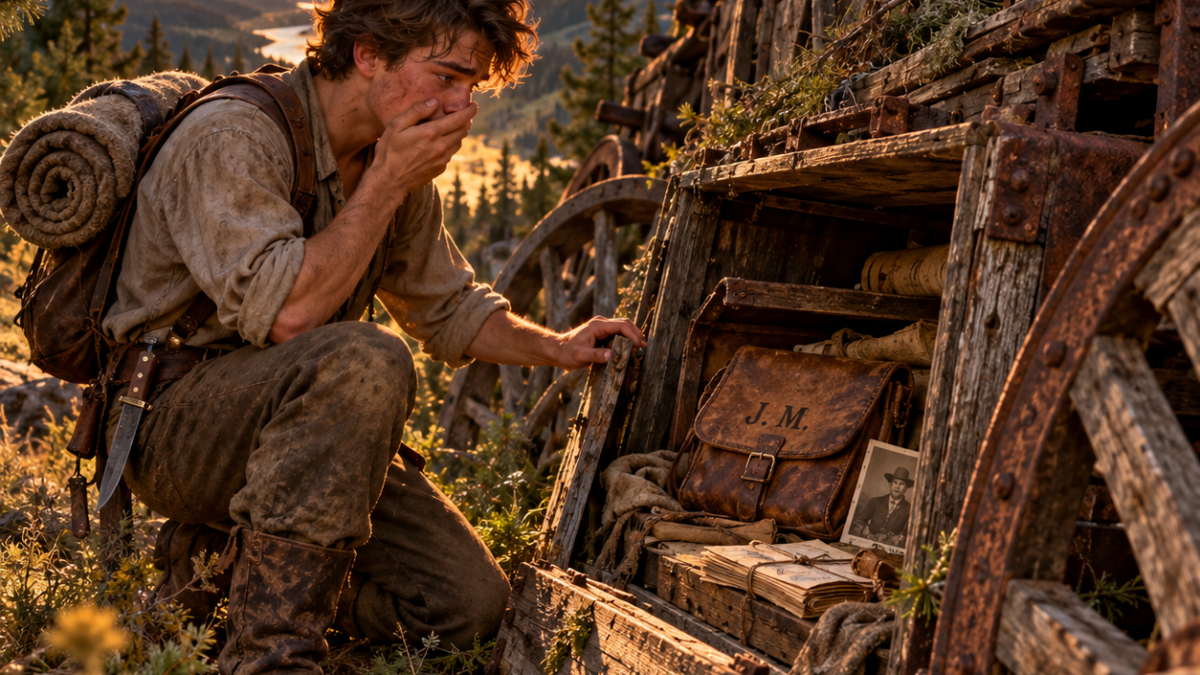
The letters were J.W.
Beneath them, cut into the rusted metal with something sharp, was the year 1879.
I stared at that date until my eyes began to water.
It was 1892.
The wagon had been lying in that ravine for thirteen years, not ninety.
And the initials belonged to my father.
James Walker.
For twelve years, I had lived with the same unanswered question: why had my father ridden away and never returned?
Now his initials were staring back at me from the wreckage of a freight wagon that somebody had apparently wanted the world to forget.
I leaned farther over the edge.
A handful of stones broke loose beneath my knee and clattered into the darkness. I jerked backward, catching myself against a pine root.
It was too steep to climb straight down, especially with night approaching.
But I could not walk away.
I found a narrow deer trail cutting diagonally along the mountainside. It led toward the bottom of the ravine, disappearing behind fallen timber and thorn bushes.
I tied my blanket tightly across my shoulders and started down.
Halfway to the bottom, the ground crumbled under my left foot.
I slid ten feet before catching a small tree with both hands.
My pocketknife dug painfully against my hip.
Below me, loose stones bounced through the ravine.
I stayed there until my hands stopped shaking.
Then I climbed the rest of the way carefully.
By the time I reached the wagon, the last sunlight was fading through the trees.
Up close, the wreck looked worse than it had from above.
One wheel had been torn from its axle. The driver’s bench was crushed. Thick tree roots had grown around the undercarriage, and the rear of the wagon had settled deep into wet earth.
Yet the cargo compartment had survived.
Its oak boards were almost black with age, and its corners were bound in heavy iron.
I ran my fingertips over the scratched initials.
J.W.
The letters were uneven, the second stroke of the W deeper than the others.
My father had carved his initials into the wooden handle of his knife in almost exactly the same fashion.
I pulled that knife from my pocket.
For the first time in twelve years, I felt something more frightening than the belief that my father had abandoned me.
I felt hope.
And I was terrified of what it might cost me.
I spent that night beneath the broken wagon.
I gathered pine needles for bedding, wrapped myself in my blanket, and built a small fire against the cold.
Sleep came in short, miserable stretches.
Every time I closed my eyes, I saw the iron door.
At dawn, I examined the cargo box again.
The rear doors were secured by a thick iron bar. Rust had fused the fastenings, and I could barely move them.
I searched the wreckage until I found a length of bent iron, then tried to pry the doors apart.
Nothing.
I worked for nearly an hour before admitting I needed a better tool.
Farther down the ravine, I discovered the remains of an old camp beneath a rock overhang.
A broken shovel leaned against the stone. Nearby lay a battered axe with a split handle.
The axe head was badly rusted, but its edge could still bite wood.
I bound the handle with strips torn from my spare shirt and returned to the wagon.
My first strike barely marked the oak.
The second sent pain shooting through my wrists.
I kept swinging.
By noon, my palms were blistered.
By evening, I had cut deeply enough into one board to expose a narrow opening.
I could smell old leather, damp wood, and something metallic inside.
I pushed my knife through the gap.
It struck an object.
Not loose cargo.
Something solid and square.
I enlarged the opening until I could reach through with one arm.
My fingers brushed a wooden crate.
Then another.
Then cold iron.
I worked until darkness forced me to stop.
The following morning, with my last strength, I drove the axe into the weakened plank and pulled.
The wood split.
A section broke inward.
I stumbled forward, catching myself against the iron frame.
For several seconds, I simply stared.
The cargo compartment was packed with old freight crates.
Several had collapsed under the weight of the wagon’s fall. One had split open, spilling bolts of ruined cloth and corroded tools.
But near the front stood a small iron strongbox.
It had been wedged beneath a heavy timber, sheltered from much of the moisture that had destroyed everything around it.
I crawled through the broken opening and dragged it toward me.
It was heavier than expected.
The lock refused to turn, and the lid was too solid to pry open with my knife.
I carried it outside and placed it on a flat stone.
Then I attacked the hinges with the axe.
It took more than an hour.
The final hinge gave way with a sharp metallic crack.
I pulled the lid back.
Inside were three canvas bags.
I loosened the cord around the first one.
Silver coins spilled into my palm.
I had never held so much money.
The coins were old, some blackened with age, but their stamped faces caught the sunlight.
I opened the second bag.
More silver.
The third was the same.
For a moment, I forgot my aching hands, my empty stomach, and the fact that I had been sleeping beneath a wrecked wagon.
Then I noticed the papers.
They were wrapped in oilcloth beneath the bags.
The first was a freight manifest.
The writing was faded but readable.
It listed several merchants, a banking office, and a shipment traveling from the eastern mining settlements toward a distribution station west of the mountains.
The date was September 1879.
I searched the page for my father’s name.
It wasn’t there.
Instead, the driver was listed as Thomas R. Bell.
My hope faltered.
Then I found another paper.
It was a handwritten note, folded into quarters and sealed inside a worn leather envelope.
The address on the outside made my breath catch.
To Mary Walker and our son Robert.
My mother’s name.
My name.
I sat down hard on the pine needles.
For years, I had imagined receiving a message like that.
I had imagined it so often that I knew exactly what I wanted it to say.
I’m sorry.
I’m coming home.
I never meant to leave you.
But I was afraid to open it.
My hands trembled as I unfolded the brittle paper.
The ink had faded in places, yet most of the words remained.
My dearest Mary,
If this letter reaches you without me, please understand that I did not choose to stay away.
There has been trouble on the mountain road. The men who arranged this shipment are not the men they claim to be.
I have taken precautions, but I fear someone knows what I discovered.
Tell Robert I kept my promise. Tell him I never stopped trying to come home.
I stopped reading.
The words blurred.
For a long time, I sat without moving.
Then I wiped my face with the sleeve of my shirt and continued.
I have placed the evidence where only someone who remembers our old journeys will think to look.
If the worst happens, ask Amos Bennett about the three pines.
He knows the road.
The letter ended with my father’s signature.
James Walker.
Beneath it was a short line written in smaller letters.
For Bobby, when he is old enough.
I could barely breathe.
Amos Bennett had raised me after my mother died.
He had taught me how to harness a team, how to read changing weather, and how to find my way when roads disappeared beneath snow.
He had also been the last person I knew who had worked alongside my father.
But Amos had died four years earlier.
Whatever he had known, he had carried to his grave.
Or so I thought.
At the bottom of the strongbox lay a little metal tin.
I opened it.
Inside was a brass compass.
Its glass was scratched. Its leather strap had hardened with age.
I turned it over.
Two initials had been carved into the back.
J.W.
And below them, almost too faint to see, were three tiny pine trees.
I remembered my father holding that compass in his palm.
I remembered asking why the needle always pointed north.
“Because it doesn’t care where you’re trying to go,” he’d told me. “It only tells you where you are.”
I closed my fingers around the compass.
My father had not simply disappeared.
He had left a trail.
And somehow, after twelve years, I had found the first piece of it.
The silver should have been the first thing on my mind.
Three heavy bags of coins were more money than I had ever seen. If I could carry them out of the ravine, I might never have to beg another ranch owner for employment.
But I hardly looked at them.
I kept reading my father’s letter.
One sentence troubled me.
The men who arranged this shipment are not the men they claim to be.
I turned back to the freight manifest.
Thomas R. Bell.
The name meant nothing to me.
Below it were the names of the companies responsible for the shipment, including a banking office in Gravel Fork.
One name caught my attention.
Harlan Mercantile and Freight.
I read it again.
Harlan.
The same name as the man who had dismissed me from the ranch.
It could have been a coincidence. Harlan was not an unusual surname in the territory.
But suddenly I remembered his expression when I told him about my stolen savings.
He had looked frightened.
Not angry.
Not surprised.
Frightened.
I folded the documents carefully and returned them to the oilcloth.
I needed answers.
And the only man I knew who might have possessed them was already dead.
I climbed out of the ravine that afternoon, carrying the compass, the letter, and a handful of silver coins.
I left the remaining money concealed inside the strongbox.
Taking the entire fortune would have been foolish. I did not know whom the silver belonged to, and I had no intention of walking into Gravel Fork carrying three bags of money that somebody might recognize.
Before leaving, I covered the opening in the wagon with loose boards and pine branches.
Then I marked the route with three small cuts on the trunk of a dead cedar.
By sunset, I was back at the general store.
The shopkeeper looked up from his ledger.
“You again?”
“I need to ask about Amos Bennett.”
His pen stopped moving.
“What about him?”
“You recognized his name yesterday.”
“Plenty of folks knew Amos.”
“Did you know my father?”
He studied my face.
“What’s your name, boy?”
“Robert Walker.”
For several seconds, he said nothing.
Then he closed the ledger.
“Come into the back.”
I followed him through a narrow doorway into a storage room stacked with flour sacks and wooden crates.
He shut the door.
“My name’s Samuel Price,” he said. “And I knew your father.”
I felt my throat tighten.
“What happened to him?”
Samuel pulled out a chair.
“Sit down.”
“I’d rather stand.”
He nodded slowly.
“Your father was driving freight through the mountains when he discovered that part of the cargo had been entered under false shipping records. He suspected somebody was using legitimate freight runs to hide stolen money.”
“Who?”
“Nobody ever proved it.”
“Did they find his wagon?”
“No.”
“Did they find him?”
Samuel looked down.
“No.”
I removed the compass from my pocket and placed it on the table.
His face lost its color.
“Where did you get that?”
“From a wagon at the bottom of the old freight trace.”
He picked up the compass with shaking fingers.
“I haven’t seen this in years.”
“Then you recognize it.”
“Your father carried it everywhere.”
I leaned forward.
“There’s a letter. He said Amos knew something about three pines.”
Samuel’s eyes moved toward the closed door.
“Did anybody see you come back from the mountains?”
“I don’t think so.”
“Did you tell anyone what you found?”
“Only you.”
He set the compass down carefully.
“Then keep it that way.”
“Why?”
“Because the last man who started asking questions about that freight run disappeared, too.”
“Who?”
“Amos Bennett.”
I stared at him.
“Amos didn’t disappear. He died.”
Samuel’s expression tightened.
“That’s what everybody was told.”
I barely slept that night.
Samuel let me stay in a small room above his store, but every creak in the building sent me reaching for my father’s knife.
Before closing, he had told me what he remembered.
Amos had spent years investigating the disappearance of my father’s wagon. He believed the freight company had falsified records after the accident.
Shortly before his death, Amos had visited Gravel Fork and asked Samuel whether he still possessed an old survey map.
“He wanted to locate a landmark known as the Three Pines,” Samuel explained.
“Did he find it?”
“I don’t know. He left before I could help him.”
“What happened afterward?”
“Two weeks later, a man came through town saying Amos had died of fever.”
That was true, at least in part.
I remembered Amos spending his final days in bed, struggling to breathe.
But I also remembered an argument outside the bunkhouse shortly before he became ill.
Two strangers had visited him.
Their voices had been low and angry.
At the time, I had been fifteen and too young to understand why Amos refused to tell me what they wanted.
Now those memories felt different.
The next morning, Samuel brought an old survey map upstairs.
He spread it across the table.
“This is the freight route before the county closed it.”
I followed the faded line through the mountains.
Near a bend above a narrow gorge, someone had drawn three small trees.
Beneath them was a handwritten notation.
Bennett Crossing.
“Amos’s family maintained that section of road,” Samuel said. “There’s supposed to be an old freight shelter nearby.”
“Where?”
He tapped the map.
“About four miles north of where you found the wagon.”
I reached for the compass.
Samuel stopped me.
“Robert, listen carefully. Finding old coins doesn’t mean they’re yours. And if those papers really describe stolen freight, there may be people with a legal interest in keeping the shipment buried.”
“Then I’ll take the evidence to the sheriff.”
“Eventually. But first we ought to find out what the papers actually prove.”
I looked at the map.
For twelve years, I had wondered whether my father had wanted to come home.
Now I knew he had.
What I did not know was whether somebody had prevented him.
We left Gravel Fork just after sunrise.
Samuel brought a horse, rope, lanterns, and a rifle. I carried my blanket and my father’s knife.
By midday, we reached Bennett Crossing.
The three pine trees stood on a narrow ridge overlooking the old road.
Two had grown together near their roots. The third leaned toward the ravine, its upper branches blackened by lightning.
Behind them was a collapsed stone shelter.
Samuel dismounted.
“Looks like nobody’s been here in years.”
I pushed aside a curtain of vines and stepped inside.
The shelter had once been large enough for two men and their equipment. Its roof was half gone, and weeds grew between the floorstones.
I searched beneath the broken remains of a wooden bench.
Nothing.
Then I remembered the compass.
Three pines had been scratched into its back.
I turned it toward the trees.
One pine leaned east. Two stood west.
I examined the floor.
Near the western wall, a stone lay slightly higher than the others.
I knelt and pulled at it.
It did not move.
Samuel brought the iron pry bar.
Together, we lifted the stone.
Beneath it was a shallow cavity lined with brick.
Inside rested a small leather satchel.
I reached down and pulled it free.
The leather was cracked, but its buckles had survived.
Inside were several folded papers and a notebook.
On the first page, written in a hand I recognized from my father’s letter, were the words:
Record of the September Freight Shipment.
I turned the page.
Names.
Dates.
Amounts.
And, beside each entry, a note explaining how legitimate freight payments had been diverted into private accounts.
Samuel leaned over my shoulder.
“Good Lord.”
Near the end, my father had written:
I refused to carry the altered manifest. Bell threatened to replace me, but his name was already on the papers. I believe he intends to make certain the shipment never reaches its destination.
The final entry was dated September 18, 1879.
If the wagon is destroyed, the records at Bennett Crossing may establish who arranged it. Amos has agreed to keep this location secret until I can get Mary and Bobby somewhere safe.
I read the last words again.
Until I can get Mary and Bobby somewhere safe.
My father had known we were in danger.
I could not make myself speak.
Then Samuel turned another page.
A list of payments appeared.
One name had been underlined.
Edward Harlan.
The ranch owner’s father.
“That doesn’t prove your employer knew anything,” Samuel said.
“I know.”
But I was no longer thinking clearly.
The man who had given me work, food, and a place to sleep might have been connected to the same family that my father had feared.
I thought of the missing twenty-three dollars and thirteen cents.
Then I thought of Harlan’s refusal to help me.
“Maybe he knew about the wagon,” I said.
“Maybe. But don’t mistake suspicion for proof.”
Samuel began examining the other documents.
One sheet described an arrangement between Thomas Bell and Edward Harlan to move funds outside the freight company’s accounts.
Another recorded the transfer of silver from several legitimate merchants.
“This money wasn’t all stolen from one person,” Samuel said. “Some came from payments entrusted to the carrier. Some may have belonged to mining suppliers.”
“Could anyone still claim it?”
“Possibly. Or their estates could. We need somebody qualified to examine the records.”
He folded the notebook.
“We go to the sheriff.”
I agreed.
But as we stepped outside, Samuel caught my arm.
Two horses stood below the ridge.
They had not been there when we arrived.
A moment later, a voice called from the trees.
“Robert Walker!”
I knew that voice.
It belonged to Harlan.
He stepped into the clearing with a shotgun resting across his forearm.
Beside him stood the ranch foreman, Caleb Moss.
Moss had been the man responsible for assigning bunkhouse beds and keeping track of hired hands.
He also had a habit of entering rooms without knocking.
I remembered discovering my tobacco tin empty.
My fingers closed around the compass.
Harlan looked at the open shelter, then at the satchel in Samuel’s hand.
“So it’s true,” he said.
Samuel took one step forward.
“Put down the gun, Harlan.”
“Don’t tell me what to do.”
“Then tell us why you’re here.”
Harlan ignored him.
He looked directly at me.
“Where’s the wagon, Robert?”
My stomach tightened.
“Why do you want to know?”
“Because that freight belonged to my father’s business.”
“According to these papers, your father helped steal part of it.”
Moss shifted beside him.
Harlan’s jaw clenched.
“You don’t understand what you’re holding.”
“Then explain it.”
For a moment, he looked less like the ranch owner who had commanded me for years and more like a frightened old man who had run out of places to hide.
“My father was a hard man,” he said. “He made deals I didn’t approve of.”
“Did you know about my father?”
Harlan looked away.
I stepped closer.
“Did you know what happened to James Walker?”
“Robert—”
“Answer me.”
His silence was worse than anything he could have said.
Moss suddenly moved forward.
“Give us the satchel.”
Samuel raised his rifle.
“Stay where you are.”
Moss stopped.
Harlan looked between them.
“Nobody needs to get hurt.”
“Then lower your shotgun,” Samuel said.
Harlan hesitated.
Finally, he turned the weapon toward the ground.
I could hear my own breathing.
“Was my father murdered?”
Harlan closed his eyes briefly.
“I don’t know.”
“Was he pushed off that road?”
“I don’t know that either.”
“Then what do you know?”
His answer came so quietly I almost missed it.
“My father received a letter saying Walker had discovered the altered accounts. After the wagon disappeared, Bell came to our house demanding more money.”
“What money?”
“Money to keep his mouth shut.”
Samuel’s face hardened.
“About the wreck?”
“About everything.”
I looked at Moss.
“And why are you here?”
He said nothing.
Harlan answered for him.
“Caleb followed you from Gravel Fork.”
“Why?”
“Because I asked him to.”
I felt something inside me settle into a hard, cold certainty.
“You knew I might find something.”
Harlan rubbed a hand over his face.
“When you asked about the old freight trace years ago, I thought you were just a boy missing his father. But when you left the ranch and headed west, I became afraid you’d heard something.”
I stared at him.
“You fired me.”
“The bank was taking the ranch.”
“You let me leave with less than two dollars.”
His eyes flickered toward Moss.
I turned.
“Did you steal my savings?”
Moss’s expression changed.
There was my answer.
“Twenty-three dollars and thirteen cents,” I said. “You took everything I had.”
“There’s no proof,” he snapped.
Samuel looked at Harlan.
“Did you order that?”
“No.”
Moss gave a harsh laugh.
“He told me to find out what Robert knew. I searched his belongings. The money was there, and I took it.”
“Why?”
“Because I figured he wouldn’t get far without it.”
My hands began to shake.
For three years, I’d trusted that man.
I had worked beside him, eaten at the same table, and obeyed his orders.
And he had robbed me while I was packing to leave.
Harlan looked sick.
“Caleb, give him back his money.”
Moss stepped backward.
“You’re not blaming this on me.”
He turned toward his horse.
Samuel lifted the rifle slightly.
“Don’t move.”
But Moss was already running.
He reached the horse, seized the saddle horn, and swung himself up.
I heard the hoofbeats before I understood what was happening.
He was riding directly toward me.
I jumped aside.
The horse struck my shoulder, knocking me against the stone wall.
The satchel fell from Samuel’s hands.
Moss leaned down and snatched it.
Then he drove his heels into the horse and disappeared down the ridge.
Samuel fired once into the air, but Moss did not stop.
Harlan stood frozen.
I pushed myself upright, clutching my bruised shoulder.
“He has the evidence.”
Samuel was already mounting his horse.
“Not all of it.”
He reached inside his coat.
Before leaving the shelter, he had slipped several loose pages into his pocket.
The notebook was gone, but the records showing the disputed payments remained.
Still, the notebook contained my father’s final written account.
I could not lose it.
I ran toward the other horse.
Harlan caught my arm.
“Robert, don’t.”
I pulled away.
“You’ve spent twelve years keeping quiet. I’m finished doing the same.”
I mounted.
Samuel followed.
We rode down the narrow trail, following the fresh hoofprints through the trees.
For nearly an hour, we saw nothing.
Then we heard shouting.
At the next bend, Moss’s horse stood riderless beside a fallen tree.
The animal was trembling.
Farther down the slope, Moss clung to a narrow shelf of rock.
The satchel lay above him, caught beneath a root.
He had tried to take a shortcut and lost his footing.
Below him was a drop of nearly forty feet.
“Help me!” he shouted.
I dismounted.
For one terrible moment, I considered leaving him there.
He had stolen my money, betrayed my trust, and nearly trampled me.
But then he looked up.
His face was gray with fear.
“Robert, please!”
Samuel brought the rope.
Together, we secured it around a pine trunk.
I lowered myself far enough to throw Moss the free end.
“Put it around your waist!”
He struggled to tie it.
“Pull!”
We dragged him onto solid ground.
He collapsed beside the trail, gasping.
I picked up the satchel.
“Was it worth it?”
He stared at the ground.
I waited.
Finally, he said, “Harlan promised he’d pay me if I brought back whatever you found.”
Behind us, Harlan had arrived on foot.
“I never told you to steal anything.”
Moss looked up.
“You told me to make sure those papers didn’t reach the sheriff.”
Harlan said nothing.
The silence was enough.
We brought them both to Gravel Fork.
Samuel insisted that the sheriff take possession of the papers immediately.
The sheriff, a broad-shouldered man named Daniel Mercer, listened without interruption as we explained the discovery.
He examined the compass, the letter, and the surviving freight records.
Then he asked me a question I had not expected.
“Why didn’t you bring the silver?”
“Because I didn’t know who owned it.”
He nodded.
“Good answer.”
He took our statements and arranged to secure the wagon with two deputies.
Moss was detained after admitting he had taken my savings. He also confessed that Harlan had paid him to watch me after I left the ranch.
Harlan denied ordering the theft or the attack on the ridge.
He did, however, admit that his father had been involved in the freight business and that his family had received demands for money after the wagon vanished.
The sheriff did not arrest him that evening.
“There are things here that need proving,” he told me. “And some of the people involved have been dead a long time.”
I understood.
But understanding did not make the waiting easier.
That night, Samuel found me sitting outside the store with the compass in my palm.
“You’re thinking about the wagon,” he said.
“I’m thinking about the fact that my father knew someone wanted him dead.”
Samuel sat beside me.
“Your father was stubborn.”
“People keep telling me that.”
“He was also careful. Those records weren’t hidden by accident.”
I looked down at the compass.
“Then why didn’t he come home?”
Samuel did not answer.
And for the first time, I realized that finding the wagon might not give me the answer I wanted.
Three days later, the sheriff returned from the ravine.
The strongbox and its contents had been transported under guard.
A local banker counted the silver while Samuel and two merchants witnessed the inventory.
The coins amounted to a little over $1,900.
To a nineteen-year-old who had left the ranch with $1.87, it might as well have been a mountain of gold.
But the sheriff made it clear that the money would remain in custody while ownership was investigated.
Several names on the manifest belonged to businesses that had long since closed.
Others were connected to families still living in the region.
I made no claim to the silver.
What I wanted was the truth about my father.
The sheriff had also examined the wreck itself.
He came into Samuel’s store carrying a small cloth bundle.
“Robert, I found something you should see.”
He unwrapped it.
Inside lay a broken metal harness fitting and a rusted revolver.
“The revolver was beneath the driver’s bench,” he said. “It had been fired.”
I felt my stomach tighten.
“Can you tell who fired it?”
“No.”
“Can you tell whether my father was shot?”
“No. We found no remains that we could positively identify.”
I stared at the weapon.
The absence of remains was neither proof of life nor proof of death.
It was another question.
Then the sheriff removed a small piece of leather.
It had once been part of a saddlebag.
Burned into the leather were the initials J.W.
“We found this caught beneath the front axle.”
I recognized it immediately.
My father had kept his writing materials in a saddlebag marked with those letters.
I remembered sitting beside him as a child while he sharpened a pencil with the same pocketknife I now carried.
“What do you think happened?” I asked.
The sheriff hesitated.
“I think the wagon left the road at considerable speed. Whether that was an accident or deliberate, I cannot yet say.”
“Someone could have forced it over.”
“Yes.”
“Someone could have survived.”
“Possibly.”
I hated that word.
Possibly.
For twelve years, my entire life had been built around it.
The breakthrough came from an unexpected place.
A week later, an elderly woman arrived at Samuel’s store carrying a small wooden box.
Her name was Eleanor Bell.
She was the widow of Thomas Bell’s younger brother.
When the sheriff contacted surviving relatives connected to the freight company, she had recognized the missing shipment.
“I was seventeen when that wagon vanished,” she told us. “I remember the arguments.”
She placed the box on the table.
Inside were letters.
Some were written by Thomas Bell.
Others had been addressed to him.
She removed one from its envelope.
“This was found among my husband’s belongings after he died. I never knew what to make of it.”
The letter had been written three months after the wagon disappeared.
Its author was Thomas Bell.
Walker did not die where we expected him to.
I stopped breathing.
Eleanor continued reading.
He was seen alive near the northern crossing. The driver we placed in charge of the shipment failed to secure the wagon, and the money is lost.
I gripped the edge of the table.
“Read that again.”
She did.
Walker did not die where we expected him to.
My father had survived the wagon’s disappearance.
At least for a time.
The next sentence destroyed the fragile hope forming inside me.
We cannot allow him to reach his family. He has copies of the accounts and knows enough to ruin us.
I looked toward the sheriff.
“That sounds like a threat.”
“It is,” he said quietly.
Eleanor turned the page.
“The letter mentions a man hired to follow him.”
“What man?”
She read the name.
“Isaac Danner.”
Samuel stood so abruptly that his chair scraped across the floor.
I looked at him.
“You know him?”
He nodded slowly.
“Danner worked as a hired guard on the freight roads. He disappeared from the territory years ago.”
“Where did he go?”
Samuel hesitated.
“South, last I heard.”
The sheriff took the letter.
“If he’s still alive, we may be able to find him.”
I looked at the compass.
For the first time, I had proof that my father had not simply vanished in the wreck.
He had escaped.
But somebody had been hunting him.
The following weeks were the longest of my life.
The sheriff sent inquiries to neighboring counties and freight stations.
Samuel helped identify the merchants named in the documents.
The surviving records showed that the missing shipment had been used to conceal money taken through fraudulent accounting.
Edward Harlan and Thomas Bell had arranged much of the scheme.
My father had discovered discrepancies while transporting legitimate freight and refused to approve the altered paperwork.
The wagon had gone over the ravine after the men responsible attempted to seize the records.
But one question remained unanswered.
What had happened after my father escaped?
Then, near the end of October, a letter arrived from a county office nearly two hundred miles south.
A man named Isaac Danner was living under his own name outside a small mining town.
He was sixty-three years old.
And he had agreed to speak with the authorities.
I asked to accompany Sheriff Mercer.
At first he refused.
“This isn’t something a nineteen-year-old ought to handle alone.”
“I’m not going alone.”
He looked at me for a long moment.
Then he sighed.
“You stay quiet while I question him. Understood?”
I nodded.
It was the longest journey I had ever taken.
We traveled by wagon and stagecoach, stopping at small towns along the way.
Every mile brought me closer to a man who might know whether my father had died frightened, alone, or still trying to return to us.
I rehearsed questions in my head.
Did he suffer?
Did he say my name?
Did he know my mother was waiting?
But when we finally reached Danner’s house, every question disappeared.
He was sitting outside beneath a cottonwood tree.
His hair was white, and one side of his face sagged slightly from an old injury.
When he saw me, his expression changed.
He stared at my eyes.
Then he whispered, “James?”
I stopped.
The sheriff stepped forward.
“This is Robert Walker.”
Danner’s hands began to tremble.
“His boy?”
“Yes.”
He closed his eyes.
For several seconds, he said nothing.
Then he looked at me again.
“I knew this day might come.”
We sat inside his small house while the sheriff took notes.
Danner’s wife brought water, then quietly left the room.
The old man kept looking at my father’s compass.
“I remember that thing,” he said. “He used to check it even when he knew the road.”
I placed it on the table.
“Tell me what happened.”
Danner rubbed his hands together.
“I was hired to stop Walker before he reached the western station. Bell told me Walker had stolen company records. Said he was taking money from the shipment.”
“Did you believe him?”
“At first.”
“What happened?”
“We caught up with the wagon near the mountain bend. Bell’s driver was trying to turn the team around. Walker was arguing with him.”
Danner swallowed.
“One of the men pulled a pistol. Walker jumped down from the wagon. There was a struggle, and the horses bolted.”
I pictured the deep ruts cutting straight toward the ravine.
“The wagon went over?”
“Yes.”
“And my father?”
“He wasn’t inside.”
I leaned forward.
“Where was he?”
“He’d fallen onto the road. Hurt his leg badly.”
The sheriff made a note.
“Then what?”
Danner stared at the floor.
“Bell’s men wanted to finish him. I stopped them.”
“Why?”
“Because by then I had heard enough to know Walker wasn’t the thief.”
My heart was pounding.
“Did you help him?”
“I got him onto a horse and took him to a camp near the northern crossing.”
“Was he alive when you left?”
“Yes.”
“Then where did he go?”
Danner looked up.
“He wanted to get home.”
I closed my eyes.
For twelve years, I’d imagined my father riding away because he had found a better life somewhere else.
Now I pictured him injured, hunted, and trying desperately to reach us.
“Why didn’t he?” I whispered.
Danner’s voice broke.
“Because Bell wasn’t finished.”
Danner told us the rest.
My father had remained hidden for several days while his injured leg healed enough for him to travel.
During that time, he had returned secretly to Bennett Crossing and placed copies of the freight records in the stone shelter.
He had written the letter to my mother, intending to send it through a trusted driver.
But Bell had learned that he was still alive.
Danner received orders to deliver Walker to a remote station.
Instead, he warned my father and helped him escape south.
“Did you ever see him again?” I asked.
Danner hesitated.
“Once.”
My throat tightened.
“Where?”
“At a freight depot near Red Mesa. He was working under another name.”
“Why?”
“He said Bell still had men looking for him. He was trying to earn enough money to send for your mother and you.”
I stared at him.
“Did he know my mother had died?”
Danner shook his head.
“No.”
I turned away.
My mother had spent her last years believing her husband might return.
My father had spent those same years believing he could still bring us together.
They had been separated by fear, lies, and men who valued money more than human lives.
“What name was he using?” the sheriff asked.
“John Mercer.”
The sheriff frowned.
“Mercer?”
Danner nodded.
“No relation to you, I suppose.”
The sheriff shook his head.
“None that I know of.”
I looked back at Danner.
“When did you see him?”
“Spring of 1881.”
Eleven years earlier.
I had been eight.
“Did he say where he was going?”
“West. He’d heard there was work near the railroad construction camps.”
My chest tightened.
“Is he still alive?”
Danner looked at me for a long time.
“I don’t know, son.”
It was the answer I had dreaded.
Another trail ending in darkness.
But before we left, Danner reached beneath his chair and brought out a small bundle tied with string.
“Walker gave me this when we parted. Asked me to keep it in case anyone came looking.”
Inside was a folded paper.
On it, in my father’s handwriting, were several lines addressed to me.
Bobby, if you are reading this, then someone finally found the truth.
I have not forgotten you.
I have not forgotten your mother.
There is nothing I want more than to come home.
If I cannot, remember that the worst thing a man can lose is not his money or his land, but the people who trust him.
I pray you will understand why I stayed away until I could make the road safe.
I held the paper against my chest.
And for the first time since I was seven years old, I cried without trying to hide it.
The investigation did not end there.
The sheriff continued examining the freight fraud, while Danner provided a sworn statement describing the conspiracy and the violence surrounding the missing wagon.
Thomas Bell had died years earlier, as had Edward Harlan.
Neither could face trial.
But the evidence forced their surviving business associates to answer questions that had been ignored for more than a decade.
In Gravel Fork, Harlan’s reputation collapsed when the truth about his father’s business dealings became public.
He had not planned the original freight theft. He had been a young man when it occurred.
But he admitted that he had inherited records suggesting his father had been involved.
Instead of turning them over, he had concealed them.
He had feared that exposing the scandal would destroy the family business and make the ranch impossible to keep.
That fear had led him to hire Moss to follow me.
Moss, already facing charges for stealing my savings, admitted that Harlan had ordered him to retrieve any documents I discovered.
Harlan insisted he had never intended for anyone to be hurt.
I believed he was telling the truth about that much.
But it did not excuse what he had done.
When I finally faced him in the sheriff’s office, he looked older than I remembered.
“Robert,” he said, “I never wanted any of this.”
I placed my father’s letter on the desk.
“He wanted to come home.”
Harlan looked at the paper.
“I know.”
“You knew he hadn’t abandoned us?”
He lowered his eyes.
“I suspected.”
My voice rose.
“And you watched me grow up believing he had?”
He did not answer.
I stepped closer.
“My mother died waiting for him.”
His face tightened.
“I was afraid of what would happen if the truth came out.”
“It happened anyway.”
He looked at me.
For once, he had no order to give, no excuse that would change my mind.
I took the letter and walked out.
Moss eventually repaid the money he’d stolen, and the court imposed additional penalties for his theft and his attempt to take the evidence by force.
Harlan faced legal proceedings connected to his efforts to obstruct the investigation. The evidence of his father’s original fraud also complicated the disposition of the family’s remaining business assets.
The ranch was sold to satisfy outstanding debts.
I did not celebrate.
For years, that place had been the closest thing I had to a permanent home.
Watching it pass into another man’s hands hurt more than I expected.
But I no longer wanted to return to a place where the people I trusted had concealed the truth about my father.
The silver from the wagon remained under official control while the sheriff and local authorities worked to identify rightful claimants.
Eventually, portions were assigned to documented claims, while other amounts remained disputed.
I received nothing simply for discovering it.
That disappointed several people who had assumed I would become rich overnight.
But the money was never what kept me awake.
What I wanted was one more answer.
And I finally had a place to look.
In the spring of 1893, Samuel helped me arrange transportation west toward the old railroad construction towns.
We carried copies of the records Danner had provided, along with descriptions of my father.
At every freight station, I asked the same question.
“Did a man named John Mercer work here?”
Usually, the answer was no.
Sometimes an old teamster would remember someone vaguely matching his description.
A few remembered a man with an injured leg.
But the railroad had moved on, workers had scattered, and records had been lost.
After six weeks, our money was running low.
Samuel suggested returning to Gravel Fork.
I was ready to agree.
Then we reached a town called Dry Creek.
There, an elderly station agent studied the letter in my hand.
“John Mercer,” he murmured.
He opened an old ledger.
“Worked here in ’82. Maybe ’83.”
I leaned across the counter.
“Where did he go?”
The agent traced a finger along the page.
“Transferred to a supply station farther west.”
“Which station?”
He squinted.
“Willow Springs.”
I felt the familiar surge of hope.
“How far?”
“Two days by wagon.”
Samuel looked at me.
We had already spent weeks following uncertain leads.
But neither of us suggested turning back.
Willow Springs was little more than a collection of buildings beside a rail siding.
We arrived late in the afternoon.
The station manager, a woman named Clara Whitcomb, listened carefully as I described my father.
“John Mercer?” she repeated.
“Yes.”
“Do you have a picture?”
I shook my head.
She studied the handwriting on the letter.
Then her expression softened.
“I knew a man by that name.”
I gripped the counter.
“Where is he?”
She did not answer immediately.
Instead, she led us toward a small house near the edge of town.
Each step felt heavier than the last.
I had spent years imagining the moment I might see my father again.
I had imagined running toward him.
I had imagined being angry.
I had imagined asking why he never came home.
But as we approached the house, I felt only fear.
Clara stopped beside a wooden gate.
“He lived here for several years,” she said.
“Lived?”
She looked at me.
“He died last winter.”
I felt the world narrow.
The gate, the porch, the dusty road behind us—everything seemed to move farther away.
I had found him.
And I was too late.
Clara led us inside.
The house belonged to a retired railroad worker named Henry Collins, who had been my father’s friend.
Henry was a quiet man with rough hands and a bad cough.
When Clara explained who I was, he stared at me for a long time.
“You’re Walker’s boy?”
I nodded.
Henry removed his hat.
“Your father talked about you all the time.”
I sat down because my legs would no longer hold me.
Henry told me that my father had reached Willow Springs after years of moving between freight camps.
His injured leg had never healed properly.
He worked whenever he could, first repairing harnesses and wagons, then keeping records for the station.
He sent letters east.
Many came back undelivered.
Others disappeared.
Eventually, he heard that the old ranch had changed hands and that my mother had died.
“That nearly destroyed him,” Henry said.
I stared at the floor.
“He thought you might have been sent away. He kept trying to find you.”
“Why didn’t he go back himself?”
Henry looked toward the window.
“By then, he was sick. His leg gave him trouble, and his lungs were failing. He kept saying he’d make one more trip when he was strong enough.”
My throat tightened.
“He never did.”
Henry shook his head.
“No.”
Then he rose and crossed to a small wooden cabinet.
He returned carrying a box.
“Your father asked me to keep this.”
Inside were several letters.
All addressed to Robert Walker.
Some were short.
Others filled several pages.
There were descriptions of places he had traveled, people he had met, and the work he had done.
There were stories about my mother.
Memories of our old home.
Questions about whether I still liked horses.
Whether I’d grown tall.
Whether I remembered the little wooden wagon he had made for me when I was five.
At the bottom of the box was one final letter.
The date was December 1892.
Only a few months earlier.
I unfolded it carefully.
My dear Robert,
I do not know whether these words will ever reach you.
I have spent too many years believing that one more season of work, one more journey, or one more piece of evidence would allow me to return safely.
Perhaps I was wrong to wait.
Perhaps I should have risked everything and come home the first time I had the chance.
That is a burden I have carried for years.
But I want you to know that I never left because I wanted another life.
The life I wanted was with you and your mother.
If you are grown now, I hope you have become a better man than I was.
I hope you have found people you can trust.
And I hope that somewhere, on some clear morning, you can stand beneath an open sky and know that your father loved you.
Always,
Dad.
I read the letter three times.
Then I folded it and pressed it against my forehead.
For twelve years, I had needed to hear those words.
Now I had them.
And the man who wrote them was gone.
Henry took me to my father’s grave the following morning.
It stood beneath a cottonwood tree beyond the edge of town.
The marker was simple.
James Walker
1848–1892
Beneath his name were the words:
Beloved husband and father.
I knelt beside the grave.
For a long time, I could not speak.
Then I pulled the brass compass from my pocket and opened it.
The needle swung gently before settling north.
“I found your wagon,” I whispered.
The wind moved through the cottonwood leaves.
“I found the letters, too.”
I swallowed.
“I’m sorry I thought you left us.”
I had carried that anger for so many years that I did not know what to do without it.
I wanted to tell him about the ranch.
About Amos.
About the day I’d discovered my savings were gone.
About Samuel and the sheriff and the men who had finally been forced to answer for what they had done.
But most of all, I wanted to tell him that I had grown up.
That I had become strong enough to cross mountains alone.
That I still remembered his voice.
I placed my hand against the grave marker.
“I wish you’d come home, Dad.”
It was the only thing I could say.
I stayed in Willow Springs for several months.
Henry offered me work repairing freight equipment and caring for the station horses.
I accepted.
For the first time since leaving Harlan’s ranch, I had a steady income and a place to sleep without wondering whether somebody would send me away the next morning.
Samuel eventually returned to Gravel Fork.
Before leaving, he shook my hand.
“Your father would have been proud of you.”
I looked away.
“I don’t know about that.”
Samuel gripped my shoulder.
“He’d have been proud that you kept going. And he’d have been grateful you found the truth.”
After he left, I continued working.
I saved money.
I repaired wagons.
I learned to manage freight accounts, partly because I wanted to understand the kind of records my father had died trying to preserve.
Within a year, I had enough saved to purchase a small wagon and two dependable horses.
I started hauling supplies between Willow Springs and nearby ranches.
It was not a grand business.
Some weeks, the work barely covered feed and repairs.
But it belonged to me.
Every dollar I earned was accounted for.
Every shipment was recorded honestly.
And every evening, I placed the day’s earnings inside a blue tobacco tin.
The same dented tin that had once held only eighty-seven cents.
Two years after I first found the wreck, a letter arrived from Sheriff Mercer.
The investigation into the freight fraud had finally been closed.
The authorities had settled the remaining ownership questions as far as the surviving evidence allowed.
Most of the recovered silver had been distributed according to documented claims.
A portion connected to my father’s unpaid freight wages and legitimate earnings had been established separately.
After reviewing the records, the responsible parties agreed to release that amount to his surviving heir.
Me.
It was not the fortune people had imagined.
But it was enough to help expand my freight business.
I used part of it to purchase a second wagon.
Another portion went toward a small house near the station.
And with the rest, I paid for a proper stone marker at my father’s grave.
I never became the richest man in the territory.
I never wanted to.
By the time I turned twenty-three, I had three wagons, six horses, and four men working for me.
I made one rule that every employee understood.
Nobody who worked for me would be dismissed without the wages he had earned.
And nobody would have to hide his savings beneath a mattress because he feared the men sleeping beside him.
I returned to Gravel Fork once more in the autumn.
The ranch where I had grown up had a new owner.
The barn had been repaired.
The pastures were full again.
Harlan no longer lived there.
I heard that he had moved east to stay with relatives after the sale.
Moss had left the territory after completing his sentence and paying his debts.
I did not try to find either of them.
The road that led to the old freight trace was still overgrown.
I followed it on horseback until I reached the bend above the ravine.
The wreck remained below, surrounded by pines.
The iron strongbox was gone.
The cargo compartment had been opened and examined.
But the wagon itself still rested where it had fallen.
I stood at the edge and looked down.
Years earlier, I had arrived there exhausted, hungry, frightened, and angry at the world.
I had believed I possessed nothing.
No money.
No family.
No home.
Yet hidden beneath those trees had been the answers to questions that had shaped my entire childhood.
I took out the compass.
Its brass case had been cleaned, but the initials remained.
J.W.
My father’s initials.
I turned it over and traced the three little pine trees with my thumb.
Then I remembered something Amos had once told me when I was a boy.
“Your father always said a good road can take you home, but a hard road tells you who you are.”
At the time, I had thought it was just another saying from an old teamster.
Standing there, I finally understood why Amos had remembered it.
I closed the compass and slipped it into my pocket.
That winter, I moved into my own house.
It wasn’t large.
There were two bedrooms, a kitchen with a cast-iron stove, and a small front porch overlooking the road.
On the first evening, after putting the horses away, I sat at the kitchen table with my father’s letters.
I read them one final time before placing them inside a wooden box.
Beside them, I laid the pocketknife he had given me.
The blade had been sharpened so many times that it was noticeably narrower than when I first carried it.
But the handle was still solid.
Then I opened the blue tobacco tin.
Inside were twenty-four silver dollars.
Exactly the amount I had once believed was my entire future.
I had saved them deliberately.
Not because I needed to hide them.
But because I wanted to remember the day I learned how quickly a life could be stripped away—and how much could still be rebuilt.
I closed the tin and placed it beside the letters.
Then I stepped outside.
The evening sky was clear.
My horses stood quietly near the fence.
Farther down the road, a freight wagon rolled toward the station, its lantern swinging beneath the driver’s bench.
For a moment, the sound of its wheels reminded me of the stories my father used to tell.
I could almost hear him laughing.
I could almost feel his hand resting on my shoulder.
I reached into my pocket and opened the brass compass.
The needle turned.
Then it settled.
North.
I looked west toward the mountains where the old freight trace disappeared into the trees.
I had walked into those mountains believing I was searching for work.
Instead, I had found the truth about the man I thought had abandoned me.
The silver helped me build a business.
The letters gave me back my father’s love.
And the compass became the one possession I carried every day for the rest of my life.
I stood on my porch until the wagon disappeared down the road.
Then I went inside, placed the compass beside my father’s letters, and closed the door of the first home that was truly mine.
[END OF STORY]

