PART 2: Fake HOA Cops Threatened to Arrest Me Over 500 Gallons of Gas — They Had No Idea I Was an FBI Agent
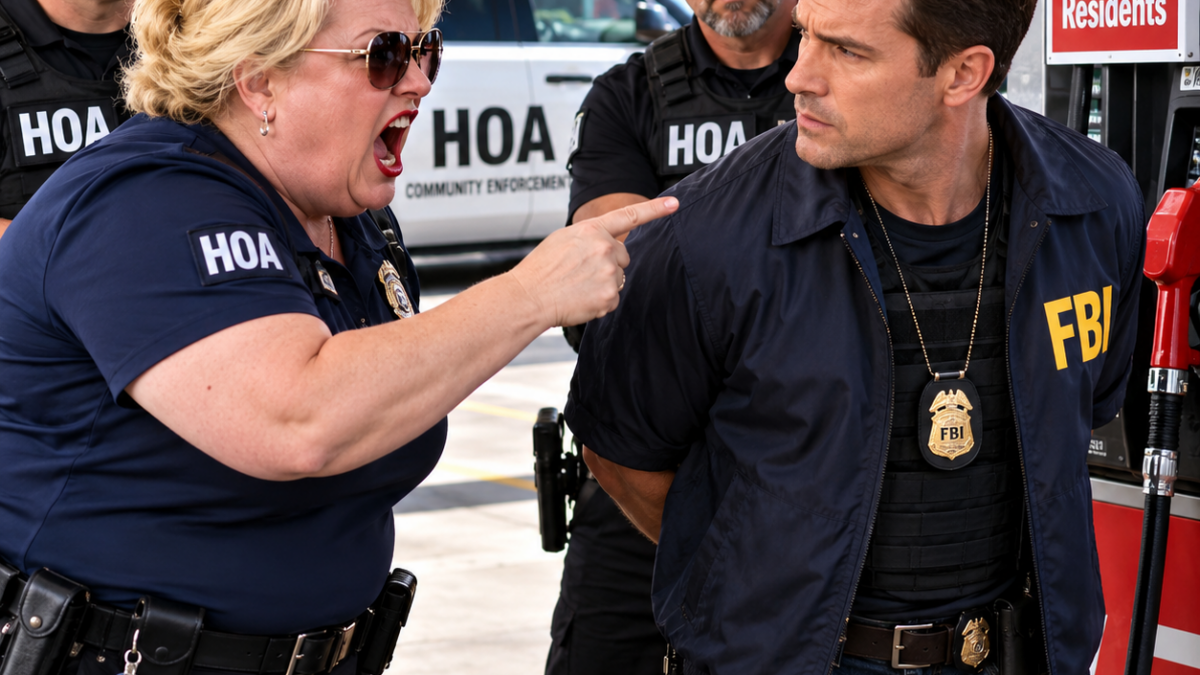
THREE MEN THOUGHT THEY COULD TAKE WHAT BELONGED TO ME SIMPLY BY PUTTING ON A UNIFORM.
THEY HAD ALREADY CONVINCED MY NEIGHBORS I WAS DANGEROUS, AND NOW THEY WERE STANDING AT MY FRONT DOOR.
BUT ONE SMALL DETAIL IN THEIR PERFECTLY REHEARSED PERFORMANCE TOLD ME THIS WAS ABOUT TO BECOME SOMETHING MUCH BIGGER.
The doorbell rang at exactly 10:14 on a Tuesday morning.
I remember the time because I had just glanced at the clock above my desk, wondering whether I had enough coffee left to get through another stack of financial records.
Outside, the Arizona sun was already turning the neighborhood sidewalks white with heat.
Inside, my house was quiet.
That quiet was one of the reasons I had bought the place eight months earlier.
After twelve years working for the FBI, I had learned to appreciate ordinary mornings. No emergency phone calls. No tense interviews. No witnesses looking over their shoulders.
Just a small house in Ridgewood Estates, a cup of black coffee, and the comforting knowledge that whatever chaos existed beyond my front door didn’t have to follow me home.
At least, that was what I had believed.
The doorbell rang again.
Three short presses.
Impatient.
I pushed my chair away from the desk and walked toward the front entrance.
Through the peephole, I saw two men standing on my porch.
Both wore dark-blue uniforms. Both had badges pinned to their chests. One was tall and broad-shouldered, with a carefully trimmed beard. The other was shorter, heavier, and kept one hand resting near his utility belt.
Behind them, parked along the curb, was a black Ford Explorer.
At first glance, they looked like law enforcement officers.
At second glance, something was wrong.
I opened the door halfway.
“Can I help you?”
The taller man stepped forward without introducing himself.
“Sir, we’re here regarding a community safety complaint. We need to inspect your property.”
His voice carried that familiar tone of practiced authority.
Not a request.
An instruction.
“What kind of complaint?” I asked.
“Unauthorized hazardous fuel storage.”
I looked past him toward the driveway.
“My fuel tank?”
“That’s correct. We’ve received reports that you’re storing approximately five hundred gallons of gasoline in violation of community safety regulations.”
The shorter man shifted closer.
“We need access to your garage. This shouldn’t take long.”
I studied their uniforms.
The badges were generic shields. Their shoulder patches lacked the official county emblem. Neither man had a visible department identification number.
And the shorter man’s holster was positioned where anyone approaching the house would notice it.
That detail bothered me more than anything else.
They wanted to be mistaken for police officers.
“Which department are you with?” I asked.
The tall man hesitated.
Only slightly.
“We’re authorized by the homeowners association.”
“That wasn’t my question.”
His partner frowned.
“Sir, we’re not here to argue.”
“Neither am I. Are you Phoenix police officers or Maricopa County sheriff’s deputies?”
“We handle community security matters.”
“Then show me your identification.”
Neither man moved.
Instead, the shorter one took another step toward my doorway.
“Look, this can be handled the easy way. We inspect the tank, make sure everything is safe, and everybody gets on with their day.”
“And the hard way?”
His jaw tightened.
“You don’t want to find out.”
For a moment, nobody spoke.
I could hear a sprinkler running somewhere across the street.
A delivery truck passed behind their SUV.
Everything looked perfectly ordinary.
That was the disturbing part.
My fuel tank was legal. It had been professionally installed, reviewed, and approved by the appropriate fire authorities months before.
I had the paperwork to prove it.
The five hundred gallons were an emergency reserve I had purchased with my own money, primarily because summer power interruptions had become increasingly common.
I wasn’t selling fuel.
I wasn’t operating a business.
And I certainly wasn’t required to give it away.
“I’ll ask you one more time,” I said calmly. “Do you have a warrant or any legal authorization to enter my garage?”
The taller man straightened.
“We don’t need a warrant for an HOA safety inspection.”
“You’re mistaken.”
His expression hardened.
“Are you refusing to cooperate?”
“I’m refusing unauthorized entry onto my property.”
The shorter man glanced at his partner.
Something passed between them.
Frustration, perhaps.
Or the realization that their usual approach wasn’t working.
“You’re making a mistake,” the shorter man said.
“Then you’re welcome to explain it to an actual police officer.”
That ended the conversation.
The taller man stepped backward.
“We’ll be reporting your refusal.”
“Be sure to include the part where you wouldn’t identify yourselves.”
I closed the door.
For several seconds, I stood perfectly still, listening to their footsteps retreat.
Then I heard the shorter man speak.
“Call Victor. Tell him this guy isn’t cooperating.”
A car door slammed.
The engine started.
And the black Explorer pulled away.
I walked to the front window.
Across the street, an elderly neighbor stood on her porch watching my house.
When she noticed me looking, she quickly turned away.
I didn’t know what Victor wanted.
I didn’t know how many people were involved.
But I understood one thing.
Those men hadn’t come to inspect anything.
They had come to see whether I could be frightened.
And somewhere in Ridgewood Estates, someone was about to discover that choosing my house had been a very serious mistake.
PART 2
THE MAN BEHIND THE UNIFORMS
I didn’t immediately call my supervisor.
I didn’t pull out my federal credentials and chase the black Explorer down the street.
And I certainly didn’t announce to the neighborhood that the two men had picked the wrong homeowner.
Instead, I did what twelve years of investigative work had taught me to do.
I preserved what I had.
My doorbell camera had recorded the entire encounter.
The footage showed both men’s faces clearly, their uniforms, their badges, and the threats they had made.
A second camera above my garage had captured the Explorer’s license plate.
I downloaded both recordings, saved backup copies, and wrote down everything I remembered while the conversation was still fresh.
Then I checked the paperwork for my fuel tank.
Permit issued.
Inspection completed.
Installation approved.
Nothing had changed.
The tank was a professionally installed emergency backup system, and every applicable requirement had been reviewed before I ever stored a gallon of fuel.
I had purchased the property after years of moving from one temporary assignment to another. I wanted a place where I could finally unpack the boxes that had followed me across the country.
I had planted two desert willow trees in the front yard.
Bought a battered wooden bench at an estate sale.
And turned the spare bedroom into an office where I could occasionally work on authorized assignments without driving across Phoenix.
It wasn’t a mansion.
It wasn’t particularly impressive.
But it was mine.
That meant something to me.
My father had spent almost forty years working as an electrician. We never had much money when I was growing up, but he taught me that a home was more than a roof.
“A person ought to be able to close his own front door and feel safe,” he used to say.
He died six years before I bought the house.
Sometimes, when I sat on the porch in the evening, I imagined what he would think of it.
He would probably complain that I’d paid too much.
Then he’d spend the next three hours checking the wiring.
I smiled at the thought.
But the smile disappeared when I replayed the video.
The shorter man had said something very specific.
This can be handled the easy way.
People who make legitimate safety complaints generally explain the problem.
People who want your property often begin by explaining what will happen if you don’t cooperate.
That distinction bothered me.
I began looking into Stanton Security Consulting, the company name associated with the vehicle.
The business had operated in the Phoenix area for years.
Its owner was Victor Stanton.
Former Phoenix police sergeant.
Thirty years in law enforcement.
Retired in 2014.
The company advertised residential security, property monitoring, and specialized community compliance services.
That last phrase caught my attention.
Community compliance services.
There was nothing inherently improper about a private security business helping an HOA.
But private employees couldn’t simply turn themselves into police officers because a homeowners association wanted something done.
And they certainly couldn’t threaten to detain residents for refusing an unauthorized inspection.
Victor’s name appeared in another place.
The Ridgewood Estates HOA directory.
Victor Stanton — Vice President, Community Safety.
I stared at the screen.
The same man owned the security company and held a leadership position in the association that had supposedly authorized the inspection.
That was an interesting arrangement.
Possibly legitimate.
Possibly something else.
I wasn’t prepared to draw conclusions yet.
But I was prepared to watch carefully.
Two days later, the association made its next move.
The certified letter arrived just after lunch.
The envelope was thick, cream-colored, and stamped with the Ridgewood Estates logo.
Across the top, in bold letters, were the words:
OFFICIAL NOTICE OF COMMUNITY SAFETY VIOLATION.
I opened it at the kitchen counter.
The letter accused me of storing hazardous materials in violation of HOA regulations.
It demanded that I schedule an inspection within seven calendar days.
Failure to comply would result in daily fines of $250, possible legal proceedings, and additional enforcement measures.
At the bottom was the signature of Margaret Keys, the HOA president.
Beneath her name was a copied recipient.
Victor Stanton.
Vice President, Community Safety.
I read the letter twice.
Then I opened the eighty-three-page document containing the association’s covenants, conditions, and restrictions.
When I purchased the house, I had reviewed those rules carefully.
I knew there were restrictions on exterior paint colors, fences, commercial vehicles, and even certain holiday decorations.
But I didn’t remember anything about privately owned emergency fuel supplies.
I searched the document.
Fuel.
Gasoline.
Hazardous storage.
Emergency reserves.
Inspection authority.
Nothing relevant appeared.
I read the entire safety section again.
The HOA had rules concerning outdoor grills and fire pits.
It did not have a provision giving private security personnel unrestricted access to homeowners’ garages.
And it did not contain anything requiring residents to share legally owned fuel.
I placed the certified letter beside the permits.
The contradiction was obvious.
But what interested me most was what the letter didn’t say.
It never identified a specific provision I had violated.
It never explained why my approved installation was supposedly unsafe.
It simply demanded compliance.
That evening, I sat at my desk and created a timeline.
Tuesday: two unidentified security employees demand entry.
Thursday: formal violation notice.
Next deadline: seven days.
I had handled fraud investigations involving companies that created artificial deadlines to pressure victims into making payments before they could ask questions.
This situation wasn’t identical.
But the pressure tactics felt familiar.
Someone wanted me to act quickly.
Someone wanted me to stop thinking.
And someone was very interested in those five hundred gallons of gasoline.
I decided to find out why.
A FRIENDLY VISIT WITH AN UGLY PURPOSE
Victor Stanton arrived at 4:17 that afternoon.
No uniform.
No badge.
No black Explorer.
He drove a silver Lexus and wore pressed khakis with a navy polo shirt.
His hair was silver, his expression warm, and his handshake carefully practiced.
If I’d met him at a neighborhood barbecue, I might have mistaken him for a friendly retired businessman.
“Good afternoon,” he said. “Victor Stanton. HOA vice president.”
“I know who you are.”
He laughed softly.
“Well, that saves us an introduction.”
I didn’t invite him inside.
He noticed.
“Mind if we talk for a minute?”
“Go ahead.”
Victor glanced toward my garage.
“I understand there’s been a little misunderstanding about your emergency fuel storage.”
“Your employees came to my house demanding entry without identifying themselves as private security.”
His smile remained in place.
“They were doing their jobs.”
“They threatened me.”
“Sometimes people misunderstand the language our security personnel use.”
“I recorded the conversation.”
That wiped a little warmth from his face.
Only for a second.
Then he shrugged.
“Good. Then there shouldn’t be any confusion.”
I waited.
Victor folded his hands.
“Look, I’ve been in this community a long time. And before that, I spent thirty years with the Phoenix Police Department. I’ve seen what happens when safety concerns get ignored.”
“So have I.”
“Then you understand why we have to be careful.”
“My installation was inspected and approved.”
“Of course. I’m not questioning your paperwork.”
“Then what are you questioning?”
He paused.
I watched his eyes move toward the garage again.
“Five hundred gallons,” he said thoughtfully. “That’s quite a reserve.”
“It’s appropriate for my needs.”
“Exactly. And in an emergency, that much fuel could be extremely valuable to the community.”
There it was.
The first honest sentence he’d spoken.
“How so?” I asked.
Victor leaned slightly closer.
“Imagine a major outage. Maybe a monsoon damages the power grid. Families have generators. People need to keep refrigerators running. Elderly residents rely on medical equipment.”
I said nothing.
“We’ve been discussing a community emergency reserve,” he continued. “Something residents could draw from when circumstances require it.”
“An HOA fuel reserve?”
“That’s right.”
“Funded by whom?”
“Well, that’s the beauty of community cooperation. We already have resources available right here.”
He nodded toward my garage.
I held his gaze.
“You’re talking about my gasoline.”
“I’m talking about being a good neighbor.”
“Would the HOA reimburse me?”
Victor smiled.
“These things aren’t always about money.”
“Who would maintain the fuel?”
“We’d make arrangements.”
“Who would be responsible for distribution?”
“That’s something we could work out.”
“Who would be legally responsible if it were mishandled?”
The smile disappeared.
“You’re getting bogged down in details.”
“Those details matter.”
He exhaled slowly.
“Let me put this another way. Everyone here benefits when residents cooperate with the association.”
“And what happens when they don’t?”
Victor looked me directly in the eyes.
“Life gets unnecessarily complicated.”
There was no smile now.
“I have relationships with code enforcement, the fire marshal’s office, zoning officials. I’ve spent decades building trust with people in this county. I don’t like involving them in neighborhood disagreements.”
He let the statement hang between us.
“But sometimes,” he added, “we have no choice.”
I could feel the anger beginning to rise.
Not because he was loud.
He wasn’t.
Not because he was physically threatening.
He didn’t have to be.
What angered me was how casually he assumed he could use public institutions to pressure a private citizen into surrendering something legally owned.
My father had worked overtime for years to save enough money for our first house.
I remembered him sitting at the kitchen table, studying bills beneath a dim light, refusing to take shortcuts because he believed doing things properly mattered.
And here was a man who had spent thirty years wearing a police badge, suggesting that the rules depended on whom he knew.
I kept my voice steady.
“Mr. Stanton, the gasoline belongs to me. The installation is legal. If the HOA wants to discuss a voluntary emergency-sharing arrangement, it can submit a written proposal.”
Victor’s expression hardened.
“Most people around here understand the importance of supporting their neighbors.”
“I support my neighbors.”
“Then demonstrate it.”
“Not by giving away five hundred gallons of fuel under pressure.”
For the first time, I saw the man beneath the pleasant performance.
His eyes narrowed.
His jaw tightened.
And his voice dropped.
“You seem determined to make this difficult.”
“I’m determined to protect my property.”
“There’s a difference between protecting your property and becoming a problem for everyone around you.”
“Then I suggest we keep our future conversations in writing.”
He stared at me.
A long silence followed.
Finally, Victor smiled again.
But there was nothing friendly about it.
“Take your time,” he said. “Just remember that decisions have consequences.”
He placed one hand on my shoulder.
It was supposed to look reassuring.
Instead, it felt like one final attempt to remind me who he thought was in charge.
Then he walked away.
I watched his Lexus disappear around the corner.
When I returned inside, I wrote down everything.
Every mention of official connections.
Every implied consequence.
Every suggestion that my refusal to share fuel would create problems.
I saved the document beside the HOA letter.
And for the first time, I began to suspect this wasn’t simply about emergency preparedness.
It was about obedience.
Victor wasn’t trying to convince me.
He was testing whether I could be controlled.
WHEN YOUR OWN NEIGHBORS STOP LOOKING AT YOU
For almost a week, nothing happened.
No visits.
No letters.
No complaints.
I began to wonder whether Victor had decided the fight wasn’t worth the trouble.
Then I went for my usual morning walk.
The difference was immediate.
Ridgewood Estates had never been an especially close-knit neighborhood, but people were generally friendly.
The retired gentleman at number nine always commented on the weather.
A couple near the corner waved whenever they drove past.
Gary Patterson, who lived three houses down, had helped me unload furniture when I moved in.
That morning, the gentleman at number nine pretended he hadn’t seen me.
The couple crossed the street.
And Gary turned toward his garage the moment I approached.
At first, I thought I was imagining it.
By the end of the week, I knew I wasn’t.
At the mailbox, conversations stopped when I arrived.
People smiled without looking at me.
A woman who used to walk her dog past my house suddenly began using the opposite sidewalk.
I had faced hostile interviews and tense investigations.
But this was different.
Those situations happened at work.
I expected people to dislike me when I was asking questions they didn’t want to answer.
I wasn’t prepared to feel unwelcome in the place I had chosen to call home.
One Saturday morning, Linda Marsh stopped me near her garden.
Linda was a retired schoolteacher in her late sixties.
She had white hair, a slightly stooped posture, and an extraordinary talent for growing tomatoes in the Arizona heat.
She was also one of the few neighbors who still spoke to me.
“Come here a minute,” she whispered.
I walked toward her fence.
She looked down the street before speaking.
“Have you heard what Victor’s been saying?”
“No.”
Her expression tightened.
“He’s telling people your fuel tank is dangerous. That you’ve been refusing safety inspections. That you threatened the security officers who came to your house.”
I felt my stomach drop.
“He’s saying I threatened them?”
She nodded.
“And there’s more.”
“Go ahead.”
“Some people believe you’re storing that gasoline for something suspicious.”
I stared at her.
“For what?”
“He hasn’t said exactly. That’s part of the problem.”
She lowered her voice.
“He just keeps suggesting there’s something wrong. People fill in the rest themselves.”
I looked toward the other houses.
The manicured lawns.
The American flags.
The identical mailboxes.
Everything appeared as peaceful as it had the day I moved in.
But the neighborhood I thought I knew was changing.
“Do you believe him?” I asked.
Linda looked offended.
“Of course not.”
“Then why isn’t anyone challenging him?”
She hesitated.
That hesitation answered the question before she spoke.
“Victor has a lot of influence.”
“Because he was a police officer?”
“Because he’s been making life difficult for people for years.”
She glanced toward the street again.
“My brother-in-law had a disagreement with him over a property line. Suddenly, his construction permit got delayed. Nobody ever proved Victor had anything to do with it, but everybody understood what had happened.”
I folded my arms.
“And people just accept that?”
Linda’s eyes filled with frustration.
“You don’t understand. Some of us have lived here for twenty years. Our savings are tied up in these houses. We’re retired. We can’t afford lawyers or endless complaints.”
Her voice broke slightly.
“I know it sounds cowardly.”
“No,” I said quietly. “It sounds exhausting.”
She looked relieved that I hadn’t judged her.
“I wish I could do more.”
“Just tell me what you know.”
She nodded.
“I can do that.”
That evening, Linda sent screenshots from the private neighborhood forum.
Victor had been busy.
One post discussed the dangers of unauthorized fuel storage.
Another warned that certain residents were refusing to respect community safety.
A third claimed the association was dealing with a homeowner whose hostility toward security personnel had created concern among board members.
He never mentioned my name.
He didn’t need to.
The comments were worse.
One neighbor suggested calling the authorities.
Another asked whether families should avoid walking near my house.
Someone proposed installing additional surveillance cameras.
Then I recognized Gary Patterson’s name.
The HOA wouldn’t be involved if there wasn’t a reason.
I stared at that sentence for a long time.
Gary had helped carry my father’s old wooden toolbox into the garage when I moved in.
He’d asked whether I needed a ladder.
He’d introduced me to a local mechanic.
Now he was publicly implying I had done something wrong without ever speaking to me.
It hurt more than I wanted to admit.
My professional training had taught me to separate facts from feelings.
But it hadn’t made me immune to loneliness.
For the first time since buying the house, I wondered whether I had made a mistake moving there.
I could have packed up.
Sold the place.
Moved somewhere quiet.
Victor probably expected exactly that.
And the thought made me sit up straighter.
Because if I left, the next homeowner might be someone like Linda.
Someone older.
Someone frightened.
Someone who couldn’t afford to resist.
I wasn’t willing to make that person Victor’s next target.
THE LITTLE PUNISHMENTS BEGAN
The first violation notice arrived on a Monday.
My trash cans had supposedly been placed six inches beyond the approved curbside boundary.
I stared at the photograph attached to the notice.
There was no measuring tape.
No reference point.
Just two green containers beside my driveway.
I moved them farther back anyway.
Two days later, another letter arrived.
This one accused a vehicle registered to my address of exceeding the community’s fifteen-mile-per-hour speed limit.
No license plate was provided.
No time.
No date.
No documentation.
I requested evidence.
The HOA didn’t respond.
Then came the lawn violation.
According to the association, my grass was one-quarter inch taller than the permitted height.
I stood in the front yard holding the letter while a landscaping crew worked three houses down.
The entire situation was absurd.
But I didn’t laugh.
Because each notice carried a fine.
And every fine created another opportunity to claim I was uncooperative.
Victor didn’t need one major accusation.
He was building dozens of minor ones.
I photographed everything.
The lawn.
The trash cans.
The driveway.
Every envelope.
Every notice.
Every date.
I disputed the allegations in writing and kept copies of every response.
A week later, I received a letter from Harrison and Cole, a Scottsdale law firm representing the HOA.
The letter accused me of continued noncompliance with community safety standards.
It claimed I had obstructed authorized inspections and created an unreasonable risk to neighboring properties.
It demanded a written response within ten business days.
The final paragraph warned that failure to cooperate could result in additional legal action.
I placed the letter beside the original violation notice.
Then I read the association’s governing documents again.
Nothing had changed.
No regulation gave Victor authority to seize my gasoline.
No provision allowed private security guards to impersonate police officers.
No rule established the imaginary inspection process they were trying to enforce.
I prepared a formal response disputing the allegations and requesting the specific provisions supporting each claim.
I also asked the association to preserve all documents, communications, and meeting records relating to my property.
Then came the call from the fire marshal’s office.
A polite woman informed me that a complaint had been filed concerning hazardous fuel storage at my address.
I asked whether the complaint identified a specific safety issue.
She explained that the office would need to inspect the installation.
I agreed.
There was no reason to refuse a legitimate inspection conducted by qualified officials.
The inspector arrived two days later.
His name was Rodriguez.
He was a serious man with a clipboard, a flashlight, and the weary expression of someone who had spent years crawling through garages during Arizona summers.
He examined the tank.
Checked the approved installation.
Reviewed the permits.
Inspected the ventilation.
Verified the relevant safety equipment.
He took photographs and made notes.
I answered his questions.
Ninety minutes later, we were standing in the driveway.
“Everything looks good,” he said.
“No violations?”
“None.”
He handed me a copy of the report.
The installation satisfied the applicable requirements.
The permits were valid.
The tank was approved.
I thanked him.
He looked toward my house.
“Mind if I ask why someone filed a complaint?”
“I think a member of my HOA wants access to the fuel.”
Rodriguez raised an eyebrow.
“Access?”
“Without paying for it.”
He stared at me for a moment.
Then he sighed.
“Well, that’s not what we’re here to decide. From a fire safety standpoint, your installation is compliant.”
“I appreciate your time.”
“Take care of yourself.”
After he left, I stood in the garage beside the tank.
Five hundred gallons.
A perfectly ordinary piece of emergency equipment.
Nothing about it was particularly interesting.
Yet it had become the center of a campaign that was slowly making my home feel like hostile territory.
I placed one hand against the metal housing.
I thought of my father.
I thought of the nights he’d come home with sore hands and grease on his clothes, determined that his family would never have to depend on someone else’s generosity to keep the lights on.
He had taught me to be prepared.
And Victor Stanton was trying to turn that preparation into a reason to punish me.
For the first time, I stopped thinking of the situation as a neighborhood disagreement.
I began thinking of the other residents who might have faced the same treatment.
Because men who learn to intimidate people successfully rarely stop after one attempt.
THE MESSAGE THAT CROSSED A LINE
The email from Sarah Chen arrived late on Friday.
Sarah worked in the administrative division of the FBI’s Phoenix field office.
We had worked together on a complex fraud investigation two years earlier.
She was careful, intelligent, and not easily alarmed.
Her subject line was simple.
A quick heads-up.
I opened the message.
She said someone had contacted the office asking questions about my employment status and professional reputation.
The inquiry hadn’t come through an official channel.
It was framed as a concerned citizen seeking general information.
Sarah hadn’t provided anything.
But she wanted me to know.
I read the message three times.
Victor had already tried uniforms.
Then legal notices.
Then neighborhood rumors.
Then regulatory complaints.
Now someone was reaching toward my career.
That changed the situation.
I had spent twelve years building a professional reputation based on careful work and strict attention to procedure.
I wasn’t going to allow a personal dispute to interfere with that.
But I also couldn’t use my federal position as a shortcut to settle a private grievance.
There were rules for a reason.
I forwarded Sarah’s message through the appropriate internal reporting channel and documented the inquiry.
Then I called Christian Robinson.
Christian was an assistant special agent in charge at the Phoenix field office.
He had supervised me on several difficult cases.
He was the kind of man who could read a hundred-page report and still notice a single unsupported claim buried on page seventy-three.
He answered on the third ring.
“Everything okay?”
“Mostly.”
“That doesn’t sound convincing.”
“I need your guidance on something personal.”
I explained the situation.
The fuel tank.
The fake-looking uniforms.
Victor’s attempts to pressure me.
The legal threats.
The complaints.
The background inquiry.
Christian listened without interrupting.
When I finished, he was quiet for several seconds.
“Have you used any official resources to investigate this personally?” he asked.
“I’ve documented public information and what happened at my home. I haven’t opened a federal investigation or used my badge against anyone.”
“Good. Keep it that way.”
“I intend to.”
“Have you made a local police report?”
“Not yet.”
“Why?”
“Until now, I’ve been trying to establish exactly what they’re doing.”
Christian sighed.
“You have enough to report the impersonation concern. Let local authorities investigate. And if they’re contacting this office, make sure that stays documented through our procedures.”
“I understand.”
“One more thing.”
“Go ahead.”
“Don’t underestimate someone who’s accustomed to getting his way.”
I looked at the stack of papers on my desk.
“Believe me, I don’t.”
“You’re an experienced agent,” Christian said. “But you’re also a homeowner. You don’t have to solve this yourself.”
That sentence stayed with me.
I thanked him and ended the call.
For weeks, I had been thinking like an investigator.
Collect the evidence.
Establish the pattern.
Identify the responsible parties.
But beneath the professional discipline was a simpler truth.
I was tired.
Tired of checking the mailbox.
Tired of watching people turn away.
Tired of wondering whether every knock at the door would bring another accusation.
Tired of feeling that I had to defend my right to live in a house I had purchased legally.
I sat in the kitchen until the sun disappeared.
Then I opened my laptop and reviewed the evidence.
Forty-seven documents.
Doorbell footage.
Photographs.
Violation notices.
Certified letters.
Forum screenshots.
The fire inspector’s report.
Sarah’s warning.
The pattern was no longer subtle.
And one detail kept standing out.
Every escalation followed my refusal to give Victor control of the fuel.
That evening, I made a decision.
I wasn’t going to confront him in anger.
I wasn’t going to threaten him with my position.
I was going to give him one last opportunity to explain himself.
And if he repeated the behavior I’d documented, I would report it through the proper channels.
I sent the HOA a short email requesting a face-to-face discussion.
I explained that I wanted to resolve the outstanding allegations and clarify what authority its representatives believed they possessed.
The response arrived the next morning.
Victor Stanton would come to my home on Thursday at 2:00 p.m.
He would bring a security representative.
I read the message.
Then I checked the cameras covering my front entrance.
Something told me Victor believed I was finally surrendering.
He couldn’t have been more mistaken.
THURSDAY AT TWO O’CLOCK
The morning of the meeting was almost painfully ordinary.
I woke before sunrise.
Made coffee.
Watered the desert willows.
Reviewed the documents one final time.
I had already preserved the earlier recordings and correspondence.
My home security system was functioning.
My phone was charged.
I had the local police non-emergency number saved.
And I had made one thing clear in my email.
Any discussion would remain voluntary.
Nobody would be permitted to enter my home without my consent.
At 1:55, I stood in the kitchen looking at the clock.
I could feel my pulse.
Not racing.
Just steady and noticeable.
I wasn’t afraid of Victor Stanton.
But I understood the risk of dealing with someone whose behavior was becoming increasingly unpredictable.
At 2:03, the doorbell rang.
I checked the camera.
Victor stood on the porch.
Beside him was the taller security employee from the first encounter.
The same dark-blue uniform.
The same generic badge.
The same confident posture.
And this time, handcuffs were clearly visible on his belt.
I opened the door.
“Good afternoon.”
Victor smiled.
“Well, look at that. You’re finally ready to talk.”
“I’m ready to clarify a few things.”
“Excellent.”
He took a step forward.
I remained in the doorway.
“We can speak here.”
Victor glanced toward the living room.
“Wouldn’t it be more comfortable inside?”
“No.”
His smile faltered.
“Still making things difficult, I see.”
“I’m keeping the conversation simple.”
The security employee shifted his weight.
Victor gestured toward him.
“This is Derek Hollis. You’ve met before.”
“I remember.”
Derek stared at me.
“Sir, the HOA’s patience is running out.”
“Then perhaps we should begin by discussing the legal basis for these notices.”
Victor exhaled.
“That’s exactly the kind of attitude that’s caused all this trouble.”
“What attitude?”
“Your constant refusal to cooperate.”
“I’ve cooperated with a legitimate fire inspection. The installation passed. I’ve responded to your notices and requested supporting documentation.”
“You’re missing the bigger picture.”
“Then explain it.”
Victor folded his arms.
“We have a responsibility to protect this community. The board has determined that your fuel reserve should be made available as part of our emergency preparedness plan.”
“Has the board formally approved that plan?”
“We’ve discussed it.”
“Can you provide the meeting minutes?”
“That’s not necessary.”
“Has the HOA offered to purchase the fuel?”
Victor’s expression darkened.
“We are not negotiating a commercial transaction.”
“Then you’re asking me to donate it.”
“I’m asking you to behave like a responsible neighbor.”
“And if I decline?”
Derek stepped closer.
“Then we have a compliance problem.”
I looked at him.
“What kind of compliance problem?”
“Obstruction.”
“Obstruction of what?”
“An authorized safety directive.”
“Authorized by whom?”
“The HOA.”
“That doesn’t give you police powers.”
Derek’s face reddened.
Victor raised a hand.
“Let’s not get caught up in technicalities.”
I shook my head.
“These aren’t technicalities. They’re the entire issue.”
Victor’s voice changed.
“Listen carefully. I’ve spent thirty years dealing with people who thought they knew better than the authorities.”
“You’re retired.”
“That doesn’t mean I’ve forgotten how things work.”
“No. But it does mean your former badge doesn’t give you authority over my property.”
The silence that followed was heavy.
Victor stared at me.
Derek glanced toward the driveway.
I could hear a lawn mower running in the distance.
Then Victor leaned forward.
“You know, we’ve tried very hard to be reasonable with you.”
“I’ve noticed.”
“Don’t be sarcastic.”
“I’m not.”
“You’ve ignored the association. You’ve made accusations about my employees. You’ve caused unnecessary tension in this neighborhood.”
“I didn’t publish allegations about myself on the community forum.”
His eyes narrowed.
“Careful.”
I held his gaze.
“Is that a warning?”
“It’s advice.”
Derek stepped directly in front of me.
“Sir, I’m going to need you to come outside.”
“Why?”
“Because this conversation is no longer voluntary.”
I looked at his badge.
Then at the handcuffs.
“Explain that.”
“You’re being detained for obstruction of community safety enforcement.”
For a second, the words seemed to hang in the hot afternoon air.
You’re being detained.
I had heard that phrase hundreds of times in my career.
Spoken by real officers exercising actual legal authority.
Hearing it from a private security employee standing on my own porch was something else entirely.
“Detained by whom?” I asked.
“By authorized security personnel.”
“Are you a sworn peace officer?”
Derek didn’t answer.
“Do you have statutory authority to arrest me for refusing an HOA inspection?”
His jaw tightened.
“Sir, you’re making this worse.”
“No. I’m asking you to identify your authority.”
Victor stepped forward.
“Enough. Derek, handle it.”
That was the moment everything changed.
Not because I lost my temper.
I didn’t.
But because Victor had stopped pretending this was a friendly conversation.
He was directing his employee to enforce a demand neither of them had established a lawful right to make.
I took out my phone.
Victor stared at it.
“What are you doing?”
“Calling the police.”
He laughed.
A short, dismissive sound.
“Go ahead.”
I dialed the non-emergency line and explained that two men at my residence were claiming authority to detain me in connection with an HOA dispute.
I described their uniforms and the circumstances.
The dispatcher asked whether I was safe.
“Yes,” I said. “I’m standing at my front door.”
Derek stepped backward.
Victor crossed his arms.
“You’re making an enormous mistake.”
I finished the call.
Then I looked at him.
“You’ve been saying that for six weeks.”
“Because you don’t seem to understand who you’re dealing with.”
“I understand perfectly.”
“No, you don’t.”
I said nothing.
Victor took another step closer.
“I know people in this department. Real people. People who have known me for decades.”
“Then they’ll have no trouble determining what happened.”
For the first time, I saw uncertainty move across his face.
He looked at Derek.
Derek looked toward the street.
And the two men who had walked onto my porch expecting an easy victory suddenly seemed very interested in leaving.
THE REAL POLICE ARRIVED
The patrol car appeared roughly fifteen minutes later.
I saw it turn onto the street and slow near my driveway.
By then, several neighbors had noticed something was happening.
A curtain moved in the house across the road.
Gary Patterson stood beside his mailbox.
Linda Marsh was on her porch.
The patrol car stopped.
A uniformed sergeant stepped out.
Her nameplate read ORTEGA.
She was in her forties, with dark hair pulled back and the calm expression of someone accustomed to sorting through difficult situations.
She approached without rushing.
“Afternoon. Who called?”
“I did.”
She looked at Victor and Derek.
“All right. Someone tell me what’s going on.”
Victor immediately extended his hand.
“Sergeant, Victor Stanton. Retired Phoenix PD. Thirty years.”
Ortega acknowledged him without accepting the handshake.
“What seems to be the issue?”
“Just a misunderstanding with a homeowner,” Victor replied. “We’re conducting an HOA compliance discussion.”
I stayed quiet.
Ortega looked toward Derek.
“And you are?”
“Derek Hollis. Stanton Security Consulting.”
Her eyes moved over his uniform.
The badge.
The utility belt.
The handcuffs.
“Are you a sworn officer?”
“No, ma’am.”
“Then why are you carrying yourself as though you’re conducting a law enforcement stop?”
Derek shifted uncomfortably.
“It’s our company uniform.”
“Did you tell this homeowner he was being detained?”
No answer.
Ortega waited.
Derek glanced at Victor.
Victor spoke.
“Sergeant, there’s been a misunderstanding about some terminology.”
“I asked him a question.”
Derek swallowed.
“We were attempting to obtain compliance.”
“Did you tell him he was detained?”
“I may have used that word.”
Ortega’s expression didn’t change.
“Under what authority?”
Derek looked at Victor again.
The retired sergeant’s confident smile had disappeared.
“We’re operating under the HOA’s community safety procedures,” Victor said.
Ortega turned toward him.
“HOA procedures don’t automatically create arrest powers.”
“Of course not. Nobody is claiming otherwise.”
I spoke for the first time.
“Sergeant, I have a recording of the conversation.”
Ortega turned toward me.
“You do?”
“Yes. I also have footage from an earlier encounter involving this company’s employees, correspondence from the HOA, and a documented history of related complaints.”
Victor let out a sharp breath.
“This is ridiculous.”
Ortega ignored him.
“Sir, can I see some identification?”
I reached slowly for my wallet.
“I need to disclose something relevant. I’m a federal law enforcement officer, currently assigned to the FBI’s Phoenix field office.”
I showed her my credentials.
Victor froze.
It was the smallest movement.
Barely noticeable.
But I saw it.
His shoulders tightened.
His eyes moved from the credentials to my face.
Then to Ortega.
Then back to me.
For six weeks, he had treated me like an ordinary homeowner who could be pressured into giving up.
Now he was trying to reconcile that assumption with what he had just learned.
Ortega examined the identification.
Then she looked at me.
“Have you been acting here in your official capacity?”
“No, Sergeant. This is a personal property dispute. I haven’t used my federal authority against these men. I called local police because I believe an unlawful attempt to detain me has occurred.”
She nodded.
“All right. Thank you for clarifying.”
Victor’s face had become noticeably pale.
“An FBI agent?” he said.
I looked at him.
“Yes.”
“Why didn’t you say something?”
“Would that have changed how you treated me?”
He opened his mouth.
No words came out.
I continued.
“You didn’t need to know my profession to respect my rights.”
Ortega raised a hand, bringing the conversation back under control.
“Let’s keep this orderly.”
She called for an additional unit and began separating the parties to obtain statements.
Derek tried to explain that he had only been following instructions.
Victor insisted there had been no intention to impersonate law enforcement.
Ortega asked them to explain the badges.
The uniforms.
The handcuffs.
The claimed detention authority.
Their answers became less confident with each question.
I provided the current recording and explained where the earlier footage was preserved.
I also showed her the fire inspection report and the HOA’s written allegations.
She reviewed enough to understand that this wasn’t a simple disagreement over lawn care or parking regulations.
Eventually, she turned toward Derek.
“Mr. Hollis, based on the statements and evidence we’ve reviewed, you’re being detained while we investigate possible impersonation and unlawful detention.”
Derek stared at her.
“You’re serious?”
“Yes.”
He looked desperately toward Victor.
“Sir?”
Victor said nothing.
Ortega directed Derek to place his hands behind his back.
He complied.
The handcuffs clicked shut.
The sound was brief.
Metal against metal.
But I would remember it for a long time.
Not because I enjoyed watching another man lose his freedom.
I didn’t.
I remembered it because six weeks earlier, Derek had used the possibility of handcuffs to frighten me into compliance.
Now a real police officer was taking responsibility for determining whether his conduct had crossed the law.
There was an important difference.
Victor seemed to understand that difference at last.
His face was drawn.
The confidence that had filled my porch minutes earlier was gone.
“Sergeant,” he said quietly, “we can clear this up.”
“That’s exactly what we’re going to do.”
She asked him to accompany the officers for further questioning.
He hesitated.
Then he nodded.
Across the street, Gary Patterson stood motionless.
The neighbors at number sixteen had come outside.
Linda’s hand covered her mouth.
Everyone had seen the uniforms arrive.
Everyone had heard Victor’s story about the dangerous homeowner.
And now they were watching one of those supposedly authoritative security men being placed in a real patrol car.
I felt no triumph.
Only exhaustion.
The officers finished their work and left.
I stood on my porch, watching the patrol cars disappear.
For weeks, the neighborhood had treated me as though I were the threat.
Now nobody seemed certain what to believe.
Gary looked toward me.
Our eyes met.
He turned away.
I went inside.
Closed my front door.
And sat down at the kitchen table.
My hands were steady.
But my chest felt tight.
I had been trained to remain composed in stressful situations.
I had learned to give testimony, preserve evidence, and keep emotion out of official reports.
None of that prepared me for the strange sadness of realizing how quickly a community could be persuaded to turn against one of its own.
I wasn’t relieved because Victor had finally learned what I did for a living.
I was relieved because the recordings were no longer sitting in a folder that only I could see.
They were now part of a legitimate investigation.
And that meant what happened next would no longer depend on Victor’s version of the truth.
FORTY-EIGHT HOURS LATER
Sergeant Ortega called two days later.
Derek Hollis had been formally charged in connection with the impersonation allegations and the attempted detention.
The precise outcome would depend on the court.
But the investigation was moving forward.
Victor’s role was still being examined.
Detectives were reviewing the earlier incident, the HOA correspondence, and the connection between his security company and the association’s enforcement activities.
Ortega asked whether I would be willing to provide the complete evidence file.
“Absolutely.”
“There’s quite a bit here,” she said after I explained the contents.
“Six weeks’ worth.”
She paused.
“Most people don’t document neighborhood disputes this thoroughly.”
“Most people shouldn’t have to.”
“Fair point.”
I hesitated.
“Sergeant, can I ask you something?”
“Go ahead.”
“Has anyone else made complaints about Stanton?”
She was quiet for a moment.
“I can’t discuss the details of an ongoing investigation. But I can tell you we’re looking beyond what happened at your house.”
That was enough.
After the call, I sent the preserved materials through the appropriate channels.
The investigators received the video recordings, photographs, notices, communications, and timeline.
I preserved my own copies.
And then, for the first time in weeks, I allowed myself to do something completely ordinary.
I made dinner.
Not a frozen meal eaten over paperwork.
Not a sandwich beside my laptop.
A real dinner.
Steak.
Roasted potatoes.
A salad that was probably much larger than necessary.
I sat at the kitchen table and ate slowly.
The house was quiet.
Outside, the sun disappeared behind the rooftops.
And I realized how long it had been since an ordinary evening had felt ordinary.
That peace didn’t last completely.
The following Monday, I received a voicemail from an unfamiliar number.
A man identified himself as having previously lived in Ridgewood Estates.
He said Linda had given him my contact information after asking whether he wanted to share his experience.
His name was Thomas Bell.
He and his wife had moved out of the neighborhood two years earlier.
“I heard you had trouble with Victor,” he said.
“You could call it that.”
A long silence followed.
Then Thomas asked a question I wasn’t expecting.
“Did he make you feel like you were losing your mind?”
I sat down.
“What do you mean?”
“Did he keep sending notices for things that didn’t make sense? Did he make the neighbors think you were dangerous? Did he act friendly in person and then threaten you when nobody else was listening?”
I closed my eyes.
“Yes.”
Thomas let out a shaky breath.
“That’s exactly what he did to us.”
I didn’t interrupt.
Sometimes the most useful thing an investigator can do is remain silent.
But I wasn’t speaking to Thomas as an investigator.
I was listening as another homeowner who understood.
Thomas explained that he and his wife, Rebecca, had once owned a home near the northern edge of the subdivision.
They had planned to retire there.
Rebecca loved the backyard.
She had spent years creating a small garden with roses, native plants, and a stone birdbath her mother had given her.
Then Victor began disputing an old storage structure near their side fence.
At first, the complaints seemed minor.
Then came inspection notices.
Fines.
Threats of legal action.
Thomas believed the pressure was intended to force him to hire Victor’s security consulting company to resolve the alleged compliance issues.
Eventually, he paid several fees.
The complaints continued.
Rebecca began having trouble sleeping.
Every envelope frightened her.
Every unfamiliar vehicle outside their house made her nervous.
One evening, she told Thomas she no longer felt safe in their own home.
He stopped speaking.
I waited.
“We sold the place,” he finally said. “Lost money on it, too.”
“I’m sorry.”
“My wife cried when we left.”
His voice cracked.
“She wasn’t crying over the house. She was crying because we’d let someone push us out of the life we worked forty years to build.”
I stared at the wall.
For six weeks, I had been thinking about my own rights.
My own property.
My own reputation.
Now I was hearing the cost of Victor’s behavior measured in something much harder to restore than money.
A couple’s sense of home.
“Thomas,” I said, “have you spoken to the detectives?”
“Not yet.”
“I think you should.”
“What good would it do now?”
“It might help prevent the same thing from happening to another family.”
He was quiet.
Then he said something I will never forget.
“That’s what Rebecca said when she heard about your case.”
I looked down at my hands.
“She’s willing to talk?”
“She said she’s tired of being afraid of a man who doesn’t even live near us anymore.”
I gave him the public contact information for the investigating department.
I didn’t promise an outcome.
I didn’t tell him Victor would go to prison.
I knew better than to predict a criminal case.
But after we ended the call, I sat in silence for a long time.
Because I finally understood how much larger this had become.
The five hundred gallons of gasoline had simply been the latest thing Victor wanted.
The real scheme was older.
And the damage extended far beyond my garage.
THE HOA STARTED TO CRACK
The association announced an emergency meeting the following week.
This time, the notice went to every homeowner.
The meeting was open.
The agenda included security practices, compliance procedures, and concerns involving former board officers.
Victor’s name was not prominently displayed.
But everyone understood why the meeting had been called.
I arrived ten minutes early.
The clubhouse was already crowded.
People stood near the coffee station whispering.
A few looked at me with embarrassed expressions.
Others avoided eye contact.
Linda was seated near the front.
She waved me over.
“Sit here.”
I took the chair beside her.
“You don’t have to do that,” I said.
“Do what?”
“Make yourself a target.”
She gave me a tired smile.
“I spent forty years telling children to stand up for what’s right.”
Her eyes moved toward the board table.
“I think it’s time I tried following my own advice.”
Margaret Keys, the HOA president, called the meeting to order.
She looked exhausted.
Her usual neat hairstyle seemed less perfect, and the papers in front of her shook slightly as she adjusted them.
“Thank you all for coming,” she began.
“We recognize that recent events have raised serious concerns about the association’s enforcement practices.”
A man near the back raised his hand.
“Where’s Victor?”
Margaret swallowed.
“Mr. Stanton has resigned from his position as vice president.”
Murmurs swept through the room.
“Why?” someone demanded.
“His resignation was submitted for personal reasons.”
That answer made several people laugh bitterly.
Gary Patterson stood.
“Are we supposed to pretend none of this happened?”
I looked at him.
He didn’t look back.
Margaret cleared her throat.
“The association is cooperating with the appropriate authorities. We’re also reviewing all compliance notices issued under the community safety program.”
Another homeowner raised her hand.
“Does that include the fees Victor told us we had to pay?”
Margaret hesitated.
“We’re reviewing all related matters.”
“That’s not an answer.”
The room grew louder.
A retired couple near the door began describing repeated inspection demands.
Another homeowner said he had paid for a private security consultation he hadn’t wanted.
A woman explained that she’d received threatening letters after disputing a landscaping fine.
For years, people had believed their experiences were isolated.
One difficult homeowner.
One confusing notice.
One inconvenient inspection.
Now those experiences were being spoken aloud in the same room.
The pattern was becoming visible.
Then Linda stood.
She was small enough that several people didn’t notice until she spoke.
“I have something to say.”
The room quieted.
“I’ve lived here for seventeen years,” she began. “I’ve watched people come and go. I’ve watched neighbors argue over fences and parking spaces. That’s normal.”
She paused.
“What isn’t normal is being afraid to speak at your own homeowners association meeting.”
Nobody interrupted.
Linda’s hands trembled.
“I knew something was wrong with Victor’s behavior. I knew he made people uncomfortable. But I kept telling myself it wasn’t my responsibility.”
She looked toward me.
“When our neighbor was accused of being dangerous, I knew those accusations didn’t match what I’d seen. Yet I was afraid to say so publicly.”
Her voice grew stronger.
“That’s something I regret.”
I felt a lump forming in my throat.
Not because Linda was praising me.
She wasn’t.
She was acknowledging something more important.
That fear had allowed one man to become more powerful than the community he supposedly served.
“I don’t want to live in a neighborhood where people are afraid of receiving a letter,” she continued.
“I don’t want someone with a security uniform deciding which families deserve to feel safe.”
She glanced around the room.
“And I don’t want us to wait until another neighbor gets hurt before we do something.”
For a moment, the clubhouse was silent.
Then someone began clapping.
A few people joined.
Then more.
I didn’t.
I sat still, watching Linda lower herself carefully into her chair.
Her eyes were wet.
I leaned toward her.
“That took courage.”
She shook her head.
“It took too long.”
I didn’t argue.
Margaret eventually regained control of the meeting.
The association announced that outstanding compliance notices linked to the disputed safety program would be reviewed.
Private security enforcement activities would be suspended while the board examined its policies.
An independent review of the association’s records would be pursued.
And homeowners would be given clearer procedures to challenge future allegations.
It wasn’t enough to undo the past.
But it was a beginning.
After the meeting, Gary approached me near the exit.
He held his car keys tightly in one hand.
For several seconds, he said nothing.
Then he looked toward the floor.
“I guess things weren’t exactly what we thought.”
I waited.
He cleared his throat.
“Well. Anyway.”
He walked away.
I watched him go.
There had been no apology.
No acknowledgment that he’d publicly accused me without evidence.
Just an awkward sentence from a man who had discovered that certainty could be embarrassing.
I could have called after him.
I could have reminded him how quickly he’d turned against me.
But the anger had begun to feel heavy.
And I was tired of carrying it.
THE OTHER FAMILIES
The investigation continued.
Over the following weeks, detectives interviewed several former Ridgewood Estates residents.
Thomas and Rebecca Bell provided records of their own.
Another homeowner reported paying nearly three thousand dollars in consulting fees after repeated compliance threats.
A third described being pressured to surrender control of equipment during a supposed community emergency planning exercise.
A fourth had moved away following months of alleged harassment.
Different properties.
Different demands.
Similar methods.
The investigators were responsible for determining which allegations could be substantiated and which conduct constituted criminal offenses.
I stayed out of their way.
My role was to cooperate, provide accurate records, and answer questions when asked.
That wasn’t always easy.
Part of me wanted to know everything.
Every interview.
Every discovered document.
Every conversation between Victor and his employees.
But I reminded myself why the distinction mattered.
I was the complainant.
I was also an FBI agent.
Those roles could not be allowed to blur.
Christian reinforced that during a call one afternoon.
“How are you holding up?” he asked.
“Better than I was.”
“Good. Keep cooperating with local investigators and let the process run.”
“I am.”
“Any temptation to jump in?”
I glanced at the evidence folder.
“Every day.”
He laughed softly.
“At least you’re honest.”
Then his tone became serious.
“You’ve done what you needed to do. Don’t let this consume the rest of your life.”
I looked through the window.
The desert willows had begun to bloom.
A small bird hopped across the walkway.
For weeks, I’d barely noticed either.
“I’ll try,” I said.
After the call, I shut down my laptop.
I went outside.
And for the first time in almost two months, I sat on the wooden bench without checking my phone.
That was when Linda came walking up the driveway carrying a plate covered in aluminum foil.
“Don’t laugh,” she said.
“Why would I laugh?”
“Because I’m bringing cookies like we’re in some kind of old-fashioned television show.”
I smiled.
“Are they good cookies?”
“Excellent cookies.”
“Then come on in.”
We sat at the kitchen table.
She had made oatmeal raisin.
My father’s favorite.
I hadn’t eaten one in years.
For a while, we talked about ordinary things.
Her garden.
The weather.
A neighborhood cat that had apparently declared ownership of three different porches.
Then Linda put down her cup.
“I owe you an apology.”
“You’ve already helped me.”
“That doesn’t change what happened.”
I looked at her.
She folded her hands.
“When Victor started spreading those rumors, I knew he was twisting things. But I was afraid of losing what little peace I had left.”
I didn’t interrupt.
“I kept telling myself someone else would speak up.”
She looked toward the window.
“Then I saw those police cars outside your house. And I realized how far things had gone.”
Her voice trembled.
“I was ashamed.”
I leaned back.
“Linda, fear doesn’t make you a bad person.”
She shook her head.
“No. But sometimes it makes good people too quiet.”
I thought about Thomas and Rebecca.
About Gary.
About the dozens of neighbors who had watched rumors spread without asking a single question.
“You’re right,” I said.
Linda looked surprised.
I continued.
“But you did something when it mattered. You gave me information. You preserved the posts. You told the truth when it became uncomfortable.”
She wiped beneath one eye.
“I just wish I’d done more.”
“Then help make sure it doesn’t happen again.”
She looked at me.
“What do you mean?”
“Run for the board.”
She laughed.
“Absolutely not.”
“Why?”
“I’m sixty-eight years old.”
“And?”
“I’ve never held an HOA position.”
“That might be an advantage.”
She looked horrified.
“People would expect me to make decisions.”
“That’s usually how boards work.”
She laughed again.
This time, the sound was genuine.
Then she became thoughtful.
“You really think I could do it?”
“I think someone who understands how much harm bad leadership can cause would be worth having.”
Linda looked down at her hands.
For a moment, I thought she would refuse.
Then she said quietly:
“Maybe it’s time.”
THE FALL OF STANTON SECURITY
The first major business consequence came about a month after Derek’s arrest.
Stanton Security Consulting became the subject of a licensing review.
The investigation into the company’s conduct raised questions about its practices, uniforms, and the authority employees had claimed while performing HOA assignments.
The company’s license was suspended pending further proceedings.
Its website disappeared.
Calls to the office stopped being answered.
The black Explorer that had parked outside my home was no longer seen in Ridgewood Estates.
Victor’s silver Lexus vanished from the neighborhood as well.
Then a real estate sign appeared on his front lawn.
FOR SALE.
Linda told me the asking price was significantly below comparable homes.
I didn’t celebrate.
A man’s house being sold under difficult circumstances wasn’t something I found entertaining.
But I couldn’t ignore the symbolism.
Victor had spent years making other people feel they might have to leave their homes.
Now he was the one preparing to leave.
One evening, I passed his property during my walk.
The curtains were closed.
The driveway was empty.
The little American flag that had hung beside his front entrance was gone.
I stood across the street for a moment.
I remembered how confidently he had walked onto my porch.
How he’d mentioned his relationships.
His influence.
His thirty years of experience.
How he’d treated the association as a tool for enforcing his personal demands.
Now the house looked ordinary.
Just another stucco building on a quiet Arizona street.
I realized something then.
Victor’s authority had always depended partly on the belief that he possessed more power than he actually did.
The uniforms.
The carefully worded letters.
The confident threats.
The references to officials and old colleagues.
All of it had created the illusion that resisting him was pointless.
Once people began questioning that illusion, it weakened.
Once investigators began examining the records, it weakened further.
And once other homeowners realized they weren’t alone, Victor lost the silence that had protected his reputation.
That was the part I hoped would last.
Not the embarrassment.
Not the resignation.
Not the business suspension.
The end of the silence.
DEREK FINALLY TOLD THE TRUTH
Several months after the confrontation, Derek Hollis accepted a plea agreement.
The precise terms were handled through the court, but the outcome included probation, community service, and restrictions preventing him from continuing the security work that had placed him in this situation.
More important to the broader investigation, his cooperation helped establish how Stanton Security had operated.
The uniforms had not been accidental.
Their appearance was meant to project official authority.
Employees were trained to speak firmly, demand compliance, and escalate encounters when residents questioned them.
Victor directed the process.
Derek’s statements also helped explain what I had suspected from the beginning.
My fuel tank was not an isolated issue.
The company had repeatedly used the language of community safety to pressure homeowners into accepting demands that were not properly authorized.
Sometimes the demands involved access.
Sometimes fees.
Sometimes property.
The method depended on the resident.
If the homeowner complied, the matter usually disappeared.
If the homeowner resisted, new violations or complaints often followed.
I thought about the first morning.
Derek standing on my porch.
His badge catching the sunlight.
His partner warning that things could go the easy way or the hard way.
At the time, I had wondered how many times they’d used those words.
Now I had a better idea.
I wasn’t happy that Derek’s life had changed so drastically.
He had made serious choices and faced consequences for them.
But I also wondered how many opportunities he’d had to walk away before he reached my front door.
How many times had someone told him the practice was wrong?
How often had he ignored the warning because the uniform made him feel important?
Those questions weren’t mine to answer.
And I didn’t need to hate him to believe he should be held accountable.
That distinction mattered to me.
My father had once told me that anger could make a person act quickly but rarely helped him act wisely.
He’d said it after I got into a fight as a teenager defending a younger boy from a bully.
I remembered coming home with a swollen lip, furious that my father wasn’t congratulating me.
“You did right to stand up for him,” Dad said.
“Then why are you mad?”
“Because you thought hurting someone was the only way to make it stop.”
I never forgot that conversation.
Now, years later, I understood it differently.
Victor had wanted me to react emotionally.
To shout.
To threaten.
To do something reckless he could use against me.
I hadn’t given him that opportunity.
Instead, I had documented the truth.
And that had proved far more effective than any angry confrontation could have been.
THE COURTROOM CONSEQUENCES
Victor’s case took longer.
The investigation expanded beyond my complaint and included testimony and documents from several former residents.
The evidence addressed the relationship between his security company, his HOA position, and demands made under the guise of community compliance.
The case ultimately resulted in a plea agreement involving conspiracy to commit extortion.
The court imposed an eighteen-month sentence, with the custodial portion reduced to six months and the remaining term subject to supervision under the agreement.
Restitution to identified victims totaled nearly twelve thousand dollars.
I read the final disposition quietly.
There was no dramatic music.
No courtroom speech.
No moment when Victor turned around and admitted I’d been right all along.
Just legal paperwork.
A recorded judgment.
Conditions.
Consequences.
For the families who had lost money, the restitution mattered.
For the former residents who had endured years of uncertainty, the public accountability mattered.
For me, the most important fact was simpler.
The behavior had been examined by people outside Victor’s circle of influence.
He could no longer control the story.
I hadn’t attended the sentencing hearing.
Some people thought that was strange.
Linda asked me about it over coffee.
“Didn’t you want to see his face when the judge handed down the sentence?”
I shook my head.
“Not especially.”
“After everything he did?”
“Especially after everything he did.”
She studied me.
“I don’t understand.”
I looked at the cup between my hands.
“For months, Victor was part of every day of my life. Every letter, every complaint, every conversation. I woke up thinking about what he’d do next.”
Linda nodded slowly.
“I remember.”
“I don’t want to spend another day organizing my life around him.”
She considered that.
Then she smiled.
“Your father must have raised you well.”
I swallowed.
“He tried.”
We sat together in silence for a moment.
I wished my father could have been there.
Not to congratulate me.
He would have been uncomfortable with that.
But to sit at the kitchen table, eat one of Linda’s cookies, and tell me that the house was still standing.
That I was still standing.
And that sometimes, that was enough.
THE WOMAN WHO DECIDED TO CHANGE THINGS
Margaret Keys resigned from the HOA presidency before the next regular election.
Her resignation prompted another wave of difficult conversations.
Some homeowners believed she’d simply trusted Victor too much.
Others argued she’d failed to question policies that should never have been approved.
The association’s legal review examined those matters.
I didn’t try to influence the outcome.
I had no interest in turning Ridgewood Estates into a permanent battlefield.
What I wanted was accountability and sensible rules.
Linda decided to run for the board.
She told me on a Sunday afternoon.
“I filled out the paperwork.”
I looked up from the porch bench.
“What paperwork?”
“The election paperwork.”
I grinned.
“You’re actually doing it?”
“Don’t sound so surprised.”
“I’m impressed.”
“Well, don’t be impressed yet. I still have to convince people to vote for me.”
I thought about the meeting where she’d stood up and admitted her fear.
“I think you’ll do fine.”
She sat beside me.
“I’ve been thinking about something.”
“What’s that?”
“When I was teaching, there was always one child in every class who was afraid to speak. Sometimes because the other children were louder. Sometimes because someone had convinced that child their voice didn’t matter.”
I listened.
“My job was to make sure that child got heard.”
She looked down the street.
“Somehow, I forgot adults need the same thing.”
I didn’t answer immediately.
Then I said:
“Maybe that should be your campaign platform.”
She laughed.
“Too long for a yard sign.”
Linda won a seat on the board.
Her first meeting was awkward.
Several longtime members treated her as though she were disrupting a system that had worked perfectly well.
But she came prepared.
She had read the governing documents.
She had consulted the association’s advisers.
And she had spoken to residents who were still afraid of receiving notices.
Under the reconstituted board, Ridgewood Estates began a substantial policy review.
The revised procedures required clearer identification of alleged violations.
Homeowners were given better opportunities to review evidence and challenge decisions.
The association restricted private security contractors from claiming enforcement powers they didn’t possess.
And the broad community-safety language that Victor had exploited was revised to clarify its limits.
The board also began reviewing the financial arrangements that had existed between the HOA and Stanton Security Consulting.
Some residents were angry that they’d paid assessments supporting services they hadn’t understood.
Others simply wanted the ordeal to end.
I understood both reactions.
Institutional repair isn’t glamorous.
It happens through meetings.
Budgets.
Revisions.
Uncomfortable questions.
People arguing over wording.
But those details matter.
They determine whether a future homeowner gets a fair hearing or another intimidating letter.
One evening, Linda came to my house carrying a thick folder.
She dropped it onto the kitchen table.
“Do you know how many pages of proposed revisions I’ve read this week?”
“How many?”
“One hundred and fourteen.”
I smiled.
“Welcome to governance.”
She pointed at me.
“This is your fault.”
“Probably.”
Then she laughed.
And for the first time since the entire ordeal began, I laughed without feeling the familiar tension beneath it.
THE BARBECUE I ALMOST REFUSED
Spring arrived quietly.
The days grew warmer.
The neighborhood filled with the smell of freshly cut grass and backyard grills.
A new family moved into Victor’s old house.
A young couple from California with two small children.
They painted the front door blue.
Planted flowers along the walkway.
And put a small plastic basketball hoop beside the garage.
I never told them what had happened there.
They deserved to begin their life in Ridgewood Estates without inheriting someone else’s history.
The rest of the neighborhood was changing too.
People began waving again.
Gary occasionally nodded when we passed each other.
The couple at number sixteen resumed their evening walks along my side of the street.
Some residents apologized.
Others avoided the subject.
I didn’t insist on public confessions.
But I noticed who had been willing to acknowledge their mistakes.
One afternoon, a handwritten invitation appeared in my mailbox.
The neighbors at number sixteen were hosting a backyard barbecue.
They wanted me to come.
I stared at the invitation longer than I expected.
For months, I’d walked past their house while they avoided looking at me.
Now they wanted me in their backyard.
Part of me wanted to decline.
To protect my dignity.
To remind them that friendship shouldn’t depend on whether the rest of the neighborhood approves.
But then I remembered something Thomas Bell had said about Rebecca.
She hadn’t cried because she’d lost a house.
She’d cried because she’d lost the life she’d imagined living there.
I didn’t want Victor to take that from me.
Not even indirectly.
So I went.
The backyard was crowded.
Someone had set up folding chairs beneath a patio cover.
Children were chasing each other around a small inflatable pool.
The smell of burgers drifted through the air.
I arrived carrying a bowl of potato salad.
The hostess looked genuinely pleased to see me.
“I’m glad you came.”
“Thanks for inviting me.”
She hesitated.
For a moment, I thought she was going to explain why she’d avoided me.
Instead, she simply said:
“You can put that on the table.”
I appreciated the kindness of leaving the past alone for an evening.
I ate a hamburger.
Talked about baseball.
Discussed the Arizona heat.
Helped someone move a cooler into the shade.
It was ordinary.
Almost painfully ordinary.
And that was what made it meaningful.
Near the end of the evening, Gary approached with two bottles of water.
He offered me one.
“Thanks.”
He stood beside me, looking toward the children playing on the grass.
After a long silence, he cleared his throat.
“I should have asked what happened.”
I looked at him.
He kept his eyes on the yard.
“Back when those security guys first came. I saw the uniforms and figured they knew what they were doing.”
I said nothing.
“I told you to let them do their jobs.”
“I remember.”
He nodded.
“I was wrong.”
The words were quiet.
But they were real.
Then he finally looked at me.
“I’m sorry.”
For weeks, I’d imagined what I might say if he ever apologized.
Something sharp.
Something that would make him understand how much his certainty had hurt.
But standing there, holding a bottle of water at a neighborhood barbecue, I discovered I didn’t want to hurt him.
I wanted my life back.
“Thank you,” I said.
He looked relieved.
I continued.
“Next time, ask questions before deciding who the bad guy is.”
Gary nodded.
“I will.”
We stood in silence.
Then he asked whether I thought the Diamondbacks had a chance that season.
I laughed.
And just like that, we were talking about baseball.
It didn’t erase what happened.
But it reminded me that people can make mistakes without being forever defined by them.
Sometimes, the most satisfying kind of accountability is not seeing someone humiliated.
It’s seeing them finally understand.
A LETTER FROM THE FAMILY WHO HAD LOST THEIR HOME
In late May, an envelope arrived with a return address in New Mexico.
Inside was a handwritten letter from Rebecca Bell.
I sat at the kitchen table and read it slowly.
She explained that Thomas had told her about our first conversation.
She thanked me for encouraging them to contact investigators.
But the part that stayed with me wasn’t about the case.
It was about their garden.
Rebecca wrote that after leaving Ridgewood Estates, she’d stopped gardening for nearly two years.
Every time she thought about planting something, she remembered the roses she’d left behind.
The birdbath.
The afternoons she and Thomas had spent planning their retirement.
She felt foolish for allowing memories of one cruel experience to keep her from doing something she loved.
Then she heard what happened to Victor.
And something changed.
Not instantly.
Not completely.
But enough.
She bought three rosebushes.
Thomas dug the holes.
They planted them together.
Rebecca wrote that she didn’t know whether the flowers would survive the New Mexico weather.
But she had decided she was finished letting Victor determine what grew in her backyard.
I lowered the letter.
For a long time, I couldn’t speak.
I had spent months documenting what Victor had done.
The notices.
The threats.
The money.
The misuse of authority.
But no official report could fully capture what it meant for a woman to plant roses again after believing she’d lost the right to feel safe at home.
I folded the letter carefully.
Then I went into my office and placed it in a separate drawer.
Not with the evidence.
That file contained the records of what had gone wrong.
Rebecca’s letter belonged somewhere else.
It was proof that life could begin again afterward.
THE LAST VISIT TO THE GARAGE
Three months after Victor’s case concluded, I was cleaning the garage on a Saturday morning.
The heat had begun to settle over Phoenix.
I had the garage door raised halfway and a portable fan running beside my workbench.
The fuel tank stood where it always had.
Five hundred gallons of emergency gasoline.
Legally installed.
Properly maintained.
Undisturbed.
I checked the equipment as part of my normal maintenance routine.
Then I stepped back and looked at it.
It seemed almost ridiculous that so much had happened because of something so ordinary.
A fuel reserve.
A private purchase.
A preparedness decision.
Yet Victor had turned it into an excuse to threaten me, damage my reputation, and isolate me from the neighbors.
I thought about the first morning.
The two uniforms.
The badges.
The black Explorer.
I thought about the way the shorter man had stood near his belt.
The demand to inspect my garage.
The implied threat.
Then I remembered the moment Victor had finally learned who I was.
His expression had changed so quickly that I could still picture it.
But the more I considered it, the less important my profession seemed.
My FBI experience had helped me recognize the tactics.
It had taught me to preserve evidence, remain calm, and distinguish legitimate authority from intimidation.
But the underlying principle had nothing to do with my badge.
A retired teacher deserved the same protection.
So did a mechanic.
A single parent.
A delivery driver.
A young couple buying their first house.
A person who had never met a police officer in their life.
Nobody should have to reveal an impressive title to receive basic respect.
That realization stayed with me longer than any courtroom outcome.
I closed the garage and went inside.
On the kitchen counter sat a photograph of my father.
He was standing in front of our old house, smiling beneath a baseball cap, one hand resting on the porch railing he’d repaired himself.
I picked up the frame.
For some reason, I thought about the first time I told him I wanted to join the FBI.
He’d listened quietly.
Then he’d asked why.
I was twenty-two and full of confidence.
I told him I wanted to catch criminals.
Make a difference.
Do something important.
Dad had nodded.
Then he said:
“That’s fine. Just remember the badge isn’t what makes a man worth listening to.”
I had laughed.
“What does?”
He pointed toward the kitchen window.
“How he treats people when he thinks they can’t do anything for him.”
I looked at the photograph.
For twelve years, I’d carried those words through interviews, investigations, and difficult decisions.
Now I understood them more clearly than ever.
Victor Stanton had spent thirty years wearing a real police badge.
Then he’d spent years borrowing the appearance of that authority after retiring.
And somewhere along the way, he’d forgotten the difference between being respected and being feared.
My father had never owned a badge.
But he’d understood that difference perfectly.
I put the photograph back on the counter.
Then I went outside to water the trees.
THE EVENING EVERYTHING FINALLY FELT PEACEFUL
The last Thursday in May brought one of those Arizona sunsets that seem almost impossible.
The sky turned orange above the rooftops.
Then pink.
Then a deep purple that slowly faded into evening.
I sat on my front porch with a glass of iced tea.
The wooden bench creaked beneath me.
Across the street, Linda was watering her garden.
She noticed me watching and raised one hand.
I waved back.
A little farther down the road, Gary was helping his grandson learn to ride a bicycle.
The boy wobbled dangerously.
Gary ran alongside him, one hand hovering near the seat.
“Keep going!” he called.
The child laughed.
For a moment, I remembered the early weeks after the accusations began.
The empty sidewalks.
The neighbors turning away.
The feeling that the entire community had accepted a story about me that I couldn’t seem to correct.
I remembered coming home from work and hesitating before opening the mailbox.
Wondering which new allegation might be waiting.
Wondering whether Victor would ever stop.
That evening, no one was watching my garage.
No one was taking photographs of my lawn.
No security vehicle sat at the curb.
No certified letter waited on the kitchen counter.
The neighborhood was simply living.
And I was part of it again.
A little girl from Victor’s former house ran down the sidewalk chasing a bright yellow ball.
It rolled into my driveway.
She stopped near the edge of the property.
“Sir?”
I smiled.
“Yes?”
“Can I get my ball?”
“Of course.”
She picked it up.
Then she looked at my porch.
“Do you live here?”
“I do.”
She smiled.
“We just moved in.”
“I know. Welcome to the neighborhood.”
“Thank you!”
She ran home.
I watched her disappear through the blue front door.
For some reason, that small exchange meant more to me than I’d expected.
The child had no idea what had happened.
She didn’t know Victor’s name.
Didn’t know about the fake uniforms, the false accusations, or the police investigation.
To her, I was simply a neighbor who had let her retrieve a ball.
And for the first time in months, that was all I wanted to be.
Just a neighbor.
Just a man sitting on his porch.
Just someone who had finally found a place to call home.
WHAT JUSTICE REALLY LOOKED LIKE
People sometimes ask whether I got revenge.
I understand the question.
After all, Victor had tried to force me to surrender something I owned.
When I refused, he attempted to punish me.
He used fear.
Rumors.
Paperwork.
False authority.
He tried to make the price of standing up for myself higher than the price of giving in.
And he almost succeeded in taking something much more valuable than five hundred gallons of gasoline.
My peace.
But revenge wasn’t what I wanted.
I didn’t want Victor frightened the way he’d frightened other people.
I didn’t want his family to suffer.
I didn’t want another person to lose a home.
I wanted the behavior to stop.
I wanted the truth examined.
I wanted people who had been harmed to have an opportunity to be heard.
And I wanted Ridgewood Estates to become the kind of neighborhood I’d believed it was when I moved in.
The legal consequences were real.
Derek faced the results of his decisions.
Victor lost his position, his security business faced scrutiny, and he accepted a criminal conviction with restitution obligations.
The association changed its policies.
Other families were finally able to tell their stories.
Linda joined the board.
Rebecca planted roses again.
Those were the outcomes that mattered.
Not the moment Victor’s face turned pale when he saw my FBI credentials.
Not the patrol car in front of my house.
Not the embarrassment of a man discovering he couldn’t intimidate everyone.
Those moments were dramatic.
But drama passes.
What remains is what people choose to do afterward.
Whether they continue to be silent.
Whether they ask questions.
Whether they defend someone who is being treated unfairly.
Whether they learn that authority must be accountable to the people it affects.
I kept the evidence file.
Every recording.
Every letter.
Every notice.
Every screenshot.
Not because I expected to need it again.
The proceedings had concluded.
I kept it because records matter.
They preserve the truth when memories become inconvenient.
They protect people when powerful voices attempt to rewrite what happened.
And they remind us that intimidation often succeeds because no one thinks to document it.
I also kept Rebecca’s letter.
But not in the same drawer.
That letter reminded me of something the evidence alone couldn’t explain.
Winning a dispute doesn’t automatically restore what was lost.
Peace takes time.
Trust takes time.
A sense of belonging takes time.
Sometimes healing begins with a sincere apology.
Sometimes with a difficult conversation.
Sometimes with a neighbor finally waving again.
And sometimes with three small rosebushes planted in unfamiliar soil.
That evening, as the last light disappeared behind the Superstition Mountains, I looked toward my garage.
The gasoline was still there.
All five hundred gallons.
Properly permitted.
Legally stored.
Entirely mine.
For a long time, I had thought that protecting it was the point of the fight.
But sitting there on my porch, listening to children laughing down the street, I understood something I hadn’t fully appreciated before.
The gasoline had never been the most valuable thing at stake.
It was the right to feel safe in my own home.
The right to say no without being punished.
The right to be treated fairly, whether anyone knew my profession or not.
Victor Stanton had mistaken fear for respect.
He had mistaken a uniform for unquestionable authority.
And he had mistaken my silence for surrender.
He was wrong about all three.
I didn’t defeat him by being louder.
I didn’t defeat him by threatening him.
And I didn’t defeat him by using my FBI credentials as a weapon.
I stood my ground, preserved the evidence, and allowed the truth to be tested through the proper process.
In the end, Victor didn’t lose because I was an FBI agent.
He lost because he’d spent years treating ordinary people as though they had no right to stand up for themselves.
And eventually, those ordinary people began standing together.
I finished my iced tea.
The porch light came on.
Across the street, Linda called goodnight.
I returned the greeting.
Then I went inside and closed the front door.
For the first time since that Tuesday morning, I didn’t feel the need to check the camera before turning off the lights.
I knew there were no guarantees that life would always be peaceful.
There never are.
But that night, my home finally felt like home again.
And I remembered something my father used to tell me whenever life became difficult.
“Son, don’t spend your life trying to make people afraid of you. Live in a way that makes you unafraid of them.”
I looked at his photograph one last time.
Then I turned out the kitchen light.
The house settled into silence.
Not the tense silence of waiting for another threat.
Not the lonely silence of feeling unwelcome among neighbors.
But the ordinary, gentle silence of a place where I belonged.
They had come to my door expecting to take five hundred gallons of gasoline.
What they nearly took was my faith in the people around me.
And what I finally got back was worth more than anything they could have carried out of my garage.
My peace. My dignity. And my home.
THE END.


