PART 2: Everyone Watched My Dog Starve Until He Could Barely Stand—But When I Uncovered Who Had Abandoned Him, I Made Sure They Could Never Hide the Truth Again
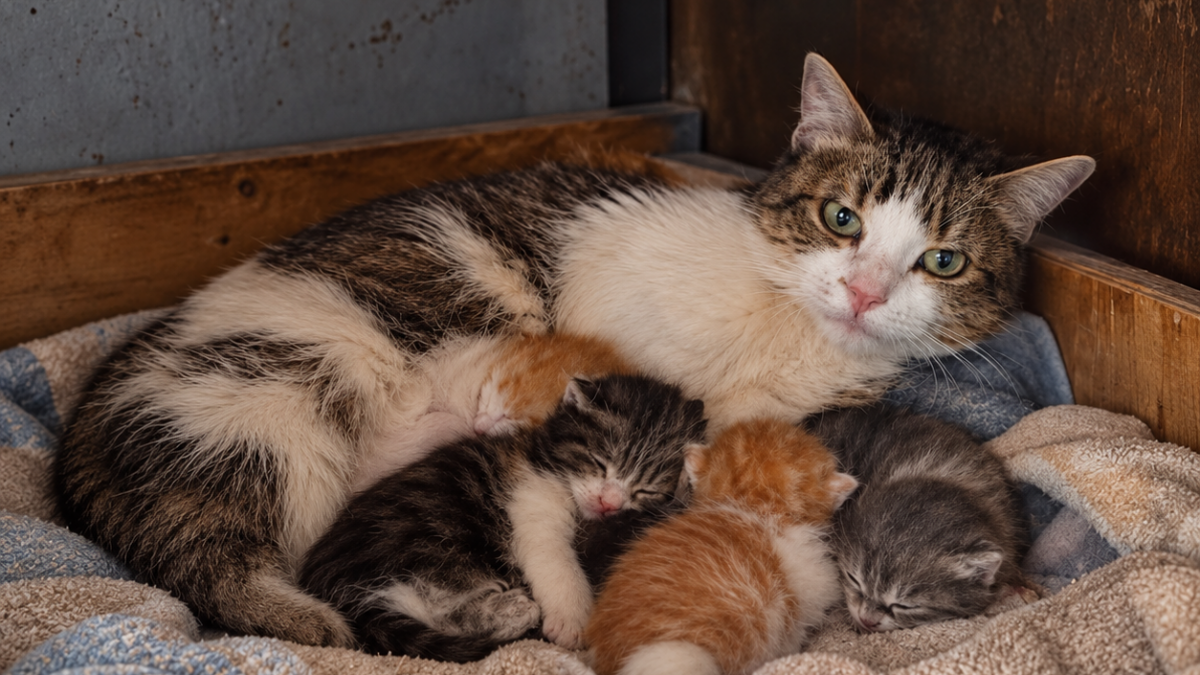
At six o’clock, the last lights in the shelter went dark, and the pregnant cat everyone had ignored all day was left curled against a threadbare blanket.
I was already at the door when I heard a faint scratching behind me, followed by a cry so small and frightened that I dropped my keys.
What I saw when I turned those lights back on would change not only Musia’s fate, but the way I looked at every animal people called “too much trouble.”
It was late October, the kind of evening when darkness seemed to arrive before anyone was ready for it. Cold wind chased dry leaves across the shelter parking lot, rattling them against the chain-link fence, while the employees pulled on their jackets and hurried toward their cars.
I had worked there long enough to know the rhythm of closing time.
Food bowls checked.
Water refreshed.
Medication given.
Kennel doors secured.
Lights off.
Go home.
But that evening, I kept looking toward the last row of cat enclosures.
Musia was there.
She was a small, dirty-white cat with gray patches across her back, enormous green eyes, and a belly that seemed impossibly large for her thin frame. She had spent most of the afternoon pressed against an old blanket, curling herself around her swollen stomach as though she could somehow shield the unborn kittens inside her from the cold.
All day, she had watched people pass.
Families stopped in front of the kittens.
Children squealed over the younger cats with fluffy tails and bright eyes.
A couple adopted a playful black-and-white male who had been with us less than a week.
Even Arthur, an elderly orange tomcat who was nearly deaf and had arthritis in both back legs, left that afternoon wrapped in a blue blanket in the arms of a retired teacher.
Musia watched every one of them leave.
No one chose her.
At one point, a woman came down the aisle with her young daughter.
The girl slowed near Musia’s enclosure.
“Mom, look at this one.”
Her mother barely glanced over.
“She’s pregnant.”
“So?”
“So that means kittens. Vet bills. More mess. More problems.”
Then she laughed softly and added, “Who needs that kind of trouble?”
They kept walking.
I remember Musia lifting her head.
She gave one quiet meow.
It wasn’t loud.
It wasn’t demanding.
It sounded almost polite.
As if she were saying, I’m here too.
The woman never turned around.
I had seen animals rejected for every reason imaginable.
Too old.
Too shy.
Too large.
Wrong color.
Missing a leg.
Needed medication.
Didn’t photograph well.
But something about Musia stayed with me.
Maybe it was the way she continued watching the doorway long after every visitor had gone.
Maybe it was because she never hissed or scratched when we handled her.
Maybe it was because she had already survived more than anyone looking through that cage door could see.
Animal control had found her beside an abandoned convenience store three weeks earlier.
She had been hiding underneath an overturned wooden crate during a rainstorm, soaked through, trembling, and so hungry that she had eaten nearly an entire bowl of food before anyone could examine her.
During the veterinary checkup, we learned she was pregnant.
Far along.
The veterinarian estimated that she had only a few weeks left.
We hoped someone might adopt or foster her before the kittens arrived.
No one did.
By six that evening, the building was almost empty.
I grabbed my coat, shut down the front desk computer, and walked toward the employee exit.
My hand was already on the door when I heard it.
Scratch.
I stopped.
Silence.
Then—
Scratch.
Scratch.
A thin, trembling meow followed.
I turned around.
“Musia?”
Another cry came from the darkened cat room.
I dropped my bag on the floor and ran back.
When I flipped on the lights, Musia was lying on her side.
Her entire body was trembling.
Her breathing was fast and shallow.
Her front paws clenched and released against the edge of the blanket.
For one terrible second, I thought she was dying.
Then I understood.
She was in labor.
“Oh, sweetheart.”
I rushed to her enclosure.
“Not tonight. Please, not when everyone’s gone.”
Musia tried to stand.
Her legs failed beneath her.
She looked directly at me.
Those enormous green eyes were no longer watching the doorway.
They were watching me.
I called our veterinarian with shaking hands.
“I think Musia’s giving birth.”
“How strong are the contractions?”
“Strong. She can barely stand.”
“I’m coming back. Don’t leave her alone.”
I took off my coat, gathered clean towels from the treatment room, and sat on the floor beside her enclosure.
Outside, the wind howled against the windows.
A fluorescent bulb buzzed above us.
The shelter that had been noisy all day was now so quiet that I could hear every strained breath Musia took.
Twenty minutes later, the first kitten arrived.
Tiny.
Wet.
Eyes closed.
Musia immediately pulled the newborn close and began licking it.
Then came a sound so soft I almost missed it.
A squeak.
The kitten was breathing.
I laughed through tears.
“You did it, Mama.”
Musia looked up at me.
Exhaustion filled her face, but so did something else.
Trust.
The second kitten arrived.
Then the third.
And just when I started believing the worst was over, Musia’s body suddenly tightened again.
The fourth kitten slipped onto the blanket.
And this one didn’t move.
I stopped breathing.
Musia dragged the tiny body toward her and began licking it frantically.
Once.
Twice.
Again.
Nothing.
“Come on,” I whispered.
Musia wrapped both front paws around her baby.
“Come on, little one…”
And then—
PART 2
A sound came from the kitten.
So faint that at first I thought I had imagined it.
A tiny click.
Then another.
The kitten’s mouth opened.
Its chest twitched.
“Musia…”
I leaned closer.
“Keep going.”
Musia licked the kitten harder, almost desperately, pushing her nose against its tiny rib cage as if she understood exactly what was happening.
Then the kitten coughed.
One fragile squeak broke through the silence.
I covered my mouth.
“Oh my God.”
Musia immediately pulled the newborn beneath her chin.
The kitten was alive.
Barely.
But alive.
Our veterinarian, Dr. Harris, came through the shelter doors less than two minutes later carrying an emergency bag and wearing the same clothes he had gone home in.
“What happened?”
“Four kittens. The last one wasn’t breathing.”
He knelt beside me.
“Is it breathing now?”
“A little.”
He examined the kitten first.
The tiny animal fit almost entirely in one of his hands.
“Heart rate is weak.”
My relief disappeared immediately.
“How weak?”
“Weak enough that we need to watch him very closely.”
Then he turned to Musia.
The expression on his face changed.
He touched her abdomen carefully.
“Musia, sweetheart…”
“What?”
He didn’t answer at first.
He checked her gums.
Then her pulse.
Then he pressed gently along her abdomen again.
“She’s exhausted.”
“That’s normal after labor, isn’t it?”
“Some exhaustion is normal.”
The way he said it made my stomach tighten.
“And this?”
“She’s weaker than I’d like.”
Musia’s breathing remained rapid.
Her eyes kept closing.
Every few seconds she forced them open again and looked down at her kittens.
She seemed terrified that if she slept, something would happen to them.
Dr. Harris checked for another kitten.
None.
Four babies.
That should have been good news.
But Musia was bleeding more than expected.
Not dramatically.
Not enough to make someone unfamiliar with childbirth panic.
But Dr. Harris noticed immediately.
“We need to get her to the treatment room.”
I looked at the kittens.
“Can we move them?”
“We have to.”
The moment I reached toward the blanket, Musia lifted her head.
A weak growl came from her throat.
It was the first time I had ever heard her growl.
“I know,” I whispered. “I know, Mama. I’m not taking them.”
She tried to place one paw over the kittens.
Her entire body shook with the effort.
That nearly broke me.
This cat had been abandoned beside a closed store.
She had hidden under a crate in the rain.
She had sat in a shelter while strangers walked past and called her pregnancy a problem.
And now, after everything, the one thing she feared most was losing her babies.
“I promise,” I told her.
I don’t know whether cats understand promises.
But she looked directly into my eyes.
“They’re staying with you.”
We moved Musia and all four kittens together.
Dr. Harris worked for nearly an hour.
He gave Musia fluids.
Medication.
Calcium.
He monitored the bleeding.
The smallest kitten—the fourth—was placed on a warming pad beside her.
Every few minutes I touched its tiny chest just to make sure it was still moving.
At 8:17 p.m., the kitten stopped nursing.
“Doctor.”
Dr. Harris looked over.
“He stopped.”
He immediately picked him up.
The kitten was cold.
Far colder than he should have been.
“Hypothermia.”
“Can you save him?”
“I’m going to try.”
Those were the longest twenty minutes of my life.
I sat beside Musia while Dr. Harris warmed the kitten gradually.
Musia kept looking toward him.
Whenever the baby made the slightest sound, her ears moved.
At one point she tried to stand.
She couldn’t.
I placed my hand near her head.
“He’s right there.”
She pressed her face against my fingers.
“I’m not letting anybody take him away.”
Dr. Harris finally returned the kitten to the warming box beside Musia.
“He’s responding.”
I exhaled.
“But?”
“But tonight is going to be difficult.”
The kitten was significantly smaller than the others.
He had probably received less nutrition in the womb.
If he failed to nurse, he could decline quickly.
“And Musia?”
“She needs monitoring too.”
“Can I stay?”
Dr. Harris looked at me as if the question were ridiculous.
“You were going to stay whether I said yes or no.”
He was right.
By ten o’clock, every other sound in the shelter had disappeared.
No phones.
No visitors.
No barking from the front kennels because even the dogs had settled.
Only the occasional rustle of blankets and tiny newborn cries.
I made a bed for myself out of two folded blankets beside Musia’s enclosure.
I didn’t sleep.
Every thirty minutes, I checked the smallest kitten.
At midnight, he nursed for almost forty seconds.
At 1:20 a.m., he did it again.
At 2:05, Musia finally slept.
Not deeply.
Not peacefully.
But she slept with all four kittens pressed against her belly.
I watched them and thought about the woman from earlier that day.
Who needs that kind of trouble?
I looked at Musia’s tired face.
At four new lives tucked against her.
At the smallest kitten fighting for every breath.
Trouble.
That word suddenly made me angry.
Animals became “trouble” when they needed patience.
They became “difficult” when they needed medicine.
“Inconvenient” when they grew old.
“Too much” when caring for them required sacrifice.
People loved rescue stories when the rescue was already finished.
They loved clean photographs.
Happy endings.
Bright eyes.
Fluffy kittens sitting in baskets.
But rescue rarely looked like that while it was happening.
Sometimes rescue looked like blood on a towel at midnight.
Sometimes it looked like a shivering newborn in your palm.
Sometimes it looked like a mother who had nothing left and still curled her body around her babies to keep them warm.
At three in the morning, the smallest kitten finally crawled over his brother and latched onto Musia on his own.
I laughed so loudly that one of the dogs in the next room barked.
“Sorry.”
I looked back at him.
“You stubborn little thing.”
That was when I started calling him Bean.
He was hardly bigger than one.
By sunrise, all four kittens were alive.
Musia was exhausted but stable.
When the morning staff arrived, they found me sitting cross-legged on the floor with my hair tied up badly, yesterday’s clothes wrinkled, and a cup of terrible vending-machine coffee beside me.
My coworker Jenna stopped in the doorway.
“You stayed here all night?”
I pointed toward Musia.
“She stayed too.”
Jenna crouched beside the enclosure.
“Oh my gosh.”
She counted.
“One, two, three…”
“Four.”
The smallest moved weakly beside Musia.
Jenna smiled.
“That one is tiny.”
“That’s Bean.”
“You named him already?”
“He almost died. He earned a name.”
She looked at Musia.
“And Mom?”
“Musia.”
“No, I mean how’s she doing?”
“Better.”
Musia opened her eyes when she heard us.
Then, as if checking attendance, she looked down at each kitten.
One.
Two.
Three.
Bean.
Only after that did she rest her head again.
For the next several days, Musia and her babies became the center of my world.
The first kitten was mostly white with a gray patch on his forehead.
We called him Milo.
The second was a little female with gray ears and a gray tail.
Jenna named her Daisy.
The third, another male, had uneven gray markings over one eye and an attitude far larger than his body.
We called him Scout.
And then there was Bean.
Bean remained half the size of his siblings.
Every feeding felt like a test.
Some days he gained weight.
Some mornings the scale barely changed.
I kept a notebook beside the enclosure.
Milo: 142 grams.
Daisy: 137.
Scout: 145.
Bean: 91.
The next morning:
Milo: 151.
Daisy: 146.
Scout: 154.
Bean: 93.
Two grams.
I stared at that number.
“Come on, buddy.”
Dr. Harris stood behind me.
“He gained.”
“Two grams.”
“Two is more than zero.”
“It’s not enough.”
“He’s fighting.”
“So am I.”
Dr. Harris smiled slightly.
“I noticed.”
Musia seemed to notice too.
Whenever I supplemented Bean with formula, she watched everything I did.
The first time, she reached one paw toward him.
Not aggressively.
Just enough to touch his back.
“I’m giving him back.”
I placed Bean beside her immediately after feeding.
Musia washed his face for nearly five minutes.
By the end of the first week, she allowed me to handle every kitten without protest.
But she never stopped counting them afterward.
I had never seen anything like it.
If I took Milo for weighing, she watched.
When I returned him, she sniffed him and looked toward the others.
If Daisy was next, same thing.
Scout.
Bean.
One by one.
Every time.
A mother taking inventory.
Making sure the world had not stolen anything else from her.
Then, on the eighth morning, our shelter manager called me into her office.
Her name was Linda.
She wasn’t cruel.
That’s important.
People like simple villains.
Real life rarely gives you one.
Linda cared about animals.
She had spent fifteen years in shelter management.
She had been bitten, scratched, screamed at, threatened, and once slept in her office for two nights during a flood.
But Linda also had numbers to manage.
Kennels.
Intakes.
Vet bills.
Food.
Staff hours.
Foster homes.
Adoption rates.
And that week we had a problem.
“We’re full,” she said.
“I know.”
“No. I mean full full.”
She slid a clipboard toward me.
Three cats were arriving from animal control that afternoon.
Two surrendered dogs were scheduled for Friday.
A litter of six kittens had been found behind a restaurant.
Every isolation space was occupied.
“We need foster placement for Musia.”
“She’s not ready to move.”
“She doesn’t have to go far.”
“Linda.”
“I know you’re attached.”
“That has nothing to do with it.”
She raised an eyebrow.
It had everything to do with it.
I sat back.
“Bean is still underweight.”
“I know.”
“Musia only stopped bleeding normally two days ago.”
“I know.”
“She just started eating consistently.”
“I know.”
“Then why are we having this conversation?”
“Because we have twelve animals arriving and nowhere to put them.”
I looked toward the window in her office.
Beyond it I could see the cat room.
Musia’s enclosure was at the end.
“What about the foster list?”
“We’ve called everyone.”
“And?”
“Three no responses. Two are already fostering litters. One is out of town.”
“The emergency foster network?”
“Same situation.”
I knew what she was going to say before she said it.
“You can’t keep them in the shelter indefinitely.”
My jaw tightened.
“They’re nine days old.”
“I said indefinitely, not today.”
“Then what are you asking?”
“I’m asking you to help me find a solution before we don’t have one.”
I hated the sentence because she was right.
Shelter work teaches you something cruel very quickly.
Saving one animal does not stop the next one from needing you.
There is always another carrier at the door.
Another injured dog.
Another abandoned litter.
Another animal somebody promised to love until loving it became inconvenient.
I left Linda’s office angry anyway.
Not at her.
At the whole system.
At the fact that Musia had survived the street only to become a space problem.
At the fact that four newborn kittens could be reduced to a line on a capacity spreadsheet.
At every person who had walked past her because they wanted something easier.
That afternoon I made seventeen phone calls.
Nothing.
I contacted former fosters.
Nothing.
I called a rescue group two towns over.
Full.
Another rescue forty miles away.
No neonatal space.
A woman who had fostered kittens for us twice answered but had just undergone surgery.
“I’m sorry,” she said. “If it were next month…”
“It’s okay.”
But it wasn’t.
By four o’clock, I had run out of names.
I went into the cat room and sat beside Musia.
She was nursing the kittens.
Bean was wedged between Daisy and Scout, kneading with tiny paws.
“You have terrible timing,” I told her.
Musia blinked.
“I mean that affectionately.”
She blinked again.
I leaned against the wall.
“I don’t know what to do with you.”
Musia stood, carefully stepped over her kittens, and walked toward the enclosure door.
Then she pressed her forehead against my fingers through the bars.
That was it.
My resistance disappeared.
I walked straight back to Linda’s office.
“I’ll take them.”
She looked up.
“What?”
“I’ll foster them.”
“You already have two cats.”
“They have their own room.”
“You work full-time.”
“I work here.”
“You live twenty-five minutes away.”
“Twenty-two if traffic is good.”
Linda stared at me.
“You thought about this for approximately ninety seconds.”
“I’ve been thinking about it for nine days.”
“That is not better.”
“I’ll take them.”
She leaned back in her chair.
“What does your landlord say?”
“I own my place.”
“Your cats?”
“I’ll keep them separated.”
“Supplies?”
“I have a spare bathroom. I’ll convert it.”
“Night feedings for Bean?”
“I’m already barely sleeping.”
Linda sighed.
Then she smiled.
“I knew this was coming.”
That evening, Musia left the shelter for the first time since she had arrived.
Not as an adopted cat.
Not yet.
But she left in a carrier with all four kittens tucked beside her.
When I carried them through the front doors, Musia froze.
The wind had stopped.
The sky was clear.
She looked around through the carrier door with enormous eyes.
I wondered whether she remembered the last time she had been outside.
The rain.
The abandoned store.
Hunger.
Cold.
I placed the carrier gently in my car.
“You’re not going back there.”
At my house, I had prepared the spare bathroom with blankets, a low-sided box, food, water, a litter tray, and a small warming pad.
The moment I opened the carrier, Musia stayed inside.
I didn’t force her.
I sat against the opposite wall and waited.
Five minutes.
Ten.
Fifteen.
Then Scout crawled out first.
Musia immediately followed.
She picked him up by the scruff, carried him to the box, and went back for the others.
Milo.
Daisy.
Bean.
Only after all four were arranged exactly where she wanted them did she inspect the room.
She sniffed the water.
The food.
The corners.
The door.
Then she walked toward me.
I held out my hand.
Musia sniffed it.
And climbed into my lap.
I froze.
She had never done that before.
Not once.
She turned around twice, tucked her paws beneath herself, and rested her head against my stomach.
For several seconds I didn’t move.
Then I touched her back.
“You’re safe.”
She began to purr.
It was the first time I had heard it.
I cried harder than I had the night the kittens were born.
The next three weeks were exhausting.
And wonderful.
Bean needed supplemental feedings.
Scout learned to climb before he learned when not to climb.
Daisy became obsessed with attacking my shoelaces.
Milo preferred sleeping in places that made no anatomical sense.
Musia slowly changed too.
Her ribs became less visible.
Her coat improved.
The wary expression in her eyes softened.
She started waiting beside the bathroom door when I came home from work.
Eventually I let her explore the hallway while my own cats remained separated.
The first time she saw the couch, she stared at it as though it were a complicated machine.
Then she jumped up.
Turned twice.
Lay down.
Within twenty minutes, she acted as though she had owned it for years.
But the happiest moments were never the funny ones.
They were the quiet ones.
Sometimes late at night I would sit on the bathroom floor while the kittens slept.
Musia would lie beside them, one paw stretched across Bean.
I would remember that first evening in the shelter.
The woman walking away.
Who needs that kind of trouble?
The words still irritated me.
Until one Saturday afternoon, when that same woman walked back into the shelter.
I recognized her immediately.
Same dark coat.
Same carefully styled hair.
Same little girl beside her.
The daughter recognized me too.
“Mom, that’s the lady.”
Her mother smiled.
“We were here a few weeks ago.”
“I remember.”
“I heard you have kittens available soon.”
I already knew where this was going.
“Several kittens are currently in foster care.”
Her daughter brightened.
“The ones from the pregnant cat?”
The woman laughed.
“Yes. Apparently that cat had some really cute babies.”
Something inside me hardened.
Not because she wanted a kitten.
People changed their minds.
People learned.
I wanted to believe that.
So I kept my voice neutral.
“They’re still too young to be adopted.”
“When will they be ready?”
“A few more weeks.”
“Can we reserve one?”
“We don’t reserve animals that far in advance, but you can submit an application when they become available.”
She pulled out her phone.
“Do you have pictures?”
I showed her.
Milo.
Daisy.
Scout.
Bean.
She stopped at Daisy.
“Oh, that one.”
Her daughter leaned closer.
“She’s cute.”
“That’s the one we want.”
I felt a strange chill.
“What are you looking for in a cat?”
The woman looked confused.
“A kitten.”
“I mean personality. Energy level. Long-term expectations.”
She shrugged.
“Something cute for my daughter.”
Her daughter looked embarrassed.
“Mom…”
“What? That’s why we’re here.”
“What happens when she isn’t a kitten anymore?” I asked.
The woman laughed.
“She’ll still be a cat.”
“And if she develops medical problems?”
“We’ll deal with it.”
“How?”
Her smile faded.
“I’m sorry?”
“We ask everyone these questions.”
That was true.
“What if she needs expensive veterinary care?”
“I suppose we’d decide when it happened.”
“What does that mean?”
“It means I’m not spending thousands of dollars on a cat.”
Her daughter stared at the floor.
I remembered Bean struggling to breathe.
Musia bleeding on a towel.
Twenty-minute feedings.
Weight charts.
Cold nights.
“Would the cat be indoor-only?”
“Mostly.”
“Mostly?”
“We have a yard.”
“Would she be spayed?”
“If required.”
“It is.”
She sighed.
“All right.”
“Would you return her to us if you ever couldn’t keep her?”
The woman’s expression changed.
“Why would I bring her back here?”
“Because our contract requires it.”
“If it didn’t work out, I’d probably give her to someone.”
“That would violate the adoption agreement.”
Now she was annoyed.
“I think you’re making this unnecessarily complicated.”
“I don’t.”
Her daughter tugged gently at her sleeve.
“Mom, maybe we should go.”
But the woman wasn’t finished.
“You have dozens of animals needing homes. I’m offering to take one.”
“You’re applying to adopt one.”
“Is there a difference?”
“Yes.”
A very large one.
She folded her arms.
“Look, I’m not trying to be rude, but this is exactly why shelters stay overcrowded. People come in willing to help, and then you interrogate them.”
I felt my face grow warm.
I thought about Linda warning me not to take difficult conversations personally.
I thought about every animal returned because someone had wanted a baby but not an adult.
Every dog surrendered because he grew too large.
Every cat abandoned because of a veterinary bill.
Then I looked at the little girl.
She looked uncomfortable, but not cruel.
So I softened my voice.
“Adoption isn’t about giving an animal to anyone willing to carry it through the door. It’s about finding a home where that animal is unlikely to come back through the door.”
The woman stared at me.
Then she looked at the photograph again.
“What about the mother?”
“Musia?”
“Yes.”
“What about her?”
“Is she going to be available too?”
“She will be.”
“Who would want her now?”
There it was.
The same tone.
The same casual dismissal.
“She’s not a kitten,” the woman continued. “And after having babies, she probably has all kinds of issues.”
Her daughter whispered, “Mom.”
I locked my phone.
“Musia is affectionate, calm, litter-trained, gentle with people, and one of the most devoted animals I’ve ever met.”
“Well, good luck.”
She gave a little laugh.
“I still want the gray kitten.”
I knew then that Daisy would never go home with her.
Not because I wanted revenge.
Not because I wanted to punish her for what she had said weeks earlier.
But because the conversation had answered every question I needed answered.
She saw an animal as desirable when it was young, pretty, and easy.
Musia had already taught me what happened when life stopped being easy.
“I don’t think this adoption would be a good match.”
The woman blinked.
“Excuse me?”
“You’re welcome to speak with our adoption coordinator, but based on this conversation, I wouldn’t recommend approval.”
Her face reddened.
“You’re refusing to give my daughter a kitten?”
“I’m declining an adoption application that hasn’t even been submitted yet.”
“That is ridiculous.”
Her daughter looked close to tears.
I felt bad for her.
But I did not change my answer.
The woman raised her voice.
“So you’d rather keep animals in cages?”
“No. I’d rather keep them from ending up in cages twice.”
For several seconds the lobby went completely silent.
Linda was at the desk across the room.
She had heard everything.
I expected her to intervene.
She didn’t.
The woman turned toward her.
“Are you the manager?”
“Yes.”
“I want to complain.”
“I heard the conversation.”
“And?”
Linda looked at me.
Then back at the woman.
“Our staff member followed policy.”
“You can’t be serious.”
“We evaluate adoption suitability based on long-term care expectations. We do not place animals as disposable gifts.”
“I never said disposable.”
“You said you would not commit to veterinary treatment, might give the cat away instead of returning her under contract, and questioned whether spaying was necessary.”
The woman opened her mouth.
Closed it.
Linda continued calmly.
“You are welcome to apply elsewhere.”
The woman grabbed her daughter’s hand.
“This place is unbelievable.”
As they walked out, the girl looked back at me.
Not angrily.
Sadly.
I hoped someday she would understand.
After the door shut, Linda looked at me.
“You enjoyed that last sentence.”
“A little.”
“Professional.”
“I was professional.”
“You were professionally furious.”
“That too.”
She smiled.
Then her expression softened.
“You were right.”
I looked toward the hallway leading to the cat room.
“It just bothers me.”
“I know.”
“She called Musia trouble before the kittens were born.”
Linda’s eyes narrowed.
“That was her?”
“Same woman.”
“Well.”
Linda picked up a file.
“Then I’m glad Daisy has you making decisions.”
I shook my head.
“Not me.”
“What?”
“Musia.”
Linda stared at me.
“I’m serious. If I wouldn’t trust someone with Musia, I’m not trusting them with her babies.”
“That is not technically an adoption standard.”
“It should be.”
A week later, Bean scared us again.
He had been doing well.
Growing.
Playing.
Even picking fights with Scout.
Then one morning he refused breakfast.
I knew immediately something was wrong.
Bean never refused food.
I touched him.
Too warm.
My stomach dropped.
I called Dr. Harris before I even got dressed.
He met me at the clinic.
Musia came with us because leaving her behind made her frantic.
The other kittens stayed with Jenna.
Bean’s temperature was high.
His breathing was fast.
Dr. Harris listened to his chest.
His expression darkened.
“What?”
“Possible respiratory infection.”
“He was fine yesterday.”
“They can deteriorate fast at this age.”
“How fast?”
He looked at me.
That was enough.
They started antibiotics.
Fluids.
Oxygen.
Musia sat inside a carrier beside the treatment table.
She could hear Bean crying.
Every time he cried, she answered.
Finally Dr. Harris let me place him beside her for a moment.
Musia washed his face so intensely that Bean complained.
“That’s right,” I whispered. “Annoy him.”
For three days, we fought for him again.
Bean stopped eating completely.
I syringe-fed him tiny amounts.
He lost weight.
All the progress we had celebrated disappeared.
One night I sat on my kitchen floor with him wrapped against my chest.
Musia was beside me.
Bean’s eyes were half closed.
His breathing sounded terrible.
I cried.
Not loudly.
I didn’t want to frighten him.
“I don’t know if I can do this again.”
Musia looked at me.
“This isn’t fair.”
She touched Bean with one paw.
“I know he’s yours. I know.”
For the first time since taking them home, I considered the possibility that love might not be enough.
That effort might not be enough.
That some animals could be held, warmed, medicated, fed, watched every hour—and still leave you.
Bean shifted.
His tiny head rested against my thumb.
I could feel every breath.
In.
Out.
In.
Pause.
Out.
At two in the morning, he suddenly turned toward the syringe.
I offered a drop of formula.
He swallowed.
Another.
Swallowed.
I barely moved.
“Musia.”
Her ears lifted.
“Look.”
Bean swallowed again.
By morning he had taken five milliliters.
It wasn’t much.
To me it felt like a miracle.
The fever broke that afternoon.
Two days later, he ate without help.
Three days after that, he slapped Scout in the face over a toy mouse.
I sent Dr. Harris a video.
His reply was simple:
That is the best fight I’ve ever seen.
When the kittens reached eight weeks old, reality returned.
They were ready for adoption.
I hated it.
I had known from the beginning that foster meant temporary.
I had repeated it to myself every time I bought another toy.
Temporary.
Every time Daisy fell asleep on my shoulder.
Temporary.
Every time Scout climbed my jeans like a tree.
Temporary.
Every time Milo waited outside the shower.
Temporary.
Every time Bean curled into my neck and purred.
Temporary.
But temporary had become a family.
And families hurt when they separate.
Musia had been spayed by then.
She recovered beautifully.
Her coat was soft.
She had gained weight.
She no longer looked like a frightened stray cat.
She looked like someone’s pet.
The problem was that she still wasn’t anyone’s pet.
The kittens received applications almost immediately.
Milo had three.
Daisy had four.
Scout had two.
Even Bean—the sickly little kitten who had frightened us half to death—had six.
Musia had zero.
I checked the system three times.
Zero.
I wanted to throw the computer through the wall.
Jenna leaned over my shoulder.
“Still nothing?”
“No.”
“She’s beautiful.”
“I know.”
“She’s sweet.”
“I know.”
“She’s young.”
“I know.”
Jenna hesitated.
“You could adopt her.”
I stared at the screen.
Of course I could.
I had thought about it every day.
But I had two senior cats, one with kidney disease.
Adding another permanent cat could disrupt their routine.
And if I adopted every foster I loved, I would eventually stop being able to foster at all.
“I can’t solve every adoption by keeping them.”
“You don’t have to solve every one.”
“I know.”
“Just hers.”
That was the problem.
I wanted to.
Badly.
But I also wanted Musia to have something I wasn’t sure I could give her.
A home where she wasn’t one more animal among many.
A person who chose her.
Not because she had kittens.
Not because they felt sorry for her.
Because they saw her.
The first kitten adopted was Milo.
A young couple named Eric and Sam spent almost an hour with him.
They sat on the floor.
Asked about his personality.
Asked what food he ate.
Asked whether he liked being held.
Asked about vaccinations.
Asked about insurance.
Asked what signs of illness they should watch for.
Before they left, Eric asked something that made my eyes sting.
“Will his mother be okay when he goes?”
I looked at Musia through the glass.
“Yes.”
Then I told the truth.
“But she’ll notice.”
They adopted Milo.
When I brought him out in the carrier, Musia sniffed him through the door.
Then she looked at me.
It felt unbearable.
“I know.”
She touched the carrier with her nose.
Milo meowed.
Musia answered.
I nearly changed my mind.
But good rescue means letting go when the right home arrives.
I handed the carrier over.
Eric held it carefully with both hands.
“We’ll take care of him.”
“Please do.”
“We will.”
After they left, Musia searched the foster room for twenty minutes.
Behind the box.
Under the chair.
Inside the carrier.
She called softly.
I sat beside her.
“Milo’s safe.”
She kept looking.
I cried again.
The next day she stopped searching.
Daisy left four days later with a woman named Marlene who had recently lost her sixteen-year-old cat.
Marlene didn’t choose Daisy because she was gray and pretty.
She chose her because during the meet-and-greet, Daisy climbed directly into her lap and refused to leave.
“I think she made the decision,” I said.
Marlene laughed through tears.
“I think so too.”
Before she left, she asked about Musia.
“How old is their mother?”
“Probably two or three.”
“And nobody has applied for her?”
“Not yet.”
Marlene looked genuinely surprised.
“She’s lovely.”
“I know.”
“People are strange.”
“I know that too.”
Scout went next.
He was adopted by a family with two teenage boys who spent thirty minutes letting Scout attack the strings on their hoodies.
One of them asked, “Does he always do this?”
“Yes.”
“Perfect.”
Three kittens gone.
Bean remained.
Musia spent more time with him than ever.
Maybe it was coincidence.
Maybe mothers don’t think the way we do.
But I swear she knew.
Bean slept pressed against her chest.
He followed her from room to room.
When she jumped onto the couch, he tried to follow even when he was too small.
She groomed him constantly.
And Bean adored her.
That created a new problem.
Every applicant wanted Bean alone.
I turned down two.
Not because they were bad homes.
Because Bean panicked when separated from Musia.
During one meet-and-greet, I carried him into another room for less than five minutes.
He cried continuously.
Musia cried from the other side of the door.
He refused to play.
Refused treats.
Scratched at the door.
The moment I reunited them, Bean buried his face against her.
I went to Linda.
“I think they’re bonded.”
She looked at the notes.
“Maybe.”
“Not maybe.”
“Bonded pairs are harder to adopt.”
“I know.”
“Musia already has no applications.”
“I know.”
“If we require someone to take both—”
“I know.”
She studied my face.
“You’re going to do it anyway.”
“Yes.”
Linda sighed.
“Update the listing.”
That afternoon, Musia and Bean became a package.
MUSIA & BEAN — BONDED MOTHER AND SON. MUST BE ADOPTED TOGETHER.
Applications stopped completely.
A week passed.
Nothing.
Two weeks.
Nothing.
Bean grew bigger.
Musia became more playful.
They were happy in my home.
And every day I became more afraid that nobody would ever choose them.
Then, on a rainy Tuesday afternoon, the shelter phone rang.
Jenna answered.
A few minutes later she walked toward me smiling strangely.
“What?”
“Someone asked about Musia.”
I froze.
“Only Musia?”
“And Bean.”
I stood so fast my chair rolled backward.
“Who?”
“An older couple.”
“When are they coming?”
“Tomorrow.”
I barely slept.
Which was ridiculous.
I had survived Musia’s labor.
Bean’s hypothermia.
Bean’s infection.
Four kitten adoptions.
But one adoption appointment terrified me.
The couple arrived at eleven the next morning.
Their names were Thomas and Elena.
Thomas was seventy-two.
Elena was sixty-nine.
They had been married forty-six years.
Their cat, Lucy, had died six months earlier at age eighteen.
They had waited before adopting again because, as Elena told me, “Grief shouldn’t choose your next animal for you.”
I liked her immediately.
We sat in the meeting room.
I gave them the full history.
Street rescue.
Pregnancy.
Birth.
Bean’s difficult start.
Illness.
Bond.
I watched their faces carefully.
No hesitation.
No annoyance.
No calculation.
Thomas asked, “Does Musia like windows?”
I smiled.
“She loves them.”
“We have a sunroom.”
Elena asked, “Does Bean need any ongoing medication?”
“No.”
“Any likely future complications?”
“We can’t predict everything, but currently he’s healthy.”
Thomas nodded.
“We have a veterinarian.”
Then he asked the question that changed everything.
“What does Musia like?”
Not Bean.
Not the cute kitten.
Musia.
I looked at him.
“She likes soft blankets. Quiet rooms. Sitting near people without always being held. She likes chicken-flavored treats. She hates the vacuum. She likes watching birds.”
Thomas smiled.
“So does my wife.”
Elena slapped his arm.
“I do not hate the vacuum.”
“You haven’t used it since 2004.”
“I have standards.”
I laughed.
They met Musia and Bean together.
Bean ran immediately toward Thomas’s shoelaces.
Musia stayed near the back of the room.
I watched.
Thomas didn’t approach her.
He sat on the floor.
Ignored her.
Played gently with Bean.
Five minutes passed.
Musia stepped closer.
Thomas continued talking to me.
Ten minutes.
She sniffed his knee.
He still didn’t reach for her.
Elena whispered, “He always does that.”
“What?”
“Lets them decide.”
Finally Musia climbed into his lap.
Thomas looked down.
His eyes filled with tears.
“Well,” he whispered.
Musia curled against him.
Bean climbed onto Elena.
Nobody spoke for several seconds.
I knew.
You learn to recognize the right home.
It doesn’t always arrive with dramatic music.
Sometimes it’s just an old man sitting patiently on the floor, refusing to force a frightened animal to love him.
Elena looked at me.
“We’d like both of them.”
My throat tightened.
“They have to stay together.”
“We know.”
“I mean permanently.”
“We know.”
“If there’s ever a problem—”
“We call you.”
“If you can’t keep them—”
“We bring them back here.”
“If Musia needs medical care—”
“We take her to the vet.”
“If Bean—”
Thomas smiled.
“You can stop interviewing us.”
“I can’t.”
“Then keep going.”
So I did.
They answered everything.
Correctly.
Patiently.
Without defensiveness.
Then Elena reached across the table and touched my hand.
“You love them.”
It wasn’t a question.
I looked toward Musia.
“Yes.”
“Then I want you to know something.”
She waited until I looked at her.
“We aren’t taking them away from you.”
My eyes burned.
“We’re giving them another person to love them.”
That sentence destroyed whatever composure I had left.
I cried.
Elena cried.
Thomas pretended he wasn’t crying while wiping his glasses for the third time.
Even Linda, watching from the doorway, suddenly became extremely interested in paperwork.
The adoption was approved.
They would pick Musia and Bean up Friday.
I spent Thursday night sitting on the floor with them.
Bean chased a toy mouse.
Musia lay beside me.
I told her everything she didn’t understand.
“You’re getting a sunroom.”
She blinked.
“Big windows.”
Blink.
“Two retired humans who will probably spoil you terribly.”
She purred.
“And Bean is going with you.”
At that, she lifted her head because Bean had crashed into a cardboard box.
“Yes. Him too.”
I touched her cheek.
“You did it, Mama.”
I thought about the shelter aisle.
The people walking past.
The woman saying no one needed that trouble.
Musia had spent weeks being treated like the least desirable animal in the room.
Now two people were rearranging their house before she even arrived.
Friday morning came too quickly.
I packed their records.
Favorite blanket.
Toys.
Food.
The little notebook containing Bean’s earliest weights.
I almost kept that.
Instead I placed it in the bag.
It belonged to his history.
Thomas and Elena arrived with two secure carriers even though Musia and Bean would likely ride beside each other.
Thomas had already installed a tall cat tree in the sunroom.
Elena had bought three beds.
“Three?”
“She might not like the first two.”
I laughed.
Musia went into the carrier calmly.
Bean did not.
He attempted to climb my arm, Elena’s coat, the table, and finally Thomas.
“Healthy,” Thomas said.
“Unfortunately.”
Before they left, I knelt beside Musia’s carrier.
She pushed her nose against the door.
I slipped one finger through.
She rubbed her face against it.
For a second I was back in the dark shelter again.
The wind.
The blood.
Four newborn kittens.
Her exhausted green eyes.
I whispered, “You’re not being left behind anymore.”
Then I stood.
Thomas carried her out.
I watched through the front window as they placed both carriers safely in the car.
Elena waved.
They drove away.
I made it approximately seven seconds before crying.
Linda stood beside me.
“You okay?”
“No.”
“Good adoption.”
“I know.”
“Then why are you crying?”
I looked at her.
“You’ve worked in rescue fifteen years and you’re asking that?”
“Fair.”
Two weeks later, an envelope arrived at the shelter.
Inside were photographs.
Musia asleep in a patch of sunlight.
Bean hanging halfway off a cat tree.
Musia and Bean curled together on a sofa.
Bean stealing food from Thomas’s plate.
Musia sitting on Elena’s lap near a fireplace.
There was also a note.
She sleeps beside us every night. Bean thinks the house belongs to him. Musia seems to agree. Thank you for trusting us with your family.
I pinned the pictures beside my desk.
That should have been the ending.
But Musia’s story had one last turn.
Three months later, the shelter held a community adoption day.
Milo’s adopters came.
So did Daisy’s.
Scout’s family sent photographs because they were out of town.
Thomas and Elena brought Musia and Bean for a short visit after asking whether it would stress them.
Musia walked into the shelter in a secure harness.
I almost didn’t recognize her.
Her coat shone.
Her body was strong.
Her eyes were bright.
She wasn’t the thin pregnant stray hiding beneath a crate anymore.
She wasn’t the cat curled against a dirty blanket while people walked past.
She looked loved.
Because she was.
Bean was enormous.
I stared at him.
“That is not Bean.”
Thomas laughed.
“He still answers to it.”
“He’s a loaf.”
“A bean grows.”
“Not into that.”
I knelt.
Bean climbed onto my leg.
Musia approached more slowly.
Then she pressed her forehead against my chest.
I closed my eyes.
“Hi, Mama.”
That was when I heard a familiar voice behind me.
“Oh.”
I turned.
The woman from months earlier stood several feet away.
The same woman who had called Musia “trouble.”
Her daughter was with her.
They recognized Musia.
The woman looked at the cat.
Then at Bean.
“Is that the pregnant cat?”
“She was.”
“She looks completely different.”
Thomas rested one hand on Musia’s back.
“She’s ours now.”
The woman looked surprised.
“You adopted the mother?”
“And her son.”
“Both?”
Elena smiled.
“Of course.”
The daughter knelt slowly.
“Musia?”
Musia watched her.
The girl held out her hand.
Musia approached and sniffed it.
The girl smiled.
“She remembers me.”
Maybe she did.
Maybe she didn’t.
But I remembered her.
The girl looked at her mother.
“She’s really pretty.”
Her mother said nothing.
Then the girl noticed Bean.
“Is that the tiny kitten?”
“The very same,” I said.
“He got huge.”
“He worked hard at it.”
Thomas laughed.
The woman looked at the photographs displayed beside our booth.
Milo.
Daisy.
Scout.
Bean.
Musia.
All safe.
All loved.
Every animal she had once dismissed as extra trouble had become somebody’s family.
She looked at me.
For once, she had no clever comment.
No criticism.
No complaint about forms or contracts or inconvenience.
She simply stood there.
And I realized something.
I didn’t need to embarrass her.
I didn’t need to remind her of what she had said.
I didn’t need revenge in the way people usually imagine it.
Musia was standing in front of her.
Healthy.
Wanted.
Protected.
Loved by two people who saw value where someone else had seen inconvenience.
That was enough.
But her daughter surprised me.
She stood and looked at her mother.
“Mom?”
“Yes?”
“Remember when you said nobody would want the pregnant cat?”
The woman’s face changed.
Children have extraordinary timing.
Thomas looked away to hide a smile.
Linda, standing behind the booth, suddenly became fascinated by a stack of brochures.
The woman cleared her throat.
“I may have said something like that.”
“You did.”
Her daughter looked at Musia.
“You were wrong.”
Silence.
Then Elena smiled.
“She was.”
Not cruelly.
Not triumphantly.
Just factually.
The woman looked at Musia again.
Then at Thomas.
“Are you happy with her?”
Thomas seemed genuinely confused by the question.
“Very.”
“She doesn’t cause problems?”
Thomas laughed.
“She wakes me up at five thirty every morning.”
Elena added, “She steals my chair.”
“She screamed at the bathroom door yesterday because I took too long.”
“She also sleeps beside him every night.”
Thomas scratched Musia gently beneath the chin.
“That outweighs the bathroom complaints.”
The woman’s expression softened.
For the first time, she crouched.
Musia allowed her to touch the top of her head.
“I guess I was wrong.”
Her daughter grinned.
“I told you.”
The woman gave her a look.
“Don’t enjoy this too much.”
“I’m enjoying it a little.”
So was I.
But the most satisfying part came later.
The girl asked if she could volunteer at the shelter when she was old enough.
Her mother looked startled.
“You still want to come here?”
“Yes.”
“After all this?”
The girl shrugged.
“They saved Musia.”
That sentence stayed with me.
They saved Musia.
People often say that about shelters.
Rescuers saved the animal.
Veterinarians saved the animal.
Fosters saved the animal.
But I had learned better.
Musia had saved things too.
She saved four kittens by keeping them alive inside her when she barely had enough food for herself.
She saved Bean again and again by refusing to stop caring for him.
She taught a little girl that an animal’s worth did not disappear because caring for it was inconvenient.
She taught me that sometimes the least chosen animal becomes the one you remember forever.
And, indirectly, she changed the shelter.
After her adoption, Linda created a dedicated maternity foster program.
We recruited volunteers specifically for pregnant cats and newborn litters.
A local business donated warming pads.
Another donor funded portable incubators.
We converted a storage room into a quiet maternity area.
On the wall outside, Linda hung a framed photograph of Musia with all four newborn kittens.
Underneath it was a small plaque.
It read:
NO ANIMAL IS “TOO MUCH TROUBLE” TO DESERVE A CHANCE.
The first time I saw it, I stood there for several minutes.
Linda came up beside me.
“Too sentimental?”
“Yes.”
“Want me to remove it?”
“No.”
She smiled.
“I didn’t think so.”
Over the next year, twenty-seven pregnant cats entered that program.
Twenty-seven mothers who otherwise might have delivered in crowded kennels, outside, in abandoned buildings, or beneath porches.
Dozens of kittens survived.
Families were screened more carefully.
Mothers were no longer treated as an afterthought once their kittens became adoptable.
Whenever someone asked why the program existed, I pointed toward Musia’s photograph.
“That cat.”
Sometimes people laughed.
“One cat caused all this?”
“Yes.”
One cat.
One cold October night.
One employee who almost walked out the door.
One faint scratch in the dark.
That was all it took.
I continued receiving photographs from Thomas and Elena.
At Christmas, Musia was wearing a red collar and looking deeply offended by a decorative bow.
Bean had knocked over part of their Christmas tree.
Thomas wrote:
We believe Musia is innocent. The large gray criminal refuses to comment.
In spring, they sent a photograph of Musia lying in the sunroom surrounded by flowers outside the windows.
Bean was beside her.
He was nearly twice her size.
At the bottom, Elena had written:
She still checks where he is before she falls asleep.
That made me cry.
Of course she did.
Some habits are born from fear.
Some survive because they become love.
A year after the kittens were born, Thomas and Elena invited me to visit.
Their house sat on a quiet street lined with maple trees.
The moment I walked through the door, Bean appeared.
He stared at me.
I stared at him.
“You’re gigantic.”
He walked away.
Apparently fame had changed him.
Then Musia entered the hallway.
She stopped.
For a second neither of us moved.
I wondered if a year was too long.
Maybe she didn’t remember my smell.
Maybe cats didn’t hold memories the way we hoped they did.
Then she ran toward me.
Not walked.
Ran.
She rose onto her back legs and put both front paws against my knee.
I dropped to the floor.
“Musia.”
She climbed into my lap.
Exactly as she had that first night in my house.
Thomas stood in the kitchen doorway.
“Well, apparently we know where we rank.”
Elena elbowed him.
“Be quiet.”
I buried my face against Musia’s fur.
She purred so loudly I could feel it against my chest.
“I missed you too.”
Bean eventually joined us.
He sat directly on my foot.
Some things never become graceful.
We spent the afternoon talking.
Thomas showed me the sunroom.
There were two cat trees.
Not one.
Two.
A heated bed.
Three scratching posts.
A basket of toys.
A water fountain.
“Do you realize your cats have better furniture than I do?”
Thomas nodded seriously.
“They have higher standards.”
Musia jumped onto the windowsill.
Outside, birds moved through the garden.
Bean joined her.
They sat shoulder to shoulder.
Mother and son.
I remembered the first time I saw Bean.
Motionless.
Wet.
Silent.
Musia licking him as if determination alone could create life.
I remembered whispering, Breathe.
Now he was a healthy adult cat who had apparently eaten half of Thomas and Elena’s retirement savings in food.
It seemed fair.
Before I left, Elena gave me a small envelope.
Inside was a photograph.
The one taken on adoption day.
Thomas sitting on the floor.
Musia in his lap.
Bean climbing over Elena.
On the back, Elena had written:
You thought you were finding them a home. They were finding us.
I kept that photograph.
It is still beside my desk.
Years have passed since that October evening.
I have seen hundreds of animals come through shelter doors.
Some stories ended beautifully.
Some broke my heart.
That is rescue.
You learn to celebrate without becoming careless.
You learn to hope without pretending hope guarantees anything.
You learn that sometimes doing everything right still ends badly.
And sometimes, when you are exhausted and ready to go home, you hear a tiny scratching sound from a dark room.
Sometimes you turn around.
Sometimes four lives are born while the wind rattles the windows.
Sometimes the weakest baby survives.
Sometimes the mother nobody wanted becomes the reason an entire shelter changes the way it treats pregnant animals.
And sometimes the sweetest revenge against everyone who called an animal unwanted is simply letting them live long enough to prove those people wrong.
Musia never knew people had passed her by because she was pregnant.
She never knew someone called her trouble.
She never knew that her photograph hung in the shelter.
She never knew volunteers were being trained because of her.
She never understood that kittens she would never meet were surviving because her story had changed our policies.
She didn’t need to know.
She knew the things that mattered.
She knew where her food bowl was.
She knew which chair belonged to Elena even though she stole it anyway.
She knew the sound of Thomas opening the treat drawer.
She knew Bean was nearby.
And she knew that when darkness came at the end of the day, nobody was going to shut off the lights and leave her behind.
One evening, several years after Musia’s rescue, Thomas sent me one final photograph.
Musia was older.
There was a little white around her face that hadn’t been there before.
She was curled beneath a blanket on the couch.
Bean, now a massive gray-and-white cat, was pressed against her side.
Thomas had written only one sentence.
She still counts him before she sleeps.
I sat at my desk for a long time staring at those words.
Then I looked across the shelter toward the maternity room that had never existed before Musia.
Inside, another rescued mother cat was nursing five newborn kittens beneath a warming lamp.
A volunteer sat beside her.
The room was quiet.
Warm.
Safe.
Nobody was alone.
I thought about the night Musia gave birth.
The fourth kitten lying still.
Her paws pulling him close.
Her tongue moving over him again and again.
My own useless whisper.
Come on, little one.
Breathe.
And then that tiny sound.
That first fragile squeak.
At the time, I thought I was witnessing one kitten being given a second chance.
I was wrong.
Musia’s story gave second chances to animals we had not even met yet.
That is why I no longer use the word unwanted.
An animal can be overlooked.
Ignored.
Abandoned.
Rejected.
But unwanted is different.
Unwanted sounds permanent.
Musia taught me that it isn’t.
Sometimes all it takes is one person turning back toward the dark instead of walking out the door.
And whenever someone tells me they want an animal that is young, easy, perfect, and uncomplicated, I think of Musia.
I think of the rain-soaked cat beneath the wooden crate.
The pregnant mother nobody stopped to meet.
The exhausted animal protecting four newborn babies with everything she had.
The frightened cat who climbed into my lap the first night she realized she was safe.
The mother who searched for each kitten as they left.
The cat who waited longer than all of them for someone to choose her.
And then I think of her lying in sunlight beside Bean in a house where two people built their lives around her.
That was Musia’s victory.
Not revenge through cruelty.
Not humiliation.
Not making someone else suffer.
Something far better.
She became impossible to dismiss.
The animal people walked past became the animal whose story changed a shelter.
The mother someone called a burden became the reason dozens of other mothers received better care.
The frightened stray nobody wanted became someone’s family.
And the tiny kitten who almost died on a cold October night grew up beside her, exactly where he belonged.
For years afterward, whenever I locked the shelter at six o’clock, I always stopped before leaving.
I walked through the cat room one more time.
Checked the blankets.
Checked the bowls.
Listened.
Sometimes there was nothing but silence.
Sometimes a sleepy meow.
Sometimes a paw reaching through the bars.
And every single time, before switching off the final light, I looked toward the corner where Musia had once been.
Then I remembered the scratch that made me turn around.
And I made sure nobody was still asking to be seen.

