PART 2: Everyone Was Afraid of the Scarred Dog in the Last Kennel—Then a Dying Puppy Was Brought In and He Did the One Thing Nobody Expected
PART 2
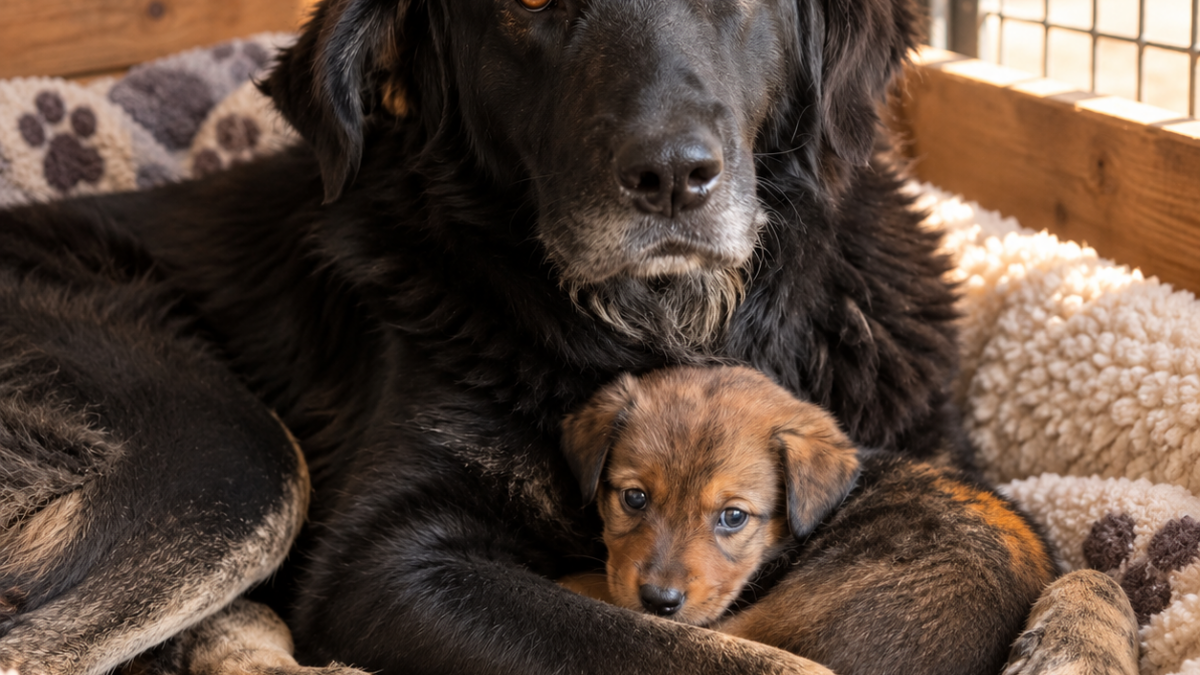
Rachel cut the blue nylon away from the puppy’s neck because it was too tight and had begun rubbing the skin underneath. Shadow watched every movement. Usually, if someone used scissors or metal instruments near him, he backed away immediately, but this time he didn’t move. He kept his chest pressed against the little dog as though his own body had become a wall between the puppy and everything else in the room.
“Claire,” Rachel said quietly, “I need to treat him.”
I nodded.
“Shadow.”
The big dog looked at me.
“We need the baby.”
The word felt ridiculous.
Shadow wasn’t human.
He didn’t understand our explanation.
Yet when Rachel reached down, Shadow’s muzzle moved over the puppy.
Not threateningly.
Protectively.
One of the volunteers stiffened.
“Careful.”
I crouched several feet away.
“Shadow.”
His eyes moved toward me.
For months I had learned not to demand anything from him. Every bit of progress had come through patience. Sitting outside his kennel. Tossing treats without looking directly at him. Letting him choose distance.
So I didn’t pull the puppy away.
I waited.
“Rachel needs him.”
Shadow stared.
The puppy squeaked.
Then Shadow did something extraordinary.
He licked the tiny dog’s head once and slowly moved his front leg aside.
Permission.
Rachel lifted the puppy.
Shadow stood immediately.
He followed us into the treatment room.
Nobody tried to stop him.
—
We named the puppy Milo before lunch.
Technically, Rachel hated naming critical patients too early.
She claimed it made staff emotionally irrational.
We ignored her.
Milo’s body temperature was dangerously low. His blood glucose was barely measurable. He was dehydrated, anemic, infested with fleas, and so underweight that his ribs were obvious beneath his damp coat.
But there was no major trauma.
No broken bones.
No internal bleeding.
The greatest danger was simply that his little body had run out of almost everything it needed to keep going.
Warmth.
Food.
Fluid.
Strength.
Rachel started warmed IV fluids through a tiny catheter.
Milo cried.
From outside the treatment-room door came a deep answering whine.
We all looked toward it.
Shadow was lying against the door.
Waiting.
“He can’t stay there all day,” one of the staff said.
Rachel looked at Milo.
Then Shadow.
“Apparently he can.”
—
For the next six hours, Shadow refused to return to his kennel.
We tried.
He walked back to the treatment-room door.
We offered food.
He ignored it.
We brought his bed.
He lay on the concrete instead.
Every time Milo made a sound, Shadow’s ears lifted.
At around three that afternoon, Milo’s temperature finally entered the low end of normal.
At four, he swallowed a few milliliters of formula.
At five, he lifted his head.
Rachel stared at the chart.
“I genuinely didn’t think he’d make it this far.”
I looked through the small window in the door.
Shadow was still there.
“Maybe nobody told him that.”
—
Briar Ridge Working Dogs.
The name bothered me.
It bothered Rachel too.
Our shelter director, Megan, searched state business records.
A company with that name had existed in the county until approximately three years earlier.
Registered owner:
**Douglas Rainer.**
Business purpose:
Training and sale of working dogs.
Address:
An old rural property fourteen miles east of town.
The company had dissolved after tax problems.
The property had changed owners.
Nothing immediately criminal.
But one thing caught Megan’s attention.
The abandoned industrial property where Shadow had been found was once leased by Briar Ridge as a secondary training location.
I stared at the screen.
“Shadow was found there.”
“Yes.”
“And Milo had their nylon tag.”
“Yes.”
“So they came from the same place.”
“Maybe.”
I hated maybe.
“Shadow recognized it.”
“That isn’t evidence.”
“No.”
But it was something.
—
Officer Marcus Reed from animal control came that evening.
He had been involved when Shadow was first picked up.
The moment we showed him the blue strap, his expression changed.
“I remember that company.”
“Why?”
“Complaints.”
“What kind?”
“Mostly noise. Dogs barking at night. One loose dog report. A neighbor once claimed he heard fighting.”
My stomach tightened.
“Dogfighting?”
Marcus lifted one hand.
“Nobody proved that.”
“What happened?”
“Officer went out. Property owner denied it. Dogs were behind fencing. No visible injured animals accessible from public view. We didn’t have grounds for more.”
“What about Douglas Rainer?”
“He moved.”
“Where?”
“Not sure.”
I looked at Shadow through the door.
Old scars.
Broken tooth.
Fear of men.
Fear of metal.
“Could Shadow have been used for fighting?”
Marcus’s face stayed careful.
“Could be a hundred explanations.”
That was the responsible answer.
I hated it anyway.
—
The next morning Milo was stronger.
Not strong.
Stronger.
He drank formula from a syringe.
Then from a bottle.
By afternoon, his eyes seemed brighter.
When Rachel allowed Shadow into the treatment room under supervision, Milo smelled him before he could see him.
The little puppy started squirming.
Shadow approached.
Milo crawled directly between his front legs.
No hesitation.
No fear.
Shadow lowered his head.
Then Milo did something almost comical.
He tried to nurse from a male dog.
Rachel laughed for the first time in two days.
“Wrong department, buddy.”
Shadow looked offended.
But he didn’t move away.
—
We began using Shadow as part of Milo’s recovery.
Not because Shadow was some magical medical treatment.
Warmth mattered.
Calm mattered.
Milo ate better when Shadow was nearby.
He slept more deeply pressed against Shadow’s side.
And Shadow changed too.
He started eating regularly.
He came out of his kennel without trembling.
He allowed me to clip on his leash without backing into the wall.
He even began walking through the shelter courtyard with Milo carried beside him in a small sling.
People stared.
The giant dog everyone had avoided was now moving through the building like an anxious father.
I knew we shouldn’t humanize him too much.
But sometimes the human words are the closest ones we have.
—
A week later, we received the first clue that turned our curiosity into an investigation.
A woman named Hannah Brooks saw the shelter’s social-media post about Milo.
The post didn’t mention Briar Ridge.
It simply showed a photograph of Milo asleep against Shadow.
Hannah called immediately.
“Where did you get that puppy?”
Megan answered.
“Found in a box outside our shelter.”
“What was around his neck?”
Megan went silent.
“Why?”
“Blue nylon?”
My skin prickled.
“How do you know?”
Hannah started crying.
“Because that’s what he uses.”
“Who?”
“Doug Rainer.”
—
Hannah agreed to meet Marcus.
She had worked at Briar Ridge six years earlier.
Only nine months.
She left because she couldn’t tolerate what she was seeing.
Not organized dogfighting, exactly.
At least not what most people imagine.
Douglas Rainer trained high-drive guard dogs, protection dogs, and dogs sold to private security buyers. Some legitimate.
Others less legitimate.
He also bred large dogs.
Too many.
Dogs that failed his temperament tests were sold cheaply, abandoned, or used as “pressure dogs” during training—animals used to provoke reactions in other dogs.
Marcus asked:
“Were animals intentionally injured?”
Hannah looked down.
“Sometimes.”
“Did you report it?”
“No.”
“Why?”
“I was twenty.”
Marcus didn’t accept that as an answer.
Neither did I.
Hannah swallowed.
“I was scared of him.”
There.
More honest.
—
She pulled out her phone.
Old photographs.
Dogs in outdoor runs.
German Shepherds.
Mastiffs.
Rottweiler mixes.
One photograph made my stomach drop.
A younger Shadow.
No gray around the muzzle.
Fewer scars.
Same split ear.
Same eyes.
He was standing beside a wooden training wall.
Around his neck:
Blue nylon.
**BRIAR RIDGE WORKING DOGS.**
Megan whispered:
“That’s him.”
Hannah nodded.
“They called him Nero.”
Shadow had a name before us.
Nero.
I looked through the office window toward his kennel.
For some reason I hated the name.
Not because there was anything wrong with it.
Because it belonged to the life that had made him afraid.
—
“What happened to him?” Marcus asked.
Hannah stared at the photograph.
“He was one of Doug’s best dogs when he was young.”
“Best how?”
“Obedient. Strong. Smart.”
“Protection trained?”
“Yes.”
“Attack trained?”
She hesitated.
“Controlled bite work.”
That was legal when properly done.
Marcus knew.
“So why all the scars?”
Hannah looked uncomfortable.
“Doug started using harsher methods.”
“What methods?”
She shook her head.
“I didn’t see everything.”
“What did you see?”
“Shock collars.”
“Legal.”
“Too high.”
“Hard to prove.”
“Isolation.”
“Not necessarily illegal.”
“Putting dogs together that shouldn’t have been together.”
Marcus’s eyes narrowed.
“Fights?”
“Sometimes.”
“Intentional?”
Hannah whispered:
“Sometimes.”
—
Shadow wasn’t a fighting dog.
That was important.
He had been trained as a protection dog.
But according to Hannah, Douglas sometimes used dominant adult dogs to intimidate younger dogs or “test nerve.”
Shadow had been one of the dogs he used.
At first, Shadow avoided conflict.
Then after repeated incidents, he became harder to handle.
Douglas punished him for reacting to situations Douglas himself created.
A cycle.
Fear.
Reaction.
Punishment.
More fear.
Eventually Shadow was moved away from clients and kept at the secondary property.
Hannah left before knowing what happened next.
—
“Why would Milo have the old company strap if Briar Ridge closed years ago?” I asked.
Hannah’s answer was immediate.
“Doug never stopped.”
Marcus looked up.
“What?”
“He changed names.”
—
The current operation was called:
**Iron Vale K9 Solutions.**
Different company.
Different county on paper.
Same man.
Hannah had seen online advertisements.
Protection dogs.
Working puppies.
Guard-dog prospects.
Some sold for thousands.
Douglas didn’t advertise the location publicly.
Meetings by appointment.
Pickup points.
Cash preferred.
Marcus called state licensing authorities.
Iron Vale wasn’t licensed as a commercial breeding facility in our county.
It was registered as a training consultancy.
That did not automatically make it illegal.
But questions were accumulating.
—
Milo’s box became evidence.
We had almost thrown it away.
Thank God we hadn’t.
One of our volunteers had placed it near the trash, but rain had soaked it so badly that she left it in the utility room to dry first.
Marcus inspected it.
Ordinary cardboard.
No address.
No label.
But on the bottom was a shipping sticker partially covered by mud.
Sender:
**Iron Vale Equipment LLC.**
Different company.
Same mailing address as Douglas’s current business registration.
Marcus looked at me.
“Now I can ask more questions.”
—
Shelter security footage showed the box arriving at 4:42 a.m.
A dark pickup stopped outside our entrance.
A man got out.
Baseball cap.
Heavy jacket.
Face unclear.
He placed the box beside the doors.
He did not knock.
Did not call.
Did not wait.
He returned to the truck and left.
Milo had remained outside in freezing rain for almost three hours before our morning staff arrived.
That alone could have killed him.
—
Investigators enhanced the vehicle image enough to identify part of the license plate.
Registered to Iron Vale Equipment.
Douglas Rainer’s company.
Now Marcus had more than questions.
—
When Douglas was contacted, he denied owning Milo.
Denied knowing Shadow.
Denied using blue nylon tags.
Denied that the truck had been driven by him.
“It’s a business vehicle,” his lawyer said. “Multiple employees have access.”
Reasonable.
Technically.
Marcus asked for employee names.
The lawyer delayed.
Then provided three.
One of them was Douglas’s nephew, Evan Rainer, twenty-two.
—
Evan contacted animal control privately two days later.
He wanted immunity.
He didn’t get immunity.
But the prosecutor offered to consider cooperation.
Evan talked.
For four hours.
—
Iron Vale had approximately thirty dogs across two properties.
Only fourteen officially documented.
Some were client dogs.
Some breeding dogs.
Some puppies.
Douglas bought and sold dogs through informal networks.
He was careful about veterinary records.
Careful about property inspections.
Careful enough to remain just beyond obvious violations.
But according to Evan, things had changed during the previous year.
Business was failing.
Costs rising.
Dogs that couldn’t be sold became burdens.
Milo belonged to a litter of seven.
Mother:
A young shepherd-mastiff mix named Ivy.
Father:
Unknown.
Maybe one of Douglas’s own males.
Milo was the smallest.
He developed diarrhea.
Stopped gaining weight.
Douglas decided he wasn’t worth veterinary treatment.
Evan asked:
“Can I take him to the shelter?”
Douglas refused.
Why?
Because he didn’t want a weak puppy connected to his operation.
Reviews mattered.
Reputation mattered.
Money mattered.
So at four in the morning, Douglas told Evan to put the puppy in a box and leave him somewhere.
Evan drove.
Evan abandoned Milo.
Not Douglas.
That mattered legally.
—
“Why our shelter?” I asked Marcus later.
“Evan knew we had overnight staff some days.”
“But not that morning.”
“He claims he thought someone would find Milo quickly.”
“In freezing rain.”
Marcus nodded.
“Yeah.”
I was furious.
“Then why is Douglas responsible?”
“Potentially ordering or directing abandonment. Depends on evidence.”
“Does Evan have proof?”
Marcus looked at me.
“Text messages.”
—
One message:
**Douglas:** Don’t spend another dollar on that runt.
**Evan:** He needs a vet.
**Douglas:** He needs to be gone.
**Evan:** Shelter?
**Douglas:** Not with our name attached.
Then:
**Douglas:** Use the equipment box. Dump him somewhere they’ll find him.
Evan:
**That’s messed up.**
Douglas:
**Then you pay his bills.**
No response.
Two hours later:
**Douglas:** Done?
Evan:
**Yeah.**
Douglas:
**Good.**
—
That message ended any doubt I still had about Milo.
But Shadow?
Nero?
The older dog had disappeared years earlier.
Evan had been a teenager then, but he remembered him.
“Doug hated that dog.”
“Why?” Marcus asked.
“Because he stopped doing what he was told.”
“What does that mean?”
“He’d freeze.”
“During training?”
“Yeah.”
“Fear?”
“Probably.”
“What happened?”
“Doug kept him at the old warehouse.”
“The place where animal control found Shadow.”
“Yeah.”
“Who fed him?”
“Whoever remembered.”
My throat tightened.
“How long?”
Evan looked ashamed.
“Years.”
—
Shadow had not wandered to that abandoned property.
He had been left there.
The company moved.
He didn’t.
For nearly two years, according to Evan, Shadow survived around the old site while different people occasionally brought food.
Then even that stopped.
Neighbors sometimes saw him.
Nobody knew he belonged to someone.
When the property was finally sold, animal control was called.
Shadow had spent years abandoned without technically being “dumped” in a single dramatic moment.
Sometimes cruelty is not one act.
Sometimes it’s a long series of decisions not to care.
—
The investigation expanded quickly after Evan’s statement.
Search warrants were approved for Iron Vale’s training property and Douglas’s rural kennel.
I didn’t go.
I saw photographs later.
Twenty-eight dogs.
Nine puppies.
Several healthy.
Several not.
One elderly shepherd had untreated dental disease so severe she struggled to eat.
A mastiff had chronic ear infections.
Two dogs were underweight.
A young female had pressure sores.
And in an isolated shed, officers found a dog that made Marcus call us immediately.
Ivy.
Milo’s mother.
—
She was alive.
Thin.
Frightened.
Milk still present.
Her other six puppies were gone.
Sold.
All six traced eventually and thankfully alive.
Milo was the only one Douglas considered worthless.
—
Ivy came to our shelter under protective hold because our veterinary team had experience with Milo.
The moment she entered the treatment wing, Shadow stood.
He had been asleep.
He woke before Ivy made a sound.
His nose lifted.
His entire expression changed.
Ivy froze when she saw him.
Then she walked forward.
Not like strangers.
Slowly.
Carefully.
Shadow approached the kennel gate.
Ivy pressed her nose through.
Shadow touched it.
No excitement.
No dramatic reunion.
Just recognition.
Rachel whispered:
“They know each other.”
Evan confirmed it later.
Ivy had spent her first year at the old industrial training property.
Shadow had still been there.
She’d been a young dog then.
Douglas occasionally used Shadow as a “settling dog” because, despite everything, he was calm around puppies and timid dogs when humans weren’t forcing him into conflict.
That was why Shadow had responded to Milo.
Not because he magically knew Milo was Ivy’s son.
Maybe scent helped.
Maybe the blue strap.
Maybe the puppy simply activated something Shadow had always had inside him.
Gentleness.
The thing everyone had been too frightened to see.
—
Milo reunited with Ivy after veterinary clearance.
He was nearly eight weeks old by then and much stronger.
When we opened the divider, Milo ran toward her.
Ivy sniffed him frantically.
Then washed his entire head.
Milo complained loudly.
Shadow watched from the next pen.
After several minutes, Ivy walked toward Shadow’s side of the divider.
He lay down.
She lay down too.
Milo squeezed himself between both fences and fell asleep.
Three dogs tied together by one terrible place.
Now safe in another.
I sat on the floor and cried.
Rachel handed me a tissue.
“Again?”
“Shut up.”
—
Douglas Rainer was arrested three weeks after the search.
The charges were not some cinematic list of every bad thing anyone imagined he had done.
They were specific.
Animal abandonment.
Conspiracy or solicitation related to Milo’s abandonment, depending on the final charging theory.
Multiple neglect counts based on veterinary documentation.
Commercial breeding and licensing violations.
Falsification of certain animal records.
Improper disposal/abandonment related to Shadow’s historical case became harder because of time limits and evidence issues, but it mattered in the civil and licensing proceedings.
Evan faced charges too.
That was important.
He had put Milo in the box.
Cooperation did not erase action.
His lawyer negotiated.
Probation.
Community service.
Mandatory animal-welfare education.
Restitution.
No employment involving commercial breeding during the probation period.
Some people thought he deserved more.
Maybe.
But he had also provided the evidence that got twenty-eight dogs removed.
Justice gets complicated when guilty people help stop guilt.
—
Douglas fought everything.
Publicly, he called himself a legitimate working-dog trainer targeted by emotional activists who didn’t understand the industry.
He posted photographs of healthy dogs he’d sold.
Testimonials from satisfied clients.
Videos of proper training sessions.
And some of those things were real.
That’s what made the case important.
Bad people are rarely bad every minute.
A person can care for profitable animals well and still discard the ones that stop being profitable.
A clean photograph does not erase a locked shed.
—
Then Douglas made a mistake.
He came to the shelter.
Against his attorney’s advice.
Of course.
He claimed he wanted to inspect animals that were “still legally his.”
He especially wanted Ivy.
And one other dog.
Shadow.
—
I was at the front desk.
When Douglas walked in, Shadow was in the adjacent behavior room with Milo.
The moment he heard Douglas’s voice, Shadow disappeared.
Not literally.
Emotionally.
His body dropped.
Tail tucked.
He crawled behind a bench.
The dog who had begun walking confidently through our halls became the animal we had first met.
Shaking.
Eyes wide.
Silent.
I had never hated anyone so quickly.
Douglas pointed through the window.
“That’s Nero.”
I stepped in front of him.
“His name is Shadow.”
“I trained that dog.”
Rachel came from the treatment room.
“You need to leave.”
Douglas laughed.
“He’s mine.”
“No.”
“I’ve got breeding records.”
Marcus happened to be in the building.
Another gift from timing.
He approached.
“Mr. Rainer, you were instructed through counsel not to contact seized animals or witnesses.”
Douglas pointed toward Shadow.
“That dog wasn’t seized. He was stolen years ago.”
Marcus’s expression sharpened.
“Interesting choice of word.”
Douglas realized too late.
Marcus continued:
“You reported him missing?”
Silence.
“Insurance claim?”
Nothing.
“Police report?”
Douglas’s jaw tightened.
“He ran off.”
I looked through the glass.
Shadow was hiding from the sound of his voice.
I couldn’t stop myself.
“No. You left him.”
Douglas looked at me.
“You don’t know anything about that dog.”
“I know what he does when he hears you.”
That landed.
—
Then Milo barked.
Tiny puppy bark.
Douglas looked toward him.
“That’s the runt?”
My hands clenched.
Rachel said:
“Leave.”
Douglas looked Milo up and down.
“Looks fine now.”
That sentence.
Not:
He survived.
Not:
I’m glad.
Looks fine now.
Like an item repaired by somebody else’s money.
Then:
“Could probably sell him after all.”
Rachel moved before I did.
Not violently.
She opened the lobby door.
“Out.”
Douglas laughed.
“Everybody’s emotional.”
Marcus answered:
“Everybody except you, apparently.”
Douglas left.
But the lobby camera recorded everything.
Including the phrase:
**Could probably sell him after all.**
His attorney was not pleased.
—
The case drew attention.
A local newspaper published a careful investigation.
Not sensational.
Records.
Complaints.
Company histories.
Licensing gaps.
Former employees.
Veterinary findings.
One sentence from Hannah became the headline beneath the main article:
**”The dogs that made money were cared for. The ones that stopped making money disappeared.”**
That was the entire system.
—
Former clients came forward.
Most had healthy dogs and no complaints.
Some defended Douglas.
Others had troubling stories.
One family purchased a shepherd that developed seizures within months. Douglas refused contact.
Another returned a dog for behavioral problems and was told it would be “placed on a farm.” Nobody could trace what happened afterward.
A former employee remembered three adult dogs being moved to the old industrial site.
Only Shadow was ever found.
That haunted us.
But there wasn’t enough evidence to determine what happened to the others.
Not every question gets an answer.
—
Shadow’s history became clearer through photographs.
He had once been handsome in the polished way expensive working dogs are photographed.
Chest out.
Glossy coat.
Blue collar.
Alert eyes.
Then later images showed scars.
Weight loss.
Different environment.
Less handling.
Finally no photographs at all.
As if his existence became less worth documenting as his usefulness declined.
—
I printed one old photograph.
Then regretted it.
Shadow saw it only as paper.
I saw a dog before fear.
For several days, I kept comparing him to who he’d been.
Then I realized something unfair.
Shadow did not need to become that dog again.
Healing wasn’t restoration to some earlier version people found prettier.
He could become whoever he was now.
Scarred.
Quiet.
Gentle with Milo.
Suspicious of boots.
Loving in strange little ways.
That was enough.
—
Milo recovered completely.
At twelve weeks, he had transformed from the half-dead animal in the cardboard box into an athletic little menace.
He chased mop heads.
Chewed blankets.
Barked at his reflection.
Stole Rachel’s pen.
And treated Shadow like personal playground equipment.
He climbed over Shadow’s back.
Bit his ears.
Slept on his tail.
Shadow tolerated nearly everything.
When Milo became too obnoxious, Shadow gave one deep huff.
Milo stopped.
Usually for approximately eight seconds.
—
Ivy recovered more slowly.
Her body told the story of repeated breeding.
She was only around three but had likely produced at least two litters already.
She had intestinal parasites.
Skin irritation.
Anemia.
No catastrophic injuries.
Just depletion.
The kind of neglect that doesn’t make dramatic photographs.
She needed food.
Rest.
Medical care.
Time.
—
Once legal ownership transferred, Ivy went into a foster home with a retired veterinary nurse named Diane.
Milo initially went with her.
Shadow stayed at the shelter.
That lasted one night.
Shadow refused dinner.
He paced.
For hours.
I thought we’d destroyed his progress.
The next morning, Diane called.
“I have room.”
“For?”
“Shadow.”
I laughed.
“You haven’t met him.”
“I’ve seen him.”
“He’s ninety pounds.”
“I’ve had mastiffs.”
“He’s fearful.”
“So am I before coffee.”
I liked her immediately.
—
We introduced Diane properly.
She sat on the floor outside Shadow’s kennel.
Didn’t stare.
Didn’t reach.
Read a book.
For forty-five minutes.
Shadow eventually approached.
Sniffed her shoe.
Retreated.
Diane kept reading.
Next day, same.
Third day, he took chicken.
By the end of the week, Shadow allowed her to clip a leash.
Diane looked at me.
“So?”
“So what?”
“Bring him.”
“To foster?”
“Yes.”
“With Ivy and Milo?”
“That’s generally what ‘bring him’ means.”
—
The first photograph she sent that night showed all three dogs asleep in her living room.
Ivy on a dog bed.
Milo upside down on the rug.
Shadow beside the doorway.
Not touching anyone.
But inside.
Home environment.
Door open.
No kennel bars.
I stared at that picture for a long time.
—
The trial process took nearly a year.
Douglas eventually accepted a negotiated plea after prosecutors obtained more business records and expert testimony.
He pleaded to several animal neglect and abandonment-related offenses, commercial licensing violations, and falsified record counts.
He lost his ability to operate a commercial breeding or training kennel for a lengthy period.
He received jail time followed by probation, substantial fines, restitution for veterinary and shelter expenses, and restrictions on animal ownership.
The Iron Vale operation closed.
All seized animals were legally surrendered.
His business assets—including several training structures and vehicles—were sold to satisfy debts and restitution.
Did he receive the punishment I imagined when Shadow hid beneath that bench?
No.
My imagination was less civilized.
But the dogs were out.
The operation was gone.
That mattered more.
—
During sentencing, Douglas tried to explain himself.
“Working dogs are expensive to maintain.”
The judge looked at him.
“Then maintain fewer dogs.”
Silence.
“Some animals don’t work out.”
“Then rehome them responsibly.”
“I tried.”
The prosecutor produced Milo’s message.
**Use the equipment box. Dump him somewhere they’ll find him.**
The judge looked back at Douglas.
“That is not rehoming.”
Douglas said nothing.
Then the judge referenced Shadow.
Though the oldest abandonment couldn’t support every criminal charge prosecutors wanted, the records had established the pattern.
“You kept an animal at a closed industrial property after your company ceased operating there.”
Douglas’s attorney stood.
The judge clarified:
“I am addressing documented conduct considered in sentencing, not imposing a separate conviction.”
Then:
“Mr. Rainer, your repeated defense is that these animals became difficult, expensive, or unsuitable for your business.”
Pause.
“Those are reasons to find another responsible placement.”
Another pause.
“They are not reasons to make the animals disappear.”
Nobody moved.
—
Evan spoke too.
His voice shook.
“I put Milo in the box.”
No excuses.
That mattered.
“I told myself I was better than my uncle because I left him at a shelter instead of somewhere nobody would find him.”
He swallowed.
“But I still left a sick puppy outside in freezing rain because I was scared to stand up to him.”
He looked toward me.
“I don’t expect forgiveness.”
Good.
Because I didn’t know if I had it.
“I just want the court to know I understand the difference now.”
The judge gave him structured probation, service, and restrictions consistent with the agreement.
Evan served his community hours at a municipal animal-care facility.
Not our shelter.
That was intentional.
—
Two years later, Evan became a veterinary assistant.
I know how that sounds.
Another redemption arc too neat to believe.
But real life sometimes does that.
He didn’t become some perfect hero.
He just kept showing up.
Cleaning cages.
Taking courses.
Working.
He once told Megan:
“The puppy didn’t need me to feel guilty forever. He needed me to stop being the kind of person who could leave him.”
That sentence reached me.
Eventually.
—
Douglas’s old rural kennel property was sold.
A nonprofit bought part of it with a grant and private donations.
Not our shelter.
A separate rescue specializing in fearful and working-breed dogs.
They removed the old isolation sheds.
Converted training runs into rehabilitation yards.
Built shaded kennels.
Added a medical room.
Someone suggested naming it after Shadow.
Megan asked me.
I said no.
“Why?”
“Because Shadow spent enough of his life attached to that place.”
Instead, they named one of the rehabilitation programs:
**Second Start.**
Better.
—
Diane fostered Shadow, Ivy, and Milo for six months.
Then she called me.
“I have a problem.”
My heart dropped.
“What happened?”
“I failed fostering.”
I started laughing.
“Which one?”
“Yes.”
“All three?”
“They’re already home.”
“You were supposed to find adopters.”
“I did.”
“Who?”
“Me.”
Of course.
—
Shadow’s adoption paperwork was the longest.
Because everyone wanted to be certain.
Behavior assessment.
Veterinary review.
Home evaluation.
Safety plan.
Diane didn’t complain once.
When she signed, Shadow lay beneath the table.
Milo was chewing the corner of a folder.
Ivy was asleep.
Diane looked down.
“Well.”
I asked:
“What?”
“I wanted one older dog.”
I laughed.
“That’s shelter math.”
—
Shadow changed more in Diane’s house than he ever had inside the shelter.
Not dramatically.
Slowly.
The first time he slept in the middle of a room instead of against a wall, Diane sent us a photograph.
The first time he barked at a squirrel.
Photograph.
The first time he carried a toy.
Photograph.
It was a faded stuffed bear.
Milo stole it.
Shadow took it back.
Diane wrote:
**First documented act of selfishness. Very proud.**
—
Men remained difficult.
Diane’s brother visited often.
He was six foot four, wore heavy boots, and had a booming voice.
Shadow hid.
So the brother began entering through the back door in sneakers.
Sat on the floor.
Ignored Shadow.
Brought chicken.
Months.
One day Shadow approached.
Touched his hand.
Walked away.
Diane’s brother cried in the bathroom.
Diane told all of us.
Naturally.
—
Shadow never became outgoing.
He didn’t need to.
He liked Diane.
Ivy.
Milo.
Me.
Rachel.
A small circle.
Enough.
—
Milo grew into a fifty-pound adult, much smaller than Shadow but convinced he was exactly the same size.
He continued sleeping against Shadow whenever possible.
Even after he no longer fit between Shadow’s front legs, he tried.
Shadow would sigh.
Shift.
Make room.
Every time.
—
Ivy became surprisingly playful.
Once her body recovered, she discovered tennis balls.
Then refused to return them.
Diane purchased twenty.
Ivy collected them beneath the dining table like treasure.
Milo stole them.
Shadow remained above such nonsense until no one was looking.
Then he carried one into the bedroom.
Diane caught him.
He dropped it immediately.
“Too late,” she said.
—
The shelter stopped describing Shadow as unpredictable.
We removed the word from his old profile.
Not because every fearful dog is safe with everyone.
Because the word had mostly described our ignorance.
His new file said:
**Fearful with unfamiliar handling. Requires slow introductions. Strong affiliative behavior with familiar dogs. Particularly gentle with puppies.**
Accurate language matters.
Labels shape what people see.
—
Shadow’s story spread locally after the court case became public.
Not because we wanted a viral dog.
Because people were fascinated by the contrast.
The dog everyone feared.
The puppy he saved.
Donations arrived.
Some people offered to adopt Shadow even after Diane had already adopted him.
That annoyed me.
Where were all those people when he sat in the last kennel for five months?
Humans like heroes.
They struggle with ordinary broken creatures.
—
We used the attention differently.
The shelter created a program for long-stay fearful dogs.
No dramatic name.
**Quiet Kennel Project.**
Sound dampening.
Visual barriers.
Consistent handlers.
Longer decompression.
Behavior consultations.
Volunteer training.
Less pressure on dogs to perform friendliness for adopters.
Shadow’s case helped us understand that a dog could appear distant, intense, or “scary” while actually living in constant fear.
—
The first dog helped by the program was a brindle mastiff named Ruth.
She spent three months hiding.
Then approached one volunteer.
Then another.
Eventually adopted by a retired teacher.
Second was a shepherd named Benji.
Then a pit bull named May.
Not every dog became adoptable.
Some needed sanctuary placement.
Some had behavior risks that required strict management.
We didn’t turn Shadow into a fairy tale that said love fixes everything.
Love does not replace expertise.
But patience reveals information fear can hide.
That became our lesson.
—
Three years after his adoption, Shadow returned to the shelter.
Voluntarily.
For an event.
I didn’t know how he’d react.
The moment he entered the hallway, his body stiffened.
I regretted it.
Then Milo walked ahead.
Ivy beside him.
Diane held Shadow’s leash loosely.
He smelled the air.
Looked toward his old kennel.
Walked three steps.
Stopped.
Then turned away.
He followed Milo toward the courtyard.
No panic.
No hiding.
I exhaled.
The building no longer owned him.
—
We brought him into the puppy room briefly.
Under controlled conditions.
Three abandoned puppies were sleeping behind a barrier.
Shadow smelled them.
Tail moved once.
Diane whispered:
“There he goes.”
He lay beside the barrier.
One puppy crawled toward him.
Pressed against the wire.
Shadow put his nose against it.
That photograph became the shelter’s most requested image.
We didn’t put a dramatic caption.
Just:
**Shadow, three years after adoption.**
Nothing else needed.
—
Douglas appealed parts of his licensing ban.
Lost.
Then tried to have certain seized business equipment returned.
Lost again.
At one hearing, his attorney argued that the business collapse had already punished him enough.
The regulator answered:
“The purpose of the restriction is not to punish the business failure. It is to protect future animals.”
Exactly.
That was the difference between revenge and prevention.
—
Did I enjoy watching his appeals fail?
Yes.
I am not a saint.
But over time, Douglas became less important.
That was healthier.
Shadow didn’t wake up thinking about him.
Milo didn’t care.
Ivy certainly didn’t.
Why should we build their good life around the person who caused the bad part?
—
At eight or nine, Shadow began showing arthritis.
His exact age remained uncertain.
Old records suggested he might actually be ten.
Diane didn’t care.
“We’ll call him forty.”
“Dog years?”
“No. Emotional age.”
—
Rachel started joint medication.
Diane added rugs.
Ramps.
Orthopedic beds.
Shadow preferred the cheapest rug near the kitchen.
Of course.
—
Milo became Shadow’s unofficial guide in strange situations.
If Shadow hesitated at a doorway, Milo went first.
If a new person entered, Milo investigated.
If Milo returned relaxed, Shadow often followed.
We used to think Shadow saved Milo.
Years later, Milo saved Shadow in a hundred tiny ways.
That’s the part people didn’t post.
—
Ivy died first.
Cancer.
She was only around nine.
Too young.
Diane noticed a mass.
Treatment bought them ten good months.
When the end came, Shadow stayed beside her bed.
Milo paced.
Diane had the veterinarian come home.
I was there.
Ivy ate chicken.
Held a tennis ball between her paws.
Then fell asleep with Shadow’s nose touching her shoulder.
After she died, Shadow remained there almost thirty minutes.
Then walked to her tennis-ball collection.
He picked up one ball.
Carried it to his bed.
He kept that ball for the rest of his life.
—
Milo grieved loudly.
Shadow quietly.
Different.
Neither wrong.
For weeks, Shadow slept on Ivy’s empty bed.
Diane didn’t move it.
Eventually he returned to his usual rug.
Healing doesn’t mean forgetting the bed.
It means using another one again.
—
A year later, Evan visited.
Diane agreed.
His first time meeting Milo as an adult.
Evan stood in the backyard.
Milo ran straight toward him.
Friendly idiot.
Evan crouched and started crying before Milo even reached him.
Milo licked his face.
No moral judgment.
Just new person.
Evan whispered:
“I’m sorry.”
Milo stole the treat bag from his pocket.
Diane laughed.
“That’s his response.”
—
Shadow remained farther away.
Evan didn’t approach.
Good.
He knew better.
After twenty minutes, Shadow came within ten feet.
Then five.
Sniffed.
Walked away.
Evan looked at me.
“That’s more than I deserve.”
I answered:
“It’s not about deserve.”
He nodded.
By then, he understood.
—
When Shadow reached approximately twelve, his muzzle turned almost completely gray.
His scars seemed softer somehow.
Not gone.
Just less important against old age.
People who met him then had trouble imagining why anyone had once been frightened.
He moved slowly.
Slept deeply.
Accepted touch from his small circle.
Still disliked strangers leaning over him.
Reasonable.
I dislike strangers leaning over me too.
—
He developed heart disease.
Manageable at first.
Then a growth near his spleen.
Rachel was still his veterinarian.
Imaging suggested surgery carried significant risk.
Diane asked every question.
Quality of life.
Pain.
Options.
Time.
We chose monitoring.
No heroic intervention simply because we were afraid of goodbye.
Shadow had spent enough of his life with people forcing things onto him.
His old age would include choice wherever possible.
—
He got another good year.
A full year.
Winter snow.
Spring sunlight.
Slow walks.
Milo beside him.
One stolen hamburger at a cookout.
Diane claimed Shadow took it.
I blamed Milo.
No proof.
Case unresolved.
—
Then, one October morning, Shadow collapsed in the yard.
Diane called me from the emergency clinic.
I knew from her voice.
The splenic mass had ruptured.
Internal bleeding.
Surgery might stop it.
But Shadow was old.
Heart disease.
Weak.
The odds were poor.
Rachel sat with us.
“We can operate.”
Diane looked at Shadow.
He was lying on a blanket.
Breathing slowly.
Milo pressed against his back.
“What would recovery look like?”
“Hard.”
“Chance of more good time?”
Rachel didn’t give false certainty.
“Possibly months. Possibly much less.”
Diane closed her eyes.
Then asked the best question.
“If we do nothing, is he suffering?”
“Not if we manage this now.”
Diane nodded.
“Home.”
—
We brought Shadow home.
No emergency surgery.
No sterile room.
No final hours separated from Milo.
Home.
—
That evening, people who mattered came quietly.
Rachel.
Megan.
Me.
Diane’s brother.
Evan asked if he should.
Diane said no.
He understood.
Shadow’s last hours didn’t exist to give everyone closure.
They belonged to Shadow.
—
He lay on the same rug near the kitchen he had chosen years earlier over every expensive bed.
Milo lay beside him.
The old stuffed bear was nearby.
So was Ivy’s tennis ball.
Diane sat on the floor.
I sat across from her.
For a while nobody said anything.
—
I thought about the first day.
Shadow walking toward dying Milo.
Everyone afraid.
Someone whispering:
“Take the puppy away.”
How wrong we had been.
We thought danger was approaching the helpless thing.
Actually, safety was.
—
Rachel arrived after sunset.
She examined him.
The bleeding had worsened.
His gums pale.
Breathing tiring.
Time.
Diane nodded.
Then she looked at me.
“Can you tell him?”
I almost laughed through tears.
“Tell him what?”
“Whatever you always tell dogs.”
“I don’t have a speech.”
“You absolutely have speeches.”
Fair.
—
I moved closer.
Shadow’s eyes opened.
“Hey.”
His tail didn’t move.
Too tired.
I touched his paw.
He allowed it.
Years earlier, I couldn’t have touched his shoulder without making him flinch.
Now his paw rested beneath my hand.
“You scared the hell out of us.”
Diane laughed softly.
“All five months.”
Shadow breathed.
“We thought we knew you.”
Another breath.
“We didn’t.”
Milo moved closer.
Shadow’s eyes shifted toward him.
Of course.
Always Milo.
—
I whispered:
“You saved him.”
Technically, Rachel saved him medically.
Warm fluids.
Nutrition.
Treatment.
But there are truths medicine doesn’t measure.
Shadow gave Milo warmth.
Stimulation.
Calm.
A reason to keep responding.
Maybe the puppy would have survived without him.
Maybe not.
The important part wasn’t proving a miracle.
The important part was that Shadow had chosen tenderness when everyone expected danger.
—
“You know what happened after that?”
I continued.
“Twenty-eight dogs got out.”
Diane’s face crumpled.
“Ivy got out.”
Milo licked Shadow’s paw.
“Evan changed his life.”
I swallowed.
“Douglas can’t do it anymore.”
Shadow didn’t know any of those names the way I did.
Didn’t matter.
“People stopped calling dogs like you unpredictable just because they were scared.”
My voice broke.
“You did all that by being exactly who they thought you weren’t.”
—
Rachel administered the sedative.
Shadow relaxed.
For the first time in his entire life with us, I saw every muscle in his face go completely loose.
No watchfulness.
No calculation.
No waiting for the next thing.
Just rest.
Milo put his head across Shadow’s front legs.
The same place he’d fit as a tiny puppy.
He was too big now.
Shadow didn’t move.
—
Diane touched his split ear.
“No more loud bowls.”
Breath.
“No more boots.”
Another.
“No more kennels.”
She started crying.
“No more being brave for everyone else.”
Rachel prepared the final medication.
Diane kissed his forehead.
“You were never what they said.”
Then nodded.
—
Shadow’s breathing slowed.
One breath.
Another.
The last exhale was so soft I almost missed it.
Milo remained still.
His head stayed across Shadow’s paws.
Nobody moved him.
—
After several minutes, Milo lifted his head.
Sniffed Shadow’s face.
Pushed his nose beneath Shadow’s chin.
Waited.
Then lay down again.
Diane sobbed.
I looked away because sometimes privacy is a kindness even among friends.
—
Shadow was cremated.
Diane kept most of his ashes.
Some went beneath the tree where Ivy’s ashes had been scattered.
Milo’s old blanket was placed there for one afternoon before Diane took it back because rain was coming.
Sentiment has limits.
—
The shelter installed a small plaque near the Quiet Kennel Project.
Not a dramatic monument.
Just:
**SHADOW**
**HE TAUGHT US THAT FEAR CAN LOOK LIKE DANGER—AND GENTLENESS CAN HIDE WHERE PEOPLE ARE TOO AFRAID TO LOOK.**
Below it:
**For the dogs who need time.**
I liked that.
—
Milo lived another six years.
Healthy.
Happy.
Ridiculously social.
He eventually became a helper dog for carefully managed shelter introductions—not because Shadow’s exact role could be recreated, but because Milo himself was calm around frightened dogs.
The puppy Shadow helped survive became the dog who helped other frightened animals take their first steps toward people.
Life likes circles.
—
At ten, Milo started slowing.
At eleven, arthritis.
At twelve, gray around the muzzle.
Diane joked:
“He’s turning into Shadow.”
Not really.
Milo had never carried Shadow’s fear.
That was the gift.
He got to grow old without it.
—
Evan remained in veterinary work.
Eventually he became a licensed technician.
He never used Milo’s story as a way to make himself look heroic.
When he spoke to young shelter volunteers, he always began:
“I abandoned a puppy.”
Not:
My uncle made me.
Not:
I was scared.
Not:
I later helped.
First:
“I abandoned a puppy.”
Then he told the rest.
That honesty made people listen.
—
One teenager once asked him:
“Why didn’t you just say no?”
Evan was quiet.
Then:
“Because I was more afraid of one angry man than I was afraid of becoming someone I hated.”
The room went silent.
He continued:
“That’s what cowardice feels like while you’re doing it. It usually has an excuse.”
I remembered Shadow.
All those scars.
All those years.
Excuses had surrounded him too.
Business.
Training.
Cost.
Difficulty.
Temperament.
Every cruel choice dressed as practicality.
—
Douglas eventually finished his sentence and probation.
We heard he moved several states away.
No new commercial dog license appeared under his name.
Maybe he changed.
Maybe he didn’t.
I stopped checking.
That was progress for me.
People sometimes think revenge means watching someone forever to make sure they stay miserable.
That gives them too much space.
The dogs deserved that space.
—
The old Iron Vale property became fully operational as a rescue training center.
No breeding.
No sales.
Behavior rehabilitation.
Temporary boarding for animals seized during cruelty investigations.
New owners removed the last chain posts from the back lot.
One of the workers brought a pile of them to scrap.
I happened to be there.
Rusty iron.
Concrete stuck to the bottoms.
I stared.
“Want one?” the worker joked.
“No.”
Good answer.
Not every artifact deserves preservation.
Some things should become scrap.
—
The first long-term resident in the renovated isolation building was a black shepherd mix.
Scared of men.
Scared of metal.
Wouldn’t eat if watched.
For obvious reasons, everyone called me before choosing a name.
“Don’t call him Shadow.”
They didn’t.
They named him Cooper.
He found a home eleven months later.
—
Years after Shadow died, a new volunteer asked me whether I thought he truly “saved” Milo.
I understood the question.
Medically?
We couldn’t prove it.
Milo was already being warmed.
Rachel was already treating him.
The dog did not perform CPR.
Didn’t magically cure hypothermia.
So I answered honestly.
“I don’t know whether Milo would’ve died without Shadow.”
The volunteer looked slightly disappointed.
Then I continued:
“But Shadow changed what happened to him.”
“How?”
“He kept him warm. He stimulated him. He calmed him. And he made us look closer at the strap.”
I pointed toward the plaque.
“Without Shadow, we might have saved one puppy and stopped there.”
The volunteer nodded.
“Instead?”
“Instead we found where he came from.”
Twenty-eight dogs.
Ivy.
Records.
A business.
A pattern.
“That’s enough saving for me.”
—
Milo’s last year was gentle.
Diane was older too.
Her knees hurt.
Milo’s hips hurt.
They took slow walks together.
He slept in the kitchen where Shadow used to lie.
Sometimes directly on the same worn rug.
Diane refused to replace it.
I stopped arguing.
—
When Milo’s time came, it wasn’t dramatic.
Kidney disease.
Age.
Loss of appetite.
No emergency.
No freezing box.
No abandoned doorway.
He was thirteen.
He had lived twelve years and eleven months longer than someone once thought worth paying for.
That calculation mattered to me.
—
Diane called Evan.
Not because she owed him.
Because she wanted him there.
He came after work in scrubs.
Sat on the floor.
Milo recognized him.
Tail.
Still friendly.
Always.
Evan laughed and cried.
“You really don’t hold grudges.”
Milo put his head in Evan’s lap.
—
Rachel had retired.
Her younger partner, Dr. Sophie Lane, came to the house.
We sat in the same kitchen where Shadow had died six years earlier.
Milo lay on the old rug.
Diane placed Ivy’s tennis ball beside him.
Then Shadow’s stuffed bear.
I laughed.
“He hated sharing that.”
“He shared everything with Milo.”
True.
—
Before the medication, Evan whispered:
“I should’ve carried you inside that morning.”
Milo breathed slowly.
“I should’ve knocked.”
His voice broke.
“I should’ve waited until somebody opened the door.”
Diane put one hand on his shoulder.
“You can’t change that morning.”
“I know.”
“What did you do with the years after?”
Evan looked at Milo.
“Everything I could.”
Diane nodded.
“Then stay here.”
That was forgiveness.
Not forgetting.
Not pretending.
A changed relationship to the truth.
—
Milo died with his head in Diane’s lap.
Evan holding one paw.
Me holding the other.
Old age.
Again.
The ending he had almost lost before his story began.
—
His ashes went beneath the same tree as Shadow and Ivy.
The small stone was replaced with a larger one.
It read:
**SHADOW — IVY — MILO**
**ONE WAS FEARED.**
**ONE WAS USED.**
**ONE WAS THROWN AWAY.**
**ALL THREE BECAME FAMILY.**
Underneath, Diane added:
**AND NONE OF THEM WERE WHAT SOMEONE ELSE DECIDED THEY WERE WORTH.**
Long inscription.
Perfect.
—
Diane died several years later.
Peacefully.
Her niece found detailed instructions in her desk.
The house went to family.
Money to several charities.
A portion of her ashes was to be placed beneath the same tree.
Her niece called me.
“She wrote: ‘Don’t put me directly on top of the dogs. Give everyone some personal space.'”
I laughed until I cried.
Classic Diane.
—
So now, beneath one tree, there is a woman who took three damaged animals into her house after insisting she wanted none of them, a mother dog who survived being used for litters, a puppy abandoned because he cost too much to treat, and a huge black dog who spent years being described as dangerous because people didn’t understand what fear looked like on a body that large.
That’s family.
At least one version.
—
The shelter has changed since then.
New building.
Better kennels.
Behavior rooms.
Quiet areas.
No more old concrete run where Shadow spent those first months.
I was surprisingly glad when they demolished it.
I didn’t want a shrine.
His story deserved movement, not preservation of the place he waited.
—
The Quiet Kennel Project became a permanent part of our shelter design.
Every fearful dog gets an initial decompression period.
Every volunteer gets training.
No one is allowed to call a dog “bad,” “mean,” or “unpredictable” in an official note without describing the actual behavior.
Instead:
**Freezes when approached by unfamiliar men.**
**Growls when cornered.**
**Avoids leash handling.**
**Recovers slowly after loud noises.**
Facts.
Not verdicts.
Shadow taught us the difference.
—
And every time a tiny puppy arrives half frozen, I remember him.
That dark shape crossing the hallway.
Everyone afraid.
Someone saying:
“Take the puppy away.”
Then Shadow lowering himself.
Making his own body into warmth.
—
People love dramatic transformations.
They want me to say Shadow became completely fearless.
He didn’t.
They want me to say he learned every person was good.
He didn’t.
That would have been a dangerous lesson anyway.
They want me to say he forgave Douglas.
Dogs don’t need our narrative.
Shadow simply learned that some people were safe.
Some rooms were safe.
Some hands didn’t hurt.
Some dogs could sleep against him.
Some nights ended with morning instead of punishment.
That was enough.
—
And if you want the revenge, there was revenge.
Douglas Rainer built a business around deciding which dogs were valuable and which weren’t.
In the end, his own records proved the pattern.
His own messages exposed him.
His own nephew testified.
His operation closed.
His breeding stock was removed.
His licensing disappeared.
Money from seized assets helped care for dogs his system had failed.
The property connected to his business became a place that rehabilitated frightened dogs instead of producing them.
The puppy he called a runt lived thirteen years.
The female he treated as a breeding resource became family.
The dog he abandoned in a forgotten industrial property became the reason people learned his name for all the wrong reasons.
That’s enough revenge.
—
But I don’t think of Douglas when I think of Shadow.
That’s important.
I think about the first time Shadow carried a toy.
The faded bear.
The time Milo slept across his paws.
The way Ivy stole tennis balls.
The photograph of three dogs in Diane’s living room on the first foster night.
I think about the moment Shadow finally slept with his back exposed to the room.
That photograph meant more than court.
A fearful animal sleeping deeply is evidence too.
Evidence that safety happened.
—
The most important moment remains the first.
Not the arrest.
Not the judge.
Not the adoption.
The blanket.
A dying puppy.
A giant scarred dog.
Everyone holding their breath.
Shadow could have done anything.
That was what we believed.
We had built an entire story about him from scars, size, silence, and fear.
Then he lowered himself around Milo.
Licked his face.
Whined.
And showed us how little we knew.
—
Milo took a breath.
One weak little sound.
Shadow pulled him closer.
That moment changed the puppy.
It changed Shadow.
It changed our shelter.
And eventually it changed animals who would not even be born until years later.
That’s what one act of gentleness can do when somebody notices.
—
There is still a photograph hanging in our staff room.
Not the professional one.
Not a court exhibit.
A volunteer took it on an old phone.
Slightly blurry.
Shadow lying on the treatment-room blanket.
Milo almost invisible between his front legs.
Shadow’s scarred muzzle lowered over him.
Above the photograph are the words:
**THE DOG EVERYONE FEARED WAS THE FIRST ONE WHO KNEW THE PUPPY NEEDED HIM.**
New volunteers ask whether that’s really Shadow.
“Yes.”
“The scary one?”
I always correct them.
“The scared one.”
There’s a difference.
And once you understand that difference, you never look at certain dogs the same way again.


