PART 2: Everyone Walked Past the Dog With a Tumor on His Leg—Then He Turned Toward Me and Changed Both Our Lives
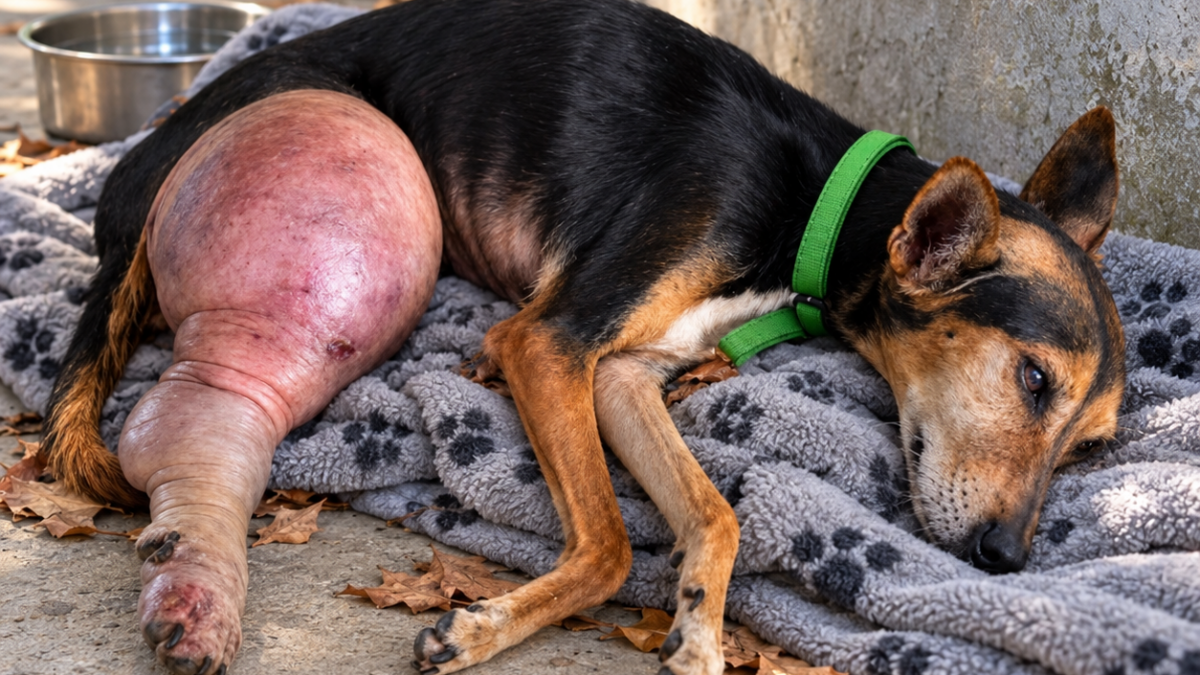
The first time I saw Duke, he was limping through a crowded street with a tumor hanging from his leg so large that every step seemed to pull pain through his entire body. People kept moving around him as if he were part of the sidewalk, but when I called softly from across the road, that exhausted dog stopped, lifted his head, and turned toward me. I thought getting him off the street would be the hardest part of saving him, but a few hours later a doctor showed me the scan and told me the fight had barely begun.
My name is Emily Carter, and I had been volunteering with a small animal rescue for almost six years when the call about Duke came in.
The message was short.
Large stray dog. Severe growth on rear leg. Barely walking. Still moving through traffic.
By the time I reached the neighborhood with another volunteer named Marcus, the afternoon heat had settled between the buildings, and people were moving quickly along the sidewalks, carrying groceries, checking phones, waiting for buses, going wherever their day required them to go.
Then I saw him.
Duke was standing near the curb.
He was a big mixed-breed dog, probably some combination of shepherd and retriever, though it was difficult to tell beneath the dirt and weight loss. His ribs showed faintly through his coat. One back leg was swollen around a massive growth that hung low enough to change the way he walked.
He took three steps.
Stopped.
Lowered his head.
Then kept going.
“Oh my God,” Marcus whispered.
I had seen injured animals before, but there was something especially painful about watching Duke continue forward as though stopping was not an option available to him.
People walked around him.
Some stared.
One man stepped sideways to avoid him.
A woman pulled her child closer.
Nobody was cruel to him.
Somehow that almost made it worse.
They simply kept going.
Duke did too.
“Don’t chase him,” I told Marcus.
We moved ahead and crouched near the sidewalk.
“Hey, buddy.”
Duke stopped.
His eyes found mine.
There was no aggression there.
No barking.
No warning.
Only exhaustion.
I held out my hand.
“You don’t have to keep walking.”
For several seconds, he remained where he was.
Then he turned.
One painful step.
Another.
He came toward us.
I will never forget that.
He had every reason not to trust strangers, but somehow, when given the choice between continuing alone and coming closer to two people he had never seen before, Duke chose us.
When he reached me, he lowered his head against my arm.
Marcus looked away.
“Okay,” I whispered. “We’ve got you.”
Duke was too weak to climb into the rescue vehicle.
We lifted him together.
He didn’t struggle.
He simply let his weight fall into our arms.
At the veterinary hospital, Dr. Aaron Patel examined him immediately.
Duke was dehydrated, underweight, anemic, and clearly in significant pain. The tumor was ulcerated in places and far more extensive than we had first realized.
Dr. Patel ordered imaging.
Hours later, he called me into a consultation room.
The CT scan was glowing on the screen behind him.
“Is it cancer?” I asked.
He didn’t soften the answer.
“Yes.”
My stomach dropped.
“Can you remove it?”
“That’s what we want to do.”
“Then do it.”
He looked at me carefully.
“We can’t. Not yet.”
I stared at him.
“What do you mean?”
“Duke is too weak for a surgery of this magnitude. His body is already struggling. If we put him under anesthesia today, there is a real chance he won’t survive the operation.”
I looked through the glass toward the treatment area.
Duke was lying beneath a blanket.
He had finally stopped walking.
For the first time that day, he had nowhere he needed to go.
But suddenly stopping felt dangerous too.
“What happens if we wait?”
Dr. Patel glanced toward the scan.
“We build him up. Fluids. Nutrition. Pain control. Bloodwork. We give his body the best chance we can.”
“And the tumor?”
“We hope it gives us enough time.”
I sat beside Duke that night.
He was too tired to lift his head when I entered.
I placed my hand beside his paw.
“You came toward me today,” I whispered. “So I’m not going anywhere now.”
Behind me, Dr. Patel quietly closed the treatment-room door.
And for the first time, Duke and I began waiting together.
PART 2
That first night, I learned how long darkness can feel when the life you are worried about is sleeping behind a glass hospital door.
Duke barely moved.
Every few hours a technician checked his temperature, adjusted his fluids, examined the tumor, or offered him food.
At first he refused everything.
Not dramatically.
He simply turned his head away.
I tried sitting beside him.
“Just one bite.”
Nothing.
I warmed a little canned food.
He smelled it.
Then lowered his head back onto the blanket.
Marcus came by around nine that evening with coffee for me and a sandwich I didn’t remember asking for.
“You staying?”
“Yes.”
He looked at Duke.
“You know they have overnight staff.”
“I know.”
“They’ll call.”
“I know.”
“You’ve said ‘I know’ three times.”
“That’s because you’ve said three things I already know.”
Marcus sighed and handed me the coffee.
“You’re impossible.”
Duke’s ear moved at the sound of our voices.
I leaned closer.
“See? He agrees with me.”
Marcus sat against the wall.
For almost an hour, neither of us said much.
At ten thirty, Duke finally lifted his head.
A technician named Rachel brought in a fresh dish containing a small portion of soft food.
Duke smelled it.
His nose moved.
I held my breath.
“Come on.”
He took one bite.
Then stopped.
Rachel smiled.
“That’s something.”
Duke took another.
I laughed quietly.
“There you go.”
He finished perhaps a third of the portion before lying back down.
To anyone else, it would have looked insignificant.
To us, it felt like a declaration.
I’m still here.
The next morning, Dr. Patel showed me Duke’s bloodwork.
His anemia worried him.
His nutritional state worried him.
His infection markers worried him.
Almost everything on the page seemed to come with a sentence beginning with, “We need to watch…”
But Duke was stable.
That became our first victory.
Stable.
Not good.
Not safe.
Stable.
I went home for three hours to shower.
When I returned, Duke lifted his head when I entered.
That was our second victory.
“Hey.”
His tail moved.
Barely.
One slow tap against the blanket.
Rachel saw it.
“Oh, there it is.”
“What?”
“The beginning of you becoming his person.”
I shook my head.
“I’m just helping.”
Rachel smiled.
“Sure.”
At that point, I had no intention of adopting Duke.
I need to say that clearly because people tend to rewrite rescue stories afterward, as though love was obvious from the beginning.
It wasn’t.
I already had a dog at home.
Maggie was an eight-year-old black Lab mix who believed the couch belonged to her.
My work schedule was irregular.
I had never owned a dog with Duke’s medical needs.
More importantly, Duke might not survive the surgery.
I would not allow myself to think past that.
So each day became small.
Breakfast.
Medication.
Bloodwork.
Rest.
Dinner.
Another night.
On the third day, Duke stood without assistance.
He placed most of his weight on the three healthy legs, keeping the leg with the tumor partly lifted.
Dr. Patel watched him.
“He’s stronger.”
“Enough?”
“Not yet.”
I hated those words.
Not yet.
“How much stronger does he have to be?”
“Strong enough that I believe anesthesia is an acceptable risk.”
“And when will that be?”
“When his body tells us.”
I looked at Duke.
“He’s not very talkative.”
Dr. Patel smiled.
“His blood is.”
By day four, Duke had begun waiting for me.
I knew because Rachel told me.
“He watches the door around four.”
“That’s when I usually come.”
“Exactly.”
“Maybe he’s waiting for dinner.”
“Dinner comes at five thirty.”
“That doesn’t prove anything.”
Rachel gave me a look.
“You rescue people are terrible at admitting when a dog owns you.”
“I am not owned.”
That afternoon, Duke struggled to his feet when I entered.
“Don’t.”
He tried anyway.
I crouched beside him.
“You don’t have to stand.”
He pressed his head against my chest.
I stopped talking.
There are moments when an animal chooses contact that feel different from ordinary affection.
Duke had been handled by dozens of people by then.
Technicians.
Veterinarians.
Assistants.
All necessary.
All gentle.
But that was the first time he leaned into me because he wanted to.
I put both arms around his neck carefully.
“You’re making this complicated.”
His tail moved once.
On day five, Dr. Patel called me before I arrived.
“We may be ready.”
I stopped walking through the grocery store.
“Ready for what?”
He laughed softly.
“You know what.”
“Surgery?”
“If tonight’s bloodwork looks good, tomorrow morning.”
My entire body went cold.
For days I had begged for that sentence.
When it came, I wanted to delay it.
“What are his chances?”
“Emily.”
“Numbers.”
“I don’t have honest percentages for a case exactly like his.”
“Then give me your best judgment.”
He paused.
“The surgery is risky.”
“And without it?”
“The tumor is malignant. It is already compromising his movement and quality of life. Leaving it is not a reasonable long-term option.”
“So surgery is his chance.”
“Yes.”
“Can he survive it?”
“I believe he can. That’s why I’m willing to operate.”
I drove to the hospital immediately.
Duke was lying on his blanket.
He looked almost peaceful.
That made me angry.
“How can you look relaxed?”
He opened one eye.
“You have surgery tomorrow.”
No reaction.
“This is very serious.”
He yawned.
Rachel laughed from the doorway.
“He seems appropriately concerned.”
I sat down.
My hand found Duke’s chest.
His heart beat steadily beneath my palm.
That evening, I stayed until visiting hours ended.
Before leaving, I pressed my forehead gently against his.
“You turned toward us.”
His eyes stayed on mine.
“You did your part.”
I swallowed.
“Tomorrow, let them do theirs.”
The hospital called at 6:15 the next morning.
Surgery was scheduled for eight.
I was there by seven.
Dr. Patel explained everything again.
They would remove the tumor with the widest safe margins possible.
Depending on what they found, they might need to remove more tissue than expected.
There was a possibility Duke could lose the leg.
That had not been ruled out.
I stared at him.
“You never said that.”
“I said we needed imaging and surgical assessment.”
“You think he might lose it?”
“I think preserving his life matters more than preserving the limb.”
I knew he was right.
I hated him for being right.
“What will you decide?”
“What gives him the best chance.”
I signed the surgical authorization as the rescue representative.
My hand shook.
Duke was wheeled toward the operating area.
For the first time since I had found him, he was moving away from me instead of toward me.
I nearly followed.
Rachel stopped me gently.
“You can’t go farther.”
“I know.”
“You’ve said that before.”
I looked at her.
“I hate today.”
She nodded.
“I know.”
The doors closed.
Waiting during surgery does strange things to time.
Ten minutes can feel like an hour.
An hour can disappear without you understanding how.
Marcus came.
He brought coffee again.
I didn’t drink it.
At 9:23, nobody had called.
At 10:10, nothing.
At 10:48, I walked to the front desk and asked if anyone had an update.
They didn’t.
At 11:17, I convinced myself silence was good.
At 11:31, I convinced myself silence was terrible.
At 11:46, Dr. Patel came through the double doors.
I stood so quickly my chair hit the wall.
“Well?”
He removed his surgical cap.
“He’s alive.”
My knees almost gave out.
“Alive?”
“Yes.”
“What happened?”
“The tumor is out.”
“All of it?”
“We removed what appeared to be the primary mass with appropriate margins where anatomy allowed. Pathology will tell us more.”
“The leg?”
“Still there.”
I covered my face.
Marcus grabbed my shoulder.
Dr. Patel continued.
“He lost blood. We’re monitoring him closely. The next several hours matter.”
“But he woke up?”
“He’s beginning to.”
I cried then.
Not gracefully.
I didn’t care.
After everything, Duke had gone to sleep beneath surgical lights and come back.
That afternoon, I was allowed to see him for less than five minutes.
He looked terrible.
Bandages covered the surgical area.
His eyes were unfocused.
His breathing was slow.
But when I said his name, one ear moved.
“Hey.”
Another tiny movement.
“It’s me.”
His eyes opened.
Not much.
Enough.
I put my hand beside his paw.
“No walking today.”
Duke’s toes shifted against my fingers.
“You’ve done enough.”
His recovery from surgery became a second rescue.
The first was getting him off the street.
The second was convincing his body to believe it was allowed to heal.
Pain medication kept him comfortable.
The surgical site required constant monitoring.
He needed help standing at first.
When he finally took a few steps, the absence of the heavy tumor changed his balance so much that he looked confused.
He lifted the leg too high.
Set it down.
Looked back.
I laughed.
“You forgot what normal feels like.”
He tried again.
Three steps.
Then five.
Rachel walked beside him with a support sling.
“Slow.”
Duke ignored her.
“Apparently he has places to be,” I said.
For a dog who once walked because he had nowhere to stop, he was suddenly impatient to move because he had somewhere worth going.
That thought stayed with me.
Pathology results came four days later.
Dr. Patel called me into the same consultation room where he had first shown me the scan.
I hated that room.
“Tell me.”
“The tumor was malignant.”
“I know that.”
“We confirmed the type.”
He explained the cancer.
Some of the words blurred together.
“What matters?”
“What matters is that surgery gave him the best chance we could give him.”
“Is he cured?”
“I won’t use that word.”
“Why?”
“Because oncology rarely gives us permission to be careless.”
I stared at him.
“So it can come back.”
“Yes.”
“Spread?”
“Yes.”
My relief cracked.
“How long?”
“We monitor.”
“That isn’t an answer.”
“It’s the honest one.”
I turned toward the scan.
Weeks earlier, that image had looked like a death sentence.
Now the mass was gone.
But uncertainty remained.
“Does Duke know any of this?”
Dr. Patel smiled gently.
“No.”
“Lucky him.”
“He knows whether he hurts today.”
I looked at him.
“And?”
“He hurts less.”
That helped.
Duke remained hospitalized for another week.
I visited every day.
And somewhere during those days, something changed.
Not in Duke.
In me.
I stopped asking where he would go after discharge.
I started thinking about where his bed would fit in my house.
I measured the space beside Maggie’s favorite couch.
I researched ramps.
I bought nonslip rugs.
I told myself I was preparing for temporary foster care.
Marcus came over while I was moving furniture.
“What are you doing?”
“Making room.”
“For what?”
“Recovery.”
“Whose?”
I stared at him.
He stared at me.
Then he laughed.
“You’re adopting him.”
“No.”
“You bought a dog bed.”
“For medical reasons.”
“It has his name embroidered on it.”
I looked at the bed.
That had been an impulse purchase.
“Customization improves recovery.”
“You’re insane.”
“Possibly.”
“What does Maggie think?”
That was the real question.
Maggie had met many foster dogs.
She tolerated most.
Liked some.
Disliked two with impressive commitment.
Duke’s introduction would need to be slow, especially because he was still recovering.
Dr. Patel approved a short controlled meeting outside the hospital grounds once Duke was stable enough.
Marcus brought Maggie.
She stepped out of the car, saw me, and wagged.
Then saw Duke.
Stopped.
Duke saw her.
He stopped too.
We walked them parallel twenty feet apart.
Maggie sniffed grass.
Duke watched her.
No barking.
Ten feet.
Then fifteen again.
Maggie looked at Duke.
Duke looked away politely.
“Good,” I whispered.
Eventually they sniffed briefly.
Maggie walked away.
Duke followed two steps, then stopped.
Marcus smiled.
“Romance.”
“She’s eight.”
“Friendship, then.”
By the third meeting, Maggie allowed Duke to walk beside her.
That was approval by Maggie’s standards.
Two weeks after surgery, Dr. Patel said the words I had imagined every day.
“He can go.”
I looked at Duke.
“Home?”
Dr. Patel raised an eyebrow.
“Which home?”
I pretended not to hear the question.
I signed the foster discharge paperwork.
Temporary foster.
That’s what the form said.
Temporary.
Duke walked out of the hospital slowly.
The tumor was gone.
The bandage remained.
His body was still thin.
But he walked without that terrible dragging weight.
At the vehicle, I opened the rear door.
Duke hesitated.
Weeks earlier, Marcus and I had lifted him because he was too weak to climb.
This time I lowered the ramp.
Duke put one paw on it.
Then another.
He climbed.
I cried before we even left the parking lot.
“Don’t judge me.”
Duke lay down.
Maggie sighed from the other side of the divider.
The first night home, Duke did not understand the bed.
He sniffed it.
Circled it.
Then lay on the floor beside it.
“You’re doing this wrong.”
He looked at me.
I patted the cushion.
“Bed.”
Nothing.
Maggie walked over.
She stepped onto Duke’s bed.
Turned twice.
Lay down.
Duke stared.
“That is not yours.”
Maggie closed her eyes.
I moved her.
Duke watched.
Then, cautiously, he stepped onto the bed.
His front paws first.
Then the rest.
He lowered himself.
His entire body relaxed.
I sat beside him.
“That’s yours.”
He put his head down.
Within minutes, he was asleep.
I stayed there longer than necessary.
Maybe because I remembered the street.
Maybe because I remembered watching him take one painful step after another with nowhere to rest.
Now he had a bed.
It seemed too simple to matter so much.
It did.
The first weeks at home were not a perfect montage.
Duke had accidents.
Medication schedules.
Follow-up appointments.
Bandage changes.
A moment when the surgical site became red and sent me into complete panic.
A night when he refused dinner and I called Dr. Patel after hours.
“He skipped one meal.”
“He never skips.”
“He’s on medication.”
“He never skips.”
“Emily.”
“What?”
“Monitor him.”
“What if—”
“Monitor him.”
Duke ate breakfast normally.
I apologized to Dr. Patel by text.
His response:
You owe my phone an apology.
I sent back:
Your phone knew what career it chose.
Gradually Duke strengthened.
His shoulders filled out.
His ribs disappeared.
His coat became glossy.
The surgical area healed.
He learned the yard.
He learned the kitchen.
He learned that Maggie did not share her favorite blanket.
He learned my morning routine.
Within a month, he knew the sound of the refrigerator drawer where the cheese was stored.
One morning, I found him standing beside Maggie waiting.
“You both understand that cheese is not breakfast.”
Two tails wagged.
“That was not a vote.”
Two tails continued.
They got cheese.
Duke’s fear was subtle.
He did not hide under furniture.
He did not panic at every noise.
Instead, he watched exits.
When I walked toward the front door, his head lifted.
When visitors left, he followed them with his eyes.
When I moved from one room to another, he often followed.
Not close enough to trip me.
Close enough to know where I was.
The first time I went outside without him, he stood at the window.
I was only taking trash to the curb.
When I returned, he was still there.
“You thought I left?”
His tail moved.
“I’m coming back.”
That became another ritual.
Short departures.
Returns.
Predictability.
One day Duke stopped following me to the door.
That felt like progress.
The legal side of his story came later.
A microchip had been found during one of his hospital examinations.
It was old.
The information was incomplete.
But investigators eventually traced it to a previous owner named Raymond Cole.
Raymond had acquired Duke years earlier as a young dog.
When animal welfare contacted him, he initially claimed Duke had disappeared months before.
Then records complicated the story.
Neighbors remembered Duke developing the mass while still at Raymond’s property.
One neighbor had asked whether he planned to take the dog to a veterinarian.
Raymond reportedly said he could not afford surgery.
Another neighbor remembered Duke becoming thinner.
Then, according to witnesses, Duke stopped appearing in the yard.
Raymond insisted Duke had escaped.
The investigation could not prove every detail of how Duke ended up in the commercial district where we found him.
I wanted certainty.
The evidence did not give it.
That frustrated me.
I had imagined justice would look simple.
Someone did wrong.
Proof appeared.
Court followed.
Punishment came.
Reality was messier.
What authorities could establish was that Duke’s tumor had been visible and progressing for a significant period while he remained in Raymond’s care, and adequate treatment had not been obtained.
Neglect proceedings followed.
Veterinary records, witness accounts, photographs, and Duke’s medical condition all became part of the case.
Raymond’s attorney argued finances.
The tumor surgery would have been expensive.
That part was true.
But Dr. Patel explained something important during testimony.
“If a caretaker cannot afford definitive treatment, there are still options.”
The attorney asked, “Such as?”
“Surrender. Rescue referral. Charitable assistance. Humane euthanasia if suffering cannot otherwise be relieved. Doing nothing while the animal’s condition worsens is not medical care.”
The room became quiet.
I remembered Duke walking.
Still moving because nobody had given him a place to stop.
Raymond eventually accepted a negotiated resolution involving animal-neglect findings, financial penalties, restrictions on animal ownership for the court-ordered period, and permanent relinquishment of any legal claim to Duke.
He did not go to prison for years.
There was no dramatic handcuff scene.
Some people were disappointed.
I wasn’t.
Because the line that mattered was permanent relinquishment.
Duke was not going back.
When the rescue director called me with that news, I was sitting on my back porch.
Duke and Maggie were sleeping in the sun.
“What happens now?” I asked.
“He’s legally ours to place.”
I looked at Duke.
He opened one eye.
“Place?”
“Yes.”
“With whom?”
There was silence.
Then the director laughed.
“Emily.”
“What?”
“You have fostered him for three months.”
“Yes.”
“You sent us forty-seven photos.”
“Documentation.”
“You bought him a birthday bandana.”
“Morale.”
“You had a custom orthopedic bed made.”
“Medical.”
“Do you want the adoption application or not?”
Duke stood.
He walked to me.
Rested his head against my knee.
I looked down.
“Send it.”
The adoption became official on a Tuesday.
No ceremony.
Just signatures.
But Marcus showed up with a cake for humans and dog treats.
Rachel came after her shift.
Dr. Patel sent a card.
Maggie wore a bandana that said BIG SISTER, which she hated.
Duke wore nothing because he tried to eat his.
I signed my name.
Then Duke put one paw directly on the papers.
Marcus took a photograph.
“Legal witness.”
“He can’t read.”
“Neither can half the people who sign contracts.”
“Marcus.”
“What?”
Rachel laughed.
Duke looked around the room as though he had no idea why everyone was staring at him.
Maybe he didn’t.
Home had become normal before paperwork confirmed it.
That was how I wanted it.
Cancer follow-ups continued.
Every appointment frightened me.
Bloodwork.
Physical exam.
Imaging when indicated.
Every time Dr. Patel said “no obvious recurrence,” I felt as if someone had returned oxygen to the room.
Six months.
Clear.
Nine months.
Clear.
One year.
Clear.
At the anniversary appointment, Dr. Patel rubbed Duke’s shoulder.
“You were supposed to be difficult.”
Duke licked his hand.
“He still is,” I said.
“Medically.”
“Emotionally too.”
Duke had developed one terrible habit.
He stole socks.
Not shoes.
Not towels.
Socks.
Only used ones.
I blamed Marcus after he laughed the first time.
Duke apparently decided laughter meant approval.
One afternoon, I found him with three socks arranged around his bed.
“Are you building something?”
Tail wag.
I picked up one.
Duke grabbed another.
“No.”
He ran.
For a dog who once could barely walk, he became remarkably fast when committing a crime.
Maggie watched from the couch.
“You could help.”
She looked away.
“Coward.”
Duke disappeared down the hallway.
I followed.
That was our life.
Not rescue.
Not cancer.
Life.
Two years after Duke came home, Maggie died.
She had developed heart disease that progressed quickly.
Her final week was gentle.
Her final day was at home.
Duke stayed near her.
After she was gone, he searched for three days.
He checked the couch.
The yard.
Her blanket.
He ate, but without enthusiasm.
I placed Maggie’s collar beside her photograph.
Duke smelled it.
Then lay down.
I sat beside him.
“You’re allowed to miss her.”
His head rested against my leg.
For weeks, the house felt wrong.
Duke became quieter.
So did I.
Grief changed the shape of our days.
Then one morning, I dropped a sock.
Duke stole it.
I chased him.
Halfway down the hall, I started laughing.
The sound surprised both of us.
Duke stopped.
Looked back.
Then ran again.
That was the first moment the house felt alive after Maggie.
Not healed.
Alive.
There is a difference.
Months later, we began fostering again.
The first dog was a frightened young shepherd mix named Rosie.
Duke did something unexpected.
He gave her space.
This dog who once shadowed me learned how not to overwhelm another frightened animal.
Rosie hid near the kitchen table.
Duke lay eight feet away.
Eventually she moved closer.
By day three, she slept near his bed.
By day seven, she followed him into the yard.
I sent Marcus a photograph.
His reply:
He’s officially management now.
Duke helped three foster dogs that year.
Not through training.
Simply by being stable.
Calm.
Predictable.
Something he had once desperately needed from people, he now offered to other dogs.
That felt like a kind of justice no courtroom could create.
The fourth foster almost became permanent.
Her name was Poppy.
Small.
Bossy.
White with brown ears.
She weighed less than one third of Duke.
Within forty-eight hours, she controlled him.
If Duke approached his bed, Poppy sometimes occupied the center.
Duke stood nearby.
Looked at me.
“What?”
He looked at Poppy.
“That is your bed.”
Poppy yawned.
Duke looked at me again.
“You are approximately four times her size.”
Nothing.
I moved Poppy.
Duke climbed in.
Five minutes later, Poppy joined him.
Within a month, they slept together.
The family who eventually adopted Poppy cried when they picked her up.
So did I.
Duke watched the door after she left.
Then came to me.
“She’s okay.”
He leaned against my side.
“She got a family.”
His tail moved.
“You helped.”
I don’t know whether he understood.
Maybe I needed him to.
Years passed.
Duke’s old surgical scar became almost invisible beneath his fur.
People who met him had no idea.
Sometimes I showed them his rescue photograph.
The reactions were always the same.
“That’s Duke?”
“Yes.”
“With that tumor?”
“Yes.”
“How did he even walk?”
That question stayed with me.
How did he?
Pain changes movement.
The body learns to compensate.
The mind learns to continue.
Duke had kept going because he had no reason to believe stopping would bring help.
After rescue, he became a dog who knew he could stop.
That mattered.
If he grew tired on walks, he sat down.
I waited.
If he wanted attention, he approached.
If he was uncomfortable, he looked at me.
He had learned something I wanted every neglected animal to learn.
Needs can be answered.
You do not always have to endure quietly.
On his fifth rescue anniversary, the hospital invited Duke back for a small fundraiser supporting cancer treatment for rescue animals.
I almost declined.
Duke was not a public-events dog.
Too many people tired him.
Then I thought about the families who had received treatment assistance through donations.
We went for one hour.
Duke entered the lobby where he had once arrived unable to stand without help.
Rachel was still working there.
She saw him and stopped.
“No.”
“What?”
“That cannot be the same dog.”
“You’ve seen him since.”
“Not in a year.”
Duke walked toward her.
She knelt.
He pressed his head into her chest.
Rachel cried instantly.
“This is unfair.”
“You started it.”
“I did nothing.”
“You fed him.”
“I’m a nurse. That was my job.”
“You sat with him.”
“Also job.”
“You loved him.”
She looked at Duke.
“That part was free.”
Dr. Patel came out next.
His hair had more gray.
Duke’s muzzle did too.
“Look at you.”
Duke smelled his pockets.
“He remembers treats.”
Dr. Patel laughed.
“Selective memory.”
During the fundraiser, they placed Duke’s original CT image beside a recent photograph.
The contrast was brutal.
One image: massive tumor.
One: Duke standing beside me in the yard, ears up, body strong.
Donations that afternoon funded treatment for three dogs and one cat.
A woman approached me near the end.
Her dog had recently been diagnosed with cancer.
“I’m scared.”
I understood.
“What did the vet say?”
“That surgery could help.”
“Then ask every question.”
“What if I can’t afford all of it?”
“Ask for resources before deciding there are none.”
She nodded.
“I almost waited.”
I looked at Duke.
“Don’t wait because you’re embarrassed.”
Tears filled her eyes.
“I’m trying.”
“Trying early matters.”
Months later, she sent the hospital a photograph.
Her dog had completed treatment.
Still alive.
Still playing.
I kept a copy.
That became Duke’s revenge too.
His suffering helped another animal receive care sooner.
Not because he had to suffer for a reason.
I hate that idea.
Pain does not become acceptable just because something good later grows around it.
But once pain has happened, we get to decide what grows afterward.
With Duke, we grew help.
At seven years after rescue, his cancer still had not returned.
Dr. Patel finally used language slightly stronger than usual.
“I’m very pleased.”
“That’s it?”
He looked at me.
“What do you want?”
“Confetti.”
“You can bring your own.”
“I want you to say he beat it.”
He scratched Duke’s neck.
“I’ll say he has done exceptionally well.”
“You veterinarians hate joy.”
“We hate tempting fate.”
Duke stole a treat from his hand.
“See? He agrees with me.”
Age began showing gradually.
Duke’s muzzle whitened.
His hips stiffened.
Long walks became shorter.
I bought another orthopedic bed.
Marcus came over.
“How many beds has this dog had?”
“That is irrelevant.”
“I count four.”
“Medical needs change.”
“One is in the kitchen.”
“He supervises cooking.”
“One is in your bedroom.”
“He sleeps.”
“One in the living room.”
“He lives there.”
“And one on the porch.”
“He likes weather.”
Marcus shook his head.
“You’ve built a retirement community for one dog.”
“Membership is exclusive.”
Duke loved every bed.
Unlike his first night, when he had not understood what a bed was for.
Sometimes I watched him lower his old body onto the cushion, sigh deeply, and fall asleep.
I always remembered the street.
The crowd.
His painful steps.
Years of safe rest were the answer to that image.
At ten, Duke developed a new lump.
I found it while rubbing his side.
Everything inside me stopped.
“No.”
Duke looked at me.
I felt again.
Small.
Firm.
My hands began shaking.
We were at the hospital within two hours.
A younger veterinarian examined him because Dr. Patel was in surgery.
Imaging.
Needle sample.
Waiting.
I felt seventeen years older during those hours.
Dr. Patel eventually came into the consultation room still wearing scrubs.
“I heard.”
“Is it back?”
“Not necessarily.”
“Don’t do that.”
“Do what?”
“Speak like a doctor.”
“I am a doctor.”
“Speak like a human.”
He sat.
“The cytology does not currently look like a recurrence of his previous cancer.”
I exhaled so hard I became dizzy.
“What is it?”
“Most consistent with a benign fatty mass.”
“Benign?”
“Probably.”
“Probably?”
He raised a hand.
“Emily.”
“What?”
“Breathe.”
I laughed.
Then cried.
Then laughed again.
Duke slept through most of the emotional event he had caused.
The lump remained harmless.
Age did not.
At eleven, arthritis became significant.
At twelve, he needed a ramp for the car.
At thirteen, his hearing weakened.
But he stayed himself.
Still interested in food.
Still stealing socks occasionally, though now he moved so slowly I could retrieve them without effort.
That offended him.
One afternoon, he grabbed a sock.
I followed.
Duke accelerated.
His version of accelerating looked like a determined elderly shuffle.
“Sir.”
He kept going.
“I can literally walk faster than you.”
He looked back and continued.
I let him win.
He reached his bed.
Dropped the sock.
Looked proud.
“Criminal mastermind.”
Tail thump.
Those small ridiculous moments became precious because I understood time was changing.
The dog who once seemed unlikely to survive surgery had become old.
Really old.
There is something extraordinary about gray fur on an animal you once feared would not see another week.
People see age as decline.
I saw evidence.
Years.
Meals.
Naps.
Walks.
Vet appointments.
Christmas mornings.
Thunderstorms.
Friends.
Losses.
Returns.
All the ordinary things cancer once threatened to steal.
On Duke’s thirteenth rescue anniversary, I took him back to the street where I had found him.
I almost didn’t.
I worried it might upset him.
But the neighborhood had changed.
A coffee shop where an empty storefront used to be.
New crosswalk.
Different bus shelter.
Trees taller.
Duke stepped carefully from the car.
We walked perhaps twenty yards.
Then he stopped.
Not from fear.
From fatigue.
I sat beside him on a low wall.
“You remember?”
He smelled the air.
Maybe dogs remember places through scent.
Maybe he had no idea.
I looked at the sidewalk.
Somewhere nearby was the spot where he had turned toward me.
“You came over here.”
Duke leaned against my leg.
“Best decision you ever made.”
He looked up.
“Okay, maybe cheese was first.”
A young man passed us.
He smiled at Duke.
“Old guy?”
“Very.”
“Looks happy.”
I looked at Duke.
“He is.”
That mattered more than whether he remembered.
I did.
The following winter was hard on him.
Cold mornings made standing difficult.
His appetite remained good, but his body lost muscle.
Bloodwork showed the changes of age.
Kidneys.
Liver values.
Nothing catastrophic.
Everything cumulative.
Dr. Patel had reduced his clinical hours by then.
At one appointment he sat on the floor beside Duke.
“We’re both old.”
Duke licked his chin.
“I meant him.”
“I know what you meant.”
Dr. Patel rubbed Duke’s shoulder.
“Still no evidence of that original cancer returning.”
Thirteen years.
I swallowed.
“He beat it.”
This time Dr. Patel looked at me.
Then smiled.
“Yes.”
One word.
It was enough.
Duke’s final decline came months later.
Not cancer.
Age.
His kidneys weakened.
Medication and diet helped for a while.
Then he stopped enjoying walks.
He still liked the yard.
Then only the porch.
Then mostly the bed near the window.
I moved my work when possible so I could stay home more.
Marcus visited.
Rachel came one Saturday.
Duke recognized her voice before he saw her.
His tail moved.
Rachel knelt beside him.
“Remember me?”
Duke smelled her hands.
“She fed you after surgery,” I said.
“He doesn’t need the résumé.”
“I’m helping.”
Rachel touched his gray face.
“You were such a mess.”
Duke closed his eyes.
“Now look at you.”
She cried quietly.
After she left, I sat beside him.
“You made everyone emotional.”
No response.
“You’ve always been manipulative.”
Tail movement.
The day I knew came quietly.
Duke refused breakfast.
That had happened once or twice before.
I waited.
At lunch, nothing.
Cheese.
Nothing.
Chicken.
He smelled it but turned away.
I sat on the floor.
“Duke.”
His eyes opened.
“Come on.”
He placed his head on my knee.
My heart broke.
I called Dr. Patel.
He came to the house that evening.
Not as a hospital appointment.
As a friend.
He examined Duke slowly.
Listened to his heart.
Felt his abdomen.
Checked hydration.
Watched him try to stand.
Then he looked at me.
I already knew.
“Can we fix it?”
He sat beside me.
“We can treat pieces.”
“That’s not what I asked.”
“No.”
The room blurred.
Duke breathed slowly.
“Is he suffering?”
“He’s tired. Probably nauseated. His body is having a hard time compensating.”
“Could hospitalization help?”
“Possibly temporarily.”
“How temporary?”
“I don’t know.”
“Would he come home?”
“Maybe.”
I hated that word.
Maybe.
I looked around.
Duke’s bed.
His toys.
One stolen sock still near the couch.
The window he liked.
The ramp.
The bowls.
Home.
“He spent enough time in hospitals.”
Dr. Patel nodded.
“I agree.”
Marcus arrived.
Then Rachel.
I hadn’t called them.
Dr. Patel had.
Normally I would have been angry.
I wasn’t.
Duke’s life had belonged partly to all of us.
Marcus sat on the floor.
“Hey, big man.”
Duke’s tail moved.
Marcus covered his face.
“Don’t do that.”
I laughed through tears.
“He knows.”
Rachel brought something in a paper bag.
“What’s that?”
“Cheeseburger.”
I stared.
“He won’t eat.”
“He might eat bad decisions.”
We tore off a tiny piece.
Duke smelled it.
Licked.
Then ate.
All of us cheered so loudly he looked startled.
“Sorry.”
Another piece.
He ate that too.
Then stopped.
Rachel smiled.
“Retirement meal.”
Dr. Patel waited.
Nobody rushed.
As evening fell, rain started against the windows.
Duke slept.
I sat with one hand on his chest.
Eventually he woke.
He looked toward me.
I thought about the first day.
A street.
A crowd.
The tumor.
Every step hurting.
People passing.
Then him seeing us.
Turning.
Coming closer.
Trusting hands that had done nothing to earn his trust yet.
That single turn had created everything that followed.
Surgery.
Home.
Maggie.
Poppy.
Foster dogs.
Cancer fund.
Thirteen years.
A life.
I leaned close.
“You came toward me once.”
His eyes stayed on mine.
“So I’m coming all the way with you now.”
Dr. Patel prepared the medication.
I asked for another minute.
Then another.
Nobody complained.
Duke rested his head in my lap.
“I’m sorry people walked past.”
My voice broke.
“I’m sorry you hurt that long.”
His breathing remained steady.
“But you don’t have to keep walking anymore.”
That was the sentence that undid me.
All those years earlier, Duke had kept moving because there was nowhere safe to stop.
Now there was.
His bed.
His home.
His people.
Me.
“You can rest.”
The first medication made him deeply sleepy.
His body relaxed.
His face softened.
For a moment, he looked like a younger dog.
Marcus touched his back.
Rachel held one paw.
Dr. Patel waited.
I kept Duke’s head in my lap.
“You were worth stopping for.”
His tail moved once.
One final small sweep.
Dr. Patel gave the last medication.
Duke took one breath.
Then another.
Then a softer one.
And stopped.
Nobody moved.
Rain touched the windows.
The house was quiet.
I buried my face in his fur.
Years before, strangers had stepped around him because stopping would have interrupted their day.
Now four people sat on a floor refusing to move because his life mattered enough to stop everything.
That felt like the ending.
Not the cancer.
Not Raymond.
Not court.
Not revenge.
This.
Duke had once walked in pain through a crowd that barely noticed him.
At the end of his life, every person in the room noticed his final breath.
There was no greater reversal I could imagine.
We held a memorial through the rescue a month later.
Duke’s oncology fundraiser had grown over the years into a formal assistance program.
After he died, the board renamed it the Duke Medical Fund.
I resisted.
“He doesn’t need his name on anything.”
The rescue director said, “Other dogs need what his name makes people remember.”
That changed my mind.
The fund helped animals whose owners or rescuers could not immediately afford urgent diagnostics, surgery, or cancer treatment.
It did not pay every bill.
It could not save every animal.
Nothing can.
But it gave people options before hopelessness turned into neglect.
The first dog helped after the renaming was a shepherd with a large abdominal mass.
The owner was an elderly man living on a fixed income.
When he heard what surgery might cost, he started crying.
“I can’t do that.”
The hospital social worker told him about Duke’s Fund.
The mass was removed.
Benign.
The dog went home.
The man later sent a handwritten note.
Thank whoever Duke was.
I framed it.
Months later, another case came in.
A stray dog with a leg tumor.
Not as large as Duke’s.
Not as advanced.
A passerby noticed early.
The rescue intervened.
Surgery happened quickly.
The dog recovered.
Rachel sent me the photograph.
This one got stopped sooner.
I stared at the message.
That became the most satisfying revenge in Duke’s entire story.
The street had once taught Duke that suffering could be visible and still ignored.
His life afterward helped build systems where other suffering was noticed sooner.
Raymond’s punishment had an end date.
Duke’s impact did not.
That mattered more to me.
I kept Duke’s first hospital collar.
His adoption papers.
The photograph of his paw on the contract.
One of his stolen socks.
Marcus laughed when he found out.
“You kept a dirty sock?”
“It’s washed.”
“Then it has no historical integrity.”
“Get out.”
I kept his bed for months.
Eventually, another foster dog needed it.
A scared senior hound named Benny.
Benny stood beside the bed the first night just as Duke once had.
He smelled it.
Circled.
Then lay down.
I cried in the hallway.
Not because Benny replaced Duke.
Nobody could.
Because a bed is supposed to hold a dog.
Keeping it empty forever would not honor the one who taught me why it mattered.
Benny stayed three weeks before adoption.
Then another dog used it.
Then another.
Eventually the bed wore out.
I threw it away.
That was harder than I expected.
Objects carry our grief because they do not argue with us about moving forward.
Years later, people still asked about Duke.
Some remembered the rescue photograph.
Some remembered the hospital fundraiser.
Some only knew the medical fund.
New volunteers occasionally asked me why it was named after him.
I told them the simple version.
“He was a stray with a malignant tumor. He was too weak for surgery when we found him. We built him up. He survived surgery. I adopted him. He grew old.”
They always reacted to the last sentence.
“He grew old?”
“Yes.”
That was my favorite part.
Not:
He survived.
He grew old.
Survival sounds temporary.
Growing old means you were given time.
Duke got time.
Thirteen years after surgery.
Thousands of meals.
Thousands of nights.
Maggie.
Friends.
Fosters.
Cheese.
Socks.
Beds in every room.
A life so ordinary that eventually people meeting him never knew he had once been dying.
I still sometimes drive through that neighborhood.
The exact storefronts have changed.
The street is busier now.
Whenever I pass the corner where I first saw him, I look.
Habit.
Maybe hope.
Maybe fear that another animal will be there.
Once, I saw a skinny dog near the sidewalk.
I pulled over immediately.
It had an owner ten feet away talking on the phone.
The man looked confused when I asked if the dog was okay.
I laughed and apologized.
Driving away, I realized Duke had permanently changed the way I looked at roads.
I scan.
Sidewalks.
Ditches.
Bus stops.
Parking lots.
Because once, an animal everyone else treated as background turned his face toward me.
I never wanted to miss that again.
The strangest part is that people still tell me I saved Duke.
I understand why.
I helped lift him.
I stayed through surgery.
I brought him home.
But rescue changes both directions.
Before Duke, I believed helping meant action.
Catch.
Transport.
Treat.
Place.
Duke taught me that sometimes helping begins before all of that.
It begins with noticing.
Slowing down.
Looking directly at suffering instead of allowing the crowd to tell you it must belong to someone else.
Someone else will stop.
Someone else will call.
Someone else will help.
Duke had already passed too many “someone elses.”
That day, I happened to be the one who stopped.
Everything after that grew from a pause.
A street.
A dog.
A person kneeling.
His decision to turn toward me.
Mine not to look away.
If I could return to that afternoon now, I would tell the woman I was then not to be afraid of how much caring would cost.
The surgery bills.
The sleepless nights.
The cancer scans.
The years of attachment.
The final loss.
All of it was expensive in ways money does not measure.
I would pay it again.
Every part.
Because love is not made less valuable by the fact that it eventually hurts.
Sometimes the hurt is proof you stayed long enough for a life to matter.
Duke’s tumor once seemed like the largest thing about him.
It wasn’t.
Cancer was one chapter.
A brutal one.
But it did not get the final page.
The final page belonged to an old dog asleep in his own home.
A full bowl nearby.
A stolen sock on the floor.
People around him.
No crowd passing.
No painful road ahead.
Just rest.
And whenever someone asks me what became of the dog who walked through that street with a tumor on his leg, I tell them the truth.
He stopped walking alone.
He survived the surgery.
He found a home.
He spent years teaching frightened dogs how to feel safe.
He helped other animals receive medical care.
He became gray around the muzzle.
He stole socks until old age made him too slow to escape.
And when his body finally became tired, he did not have to search for somewhere to stop.
He already had it.
Home.
That was Duke’s revenge against every painful mile he had once walked unnoticed.
That was his victory over cancer.
That was the promise we kept after he turned toward us.
He would never have to keep moving because nobody cared enough to make room for him again.
And he never did.
Years passed, and the photograph of Duke on the day I found him slowly became harder for people to connect with the dog sleeping in my living room.
In the photograph, his body was painfully thin. His coat looked dull. His eyes were tired. The enormous tumor hanging from his leg distorted the entire shape of him, forcing him to walk as though every step required a decision.
In my house, Duke became almost unrecognizable from that dog.
His ribs disappeared beneath healthy muscle.
His coat became thick and soft.
The surgical scar faded beneath new fur.
He developed strong opinions about cheese, car rides, and exactly how much space one dog should be allowed to occupy on a queen-size bed.
He stole socks.
He learned to open a bathroom door that didn’t latch properly.
He once carried one of my bras into the backyard while I had company and refused to surrender it until Marcus bribed him with turkey.
“You rescued a criminal,” Marcus told me.
Duke wagged proudly.
“I rescued a dog.”
“Same thing, apparently.”
Those ridiculous moments were more important to me than most people understood.
The world had first seen Duke as a tragedy.
I wanted him to become ordinary.
Not inspirational every morning.
Not courageous every time he walked.
Not “the cancer dog” forever.
Just Duke.
A dog who sometimes snored loudly enough to wake himself.
A dog who believed an open refrigerator was a personal invitation.
A dog who was deeply offended by baths but happily rolled in mud.
A dog who once limped through a crowd because he had nowhere safe to stop and eventually learned that if he became tired, all he had to do was sit down and someone would wait beside him.
That change took time.
On our early walks, Duke rarely stopped voluntarily.
Even after his body healed, he kept moving forward at the same determined pace.
If I stopped, he stood.
If I sat on a bench, he remained beside me.
It took months before he understood that rest did not have to mean weakness.
One spring afternoon, perhaps a year after his surgery, we were walking through a park when Duke slowed beneath an oak tree.
I expected him to continue.
Instead, he sat.
Then he lay down in the grass.
I looked at him.
“What?”
His tongue hung out slightly.
His eyes closed.
“You’re taking a break?”
Tail thump.
I sat beside him.
For ten minutes, nothing happened.
Children played across the field.
Someone threw a tennis ball for a golden retriever.
Cars passed beyond the trees.
Duke slept.
It sounds insignificant.
It wasn’t.
The first day I saw him, he had kept walking while pain pulled at his leg because stopping had offered him nothing.
Now he could stop because he knew I would stop too.
That became one of my favorite memories.
Not the surgery.
Not the adoption paperwork.
A dog asleep beneath a tree because he finally believed rest was safe.
His cancer follow-ups continued.
Every appointment made me nervous.
The night before each one, I checked his body obsessively.
Leg.
Chest.
Abdomen.
Shoulders.
Any lump became suspicious.
Any change in appetite became a crisis in my imagination.
Dr. Patel learned to expect it.
At Duke’s two-year checkup, I pointed to a tiny bump near his shoulder.
“That.”
Dr. Patel touched it.
“A skin tag.”
“How do you know?”
“Because I went to veterinary school.”
“That answer is unnecessarily smug.”
He smiled.
“Emily, you cannot perform oncology through anxiety.”
“I’m not anxious.”
Duke sneezed.
I looked down.
“He sneezed.”
Dr. Patel stared at me.
“Please go home.”
We did.
Duke remained clear.
Another six months.
Clear.
Another year.
Clear.
Each clean checkup felt like borrowed time becoming owned time.
One year became three.
Three became five.
The calendar kept moving beyond every frightening expectation I had allowed myself in the hospital.
Maggie aged beside him.
She had been the established dog when Duke arrived and never let him forget it.
If there was one sunbeam on the floor, Maggie claimed it first.
If there was one piece of chicken, she stared at me until Duke’s portion became slightly smaller.
Duke outweighed her, but hierarchy is not always about size.
He accepted her authority.
When Maggie grew older and developed heart disease, Duke changed around her.
He stopped pushing past her at doors.
He waited when she moved slowly.
Sometimes he stood beside her on the porch while she decided whether she had enough energy to walk into the yard.
The day Maggie died, Duke remained beside her bed for hours.
Afterward, he searched.
The couch.
The kitchen.
The backyard.
He smelled her blanket repeatedly.
For three days he barely touched his favorite toys.
I sat beside him one night.
“I know.”
He placed his head in my lap.
I thought about how easily people say animals live only in the present.
Maybe they do not understand death the way we do.
But Duke understood absence.
He understood when someone who had always been there was suddenly not.
We grieved together.
Months later, life expanded again.
Foster dogs came through the house.
At first I worried that Duke would resent them.
Instead, he surprised me.
He became patient.
Especially with frightened dogs.
One little shepherd mix named Rosie arrived terrified of doorways.
She would stand several feet away and freeze.
I tried treats.
Soft voices.
Space.
Duke watched.
One afternoon, he walked through the doorway.
Then stopped on the other side.
He turned around.
Rosie stared at him.
Duke waited.
No barking.
No movement.
Finally Rosie took one step.
Then another.
She crossed.
Duke simply walked away.
“You did that on purpose,” I whispered.
He looked back.
Probably not.
But I chose to believe he had.
Over the following years, Duke helped half a dozen foster dogs simply by being predictable.
He never became their therapist.
He was a dog.
But sometimes a calm dog is the best evidence another frightened dog can receive that a house might be safe.
His own history gradually became something strangers could not see.
That was the victory.
Then came his fifth rescue anniversary.
The veterinary hospital asked if Duke could attend a fundraiser supporting medical treatment for rescue animals with tumors and other serious conditions.
I hesitated.
Crowds exhausted him.
But the event would be small.
So we went.
The lobby had been transformed.
Photographs lined one wall.
Duke before surgery.
Duke afterward.
Other rescue animals who had received treatment.
On a screen near the front desk, Duke’s original CT scan was displayed beside a recent photograph of him standing in my yard.
I hated seeing the old scan.
Even after five years, it brought back the same cold feeling.
Dr. Patel stood beside me.
“You okay?”
“I forgot how big it was.”
“I didn’t.”
Duke smelled his pocket.
Dr. Patel laughed and produced a treat.
“You remember me for all the wrong reasons.”
I said, “He remembers competence.”
“He remembers chicken.”
Rachel came from behind the desk.
The moment Duke heard her voice, his entire body changed.
Tail.
Ears.
Head.
She knelt.
He walked straight into her arms.
Rachel started crying immediately.
“Oh, no.”
I laughed.
“What?”
“He’s gray.”
“Barely.”
“He wasn’t gray.”
“You weren’t either.”
She looked at me.
“Cruel.”
Duke licked her cheek.
During the fundraiser, people asked questions.
“How did you know when to help?”
“How expensive was surgery?”
“Did the cancer come back?”
“What would have happened if you hadn’t stopped?”
That last question bothered me.
Nobody knew.
Maybe another person would have stopped ten minutes later.
Maybe animal control would have found him.
Maybe Duke would have collapsed somewhere.
Rescue stories often turn one person into the hero because that makes the story easier to tell.
Reality is usually a chain.
The person who sees.
The person who calls.
The volunteer who drives.
The technician who starts fluids.
The surgeon.
The donor.
The foster.
The adopter.
Remove enough links, and the chain breaks.
So when people thanked me, I pointed toward the hospital staff.
“They saved him too.”
Dr. Patel corrected me.
“Duke did some work.”
Duke was asleep beneath the table.
“Currently impressive work.”
That afternoon, enough money was raised to help four animals with emergency diagnostics and treatment.
One was a young boxer with an abdominal mass.
One was an older mixed breed with a suspicious growth near her shoulder.
Months later, I learned both survived surgery.
That mattered.
Duke’s suffering had not happened for a reason.
I never believed that.
No animal needs to suffer so that humans can learn a lesson.
But once suffering had happened, we could decide whether it ended with one life or helped protect another.
Duke’s story began doing that.
The rescue created a medical assistance fund.
At first, it had no name.
After several years, donors began calling it Duke’s Fund anyway.
When the board formally proposed using his name, I resisted.
“He’s not dead.”
The director laughed.
“You can have things named after you while alive.”
“Sounds suspicious.”
Duke slept through the meeting.
Eventually I agreed.
The Duke Medical Fund helped animals whose treatment might otherwise be delayed while rescues tried to raise money.
One case stayed with me.
A senior shepherd named Max arrived with a growing tumor on his side.
His owner, Mr. Jensen, was seventy-three and lived alone.
He had noticed the growth early.
But he was terrified of the cost.
Instead of waiting until Max became as sick as Duke had been, his daughter found the fund.
The hospital examined him.
The tumor was operable.
Surgery happened before it became enormous.
Benign.
When Mr. Jensen picked Max up, he cried.
He later sent a card.
Inside he wrote:
Thank Duke for helping us stop sooner.
I framed it.
That line became one of the most important parts of Duke’s legacy.
Stop sooner.
Notice sooner.
Ask sooner.
Help sooner.
The first time, Duke had been forced to endure until his body carried a tumor no one could pretend not to see.
Now his name was helping dogs receive treatment before suffering became impossible to ignore.
That felt more satisfying than any punishment.
The investigation involving Raymond had ended years earlier.
Sometimes people asked whether I hated him.
At first, yes.
I wanted him to feel ashamed.
I wanted him to look at the surgical photographs.
I wanted him to understand the pain Duke must have carried.
But anger becomes heavy when you keep carrying it after the person you are angry for has moved on.
Duke didn’t spend his mornings thinking about Raymond.
He thought about breakfast.
He didn’t stare toward the door wishing for revenge.
He stared toward the kitchen.
He didn’t need me to hate the past forever.
He needed me to care for the present.
That realization freed me.
Raymond had faced legal consequences.
He lost any claim to Duke.
He was restricted from animal ownership under the court order.
The neglect was documented publicly.
Those consequences mattered.
But Duke’s victory was not another person’s suffering.
His victory was time.
Years the tumor nearly stole.
Years the street nearly stole.
Years neglect nearly stole.
Every birthday felt like a quiet act of defiance.
Six.
Seven.
Eight years after rescue.
Duke’s muzzle became gray.
His body slowed.
He began waking stiff on cold mornings.
I bought supplements.
Then medication.
Then rugs so he wouldn’t slip.
Then a ramp.
Then another ramp after the first one was too steep.
Marcus saw the second version.
“This dog has better accessibility than most public buildings.”
“Correct.”
“Does he even use it?”
Duke walked past the ramp and waited beside the car for me to lift him.
Marcus smiled.
“He appears grateful.”
“Don’t.”
Eventually Duke learned to use it.
At ten years after rescue, I found a lump near his ribs.
The world stopped.
I called Dr. Patel.
His receptionist said the earliest appointment was tomorrow.
“I need today.”
“Emily—”
“He had malignant cancer.”
She knew Duke.
Everyone knew Duke.
“Come at four.”
I arrived at 3:15.
Tests were performed.
Needle aspirate.
Imaging.
Waiting.
I sat on the floor beside Duke exactly the way I had the first week.
He leaned against me.
“I’m not doing this again.”
Tail thump.
“I mean it.”
Dr. Patel came in.
“The sample looks consistent with a lipoma.”
I blinked.
“In English.”
“Fat.”
“That thing almost killed me and it’s fat?”
“Most likely benign fat.”
“You’re sure?”
“As sure as cytology allows today.”
I began crying.
Dr. Patel handed me tissues.
“You are exhausting.”
“I pay you.”
“Not enough.”
Duke fell asleep.
The lump remained harmless.
Age became the thing we could not remove surgically.
At eleven, his hearing weakened.
At twelve, arthritis shortened our walks.
At thirteen, he preferred sitting beside the front window to exploring the neighborhood.
I worried that slowing down meant losing him.
Then I realized old age has its own rhythm.
Duke still enjoyed life.
He enjoyed breakfast.
He enjoyed sunshine.
He enjoyed riding in the car if I lifted him.
He enjoyed visitors.
He enjoyed stealing socks, although escape speed had become embarrassing.
One afternoon, he took one from the laundry basket.
I saw him.
“Duke.”
He looked at me.
“Drop it.”
He turned.
Started walking.
Slowly.
Painfully slowly.
“You understand I can catch you.”
He accelerated into what could generously be called a determined shuffle.
I followed at normal walking speed.
Marcus happened to be visiting.
“Are you chasing a thirteen-year-old dog?”
“He started it.”
Duke reached his bed.
Dropped the sock.
Looked triumphant.
Marcus applauded.
“Champion.”
Duke’s tail thumped.
I let him keep the sock for ten minutes.
Growing old turned out to be one of the greatest gifts Duke ever received.
I began noticing gray fur differently.
People sometimes apologized when their dogs became old.
“They’re slowing down.”
“They sleep all day.”
“They can’t do what they used to.”
I understood the sadness.
But when I looked at Duke’s white muzzle, I saw accumulated proof.
He had stayed.
Long enough to become old.
That was something the dog in the CT scan had not been promised.
On his thirteenth rescue anniversary, I took him back to the street where I found him.
I had thought about doing it for years.
Then always decided it was sentimental nonsense.
Finally, sentiment won.
The neighborhood had changed.
The old storefront was now a coffee shop.
There was a crosswalk where none had existed before.
Trees planted along the sidewalk had grown tall.
I parked nearby.
Duke needed the ramp now.
He climbed down slowly.
We walked toward the corner.
He sniffed everything.
No obvious recognition.
I wondered whether that disappointed me.
Then I realized I was relieved.
Maybe forgetting a place of pain was not a loss.
I sat on a low wall.
Duke stopped beside me.
He leaned his shoulder against my knee.
“This is where you found me.”
His ears moved.
“You were a disaster.”
Tail thump.
“I mean medically.”
He looked toward a bakery.
“You’ve become extremely food-motivated.”
Another thump.
A young woman walked past.
She stopped.
“What a sweet old dog.”
“Thank you.”
“How old?”
“Very.”
She smiled.
“He looks loved.”
Three words.
That was all.
After she left, I touched Duke’s gray face.
“You hear that?”
He looked at me.
Not sick.
Not pitiful.
Not abandoned.
Loved.
That was what strangers saw now.
We stayed fifteen minutes.
Then Duke became tired.
He sat.
I waited.
Just as I had beneath the oak years earlier.
When he stood again, we walked back slowly.
No rush.
No painful need to keep moving.
We had nowhere more important to be.
That winter, Duke’s kidney values began changing.
Not dramatically.
Enough.
Diet.
Medication.
More water.
More frequent bathroom trips.
He still ate well.
Then he lost weight.
I increased monitoring.
Dr. Patel reduced his clinical hours around that time.
His own hair was mostly gray.
At one appointment, he sat on the floor beside Duke.
“Two old men.”
“You’re not a dog.”
“Thank you for clarifying.”
Duke licked his chin.
Dr. Patel looked at the latest imaging.
“No evidence of recurrence from the original cancer.”
I smiled.
Thirteen years.
“Can I say it now?”
“Say what?”
“He beat it.”
Dr. Patel looked at Duke.
Then at me.
“Yes.”
I had waited thirteen years for that word.
Yes.
Duke had beaten the cancer.
In the end, something simpler would take him.
Time.
His final months were quiet.
He slept more.
Stopped following me upstairs.
Then stopped climbing the small step to the porch without help.
I adjusted.
Bed near the window.
Water closer.
Rugs everywhere.
Medication hidden in food.
Short trips outside.
I learned his new signals.
A look meant help standing.
One paw against the bed meant he needed to go out.
Restlessness at night meant nausea.
Age created another language between us.
Then one morning Duke did not eat.
I told myself it was one meal.
At noon, he refused chicken.
At three, cheese.
That frightened me.
Duke had never refused cheese voluntarily in his entire known history.
I called Dr. Patel.
He came to the house.
Not the hospital.
Home.
He arrived carrying his medical bag and wearing jeans instead of scrubs.
That alone told me too much.
He examined Duke beside the living-room window.
Listened.
Touched his abdomen.
Checked his gums.
Watched him attempt to stand.
Duke made it halfway.
Then lowered himself.
I helped.
“What can we do?”
Dr. Patel sat beside us.
“Fluids.”
“Okay.”
“Anti-nausea medication.”
“Okay.”
“Hospitalization, if you want aggressive support.”
“How long?”
“I don’t know.”
“Would it fix this?”
Silence.
“Patel.”
“No.”
I looked down.
Duke’s head rested near my knee.
“Then what does hospitalization do?”
“Maybe gives us a little time.”
“For him?”
Dr. Patel understood the question.
“Probably more for us.”
That was the answer.
I hated it.
I also trusted it.
Marcus came later.
Rachel too.
Dr. Patel had called them after I gave permission.
Rachel carried a paper bag.
“What is that?”
“Cheeseburger.”
I laughed despite everything.
“He hasn’t eaten all day.”
“He has standards.”
She tore off a piece.
Duke smelled it.
For several seconds, nothing.
Then his tongue moved.
He took it.
All four of us reacted as if he had scored the winning touchdown.
Duke looked startled.
“Sorry,” I whispered.
Another piece.
He ate.
Then one more.
That was enough.
Rachel touched his face.
“You remember me?”
Tail movement.
“You better.”
Marcus sat on the floor.
He looked around the house.
Beds.
Ramps.
Medication.
One old sock near Duke’s bed.
“This dog owns everything.”
“Correct.”
Duke’s breathing remained calm.
Evening came.
Rain started against the windows.
I kept thinking about the first street.
He had been walking.
Always walking.
People passing.
No place to stop.
That image had followed me for thirteen years.
I lay beside him.
“You know something?”
His eyes opened.
“You don’t have to keep moving anymore.”
His breathing stayed slow.
“You did enough.”
My throat closed.
“You came toward me once.”
I put my hand against his chest.
“That was your job.”
I looked at Dr. Patel.
He understood.
I looked back at Duke.
“Everything after that was ours.”
Dr. Patel prepared the sedative.
I asked for another minute.
Then another.
Nobody rushed me.
That is something I remain grateful for.
Loss already feels fast enough.
You do not need people measuring goodbye with a clock.
I placed Duke’s head in my lap.
“I’m sorry you hurt for so long before we met.”
His eyes remained half-open.
“I’m sorry people saw you and didn’t stop.”
Marcus wiped his face.
Rachel was already crying.
“But listen to me.”
My voice shook.
“You were never invisible again.”
Duke’s tail moved.
One small thump.
Every person in the room saw it.
Dr. Patel gave the first medication.
Duke relaxed.
The tension left his legs.
His breathing deepened.
I rubbed the place behind his ear he always loved.
“You had a good life.”
I needed to say it.
Maybe for him.
Mostly for myself.
“You had Maggie.”
Breath.
“You had Rosie.”
Breath.
“Poppy.”
Another.
“You had more beds than any animal needs.”
Marcus laughed through tears.
“Fact.”
“You stole my socks.”
Rachel said, “Many socks.”
“You survived cancer.”
I swallowed.
“You got old.”
That was the sentence that broke me.
I lowered my face into his fur.
“You got so old.”
Dr. Patel waited until I nodded.
Then he gave the final medication.
Duke took a slow breath.
Then another.
Then one that barely seemed to happen.
And stopped.
Rain moved against the windows.
Nobody spoke.
Duke’s head remained in my lap.
My hand stayed on his chest even though there was no heartbeat beneath it.
I remembered the first time I touched him.
Street dust.
Heat.
That massive tumor.
His body leaning into my arms because he had finally decided to stop.
Now thirteen years later, he stopped again.
But this time, he stopped at home.
On a soft bed.
With people touching him.
With a full water bowl nearby.
With half a cheeseburger on the table because we had tried every possible bribe.
With no pain dragging from his leg.
No traffic.
No crowd.
No need to search.
He had arrived.
That was the ending.
Not death.
Arrival.
He finally had nowhere else he needed to go.
We stayed with him for a long time.
At one point Rachel whispered, “Remember how thin he was?”
“Yes.”
Marcus said, “Remember how ugly that tumor was?”
“Very.”
Dr. Patel smiled faintly.
“Remember how argumentative Emily was?”
I looked at him.
“I am grieving.”
“You were argumentative while grieving too.”
Rachel laughed.
It felt wrong for half a second.
Then right.
Duke’s life had contained too much humor for his final room to hold only sorrow.
When Dr. Patel finally took him, I wrapped Duke in one of his blankets.
Then I added a sock.
Marcus stared.
“Seriously?”
“He earned it.”
“Whose?”
“Mine.”
“Historic sacrifice.”
I placed it beside Duke.
“He won.”
That night, the house sounded completely wrong.
No nails on the floor.
No heavy breathing.
No collar tags.
His bed near the window looked enormous without him.
I left the porch light on even though there was no reason.
Habit.
For thirteen years, part of me had always been listening for Duke.
Now every silence became evidence he was gone.
Grief entered ordinary objects first.
His bowl.
His leash.
The ramp.
One pill left in a medication bottle.
A clump of white fur beneath the table.
I found one of his stolen socks behind the couch three days later.
I sat on the floor holding it and laughed until laughter turned into crying.
I kept that sock.
Washed.
Marcus objected.
“A washed sock loses authenticity.”
“I’m going to ban you from my house.”
“You say that every year.”
The rescue organized a memorial a month later.
I expected staff.
Maybe some donors.
More than one hundred people came.
Families whose animals had received assistance through Duke’s Fund.
Veterinary staff.
Former foster adopters.
People I barely knew.
One elderly man approached carrying a photograph.
Max, the shepherd whose tumor had been removed early.
“He’s eleven now,” Mr. Jensen said.
I looked at the photograph.
Max standing beside a lake.
“You helped us before it got bad.”
“Duke did.”
Mr. Jensen touched the picture.
“Then thank Duke.”
Another woman told me the fund had helped diagnose her cat’s cancer.
The treatment gave them eighteen more months together.
A couple brought photographs of a mixed-breed dog whose leg tumor was discovered early.
Surgery.
Recovery.
Years.
Every story felt like a piece of Duke continuing without him.
The board unveiled a new plaque beside the fund information.
DUKE MEDICAL FUND
Because suffering should be noticed before an animal has to carry it alone.
I read it twice.
Then touched the lettering.
That was the revenge I wanted for him.
Not Raymond suffering forever.
Not strangers hating someone they had never met.
Not punishment as entertainment.
Notice.
Where Duke had once been ignored, other animals would be seen.
Where his tumor had grown until walking hurt, another growth might be treated while still small.
Where no one gave him somewhere safe to stop, another dog might receive help before reaching the street.
Years after Duke died, the fund kept growing.
Businesses sponsored it.
Families gave birthday donations.
Children held lemonade stands.
One girl donated twenty-three dollars and fourteen cents in coins.
Her note said:
For dogs who hurt.
I cried over that one too.
The hospital kept Duke’s original CT image in a teaching file.
Not publicly displayed all the time.
But sometimes veterinary students saw it during discussions about delayed treatment and advanced masses.
Dr. Patel told me once.
“They ask how he did.”
“What do you tell them?”
“That he survived surgery.”
“Only that?”
He smiled.
“I tell them he lived thirteen more years.”
That was always the part that shocked people.
Thirteen years.
Long enough for the story to stop being about cancer.
Long enough for the surgical scar to disappear.
Long enough for people to meet him and never know.
Long enough for his face to turn gray.
Long enough for a young veterinarian to become a gray-haired one too.
Long enough for me to forget what my house had sounded like before him.
That is what rescue gave Duke.
Not immortality.
Time.
And time turned survival into life.
Months after his death, I brought another foster dog home.
Benny.
Senior hound.
Scared.
Thin.
Not dying.
Just uncertain.
I put Duke’s old orthopedic bed in the living room.
Benny approached it.
Smelled it.
Circled.
Lay down.
My first instinct was anger.
For one irrational second, that was Duke’s bed.
Then Benny sighed.
His body softened.
I sat in the hallway and cried.
Beds are meant to hold dogs.
Bowls are meant to be filled.
Leashes are meant to walk someone.
Homes are meant to shelter the living, not become museums for the ones we lost.
Benny stayed three weeks.
Then he was adopted.
Another foster used the bed.
Then another.
Eventually the fabric tore.
Padding flattened.
I threw it away.
That was harder than burying some objects.
But Duke had taught me something else.
Rest is meant to be used.
Years later, I still drove through the neighborhood where I found him.
Not intentionally every time.
Sometimes it was simply on the way somewhere.
But I always looked toward the sidewalk.
The first few years after his death, I saw Duke there in memory.
Thin body.
Tumor.
Head lowered.
Then turning toward me.
Gradually, the image changed.
Now when I think of him on that street, I imagine the dog he became walking beside the one he was.
The old Duke.
Gray muzzle.
Strong enough to have survived everything.
Walking back toward that younger dog.
As if he could say:
Turn.
Go with her.
There is a bed waiting.
There is cheese.
There is another dog named Maggie who will boss you around.
There will be surgery and fear and hard days.
But there will also be thirteen years.
There will be sunbeams.
Socks.
Foster dogs.
A medical fund.
People who know your name.
And one day when your body is tired, you will not be walking alone through a crowd.
You will be home.
I know dogs do not think in stories the way people do.
That image is mine.
I keep it anyway.
Because when people ask me what I learned from Duke, I no longer say rescue is about saving animals.
That sounds too grand.
Duke taught me something smaller.
More difficult.
Rescue begins with refusing to let suffering become background.
We live in a world full of motion.
Phones.
Work.
Traffic.
Schedules.
Responsibilities.
It becomes easy to assume someone else will deal with what we pass.
Duke was surrounded by “someone else.”
Until he wasn’t.
One person slows down.
Another person helps lift.
A doctor operates.
A nurse feeds.
A donor pays.
A home opens.
That is how one abandoned dog gets thirteen more years.
People still occasionally send me Duke’s original photograph when it resurfaces online.
They write:
I can’t believe people walked past him.
Neither can I.
But I also understand something now.
The important question is not whether we can judge every person who passed.
The important question is what we do when we are the person standing there.
Duke turned toward me.
That was all.
One exhausted dog making one small decision.
Come closer.
Trust once.
Stop walking.
Everything else began there.
The surgery.
The adoption.
The years.
The fund.
The final evening.
All of it grew from one turn on a sidewalk.
Sometimes lives change through dramatic heroism.
Sometimes they change because a dog with nowhere left to go sees two strangers kneeling and chooses to walk toward them.
And sometimes the greatest revenge against every person who once treated a suffering animal as invisible is not anger at all.
It is making that animal impossible to forget.
Duke became impossible to forget.
His name remains on a fund.
His CT scan teaches students.
His story makes people stop sooner.
His bed held other frightened dogs.
His life gave rescue workers proof that advanced illness is not always the end.
And in my house, one washed sock still sits inside a small wooden box beside his collar.
Whenever I open it, I can almost hear Marcus saying the sock has lost its historical integrity.
I can almost hear Rachel laughing.
I can almost hear Duke’s tags behind me.
Then the room becomes quiet again.
I miss him.
I always will.
But grief no longer returns me first to his final breath.
It takes me to the sidewalk.
Duke looking up.
Duke turning.
Duke coming toward me.
That is where our story truly began.
And if I could speak to him there now, before I knew about the malignant tumor, before I knew whether surgery would work, before I knew how completely he would rearrange my life, I would tell him only one thing.
“You can stop now.”
Because that was what Duke had needed all along.
Permission to stop hurting alone.
Permission to stop walking because nobody cared.
Permission to put his weight into someone else’s arms.
He finally received it.
Then he spent thirteen years proving how much life can fit inside the space created when somebody notices.
That was Duke’s ending.
Not a dog dying of old age.
A dog who once had nowhere to stop finally getting so much home, so much care, and so much time that when he stopped for the last time, he had already arrived exactly where he belonged.

