PART 2: Everyone Stared at Phoenix’s Face—Until the Day He Made Them See the Dog Behind It
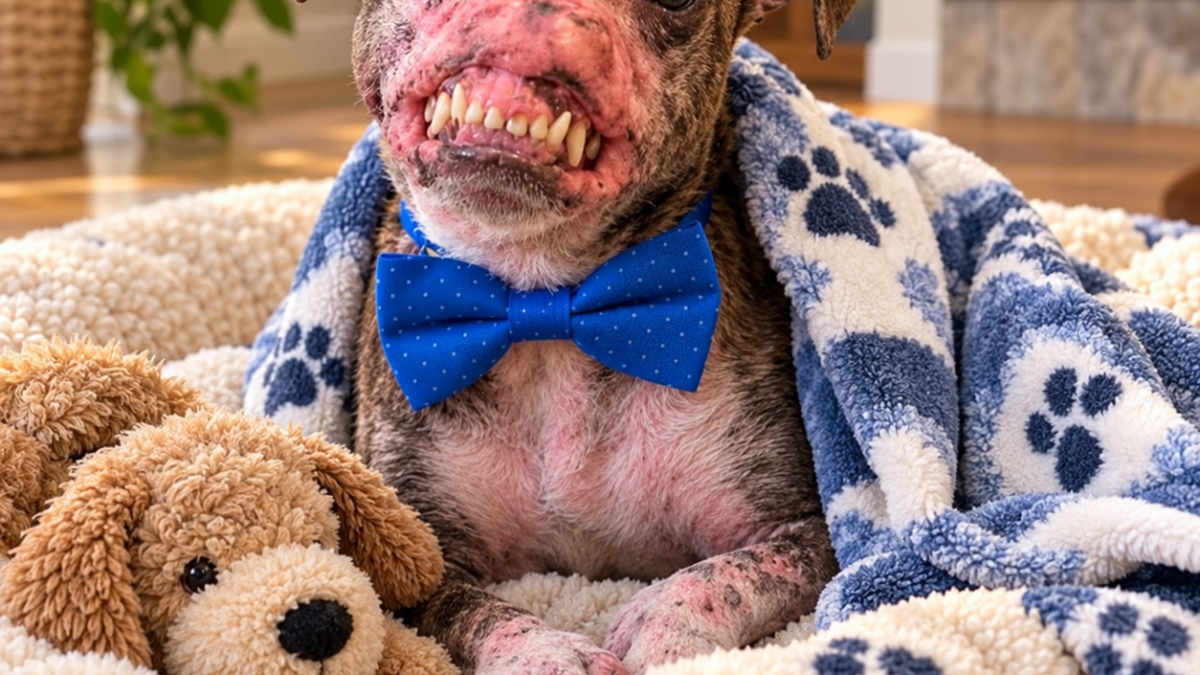
The first time I saw Phoenix, I understood why strangers stopped and stared, but the longer I looked at him, the more ashamed I became that his face had been the first thing I noticed.
His exposed teeth made him look as if he were permanently grinning, yet there was nothing frightening in the way he watched me from beneath a gray blanket, waiting to learn whether my hands would stay or pull away.
What happened after people began sharing his photograph would force all of us to decide whether we were looking at a damaged face—or finally seeing the dog behind it.
I was standing in the treatment room when Phoenix arrived, and even after years around rescue animals, I needed a second to understand what I was seeing.
Much of the hair around his face was gone. The skin across his muzzle was pink, irritated and visibly changed by disease. The tissue around his lips had been affected so severely that his teeth remained exposed, creating an expression that looked like an enormous grin even when he was simply resting.
Someone beside me whispered, “Oh, sweetheart.”
Phoenix lifted his eyes.
That was the moment everything changed for me.
His face was dramatic.
His eyes were not.
They were tired, cautious and strangely gentle.
He didn’t lunge.
He didn’t growl.
He didn’t seem to understand that anything about him was unusual.
He only watched us.
I crouched several feet away.
“Hi, Phoenix.”
His ears shifted slightly.
I put my hand on the floor instead of reaching toward him.
“You don’t have to come closer.”
For several seconds, he remained perfectly still.
Then his nose moved.
One inch.
Another.
He sniffed the air between us.
I had already learned enough from frightened animals to know that trust becomes harder when humans rush to prove they deserve it, so I stayed where I was.
Eventually Phoenix lowered his head again.
That was enough for the first day.
The medical work was more complicated.
Phoenix wasn’t suffering because he was aggressive, dangerous or somehow monstrous, despite the assumptions people would later make when his photographs began spreading online. His body was fighting a serious systemic autoimmune condition that had attacked his skin and changed his appearance in ways that were impossible to hide.
Treatment could help.
Comfort could help.
Consistency could help.
But none of us could promise that his face would ever look the way strangers thought a dog’s face was supposed to look.
I remember asking the veterinarian that question directly.
“Will he ever look normal?”
She stopped writing.
Then she looked at me.
“Define normal.”
I felt my face warm.
She wasn’t angry.
That somehow made it worse.
“I didn’t mean—”
“I know what you meant.”
She glanced toward Phoenix.
“He may always look different.”
Phoenix was curled beneath a gray-and-white blanket, his eyes barely visible over the edge.
The veterinarian continued.
“Our job isn’t to make him acceptable to people. Our job is to make him comfortable enough to live.”
That sentence stayed with me.
Over the following days, Phoenix began teaching us what comfort meant to him.
Soft blankets mattered.
Quiet voices mattered.
Predictable meals mattered.
He loved being wrapped until only his face remained visible, and despite everything his body was dealing with, he could relax so completely that sometimes he would fall asleep while we worked nearby.
One afternoon, someone brought in a bright blue bow tie.
“You cannot be serious,” I said.
“Completely serious.”
We clipped it gently around Phoenix’s neck.
He stared at us.
The bow tie sat beneath that unforgettable face.
For one second the room went silent.
Then somebody laughed.
Not at him.
With joy.
Phoenix looked absurdly formal.
Like a tiny gentleman preparing for the most important portrait of his life.
We took a photograph.
I remember thinking it would make the staff smile.
I had no idea how far that picture would travel.
Within days, people were reacting to Phoenix from places I had never been.
Some saw the bow tie.
Some saw the blanket.
Some saw his eyes.
But others saw only his face.
And one afternoon, as I stood beside his bed reading comments from strangers who had never touched him, never fed him and never watched him fall asleep against a caregiver’s hand, I found one sentence that made my stomach turn.
Someone had written:
Why would anyone keep a dog that looks like that alive?
I slowly lowered the phone.
Phoenix was watching me.
Still wrapped in his blanket.
Still wearing that impossible expression his condition had created.
I sat beside him.
He pushed his nose toward my wrist.
And as his head settled against my hand, I realized the fight for Phoenix was no longer only happening inside his body.
It had moved outside the clinic.
And this time, I wasn’t willing to stay quiet.
PART 2
I stared at that sentence until the words blurred.
Why would anyone keep a dog that looks like that alive?
I had seen ugly comments before. Rescue work introduces you to both ends of human nature. There are people who will drive three hours in the rain to bring a frightened dog a medication he needs, and there are people who can look at an animal they have never met and reduce his entire existence to whether his appearance pleases them.
Usually I could let ignorance pass.
That afternoon, I couldn’t.
Phoenix was lying less than three feet from me.
His gray-and-white blanket had slipped from one shoulder, and I could see part of the irritated skin along his neck. His eyes followed my face as if he knew my mood had changed.
I put the phone facedown.
“Don’t worry,” I whispered. “You don’t have to read the internet.”
His tail moved once beneath the blanket.
I smiled despite myself.
“Smartest dog in the building.”
Our veterinarian, Dr. Harris, walked in carrying Phoenix’s medication chart.
She looked from me to the phone.
“What happened?”
“Nothing.”
“That tone usually means something.”
I hesitated.
Then I showed her the comment.
She read it.
Her expression barely changed.
That surprised me.
“You’re not angry?”
“I am.”
“You don’t look angry.”
“I learned a long time ago not to give strangers control of my blood pressure.”
She handed the phone back.
I looked at Phoenix.
“It bothers me.”
“It should.”
“How can someone say that?”
Dr. Harris pulled a chair closer to the treatment table.
“Because some people confuse appearance with quality of life.”
“That doesn’t answer it.”
“It does.”
She leaned toward Phoenix and checked one of the affected areas along his skin.
“A dog can be scarred, missing hair, missing a leg, blind, deaf, old or chronically ill and still enjoy food, comfort, affection, curiosity, sleep, play, familiar people and tomorrow.”
She glanced at me.
“But humans are visual. We see a body that frightens us and sometimes assume the life inside it must be frightening too.”
Phoenix shifted.
Dr. Harris stopped touching him immediately.
He looked at her hand.
She waited.
After several seconds, he leaned forward again.
Only then did she continue.
“That,” she said quietly, “is the part people don’t see in a photograph.”
“What?”
“Choice.”
I watched Phoenix.
“He could have moved away.”
“Yes.”
“But he came back.”
“Yes.”
Dr. Harris smiled.
“That matters more to me than what his face looks like.”
I knew she was right.
I also knew one thoughtful conversation inside a clinic wouldn’t erase what was happening outside it.
Phoenix’s photograph kept spreading.
The blue bow tie became strangely famous.
People shared the picture because his appearance stopped them.
Some captions were compassionate.
Others were sensational.
A few called him a monster.
That word made me furious.
Phoenix had never done anything monstrous.
His disease had altered his skin and the structure around his mouth. That was all.
Yet people needed categories.
Beautiful.
Ugly.
Healthy.
Broken.
Normal.
Abnormal.
Safe.
Dangerous.
Phoenix fit badly into those boxes, and some people seemed offended by that.
Then something happened that I hadn’t expected.
For every cruel message, several compassionate ones began appearing.
A woman wrote that Phoenix reminded her of her father after extensive facial surgery.
A man said his daughter had a visible birth difference and loved the photograph because Phoenix “looked happy without needing to hide.”
A veterinary student asked detailed questions about autoimmune disease.
A burn survivor wrote simply:
I know what it feels like when people meet your scars before they meet you. Tell him I think he looks perfect.
I read that one twice.
Then a third time.
I printed it.
I don’t know why.
Maybe because I wanted something physical to counter the ugly sentence still lodged in my head.
I taped the message inside the staff cabinet above the counter where we prepared Phoenix’s medication.
Dr. Harris saw it that evening.
She didn’t say anything.
The next morning another note had appeared beside it.
One of our technicians had printed a message from a woman who owned a three-legged dog.
Then another appeared.
Then another.
Within a week, the inside of that cabinet door was covered.
Messages.
Photographs.
Drawings.
One child had drawn Phoenix wearing a crown over his blue bow tie.
Someone else drew him as a superhero.
Phoenix knew nothing about any of it.
He cared about breakfast.
That was one of the things I loved most about him.
The world could argue about whether he was beautiful while Phoenix was busy trying to determine whether I had hidden cheese in my pocket.
His condition required continued care, and not every day was good.
Some mornings his skin looked angrier.
Some days he seemed tired.
There were medication adjustments, examinations and periods when progress felt painfully slow.
One morning I found him curled tightly beneath his blanket, uninterested in food.
That frightened me.
Phoenix loved breakfast.
I sat beside him.
“Hey.”
He didn’t lift his head.
I touched the blanket, not him.
“You feeling lousy?”
His eyes opened.
Dr. Harris came in a few minutes later.
We checked him carefully.
There were no dramatic alarms, but his body was clearly telling us that something needed attention.
Treatment was adjusted.
For most of that day, I remained nearby.
There is a particular helplessness in caring for a chronically ill animal.
You can follow every protocol.
Measure every dose.
Watch every symptom.
And still there are moments when the best thing you can offer is presence.
At noon I sat on the floor eating a terrible sandwich.
Phoenix looked at me.
“Don’t.”
His eyes moved toward the sandwich.
“You didn’t want breakfast.”
His nose lifted.
“That does not mean you get turkey.”
He kept staring.
“You are emotionally manipulating a medical professional.”
Tail movement.
“Unbelievable.”
I tore off the tiniest approved piece and checked with Dr. Harris before giving it to him.
Phoenix ate it immediately.
Five seconds later he looked at the rest.
I laughed.
“There you are.”
That tiny appetite felt like a victory.
By evening he had eaten part of his regular meal.
The next morning he greeted me standing.
I almost cried.
Recovery with Phoenix was never one straight line.
It was a collection of small recoveries.
Eat today.
Rest tonight.
Tolerate the examination.
Accept the medication.
Trust the hand.
Choose the blanket.
Wake up tomorrow.
Weeks passed.
His face remained different.
That stopped mattering inside the clinic.
We no longer entered the room thinking about exposed teeth.
We noticed whether Phoenix was in his bed or under the desk.
We noticed which blanket he had chosen.
We noticed his moods.
We learned he disliked one brand of treat.
We learned he adored another.
We learned he could somehow distinguish the sound of a cheese wrapper from every other plastic package in the building.
We learned he liked the bow tie far less than humans liked seeing him in it.
We used it sparingly.
“He’s a patient, not a fashion influencer,” Dr. Harris reminded us.
One afternoon a local photographer contacted the rescue organization and asked whether she could photograph Phoenix.
I was immediately suspicious.
“What kind of photographs?”
Her name was Leah.
“Portraits.”
“Why?”
There was a pause on the phone.
“Because everyone keeps photographing his condition.”
That caught me.
She continued.
“I’d like to photograph him.”
I looked toward Phoenix.
He was asleep.
“What’s the difference?”
“The difference is whether I’m trying to document what’s wrong with him or who he is.”
I didn’t answer immediately.
Leah added, “If he’s uncomfortable, I leave.”
That mattered.
We agreed to a short session.
No flash.
No large equipment crowding him.
No forced posing.
Phoenix could stop at any moment.
Leah arrived carrying one camera and a small bag.
She sat on the floor for fifteen minutes before she even raised the camera.
Phoenix ignored her.
That was ideal.
Eventually curiosity won.
He approached.
Sniffed her shoe.
Then the camera strap.
Leah smiled but didn’t reach.
“Hi, handsome.”
Phoenix sniffed her knee.
Then walked away.
“That’s the entire interview,” I said.
She laughed.
“Did I get the job?”
“Pending review.”
The photographs she took were different from the images people had already seen.
Not because Phoenix looked different.
Because the photographs felt different.
In one, he was wrapped in his favorite blanket with only his eyes and upper face visible.
In another, he was looking directly toward Leah, teeth exposed as always, but the focus landed on his expression instead of his condition.
And then there was the photograph.
The blue bow tie.
I almost said no when someone suggested it.
Then Phoenix walked over while we were holding it and sniffed it.
“Fine,” I said. “One minute.”
We clipped it loosely around his neck.
Leah positioned herself low on the floor.
Phoenix sat.
The bow tie was ridiculously bright.
His pink skin contrasted with the blue.
His exposed teeth created that enormous permanent grin.
But his eyes were calm.
Not tragic.
Not defeated.
Calm.
Leah took the photograph.
Then she lowered the camera.
“Oh.”
“What?”
She showed me the screen.
For once, I didn’t see his condition first.
I saw Phoenix.
I understood why that photograph eventually traveled so far.
Not because it disguised him.
It didn’t.
His face remained exactly what it was.
The photograph simply refused to apologize for it.
When the rescue organization posted the image, attention exploded.
Thousands of people reacted.
Messages poured in.
Most were supportive.
Some were not.
One comment said:
This thing is nightmare fuel.
Another:
That’s cruel. Put him down.
I felt my anger return.
Then I saw a reply beneath the second comment.
A woman had written:
You are looking at one photograph and deciding whether his life has value. The people caring for him are looking at his appetite, comfort, behavior, pain level, response to treatment, interest in people and quality of life. Those are not the same thing.
Dr. Harris read it over my shoulder.
“Smart woman.”
I smiled.
Then another reply appeared.
And another.
People were defending Phoenix.
Not blindly.
Not with empty slogans.
They were talking about medical care.
Quality of life.
Chronic illness.
Compassion.
They were asking questions.
They were learning.
That was when the conflict around Phoenix began turning into something I hadn’t expected.
The very face some people used as justification for dismissing him became the reason thousands of others started discussing what animal welfare actually means.
But the cruel messages didn’t stop completely.
One afternoon a man called the rescue directly.
I happened to answer.
“I’m calling about that dog.”
“Which dog?”
“The deformed one.”
My jaw tightened.
“His name is Phoenix.”
“Whatever. I saw him online.”
“How can I help you?”
“I want to know who is paying for this.”
“For his treatment?”
“Yes.”
I explained that his care was supported through the rescue and donations.
The man laughed.
“You people are wasting money.”
I gripped the desk.
“What makes you say that?”
“Look at him.”
I took a breath.
“I do.”
“That isn’t a normal dog.”
“No, his condition is unusual.”
“That’s not what I mean.”
“I know.”
There was silence.
The man continued.
“You could help ten normal dogs with what you spend on one like that.”
That sentence hit differently.
It sounded rational enough to hide the cruelty inside it.
I could have argued.
Instead I asked, “Do you have a dog?”
He hesitated.
“Yes.”
“What’s her name?”
Another pause.
“Sadie.”
“How old?”
“Eight.”
“If Sadie developed a treatable autoimmune condition tomorrow and still wanted food, affection, walks and your company, would you decide she no longer deserved care because another dog might cost less?”
He didn’t answer.
I continued.
“Phoenix doesn’t know he looks different. He knows whether he hurts. He knows whether he’s hungry. He knows whether we come back. He knows whether a hand is gentle.”
The man’s voice changed slightly.
“I’m just saying there has to be a limit.”
“There does.”
I surprised him.
“There absolutely does. Humane medicine has limits. Quality of life matters. Pain matters. Prognosis matters. We make those assessments every day.”
I looked through the window toward Phoenix.
“But his face is not a quality-of-life measurement.”
Silence.
Then the man hung up.
I sat there angry for several minutes.
Dr. Harris walked by.
“Problem?”
“I just gave a stranger a lecture.”
“Did you charge him?”
“No.”
“Then stop giving free consultations.”
I laughed.
She kept walking.
That conversation spread among staff because I complained about it for the rest of the day.
Eventually I stopped.
Phoenix had more important things happening.
His comfort had improved.
His routine had stabilized.
And he had started doing something new.
Playing.
The first time it happened, I almost didn’t recognize it.
One of the technicians rolled a soft toy across the floor.
Phoenix watched it.
Normally he ignored toys.
That day his ears lifted.
The toy stopped near his bed.
Phoenix stood.
Walked over.
Sniffed it.
Then picked it up.
We froze.
He shook it once.
Everyone lost their minds.
“Did you see that?”
“Don’t scare him!”
“He played!”
Phoenix dropped the toy and stared at us as if we were insane.
I laughed so hard I had to sit down.
Someone rolled it again.
Phoenix followed.
Not far.
Not energetically.
But enough.
Later I thought about how absurd rescue milestones can sound to anyone outside the room.
A dog picked up a toy.
So what?
But when you have watched an animal use most of his energy simply managing illness, play is not trivial.
Play means there is enough room inside the day for something unnecessary.
Pain demands attention.
Fear demands attention.
Hunger demands attention.
Play happens when, for one moment, nothing urgent is taking everything else.
That afternoon Phoenix played for less than two minutes.
I celebrated those two minutes for weeks.
His growing public profile eventually brought an offer we weren’t expecting.
A regional animal welfare event wanted Phoenix to appear as a special guest.
My first reaction was no.
Absolutely not.
I pictured crowds.
Phones.
People leaning toward him.
People trying to touch his face.
People treating him like a spectacle.
“No.”
The rescue coordinator, Melissa, held up both hands.
“I haven’t agreed.”
“Good.”
“They’re willing to give us a quiet room.”
“No.”
“Phoenix would only come out if he was comfortable.”
“No.”
“They want Dr. Harris to speak about visible medical conditions and quality of life.”
I paused.
“That part is good.”
“And Phoenix doesn’t have to be on stage.”
I looked at her.
“Then why bring him?”
Melissa smiled.
“Exactly.”
I understood her point.
We could tell his story without using him.
Dr. Harris agreed to speak.
Phoenix stayed home.
That decision created another wave of comments because people had expected to see him.
Some complained.
One message said:
What’s the point if Phoenix isn’t there?
Dr. Harris read it before her presentation.
“The point,” she muttered, “is that Phoenix is not public property.”
Her talk became one of the most important moments in his story.
She showed no graphic photographs.
She explained autoimmune disease in plain language.
She talked about visible differences.
She talked about pain assessment.
She talked about ethical treatment decisions.
Then she showed the bow-tie portrait.
The room went quiet.
“Most of you saw his teeth first,” she said.
Nobody moved.
“I did too.”
That admission mattered.
Then she displayed another image.
Phoenix asleep beneath his blanket.
“This is also Phoenix.”
Another image.
Phoenix sniffing a toy.
“This is Phoenix.”
Another.
Phoenix leaning into a caregiver’s hand.
“This is Phoenix.”
She looked across the room.
“The ethical question is never whether an animal looks difficult for us to see. The question is whether that animal can still experience comfort, interest, connection and a life whose good moments outweigh suffering.”
I stood at the back.
My throat tightened.
Dr. Harris continued.
“Phoenix does not need us to call him beautiful.”
That surprised people.
“He needs us to treat him accurately.”
She paused.
“He is not an inspirational object. He is not proof that love fixes everything. He is a dog with a serious medical condition who happens to enjoy blankets, food, familiar people and occasionally a ridiculous blue bow tie.”
People laughed softly.
“He deserves medical judgment based on his welfare, not visual judgment based on ours.”
Afterward, a woman approached us.
She had been sitting near the front.
“My husband won’t come to things like this,” she said.
Dr. Harris waited.
“He has facial scarring.”
The woman looked at the photograph of Phoenix still projected behind us.
“People stare.”
I didn’t know what to say.
She continued.
“He pretends he doesn’t notice.”
Her voice cracked.
“But he notices.”
Dr. Harris touched her arm.
The woman smiled sadly.
“I know Phoenix is a dog. I’m not saying it’s the same.”
“No,” Dr. Harris said. “But being looked at before being known can hurt in many forms.”
The woman nodded.
Then she asked if she could have one of the printed Phoenix cards from the information table.
We gave her two.
A week later she emailed us.
Her husband had placed one beside his computer.
That message went onto the cabinet door.
By then there was barely any room left.
Months went by.
Phoenix became more stable medically, though never simple.
His condition remained part of his life.
There were good stretches.
There were setbacks.
The rescue team learned not to make dramatic declarations.
We stopped saying, “He’s finally better.”
Instead we said, “He’s having a good week.”
Chronic illness teaches humility.
One morning Phoenix’s skin flared badly.
He became uncomfortable.
He stopped seeking attention.
The cheerful internet version of rescue disappeared instantly.
No bow tie.
No cute blanket photographs.
Just medicine.
Observation.
Concern.
Dr. Harris stayed late.
So did I.
Phoenix lay with his head turned away.
I sat near the kennel.
“Remember when everyone thought you were famous?”
No response.
“I regret to inform you that fame does not exempt you from treatment.”
His ear moved.
“Also, your fan mail is ridiculous.”
Nothing.
“You have better mail than I do.”
He opened one eye.
“There he is.”
I wanted him better immediately.
That was impossible.
For three days we watched closely.
Medication changed.
His appetite slowly returned.
On the fourth day, I opened a treat bag.
Phoenix raised his head before I said anything.
I almost hugged Dr. Harris.
“Cheese detection is back.”
“Very scientific.”
“I’m documenting it.”
“You do that.”
By the end of the week he was stronger.
That setback changed the way I understood his public story.
People liked transformation.
Before and after.
Sick and healed.
Sad and happy.
Broken and fixed.
Phoenix refused to fit that structure.
There was no clean “after.”
His life was ongoing.
His condition was ongoing.
His joy was ongoing.
So was his vulnerability.
And somehow that made his story more honest.
One day a family asked to meet him.
I immediately became defensive.
“Why?”
Melissa answered, “Because they’re considering supporting his long-term care.”
“Do they understand his condition?”
“Yes.”
“Children?”
“One adult daughter.”
“Experience with medical animals?”
“Yes.”
My questions kept coming.
Melissa eventually sighed.
“You know you can meet them before Phoenix does.”
“I intend to.”
Their names were Claire and Robert.
Their daughter, Hannah, was twenty-four.
They arrived without cameras.
That earned immediate points.
Claire sat across from me.
“We don’t need to touch him.”
More points.
Robert said, “We don’t even need to see him if that’s stressful.”
I looked at him.
“Then why come?”
Hannah answered.
“Because I wanted to understand what he needs.”
She had a small scar along one side of her chin.
I tried not to look at it.
She noticed.
“It’s okay.”
I felt embarrassed.
She smiled.
“Car accident.”
“I’m sorry.”
“Don’t be.”
She looked toward the treatment hallway.
“I spent almost two years hating photographs.”
That made me understand something.
Hannah continued.
“Then somebody sent me Phoenix’s picture.”
“The bow tie?”
“The bow tie.”
Of course.
“I thought he looked strange,” she admitted.
I respected the honesty.
“Then I read about him.”
Her fingers touched her chin unconsciously.
“And I realized I was doing to him exactly what I thought people were doing to me.”
Nobody spoke.
Claire reached for her daughter’s hand.
Hannah pulled a folded piece of paper from her bag.
“I wrote something for him.”
I smiled.
“He cannot read.”
“I assumed.”
“What does it say?”
She handed it to me.
I opened it.
You didn’t need your face to change for people to learn how to look at you.
I swallowed.
“That’s going on the cabinet.”
Hannah laughed.
“What cabinet?”
I showed them.
She cried.
So did Claire.
Robert pretended to examine a poster on the wall.
Eventually we decided Phoenix could meet them one at a time.
No pressure.
Claire went first.
She sat on the floor.
Phoenix approached after several minutes.
Sniffed her.
Moved away.
Robert did even less.
He entered.
Sat.
Phoenix looked.
That was it.
Then Hannah came in.
She sat sideways and did not reach toward him.
Phoenix stared at her.
She stared at the floor.
Minutes passed.
Then Phoenix walked over.
He sniffed her sleeve.
She remained still.
His nose moved toward her hand.
Still she didn’t touch him.
Finally Phoenix lowered himself beside her.
Not against her.
Beside her.
Hannah started crying silently.
I whispered, “Don’t make it weird.”
She laughed through tears.
“I’m trying.”
Phoenix rested his head.
After another minute, he shifted closer.
Hannah slowly opened her palm.
Phoenix placed part of his muzzle against it.
His exposed teeth touched her skin.
She did not flinch.
That mattered more than I can explain.
Not because flinching would have made her cruel.
Phoenix’s appearance was startling.
That was real.
But Hannah had prepared herself to let him define the interaction.
Not her first reaction.
His choice.
She sat with him for nearly half an hour.
When it was time to leave, she said, “He feels completely normal when you’re sitting with him.”
I looked at her.
“He always was.”
She nodded.
“I know.”
That family became part of his support network.
They didn’t try to own his story.
They helped with care.
They visited occasionally.
Hannah sent blankets.
Robert once sent an entire box of Phoenix’s favorite treats after apparently misunderstanding the meaning of “a small donation.”
Claire began volunteering with medically complex rescue animals.
Phoenix’s world became larger.
Not because he became prettier.
Because more people learned how to enter it correctly.
Then came the photograph that finally silenced something inside me.
It was taken nearly a year after Phoenix’s bow-tie portrait first spread.
No professional camera.
No careful lighting.
No campaign.
I took it with my phone.
Phoenix was asleep on his side.
His blanket had fallen halfway off.
One paw was stretched toward me.
His face was completely relaxed.
His teeth remained visible.
His skin remained changed.
Nothing had been hidden.
But when I looked at the picture, I realized I had forgotten to notice.
Not because his difference disappeared.
Because familiarity had replaced shock.
His face had become Phoenix’s face.
The same way anyone you love eventually becomes more than the collection of features a stranger sees.
I posted the photograph with a short update about his health.
The response was enormous.
But one comment mattered more than thousands of others.
It came from the same username that had once written:
Why would anyone keep a dog that looks like that alive?
I recognized it immediately.
My entire body tensed.
The new comment said:
I wrote something cruel here months ago. I was wrong. I didn’t understand his condition or how vets measure quality of life. I’m sorry.
I stared at the screen.
I read it again.
Melissa saw my expression.
“What?”
I showed her.
She blinked.
“No way.”
“Same account.”
“What are you going to say?”
My first instinct was sharp.
Something satisfying.
Something that would punish them publicly.
I imagined writing:
Now you understand.
Or:
Maybe think before you judge next time.
I wanted the moment.
I wanted revenge.
Not the kind involving pain.
The small human kind.
The pleasure of making someone feel ashamed after they had made you angry.
Then Phoenix walked over.
He nudged my elbow.
I looked down.
He wanted the treat in my other hand.
He did not care that the internet had just completed a moral arc.
I laughed.
“What should I say?”
Phoenix stared at the treat.
“Excellent advice.”
I replied with four words.
Thank you for coming back.
Melissa looked at me.
“That’s it?”
“That’s enough.”
And it was.
That became the revenge I had not expected.
Not humiliation.
Not winning an argument.
Change.
A stranger who once thought Phoenix’s appearance made his life disposable had learned something.
Maybe they would look differently at the next animal.
Maybe at the next person.
Maybe not.
But for one moment, cruelty had lost ground.
Phoenix had done that without ever knowing there had been a fight.
His second year with us was quieter.
The internet moved on, as the internet always does.
A new story appeared.
Then another.
Phoenix stopped being the animal everyone was talking about.
I was relieved.
Fame is a terrible place for a dog to live.
Ordinary life suited him much better.
He had favorite blankets.
Favorite people.
Favorite treats.
He knew Dr. Harris’s footsteps.
He learned that Melissa usually carried snacks.
He tolerated photographs when necessary.
He remained suspicious of the bow tie.
Hannah visited often enough that Phoenix began recognizing her immediately.
One afternoon she arrived wearing a blue scarf.
I looked at her.
“Matching him now?”
“Absolutely not.”
“It’s the same blue.”
“Coincidence.”
Phoenix approached her.
She sat down.
He leaned against her leg.
Hannah scratched gently along an area where his skin tolerated touch well.
“I got engaged,” she said.
I looked at her hand.
There was a ring.
“Congratulations.”
She smiled.
“Daniel proposed last week.”
“Does he know you spend half your free time buying blankets for a famous dog?”
“He came prepared.”
She pulled a tiny object from her bag.
A blue bow tie.
I stared.
“No.”
Phoenix looked suspicious.
Hannah laughed.
“It’s for the wedding picture.”
“No.”
“One picture.”
“Phoenix is not attending your wedding.”
“I know.”
“Good.”
“I just want a photo with him before it.”
Phoenix walked away.
“He has spoken,” I said.
A week later he voluntarily approached while Hannah was holding the bow tie.
We compromised.
Thirty seconds.
The photograph showed Hannah kneeling beside Phoenix.
Her engagement ring visible.
Her scar visible.
His scars visible.
The blue bow tie between them.
Neither hiding.
Hannah later framed it.
Months after her wedding, she sent me another photograph.
The Phoenix picture was hanging in her home.
I thought about how strange influence can be.
Phoenix never gave speeches.
Never understood hashtags.
Never knew why strangers mailed him blankets.
He just lived.
Yet simply by living visibly, without apology, he changed the way some people thought.
That was enough.
As time passed, his disease continued demanding respect.
There were still medications.
Still examinations.
Still careful decisions.
Dr. Harris never allowed sentiment to replace medicine.
That mattered.
One evening I asked her the question I had secretly feared since the beginning.
“How will we know?”
She knew what I meant.
“When his life isn’t good anymore?”
I nodded.
She sat beside me.
“We watch the same things we’ve always watched.”
“Food?”
“Food. Comfort. Rest. Interest. Interaction. Pain. Mobility. More good days than bad.”
“And his face?”
She gave me a look.
I smiled.
“I know.”
“His face was never the answer.”
That sentence closed a circle.
At the beginning, I had asked if he would ever look normal.
Now I understood how wrong the question had been.
Phoenix didn’t owe us normal.
He only needed enough comfort to be Phoenix.
Years later, when gray began appearing in places where hair still grew, I found it oddly beautiful.
Not because aging is easy.
Because he had reached it.
There had been a time when strangers looked at one photograph and assumed his life should be shortened.
Instead he accumulated years.
Winters.
Summers.
Blankets.
Meals.
Visitors.
Medical appointments.
Quiet afternoons.
Those ordinary years became the strongest answer to every person who had once looked at him and seen only suffering.
One winter evening, I visited after my shift.
Phoenix was wrapped tightly in his gray-and-white blanket.
Only his face showed.
Just like the early photographs.
Someone had placed the blue bow tie beside him.
Not around his neck.
Beside him.
He looked toward me.
His eyes were older.
Still calm.
I sat down.
“Remember me?”
His tail moved beneath the blanket.
“Good answer.”
Hannah was visiting too.
She sat across from us.
“You know what’s strange?” she asked.
“What?”
“When I first saw his photo, I couldn’t stop staring at his mouth.”
I looked at Phoenix.
“And now?”
“I forget.”
“Me too.”
She smiled.
“That feels important.”
It was.
People stared at Phoenix’s face first.
Those of us who knew him eventually stopped.
We noticed when he was tired.
When he was hungry.
When he wanted space.
When he wanted company.
When he heard a familiar voice.
When he settled deeper beneath a blanket.
His face never became ordinary.
Our understanding did.
One afternoon, years after the first viral photograph, a young volunteer came into the room.
She had never met Phoenix.
She froze for half a second.
I saw it.
That first reaction.
The same reaction I had once had.
She immediately looked embarrassed.
“I’m sorry.”
“For what?”
“I stared.”
“You’re allowed to be surprised.”
She looked at him.
“He doesn’t know, does he?”
“Know what?”
“That he looks…”
She stopped.
“Different?”
“Yes.”
“No.”
Phoenix sniffed her shoe.
“He knows you smell like the treat room.”
She laughed.
She sat down.
Phoenix remained several feet away.
“Should I pet him?”
“Let him answer.”
She nodded.
Five minutes later he walked closer.
Ten minutes later he rested beside her.
The volunteer looked at me.
Her eyes were wet.
“I thought he would be scary.”
“Because of the teeth?”
She nodded.
Phoenix sighed and settled more comfortably.
She whispered, “He’s just a dog.”
There it was.
The sentence we had spent years trying to teach without ever needing to say it.
Just a dog.
Not a diagnosis.
Not an internet curiosity.
Not a symbol.
Not a monster.
Not a miracle.
A dog.
That evening, after everyone left, I sat beside Phoenix for a while.
The clinic was quiet.
He was under his blanket.
I remembered every version of him.
The first cautious look.
The medication days.
The flare-ups.
The bow-tie photograph.
The hateful comments.
The cabinet covered with messages.
The woman whose husband had facial scars.
Hannah.
The phone call from the man who thought resources should only go to animals who looked normal.
The commenter who came back to apologize.
All of it.
I placed my hand near Phoenix.
He moved forward and rested his muzzle against it.
His exposed teeth touched my wrist.
Years earlier, I might have noticed that first.
Now I noticed the warmth.
“You know something?” I whispered.
His eyes opened.
“You got the last word.”
His tail moved.
Phoenix never knew anyone had called him ugly.
He never knew strangers debated whether his life was worth living.
He never knew people used photographs of his face to argue with one another.
He never knew his blue bow tie traveled farther than any of us expected.
And I am glad.
Those were human problems.
Phoenix’s world was simpler.
Did breakfast arrive?
Was the blanket soft?
Was the room warm?
Did familiar people return?
Did the hands touching him hurt or help?
Could he rest?
Could he trust?
Could he have another good day?
For as long as the answers remained yes, Phoenix had what mattered.
The revenge people sometimes wanted for him never came through punishment because there had never been a villain responsible for his autoimmune disease.
There was no cruel owner to confront.
No courtroom.
No arrest.
The conflict had been different.
It was the judgment surrounding him.
The belief that visible damage made a life less valuable.
And against that belief, Phoenix achieved the most complete revenge possible.
He stayed.
He lived.
He was loved without needing to become easier to look at.
The people who once stopped because his face shocked them eventually stayed because of his eyes.
Some learned medicine.
Some learned patience.
Some apologized.
Some recognized pieces of their own lives in him.
And some simply learned to look twice.
One spring afternoon, we took Phoenix outside.
Nothing special had been planned.
The weather was warm.
The sun was gentle.
A breeze moved through the trees.
We spread his familiar gray-and-white blanket beneath a patch of shade.
Phoenix lowered himself onto it.
Hannah sat nearby.
Dr. Harris brought coffee.
Melissa complained that hers was cold.
I sat on the grass.
Someone had brought the blue bow tie.
Again.
“You people never learn,” I said.
Hannah laughed.
Phoenix looked at it.
Then at us.
Melissa held it out.
“Last chance to become a fashion icon.”
Phoenix turned his head away.
We burst out laughing.
“No bow tie,” Dr. Harris said. “The patient has declined.”
So we left it beside him.
The blue bow tie rested in the grass.
The blanket covered half his body.
Phoenix lifted his face toward the breeze.
Sunlight touched the pink skin around his muzzle.
His teeth showed.
His eyes closed.
Nobody tried to fix the picture.
Nobody needed to.
I took one photograph.
When I looked at it later, it became my favorite image of him.
Not the viral portrait.
Not the formal bow tie.
Not the carefully wrapped blanket.
This one.
Phoenix asleep outdoors.
His scars visible.
His bow tie rejected.
People he trusted sitting nearby.
Nothing hidden.
Nothing staged.
Nothing missing.
I printed the photograph and placed it inside the cabinet.
There was almost no space left.
I had to move several old notes.
Then I found the first message I had printed years earlier.
The burn survivor’s words:
I know what it feels like when people meet your scars before they meet you. Tell him I think he looks perfect.
I stood holding it for a long time.
Then I placed it beside Hannah’s note:
You didn’t need your face to change for people to learn how to look at you.
Between them, I placed the photograph.
That became the final version of Phoenix’s story for me.
His body never returned to the appearance strangers once considered normal.
His face remained unforgettable.
His disease remained real.
His scars remained part of him.
But the people around Phoenix changed.
We learned not to measure a life from a photograph.
We learned that comfort can matter more than appearance.
We learned that healing does not always mean restoration.
Sometimes healing means stability.
Routine.
Warmth.
Trust.
Another meal.
Another morning.
Another person who walks into the room, sees something startling and chooses to stay long enough to understand.
The first time I saw Phoenix, I stared at his face.
Years later, when I close my eyes and remember him, I barely see the scars.
I see gray blankets.
A ridiculous blue bow tie lying rejected in the grass.
A soft toy rolling across the floor.
Hannah crying while Phoenix rested beside her.
Dr. Harris pretending not to smile when he recognized a cheese wrapper.
A cabinet door covered with messages from people who had learned something because one unusual-looking dog existed openly in the world.
Most of all, I remember his eyes.
Calm.
Patient.
Watching.
They never asked us to call him beautiful.
They never asked us to feel sorry for him.
They only seemed to ask the same quiet question every rescued animal eventually asks in one form or another.
Are you staying?
And for Phoenix, finally, the answer kept becoming yes.
Yes, the food would come.
Yes, the blanket would still be there tomorrow.
Yes, someone would check on him.
Yes, someone would manage the disease his body could not control.
Yes, someone would sit beside him when he felt terrible.
Yes, someone would laugh when he played.
Yes, someone would protect his right to rest instead of turning him into a spectacle.
Yes, people could look directly at his changed face and still see nothing frightening in the dog beneath it.
Phoenix had spent his life wearing an expression people mistook for a grin.
But the happiest thing about his story was never that strange permanent smile.
It was everything that eventually happened behind it.
The meals.
The blankets.
The hands.
The voices.
The people who returned.
The strangers who changed their minds.
The good days that accumulated until they became a life.
And when Phoenix finally curled beneath his familiar blanket at the end of another ordinary day, his head resting near the blue bow tie he never particularly cared for, nobody around him needed him to look different.
Nobody needed his scars to disappear.
Nobody needed a perfect before-and-after photograph.
We only needed Phoenix.
Exactly as he was.
And after a lifetime of people noticing his face before anything else, that became the ending he deserved most.
He was no longer the dog people stared at.
He was the dog people had finally learned to see.
But even that was not the end of what Phoenix left behind, because stories like his do not stop at the moment people finally understand them. They keep moving through the people who were changed by them, through the animals who come afterward, and through the small decisions that once might have gone differently.
Several months after that quiet spring afternoon, I walked into the clinic and found a cardboard box sitting on the front counter.
My name was written across the top in thick black marker.
Inside were twenty soft blankets.
Gray.
Blue.
White.
Some had little paw prints stitched into the corners.
There was no return address, only a folded note tucked between them.
I opened it.
My mother saw Phoenix online during chemotherapy. She said she understood him because neither of them looked like themselves anymore, and neither of them wanted to be treated like they had disappeared. She passed away last month. These blankets were purchased with money she asked us to donate to animals who need comfort more than sympathy.
I read the note twice.
Then I sat down.
For several minutes, the clinic continued moving around me.
Phones rang.
A puppy barked from an examination room.
Someone carried a box of medication down the hallway.
The ordinary machinery of rescue kept going while I held a piece of paper written by a person I had never met about another person Phoenix had never known.
Dr. Harris found me there.
“What happened?”
I handed her the note.
She read it silently.
When she finished, she pressed her lips together.
“People keep doing this,” I said.
“Doing what?”
“Finding themselves in him.”
She looked toward the treatment room where Phoenix was sleeping.
“Maybe they aren’t finding themselves in him.”
“What do you mean?”
“Maybe they’re finding permission.”
I waited.
“To still matter when something visible changes.”
That sentence stayed with me.
We washed every blanket and began using them.
One went to a dog recovering from surgery.
Another went beneath an elderly terrier who had arrived trembling after his owner died.
A blue one was folded around a cat too frightened to leave the back of her carrier.
The gray blanket with white paw prints eventually went to a dog named Benny.
Benny’s face was different too.
Not like Phoenix’s.
His injury had happened years earlier, leaving one side of his jaw uneven and one eye permanently closed.
He had lived with it long enough that Benny himself seemed completely unconcerned.
Humans were less evolved.
When his foster family brought him to an adoption event, visitors repeatedly walked past.
Some stopped.
Some whispered.
One man actually said, “What happened to that one?”
That one.
I hated the phrase instantly.
Benny’s foster mother, Carla, called me afterward.
“I don’t understand,” she said. “He’s sweet. He’s house-trained. He sleeps through the night. He loves everybody.”
I knew exactly what she was asking.
Why wasn’t that enough?
I looked toward Phoenix.
He was sleeping beneath his blanket.
“Bring Benny here tomorrow.”
“For what?”
“Just bring him.”
The next afternoon Carla arrived.
Benny walked into the clinic wearing a red harness.
He was nervous, but his tail moved.
Phoenix was in a quiet side room.
We kept the dogs separated by a gate at first.
They sniffed.
Then looked away.
Perfect.
After careful introductions, both dogs settled on opposite sides of the room.
No dramatic friendship.
No miracle.
Just coexistence.
Carla sat beside me.
“What am I supposed to see?”
“Nothing.”
She frowned.
“That’s the point.”
She looked between them.
Phoenix had placed his head on the floor.
Benny was investigating a water bowl.
“What do you mean?”
“Nobody in this room is asking whether they look normal.”
Carla’s expression changed.
I continued.
“We’re asking if they’re comfortable. If they’re safe. If they can enjoy things. If they can trust. That’s what adopters need to understand.”
Carla looked at Benny.
“I’ve explained all of that.”
“I know.”
“Then why do people keep walking away?”
“Because first impressions are fast.”
I looked at Phoenix.
“Understanding is slower.”
A week later Carla asked if we could use one of Phoenix’s old photographs in Benny’s adoption profile.
Not to compare them.
Not to exploit Phoenix’s story.
Just to explain that visible difference and suffering are not the same thing.
We agreed.
The post was simple.
No dramatic language.
No tragedy.
It introduced Benny as a dog who liked car rides, scrambled eggs, sunlit carpets, and stealing socks.
At the end was one sentence:
His face tells you something happened to him. His behavior tells you who he is now.
Three days later, a retired couple applied.
They had seen Phoenix years earlier.
They remembered him.
When they met Benny, the husband sat on the floor and waited.
Benny approached.
The man didn’t react to the uneven jaw.
He scratched Benny’s chest.
His wife started crying.
Carla called me after they left.
“I think they’re the ones.”
They were.
Two weeks later Benny went home.
His new family sent a photograph of him asleep in a patch of sunlight beside an old recliner.
I printed it.
I placed it inside Phoenix’s cabinet.
By then the cabinet door could barely close.
Dr. Harris complained.
“This is technically a fire hazard.”
“You’re exaggerating.”
“There are sixty-three pieces of paper taped to one door.”
“Sixty-four.”
She stared at me.
“I added Benny.”
She sighed.
“Of course you did.”
Eventually we moved everything.
We cleared a section of wall in the staff room.
Messages.
Photographs.
Drawings.
Notes.
Phoenix’s bow-tie portrait went in the center.
Above it, Dr. Harris placed a small card.
It said:
LOOK AGAIN.
That became our unofficial rule.
Whenever a difficult case arrived, we looked again.
Whenever a dog seemed shut down, we looked again.
Whenever fear looked like aggression, we looked again.
Whenever age looked like hopelessness, we looked again.
Whenever an injury looked like the entire story, we looked again.
It did not mean every animal could be saved.
That was an important distinction.
There were cases where suffering could not be relieved.
Cases where medicine had reached its limits.
Cases where love required letting go.
Phoenix’s story never changed that reality.
If anything, it made us more careful about it.
Quality of life had to be measured honestly.
Not sentimentally.
Not visually.
Honestly.
One evening a new technician named Julia asked Dr. Harris about that.
“If Phoenix had been suffering with no chance of meaningful comfort, would you still have kept treating him because people loved his story?”
Dr. Harris answered immediately.
“No.”
Julia looked surprised.
“Even after everything?”
“Especially after everything.”
Phoenix was sleeping nearby.
Dr. Harris continued.
“Our obligation was never to keep him alive at all costs.”
She glanced toward him.
“It was to protect his life while it remained a life he could experience as worth living.”
Julia nodded slowly.
“And when it wasn’t?”
“Then our obligation would change.”
I had heard similar explanations before.
But now, as Phoenix aged, those words felt heavier.
He was slowing down.
Not dramatically.
But undeniably.
He slept longer.
He walked more carefully.
He sometimes paused before climbing onto the padded platform he liked.
We adjusted things.
A lower bed.
Non-slip mats.
More frequent checks.
Warmer blankets.
Less unnecessary movement.
Aging crept into his story the same way it enters every life—without asking whether we were ready.
One afternoon Hannah visited and noticed it too.
“He seems tired.”
“He is.”
Her eyes filled immediately.
“No.”
I knew what she meant.
Not yet.
Not him.
Not after all this.
I sat beside her.
“He’s still eating.”
“Good.”
“He still wants company.”
“Good.”
“He still gets annoyed when I don’t share cheese.”
She laughed through tears.
“Good.”
“He still has more good days than bad.”
She nodded.
“So we stay in today.”
That became another lesson Phoenix gave us.
Do not grieve tomorrow so loudly that you miss today.
Hannah sat with him for nearly two hours.
Phoenix rested his head against her thigh.
She stroked his shoulder.
At one point she whispered, “You know you’re the reason I stopped hiding from photographs.”
I pretended not to hear.
Some moments belong to the person saying them and the animal who does not understand the words.
Months later, Hannah mailed us her wedding album.
Near the back was a photograph of her standing beside her husband.
Her scar was clearly visible.
No heavy makeup covering it.
No careful angle hiding it.
Beneath the photograph she had written:
LOOK AGAIN.
I put that on the wall too.
Dr. Harris stopped complaining about space.
Phoenix continued aging.
His medical condition remained monitored.
Some weeks were good.
Some required adjustments.
We learned to recognize subtler signs.
A slower appetite.
More time spent sleeping.
Less interest in toys.
But there were still sparks.
Cheese.
Warm sunlight.
Familiar people.
A new blanket.
The sound of Melissa opening the treat drawer.
The day she accidentally dropped an entire bag, Phoenix moved faster than he had in months.
“You faker,” she shouted.
Phoenix collected three pieces before anyone could stop him.
Dr. Harris laughed.
“Excellent mobility assessment.”
Melissa pointed at him.
“He planned that.”
Phoenix chewed peacefully.
Even near the end of his life, he remained capable of winning.
Then one morning, years after I first saw him, I arrived before sunrise.
Dr. Harris was already there.
That alone told me something.
She usually arrived thirty minutes after I did.
I walked into the treatment room.
Phoenix was awake.
But he hadn’t eaten.
His breathing was different.
Not dramatic.
Just heavier.
I knew.
Or perhaps I feared.
Sometimes those are the same feeling.
I sat beside him.
“Morning.”
His eyes moved toward me.
The tail did not.
Dr. Harris came in behind me.
“We need to talk.”
I hated those words.
Every person who has loved an animal hates those words.
“What changed?”
She explained.
His body was struggling in ways our treatment could no longer easily correct.
There were options.
But they came with burdens.
Hospitalization.
More invasive intervention.
Uncertainty.
Stress.
And Phoenix was tired.
We reviewed everything.
Pain.
Appetite.
Comfort.
Interest.
Rest.
Interaction.
All the same measurements we had used for years.
His face was not part of the equation.
It never had been.
This time, the answers were different.
I stared at him.
“I’m not ready.”
Dr. Harris’s voice softened.
“That isn’t one of the measurements.”
I looked at her angrily.
Then I hated myself for it.
“I know.”
She sat beside me.
“We do not have to decide this second.”
“But soon.”
“Yes.”
I called Hannah.
I called Melissa.
We contacted the people closest to Phoenix.
Nobody rushed in shouting.
Nobody turned his last hours into spectacle.
That mattered enormously to me.
We kept the room quiet.
The gray-and-white blanket covered him.
The blue bow tie sat on a nearby chair.
Hannah arrived first.
She knelt beside him.
Phoenix opened his eyes.
His tail moved once.
She broke.
“Oh, buddy.”
She placed her hand near him.
He shifted his muzzle toward it.
Still choosing.
Even then.
Melissa arrived carrying cheese.
“Against medical advice,” she whispered.
Dr. Harris nodded.
“At this point, I’ll allow it.”
Phoenix ate a tiny piece.
Everyone laughed and cried at the same time.
I hated how normal grief and joy could exist in the same room.
For several hours we stayed.
Nobody told Phoenix he was brave.
He had never asked to be.
Nobody told him he was beautiful.
He didn’t need it.
We told him ordinary things.
That he was good.
That the blanket was his.
That Hannah had brought the wrong kind of treats again.
That Melissa still made terrible coffee.
That I still remembered the first time he stole turkey from my sandwich.
Phoenix rested.
At some point his head settled against my wrist.
His teeth touched my skin.
The exact thing that once startled strangers.
I barely noticed.
Dr. Harris sat across from me.
Her eyes were red.
“When?”
I whispered.
She checked him gently.
“When you’re ready.”
I looked at Phoenix.
Then corrected her.
“When he’s ready.”
She nodded.
We waited longer.
Near sunset, Phoenix’s breathing became harder.
He was tired.
The answer became clear.
There is no triumphant way to describe that moment.
Love does not make it easier.
Understanding does not make it painless.
Doing the right thing can still break you.
We gathered close.
Not crowding.
Just near.
Hannah held one corner of his blanket.
Melissa touched his shoulder.
I kept my hand where his muzzle rested.
Dr. Harris spoke softly as she prepared everything.
I looked into Phoenix’s eyes.
The same eyes that had changed the story from the beginning.
Not his teeth.
Not his skin.
His eyes.
“Hey,” I whispered.
He looked at me.
“You don’t have to keep doing this for us.”
My voice broke.
“You already did enough.”
His eyelids lowered.
I stroked the side of his head.
“You were never the face people were afraid of.”
I swallowed.
“You were just Phoenix.”
His breathing slowed.
The room became very quiet.
And with people around him who had learned every version of his face, Phoenix died without fear.
For several minutes, nobody moved.
I don’t remember who cried first.
Probably all of us.
Hannah bent over him and whispered something I couldn’t hear.
Melissa placed the blue bow tie beside his blanket.
Dr. Harris removed her gloves and stood with one hand covering her mouth.
I kept touching Phoenix.
Because for years we had taught him that human hands could mean comfort.
I wanted the last one he felt to mean the same thing.
Afterward, the clinic seemed wrong.
His bed was empty.
His blankets remained.
His bowl was still where we had left it.
Grief makes ordinary objects feel cruel.
The next morning, I walked into the staff room and saw the wall.
LOOK AGAIN.
Phoenix in his bow tie.
Phoenix asleep.
Phoenix beside Hannah.
Benny in his new home.
The blankets donated by a woman who had seen herself in him.
Notes from people we had never met.
Years of evidence that one dog’s life had moved outward into places he could never understand.
I stood there crying.
Then Julia came in carrying a frightened little dog wrapped in a towel.
“Sorry,” she said. “We have an intake.”
Of course we did.
There is always another animal.
I wiped my face.
“What happened?”
“Skin disease. Severe. Owner surrendered.”
The dog’s fur was missing in patches.
His skin looked painful.
He trembled.
I saw the way Julia held him.
Carefully.
No disgust.
No hesitation.
“Put him in Room Two,” I said.
She nodded.
Then she stopped beneath the wall.
Her eyes landed on Phoenix’s photograph.
She looked back at the dog in her arms.
Then at me.
“I remember.”
That was Phoenix’s last gift to the clinic.
We remembered.
We remembered not to decide too quickly.
Not to confuse appearance with suffering.
Not to confuse difference with hopelessness.
Not to promise miracles.
Not to force trust.
Not to demand gratitude.
Not to turn rescue animals into symbols when they were tired of being watched.
Not to keep them alive for our sake when their own comfort had disappeared.
Look again.
We named the new dog Teddy.
His condition was different from Phoenix’s.
His outcome would be his own.
That mattered.
We never told ourselves Phoenix had sent him.
We never needed to make grief mystical to make it meaningful.
Teddy simply arrived after Phoenix died.
And because Phoenix had lived, we were better prepared to see Teddy correctly.
That was enough.
Months after Phoenix was gone, messages still came.
Some people did not know he had died.
They asked for updates.
We answered when we could.
Eventually the rescue posted a final photograph.
Not the bow-tie portrait.
I insisted on that.
We used the spring photograph.
Phoenix asleep outside.
Scars visible.
Blue bow tie lying unused in the grass.
People he trusted nearby.
The caption was short.
It said that Phoenix had died peacefully after years of care, comfort, and ordinary days.
No dramatic language.
No claims that he “lost a battle.”
He had not lost.
A body can reach its limit without a life becoming a failure.
Then we added one line:
He never needed to look different. We needed to learn to see differently.
The response overwhelmed us.
Thousands of comments.
Photos of dogs with scars.
Cats missing eyes.
Animals with wheelchairs.
People with visible differences.
People in treatment.
People aging.
People grieving.
People who had once been afraid to look at Phoenix and now thanked him for teaching them to stay.
Then I saw a familiar username.
The person who years earlier had written:
Why would anyone keep a dog that looks like that alive?
The same person who later apologized.
Their final comment said:
I was wrong about him when I first saw him. I’ve never forgotten that. Last year I adopted a senior dog with a facial tumor because Phoenix taught me to ask about comfort before appearance. She slept beside me for eleven months before she passed. Those were good months. Thank you, Phoenix.
I stared at the words until tears ran down my face.
There it was.
The revenge.
If you still wanted to call it that.
Not someone being punished.
Not someone being humiliated.
A cruel opinion had become an adoption.
A judgment had become eleven months of safety for another dog.
Phoenix had never known.
That somehow made it more beautiful.
A week later, a package arrived.
Inside was a framed photograph.
An elderly dog with a lopsided face sleeping on a couch.
On the back someone had written:
Her name was Millie. Phoenix helped me see her.
I placed Millie on the wall.
Eventually, we stopped calling it Phoenix’s wall.
New people joined the clinic.
Some never met him.
But they learned the rule.
Look again.
Years passed.
The blue bow tie stayed inside a small wooden box at the rescue.
His gray-and-white blanket was eventually too worn to use.
We kept a square of it.
Not because Phoenix needed relics.
Humans do.
Whenever I trained new volunteers, I sometimes told them about him.
Not the viral version.
Not the shocking-face story.
I told them the small things.
“He could hear a cheese wrapper from across the building.”
“He hated the bow tie.”
“He manipulated staff expertly.”
“He liked his blanket tucked around his shoulders.”
“He once refused breakfast but somehow recovered enough to eat turkey from my sandwich.”
People laughed.
That was important.
I wanted Phoenix remembered as funny too.
Loved animals deserve to be remembered for more than their suffering.
One new volunteer once asked, “Was he really as inspirational as people say?”
I thought about it.
“No.”
She looked surprised.
“He was a dog.”
I pointed toward the wall.
“We were inspired. That was our business, not his responsibility.”
She smiled.
I continued.
“Phoenix never woke up thinking he had to teach anybody courage. He woke up wanting breakfast.”
That became another rule.
Do not make rescued animals earn love by inspiring you.
They are allowed to simply live.
The years changed me too.
I became slower to use words like ugly.
Broken.
Normal.
Hopeless.
I became suspicious of photographs without context.
I learned to ask better questions.
Is there pain?
Can it be treated?
Does the animal seek comfort?
Is there appetite?
Interest?
Connection?
Choice?
Can today still contain something good?
Phoenix never answered those questions with words.
He answered through behavior.
A nose against a hand.
A tail beneath a blanket.
A piece of cheese accepted.
A toy picked up.
A decision to stay near someone.
A relaxed body sleeping in the sun.
Those answers built a life.
One afternoon, many years later, I visited Hannah.
She had a little boy by then.
He was five.
On a shelf in her living room sat the framed photograph of her beside Phoenix wearing the blue bow tie.
Her son pointed at it.
“Mommy, what happened to that dog’s face?”
Children ask the question adults often try to hide.
Hannah sat beside him.
“He got sick.”
“Did it hurt?”
“Sometimes.”
“Did he get better?”
She looked at me.
Then back at her son.
“Some things got better. Some things didn’t.”
The boy studied Phoenix.
“Why can I see his teeth?”
“Because his face changed.”
He thought about that.
Then asked the question that destroyed me.
“Was he nice?”
Hannah smiled.
“Yes.”
“Did he like you?”
“Yes.”
“Did you like him?”
“I loved him.”
The boy nodded.
Satisfied.
Then he ran away to find a toy.
That was it.
No horror.
No argument about whether Phoenix deserved to live.
A child saw a strange face and asked who the dog was.
Not whether he should exist.
I looked at Hannah.
She was crying.
“Are you okay?”
She laughed.
“He did it again.”
“What?”
“Made somebody look twice.”
I looked at the photograph.
Phoenix had been gone for years.
Still working.
Still changing rooms he had never entered.
Still helping someone see beyond a first reaction.
When I drove home that evening, I thought about the first moment I met him.
The exposed teeth.
The damaged skin.
My own hesitation.
Then the eyes.
Always the eyes.
I used to think Phoenix’s story was about people learning that an unusual-looking dog could still be beautiful.
I no longer believe that.
Beauty was never the point.
Calling him beautiful could become another kind of demand.
As if we had to replace “ugly” with “beautiful” before we could justify compassion.
Phoenix did not need to win a beauty contest against the people who judged him.
He needed medical care.
Comfort.
Respect.
Choice.
A life.
That was all.
And that was enormous.
The most important change was not that people eventually called Phoenix handsome.
It was that some stopped asking appearance to determine value at all.
They learned to say:
He looks different.
Now tell me who he is.
That is the legacy I remember.
Not the face that made strangers stop scrolling.
The pause after the shock.
The second look.
The moment judgment became curiosity.
The moment curiosity became understanding.
The moment understanding became kindness.
That chain happened thousands of times because Phoenix existed long enough for people to learn.
And if there is a final ending to his story, perhaps it is this:
Years after his last breath, another frightened animal enters a clinic somewhere.
A person sees scars.
Or missing fur.
Or a damaged eye.
Or a body that does not match what they imagined a healthy animal should look like.
For one second, they hesitate.
Then they remember a dog with exposed teeth, pink skin, calm eyes, a soft gray blanket, and a bright blue bow tie he never particularly liked.
And instead of turning away, they kneel.
They leave space.
They offer a hand.
They wait.
The animal moves forward.
Maybe only an inch.
Then another.
And somewhere inside that tiny decision is a little piece of Phoenix still teaching us the thing we should have known all along.
A face can tell you what happened to a body.
It cannot tell you what a life is worth.
For that, you have to stay long enough to look into the eyes.


