PART 2: Everyone Called Him a Monster—Then We Found Him Guarding the Only Kitten Left Alive
PART 2
The second trapping attempt happened almost three weeks later.
We brought heavier equipment.
A stronger humane trap.
Thicker wire.
A longer trigger plate.
The farmer had stopped leaving scraps for two nights beforehand so hunger might make the bait more tempting.
I hated doing that.
But the plan was simple.
Trap him.
Neuter him.
Vaccinate him.
Treat whatever injuries we could.
Return him to the property if he truly couldn’t tolerate human contact.
Trap-neuter-return wasn’t glamorous, but for adult feral cats who had survived years without human socialization, sometimes it was the safest and kindest option.
At least that was the theory.
We baited the trap with sardines.
The next morning, the trap was twelve feet from where we’d left it.
The door was closed.
The cat was gone.
Two bars near the corner had been forced apart.
Not enough for me to understand how he’d escaped.
But somehow he had.
The farmer crouched beside the trap.
“He bent that?”
“Apparently.”
“How?”
“I have absolutely no idea.”
For another month, we stopped trying.
He continued living exactly as he had before.
He hunted.
He disappeared into haylofts.
He moved between the grain barn and equipment sheds.
When people entered, he vanished.
Occasionally somebody would catch sight of him sitting on a beam high above the floor.
Watching.
Always watching.
Nobody knew where he’d been born.
Nobody knew whether he’d once belonged to someone.
Nobody knew if humans had hurt him.
That part bothered me.
People like clean explanations.
A cat attacks because somebody abused him.
A dog bites because somebody neglected him.
An animal fears people because people gave him a reason.
Sometimes those explanations are true.
Sometimes they aren’t.
Sometimes an animal is simply born outside and learns from its mother that humans mean danger.
Sometimes six years of fighting coyotes, other tomcats, hunger, winter, machinery, dogs, parasites, and infection are enough to make trust seem like a suicidal mistake.
But people wanted a story.
So they created one.
“He must have been tortured.”
“He was probably dumped.”
“Somebody definitely beat him.”
We didn’t know that.
What we did know was simpler.
He had survived.
And survival had made him extremely good at saying no.
No to traps.
No to hands.
No to cages.
No to us.
The third attempt happened the following spring.
That was the one I remember in my skin.
We had changed strategy.
Instead of relying only on a standard trap, we set up a larger drop trap near one of his feeding locations.
The farmer’s wife had slowly established a schedule.
Same place.
Same time.
Food appeared.
She remained twenty feet away.
The tom ate.
They never touched.
Never approached.
Never became friends.
But he tolerated the arrangement.
We hoped the routine would work in our favor.
For almost two hours I sat in a parked truck holding the release line.
The tom appeared just before dusk.
He walked slowly.
Every few steps he stopped and scanned the yard.
The scar on his lip gave him that permanent exposed tooth.
Even relaxed, he looked furious.
I watched him through binoculars.
“Come on,” I whispered.
He reached the food.
One step under the trap.
Then another.
I waited.
His back legs crossed the edge.
I pulled.
The trap dropped.
What happened next took maybe five seconds.
It felt like five minutes.
The tom exploded.
There is no gentler word for it.
He hit one side.
Then another.
His claws tore at the ground.
His body slammed against the mesh.
He screamed.
Not meowed.
Not yowled.
Screamed.
I ran toward the trap with a transfer carrier.
“Easy!”
The cat hit the mesh again.
The farmer shouted, “Back off!”
I should have listened.
Instead, I tried to secure one edge where he was pushing underneath.
My glove shifted.
One front paw shot through.
Claws hooked into my forearm.
Then his teeth caught the base of my hand.
I screamed.
The farmer grabbed my jacket and pulled me backward.
The cat released.
I looked down.
Blood was already running from my wrist to my elbow.
“Jesus.”
“I’m okay.”
“You are not okay.”
“I’m fine.”
“You have holes in you.”
The tom was still throwing himself against the trap.
The entire structure was shifting.
I looked at the blood.
Then at him.
And for the first time, I wasn’t thinking like a rescuer.
I was thinking like a frightened human being.
“Let him go.”
The farmer stared at me.
“What?”
“Let him go.”
“We finally got him.”
“He’s going to break his teeth or his neck.”
I pressed my jacket sleeve against my arm.
“Lift it.”
The farmer hesitated.
“Lift it!”
He raised the edge with a long pole.
The tom shot beneath it.
He crossed the yard in seconds.
Then disappeared behind the barn.
That was it.
My third attempt.
I needed stitches.
A tetanus booster.
Antibiotics.
The bite swelled enough over the next two days that the doctor drew a line around the redness and warned me that if it spread beyond the marker, I needed to go straight to the emergency room.
For the first time in my volunteer career, I felt genuine resentment toward an animal.
I’m not proud of that.
But it’s true.
I remember sitting at my kitchen table that night, arm throbbing, replaying the attack.
My husband looked at the bandages.
“You’re going back, aren’t you?”
“No.”
He gave me a skeptical look.
“I’m serious.”
“Good.”
“That cat wants nothing to do with people.”
“Sounds obvious.”
“I mean it.”
I was angry.
At the cat.
At myself.
At the stupid conviction that patience solved everything.
“He can live out there.”
My husband sat across from me.
“Maybe that’s what he wants.”
“Exactly.”
And for almost two years, that was our official position.
The shelter kept his location in our feral-cat records.
The property owner occasionally sent updates.
Still alive.
Still huge.
Still fighting.
Still impossible.
Whenever a new volunteer saw his file and asked whether we should attempt another trap, I shut it down.
“No.”
“Why?”
“Because I’ve already paid for that lesson.”
Sometimes they’d laugh.
I didn’t.
I showed them the faint scars on my forearm.
“Unless he’s injured or dying, leave him alone.”
By the summer of 2023, he had become a local legend among the volunteers.
The barn tom.
The seventeen-pound demon.
Scarface.
The farmer called him Old Man, though nobody knew his exact age.
We guessed maybe ten or eleven by then.
Six years on the property.
Possibly older when he arrived.
Nobody knew.
Then, in early September, a young calico appeared.
The farmer’s wife noticed her first.
Small.
Thin.
Probably not much more than a year old.
Unlike the tom, she wasn’t completely feral.
She kept her distance but would approach food while people were still nearby.
For several weeks, she moved around the same barns.
Then her belly began to show.
“She’s pregnant,” the farmer told us over the phone.
We made plans.
We would trap her before she delivered if possible.
Bring her into foster care.
Let her raise the kittens safely.
Then spay her.
Adopt the kittens once they were old enough.
It was routine.
At least it should have been.
But farming properties create endless hiding places.
Before we managed to catch her, she disappeared beneath an old broken hay wagon beside one of the barns.
By the time the farmer located her, labor had already started.
He called us that evening.
“She’s having kittens.”
“How close can you get?”
“Ten feet, maybe.”
“Is she distressed?”
“I can’t tell.”
“Don’t disturb her unless something looks wrong.”
“I can see two kittens.”
“Alive?”
“Moving.”
“Good.”
I told him to place water and food nearby and give her privacy.
We planned to come the following morning.
That night, the temperature dropped.
Not dangerously.
But enough that newborn kittens would need their mother’s body heat.
At 7:18 the next morning, my phone rang.
The farmer.
I knew something was wrong before answering.
“Hello?”
“She’s dead.”
I sat upright.
“What?”
“The calico.”
“Are you sure?”
“Yeah.”
“What about the kittens?”
A pause.
“Some aren’t moving.”
“I’ll be there.”
I drove faster than I should have.
Another volunteer met me halfway.
When we reached the property, the farmer was standing near the hay wagon with his cap in both hands.
His wife was crying.
I crouched.
The calico was lying beneath the wagon.
She looked impossibly young.
That remains one of the cruelest things about animal rescue.
Sometimes the body in front of you is obviously old.
Gray muzzle.
Thin skin.
Cloudy eyes.
You can tell yourself life had time.
This cat still looked like a kitten herself.
Her body lay curved on one side.
Beside her were four newborns.
All dead.
I touched each one.
Nothing.
The fifth kitten was missing.
“How many did you see last night?” I asked.
The farmer swallowed.
“At least three. Maybe four.”
“Could she have moved one?”
“Maybe.”
We searched.
Under the wagon.
Behind boards.
Inside the nearby shed.
The farmer’s wife crawled halfway beneath an old trailer with a flashlight.
Nothing.
Newborn kittens can’t walk far.
They can’t regulate their temperature.
They can’t survive long without nursing.
If the fifth had been born alive and somehow separated from its mother, the chances were terrible.
“What about predators?” the other volunteer asked quietly.
The farmer looked toward the fields.
“Could’ve been anything.”
A hawk.
Owl.
Raccoon.
Barn cat.
Rat.
Even another adult cat.
I hated that possibility.
Male cats, especially intact toms, can kill kittens.
Not always.
But it happens.
Then the farmer said, “There’s something else.”
“What?”
“I saw Old Man around here this morning.”
My stomach tightened.
“The tom?”
“Yeah.”
“Near the wagon?”
“He came out of the grain barn.”
The other volunteer looked at me.
Neither of us said it.
We didn’t need to.
One kitten missing.
Large intact male nearby.
The conclusion came easily.
Too easily.
I stood.
“Let’s check the barn.”
The grain barn smelled like dust, feed, wood, mice, and old machinery.
Sunlight entered through cracks in the siding.
We searched along the walls.
Behind pallets.
Beneath shelving.
Then the farmer froze.
His hand came up.
“Wait.”
I stopped.
At first I heard nothing.
Then—
A tiny sound.
Barely there.
A squeak.
We followed it toward a stack of empty feed sacks near the rear wall.
The farmer moved first.
Then stopped so abruptly I nearly walked into him.
“What?” I whispered.
He didn’t answer.
He pointed.
I looked.
And for several seconds my brain simply refused to process what I was seeing.
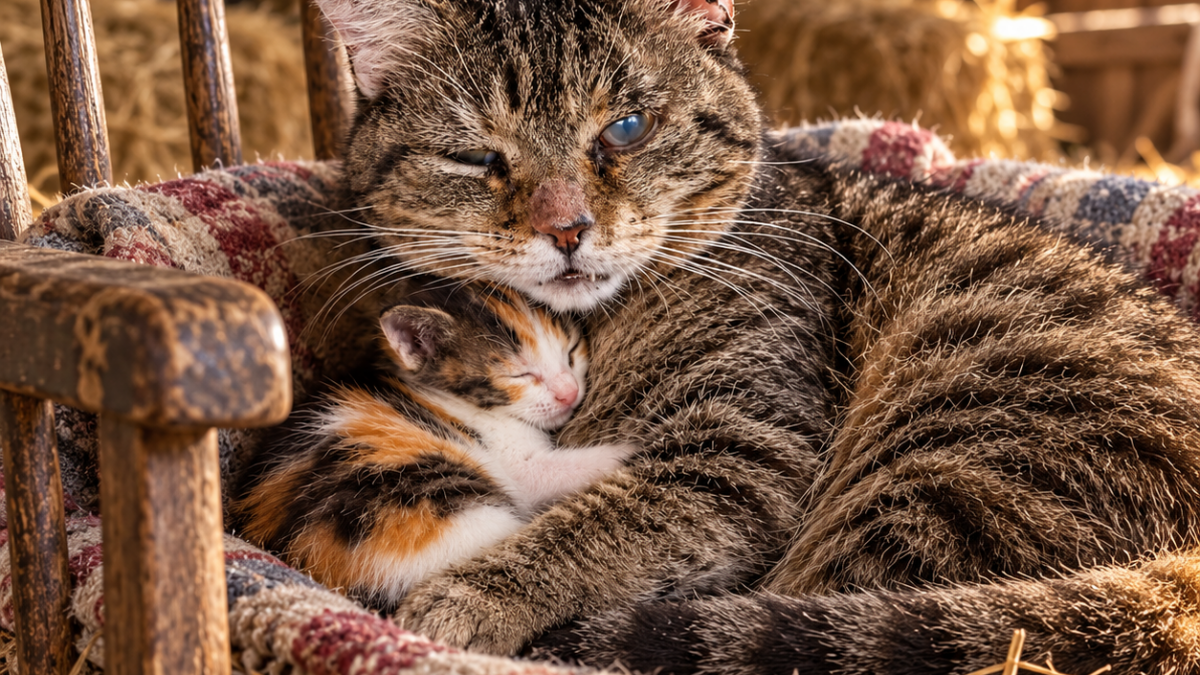
The old feral tom lay on his side.
His massive scarred head rested against the sacks.
His cloudy eye was open.
His exposed canine showed beneath the damaged lip.
And tucked underneath his jaw was something so small that at first all I could see was a patch of white and orange fur.
The missing kitten.
She was pressed against his chest.
Alive.
I think I stopped breathing.
The farmer whispered, “No way.”
The kitten moved.
One tiny paw stretched outward.
The tom lowered his head over her.
Protectively.
Not biting.
Not threatening.
Covering.
I stepped closer.
He looked at me.
Every memory of that cat hit me at once.
The bent trap.
The screaming.
My blood on the ground.
The stitches.
The doctor drawing a circle around the swelling.
My own voice saying:
Leave him alone.
But he didn’t hiss.
Didn’t flatten his ears.
Didn’t rise.
Didn’t attack.
He watched me.
Four feet.
Maybe less.
I had never been that close to him without wire between us.
The kitten made another sound.
The tom turned his face toward her.
Then began licking her head.
Slowly.
Carefully.
Her fur was clean.
Too clean for a newborn who had spent the night beside a dead mother.
I looked at the farmer.
“How long do you think he’s had her?”
“I don’t know.”
I crouched slightly.
The tom’s eye followed me.
I stopped.
“Easy, Old Man.”
His ears flicked.
The kitten crawled closer against his chest.
I could see her breathing.
She was warm.
That mattered immediately.
Newborn kittens can fade frighteningly fast when chilled.
But this little one was alive because something had been generating heat around her.
Something weighing seventeen pounds.
The other volunteer covered her mouth.
“Oh my God.”
I whispered, “He took her.”
The farmer shook his head in disbelief.
“From under the wagon?”
“Looks like it.”
“Why?”
I had no answer.
No one did.
Later, the veterinarian would tell us the kitten appeared to have been groomed repeatedly.
Her body temperature suggested she had not spent the night exposed.
Based on where she was found and the condition of the other kittens, the vet believed the tom had probably kept her warm for many hours.
Maybe twelve.
Possibly longer.
We never knew exactly when he carried her away.
Maybe the mother was already dying.
Maybe he approached after she died.
Maybe he heard the kitten crying.
Maybe he found the only one still moving.
We couldn’t know.
What mattered was what happened next.
The farmer lowered himself to one knee.
The tom watched him.
No growl.
No charge.
He simply tightened his body around the kitten.
“He doesn’t want us taking her,” the farmer whispered.
I looked at the cat who had once torn my arm open because I came too close.
“No.”
I knew that look.
“I don’t think he’s leaving without her.”
We called the shelter.
Then the veterinarian.
The kitten needed formula immediately.
Assessment.
Probably supplemental heat.
Maybe antibiotics depending on exposure.
The tom needed medical care too.
But how were we going to move them?
A volunteer on the phone said, “Can you grab the kitten?”
“Maybe.”
“And then trap him?”
I stared at the scarred animal.
Two years earlier, I’d have said absolutely not.
Now I wasn’t sure.
“If we take the kitten away,” I said, “he may panic.”
“Then take both.”
“How?”
A pause.
“Carrier?”
I almost laughed.
This cat had bent traps.
He had injured me through heavy gloves.
He had spent years refusing confinement.
But we didn’t have a better option.
I went back to the shelter and picked up the largest hard-sided carrier we owned.
On the drive back, my palms were sweating.
The scar on my forearm seemed to ache even though that made no medical sense.
Trauma does strange things to memory.
I kept replaying the third trapping attempt.
The scream.
The claws.
Blood.
Part of me was embarrassed by how afraid I felt.
I had handled frightened dogs.
Injured cats.
Animals struck by cars.
Animals that bit from pain.
But this cat had become something different in my mind.
He was the one I couldn’t help.
The failure.
The animal whose file had taught me that compassion sometimes meant backing away.
Now I was heading toward him with another box.
When I returned, he was still there.
Same position.
Same kitten.
I placed the carrier on the ground.
The tom’s eyes shifted toward it.
His body became tense.
There it was.
Recognition.
He knew cages.
Maybe not this exact carrier.
But he understood enclosure.
I sat several feet away.
“Listen.”
The farmer glanced at me as if I’d lost my mind.
I kept speaking to the cat.
“I know you remember me.”
His exposed tooth made him look threatening even when motionless.
“You probably don’t like me.”
Nothing.
“Fair enough.”
I opened the carrier.
“We need the baby.”
His tail moved once.
“If I take her, you’re going to be furious.”
His eye narrowed.
“So I’m going to make you a deal.”
The farmer whispered, “You’re negotiating with a feral cat.”
“Quiet.”
I looked at the tom.
“She goes in.”
I pointed toward the carrier.
“You can go too.”
The little kitten squeaked.
The tom licked her again.
I waited.
Finally, I took a towel.
Slowly.
Very slowly.
I reached toward the kitten.
The tom lifted his head.
Every muscle in my body tightened.
“Easy.”
My fingers touched the kitten.
The tom did not attack.
I slid my hand underneath her.
For half a second his front paw moved.
I froze.
He placed the paw across the kitten’s back.
Not clawing.
Holding.
My throat tightened.
“I’m not hurting her.”
I waited.
Eventually he lifted his paw.
I picked up the kitten.
She weighed almost nothing.
A little warm bundle with closed eyes and a belly barely larger than my thumb.
The tom stood immediately.
The farmer stepped backward.
So did the other volunteer.
I nearly did too.
Instead, I moved the kitten toward the carrier.
The tom followed.
One step.
Then another.
I placed her inside on a towel.
She cried.
The old tom reached the opening.
He looked inside.
Then looked at me.
I was prepared for him to run.
Prepared for violence.
Prepared to spend another six hours trying to trap him.
Instead, he lowered his huge head.
Stepped one paw into the carrier.
Then another.
Then all of him.
The farmer made a sound behind me.
Something between a laugh and a gasp.
The tom circled the kitten.
Lay down.
And wrapped himself around her.
I closed the carrier door.
He didn’t fight.
Not once.
For six years, that animal had rejected every attempt to contain him.
He had bent wire.
Escaped traps.
Injured people.
And now he willingly walked into a box.
Not because he trusted us.
Because she was inside.
I stared through the carrier door.
His cloudy eye met mine.
“All right,” I whispered.
“You win.”
I think that was the first moment I truly understood him.
He had never been fighting cages.
Not really.
He had been fighting the loss of control.
For six years, survival meant never allowing anyone else to decide where he went.
But now there was something more important to him than freedom.
A kitten.
We drove them to the clinic together.
I sat in the back with the carrier secured beside me.
The tom remained wrapped around her.
Every time the vehicle turned, he adjusted his body to keep her from rolling.
The kitten cried twice.
Each time, he lowered his face and groomed her.
At the clinic, a technician approached the carrier.
“That’s him?”
“Yes.”
“The cat who bit you?”
“Yes.”
She looked at the newborn.
“And that’s…?”
“Apparently his baby now.”
“Is he the father?”
“We have no idea.”
Nobody ever proved whether he was biologically related to her.
He could have been.
He might not have been.
It didn’t matter.
The veterinarian asked us to separate them briefly for the examination.
The moment I reached toward the kitten, the tom’s ears flattened.
“Don’t,” I said.
The vet stopped.
“He’s guarding her.”
“Can we sedate him?”
“Maybe, but let’s not unless necessary.”
We examined the kitten while she remained partly inside the carrier.
Female.
Calico.
Umbilical stump still present.
No obvious birth defects.
Slightly dehydrated.
But warm.
Alive.
Clean.
The vet looked at me.
“Somebody’s been grooming her.”
I glanced toward the giant tom.
“Yeah.”
“Was the mother alive when you found them?”
“No.”
“Then he’s probably been caring for her.”
“How long could she survive without milk?”
“Not long at this age. We need to get formula into her immediately.”
The technician prepared a bottle.
The kitten struggled at first.
Then latched.
The tom watched every movement.
His head remained inches from her.
We expected him to react when the bottle appeared.
Instead, he sniffed it.
Then sat back.
The kitten drank.
The old tom watched.
I noticed something strange.
His posture had changed.
Not relaxed exactly.
But focused.
All that legendary aggression had narrowed into a single purpose:
Is she safe?
When the feeding ended, the technician returned the kitten to the towel.
The tom immediately pulled her toward his chest.
The veterinarian exhaled.
“I’ve never seen anything quite like that.”
Neither had I.
We couldn’t return the kitten to the barn.
She needed feeding every few hours.
She needed temperature control.
Monitoring.
Weight checks.
The tom could theoretically be returned.
But the moment anyone suggested it, I knew the answer.
“No.”
The shelter manager looked at me.
“No what?”
“We’re not separating them.”
“He can’t live in a foster home.”
“He just walked into a carrier.”
“For the kitten.”
“Exactly.”
“He’s dangerous.”
I touched the old scar on my forearm.
“I know.”
“If he attacks a foster—”
“I’ll take them.”
The words left my mouth before I had fully thought them through.
The shelter manager stared at me.
“You?”
“Yes.”
“The last time you handled him, you needed stitches.”
“I remember.”
“Does your husband remember?”
“Unfortunately.”
“This is a terrible idea.”
“Probably.”
“Then why are you smiling?”
I hadn’t realized I was.
Because the situation was absurd.
Because two years earlier I had sworn never to trap that cat again.
Because now I was volunteering to put him in my spare bathroom.
Because apparently rescue work had finally destroyed whatever remained of my common sense.
But there was another reason.
I owed him something.
Not because I had wronged him.
I hadn’t.
We had been trying to help.
But I had reduced him to one thing.
Aggressive.
Dangerous.
Impossible.
Now he had shown me something else.
I wanted to see what happened next.
My husband met us at home.
He looked at the carrier.
Then at me.
Then at the scar on my arm.
“No.”
“Listen.”
“No.”
“Just listen.”
“No.”
“There’s a kitten.”
He looked through the carrier.
The tiny calico was sleeping beneath the tom’s chin.
My husband went silent.
I waited.
He sighed.
“How long?”
“Maybe eleven weeks.”
“Eleven?”
“Until she’s old enough for adoption.”
“And him?”
“We’ll figure it out.”
He stared at the tom.
The tom stared back.
“Does he still hate you?”
“Almost certainly.”
“Good.”
My husband opened the bathroom door.
“At least somebody in this house has sense.”
We set up the room carefully.
Large crate with the door left open.
Litter boxes.
Food.
Water.
Blankets.
A heating pad beneath part of the kitten’s nesting area.
The tom emerged from the carrier after about twenty minutes.
He inspected every corner.
Sniffed the door.
Checked the window.
Then returned to the kitten.
For the first three days, he barely slept deeply.
Whenever I entered, he positioned himself between me and her.
He didn’t charge.
Didn’t swat.
Didn’t hiss unless I moved too quickly.
But he watched.
At feeding time, I sat on the bathroom floor with the kitten in my lap.
The tom remained two feet away.
The first bottle feeding took twenty minutes.
My hands shook.
Not because of the kitten.
Because of him.
Every time she cried, his head lifted.
“She’s fine,” I told him.
He stared.
“I’m feeding her.”
He stared.
“You’re welcome.”
Nothing.
By the fifth feeding, I realized I had started explaining everything to him.
“Warm formula.”
“Clean towel.”
“Weighing her.”
“Medicine.”
“You’re not getting her until I burp her.”
My husband heard me through the door.
“Still negotiating?”
“He’s a difficult client.”
The tom never laughed.
But he stopped hissing.
The kitten gained weight.
Slowly at first.
Then steadily.
We called her Callie.
Not original.
Not clever.
But it suited her.
By the end of the first week, Callie knew the tom’s body better than she knew anything else.
After each feeding, she crawled toward him.
He groomed her face.
Her back.
Her belly.
He stimulated her to eliminate the same way a mother cat would.
That detail stunned the veterinarian.
Male cats don’t usually provide maternal care to newborn kittens at that level.
Some males tolerate kittens.
Some protect them.
Some even groom.
But this was different.
He was actively raising her.
At night, I checked the camera we installed in the bathroom.
Callie slept beneath his neck.
Sometimes almost completely hidden.
If she moved away from the warm nest, he nudged her back.
If she cried, he woke.
Every time.
One night at 2:30 a.m., I watched the monitor and started crying.
My husband woke beside me.
“What happened?”
“Nothing.”
“Then why are you crying?”
I turned the screen toward him.
The huge scarred tom was curled around Callie.
She was asleep against the same damaged lip that had once torn through my glove.
My husband watched for several seconds.
“That’s the cat?”
“That’s him.”
He was quiet.
Then he said, “Maybe he wasn’t angry.”
“What?”
“Maybe he was scared.”
I looked at the screen again.
I had heard that explanation hundreds of times in rescue.
Aggression is often fear.
Fear looks violent when escape is impossible.
I knew that academically.
But knowing something and understanding it are different.
For years, we had approached the tom with traps.
Equipment.
Gloves.
Containment.
We saw violence.
Maybe all he saw was capture.
No wonder we never met the part of him that could lie perfectly still for hours because a newborn kitten needed warmth.
During week two, Callie’s eyes opened.
The first thing she saw clearly may have been his scarred face.
I laughed when I thought about that.
Imagine entering the world and deciding a seventeen-pound battle-scarred feral tom was normal.
To Callie, he was.
She had no idea everyone else feared him.
She crawled across his paws.
Bit his whiskers.
Climbed his shoulder.
Once she got a claw stuck in the fur beneath his chin.
He sat perfectly still while I freed her.
“You’re enjoying this, aren’t you?” I asked.
His exposed tooth made him look offended.
By week three, Callie was mobile enough to become annoying.
That was when the real transformation began.
She chased his tail.
He moved it away.
She chased it again.
He moved it back.
She jumped onto his face.
He closed his eyes.
She chewed the remaining half of his right ear.
He tolerated it.
I watched this enormous animal, a cat who once attacked me for reaching toward him, allow a kitten barely larger than his head to use him as playground equipment.
One afternoon Callie pounced on his tail eleven times.
I counted.
On the twelfth, he gently pinned her with one paw.
She squeaked.
He released her immediately.
She attacked him again.
I laughed so hard I had to sit down.
“Now you know how the rest of us feel.”
He looked at me.
For once, I felt like we understood each other.
People from the shelter wanted updates.
I sent photos.
The reactions were always the same.
“That’s not him.”
“Yes, it is.”
“No way.”
“It’s him.”
“Did you drug him?”
“No.”
“Can you pet him?”
“No.”
“Can your husband?”
“No.”
“Can Callie?”
I would send a picture of her asleep on his face.
Apparently she could do anything.
By week four, we needed to give the tom a name for his medical records.
The farmer’s Old Man didn’t feel right.
Scarface felt cruel.
My husband suggested Tank.
I rejected it.
The shelter manager suggested Samson.
I stared at the tom.
“How about Brutus?”
My husband laughed.
“Subtle.”
But the name stayed.
Brutus.
It sounded like the cat everyone thought he was.
And somehow, because Callie could bite his nose while he patiently ignored her, it also became funny.
Brutus.
The monster.
Brutus.
The terror of the grain barn.
Brutus.
Full-time kitten mattress.
We managed his first thorough veterinary exam with mild sedation.
He was older than we’d initially thought.
The veterinarian estimated somewhere between eleven and thirteen.
His cloudy left eye was the result of an old injury.
Vision was limited but still present.
His missing ear had healed years earlier.
The scarred lip caused no major functional problem.
Several teeth were damaged.
His joints already showed early arthritis.
He also had scars hidden beneath his coat.
Old punctures.
Torn skin.
Evidence of countless fights.
The vet ran bloodwork.
FIV positive.
That wasn’t shocking for an older intact feral male with years of fighting history.
Otherwise, considering his life, he was remarkably stable.
“He is a survivor,” the vet said.
I looked through the glass at Callie waiting in her carrier.
“Yeah.”
Then I looked at Brutus.
“But apparently not only his own.”
We neutered him.
That decision terrified me because it meant separation during surgery.
Callie was old enough by then to remain with me for several hours.
Brutus, obviously, could not.
When he woke from anesthesia, the clinic kept him in a recovery kennel.
The moment he was alert enough to understand where he was, he began pacing.
Then growling.
Then throwing himself against the door.
A technician called me.
“He’s escalating.”
“I’m coming.”
I brought Callie.
The second she cried from inside her carrier, Brutus stopped.
Just stopped.
His head snapped toward the sound.
I placed her carrier near his kennel.
He pressed his face against the bars.
Callie reached one paw through.
He touched his nose to it.
His body lowered.
The growling ended.
The technician whispered, “You have got to be kidding me.”
I wasn’t surprised anymore.
“That’s his person.”
The technician looked at me.
“She’s a cat.”
“You know what I mean.”
Callie was home when Brutus returned later that day.
He walked unsteadily from the carrier.
She rushed toward him.
He tried to groom her, still half-dazed from medication.
Then he lay down.
Callie curled beneath his neck.
Within minutes, both were asleep.
That night I sat beside them for almost an hour.
I didn’t touch him.
I had stopped measuring progress by touch.
Humans are strangely obsessed with physical affection as proof of trust.
Can I pet him?
Can I hold him?
Will he sit on my lap?
But trust isn’t always permission to touch.
With Brutus, trust looked like this:
He slept while I was in the room.
He ate while I watched.
He allowed me to feed Callie.
He no longer placed himself between her and me every second.
Sometimes I could walk past him without his body stiffening.
That was enormous.
Week five brought the first real test.
Callie had developed a mild eye irritation.
The veterinarian wanted to examine her.
We had become too confident.
I thought I could move her into a carrier in the guest bathroom and take her alone.
Brutus was sleeping in the hall.
I picked Callie up.
Walked into the bathroom.
Closed the door.
Placed her in the carrier.
She started crying.
Immediately, Brutus appeared outside.
He scratched the door.
“She’s fine.”
Scratch.
“Brutus.”
The handle moved slightly.
I frowned.
The doorframe in our old house wasn’t perfect.
He pushed.
The latch held.
Then came a heavy impact.
“Seriously?”
Another hit.
Callie cried.
Brutus growled.
I opened the door two inches.
Wrong decision.
One massive paw shoved through.
The door flew open.
Brutus entered.
He ignored me completely.
Went straight to the carrier.
Sat beside Callie.
Then looked at me.
I looked at the damaged trim.
“You broke my door.”
He blinked.
I tried moving him.
Not touching.
Just body pressure.
He refused.
So I took both cats to the veterinarian.
The staff laughed when I explained.
“He escaped a closed bathroom?”
“Apparently doors are suggestions now.”
“Are you going to fix it?”
“No.”
“Why?”
“Because I’m never separating them again.”
I meant it.
From that day forward, every appointment involved both.
If Callie needed vaccines, Brutus came.
If Brutus needed bloodwork, Callie came.
The clinic eventually listed them as bonded.
I thought bonded was an understatement.
By week seven, Callie began eating solid food.
The first time I put down a bowl, she attacked it with the seriousness only a growing kitten can manage.
Brutus stood nearby.
I placed a second bowl beside him.
He sniffed it.
Then sat.
“Go ahead.”
Nothing.
Callie ate.
Brutus watched.
“There’s another bowl.”
He looked at me.
Callie continued eating.
Only when she stepped away did Brutus approach his own food.
At first I thought it was coincidence.
The next feeding, same thing.
Then the next.
He always waited.
She ate first.
He ate after.
That behavior became one of the details people loved most when we eventually told their story publicly.
But to me it was almost painful.
Because it reminded me what survival usually looks like.
Brutus had spent years competing for everything.
Food.
Space.
Shelter.
Safety.
Yet with Callie, he surrendered first access without hesitation.
It made no sense according to the simple version of him we had constructed.
Aggressive.
Dominant.
Feral.
Dangerous.
Except animals aren’t simple.
Neither are people.
Callie grew.
Her personality emerged.
She was fearless.
Of course she was.
She had grown up believing the most dangerous cat in three counties existed solely to protect her.
She charged vacuum cleaners.
Climbed curtains.
Investigated visitors.
Tried to steal food.
Attacked shoelaces.
Brutus followed her from room to room like a tired bodyguard.
When she climbed too high, he sat beneath her.
When she disappeared behind furniture, he waited near the opening.
When she wrestled him, he rolled onto his side and let her win.
Every time.
At first I assumed she was genuinely overpowering him because Brutus was becoming slower.
Then one afternoon I watched closely.
Callie launched herself at his shoulder.
Brutus pinned her instantly.
Effortlessly.
One paw.
She squealed in protest.
He released.
Callie jumped up.
Charged again.
This time Brutus fell dramatically onto his back.
Callie stood on his chest like a victorious lion.
I stared.
“You are letting her win.”
His cloudy eye looked toward me.
“You fraud.”
My husband walked past.
“Who are you talking to?”
“Brutus.”
“What did he do?”
“He’s throwing fights.”
My husband looked at Callie chewing Brutus’s ear.
“Maybe he’s married.”
I threw a towel at him.
By week nine, adoption discussions started.
That frightened me more than I expected.
The arrangement had always been temporary.
Callie would become adoptable around eleven or twelve weeks.
Brutus’s future was more complicated.
Could he live indoors permanently?
Yes.
We now knew that.
Was he social with humans?
Not really.
Could he be handled?
Only under controlled circumstances.
Would he ever become a conventional pet?
Probably not.
But he was calmer.
He used the litter box.
He respected the house.
He didn’t destroy furniture unless a kitten was locked behind a door.
He had stopped trying to escape.
Most importantly, Callie needed him.
The shelter manager called one afternoon.
“We’ve had three applications for the kitten.”
“No.”
Silence.
Then: “I didn’t even finish.”
“No.”
“We haven’t promised her.”
“Good.”
“One family looks excellent.”
“Are they adopting Brutus?”
Another pause.
“We need to discuss that.”
“No.”
“Listen—”
“They stay together.”
“Callie is young. She’ll adapt.”
“That’s not the point.”
“And Brutus might be easier to place separately as a barn cat.”
I stood in my kitchen watching him through the doorway.
Callie was asleep against his side.
“You want to send him back to a barn?”
“I’m saying we need to consider realistic options.”
“His realistic option is wherever she goes.”
“That’s going to reduce her adoption prospects.”
“Then reduce them.”
“We can’t hold every kitten because another animal is attached.”
“This isn’t every kitten.”
“I know.”
“No, you don’t.”
My voice rose.
“That cat survived six years without us. The first time he ever willingly surrendered his freedom was because we put her inside a carrier. He has spent every day since raising her. You aren’t splitting them because somebody wants a cute calico kitten without the seventeen-pound scarred cat attached.”
The manager was quiet.
I regretted my tone.
Not the message.
Finally she said, “What if nobody adopts both?”
I looked at Brutus.
“Then they stay here.”
My husband, standing beside the refrigerator, slowly turned toward me.
I ignored him.
The manager said, “Are you offering permanent foster?”
“I’m offering whatever keeps them together.”
After I hung up, my husband crossed his arms.
“So.”
“So what?”
“We’re keeping the demon cat?”
“I didn’t say that.”
“You told the shelter they could live here forever.”
“That’s different.”
“How?”
“It just is.”
He looked at Brutus.
Callie had climbed onto his head.
My husband sighed.
“Fine.”
“What?”
“I said fine.”
“You don’t have to—”
“That cat survived you, stitches, surgery, and kittenhood. He can survive me.”
I smiled.
Then came the application from the retired couple.
They lived thirty minutes away in the same county.
Quiet home.
No children.
No dogs.
One older cat had died the previous year.
Large house.
Enclosed sunroom.
Experience with shy cats.
They had read the shelter’s posting carefully.
The listing was unusual.
BONDED PAIR.
MUST BE ADOPTED TOGETHER.
NO EXCEPTIONS.
CALICO KITTEN + SENIOR FERAL-BACKGROUND MALE.
The shelter manager called me.
“Before you say no, meet them.”
“I didn’t say anything.”
“You inhaled.”
“I breathe.”
“Meet them.”
They visited on a Sunday.
The woman sat on my living-room floor.
Her husband stayed on the couch.
Neither approached Brutus.
That impressed me immediately.
Most visitors wanted to test him.
Would he let me pet him?
Could I get closer?
What happens if I offer food?
These two didn’t.
Callie ran straight to the woman and attacked her shoelace.
Brutus watched from beneath a chair.
The man smiled.
“That’s him?”
“That’s him.”
“He’s beautiful.”
I almost laughed.
Beautiful wasn’t the first adjective most people used.
The man noticed his exposed canine.
“Does that bother him?”
“No.”
“And the eye?”
“Limited vision.”
“Pain?”
“Not according to the vet.”
“Arthritis?”
“Early.”
He nodded.
“We can handle arthritis.”
The woman was playing with Callie using a wand toy.
Brutus emerged slowly.
He stayed six feet away.
Then four.
The woman did not turn toward him.
Smart.
Very smart.
After twenty minutes, Brutus sat beside the doorway.
The man looked at me.
“What happens if he never lets us touch him?”
I answered immediately.
“Then you don’t touch him.”
He nodded.
“Okay.”
That answer nearly sealed it.
But I needed to know one more thing.
“What if Callie becomes friendly and Brutus doesn’t?”
The woman looked at the cats.
“They still stay together.”
“What if she could be easier without him?”
“That isn’t our decision.”
I felt something tighten behind my eyes.
The woman continued.
“They’ve already decided they’re family.”
That was it.
I trusted them.
The adoption happened in December 2023.
Eleven weeks after Brutus carried a newborn kitten away from a dead litter and into the grain barn.
The morning they left my house, I cried.
Callie didn’t care.
She thought the carrier was an adventure.
Brutus knew better.
The moment he saw it, his body became tense.
I knelt nearby.
“Yeah.”
He watched me.
“You hate those.”
Callie entered first.
She had always been easy.
Brutus stood several feet away.
For one terrible moment, I thought we were back at the beginning.
The drop trap.
The panic.
The fight.
Then Callie meowed.
Brutus walked forward.
He sniffed the opening.
Stepped inside.
Turned around.
Lay beside her.
No fight.
I closed the door.
The retired woman wiped her eyes.
“He still follows her.”
“Always.”
“We’ll take care of them.”
I nodded.
“You’d better.”
Her husband smiled.
“That sounded threatening.”
“It was.”
The drive to their new home took thirty minutes.
I followed in my own car because I needed to see them settle in.
The couple had prepared a quiet room.
Beds.
Litter.
Food.
Hiding spaces.
A low heating pad.
Window perch.
Callie exited first.
Naturally.
Within five minutes she was investigating everything.
Brutus remained inside the carrier.
Ten minutes.
Twenty.
I sat on the floor.
No one rushed him.
Eventually Callie returned.
She crawled into the carrier.
Brutus groomed her.
Then she came back out.
He followed.
That was how he entered his new life.
Not because humans convinced him.
Because Callie went first.
The first week was difficult.
Brutus hid during the day.
He ate at night.
He growled when the husband accidentally entered too quickly.
Callie adjusted instantly.
Within forty-eight hours she owned the living room.
Within four days she discovered the stairs.
Within a week she was sleeping on the retired woman’s lap.
Brutus watched.
The couple never pushed him.
That mattered.
Three weeks after the adoption, I received a photograph.
Callie was stretched across a blanket on the couch.
Brutus was beside her.
Not touching the humans.
But not hiding.
The caption read:
HE CAME OUT BEFORE DARK TODAY.
A week later:
HE ATE WHILE WE WERE IN THE ROOM.
Then:
HE SLEPT IN FRONT OF US.
Then, one morning:
YOU ARE NOT GOING TO BELIEVE THIS.
Below the message was a photo.
The retired man was sitting in a chair reading.
Brutus lay three feet away on a rug.
The man’s hand was extended downward.
Brutus’s nose was touching one finger.
I cried.
It was ridiculous.
One finger.
No petting.
No cuddling.
No lap.
But I knew what it meant.
Six years.
Three traps.
Bent wire.
Blood.
Fear.
A life constructed around one rule:
Trust nobody.
Now one finger.
That was enough.
Months passed.
Callie grew into a sleek young cat.
Her calico markings became brighter.
Her legs became longer.
Her confidence remained completely unreasonable.
Brutus aged.
The vet settled on approximately thirteen years.
His joints stiffened.
Cold mornings bothered him.
He moved slower.
Jumping onto high furniture became harder.
The couple installed small pet steps near the couch and window.
Callie ignored the steps and launched herself wherever she pleased.
Brutus used them.
Except when she chased him.
Then apparently pride overcame arthritis.
I visited six months after the adoption.
I didn’t know how Brutus would react.
Would he remember me?
Would he hide?
Would he become defensive?
The retired woman opened the door.
Callie ran toward me.
Brutus remained in the hallway.
I stopped.
So did he.
His face looked almost exactly as it had in the barn.
Half ear.
Cloudy eye.
Exposed canine.
Scarred lip.
Older now.
Softer around the body.
But unmistakable.
“Hey, Brutus.”
His ear moved.
I sat on the floor.
He watched me.
Callie climbed into my lap.
“Still letting her run your life?”
Brutus approached.
Slowly.
Five feet.
Three.
Two.
Then he sniffed my knee.
I did not move.
He turned.
Walked away.
I laughed.
The retired man said, “Was that good?”
“That’s practically a marriage proposal.”
Callie attacked Brutus moments later.
She leaped onto his shoulder.
He rolled.
She pounced again.
He pinned her for half a second.
Released.
Then dramatically fell sideways.
Callie jumped onto his chest.
The retired woman smiled.
“He always lets her win.”
“I know.”
“Every time.”
I looked at the old cat.
Once, winning had probably meant survival.
Winning fights.
Winning territory.
Winning food.
Winning escape.
Now he could afford to lose.
That might have been the greatest evidence that his life had changed.
He was safe enough to let somebody else win.
People still asked me about the attack.
Especially new volunteers.
“Is that really the same cat that sent you for stitches?”
Yes.
“Was he just misunderstood?”
I never liked that question.
It was too easy.
No.
He wasn’t “just misunderstood.”
Brutus really was dangerous when cornered.
He really did attack.
He really could injure someone.
Pretending otherwise would cheapen everything.
Understanding an animal doesn’t require lying about what it can do.
Brutus was dangerous.
He was also protective.
He was fearful.
He was intelligent.
He was capable of attachment.
He was patient with a kitten.
He was violent when trapped.
Gentle when trusted by someone weaker than himself.
All of those things were true.
That’s what he taught me.
We are too eager to reduce animals to their worst moment.
Aggressive dog.
Mean cat.
Bad horse.
Problem animal.
Sometimes those labels are necessary for safety.
But they should describe behavior.
Not the entirety of a life.
I had reduced Brutus to the day he injured me.
He forced me to reconsider that judgment without ever apologizing for it.
That became his revenge.
Not claws.
Not blood.
Not another attack.
His revenge was making every one of us who had called him a monster watch him become the gentlest thing in another creature’s world.
The farmer who once warned us about him visited the retired couple too.
He stood in their living room watching Callie wrestle Brutus.
“That cannot be the same cat.”
“It is.”
“I watched him chase a raccoon off.”
The retired man laughed.
“She chases him off the couch.”
Callie bit Brutus’s remaining half-ear.
Brutus closed his eyes.
The farmer shook his head.
“I spent six years thinking he’d kill anything smaller than him.”
I understood.
We had all made assumptions.
That newborn kitten had destroyed every one of them.
We eventually pieced together what probably happened the night her mother died.
The calico likely delivered all five beneath the wagon.
Complications—possibly hemorrhage, retained kitten, eclampsia, or another birth-related emergency—killed her before morning.
Four kittens became cold and died beside her.
The fifth remained alive long enough to cry.
Brutus heard her.
That’s the part I picture.
The grain barn at night.
Wind moving outside.
The young mother motionless beneath the wagon.
A newborn calling into the darkness.
And somewhere nearby, the oldest, toughest, least trusting cat on the property listening.
What made him move?
We will never know.
Instinct?
Curiosity?
Recognition?
Was he the father?
Had he encountered kittens before?
Did the crying trigger some deeply buried behavior?
Scientists could offer possibilities.
Behaviorists could explain communal kitten care in cats.
Someone could probably build a perfectly reasonable theory.
But no theory changes the image.
Brutus crossing thirty feet of open ground.
Approaching that wagon.
Finding five kittens.
Four silent.
One alive.
Then doing something nobody expected from him.
He picked her up.
Carefully.
That point matters.
A cat capable of bending wire traps carried a newborn weighing only a few ounces without hurting her.
He brought her into the grain barn.
Placed her on feed sacks.
Cleaned her.
Curled around her.
Stayed.
All night, probably.
Maybe twelve hours.
Maybe longer.
The same cat who would not allow a human within several feet willingly gave a helpless newborn access to every vulnerable part of his body.
His throat.
Face.
Belly.
Food.
Sleep.
Why?
I wish I knew.
But maybe explaining everything makes it smaller.
Sometimes compassion appears where it makes logical sense.
A mother protects her offspring.
A bonded dog guards its owner.
A social animal helps its group.
And sometimes compassion appears in a scarred old feral tom who has spent six years surviving alone.
No one taught him.
No one rewarded him.
No one even witnessed the decision.
He did it in darkness when nobody was watching.
That is the detail I return to.
He had no audience.
Animals do not perform morality for applause.
There was no camera.
No shelter worker.
No adoption post.
No treats waiting.
No human saying, “Good boy.”
He simply heard something helpless.
And stayed.
Years later, I still have the scar on my forearm.
It has faded.
Three small marks near my wrist.
One longer line higher up.
Sometimes people notice.
“What happened?”
“A cat.”
They usually laugh.
“Must’ve been some cat.”
I always say the same thing.
“You have no idea.”
I don’t resent the scar anymore.
Actually, I’m glad it’s there.
It reminds me how completely wrong a first conclusion can be.
I thought the scar meant Brutus was incapable of trust.
Now I understand it meant he had trusted only himself for a very long time.
Those aren’t the same thing.
Callie changed that.
Not by forcing him.
Not by training him.
Not by taming him.
She simply needed him.
And for whatever reason, being needed reached a place in Brutus that fear had kept hidden.
The retired couple tells me his mornings are slower now.
Arthritis has progressed.
He receives medication.
He prefers warm blankets.
Callie, now no longer a tiny kitten, still behaves as though he is indestructible.
She ambushes him from behind furniture.
Drops toys beside him.
Attacks his tail.
Runs across him when he’s sleeping.
He tolerates almost all of it.
When he’s genuinely tired, he gives her one look.
Apparently she has finally learned what that means.
Mostly.
They sleep together every night.
Sometimes Callie is stretched over him.
Sometimes beneath his neck.
Exactly where she slept when her eyes were closed and her whole body could fit beneath his jaw.
The retired woman once sent me two photographs side by side.
The first was from the barn.
Newborn Callie tucked against Brutus’s chest.
The second was months later.
Callie nearly full-grown, curled in the same position.
Brutus older.
Grayer.
But still surrounding her.
I stared at those pictures for a long time.
Then I noticed something.
In the first picture, Brutus was awake.
Watching us.
Guarding.
In the second, his eyes were closed.
Sleeping deeply.
He didn’t need to watch anymore.
That, to me, is the real ending.
Not that Brutus became tame.
He didn’t, exactly.
Not that he forgot six years of survival.
He didn’t.
Not even that he was adopted.
The ending is that an animal who once believed sleep required vigilance eventually learned someone else could keep watch.
He had spent his life protecting himself.
Then he protected Callie.
And eventually, because of her, he allowed humans to protect him.
There was no dramatic punishment for the people who misunderstood him.
No villain was defeated.
No cruel person was exposed.
Life rarely gives us revenge that neatly.
But Brutus got something better.
Every label placed on him was forced to shrink.
Monster.
No.
Aggressive?
Sometimes.
Dangerous?
When terrified or trapped, absolutely.
Unlovable?
We had proof otherwise.
Incapable of attachment?
Look at Callie.
Beyond saving?
Look at the warm house.
Look at the pet steps beside the couch.
Look at the medication hidden in his food every morning.
Look at the retired man reading while Brutus sleeps nearby.
Look at the kitten who survived because he refused to leave her.
That was Brutus’s revenge.
He made us eat every careless word.
Not through violence.
Through tenderness.
And if you had known him only on the day he attacked me, you would never have believed it.
I barely believe it, and I was there.
Sometimes I think about those four kittens beneath the wagon.
I wish they had survived too.
Rescue stories often become polished after enough time passes.
People remember the miracle and forget what it cost.
But this story began with death.
A young mother who never got the chance to raise her litter.
Four newborn kittens whose lives lasted less than a day.
There is nothing beautiful about that.
Brutus did not erase it.
Callie surviving did not make those deaths necessary.
We don’t need tragedy to justify hope.
But within something terrible, one life remained.
And another life chose to protect it.
That is enough.
The farmer eventually cleaned out the old grain barn.
The feed sacks were thrown away.
The hay wagon was dismantled.
For a while he considered keeping the section of sacks where Brutus had been found.
Then he laughed at himself.
“They’re feed bags.”
I understood.
Meaning lives in memory more often than objects.
Still, before he threw them away, he took one photograph.
Empty barn.
Dusty light.
Stack of sacks.
Nothing dramatic.
He sent it to me.
I saved it.
Because that’s where the story changed.
Before that spot, Brutus was the cat I feared.
After that spot, he was something I couldn’t define so easily.
The retired couple eventually framed the first photograph of Brutus and Callie.
It’s in their hallway.
Visitors ask about it.
They tell the story.
Most don’t believe the first part.
“That cat?”
Yes.
“Seventeen pounds?”
At the time.
“He attacked people?”
Yes.
“He bent traps?”
Twice.
“And then he saved her?”
That is what happened.
The wording varies.
Saved.
Protected.
Raised.
Adopted.
Whatever word people choose, the result is the same.
Without Brutus, Callie almost certainly would have died that night.
She was too young.
Too cold.
Too far from a living mother.
He supplied what she couldn’t create for herself.
Warmth.
Grooming.
Protection.
Time.
Sometimes survival is only that.
Someone gives you enough time for help to arrive.
Callie grew because Brutus gave her those hours.
Brutus changed because Callie gave him something too.
Purpose, perhaps.
Or connection.
Or an excuse to risk trusting the world.
I once asked the veterinarian:
“Do you think he knew she would die?”
The vet considered it.
“We can’t know what he understood.”
“But he knew she needed warmth.”
“Almost certainly.”
“How?”
“Instinct. Her cries. Her temperature. Smell.”
I nodded.
Then asked, “Why would an adult male care?”
The veterinarian smiled slightly.
“That’s the harder question.”
Exactly.
That’s always the harder question.
Why care?
Why protect something that offers you nothing?
Why share food after years of scarcity?
Why surrender freedom because a helpless creature is inside the cage?
Why tolerate pain, inconvenience, noise, claws, teeth, and endless kitten attacks?
We can explain mechanisms.
Hormones.
Social behaviors.
Environmental triggers.
But at some point explanation meets mystery.
Not supernatural mystery.
Just the ordinary mystery of another living mind.
We never get complete access.
We observe behavior.
We infer.
We make stories.
Sometimes we’re right.
Sometimes very wrong.
I was wrong about Brutus.
That is the part I can say with certainty.
And I’m grateful he proved it.
One winter morning, about a year after the rescue, the retired woman called me.
Her voice sounded strange.
My stomach dropped.
“Is Brutus okay?”
“Oh, yes. He’s fine.”
“Callie?”
“Fine.”
“Then what happened?”
She laughed.
“He got on the bed.”
I paused.
“What?”
“He got on our bed last night.”
Brutus had never slept with humans.
He used beds when nobody was around.
Couches.
Blankets.
Window seats.
But not beside people.
“He jumped up?”
“Used the steps.”
“Of course.”
“He stood at the foot for almost five minutes.”
“And?”
“Then he lay down.”
“Near you?”
“My husband’s feet.”
I smiled.
“Did you touch him?”
“Absolutely not.”
“Good.”
“We barely breathed.”
I laughed.
“How long?”
“Forty minutes.”
Forty minutes.
For most cats, meaningless.
For Brutus, monumental.
The woman became quiet.
“Callie was between us.”
Of course she was.
Always first.
Always the bridge.
Brutus had followed her into a carrier.
Into a foster home.
Into an adoption.
Into trust.
Now onto a bed.
The retired woman said, “I don’t think he would have done any of this without her.”
“No.”
“Do you think she knows?”
I looked at the old scars on my arm.
“No.”
Then I smiled.
“But I think he does.”
Brutus grew more affectionate in his own strange way.
He never became a lap cat.
Never enjoyed being picked up.
He tolerated brief touches from his adopters on good days.
Mostly his trust remained spatial.
He chose to be near them.
For him, proximity was affection.
He sat in the same room.
Slept with his back turned.
Ate while they walked nearby.
Allowed doors to close without panic.
Those things may sound small.
They aren’t.
Trust is relative to what fear came before it.
One afternoon the retired man fell asleep in his recliner.
When he woke, Brutus was beneath the chair.
Callie was on his lap.
The old tom had positioned himself below both of them.
The man sent me a picture.
Caption:
GUESS I’M PART OF THE HERD NOW.
Cats don’t form herds.
I didn’t correct him.
He had earned the metaphor.
The most emotional visit came almost two years after my injury.
I returned to the property where Brutus had lived.
The farmer wanted help with another colony.
Three new cats had appeared near the equipment shed.
Nothing unusual.
We set humane traps.
I stood beside the grain barn.
The farmer joined me.
“You ever think he’ll come back?”
“Brutus?”
“Yeah.”
“No.”
“Good.”
He smiled.
“I kind of miss seeing him.”
“You miss the cat you told me was a monster?”
“I didn’t say I wanted him inside my house.”
Fair.
We both laughed.
Then he looked toward the old hay wagon location.
“Funny thing.”
“What?”
“I used to hate him.”
I looked at him.
“He killed chickens once.”
“I didn’t know that.”
“Young ones. Years ago.”
“That probably didn’t help his reputation.”
“Nope.”
The farmer kicked dirt with his boot.
“After what he did for that kitten, I started thinking about him different.”
“Most of us did.”
“He wasn’t mean.”
I raised an eyebrow.
“He was a little mean.”
The farmer laughed.
“Okay. He was mean.”
Then his expression changed.
“But maybe he had reasons.”
I looked through the barn doors.
“Maybe.”
We didn’t rewrite Brutus into a saint.
That’s important.
He was still a predator.
Still territorial.
Still capable of violence.
Love didn’t erase nature.
Compassion didn’t make him harmless.
One remarkable act doesn’t cancel every difficult behavior.
But difficult behavior doesn’t cancel compassion either.
Two truths can exist together.
That’s what humans struggle with.
We like heroes clean.
Villains obvious.
Animals innocent or dangerous.
People good or bad.
Reality refuses.
Brutus was both the cat who bit me and the cat who saved Callie.
Neither story is complete without the other.
If I told only the attack, you’d fear him.
If I told only the kitten, you might imagine a gentle orange grandfather cat wandering through a barn.
He wasn’t.
He was Brutus.
Scarred.
Half blind.
Half-eared.
One canine exposed.
Seventeen pounds of hard-earned survival.
And somehow, that made the tenderness more powerful.
He wasn’t gentle because life had been gentle with him.
He chose gentleness in one situation despite everything that had taught him otherwise.
That’s why I still tell his story.
As Brutus got older, Callie began changing too.
She became less relentlessly annoying.
Not completely.
But enough.
On cold mornings, she started grooming his face.
The reversal caught my attention immediately.
He had cleaned her when she was helpless.
Now she cleaned around his cloudy eye.
He had kept her warm.
Now she slept pressed against his arthritic back.
He had waited while she ate first.
The retired couple told me that sometimes Callie now stopped and looked toward him before eating.
If he didn’t approach, she’d walk over and chirp.
Maybe coincidence.
Maybe habit.
Maybe she was calling him.
Again, we can only witness.
One evening the couple sent me a short video.
Brutus stood at the bottom of the stairs.
Callie was halfway up.
He looked tired.
She came back down.
Sat beside him.
Then the two walked toward the living room instead.
I watched the clip six times.
Did she understand his joints hurt?
Did she change plans because he wouldn’t follow?
I don’t know.
But the possibility made me smile.
He had once carried her because she couldn’t follow him.
Maybe now she had learned to slow down because he couldn’t follow her.
That’s family, in whatever form.
The last time I saw Brutus, he was lying in a square of afternoon sunlight.
Callie slept against his stomach.
His fur had thinned slightly around his shoulders.
The exposed canine looked more pronounced as his face aged.
I sat about four feet away.
Closer than our first encounter.
Safer than our second.
Infinitely calmer than our third.
“Remember me?” I asked.
He opened his good eye.
I held my hand low.
Not reaching.
Just offering.
Brutus stared.
Then, slowly, he stood.
My heartbeat changed.
Even after all those years, part of my nervous system remembered.
He crossed the floor.
Sniffed my fingers.
Then rubbed the scarred side of his face once against my knuckles.
Once.
That was all.
He walked away.
I couldn’t speak.
The retired woman saw my expression.
“Has he never done that?”
I shook my head.
“No.”
She smiled.
I looked at the old cat settling beside Callie again.
Two years earlier, I had held my bleeding arm and told everyone:
Leave him alone.
He doesn’t want us.
Now I understood.
Maybe he hadn’t wanted us then.
Trust given before someone is ready isn’t trust.
It’s pressure.
We kept demanding the relationship on our timetable.
Callie didn’t.
She came into his life needing nothing except warmth.
She didn’t care about his scars.
Didn’t know his reputation.
Didn’t know everyone called him aggressive.
She didn’t approach him expecting a transformation.
She simply existed beside him.
And he chose the rest.
That may be why she succeeded where we failed.
She never asked him to become anything.
She only gave him someone to protect.
People often want stories like this to end with complete transformation.
The feral cat becomes cuddly.
The aggressive dog becomes gentle.
The frightened horse trusts everyone.
That’s not Brutus’s story.
He never became a different cat.
He became a fuller version of the cat he had always been.
The tenderness had been there somewhere.
We simply had no reason to see it.
Maybe he had cared for animals before.
Maybe not.
Maybe this was the first time.
Maybe Callie triggered something unique.
Whatever happened, it was enough.
Enough to turn the animal nobody could contain into the animal who willingly entered a carrier.
Enough to turn an eleven-week foster placement into a permanent bond.
Enough to change the opinion of everyone who knew him.
Including mine.
Especially mine.
Today, when new volunteers ask me about difficult feral cats, I tell them about Brutus.
But not as proof that every feral cat secretly wants a home.
That would be irresponsible.
Many don’t.
Not every animal can or should be forced into human companionship.
I tell the story for another reason.
“Behavior is information,” I say.
“Not identity.”
They usually look confused.
So I show them my scar.
“This was information.”
Then I show them the photograph of Brutus curled around Callie.
“This was information too.”
Both mattered.
Safety matters.
Patience matters.
Context matters.
And sometimes the animal you think you’ve completely understood will show you a side of itself that rearranges everything.
Brutus did that to an entire community.
The people who once traded stories about his attacks now shared pictures of him sleeping beside Callie.
The farmer who warned visitors to keep their distance asked for updates.
The shelter volunteer who had once suggested he might never be safely handled helped write his bonded adoption profile.
The veterinarian who expected sedation every visit learned to put Callie’s carrier beside him first.
And me?
The woman he injured?
I became one of the loudest voices insisting they never be separated.
That’s the closest thing Brutus ever got to revenge.
He didn’t need to attack us again.
He defeated every judgment we had made about him.
One by one.
The cat who couldn’t bond became inseparable from a kitten.
The cat who couldn’t tolerate confinement walked willingly into a carrier.
The cat who only cared about survival waited to eat until she had finished.
The cat who trusted nobody eventually slept inside a human home.
The cat everyone feared became the safest place in the world for a newborn.
You couldn’t invent better revenge against a bad reputation.
And Brutus did it without understanding reputation at all.
He just cared for Callie.
That was enough.
If there is one image I will carry for the rest of my life, it isn’t the attack.
Not the blood.
Not the bent wire.
Not even the carrier.
It’s the moment I first saw him in the grain barn.
Dust hanging in the sunlight.
Empty feed sacks beneath him.
That giant scarred body stretched on its side.
And a newborn calico almost completely hidden beneath his jaw.
For years, that jaw was the thing I feared.
The exposed canine.
The damaged lip.
The warning.
That morning it became shelter.
Same mouth.
Same scars.
Same animal.
Different context.
Maybe that’s the whole lesson.
We see teeth and assume threat.
Sometimes teeth belong to the creature standing between something helpless and the cold.
We see scars and assume violence.
Sometimes scars are simply evidence that someone survived long enough to become important to somebody else.
We see aggression and assume absence of love.
Sometimes love has simply never had a safe place to appear.
Brutus found his.
It weighed only a few ounces.
Its eyes were closed.
Its mother was dead.
Its four siblings were gone.
It couldn’t feed itself.
Couldn’t stay warm.
Couldn’t see the enormous cat holding it.
Callie had no idea she was supposed to fear him.
Maybe that saved them both.
She trusted him because she had no reason not to.
And he protected her because, for reasons no human will ever fully understand, something in her mattered more to him than his own freedom.
When I think about that night, I sometimes picture Brutus hearing the kitten cry beneath the wagon.
He could have ignored it.
For six years, ignoring everyone else had probably helped keep him alive.
He could have walked away.
He didn’t.
He crossed the barnyard.
Found her.
Picked her up with the same mouth that had fought countless battles.
Carried her through the darkness.
Placed her somewhere dry.
Cleaned her.
Curled around her.
Stayed.
That final word matters most.
Stayed.
Until morning.
Until humans arrived.
Until we brought a carrier.
Until Callie was safe.
Then he followed.
He had spent six years refusing to follow anyone.
But he followed her.
And maybe that is the reason his story still reaches people.
Because beneath all the drama—traps, scars, blood, fear, survival—the ending is astonishingly simple.
The toughest creature on that property heard something helpless.
And instead of walking away, he stayed.
No one trained him.
No one commanded him.
No one rewarded him.
There was no audience.
No photograph yet.
No shelter post.
No adoption family waiting.
Just an old feral tom and one tiny life left alive in the dark.
Brutus chose her.
Years later, Callie still chooses him.
She still curls beside him.
Still wrestles him.
Still sometimes chews the ragged edge of the ear everybody else was afraid to approach.
He still lets her win.
Every single time.
And whenever I see them together, I think about the first thing I said after he attacked me:
Leave him alone.
He doesn’t need us.
Maybe I was partly right.
Brutus didn’t need us to teach him how to love.
He already knew.
We were the ones who needed him to teach us how badly we had underestimated him.
And that old scar on my arm?
I don’t hide it.
I don’t regret it.
Because whenever somebody points to it and asks what kind of animal could have done that, I get to tell them about the most aggressive feral cat our county had ever known.
The cat who bent two traps.
The cat who sent me for stitches.
The cat nobody could touch.
The cat everyone eventually stopped trying to save.
Then I tell them what we found one September morning.
Not a monster.
Not a fighter.
Not even a feral cat.
Just Brutus.
Curled around a newborn kitten.
Keeping her warm.
Waiting for help.
And refusing to leave her behind.
Some things can be explained by biology.
Some by instinct.
Some by survival.
And some things are better left exactly as we witnessed them.
A scarred old cat.
A tiny surviving kitten.
One warm body wrapped around another.
No promise of reward.
No reason anyone could prove.
Just the quiet decision to protect a life smaller than his own.
Callie survived.
Brutus found a home.
They stayed together.
And the animal everyone once believed was incapable of trust spent the rest of his life proving that trust had never been missing.
It had simply been waiting for someone worth risking it for.

