PART 2: Everyone Called Her a Monster for Three Years—Then I Crawled Under the Ruins and Found What She Was Protecting
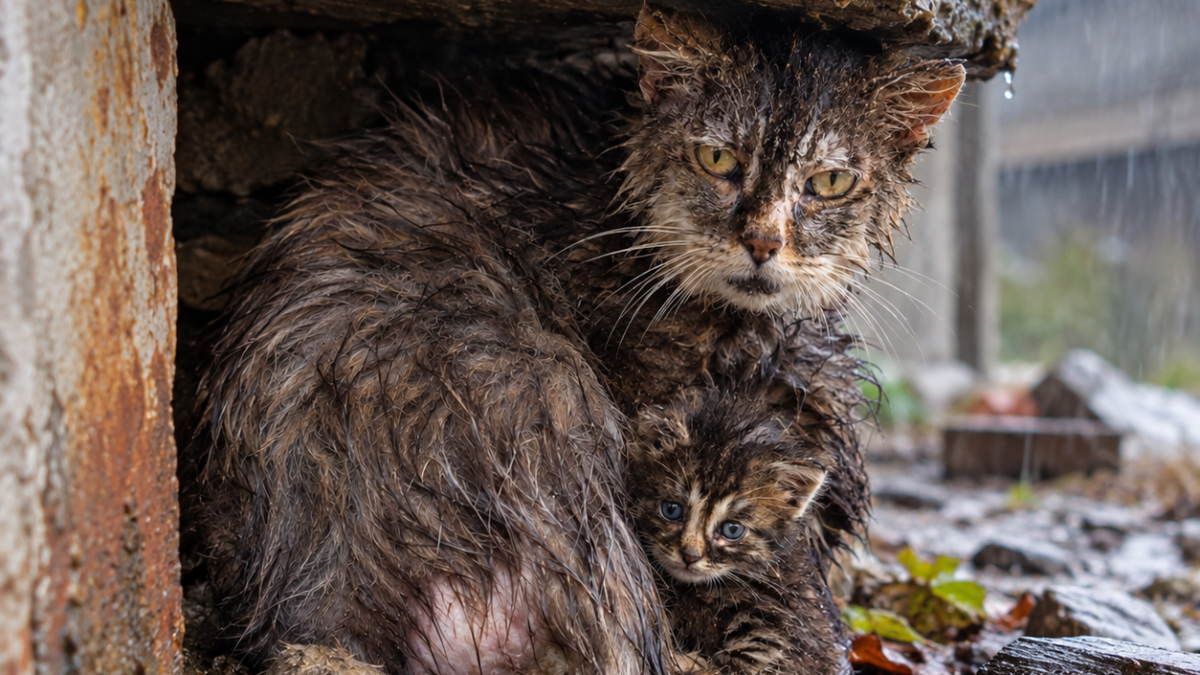
For three years, everyone in that neighborhood called the gray cat vicious, but the night I finally crawled beneath the broken concrete to reach her, I realized they had been afraid of the wrong thing.
She returned to the same shattered window every evening, even in freezing rain, even when people threw garbage at the house and chased her away, and nobody could explain why.
Then I saw one tiny movement in the darkness behind her, and suddenly everything people thought they knew about that abandoned house began to fall apart.
My name is Michael Grant, and at the time I was volunteering with a small animal rescue group outside Harrisburg, Pennsylvania. Most of our calls were ordinary by rescue standards: injured strays, abandoned litters, frightened dogs tied behind empty properties, cats trapped inside garages after families moved away. I had learned not to trust first impressions, because animals rarely behaved without a reason, but even I wasn’t prepared for what I would find at the old Harrington house on Willow Creek Road.
The call came from a woman named Rachel Myers on a Wednesday afternoon in January.
“There’s a cat living in an abandoned house behind our street,” she told me.
“How long?”
“At least three years.”
I paused.
“Three years?”
“She won’t let anyone near her. People say she attacks.”
“Has she attacked anyone?”
Rachel hesitated.
“She scratches if people corner her.”
“That’s not the same thing.”
“I know.”
Her voice softened.
“That’s why I called.”
The house had been abandoned after its elderly owner died. Over time, the windows broke, weeds swallowed the yard, and the back porch began collapsing into itself. People started treating the property like a dumping ground. Old mattresses appeared beside the garage. Bags of household trash were tossed through broken windows. Someone abandoned a refrigerator near the side fence. Teenagers occasionally went inside at night.
And through all of it, the gray cat stayed.
Rachel said neighbors had tried to catch her during the first year.
They failed.
“She hisses.”
“She’s scared.”
“They call her Ghost.”
I looked outside the rescue office window. Freezing rain was beginning to strike the glass.
“Where is she now?”
“That’s why I’m calling today. I saw her twenty minutes ago. She’s under part of the collapsed porch.”
I grabbed my coat.
By the time I reached Willow Creek Road, sleet covered the pavement.
Rachel was waiting at the curb.
She pointed toward a two-story house set back from the street.
Even from fifty yards away, it looked dead.
The roof sagged near the chimney. One upstairs window was covered with plywood. The front door hung slightly crooked. Trash had accumulated behind the house.
We walked around the side.
“There,” Rachel whispered.
At first I saw nothing.
Then two pale green eyes appeared beneath a broken concrete slab near the foundation.
The cat was pressed flat against the frozen dirt.
She was small.
Much smaller than I expected.
Her gray fur was soaked dark by the rain. One ear was torn near the tip. Her right rear leg rested at an unnatural angle, and when she tried to shift deeper into the gap, she barely used it.
I crouched several feet away.
“Hey, girl.”
She hissed immediately.
Not aggressively.
Desperately.
Her body flattened.
“Okay. I’m not coming closer.”
Rachel stood behind me.
“That’s what everyone means when they say she’s vicious.”
“She’s terrified.”
I stayed where I was.
Freezing water ran down the back of my neck.
The cat stared at me.
I placed a small dish of wet food on the ground, then moved backward.
She didn’t touch it.
Five minutes passed.
Then ten.
I talked quietly.
Nothing important.
Just enough to let her hear my voice.
“You’re cold, aren’t you?”
Her eyes never left me.
“You don’t know me. That’s fair.”
She hissed again when I shifted my weight.
“I’m staying right here.”
Then I noticed something.
The cat wasn’t simply hiding from me.
She kept turning her head.
Looking behind herself.
Every few seconds.
Always toward the darkness beneath the slab.
I thought she might have an escape route.
Then something tiny moved.
I leaned slightly sideways.
The gray cat immediately growled.
That was the first time she made a sound that genuinely sounded threatening.
I froze.
“All right.”
Another movement.
Small.
Pale.
Then a tiny paw emerged from behind her.
Rachel inhaled sharply.
A kitten crawled into view.
It couldn’t have been more than six weeks old.
Its fur was dirty white with gray patches. One eye was partly closed with infection.
The little animal pressed against the mother’s side.
The gray cat immediately curled herself around it.
That was when everything made sense.
She wasn’t defending the ruins.
She wasn’t defending garbage.
She wasn’t attacking people because she had become wild.
She was protecting the only thing she had left.
I looked at Rachel.
“She has a baby.”
Rachel’s eyes filled.
“Oh my God.”
The cat stared at us from beneath the slab, her body trembling from cold and exhaustion, one injured leg almost useless.
Yet she placed herself between us and the kitten.
Even then.
Even half-frozen.
Even starving.
She was still willing to fight.
I slowly stood.
“We’re not grabbing her.”
“What do we do?”
I looked toward the road where my rescue van waited.
“We earn her trust.”
And as I turned to get the equipment, I had no idea that rescuing that little family would uncover a three-year-old secret, put one of my volunteers in the hospital, bring the police back to that abandoned house, and force the man responsible for all of it to finally face the thing he believed he had buried forever.
PART 2
I went back to the van and returned carrying an insulated carrier, two thick blankets, food, a portable heating pad, gloves, and a humane trap.
Rachel looked at the trap.
“You said we weren’t grabbing her.”
“We aren’t.”
I placed the trap twenty feet from the porch.
“I want her to make the decision.”
The problem was the weather.
The temperature had already dropped below freezing, and the sleet was becoming heavier. The kitten was tiny, wet, and visibly sick. The mother’s rear leg worried me even more. If she had a fracture, every hour mattered.
But forcing her out could make things worse.
A terrified mother can abandon a hiding place if she believes predators have discovered it.
Human beings forget that animals do not automatically understand rescue.
We see a blanket.
They see hands.
We see a carrier.
They see a trap.
We see help.
They remember whatever happened the last time they trusted someone.
So we waited.
I opened a can of sardines and placed small pieces near the entrance beneath the slab.
The mother smelled them.
She didn’t move.
The kitten tried.
Immediately, she pushed it back with her nose.
Rachel whispered, “She won’t even let the baby eat.”
“She’s keeping it behind her.”
For thirty minutes, nothing changed.
Then the mother crawled forward six inches.
Her rear leg dragged.
My stomach tightened.
The injury looked old enough that she had learned to compensate for it, but fresh swelling surrounded the joint.
She reached the food.
Ate quickly.
Then retreated.
I moved the next portion slightly farther out.
We repeated the process.
An hour passed.
My gloves were soaked.
Rachel’s husband brought us coffee.
Another neighbor appeared.
Then another.
Soon five people stood quietly at the edge of the yard.
One man shook his head.
“That cat’ll tear you up.”
I looked at him.
“She’s protecting a kitten.”
He stared toward the porch.
“A kitten?”
Rachel said, “Yes.”
The man’s expression changed.
Not dramatically.
But enough.
People are strange that way.
Sometimes the difference between “dangerous animal” and “devoted mother” is one piece of information.
At 6:40 p.m., the mother entered the humane trap.
Not completely.
Her front half went inside.
She ate.
Then backed out.
I reset the food farther toward the rear.
Thirty minutes later, she tried again.
This time her entire body crossed the trigger plate.
The door dropped.
She exploded.
The trap shook violently.
Rachel gasped.
I ran forward but stopped several feet away.
The cat screamed.
Not a normal meow.
A raw, terrified cry.
She threw herself against the bars.
“Cover it,” I said.
I placed a blanket over the trap.
Darkness helps calm frightened cats.
Within seconds, the movement slowed.
But the kitten remained beneath the slab.
The mother could hear it crying.
Her panic returned.
I understood immediately.
“We need that baby.”
I lay flat on the frozen ground.
The gap beneath the concrete was barely eighteen inches high.
Rachel held a flashlight.
The kitten had moved deeper.
I reached slowly.
The mother screamed from the trap.
“I know,” I whispered. “I know.”
My fingertips brushed fur.
The kitten hissed.
Tiny sound.
Tiny teeth.
It tried to bite me.
I almost laughed.
“Definitely your mother’s kid.”
I wrapped my hand gently around its body.
It weighed almost nothing.
When I pulled it out, Rachel started crying.
The kitten’s infected eye was worse than I had thought.
Its ribs were visible.
But it was alive.
I placed it inside a smaller carrier directly beside its mother.
The screaming stopped.
The mother pressed herself against the side nearest her baby.
The kitten did the same.
Through two sets of bars, their noses touched.
That was the first moment I felt sure we had a chance.
## **1. The Cat Everyone Feared**
At the emergency clinic, the mother refused to leave the trap.
Dr. Elaine Foster had worked with frightened feral cats for twenty years.
She took one look at her and said, “That cat is not feral.”
I looked at her.
“You can tell already?”
“She knows exactly what humans are.”
“That doesn’t mean she was socialized.”
Elaine pointed.
The cat was staring directly at us.
“She’s not avoiding eye contact. She’s tracking hands.”
“So?”
“So she learned hands matter.”
Elaine opened the trap door into a larger examination enclosure.
The cat didn’t move.
Elaine sat down.
No gloves.
No towel.
No catch pole.
Nothing.
“Hi.”
The cat hissed.
Elaine waited.
Then she slowly placed her hand on the floor outside the enclosure.
Not toward the cat.
Just there.
The cat stared.
Twenty seconds.
Thirty.
Then her nose moved.
“She used to belong to someone,” Elaine said.
“How can you know?”
“I don’t.”
She looked at me.
“But I’d bet lunch.”
The examination confirmed what we suspected.
The mother was badly underweight.
Dehydrated.
Infested with fleas.
Her right rear leg had suffered a fracture.
Not recent.
Probably months old.
It had healed incorrectly.
Her torn ear had an active infection.
She had several scars around her ribs.
And beneath the fur near her shoulder, Elaine found something else.
A small patch where the hair had never grown properly.
A thin straight scar.
Elaine touched it gently.
The cat spun and snapped.
Elaine withdrew immediately.
“That hurts.”
“What caused it?”
“Could be anything.”
She examined the shape.
“Could be a cut.”
“From glass?”
“Possibly.”
Then Elaine looked closer.
“Or wire.”
The kitten was male.
Six or seven weeks old.
Respiratory infection.
Eye infection.
Underweight.
But otherwise stronger than expected.
Rachel had called the mother Ghost.
I hated the name.
Ghost sounded like something already gone.
Elaine agreed.
“She needs a name that belongs to a living animal.”
Rachel had followed us to the clinic.
“What about Willow?”
“Because of the road?”
She nodded.
I looked toward the enclosure.
“Willow.”
The cat’s ear moved.
That was enough.
The kitten became Finn.
Willow and Finn.
For the first time in years, they belonged to something other than an abandoned house.
## **2. Why Did She Keep Going Back?**
Willow spent her first two days at the clinic hiding behind a litter box.
She ate only when nobody watched.
Finn improved quickly.
Within twenty-four hours, he was trying to climb everything.
Willow remained tense.
But something bothered me.
Why had she stayed at that house for three years?
Food explained survival.
Shelter explained part of it.
But Rachel had told me something specific.
Willow returned to the same window every evening.
Every evening.
Not just when she needed shelter.
Not just in bad weather.
She returned.
I went back to Willow Creek Road.
The weather had cleared.
The house looked even worse in daylight.
Rachel met me.
“You’re going inside?”
“I want to see that window.”
She hesitated.
“People go in there sometimes.”
“I know.”
“Be careful.”
The back door had been forced open long ago.
I wore a respirator and carried a flashlight.
Inside, the smell of damp wood, mold, and garbage was overwhelming.
The kitchen was destroyed.
Cabinet doors hung open.
Trash covered the floor.
Someone had spray-painted the refrigerator.
The living room ceiling had partially collapsed.
I followed the hallway.
The broken window Rachel mentioned was in a small downstairs bedroom.
The glass had shattered inward years ago.
Below the sill, scratches marked the wood.
Cat scratches.
Dozens.
Maybe hundreds.
Willow had climbed through there repeatedly.
Inside the room stood almost nothing.
An overturned dresser.
A broken lamp.
A chair.
And a mattress.
I moved farther in.
Something on the floor caught my attention.
A faded strip of blue fabric.
I picked it up.
It was part of a blanket.
Covered in gray fur.
Not recent.
The room had once been used by someone.
I opened the dresser.
Empty.
Except for the bottom drawer.
Inside was an old photograph.
An elderly woman sitting on a porch.
A gray kitten in her lap.
I stared.
The cat in the photograph had two white hairs on the center of her chest.
Willow had the same marking.
I turned the picture over.
Handwritten in blue ink:
**Martha and Lila — Spring 2019**
Lila.
Willow had a name.
And she hadn’t chosen the abandoned house.
It had been her home.
## **3. Martha Harrington**
Rachel knew the elderly woman.
“Martha Harrington.”
She sat at her kitchen table with the photograph between us.
“She lived there alone.”
“What happened to her?”
“She died.”
“When?”
“Three years ago.”
The timeline fit exactly.
“Did she have family?”
Rachel frowned.
“A nephew, I think.”
“What happened to the cat?”
“I thought someone took her.”
Nobody had.
Rachel told me Martha had been widowed for years.
No children.
She loved animals.
Fed birds.
Had two indoor cats at one point, though Rachel remembered only seeing the gray one during Martha’s final months.
“Was Martha sick?”
“Cancer.”
“Did she die at home?”
“No. Hospital.”
Something tightened in my chest.
Martha left for the hospital.
Lila waited.
And perhaps nobody ever came back for her.
That explained the window.
The bedroom.
The blanket.
Willow—Lila—wasn’t returning to garbage.
She was returning to the last place she remembered being loved.
I took the photograph to the clinic.
Elaine looked at it.
“Well.”
“She had a name.”
Willow watched us from the enclosure.
I crouched.
“Lila?”
Her head lifted.
I tried again.
“Lila.”
She stood.
Slowly.
Then walked two steps toward me.
Elaine and I looked at each other.
I felt something crawl up my spine.
“Lila.”
The cat meowed.
Just once.
It was the first normal vocalization I had heard from her.
Not a hiss.
Not a growl.
Not a scream.
A meow.
Elaine whispered, “There’s your answer.”
## **4. The Nephew**
Martha’s obituary gave us the nephew’s name.
Derek Hall.
Forty-three.
Local contractor.
I found an old public notice connecting him to the property after Martha’s death.
He was the executor of her estate.
That meant one thing.
Derek had been responsible for the house.
And perhaps for Lila.
I called him.
“Mr. Hall?”
“Who’s asking?”
“My name is Michael Grant. I volunteer with Keystone Animal Rescue.”
Silence.
“We recently removed a gray cat from your aunt’s former property.”
Another silence.
Then:
“That thing’s still alive?”
Every muscle in my shoulders tightened.
“You knew about her?”
“Everybody knew about her.”
“She belonged to Martha.”
“Yeah.”
“Her name was Lila.”
“Whatever.”
“Did you make arrangements for her after your aunt died?”
Derek laughed.
Not loudly.
A short, dismissive sound.
“The cat ran off.”
“She lived inside the house.”
“She ran off.”
“She has been living on the property for three years.”
“That’s not my problem.”
“You were executor.”
“For the estate. Not a damn cat.”
I gripped my phone harder.
“Did you ever try to surrender her?”
“No.”
“Rehome her?”
“No.”
“Feed her?”
“Look, man, I don’t know what you want from me.”
“I want to know why an injured cat spent three years waiting in your aunt’s bedroom.”
He stopped laughing.
Then his voice changed.
“You went inside?”
“Yes.”
“You had no right.”
“The rear door was unsecured.”
“That property is private.”
“Then maybe stop letting people dump garbage there.”
Pause.
“Stay off my property.”
He hung up.
I stood staring at the phone.
Elaine, who had heard my side, said, “That went well.”
“He knew.”
“Of course he knew.”
“He said, ‘That thing’s still alive?’”
Elaine’s face hardened.
“That sounds like more than knowing.”
## **5. Lila Begins to Remember**
We kept calling her Willow at first.
Then Lila.
She responded more strongly to Lila.
So Lila it became.
Finn stayed Finn.
The first breakthrough came on day six.
I was sitting beside Lila’s enclosure reading intake notes.
She had stopped hissing every time I moved.
That was progress.
I placed my hand on the floor.
She watched.
Then stepped forward.
One paw.
Another.
Her nose touched my knuckle.
I didn’t move.
She smelled me.
Then rubbed her cheek against my finger.
Once.
Quickly.
As though embarrassed.
My throat tightened.
“Hi, Lila.”
She backed away.
Then returned.
Another cheek rub.
Elaine walked past and froze.
“Don’t ruin it,” I whispered.
“I’m not breathing.”
Lila rubbed my hand again.
A cat who had been called aggressive for three years was asking to be touched.
Very carefully, I moved one finger along her cheek.
She closed her eyes.
That nearly destroyed me.
Because it meant she remembered.
She remembered what affection felt like.
It had not disappeared.
It had simply been buried beneath three years of survival.
## **6. Finn**
Finn recovered faster.
Kittens are astonishing that way.
Within two weeks, he transformed from a sick, shivering animal into a small criminal.
He climbed curtains.
Stole pens.
Attacked shoelaces.
Knocked a box of syringes onto the floor.
Elaine called him “a menace.”
Finn adored Lila.
If he wandered too far, she called him back.
If a stranger entered the room, she placed herself between them.
At night, they slept pressed together.
One afternoon, I watched Finn attack Lila’s tail.
She tolerated him for almost a minute.
Then placed one paw on his head and held him against the floor.
Finn kicked.
Lila stared at him.
I laughed.
“Parenting.”
Elaine smiled.
“That’s the first time I’ve seen her behave like she expects a future.”
That sentence stayed with me.
Animals living purely in survival mode do not invest much in tomorrow.
Lila was beginning to.
## **7. The House Wasn’t Empty**
A week later, Rachel called.
“You need to come here.”
“What happened?”
“Someone is cleaning out the house.”
“Derek?”
“I don’t know.”
I drove over.
A white pickup sat in the driveway.
Two men were carrying trash bags outside.
Derek stood near the porch.
When he saw me, his face changed.
“I told you to stay away.”
“I’m on the public sidewalk.”
“Then stay there.”
“What are you removing?”
“My property.”
Rachel stood across the street watching.
One of the workers carried a small wooden box from the house.
Derek immediately intercepted him.
“Put that in my truck.”
Something about his reaction caught my attention.
“What’s in the box?”
Derek turned.
“None of your business.”
I held up Martha’s photograph.
“I found this inside.”
His eyes narrowed.
“You took that?”
“It was lying in a drawer.”
“You stole from the property.”
“It belongs with Lila.”
He stared.
“Who?”
“The cat.”
For the first time, genuine recognition crossed his face.
Then anger.
“Her name was never Lila.”
I froze.
“How would you know?”
He realized the mistake.
Too late.
I walked one step closer.
“You just told me you barely knew the cat.”
“I knew my aunt had cats.”
“You knew her name.”
He pointed toward the road.
“Get out.”
I didn’t argue.
But as I left, I saw one worker carry another item from Martha’s bedroom.
A small pet carrier.
Old.
Dusty.
Blue.
Derek snatched that one too.
## **8. The Will**
Rachel remembered Martha’s attorney.
Small town.
People remember things.
His name was Thomas Bell.
I called him, but attorney-client confidentiality meant he couldn’t tell me much.
Then I asked a different question.
“Was there any provision in Martha Harrington’s estate regarding pets?”
Long pause.
“I can’t discuss estate details with you.”
“Fair.”
Another pause.
“However, probate filings are public.”
That was all he said.
It was enough.
I searched county probate records.
Martha’s will had been filed.
Most assets went to Derek.
But one paragraph caught my eye.
Martha had set aside **$18,000 for the lifetime care of her cat, Lila**, directing Derek, as executor, to either keep her or place her in a safe home and use the funds exclusively for veterinary care, food, and maintenance.
I read the paragraph three times.
Eighteen thousand dollars.
Lila had not been forgotten.
Martha had planned for her.
And Derek had inherited responsibility.
So where had the money gone?
## **9. The First Real Evidence**
I called Frank Delaney, a humane officer I knew from previous cases.
He read the probate filing.
“This changes things.”
“He took the money?”
“Maybe.”
“He abandoned the cat.”
“Maybe.”
“Frank.”
“I’m not saying you’re wrong. I’m saying we prove things before we accuse.”
He asked for Lila’s veterinary assessment.
Photos of her condition.
The old photograph.
Witness statements.
Rachel gave one.
So did two other neighbors.
One remembered seeing Derek at the property shortly after Martha died.
Another remembered hearing a cat crying inside the house.
That mattered.
Then one neighbor, Mr. Alvarez, remembered something else.
“I saw him throw the cat outside.”
I stared at him.
“When?”
“After the funeral. Couple weeks, maybe.”
“Are you sure?”
“Gray cat.”
“What happened?”
“He opened the back door, tossed a carrier onto the porch, opened it, and the cat came out.”
“Did he leave food?”
“No.”
“Water?”
“No.”
“Did the cat try to go back inside?”
Mr. Alvarez nodded.
“Kept scratching the door.”
That night, I sat in my car outside the rescue for a long time.
Lila had not escaped.
She had been put outside.
She had tried to get back in.
And when the house eventually became open through broken windows, she returned to Martha’s bedroom.
Again.
And again.
And again.
For three years.
## **10. Derek Comes to the Clinic**
The next morning, Derek walked into the veterinary clinic.
I was there.
So was Elaine.
He approached the front desk.
“I want my cat.”
Elaine looked up.
“Excuse me?”
“The gray one from Willow Creek.”
I stepped into the hallway.
“Lila?”
Derek smiled.
“So now you know her name.”
“Why are you here?”
“She belongs to the estate.”
I laughed once.
Couldn’t help it.
Derek’s face hardened.
“What’s funny?”
“You abandoned her for three years.”
“Prove it.”
“We’re working on that.”
“I’m taking her.”
“No.”
“You have no legal right to keep my property.”
Elaine stood.
“She is currently under veterinary care as an animal cruelty investigation develops.”
Derek looked at her.
“Cruelty?”
“Yes.”
“She lived outside.”
“With an untreated fracture.”
“Cats get hurt.”
“Severe malnutrition.”
“Strays get thin.”
“Infection.”
“Not my problem.”
He realized what he had said.
Again.
Not my problem.
I watched Elaine’s face.
Cold.
Professional.
Dangerous.
“You should leave,” she said.
Derek leaned toward me.
“You think you’re some hero?”
“No.”
“You stole a cat.”
“I rescued one.”
“She’s worth money.”
The room went completely still.
I stared at him.
“What?”
His jaw tightened.
He had said too much.
Again.
“What do you mean she’s worth money?”
“Nothing.”
“The trust money?”
His face changed.
Just slightly.
There.
I had him.
“You know about the eighteen thousand.”
He stepped backward.
“I’m done talking.”
He left.
Elaine waited until the door closed.
Then she said, “Please tell me somebody recorded that.”
The clinic security system had audio.
## **11. Lila’s Surgery**
While the investigation grew, Lila needed surgery.
Her leg could not be restored completely.
The fracture had healed too badly.
But Elaine believed surgery could reduce pain and improve stability.
The morning of the procedure, Lila knew something was wrong.
Animals always know.
She refused breakfast because of anesthesia.
She paced.
Finn cried from the adjacent enclosure.
I sat beside her.
“You’re coming back.”
She stared.
“You have a baby to annoy you.”
Finn immediately knocked over his water dish.
“See?”
Lila rubbed against the bars.
I pushed one finger through.
She pressed her forehead against it.
The surgery lasted three hours.
When Elaine finally emerged, she looked exhausted.
“She’s okay.”
Those two words loosened something inside my chest.
We visited Lila in recovery.
She was groggy.
Bandaged.
Annoyed.
Alive.
When Finn was allowed near her later, he tried to climb directly onto the bandage.
Lila slapped him.
Weakly.
Elaine laughed.
“Excellent neurological function.”
## **12. The Money Trail**
Frank worked with county investigators.
Derek had filed estate accounting documents claiming the $18,000 pet-care fund had been spent.
On what?
Veterinary expenses.
Food.
Boarding.
Care.
There was one problem.
No veterinarian in the county had treated Lila after Martha’s death.
No boarding facility had records.
No rescue had received funds.
The receipts Derek submitted were from a company called Hall Property Services.
His own business.
“Pet care and property supervision.”
Thousands of dollars.
Frank showed me copies.
“He paid himself.”
“For abandoning her?”
“That’s what it looks like.”
Then investigators found something worse.
Some receipts were dated on days Hall Property Services didn’t exist yet.
Forgery.
Possible fraud.
Estate theft.
Suddenly the case was no longer just animal neglect.
Derek had apparently taken money Martha specifically left for Lila’s care, documented fake expenses, and left the cat outside.
He had been paid to protect her.
Instead, she survived by eating whatever she could catch in an abandoned house.
## **13. The Threat**
Three nights after investigators interviewed Derek, somebody threw a brick through the front window of our rescue office.
Wrapped around it with duct tape was a note.
**DROP IT.**
Nobody was inside.
Thank God.
The police came.
They photographed everything.
The brick.
The note.
The broken window.
No fingerprints.
No camera angle captured the person clearly.
But one camera across the street recorded a dark pickup driving past minutes before the impact.
Derek owned a dark pickup.
That proved nothing.
Not yet.
Frank told me to be careful.
Elaine told me to stop going places alone.
I agreed.
Then ignored my own promise two days later.
That was my mistake.
## **14. The Basement**
Rachel called about a noise inside the Harrington house.
A cat.
She thought.
Another one.
I drove there after work.
Alone.
The house was darker than usual because Derek’s cleanup crew had boarded several windows.
I entered through the rear door.
“Hello?”
Nothing.
Then I heard it.
Scratching.
Below me.
Basement.
I found the stairs.
Halfway down, the smell hit me.
Animal waste.
I turned on my flashlight.
At the bottom were three rusted wire cages.
Empty.
A fourth contained a cat.
Black.
Thin.
Terrified.
“What the hell?”
Then a light appeared behind me.
I turned.
Derek stood at the top of the stairs.
“You really don’t listen.”
My stomach dropped.
“What is this?”
“My aunt fed strays.”
“That cat is locked up.”
“It got in.”
“So you put it in a cage?”
“I was going to take care of it.”
I looked at the other cages.
“How many?”
Derek’s expression changed.
“Get out.”
“What happened to Lila’s other kittens?”
He froze.
I hadn’t known she had others.
I was guessing.
His face answered.
“Oh my God.”
“You don’t know what you’re talking about.”
“She had kittens before Finn.”
“Shut up.”
“What happened to them?”
Derek came down one step.
“Get out of my house.”
I pulled out my phone.
He lunged.
The phone flew from my hand.
I stumbled backward.
My shoulder hit the wall.
The black cat screamed.
Derek reached for the phone.
I grabbed it first.
Then something crashed upstairs.
A voice shouted.
“Michael!”
Rachel.
She had seen Derek’s truck arrive and called police before entering the porch.
Derek stopped.
Sirens sounded outside.
For the first time, he looked afraid.
Not angry.
Afraid.
That was the beginning of the end.
## **15. The Other Cats**
Police removed the black cat.
Then, with a warrant based on what they had seen and what I reported, authorities searched the property.
They found evidence that several cats had been confined in the basement over time.
Food bowls.
Old cages.
Veterinary sedatives not prescribed to Derek.
Photographs.
The photographs mattered most.
Derek had taken pictures of cats.
Dozens.
Some alive.
Some in carriers.
Some being transported.
Investigators eventually discovered that he had been trapping cats around the abandoned property and selling friendly ones online as “rescued pets.”
Others he relocated miles away.
Lila had escaped his attempts repeatedly.
That was why neighbors believed she was aggressive.
She had learned what happened when Derek caught cats.
She fought.
She ran.
She returned.
One image showed Lila inside a carrier approximately two years earlier.
Another showed her bloody ear.
That injury had not come from glass.
She had damaged it escaping the trap.
Frank stared at the photograph.
“She wasn’t afraid of people.”
“She was afraid of him.”
Exactly.
## **16. What Happened to Her First Litter**
A woman named Susan Keller contacted the rescue after local media reported the investigation.
She had bought a kitten from Derek two years earlier.
Gray-and-white female.
Found “abandoned,” he told her.
The kitten had come from the Willow Creek property.
Susan had one old photo from the advertisement.
In the background, barely visible, was Lila.
The kitten looked like Finn.
We compared dates.
Lila had likely given birth before.
Derek had taken at least some of her kittens.
Sold them.
Left Lila behind.
That explained even more.
She wasn’t only returning to Martha.
She had repeatedly raised kittens in the ruins.
And people had taken them.
No wonder she defended Finn like her life depended on it.
As far as she knew, it did.
## **17. Finn Finds a Home**
Finn grew healthy.
Too healthy, according to Elaine.
“He weighs enough to commit crimes now.”
He had become fearless.
Everyone loved him.
But separating him from Lila worried us.
Then an unexpected thing happened.
A couple named James and Natalie Harper applied to adopt both.
“Both?”
Natalie nodded.
“We saw the article.”
“This cat is still very cautious.”
“That’s fine.”
“She may hide for weeks.”
“That’s fine.”
“She may never become a lap cat.”
“That’s fine.”
I looked at James.
He smiled.
“We don’t need her to perform gratitude.”
That sentence got me.
They had a quiet house.
No children.
No other animals.
A screened sunroom.
They agreed to slow introductions.
We scheduled the adoption only after Lila’s legal custody was resolved.
For the first time, her future existed on paper.
## **18. Derek’s Last Attempt**
Before trial, Derek made one final move.
He claimed Lila had always been his cat after Martha died.
He demanded her return.
Not because he loved her.
Because if he regained possession, his attorney could argue that the rescue had interfered with estate property and damaged his rights.
The custody hearing lasted less than an hour.
The judge reviewed Martha’s will.
Veterinary evidence.
Witness statements.
Derek’s estate accounting.
Photographs from the basement.
Then she asked him one question.
“When was the last time you personally purchased food for Lila?”
Derek hesitated.
“I don’t remember.”
“Within the last year?”
Silence.
“Two years?”
Nothing.
“Three?”
His attorney whispered something.
Derek answered, “I had people handle it.”
“Who?”
Another silence.
The judge looked down at the file.
“Custody remains with the rescue pending final disposition.”
Outside court, Derek stared at me.
“You think you won.”
I said nothing.
“This isn’t over.”
I kept walking.
Behind me, he shouted:
“She’ll never be normal!”
I stopped.
Turned.
For the first time, I answered him.
“She already is.”
## **19. Home**
Lila and Finn went home with James and Natalie.
The first day, Lila hid behind a chair.
The second, beneath a table.
The third, she entered the sunroom.
Sunlight touched her fur.
Natalie sent me a photograph.
Lila sitting beside the window.
Finn sprawled upside down beside her.
No broken glass.
No freezing rain.
No garbage.
Just sunlight.
On day six, Lila climbed onto the couch.
Day twelve, she slept beside Natalie.
Week three, she allowed James to scratch beneath her chin.
Month two, she discovered the heated blanket.
After that, Natalie said, “We lost the blanket permanently.”
Lila had spent three years returning to one room because it was the last place she remembered feeling safe.
Now she had an entire house.
## **20. Trial**
Derek’s trial involved several charges and proceedings: animal cruelty, fraud connected with estate funds, falsified documentation, unlawful confinement, and other related offenses.
I testified.
Rachel testified.
Mr. Alvarez testified.
Elaine testified.
Susan testified about purchasing the kitten.
Investigators explained the money trail.
Then the prosecution displayed Martha’s will.
The courtroom became silent as the paragraph about Lila appeared.
Martha had written that her cat had been “my companion through illness and loneliness” and deserved “a safe and loving home for the remainder of her life.”
Derek stared at the table.
The prosecutor asked:
“You were responsible for carrying out that instruction?”
“Yes.”
“You received control over the eighteen-thousand-dollar fund?”
“Yes.”
“You reported it spent on Lila?”
“Yes.”
“Did you pay Hall Property Services?”
“Yes.”
“You owned Hall Property Services?”
“Yes.”
“It did not exist on the date of several submitted invoices, correct?”
Derek looked at his attorney.
“Correct?”
“Yes.”
“Did Lila receive veterinary care?”
“I don’t know.”
“You were responsible for her care.”
“I delegated.”
“To whom?”
Silence.
The prosecutor displayed the photograph of Lila in the abandoned bedroom.
Then the veterinary images.
Then the basement cages.
Then the image of Lila trapped two years earlier.
Finally, she played the security recording from the clinic.
Derek’s voice filled the courtroom.
**She’s worth money.**
The prosecutor paused the recording.
“What did you mean?”
Derek shifted.
“I was angry.”
“What money?”
“No specific money.”
“The eighteen thousand?”
“I don’t remember.”
“You remembered enough to invoice your own company.”
His attorney objected.
Sustained.
But the damage was done.
## **21. Rachel’s Testimony**
Rachel’s testimony affected me more than I expected.
She admitted the neighborhood had failed Lila.
“We were scared of her.”
“Why?”
“Because she hissed.”
“Did she ever chase you?”
“No.”
“Attack you without being cornered?”
“No.”
“Then why call her aggressive?”
Rachel looked toward the jury.
“Because it was easier.”
The prosecutor waited.
“Easier than what?”
“Than asking why she was afraid.”
That sentence changed the room.
Rachel continued.
“We created a story about her. That she was wild. That she chose the house. That she didn’t want help.”
Her eyes filled.
“Then Michael found the kitten.”
She wiped her face.
“And suddenly everything we called aggression looked like fear.”
## **22. Elaine**
Elaine brought medical records.
She explained Lila’s fracture.
Malnutrition.
Ear injury.
Chronic stress.
Then the prosecutor asked:
“Was Lila feral?”
“No.”
“Aggressive?”
Elaine considered her wording.
“She defended herself.”
“Is that aggression?”
“Sometimes. But context matters.”
“Explain.”
Elaine looked toward the jury.
“If you lock me in a basement and I hit the person coming toward me, you can describe the motion as aggressive. That description tells you nothing about why I did it.”
No one moved.
Elaine continued.
“Lila had learned that capture predicted loss.”
“Loss of what?”
“Freedom. Kittens. Safety.”
The prosecutor nodded.
“No further questions.”
## **23. The Verdict**
The jury deliberated for less than five hours on the main criminal counts.
Derek was convicted on multiple charges.
Additional financial findings followed through separate proceedings.
When the first guilty verdict was read, I expected satisfaction.
Instead, I thought of Lila beneath the concrete slab.
Wet.
Cold.
Curled around Finn.
The verdict could not give her those three years back.
It could not restore Martha.
It could not erase the nights Lila waited at the broken window.
But it did something important.
It made the truth official.
She had not chosen that life.
Someone had chosen it for her.
## **24. The Sentence**
At sentencing, the judge spoke directly to Derek.
“You were entrusted with both money and responsibility.”
Derek stared ahead.
“You used one and abandoned the other.”
The judge cited the falsified accounting, the condition of the animals, the cages, the intimidation surrounding the case, and Derek’s repeated attempts to minimize what had happened.
He received a custodial sentence on the criminal counts, financial restitution, probationary conditions, and a prohibition against owning or possessing animals for a significant period.
Assets were pursued to recover estate funds.
Hall Property Services lost several contracts after the convictions became public.
The condemned Harrington property was eventually transferred through estate and civil proceedings rather than remaining under Derek’s control.
The money recovered did not go to him.
A court-supervised portion covered legitimate expenses and restitution.
Another portion, consistent with the estate proceedings, ultimately benefited animal care.
Derek had taken money meant to save one cat.
In the end, that money helped save many.
That was the only revenge I cared about.
## **25. The House**
The Harrington house could not be saved.
Structural engineers condemned it.
The roof was too damaged.
Foundation compromised.
Mold everywhere.
The city ordered demolition.
Before it came down, James and Natalie asked if we could retrieve something.
The blue blanket from Martha’s bedroom was gone.
But the dresser remained.
Inside the bottom drawer, beneath debris, we found another photograph.
Martha sitting in bed.
Lila curled beside her.
On the back:
**My little shadow.**
I gave it to Natalie.
She framed it.
It hangs in their living room now.
## **26. One Last Visit**
We did not bring Lila inside the house.
I didn’t want her there.
But before demolition, James brought her in a carrier to the edge of the property.
We opened the carrier in the car.
She looked toward the house.
For almost a minute, she stared.
Then she turned away.
Climbed onto Natalie’s lap.
And sat down.
Maybe that meant nothing.
Maybe it meant everything.
I choose not to decide for her.
Animals deserve better than having every movement turned into human symbolism.
But I know what happened next.
Natalie opened the car door.
Lila remained on her lap.
She did not try to return to the broken window.
Not once.
## **27. Finn Grows Up**
Finn became enormous.
Nobody expected that.
The sick little kitten beneath the concrete slab grew into a fourteen-pound cat who believed every countertop belonged to him.
He developed a habit of stealing dish towels.
He slept on James’s chest.
He attacked cardboard boxes.
He adored Lila.
Even as an adult, he followed her from room to room.
When Lila slept, he slept nearby.
When strangers visited, Finn greeted them first.
Lila watched.
Then decided.
Sometimes she joined.
Sometimes she didn’t.
Choice.
That became the defining feature of her life.
No one forced her.
No one cornered her.
No one decided what she “should” be.
## **28. The First Time She Purred**
Six months after adoption, Natalie called me.
“You need to hear this.”
She held the phone near Lila.
At first I heard nothing.
Then a low vibrating sound.
A purr.
“She’s never done that before?”
“Not like this.”
Lila was lying beneath a blanket beside Natalie.
Finn was asleep near her feet.
I listened.
For thirty seconds.
Maybe forty.
It sounds ridiculous to say a cat purring made a grown man cry.
But it did.
Because the first sound I had ever heard from Lila was a hiss.
Then a scream.
Then, eventually, a meow.
Now this.
A purr.
Not because she had forgotten.
Not because trauma magically disappeared.
Because, in that moment, she felt safe enough to lower every defense.
## **29. Martha’s Letter**
Almost a year after the rescue, Thomas Bell, Martha’s former attorney, contacted Natalie.
The estate proceedings had concluded enough that a personal letter could finally be released.
Martha had written it shortly before entering the hospital.
It was addressed to Derek.
Most of it concerned ordinary matters.
Bills.
The house.
Family belongings.
Near the bottom, she wrote about Lila.
Thomas allowed Natalie to read the letter but asked us not to reproduce it publicly in full.
The meaning was clear.
Martha knew she might not return home.
She specifically asked Derek not to abandon Lila.
She explained that Lila had slept beside her during chemotherapy.
That the cat waited outside the bathroom when she was sick.
That when Martha woke at night frightened, Lila climbed onto the bed.
Martha’s final request was simple.
Make sure she is loved.
Derek had done the opposite.
Natalie cried while reading.
James cried.
I did too.
Then Lila jumped onto the table and sat directly on the document.
Natalie laughed through tears.
“Apparently she wants final editorial approval.”
That was Lila.
She had no idea humans were turning her life into evidence, tragedy, justice, or memory.
She wanted the warmest surface.
Maybe there was wisdom in that.
## **30. What Revenge Really Looked Like**
People who read about Derek’s conviction sometimes wrote to us saying they hoped he suffered.
I understood the anger.
But I stopped thinking about revenge the way they did.
I didn’t want Derek hurt.
I wanted him powerless to do it again.
That happened.
He lost access to animals.
He lost the money he had taken.
His business suffered because people knew what he had done.
His version of events collapsed under evidence.
Most importantly, Lila no longer belonged to him.
That was enough.
Because the best ending to cruelty is not another act of cruelty.
It is consequence.
It is prevention.
It is the victim becoming unreachable.
## **31. The Empty Lot**
After demolition, the Harrington property sat empty for months.
Then the township negotiated its purchase.
A neighborhood group proposed a small community garden.
Rachel called me.
“You should come see.”
Where the house had stood, raised garden beds now lined the ground.
Flowers grew near the former bedroom.
A small weatherproof cat shelter sat near the back fence for community cats.
Volunteers maintained feeding stations.
The place people had once used to dump garbage had become somewhere they gathered.
Rachel had organized most of it.
She never stopped feeling guilty about waiting so long to call.
So she turned guilt into work.
That is one of the few useful things guilt can become.
## **32. The Window**
They preserved one piece of the old house.
The wooden frame from Martha’s bedroom window.
Rachel asked Natalie if she wanted it.
Natalie said yes.
James repaired it.
Sanded away splinters.
Kept several claw marks visible.
Then he mounted it around a photograph of Lila and Finn sitting together in the sunroom.
That frame hangs beside Martha’s photograph.
The broken window had once been Lila’s entrance into a dead house.
Now it surrounded a picture of her life after survival.
## **33. Years Later**
Lila lived for many more years.
Her leg always remained slightly crooked.
Cold weather bothered it.
James built small ramps.
Natalie kept heated beds in two rooms.
Finn remained her shadow.
Lila never became the kind of cat who ran toward strangers.
That did not matter.
She loved Natalie.
Trusted James.
Tolerated me.
Which I considered an honor.
Whenever I visited, she watched me for several minutes before approaching.
Then she touched her forehead to my hand.
Every time, I remembered the sleet.
The concrete.
Her body curved around Finn.
## **34. The Day Finn Was Sick**
Years later, Finn developed an intestinal obstruction after swallowing part of a toy.
Natalie rushed him to Elaine.
Surgery.
Lila waited at home.
According to James, she walked from room to room calling.
When Finn returned two days later, wearing a recovery suit and looking deeply offended by existence, Lila smelled him for several seconds.
Then slapped him.
Once.
Immediately afterward, she lay beside him.
James sent me the video.
I laughed until my stomach hurt.
Lila had survived three years protecting kittens.
Apparently motherhood never stopped.
## **35. Lila Gets Old**
Time eventually did what Derek could not.
It made Lila slow.
Gray appeared around her muzzle, though on a gray cat it was difficult to see.
Her kidneys began declining.
Arthritis worsened.
She slept more.
Natalie placed steps beside the couch.
James lowered a window perch.
Finn, now older himself, stopped attacking her tail.
Mostly.
Elaine managed Lila’s pain carefully.
She still loved the heated blanket.
Still distrusted vacuum cleaners.
Still hated closed doors.
They kept interior doors open whenever possible.
That detail mattered to Natalie.
“No locked rooms.”
Not for Lila.
## **36. The Last Winter**
One winter morning, snow covered the garden outside.
Lila sat in the sunroom watching flakes fall.
Natalie photographed her.
In the picture, Finn sits beside her.
Their bodies touch.
Beyond the glass is an enormous white yard.
No broken window.
No freezing wind.
No need to search for food.
Just two old cats watching weather from somewhere warm.
Natalie sent it with the message:
**She doesn’t have to survive winter anymore. She just gets to watch it.**
I saved that picture.
## **37. Goodbye**
Lila was estimated to be around sixteen when her kidneys finally failed.
Natalie called me.
“She had a bad night.”
I knew.
Elaine came to their house.
They chose home euthanasia.
Lila hated clinics.
There was no reason her last experience should involve a carrier and fluorescent lights.
She lay on the heated blanket in the sunroom.
Finn beside her.
Natalie held her.
James sat on the floor.
I came too.
Lila lifted her head when I entered.
I knelt.
“Hey, girl.”
Her nose touched my finger.
Same greeting.
After all those years.
Elaine gave the sedative.
Lila relaxed.
Finn moved closer.
Natalie whispered:
“You never have to guard anybody again.”
That sentence broke all of us.
Because guarding had defined so much of Lila’s life.
Guarding herself.
Guarding kittens.
Guarding the room where Martha once slept.
Guarding Finn beneath concrete.
But not anymore.
She didn’t need to defend anything.
The house was safe.
Finn was safe.
She was safe.
Elaine administered the final medication.
Lila’s breathing slowed.
Then stopped.
Sunlight remained on the blanket.
Finn rested one paw near her shoulder.
No one moved for a long time.
## **38. What Happened to Finn**
Finn lived another three years.
He remained ridiculous until the end.
He stole food.
Yelled at closed doors.
Slept on James.
And every night for weeks after Lila died, he slept on her heated blanket.
Eventually he began sleeping elsewhere.
Life does that.
It continues.
Not because love disappears.
Because living things are designed to move forward when they can.
## **39. The Garden Memorial**
Rachel planted a willow tree in the community garden.
Not because Willow had remained Lila’s name.
But because Willow was the name we gave her when we thought she had no past.
Lila was the name Martha gave her.
Both names belonged to parts of her story.
At the base of the tree, a small plaque reads:
**For the animals we misunderstand before we understand their fear.**
No dramatic description.
No mention of Derek.
That was intentional.
He had occupied enough space.
## **40. The Thing I Remember Most**
People assume the moment I remember most is finding Finn.
It isn’t.
They think it might be discovering Martha’s photograph.
No.
Derek’s conviction?
No.
Lila purring?
Close.
The moment I remember most happened under freezing rain.
Before the investigation.
Before the money.
Before the trial.
Before any of us knew Martha existed.
I was lying on frozen ground.
Lila was beneath the concrete.
She hissed at me.
Her leg hurt.
She was starving.
Her fur was soaked.
And then Finn crawled forward.
Lila moved between us.
That was it.
She had almost nothing left.
No home.
No healthy body.
No reason to believe humans were kind.
Yet she still had something she considered worth protecting.
That told me everything important about her before I knew anything else.
Everyone called her aggressive.
They were wrong.
She was loyal.
Everyone said she had chosen the ruins.
They were wrong.
She was waiting.
Everyone said she hated people.
Wrong again.
She remembered one person who had loved her so deeply that she returned to that woman’s room for three years after she disappeared.
And the man who believed he could turn her into an inconvenience, take the money left for her care, throw her outside, take her kittens, and then erase the evidence learned something he should have understood from the beginning.
Survival leaves witnesses.
Sometimes those witnesses are photographs.
Sometimes bank records.
Sometimes neighbors.
Sometimes scars.
And sometimes the witness is a frightened gray cat who keeps returning to the same broken window until one person finally asks the right question.
Not:
**Why is she so aggressive?**
But:
**What happened to her?**
That question changed everything.
It changed Rachel.
It changed me.
It saved Finn.
And eventually, it gave Lila the thing Martha had wanted for her all along.
Not revenge.
Not headlines.
Not sympathy.
A home.
A warm room.
A full bowl.
A person who stayed.
A window she could sit beside without needing to climb through broken glass.
A kitten who grew old beside her.
And enough years of safety that, in the end, the abandoned house stopped being the place she returned to.
It became only the place she had survived.
The last time I visited Lila before she became seriously ill, I stood to leave and walked toward the front door.
She followed me.
For years, doors had meant loss.
Martha leaving.
Derek pushing her outside.
Kittens disappearing.
Traps closing.
But this time, Lila walked all the way to the doorway.
I opened it.
Cold air entered.
She looked outside.
Then looked at me.
And instead of trying to follow, she turned around.
Walked back toward Natalie.
Jumped onto her heated blanket.
Curled beside Finn.
And closed her eyes.
She knew exactly where she belonged.
After everything that had happened, that was the ending she deserved.
Not a broken window.
Not an abandoned house.
Not a concrete slab.
Home.

