PART 2: Every Vet Told Me to Keep My Stray Cat Comfortable—Then One Surgeon Looked at Sam’s Scan and Said, “I Think I Can Help Him”
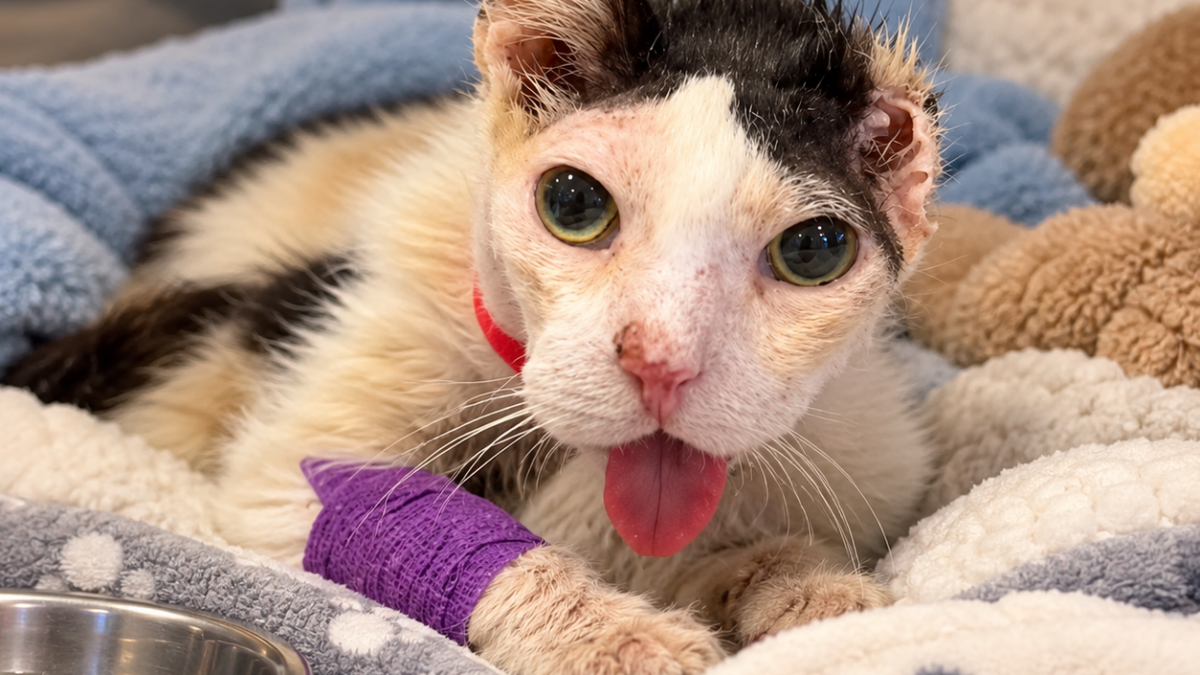
The first time Sam tried to eat in front of me, he lowered his thin face toward the bowl, hesitated as if he already knew how much it was going to hurt, and then looked up at me with such quiet patience that I had to turn away because I could not understand how a cat carrying that enormous growth beneath his jaw could still lean into my hand and purr when I touched him.
Over the next several weeks, one veterinarian after another studied his X-rays and scans and told me versions of the same painful truth—that Sam was older, painfully underweight, the operation would be extremely complicated, and perhaps the kindest thing I could do was stop searching for a cure and simply make whatever time he had left as comfortable as possible.
I almost accepted that answer, but every night Sam climbed onto my chest, pressed his damaged face against my neck, and purred as if he still expected something from tomorrow, and I couldn’t shake the feeling that somewhere there might be one doctor willing to look at him and see not a hopeless case, but a life that had not finished asking for a chance.
I found Sam in Bulgaria during one of those cold gray weeks when winter seems unwilling to leave.
I had seen stray cats in the neighborhood before.
Too many.
They moved between apartment blocks, dumpsters, small parking lots, and abandoned gardens, surviving on whatever food people left behind.
Most learned to stay several steps away from humans.
Sam didn’t.
The first time I noticed him, he was sitting beside a low concrete wall near a row of garages.
His coat was long but badly tangled.
His body beneath it looked frighteningly thin.
Then he turned his head.
That was when I saw the growth.
It distorted the lower part of his face so severely that for a moment I thought I was looking at an injury.
When he stood, he moved slowly.
Not because he was afraid.
Because he was tired.
I crouched several feet away.
“Hey, old man.”
I had no idea how old he really was.
Later, veterinarians estimated somewhere between seven and twelve.
With a street cat, years become guesses.
Sam looked at me.
I extended my fingers.
I expected him to retreat.
Instead, he walked toward me.
One step.
Another.
Then pressed his forehead into my hand.
I felt his purr before I heard it.
That was it.
Some rescue decisions happen after planning.
Sam’s happened in about ten seconds.
I brought food.
Soft food, because one look at his jaw told me chewing would be difficult.
Sam was hungry.
Desperately hungry.
He approached the bowl immediately.
Then he stopped.
He tried to take a bite.
Pulled away.
Tried again.
That was when I understood why his body was so thin.
He wanted to eat.
His body simply made eating hard.
I sat beside him.
“Okay.”
Sam looked at me.
“We’ll do this differently.”
I mashed the food until it was almost liquid and raised the dish so he did not have to lower his jaw as far.
He managed a few bites.
Then rested.
A few more.
It took nearly forty minutes for him to eat what a healthy cat might have finished in five.
Afterward, Sam leaned against my leg.
I called a veterinarian.
By evening, he was no longer sleeping beside garages.
He was in my apartment.
I gave him a quiet room, clean bedding, food, water, and a litter box.
Sam ignored the bed.
That night, while I sat on the floor reading veterinary information I barely understood, he climbed into my lap.
Then higher.
He placed his front paws on my chest and curled beneath my chin.
His purr filled the room.
I remember whispering:
“I don’t know how to fix this.”
Sam closed his eyes.
“But I’ll find out.”
The first veterinarian examined him the next morning.
Then came X-rays.
Blood work.
More consultation.
The doctor was kind.
Careful.
He did not give me false hope.
“The mass is extensive.”
“Can you remove it?”
He hesitated.
“Not here.”
“Somewhere else?”
“Possibly.”
“Then where?”
Another pause.
“Before you start searching, you need to understand that surgery may be harder on him than the disease.”
I looked through the exam-room doorway.
Sam was sitting quietly in his carrier.
“What are you telling me?”
“I’m telling you comfort care may be the kinder option.”
The words hit harder than I expected.
I looked at Sam.
He looked back.
That night, he climbed onto my chest again.
He purred.
And I made the decision that would change everything.
I would not force him through treatment simply because I was afraid to let go.
But I also would not let one answer become the only answer.
Not yet.
PART 2
The first veterinarian’s name was Dr. Petrov.
He was not cold.
He was not careless.
That matters because later, when people heard Sam’s story, some wanted to turn every doctor who declined surgery into a villain.
They weren’t.
Most were frightened of the same thing I was.
Putting an already weak animal through a complicated operation that might leave him with less comfort, not more.
Dr. Petrov showed me the X-ray.
I had no training, but even I could see the abnormal shape.
“What exactly is it?” I asked.
“We need more imaging before I can tell you how deeply it’s involved.”
“Cancer?”
“Possibly.”
“Do you think it has spread?”
“We don’t know.”
“Can we find out?”
“Yes.”
Everything became:
We don’t know.
Maybe.
Possibly.
Could.
Might.
I hated uncertainty.
Sam did not appear bothered by it.
He was more interested in whether I had brought his food.
At home, I began learning how to feed him more comfortably.
Small portions.
Soft texture.
Raised dish.
Slowly.
No rushing.
Sam would eat a little.
Rest.
Return.
Sometimes a drop of blood appeared near the mass.
The first time I saw it, my stomach turned.
I called Dr. Petrov immediately.
He talked me through what to monitor.
“When do I bring him back?”
“If the bleeding doesn’t stop, if he becomes weak, if he stops eating, if his breathing changes.”
I wrote everything down.
Sam watched me from the couch.
“Apparently you’re complicated.”
Purr.
“Expensive too.”
Purr.
“Don’t look so proud.”
HIS FIRST BATH
Sam’s coat was badly matted.
I could not simply brush everything out.
Some areas had to be carefully trimmed.
He tolerated almost all of it.
Not happily.
But patiently.
When I cleaned around his neck, he leaned into my wrist.
It made me wonder how long it had been since someone touched him without pushing him away.
Maybe days.
Maybe years.
Street animals teach you not to invent histories.
You don’t know.
You can create a tragic story in your head and accidentally replace facts with emotion.
So I tried not to.
I knew only what was in front of me.
An older male cat.
No microchip.
No known owner.
Thin.
Matted.
Large jaw mass.
Friendly.
Very friendly.
That was enough.
THE SECOND OPINION
The second clinic was in another city.
A friend drove because I didn’t trust myself to focus on traffic and Sam at the same time.
The doctor examined him for nearly twenty minutes.
Sam purred through half the exam.
“He’s unusually social,” she said.
“That’s part of the problem.”
She looked confused.
“Why?”
“Because he makes it impossible to think clearly.”
She smiled.
Then the smile disappeared when she reviewed the images.
“This would be difficult.”
“But possible?”
“Technically many things are possible.”
I hated that phrase.
“What would you do if he were your cat?”
Doctors hate that question.
I could tell.
She sat down.
“If he were my cat, I would ask what I’m trying to gain.”
“Less pain.”
“Good.”
“Better eating.”
“Good.”
“More time.”
“Maybe.”
She leaned forward.
“If surgery gives him three months of difficult recovery and only a short period of comfort, is that better?”
I didn’t answer.
“If surgery has a significant chance of complications, how much risk is acceptable?”
“I don’t know.”
“Exactly.”
She wasn’t telling me no.
She was making me define why I wanted yes.
That drive home was quiet.
My friend, Nadia, finally said:
“You okay?”
“No.”
“Want me to say something encouraging?”
“No.”
“Good, because I don’t have anything.”
I laughed despite myself.
Sam was asleep in his carrier.
NIGHT ROUTINE
Every evening became the same.
Food.
Medication.
Cleaning.
Checking the mass.
Writing down how much he ate.
Then Sam would climb onto me.
At first, I tried to stop him because I worried about pressing against his jaw.
Sam refused.
He wanted my chest.
So I learned to lie slightly turned while he curled against my collarbone.
He purred loudly.
Sometimes for an hour.
I would look at the ceiling.
Think about surgery.
Think about comfort care.
Think about what “kindness” meant when every choice could hurt.
One night, I whispered:
“Tell me what you want.”
Sam kneaded my shirt.
“Very helpful.”
Purr.
“You want dinner?”
Purr.
“Life?”
Purr.
“That’s not scientifically valid.”
He fell asleep.
THE THIRD CONSULTATION
The third doctor said no more directly.
“I would not operate.”
My throat tightened.
“Why?”
“Age unknown. Body condition poor. Mass large. Reconstruction difficult.”
“What if scans show no spread?”
“Still difficult.”
“Would you recommend euthanasia?”
The word hurt even before it left my mouth.
The doctor shook his head.
“Not based on what I’m seeing today.”
I exhaled.
“He still has quality of life.”
“Yes.”
“Then what?”
“Pain control. Soft food. Monitor bleeding. Supportive care.”
“For how long?”
“We don’t know.”
Again.
“Could he have months?”
“Possible.”
“Years?”
“Less likely.”
Sam sat on the exam table and rubbed his head against the doctor’s elbow.
The doctor smiled.
“I understand why you’re searching.”
“Do you?”
“Yes.”
“Then why does everyone keep telling me to stop?”
He looked at Sam.
“Because sometimes continuing to search becomes something we do for ourselves.”
That sentence followed me home.
Was I doing this for Sam?
Or because I couldn’t accept an ending?
THE RULE I MADE FOR MYSELF
That night, I wrote one sentence in my notebook:
I will not make Sam suffer so I can feel like I tried everything.
Then another:
But I will keep asking until I know what everything actually is.
Those two promises guided every decision afterward.
I wasn’t looking for a doctor who would say yes because I wanted yes.
I was looking for someone who could explain whether yes had a reasonable chance of making Sam’s life better.
That’s different.
SAM’S WORLD EXPANDS
While I searched, Sam lived.
That mattered.
He began exploring the apartment.
First the bedroom.
Then hallway.
Then kitchen.
He discovered the radiator.
Excellent.
A warm spot.
He discovered the sofa.
Better.
He discovered that the kitchen counter was forbidden.
Irrelevant.
He got up anyway.
The first time I found him there, I stared.
“You can barely eat, but you can jump on the counter?”
Sam looked at me.
“Fraud.”
He stepped toward my plate.
“No.”
He kept coming.
“Sam.”
Nothing.
I picked him up.
He purred.
That was the beginning of his criminal career.
WEIGHT
Gaining weight was difficult.
He wanted food.
But eating required work.
I tried different textures.
Veterinary diets.
Blended food.
Small frequent meals.
Some days went well.
Others didn’t.
When he gained one hundred grams, I celebrated.
Nadia laughed.
“One hundred grams?”
“That’s huge.”
“That’s a yogurt.”
“Leave.”
Sam gained another.
Then lost fifty.
My mood followed the scale.
Dr. Petrov warned me:
“Don’t make every number a verdict.”
Easy for him.
Hard for me.
THE BLEEDING NIGHT
One evening, Sam was eating when the mass began bleeding more than usual.
I froze.
He did not.
He kept trying to eat.
“Stop.”
I moved the bowl away.
Sam looked offended.
I grabbed clean gauze and called the emergency clinic.
They told me what to do while I prepared to leave.
Sam sat calmly.
I was shaking.
At the clinic, the bleeding slowed.
The doctor examined him.
“This is one of the concerns.”
“I know.”
“It may happen again.”
“I know.”
“Eventually, controlling this could become difficult.”
I looked at Sam.
He was trying to rub against the technician.
“How is he still like this?”
“Like what?”
“Happy.”
The technician smiled.
“Cats don’t read their charts.”
I remembered that.
SOFIA
The name Dr. Voichev reached me through another rescuer.
“He does difficult maxillofacial cases.”
“Would he see Sam?”
“Send everything.”
I did.
X-rays.
Bloodwork.
Photos.
Consultation notes.
Weight history.
Every detail.
Then I waited.
Three days.
No response.
Four.
I called.
Reception told me the doctor was reviewing.
Six days.
I convinced myself no answer meant no.
Then an email arrived.
Please bring Sam to Sofia for advanced imaging and evaluation.
Not yes.
Not surgery.
Evaluation.
Still, it felt like a door opening.
THE DRIVE
Sofia was hours away.
Sam hated the first thirty minutes.
Then slept.
I barely spoke.
Nadia came again.
“You know this might still be no.”
“I know.”
“You won’t be angry?”
“Probably.”
“At the doctor?”
“No.”
“Good.”
She looked at Sam’s carrier.
“What are you hoping he says?”
I thought.
“That there’s a path.”
Not a miracle.
A path.
DR. VOICHEV
Dr. Voichev was quieter than I expected.
He examined Sam slowly.
Touched around the jaw.
Checked lymph nodes.
Reviewed previous imaging.
Then ordered more detailed scans.
I waited in a hallway that smelled like every veterinary clinic I had learned to fear.
An hour.
Two.
Finally, he called me in.
The scans were on a screen.
He pointed.
“The encouraging thing is that we do not see evidence of distant spread.”
I stopped breathing.
“Say that again.”
“No obvious spread.”
“So you can operate?”
He didn’t answer immediately.
My heart dropped.
“We can consider it.”
“What does that mean?”
“It means the operation is technically possible.”
“Possible.”
“Yes.”
“Would you do it?”
He looked at me.
“Only if you understand what it involves.”
“I do.”
“You don’t yet.”
Fair.
WHAT SURGERY MEANT
Part of Sam’s lower jaw would need to be removed.
Diseased tissue.
Tumor.
Margins.
His face would look different.
Eating mechanics would change.
Recovery would require pain control, monitoring, nutrition support, careful wound care.
There were anesthesia risks.
Bleeding risks.
Infection risks.
Healing risks.
No guarantee the tumor would never return.
No guarantee of years.
No guarantee of anything except an attempt to remove the source of much of his daily pain.
Dr. Voichev said:
“The goal is not to make him look normal.”
“Good.”
“The goal is comfort.”
“Yes.”
“To reduce bleeding.”
“Yes.”
“To allow him to eat with less pain if recovery goes well.”
My eyes filled.
“Yes.”
He continued.
“You need to understand that sometimes technically successful surgery still does not create the quality of life we want.”
“I understand.”
“Do you?”
I looked at Sam.
He was rubbing his face against the carrier door.
“I think so.”
Dr. Voichev sat back.
“Then I think surgery is a reasonable option.”
I started crying.
Not dramatic sobbing.
Just tears.
He waited.
“Sorry.”
“No need.”
“I’ve heard no so many times.”
“They weren’t wrong.”
I looked up.
“What?”
“The other doctors.”
He pointed at the scans.
“Without this information, caution was appropriate.”
That mattered.
There was no villain.
Only a harder answer discovered later.
PREPARATION
Sam needed to be stronger.
Better nutrition.
Blood values optimized.
Dental and infection management.
The operation was scheduled, then delayed once because one lab result wasn’t where the surgeon wanted it.
I cried in the parking lot.
Then felt ashamed.
Sam didn’t care.
He went home.
Ate.
Slept on my chest.
We waited another week.
THE NIGHT BEFORE
I didn’t sleep.
Sam did.
At midnight, he climbed onto me.
I touched his back.
“What if I’m making the wrong decision?”
Purr.
“What if you don’t wake up?”
Purr.
“What if comfort care was better?”
Purr.
“You are useless at informed consent.”
Sam fell asleep.
I watched him until morning.
SURGERY DAY
At the hospital, I signed papers.
Too many papers.
Risks.
Consent.
Emergency decisions.
I hated every signature.
A technician took Sam’s carrier.
I opened it first.
Sam stepped halfway out.
I touched his head.
“Come back.”
The technician smiled.
“He will.”
I looked at her.
“Don’t promise.”
She understood.
“You’re right.”
I kissed the top of Sam’s head.
“I’ll be here.”
Then they took him.
WAITING
Waiting is its own kind of physical pain.
I walked.
Sat.
Stood.
Bought coffee.
Didn’t drink it.
Checked my phone.
Put it down.
Nadia messaged:
Anything?
No.
An hour.
Two.
Three.
I remembered every doctor who had advised against surgery.
What if they were right?
What if I had turned Sam’s final comfortable weeks into an operating room because I couldn’t accept reality?
I nearly vomited from fear.
Then my phone rang.
Hospital.
I answered before the first ring finished.
“Hello?”
“Sam is out of surgery.”
I closed my eyes.
“Alive?”
“Yes.”
“Stable?”
“Yes.”
“Awake?”
“Beginning to wake.”
I sat down on the hallway floor.
People walked around me.
I didn’t care.
THE SURGEON’S REPORT
Dr. Voichev met me later.
“The procedure went as planned.”
I laughed nervously.
“I don’t know what that means.”
“We removed the affected portion.”
“Margins?”
“Samples are going to pathology.”
“Bleeding?”
“Controlled.”
“Anesthesia?”
“He handled it.”
“Can I see him?”
“Soon.”
Then he added:
“The next days matter.”
Of course.
There is always another next.
FIRST LOOK
Sam looked different.
Of course he did.
Swelling.
Sutures.
Altered jaw line.
I felt an instinctive shock.
Then guilt for feeling it.
Sam opened his eyes.
I spoke.
“Hey.”
His ear moved.
I touched his forehead.
He leaned.
Same cat.
That was all I needed.
THE FIRST NIGHT AFTER
He was hospitalized.
I went to a nearby hotel.
I did not sleep.
At 2:11 a.m., I called.
The nurse said:
“He’s resting.”
“Pain?”
“Controlled.”
“Bleeding?”
“Minimal.”
“Breathing?”
“Stable.”
“Has he tried to stand?”
“Yes.”
“Of course he has.”
At 5:30, I called again.
The nurse laughed.
“Still resting.”
“Sorry.”
“No, you’re not.”
“No.”
DAY TWO
Sam sat up.
That felt enormous.
His face was swollen.
He hated the collar they used to prevent him from interfering with the surgical area.
Good.
Annoyance meant energy.
He tried to remove it.
“Stop.”
Sam continued.
“You just had major surgery.”
No interest.
The nurse said:
“He’s opinionated.”
“You have no idea.”
FOOD
The first question was whether he could eat.
Not immediately.
Nutrition support came first.
Then tiny amounts.
When the surgeon finally allowed a small test of soft food, my hands shook.
Sam sniffed.
I held the dish at the angle he preferred.
He licked.
Stopped.
My chest tightened.
Then licked again.
A small amount entered his mouth.
He swallowed.
No immediate pain reaction.
I looked at Dr. Voichev.
“Again?”
“Let him decide.”
Sam licked.
Another.
Then more.
I began crying.
The surgeon smiled slightly.
“That’s why we did it.”
THE FIRST MEAL WITHOUT THE OLD PAUSE
Before surgery, Sam always hesitated.
Food.
Pain.
Decision.
Food again.
After surgery, once early healing progressed, that hesitation began disappearing.
Not instantly.
Recovery hurt too.
But the old mechanical struggle changed.
One afternoon, I placed his food down.
Sam walked over.
Ate.
Stopped only to breathe.
Then continued.
I watched the entire meal.
He looked up afterward.
Food on his face.
I laughed.
“You have terrible manners.”
He purred.
That was the moment the operation became real to me.
Not the scan.
Not the surgical report.
Eating.
PATHOLOGY
The pathology call frightened me more than I expected.
The mass was malignant.
But the available findings remained consistent with localized disease as seen on imaging, and the surgeon believed the removal had achieved the intended goal as well as could reasonably be expected.
No promise.
Monitoring required.
Regular checks.
Possibility of recurrence.
I listened.
Took notes.
Then asked:
“How much time?”
Dr. Voichev sighed.
“You know I can’t answer that.”
“I had to try.”
“Measure quality, not calendar.”
Another sentence that stayed.
HOME
Sam returned home.
He walked out of the carrier and immediately headed toward the bedroom.
I thought he wanted his bed.
Wrong.
My pillow.
He climbed onto it.
Circled.
Lay down.
I laughed.
“You undergo life-changing surgery and come home entitled.”
Purr.
That first night, he returned to my chest.
Carefully.
I was afraid he’d hurt himself.
He wasn’t.
He curled beneath my chin.
His purr vibrated through me.
For weeks I had lain in that position wondering whether searching for surgery was selfish.
Now Sam slept more comfortably than he had before.
I allowed myself to believe we’d made the right choice.
RECOVERY IS NOT A STRAIGHT LINE
Three days later, he stopped eating breakfast.
Panic.
Immediate.
I called.
The clinic asked questions.
Temperature.
Behavior.
Hydration.
Pain.
Medication.
Sam ate lunch.
Nothing catastrophic.
I realized my nervous system had become trained to expect disaster.
Every pause looked like recurrence.
Every nap looked like decline.
Every strange movement looked like a complication.
Dr. Petrov, who resumed some of Sam’s follow-up care locally, finally told me:
“You need to stop examining him like a medical file.”
“What?”
“Look at him.”
Sam was on the windowsill.
Watching pigeons.
“What does he want?”
“Bird murder.”
Dr. Petrov laughed.
“Exactly.”
THE WINDOW
Sam loved the window.
Before surgery, he’d sit there too, but rarely for long.
After recovery, he spent hours.
Birds.
People.
Cars.
Snow.
Rain.
He followed everything.
The world interested him.
That became one of my quality-of-life measures.
Not just:
Did he eat?
But:
Did he care?
Did he look outside?
Did he follow me?
Did he climb onto my chest?
Did he complain when dinner was late?
As long as Sam had opinions, we were doing okay.
HIS COAT
Good nutrition changed him.
The matted street coat was gone.
New fur grew softer.
His body filled slightly.
Still lean.
He was an older cat after all.
But no longer painfully thin.
People who met him months later often stared at old photographs.
“That’s Sam?”
“Yes.”
“Same cat?”
“Yes.”
The jaw was different.
The face was different.
But the eyes were unmistakable.
THE FIRST TIME HE RAN
Not far.
Across the hallway.
I opened a package and a piece of paper fell.
Sam attacked it.
I moved it.
He chased.
For maybe ten seconds, he became a kitten.
I sat on the floor laughing.
He pounced.
Missed.
Pounced again.
Then stopped, dignity returning.
“Did anyone see that?”
Sam walked away.
THE DOCTORS WHO SAID NO
Months later, I sent updates to the earlier clinics.
Not to prove them wrong.
To thank them.
One replied:
We are delighted to see him doing so well.
Another:
Wonderful outcome. We remain glad you obtained advanced surgical evaluation.
The third doctor—the one who had asked whether my search was for Sam or for myself—called.
“I’m happy you continued.”
I laughed.
“You told me to consider stopping.”
“I told you to examine why you continued.”
“Fair.”
“Different.”
“Very.”
He asked:
“Is he comfortable?”
“Yes.”
“Eating?”
“Yes.”
“Then good.”
No ego.
No competition.
Medicine is not supposed to be a contest.
Sam needed caution from some doctors and courage from another.
Both mattered.
THE INTERNET VERSION
Sam’s story spread.
As always, the internet simplified it.
VETS GAVE UP—ONE HERO SURGEON SAVED HIM.
I hated that.
The first vets did not give up.
They prevented me from rushing blindly into a dangerous procedure.
Dr. Voichev didn’t perform a miracle.
He had better imaging, specific surgical experience, and a case he believed could reasonably benefit.
I corrected posts when I could.
The real story was better.
A rescuer kept asking.
Doctors kept evaluating.
Eventually, the right expertise met the right case.
“WHY DIDN’T SOMEONE HELP HIM EARLIER?”
People asked this constantly.
I don’t know.
Maybe people fed him and didn’t understand the mass.
Maybe it grew slowly.
Maybe he moved neighborhoods.
Maybe someone tried.
Maybe nobody did.
Street life creates gaps.
Sam couldn’t tell us.
I stopped inventing answers.
The only useful question was:
What do we do now?
THE FIRST WINTER INSIDE
Snow fell outside.
Sam sat on the radiator.
I looked at him.
“Remember the street?”
No response.
“Probably not the way I do.”
He stretched.
A life indoors had become normal quickly.
Warmth should be normal.
Food should be normal.
Safety should be boring.
That’s success.
A VISITOR
Nadia came over.
Sam climbed into her lap.
“Traitor.”
She scratched his chin carefully.
“He loves me.”
“He loves heat sources.”
“Same thing.”
Sam purred.
Nadia looked at his face.
“You know, I don’t notice the jaw anymore.”
I understood.
At first, the tumor entered the room before Sam did.
Now Sam entered first.
The medical history followed only if someone asked.
That’s what recovery should do.
A YEAR
One year after surgery, scans showed no obvious recurrence.
I didn’t celebrate until I got home.
Then I bought Sam expensive food he probably did not need.
He ate half.
Walked away.
“Do you know what this cost?”
Sam returned later.
Finished it.
Fine.
We marked the anniversary quietly.
No party hat.
Cats have dignity.
Mostly.
THE CASE OF THE MISSING CHICKEN
Sam stole cooked chicken from the counter.
This required jumping onto a chair, then the counter.
A cat who once struggled to eat had become a food thief.
I caught him with the evidence.
“Sam.”
He froze.
Chicken in mouth.
“Put that down.”
He ran.
I chased an older cat through my apartment while laughing so hard I couldn’t breathe.
That became my favorite revenge story.
The tumor had once controlled every meal.
Now Sam was committing culinary crimes.
THE FEAR RETURNS
At eighteen months, I felt a small firmness near the surgical area.
My whole body went cold.
Appointment.
Scan.
Waiting.
Scar tissue.
Not recurrence.
I cried in the parking lot.
Relief can hurt.
AGE
We never knew Sam’s exact age.
At first, vets estimated seven to twelve.
Years passed.
That range became ridiculous.
“Congratulations,” Nadia said. “Your cat is somewhere between ten and seventeen.”
“Very useful.”
Sam developed mild arthritis.
Kidney values needed monitoring.
Normal older-cat problems.
I loved every one.
Not because I wanted him sick.
Because ordinary aging meant we had moved past the extraordinary crisis.
SOFIA AGAIN
We returned to Dr. Voichev for another follow-up.
Sam recognized the hospital and objected.
Loudly.
The surgeon smiled.
“Good voice.”
“He has opinions now.”
“He had opinions before.”
“True.”
The scan looked stable.
Dr. Voichev examined him.
Then asked:
“How is eating?”
“Too good.”
“Weight?”
“Up.”
“Bleeding?”
“None.”
“Comfort?”
I looked at Sam.
He was trying to escape the exam table.
“Excellent.”
The surgeon nodded.
“Then the operation achieved what we hoped.”
Not cure.
Not immortality.
Comfort.
The word that had once sounded like surrender now sounded like victory.
WHAT “REVENGE” LOOKED LIKE
People asked me for a dramatic ending.
Who abandoned Sam?
Did we find them?
Did they suffer consequences?
No.
We didn’t know his history.
There was no investigation with a villain.
No courtroom.
No confrontation.
For a while, I thought that made the story incomplete.
Then Sam showed me otherwise.
His revenge was not against a person.
It was against every terrible expectation created by the street and the tumor.
Pain said meals would always hurt.
Sam stole chicken.
Weakness said he would stay thin.
Sam gained weight.
Doctors feared surgery might take too much.
Sam recovered.
The street said he belonged nowhere.
Sam claimed my pillow.
That was revenge.
THE PILLOW
I bought him three cat beds.
He used none.
My pillow.
Always.
Sometimes directly on my face.
At 3:00 a.m., I’d wake with fur in my mouth.
“Sam.”
Purr.
“Move.”
No.
I would shift.
He would occupy more space.
The cat once without a safe place to sleep became a landlord in my own bedroom.
I accepted this.
THE SECOND CAT
A foster kitten came temporarily.
Tiny black female named Mira.
Sam hated her.
For twelve hours.
Mira followed him.
Sam hissed.
Mira followed.
Sam moved.
Mira followed.
By evening, she slept near his tail.
By day three, Sam groomed her head.
I watched.
Something about older rescued animals caring for younger ones always destroys me emotionally.
Sam had spent years surviving alone.
Now another creature assumed he was safe enough to sleep beside.
THE VET VISIT THAT MADE ME LAUGH
A new veterinarian who hadn’t met Sam before opened his file.
Read.
Looked at him.
Looked again.
“This is that cat?”
“Yes.”
“The mandibulectomy?”
“Yes.”
“The huge mass?”
“Yes.”
Sam tried to steal a treat from her pocket.
She laughed.
“I expected someone more fragile.”
“So did life.”
THREE YEARS
Three years after surgery, Sam was still there.
That sentence alone would have shocked me in the beginning.
He ate.
Slept.
Played less, but still played.
Watched birds.
Demanded lap access.
Purred.
Three years.
All those nights I had asked:
How much time?
Nobody knew.
Good.
If I’d been given a number, I might have spent the years counting down.
Instead, I lived them.
THE MAN OUTSIDE THE STORE
One afternoon, an older man stopped me while Sam was in a carrier after a vet visit.
“What happened to his face?”
I gave the short version.
Tumor.
Surgery.
Recovery.
The man looked sad.
“Poor thing.”
Sam hissed at him.
I laughed.
“He’s not interested in pity.”
The man smiled.
“Fair.”
That became my policy.
Sam deserved compassion for what he experienced.
Not a lifetime sentence of being “poor Sam.”
THE NEW PHOTO
I stopped sharing the original street photograph as the first image.
Instead, I used a recent photo.
Sam on a blanket.
Eyes bright.
Then, if context required, the old one.
People should meet who he became before being asked to witness who he was.
FOUR YEARS
Sam’s kidneys began showing age.
We changed food.
Medication.
Hydration support.
Regular labs.
This time I didn’t panic the same way.
I had learned.
We would treat what existed.
Not fight imaginary futures.
Sam still ate.
Still purred.
Still climbed onto my chest, though more slowly.
DR. VOICHEV’S RETIREMENT DINNER
Years later, I learned Dr. Voichev was being honored by colleagues.
I sent a photograph.
Sam sleeping on me.
Caption:
Still here. Still eating. Still taking over my bed.
The doctor replied:
Good. That was the point.
I cried.
Four words.
That was the point.
Not making a heroic story.
Not proving another doctor wrong.
Giving a cat days worth living.
THE TUMOR NEVER BECAME HIS NAME
This mattered more with time.
Sam was never introduced as “the tumor cat” at home.
He was:
Sam.
Sammy when he was being cute.
Samuel when he committed crimes.
Old Man when he complained.
Sir when he demanded food.
The medical story shrank.
The personality grew.
THE LAST GOOD SUMMER
Sam was older.
Exactly how old? No idea.
He liked the balcony in warm weather.
Supervised.
He would lie in sunlight.
Head tilted.
Eyes closed.
One afternoon, I sat beside him.
“You know I almost listened.”
His ear moved.
“I almost stopped looking for surgery.”
No response.
“Maybe that wouldn’t have been wrong.”
Important truth.
Comfort care would not have been failure.
The decision we made was right because Sam happened to be a suitable candidate after better imaging.
Another cat might not be.
Love does not mean always choosing more treatment.
Love means choosing what serves the animal.
For Sam, surgery served him.
I was grateful.
Not triumphant.
THE FIRST SIGN OF THE END
It was not the jaw.
That surprised me.
Years after surgery, the tumor had not become the thing that ended his life.
Age did.
Kidneys.
General decline.
Arthritis.
The body getting tired.
Strangely, I found comfort in that.
Sam had outlived the crisis that once seemed certain to define everything.
FOOD AGAIN
The first symptom that frightened me was appetite.
He ate less.
I tried warm food.
Different textures.
Chicken.
Sam sniffed.
Some days ate.
Some days didn’t.
The old fear returned.
Not the tumor.
The memory.
A cat wanting food but struggling.
I called the vet.
We adjusted treatment.
For a while, appetite improved.
Then slowly declined again.
THE QUALITY LIST
I made a list.
Not because numbers decide everything.
Because grief lies.
Good day?
Bad day?
Eating?
Comfort?
Mobility?
Interest?
Purring?
Windows?
Chest time?
Sam still had many yeses.
Then fewer.
I watched carefully.
NADIA’S QUESTION
“How will you know?”
We were drinking coffee while Sam slept beside me.
“I don’t know.”
“You always know things.”
“No.”
She smiled sadly.
“That’s new.”
I touched Sam’s back.
“I promised him I wouldn’t make treatment about my fear of losing him.”
Nadia nodded.
“Same promise now.”
Exactly.
THE LAST WEEK
Sam stopped climbing onto the counter.
That mattered.
Then he stopped going to the window.
That mattered more.
He still climbed onto me.
Until one evening, he tried.
Front paws on my chest.
Then stopped.
I lifted him gently.
He settled.
Purr.
Weak.
Still there.
I cried silently.
“You don’t have to do this for me.”
His eyes closed.
THE FINAL CONSULTATION
The veterinarian examined him at home.
I wanted home if possible.
She sat with me.
“We can adjust medication again.”
“Would it give him comfort?”
“Possibly for a short period.”
“Would it make him eat?”
“Maybe.”
“Would it make him want the window again?”
She didn’t answer.
I knew.
I looked at Sam.
“Is he suffering?”
“He’s tired. Some discomfort. We can manage some of it.”
“Some.”
“Yes.”
There are moments when love stops asking how to extend time and starts asking how to protect the ending.
We were there.
THE LAST NIGHT
Sam slept on my chest.
One final time.
I barely moved.
My back hurt.
My arm went numb.
Didn’t matter.
His purr came and went.
I whispered everything.
“You were supposed to stay two weeks.”
Purr.
“You know that?”
Nothing.
“I was going to help you, find someone, maybe foster.”
Sam slept.
“You completely destroyed that plan.”
I laughed through tears.
“Years, Sam.”
I touched his fur.
“You gave me years.”
MORNING
Sunlight entered the room.
Sam opened his eyes.
I carried him to the window.
He looked out for maybe thirty seconds.
Birds moved on another building.
I don’t know whether he truly watched.
I chose to believe he did.
Then I carried him back to bed.
GOODBYE
The veterinarian came.
Nadia came.
Dr. Petrov stopped by briefly because he had followed Sam’s story from the beginning.
I had sent Dr. Voichev a message the night before.
His reply:
You gave him the life surgery was meant to make possible. Protect that life to the end.
I read it again.
Then put my phone away.
Sam lay on his blanket.
I touched his head.
Same place I’d touched him near the garages years earlier.
“Hey, old man.”
His eyes opened.
“You did good.”
Purr.
Barely audible.
The veterinarian gave us time.
I placed Sam against my chest.
Where he had always wanted to be.
He left there.
Warm.
Held.
Home.
AFTER
The apartment felt wrong.
Too much space.
My pillow remained empty.
Food bowls.
Medication.
Blankets.
Small things become brutal after loss.
The first night, I woke at 2:00 a.m. because I thought Sam had climbed onto me.
Nothing.
I cried harder then than during goodbye.
THE SCAN
Weeks later, I found the original scan in my files.
The tumor.
Huge.
The image that had dominated our lives.
I stared.
Then opened a photograph from three years after surgery.
Sam stealing chicken.
I laughed.
That became the pair I kept.
Not before and after.
Problem and answer.
THE “REVENGE” EVERYONE WANTED
People wanted me to say Sam defeated cancer.
That’s too simple.
He had serious disease.
Surgery removed the visible problem.
He had years afterward.
Then age took him.
Was that victory?
Absolutely.
But not because he was immortal.
Because he got time with comfort.
He got meals that did not require the old painful hesitation.
He got warmth.
He got a pillow.
He got Mira.
He got sunlight.
He got old.
That’s revenge enough.
THE STREET AGAIN
I went back to the garages once.
No reason.
Just memory.
A different stray cat sat near the wall.
I fed her.
She didn’t let me touch her.
Good boundaries.
I looked at the place where I’d first seen Sam.
No sign.
No marker.
The street had moved on.
So had he.
THE SAM FUND
Our rescue eventually created a small medical-assistance fund for older street cats requiring advanced diagnostics.
Not surgery for everyone.
That was important.
Evaluation.
Imaging.
Second opinions.
Pain management.
Dental care.
Whatever the individual cat actually needed.
We called it the Sam Fund.
The first cat helped was not surgical.
An older female named Daria.
Advanced disease.
No curative option.
The fund paid for diagnostics and comfortable hospice care.
Someone asked me:
“Doesn’t that defeat Sam’s story?”
“No.”
They looked confused.
“Sam’s story isn’t ‘always operate.'”
“What is it?”
“Get enough information to make the right decision for the cat.”
That’s his legacy.
THE SECOND CAT
Another cat, Boris, did have surgery.
Different condition.
Different surgeon.
Recovered.
His foster sent a video of him eating.
I cried.
Of course.
DR. PETROV
Years after Sam died, Dr. Petrov told me:
“You know what I learned from him?”
“What?”
“To say ‘I wouldn’t operate here’ instead of ‘nothing can be done.'”
That mattered.
Not because his first advice had been wrong.
Because language matters.
A limit in one clinic is not always the limit of medicine.
And sometimes it is.
The skill is knowing the difference.
THE CHEST
The thing I miss most?
Weight.
Sam’s weight on my chest.
Funny, because when I found him he weighed too little.
Later, healthy enough to be annoying, he felt heavy.
I complained.
“Sam, I need to breathe.”
He ignored me.
Now I’d give anything for that weight.
IF I COULD TALK TO HIM ON THE STREET
I would crouch beside the old wall.
Sam would approach.
Thin.
Matted.
Jaw distorted.
I would hold out my hand.
He would lean into it.
Then I would say:
“Listen, old man.
“I’m going to take you home.
“Tomorrow a doctor is going to scare me.
“Then another.
“Then another.
“They’re going to tell me surgery may be too much.
“They might be right based on what they know.
“I’m going to lie awake wondering whether continuing is love or selfishness.
“You’re going to sleep on my chest through all of it.
“Eventually we’re going to drive to Sofia.
“A surgeon is going to look at better scans and tell me something I almost stopped believing.
“The tumor hasn’t spread.
“There is a path.
“The operation will be difficult.
“You’ll lose part of your lower jaw.
“You’ll look different.
“You won’t care.
“I will care for about thirty seconds and then feel stupid.
“You’re going to wake up.
“You’re going to eat.
“Slowly first.
“Then normally enough to make me cry over a bowl of cat food.
“Later you’re going to steal chicken.
“You’re going to jump onto counters you’re not allowed on.
“You’re going to sleep on my pillow.
“You’re going to teach a black kitten that your tail is not a toy.
“She won’t listen.
“You’re going to sit in sunlight.
“You’re going to get older.
“Your kidneys will eventually become a problem.
“Do you understand how wonderful that is?
“Your jaw won’t be the thing that gets the final word.
“Age will.
“You’re going to become an old cat in a home.
“So come with me.
“We have a long way to go.”
THE ANSWER TO THE QUESTION
Was it worth continuing after several doctors said surgery might be too risky?
For Sam?
Yes.
But that answer is specific to Sam.
I never want his story used to shame someone who chooses comfort care when surgery is unlikely to help.
Sometimes letting go is love.
Sometimes operating is love.
Sometimes continuing diagnostics is love.
Sometimes stopping diagnostics is love.
The decision becomes ethical only when the animal remains at the center.
Sam remained at the center.
That’s why I can live peacefully with the choice.
THE LAST PHOTO
My favorite photograph isn’t before surgery.
Not after.
Not the scan.
Not the surgical site.
Sam is lying on my chest.
Only his head visible.
Eyes closed.
One paw curled near my neck.
My face is not in frame.
You see only fur, blanket, and peace.
Nobody looking at it would know he once lived outside.
Good.
Nobody would know his jaw once made every meal difficult.
Good.
Nobody would know how many specialists we consulted.
Good.
It is a boring photograph.
Perfect.
WHAT SAM TAUGHT ME
He taught me that a second opinion is not disrespect.
That a doctor saying “I can’t safely do this” may be protecting an animal, not giving up.
That another surgeon saying “I think I can” does not make the first doctor wrong.
That quality of life is not a consolation prize.
It is the whole goal.
That eating can be a miracle.
That pain should never become an animal’s identity.
That rescue does not mean refusing death forever.
It means creating good life where good life is still possible.
And when it is no longer possible, staying.
EPILOGUE
For years, I thought Sam’s story was about persistence.
Keep calling.
Keep searching.
Keep asking.
Don’t accept the first answer.
That’s only half of it.
The other half is knowing what you’re searching for.
I wasn’t searching for immortality.
I was searching for comfort.
A meal without the old struggle.
Sleep without constant irritation.
Days where Sam could think about birds instead of his jaw.
Years, if we were lucky.
We were lucky.
Very lucky.
The cat who arrived painfully thin became heavy enough to make my chest uncomfortable.
The cat who struggled over every bite became a thief of unattended chicken.
The cat with the frightening face became the cat people stopped noticing was different.
The stray who belonged nowhere claimed my pillow.
And when his life finally ended, it did not end because we had failed to remove his past.
It ended because he had lived long enough to become old.
That is the ending I wanted without knowing how to ask for it.
No dramatic revenge.
No villain destroyed.
No miracle that erased mortality.
Something better.
Time.
Comfort.
Home.
Sam had once stood beside a wall with a body that made something as simple as dinner difficult.
Years later, he stood on my kitchen counter with stolen chicken in his mouth while I told him to get down.
If you want one image that explains his entire life, use that one.
Not the tumor.
Not the scans.
Not the surgery.
Sam.
Breaking the rules.
Eating.
Alive.
And completely certain that the house belonged to him.
For a long time after Sam was gone, I kept expecting the apartment to correct itself.
I would wake up at night and leave one arm slightly away from my chest because that was where he usually settled. I would open a can of food and instinctively turn toward the kitchen doorway, waiting for the slow, demanding walk of an old cat who had once needed forty minutes to finish a meal and later behaved as though every dinner in the world had been created specifically for him.
Sometimes I would wake because I was certain I felt weight against me.
Not memory.
Weight.
Warm fur.
A paw near my collarbone.
Then I would open my eyes and find nothing there.
Those moments were harder than the surgery had been.
Surgery gave me something to do.
Grief did not.
There was no scan to schedule.
No food to soften.
No medication to measure.
No phone call to make.
For years, my love for Sam had been physical work.
Carry him.
Feed him.
Clean him.
Drive him.
Hold him.
Watch him.
Then suddenly love had nowhere to go.
That was the part nobody had prepared me for.
Nadia came over one afternoon and found me sitting at the kitchen table with one of Sam’s old bowls in front of me.
“You keeping that?”
“I don’t know.”
“Do you want to?”
“I don’t know.”
She sat across from me.
The bowl had scratches inside from years of use.
Nothing special.
Cheap ceramic.
Blue around the edge.
Sam had eaten from it so many times that I could still picture exactly how his face looked over it after surgery.
“You’re allowed to keep it,” Nadia said.
“I know.”
“You’re also allowed to throw it away.”
“I know.”
“Then why are you staring at it like it has instructions?”
I smiled a little.
“Because everything with him used to have instructions.”
Feed this amount.
Give this medication.
Check this.
Call if that happens.
Nadia nodded.
“And now?”
“Now there’s nothing left to do right.”
She reached across the table.
“Maybe that’s because you already did it.”
I looked away.
For years, I had measured love through action.
Sam forced me to learn that sometimes loving someone after they’re gone means accepting that there is nothing left to fix.
That lesson took longer than I expected.
A few months after his death, Dr. Petrov called.
Not about another case.
Just Sam.
“I was cleaning old records.”
“That’s ominous.”
He laughed.
“I found his original films.”
My stomach tightened.
“The first ones?”
“Yes.”
I had not looked at them in years.
The mass had dominated those images.
Large.
Distorting everything around it.
At the time, it had looked almost impossible that a cat could continue functioning with something like that.
“Do you want copies?”
My first instinct was no.
Then yes.
Then no again.
“I don’t know.”
Dr. Petrov understood.
“I’ll keep them.”
“Thank you.”
Before we hung up, he said:
“You know, I think about him sometimes.”
“Why?”
“Because he changed how I talk to people.”
I became still.
“What do you mean?”
“When you first came in, I told you comfort care might be the kinder choice.”
“You were probably right to say that.”
“I still think I was right based on what I knew.”
“So what changed?”
“I learned to explain the boundary between ‘I would not do this here’ and ‘this cannot be done anywhere.'”
That mattered more than he probably knew.
Sam had not proven the first doctors wrong.
He had shown how dangerous certainty can become when medicine reaches the edge of one person’s tools.
“I started telling clients,” Dr. Petrov continued, “‘This is beyond what I can safely offer, but if you want a referral, I’ll help you look.'”
I sat quietly.
“Has that mattered?”
“For some cases, yes.”
“How many?”
“Not many.”
He paused.
“But enough.”
After the call, I looked toward Sam’s old spot on the windowsill.
That was when I realized his life had continued to change things even after he left it.
Not in dramatic ways.
No monument.
No viral campaign.
A sentence changed in an exam room.
A doctor became more careful with language.
That counts.
Sometimes legacy is just making the next person’s options clearer.
The Sam Fund grew slowly.
At first, it barely covered diagnostic imaging for two or three older street cats each year.
Then donations increased.
People remembered his story.
One donor wrote:
I don’t want every old stray to be operated on. I want every old stray to be properly evaluated before somebody decides nothing can be done.
Exactly.
That became the philosophy of the fund.
Not “save at all costs.”
Not “never give up.”
I had grown suspicious of those phrases.
They sound loving.
Sometimes they’re dangerous.
There are situations where the kindest thing is comfort.
There are diseases surgery cannot fix.
Bodies too fragile for aggressive treatment.
Animals whose remaining days should not be spent recovering from procedures unlikely to help.
Sam’s story was not proof that treatment is always the answer.
It was proof that information matters.
The first cat helped by the fund was Daria.
She was older.
Gray.
Missing several teeth.
Severe oral disease.
Her foster thought she might need the same type of heroic intervention people associated with Sam.
Advanced imaging showed something different.
Her condition was widespread.
Surgery would have been difficult and unlikely to produce meaningful comfort.
So we didn’t do it.
Instead, the fund covered pain control, dental relief where possible, nutrition support, and hospice care.
Daria lived four comfortable months in a foster home.
She slept in sunlight.
Ate soft fish.
Learned to sit beside the foster’s husband every evening.
Then one morning, her body told them enough.
They said goodbye at home.
A volunteer later asked me:
“Doesn’t that feel like the opposite of Sam?”
“No.”
“Why?”
“Because Sam was never about surgery.”
She looked confused.
“He was about finding the option that served him.”
For Daria, that option was not surgery.
That did not make her story smaller.
It made it honest.
The second cat was Boris.
Much younger.
A complicated jaw injury after years on the street.
Different diagnosis.
Different anatomy.
Different surgeon.
He did have surgery.
When his foster sent a video of him eating comfortably for the first time, I cried so hard I had to sit down.
Not because Boris was Sam.
He wasn’t.
I had promised myself I would never turn another animal into a replacement for him.
I cried because eating had become sacred to me.
Most people don’t understand that until they’ve watched an animal want food and fear the act of taking it.
A bowl.
A cat.
A quiet room.
Chewing without hesitation.
You don’t know what a miracle can look like until ordinary things have been taken away.
Years passed.
People occasionally recognized me from Sam’s old posts.
One woman stopped me in a clinic lobby.
“You’re Sam’s person.”
For a second, I almost corrected her.
Then I smiled.
“Yes.”
She had brought in a rescued tomcat with chronic mouth problems.
“He reminds me of Sam.”
I looked into the carrier.
He looked nothing like Sam.
Short black coat.
Round face.
Both ears intact.
Angry eyes.
“No,” I said.
She seemed surprised.
“Sorry?”
“He reminds you of what happened to Sam.”
She thought about it.
“Yes.”
“That’s different.”
The cat hissed at me.
I laughed.
“He definitely has his own personality.”
The woman smiled.
That mattered to me.
We are too quick to make suffering the main point of resemblance between animals.
Scarred cat?
Sam.
Jaw problem?
Sam.
Older stray?
Sam.
No.
Sam was more than the category.
Every new animal deserved that same respect.
Their history could inform care without swallowing identity.
I started saying that more in rescue meetings.
“Don’t introduce them by the worst thing that happened.”
One volunteer challenged me.
“But the medical story helps fundraising.”
She was right.
Sadness raises money.
Before photos spread faster than ordinary ones.
People react to crisis.
We still had to tell the truth.
But we changed how we told it.
If we showed an early image, we followed with current behavior.
Not just:
This cat had a terrible wound.
Also:
He loves cardboard boxes.
She sleeps on laundry.
He hates the vacuum.
She screams for breakfast.
Give people someone to care about, not only something to feel sorry for.
That shift came from Sam.
Because for too long, strangers met his tumor before they met him.
I regretted that.
So I made sure the cats who came after him got introduced as whole beings sooner.
One winter evening, several years after Sam’s death, it snowed heavily.
The apartment radiator clicked on.
I found myself staring at the spot where Sam used to stretch until half his body hung off the edge.
I laughed.
He had been terrible at sleeping normally.
Pillow sideways.
Back feet in my face.
Head beneath blankets.
Body on chest.
No respect for human breathing.
I realized I was smiling without crying.
That was new.
Grief had changed shape.
At first, every memory of Sam had an edge.
Now some memories simply felt warm.
I used to think healing from loss meant missing him less.
It didn’t.
I missed him differently.
The absence became part of the room without taking up the whole room.
A year after that, Nadia gave me a kitten.
Not permanently.
She was fostering and needed someone to keep a tiny tabby named Olive for four days.
“No.”
“Why?”
“I don’t want a cat.”
“You have fostered since Sam.”
“Medical cats.”
“Olive is medical.”
“What’s wrong with her?”
“She has a cold.”
I stared at Nadia.
“You’re manipulating me.”
“Correct.”
Olive arrived.
Tiny.
Wild.
Climbed curtains.
Attacked ankles.
Slept nowhere near my chest.
Good.
Completely different.
On the third night, she jumped onto the bed.
Walked across me.
Stopped.
For one second, my whole body tensed.
Then Olive stepped directly onto my stomach and bit the blanket.
I laughed.
“Thank you.”
She looked offended.
Because she had not become Sam.
That was a gift.
It reminded me I could love another cat without asking them to fill his shape.
Olive was adopted by another family a week later.
I didn’t keep her.
That also felt right.
Sam had not closed my heart.
He had simply taught it a specific language.
I didn’t need to repeat the same story.
I could help other animals have their own.
The city changed too.
More people began bringing older street cats for evaluation.
Not enough.
Never enough.
But more.
One local clinic created a discounted senior-stray screening day twice a year.
Dr. Petrov said Sam’s case was one reason.
Advanced cases that would once have been dismissed as hopeless received imaging or referrals.
Sometimes the answer remained no.
Sometimes there was a path.
One case involved a large facial mass in an old white cat.
People immediately asked if he could have “Sam’s surgery.”
I refused to answer.
The surgeon evaluated him.
Different tumor.
Different spread.
No surgical option.
His foster chose hospice.
He lived six weeks comfortably.
When he died, the foster apologized to me.
“I feel like I failed him.”
I became angry.
Not at her.
At the idea.
“Why?”
“Sam survived.”
“Sam’s body gave us an option.”
She cried.
“I wanted that for Leo.”
“So did I.”
“I kept thinking maybe we should have gone farther.”
“Would farther have made him more comfortable?”
She knew the answer.
“No.”
“Then you did not fail.”
It took me years to learn that rescue culture sometimes turns endurance into morality.
Keep going.
Keep treating.
Keep fighting.
As if stopping means love ran out.
Sam taught me the opposite.
Love is not measured by how many procedures you can tolerate watching.
It is measured by whether the animal’s welfare remains larger than your fear.
When Sam had a reasonable surgical path, we took it.
When age later took away that path, I stayed home with him.
Both decisions came from the same love.
I wish more people understood that.
One afternoon, Dr. Voichev sent me a message unexpectedly.
He had received a young surgeon who wanted to study complex jaw procedures.
During teaching, Sam’s case came up.
Do you mind if I use anonymized imaging and outcome notes for education?
I stared at the screen.
Sam.
Still teaching.
I wrote:
Yes, as long as the outcome includes the years afterward, not only the operation.
Dr. Voichev replied:
Exactly.
That pleased me more than I can explain.
Surgical success is not a clean incision.
Not a technically perfect procedure.
Not waking up from anesthesia.
The outcome is life afterward.
Eating.
Comfort.
Behavior.
Years.
If a young surgeon looked at Sam’s scan, I wanted them to see the stolen chicken too.
The pillow.
The sunlight.
The old-age kidney disease.
The final morning.
Medicine has to remember what it is trying to create.
Not merely survival.
Living.
On what would have been one of Sam’s later anniversaries, I opened the folder containing his photographs.
There were hundreds.
I had forgotten how many were bad.
Blurry.
Half his face cut off.
Dark.
Phone shadow over him.
Too close.
Too far.
Many showed nothing special.
Sam sleeping.
Sam sitting.
Sam looking annoyed.
Sam walking away from the camera.
At first, I had only treasured the dramatic pictures.
Street Sam.
Post-surgery Sam.
Chicken thief Sam.
But that day, one image stopped me.
He was sitting beside a laundry basket.
Not even looking at me.
There was a sock on his back.
I must have dropped it.
He hadn’t noticed.
That’s it.
Nothing happened.
And suddenly I understood why it made me cry.
He had become so safe that life had room for stupid photographs.
No medical urgency.
No symbolic meaning.
A cat.
A sock.
Tuesday.
That is what I wanted for every rescue animal.
Not to remain forever inspirational.
To become boring.
Boredom is a luxury when your body has once made eating painful.
Another year passed before I returned to the place where I first found him.
The garages looked different.
New paint.
Different cars.
One wall had been demolished.
I stood on the sidewalk trying to remember exactly where Sam had sat.
I couldn’t.
At first, that upset me.
Then I thought:
Good.
The world did not preserve his suffering.
Why should it?
I had the part worth preserving.
The home years.
I looked around for stray cats.
Two appeared from beneath a car.
One wouldn’t approach.
The other came close enough to accept food.
I left bowls with a local feeder I’d arranged to meet.
She asked:
“Was this where Sam lived?”
“Yes.”
“For how long?”
“I don’t know.”
“Do you think anyone remembers him?”
I looked at the garages.
“Doesn’t matter.”
Because memory wasn’t proof of worth.
Sam’s life mattered even if everyone on that street forgot him.
Animals do not need public remembrance to justify having existed.
They need care while they’re here.
That realization freed me from the idea that every rescue story needed to become a legend.
Sam didn’t need a statue.
He needed dinner.
The Sam Fund eventually helped its hundredth cat.
We almost held a celebration.
Then decided Sam would have hated it.
So we bought food.
Paid for scans.
And someone made a cake for the humans.
The hundredth cat was a twelve-year-old orange male named Petar.
His case turned out to be treatable dental disease, not cancer.
He recovered after surgery and was adopted by a woman who owned a bakery.
She sent photographs of Petar sleeping near bags of flour.
I thought about how easily he could have become another “hopeless street cat” if nobody had paid for the diagnostics.
Not every dramatic-looking case is terminal.
Not every hopeful-looking case is treatable.
That’s why assumptions are dangerous in both directions.
Information first.
Then compassion guided by reality.
Sam had taught me that.
I became older too.
My back hurt.
I stopped taking the stairs two at a time.
Nadia developed gray hair and blamed me.
Dr. Petrov retired.
Dr. Voichev eventually worked less.
The rescue gained younger volunteers who knew Sam only from stories.
One of them asked me:
“Did you know from the beginning he’d make it?”
I laughed.
“No.”
“But you believed?”
“Sometimes.”
“What kept you going?”
I thought about that for a long time.
“Sam.”
She smiled as though that were obvious.
“No, I mean specifically.”
I looked at the picture of him on my office wall.
“The way he participated.”
“What?”
“He kept showing interest in life.”
Eating even when it was difficult.
Looking out windows.
Climbing onto me.
Stealing food later.
His body was ill, but he kept voting for another day in the small ways cats vote.
That influenced me.
Not because animals can give informed consent the way humans do.
They can’t.
But quality of life has signals.
Interest.
Appetite.
Comfort.
Interaction.
Curiosity.
Sam kept giving us enough of those signals to justify asking what else medicine could offer.
When those signals faded at the end, that influenced me too.
Same cat.
Different answer.
That’s the part of his story I wish people understood best.
I was not brave because I refused to let him go.
I was responsible because I eventually knew when to.
Both mattered.
One rainy evening, I sat by the window with the old blue food bowl in my lap.
Yes, I had kept it.
Nadia had been right.
I didn’t need to decide immediately.
Years later, it was just an object.
Still precious.
But not painful.
I ran my thumb over the scratches.
I thought about Sam before surgery.
He would approach food.
Pause.
Try.
Pull back.
Try again.
Then I remembered Sam years later on the kitchen counter with chicken in his mouth.
That image still made me laugh.
If life wanted to give me one perfect answer to the original problem, it had.
The cat who could barely eat eventually became a thief.
Not poetic.
Better.
Real.
There is a temptation in rescue storytelling to say:
Love saved him.
It sounds beautiful.
It isn’t quite true.
Love found him.
Veterinary expertise treated him.
Imaging changed options.
Surgery reduced his pain.
Nutrition built his strength.
Monitoring protected recovery.
Money paid for care.
Transport got him to Sofia.
Time did the rest.
Love held all of those pieces together.
That’s more accurate.
And to me, more beautiful.
Because love without practical action would not have been enough.
Feeling sorry for Sam would not have fed him.
Hope alone would not have removed the tumor.
Compassion became meaningful when it turned into appointments, phone calls, food preparation, money, sleepless nights, decisions, and finally the courage to let him go.
That is what rescue really asks.
Not emotion.
Responsibility.
Years after his death, a woman messaged me from another country.
Her cat had a large jaw tumor.
She had read Sam’s story.
She asked:
“Should I keep searching for a surgeon?”
I stared at the message for a long time.
The old version of me might have said yes immediately.
Never give up.
Find another doctor.
Sam made it.
Instead, I wrote:
Get the best imaging and specialist opinions you reasonably can. Ask what surgery would give your cat, not only whether surgery can be done. Ask about pain, recovery, prognosis, eating, and quality of life. Sam’s choice was right for Sam. Your cat deserves a decision based on her own case.
She later wrote back.
Surgery wasn’t appropriate.
They chose comfort care.
Her cat lived three peaceful months.
She thanked me.
I cried.
That felt like Sam’s legacy too.
Not pushing someone toward the same choice.
Helping them ask better questions.
The older I became, the less I thought of Sam’s life as a victory over death.
Death was never the enemy.
Pain was.
Fear was.
Hunger was.
Being unseen was.
Those were the things we fought.
Death came eventually, as it comes for every animal.
But by then, death arrived in a warm apartment after years of comfort.
It did not come beside a garage while Sam struggled over food.
That difference was everything.
Sometimes I imagine what Sam would think about the fund, the teaching cases, the volunteers, the policies, the other cats.
Nothing.
He would think about food.
Warmth.
Where to sleep.
Whether my chest was available.
That’s one of the healthiest things animals give us.
They don’t care about legacy.
We do.
They care about experience.
Was today comfortable?
Was I fed?
Was I safe?
Was someone gentle?
Sam lived inside those questions.
Toward the end, most answers were yes.
That is enough.
If I could add one final line to the notebook I kept during his early months, it wouldn’t be about tumor size.
Weight.
Surgery.
Pathology.
I would write:
Eventually, Sam stopped being a rescue story and became my cat.
That was the real destination.
Not recovery as a public event.
Belonging as private routine.
He became the animal I complained about.
The one I moved around in bed.
The one who stole food.
The one whose litter tracked across the floor.
The one who made vet bills irritating instead of terrifying.
The one I told to get off the counter every single day.
The one I missed when I traveled.
The one whose weight on my chest annoyed me until the day it disappeared.
He became normal enough for me to forget, sometimes, that there had ever been a tumor.
That’s the most satisfying ending I can imagine.
When I think about him now, the first image is no longer the street.
It is not the scan.
It is not Sofia.
Not surgery.
Not even goodbye.
I see the kitchen.
Sam on the counter.
Chicken hanging from his mouth.
Me standing three feet away saying:
“Samuel.”
His eyes wide.
Caught.
Absolutely no remorse.
Then he runs.
Slowly, because he was old.
But fast enough.
I chase him.
He drops the chicken.
Changes his mind.
Picks it up again.
And for that ridiculous moment, nothing in the world is wrong.
His jaw works.
His body works.
He has a home to run through.
Someone cares enough to chase him.
That is the life we were trying to create when we kept searching for another answer.
Not perfection.
Not immortality.
A cat stealing chicken in a kitchen that belonged to him.
Sam got that.
He got years of it.
And in the end, that mattered far more than the tumor ever did.

