PART 2: EVERY NIGHT AT 11:40, MY CAT CARRIED ONE PIECE OF CHICKEN TO THE DOOR—THEN I FINALLY SAW WHY
PART 2
I grabbed my phone and hurried downstairs.
Then I stopped halfway.
If I opened the door too quickly, whatever was outside might disappear.
So instead, I crouched on the staircase where Leo couldn’t see me and watched through the camera.
The shadow moved again.
Then a face appeared through the narrow glass panel beside the door.
Orange fur.
Large eyes.
One ear slightly damaged at the tip.
A small cat.
He was thinner than Leo.
Much thinner.
His coat looked rough, and he held his body close to the ground as though he had learned that being noticed was dangerous.
He glanced left.
Then right.
Leo remained perfectly still.
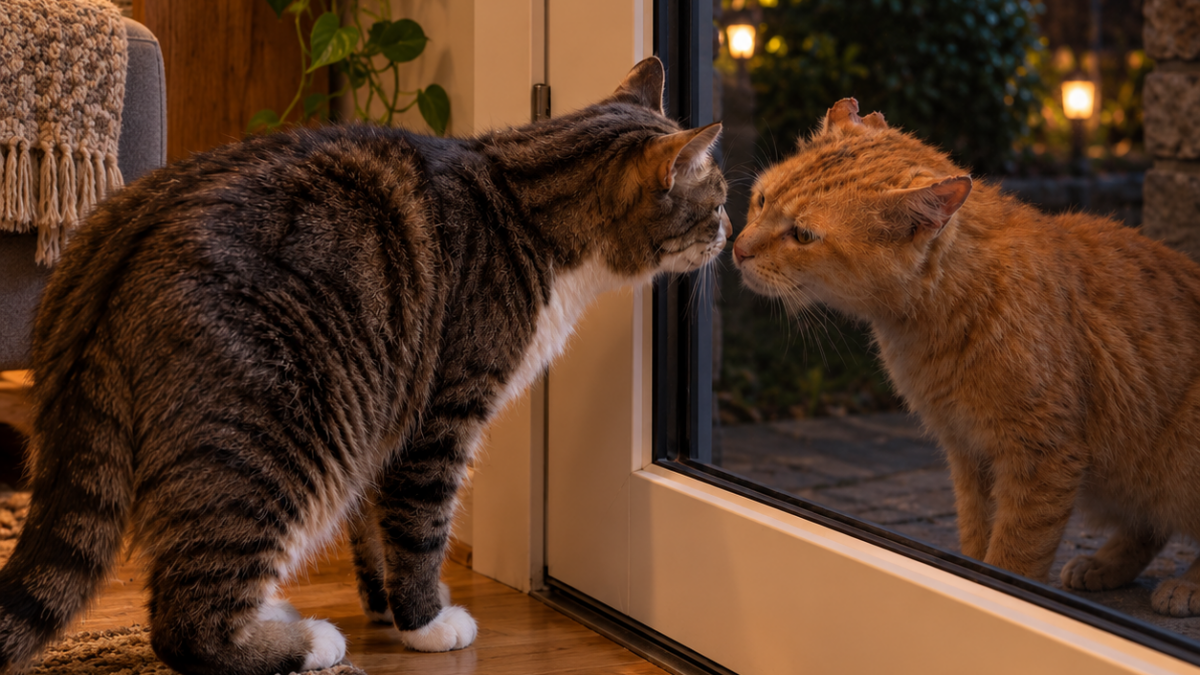
For a few seconds, the two cats simply looked at each other through the door.
Then Leo lowered his head.
He pushed the piece of chicken forward with one paw.
The food slid beneath the small gap at the bottom of the door.
The orange cat froze.
I covered my mouth.
“No way.”
The cat sniffed.
Moved closer.
Picked up the chicken.
And disappeared into the darkness.
Leo watched him go.
Then he turned around, walked calmly back into the kitchen, and climbed onto his usual chair.
That was it.
No excitement.
No expectation of praise.
No dramatic reaction.
He simply settled down as if he had completed a task he had been doing for days.
I stood on the stairs staring at him.
“Leo.”
He looked up.
“You’ve been feeding somebody?”
He blinked.
I walked over and sat on the floor beside him.
“How long?”
Of course, he didn’t answer.
But suddenly the entire week made sense.
One piece of chicken.
11:40.
The front door.
Leo had not developed a meaningless habit.
He had established a routine with a hungry cat outside.
And apparently, both of them understood it perfectly.
That night, I replayed the recording four times.
The orange cat’s appearance lasted less than thirty seconds.
But each time I noticed something new.
How cautiously he approached.
How Leo never rushed him.
How the stray waited until the house was quiet.
How quickly he disappeared after eating.
Most of all, I noticed how thin he looked.
Not dramatically so.
Not the kind of image designed to shock anyone.
Just thin enough that you knew meals were probably uncertain.
I looked toward Leo.
“You knew, didn’t you?”
He was grooming one paw.
“You saw him out there before I did.”
No reaction.
“And you’ve been saving food for him.”
Leo looked toward me.
Then toward the kitchen.
I laughed softly.
“Okay. Apparently this conversation is over.”
But I couldn’t stop thinking about the cat outside.
### The Next Night
I changed nothing.
That felt important.
My first instinct was to put a bowl outside immediately.
A large one.
Plenty of food.
Water.
A blanket.
Maybe a box for shelter.
Everything at once.
Then I reconsidered.
This cat was already frightened.
He trusted a routine.
He trusted Leo.
He did not trust me.
So I decided to observe before trying to help.
At 11:30, I went upstairs.
Leo ate.
11:40 arrived.
Chicken.
Door.
Waiting.
Then, almost exactly as before, the orange cat appeared.
He was more visible this time because the porch light was on.
His fur was a dusty orange, darker along the back.
The tip of one ear looked torn or perhaps simply weathered.
His eyes were bright but cautious.
Leo pushed the chicken through.
The stray ate it.
Then something changed.
Instead of immediately running away, he remained near the door.
Leo moved closer to the glass.
The orange cat stared at him.
Leo sat down.
So did the stranger.
Two cats.
One inside.
One outside.
Separated by an inch of door and an entire difference in their lives.
Leo had a warm house.
Fresh water.
A clean bed.
A ridiculous collection of toys he mostly ignored.
The orange cat had the night.
I felt something tighten in my chest.
They stayed there for almost a minute.
Then the stray disappeared.
Leo went back to bed.
The following afternoon, I bought a second food dish.
### My First Attempt
At 11:20 the next night, I placed a small amount of food outside.
Not near the sidewalk.
Not in the middle of the porch.
Right beside the door.
Then I went inside.
Leo watched me.
“I’m helping.”
He stared at the bowl.
“Yes, I know this was apparently your project first.”
He walked toward the door and sniffed beneath it.
“You can still give him chicken if you want.”
At 11:40, Leo followed his routine.
But when the orange cat arrived, he noticed the bowl.
He stopped.
Immediately.
His entire body changed.
The comfortable rhythm was gone.
The bowl was new.
New meant suspicious.
He retreated two steps.
I whispered at the camera.
“No, no. It’s okay.”
He couldn’t hear me.
Leo sat behind the glass.
The stray looked toward him.
Then at the bowl.
Then toward the street.
Several seconds passed.
Finally, he approached.
Slowly.
He sniffed the food.
A car moved somewhere nearby.
The orange cat jumped back.
I saw how easily fear controlled him.
He waited again.
Then returned.
One bite.
Pause.
Another bite.
Leo remained completely still.
He did not paw the glass.
He did not meow.
He didn’t appear jealous that another animal was eating food I had placed outside.
He simply watched.
Eventually, the orange cat finished enough to satisfy himself and walked away.
I let out a breath I hadn’t realized I was holding.
“Good job.”
Leo turned around.
Again, apparently, the compliment meant nothing.
### Our New Routine
For the next several nights, I left food outside.
Always at the same time.
Always in the same place.
I began setting out fresh water too.
The orange cat returned.
11:40.
Then 11:37.
Then 11:35.
His confidence increased in tiny increments.
The first few nights, he ate while looking over his shoulder constantly.
By the end of the second week, he sometimes sat near the bowl after finishing.
Leo joined him from inside.
They rarely made a sound.
They didn’t need to.
Their friendship seemed built almost entirely from presence.
I became fascinated by it.
If I walked too close to the window, the orange cat disappeared.
If Leo approached, he stayed.
One night I intentionally sat on the floor six feet from the door.
The stray appeared.
Saw me.
Vanished.
Leo looked back at me.
“I know.”
He continued staring.
“I ruined it.”
Leo blinked.
“I’m learning.”
The next night, I stayed farther away.
The orange cat returned.
### He Was Afraid of Hands
It took nearly three weeks before I got my first clear look at him without glass separating us.
I opened the door early one evening to place the food outside.
I didn’t realize he was already under the porch chair.
The instant the door moved, he bolted.
Not far.
Only to the edge of the yard.
I froze.
He froze.
For the first time, we stood facing each other.
He was smaller than he looked on camera.
Thin legs.
Narrow shoulders.
Old scars hidden under his coat.
The torn ear was obvious now.
But his eyes were what stayed with me.
Not wild.
Not aggressive.
Just cautious.
I lowered myself slowly onto the porch step.
“It’s okay.”
The cat backed away.
“I’m not coming closer.”
He stared.
I picked up the bowl.
Placed it gently on the porch.
Then went inside.
Through the glass, I saw him return several minutes later.
Leo was already waiting.
### Leo Never Rushed Him
That became the part I admired most.
Leo was not an especially patient cat with me.
If breakfast was late, he informed me.
If a door was closed, he complained.
If I moved him from my pillow, he considered it a personal betrayal.
But with the orange cat, Leo seemed different.
He never rushed.
Never crowded the entrance.
Never acted possessive about the food.
Once, the stray came unusually close to the glass.
Leo moved forward.
The orange cat immediately stiffened.
Leo stopped.
He sat down.
Waited.
A few seconds later, the stray relaxed.
I watched from the hallway.
“Since when are you this emotionally intelligent?”
Leo ignored me.
Maybe animals notice things we miss.
Leo didn’t know the details of the other cat’s life.
Neither did I.
But he seemed to understand one essential truth.
His friend needed space.
So Leo gave it to him.
### I Began Talking to Him
Not Leo.
The stray.
I started speaking quietly through the closed door while he ate.
“Good evening.”
His ears moved.
“That’s your dinner.”
He ate.
“Leo says you’re late.”
Leo looked at me.
“Okay, Leo did not say that.”
Night after night, I continued.
I never expected the cat to understand the words.
I wanted him to recognize my voice.
To learn that it could exist nearby without something unpleasant following it.
At first, he left the moment I spoke.
Then he tolerated one sentence.
Then two.
Eventually, I could sit several feet from the door and read while he ate outside.
That felt like progress.
Not dramatic progress.
The kind that would look meaningless to anyone who hadn’t watched how quickly he used to run.
But trust is often measured in inches.
One foot closer.
Ten seconds longer.
One less frightened retreat.
### Winter Came Harder
The nights became colder.
That worried me.
The orange cat still disappeared after eating, and I had no idea where he slept.
I placed a simple insulated shelter near the porch, far enough from the door that he wouldn’t feel trapped.
The first night, he avoided it entirely.
The second, he sniffed it.
The third, I found the blanket inside slightly disturbed.
I smiled so broadly that Leo probably thought I was ridiculous.
“You think he slept there?”
Leo was busy with breakfast.
“I’m choosing to believe he did.”
A few days later, the camera confirmed it.
At 2:13 in the morning, the orange cat returned.
He circled the shelter.
Then stepped inside.
He stayed almost four hours.
I watched the recording over coffee.
Something about knowing he had spent the coldest part of the night in a dry space made me unexpectedly emotional.
Leo sat beside me.
“He used it.”
Leo watched the screen.
“You did all this.”
He put one paw on my leg.
Whether it was acknowledgment or a request for breakfast, I’ll never know.
### Then He Disappeared
For twenty-three nights, the orange cat came.
Then, suddenly, he didn’t.
11:40 passed.
Leo waited.
11:50.
Midnight.
Nothing.
Leo stayed by the door longer than usual.
I told myself not to worry.
Stray animals have routes.
Maybe he found food somewhere else.
Maybe he had simply chosen another place to sleep.
The second night, he still didn’t come.
Leo carried the chicken to the door anyway.
Then sat beside it for almost forty minutes.
Watching.
Waiting.
I hated that.
“Come on, buddy.”
Leo didn’t move.
“He’ll come back.”
I had no idea whether that was true.
The third night, I left the porch light on.
Food remained untouched.
Water remained full.
Leo paced between the kitchen and front door.
That was when I realized I was no longer merely curious about the stray.
I cared about him.
He had become part of our household without ever entering it.
There was an empty place outside where he was supposed to be.
### The Fourth Night
At 11:52, Leo suddenly stood.
I was sitting on the couch.
His ears turned toward the door.
Then he ran.
I followed.
A shadow appeared.
Orange.
“There you are.”
The cat approached slowly.
He looked tired.
Not severely injured.
Not in obvious distress.
Just worn down.
His fur was damp from light rain.
I crouched several feet behind Leo.
“You scared us.”
The cat looked at me.
For once, he didn’t immediately retreat.
Leo pushed the chicken beneath the door.
The orange cat ate.
Then another strange thing happened.
He remained.
He lowered himself onto the porch mat and stayed there.
Leo lay down on the other side.
Two bodies facing each other through glass.
I sat against the wall and watched them.
“You missed him,” I whispered.
Leo’s tail moved once.
That night, I understood how genuine their bond had become.
### Trust Became Personal
Over the next several weeks, the orange cat allowed me closer.
Two yards.
One yard.
Six feet.
Four.
I started sitting on the porch after placing his food down.
At first, he waited at the edge of the yard until I went inside.
Eventually, hunger overcame caution.
He approached while I remained seated.
I looked away deliberately.
No direct stare.
No sudden movement.
He ate.
I listened.
The tiny crunch of food became one of the most rewarding sounds in my day.
One evening, he stopped eating and looked at me.
We were maybe five feet apart.
“Hi.”
His ears rotated forward.
“That’s it. I’m staying here.”
He took another bite.
I smiled.
Progress.
### Leo Became the Bridge
There was one method that consistently worked better than anything I tried.
Leo.
If the orange cat could see Leo through the screen door, he became calmer.
So I began opening the solid door while keeping the storm door closed.
Leo sat inside.
The stray ate outside.
Only a thin layer of glass separated them.
Soon they began meeting nose to nose against it.
The first time, I nearly grabbed my phone.
Then stopped myself.
Some moments deserved to be experienced before being recorded.
Leo pressed his nose to the glass.
The orange cat did the same.
Then both sat down.
No noise.
No tension.
Just recognition.
### The First Touch
A week later, I opened the door a few inches while standing well behind it.
The orange cat was outside.
Leo was inside.
I expected the stranger to run.
He didn’t.
Leo approached the opening.
The orange cat stiffened.
Leo stopped.
Waited.
Then the orange cat took one step.
Their noses touched through the gap.
My eyes filled immediately.
It lasted perhaps one second.
Then the stray backed away.
But he didn’t leave.
Leo sat down.
The orange cat sat too.
I whispered:
“Good boys.”
Neither acknowledged me.
### I Wanted Too Much, Too Quickly
My mistake came several nights later.
The cat had grown so comfortable around the doorway that I convinced myself he was ready.
I placed the food just inside the entrance.
Not far.
Maybe eighteen inches.
Then I opened the door and moved back.
The orange cat appeared.
Saw the bowl.
Stopped.
Leo approached him.
For a moment, I thought it would work.
Then I shifted my weight.
The floor creaked.
The orange cat spun around and ran.
He didn’t return that night.
I felt awful.
“I pushed him.”
Leo sat near the door.
“I know.”
The next night, I moved the bowl back outside.
No experiments.
No pressure.
The orange cat returned.
I apologized out loud.
“I’m sorry.”
He ate.
That was when I learned something important.
Rescue cannot be about satisfying the rescuer’s need to succeed.
It has to happen at the animal’s pace.
I wanted to bring him inside because I knew it would be safer.
He didn’t know that.
To him, inside meant unknown.
A doorway was a risk.
Humans were a risk.
So I stopped trying to create the moment.
I let him decide when it would happen.
### Spring
The weather softened.
The orange cat began spending longer periods near the house.
Sometimes I saw him during the afternoon.
He would sleep beneath a bush near the porch.
Leo watched from the window.
If the stray walked toward the side yard, Leo followed him from room to room inside, moving from window to window as though tracking an old friend.
“You have a social life now,” I told him.
Leo chirped.
I laughed.
“Better than mine.”
### The Bowl Moved One Inch
Instead of moving his food dramatically inside again, I tried something different.
One inch.
That was all.
Each evening, I moved the bowl slightly closer to the threshold.
Some nights I didn’t move it at all.
The orange cat barely seemed to notice.
Week by week, the bowl reached the doorway.
Then halfway across it.
The first time he placed one paw inside, I didn’t breathe.
Leo sat six feet away.
The orange cat stretched forward.
Ate.
Retreated.
The next night, two paws entered.
Then three.
Eventually his entire front half crossed the threshold.
But his back legs remained outside, ready to launch him to safety.
I never closed the door.
Never moved toward him.
He always had an escape route.
### “There’s Room for You Here”
I often wondered what Leo thought.
Maybe nothing complicated.
Maybe he simply recognized another cat and shared food because that is what happened to make sense to him.
I didn’t need to turn him into a tiny philosopher.
But from where I stood, his behavior carried a message I found hard to ignore.
Leo had everything he needed.
And he seemed completely unthreatened by the idea that another animal might receive something too.
Food was not diminished by sharing one piece.
Safety was not diminished by letting another cat approach.
Home was not diminished by making room.
Humans struggle with those ideas sometimes.
Leo did not.
### The Night Everything Changed
It happened on an ordinary Thursday.
No storm.
No dramatic weather.
No warning that anything important was coming.
Leo ate dinner.
11:40 came.
But instead of carrying chicken toward the door, he walked there empty-mouthed.
That was unusual.
I watched him.
He sat.
A minute later, the orange cat appeared.
I had already placed food near the threshold.
The door was open.
The orange cat stepped onto the porch.
Then inside.
One paw.
Two.
Three.
All four.
He stopped.
For the first time, the little orange cat was completely inside my house.
I was sitting on the kitchen floor twenty feet away.
My heart began pounding.
“Don’t move,” I whispered to myself.
Leo stood.
The orange cat noticed him.
They faced each other.
Everything seemed to slow.
I knew enough about cats to understand that introductions could go wrong.
There could be hissing.
Swatting.
Territorial behavior.
Fear.
I was prepared to intervene carefully if needed.
Leo took one step.
The orange cat remained still.
Another step.
The orange cat’s body was tense.
Leo stopped directly in front of him.
For one second, neither moved.
Then Leo lowered his head slightly.
The orange cat leaned forward.
Their noses touched.
No growling.
No hiss.
Nothing.
Just a greeting.
My hand flew to my mouth.
“Oh my God.”
Leo turned around.
And, as though this were the most ordinary thing in the world, he walked back toward his food bowl.
The orange cat watched him.
Then followed.
Three steps.
Five.
Seven.
He stopped near the kitchen entrance.
Leo began eating.
The orange cat looked toward me.
I stayed still.
He looked toward the open front door.
Then back at Leo.
For the first time, he had a choice between outside and inside.
And he did not immediately choose outside.
### Five Minutes
That first visit lasted five minutes.
Maybe six.
The orange cat explored only a small section of the hallway.
He sniffed the wall.
The corner of a shoe rack.
The leg of a chair.
He never came near me.
I didn’t care.
He was inside.
Then a sound from the refrigerator startled him.
He turned and ran out.
I didn’t follow.
I didn’t call after him.
I simply closed the door halfway and looked at Leo.
Leo was eating.
“You could at least pretend that was a major historical event.”
He looked at me.
Then continued eating.
### He Came Back the Next Night
That mattered more.
One visit could have been accidental courage.
Returning meant choice.
The next night, he stepped inside again.
Then the next.
Five minutes became ten.
Ten became twenty.
He began eating beside the doorway.
Leo ate several feet away.
Gradually, their dinners became shared evenings.
### The First Time He Slept Inside
Weeks later, I woke at 2:00 a.m. and noticed Leo was not beside me.
I went downstairs.
The front door was closed.
Earlier that night, the orange cat had entered, and for the first time, he had remained when I gently closed the door.
I had left the hallway light dim.
A blanket rested near the couch.
I found them in the living room.
Leo was curled on the rug.
The orange cat was asleep three feet away.
Three feet.
Not touching.
Not cuddling.
Not yet.
But sleeping.
Inside.
With his eyes closed.
I stood in the doorway for a long time.
Then I quietly went back upstairs.
### Morning
At six, I came down.
The orange cat was awake.
The second he saw me, he stood.
I stopped.
“Morning.”
He looked toward the front door.
I opened it.
Immediately.
I wanted him to learn that being inside did not mean being trapped.
The door opened whenever he needed it.
He stood at the threshold.
Looked outside.
Then looked back.
Leo approached.
The orange cat stepped onto the porch.
He remained there for several seconds.
Then trotted toward the yard.
I felt strangely sad.
Leo didn’t.
He sat beside the open door.
Waiting.
At 7:15, the orange cat came back.
That was when I knew.
The house was becoming part of his world.
### The Veterinarian
I eventually needed to make sure he was healthy.
That required a level of trust we still didn’t quite have.
So I waited until he could tolerate my presence within a few feet.
Then one afternoon, while he was eating, I extended my hand.
Not toward his head.
Just low beside me.
He froze.
Sniffed.
One step.
Another.
His nose touched my fingers.
I nearly cried.
I didn’t move.
He sniffed again.
Then walked away.
The next evening, he did it faster.
Several days later, he allowed me to touch his cheek.
One finger.
Half a second.
Then he retreated.
“Thank you,” I whispered.
The first real pet came almost two weeks after that.
He leaned into my hand.
Only slightly.
But enough.
Eventually, with patience and help, I was able to arrange a veterinary visit.
We learned that, aside from the expected issues of outdoor life, he was doing better than I feared.
He received the care he needed.
And after that, there was no question in my mind.
If he wanted the house, the house was his.
### I Never Officially Adopted Him in One Dramatic Moment
There was no single ceremony.
No day when I announced:
“You live here now.”
It happened gradually.
First a bowl.
Then shelter.
Then a doorway.
Then a blanket.
Then a place on the couch.
Then one evening I looked around and realized I had two cats.
The orange cat had stopped leaving for entire nights.
His food bowl had moved permanently into the kitchen.
There was a second litter box.
A second veterinary file.
A second favorite sleeping spot.
And somehow, Leo behaved as though this had always been the plan.
### Their First Argument
Friendship did not make them saints.
One morning, the orange cat tried to take Leo’s preferred window seat.
Leo stared at him.
The orange cat ignored him.
Leo stepped closer.
The orange cat moved approximately two inches.
Leo sat beside him with obvious disapproval.
I laughed.
“So much for unconditional generosity.”
Eventually, both squeezed onto the windowsill.
They spent an hour watching birds.
### The First Time They Slept Together
That happened months after the food-sharing began.
I came home late.
The living room was dark except for the lamp near the couch.
Leo was sleeping on one cushion.
The orange cat was beside him.
Their backs touched.
Nothing more.
But that tiny point of contact said everything.
The animal who once fled if I moved too quickly was sleeping deeply beside the friend who had first fed him.
I took one photograph.
Then turned off the lamp.
### His Fear Didn’t Vanish Overnight
That was important.
A happy ending did not erase his instincts.
Sudden knocks frightened him.
Unknown visitors sent him upstairs.
Sometimes, if I reached too quickly, he flinched before remembering where he was.
I never punished that.
Neither did Leo.
When visitors came, Leo remained downstairs.
The orange cat hid.
Later, Leo often went upstairs.
A few minutes after that, the orange cat would emerge.
I began joking that Leo served as his emotional-support cat.
The truth wasn’t far off.
### 11:40 Never Completely Ended
Even after the orange cat moved inside, something strange happened.
At 11:40, Leo sometimes still carried one piece of food toward the front door.
The first time he did it after his friend had already eaten beside him, I laughed.
“Leo. He lives here.”
Leo placed the food near the door.
The orange cat walked over.
Ate it.
Then sat beside Leo.
I shook my head.
“Fine. Tradition.”
From then on, I stopped interfering.
Some rituals deserve to survive even after they are no longer necessary.
### The Camera Footage
I kept the first recording.
For months.
Then years.
Not because I wanted to remember how frightened the orange cat had been.
Because the video captured the beginning of something none of us understood at the time.
Leo sitting quietly.
Chicken beneath the door.
A cautious face appearing from the dark.
If you watched only those few seconds, you would never know where they led.
To a warm house.
A veterinary visit.
A second bed.
Shared windowsills.
Arguments over cardboard boxes.
Afternoon naps.
Safety.
### The Reversal
This was the only kind of revenge I wanted for that orange cat.
Not retaliation.
Not suffering returned to whoever had failed him.
Something better.
A life so secure that his past no longer controlled the ending.
Once, he had waited outside a closed door for a single piece of chicken.
Now he could walk into the kitchen whenever he wanted.
Once, he disappeared into the darkness after every meal.
Now he fell asleep on my couch.
Once, my footsteps made him run.
Now he sometimes followed me from room to room.
Once, he approached our home only because Leo made the doorway feel safe.
Now it was his doorway too.
That was enough.
### One Winter Later
Almost exactly a year after I first discovered Leo’s secret, snow fell overnight.
I woke early.
The backyard was white.
Leo sat at the window.
The orange cat sat beside him.
I made coffee.
Then I noticed the time displayed on the microwave.
11:40 a.m.
Not night.
Still, the number made me smile.
I took a piece of cooked chicken from the refrigerator.
I divided it in two.
One for Leo.
One for his friend.
They ate side by side.
No door between them.
### I Often Thought About the First Week
How many times had I picked up Leo’s carefully placed piece of food and returned it to his bowl?
Three?
Four?
I laughed at myself whenever I remembered.
Leo must have thought I was impossible.
He carried food to the door.
I carried it back.
He carried it again.
I moved it again.
Night after night, he kept trying until I finally became curious enough to look.
There is something humbling about realizing your cat understood a situation before you did.
### What Had Leo Seen?
I still don’t know how their friendship began.
Maybe Leo spotted the orange cat through the window.
Maybe the stray approached one night and Leo smelled him beneath the door.
Maybe the first piece of food was accidental.
Maybe Leo dropped it, the stray ate it, and a routine formed.
There was no way to know.
But by the time I noticed, the agreement between them was established.
11:40.
Chicken.
Door.
Return tomorrow.
### No Contract Needed
Humans often require explanations for relationships.
When did you meet?
Who approached first?
Why did you trust each other?
Animals can skip all of that.
Leo had food.
The other cat was hungry.
Somehow, that became enough to start.
### The Orange Cat Changed Too
Once he became comfortable indoors, personality emerged beneath the caution.
He was playful.
More than I expected.
He loved paper bags.
He attacked shoelaces.
He became obsessed with the reflection from my watch when sunlight hit it.
And he talked.
Constantly.
The cat who once approached in complete silence eventually developed a loud opinion about breakfast.
Leo seemed occasionally offended by this.
“You created this problem,” I told him.
The orange cat meowed.
Leo walked away.
### His Favorite Place
Ironically, his favorite sleeping place became the rug near the front door.
The same door he had once approached only from outside.
Sometimes I would come downstairs and find him stretched across it, belly exposed, asleep.
The transformation never stopped affecting me.
A doorway that once represented uncertainty had become one of the safest places in his world.
### The Torn Ear
His ear never became perfectly shaped.
And I was glad.
Not because I wanted him marked by a difficult past.
Because it became part of his face.
Part of him.
He was not valuable despite being imperfect.
He was simply himself.
Leo certainly didn’t care.
Neither did I.
### People Asked Which Cat Saved Which
Friends who heard the story would say:
“Leo saved him.”
I understood what they meant.
But sometimes I thought the orange cat gave Leo something too.
Before him, Leo’s life was comfortable.
Predictable.
He had me.
He had his routines.
Then suddenly he had responsibility.
A friend to watch for.
Someone to wait for.
Someone to share with.
When the orange cat disappeared those three nights, Leo’s behavior made it clear that the relationship mattered to him.
Compassion can change the giver too.
### The First Visitor He Didn’t Hide From
Nearly eighteen months after he started coming inside, my sister visited.
The orange cat normally avoided guests.
That afternoon, he disappeared upstairs as soon as the doorbell rang.
Predictable.
My sister sat on the couch.
Leo greeted her.
Twenty minutes passed.
Then the orange cat appeared at the top of the stairs.
He watched.
Leo jumped onto the couch beside my sister.
The orange cat came down one step.
Then another.
Eventually, he crossed the room.
He did not let her touch him.
But he remained.
That was enough.
My sister whispered:
“Is that him?”
“Yes.”
“The 11:40 cat?”
I smiled.
“That’s him.”
She looked at Leo.
“And that’s the food smuggler?”
“Exactly.”
### The Food Smuggler
That became Leo’s unofficial nickname.
Every time he stole a treat from the kitchen, I said:
“Once a smuggler, always a smuggler.”
He never looked remorseful.
### One Piece
I think that is why the story stayed with me.
Leo never gave away his entire dinner.
He didn’t drag the bowl outside.
He didn’t perform some impossible act of sacrifice.
He shared one piece.
Small.
Manageable.
Consistent.
We sometimes imagine kindness has to be enormous to matter.
Leo proved otherwise.
For a hungry animal, one piece mattered.
Then another the next night.
And another.
Small kindness repeated becomes something much larger than the individual act.
It becomes reliability.
Reliability becomes trust.
Trust opens doors.
Literally, in our case.
### If I Had Opened the Door on Night One
I have wondered what would have happened.
Probably the orange cat would have run.
Maybe he would not have returned for days.
Maybe our desire to help would have frightened him away.
Leo’s approach was better.
No grabbing.
No chasing.
No demands.
Here is food.
Take it if you want.
Come back tomorrow if you need more.
There was wisdom in that simplicity.
### The Night I Finally Understood Leo
Months after both cats were sleeping comfortably inside, I found myself thinking about why Leo never ate the piece he carried to the door.
Cats are not famous for unnecessary generosity around food.
Leo especially.
Yet he repeatedly left something valuable somewhere else.
Maybe he associated the orange cat with hunger.
Maybe he knew what it was to anticipate dinner and recognized that same need.
Maybe I was projecting too much human meaning onto feline behavior.
It didn’t matter.
Whatever mechanism existed inside Leo’s mind, the result was compassion in action.
### A House Is Not Just Walls
The orange cat taught me that too.
At first, I thought rescuing him meant bringing him physically indoors.
But entering a building and feeling at home are different things.
The walls could keep out rain.
The heater could provide warmth.
The food could fill his stomach.
Trust took longer.
A home is also knowing the door will open.
Knowing a hand will stop when you pull away.
Knowing food will still be there tomorrow.
Knowing the other cat will not attack you for existing.
Knowing sleep is safe.
That took months.
And it was worth every one of them.
### Two Years Later
If someone had visited my house without knowing the story, they never would have guessed.
They would have seen two cats.
Leo, calm and confident.
The orange cat, slightly more cautious but completely comfortable in familiar surroundings.
Two bowls.
Two beds.
A ridiculous number of toys.
Nothing dramatic.
And that was exactly what I wanted.
A rescue story that eventually stopped looking like a rescue story.
Just life.
### The Camera Came Down
One afternoon, I finally removed the camera near the door.
It had been there so long I barely noticed it anymore.
I held it in my hand.
Leo watched.
“That’s the thing that exposed you.”
He walked away.
The orange cat came over and sniffed it.
“And you.”
He rubbed his cheek against the corner.
I laughed.
Then I put the camera in a drawer.
We didn’t need it anymore.
Nobody outside was waiting for one piece of chicken.
Everyone who belonged there was already inside.
### But I Kept the First Video
Of course I did.
### Years Later
Every so often, I still watch it.
The quality isn’t especially good.
The angle is low.
The porch lighting is poor.
Leo takes up half the frame.
Then the orange face appears.
The food slides beneath the door.
The cat eats.
Gone.
Less than a minute.
That tiny recording contains the entire beginning.
### Some Stories Begin With Noise
Sirens.
Shouting.
A dramatic rescue.
Ours began quietly.
A food bowl.
A kitchen.
A clock.
11:40.
### I Had Almost Missed It
That thought always humbles me.
I could have continued picking up the chicken forever.
Maybe eventually I would have noticed the stray another way.
Maybe not.
Leo kept repeating the message until I paid attention.
### The Lesson Was Never “Cats Are Better Than People”
People sometimes turn animal stories into that.
I don’t.
Humans fed the orange cat.
Provided veterinary care.
Built shelter.
Opened the house.
Patience came from both species.
What Leo reminded me was simpler.
Compassion is not owned by humans.
We are not the only creatures capable of responding to another being’s need.
### Leo Never Wanted Credit
He didn’t know the camera existed.
He didn’t know I was impressed.
He certainly didn’t know anyone might eventually hear the story.
That made the act more meaningful to me.
There was no audience.
Only another hungry cat.
### The Best Kind of Kindness
The kind nobody sees.
The kind that happens because someone needs it.
### His Friend Became Family
One evening, I realized I had stopped referring to him as “the stray.”
I don’t remember exactly when.
At some point, he was simply Leo’s friend.
Then my cat.
Then family.
Language had caught up with reality.
### A Stormy Night
Much later, heavy rain struck after midnight.
Wind pushed against the windows.
The orange cat startled at the sound.
Old instincts.
He ran toward the hallway.
Leo followed.
I found them under the dining table.
The orange cat crouched close to the floor.
Leo sat beside him.
I lowered myself several feet away.
“It’s okay.”
Lightning flashed.
The orange cat moved closer to Leo.
Leo did nothing dramatic.
He stayed.
Eventually, the cat relaxed.
That was their relationship in one scene.
Leo stayed.
### Staying Matters
Food started it.
Presence sustained it.
### The Happiest Revenge
If there was revenge against the loneliness and fear that had shaped the orange cat’s old life, it looked like this:
He became expected.
At dinner.
At bedtime.
At the window.
On the couch.
When I came home, I looked for two cats.
If only one appeared, I asked where the other was.
His existence had become part of the rhythm of the house.
He was no longer invisible.
That was the reversal.
### One Night at 11:40
Several years after the first video, I happened to be awake in the kitchen at exactly 11:40.
Leo was older.
The orange cat was asleep on a chair.
I looked at the clock.
11:40.
Then at Leo.
“Do you remember?”
Leo walked to his bowl.
Picked up one piece of chicken.
I started laughing.
“No.”
He carried it toward the front door.
For one second, emotion hit me so quickly I couldn’t speak.
Then Leo turned.
Instead of leaving the food at the threshold, he carried it to the chair.
The orange cat lifted his head.
Leo dropped the chicken beside him.
The orange cat ate it.
I stood frozen.
Maybe it was coincidence.
Maybe not.
I will never know.
But tears filled my eyes anyway.
“You’re still doing it.”
Leo sat beside the chair.
His friend licked his lips and settled back down.
The ritual had changed location.
The reason had disappeared.
The friendship had not.
### That Became My Favorite Memory
More than the camera footage.
More than the first entry into the house.
More than the nose touch.
An old habit transformed.
Once:
Chicken to the door.
Later:
Chicken directly to his friend.
No barrier.
No darkness.
No waiting.
### Leo Grew Older
Time does what time always does.
Gray hairs appeared around his face.
He slept more.
Jumped less.
The orange cat, once the weaker and more cautious of the two, became the one who sometimes waited for Leo.
Roles changed.
If Leo moved slowly toward the kitchen, his friend stayed nearby.
If Leo slept, the orange cat often chose the closest cushion.
Their relationship had begun with one helping the other.
Eventually, it became mutual.
That felt right.
### I Thought About the First Chicken
Was that the beginning?
Maybe.
One tiny piece.
Leo could have eaten it.
He didn’t.
The orange cat could have been too frightened to approach.
He wasn’t.
Two small decisions.
A friendship.
A home.
Years.
### We Never Know What Small Choices Become
That is perhaps what I carry from their story more than anything else.
We see moments in isolation.
A meal.
A bowl.
A door.
A cautious animal.
We rarely see the future hiding inside them.
### The Orange Cat Learned One More Thing
He learned to ask.
That transformation may have been the sweetest.
At first, he accepted only what was offered.
Later, he began walking to his bowl and looking at me when hungry.
Eventually, he meowed.
The first time he did, I laughed.
“Well, look at you.”
He meowed again.
“You used to run if I breathed too loudly.”
Another meow.
“Now I’m apparently late with dinner.”
Leo looked toward me as if to say:
I warned you.
### Safety Creates Personality
Fear had once hidden nearly everything interesting about him.
Once safety arrived, humor appeared.
Stubbornness.
Preference.
Curiosity.
Affection.
Even mischief.
That is one reason rescue stories shouldn’t end at the moment of rescue.
The best part often comes afterward.
When an animal finally has enough peace to become himself.
### He Was Funny
He stole warm laundry.
Slept on freshly folded towels.
Discovered that cabinet doors could sometimes be opened with a paw.
Developed an irrational feud with the vacuum cleaner.
Learned that 5:00 a.m. was technically a valid breakfast time if he meowed long enough.
Leo had created a monster.
A very lovable one.
### I Told Him That
Frequently.
“You know this is your fault.”
Leo never accepted responsibility.
### The Front Door Lost Its Power
For a long time, the orange cat watched the front door nervously whenever it opened.
Eventually, even that changed.
He learned that doors could open without meaning he had to flee.
He could sit five feet away while I brought groceries inside.
He could watch delivery drivers.
He could remain in the room.
One afternoon, the door stood open while I carried boxes.
The orange cat sat inside.
He looked toward the porch.
Then toward me.
He did not run outside.
Not because he was trapped.
Because he chose to stay.
That choice moved me more than I expected.
Freedom means being able to leave.
Home means choosing not to.
### Leo Never Closed the Door
That became the symbolic center of the story for me.
Leo’s kindness had never demanded captivity in return.
He shared food first.
Trust first.
Choice first.
The house came later.
### A Friend Asked Me Once
“Why do you think the stray trusted Leo before he trusted you?”
I answered immediately.
“Because Leo never wanted anything from him.”
That was the truth.
I wanted to rescue him.
Feed him.
Touch him.
Bring him inside.
Take him to the vet.
Give him safety.
Good intentions.
But intentions are still desires.
Leo’s approach was simpler.
Here.
Eat.
I’m staying over here.
See you tomorrow.
Trust grew in that space.
### I Learned From My Cat
Patience.
Distance.
Consistency.
How to help without forcing.
Not bad lessons.
### The Final Years of the Story
I wish every rescue could become this ordinary.
No emergency.
No final dramatic battle.
Just time.
The orange cat grew healthy.
Leo grew older.
They remained companions.
The 11:40 ritual faded into household mythology.
Occasionally, friends asked me to tell the story again.
I always started the same way:
“Every night, my cat stole one piece of chicken.”
Someone would laugh.
Then I told them about the door.
The camera.
The orange face.
The waiting.
By the end, they usually weren’t laughing anymore.
Then I told them he lived with us now.
And they smiled again.
That was the proper emotional order.
Curiosity.
Concern.
Hope.
Relief.
### The Story Needed a Happy Ending
Not because all stories deserve to be artificially cheerful.
Because this one actually had one.
The frightened cat came inside.
Leo accepted him.
I earned his trust.
He received care.
He stayed.
That was enough.
### The Most Satisfying Ending Was Also the Simplest
One winter evening, years after the night I first installed the camera, I walked into the living room.
Both cats were asleep.
Leo lay near the heater.
The orange cat slept beside him.
Their paws touched.
Snow fell outside.
The front door was locked for the night.
Food waited in the kitchen.
Water bowls were full.
The house was quiet.
I stood there looking at them.
Then at the clock.
11:42.
I smiled.
Two minutes late.
Nobody was waiting outside anymore.
### I Thought About the Old Routine
11:40.
Leo carries chicken.
Leo waits.
Orange cat arrives.
Food passes under the door.
Orange cat disappears.
Again.
Again.
Again.
Until I finally see.
### Then I Looked at What We Had Now
No gap beneath a door was needed.
No midnight visitor.
No fear of being seen.
No disappearing into darkness.
Just two cats asleep inside the same home.
If you want to call that revenge against everything the orange cat had endured before reaching us, then fine.
It was the gentlest revenge imaginable.
He lived well.
### What Happened to Whoever Had Failed Him Before?
I don’t know.
I never learned his history.
Maybe he had been born outside.
Maybe he had once belonged to someone.
Maybe he had gotten lost.
Maybe there was a family somewhere who had wondered what happened.
I refused to invent villains simply to make the story more dramatic.
The past remained unknown.
What mattered was that the future stopped being unknown.
He had us.
### Truth Was Better Than a Villain
Because Leo’s kindness did not require one.
You do not need a monster in a story for compassion to matter.
Sometimes hunger itself is enough of an enemy.
Loneliness.
Fear.
Cold nights.
Uncertainty.
Those were the things Leo defeated one tiny piece at a time.
### One Piece at a Time
That phrase still stays with me.
No grand rescue.
One piece.
Then another.
Trust.
Then another.
A bowl.
A shelter.
A touch.
A doorway.
A house.
A family.
### Leo Was Never Trying to Change the World
At least I doubt it.
He was helping one cat.
Maybe that is how the world changes most often anyway.
Not everywhere.
Not everyone.
One.
### The Orange Cat Didn’t Need the Whole World
He needed one safe door.
### And Leo Showed Him Which One
That is why I can never think of 11:40 as just a time anymore.
Whenever I notice it on a clock, I remember the camera screen.
Leo waiting.
The little orange face appearing from the night.
The piece of chicken sliding under the door.
I remember how close I came to dismissing the whole thing as an odd habit.
Then I remember everything that followed.
### My House Became Bigger Without Changing Size
Two cats instead of one.
More food.
More fur.
More veterinary appointments.
More scratched furniture.
More joy.
There was room.
Leo had known that before I did.
### The Message I Imagined
I know Leo didn’t speak in sentences.
Still, if I had to translate that first act of kindness into words, I think it would have sounded something like:
I know you’re out there.
I know you’re hungry.
I saved this.
Come back tomorrow.
And later:
You can come closer.
Then:
You can step inside.
And eventually:
You can stay.
### There’s Room for You Here
Those became the words I associated with the story most.
There was room.
Not because our house was huge.
Not because life was perfect.
Because kindness made room.
### The Last Time Leo Carried Chicken
As he became older, the ritual happened less often.
Then one evening, he did it again.
11:40.
He carried a small piece toward the orange cat.
Dropped it.
His friend ate.
Then, unexpectedly, the orange cat leaned forward and licked the side of Leo’s face.
Once.
Leo looked mildly offended.
I laughed so hard tears came.
“After all these years, that’s your thank-you?”
The orange cat curled beside him.
Leo accepted it.
### That Was Enough
No speeches.
No recognition.
No medal for Leo.
No explanation from the orange cat.
Just years of companionship born from one small act nobody was supposed to notice.
### What Leo Taught Me
Kindness does not have to announce itself.
It does not need an audience.
It does not need to solve everything.
Sometimes kindness is simply noticing that somebody else has less than you do and deciding to share a little.
Then doing it again tomorrow.
### Consistency Is Love Too
That may be the most important thing.
One piece of chicken might have fed the orange cat for a moment.
Returning every night told him something else.
There will be food tomorrow.
I will be here tomorrow.
You can come back tomorrow.
For a frightened animal, tomorrow is a powerful promise.
### Eventually, Tomorrow Became Home
And home became years.
### If I Had Never Installed the Camera
Maybe Leo would have continued.
Maybe the cat would have kept coming.
Perhaps eventually I would have met him anyway.
But I’m grateful curiosity made me watch.
Because I got to witness something I might otherwise have missed completely.
A private act of generosity.
### The Camera Showed Me More Than a Cat
It showed me my own assumptions.
I thought Leo was wasting food.
He was sharing it.
I thought the repeated behavior was pointless.
It had purpose.
I thought I was the caregiver in the house.
Apparently, I wasn’t the only one.
### That Made Me Smile
Still does.
### The Happy Ending Was Not the First Night Inside
It wasn’t the vet visit.
It wasn’t the first touch.
It wasn’t even adoption.
The happy ending happened repeatedly.
Every time the orange cat slept peacefully.
Every meal he expected instead of hoped for.
Every time a visitor arrived and he recovered from fear faster.
Every time he and Leo shared the window.
Every morning he woke in the same safe place.
Happy endings are often daily habits.
### A Different 11:40
Years later, I woke one night and checked my phone.
11:40.
I walked downstairs.
No reason.
Maybe memory pulled me there.
Leo was asleep.
The orange cat was awake near the window.
I sat beside him.
He glanced at me.
For the first time, I thought about how strange my presence might once have seemed to him.
The human behind the dangerous door.
The one he avoided.
Now he climbed onto the couch beside me.
He pressed against my leg.
I touched his head.
He closed his eyes.
No hesitation.
### I Whispered
“You came a long way.”
He purred.
That was the only answer I needed.
### The Door
I looked toward it.
The same door.
Nothing special.
Paint.
Lock.
A narrow gap beneath it.
Once, that gap had been enough for a piece of chicken.
Then enough for hope.
Then eventually unnecessary.
I don’t think I will ever replace that door unless I absolutely have to.
Not because it is beautiful.
Because I know what crossed beneath it.
### A Tiny Gift
That’s all.
### But Tiny Gifts Can Become Bridges
Leo built one.
Chicken by chicken.
Night by night.
### And the Orange Cat Crossed It
First with trust.
Then with his paws.
Then with his whole life.
### A Final Winter Morning
One morning I found them sitting together in the sun.
Leo’s body had become thinner with age.
The orange cat looked strong.
Healthy.
Comfortable.
Their shoulders touched.
Outside, birds moved through the bare branches.
Inside, warmth.
I took a photograph.
Not because it was dramatic.
Because it wasn’t.
That photograph eventually became my favorite.
Two ordinary cats.
No visible evidence of the story behind them.
If someone saw it without context, they might scroll past.
I never could.
I knew what it meant.
### Once Outside
Now inside.
### Once Hungry
Now fed.
### Once Frightened
Now sleeping in sunlight.
### Once Alone
Now beside a friend.
That was the ending.
### Leo’s Quiet Victory
Leo never chased away the darkness.
He simply gave his friend one reason to return from it.
Again and again.
Eventually, the return became permanent.
### I Still Think About That
When people talk about changing lives, they often picture enormous gestures.
Money.
Heroism.
Sacrifice.
Sometimes those things matter.
But sometimes the difference between loneliness and connection is one small reliable kindness.
### One Piece of Chicken
That is almost absurdly simple.
Yet I saw where it led.
### The Final 11:40
The last scene I want to remember happened long after the camera was gone.
I was washing a mug in the kitchen.
The clock changed.
11:40.
Leo lifted his head.
The orange cat was sleeping near the doorway.
For a second, Leo looked toward his bowl.
Then toward his friend.
He didn’t carry anything.
He didn’t need to.
He walked over and lay down beside him.
The orange cat opened his eyes.
Recognized Leo.
Closed them again.
I turned off the kitchen light.
Before going upstairs, I looked back.
Two cats.
One doorway.
No one outside.
No one hungry.
No one waiting alone in the dark.
And suddenly, the entire story seemed contained in that quiet room.
Leo had once carried food across the kitchen because a frightened animal couldn’t come any farther.
Now he crossed the same kitchen simply to sleep beside his friend.
That was progress.
That was trust.
That was love in the quietest form I had ever witnessed.
I used to think Leo was leaving one piece of food by the door.
I know better now.
He was leaving an invitation.
Not a dramatic one.
Not one spoken in words.
Just enough to say:
I see you.
You can come back.
There will be something here for you.
Night after night, that message waited at 11:40.
Eventually, the orange cat believed it.
First enough to approach the porch.
Then enough to eat.
Then enough to stay.
Then enough to cross the threshold.
And finally enough to sleep inside a home he had once been too frightened even to enter.
People sometimes ask when the rescue happened.
I never know what date to give them.
Was it the night Leo shared the first piece?
The night I installed the camera?
The first bowl I left outside?
The first time the orange cat touched my hand?
The first time he entered?
The first night he slept indoors?
Maybe rescue was all of those moments.
Maybe some lives aren’t changed in one dramatic second.
Maybe they change slowly, when kindness keeps showing up at the same time every night.
That is how it happened in our house.
No grand gesture.
No applause.
Just Leo.
A bowl of food.
A frightened orange cat.
And one piece of chicken carried patiently toward a closed door.
Again.
And again.
And again.
Until one night, the door no longer needed to separate them.
The orange cat came inside.
Leo welcomed him.
And he never again had to wonder whether there would be something waiting for him tomorrow.
Because by then, he finally understood.
There wasn’t just food waiting.
There was a friend.
There was safety.
There was a place beside the window.
There was a warm floor on cold nights.
There was a human who had learned to wait instead of chase.
There was a home.
And most importantly, there was room for him.
All because one little cat looked at what he had, looked toward somebody who had less, and quietly decided:
**I can share.**

