PART 2: Every Morning, the Starving Dog Waited at an Abandoned Post Office—Then I Learned Why He Lifted His Head at Every Car
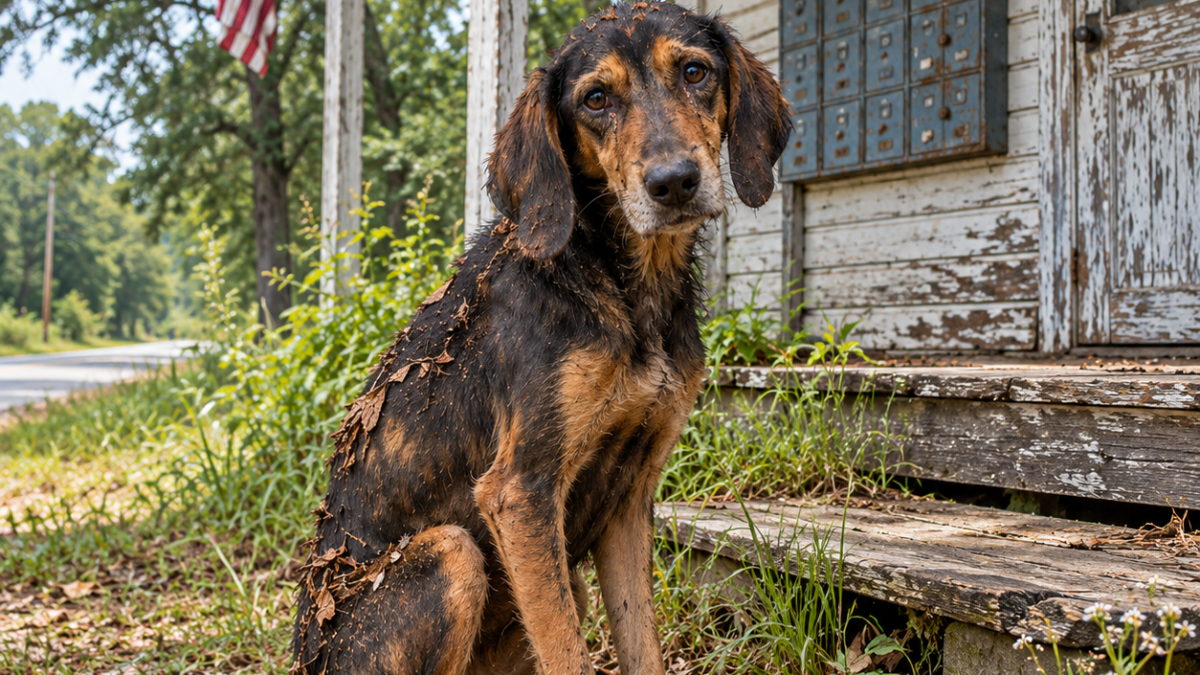
PART 2
The first step was easy.
The second wasn’t.
Clay—as he would eventually be named—walked three feet beside me before he stopped again.
The leash went slack between us.
He turned his head toward the post office.
Rain tapped against the tin awning.
The old building seemed even smaller in the gray morning, its warped porch and broken mailbox slots hardly worthy of the loyalty this dog had given it.
“Come on.”
Nothing.
I stepped closer.
He did not back away from me anymore.
That was progress.
But he would not move forward either.
His eyes stayed fixed on the building.
I crouched beside him.
“I don’t know who you’re waiting for.”
One ear shifted.
“I don’t know if they’re coming.”
The words hurt to say because I had no right to make that conclusion.
Maybe someone was looking.
Maybe the dog had wandered miles.
Maybe the post office was simply the first quiet shelter he found.
Maybe all my ideas about waiting were exactly that—ideas.
Animals do not hand us their biographies.
They give us behavior.
We build stories around it.
Sometimes correctly.
Sometimes not.
But I knew one thing.
Whatever had brought him there, staying was hurting him.
He was too thin.
Too dehydrated.
His coat smelled like wet dirt.
One patch along his hip had been rubbed nearly bare.
The tips of his ears were irritated from insects.
He needed help.
I placed a piece of chicken on the ground between us.
He looked.
Then at me.
Then back toward the post office.
“You are allowed to leave.”
I moved the food one step closer to the truck.
Clay followed.
Another piece.
Another step.
It took nearly twenty minutes to cross a distance I could have walked in thirty seconds.
When we reached the truck, I opened the rear door.
Clay froze again.
Cars were different.
A building was static.
A vehicle meant movement.
Whatever history existed between him and cars, I couldn’t know yet.
I laid the blanket I had been bringing him on the seat.
The same one he had refused to lie on.
He smelled it.
Then placed one front paw inside.
Stopped.
Second paw.
His back legs stayed on the ground.
For several seconds, he existed half in the truck and half out.
A perfect summary of where his trust was.
I did not push.
Eventually he climbed in.
Then immediately turned around.
His eyes went back to the post office.
I almost closed the door.
Stopped.
Instead, I sat on the edge of the seat beside him.
We watched the building together.
Rain moved across the empty gravel.
No car came.
No person appeared on the porch.
The dog breathed slowly.
Finally he lowered himself onto the blanket.
That was when I closed the door.
“Okay.”
Clay looked at me through the window.
“You don’t know this yet, but we’re going somewhere better.”
I drove carefully.
At the first intersection, I looked in the mirror.
Clay was standing.
Watching through the rear window.
I wondered whether dogs understand distance.
Whether every turn felt like another layer between him and the thing he believed mattered.
At the veterinary clinic, he refused to jump out.
Fair.
I lifted him.
He weighed much less than he should have.
The moment his body settled into my arms, I felt every rib.
I had known he was thin.
Feeling it was different.
“Hey.”
His head turned toward my chest.
“You’re okay.”
I carried him inside.
The receptionist looked up.
“Oh.”
That one syllable told me how bad he looked.
“We found him near the old post office.”
“How long?”
“I’ve been feeding him about a week. People say he’s been there longer.”
She came around the desk.
“Any owner?”
“Not yet.”
“Microchip?”
“That’s why we’re here.”
We scanned him.
Nothing.
Again.
Nothing.
No tag.
No collar.
No tattoo.
No easy answer.
Dr. Morgan examined him.
“Male. Probably six or seven.”
“Older than I thought.”
“Hound mixes can gray early.”
Clay’s muzzle had faint silver around the chin.
The veterinarian checked his gums.
“Dehydrated.”
His body condition.
“Significantly underweight.”
His paws.
“Raw between the pads.”
Ears.
“Some infection.”
Skin.
“Fleas, ticks, probably intestinal parasites.”
Nothing catastrophic.
Everything cumulative.
The slow damage of being outside too long.
“Can he recover?”
Dr. Morgan looked at me.
“Yes.”
That simple answer loosened something in my chest.
“What do we do?”
“Slow feeding. Parasite treatment. Fluids today. Bloodwork. We need to watch for underlying disease because not everything is necessarily from being stray.”
“Can I take him home?”
The veterinarian smiled.
“You already decided that, didn’t you?”
“I didn’t say permanently.”
“Neither did I.”
Clay sat beside my leg.
Dr. Morgan looked down.
“He did.”
I ignored her.
Temporary.
That was the word I used.
Temporary foster.
Temporary bed.
Temporary bowls.
Temporary arrangement.
Rescue people use “temporary” the way frightened people use umbrellas.
We pretend the word protects us.
That afternoon, I drove Clay home.
My house sat on two acres outside town.
I had a fenced side yard, a screened porch, and one resident dog named Rosie, a twelve-year-old beagle who believed enthusiasm was for younger animals.
Before bringing Clay inside, I put Rosie in another room.
I let him explore alone.
Clay stepped through the doorway.
Stopped.
His nose worked rapidly.
Wood floor.
Furniture.
Laundry detergent.
Old dog.
Food.
Human.
He stood there for so long I worried he might panic.
Then he walked one step.
Another.
He found the water bowl.
Drank.
Found the kitchen.
Found Rosie behind the baby gate.
Rosie stared.
Clay stared.
Rosie yawned.
Excellent diplomacy.
I had prepared a bed in the laundry room.
Blankets.
Low light.
Quiet.
Clay walked right past it.
He went to the front door.
Sat.
I stopped.
Of course.
I sat beside him.
“You’re not going back tonight.”
Clay watched the door.
“I know that means nothing to you.”
He remained there.
For almost two hours.
At six, I fed him.
He ate.
Returned to the door.
At eight, I walked him outside on leash.
He did his business.
Then pulled toward the driveway.
Not strongly.
Just enough to tell me where he wanted to go.
The road.
Back.
I stood still.
“No.”
Clay looked at me.
“Not tonight.”
He returned inside.
Sat at the door again.
I put the blanket from the post office beside him.
This time, he lay on it.
That felt like something.
At eleven, I turned off the lights.
Clay remained near the entrance.
Rosie slept in my bedroom.
I checked once before going to bed.
The new dog’s head rested on his paws.
Eyes open.
Waiting.
At 2:13 a.m., I woke.
Something had changed.
No sound.
I walked toward the hall.
Clay was standing at the front door.
Tail moving.
I froze.
Headlights swept across the wall.
A car passed outside.
Clay’s tail wagged harder.
He listened.
The engine faded.
Tail stopped.
He lay down.
I stood in the dark.
That was when I stopped wondering whether I had imagined the pattern.
Cars mattered.
Not all sounds.
Cars.
He expected something from them.
The next morning, I called everyone.
County shelter.
Animal control.
Neighboring rescues.
Veterinary offices.
Sheriff’s non-emergency line.
I posted him in lost-and-found groups.
Not a dramatic story.
Just facts.
FOUND MALE BLACK-AND-TAN HOUND MIX.
Rural Georgia.
Distinctive white patch under chest.
Approximate age.
Proof of ownership required.
Within hours, messages came.
“My cousin lost a dog like that.”
Different markings.
“My neighbor’s hound ran away.”
Female.
“Could be my dad’s.”
Dog found at home.
Nothing.
I drove back to the post office without Clay.
I wanted to look more carefully.
The building had been closed for almost eight years.
According to a faded county notice still stapled near the door, mail services had moved to a larger facility twelve miles away.
There was no official reason for anyone to stop there regularly anymore.
But the gravel showed fresh tire marks.
Probably locals turning around.
Hunters.
Utility workers.
Teenagers.
The kind of rural place people still use long after the purpose disappears.
I walked around the side.
Behind the building was a narrow covered area where packages had once been unloaded.
There I found an old water bowl.
Plastic.
Cracked.
Sun-faded.
Not recent.
Not proof of anything.
But someone had once fed an animal there.
Then I noticed a chain attached to a post.
My stomach dropped.
Rusty.
Old.
Maybe years old.
Maybe used for something else entirely.
I photographed it.
No conclusions.
Just data.
At the diner that afternoon, I started asking.
The old post office?
People remembered.
A woman named Carol had worked there before it closed.
“Dog?”
She frowned.
“Black and tan?”
“Yes.”
“How old?”
“Maybe six.”
She shook her head.
“Wouldn’t be the same one I’m thinking.”
“Why?”
“The one that used to come around belonged to Earl.”
“Earl who?”
She named him.
Earl Patterson.
Retired mail carrier.
Lived somewhere near Mill Creek Road.
Carol continued.
“He had a hound pup years ago. Brought him everywhere.”
My pulse changed.
“What color?”
“Black and tan.”
“Name?”
She stared at the counter.
“Something simple.”
I waited.
“Clay?”
My chest tightened.
“Clay?”
“Maybe.”
That was the first time I heard the name.
“What happened to Earl?”
Carol’s expression changed.
“He got sick.”
“How long ago?”
“Couple years.”
“Is he alive?”
“I don’t know.”
That was all it took.
The dog became Clay before I had proof.
Not because I wanted to rename him.
Because the sound fit the red dirt covering his legs.
Because Carol remembered it.
Because when I returned home and said:
“Clay?”
the dog lifted his head.
Not just an ear.
His whole head.
Rosie looked too.
I tried again.
“Clay.”
Tail.
One slow movement.
I sat down.
“Oh.”
He came toward me.
That was new.
He had not voluntarily approached me inside the house yet.
He walked three steps.
Stopped.
I whispered:
“Clay?”
Tail again.
That was enough.
I called Carol.
“I think you remembered right.”
She gave me Earl Patterson’s old road.
No house number.
Rural directions.
“Past the white church, left at the broken cattle fence, maybe half a mile.”
Classic Georgia navigation.
I drove the next morning.
Clay stayed with Rosie.
If Earl existed and this was wrong, I did not want to drag the dog through another confusing encounter.
Mill Creek Road narrowed quickly.
Pines.
Old mailboxes.
Pastures.
I found the white church.
Then the broken cattle fence.
Half a mile later, one mailbox said:
PATTERSON.
The house beyond it was empty.
Not abandoned.
Just unoccupied.
Grass high.
Curtains closed.
I knocked.
Nothing.
A truck pulled into the neighboring driveway.
An older man got out.
I walked over.
“Sorry to bother you. Do you know Earl Patterson?”
He looked at me carefully.
“Who wants him?”
I explained.
The dog.
The post office.
The name Clay.
The man’s face changed.
“Clay’s alive?”
There it was.
No ambiguity.
“You know him?”
“That dog belonged to Earl.”
My eyes filled.
“Where’s Earl?”
The man looked toward the empty house.
“Dead.”
The word landed hard.
“When?”
“About eleven months ago.”
I closed my eyes.
Of course Earl wasn’t coming back.
Not from the post office.
Not from anywhere.
The neighbor’s name was Wade.
He invited me onto his porch.
He told me the story.
Earl had carried mail for thirty-two years.
Even after retirement, he loved the old post office.
He met friends there.
Picked up newspapers.
Helped the final postmaster fix things.
When he adopted a young hound mix from a county shelter, he named him Clay because the puppy came home with red dirt up to his belly.
Every morning, Earl drove the same route.
Coffee.
Old post office.
Walk.
Sometimes fishing.
Clay in the truck.
The dog would sit on the porch while Earl talked.
Wait.
Then leave with him.
That was the pattern.
The building wasn’t home.
It was a promise.
Earl always came back out.
“What happened when Earl died?”
Wade looked uncomfortable.
“His daughter took Clay.”
“Name?”
“Deborah.”
“Where does she live?”
“Atlanta, last I heard.”
“Did Clay run away?”
“I don’t know.”
“You didn’t see him after?”
“Once.”
Wade’s jaw tightened.
“She came back for furniture. Dog was in the truck.”
“When?”
“Maybe nine months ago.”
“So he wasn’t wandering around here right after Earl died.”
“No.”
“What did Deborah say about him?”
“That she couldn’t keep him long-term.”
My stomach tightened.
“Did she find him another home?”
“She said she would.”
“Do you know if she did?”
“No.”
I left with more questions than answers.
But one thing was clear.
Clay was not waiting for a person who had simply forgotten him.
He was waiting at a place connected to Earl.
His person.
Dead eleven months.
I sat in my truck and cried.
Then immediately felt foolish for assuming I knew what Clay understood.
He may not have been waiting consciously for Earl.
Maybe he returned because the post office was familiar.
Maybe someone recently left him nearby.
Maybe he followed scent memory.
Behavior is not language.
Still, the old pattern made terrible sense.
Cars arrive.
Earl leaves.
Earl returns.
Clay waits.
I called Deborah Patterson.
Finding her took two days.
She answered cautiously.
I introduced myself.
Said Earl’s name.
Then Clay.
Silence.
“You found him?”
“Yes.”
Another silence.
“Where?”
“The old post office.”
She started crying.
Not what I expected.
I sat down.
“When did you lose him?”
“I didn’t.”
The answer was quiet.
“What do you mean?”
“I gave him away.”
My body tightened.
“To whom?”
“A man outside Macon. Friend of someone from work.”
“When?”
“Eight months ago.”
“Name?”
She gave it.
Thomas Reed.
“Why?”
“I couldn’t keep him.”
No defensiveness.
Just grief.
“Clay destroyed my apartment when I left for work. Howled. Scratched the door. My landlord threatened eviction. He wouldn’t settle.”
“Did you contact rescues?”
“Yes.”
That stopped my anger.
“Several. Everyone was full.”
“Trainer?”
“I paid for one.”
“And?”
“He said Clay was grieving and had severe separation anxiety.”
Deborah’s voice broke.
“I tried.”
I waited.
“I’m not asking you to believe me.”
“I’m listening.”
She continued.
“My dad died in the hospital. Clay was at the house when it happened. Dad never came home.”
There it was again.
One door.
One person.
No return.
“I took Clay because I loved my father.”
She sniffed.
“But I work ten-hour shifts. Clay panicked every time I left.”
“What about Thomas?”
“He had land. Dogs. Said he could keep him.”
“And did he?”
“I got pictures for maybe two months.”
“Then?”
“Stopped answering.”
“Did you go there?”
“Once. Nobody home.”
“Why didn’t you report him missing?”
“He told me Clay ran away.”
My heart stopped.
“When?”
“Six months ago.”
Clay had supposedly been missing six months.
People at the post office thought he had appeared weeks ago.
Where had he been between?
We didn’t know.
I asked for Thomas’s address.
Then contacted animal control instead of going myself.
Important distinction.
Rescue is not law enforcement.
Emotion does not make you authority.
They checked.
Thomas no longer lived at the property.
The current tenant knew nothing about Clay.
No evidence of intentional abandonment.
No way to prove what happened.
Deborah sent photographs.
Clay younger.
Earl.
Truck.
Post office porch.
The dog lying at Earl’s boots.
One photograph destroyed me.
Earl sitting on the same cracked wooden steps.
Coffee in one hand.
Clay beside him.
Head against Earl’s knee.
Same building where I found him alone.
I printed the photo.
Brought it home.
Set it on the floor.
Clay smelled the paper.
Nothing dramatic.
No movie recognition.
He walked away.
I laughed through tears.
“Of course.”
Dogs do not owe us poetic reactions.
The photograph was for me.
The name was for him.
“Clay.”
He turned.
Tail.
That was enough.
Deborah asked whether she could visit.
I hesitated.
Not because I blamed her.
Because Clay was finally stabilizing.
He had started sleeping away from the door.
Started following Rosie into the yard.
Started approaching me before food appeared.
Would seeing someone from Earl’s family help?
Confuse him?
There was no perfect answer.
We arranged a quiet meeting.
Deborah arrived Saturday morning.
Clay was in the yard.
The moment she stepped out of the car, his body changed.
He froze.
Nose lifted.
Deborah whispered:
“Clay.”
He ran.
Not fast at first.
Then faster.
Deborah dropped to her knees.
Clay hit her so hard she fell backward into the grass.
He licked her face.
Whined.
Circled.
Returned.
Tail whipping.
I stood near the porch crying.
Deborah cried harder.
“I’m sorry.”
Clay pressed against her.
“I’m so sorry.”
She held him.
“I thought you were safe.”
That sentence again.
A phrase that appears too often in rescue.
I thought you were safe.
Meaning:
I gave responsibility to someone else.
I trusted information I wanted to believe.
I assumed a bad possibility was less likely than it was.
Human.
Painful.
Not always malicious.
Deborah stayed two hours.
Clay loved her.
Then, to my surprise, when she walked toward her car, Clay did not follow immediately.
He looked.
Then looked at me.
I froze.
Deborah noticed.
Her face changed.
“He wants you.”
“I don’t know.”
“Yes.”
Clay walked back to my porch.
Sat beside Rosie.
Deborah covered her mouth.
“I think he wants you.”
Again, we could not know his exact inner world.
But we knew what happened.
He stayed.
Deborah crouched in the driveway.
“Clay.”
He wagged.
Did not move.
She smiled through tears.
“Okay.”
Then she looked at me.
“Please don’t make him move again.”
That sentence decided everything.
I had still been calling myself his foster.
Temporary.
Emergency placement.
Recovery.
Now I understood how absurd that had become.
Clay slept in my house.
Knew Rosie.
Knew my truck.
Knew the kitchen.
Knew the morning walk.
Knew that I came back.
The most important one.
I came back.
Every time.
I looked at Deborah.
“I won’t.”
The adoption paperwork became official the next week.
Clay Patterson became Clay Harris on veterinary records, though I never thought of names that way.
He was Clay.
Earl’s dog.
Then Deborah’s responsibility.
Then Thomas’s, maybe.
Then no one’s.
Then mine.
Lives do not always fit clean ownership lines.
Love certainly doesn’t.
Clay’s recovery accelerated after that.
Not because a signature changed him.
Because enough safe days accumulated.
He gained weight.
Twenty-eight pounds became thirty-two.
Then thirty-six.
His ideal was about forty.
His coat changed.
Black became glossy.
Tan markings brightened around his face and legs.
Red clay eventually disappeared from his paws.
That almost made me sad.
The dirt that inspired his name was gone.
The dog remained.
At first, Clay hated closed doors.
If I went to the bathroom, he scratched.
If I took out trash, he whined.
If I drove away, he paced.
Separation anxiety.
Not surprising.
We worked with a certified trainer.
Slowly.
One minute outside.
Return.
Three minutes.
Return.
Keys picked up without leaving.
Shoes on.
Sit back down.
Truck started.
Stop.
Predictable departures.
Predictable returns.
No emotional goodbye performances.
Clay struggled.
So did I.
The first time I left him alone for twenty minutes, I watched on a camera from the end of the driveway.
He paced.
Whined.
Went to the door.
Rosie slept.
Clay looked at Rosie.
Paced again.
Then lay down.
I stared at the screen.
Five minutes.
Still down.
Ten.
I cried in my truck.
A neighbor drove past and probably assumed my life was collapsing.
In a way, it was rebuilding.
I returned.
Clay exploded with joy.
Trainer instructions said keep reunion calm.
I failed.
I hugged him.
“I came back.”
That phrase became our ritual.
Not intentionally.
Every time I returned:
“I came back.”
Grocery store.
“I came back.”
Work.
“I came back.”
Mailbox.
“I came back.”
Clay eventually stopped panicking.
Not completely.
But enough.
Thirty minutes.
One hour.
Two.
He learned that doors could close without becoming endings.
That was bigger than anything the clinic did.
The old post office remained complicated.
For several months, I avoided driving past with Clay.
Then one afternoon, I had no practical route around it.
I could have turned.
Instead I kept going.
Clay stood in the back seat as we approached.
The building appeared.
His body went rigid.
I slowed.
Bad decision?
Maybe.
I pulled into the gravel.
Clay whined.
I opened the door but kept him leashed.
He jumped down.
Went straight to the porch.
Smelled.
Every board.
Mailbox.
Corner.
Then sat.
My chest tightened.
Cars passed.
Clay looked at them.
I crouched.
“You want to stay?”
He looked toward the road.
Then me.
I waited.
Clay stood.
Walked toward my truck.
I did not call him.
He chose it.
I laughed.
“You’re done?”
Tail.
He climbed in.
We left.
That was the day the post office stopped frightening me.
It could be part of his past without owning his future.
Months later, something unexpected happened.
The county announced plans to demolish the building.
Unsafe structure.
Liability.
No funding for restoration.
People barely cared.
It had been closed for years.
But when I heard, my stomach tightened.
Not because Clay needed it.
He didn’t.
Because Earl’s photograph existed there.
The story.
A place where one man and one dog had shared ordinary mornings.
I contacted Deborah.
“Did you know?”
“No.”
“Do you care?”
She was quiet.
“My dad loved that building.”
“Do you want anything from it?”
“What do you mean?”
“Maybe a board. Mailbox. Something before demolition.”
She started crying.
We requested permission.
The county allowed us to salvage one small wooden bench from the porch after inspectors cleared it.
Earl had repaired that bench years earlier, according to Wade.
I loaded it into my truck.
Clay sniffed it.
Then tried to pee on one leg.
I shouted.
“No!”
Deborah laughed so hard she bent over.
“Dad would appreciate that.”
We refinished the bench.
Not professionally.
Badly.
I sanded.
Deborah stained.
Wade replaced one rotten support.
We placed it under a pecan tree in my yard.
A small brass plate read:
EARL & CLAY — MORNING ROUTE
Nothing dramatic.
No viral slogan.
Clay slept beneath it.
That was enough.
The demolition came.
Clay did not attend.
He was at home stealing Rosie’s bed.
Perfect.
The old post office disappeared.
For a while, I felt sad.
Then relieved.
Clay no longer had anywhere physical to return to.
Home had moved.
Maybe that sounds symbolic.
It was also practical.
There was no dangerous abandoned building where he could wander back.
The county cleared the lot.
Eventually wild grass took over.
The place where Clay waited became just roadside earth again.
His life continued.
Year two brought something I never expected.
Clay became confident.
Not loud.
Not wild.
Confident.
He began greeting visitors.
At first behind me.
Then beside.
Eventually at the door.
His tail no longer wagged at every engine.
That change took almost a year.
I noticed one afternoon.
A delivery truck pulled in.
Clay lifted his head from the porch.
Watched.
The driver brought a package.
Clay sniffed him.
Went back to sleep.
I stood there stunned.
The driver asked:
“You okay?”
“Yes.”
“You look like you’re about to cry.”
“My dog ignored your truck.”
He stared.
“Ma’am?”
“Long story.”
He left quickly.
Fair.
I sat beside Clay.
“You did it.”
He yawned.
Cars were now just cars.
Not promises.
That might have been his greatest recovery.
Rosie died the following winter.
Twelve became thirteen.
Then almost fourteen.
Her kidneys failed.
Clay had known her less than two years.
Still, she had been his first stable dog companion.
The calm old beagle who taught him:
This house is boring.
Food comes.
Human returns.
Sleep.
Rosie’s death affected him.
He searched her bed.
Smelled the yard.
Ate less for two days.
I sat with him.
“I miss her too.”
Clay rested his head on my leg.
Grief had entered our home.
But unlike earlier losses, this one happened inside safety.
Clay did not lose Rosie and then lose the house.
Did not lose me.
Did not lose his food.
One loss remained one loss.
That is what stability does.
It keeps grief from becoming collapse.
Months later, I fostered another dog.
Bad idea.
Excellent decision.
His name was Peanut.
Tiny terrier.
Fourteen pounds.
Personality of a corrupt dictator.
Peanut arrived barking at everything.
Clay stared.
Peanut stole his bed.
Clay allowed it.
Peanut stole his toy.
Clay allowed it.
Peanut tried to steal his dinner.
Clay corrected that one.
Good boundaries.
The foster stayed three weeks.
Clay became his anchor.
The irony was not lost on me.
A dog who once could not trust anyone to return now helped another frightened dog settle.
When Peanut’s adopter came, Clay walked to the driveway with us.
Peanut left.
Clay watched the car.
My heart tightened.
Would old behavior return?
Clay stood thirty seconds.
Then turned.
Walked inside.
That was all.
He understood leaving better now.
Or at least he recovered faster.
I fostered again.
Then again.
Clay became good at it.
Not every dog.
He disliked one exuberant adolescent shepherd and spent most of that placement looking at me like I had failed him personally.
Fair.
But fearful dogs?
Clay understood.
He did not crowd.
He lay nearby.
Waited.
Exactly what I had done for him.
Maybe we teach animals.
Maybe animals teach one another.
Probably both.
The Earl & Clay bench became the place frightened fosters first met him.
Outside.
Neutral.
Quiet.
Clay under the bench.
New dog several feet away.
No pressure.
Somehow the bench kept being useful.
Deborah visited regularly.
Her relationship with Clay changed too.
At first, every visit made her cry.
Eventually, they became normal.
She brought treats.
Clay inspected her purse shamelessly.
She once said:
“I’m glad he doesn’t act sad when I leave anymore.”
I understood.
Guilt wants evidence it has been forgiven.
Clay offered no moral judgment.
He simply lived.
Deborah eventually told me more about Earl.
He had been lonely after retirement.
His wife had died years earlier.
His daughter lived away.
Mail delivery had given him identity.
Routes.
Names.
People.
After retirement, the old post office became his social anchor.
Clay gave him another.
Wade said Earl sometimes drove there even after closure just to sit on the steps with coffee.
“So Clay didn’t know it was closed,” I said.
Wade laughed.
“Earl barely accepted it was closed.”
That made me like a dead man I had never met.
I started imagining the mornings.
Truck.
Coffee.
Hound.
Red dirt.
Same bench.
Cars passing.
Then one day, Earl went to the hospital.
No return.
Clay lost the pattern.
Deborah tried to become the next one.
Couldn’t.
Then another home.
Then unknown months.
Finally the dog returned to the last place where the pattern had felt unbreakable.
Not necessarily because he expected Earl in a human narrative.
But because memory pulls bodies toward familiar geography.
That was enough.
Clay reached eight.
Then nine.
His face grayed.
The black around his muzzle softened.
He remained lean by nature.
Healthy.
The veterinary staff adored him.
Dr. Morgan would say:
“Post office dog.”
I corrected her.
“Clay.”
She smiled.
“Right.”
That distinction mattered.
I did not want his identity frozen in abandonment.
Animals deserve to outgrow the headline.
Clay was no longer the dog who waited at the post office.
He was:
The dog who stole hamburger buns.
The dog who hated baths.
The dog who slept upside down in summer.
The dog who feared fireworks.
The dog who fostered terrified puppies.
The dog who knew exactly which cabinet contained peanut butter.
The dog who once escaped the yard only to sit on my front porch because apparently escape was theoretical.
Normal.
Normal is the luxury rescue stories rarely celebrate enough.
One Fourth of July, fireworks started early.
Clay panicked.
Not surprising.
Hounds hear everything.
He paced.
I closed curtains.
Turned on fans.
Set up his safe room.
Clay eventually crawled under my desk.
I sat on the floor.
He leaned against me.
The explosions continued.
“I came back,” I whispered automatically.
Then laughed.
“I never left.”
Clay rested his head on my knee.
Some phrases survive beyond their original purpose.
Year ten of his life brought arthritis.
Nothing dramatic.
Morning stiffness.
Shorter runs.
More naps.
We adjusted.
Supplements.
Medication.
Rugs.
A ramp to the porch.
Clay refused the ramp for six months.
Then one cold morning, used it without comment.
I pretended not to celebrate.
At eleven, he stopped enjoying long car rides.
That hurt unexpectedly because cars had once been central to his fear.
Now he simply got tired.
We drove shorter distances.
To the vet.
To Deborah’s.
To a pond.
Never far.
One afternoon, I took him to the old post-office lot.
The building had been gone for years.
Grass.
A county utility box.
Nothing else.
Clay stepped from the truck.
Smelled.
Walked.
No visible reaction.
He urinated near where the porch had been.
I laughed.
“That’s your memorial?”
Tail.
We stayed ten minutes.
Then he walked back to the truck.
Home.
The word had changed meaning.
At twelve, Clay developed a heart murmur.
Mild.
We monitored.
At thirteen, kidney values began shifting.
Still manageable.
I hated every number.
The veterinarian told me:
“Don’t turn bloodwork into a countdown.”
Good advice.
Hard.
I tried.
Clay still ate.
Walked.
Slept.
Demanded treats.
Still greeted me when I returned.
Tail slower.
Same meaning.
“I came back.”
Every time.
At thirteen and a half, Deborah visited with a box.
Inside were Earl’s things she had finally been ready to sort.
One old postal cap.
A work jacket.
Coffee thermos.
Photographs.
And a short leather leash.
Clay smelled the box.
His nose stopped at the jacket.
He pushed into it.
Long.
Then lay down.
Deborah covered her mouth.
I sat beside her.
“Do you think he remembers?”
“I think he recognizes something.”
She cried.
“I wish Dad could see him.”
I looked at Clay.
Old.
Safe.
Head on Earl’s jacket.
“Maybe the better question is whether your dad would recognize the life Clay got.”
Deborah smiled through tears.
“He’d complain you don’t give enough table food.”
“Then I’m glad he’s not here.”
We laughed.
The jacket stayed with Clay.
Not all the time.
I folded it near his bed.
Sometimes he slept on it.
Sometimes ignored it.
Memory became one object among many.
That felt healthy.
Then came the storm.
Summer thunder.
Hard rain.
Clay was fourteen.
We were in the living room when the power went out.
Lightning flashed.
Clay startled.
Then walked to the front door.
Not the desk.
Not his bed.
Door.
My heart tightened.
Old pattern?
He stood.
Listened.
Rain hammered the porch roof.
I went beside him.
“What is it?”
Another flash.
Clay looked toward the driveway.
Then sat.
I sat too.
For maybe five minutes, we watched darkness.
Then the power returned.
Clay stood.
Walked to his bed.
Nothing else.
I realized I had been the one carrying the past more tightly than he had.
That happens.
Rescuers preserve trauma in memory because we saw the before.
Animals often continue into now.
Clay taught me not to make every behavior about old pain.
Sometimes a dog sits by a door because he heard something.
That’s all.
The final year began quietly.
Less appetite.
More sleep.
Kidney disease progressed.
Heart murmur louder.
Arthritis.
No single crisis.
Age stacking itself piece by piece.
Clay stopped joining foster dogs in the yard.
He watched from the porch.
Still useful.
One puppy named Fern was terrified of people.
Clay lay near her gate.
Fern approached him first.
Then me.
I whispered:
“Still working.”
Clay closed his eyes.
At fifteen, he had earned retirement.
He spent mornings under the Earl & Clay bench.
Afternoons inside.
Evenings near my feet.
One day Deborah came and sat on the bench.
Clay lowered himself beside her.
She touched his gray muzzle.
“Remember Grandpa?”
Clay yawned.
She laughed.
“That’s fair.”
Then she looked at me.
“I spent years feeling like I failed both of them.”
“You did what you could then.”
“Not enough.”
“Maybe.”
She looked surprised.
People expect comfort to lie.
I continued.
“But you helped fix what came after.”
She nodded.
“I’m glad you didn’t tell me it wasn’t my fault.”
“Some parts were. Some weren’t.”
She looked at Clay.
“That’s harder.”
“Yes.”
“Better too.”
Accountability without cruelty.
Compassion without pretending choices had no consequences.
Clay didn’t need us simplifying his history.
Neither did we.
Thomas—the man who had taken Clay after Deborah—was never conclusively proven to have abandoned him.
Animal control located him years later through unrelated records.
He maintained that Clay escaped his property.
Could have been true.
Could have been incomplete.
No evidence solved it.
I learned to tolerate that.
Not every mystery deserves an invented villain.
Clay’s life did not need one for the ending to be satisfying.
His revenge against abandonment was already visible.
Fifteen years old.
Warm porch.
Full bowl.
People who returned.
Nothing a punishment could add would be better than that.
One October morning, Clay did not get up for breakfast.
That was the first sign.
He lifted his head.
Tail moved.
But body stayed.
I brought the bowl.
He smelled it.
Turned away.
My stomach dropped.
“Clay?”
Eyes on me.
No panic.
Just tired.
We went to Dr. Morgan.
Bloodwork.
Kidneys significantly worse.
Heart.
Age.
Pain.
Options.
Fluids might help temporarily.
Medication adjustment.
Hospitalization.
I asked the question I had learned to ask.
“Would treatment give him good time?”
Dr. Morgan hesitated.
“Possibly a little.”
“Comfortable?”
“We can try.”
I looked at Clay.
He rested his head on my shoe.
That gesture destroyed me.
Not because it matched some earlier dramatic moment.
Because Clay rarely did that.
He preferred beside, not on.
I chose one night of supportive treatment.
He improved slightly.
Ate chicken.
Walked into the yard.
I allowed myself hope.
Then the next morning, worse.
I called Deborah.
She came.
Wade came.
Even Carol from the diner came for ten minutes.
I did not turn Clay’s goodbye into a parade.
Short visits.
Quiet.
People who mattered to his story.
Deborah brought Earl’s jacket.
Clay smelled it.
Tail.
Once.
She placed it beneath his head.
“I think Dad would say you were a good boy.”
Clay closed his eyes.
Wade rubbed his ears.
“Old Earl had no idea how long you’d be causing trouble.”
Clay’s tail moved.
Carol cried.
“I knew his name.”
“You did.”
That mattered more than she realized.
One remembered name had opened the entire past.
That evening, Clay rallied enough to walk outside.
I followed him.
He went toward the pecan tree.
The bench.
Earl & Clay.
He lay beneath it.
Red Georgia dirt touched his paws again.
For the first time in years, the color looked like the day I found him.
I sat on the bench.
“Full circle?”
Clay sighed.
Dogs do not care about literary structure.
Good.
I stayed until sunset.
Then helped him inside.
The veterinarian came the next morning.
Home euthanasia.
I hated the phrase.
Loved the option.
Clay lay on his bed.
Earl’s jacket under his head.
The old postal cap sat on the shelf nearby, though Clay obviously did not care.
Deborah sat on one side.
I sat on the other.
Dr. Morgan explained.
I already knew.
Still listened.
Clay’s breathing was slow.
I touched the tan fur above his eyes.
“Remember the post office?”
No reaction.
“Good.”
Deborah laughed through tears.
I smiled.
“You don’t need to remember it.”
Clay opened his eyes.
I continued.
“You don’t need to wait.”
That was the sentence I had been carrying for fifteen years of his life, though I had known him only the later part.
“You don’t have to listen for cars.”
His tail moved once.
“I’m already here.”
The sedative went in.
Clay relaxed.
His head became heavy against the jacket.
Deborah whispered:
“Dad’s here too, in a way.”
Maybe.
Maybe not.
It comforted her.
That was enough.
I put one hand against Clay’s chest.
“You’re home.”
The final medication followed.
Breathing slowed.
Stopped.
No road.
No empty porch.
No engines passing.
No disappointed lowering of the head.
Clay died inside the home where every important person had learned to return.
For a long time afterward, I sat beside him.
The house was quiet.
Different quiet than the post office.
That building had been empty.
This house was full of absence.
There is a difference.
Deborah eventually said:
“What do we do with the bench?”
I looked through the window.
“Nothing.”
So it stayed.
Still there.
Years later.
Weathered.
The plate fading.
Foster dogs sleep under it.
People sit on it.
Most have no idea.
The Clay Fund came later.
Not immediately.
I did not want to turn grief into a project before grief had finished being grief.
But the rescue group had one recurring problem.
Senior dogs abandoned after owners died, entered hospitals, moved into care, or lost housing.
Families assumed shelters would take them.
Shelters were full.
Dogs with grief-related behaviors were harder to place.
So we created a small foster assistance program for older dogs in sudden family transitions.
Not only strays.
Not only abuse.
Loss.
Owner death.
Hospitalization.
Eviction.
Care-home admission.
The kind of disruptions that can turn a loved dog into a “problem” overnight.
We called it Clay’s Porch.
The mission:
Give the dog somewhere safe to wait while humans figure out what comes next.
Not a roadside.
Not an abandoned building.
A porch.
A bed.
A person.
The first dog was a twelve-year-old spaniel named Molly after her owner entered hospice.
Her daughter lived overseas.
We fostered Molly for seven weeks.
Then reunited her with family.
The second was a shepherd whose owner had a stroke.
The third, two senior Chihuahuas after a house fire.
Every time, I thought:
Wait somewhere safe.
That was Clay’s legacy.
People sometimes ask what happened to whoever left him.
I tell them the truth.
We never proved anyone deliberately dumped Clay at the post office.
We knew Earl died.
We knew Deborah tried and eventually rehomed him.
We knew Thomas said he escaped.
We knew Clay appeared later at a place connected to his earliest stable life.
That is all.
I refuse to manufacture cruelty to make the story cleaner.
Clay’s story does not need a villain.
Loneliness was enough.
Disruption was enough.
Systems failing to catch a grieving dog before he became a roadside stray were enough.
And if someone did abandon him?
Clay still got the better ending.
That is the only revenge I care about.
Someone may have thought he was disposable.
He became irreplaceable.
Someone may have believed an old rural building was good enough for him.
He got a home.
Someone may have driven away.
I returned.
Again.
And again.
And again.
Until engines stopped meaning loss.
Until footsteps stopped being questions.
Until a closed door became temporary.
Until Clay learned that “home” was not the place where you waited for somebody who never came.
Home was where somebody kept coming back.
That is what made his final years different.
And that is why the most important moment in Clay’s story was not when I first found him.
It wasn’t when he drank water.
It wasn’t the veterinarian.
It wasn’t learning his name.
It wasn’t even discovering Earl.
The most important moment happened months later.
I drove home from the grocery store.
My truck turned into the driveway.
Clay was sleeping on the porch.
He heard the engine.
Lifted his head.
For an instant, I saw the old post office dog.
Then something different happened.
He didn’t stand anxiously.
Didn’t scan the road.
Didn’t look past me.
He watched my truck.
Only mine.
I opened the door.
“Hey, Clay.”
His tail began moving.
He walked toward me.
Slowly.
Confidently.
Not because maybe somebody had returned.
Because he knew exactly who had.
I set the grocery bags down.
Crouched.
Clay pressed his forehead against my chest.
“I came back.”
That became our promise.
Not once.
Thousands of times.
I came back.
Until one day, Clay no longer needed the words.
He expected them to be true.
And perhaps that is the best thing we ever gave each other.
The old post office was gone.
Earl was gone.
Rosie was gone.
Eventually Clay was gone too.
But the waiting changed.
At the beginning, waiting meant uncertainty.
A car.
Hope.
Disappointment.
Silence.
At the end, waiting meant certainty.
The truck would turn into the drive.
The door would open.
Food would come.
A hand would reach down.
Night would end.
Morning would come.
Someone would still be there.
Clay spent whatever lonely days he had at that abandoned post office believing that maybe the next engine would bring his life back.
Instead, one morning, my truck stopped.
I was not the person he had been waiting for.
I never could be.
I could not give Earl back.
Could not repair every missing year.
Could not explain how a dog who had once been loved ended up alone beside a building nobody used.
What I could give him was something new.
A different car to recognize.
A different doorway.
A different bed.
A new routine.
Another person who learned the most important rule Earl had unknowingly taught him years before:
If you ask a dog to trust that you’re coming back, then come back.
Every time you can.
For as long as you can.
Clay waited at an abandoned post office because somewhere in his memory, people still returned there.
He died years later in a house where waiting was no longer lonely.
And if I had to reduce his whole life with me to one image, it would not be the thin dog sitting on cracked steps with red clay on his paws.
It would be the old dog asleep beneath Earl’s bench in my yard, belly full, muzzle gray, one ear folded beneath his head while my truck sat twenty feet away.
No one leaving.
No one missing.
Nothing left to wait for.
He was already home.
Every Morning, the Starving Dog Waited at an Abandoned Post Office—Then I Learned Why He Lifted His Head at Every Car
[FACEBOOK CAPTION — 700–800 WORDS]
Every morning, the starving black-and-tan dog sat on the same cracked step of an abandoned Georgia post office, lifting his head whenever a car slowed because some part of him still believed the person he was waiting for might finally come back.
His ribs showed through his filthy coat, red Georgia clay covered his legs, and he had been alone long enough that even a bowl of water made him hesitate—but he still watched every set of approaching footsteps with the same exhausted hope.
Then, on the morning I finally stopped my truck and walked toward him, he looked past me toward the road as if he were expecting someone else, and I realized getting him away from that building might mean asking him to give up the last thing he still believed in.
My name is Rachel, and I first noticed him on a cloudy Tuesday morning while driving a back road outside a small Georgia town.
The old post office had been closed for years.
Its wooden siding had faded nearly gray. Rust circled the little metal mailboxes, weeds pushed through the cracked walkway, and one corner of the porch sagged enough that everybody in town knew not to put their full weight on it.
I had driven past the building dozens of times.
That morning, something near the steps moved.
I slowed.
A dog raised his head.
Black-and-tan hound mix.
Long ears.
Narrow waist.
Dirty coat.
He didn’t stand.
He simply watched my truck.
I drove another hundred yards before something made me stop.
I backed up.
The dog was still there.
“Hey, buddy.”
His ears moved.
I opened the door.
His eyes followed the sound.
For one second, his tail tapped the ground.
Then he looked past me toward the truck.
That tiny movement bothered me immediately.
He wasn’t excited to see me.
He was excited because a vehicle had stopped.
I crouched several yards away.
“You waiting on somebody?”
The dog lowered his head.
I had bottled water in the truck and an old plastic food container behind the seat.
I poured water into it and placed it halfway between us.
He stared.
Didn’t move.
So I backed away.
Only then did he stand.
His legs were thinner than I expected.
He approached carefully, stopping every few steps to watch me.
When he reached the water, he drank.
And drank.
And drank.
I had to stop myself from moving closer.
Eventually he lifted his head.
Water dripped from his muzzle.
For the first time, he looked directly at me.
There was no dramatic surrender in his face.
No sudden trust.
Just exhaustion.
The kind that makes an animal stop asking the world for much.
I returned the next morning with food.
He was in the same place.
The next morning too.
Same step.
Same road.
Same reaction whenever an engine approached.
Someone at the gas station told me people had seen him there for weeks.
“Figured he belonged to somebody nearby,” the clerk said.
“He doesn’t.”
“You sure?”
I thought of his ribs.
The dirt packed into his fur.
The way he slept beside the entrance of a building nobody used anymore.
“I’m sure enough.”
By the fourth day, he would eat while I sat ten feet away.
By the sixth, five feet.
I brought a blanket.
He smelled it.
Then lay beside it instead of on it.
“Okay,” I told him. “We’re negotiating.”
On the seventh morning, rain moved in.
I found him curled against the post office wall, soaked.
I sat on the porch.
He watched me.
I placed my hand on the boards between us.
Nothing.
Several minutes passed.
Then a car appeared around the bend.
The dog stood immediately.
Tail moving.
Head high.
Hope.
The car drove past.
His tail stopped.
He sat again.
And that was when I understood.
He wasn’t staying because he loved that abandoned building.
He was staying because somewhere inside him, that building was connected to someone who had once returned.
I clipped a leash loosely around his neck.
He did not resist.
But when I stepped toward my truck, he froze.
Then he turned and looked back at the post office.
For several seconds, neither of us moved.
I whispered, “I know.”
He stared at those broken steps one last time.
Then he took a single step toward me.
And the dog who had spent weeks waiting for someone else finally began walking away with me.
[END OF FACEBOOK CAPTION]
[FIRST COMMENT / FULL STORY CONTINUATION]
The first step was easy.
The second wasn’t.
Clay walked three feet beside me before he stopped again.
The leash went slack between us.
He turned his head toward the post office.
Rain tapped against the tin awning.
The old building seemed even smaller in the gray morning, its warped porch and broken mailbox slots hardly worthy of the loyalty this dog had given it.
“Come on.”
Nothing.
I stepped closer.
He did not back away from me anymore.
That was progress.
But he would not move forward either.
His eyes stayed fixed on the building.
I crouched beside him.
“I don’t know who you’re waiting for.”
One ear shifted.
“I don’t know if they’re coming.”
The words hurt to say because I had no right to make that conclusion.
Maybe someone was looking.
Maybe the dog had wandered miles.
Maybe the post office was simply the first quiet shelter he found.
Maybe all my ideas about waiting were exactly that—ideas.
Animals do not hand us their biographies.
They give us behavior.
We build stories around it.
Sometimes correctly.
Sometimes not.
But I knew one thing.
Whatever had brought him there, staying was hurting him.
He was too thin.
Too dehydrated.
His coat smelled like wet dirt.
One patch along his hip had been rubbed nearly bare.
The tips of his ears were irritated from insects.
He needed help.
I placed a piece of chicken on the ground between us.
He looked.
Then at me.
Then back toward the post office.
“You are allowed to leave.”
I moved the food one step closer to the truck.
Clay followed.
Another piece.
Another step.
It took nearly twenty minutes to cross a distance I could have walked in thirty seconds.
When we reached the truck, I opened the rear door.
Clay froze again.
Cars were different.
A building was static.
A vehicle meant movement.
Whatever history existed between him and cars, I couldn’t know yet.
I laid the blanket I had been bringing him on the seat.
The same one he had refused to lie on.
He smelled it.
Then placed one front paw inside.
Stopped.
Second paw.
His back legs stayed on the ground.
For several seconds, he existed half in the truck and half out.
A perfect summary of where his trust was.
I did not push.
Eventually he climbed in.
Then immediately turned around.
His eyes went back to the post office.
I almost closed the door.
Stopped.
Instead, I sat on the edge of the seat beside him.
We watched the building together.
Rain moved across the empty gravel.
No car came.
No person appeared on the porch.
The dog breathed slowly.
Finally he lowered himself onto the blanket.
That was when I closed the door.
“Okay.”
Clay looked at me through the window.
“You don’t know this yet, but we’re going somewhere better.”
I drove carefully.
At the first intersection, I looked in the mirror.
Clay was standing.
Watching through the rear window.
I wondered whether dogs understand distance.
Whether every turn felt like another layer between him and the thing he believed mattered.
At the veterinary clinic, he refused to jump out.
Fair.
I lifted him.
He weighed much less than he should have.
The moment his body settled into my arms, I felt every rib.
I had known he was thin.
Feeling it was different.
“Hey.”
His head turned toward my chest.
“You’re okay.”
I carried him inside.
The receptionist looked up.
“Oh.”
That one syllable told me how bad he looked.
“We found him near the old post office.”
“How long?”
“I’ve been feeding him about a week. People say he’s been there longer.”
She came around the desk.
“Any owner?”
“Not yet.”
“Microchip?”
“That’s why we’re here.”
We scanned him.
Nothing.
Again.
Nothing.
No tag.
No collar.
No tattoo.
No easy answer.
Dr. Morgan examined him.
“Male. Probably six or seven.”
“Older than I thought.”
“Hound mixes can gray early.”
Clay’s muzzle had faint silver around the chin.
The veterinarian checked his gums.
“Dehydrated.”
His body condition.
“Significantly underweight.”
His paws.
“Raw between the pads.”
Ears.
“Some infection.”
Skin.
“Fleas, ticks, probably intestinal parasites.”
Nothing catastrophic.
Everything cumulative.
The slow damage of being outside too long.
“Can he recover?”
Dr. Morgan looked at me.
“Yes.”
That simple answer loosened something in my chest.
“What do we do?”
“Slow feeding. Parasite treatment. Fluids today. Bloodwork. We need to watch for underlying disease because not everything is necessarily from being stray.”
“Can I take him home?”
The veterinarian smiled.
“You already decided that, didn’t you?”
“I didn’t say permanently.”
“Neither did I.”
Clay sat beside my leg.
Dr. Morgan looked down.
“He did.”
I ignored her.
Temporary.
That was the word I used.
Temporary foster.
Temporary bed.
Temporary bowls.
Temporary arrangement.
Rescue people use “temporary” the way frightened people use umbrellas.
We pretend the word protects us.
That afternoon, I drove Clay home.
My house sat on two acres outside town.
I had a fenced side yard, a screened porch, and one resident dog named Rosie, a twelve-year-old beagle who believed enthusiasm was for younger animals.
Before bringing Clay inside, I put Rosie in another room.
I let him explore alone.
Clay stepped through the doorway.
Stopped.
His nose worked rapidly.
Wood floor.
Furniture.
Laundry detergent.
Old dog.
Food.
Human.
He stood there for so long I worried he might panic.
Then he walked one step.
Another.
He found the water bowl.
Drank.
Found the kitchen.
Found Rosie behind the baby gate.
Rosie stared.
Clay stared.
Rosie yawned.
Excellent diplomacy.
I had prepared a bed in the laundry room.
Blankets.
Low light.
Quiet.
Clay walked right past it.
He went to the front door.
Sat.
I stopped.
Of course.
I sat beside him.
“You’re not going back tonight.”
Clay watched the door.
“I know that means nothing to you.”
He remained there.
For almost two hours.
At six, I fed him.
He ate.
Returned to the door.
At eight, I walked him outside on leash.
He did his business.
Then pulled toward the driveway.
Not strongly.
Just enough to tell me where he wanted to go.
The road.
Back.
I stood still.
“No.”
Clay looked at me.
“Not tonight.”
He returned inside.
Sat at the door again.
I put the blanket from the post office beside him.
This time, he lay on it.
That felt like something.
At eleven, I turned off the lights.
Clay remained near the entrance.
Rosie slept in my bedroom.
I checked once before going to bed.
The new dog’s head rested on his paws.
Eyes open.
Waiting.
At 2:13 a.m., I woke.
Something had changed.
No sound.
I walked toward the hall.
Clay was standing at the front door.
Tail moving.
I froze.
Headlights swept across the wall.
A car passed outside.
Clay’s tail wagged harder.
He listened.
The engine faded.
Tail stopped.
He lay down.
I stood in the dark.
That was when I stopped wondering whether I had imagined the pattern.
Cars mattered.
Not all sounds.
Cars.
He expected something from them.
The next morning, I called everyone.
County shelter.
Animal control.
Neighboring rescues.
Veterinary offices.
Sheriff’s non-emergency line.
I posted him in lost-and-found groups.
Not a dramatic story.
Just facts.
FOUND MALE BLACK-AND-TAN HOUND MIX.
Rural Georgia.
Distinctive white patch under chest.
Approximate age.
Proof of ownership required.
Within hours, messages came.
“My cousin lost a dog like that.”
Different markings.
“My neighbor’s hound ran away.”
Female.
“Could be my dad’s.”
Dog found at home.
Nothing.
I drove back to the post office without Clay.
I wanted to look more carefully.
The building had been closed for almost eight years.
According to a faded county notice still stapled near the door, mail services had moved to a larger facility twelve miles away.
There was no official reason for anyone to stop there regularly anymore.
But the gravel showed fresh tire marks.
Probably locals turning around.
Hunters.
Utility workers.
Teenagers.
The kind of rural place people still use long after the purpose disappears.
I walked around the side.
Behind the building was a narrow covered area where packages had once been unloaded.
There I found an old water bowl.
Plastic.
Cracked.
Sun-faded.
Not recent.
Not proof of anything.
But someone had once fed an animal there.
Then I noticed a chain attached to a post.
My stomach dropped.
Rusty.
Old.
Maybe years old.
Maybe used for something else entirely.
I photographed it.
No conclusions.
Just data.
At the diner that afternoon, I started asking.
The old post office?
People remembered.
A woman named Carol had worked there before it closed.
“Dog?”
She frowned.
“Black and tan?”
“Yes.”
“How old?”
“Maybe six.”
She shook her head.
“Wouldn’t be the same one I’m thinking.”
“Why?”
“The one that used to come around belonged to Earl.”
“Earl who?”
She named him.
Earl Patterson.
Retired mail carrier.
Lived somewhere near Mill Creek Road.
Carol continued.
“He had a hound pup years ago. Brought him everywhere.”
My pulse changed.
“What color?”
“Black and tan.”
“Name?”
She stared at the counter.
“Something simple.”
I waited.
“Clay?”
My chest tightened.
“Clay?”
“Maybe.”
That was the first time I heard the name.
“What happened to Earl?”
Carol’s expression changed.
“He got sick.”
“How long ago?”
“Couple years.”
“Is he alive?”
“I don’t know.”
That was all it took.
The dog became Clay before I had proof.
Not because I wanted to rename him.
Because the sound fit the red dirt covering his legs.
Because Carol remembered it.
Because when I returned home and said:
“Clay?”
the dog lifted his head.
Not just an ear.
His whole head.
Rosie looked too.
I tried again.
“Clay.”
Tail.
One slow movement.
I sat down.
“Oh.”
He came toward me.
That was new.
He had not voluntarily approached me inside the house yet.
He walked three steps.
Stopped.
I whispered:
“Clay?”
Tail again.
That was enough.
I called Carol.
“I think you remembered right.”
She gave me Earl Patterson’s old road.
No house number.
Rural directions.
“Past the white church, left at the broken cattle fence, maybe half a mile.”
Classic Georgia navigation.
I drove the next morning.
Clay stayed with Rosie.
If Earl existed and this was wrong, I did not want to drag the dog through another confusing encounter.
Mill Creek Road narrowed quickly.
Pines.
Old mailboxes.
Pastures.
I found the white church.
Then the broken cattle fence.
Half a mile later, one mailbox said:
PATTERSON.
The house beyond it was empty.
Not abandoned.
Just unoccupied.
Grass high.
Curtains closed.
I knocked.
Nothing.
A truck pulled into the neighboring driveway.
An older man got out.
I walked over.
“Sorry to bother you. Do you know Earl Patterson?”
He looked at me carefully.
“Who wants him?”
I explained.
The dog.
The post office.
The name Clay.
The man’s face changed.
“Clay’s alive?”
There it was.
No ambiguity.
“You know him?”
“That dog belonged to Earl.”
My eyes filled.
“Where’s Earl?”
The man looked toward the empty house.
“Dead.”
The word landed hard.
“When?”
“About eleven months ago.”
I closed my eyes.
Of course Earl wasn’t coming back.
Not from the post office.
Not from anywhere.
The neighbor’s name was Wade.
He invited me onto his porch.
He told me the story.
Earl had carried mail for thirty-two years.
Even after retirement, he loved the old post office.
He met friends there.
Picked up newspapers.
Helped the final postmaster fix things.
When he adopted a young hound mix from a county shelter, he named him Clay because the puppy came home with red dirt up to his belly.
Every morning, Earl drove the same route.
Coffee.
Old post office.
Walk.
Sometimes fishing.
Clay in the truck.
The dog would sit on the porch while Earl talked.
Wait.
Then leave with him.
That was the pattern.
The building wasn’t home.
It was a promise.
Earl always came back out.
“What happened when Earl died?”
Wade looked uncomfortable.
“His daughter took Clay.”
“Name?”
“Deborah.”
“Where does she live?”
“Atlanta, last I heard.”
“Did Clay run away?”
“I don’t know.”
“You didn’t see him after?”
“Once.”
Wade’s jaw tightened.
“She came back for furniture. Dog was in the truck.”
“When?”
“Maybe nine months ago.”
“So he wasn’t wandering around here right after Earl died.”
“No.”
“What did Deborah say about him?”
“That she couldn’t keep him long-term.”
My stomach tightened.
“Did she find him another home?”
“She said she would.”
“Do you know if she did?”
“No.”
I left with more questions than answers.
But one thing was clear.
Clay was not waiting for a person who had simply forgotten him.
He was waiting at a place connected to Earl.
His person.
Dead eleven months.
I sat in my truck and cried.
Then immediately felt foolish for assuming I knew what Clay understood.
He may not have been waiting consciously for Earl.
Maybe he returned because the post office was familiar.
Maybe someone recently left him nearby.
Maybe he followed scent memory.
Behavior is not language.
Still, the old pattern made terrible sense.
Cars arrive.
Earl leaves.
Earl returns.
Clay waits.
I called Deborah Patterson.
Finding her took two days.
She answered cautiously.
I introduced myself.
Said Earl’s name.
Then Clay.
Silence.
“You found him?”
“Yes.”
Another silence.
“Where?”
“The old post office.”
She started crying.
Not what I expected.
I sat down.
“When did you lose him?”
“I didn’t.”
The answer was quiet.
“What do you mean?”
“I gave him away.”
My body tightened.
“To whom?”
“A man outside Macon. Friend of someone from work.”
“When?”
“Eight months ago.”
“Name?”
She gave it.
Thomas Reed.
“Why?”
“I couldn’t keep him.”
No defensiveness.
Just grief.
“Clay destroyed my apartment when I left for work. Howled. Scratched the door. My landlord threatened eviction. He wouldn’t settle.”
“Did you contact rescues?”
“Yes.”
That stopped my anger.
“Several. Everyone was full.”
“Trainer?”
“I paid for one.”
“And?”
“He said Clay was grieving and had severe separation anxiety.”
Deborah’s voice broke.
“I tried.”
I waited.
“I’m not asking you to believe me.”
“I’m listening.”
She continued.
“My dad died in the hospital. Clay was at the house when it happened. Dad never came home.”
There it was again.
One door.
One person.
No return.
“I took Clay because I loved my father.”
She sniffed.
“But I work ten-hour shifts. Clay panicked every time I left.”
“What about Thomas?”
“He had land. Dogs. Said he could keep him.”
“And did he?”
“I got pictures for maybe two months.”
“Then?”
“Stopped answering.”
“Did you go there?”
“Once. Nobody home.”
“Why didn’t you report him missing?”
“He told me Clay ran away.”
My heart stopped.
“When?”
“Six months ago.”
Clay had supposedly been missing six months.
People at the post office thought he had appeared weeks ago.
Where had he been between?
We didn’t know.
I asked for Thomas’s address.
Then contacted animal control instead of going myself.
Important distinction.
Rescue is not law enforcement.
Emotion does not make you authority.
They checked.
Thomas no longer lived at the property.
The current tenant knew nothing about Clay.
No evidence of intentional abandonment.
No way to prove what happened.
Deborah sent photographs.
Clay younger.
Earl.
Truck.
Post office porch.
The dog lying at Earl’s boots.
One photograph destroyed me.
Earl sitting on the same cracked wooden steps.
Coffee in one hand.
Clay beside him.
Head against Earl’s knee.
Same building where I found him alone.
I printed the photo.
Brought it home.
Set it on the floor.
Clay smelled the paper.
Nothing dramatic.
No movie recognition.
He walked away.
I laughed through tears.
“Of course.”
Dogs do not owe us poetic reactions.
The photograph was for me.
The name was for him.
“Clay.”
He turned.
Tail.
That was enough.
Deborah asked whether she could visit.
I hesitated.
Not because I blamed her.
Because Clay was finally stabilizing.
He had started sleeping away from the door.
Started following Rosie into the yard.
Started approaching me before food appeared.
Would seeing someone from Earl’s family help?
Confuse him?
There was no perfect answer.
We arranged a quiet meeting.
Deborah arrived Saturday morning.
Clay was in the yard.
The moment she stepped out of the car, his body changed.
He froze.
Nose lifted.
Deborah whispered:
“Clay.”
He ran.
Not fast at first.
Then faster.
Deborah dropped to her knees.
Clay hit her so hard she fell backward into the grass.
He licked her face.
Whined.
Circled.
Returned.
Tail whipping.
I stood near the porch crying.
Deborah cried harder.
“I’m sorry.”
Clay pressed against her.
“I’m so sorry.”
She held him.
“I thought you were safe.”
That sentence again.
A phrase that appears too often in rescue.
I thought you were safe.
Meaning:
I gave responsibility to someone else.
I trusted information I wanted to believe.
I assumed a bad possibility was less likely than it was.
Human.
Painful.
Not always malicious.
Deborah stayed two hours.
Clay loved her.
Then, to my surprise, when she walked toward her car, Clay did not follow immediately.
He looked.
Then looked at me.
I froze.
Deborah noticed.
Her face changed.
“He wants you.”
“I don’t know.”
“Yes.”
Clay walked back to my porch.
Sat beside Rosie.
Deborah covered her mouth.
“I think he wants you.”
Again, we could not know his exact inner world.
But we knew what happened.
He stayed.
Deborah crouched in the driveway.
“Clay.”
He wagged.
Did not move.
She smiled through tears.
“Okay.”
Then she looked at me.
“Please don’t make him move again.”
That sentence decided everything.
I had still been calling myself his foster.
Temporary.
Emergency placement.
Recovery.
Now I understood how absurd that had become.
Clay slept in my house.
Knew Rosie.
Knew my truck.
Knew the kitchen.
Knew the morning walk.
Knew that I came back.
The most important one.
I came back.
Every time.
I looked at Deborah.
“I won’t.”
The adoption paperwork became official the next week.
Clay’s recovery accelerated after that.
Not because a signature changed him.
Because enough safe days accumulated.
He gained weight.
Twenty-eight pounds became thirty-two.
Then thirty-six.
His ideal was about forty.
His coat changed.
Black became glossy.
Tan markings brightened around his face and legs.
Red clay eventually disappeared from his paws.
That almost made me sad.
The dirt that inspired his name was gone.
The dog remained.
At first, Clay hated closed doors.
If I went to the bathroom, he scratched.
If I took out trash, he whined.
If I drove away, he paced.
Separation anxiety.
Not surprising.
We worked with a certified trainer.
Slowly.
One minute outside.
Return.
Three minutes.
Return.
Keys picked up without leaving.
Shoes on.
Sit back down.
Truck started.
Stop.
Predictable departures.
Predictable returns.
No emotional goodbye performances.
Clay struggled.
So did I.
The first time I left him alone for twenty minutes, I watched on a camera from the end of the driveway.
He paced.
Whined.
Went to the door.
Rosie slept.
Clay looked at Rosie.
Paced again.
Then lay down.
I stared at the screen.
Five minutes.
Still down.
Ten.
I cried in my truck.
A neighbor drove past and probably assumed my life was collapsing.
In a way, it was rebuilding.
I returned.
Clay exploded with joy.
Trainer instructions said keep reunion calm.
I failed.
I hugged him.
“I came back.”
That phrase became our ritual.
Not intentionally.
Every time I returned:
“I came back.”
Grocery store.
“I came back.”
Work.
“I came back.”
Mailbox.
“I came back.”
Clay eventually stopped panicking.
Not completely.
But enough.
Thirty minutes.
One hour.
Two.
He learned that doors could close without becoming endings.
That was bigger than anything the clinic did.
The old post office remained complicated.
For several months, I avoided driving past with Clay.
Then one afternoon, I had no practical route around it.
I could have turned.
Instead I kept going.
Clay stood in the back seat as we approached.
The building appeared.
His body went rigid.
I slowed.
Bad decision?
Maybe.
I pulled into the gravel.
Clay whined.
I opened the door but kept him leashed.
He jumped down.
Went straight to the porch.
Smelled.
Every board.
Mailbox.
Corner.
Then sat.
My chest tightened.
Cars passed.
Clay looked at them.
I crouched.
“You want to stay?”
He looked toward the road.
Then me.
I waited.
Clay stood.
Walked toward my truck.
I did not call him.
He chose it.
I laughed.
“You’re done?”
Tail.
He climbed in.
We left.
That was the day the post office stopped frightening me.
It could be part of his past without owning his future.
Months later, something unexpected happened.
The county announced plans to demolish the building.
Unsafe structure.
Liability.
No funding for restoration.
People barely cared.
It had been closed for years.
But when I heard, my stomach tightened.
Not because Clay needed it.
He didn’t.
Because Earl’s photograph existed there.
The story.
A place where one man and one dog had shared ordinary mornings.
I contacted Deborah.
“Did you know?”
“No.”
“Do you care?”
She was quiet.
“My dad loved that building.”
“Do you want anything from it?”
“What do you mean?”
“Maybe a board. Mailbox. Something before demolition.”
She started crying.
We requested permission.
The county allowed us to salvage one small wooden bench from the porch after inspectors cleared it.
Earl had repaired that bench years earlier, according to Wade.
I loaded it into my truck.
Clay sniffed it.
Then tried to pee on one leg.
I shouted.
“No!”
Deborah laughed so hard she bent over.
“Dad would appreciate that.”
We refinished the bench.
Not professionally.
Badly.
I sanded.
Deborah stained.
Wade replaced one rotten support.
We placed it under a pecan tree in my yard.
A small brass plate read:
EARL & CLAY — MORNING ROUTE
Nothing dramatic.
No viral slogan.
Clay slept beneath it.
That was enough.
The demolition came.
Clay did not attend.
He was at home stealing Rosie’s bed.
Perfect.
The old post office disappeared.
For a while, I felt sad.
Then relieved.
Clay no longer had anywhere physical to return to.
Home had moved.
Year two brought something I never expected.
Clay became confident.
Not loud.
Not wild.
Confident.
He began greeting visitors.
At first behind me.
Then beside.
Eventually at the door.
His tail no longer wagged at every engine.
That change took almost a year.
I noticed one afternoon.
A delivery truck pulled in.
Clay lifted his head from the porch.
Watched.
The driver brought a package.
Clay sniffed him.
Went back to sleep.
I stood there stunned.
The driver asked:
“You okay?”
“Yes.”
“You look like you’re about to cry.”
“My dog ignored your truck.”
He stared.
“Ma’am?”
“Long story.”
He left quickly.
Fair.
I sat beside Clay.
“You did it.”
He yawned.
Cars were now just cars.
Not promises.
That might have been his greatest recovery.
Rosie died the following winter.
Twelve became thirteen.
Then almost fourteen.
Her kidneys failed.
Clay had known her less than two years.
Still, she had been his first stable dog companion.
The calm old beagle who taught him:
This house is boring.
Food comes.
Human returns.
Sleep.
Rosie’s death affected him.
He searched her bed.
Smelled the yard.
Ate less for two days.
I sat with him.
“I miss her too.”
Clay rested his head on my leg.
Grief had entered our home.
But unlike earlier losses, this one happened inside safety.
Clay did not lose Rosie and then lose the house.
Did not lose me.
Did not lose his food.
One loss remained one loss.
That is what stability does.
It keeps grief from becoming collapse.
Months later, I fostered another dog.
His name was Peanut.
Tiny terrier.
Fourteen pounds.
Personality of a corrupt dictator.
Peanut arrived barking at everything.
Clay stared.
Peanut stole his bed.
Clay allowed it.
Peanut stole his toy.
Clay allowed it.
Peanut tried to steal his dinner.
Clay corrected that one.
Good boundaries.
The foster stayed three weeks.
Clay became his anchor.
The irony was not lost on me.
A dog who once could not trust anyone to return now helped another frightened dog settle.
When Peanut’s adopter came, Clay walked to the driveway with us.
Peanut left.
Clay watched the car.
My heart tightened.
Would old behavior return?
Clay stood thirty seconds.
Then turned.
Walked inside.
That was all.
He understood leaving better now.
Or at least he recovered faster.
I fostered again.
Then again.
Clay became good at it.
Not every dog.
He disliked one exuberant adolescent shepherd and spent most of that placement looking at me like I had failed him personally.
Fair.
But fearful dogs?
Clay understood.
He did not crowd.
He lay nearby.
Waited.
Exactly what I had done for him.
Maybe we teach animals.
Maybe animals teach one another.
Probably both.
The Earl & Clay bench became the place frightened fosters first met him.
Outside.
Neutral.
Quiet.
Clay under the bench.
New dog several feet away.
No pressure.
Somehow the bench kept being useful.
Deborah visited regularly.
Her relationship with Clay changed too.
At first, every visit made her cry.
Eventually, they became normal.
She brought treats.
Clay inspected her purse shamelessly.
She once said:
“I’m glad he doesn’t act sad when I leave anymore.”
I understood.
Guilt wants evidence it has been forgiven.
Clay offered no moral judgment.
He simply lived.
Deborah eventually told me more about Earl.
He had been lonely after retirement.
His wife had died years earlier.
His daughter lived away.
Mail delivery had given him identity.
Routes.
Names.
People.
After retirement, the old post office became his social anchor.
Clay gave him another.
Wade said Earl sometimes drove there even after closure just to sit on the steps with coffee.
“So Clay didn’t know it was closed,” I said.
Wade laughed.
“Earl barely accepted it was closed.”
That made me like a dead man I had never met.
I started imagining the mornings.
Truck.
Coffee.
Hound.
Red dirt.
Same bench.
Cars passing.
Then one day, Earl went to the hospital.
No return.
Clay lost the pattern.
Deborah tried to become the next one.
Couldn’t.
Then another home.
Then unknown months.
Finally the dog returned to the last place where the pattern had felt unbreakable.
Not necessarily because he expected Earl in a human narrative.
But because memory pulls bodies toward familiar geography.
That was enough.
Clay reached eight.
Then nine.
His face grayed.
The black around his muzzle softened.
He remained lean by nature.
Healthy.
The veterinary staff adored him.
Dr. Morgan would say:
“Post office dog.”
I corrected her.
“Clay.”
She smiled.
“Right.”
That distinction mattered.
I did not want his identity frozen in abandonment.
Animals deserve to outgrow the headline.
Clay was no longer the dog who waited at the post office.
He was the dog who stole hamburger buns.
The dog who hated baths.
The dog who slept upside down in summer.
The dog who feared fireworks.
The dog who fostered terrified puppies.
The dog who knew exactly which cabinet contained peanut butter.
The dog who once escaped the yard only to sit on my front porch because apparently escape was theoretical.
Normal.
Normal is the luxury rescue stories rarely celebrate enough.
At eleven, Clay’s hips began to stiffen.
Nothing dramatic.
A slower rise from bed.
A pause before climbing the porch steps.
The veterinarian called it early arthritis.
Medication helped.
I added rugs.
Bought a ramp.
Clay refused the ramp for six months because apparently old dogs are entitled to reject expensive solutions humans purchase for them.
Then one cold morning, he used it without looking at me.
I stood in the doorway.
“Really?”
Clay kept walking.
“No thank you?”
Nothing.
“Six months I’ve been tripping over that thing.”
Tail.
That counted.
At twelve, he stopped enjoying long drives.
Short trips were fine.
Veterinarian.
Deborah’s house.
A quiet pond outside town.
But after twenty minutes, he shifted repeatedly and looked uncomfortable.
So I stopped making him go far.
That sounds simple.
It was another adjustment.
Rescue had taught me to celebrate movement.
Now aging taught me to respect stillness.
The happiest dog is not always the dog going everywhere.
Sometimes it is the old dog choosing the same sunny patch every afternoon because nothing else is required.
At thirteen, bloodwork showed early kidney changes.
I stared at the numbers.
Dr. Morgan watched me.
“Rachel.”
“What?”
“Don’t turn bloodwork into a countdown.”
“I’m not.”
“You are.”
I looked at Clay.
He was standing beside the treat jar.
“You’re right.”
“Look at him.”
Clay stared at us.
Dr. Morgan held up a biscuit.
He sat immediately.
“Does that dog look like he’s worrying about creatinine?”
“No.”
“Then follow his lead.”
She gave him the treat.
He swallowed it almost whole.
I pointed.
“He’s also bad at chewing.”
“Different issue.”
I tried.
Really tried.
More ordinary days.
Less mathematics.
Then Deborah called one afternoon.
“I found a box.”
“Congratulations.”
“My dad’s box.”
That changed things.
She came over carrying an old cardboard container sealed with brown tape.
Inside were pieces of Earl’s life.
A faded postal cap.
Work gloves.
An old coffee thermos dented along one side.
Photographs.
A pocketknife.
Receipts.
A short leather leash.
And a dark work jacket.
Clay had been sleeping across the room.
The moment Deborah unfolded the jacket, his nose lifted.
He stood.
Slowly.
Walked over.
Smelled the fabric.
Long.
Then again.
He pushed his muzzle into the sleeve.
Deborah sat down hard in the chair.
“Oh.”
Clay lowered himself onto the jacket.
His head rested across the chest.
Deborah covered her mouth.
“Dad wore that every winter.”
I sat beside her.
Clay closed his eyes.
We did not say he knew Earl was somehow inside the jacket.
We did not need to.
Scent remains powerful long after humans think an object has become only cloth.
Whatever Clay recognized, it comforted him.
Deborah cried quietly.
“I wish Dad could see him.”
I looked at the old dog.
Safe.
Gray.
Well fed.
Sleeping on the jacket.
“Maybe the better question is whether your dad would recognize the life Clay got.”
Deborah laughed through tears.
“He’d say you don’t feed him enough table scraps.”
“Then I’m glad I never met him.”
Clay opened one eye.
“Don’t take his side.”
The jacket stayed.
I folded it beside Clay’s bed.
Some days he slept on it.
Some days he ignored it.
Eventually, it became ordinary.
That was important too.
Memory did not have to remain sacred every second.
It could become part of the furniture.
A thing that smelled like love and then simply became a comfortable place to rest.
The final year began quietly.
Clay was almost fifteen.
His kidney disease advanced.
The heart murmur Dr. Morgan had been watching grew louder.
His arthritis became harder to control.
None of those changes came like an emergency.
They accumulated.
Age stacking itself in small pieces.
One morning, he skipped breakfast.
The next, he ate half.
Then normal again.
One evening, he slipped on the kitchen floor despite the rugs.
I added another.
My house gradually became a series of pathways built for one old dog.
I did not mind.
People sometimes told me:
“You’ve done so much for him.”
I hated that.
Clay was not an unpaid debt.
I wasn’t still rescuing him.
We were living together.
There is a difference.
You rescue an animal from a bad situation once.
Afterward, you feed him because he lives in your house.
Take him to the veterinarian because he is family.
Wake at two in the morning because he is sick.
Rearrange rugs because he is old.
Those things are not heroism.
They are the maintenance of love.
Clay’s appetite came back for a while.
Then faded again.
Dr. Morgan changed his diet.
Added medication for nausea.
For three months, he surprised us.
He gained a little energy.
Started asking for short walks in the morning.
Still inspected foster dogs from the porch.
Still knew when Deborah’s car arrived.
Still stole toast if I made the mistake of turning my back.
One Sunday, Carol came to visit.
She had retired from the diner.
She sat under the Earl & Clay bench with coffee in a travel mug.
Clay lay at her feet.
“You know,” she said, “Earl used to drink coffee exactly like this.”
“Under a pecan tree?”
“No. Out of something much worse than this mug.”
I laughed.
Carol rubbed Clay’s ears.
“I’m glad I remembered his name.”
“So am I.”
“What if I hadn’t?”
I shook my head.
“Don’t.”
“No, I think about that.”
“So do I.”
She looked at Clay.
“Would you have kept him anyway?”
“Yes.”
No hesitation.
That surprised both of us.
I continued.
“I would have wondered forever who he was waiting for. But yes. He would still be Clay, even if I’d given him another name.”
Carol smiled.
“That’s the part people forget.”
“What?”
“History explains them. It doesn’t decide whether they deserve a future.”
I looked at her.
“That was annoyingly wise.”
“I’m retired. We practice.”
Clay sighed.
At fifteen, his good days began losing ground.
I had started keeping a simple calendar.
Not because Dr. Morgan told me to.
Because I needed honesty.
Green days.
Good appetite.
Comfortable walk.
Interested in people.
Yellow.
Restless.
Ate less.
Needed more help.
Red.
Pain.
Refused food.
Could not settle.
For weeks, green still won.
Then green and yellow balanced.
Then yellow.
I hated the calendar.
I needed it.
Love is terrible at measurement when fear enters the room.
One Tuesday morning, Clay did not get up when I opened the refrigerator.
That alone frightened me.
He had spent years believing every refrigerator door contained a personal opportunity.
“Clay?”
Head up.
Tail.
But body stayed down.
I carried food to him.
He smelled it.
Turned away.
My stomach dropped.
At the clinic, Dr. Morgan ran tests.
The kidney values had worsened significantly.
His heart was working harder.
Dehydration.
Weakness.
Pain from arthritis.
She talked through options.
Fluids.
Medication adjustments.
Hospitalization.
Maybe temporary improvement.
I asked the question I had learned to ask from watching too many old animals reach this point.
“Would we be buying good time?”
Dr. Morgan hesitated.
“Possibly some.”
“Good?”
Another pause.
“That’s harder to promise.”
I looked at Clay.
He rested his chin on my shoe.
My eyes filled.
“We try one night.”
She nodded.
Clay received fluids.
Anti-nausea medication.
Pain control.
The next afternoon he ate chicken.
My hope became irresponsible immediately.
“He’s better.”
Dr. Morgan smiled gently.
“He feels better today.”
I knew the distinction.
Didn’t want it.
We went home.
Clay walked outside.
Slow.
He stood in the sun.
Smelled the grass.
I sat beside him.
For several minutes he looked almost like the dog he had been the year before.
Then his legs shook.
I helped him inside.
The next morning, he refused chicken.
That was when I knew.
I called Deborah.
She came immediately.
Then Wade.
Then Carol.
Not all at once.
I didn’t turn Clay’s last day into an audience.
Short visits.
Quiet.
People who belonged to the story.
Deborah brought Earl’s jacket.
Clay smelled it.
Tail.
One small movement.
She laid it under his head.
“Dad would say you were a good boy.”
Clay closed his eyes.
Wade crouched painfully beside him.
“Old Earl had no idea how much trouble you’d cause everybody.”
Clay’s ear moved.
Wade laughed.
“Yeah. You heard me.”
Carol sat on the floor despite insisting her knees were too old.
She touched Clay’s paw.
“I remembered your name.”
That sentence made me cry harder than almost anything.
Because she had.
A name in a diner.
One small memory.
It had opened an entire life we might never have known.
When everyone left, Clay slept for two hours.
Near sunset, he stood.
On his own.
I grabbed the support harness but he moved before I reached him.
Slowly toward the door.
I opened it.
He walked outside.
Past the porch.
Toward the pecan tree.
Toward the bench.
Earl & Clay — Morning Route.
He lowered himself beneath it.
Red Georgia clay dusted the tips of his paws.
I sat above him.
For years I had watched that red dirt disappear from his coat.
Now seeing it again felt strangely right.
Not because I wanted him returned to the beginning.
Because the beginning no longer had power over the ending.
The first red clay had meant hunger.
Waiting.
Loneliness.
This red clay meant a yard.
His yard.
His bench.
His person sitting above him.
Clay sighed.
“You’re tired.”
His eyes closed.
“I know.”
I touched his gray head.
“I’m tired too.”
For almost an hour, neither of us moved.
The sky turned orange between the pecan branches.
A truck passed on the road.
Clay’s ears moved.
That was all.
No head lifting urgently.
No standing.
No hopeful tail.
The engine faded.
Clay remained.
I started crying.
Not because he was too weak.
Because after all those years, a passing car meant nothing.
He did not need it to be anyone.
Everyone he needed was already here.
That was when the ending became clear to me.
The next morning, Dr. Morgan came to the house.
Clay lay on his bed near the window.
Earl’s jacket beneath his head.
I had moved the old post-office photograph onto the table.
Earl on the cracked porch.
Coffee in hand.
Young Clay beside him.
Deborah sat on one side of the bed.
I sat on the other.
Dr. Morgan explained the medications even though we all knew.
Then she asked:
“Ready?”
No.
Of course not.
But readiness was no longer the standard.
Clay’s comfort was.
I put my hand against his chest.
“Hey.”
His eyes opened.
“Remember the post office?”
No reaction.
I laughed through tears.
“Good.”
Deborah smiled.
I stroked the tan fur above his eyes.
“You don’t need to remember that part.”
Clay breathed slowly.
“You don’t have to listen for cars anymore.”
Tail.
One faint movement.
“I’m already here.”
Dr. Morgan gave the sedative.
Clay relaxed almost immediately.
His head became heavier against Earl’s jacket.
Deborah bent down.
“My dad loved you.”
Maybe Clay understood the voice.
Maybe the smell.
Maybe nothing about the sentence.
It did not matter.
I kept my hand on him.
“You’re home.”
The final medication went in.
His breathing slowed.
One breath.
Another.
Then quiet.
Clay died inside the house where every important door had eventually become safe.
No abandoned porch.
No highway.
No strange vehicle driving away.
No waiting for a person who could not return.
Home.
For several weeks afterward, I could not sit on the Earl & Clay bench.
I walked past it.
Watered the pecan tree.
Let foster dogs smell around it.
But I did not sit.
The first time I finally did, Deborah was with me.
She carried two coffees.
“Dad’s ritual,” she said.
“You know I don’t drink mine black.”
“He’d judge you.”
“He’s dead. I can survive his opinion.”
She laughed.
We sat.
No Clay beneath us.
That absence felt physical.
Deborah looked at the brass plate.
“Do you ever think you should’ve changed it?”
“To what?”
“Maybe Earl, Clay and Rachel.”
“No.”
“Why?”
“Because it was theirs first.”
She nodded.
We drank coffee.
A new foster dog named Ellie lay in the grass nearby.
Terrified little foxhound.
Wouldn’t come within ten feet of me.
But she liked the bench.
Maybe because it smelled like generations of dogs.
Maybe because it offered shade.
I didn’t turn it into magic.
I had learned enough.
Still, Ellie slept there.
Three weeks later, she allowed me to touch her.
Two months later, she was adopted.
The bench kept being useful.
That became the beginning of something else.
Our rescue network had a recurring problem.
Older dogs arriving after human emergencies.
Owners hospitalized.
Owners entering nursing homes.
Evictions.
Deaths.
Family members willing to help but not immediately equipped.
Shelters full.
Fosters limited.
Dogs entering kennels not because anyone stopped loving them, but because life collapsed faster than people could make arrangements.
Clay’s story had contained every version of that.
Earl died.
Deborah tried.
Her apartment failed.
A rehoming failed.
Clay disappeared.
Then he returned to the last familiar place he knew.
I kept thinking:
What if somebody had caught the situation earlier?
Not saved Clay after the post office.
Prevented the post office.
So with Deborah, Dr. Morgan, and our rescue group, we started a small foster assistance program.
Nothing impressive.
A few volunteers.
Donated crates.
Food.
Short-term veterinary support.
Temporary homes for dogs whose owners were in sudden transition.
We called it Clay’s Porch.
The name came from Deborah.
I resisted.
“Too sentimental.”
“You named a bench.”
“Different.”
“No.”
She won.
The description was simple:
A safe place to wait while the humans figure out what comes next.
That sentence mattered.
Waiting itself was not the enemy.
Clay had waited because waiting was all he had.
We wanted other dogs to wait somewhere safe.
A porch.
A bed.
A foster home.
With food.
With records.
With people knowing exactly who was supposed to return.
The first dog Clay’s Porch helped was a twelve-year-old spaniel named Molly.
Her owner, Mrs. Greene, had a stroke.
Her daughter lived in Colorado and needed three weeks to arrange travel and housing.
Without temporary foster, Molly would have entered the county shelter.
Instead, she stayed with Carol.
Yes.
Carol.
Retired diner employee.
Apparently remembering one hound’s name had turned into a career change.
Molly slept on Carol’s sofa for twenty-two days.
Then her owner’s daughter came.
The reunion happened in Carol’s driveway.
Molly recognized her immediately.
Tail.
Whining.
Whole body shaking.
I stood nearby.
Carol whispered:
“This is what should’ve happened for Clay.”
I shook my head.
“No.”
She looked at me.
“This is what Clay helped make happen for her.”
Better.
The second case was a shepherd whose owner needed emergency surgery.
The third involved two senior Chihuahuas after a house fire.
Then an elderly coonhound whose person entered hospice.
Each animal came with different problems.
Medication.
Fear.
Special diets.
Behavior.
But the principle held.
Nobody had to sit beside an empty building hoping human chaos would reorganize itself.
Deborah became the person who managed owner records.
That surprised me.
She had spent years blaming herself for losing track of Clay.
Now she became almost obsessive about documentation.
Every dog had two contacts.
Veterinarian information.
Microchip check.
Medication list.
Written return plan.
“What if somebody changes numbers?” I asked.
“We get a second number.”
“What if both change?”
“Third contact.”
“Deborah.”
“No.”
I smiled.
“You’re terrifying.”
“Good.”
She looked at Clay’s photograph hanging above the desk.
“I’m not losing another one on paperwork.”
That was accountability transformed into usefulness.
Not self-punishment.
Work.
Wade helped build outdoor runs for emergency fosters.
Carol fostered seniors.
Dr. Morgan discounted intake exams when she could.
I handled transport.
Years passed.
Clay’s Porch grew slowly.
Never enormous.
We did not want volume beyond capacity.
That lesson had been learned too many times.
Sometimes we had to say no.
I hated those days.
But a rescue that promises more than it can provide eventually becomes another version of the problem.
So we stayed small enough to keep our word.
That became our rule.
If we say a dog has a place, the place exists.
If we say we will call, we call.
If we say an owner can get their animal back after discharge, we document exactly how.
Promises should mean something.
Clay taught us that too.
One December morning, almost three years after Clay died, I drove to the old post-office lot.
I hadn’t been there in months.
The building was long gone.
Wild grass.
A utility box.
A few pine saplings.
No trace of the porch.
The county had installed a small pull-off farther down the road.
I parked.
Walked toward the approximate place where the steps had been.
No memorial.
No sign.
I liked that.
Clay did not need his saddest chapter marked forever.
I stood in the red dirt.
A car passed.
Then another.
For a moment, I could see him again.
Thin.
Wet.
Head lifting.
Hope entering his eyes.
Then lowering.
I let the image stay for a few seconds.
Then I replaced it deliberately.
Clay on my porch.
Older.
Healthy.
Ignoring the delivery truck.
Clay under Earl’s bench.
Clay supervising frightened fosters.
Clay asleep on Earl’s jacket.
Clay refusing the expensive ramp until he personally decided it was acceptable.
Clay stealing hamburger buns.
Clay fifteen years old with red dirt on his paws again, not because he was lost, but because the dirt belonged to his own yard.
That was the full dog.
I said aloud:
“You got more.”
Nobody was there.
Good.
I would have looked ridiculous.
“You got so much more.”
The wind moved through the grass.
I went home.
That afternoon, a woman named Teresa arrived at Clay’s Porch with a dog named Boone.
Boone was ten.
His owner—Teresa’s brother—had been hospitalized following a severe accident.
Teresa lived in another state and could not keep Boone permanently.
She stood in our intake room crying.
“He thinks I’m taking him away.”
Boone pressed against her leg.
“He’ll hate me.”
I crouched.
“No.”
“How do you know?”
“I don’t.”
She looked at me.
I continued.
“He may be confused. He may grieve. He may wait by the door.”
Teresa started crying harder.
“But we know where his person is.”
“Yes.”
“And we know who you are.”
“Yes.”
“And we have your number.”
“Yes.”
“And you have ours.”
She nodded.
“That changes everything.”
Boone stayed with Wade for six weeks.
His owner recovered enough to move into rehabilitation.
Then home.
The reunion happened on a cool morning.
The man used a walker.
Boone saw him.
Stopped.
Then ran so hard Wade dropped the leash.
The dog pressed against the walker.
The man cried.
Teresa cried.
Wade cried.
I cried.
Apparently rescue workers do not improve with repetition.
Afterward, Teresa hugged me.
“Thank you for making sure he didn’t think he’d been abandoned.”
I looked at Boone.
Then at the empty transport crate.
“That’s why we’re here.”
That night I sat on the Earl & Clay bench.
The pecan tree had grown wider.
Its branches cast more shade now.
Clay’s brass plate was worn.
I traced the letters with one finger.
EARL & CLAY — MORNING ROUTE.
I finally understood why I had never added my own name.
The bench wasn’t about who owned Clay last.
It was about continuity.
Earl gave Clay a life.
Then died.
Deborah tried to hold what remained.
Failed in some ways.
Succeeded in others.
I found Clay.
Rosie taught him calm.
Clay taught fosters patience.
His story helped build a program.
One relationship did not replace another.
They stacked.
That was the happy ending I had been looking for without realizing it.
Not:
Clay forgot Earl.
He didn’t need to.
Not:
I became the person he had always been waiting for.
I wasn’t.
Not:
Everything bad was erased.
Impossible.
The ending was larger.
Clay loved Earl.
Lost him.
Survived.
Loved again.
Trusted again.
Built another home without betraying the first one.
Then, after Clay was gone, the safety he finally received became something we could offer forward.
That is what made the ending satisfying to me.
Nothing had to be wasted.
Not even the waiting.
Years later, Deborah gave me Earl’s old postal cap.
“I don’t need every object,” she said.
“Neither do I.”
“Take it anyway.”
I did.
It sits in the Clay’s Porch office now.
Not displayed dramatically.
Just on a shelf.
Most volunteers do not know whose it was.
That feels right.
One day a teenage volunteer asked:
“What’s with the old hat?”
I told him.
Short version.
Retired mail carrier.
Dog named Clay.
Old post office.
Loss.
Waiting.
Home.
The teenager looked at the photograph beside it.
Clay sleeping under the bench.
“That’s him?”
“Yes.”
“He looks normal.”
I smiled.
“He was.”
The teenager frowned.
“You know what I mean.”
“I do.”
He expected the rescued dog to look permanently tragic.
Scarred in an obvious way.
But Clay had become ordinary.
That was the victory.
Trauma was something that happened to him.
Not a costume he had to wear forever.
The volunteer looked at the intake list.
“Which dog are we picking up today?”
“Senior Lab. Owner going into rehab after surgery.”
“Temporary?”
“Three weeks, probably.”
He grabbed a leash.
“I’ll get the van ready.”
Life continued.
That is what legacy looks like most days.
Not speeches.
Someone grabbing a leash.
A crate cleaned.
A number written correctly.
A dog riding to a safe foster instead of sitting alone somewhere familiar, hoping.
Sometimes, late in the afternoon, I still hear a truck turn into my driveway and instinctively expect Clay’s nails on the porch.
The sound is gone before I finish imagining it.
Grief does that.
It leaves reflexes behind.
But the reflex no longer hurts like it once did.
It feels warm.
Because when I picture Clay now, I do not see him waiting for a car.
I see him hearing mine.
That is different.
The morning I found him, every engine held a question.
Is that you?
Is that you?
Is that you?
Years later, my truck held an answer.
Yes.
I’m home.
And I kept giving him that answer until his body no longer needed to hear it.
If Earl had somehow been able to ask me for one thing, I think that would have been it.
Not:
Make Clay forget me.
Never.
Not:
Replace me.
Impossible.
Just:
Give him someone who comes back.
I did.
Then one day, Clay stopped watching the road.
He stopped measuring engines.
Stopped sleeping beside the door.
Stopped treating every departure as a possible ending.
He learned what safe dogs know without ever having to think about it:
People can leave the room and still belong to you.
Cars can drive away and return.
Morning follows night.
Bowls get filled again.
Beds remain where you left them.
Home can survive absence.
That was the lesson Clay needed.
And, eventually, the lesson he gave the rest of us.
Deborah stopped treating one failed rehoming decision as the only thing she had ever done for him.
She built records that kept other dogs from disappearing between human responsibilities.
Wade turned retirement hours into building foster runs.
Carol went from remembering one dog’s name in a diner to becoming the woman every senior spaniel in three counties somehow ended up sleeping beside.
Dr. Morgan kept reminding us to treat the animal in front of us, not the tragedy behind him.
And me?
I stopped thinking rescue was only about finding animals.
Sometimes rescue is finding the thread connecting who they were to who they can still become.
Clay’s thread led through red dirt.
An old post office.
A mail carrier named Earl.
A daughter doing her imperfect best.
Months we could never fully account for.
A truck.
A clinic.
A beagle named Rosie.
A porch.
A bench.
Foster dogs.
Gray fur.
And finally a quiet room with Earl’s jacket under his head.
Nothing neat.
Everything connected.
The old post office had once been the place where Clay waited for a life that never returned.
Years later, the land was empty.
The building gone.
The porch gone.
The mailbox gone.
Even the tire marks long erased by rain.
But the story did not end when the structure disappeared.
It moved.
Into my house.
Into Deborah’s work.
Into the bench.
Into Clay’s Porch.
Into every owner who went to the hospital knowing their dog had somewhere safe to sleep.
Into every dog who waited with a foster instead of beside an empty road.
That became the final answer to Clay’s waiting.
Not one person returning.
Many people learning not to leave another animal without a plan.
And maybe that is why I no longer feel sad when I drive past the empty lot.
I don’t see what Clay lost there anymore.
I see what started there.
One starving dog lifted his head when my truck slowed.
I almost kept driving.
I didn’t.
He almost stayed.
He didn’t.
Between those two decisions, an entire second life opened.
Years of it.
Enough years that his saddest morning became a tiny fraction of who he was.
Enough years that when people asked me about Clay near the end, I had to remind myself they meant the post-office dog.
Because to me, he was simply Clay.
My dog.
Rosie’s annoying roommate.
Deborah’s connection to her father.
The patient Dr. Morgan bribed with biscuits.
The foster-dog babysitter.
The hound who hated baths and loved peanut butter.
The old dog who used an expensive ramp only after six months of refusing on principle.
The dog who slept beneath Earl’s bench.
The dog who finally stopped waiting.
That is the ending.
Not that somebody rescued him.
Not even that he found a home.
It is that home became so ordinary he stopped needing to prove it was there.
And on his last evening beneath the pecan tree, when a truck passed the road and Clay did not lift his head, I finally understood what all those years had accomplished.
For the first time in his story, an engine could disappear into the distance without taking anything from him.
Because the person he loved was sitting right above him.
The house was twenty feet away.
His bed was inside.
Earl’s jacket was waiting near it.
His bowl was in the kitchen.
The yard smelled like every season we had spent together.
Nothing was missing in that moment.
Nothing needed to return.
Clay had spent the beginning of our story staring down a road.
He spent the end of it facing home.
And that was enough.
More than enough.
He was already home.

