PART 2: Every Family Wanted to Adopt Luna—But She Refused to Leave the Terrified Dog in the Cage Beside Her
PART 2
I wish I could say I understood immediately what to do after that.
I didn’t.
Shelters run on practical decisions.
Space.
Food.
Medication.
Temperament testing.
Adoption applications.
Kennel availability.
Staffing.
You learn quickly that love may be the reason you begin rescue work, but logistics are what carry you through most days.
Luna and Benji did not fit neatly into any category we used.
They had not arrived together.
Nobody had surrendered them as a bonded pair.
There was no history saying they had ever met before the shelter.
Technically, they were two separate dogs.
Emotionally, that had stopped being true.
The morning after Luna refused her first adoption, I arrived before seven.
The shelter was still quiet except for the dogs who had learned the sound of my keys.
I walked toward Benji’s kennel.
Luna was still there.
She had a bed in her own enclosure.
A thick blanket.
Water.
A quiet corner.
But somehow she had convinced the overnight worker to leave her outside Benji’s gate.
“You slept here?”
Luna lifted her head.
Her old tail thumped once against the floor.
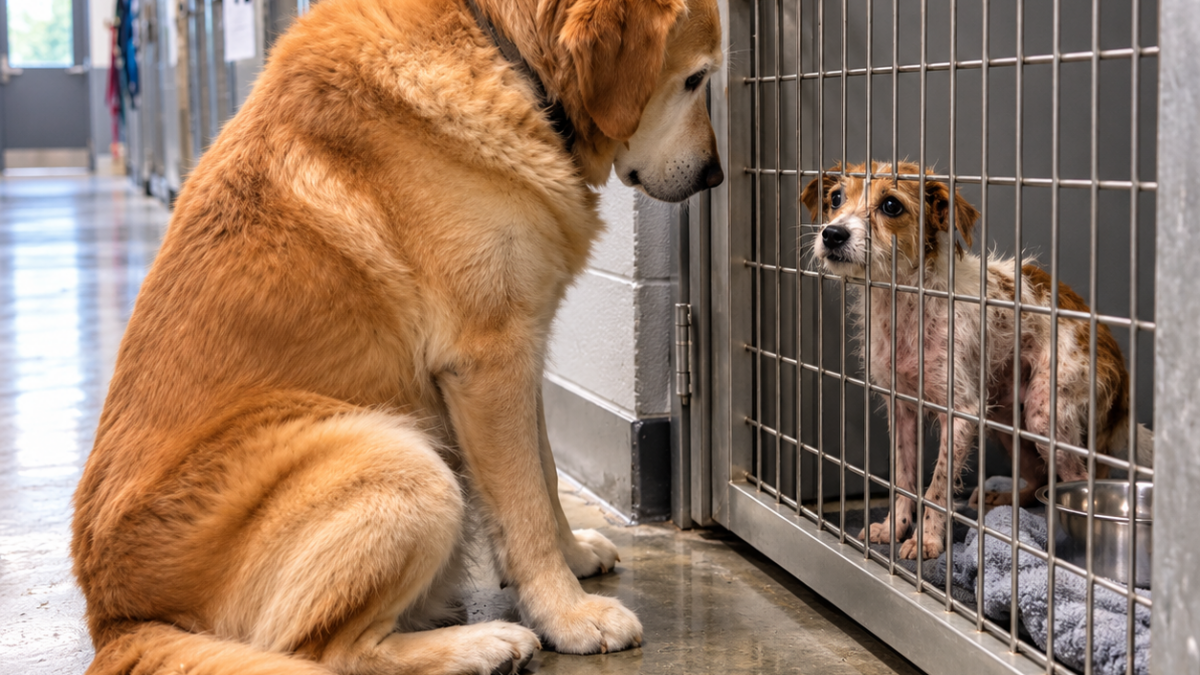
Benji was curled directly behind the bars.
I crouched.
“You two are creating administrative problems.”
Luna blinked.
Benji watched me from behind her shoulder.
That alone was unusual.
Before Luna began lying beside him, Benji rarely watched people with curiosity.
He watched them for danger.
There is a difference.
A curious dog studies you.
A frightened dog studies your hands.
Your feet.
The door.
Your distance.
Benji always needed to know how quickly he could retreat.
But with Luna between us, something changed.
I extended my fingers toward the bars.
Benji remained where he was.
“Morning, little man.”
His ears twitched.
Luna turned her head toward him.
Benji looked at her.
Then back at me.
He moved forward one inch.
That was all.
But for Benji, one inch could be a mile.
I spoke with the shelter director later that morning.
“I think we need to consider them bonded.”
She looked through the office window toward the kennel corridor.
“They’ve known each other what, a few weeks?”
“Long enough.”
“You know bonded-pair adoptions are harder.”
“I know.”
“Luna could have been adopted yesterday.”
“I know.”
“She’s older.”
“I know.”
“The longer senior dogs stay—”
“I know.”
She stopped.
I realized I sounded defensive.
She sighed.
“I’m not saying separate them.”
“It sounds like it.”
“I’m saying we need to think carefully. If Luna keeps refusing adopters because of Benji, and nobody wants Benji because he’s terrified of people, we could end up keeping both here for months.”
I hated hearing it.
Because she was right.
Most families walking into a shelter do not ask for two dogs.
Especially not one elderly dog and one young, traumatized terrier who may require weeks or months of patient rehabilitation.
Luna was easy to love.
Benji was easy to worry about.
Those are not always the same thing in an adoption room.
Still, I said, “We give them time.”
The director looked at me.
“How much?”
“As much as we reasonably can.”
She nodded slowly.
“Fine. For now.”
That phrase became our compromise.
For now.
Luna’s kennel was moved closer to Benji’s.
We began supervised time together.
What happened surprised even those of us who had watched hundreds of dog interactions.
Benji changed around her.
Not dramatically.
Not overnight.
He didn’t suddenly become playful.
He didn’t run into our arms.
He didn’t stop trembling around strangers.
But Luna made the world smaller for him.
And therefore safer.
If she walked into the exercise yard, Benji followed.
If she approached a water bowl, he drank afterward.
If she accepted food from my hand, Benji watched carefully.
Sometimes, several minutes later, he would take a piece from the floor near me.
Luna never pushed him.
That mattered.
She did not drag him into experiences.
She showed him they existed and let him decide.
One afternoon I watched them in the small outdoor pen.
Luna lay in a patch of sunlight.
Benji stood near the door.
A lawn mower started somewhere beyond the fence.
Benji jumped.
His entire body tightened.
He ran toward Luna.
Not toward the building.
Not toward me.
Luna.
He pressed himself against her side.
Luna lifted her head.
Then lowered it across his shoulders.
Nothing else.
The mower continued.
Benji trembled.
Gradually the trembling slowed.
I sat on a bench watching them.
One of my coworkers, Sarah, came outside.
“That’s unbelievable.”
“What?”
“He uses her like a nervous system.”
I knew exactly what she meant.
When Benji could not regulate his fear, Luna did it for him.
Her breathing stayed slow.
Her body stayed loose.
She did not react to every sound.
Benji seemed to borrow that calm.
“How do we adopt one without the other?” Sarah asked.
“We don’t.”
That was the first time I said it without hesitation.
From then on, their profile changed.
LUNA & BENJI — BONDED PAIR.
The words made some people immediately move on.
That hurt.
A woman came specifically because she had seen Luna online.
“She’s exactly what my father needs.”
“She’s wonderful.”
“I have a quiet home. Big backyard.”
“That sounds great.”
Then I explained Benji.
Her expression changed.
“I can’t take two.”
“I understand.”
“Couldn’t he bond with another dog?”
“Possibly.”
“Then why keep Luna here?”
There was no cruelty in her question.
Just practicality.
I looked toward Luna.
She was sitting outside Benji’s kennel.
“Because she keeps choosing him.”
The woman watched them for a moment.
Then sighed.
“I wish I could.”
“So do I.”
She left.
Luna stayed.
Another adopter came the following week.
A retired man named Harold.
He loved Labradors.
Had owned three.
His last dog had died the year before.
Luna walked straight to him and rested her head against his knee.
Harold’s eyes filled immediately.
“Oh, sweetheart.”
He spent nearly an hour with her.
Then met Benji.
Benji retreated to the far wall.
Harold waited.
Benji didn’t approach.
“I’m seventy-two,” Harold finally said. “I don’t know if I have the energy for a dog who needs that much rehabilitation.”
“That’s fair.”
“I could take Luna.”
I looked at her.
Luna was watching Benji.
Harold noticed.
“That’s the problem, isn’t it?”
“Yes.”
He sat silently.
Then he rubbed Luna’s ears.
“I won’t ask you to separate them.”
I liked him even more for that.
He left alone.
That night, I felt angry.
Not at Harold.
Not at the first family.
Not at anybody.
Just the situation.
A perfect senior dog was sleeping on shelter concrete because she refused to abandon a frightened terrier.
A frightened terrier remained frightened because the only being he completely trusted could not promise him what came next.
I sat outside their kennels after closing.
“You know,” I told Luna, “you’re making this very difficult.”
She rested her chin on her paws.
Benji sat behind her.
“People want you.”
Nothing.
“Good people.”
Luna blinked.
“You could have a couch right now.”
Benji shifted.
Luna turned toward him.
I sighed.
“Yes. I know.”
I started bringing a folding chair into the corridor.
Some evenings I read paperwork there.
Luna slept outside Benji’s gate.
Benji slowly became accustomed to my presence.
At first he stayed in the back.
Then halfway.
Then near Luna.
One night, I was reading when I felt something against my shoe.
I looked down.
Benji’s nose.
He had stretched as far as his body would allow without fully approaching.
I did not move.
He sniffed.
Retreated.
My chest tightened.
Luna opened one eye.
“You saw that?”
Tail thump.
“Don’t act like you planned it.”
Another thump.
Perhaps she had.
The next day, Benji took food from my hand.
Not cleanly.
He grabbed it and retreated so fast his nails clicked against the floor.
But he took it.
Sarah celebrated.
“He touched you!”
“He stole chicken from me.”
“Same thing.”
Progress with fearful dogs can look ridiculous from outside.
A dog remains in the same room.
Victory.
A dog eats while you’re present.
Victory.
A dog looks away from you instead of staring in terror.
Victory.
A dog falls asleep.
Huge victory.
Benji accumulated tiny victories.
Almost all with Luna nearby.
Then one Thursday afternoon, Luna received another adoption inquiry.
A family had seen the bonded-pair note.
They said they were open to two dogs.
Everyone became cautiously excited.
A couple named Rachel and Tom arrived with their college-aged son.
They had a large fenced property.
No other pets.
Experience with rescue dogs.
They met Luna.
Loved her.
Then they sat quietly with Benji.
For twenty minutes.
Benji eventually came near enough to smell Rachel’s shoe.
I could barely believe it.
“This is promising,” Sarah whispered.
Rachel smiled.
“He doesn’t have to love me today.”
Exactly the right thing to say.
We spent almost two hours discussing their needs.
The couple listened carefully.
When they left, they said they wanted to sleep on the decision.
The next morning, Rachel called.
My heart jumped.
Then fell.
“We’ve decided we can’t do both.”
I closed my eyes.
“I understand.”
“Our son is moving out soon. We travel sometimes. I’m afraid Benji needs more stability than we can guarantee.”
“That’s a responsible decision.”
“I’m sorry.”
“So am I.”
Luna remained.
Weeks accumulated.
Then a month.
Benji improved enough that he sometimes walked beside Luna in the corridor.
Never first.
Always behind her shoulder.
If she stopped, he stopped.
If she moved, he moved.
We called him her shadow.
Luna seemed physically healthy for her age, but age was visible.
She got up more slowly.
Her muzzle silvered further.
Cold mornings made her hips stiff.
That created another fear in me.
Time.
What if Luna aged faster than Benji healed?
What if we waited too long for a perfect joint adoption?
What if Luna deserved comfort now?
One evening I brought that concern to the director.
“What if we’re being unfair to her?”
She knew immediately what I meant.
“You think we should separate them?”
“I don’t know.”
“That’s different from what you said before.”
“I know.”
We looked through the office window.
Luna was lying outside Benji’s kennel.
Benji was sleeping with his paws almost touching hers through the bars.
The director sighed.
“I’ve been wondering the same thing.”
I hated that.
“What do we do?”
“We keep looking.”
“For how long?”
She gave me the answer I had given her weeks earlier.
“For as long as we reasonably can.”
I laughed despite myself.
“That’s not helpful.”
“No.”
Then the family arrived.
The one I will remember for the rest of my life.
It was a Saturday morning.
The shelter had been busy.
Dogs barking.
Phones ringing.
A volunteer trying to convince a German Shepherd that the mop was not an enemy.
Around eleven, a mother, father and little girl walked in.
The girl was maybe seven.
Brown hair tied loosely behind her head.
Large curious eyes.
Her name was Emma.
“We’re here to adopt a dog,” her father said.
I gave them the normal questions.
Yard?
Yes.
Other animals?
No.
Children?
Emma.
Schedule?
Stable.
Experience?
They had owned an older mixed-breed dog who had died two years earlier.
Emma had been asking for another dog ever since.
I expected her to rush toward the puppies.
Most children did.
Instead, Emma walked slowly along the kennels.
She stopped.
Looked.
Moved on.
A young Beagle jumped against the bars.
Emma smiled.
A shepherd brought her a toy.
She laughed.
A little fluffy dog spun in circles.
Still, Emma kept walking.
Then we reached Luna.
Luna was lying, as usual, outside Benji’s kennel.
She lifted her head.
Looked at Emma.
Then lowered it again.
Emma stopped.
She looked at Luna.
Then at Benji, who had already retreated into the corner.
Then back at Luna.
“Why is she lying there?”
I crouched beside her.
“Her name is Luna.”
“She’s pretty.”
“She is.”
“Why doesn’t she sleep in her own cage?”
I glanced at Emma’s parents.
They seemed curious too.
So I told them.
“Luna doesn’t like leaving Benji alone.”
Emma looked through the bars.
“Is that Benji?”
“Yes.”
“Why is he hiding?”
“He’s afraid.”
“Of what?”
I hesitated.
“People. New places. Sudden things. We don’t know everything that happened to him before he came here.”
Emma became very quiet.
Then she sat down on the floor.
Her mother said, “Emma, honey—”
“It’s okay,” I said.
Emma did not reach through the bars.
That impressed me immediately.
Children often want contact.
They equate affection with touching.
Emma simply sat.
Benji watched her.
She watched him.
No baby talk.
No calling.
No pushing treats through the gate.
Just waiting.
Luna raised her head again.
Looked at Emma.
Then Benji.
Something about the scene made the entire noisy corridor seem quieter.
After several minutes, Emma stood.
She walked to her parents.
“I want them.”
Her father smiled.
“Which one?”
“Both.”
The smile disappeared slightly.
“Emma, we came for one dog.”
“I know.”
She pointed toward Luna.
“She won’t leave him.”
Her parents exchanged a look.
Emma continued.
“If we take her, she’ll be sad.”
Her mother crouched.
“Honey, two dogs are a lot.”
“But if we take Benji without her, he’ll be scared.”
Nobody answered.
Emma looked between them.
“They’re one thing.”
Her father frowned gently.
“What do you mean?”
“They’re together.”
She struggled for better words.
“Like… if you take half, the other half is wrong.”
I felt something tighten in my throat.
Her mother looked at me.
“Can they be adopted together?”
“Yes.”
Then I gave the warning I had given everyone.
“But Benji is not an easy adoption.”
Emma turned toward me.
“He bites?”
“No.”
“Then what?”
“He’s very frightened. He may hide. He may not eat normally at first. He may take a long time before he trusts you. You can’t force him.”
Emma thought about that.
Then said something I still remember word for word.
“I know what being scared feels like.”
Her mother’s expression changed.
Emma continued.
“When I started school, I didn’t want Mommy to leave.”
Her father smiled softly.
“That was a rough week.”
Emma nodded.
“Mommy kept telling me, ‘I’m with you.’”
She looked back at Benji.
“I can tell him that.”
I blinked.
“Tell him what?”
“I’m with you.”
She said it so simply.
“I can tell him every day until he believes me.”
Her mother covered her mouth.
Her father stared at Benji.
I looked away because my eyes had already filled.
Seven years old.
That little girl understood something many adults never learn.
Trust is not convinced.
It is accumulated.
One safe day.
Then another.
Then another.
Her parents asked for time to talk privately.
I took Emma back toward the lobby.
She kept looking over her shoulder.
Luna watched her.
Benji watched Luna.
For twenty minutes, I tried not to hope.
Finally Emma’s parents approached.
Her father exhaled.
“We came for one dog.”
My stomach tightened.
Then he smiled.
“We’re leaving with two.”
Emma screamed.
Not loudly enough to scare Benji, thankfully, because her mother immediately covered her mouth.
“Quiet.”
Emma bounced in place.
“Sorry.”
I laughed through tears.
We began the paperwork.
Two adoption forms.
Two medical histories.
Two feeding instructions.
Benji’s behavioral notes were much longer.
We explained decompression.
Safe spaces.
No forced contact.
No grabbing.
No cornering.
Keep routine predictable.
Let Luna guide some transitions.
Emma listened more carefully than many adults.
At one point she asked, “If Benji hides, do I go get him?”
“No.”
“What do I do?”
“Give him room.”
“Can I sit near him?”
“Yes, if he’s comfortable.”
“Can I read?”
I smiled.
“That would be perfect.”
She nodded seriously.
“I have a book about dinosaurs.”
Benji was about to receive an education.
When the paperwork was complete, I opened Luna’s kennel.
She stood.
I clipped on her leash.
Then we approached Benji.
He retreated.
I opened his door and sat near the entrance.
“Hey, buddy.”
Benji trembled.
Luna walked forward.
She stopped at the threshold.
Benji stared at her.
For a long time, nothing happened.
Nobody rushed him.
Emma sat several feet away.
Her parents stood behind her.
Luna waited.
Benji moved one paw.
Then another.
He reached the open kennel door.
Stopped.
Looked at the hallway.
Retreated one step.
Luna remained.
I whispered, “It’s okay.”
Benji looked at Luna.
Then stepped out.
One paw.
Two.
His whole body appeared.
He pressed himself against Luna’s side.
My eyes filled.
“Good boy.”
Benji trembled.
But he was outside.
Emma extended one hand.
Not toward him.
Just low.
Still.
Benji saw it.
He looked at Luna.
Luna sniffed Emma’s fingers.
Benji watched.
Then he stretched his neck.
One inch.
Two.
He smelled Emma’s hand.
She did not move.
Then Benji touched his nose to her fingers.
Emma smiled.
“Hi, Benji.”
He froze.
Her voice remained soft.
“I’m Emma.”
His nose touched her again.
“I’m with you.”
That was the moment I lost whatever composure I had left.
I sat on the floor.
And I cried.
Shelter workers cry more than people think.
Sometimes in bathrooms.
Sometimes in cars.
Sometimes over dogs nobody else remembers.
That day I cried in the middle of the kennel corridor while a seven-year-old girl introduced herself to a terrified Jack Russell.
Emma’s mother cried too.
Her father pretended he had something in his eye.
Luna stood between everyone, calm as ever.
As if this had been obvious to her from the beginning.
Then came the walk to the exit.
The same walk Luna had refused before.
I held my breath.
Emma walked in the center.
Her mother held Luna’s leash.
I held Benji’s.
We reached kennel seventeen.
Empty now.
Luna paused.
My heart stopped.
She looked at the open cage.
Then at Benji.
Benji stood beside her.
Luna moved again.
Toward the exit.
No resistance.
No sitting.
No refusal.
She walked through the front door.
Benji followed.
Outside, sunlight hit them.
Benji stopped.
The parking lot was too open.
Too loud.
A truck passed.
He ducked.
Luna turned.
Waited.
Benji stepped closer.
Emma crouched several feet away.
“I’m with you.”
He looked at her.
Then moved.
That is how they left the shelter.
Emma in the middle.
Luna on one side.
Benji on the other.
Benji trembling.
But walking.
He was no longer hiding.
Luna had refused several chances at a home because she would not abandon him.
Now she had found a family willing to understand that loving Luna meant accepting the promise Luna had already made.
I watched their car disappear.
Then went back inside.
Benji’s kennel was empty.
Luna’s was empty.
For shelter workers, empty kennels are usually good.
Still, I stood there for several minutes.
Sarah came beside me.
“They made it.”
“I think so.”
“You okay?”
“No.”
She laughed.
“Good.”
The first update came that evening.
Emma’s mother called.
I answered before the second ring.
“How are they?”
She laughed.
“I was going to say hello first.”
“Sorry.”
“Luna is asleep.”
“And Benji?”
A pause.
“He won’t come inside.”
My heart dropped.
“What happened?”
“Nothing. He walked to the porch and stopped.”
“Where’s Luna?”
“Inside the living room.”
“Can he see her?”
“Yes.”
“Don’t force him.”
“We’re not.”
I heard Emma in the background.
Then her mother said, “Wait.”
Silence.
“What?”
“Luna stood up.”
I closed my eyes.
“What is she doing?”
“She walked toward the door.”
More silence.
“She sat down just inside.”
“Can Benji see her?”
“Yes.”
Another pause.
“He’s moving.”
I could hear Emma whispering.
“Come on, Benji.”
Her mother corrected gently.
“Remember, we wait.”
Several minutes passed.
Then:
“He came in.”
I exhaled.
“Where did he go?”
Her mother laughed softly.
“Straight to Luna.”
Of course.
Benji did not explore the house.
Did not check the kitchen.
Did not inspect his new bed.
He walked directly to Luna.
Curled beside her.
And fell asleep.
The first night in his permanent home, Benji still needed his guardian.
Luna stayed.
The second update came three days later.
Benji was barely eating.
That worried everyone.
Emma’s mother placed food near his safe area.
He sniffed.
Backed away.
Luna walked over.
She smelled his bowl.
Then looked at him.
Benji approached.
Took one bite.
Then another.
Emma whispered, “She told him it’s safe.”
Nobody corrected her.
Perhaps that was exactly what happened.
By the end of the first week, Benji was eating regular meals.
Still only when the room was quiet.
Still watching Luna.
But eating.
Emma sat nearby during breakfast with her dinosaur book.
She didn’t stare at him.
Didn’t reach.
She read aloud.
Dinosaurs, apparently, became part of Benji’s rehabilitation.
On the second week, Emma’s mother sent me a video.
Emma sat on the floor reading.
Luna slept nearby.
Benji stood behind an armchair.
Emma turned a page.
Benji stepped out.
One foot.
Two.
He walked past the chair.
Toward Luna.
Then stopped halfway.
He looked at Emma.
She kept reading.
He took another step.
By the end of the video, he was lying six feet from her.
No Luna between them.
Six feet.
I watched it repeatedly.
To anyone else, almost nothing happened.
To me, Benji had crossed an ocean.
The third week brought something better.
A ball.
Emma had left a small rubber ball on the floor.
Benji had ignored toys since arriving.
One afternoon, Luna nudged the ball accidentally.
It rolled.
Benji’s eyes followed.
Emma noticed but stayed quiet.
Benji walked toward the ball.
Sniffed.
Touched it with his nose.
It rolled again.
He jumped backward.
Then approached.
Another nudge.
The ball rolled toward Luna.
Benji followed.
Luna looked at it.
Then at him.
Benji picked it up.
Emma gasped.
Benji almost dropped it.
She covered her mouth.
He carried the ball two steps.
Placed it near Luna.
Luna smelled it.
Benji’s tail moved.
Once.
Emma whispered, “Mom.”
Her mother was already watching.
The tail moved again.
Then wagged.
A real wag.
Emma started crying.
“My mom cried too,” she told me later.
“So did I.”
“You weren’t even there.”
“I don’t need to be there anymore. I cry professionally.”
Emma laughed.
Week four, Benji began exploring without Luna.
Kitchen.
Back to living room.
Hallway.
Back.
Bedroom doorway.
Back.
Each trip was short.
He always returned to check.
Luna always remained.
Not chasing.
Not rescuing.
Waiting.
She had done the same thing in the shelter.
Wait until he believes.
Week five changed Emma’s relationship with him.
She was sitting on the couch reading.
Luna was asleep across the room.
Benji entered.
Emma did not call him.
He approached.
Stopped beside the couch.
Emma kept reading.
Then Benji jumped up.
Not gracefully.
He almost missed.
Recovered.
Sat beside her.
Emma froze.
Benji lowered his head into her lap.
She slowly placed one hand against his back.
He didn’t move.
She stroked once.
Twice.
Benji closed his eyes.
When Emma’s mother entered, she found them asleep.
The book had fallen beside Emma.
Benji’s head remained in her lap.
That evening Emma called me herself.
“He trusts me.”
Her voice was shaking with happiness.
“Yes.”
“I didn’t make him.”
“I know.”
“I waited.”
“Yes.”
“It worked.”
I smiled.
“Patience usually looks like nothing until suddenly it looks like everything.”
Emma was silent.
“I’m writing that down.”
“You’re seven.”
“I have a notebook.”
Fair enough.
By week six, Luna no longer slept beside Benji all night.
That worried Emma at first.
She called.
“Luna moved to her own bed.”
“That’s okay.”
“But Benji is alone.”
“Is he upset?”
“No.”
“Is he sleeping?”
“Yes.”
“Then Luna knows something.”
“What?”
“He doesn’t need her touching him every minute anymore.”
Emma considered that.
“So she’s leaving him?”
“No.”
I chose the words carefully.
“She’s trusting him.”
That distinction mattered.
Luna’s love was changing.
At the shelter, love meant lying outside a cage.
At the house, love increasingly meant distance.
The kind of distance possible only when you believe the other being is safe.
Benji slept in his own bed.
Luna slept across the room.
Same home.
Same family.
No bars.
Week seven brought the first bark.
The doorbell rang.
Benji ran toward the hallway.
Emma’s father expected him to hide.
Instead:
Woof.
He startled himself.
Then barked again.
Luna lifted her head.
Looked at him.
Lay back down.
Emma shouted from the kitchen, “Benji barked!”
Her father laughed.
“Yes.”
“He’s protecting us!”
Perhaps not quite.
But nobody spoiled the moment.
Benji had finally reacted to a sound like a dog living in a house instead of a dog expecting danger.
Two months after the adoption, I visited.
I had been counting the days.
Emma opened the door.
“Come in!”
I stepped inside.
A dog barked.
I looked down.
Benji.
He stood ten feet away.
Tail uncertain.
Body alert.
Not hiding.
“Hey, little man.”
He stared.
Then approached.
I remained still.
Benji smelled my shoes.
My pants.
My hand.
Then sat at my feet.
I looked toward Luna.
She was lying near the window.
Watching.
“Are you seeing this?”
Emma laughed.
“He does that now.”
Benji rested his head against my knee.
My throat tightened.
The dog who once pressed himself against a shelter wall when I approached was voluntarily touching me.
I looked at Luna again.
She closed her eyes.
Emma sat beside me.
“See? He trusts you.”
I shook my head.
“No.”
She frowned.
“He does.”
“Yes. But that started because he trusts you.”
Emma looked confused.
I continued.
“You taught him that people can be safe. Once he believed that, he could start giving other people a chance.”
She looked at Benji.
Then Luna.
“So Luna taught him the world is safe.”
“Yes.”
“And I taught him people can be nice.”
“Yes.”
Emma thought for several seconds.
Then said, “Benji taught me love is patience.”
I stopped.
I had spent years working in shelters.
Years reading behavior manuals.
Years sitting through training sessions.
Years learning how fear affects dogs.
And a seven-year-old girl had summarized the most important lesson in six words.
Love is patience.
“That’s exactly what he taught you.”
We walked into the backyard.
Benji followed Emma.
Not Luna.
Emma threw the ball.
Benji ran.
Actually ran.
His little legs moved so fast he nearly tripped turning around.
He brought the ball halfway back.
Then changed his mind.
Emma chased him.
Benji ran faster.
Luna lay in the grass.
Watching.
That was when I saw what Luna’s entire journey had really been.
She had not attached herself to Benji because she wanted him dependent forever.
She had stayed because dependence was what he needed then.
Now he needed something else.
Freedom.
Confidence.
Space to make mistakes.
Space to run away with the ball.
Luna gave him that too.
Over the next several months, Benji continued changing.
He walked in the yard alone.
Approached visitors slowly.
Played with other dogs during carefully managed introductions.
Learned to sleep through ordinary household noises.
Discovered that the sound of a food bag opening meant very good things.
Became mildly obsessed with cheese.
Emma continued reading to him.
The dinosaur book ended.
Then came space.
Then a book about whales.
Benji probably became the most educated Jack Russell in the county.
Luna remained his anchor.
But anchors do not have to be chains.
That difference defined their relationship.
One afternoon, Emma’s mother sent me a photograph.
Benji was asleep on one side of the room.
Luna on the other.
The caption read:
“Look how far apart they are.”
To somebody who didn’t know them, the photograph looked boring.
To me, it was extraordinary.
Benji could rest without physical reassurance.
He had learned something Luna had been trying to teach him since the shelter.
Safety can remain even when the one protecting you isn’t touching you.
Then winter came.
Cold weather made Luna’s joints stiffer.
Emma noticed first.
“She’s walking slower.”
Her parents took Luna to the veterinarian.
Nothing catastrophic.
Age.
Arthritis.
Normal changes in an older Labrador.
Medication helped.
Soft bedding helped.
Shorter walks helped.
Still, hearing it frightened me.
Luna had spent so much of her life protecting Benji.
I suddenly wondered whether Benji would understand when she needed him.
The answer came faster than I expected.
One cold morning, Luna hesitated at the porch steps.
Two steps.
Nothing dramatic.
But her hips were bothering her.
Emma’s father stood nearby, ready to help.
Benji had already gone into the yard.
He turned.
Saw Luna.
Came back.
He climbed the first step.
Stopped.
Looked at her.
Then came down again.
Luna moved one paw.
Benji waited.
Another.
Wait.
Eventually she made it.
Benji walked beside her into the yard.
Emma’s mother recorded part of it.
When I watched, my eyes filled.
The frightened dog who had once needed Luna to cross every threshold was now waiting for her.
That was the moment their roles began to shift.
Not completely.
Luna remained Luna.
Calm.
Steady.
Protective.
But Benji became attentive to her.
If Luna moved slowly, he slowed down.
If she slept, he often settled nearby.
If another dog became too energetic around her, Benji inserted himself between them with surprising confidence.
Emma laughed the first time.
“He thinks he’s big.”
Emotionally, perhaps he was.
A year after their adoption, the family brought Luna and Benji back to the shelter for a visit.
I heard barking in the lobby.
Then Emma shouting my name.
I came around the corner.
And stopped.
Luna looked older.
Still beautiful.
Still honey-colored beneath the silver.
Benji looked almost like a different dog.
His body was relaxed.
Tail up.
He wore a blue collar.
He saw me.
Ran forward.
I crouched.
Benji jumped against my legs.
I laughed.
“Who are you?”
Emma beamed.
“That’s Benji.”
“No. Our Benji hid behind walls.”
She put both hands on her hips.
“He doesn’t anymore.”
Luna approached more slowly.
I hugged her around the neck.
“You did good.”
Her tail moved.
Benji squeezed between us.
Emma laughed.
“He gets jealous now.”
“Good. Jealousy is very advanced compared with terror.”
We walked through the shelter.
When we reached kennel seventeen, I stopped.
Emma noticed.
“Was that his?”
“Yes.”
The kennel was occupied by another dog now.
A young mixed breed.
Benji looked inside.
No reaction.
No trembling.
Nothing.
The cage no longer meant anything to him.
I felt strangely emotional about that.
The place that had once represented his entire world had become just another doorway.
Luna looked at Benji.
Then continued walking.
Emma slipped her hand into mine.
“He doesn’t remember?”
“Maybe he remembers smells. Maybe feelings. We can’t know.”
“Is that sad?”
“No.”
I looked at Benji trotting ahead.
“I think it’s beautiful.”
Their life continued.
Years passed.
Emma got older.
Benji got braver.
Luna got grayer.
The family sent photographs every few months.
Emma and Benji doing homework.
Luna sleeping beneath the table.
Both dogs wearing ridiculous holiday bandanas.
Benji standing in snow looking offended.
Luna lying in sunlight.
At some point, updates stopped feeling like rescue reports.
That was my favorite stage.
When nobody wrote:
Benji approached someone today.
Instead:
Benji stole Dad’s sock again.
When nobody said:
Luna helped him through a fear episode.
Instead:
Luna refused to move off the couch.
Normal problems.
Normal life.
The shelter story had become background.
Exactly where it belonged.
One spring, Emma called me.
She was older now.
Her voice no longer sounded like the seven-year-old who had sat outside Benji’s cage.
“I think I figured out why Luna wouldn’t leave him.”
I smiled.
“You figured that out years ago.”
“No. I thought I did.”
“What changed?”
She paused.
“I used to think Benji needed Luna.”
“He did.”
“Yeah. But Luna needed him too.”
I sat back.
“Tell me.”
“If she only wanted a home, she could have left.”
“Yes.”
“But she kept staying.”
“Yes.”
“And once Benji became okay, she looked happier too.”
I thought about it.
Emma continued.
“Maybe taking care of him gave her somewhere to belong before she had a house.”
That silenced me.
Luna had been found sitting beside a road.
Waiting.
We never knew for whom.
Maybe she had lost someone.
Maybe she had been abandoned.
Maybe she simply did not know where to go next.
Then she met Benji.
A dog who needed somebody to stay.
For Luna, staying was something she understood.
Perhaps Emma was right.
They had rescued each other long before any human signed adoption papers.
“What do you think?” she asked.
“I think you may understand Luna better than any of us.”
Emma laughed.
“She’s pretty obvious.”
“She refused multiple homes until we figured it out. She was not obvious.”
“Maybe humans are slow.”
“Definitely.”
As Luna entered advanced age, the family adjusted everything around her.
Rugs on slippery floors.
A ramp near the porch.
Medication.
Short walks.
A thick orthopedic bed.
Benji slept beside it.
Not on it.
Beside.
The same position Luna once took outside his cage.
When I saw the photograph, I had to put my phone down.
The image brought back the shelter corridor so clearly that for a moment I could smell disinfectant.
Luna on cold stone.
Nose near metal bars.
Benji asleep inside.
Now the bars were gone.
The floor was warm.
Luna slept in a soft bed.
And Benji lay on the floor beside her.
Staying.
Love had completed a circle.
Emma called one evening.
“She had a bad day.”
I knew immediately she meant Luna.
“How bad?”
“She didn’t want dinner.”
That frightened everyone.
Luna always liked dinner.
The veterinarian adjusted medication and checked her.
Age was catching up.
No sudden emergency.
But the family understood they had entered a different chapter.
Emma cried on the phone.
“I don’t want Benji to lose her.”
“I know.”
“What will happen to him?”
“We’ll help him.”
“He still needs her.”
“Yes.”
“But what if—”
I stopped her gently.
“Emma.”
Silence.
“Remember what Luna taught Benji.”
“That the world is safe.”
“Yes.”
“Because she stayed.”
“Yes.”
“And what did you teach him?”
“That people can be kind.”
“Yes.”
“And what did Benji teach you?”
Emma sniffed.
“That love is patience.”
“Then this part will need patience too.”
She cried harder.
So did I after we hung up.
We had spent years celebrating Benji becoming independent of Luna.
But independence does not cancel love.
It only makes love freer.
Benji could survive without constant contact.
That did not mean losing Luna would be easy.
Several months later, I visited.
Luna was lying on her bed near the window.
Her body looked thinner.
Her face almost completely silver.
But when I entered, her tail moved.
I crouched.
“Hi, beautiful.”
She lifted her head.
I kissed the top of it.
Benji approached.
No barking.
He leaned against my leg.
Emma sat beside Luna.
“She sleeps more.”
“That’s okay.”
“She still goes outside.”
“Good.”
“She still eats most days.”
“Good.”
Emma touched Luna’s paw.
“I hate this.”
“I know.”
Luna looked at her.
Emma smiled through tears.
“Sorry.”
The dog put her head against Emma’s knee.
Benji climbed onto the blanket beside them.
I sat on the floor.
Four of us.
No cage.
No corridor.
No adoption forms.
Just a family spending an afternoon together.
I realized that day that shelter workers sometimes imagine adoption as an ending.
We hand over the leash.
Take a photograph.
Wave goodbye.
Kennel empty.
Success.
But the real story happens afterward.
Years of breakfast.
Sickness.
Holidays.
School.
Aging.
Fear.
Trust.
Loss.
Loyalty.
The leash handoff is not the happy ending.
It is permission for the happy ending to begin.
Luna had given Benji that chance.
Emma had given both dogs a home.
And the dogs had given Emma something she would carry far beyond childhood.
I saw it in the way she touched Luna.
No grabbing.
No desperate attempts to make the old dog behave young.
Just presence.
Emma had learned how to stay.
Eventually, Luna’s good days became fewer.
Her veterinarian and family monitored her carefully.
They refused to let their own fear become more important than her comfort.
When treatment helped, they treated.
When she wanted food, she ate.
When she wanted the yard, someone walked beside her.
When she wanted sleep, everyone let her sleep.
Benji adjusted his pace.
A dog once too afraid to cross a hallway became Luna’s patient companion.
He waited at doors.
Waited at steps.
Waited beside her food bowl.
Waited during slow walks.
Waiting had once been Luna’s language.
Now Benji spoke it fluently.
One evening Emma sent me a short video.
The sun was setting through their living-room window.
Luna slept on her bed.
Benji lay beside her.
At one point, Luna’s paw moved.
Benji lifted his head.
He placed his nose against her paw.
Then lay back down.
No drama.
I watched it six times.
That was their entire relationship in a few seconds.
I’m here.
You’re not alone.
Rest.
When Luna’s final decline eventually came, it was gentle compared with everything we feared.
She stopped wanting to walk far.
Then stopped wanting to walk at all.
She ate less.
Slept more.
The veterinarian talked honestly with the family about comfort and quality of life.
Emma was older by then, but in my mind I still saw the seven-year-old kneeling outside Benji’s kennel.
She called me after the appointment.
“We might have to let her go soon.”
I closed my eyes.
“Yes.”
“I don’t know if I can.”
“I know.”
“How do you know when it’s right?”
“You listen to the veterinarian. You watch Luna. And you ask whether you’re asking her to stay for her or for you.”
Emma cried.
“That’s horrible.”
“Yes.”
“I don’t want love to mean letting go.”
“Sometimes love means not asking for one more painful day just because we want one more day.”
She was quiet.
Then:
“What about Benji?”
“He’ll be there.”
The family arranged for Luna to remain at home when the time came.
Her bed.
Her people.
Benji.
No frightening clinic room.
No unfamiliar place.
I was invited.
I almost said no because I wasn’t sure I could bear it.
Then I remembered Luna on the shelter floor.
Staying beside Benji because he needed her.
So I went.
Luna was lying on a blanket in the living room.
Emma sat beside her.
Her parents were nearby.
Benji lay against Luna’s back.
I crouched.
Luna opened her eyes.
That look.
Older.
Tired.
Still Luna.
“Hi.”
Her tail barely moved.
I touched her head.
“You stubborn old girl.”
Emma laughed through tears.
“She still is.”
We spent time telling stories.
The adoption attempts.
The cold shelter floor.
The first night Benji refused to enter the house.
The ball.
The bark.
The stolen socks.
Emma reminded me of the dinosaur book.
“I still have it.”
“You should.”
“Benji chewed the corner.”
“Historical artifact.”
Eventually the veterinarian arrived.
No one rushed.
Luna was comfortable.
Benji stayed close.
Emma held her.
I watched Benji.
I worried he would panic.
Instead, he lay with his nose against Luna’s shoulder.
The dog who once could not exist calmly without Luna was doing the hardest thing she had ever asked of him.
He was staying calm for her.
Emma whispered over and over:
“I’m with you.”
The same words she had once promised Benji.
Now she gave them to Luna.
“I’m with you.”
Luna’s breathing slowed.
Her body relaxed.
And surrounded by the family she had refused to find without Benji, Luna died peacefully.
No cage.
No road.
No waiting.
Home.
Benji remained beside her for a long time.
Nobody pulled him away.
Nobody tried to distract him.
When Luna was gone, he smelled her.
Touched his nose to her face.
Then lay down.
Emma sat beside him.
“I’m with you,” she whispered.
Benji leaned into her.
That nearly broke me.
Because years earlier, if Luna had disappeared from Benji’s world, I don’t know what would have happened.
But this Benji was different.
Luna had built something inside him.
Emma had continued it.
A home had reinforced it.
He would grieve.
But he would not be alone.
The next weeks were difficult.
Benji searched.
Of course he did.
He checked Luna’s bed.
Waited near the porch.
Paused at meal times.
Some nights he slept in the spot beside her old bed.
Emma let him.
She sat with him.
Read again.
Not because he needed dinosaur facts.
Because this was how they had always built safety.
Presence without pressure.
Time.
One evening Benji walked away from Luna’s empty bed and climbed onto Emma’s couch.
He rested his head in her lap.
Emma sent me a photograph.
Under it she wrote:
“He chose me again.”
I answered:
“He has been choosing you for years.”
Months passed.
Benji’s grief softened.
He began playing again.
Barked at the door.
Stole socks.
Waited for Emma.
Luna remained in the rhythms of the house.
Her picture.
Her collar.
Stories.
The indentation that took months to disappear from her favorite bed before the family finally donated it to a senior-dog rescue.
Emma kept Luna’s first tag.
Benji kept everything Luna had taught him.
That was the more important inheritance.
Several months after Luna died, Emma and Benji visited the shelter again.
Emma was almost grown now.
I watched them walk through the entrance together.
Benji trotted confidently.
No Luna beside him.
For the first time, that image did not make me sad.
It made me proud.
We walked toward the kennel corridor.
Benji smelled the air.
Dogs barked.
A metal bowl fell somewhere.
Years earlier those sounds would have sent him against the nearest wall.
Now his ears moved.
That was all.
We reached the place where his old cage had been.
Emma crouched.
“Do you remember?”
Benji looked at her.
Tail wag.
She smiled.
“Maybe not.”
I said, “He doesn’t need to.”
Benji stepped toward another kennel.
Inside was a frightened little dog curled in the corner.
Benji stopped.
My breath caught.
The dog looked at him.
Benji sat.
Emma looked at me.
I looked at her.
Neither of us spoke.
Benji lowered himself onto the floor.
Outside the cage.
Quiet.
Waiting.
Exactly where Luna had once lain for him.
Emma covered her mouth.
“No way.”
I felt tears immediately.
The frightened dog inside took one small step.
Benji remained still.
Another step.
Benji waited.
Emma sat beside him.
Not touching the dog.
Not calling.
Waiting.
For several minutes, the three of them stayed there.
The circle was so complete that it almost felt impossible.
Luna had once taught Benji:
I will not leave you because you are afraid.
Emma had taught him:
People can stay too.
Now Benji, without anyone asking, offered the same thing to another frightened dog.
I crouched beside Emma.
“She’s still here.”
Emma looked at me through tears.
“Luna?”
“Everything she taught him.”
Emma touched Benji’s back.
He remained focused on the little dog.
The dog moved closer.
One step.
Then another.
I smiled.
That was Luna’s revenge against everything that had once made Benji afraid.
Not punishment.
Not anger.
Multiplication.
Fear had tried to make Benji smaller.
Luna turned him into safety for someone else.
Loneliness had once trapped him in a corner.
Now his presence could pull another dog out of one.
That was larger than any dramatic justice I could have invented.
Emma volunteered at the shelter after that.
At first only weekends.
Then more regularly.
She was good with frightened dogs.
Of course she was.
She understood that progress cannot be forced.
She knew how to sit.
How to read without staring.
How to let curiosity do the work.
New volunteers sometimes asked why she was so patient.
Emma would point to Benji.
“He taught me.”
I always wanted to correct her.
Luna taught Benji.
Benji taught Emma.
Emma taught others.
Eventually I stopped separating it.
Maybe that was the entire point.
Love did not move in one direction.
It traveled.
Years earlier, Emma had said Luna and Benji were “one thing.”
At the time, I thought it was a child’s way of describing a bonded pair.
Now I understood something deeper.
Love joins lives without erasing them.
Luna remained Luna.
Benji remained Benji.
Emma remained Emma.
But each changed what became possible for the next.
That was why separating the story into who rescued whom never worked.
We found Luna beside a road.
Maybe we rescued her.
Luna stayed beside Benji.
She rescued him.
Emma insisted on adopting both.
She rescued them.
Benji taught Emma patience.
Maybe he rescued something in her too.
Years later, Emma would help frightened shelter dogs because two animals had shown her what waiting can accomplish.
Who rescued whom?
Eventually the question became useless.
One autumn afternoon, I sat outside the shelter with Emma.
Benji was older now.
Gray around his muzzle.
He lay in the sun.
Emma was telling me about college plans.
She wanted to study animal behavior.
I laughed.
“What?”
“Nothing.”
“You’re laughing.”
“I was thinking about the first day you came here.”
“I remember.”
“You came for one dog.”
“Dad reminds me constantly.”
“And you left with two.”
“Best negotiation of my life.”
Benji lifted his head when he heard her voice.
Emma smiled.
“I wish Luna could see him now.”
I looked at Benji.
The dog who once hid in the corner now slept in an open yard while shelter employees walked past.
“I think she saw enough.”
“What do you mean?”
“She saw him become brave.”
Emma looked down.
“She never got to see everything.”
“No one does.”
That silenced us.
Then I added, “But she stayed until he no longer needed her to stand between him and the world.”
Emma’s eyes filled.
“She knew?”
“I think so.”
Benji stood.
Walked toward Emma.
Rested his head on her knee.
She stroked his gray muzzle.
“I still need him.”
“That’s different.”
“How?”
“You don’t need him because you can’t function without him.”
I watched her hand move over his head.
“You need him because love creates a place in your life. Losing the place hurts. Keeping the love matters.”
Emma nodded.
We sat there until sunset.
When she finally stood, Benji stood too.
They walked toward the parking lot.
No Luna physically beside them.
But I could see her in every step.
In Benji’s relaxed body.
In Emma’s patience.
In the way neither hurried the other.
Years after that first Sunday, I sometimes still think about the family who originally wanted Luna.
Good people.
Kind people.
They believed they were taking an older Labrador home.
When Luna refused to leave Benji, they walked away.
At the time, I felt disappointed.
Now I’m grateful.
Not because they did anything wrong.
Because the wrong ending did not happen.
If Luna had reluctantly left with them, she might have had a comfortable house.
A bed.
Children.
Food.
Love.
But Benji might have remained behind.
And Luna had already decided comfort without him was not the home she wanted.
We humans kept assuming Luna’s story was about finding someone willing to choose her.
It wasn’t.
It was about finding someone willing to respect who she had already chosen.
That person turned out to be a seven-year-old girl.
A girl who looked at two dogs and refused to count them as one plus one.
She saw a bond.
She saw responsibility.
She saw fear and did not call it a defect.
She saw an old dog refusing to leave and did not call her stubborn.
She asked why.
That question changed everything.
Sometimes the greatest difference between kindness and indifference is simply taking enough time to ask why.
Why does this dog hide?
Why does that dog wait?
Why won’t she leave?
Why is he trembling?
Behavior tells a story before words ever could.
Luna had been telling us hers for weeks.
We were simply slow.
She lay outside Benji’s cage.
Stayed when adopters came.
Touched noses through the bars.
Waited when he froze.
Walked first when he could not.
She told us again and again:
He is part of my decision.
Emma was the first person who listened completely.
Near the end of Benji’s life, many years later, Emma called me again.
He had developed health problems common in older dogs.
Nothing connected to the frightened little terrier he once was.
Time.
Just time.
Emma was an adult now.
Her voice still changed when she talked about him.
“He sleeps most of the day.”
“That’s okay.”
“He still follows me to the kitchen.”
“Of course.”
“He doesn’t care about the ball anymore.”
“He earned retirement.”
She laughed.
Then became quiet.
“I’m scared.”
“I know.”
“I keep thinking about Luna.”
“Good.”
“Good?”
“She showed both of you how to do this.”
“How to lose someone?”
“No.”
I paused.
“How to stay when staying is what the other person needs.”
Emma cried softly.
When Benji’s final days arrived, she stayed.
Exactly as promised.
No pressure.
No panic.
Just presence.
She sat beside him and read.
Not dinosaurs anymore.
I asked what book.
She laughed through tears.
“The old dinosaur book.”
Of course.
She had saved it.
Chewed corner and all.
Benji slept beside her while she read the same pages she had read when he was afraid to come within six feet.
At some point, he opened his eyes.
Emma touched his head.
“I’m with you.”
The promise had lasted a lifetime.
Benji died peacefully at home not long afterward.
He was old.
Loved.
Safe.
The dog who had once trembled alone in the farthest corner of a shelter kennel left the world with his head resting against the person who had waited for him when she was seven.
When Emma called me afterward, neither of us could speak for a while.
Finally she said, “Now they’re both gone.”
“Yes.”
“The house feels wrong.”
“I know.”
“What do I do with all this?”
“What?”
“The love.”
That question almost undid me.
I looked around the shelter.
Dogs barking.
Metal doors.
Leashes.
Bowls.
New animals arriving with histories I did not know.
Then I remembered Benji sitting outside the frightened dog’s cage years earlier.
“You use it.”
Emma was quiet.
“How?”
“You already know.”
She did.
Months later, Emma began fostering fearful dogs.
Not because replacing Luna and Benji was possible.
It wasn’t.
She did it because they had taught her that love does not become useless when the one you loved is gone.
It becomes knowledge.
Patience.
Skill.
Attention.
The ability to recognize fear without rejecting the frightened.
Emma’s first foster was a little terrier mix named Milo.
He hid beneath her kitchen table for three days.
She did not drag him out.
Did not force affection.
She sat nearby.
And read.
When she sent me the photograph, I laughed.
“What book?”
She replied:
“You already know.”
The dinosaur book.
Milo emerged on day four.
On day six, he ate beside Emma.
Week two, he slept in the living room.
Month two, he was adopted by a quiet retired couple.
Emma cried when he left.
Then fostered another.
And another.
That is how Luna’s story continued long after Luna was gone.
Not as a memory trapped inside photographs.
As behavior.
A choice.
A method of loving.
Wait.
Stay.
Do not force.
Let trust arrive on its own feet.
Years after I first met Luna, I remain at the shelter.
The building has changed.
Some kennels were renovated.
New flooring.
Different paint.
Employees came and went.
I have more gray hair than Luna did when she arrived.
Sometimes new volunteers ask why I have an old photograph pinned inside my locker.
It shows three figures walking away from the shelter.
A little girl in the middle.
An old honey-colored Labrador on one side.
A small Jack Russell on the other.
The photograph is not particularly good.
Slightly blurred.
Taken from behind.
But I keep it because it reminds me what my job actually is.
I once thought shelter work meant finding dogs homes.
That is only part of it.
Sometimes the job is recognizing that a dog has already formed a family before a human has signed the papers.
Sometimes it means telling an adopter the easy dog comes with the frightened one.
Sometimes it means losing an adoption opportunity because separating two animals would solve the wrong problem.
Sometimes it means trusting a seven-year-old who sees something adults have been overlooking.
And sometimes it means sitting on the floor.
Doing nothing.
Waiting.
I used to think doing nothing was the opposite of helping.
Benji changed that.
Luna changed that.
Emma changed that.
There are times when waiting is active.
It tells a frightened being:
I won’t invade your space.
I won’t demand affection.
I won’t punish hesitation.
I won’t leave because trust is taking longer than I wanted.
I will be here when you are ready.
Luna said it with her body outside a cage.
Emma said it with words.
Benji eventually said it to other frightened dogs simply by lying near them.
That is how fear became trust.
Not through force.
Through repetition.
Safety repeated enough times becomes expectation.
Expectation becomes confidence.
Confidence becomes freedom.
I saw that entire transformation in Benji.
At first, he expected every approaching person to hurt or frighten him.
Then he expected Luna to stay.
Then Emma.
Then the family.
Eventually he expected ordinary people to be safe until proven otherwise.
That change allowed him to live.
Not merely survive.
Live.
Run.
Steal socks.
Bark at doors.
Play with balls.
Sleep alone.
Love people.
Grow old.
People sometimes ask which moment was the miracle.
Was it when Emma chose both dogs?
When Benji touched her hand?
When he wagged his tail?
When he slept in her lap?
I don’t know.
Miracles in rescue rarely happen in one moment.
They accumulate.
Luna lying on cold concrete.
Benji moving one inch closer.
Emma sitting instead of reaching.
Parents saying yes to two dogs instead of one.
A first night inside.
A first meal.
A ball.
A tail wag.
A couch.
A bark.
A yard.
Years.
Gray fur.
A peaceful goodbye.
Maybe the miracle was not any one event.
Maybe it was that none of them left when leaving would have been easier.
Luna could have left Benji.
Emma’s family could have chosen another dog.
Benji could have remained inside fear forever.
Emma could have grown up and forgotten the lesson.
Instead, they stayed.
That is the thread running through everything.
Stay.
Luna stayed outside the cage.
Emma stayed near Benji.
Benji stayed beside Luna when she became old.
Emma stayed with both of them at the end.
Then she stayed with new frightened dogs who had no idea they were inheriting lessons from a honey-colored Labrador they would never meet.
Sometimes I sit at my desk after closing and look down the kennel corridor.
The building gets quiet.
Dogs settle.
Lights dim.
And I remember Luna lying there.
Nose against bars.
Benji inches away.
At the time, I saw an old dog wasting an adoption opportunity.
Now I see something else.
Luna knew what home meant before I did.
Home was not simply a place where someone wanted her.
Home was where nobody she loved had to be left behind.
Emma understood.
Eventually, so did I.
And that is why, when people ask me about the sweetest adoption I have ever seen, I never tell them about the easiest dog.
I tell them about Luna.
The senior Labrador everyone wanted.
The dog who could have walked through the shelter door and into a comfortable life.
But every time we led her toward freedom, she stopped at Benji’s cage.
She sat.
Waited.
Refused.
Not because she was afraid of leaving.
Because she knew freedom meant nothing if Benji remained terrified behind bars.
For weeks, we thought Luna was the dog waiting to be adopted.
She wasn’t.
She was waiting for somebody who understood the adoption had to include both hearts.
That somebody was Emma.
Seven years old.
Small hands.
A dinosaur book.
Enough patience to sit beside a frightened dog without touching him.
The first words she gave him were simple.
“I’m with you.”
Years later, those were the words she gave Luna at the end.
And later still, those were the words she gave Benji.
The same promise.
Different moment.
A lifetime between them.
If I learned anything from Luna, Benji and Emma, it is that love is not proven by how tightly we hold something.
Sometimes it is proven by how patiently we wait.
Sometimes by refusing to walk away.
Sometimes by letting someone move farther from us because they have finally learned they can stand alone.
And sometimes, at the very end, by staying beside them while they let go.
Luna spent her first months with us waiting beside a cage.
Benji spent years learning he did not need a cage to feel safe.
Emma spent a lifetime carrying what they taught her into other frightened lives.
That is how their story ended.
And also how it never really ended.
Because somewhere right now, another frightened dog is pressed against the back of a shelter kennel.
Someone will approach.
The dog may retreat.
The person may feel rejected.
But perhaps that person will remember to sit.
Wait.
Read a book.
Offer no demand.
Give fear enough time to discover nothing terrible happens.
Maybe the dog will move one inch.
Then another.
Maybe one day the cage door will open.
And this time, when the dog walks through it, there will be someone on the other side saying the words Benji once needed more than anything else:
I’m with you.
I’m still here.
You can come when you’re ready.
And I’m not leaving you behind.

