PART 2: Every Evening, He Waited Beside the Same Rusted Nebraska Mailbox—Then I Learned Who Had Left Him There
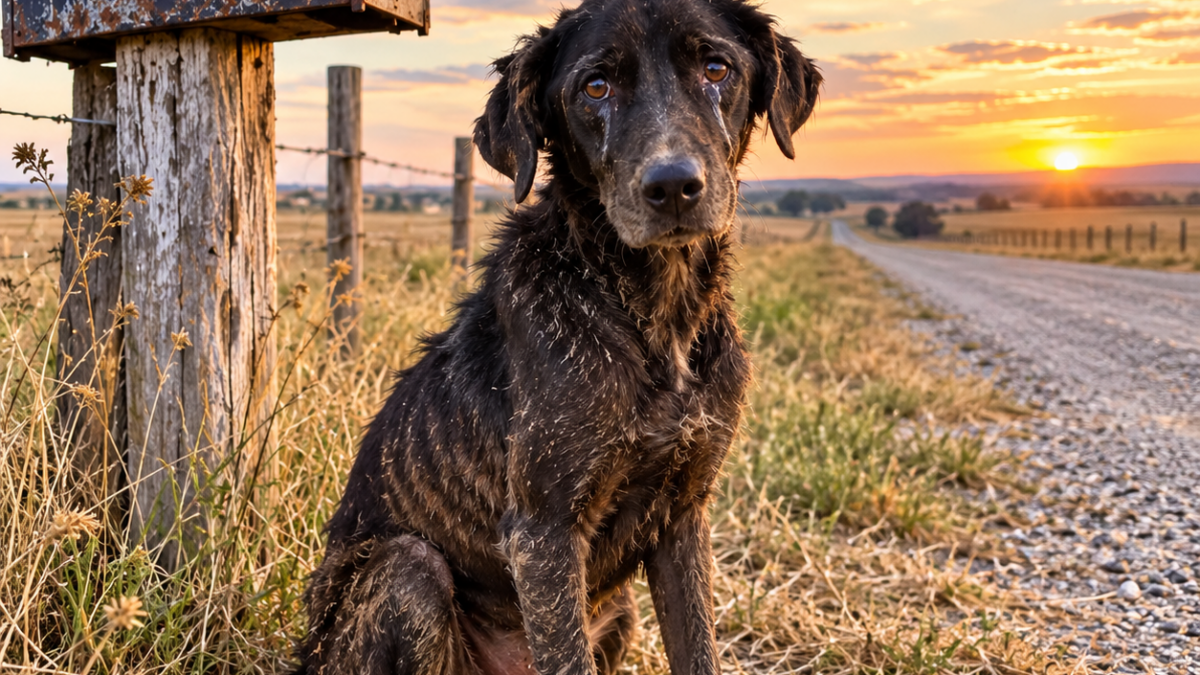
Every evening, the black dog sat beside a rusted mailbox on a Nebraska road and watched every car like one of them might finally bring his whole world back.
The first time I stopped, he looked at me with wet, exhausted eyes, and I swear the question in them was more painful than any bark could have been.
I thought I was only going to leave him food and water—but before that lonely stretch of prairie was finished with us, I would learn why he had been waiting there and what someone had tried very hard to leave behind.
I had driven County Road 18 outside Broken Bow for years. It was the kind of Nebraska road where the sky seemed to swallow everything—dry grass, weathered fence posts, and miles of open land.
That afternoon, I was coming home from work when I noticed something dark beside an old mailbox.
At first I thought it was a trash bag.
Then the shape lifted its head.
I hit the brakes.
The dog didn’t move when my tires crunched onto the shoulder. He was almost completely black, but dust had turned his coat brown along his legs and belly. His ribs showed beneath loose skin. Both ears drooped, and his tail lay flat against the gravel.
I stayed inside my SUV for a moment.
“Hey, buddy,” I whispered, though the windows were still closed.
He stared at me.
No barking. No growling. No attempt to run.
That frightened me more than aggression would have.
I stepped out slowly and stopped near the front bumper. The wind moved through the prairie grass, and the old mailbox squeaked on its rusted post.
The dog lowered his head.
“I’m not going to hurt you.”
His eyes lifted again.
There were wet tracks down his dusty face.
I know dogs don’t cry the way people do. But standing there, looking at him, I felt one question so strongly it almost made me look away.
Are you leaving too?
I sat on the ground.
Not close. Maybe fifteen feet away.
He watched every movement.
I had half a turkey sandwich in my lunch bag and a bottle of water in the car. I tore the sandwich into pieces, set them on an upside-down plastic lid, and poured water into a travel bowl I kept for my own dog.
Then I pushed both toward him and backed away.
He stared at the food for almost a minute.
That hesitation hurt.
A starving dog should have rushed it. This one seemed unsure kindness would stay.
Finally, he stood.
His back legs trembled.
One step.
Then another.
He ate carefully, pausing every few bites to look at me.
“I’m staying,” I told him.
The words came out before I understood what I meant.
When he finished, he drank for a long time, then returned to the mailbox and sat beneath it.
Not beside me.
Beside the mailbox.
I glanced down the road.
There were no houses close enough to explain him. The nearest farmhouse had been empty since the Thompsons moved away years ago. Beyond that were pasture and windbreaks.
I took a picture and called the county shelter.
A woman named Marcy answered.
“Can you bring him in?”
“I don’t think I can get near him yet.”
“Don’t chase him. Feed him if he’ll eat. We’ll see whether someone has reported a missing dog.”
“Can you send somebody?”
“We’re down one officer today. Earliest might be tomorrow morning.”
Tomorrow felt too far away.
I looked at the dog.
“I’ll come back.”
His ears twitched at my voice.
I drove home, loaded food, a blanket, water, and a slip lead, then turned around.
The sun was lower when I reached the mailbox again.
He was still there.
Exactly where I had left him.
I parked farther away this time and sat in the grass.
For nearly an hour, neither of us did much.
I talked anyway.
I told him my name was Claire. I told him I lived twelve miles away. I told him my old mutt, Sadie, would probably hate sharing her couch. I told him the weather forecast said the temperature would drop after dark.
He listened with his head between his paws.
When I finally stood to leave, his eyes followed me to the car.
I opened the door, then looked back.
“Tomorrow morning,” I promised.
For the first time, his tail moved once against the dirt.
The next morning, before sunrise, I drove back to that mailbox.
And when my headlights swept across the shoulder, what I saw beside it made me grip the steering wheel with both hands.
PART 2
There were tire tracks in the gravel.
Fresh ones.
They curved off the road, stopped almost exactly where I had parked the afternoon before, then continued east.
The black dog was still there.
But he wasn’t sitting anymore.
He was lying flat beneath the mailbox with his nose tucked against his chest, and beside him sat a dented aluminum pie pan filled with something that looked like old dog food.
For one stupid, hopeful second, I thought his owner had finally come back.
I pulled over and jumped out.
“Hey, buddy.”
His head lifted.
That tiny tail moved once.
Relief went through me so fast my knees weakened.
“Okay. Good. You’re still here.”
I glanced at the food.
He hadn’t touched it.
There were cigarette ashes in the pan.
My hope disappeared.
I crouched several yards away.
“Did somebody come bothering you?”
He watched me.
The temperature had dropped overnight. Frost glittered along the grass, and when the dog tried to stand, I could see him shivering.
I poured fresh food into the bowl I had brought.
He ate sooner this time.
Not quickly.
But without the long hesitation from the day before.
That felt like progress.
A county animal-control truck arrived about twenty minutes later.
The woman who climbed out was short, maybe fifty, with gray threaded through her dark hair and the kind of calm expression that told me she had spent years approaching frightened animals.
“Claire?”
“That’s me.”
“I’m Marcy.”
We shook hands.
She looked past me.
“That our guy?”
“Yeah.”
The dog immediately backed closer to the mailbox when he saw her uniform.
Marcy stopped.
“That tells me something.”
“What?”
“He’s afraid of strangers, but he hasn’t left when you’ve approached.”
“He’s only seen me twice.”
“Sometimes twice is enough when you’re the person bringing breakfast.”
She opened the truck and took out a catch pole.
The dog saw it.
His entire body changed.
His head came up.
His ears flattened.
Then he ran.
“Wait!”
He disappeared through the fence line and into the tall grass.
I turned on Marcy.
“You scared him.”
“I know.”
“Why did you bring that thing out?”
“Because if he’s injured and won’t allow handling, I need a safe way to contain him.”
“He was almost letting me touch him.”
“Almost isn’t contained.”
I knew she was right.
I was still angry.
We walked along the fence for nearly half an hour.
Nothing.
The prairie could hide an animal faster than you’d think. The grass was waist-high in patches, and drainage ditches cut through the land.
I kept calling.
“Buddy!”
Nothing.
Marcy finally stopped.
“Don’t keep pushing him.”
“I can’t leave him out here.”
“I’m not telling you to.”
“Then what are you telling me?”
“Go back to the mailbox.”
I stared at her.
“He keeps returning there, right?”
“Yes.”
“Then that place means something to him.”
We walked back.
I hated the emptiness beside the post.
The stupid rusted box suddenly seemed important.
Marcy looked at it.
“You know whose property this was?”
“Not anymore.”
The mailbox still had numbers nailed to the side.
2147.
No name.
Marcy wrote it down.
“I’ll check county records.”
She looked at the tracks.
“You said these weren’t here yesterday?”
“Not these.”
She took pictures.
“What’s wrong?”
“Nothing yet.”
“That isn’t an answer.”
She looked at me.
“You called about a stray yesterday. You came back today and found fresh tire tracks plus food somebody left overnight. Could be a neighbor. Could be somebody else who noticed him. Could be nothing.”
“But?”
“But I document things before they stop being documentable.”
I liked Marcy a little more after that.
She put the catch pole away.
“I’m going to drive the section roads and see if I can spot him. You stay here.”
“You think he’ll come back?”
“I think he trusts this mailbox more than either of us.”
That sentence bothered me all morning.
I sat in my SUV with the heater running intermittently and watched the grass.
At 8:42, a black head appeared near the fence.
I shut the engine off.
He stood fifty yards away.
“Hey.”
His ears lifted.
I got out, sat beside my front tire and looked away from him.
No pressure.
No staring.
No reaching.
“You made me look pretty stupid in front of Marcy,” I said.
The dog took one step.
“I’m blaming you for that.”
Another.
“You owe me gas money too.”
He came through the fence.
I kept talking.
By the time he reached the mailbox, I had told him about my electric bill, my boss, and Sadie’s lifelong war against the vacuum cleaner.
He sat.
I slid food toward him.
This time he started eating almost immediately.
When he finished, he looked at me.
“Can I try something?”
He obviously didn’t answer.
I extended one hand.
Not toward him.
Just onto the ground between us.
He lowered his nose.
Two inches closer.
Then he froze.
I stayed still.
His nose touched my fingertips.
Barely.
The contact lasted less than a second.
Then he jumped backward.
But he didn’t run.
I started crying.
“Okay,” I whispered. “That was enough.”
Marcy returned around ten.
She stayed by her truck.
“Any luck?”
“He touched me.”
She smiled.
“That’s more useful than my catch pole right now.”
“Thank you for admitting it.”
“Don’t get used to it.”
She had checked the address.
The property behind the mailbox had once belonged to a man named Harold Mercer.
“He died eleven months ago.”
My eyes went back to the dog.
“Did he have a dog?”
“I don’t know yet.”
“What happened to the house?”
“Estate transferred to a relative. Property was sold six months later.”
“Who was the relative?”
“Evan Mercer. Nephew.”
“Can you call him?”
“I can.”
“Do it.”
Marcy raised an eyebrow.
“I plan to.”
She handed me her card.
“If you can get close enough to see whether he’s wearing a collar or tag, call me.”
“He isn’t wearing a collar.”
“Could be microchipped.”
“If I can ever get him into my car.”
“You probably will.”
I looked at her.
“You sound pretty certain.”
“He came back to you after I scared him away.”
She nodded toward the dog.
“That’s a choice.”
For the next four days, my life reorganized itself around a mailbox.
Before work, I drove twelve miles east.
After work, I drove twelve miles east again.
Every time, he was either sitting beside the post or appeared within minutes of hearing my engine.
On the third day, his tail wagged twice.
On the fourth, he took food directly from my hand.
On the fifth, I touched his shoulder.
His entire body trembled.
Not aggression.
Fear.
The trembling ran beneath his skin like an electric current.
I almost pulled away.
Then he leaned.
Just slightly.
Into my palm.
“Oh, honey.”
That was the first time I called him that.
He closed his eyes.
I rubbed his shoulder.
I could feel every bone.
“You’ve been doing this alone too long.”
His eyes opened.
For a few seconds, neither of us moved.
Then a pickup appeared down the road.
The dog jerked away from me.
His head snapped toward the vehicle.
And something changed in him.
He stood.
His ears lifted higher than I had ever seen them.
His tail rose.
The truck was still half a mile away.
The dog moved toward the edge of the road.
“Hey. Stay back.”
He ignored me.
The truck came closer.
He took another step.
And suddenly he was no longer the exhausted animal I had been feeding.
He was waiting.
Every part of him was waiting.
The pickup passed without slowing.
The dog ran three steps after it.
Then stopped.
I watched his tail fall.
He returned to the mailbox and sat down.
That was the moment I understood.
He wasn’t staying there because it offered shelter.
It didn’t.
He wasn’t staying because there was food.
There hadn’t been until I came.
He was waiting for a vehicle.
Maybe one specific vehicle.
I sat beside him.
“Who are you waiting for?”
He looked down the road.
That afternoon, I drove to the nearest farmhouse.
A man in his seventies answered after I knocked twice.
“Sorry to bother you. I’m trying to find out about a black dog near the old Mercer place.”
His face changed.
“Boone?”
My heart kicked.
“His name is Boone?”
“Black Lab mix?”
“Thin. Gray around the muzzle.”
“That’s Boone.”
“You know him?”
“Knew Harold.”
The man opened the screen door wider.
“You better come in.”
His name was Walter Jensen.
His wife, Ruth, poured me coffee while Walter told me about Harold Mercer.
Harold had been a widower.
No children.
He’d lived on that patch of Nebraska land for nearly forty years.
Boone had arrived as a puppy about nine years before Harold died.
“Somebody dumped a litter near the grain elevator,” Walter said. “Harold took the black one.”
I looked down at my coffee.
“So Boone was abandoned once already.”
“Suppose he was.”
“What was Harold like with him?”
Walter smiled.
“That dog went everywhere with him.”
Ruth joined us at the table.
“Harold talked to Boone more than he talked to people.”
Walter laughed softly.
“That’s because Boone argued less.”
I smiled, but my throat hurt.
“Why the mailbox?”
They looked at each other.
Ruth answered.
“Every afternoon around five, Harold drove down to get the mail. Boone rode in the truck.”
“Every day?”
“Near enough.”
“When the weather was good, sometimes they sat there.”
“Sat where?”
“By that mailbox.”
I stared at her.
Ruth continued.
“Harold had an old folding chair. He’d sit out there, look at the road, drink coffee. Boone would lie beside him.”
“Why?”
Walter shrugged.
“Harold said sunsets were better from the road.”
I thought of Boone staring west every evening.
The pieces were beginning to hurt.
“What happened when Harold died?”
Walter’s smile disappeared.
“Heart attack.”
“At home?”
“In the kitchen.”
“Was Boone there?”
“Far as I know.”
I swallowed.
“What happened to him afterward?”
Walter looked toward the window.
“That part never sat right with me.”
“Tell me.”
“Harold’s nephew came down from Omaha to settle things. Evan.”
“I know the name.”
“He was here maybe two weeks off and on.”
“Did he keep Boone?”
“For a while.”
“What does that mean?”
“I saw Boone around the property while Evan cleaned the house out.”
“And after?”
Walter’s jaw tightened.
“I figured Evan took him.”
“He didn’t.”
“No.”
“Did you see what happened?”
“No.”
Ruth touched Walter’s arm.
“You saw the truck.”
Walter sighed.
“About a week before the property closed, I saw Evan’s pickup at the mailbox.”
“With Boone?”
“I couldn’t tell from here.”
“When?”
“Late afternoon.”
“What happened?”
“He stayed maybe five minutes. Then drove away.”
“And Boone appeared after that?”
“Next day.”
I felt my hands close around the coffee mug.
“Why didn’t anybody do anything?”
Walter’s eyes met mine.
It was not an accusing look.
It was worse.
Ashamed.
“I fed him.”
“How long?”
“Few days. Then he disappeared.”
“He didn’t disappear.”
“I know that now.”
“Where did you think he went?”
“I thought maybe somebody took him in.”
I stood and walked to the window.
From there I could see miles of pasture.
People assumed.
That was how animals vanished while remaining in plain sight.
One person assumed an owner would return.
Another assumed a neighbor had helped.
Someone else assumed a rescue knew.
Meanwhile a dog sat beside a mailbox waiting for a truck that had already chosen to leave him.
“Do you have any pictures of Boone with Harold?”
Ruth stood.
“I might.”
She returned with her phone.
The first photograph showed an older man in faded overalls sitting on a tractor.
Boone was in the passenger side of the cab.
Healthy.
Shiny.
His tongue hanging out.
The second showed Harold in a lawn chair beside the black mailbox.
Boone lay at his boots.
My eyes filled.
“That’s him.”
Ruth touched my shoulder.
“Is he bad?”
“He’s thin. Really thin.”
“Oh, Lord.”
“I’m trying to get him out.”
“Take him.”
I looked at her.
“Believe me, I’m trying.”
Before I left, Walter stopped me at the door.
“Claire?”
“Yeah?”
“If Evan left that dog there, don’t let him talk his way out of it.”
The anger in his voice surprised me.
“I don’t plan to.”
But at that moment, I still didn’t know what I could prove.
That changed the next morning.
Marcy called me at 6:17.
“I spoke with Evan Mercer.”
I sat up in bed.
“And?”
“He says Boone ran away.”
“When?”
“He’s vague.”
“Of course he is.”
“He says Boone disappeared while he was clearing Harold’s property.”
“That’s not what the neighbors think.”
“I know.”
“Did you tell him Boone’s been sitting at the mailbox?”
“Yes.”
“What did he say?”
Marcy went quiet.
“What?”
“He asked if the dog was still alive.”
I felt something cold go through me.
“He asked that?”
“Yes.”
“Not whether Boone was okay?”
“No.”
“Not where he was?”
“No.”
I got out of bed.
“Marcy.”
“I know.”
“What are you going to do?”
“Keep asking questions.”
The forecast that morning changed everything.
A hard freeze.
Thirty-mile-an-hour wind.
Wind chill in the teens.
I called work and told my supervisor I’d be late.
Then I drove straight to the mailbox.
Boone was waiting.
The moment my SUV came into view, his ears lifted.
His tail moved.
Three times now.
I opened the passenger door.
“Today’s the day.”
He looked at me.
“I know you don’t agree.”
I set food just inside the door.
He approached.
Stopped.
Backed away.
“Come on.”
He paced.
“I’m not leaving you out here tonight.”
He looked toward the road.
That broke me.
“He’s not coming back, Boone.”
The dog froze.
I knew he didn’t understand the sentence.
But I did.
“He’s not coming back.”
My voice cracked.
“I’m sorry.”
Boone looked toward the horizon.
I sat on the gravel.
For an hour, nothing happened.
At one point he came close enough that I slipped two fingers beneath his chin.
At another, he walked to the open car door, sniffed the threshold, then retreated.
I didn’t force him.
By noon, clouds had covered the sky.
The temperature kept falling.
Marcy arrived without the catch pole.
Smart woman.
She brought rotisserie chicken.
“Bribery?” I asked.
“Professional technique.”
Boone approved.
We built a trail of chicken pieces toward the SUV.
He followed four feet.
Stopped.
Followed two more.
Backed away.
An hour later, we tried again.
At 2:23, he put both front paws inside.
I stopped breathing.
“Don’t move,” Marcy whispered.
“I’m not.”
Boone ate one piece.
Then another.
His rear paws remained on the gravel.
I placed the next piece farther inside.
He looked at me.
Then at the road.
The wind rattled the mailbox.
Boone turned his head.
For a terrible second, I thought he was leaving.
Then he lifted one rear paw into the SUV.
Then the other.
He was inside.
I reached for the door.
Boone panicked.
He spun.
His shoulder hit the seat.
“Easy!”
Marcy blocked the opening without touching him.
Boone froze.
I climbed into the driver’s seat.
“Boone.”
His head snapped toward me.
It was the first time I had used his name.
“Boone.”
He stared.
I held out my hand.
“That’s your name, isn’t it?”
His breathing slowed.
I touched his shoulder.
Then I closed the passenger door.
Boone stood rigidly on the floorboard.
Before I pulled away, he looked through the window.
At the mailbox.
He stared at it until we turned the first bend.
I cried all the way to the veterinary clinic.
Dr. Hannah Pike met us at the side entrance.
She took one look at Boone and said, “How long has he been out?”
“I don’t know.”
He weighed forty-three pounds.
For a dog his size, he should have been closer to sixty-five.
He was dehydrated.
Flea-ridden.
His paw pads were cracked.
Two nails had broken below the quick at some point and healed badly.
He had an infected patch of skin along his hip and arthritis in both rear legs.
His teeth were worn but serviceable.
No major organ failure.
No heartworm.
No immediately life-threatening infection.
When Hannah finished examining him, I asked the question I had been afraid to ask.
“Is he going to make it?”
She looked at Boone.
“If his bloodwork comes back the way I expect?”
“Yes.”
My knees almost gave out.
“Yes?”
“He needs slow refeeding, fluids, treatment for the skin infection, parasite control, and time.”
“How much time?”
“For his body? A few months.”
“And the rest?”
Hannah looked at him.
“The rest takes however long it takes.”
Then the technician scanned his shoulders.
The machine beeped.
“He’s chipped.”
I already knew whose name would appear.
**BOONE MERCER.**
Registered owner:
**HAROLD MERCER.**
The listed phone number was disconnected.
The emergency contact was blank.
I stared at the screen.
At least somewhere, officially, Boone’s name still belonged to the man who had once loved him.
I called Marcy.
She came to the clinic.
Because Boone technically had a known prior owner and the estate history was unclear, she explained that the county needed to place a hold on him while ownership was sorted out.
“You’re telling me he has to go to the shelter?”
“No.”
“Good.”
“I’m telling you he can stay with an approved foster during the hold.”
“Me.”
Marcy smiled.
“That was my next sentence.”
When I brought Boone home, my dog Sadie was standing behind the baby gate.
Sadie was twelve years old, forty pounds overweight according to everyone except Sadie, and had reached the age where she considered any disruption to her schedule a violation of federal law.
She looked at Boone.
Boone looked at her.
Sadie looked at me.
Her expression clearly said:
Absolutely not.
“Be nice.”
Sadie sneezed and walked away.
Boone wouldn’t cross the doorway.
I had prepared my guest room.
Soft bed.
Water.
Blankets.
Food.
Dim lamp.
Everything I could think of.
He stood at the threshold staring.
“You’re allowed in.”
Nothing.
I stepped into the room.
He remained outside.
It took me a few minutes to understand.
“Were you not allowed in the house?”
His head lowered.
I walked back toward him.
Then I sat inside the room.
“Okay.”
I waited.
Eventually Boone put one paw across the threshold.
Then another.
When all four feet were inside, he immediately turned toward the door.
I left it open.
That first evening, Boone ignored the bed.
He slept on the floor.
I put a blanket beside him.
He moved away from it.
At 2:00 in the morning, I checked on him.
He was awake.
Watching the doorway.
At 3:30, awake.
At 5:10, awake.
The next night was the same.
On the third night, I woke at midnight and found him sleeping.
Not deeply.
But sleeping.
I sat in the hallway and cried quietly so I wouldn’t wake him.
He had spent months listening for engines.
Listening for footsteps.
Waiting for someone to return.
Now, finally, he had slept long enough to stop listening.
The first week was about food.
Boone didn’t understand that meals were guaranteed.
He ate too fast and became nauseated, so Hannah had me feed small portions several times a day.
Whenever I picked up his bowl after he finished, he followed it with his eyes.
“It’s coming back.”
He didn’t believe me.
So I began returning the empty bowl to the floor.
That helped.
He could see it was still his.
One afternoon, I filled it again while he watched.
Boone stared at me.
Then at the bowl.
Then at me again.
His tail moved.
“You’re getting it.”
By the second week, he knew breakfast happened every morning.
By the third, he had learned dinner was just as reliable.
By the fourth, he started coming into the kitchen when he heard the food container open.
His coat changed.
Not overnight.
But enough that I noticed.
The dull gray-brown dust disappeared.
Black came back.
Glossy in places.
His hips were still too sharp, but muscle slowly returned to his hindquarters.
He started walking farther.
At first, the driveway.
Then the mailbox in front of my house.
That stopped him cold.
The first time he saw it, he froze.
Black box.
Wooden post.
Not the same mailbox.
Close enough.
He walked toward it.
Sniffed underneath.
Then sat.
My chest tightened.
“Boone.”
He looked down the road.
Five minutes passed.
Ten.
“Come on.”
Nothing.
I walked back to the porch.
Sadie followed me.
Boone stayed beside the mailbox.
The sun began lowering.
I understood.
I carried a lawn chair to the edge of the driveway and sat beside him.
“If we’re doing this, we’re doing it together.”
Boone looked at me.
I stayed until dark.
The next afternoon, he sat there again.
So did I.
The third afternoon, he sat for only ten minutes.
Then he came back to the house on his own.
Progress.
Small enough that most people wouldn’t see it.
Huge enough that I did.
Meanwhile, Marcy kept investigating.
She spoke with Walter and Ruth.
She pulled the estate transfer.
She confirmed that Evan had taken possession of Harold’s personal property after his death.
Boone had legally fallen into a gray area because animals were considered property, but the evidence that Evan had assumed care for Boone was strong.
Veterinary records from five years earlier listed Harold as owner.
A receipt found among estate documents listed Evan as the person who bought dog food three days after Harold died.
That proved little by itself.
Then Walter remembered something.
A security camera.
Not at the mailbox.
At his machinery shed.
It pointed toward the road.
The footage was old.
His system overwrote most recordings after thirty days.
But Walter had saved several clips months earlier because someone had been stealing diesel fuel.
One clip was dated six months before I found Boone.
At 5:18 p.m., Evan’s blue pickup appeared.
It stopped beside the Mercer mailbox.
The camera was too far away for faces.
But we could see the passenger door open.
A black dog jumped out.
The dog stood beside the truck.
The truck remained there less than a minute.
Then it drove away.
The dog ran after it.
I watched the clip once.
Then again.
Then I turned away.
Marcy paused the video.
“That’s Boone?”
“Yes.”
“You’re sure?”
“Yes.”
Technically, another black dog could have looked similar from that distance.
But I knew the way Boone moved.
Even underweight, even months later, I knew the slight hitch in his left rear leg.
Walter knew him too.
Marcy took a copy.
“Now what?”
“I send it with the rest.”
“To the county attorney?”
“Yes.”
“What will happen?”
“I can’t promise charges.”
“He dumped him.”
“It looks that way.”
“He drove away while Boone chased the truck.”
“I saw it.”
I pointed at the screen.
“You saw it.”
“Yes.”
“Then what else do you need?”
“Enough evidence that will hold up when somebody on the other side says exactly what you just said isn’t certain.”
I hated that answer.
But I respected it.
She asked the vet to document Boone’s condition at intake.
She photographed his ribs.
His paws.
His skin infection.
She documented his weight.
The fact that he had been located repeatedly at the same place.
Walter and Ruth gave statements.
Then she called Evan again.
This time, his story changed.
Boone had not “run away.”
Evan said he had tried to rehome him.
No one wanted an old dog.
So he had taken Boone to the mailbox because, according to him, Boone “knew the area.”
When Marcy told me, I thought I had misunderstood.
“He admitted it?”
“More or less.”
“He admitted leaving him?”
“He says he believed neighbors would care for him.”
“That is abandonment.”
“That’s the issue being reviewed.”
“He left a nine-year-old dog beside a road.”
“Yes.”
“With no house.”
“Yes.”
“In August.”
“Yes.”
“And then winter came.”
“I know.”
I was shaking.
Marcy waited.
“Where does he live?”
“No.”
“I asked a question.”
“And I’m not answering it.”
“I’m not going to hurt him.”
“I know.”
“Then why won’t you tell me?”
“Because whatever satisfaction you think you’re going to get by showing up at his door will last five minutes.”
She stepped closer.
“You want to help Boone?”
“Yes.”
“Then let me do this right.”
I looked toward the guest room.
Boone was asleep on the floor.
Not the bed.
Still not the bed.
“You know what I want?”
“What?”
“I want Evan to sit beside that mailbox for six months.”
Marcy’s expression softened.
“I know.”
“No food unless a stranger notices him.”
“Claire.”
“No water unless somebody remembers.”
“Claire.”
“I want him to hear every car and wonder whether this is the one coming back.”
She let me finish.
Then she said, “Boone doesn’t need that.”
I looked at her.
“He needs you not to become somebody you’re not because somebody else failed him.”
I hated that she was right.
Again.
So I stayed home.
I gave Boone his medicine.
I measured his food.
I took him on short walks.
And I waited for the system to move.
That became harder when Evan came looking for Boone.
It happened on a Saturday.
I was in the backyard hanging blankets on the line when a blue pickup stopped in front of my house.
Boone was outside with me.
The instant he saw the truck, his body locked.
I didn’t recognize it immediately.
Boone did.
His tail dropped.
He backed toward the porch.
The driver’s door opened.
A man climbed out.
Late forties.
Baseball cap.
Work jacket.
He looked toward Boone.
“There you are.”
Boone turned and ran to the back door.
Not toward him.
Away.
I knew.
I stepped between the man and the house.
“You’re Evan.”
He looked at me.
“You Claire?”
“How did you get my address?”
“Walter talks too much.”
I didn’t answer.
He pointed toward the house.
“I came for the dog.”
“No.”
His eyebrows lifted.
“No?”
“Boone is under county hold.”
“That’s my uncle’s dog.”
“Your uncle is dead.”
“That means Boone came to me.”
“Then you abandoned him.”
His face hardened.
“I didn’t abandon anybody.”
“I saw the video.”
That stopped him.
“What video?”
“The one where you opened your truck door at the mailbox and drove away while Boone ran after you.”
For the first time, he looked uncertain.
Then the anger came back.
“You don’t know what happened.”
“I know enough.”
“He hated being in the house after Harold died.”
“So you left him by a road?”
“I tried keeping him.”
“For how long?”
“He tore things up.”
“He lost his person.”
“He wouldn’t settle.”
“So you punished him for grieving?”
“Don’t talk to me like you know anything about it.”
I stepped closer.
“Then tell me.”
He looked toward the door where Boone had disappeared.
“My uncle spoiled that dog.”
“That’s your defense?”
“I’m saying Boone wasn’t easy.”
“Neither is grief.”
Evan laughed once without humor.
“You rescue people always think every animal is some saint.”
“No.”
I folded my arms.
“Sadie once ate half a couch.”
He stared at me.
“I’m not asking Boone to be a saint. I’m asking why a grown man thought leaving an old dog beside a mailbox was acceptable.”
“He knew that place.”
“He waited there.”
“See?”
I couldn’t believe what I was hearing.
“He waited because Harold used to sit there with him.”
Evan’s expression changed.
Just a flicker.
I saw it.
“You knew that.”
He looked away.
“You knew exactly why he’d stay.”
“I figured he wouldn’t wander.”
The words were so cold I almost missed their meaning.
“You left him there because you knew he would wait.”
Silence.
That was worse than anything I had imagined.
“You knew he’d stay near the mailbox.”
“I figured Walter would feed him.”
“Did you ask Walter?”
“No.”
“Ruth?”
“No.”
“Animal control?”
“No.”
“A shelter?”
“No.”
“A rescue?”
“Those places are always full.”
“Did you call?”
He didn’t answer.
I felt all the anger I had been carrying rise at once.
Boone had not stayed because he lacked the courage to leave.
He had stayed because somebody had exploited the most loyal thing about him.
His attachment.
His memory.
His hope.
Evan took one step toward the house.
“I’m taking my property.”
I blocked him.
“No.”
“You can’t steal my dog.”
“I didn’t steal anything.”
“You have him.”
“Under a county-authorized foster hold.”
He pulled out his phone.
“Then I’ll call the sheriff.”
“Please do.”
That was not the answer he expected.
Twenty minutes later, a sheriff’s deputy pulled into my driveway.
Marcy arrived five minutes after that.
Boone had hidden beneath my kitchen table.
I stayed with him until Marcy knocked.
The deputy spoke to Evan outside.
I couldn’t hear everything.
I heard enough.
Ownership dispute.
Active animal-control investigation.
Evidence of abandonment.
Veterinary condition.
Temporary custody.
Evan kept getting louder.
“This is ridiculous. It’s a dog.”
From beneath the table, Boone started shaking.
I sat on the floor.
“It’s okay.”
His eyes stayed on the door.
“You’re not going anywhere.”
Outside, Evan shouted again.
“I said I want him back.”
The deputy’s voice was calmer.
“Sir, right now you need to leave the property.”
“He belongs to my family.”
Marcy answered.
“He is not leaving this foster placement today.”
Something hit the side of Evan’s truck.
Maybe his hand.
Boone flinched.
That was enough for me.
I stood.
I walked outside.
Marcy turned.
“Claire.”
“No.”
I looked at Evan.
“You want to know the difference between you and Boone?”
He laughed bitterly.
“I’m sure you’re going to tell me.”
“When Harold died, Boone lost everything and still kept waiting for someone he loved.”
I pointed toward the road.
“You lost an inconvenience and came back only when somebody told you there might be consequences.”
His face reddened.
“Stay away from me.”
“That’s exactly what I plan to do.”
Marcy stepped between us.
“Claire. Inside.”
I went.
Not because Evan deserved the last word.
Because Boone needed me more than my anger did.
Five minutes later, the blue pickup drove away.
Boone heard it.
He crawled from beneath the table.
Then he walked to the window.
Watched the truck disappear.
I stood behind him.
He didn’t whine.
Didn’t scratch the door.
Didn’t run outside.
He simply watched.
When the truck was gone, Boone turned around.
And walked to me.
That was the first time he chose me over the road.
I dropped to my knees.
He put his head against my chest.
“You’re done waiting for him.”
His tail moved against the floor.
Sadie appeared from the hallway, looked at both of us, and sighed like she was tired of emotional people.
Then she lay beside Boone.
It was the first time she had done that.
I laughed through my tears.
“Traitor.”
Sadie closed her eyes.
Boone did too.
That night he slept on the bed.
Not my bed.
His.
The soft orthopedic dog bed I had bought three weeks earlier.
I found him there at 1:00 in the morning, curled tightly in the center.
For a while, I stood in the doorway afraid to breathe.
Then Boone stretched.
One paw slid over the edge.
His face relaxed.
I took a picture.
The next morning, I sent it to Marcy.
She replied:
**Looks like he finally understands.**
I wrote back:
**I think I’m the one who finally understands.**
Boone wasn’t waiting for Harold anymore.
Not exactly.
I think he had been waiting for the world to become predictable again.
Harold had been predictable.
Mail at five.
Coffee beside the road.
Truck door opening.
Dinner.
Home.
Then one day everything disappeared.
After that, Boone had only one predictable place left.
The mailbox.
So he held onto it.
Now breakfast came at seven.
Walk at eight.
Dinner at five-thirty.
Sadie stole his toys at six.
I watched television at eight.
Boone slept near the couch.
Routine became medicine.
Three months after I found him, Boone weighed fifty-seven pounds.
His coat was black again.
Really black.
There was gray around his muzzle, but that belonged there.
His eyes were brighter.
His rear legs still ached on cold mornings, so Hannah started him on arthritis medication.
He discovered tennis balls.
He didn’t fetch them.
He stole them.
Completely different sport.
I would throw one.
Sadie would chase it.
Boone would wait until Sadie brought it back, take it from her mouth and walk away.
Sadie was furious.
I was delighted.
The first time Boone barked inside my house, I almost fell off the couch.
UPS driver.
One bark.
Deep.
Serious.
Then Boone looked terrified by his own voice.
I started laughing.
“You’re allowed.”
He wagged.
“You’re allowed to be loud here.”
That mattered too.
Trust did not arrive in one grand moment.
It came as ordinary things.
Boone sleeping through a thunderstorm.
Boone letting me wipe mud from his feet.
Boone staying asleep when I picked up my keys.
Boone hearing my car leave and no longer panicking because he had learned I came back.
That one took longest.
For the first month, my neighbor said Boone sat by the window whenever I went to work.
The second month, he waited twenty minutes.
The third month, five.
Then one afternoon I came home and found him asleep.
He hadn’t even heard me enter.
That might have been my favorite victory.
The legal case moved slower than Boone’s recovery.
I hated that.
The county attorney eventually filed misdemeanor animal-neglect and abandonment charges.
Evan’s attorney argued Boone had effectively become a stray after Harold’s death.
The state argued Evan had assumed responsibility for Boone, then intentionally transported and left him without arranging care.
The video mattered.
The veterinary records mattered.
Walter’s testimony mattered.
Evan’s own statements mattered.
Most of all, the timeline mattered.
Boone had not wandered miles away.
He had been left at a location Evan knew would hold him.
The temporary custody hearing happened first.
I sat in the back of a small county courtroom with Marcy.
Evan sat at another table.
I hated how ordinary everything looked.
Fluorescent lights.
Brown carpet.
People shuffling paperwork.
I had imagined justice would look different.
Louder.
More dramatic.
Instead, a judge read documents while Boone waited at home with Sadie.
Marcy testified.
Walter testified.
Hannah testified about Boone’s condition.
Then Evan testified.
His attorney asked why he had taken Boone to the mailbox.
“Because Boone knew the area.”
“Did you intend for him to suffer?”
“No.”
“Did you believe neighbors would care for him?”
“Yes.”
“Was it your understanding Boone had historically spent time outside?”
“Yes.”
Then the county attorney stood.
“Mr. Mercer, did you contact Walter Jensen and ask him to take responsibility for Boone?”
“No.”
“Did you contact Ruth Jensen?”
“No.”
“Animal control?”
“No.”
“A rescue?”
“No.”
“A shelter?”
“No.”
“Veterinarian?”
“No.”
“Did you leave food?”
“Some.”
“How much?”
“I don’t remember.”
“Water?”
“There are stock tanks around.”
“Did you verify Boone could access them?”
“No.”
“Did you return daily?”
“No.”
“Weekly?”
“No.”
“When did you next physically check Boone?”
Evan looked toward his lawyer.
The lawyer could not answer for him.
“I didn’t.”
The courtroom went quiet.
The county attorney picked up a photograph.
It showed Boone on the day I found him.
Ribs visible.
Dust covering his coat.
Eyes sunken.
“Is this the dog you left?”
Evan looked.
“Yes.”
“How long after you left Boone was this photograph taken?”
“Months.”
“Six months.”
Evan said nothing.
“You testified that you believed neighbors would care for him.”
“Yes.”
“What did you do when no neighbor contacted you to confirm they had accepted responsibility?”
Nothing.
The attorney waited.
Evan finally said, “I assumed.”
There it was.
One word.
The word that almost killed Boone.
Assumed.
Walter assumed someone took him.
People driving past assumed he belonged nearby.
Evan assumed somebody else would feed him.
For months, Boone survived in the space between other people’s assumptions.
The judge awarded custody to the county, with continued foster placement authorized until the criminal matter was resolved.
Evan lost any immediate claim to remove him.
Outside the courthouse, Marcy touched my arm.
“Breathe.”
“I am.”
“No, you’re pretending.”
I exhaled.
“Can he still get Boone back?”
“Highly unlikely.”
“That isn’t no.”
“No.”
She smiled.
“But it’s close.”
The criminal case never became the huge courtroom spectacle I had imagined.
Real cases rarely do.
Evan eventually accepted a plea agreement.
He admitted abandoning Boone without arranging adequate care.
There was a fine.
Restitution for part of Boone’s veterinary expenses.
Community service.
Probation.
And a restriction preventing him from owning or being primarily responsible for companion animals during the probation period.
Was it enough?
At first, I didn’t think so.
I wanted something bigger.
I wanted the punishment to equal every evening Boone had spent beside that mailbox.
How do you calculate that?
One hour for every car he watched?
One day for every night he slept without knowing whether food would come?
One punishment for every time he lifted his head because an engine sounded like a truck he remembered?
There was no sentence for that.
No court could return those months.
But the agreement did something important.
It said what happened to Boone was not nothing.
It created a record.
It placed responsibility where it belonged.
And it made it harder for someone to do the same thing again.
The final part of the case was Boone’s ownership.
The county formally took custody after Evan surrendered any remaining claim.
Marcy called me on a Wednesday afternoon.
“Are you sitting down?”
“No.”
“Sit.”
I sat at my kitchen table.
Boone was beneath it, his usual place while I worked through bills.
“Okay.”
“You know that black dog you keep feeding?”
“No, never seen him.”
“He’s legally available.”
My throat tightened.
“For adoption?”
“Yes.”
I looked down.
Boone was asleep with his nose against my slipper.
“Marcy.”
“Yeah?”
“What if I say no?”
She laughed.
“I’ll assume you’ve been kidnapped.”
I started crying.
Boone woke.
His head came up.
“What do I need to sign?”
“Come tomorrow.”
“No. Today.”
“Claire, the office closes in forty minutes.”
“I’m twelve minutes away.”
“You have to drive through town.”
“Thirty-eight.”
She sighed.
“I’ll tell them you’re coming.”
I looked down at Boone.
“Want to go get adopted?”
His tail hit the floor.
Sadie appeared from the living room.
“Not you. You already own half the house.”
Boone followed me to the SUV.
Months earlier, I had needed chicken, patience and two hours to get him inside a vehicle.
That afternoon, I opened the door.
He jumped in.
Just like that.
I stood there holding the handle.
The simplicity of it nearly broke me.
“You trust me that much now?”
Boone looked out the windshield.
I closed the door.
At the shelter, Marcy had already printed the paperwork.
The adoption fee was one dollar.
I stared at her.
“One dollar?”
“County senior-dog special.”
“That’s ridiculous.”
“You want me to make it two?”
“No.”
I signed.
Name.
Address.
Phone number.
Veterinarian.
Then came the line:
**New owner signature.**
I stopped.
Marcy noticed.
“You okay?”
“Yeah.”
I looked at Boone sitting beside my chair.
“Just give me a second.”
For months, I had called him mine in every way except legally.
My dog.
My boy.
My Boone.
Now a single signature would make official what he had already decided.
I signed.
Marcy stamped the form.
“That’s it.”
“That’s it?”
“That’s it.”
I stared at her.
“After everything?”
“You expected fireworks?”
“Maybe a marching band.”
“Budget cuts.”
I laughed.
Then cried.
Again.
Boone leaned against my leg.
Marcy crouched and scratched behind his ear.
“You picked a good one, Boone.”
I shook my head.
“He picked first.”
That evening, I bought him a new collar.
Dark red.
A brass tag.
**BOONE**
Underneath:
**I AM HOME.**
I almost chose my phone number for the second line.
Then I realized the engraving machine could fit both.
So the back read:
**CLAIRE — 308-555-0146**
I clipped it onto his collar.
The tag jingled.
Boone looked down.
“You have an address now.”
His tail wagged.
“You have a house.”
Another wag.
“You have a bed.”
He glanced toward Sadie.
“Well, two beds, because apparently hers is yours too.”
Sadie groaned.
“And you have me.”
Boone stepped forward and pressed his forehead against my stomach.
I put both arms around him.
“No more waiting.”
Months passed.
Spring came.
The Nebraska prairie turned green.
Boone discovered mud.
A lot of mud.
His favorite hobby became finding the exact patch of earth I had hoped he would avoid and lying in it.
He gained another four pounds.
Hannah finally said, “Stop feeding him extra.”
“I’m not.”
She looked at me.
“Claire.”
“Maybe one biscuit.”
“How many is one?”
“Depends how you define biscuit.”
Boone sat beside me, looking innocent.
Hannah pointed at him.
“You’re part of this.”
His tail wagged.
By summer, people who had only seen the first photograph barely recognized him.
His shoulders had filled out.
His coat shone.
His eyes no longer followed every vehicle.
Not every vehicle.
Some sounds still triggered old habits.
A diesel pickup slowing near the house.
The metallic slam of a truck door.
A certain engine pitch.
Boone would freeze.
Then he would look at me.
I learned what to do.
Nothing dramatic.
Just:
“I’m here.”
Eventually his body believed what his ears still feared.
One August evening, almost a year after I first saw him, I made a decision.
I was going to take Boone back to the mailbox.
Everyone had an opinion.
Walter thought it was a good idea.
Ruth thought it might upset him.
Marcy said, “You know him better than we do.”
Hannah said, “Don’t force anything.”
I wouldn’t.
I wasn’t taking Boone back because I thought dogs needed symbolic closure.
That was probably a human idea.
I was taking him because I needed to know whether that place still owned part of him.
And maybe because part of me still belonged there too.
So on a warm September evening, I put Boone and Sadie in the SUV.
Yes, Sadie came.
She refused to be excluded from anything involving a car.
We drove east.
The sky was enormous.
Fields turned gold beneath the falling sun.
Boone slept most of the way.
Then we turned onto County Road 18.
His head lifted.
I saw it immediately.
His nose moved toward the window.
His ears rose.
Recognition.
My hands tightened on the steering wheel.
“You remember.”
Boone stood.
Sadie remained asleep.
Of course.
When the old mailbox appeared in the distance, Boone moved closer to the glass.
I slowed.
My heart was pounding harder than it had the first day.
The mailbox looked even smaller than I remembered.
Rust.
Faded black paint.
The same slight lean toward the road.
I parked.
For a moment, I didn’t open the doors.
Boone stared.
“What do you think?”
His eyes stayed on the post.
I clipped his leash on.
Then we got out.
Boone walked directly to the mailbox.
He sniffed the base.
The grass.
The gravel.
The old wooden post.
Then he sat.
Exactly where he used to sit.
I felt tears coming.
“No.”
I laughed quietly.
“I promised myself I wasn’t going to do this.”
Sadie wandered off to investigate something more interesting.
Boone looked west.
A truck appeared in the distance.
My stomach tightened.
Boone’s ears lifted.
The truck came closer.
For a moment, time folded in on itself.
I saw the starving dog again.
Dusty coat.
Sharp ribs.
Head lifting at every engine.
Hope appearing and disappearing over and over.
The truck approached.
Boone stood.
I held my breath.
It passed.
Gravel flew.
The sound faded.
Boone watched it disappear.
Then he turned.
He looked at me.
His tail wagged.
Once.
Twice.
Then harder.
He walked away from the mailbox.
Straight to me.
I dropped to my knees.
“There you are.”
Boone leaned into me.
Not toward the road.
Not toward the disappearing truck.
Toward me.
“You ready to go home?”
He licked my chin.
“I’m taking that as yes.”
I stood.
Boone walked toward the SUV.
Halfway there, he stopped.
Looked back once.
At the mailbox.
At the road.
At whatever memory lived there.
Then he jumped into the car.
He didn’t wait for me to bribe him.
He didn’t hesitate.
He climbed in because that vehicle was taking him home.
I stood beside the open door and cried.
Sadie barked from the back seat because apparently I was taking too long.
“Okay, okay.”
I got behind the wheel.
Before we left, I looked at the mailbox one more time.
For months, I had hated that thing.
I had seen it as a monument to cruelty.
A place where somebody exploited a dog’s loyalty and left him waiting.
But sitting there with Boone behind me, I realized the mailbox was also the reason I had found him.
He had chosen one place.
Stayed visible.
Kept returning.
Kept hoping.
And one ordinary afternoon, I had finally been the person who stopped.
I drove home as the sun disappeared.
Boone slept the entire way.
That night he climbed into his bed, circled three times and collapsed with a sigh.
I sat beside him.
His red collar was slightly faded now.
The brass tag had tiny scratches.
**I AM HOME.**
I rubbed his ear.
“You know what I used to think?”
His eyes opened.
“I thought I rescued you.”
Boone yawned.
“Very rude.”
His eyes closed again.
“But I think you were doing the hardest part long before I showed up.”
He had survived.
Not because abandonment made him stronger.
I hate when people say suffering is a gift.
It isn’t.
Boone should never have needed that kind of strength.
He survived because somewhere inside him, there was still enough trust to lift his head when one more car stopped.
Enough hope to take one careful step toward food.
Enough courage to put his nose against my fingers.
Enough willingness to try another human being after one had failed him.
That deserved respect.
Not romanticizing.
Respect.
The next morning, I woke to something heavy on my legs.
Boone.
He had climbed into my bed during the night.
This from the dog who once refused to cross the threshold of my guest room.
He was lying upside down with his feet against the wall.
Sadie occupied the other half of the mattress.
I had approximately eleven inches of sleeping space.
“This is unacceptable.”
Neither dog moved.
“I pay the mortgage.”
Boone opened one eye.
Then closed it.
I started laughing.
That became our life.
Ordinary.
Beautifully, ridiculously ordinary.
Breakfast.
Walks.
Vet visits.
Dog hair everywhere.
Boone stealing Sadie’s tennis balls.
Sadie stealing Boone’s bed.
Boone barking at delivery trucks.
Me pretending I had control over anything.
He never became a young dog again.
His muzzle continued turning gray.
His arthritis got worse with winter.
I added rugs so he wouldn’t slip.
Built a small ramp for the back steps.
Started warming his food because apparently room-temperature dinner became beneath him.
“You lived beside a road eating whatever you could find,” I reminded him one night when he rejected a cold meal.
Boone stared.
“Now you require cuisine?”
He stared harder.
I microwaved it.
Of course I did.
Two years after I found him, Walter called.
The old Mercer property had sold again.
A young couple was moving onto the land.
They planned to remove the old mailbox.
“They asked whether I knew anything about it,” Walter said.
I went quiet.
“What are they doing with it?”
“Throwing it away, I imagine.”
“No.”
Walter laughed.
“I figured.”
I met the new owners that Saturday.
Emily and Ben Carter.
They knew part of Boone’s story because Walter had told them.
Emily looked at the rusted mailbox.
“You want this?”
“Yes.”
“It’s barely a mailbox.”
“I know.”
“We were going to replace it.”
“Please do.”
Ben unbolted the box from the post.
He handed it to me.
It was lighter than I expected.
Rust flaked onto my jacket.
I stood holding the thing that had once been the center of Boone’s world.
Emily asked, “What are you going to do with it?”
“I don’t know yet.”
I took it home.
Boone sniffed it in the garage.
Once.
Then walked away.
That made me laugh.
I had expected another emotional moment.
Boone apparently had no interest.
“You’re healthier than I am.”
I cleaned the mailbox.
Not enough to erase its age.
Just dirt and loose rust.
Then I mounted it on a wooden shelf in the rescue office.
Yes, rescue office.
Because after Boone, something else changed.
I started volunteering with Marcy on weekends.
Then fostering.
Then helping coordinate emergency placements.
I wasn’t trying to become a hero.
I had simply learned how thin the line could be between “somebody should help” and nobody helping.
The first foster after Boone was a hound mix found behind a feed store.
Then a senior Chihuahua whose owner entered assisted living.
Then two puppies somebody left inside a plastic tote near a church.
Boone hated the puppies.
Not truly.
He simply objected to their lack of manners.
One climbed on his head.
Boone looked at me with betrayal.
“I didn’t make him.”
His expression said I had clearly failed as management.
The old mailbox became a reminder.
We placed a small card beneath it.
No dramatic slogan.
Just:
**BOONE’S MAILBOX**
**Stop. Look twice. Someone may be waiting.**
People asked about it.
I told them.
Not the polished version.
The true one.
A dog was abandoned.
People drove past.
One person stopped.
Others helped.
The system eventually held someone accountable.
The dog lived.
And then I always added the part I thought mattered most.
“You don’t have to solve everything when you stop.”
You can call someone.
Bring water.
Take a photograph.
Ask who owns the animal.
Return tomorrow.
Document what you see.
Sometimes rescue begins with nothing more heroic than refusing to pretend you didn’t notice.
Boone became our unofficial greeter.
Terrible choice.
He slept through most visitors.
Children loved him.
He had a special patience with quiet kids.
One little boy sat beside him for forty minutes reading a book aloud.
Boone slept through the entire thing.
The boy’s mother apologized.
“For what?”
“He’s probably bothering him.”
I looked at Boone.
His head was on the child’s shoe.
“No.”
I smiled.
“I think he likes people who stay.”
Years passed.
Boone slowed down.
That part is difficult to write.
Because once you rescue an old dog, there is a cruel bargain hidden inside the joy.
You get him back.
But not forever.
No one gets forever.
With seniors, you simply see the clock more clearly.
By the fourth year, Boone’s walks shortened.
One mile became half.
Half became around the block.
Around the block became the end of the driveway.
He still visited the mailbox there.
My mailbox.
Not the Nebraska road.
He would sniff the post, pee on Walter’s newspaper if Walter had dropped it off for me, then come inside.
He no longer watched cars.
One November morning, Hannah listened to Boone’s heart longer than usual.
I knew.
“What?”
She removed the stethoscope.
“His rhythm’s changed.”
My stomach tightened.
Tests followed.
Heart disease.
Manageable for a while.
Medication.
Monitoring.
More expensive food that Boone liked far too much.
He had earned every bite.
We got another year.
A good one.
Not perfect.
Good.
Spring sunlight on the porch.
Slow walks.
Car rides.
Boone asleep under my desk.
Sadie died during that year.
She was seventeen.
Boone searched for her for several days.
He checked her bed.
The kitchen.
The yard.
Then one evening, he lay where she used to sleep.
I sat beside him.
“I know.”
He put his head in my lap.
Losing Sadie taught me something about Boone I hadn’t fully understood before.
He had survived grief more than once.
The puppy abandonment.
Harold.
The roadside.
And now Sadie.
Still, he kept attaching himself to life.
Not because he forgot.
Because love after loss was still worth having.
That lesson became important sooner than I wanted.
Boone’s heart condition progressed.
He began tiring after walking across the room.
Some mornings he wouldn’t eat.
Then he would rally.
The dangerous thing about aging animals is that one good afternoon can convince you the bad days aren’t real.
I held onto every good afternoon.
Probably too tightly.
Hannah knew.
One day she sat beside me on the clinic floor.
Boone was asleep between us.
“How will I know?”
“You’ll know.”
“I hate that answer.”
“I know.”
“What if I wait too long?”
“That’s why we keep talking.”
“What if I do it too soon?”
“That’s why we keep talking.”
I rubbed Boone’s chest.
“I promised him nobody was leaving again.”
Hannah’s voice softened.
“Helping him die peacefully isn’t leaving.”
I looked away.
It felt like it.
Months later, on an October evening, Boone walked to my mailbox.
Slowly.
Painfully.
He sat.
The sky was gold.
Almost exactly like the evening I first met him.
I brought a chair.
Sat beside him.
For twenty minutes, we watched cars.
Boone didn’t lift his head for any of them.
He leaned against my leg.
That was all.
I knew.
The next morning, Hannah came to my house.
I had asked for that.
Boone hated clinics by then.
He deserved his own bed.
His own room.
His own smells.
I fed him roast chicken.
He ate three pieces.
Rejected the fourth.
“Still picky.”
His tail moved.
I lay beside him on the floor.
The old mailbox from County Road 18 was on a shelf across the room.
Boone didn’t look at it.
He looked at me.
“Remember when you wouldn’t get in my car?”
His tail moved.
“I sat in the dirt for two hours.”
Another wag.
“You cost me a whole rotisserie chicken.”
I kissed his forehead.
“Best chicken I ever bought.”
Hannah gave him the first medication.
Boone relaxed.
His head became heavy against my arm.
I cried into his fur.
Not because I thought I had failed.
Not this time.
Because we had succeeded long enough for goodbye to become expensive.
Years earlier, Boone had been alone beside a road with no guarantee the next meal would come.
Now he was leaving from a warm room after years of knowing exactly where he belonged.
I put my forehead against his.
“You don’t have to wait for anybody.”
His breathing slowed.
“I’m right here.”
Hannah waited.
I nodded.
The final medication went in.
Boone’s body softened.
I kept one hand on his chest.
One hand around his paw.
And when his heart stopped, the house became so quiet I could hear the Nebraska wind pushing against the windows.
Hannah listened.
Then she whispered, “He’s gone.”
I closed my eyes.
For a while, I couldn’t speak.
Then I said the first thing that came to me.
“No.”
Hannah waited.
I shook my head.
“He’s not waiting anymore.”
Afterward, I sat beside Boone for nearly an hour.
There was no need to hurry.
He had spent enough of his life waiting for other people’s schedules.
This time the world could wait for him.
I buried some of his ashes beneath the cottonwood tree behind my house.
The rest I kept.
Beside Sadie.
I placed Boone’s red collar around the old mailbox.
His brass tag still read:
**I AM HOME.**
For weeks, I couldn’t walk past it without touching it.
People asked whether I regretted going back to that road that first morning.
Never.
Not once.
Even the ending did not change that.
Grief is the price we pay because something was worth keeping.
Boone was worth every part of it.
A few months after he died, I drove County Road 18 again.
The Carter family’s new mailbox stood where the old one had been.
Fresh cedar post.
Bright black box.
Their last name painted neatly on the side.
The prairie looked the same.
Grass.
Fence.
Sky.
I pulled over.
For a moment, I saw him exactly as he had been.
Thin black body.
Head between his paws.
Eyes following the road.
Then the image changed.
Boone running through my backyard.
Boone stealing Sadie’s tennis ball.
Boone asleep upside down on my bed.
Boone refusing cold dinner because I had accidentally turned a roadside survivor into a food critic.
Boone jumping into my SUV without hesitation.
Boone turning away from the old mailbox and walking toward me.
That was the memory I chose.
Not the waiting.
The leaving.
He had left that mailbox twice.
The first time because I finally convinced him to trust me.
The second because he no longer needed it.
I sat in my car until sunset.
A truck passed.
Then another.
Neither slowed.
I smiled.
For years, that would have hurt.
Now it didn’t.
There was no black dog waiting beside the road anymore.
Boone had gotten what he deserved.
Not revenge.
Not pity.
A life.
A real one.
With routines and muddy paws and stolen tennis balls.
With vet bills and bad joints.
With warm food.
With arguments over couch space.
With people who knew his name.
With a collar that said he belonged somewhere.
And yes, there had been justice too.
The man who left him was forced to answer for it.
He lost the right to pretend Boone had simply disappeared.
His own statements, the video, the veterinary records and the people who had watched Boone’s decline turned abandonment into a documented fact instead of a convenient story.
For a long time, I thought that was the revenge I wanted.
It wasn’t.
The best revenge happened every morning Boone woke up in my house.
Every meal.
Every nap.
Every pound he gained.
Every time a truck drove away and Boone discovered nobody he loved had disappeared with it.
Every year he lived beyond the day somebody decided he was disposable.
That was our answer.
You left him beside a mailbox?
Fine.
He got a home.
You assumed somebody else would care?
Somebody did.
You thought an old dog was too difficult?
He became the easiest part of my day.
You expected him to disappear?
People learned his name.
And most importantly, Boone learned that the cruelest thing one human did to him was not the final definition of humanity.
That mattered more than punishment.
I started the engine.
Before pulling away, I lowered my window.
The prairie wind came through.
For a ridiculous second, I almost called his name.
Instead, I said quietly:
“You can stop waiting now, buddy.”
Then I drove home.
Years have passed since that evening.
The rusted mailbox still sits on a shelf in our rescue office.
Boone’s collar is looped around it.
New volunteers ask about him.
I tell the story.
Sometimes I shorten it.
Sometimes I don’t.
But I always tell them one thing.
When I first saw Boone, I thought his saddest quality was that he had been forgotten.
I was wrong.
The saddest thing was that he still believed the person who forgot him might come back.
That was why every engine mattered.
Why every truck made him lift his head.
Why he stayed beside a post that offered no shelter, no food and no warmth.
Hope kept him alive.
But hope also kept him waiting.
What changed Boone wasn’t that somebody finally returned.
Nobody did.
What changed him was discovering he didn’t need the person who left.
He needed one person who stayed.
At first, I stayed five minutes.
Then an hour.
Then another morning.
Then another evening.
Then one night became a foster placement.
A foster placement became an adoption form.
An adoption became years.
That is how Boone’s life changed.
Not in one miraculous moment.
In repetitions.
I came back.
I came back.
I came back.
Until eventually he stopped wondering whether I would.
That is still the thing I am proudest of.
Not that I rescued a dog from a Nebraska roadside.
That sounds too simple.
Boone did the hardest part himself.
He risked believing me.
The first time his nose touched my fingertips, he was gambling everything he had learned about people against one possibility:
Maybe this one is different.
I spent the rest of his life trying to make sure he had bet correctly.
And when I think of him now, I don’t picture the dog sitting beneath the rusted mailbox.
I picture the final time I took him there.
A vehicle approaching.
Boone watching.
The vehicle passing.
Dust settling.
Silence returning.
Then Boone turning away from the empty road.
Turning toward me.
His tail beginning to wag.
Walking to my car without being called.
Leaving the mailbox behind.
Not because someone finally came back for him.
Because he finally understood someone already had.
Me.
And from that day forward, Boone never waited alone again.



