PART 2: EVERY EVENING, A 79-YEAR-OLD MAN CARRIED HIS PARALYZED DOG OUTSIDE TO WATCH THE SUNSET—THEN WE LEARNED WHY HE WAS COUNTING THEM
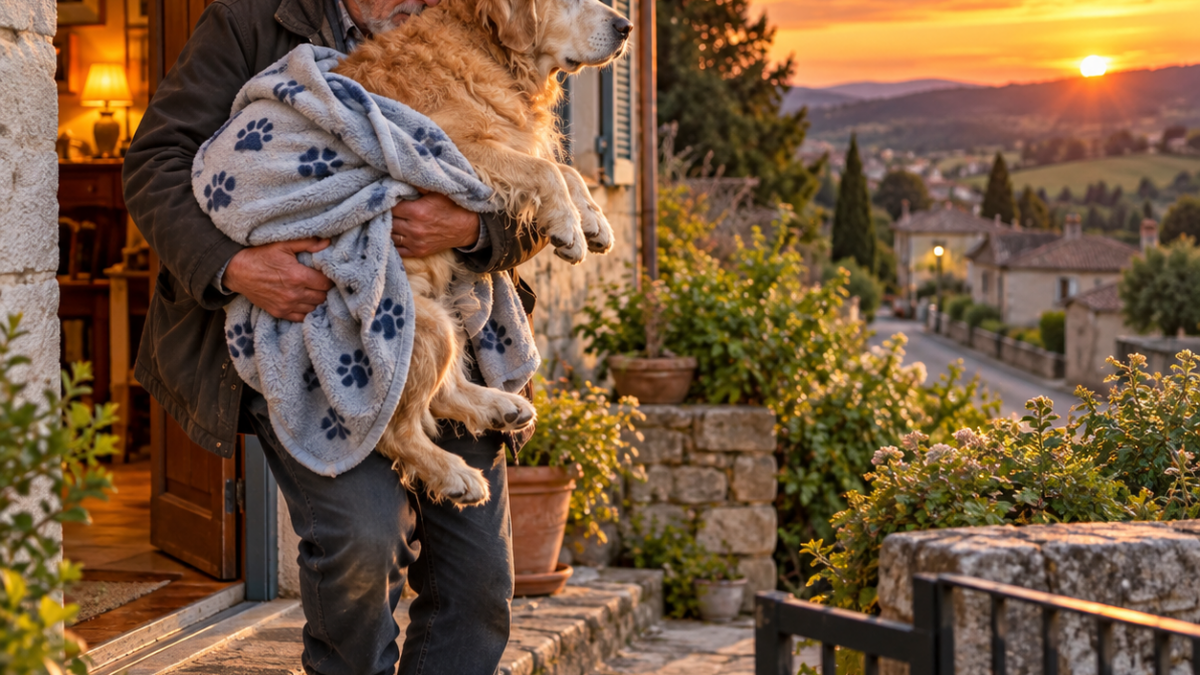
PART 2
For a few seconds, I stood there without knowing what to say.
There are moments when every sentence sounds useless before you speak it.
I’m sorry.
He had already heard it.
Is there anything I can do?
He would say no.
Are you sure?
That would be cruel.
So I looked at Gaspard instead.
He was lying across Marcel’s lap beneath the pale blue blanket, head resting against the old man’s forearm.
His eyes were open.
Still soft.
Still following sound.
But the life inside them looked tired.
Not absent.
Tired.
There is a difference.
I crouched beside the wicker chair.
“Hey, Gaspard.”
His ear moved.
His eyes found me.
His tail did not move.
It had not moved much lately.
I stroked the side of his face.
He pushed faintly into my hand.
That small movement almost undid me.
Marcel watched.
“He knows you.”
“I’ve known him sixteen years.”
“Sixteen years,” Marcel repeated.
He looked toward the garden.
It was September, that time of year when the evenings still carry a little warmth but the shadows become longer earlier than you expect.
Marcel’s roses were beginning to fade.
A few petals had fallen beside the path.
Everything looked normal.
That was what made the conversation so unbearable.
A normal street.
Normal Thursday.
Birds in hedges.
A lawn mower somewhere two houses away.
And a man sitting with the dog he had loved for sixteen years, knowing he had only one sunset left.
I finally asked, “What did the veterinarian say?”
Marcel ran his thumb slowly along Gaspard’s forehead.
“Nothing I didn’t already know.”
His voice was steady.
Too steady.
“He’s in pain?”
“More than before.”
“Even with the medication?”
Marcel nodded.
“His front legs are starting to struggle too. His breathing gets heavy at night. Yesterday he stopped eating halfway through dinner.”
For Gaspard, that was serious.
The dog had treated food as a religious event his entire life.
Marcel smiled faintly, apparently thinking the same thing.
“You remember when he stole that entire roast from your table?”
I laughed despite myself.
“That was my daughter’s birthday.”
“He was young.”
“He was eight.”
“Young.”
“He ate almost two pounds of beef.”
Marcel shrugged.
“He had ambition.”
I laughed again.
Then the laughter disappeared as quickly as it came.
Marcel looked toward Gaspard.
“He left half his chicken this morning.”
I understood.
Sometimes the end does not arrive dramatically.
Sometimes it arrives as half a bowl left untouched.
A dog who always wanted more saying, in the only way he can, enough.
“When did you decide?”
“Last night.”
“Were you alone?”
Marcel nodded.
I felt an immediate anger I couldn’t place anywhere.
Not at Marcel.
Not at the vet.
Certainly not at Gaspard.
At time, maybe.
At biology.
At the unfairness of love always arriving with an expiration date nobody gets to choose.
“What happened?”
Marcel looked at me.
“He cried.”
I had never heard Gaspard cry.
Not once.
Even when arthritis first became bad.
Even when he slipped.
Even during injections.
Marcel swallowed.
“I moved him. I thought maybe he was uncomfortable. Then he cried again.”
His hand stopped on Gaspard’s head.
“He looked at me.”
That was all Marcel could say for a moment.
“He looked at me, and I knew.”
I sat down on the edge of the terrace.
Marcel continued.
“I called Dr. Lefèvre this morning. She came because she knows I don’t drive much anymore.”
“What did she say?”
“She examined him.”
“And?”
“She said we could probably buy days.”
Marcel’s mouth tightened.
“Maybe a week.”
He looked directly at me.
“But she said they would be my days, not his.”
That sentence stayed between us.
His days.
Not Gaspard’s.
I think every person who has loved an old animal eventually reaches that terrible border.
On one side is love.
On the other is fear of grief.
And because both feelings can sound like “don’t leave,” it becomes difficult to know which one is speaking.
Marcel knew.
That did not make the decision easier.
It made it honest.
“I asked her if I was giving up too soon,” he said.
“What did she say?”
“She asked me to name five things Gaspard still enjoyed.”
I looked at him.
“What did you say?”
“Food.”
He paused.
“Not anymore.”
Another pause.
“Walking to the gate.”
He looked at Gaspard’s useless legs.
“Not anymore.”
“Playing with that rope he used to carry everywhere.”
He shook his head.
“Not for months.”
“Following me to the workshop.”
His voice softened.
“Not anymore.”
Then he looked west.
“The sunset.”
I felt my throat tighten.
“He still watches?”
“Every night.”
Marcel looked at Gaspard.
“So I told her there was one thing left.”
I looked toward the fields.
The sun was still high.
Hours away.
“When did you schedule it?”
“Tomorrow morning at nine.”
“At the clinic?”
“No.”
He shook his head.
“Here.”
That surprised me.
“Dr. Lefèvre is coming here?”
“Yes.”
Marcel’s hand trembled.
Only then.
Just once.
“She said he should be where he knows the smells.”
He looked toward his front door.
“His blanket. His garden. Me.”
I took a breath.
“And tonight?”
“Tonight we watch the sunset.”
The way he said it told me everything.
Not we might.
Not if he feels up to it.
We watch.
Sixteen years of sunsets.
He was not missing the last one.
I stood.
“I’ll leave you two alone.”
Marcel nodded.
I walked halfway across the street before stopping.
My wife, Claire, was standing in our doorway.
She had been watching.
She knew from my face.
“What happened?”
I crossed to her.
“Tomorrow.”
She covered her mouth.
“No.”
I nodded.
“Oh, Marcel.”
I looked back.
He was sitting exactly where I had left him.
One hand on Gaspard.
Face toward the fields.
Claire whispered, “Is he alone?”
“Yes.”
“Does he want to be?”
“I don’t know.”
That question became the entire problem.
Marcel was private.
Proud.
He didn’t ask for things.
Never had.
After his wife, Elise, died six years earlier, the whole street had tried to help.
Meals appeared.
People offered rides.
Someone volunteered to mow his lawn.
Marcel thanked everyone, then quietly resumed doing everything himself.
Gaspard had been his constant companion through that period.
We all knew it.
On the morning after Elise’s funeral, I had seen Marcel sitting outside before sunrise.
Gaspard was beside him.
No leash.
No toy.
Just pressed against his leg.
For months afterward, wherever Marcel went, Gaspard followed.
Garden.
Shed.
Mail box.
Bench outside the bakery.
He was not simply a dog.
He had become the physical proof that Marcel was not alone.
Now Marcel was about to lose that too.
Claire said, “We can’t let him spend tonight by himself.”
“He may want to.”
“Then we stay far enough away.”
“What does that mean?”
She thought.
“I don’t know yet.”
Within twenty minutes, the whole street knew.
I did not tell everyone.
That is how small streets work.
Claire told Sophie next door.
Sophie told Bernard.
Bernard told the Moreaus because their granddaughter adored Gaspard.
By five o’clock, people were texting each other quietly.
No one wanted Marcel to feel invaded.
No one wanted a spectacle.
We argued in whispers outside my house.
“We should bring food.”
“No. That turns it into a party.”
“Candles?”
“Too much.”
“Flowers?”
“For the dog? While he’s alive?”
“Why not?”
“Because Marcel will hate it.”
“What if we just sit outside?”
That came from twelve-year-old Émilie Moreau.
Everyone turned.
She shrugged.
“We all watch him watch the sunset anyway.”
Children sometimes find the obvious answer while adults are busy decorating grief.
Émilie continued.
“We could just watch too.”
Claire looked at me.
That was it.
No speeches.
No balloons.
No dramatic signs.
No crowd surrounding Marcel.
At sunset, we would come outside.
On our own porches.
Our own front steps.
Our own gardens.
We would face west.
And we would watch with them.
Nobody would make Marcel perform grief.
Nobody would force conversation.
He and Gaspard would not be alone.
That was the plan.
Then Bernard ruined the simplicity.
“What about the old photos?”
I looked at him.
“What photos?”
“You remember the neighborhood barbecue twelve years ago? Gaspard stole sausages from three tables.”
Everyone remembered.
Sophie laughed through tears.
“I have pictures.”
Within minutes, people were searching old phones, albums and drawers.
Gaspard with children.
Gaspard covered in mud.
Gaspard wearing a paper crown at someone’s birthday.
Gaspard asleep beneath Marcel’s workbench.
Gaspard sitting beside Elise.
Gaspard young enough that his muzzle was still completely gold.
The photos started arriving in our group chat.
Then one appeared that stopped everyone.
Marcel and Elise sitting on their terrace about ten years earlier.
Gaspard between them.
Behind them, the sky was orange.
All three were facing the sunset.
Claire whispered, “Oh.”
We printed it.
Not for that evening.
For later.
If Marcel wanted it.
At five thirty, I crossed back over.
Marcel was still outside.
Gaspard was sleeping now.
The sun had moved lower.
“Need anything?”
Marcel shook his head.
Then paused.
“Could you help me later?”
The question stunned me.
He almost never asked.
“Anything.”
“When it’s time to move the chair.”
I nodded.
“Of course.”
His eyes stayed on Gaspard.
“He’s heavier in the evening.”
Maybe Gaspard was.
Maybe Marcel was simply more tired.
I didn’t correct him.
At six fifteen, Marcel carried Gaspard inside briefly.
Medication.
Water.
A little food.
Gaspard took two bites.
Then turned away.
Marcel did not try again.
At six forty, he opened the door.
I crossed immediately.
“Let me.”
For a moment, I thought he would refuse.
Then he looked down at Gaspard.
“All right.”
That single surrender told me how tired he was.
I took Gaspard’s back half while Marcel supported his chest.
Even divided between us, he felt substantial.
Warm.
Soft.
Vulnerable.
His hind legs hung without resistance.
We carried him the three yards together.
Marcel lowered himself into the wicker chair.
I settled Gaspard across him.
Then we positioned the blue blanket.
Marcel whispered, “There you go.”
Gaspard’s head lifted slightly.
He looked west.
Exactly as he had every evening.
I moved the chair a few inches.
“Good?”
Marcel nodded.
“Perfect.”
I stepped back.
That was when Marcel noticed the street.
Sophie had brought two chairs onto her porch.
Bernard stood by his gate.
The Moreau family sat on their front steps.
An elderly widow named Madame Roux had wrapped herself in a shawl and stood beside her roses.
Claire was outside our house.
Children were quiet.
Unnaturally quiet.
Every person faced west.
Marcel stared.
“What is this?”
I said nothing.
Claire called gently from across the road.
“We thought the sky looked worth watching tonight.”
Marcel looked at me.
I shrugged.
“Gaspard has been recommending sunsets for sixteen years. We figured we should finally listen.”
For a second, Marcel’s face did not change.
Then his mouth trembled.
He turned away from us.
Looked west.
His hand remained on Gaspard’s head.
Nobody approached.
That mattered.
We gave them their space.
More doors opened as sunset drew closer.
People who had just returned from work came outside.
A teenager stopped his scooter and sat on the curb.
The baker from the corner arrived after someone told him.
He stood near Bernard’s hedge still wearing flour on one sleeve.
Even Dr. Lefèvre came back.
She parked at the end of the street, stepped out quietly and remained by her car.
I walked over.
“You didn’t have to come.”
She watched Marcel.
“I know.”
“Does he know you’re here?”
“No.”
“Should I tell him?”
She shook her head.
“Not yet.”
We stood there.
The sky began changing.
Gold first.
Then orange along the horizon.
Gaspard lifted his head higher.
Marcel whispered something I couldn’t hear.
Maybe the same thing he had said for sixteen years.
Look, old man.
There it is.
The whole street fell almost completely silent.
No engines.
No lawn mowers.
No conversations.
Even children somehow understood.
The sun lowered.
Gaspard watched.
I know people sometimes assign too much human meaning to animals.
Maybe Gaspard did not understand sunsets the way we do.
Maybe he liked the warmth.
The colors.
The evening smells.
The routine.
Maybe it simply meant Marcel sat still beside him.
Whatever the reason, he watched.
Fully.
His brown eyes followed the bright line sinking behind the fields.
Marcel’s hand moved slowly over his head.
Then something happened.
Émilie stood.
Her mother reached for her arm.
Émilie whispered, “It’s okay.”
She crossed the street carrying something.
A tennis ball.
Old.
Faded.
I recognized it.
Gaspard had played with it for years before arthritis took his running.
Émilie stopped several feet from Marcel.
“Can I give him this?”
Marcel looked at the ball.
Then at her.
“Where did you find that?”
“In our shed. He left it in our yard years ago.”
Marcel took it.
Gaspard’s nose moved.
The dog sniffed.
For one second, his eyes seemed brighter.
His front paw shifted.
Marcel laughed.
A real laugh.
The first I had heard from him all day.
“You remember this?”
Gaspard’s nose touched the ball.
Émilie sat in the grass a few yards away.
Then one by one, people began bringing small pieces of Gaspard’s life.
Not planned.
It simply happened.
Bernard brought an old piece of rope Gaspard had once stolen from his garage.
Sophie brought a photograph of Gaspard asleep beneath her picnic table during a summer party.
Madame Roux brought half a biscuit.
Marcel laughed again.
“He can’t have that much.”
“Then give him one bite.”
Gaspard took the tiniest piece from Marcel’s fingers.
The whole street seemed to exhale.
The baker came last.
He carried a small paper bag.
Marcel raised an eyebrow.
“No chocolate.”
“I’m not an idiot.”
“What is it?”
“A little chicken.”
Gaspard smelled it.
For the first time all day, he looked interested.
Marcel tore off a tiny piece.
Gaspard ate.
Then another.
Three pieces.
That was all.
But Marcel looked as though someone had handed him another year.
“Good boy.”
Gaspard rested his head again.
The sun was touching the horizon.
Dr. Lefèvre eventually crossed the street.
Marcel saw her.
His expression tightened.
She crouched beside the chair.
“May I?”
Marcel nodded.
She placed her hand gently on Gaspard’s chest.
Listened.
Watched his breathing.
Then smiled softly.
“He’s comfortable.”
“For now?”
“For now.”
Marcel looked west.
“Enough.”
Dr. Lefèvre stood.
Before leaving, she whispered something to Marcel.
He closed his eyes.
Then nodded.
Later he told me what she had said.
“You are not taking tomorrow away from him. You are protecting tonight.”
At the time, I only saw Marcel nod.
The sun sank lower.
Half gone.
Then only a thin arc.
Gaspard’s breathing slowed.
Not dangerously.
Peacefully.
His head rested against Marcel’s chest.
The old man whispered, “Remember when you used to run down there?”
He pointed toward the fields.
“Remember Elise?”
Gaspard’s ear moved.
Marcel smiled through tears.
“She always said you loved sunsets more than us.”
He kissed the top of Gaspard’s head.
“She was probably right.”
The sun disappeared.
No one clapped.
Thank God.
No one spoke.
The sky remained bright after the sun was gone.
Orange fading to pink.
Pink to lavender.
That strange afterglow that sometimes feels more beautiful because you know the source has already vanished beneath the horizon.
Marcel stayed seated.
So did we.
Five minutes.
Ten.
Twenty.
Nobody wanted to be the first to go inside.
Eventually, Gaspard fell asleep.
Marcel whispered, “He’s gone to sleep.”
I crossed the street.
“Want help?”
“Yes.”
This time there was no hesitation.
Bernard came too.
Together, we lifted Gaspard.
Marcel held his head.
We carried him inside.
The whole street watched.
At Marcel’s door, I turned.
People remained outside.
Some crying.
Some simply standing.
Marcel saw them.
He whispered, “Thank you.”
Claire answered for everyone.
“Goodnight, Gaspard.”
One by one, others repeated it.
“Goodnight, old boy.”
“Goodnight, Gaspard.”
“Sleep well.”
Émilie did not speak.
She just held up the old tennis ball.
Marcel noticed.
Then closed the door.
I barely slept that night.
At eight thirty the next morning, I was outside before Dr. Lefèvre arrived.
I told myself I was taking out the trash.
Nobody believed that, including me.
The street was unusually quiet.
People knew.
Nobody gathered this time.
Last night had belonged to all of us.
This morning belonged to Marcel and Gaspard.
At 8:55, Dr. Lefèvre’s car arrived.
She carried her medical bag.
I walked toward her.
“Is there anything you need?”
“No.”
She looked at Marcel’s house.
“Is he ready?”
I almost laughed at the question.
“Can anyone be?”
She nodded.
“No.”
Before she reached the gate, Marcel opened the door.
He looked older than he had the night before.
Not one day older.
Years.
“Come in.”
Dr. Lefèvre entered.
The door closed.
Then we waited.
Not outside his gate.
Inside our homes.
But nobody really did anything.
Claire stood at the kitchen window.
I sat at the table pretending to drink coffee.
Across the street, Bernard swept the same section of pavement for fifteen minutes.
At 9:42, Dr. Lefèvre came out alone.
She stopped beside Marcel’s gate.
Looked toward my house.
I stood.
She gave one small nod.
Gaspard was gone.
I crossed the road.
“Is Marcel okay?”
She looked back at the house.
“As okay as someone can be.”
“Was it peaceful?”
“Yes.”
That mattered more than anything.
“Very peaceful.”
She touched my arm.
“He was in Marcel’s lap.”
I closed my eyes.
“Blue blanket?”
She nodded.
“Blue blanket.”
“Did he know?”
“Know what?”
“That it was happening.”
Dr. Lefèvre considered.
“I think he knew he was with his person.”
That answer was enough.
I went to Marcel’s door.
Then stopped.
I almost knocked.
Instead, I sat on the low stone wall outside.
Exactly where Marcel could see me if he looked through the window.
I waited.
Twenty minutes later, the door opened.
Marcel stood there.
Empty arms.
That image will stay with me forever.
For two months, every evening, I had seen him step through that doorway carrying Gaspard.
Now his arms hung at his sides.
He looked at me.
I stood.
Neither of us spoke.
Then Marcel said, “He waited for the sun.”
My throat closed.
“What?”
“He woke before nine.”
Marcel smiled faintly.
“Kept looking toward the terrace door.”
I looked west.
“He wanted another one?”
“Maybe.”
Marcel shook his head.
“No. I think he just wanted his chair.”
“What did you do?”
“I carried him to the window.”
His voice trembled.
“We sat there.”
The morning sun came from the wrong direction.
No sunset.
But Gaspard apparently did not complain.
“He put his head on me.”
Marcel looked down.
“And that was that.”
I walked closer.
Marcel was not a man who hugged people.
Neither was I.
That morning, I hugged him.
He stood stiffly for half a second.
Then his shoulders collapsed.
He cried.
Not politely.
Not quietly.
Seventy-nine years of pride disappeared.
I held on.
Eventually, Marcel whispered, “I don’t know what to do tonight.”
That broke me more than anything.
Not the death itself.
Tonight.
At sunset.
Sixteen years of having a place to be.
A reason to sit.
A head in his lap.
A ritual.
Gone.
“We’ll figure it out.”
He stepped back.
“No.”
He wiped his face.
“It was his sunset.”
I understood.
That evening, nobody knew what to do.
At six forty, I watched Marcel’s door.
Closed.
Six fifty.
Still closed.
People across the street were doing the same thing without admitting it.
At seven, the sky began turning gold.
Then Marcel’s door opened.
He stepped out alone.
No blue blanket.
No Gaspard.
He walked slowly to the wicker chair.
Sat.
Turned west.
I almost cried immediately.
Then Claire took my hand.
“Come on.”
We walked outside.
Sophie did too.
Bernard.
The Moreaus.
Madame Roux.
No plan this time.
No group messages.
Nobody needed them.
We had learned the ritual.
Every evening for two months, Marcel had carried Gaspard toward the sunset.
Now the street carried the ritual for Marcel.
We sat.
The sun went down.
Marcel watched.
When it disappeared, he remained still.
Then he looked around.
Saw all of us.
He smiled.
Small.
Broken.
Real.
The next evening, we did it again.
Not everyone.
Some people were working.
Some busy.
But enough.
For about a week, there was always someone outside at sunset.
Then life gradually resumed.
It had to.
Children had school.
People worked late.
Weather changed.
But Marcel kept sitting there.
Alone sometimes.
Never quite alone again.
A few days after Gaspard died, Claire brought over the photograph we had printed.
Marcel and Elise on the terrace.
Gaspard between them.
Orange sky.
Marcel stared at it for a long time.
“I forgot this existed.”
“Sophie had it.”
He touched Elise’s face.
Then Gaspard’s.
“What year?”
“About ten years ago.”
Marcel laughed softly.
“He still had black around his nose.”
He put the photograph on his mantel.
Beside one of Elise.
That afternoon, he told us more of Gaspard’s story.
I thought I knew most of it.
I didn’t.
Marcel and Elise had gotten Gaspard when Marcel was sixty-three.
He had just retired.
He hated retirement.
That surprised me.
Everyone imagined Marcel had been born ready to tend roses and complain about squeaky gates.
He had worked as a carpenter since he was sixteen.
Forty-seven years.
Then one Friday, he stopped.
Monday morning arrived.
No workshop.
No orders.
No apprentices.
No noise.
“I nearly lost my mind,” he told me.
Elise noticed.
A month later, she brought home a honey-colored puppy.
Marcel had been furious.
“I told her we were too old for puppies.”
Claire laughed.
“What did she say?”
“She put him in my arms and went to make coffee.”
That was Elise.
Apparently.
By evening, Marcel had built Gaspard a bed.
By the end of the week, he had built a gate.
By the end of the month, Gaspard had taken over the house.
“The sunset thing started that first summer,” Marcel said.
“He would disappear around eight thirty. I thought he was digging under the fence.”
Instead, the puppy was sitting on the terrace steps looking west.
“Every evening?”
“Every evening.”
“At that age?”
“Yes.”
“What do you think he was looking at?”
Marcel shrugged.
“Maybe nothing.”
Then smiled.
“Maybe everything.”
Years passed.
Marcel taught Gaspard to bring pieces of wood from one side of his small workshop to another.
Gaspard mostly stole them.
Elise taught him not to jump on visitors.
Gaspard learned selectively.
He loved children.
Hated the vacuum.
Feared thunderstorms.
Once ate an entire tray of cheese pastries.
Another time disappeared during a neighborhood party and was found asleep under Bernard’s table with four stolen sausages.
We all knew pieces of these stories.
Marcel knew all of them.
After Elise became ill, Gaspard changed.
He stopped wandering far.
Stayed near her chair.
When she moved upstairs less often, he slept outside her bedroom.
On the last night she was home, Gaspard lay beside her bed.
After she died, he spent three days looking for her.
Marcel’s voice became quieter.
“He checked every room.”
I remembered.
“He waited by the gate.”
Marcel nodded.
“Same way I waited for him.”
I had no answer.
“After Elise died,” he continued, “I stopped watching sunsets.”
“Why?”
“Too painful.”
He looked west.
“That had been our thing too. Not every night like Gaspard, but often.”
“So Gaspard kept going?”
“Every evening.”
“And you?”
“For months, I stayed inside.”
“What changed?”
“One night he barked.”
“Gaspard almost never barked.”
“I know.”
Marcel smiled.
“He stood at the terrace door barking at me.”
“What did you do?”
“I got annoyed.”
That sounded like Marcel.
“I told him to stop.”
“And?”
“He barked again.”
Claire laughed.
“So you went outside.”
“I went outside.”
Marcel’s eyes filled.
“He sat beside me. The sun went down. First one I had watched since Elise.”
I understood then.
Those sunsets had never been just Gaspard’s.
Gaspard had brought Marcel back to them.
After his wife died, the dog had led him outside night after night until beauty stopped feeling like betrayal.
Now Marcel had carried Gaspard outside for two months in return.
The ritual made sense in a deeper way.
He wasn’t indulging an old dog.
He was repaying a debt.
Gaspard had once carried Marcel through grief without lifting him.
Marcel had carried Gaspard through paralysis with both arms.
That symmetry broke something in me.
I asked, “Did Dr. Lefèvre know?”
“About Elise?”
“Yes.”
Marcel nodded.
“She knew everything.”
“What did she say when his legs stopped working?”
“That I should watch him.”
“For pain?”
“For joy.”
I looked at him.
“She said old animals tell you when the world has become too small.”
That sentence stayed with me.
“And had it?”
“Almost.”
Marcel looked toward the empty wicker chair.
“By the end, his world was that chair and the sunset.”
He smiled sadly.
“But he still wanted both.”
That was why Marcel waited.
Not because he could not let go.
Because Gaspard still had one thing he loved.
When that one thing remained enough, Marcel carried him.
When pain began taking even that away, Marcel made the harder choice.
That changed how I thought about the final two months.
I had seen burden.
Marcel had seen permission.
One more sunset.
Then another.
Then another.
As long as Gaspard still lifted his head when the sky changed, Marcel carried him outside.
There is courage in keeping someone alive.
There is another kind in noticing when you are keeping them only for yourself.
Marcel somehow found both.
About two weeks after Gaspard died, a small conflict erupted on our street.
Not dramatic by most standards.
But it mattered.
A developer had purchased the field west of us.
We had known construction might happen eventually.
Now survey markers appeared.
Rumors followed.
Eight houses.
Maybe ten.
The proposed homes would sit directly across the western horizon from Marcel’s terrace.
For most people, it was a property issue.
Traffic.
Drainage.
Views.
For Marcel, it was the sunset.
Bernard came to my house one morning holding a planning notice.
“You’ve seen this?”
I read it.
Public meeting at the municipal office.
Marcel’s western field would become a residential extension if approved.
I looked across the street.
He was watering roses.
“Does he know?”
“Not yet.”
We told him.
Marcel read the notice twice.
Then handed it back.
“What can you do?”
“We can object.”
“On what grounds?”
“Traffic. Drainage. Density. Whatever’s legitimate.”
Marcel shrugged.
“Fields become houses.”
“You’re not angry?”
“Why should I be?”
“Your view.”
He looked west.
“It was never mine.”
That answer irritated Bernard.
“It’s not about ownership. It’s about—”
Marcel raised a hand.
“I had sixteen years.”
Bernard fell silent.
Marcel continued.
“Don’t turn Gaspard into an excuse to fight people.”
That ended the conversation.
But it did not end what happened next.
At the planning meeting, neighbors still raised concerns.
Not about a dog.
Real concerns.
Drainage.
Road capacity.
Emergency access.
The project was modified.
Fewer houses.
A wider green strip.
The sunset would still partly change.
Marcel attended once.
He said almost nothing.
Afterward, a young planner approached him.
“I heard about your dog.”
Marcel looked at me accusingly.
I raised both hands.
Not me.
The planner said, “My mother lives near here. She told me.”
Marcel nodded.
The young man hesitated.
“We can’t preserve an entire private view.”
“I know.”
“But the revised plan includes a public path along the western edge.”
Marcel listened.
“We were wondering if you’d mind if we put a bench there.”
“A bench?”
“Yes.”
The planner smiled.
“Facing west.”
Marcel said nothing.
The young man continued.
“Nothing dramatic. No statue. No plaque if you don’t want one.”
Marcel looked down.
“Why?”
“Because apparently half this street has started watching sunsets.”
That was true.
After Gaspard died, the ritual spread.
Not nightly.
Not formally.
But people noticed the sky more.
Children sat on curbs.
Couples stood at gates.
Madame Roux brought tea outside.
I had caught myself several times stopping whatever I was doing because the light had changed.
Gaspard had trained an entire street.
Marcel looked at the planner.
“What kind of bench?”
I laughed.
Of course that was his question.
He had been a carpenter.
The planner showed him a standard metal design.
Marcel looked offended.
“That thing?”
The planner blinked.
“What’s wrong with it?”
“Everything.”
That was how Marcel ended up building Gaspard’s bench himself.
The developer provided the location and concrete base.
Marcel provided wood.
Oak.
Naturally.
He refused help at first.
Naturally.
Then after two hours his back protested, and he allowed me to hold pieces while he worked.
“Not like that.”
“I’m holding it.”
“Wrong.”
“How can holding wood be wrong?”
“You’re doing it.”
I almost threw the board at him.
Bernard laughed.
For the first time since Gaspard died, Marcel spent days in his small workshop again.
Sawing.
Sanding.
Measuring.
Cursing.
Alive.
The bench took three weeks.
Simple.
Strong.
Wide enough for two people and a large dog.
Marcel insisted on that dimension.
“Why?”
“Dogs take space.”
Fair.
He carved nothing into it.
No name.
No dates.
No sentimental phrase.
At the back, hidden beneath the seat where only someone looking carefully would see, he burned one small mark into the wood.
A paw print.
That was all.
When the bench was installed, the entire street wanted a ceremony.
Marcel refused.
So naturally, we had one without calling it a ceremony.
We brought coffee.
Children brought pastries.
People gathered near sunset.
Marcel sat in the center of the bench.
The space beside him remained empty.
Émilie came carrying the old tennis ball.
She had kept it.
“Can this go here?”
Marcel looked at it.
“For tonight.”
She placed the ball beside him.
The sun went down.
Nobody spoke.
Afterward, people left.
The tennis ball disappeared.
The next morning, I saw it on Marcel’s mantel beside the photograph.
He had taken it home.
That bench became part of our street.
Dog walkers stopped there.
Older couples sat.
Teenagers met there.
Children climbed on it despite repeated instructions.
Marcel pretended to disapprove.
Sometimes I found him sitting there alone.
Always at sunset.
One evening, months later, I joined him.
He didn’t object.
We sat in silence.
The western field had construction fencing now.
Machines in the distance.
The view was changing.
Still, the sky above remained enormous.
Marcel said, “You know what I regret?”
I expected him to say he wished Gaspard had lived longer.
Instead:
“I should have let you help sooner.”
I looked at him.
“With carrying him?”
“Yes.”
“Why?”
“My back still hurts.”
I laughed.
“So all that pride was stupidity?”
“Mostly.”
I leaned back.
“You once told me he carried you sixteen years.”
“He did.”
“And you carried him.”
“For two months.”
“You think that’s unequal?”
Marcel thought.
“No.”
Then he looked at me.
“But the street carried both of us at the end.”
That was the closest Marcel ever came to giving a speech.
I remember it because he was right.
We had thought we were gathering for Gaspard’s last sunset.
In reality, we were making sure Marcel survived the morning after.
That is what communities sometimes do when they function correctly.
Not rescue someone from grief.
You cannot.
Not erase loneliness.
You cannot.
You simply make the distance smaller.
A chair across the street.
A light in another window.
Someone sitting nearby at sunset.
Presence.
Months became a year.
On the anniversary of Gaspard’s death, nobody planned anything.
At least officially.
At sunset, I walked toward the bench.
Half the street was already there.
Marcel sat at one end.
Émilie, now thirteen, sat beside him.
Several dogs were present.
One young Labrador kept trying to steal food.
Marcel watched him.
“Terrible manners.”
I said, “Remind you of anyone?”
He smiled.
“Gaspard had dignity.”
“Gaspard stole my daughter’s birthday roast.”
“He had appetite.”
The Labrador grabbed a bread crust.
Marcel laughed.
That sound felt like victory.
Not against a person.
Against the idea that grief gets to keep everything it takes.
It didn’t.
Time had taken Gaspard.
It had taken Elise.
It would take all of us eventually.
But it had not taken the sunsets.
That became our only revenge against time.
We kept watching.
Another year passed.
Marcel turned eighty-one.
His back worsened.
He stopped gardening as aggressively.
We began helping without asking.
This annoyed him.
“You cut the roses wrong.”
“They’re alive.”
“For now.”
“Do it yourself.”
“I can’t.”
“Then be grateful.”
He muttered something impolite.
I took that as gratitude.
The bench weathered beautifully.
Oak silvered slightly.
The hidden paw print remained.
People who did not know the story used it anyway.
That pleased Marcel most.
He did not want a shrine.
He wanted a bench.
“Things should work,” he said.
Exactly the same principle he used for his ancient squeaky gate.
As long as it closes, it does its job.
As long as a bench holds someone, it does its job.
As long as memory helps you continue living, it does its job.
The rest is decoration.
One afternoon, a young woman moved into a house near the end of the street.
She had a rescue dog named Milo.
Nervous.
Thin.
Afraid of men.
For weeks, Milo barked whenever Marcel walked past.
Marcel ignored him.
One evening, the woman brought Milo near the bench.
He stayed six feet away.
Marcel sat.
Did not reach.
Did not call.
Just watched the sunset.
Milo eventually approached.
Sniffed Marcel’s shoe.
Then backed away.
Next evening, slightly closer.
After about a week, Milo sat beside the bench.
Marcel looked at me.
“Stubborn.”
I laughed.
“Dog or you?”
“Yes.”
Another week.
Milo placed his head on Marcel’s knee.
I saw the exact moment.
Marcel froze.
His hand hovered.
Then slowly rested on the dog’s head.
His eyes filled.
He did not cry.
Not then.
Later, after the young woman left, Marcel sat alone.
I joined him.
“Okay?”
“No.”
Fair.
“You miss him.”
“Every day.”
He looked at his hand.
“It felt like Gaspard for a second.”
“Is that bad?”
“No.”
Marcel swallowed.
“That’s the problem.”
I understood.
Grief sometimes hurts most when something feels good again.
Because joy resembles betrayal before it becomes permission.
Marcel eventually became one of Milo’s favorite people.
He never adopted another dog.
People suggested it.
He refused.
Not because he believed Gaspard could be replaced.
Exactly the opposite.
“I had my dog,” he said.
“That doesn’t mean you couldn’t have another.”
“I know.”
“Then why not?”
He shrugged.
“I like borrowing yours.”
That became his role.
Neighborhood grandfather to every dog.
He kept biscuits near the gate.
Claimed they were for visitors.
Dogs learned.
Every evening near sunset, at least one would pull its owner toward Marcel’s terrace.
He pretended this bothered him.
Nobody believed him.
Years later, when Marcel himself became less mobile, the ritual changed again.
He no longer walked to the public bench often.
Instead, people came to his terrace.
A chair here.
Another there.
Someone brought tea.
Children who had grown into teenagers sat on the steps.
Gaspard’s wicker chair remained.
Nobody used it.
Not because Marcel forbade it.
Nobody felt right sitting there.
One summer evening, I asked.
“Why keep that chair? It’s falling apart.”
Marcel looked offended.
“It still holds weight.”
There it was again.
As long as it works.
I repaired the wicker with him.
Mostly me.
He supervised.
Badly.
The chair survived.
At eighty-four, Marcel began talking more about death.
Not morbidly.
Practically.
He had always been practical.
He showed me where important papers were.
Which nephew to call.
What to do with tools.
“Why are you telling me this?”
“Because you’re nosy.”
“You called me over.”
“Exactly.”
Among his instructions was one unusual request.
“When I go, give the bench to the street.”
“The bench already belongs to the street.”
“On paper.”
“You built it for the public path.”
He shook his head.
“Technically the land agreement lists me as donor.”
I stared.
“You have legal paperwork for a bench?”
“I’m a carpenter, not an idiot.”
“Debatable.”
He ignored me.
“I want it maintained.”
“We will.”
“And the chair?”
I knew which one.
“Gaspard’s?”
“Yes.”
“What should I do with it?”
“Burn it.”
“What?”
“It’s old.”
“Marcel.”
“What do you want, a museum?”
I laughed.
He smiled.
Then became serious.
“Actually, keep one piece.”
“One piece?”
“Armrest.”
“Why?”
He looked west.
“You’ll think of something.”
Of course.
Even near the end, Marcel gave me woodworking assignments.
He lived three more years.
Longer than any of us expected.
He died at eighty-seven.
Peacefully.
In his own bed.
Not during sunset.
I somehow found that amusing.
After everything, Marcel left at dawn.
Claire said maybe Elise had always preferred mornings.
Maybe.
I do not know what comes after.
I do know what came immediately after for us.
Another empty house.
Another quiet terrace.
Another missing figure in the rhythm of the street.
We buried Marcel beside Elise.
A photograph of Gaspard went into the small memorial display at the service because Marcel’s nephew insisted.
Everyone agreed.
Afterward, I returned to the house.
The wicker chair waited on the terrace.
I remembered his instruction.
Burn it.
I could not.
Not yet.
Instead, I removed one armrest.
Old wood beneath weathered wicker.
Brought it to my workshop.
For several days, I stared at it.
Then I knew.
I shaped the old armrest into a small plaque.
Not dramatic.
No long quote.
Just three words.
WATCH THE SUNSET.
Underneath, smaller:
MARCEL & GASPARD
I fixed it beneath the public bench.
Not on the back.
Not where everyone would immediately see.
Under the seat.
Beside the paw print.
A secret.
You had to sit down and look carefully.
That felt right.
The rest of the chair?
Eventually, I did what Marcel asked.
We burned it in Bernard’s old metal fire pit one cold evening.
Just a few neighbors.
No ceremony.
At least we claimed it wasn’t.
As the wicker caught, I felt sick.
Claire squeezed my hand.
“He told you to.”
“I know.”
Wood burned slowly.
The chair that had held Marcel and Gaspard through those final sunsets became heat and ash.
I thought it would feel like destruction.
Instead, it felt like completion.
The next evening, we sat on the bench.
The sky was spectacular.
Orange so bright it looked unreal.
Someone said, “Gaspard would’ve loved this.”
Émilie, now an adult, corrected him.
“Gaspard does love this.”
We all looked at her.
She laughed.
“I don’t mean ghost-dog stuff.”
“Good.”
“I mean this whole street watches because of him.”
She pointed around.
People on porches.
A couple walking.
Children.
Dogs.
Marcel’s old house occupied by his nephew and young family.
Everyone noticing the sky.
“He changed what sunset means here.”
She was right.
That is the strange thing about rituals.
At first, they belong to one person.
Then one family.
Then memory spreads them.
The ritual outlives the people who began it.
Even now, years later, newcomers sometimes ask why so many people on our street come outside when the evening light turns gold.
We tell them.
An old dog liked sunsets.
His name was Gaspard.
For sixteen years, he watched them.
When his back legs failed, his seventy-nine-year-old human carried him outside every evening.
For two months.
Three yards each way.
No matter how much his back hurt.
No matter the weather.
Until there was only one sunset left.
Then an entire street came outside.
Not to say goodbye with speeches.
Not to turn grief into entertainment.
We simply faced west.
Together.
Gaspard watched the sun disappear.
Marcel held him.
And for one final evening, the thing Gaspard loved most remained exactly as it had always been.
His person.
His chair.
His blanket.
His sunset.
The next morning, Marcel made the kindest decision he had ever hated making.
Gaspard died in his lap at home.
No fear.
No clinic table.
No strange room.
Just Marcel’s hand on his head.
The same blue blanket.
The smell of the house he knew.
And a heart that had been loved for sixteen years finally allowed to rest.
People sometimes call the ending sad.
Of course it was.
I cried.
We all did.
But sad is not the same as wrong.
There was nothing wrong with Gaspard’s ending.
The wrong ending would have been keeping him for our comfort after his own comfort was gone.
Marcel understood that.
The veterinarian understood.
Eventually, so did we.
And if there was any revenge in their story, it was not against a person.
There was no villain.
No cruel neighbor.
No owner who needed punishment.
Their enemy was time.
Age.
The slow theft of movement.
The fact that even the best sixteen years must eventually become memory.
We could not defeat that.
But for one evening, we refused to let it have everything.
Time took Gaspard’s legs.
Marcel became his legs.
Time took his ability to walk to the terrace.
Marcel carried him.
Time took games.
Runs.
Long walks.
But it did not take the western sky.
Not until the very end.
Then, when time finally took Gaspard too, it still failed to take the ritual.
The next night, Marcel watched.
The street watched.
Years later, we still watch.
That is the only kind of revenge against time that makes sense to me.
You cannot stop it.
You make something it cannot erase.
A habit.
A story.
A bench.
A hidden paw print.
Three words beneath a seat.
A neighborhood that looks west.
Sometimes, when I sit there alone, I imagine that first period before any of us understood what Marcel was doing.
He steps through his door.
Seventy-nine.
Back bent.
Gaspard wrapped in blue.
“Easy, old man. We’re almost there.”
Three yards.
Pause.
Chair.
Blanket.
West.
Again tomorrow.
Again.
Again.
Again.
People saw an old man carrying a heavy dog.
Now I know better.
Marcel was not simply carrying Gaspard toward the sunset.
They were carrying each other toward goodbye.
Gaspard had done his part first.
Sixteen years of companionship.
Through retirement.
Through Elise’s illness.
Through widowhood.
Through silent mornings when Marcel had no reason to leave the house.
Through grief.
Gaspard got him outside.
Gaspard made him walk.
Made him speak.
Made him watch the sky again.
Then the debt changed direction.
When Gaspard could no longer stand, Marcel became his movement.
That is what love looks like after the easy part ends.
Not photographs.
Not declarations.
Not the excitement of bringing a puppy home.
Love at sixteen years old looks like towels on the floor.
Medication schedules.
Cleaning accidents without making the animal feel ashamed.
Lifting sixty pounds when your own spine hurts.
Turning down invitations because your dog cannot be left.
Sleeping lightly because he may need repositioning.
Watching appetite.
Watching breathing.
Wondering every morning whether today is still a good day.
And then, finally, recognizing when “one more day” has stopped being a gift.
I saw Marcel do all of that.
He never called himself devoted.
He would have laughed at the word.
“He’s my dog,” was all he ever said.
Maybe that is enough.
People who truly stay rarely narrate staying.
They simply keep showing up.
One evening not long ago, I found a boy sitting on the bench with his young dog.
I had never seen them before.
New family.
The boy was maybe nine.
His dog, some kind of spaniel mix, was bouncing beside him.
The boy’s father stood nearby.
I sat at the other end.
The boy asked, “Why does everyone sit here at sunset?”
His father said, “I told you. It’s just a bench.”
I smiled.
“It’s not just a bench.”
The father looked apologetic.
The boy became interested.
“What is it?”
So I told him.
Not everything.
Just enough.
Old dog.
Old man.
Sunsets.
Paralysis.
Two months.
Final evening.
The boy listened.
Then looked at his dog.
“Would you carry him?”
His father laughed.
“He weighs twenty pounds.”
“That’s not what I asked.”
The father looked at the dog.
Then at his son.
“Yes.”
The boy seemed satisfied.
The sun began dropping.
His dog stopped bouncing for a moment.
Sat.
Looked west.
The boy gasped.
“He’s doing it!”
I laughed.
“Careful. That’s how it starts.”
The father smiled.
We watched together.
After they left, I ran my hand under the bench.
The little plaque remained.
WATCH THE SUNSET.
MARCEL & GASPARD.
The letters had darkened.
The wood had weathered.
Still readable.
I thought about Marcel’s old gate.
“Tant qu’il ferme, il fait son travail.”
As long as it closes, it does its job.
Maybe memory works the same way.
As long as it opens something inside us, it does its job.
That story still opens something in me.
It reminds me to notice the ordinary rituals before they become last times.
The last walk rarely announces itself.
The last game.
Last drive.
Last dinner finished completely.
Last time a dog jumps onto a couch without help.
Last time your parent calls.
Last time a friend sits in a familiar chair.
We do not know.
That is both cruel and merciful.
If every ordinary moment came labeled LAST, none of us could live normally.
Marcel received something unusual.
He knew.
One final sunset.
A terrible gift.
He knew exactly what it was.
And because he knew, he treated it differently.
Slowly.
No phone.
No distraction.
No pretending tomorrow would be the same.
He held Gaspard.
The street became quiet.
The sky changed.
That was enough.
I have thought many times about what I would do if I knew I had one final sunset with someone I loved.
Would I talk?
Apologize?
Thank them?
Try to compress years into minutes?
Marcel mostly said nothing.
Maybe he understood something I still struggle to learn.
Presence can contain words without speaking them.
Gaspard did not need a summary of sixteen years.
He needed Marcel’s body beneath his.
That familiar hand.
That familiar voice.
The western light.
Dogs simplify us if we let them.
They ask us to stop performing love and start practicing it.
Food.
Walk.
Touch.
Stay.
Come back.
Sit here.
Watch.
Toward the end of his life, Marcel once told me something I have never forgotten.
We were sitting on the bench.
He was eighty-five then.
Sunset had almost finished.
He said, “People think the last sunset was for Gaspard.”
“Wasn’t it?”
“Half.”
“What was the other half?”
“For me.”
I looked at him.
He continued.
“If I had taken him straight to the vet that afternoon, I would have spent the rest of my life wondering whether I stole the one thing he still wanted.”
“You didn’t.”
“I know.”
He looked at the horizon.
“That sunset gave me permission.”
“To let him go?”
Marcel nodded.
“He watched it. Then he slept.”
His voice softened.
“I knew he was done.”
I had never understood that part.
Marcel needed one last piece of evidence.
Not medical.
Emotional.
Gaspard had received what remained of joy.
Nothing unfinished.
Nothing denied out of convenience.
Marcel could release him without wondering whether one more evening would have changed everything.
That final sunset did not prolong Gaspard’s suffering.
It completed his life.
The next morning was not defeat.
It was mercy after completion.
That distinction mattered deeply to Marcel.
Now it matters to me.
People sometimes ask whether a dog can truly appreciate a sunset.
I do not know.
I am not going to pretend certainty.
Maybe Gaspard watched light because his eyes liked it.
Maybe evening air carried interesting smells.
Maybe sitting west meant Marcel was nearby.
Maybe his habit began accidentally and humans built meaning around it.
I don’t care.
The meaning was real because the ritual was real.
For sixteen years, as evening came, Gaspard went west.
When he could no longer go, Marcel carried him.
That is enough evidence for me.
You do not need to prove a dog understands beauty exactly as a human does before respecting what the dog chooses repeatedly.
Gaspard chose sunsets.
Marcel respected that choice.
Until the final one.
There is something else I never told Marcel.
The night after Gaspard’s last sunset, when we all came outside again, I looked at the empty space in his lap and felt furious.
Not sad.
Furious.
At the universe.
At aging.
At the cheapness of endings.
Sixteen years of loyalty and then what?
A blanket folded in a closet.
A chair holding nobody.
A bowl removed from the kitchen.
I wanted something to blame.
Someone to punish.
That is the mind’s desperate attempt to turn grief into a problem that can be solved.
If someone caused this, you can fight them.
If a rule caused it, change the rule.
If a villain caused it, defeat the villain.
But no one did.
Gaspard was sixteen.
Loved.
Old.
His body ended.
There was nothing to prosecute.
Nothing to expose.
Nothing to avenge in the usual way.
I hated that.
Then weeks passed.
Marcel built the bench.
People watched sunsets.
Dogs sat beside strangers.
The ritual moved outward.
My anger changed.
I began to understand that grief has its own answer to helplessness.
Creation.
Build something.
Do something.
Carry something forward.
You cannot punish death.
But you can refuse to let death reduce a life to absence.
That was our revenge.
A bench instead of emptiness.
Stories instead of silence.
A street looking west instead of one old man looking at an empty chair.
Years later, when Marcel died, we did the same for him.
His funeral was in the morning.
That evening, without discussion, the street filled.
More people than at Gaspard’s final sunset.
Former neighbors returned.
Children who had grown up came back.
Émilie brought her own little daughter.
Someone brought the old photograph of Marcel, Elise and Gaspard.
We placed it on the bench.
The western sky turned orange.
A dog barked somewhere.
Émilie’s daughter asked, “Is that Gaspard?”
Émilie smiled.
“No, sweetheart.”
“Where is Gaspard?”
The adults went quiet.
Émilie looked toward the sunset.
“He finished his walk a long time ago.”
Her daughter considered that.
Then pointed to Marcel in the photograph.
“And him?”
“He did too.”
The girl nodded as though this made perfect sense.
Maybe it does.
We are all walking something.
Some walks last sixteen years.
Some eighty-seven.
The point may not be how far.
Maybe it is who carried us when our legs failed.
Marcel carried Gaspard physically.
Gaspard carried Marcel emotionally.
The street carried Marcel socially.
Then the story carried all of us beyond both of them.
That is the structure I see now.
No one gets through life entirely on their own strength.
We take turns.
One day you are the strong arms.
Another day you are the weight.
Both are part of love.
The final time I saw Marcel alive, he sat on his terrace in Gaspard’s wicker chair.
Yes, the same one he later told me to burn.
I brought coffee.
He looked west.
It was too early for sunset.
“Planning ahead?”
He said, “At my age, you take a seat when it’s available.”
We laughed.
Then he asked, “You think people will remember him?”
“Gaspard?”
“Yes.”
“Marcel, half the neighborhood learned to watch the sky because of him.”
“That’s not what I asked.”
I understood.
“Remember him?”
“Yes.”
I looked at the old man.
“Yes.”
“Why?”
“Because you loved him where people could see it.”
He frowned.
“That sounds sentimental.”
“It is.”
“I hate sentimental.”
“I know.”
He sipped coffee.
After a moment, he said, “Good.”
That was Marcel.
He died three weeks later.
And yes.
We remember.
Not every detail.
Memory edits.
Names fade.
Dates blur.
But I remember the essential image.
A seventy-nine-year-old man carrying a sixteen-year-old dog.
One hand under the chest.
One beneath the useless back legs.
Pausing at the doorframe.
Three yards.
Wicker chair.
Pale blue blanket.
West.
“Easy, old man. We’re almost there.”
I used to think those words meant the chair.
Now I hear something else in them.
We’re almost there.
Almost evening.
Almost goodbye.
Almost at the place where love has to change form.
Marcel probably did not mean any of that.
He was simply tired.
Gaspard was heavy.
The chair was three yards away.
But stories become larger after we live through them.
That one sentence now contains everything.
Effort.
Tenderness.
Mortality.
Promise.
They were almost there.
Then they arrived.
And when the final sunset came, an entire street quietly arrived with them.
No one imagined we would.
Not two months earlier.
Not when Gaspard first stopped walking.
Not when Marcel began carrying him.
We had been neighbors.
People who knew who forgot the trash.
Who burned toast.
Who received grandchildren on Sundays.
Then one old dog reached the end of his life, and for one evening we became something closer to family.
That may be Gaspard’s greatest legacy.
Not the bench.
Not the paw print.
Not even sunsets.
He taught a street how to show up without needing to fix anything.
That is harder than it sounds.
When people are hurting, we want tasks.
Bring food.
Make calls.
Solve logistics.
Those matter.
But some grief has no assignment.
Sometimes the only available act is to sit on your own porch facing the same direction.
We did.
Marcel noticed.
It mattered.
I know because years later he told me.
“I thought nobody understood.”
“Understood what?”
“What Gaspard was to me.”
He looked embarrassed after saying it.
I answered, “We didn’t.”
He looked up.
“Not until the end.”
That surprised him.
I continued.
“We knew you loved him. We didn’t know how much of your life he was holding together.”
Marcel nodded.
“That’s the trouble with dogs.”
“What?”
“They do important work nobody sees.”
That may be the truest thing he ever said.
Gaspard never had a job.
No search-and-rescue vest.
No therapy certification.
No heroic newspaper story.
He chased sticks.
Stole food.
Watched sunsets.
Slept beside a grieving man.
Yet for six years after Elise died, that ordinary dog helped keep Marcel connected to the world.
Meals mattered because Gaspard needed them.
Walks mattered.
Morning mattered.
Evening mattered.
Sunsets mattered.
A life can be saved quietly.
No applause.
No one notices.
Then the dog gets old and everyone says, “He had a good life.”
Maybe we should also say, “He gave one.”
Gaspard did.
Marcel knew.
At the end, he paid it back the only way he could.
Three yards at a time.
For two months.
Until there was one sunset left.
Then we all came outside.
The sky did what skies have done for millions of years.
The sun sank.
Colors changed.
Darkness came.
Nothing in nature stopped because a dog was dying.
That used to feel cruel to me.
Now it feels comforting.
The sunset did not know it was Gaspard’s last.
It did not become grander.
It did not perform.
It simply arrived.
Exactly as it had thousands of evenings before.
Maybe that was the perfect final gift.
Not a special sunset.
A familiar one.
The thing he loved behaving normally.
No emergency.
No hospital lights.
No frantic voices.
Just evening.
His human.
His street.
His blanket.
His tired head.
Then sleep.
The following morning, mercy.
And after that, memory.
I have told this story many times now.
Each time, I think the ending is Gaspard’s death.
Then I realize it isn’t.
The ending keeps moving.
The bench.
Marcel returning to woodworking.
Milo resting his head on Marcel’s knee.
Children learning why people stop at sunset.
Marcel dying years later.
The plaque beneath the bench.
The boy with the spaniel.
Me sitting here now, still looking west.
Maybe stories about love do not have clean endings because love keeps changing owners.
Gaspard gave something to Marcel.
Marcel gave it to us.
We give it to whoever asks why the bench faces west.
That is enough.
Tonight, if the sky is clear, I’ll probably walk there again.
I’ll sit.
The oak will be cool beneath me.
If I reach under the seat, my fingers will find the little burned paw print.
Then the plaque.
WATCH THE SUNSET.
MARCEL & GASPARD.
I won’t think only about death.
I’ll think about sixteen years.
A puppy sitting on terrace steps.
Elise laughing.
Marcel pretending he never wanted a dog.
A stolen roast.
A red tennis ball.
A carpenter’s workshop.
A widowhood survived.
Rugs across a tile floor.
Medication.
A pale blue blanket.
A man with an aching back refusing to let his dog miss the one thing he still loved.
I’ll think about the night all of us came outside.
And when the sun finally touches the fields, I’ll remember Marcel’s voice.
“Easy, old man. We’re almost there.”
Then the light will fade.
People will stand.
Dogs will pull toward home.
Dinner will wait.
Another day will end.
And somewhere inside that ordinary ending will remain the proof that Marcel and Gaspard left behind:
Time can take strength.
It can take movement.
It can take the people and animals we love.
But if we are lucky, and if we pay attention, it does not get to take what they taught us to notice.
Gaspard taught us to notice the sunset.
Marcel taught us to stay for it.
And all these years later, whenever the western sky turns orange, our little street still remembers both.

