PART 2: Every Day at 2:00, a Therapy Dog Chose the Same Lonely 82-Year-Old Man—Then We Learned What His Late Wife Had Been Hiding
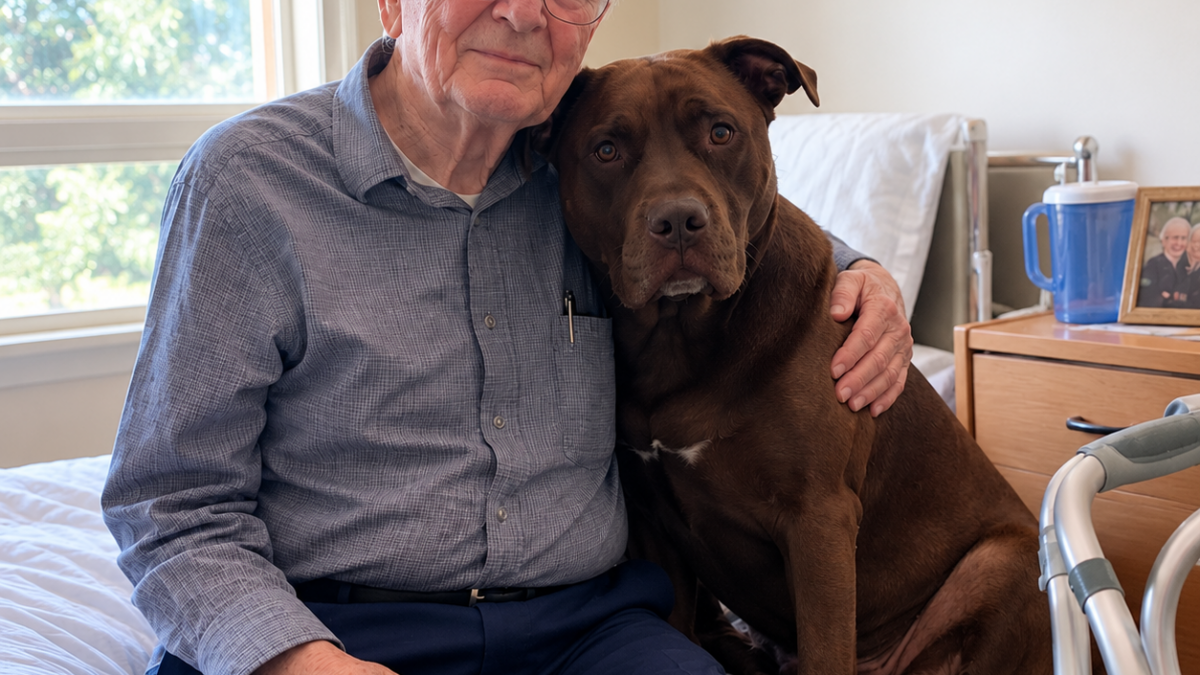
Every afternoon at exactly two o’clock, a large dark dog walked past twenty-three other residents in my nursing home, ignored every hand reaching toward him, entered my room without being called, and placed his head on the knees of an eighty-two-year-old man who had spent seventy-five years being afraid of dogs.
For weeks I refused to touch him, refused to admit I waited for the sound of his paws in the hallway, and told everyone his visits meant nothing—until the first afternoon he failed to appear and I discovered how quickly a person can become dependent on something he spent most of his life avoiding.
But the reason Ziggy had chosen my room was not kindness, coincidence, or some mysterious instinct, and when my daughter finally opened a dusty box that had belonged to my late wife, I learned that this dog had been part of my family long before I ever knew his name.
My name is Henri Martin.
I was eighty-two when Ziggy came into my life.
By then I had lived at Belvédère for two years.
It was a small retirement residence overlooking the Yvette Valley, far enough from the main road that most days the loudest sounds were wind through the cypress trees and the wheels of medication carts moving along the hallway.
My wife, Élisabeth, had died three years earlier.
We had been married fifty-four years.
People like to say that after half a century together, you learn how to live as one person.
Nobody tells you what happens when half of that person disappears.
My daughter Claire lived in Lyon and called every Sunday.
My son Philippe lived much closer but called less often.
He was always busy.
Work.
Traffic.
Children.
Meetings.
There was always a reason.
I told everyone I understood.
Mostly because saying you understand hurts less than admitting you are waiting.
I spent most afternoons beside my second-floor window doing crossword puzzles Claire mailed me once a month.
Then the administration announced a therapy-dog program.
I voted against it.
I had been afraid of dogs since I was seven, when a large dog chased me nearly three blocks on my way home from school.
Seventy-five years later, I still crossed streets to avoid them.
“No dogs in my room,” I told Nurse Camille.
She laughed.
“You haven’t even met them.”
“I don’t need to meet fire to know it’s hot.”
“Henri, you’re impossible.”
“I’ve had eighty-two years of practice.”
Then one Tuesday at two o’clock, my door opened.
A dog entered.
Not the tiny harmless creature I had imagined.
He was large.
Dark chocolate coat.
Broad chest.
Powerful head.
He stopped inside my doorway and looked directly at me.
I froze.
“Camille!”
No answer.
The dog walked forward.
Slowly.
One step.
Then another.
“Stop.”
He did not.
“Someone remove this animal.”
Still nothing.
He reached my chair.
Sat.
Then, without asking permission, lowered his heavy head onto my knees.
My hands locked around the armrests.
I barely breathed.
The dog stayed.
Five minutes.
Ten.
Maybe fifteen.
Then his handler appeared.
Her name was Sophie.
“Ziggy!”
The dog lifted his head.
Sophie stared at us.
“I am so sorry. He has never done that.”
“Excellent. Then he can never do it again.”
She clipped on his leash.
Ziggy looked back at me as she led him out.
The next afternoon at two, he returned.
Then Wednesday.
Thursday.
Friday.
Every day.
Same time.
Same room.
Same head on my knees.
I never touched him.
Then came a Sunday when Claire canceled her call because one of her children was sick.
I had been thinking about Élisabeth all morning.
About how she held my hand during her last hospital stay.
About the sound she made when she laughed.
About the fact that after fifty-four years together, I could no longer remember exactly how her voice sounded when she said my name.
At two, Ziggy entered.
He sat beside me.
Placed his head on my knees.
And for the first time, I lowered one hand.
His coat was warm.
Soft.
He looked up.
No tension.
No demand.
Just those quiet brown eyes.
My fingers moved once over his forehead.
Ziggy closed his eyes.
And I almost cried.
Three days later, the director of Belvédère summoned Sophie into his office and informed her that Ziggy’s visits to my room were being suspended.
At the time, I thought losing the dog was the worst thing that could happen.
I had no idea the argument over Ziggy was about to uncover a secret Élisabeth had kept from me for almost ten years.
PART 2
The first thing I did when Camille told me Ziggy would not be coming that afternoon was pretend I didn’t care.
This is an important skill for old men.
We call it dignity.
Women usually call it stubbornness.
“What do you mean, suspended?” I asked.
Camille stood beside my medication cabinet with her arms folded.
“Mr. Delorme wants the therapy program reviewed.”
“Why?”
“There was a complaint.”
“About Ziggy?”
“Yes.”
“What did he do?”
Camille hesitated.
That made me nervous.
“Did he bite someone?”
“No.”
“Growl?”
“Not exactly.”
“What does ‘not exactly’ mean?”
“There was an incident yesterday in the west lounge.”
I remembered nothing unusual.
After lunch I had been in my room.
Camille pulled up a chair.
“A resident named Madame Fournier was walking with her daughter. She lost her balance.”
“Is she all right?”
“Yes. She didn’t fall. Ziggy barked when the daughter grabbed her.”
“And?”
“The daughter says he frightened them.”
I stared.
“He barked.”
“Yes.”
“He did not touch her.”
“No.”
“He did not lunge.”
“No.”
“Then what exactly is being reviewed?”
Camille smiled slightly.
“You sound like someone who likes dogs now.”
“I sound like someone who dislikes stupidity.”
“Of course.”
She explained that Madame Fournier’s daughter had filed a formal complaint.
Not only about the bark.
About Ziggy’s size.
His breed.
His freedom to walk on a loose lead through common areas.
She said her mother no longer felt safe.
Belvédère’s director, Laurent Delorme, responded by suspending Ziggy from resident-floor visits until the therapy organization completed a behavior review.
Reasonable words.
Professional words.
Still, all I heard was:
No two o’clock visit.
I looked at the clock.
1:38.
“Where is Ziggy now?”
“Home with Sophie.”
“When does the review happen?”
“Tomorrow.”
“And if he passes?”
“Then perhaps he returns.”
“Perhaps?”
Camille sighed.
“Henri, there are other issues.”
Of course there were.
There are always other issues when someone wants to make a simple thing difficult.
“What issues?”
“Insurance.”
I rolled my eyes.
“Ah. The sacred god.”
“Also budget.”
“Another god.”
“Laurent says the program costs more than originally projected.”
“Then say that.”
Camille lowered her voice.
“I didn’t tell you this.”
“You’re about to.”
“He was already considering reducing the program.”
Before the complaint.
That changed how I heard everything.
“Ziggy gave him an excuse.”
“I wouldn’t phrase it like that.”
“I would.”
At 1:55, I tried to read.
At 1:57, I reread the same clue four times.
At 1:59, I looked toward the doorway.
Two o’clock came.
Nothing.
No paws.
No breathing.
No dark head pushing through the door.
My room sounded enormous.
I hated that.
I hated it enough to become angry.
Anger is useful when sadness feels embarrassing.
I rang the nurse’s button.
Camille returned.
“I need to see Mr. Delorme.”
“Now?”
“Yes.”
“You’re in slippers.”
“He has seen feet.”
She laughed despite herself.
Twenty minutes later, I was in Laurent Delorme’s office.
I had known Laurent for a year.
Forty-eight.
Expensive glasses.
Perfect shirts.
A man who used phrases such as operational exposure and risk mitigation even when talking about soup.
He stood when I entered.
“Henri.”
“Don’t ‘Henri’ me.”
He sat again.
“That sounds promising.”
“I want Ziggy back.”
“I’m aware.”
“He barked once.”
“The complaint concerns more than barking.”
“So Camille said.”
Laurent’s expression changed.
I realized Camille would hear about that later.
I didn’t care.
“The program is being reviewed,” he said. “This is temporary.”
“Is it?”
“Yes.”
“Were you planning to reduce it before the complaint?”
He paused.
Good.
That pause answered.
“We review all programs.”
“Were you?”
“Costs have increased.”
“Then the dog isn’t the problem.”
“Henri.”
“Again with my name.”
He removed his glasses.
“The therapy program is valuable. But we have seventy-one residents, limited staff, insurance requirements, and families with different comfort levels.”
“I had a different comfort level.”
Laurent looked at me.
“You opposed the program.”
“I did.”
“You specifically wrote, ‘No dog will ever enter my room with my consent.’”
I remembered.
I had signed it too.
Laurent almost smiled.
“I still have the form.”
“Burn it.”
That got a laugh.
Then he became serious again.
“Ziggy’s interaction with you has been extraordinary. That doesn’t mean I can ignore another family’s concerns.”
I knew he was right.
That was deeply inconvenient.
“So evaluate him.”
“We are.”
“And then?”
“We’ll decide.”
“Who?”
“Administration, clinical staff, and the therapy organization.”
“What about residents?”
Laurent blinked.
“What?”
“Do residents get a say in whether the resident program continues?”
“We have satisfaction surveys.”
I stared at him.
“A survey.”
“Yes.”
“You ask people whether the potatoes are too salty.”
“That question is on the survey, yes.”
“I want a meeting.”
“With whom?”
“The residents.”
“Henri—”
“The people who actually receive the program.”
He leaned back.
“You have become remarkably political over one dog.”
“I have become remarkably annoyed.”
That afternoon, I did something I had not done in two years.
I went to the common room voluntarily.
The Tuesday bridge group stared as if I had walked in wearing a clown suit.
Madame Vasseur lifted one eyebrow.
“You lost?”
“I need signatures.”
“For what?”
“A resident meeting.”
“About?”
“The therapy dogs.”
She smiled.
“Ah. The big brown one.”
“Ziggy.”
“So you know his name now.”
“Everyone knows his name.”
“You voted against him.”
“People make mistakes.”
Madame Vasseur nearly dropped her cards.
“Can someone record that?”
Within an hour, I had thirty-one signatures.
Not everyone supported me.
Monsieur Leclerc hated dogs more than I once did.
Madame Fournier herself said the bark had frightened her.
That mattered.
I did not want to erase her fear simply because Ziggy helped me.
So I asked her what happened.
She sat in a wheelchair near the window.
Her daughter wasn’t present.
“Ziggy barked,” she said.
“Why?”
“I stumbled.”
“What did your daughter do?”
“Caught my arm.”
“And the dog?”
“He stood up.”
“Toward you?”
She thought.
“Between us, perhaps.”
“Did he touch you?”
“No.”
“Were you frightened?”
“Yes.”
“Of the dog?”
She looked down.
“Of falling.”
That distinction mattered.
“Your daughter said Ziggy frightened you.”
“She was frightened too.”
“Would you want him banned?”
Madame Fournier sighed.
“No.”
I stopped.
“No?”
“I want Sophie to keep him on the other side of the lounge if I’m walking.”
Reasonable.
“So why did your daughter complain?”
“She worries.”
Children do that.
Sometimes love becomes control when fear is involved.
I understood more than I wanted to.
The next morning, Ziggy underwent his behavior review.
I was not allowed to attend.
Ridiculous.
I waited beside my window.
At 11:16, Sophie called the nurses’ station and asked for me.
Camille brought the phone.
“He passed,” Sophie said.
My chest loosened.
“Good.”
“There was no sign of inappropriate aggression.”
“Obviously.”
“Henri.”
“Sorry.”
“The evaluator believes the bark was an alert response to sudden movement and instability.”
“So he returns?”
Silence.
“Sophie?”
“Not yet.”
I gripped the phone.
“Why?”
“Laurent has suspended the program through Friday while administration reviews liability.”
There it was.
Behavior no longer mattered.
The complaint had become the door through which every other concern entered.
Cost.
Insurance.
Management.
I was furious.
Then Sophie said something strange.
“Henri, can I ask you a question?”
“Yes.”
“Have you ever lived near Melun?”
My hand stopped.
“Why?”
“Just answer.”
“For fifty years.”
“Rue des Acacias?”
I went cold.
“Yes.”
Sophie didn’t speak.
“How do you know that address?”
“I need to come see you.”
“When?”
“This afternoon.”
“At two?”
She paused.
“Yes.”
At 1:58, I was already sitting upright.
At exactly two, Sophie entered.
Without Ziggy.
The disappointment was childish.
I hated myself for it.
Then I saw what she carried.
A folder.
Old.
Brown cardboard.
“Where’s the dog?”
“At home.”
“Is he well?”
“Yes.”
“Then what is that?”
Sophie sat opposite me.
“I reviewed his therapy certification file because of the complaint.”
“And?”
“When I adopted Ziggy four years ago, he came from a rescue outside Fontainebleau.”
I listened.
“He had a microchip, but the registration was outdated.”
“To whom?”
“A man named Marcel Girard.”
The name struck something old.
I looked toward the window.
“Marcel.”
“You knew him?”
“Neighbor.”
“How close?”
“Three houses down.”
Sophie opened the folder.
“He died five years ago.”
“I know.”
That surprised her.
“Were you friends?”
“No.”
Then I corrected myself.
“Élisabeth was.”
My wife.
Of course.
Marcel had been a widower.
A retired schoolteacher.
Quiet.
Always wore a brown cap.
And he had a dog.
I remembered that much.
A dark dog behind the hedge.
I had avoided the house whenever the gate stood open.
Sophie slid a photograph toward me.
Ziggy.
Younger.
Standing beside Marcel.
Same broad chest.
Same chocolate coat.
My throat tightened.
“That is him?”
“Yes.”
“I never…”
I touched the edge of the photograph.
“I barely looked.”
Because I had been afraid.
Even from across the street.
I remembered telling Élisabeth once:
“Marcel needs to control that animal.”
She had replied:
“He does control him. You control your imagination.”
That sounded like her.
Sophie continued.
“After Marcel died, Ziggy’s records become unclear.”
“What happened?”
“A relative placed him temporarily with someone. Then he ended up surrendered to a rescue. The microchip was never properly updated until I adopted him.”
“Why would he come to me?”
“I don’t know yet.”
“What do you mean yet?”
Sophie opened another document.
Veterinary record.
Emergency contact:
**Élisabeth Martin.**
I stopped breathing for a moment.
My wife’s name.
Our old phone number.
Our address.
I read it twice.
“Why is she here?”
“Apparently she was listed as Ziggy’s emergency caregiver.”
“No.”
“Henri.”
“No. Élisabeth knew I was afraid of dogs.”
“That doesn’t mean she wasn’t helping one.”
I almost laughed.
Yes.
That was exactly something Élisabeth would do.
Help quietly.
Avoid unnecessary argument.
Then tell me twenty years later when it became funny.
Sophie gave me another paper.
Notes from the veterinary clinic.
**During Mr. Girard’s hospitalization, dog temporarily exercised by neighbor E. Martin. Daily walk approximately 14:00.**
Two o’clock.
My hands began shaking.
Sophie noticed.
“Henri?”
I didn’t answer.
Daily walk approximately 14:00.
Every day.
The dog entered my room at two.
Not 1:45.
Not 2:30.
Two.
Sophie whispered:
“I think he remembers.”
“No.”
“Maybe not consciously the way we do.”
“No.”
I stood too quickly.
The room tilted.
Sophie moved toward me.
“Sit.”
I did.
I looked at my hands.
“Élisabeth walked him?”
“For at least several months, according to the records.”
“She never told me.”
“Maybe she did.”
“I would remember.”
Sophie gave me a look.
I became irritated.
“My memory is fine.”
“I didn’t mean—”
“I would remember.”
Then I realized something else.
Claire.
I reached for the phone.
“Call my daughter.”
“What?”
“Now.”
Claire answered on the second attempt.
“Papa?”
“Did your mother walk Marcel’s dog?”
Silence.
That was enough.
“Claire.”
She laughed nervously.
“Oh.”
“Do not ‘oh’ me.”
Sophie covered a smile.
Claire said:
“I forgot about that.”
“You forgot?”
“It was years ago.”
“Did you know?”
“Yes.”
“How long?”
“I don’t know. Maybe a year?”
I stared at the wall.
“A year?”
“Marcel had surgery. Then physical therapy. Mom helped with Ziggy.”
“You knew his name?”
“Of course.”
I felt ridiculous.
The whole family apparently had a secret dog history.
“Why didn’t anyone tell me?”
Claire laughed.
“Because you were terrified.”
“I am not—”
“Papa, you once waited twenty minutes inside the garage because a Labrador was sitting across the street.”
“That Labrador was watching me.”
“So is Ziggy.”
Sophie laughed.
I pointed at her even though Claire couldn’t see.
“This is not funny.”
Claire became softer.
“Mom kept him in Marcel’s garden. She walked him at two because that’s when you used to nap after lunch on weekends.”
That was betrayal on a marital scale.
“She scheduled a dog around my sleep?”
“She loved you.”
“That is not an answer.”
“It is exactly the answer.”
I went quiet.
Claire continued.
“She never wanted to make you uncomfortable.”
“Then why help the dog?”
“Because Marcel needed help.”
Again.
Exactly Élisabeth.
“She used to say Ziggy was gentle.”
My chest tightened.
Claire hesitated.
“Papa, I think there’s something at the old house.”
“What?”
“A box of Mom’s notebooks.”
“What notebooks?”
“Calendars. Lists. Recipes. You know how she wrote everything down.”
I knew.
Élisabeth documented life like she was preparing evidence for a future civilization.
Shopping lists.
Phone numbers.
Medication schedules.
Recipes.
Appointments.
Notes reminding me to call the plumber.
Claire continued:
“I remember seeing Ziggy’s name.”
My mouth went dry.
“Bring them.”
“I’m in Lyon.”
“Then come.”
Silence.
I regretted the demand immediately.
Claire had work.
Children.
A life.
Before I could apologize, she said:
“I can come Saturday.”
Saturday.
Three days.
“Good.”
Then, softer:
“Thank you.”
Claire paused.
“For what?”
“For coming.”
“I should come more.”
The words were quiet.
Honest.
I did not know what to do with them.
So I said:
“Bring the box.”
Because old men are cowards in specific ways.
Friday morning, Belvédère held the resident meeting I had demanded.
Laurent expected perhaps fifteen people.
Forty-seven attended.
Some came because they cared about therapy dogs.
Some because they were bored.
Both motives count in democracy.
Sophie attended.
The therapy organization’s evaluator joined by video.
Madame Fournier came with her daughter, Isabelle.
Laurent opened.
“This is not a vote.”
Madame Vasseur muttered:
“Then why are we here?”
Several people laughed.
Laurent tried again.
“We want resident input before finalizing changes to the animal-assisted visitation program.”
Better.
The evaluator spoke first.
Ziggy had passed.
No concerning aggressive response.
The incident appeared consistent with alert barking during sudden movement.
Recommendations:
Closer handler positioning in crowded areas.
Clear walking routes.
Residents who preferred distance could opt out.
No unsupervised hallway roaming.
Reasonable.
Then Isabelle Fournier spoke.
“My mother was terrified.”
Madame Fournier interrupted:
“I was afraid of falling.”
Isabelle looked at her.
“Maman.”
“I was.”
“Ziggy barked at me.”
“He barked when I stumbled.”
“You don’t know why.”
“Neither do you.”
The room went quiet.
Old women are dangerous when people speak for them too long.
Madame Fournier turned toward Laurent.
“I don’t want the dog near me when I walk.”
“That’s completely reasonable.”
“But I don’t want him removed.”
Isabelle looked hurt.
“You told me—”
“I told you I was frightened.”
“That is different.”
That phrase would stay with me.
Being frightened is not always the same as wanting the frightening thing destroyed.
I had spent seventy-five years proving that.
Laurent thanked her.
Then presented finances.
The therapy program cost more than expected.
Insurance premiums had risen.
The provider wanted updated facility support.
A new budget year was coming.
Finally we reached the truth.
Not one bark.
Money.
Programs often die through accounting long before anyone admits they are choosing.
I raised my hand.
Laurent sighed.
“Henri.”
“How much?”
“What?”
“The annual cost.”
He gave a figure.
It wasn’t small.
It also wasn’t enormous compared with Belvédère’s operating budget.
“How much do residents pay for entertainment programming?”
“Henri, that’s not directly comparable.”
“Humor me.”
He gave another figure.
“Flower arranging?”
Madame Vasseur gasped.
“Don’t you dare cut flowers.”
I ignored her.
“Television package?”
Someone laughed.
Laurent rubbed his forehead.
“This isn’t a line-by-line budget review.”
“It should be.”
He looked at me.
“You’ve become exhausting.”
“Ziggy did that.”
Then Sophie spoke.
“The therapy organization can reduce visits from three days to two.”
My stomach dropped.
Two days meant not every day.
But Ziggy’s daily visits to me had been outside the formal schedule anyway.
Because Sophie sometimes brought him on training days.
Personal favor.
Unsustainable.
Laurent said:
“That would help.”
Another resident asked:
“What if we fundraise?”
Then another:
“My family donates every Christmas.”
Another:
“Mine too.”
The meeting became chaotic.
Families.
Residents.
Staff.
Ideas.
Laurent raised both hands.
“We are not deciding today.”
I stood.
My knees hurt.
That helped me stay angry.
“I have something to say.”
Madame Vasseur whispered:
“Obviously.”
I ignored her.
“For seventy-five years, I did not like dogs.”
“Afraid,” Camille corrected from the back.
“Not relevant.”
Laughter.
I continued.
“When Ziggy first came into my room, I wanted him removed.”
I looked at Madame Fournier.
“So I understand fear.”
Then Sophie.
“I also understand something else now.”
I had not planned the sentence.
It came anyway.
“I did not need a dog to make me younger. I did not need him to cure anything. I needed something to happen tomorrow that I wanted to see.”
The room became silent.
I looked at Laurent.
“Do you understand?”
He did not speak.
“Before Ziggy, every day here was very much like the day before. Breakfast. Medicine. Crossword. Lunch. Window. Dinner. Sleep.”
My throat tightened.
“People think old age is frightening because of pain.”
I shook my head.
“Sometimes it is frightening because nothing is expected from you and eventually you stop expecting anything too.”
I looked toward the empty doorway.
“At two o’clock, I started expecting something.”
Camille wiped her eyes.
I hated her for that.
Then I added:
“This program may be optional. It is not decorative.”
No applause.
Thank God.
Applause would have ruined it.
Just silence.
Then Madame Vasseur said:
“Also, the flower budget stays.”
That saved me.
The room laughed.
Laurent postponed the decision until Monday.
Saturday morning, Claire arrived carrying a cardboard box.
She also brought my grandson Lucas, who was twenty-one and taller than anyone in our family had a right to be.
I had not seen him in eight months.
He hugged me.
I pretended this was ordinary.
Claire noticed.
She always noticed.
“You’ve lost weight.”
“I have not.”
“You have.”
“People shrink.”
“That isn’t how weight works.”
“Ask science.”
She placed the box on my table.
Élisabeth’s handwriting appeared on the lid.
**CALENDARS / HOUSE / KEEP**
My chest tightened before we even opened it.
Inside were years of notebooks.
Small.
Blue covers.
One for each year.
Claire found the one from ten years earlier.
We turned pages.
Doctor appointment.
Buy tomatoes.
Philippe dinner 7:30.
Henri dentist.
Marcel hospital.
Then:
**2:00 — Ziggy.**
Next day:
**2:00 — Ziggy.**
Then again.
Again.
Weeks.
Months.
Some entries had tiny notes.
**Ziggy hates rain.**
**Ziggy stole glove.**
**Henri almost saw us—close call!**
Claire laughed.
I did not.
“Your mother was a criminal.”
“She was walking a dog.”
“Behind my back.”
“You were napping.”
“Still.”
Lucas read over my shoulder.
“Grandpa, this is hilarious.”
“Traitor.”
Then one entry stopped me.
**Marcel tired. Ziggy stayed with me after walk. Sat by kitchen door while Henri read upstairs. Such a gentle dog. Henri would love him if he weren’t so frightened.**
I couldn’t breathe properly.
Claire touched my shoulder.
“Papa.”
I read it again.
**Henri would love him if he weren’t so frightened.**
Élisabeth knew.
Ten years before I did.
Of course she did.
That woman had been annoyingly correct for fifty-four years.
I turned the page.
Three weeks later:
**Ziggy waited at gate at 2. Dogs remember routines better than people.**
Another:
**Marcel home soon. Ziggy will miss our walks. I think I will too.**
Then, near the end of the year:
**Marcel better. Ziggy back with him full time. Henri still has no idea. One day perhaps I’ll tell him.**
She never did.
Three years later she became ill.
Then everything else took over.
Hospital visits.
Tests.
Fear.
Time.
Ziggy disappeared from our conversations because he had never officially entered them.
Claire sat beside me.
“She probably forgot she never told you.”
“No.”
“What?”
“She was saving it.”
“For what?”
“An argument.”
Claire laughed through tears.
“That sounds like Mom.”
I closed the notebook.
Then realized Ziggy was not there.
The room felt wrong again.
“Can we see him?”
Claire asked.
“Sophie has him.”
“Call her.”
I did.
An hour later, Ziggy entered my room.
At 1:56.
Early.
Unacceptable.
He saw—or smelled—Claire first.
His tail moved.
Claire froze.
“Oh my God.”
“What?”
“I remember him.”
Sophie stopped.
“You do?”
Claire knelt.
“Ziggy?”
His whole body changed.
He approached.
Sniffed her hands.
Then licked her wrist.
Claire started crying.
“I was seventeen when Mom walked him.”
“Twenty-eight,” I corrected.
“What?”
“You were twenty-eight.”
She laughed through tears.
“I meant Lucas was little. I don’t know. My brain stopped.”
Lucas crouched too.
Ziggy sniffed him.
Then came to me.
Of course.
Head on knees.
I touched his forehead.
Claire watched.
“Mom would lose her mind.”
“I know.”
“She tried to get you near this dog for years.”
“No, she didn’t.”
“She absolutely did.”
“She respected my fear.”
“She manipulated around it.”
“Also true.”
Sophie handed me the old photograph of Marcel and Ziggy.
Claire looked.
“Wait.”
She pulled out her phone.
Scrolled.
Then showed us a picture.
Élisabeth in our garden.
Holding flowers.
At the far edge of the frame, half-hidden behind a hedge:
Ziggy.
Young.
Watching her.
I stared.
He had been there.
At my house.
Inside my life.
Just outside the part I was willing to see.
That realization hurt in ways I cannot explain.
How many things had I missed because fear decided where I looked?
That evening, Claire and I talked until after dinner.
About Élisabeth.
About the nursing home.
About Philippe.
Eventually Claire said:
“You know he asked about the house again.”
My mood changed.
“What house?”
“Our house.”
“The old house.”
“Yes.”
“What about it?”
Claire hesitated.
“He thinks you should sell.”
“I know.”
“He says upkeep is getting expensive.”
“I know.”
“He asked if you signed the authorization.”
“What authorization?”
Claire stared.
“The property management mandate.”
“I signed something last year.”
“What exactly?”
I felt irritated.
“Paperwork.”
“Papa.”
“Your brother said it allowed him to handle repairs.”
Claire’s expression changed.
“Do you have a copy?”
“No.”
“Did you read it?”
“I am eighty-two, not incompetent.”
“That was not my question.”
I looked away.
No.
I had not read every page.
Philippe had come after lunch.
I had been tired.
He said the roof needed work and utilities needed handling.
He placed tabs where I should sign.
I trusted him.
Why wouldn’t I?
He was my son.
Claire did not accuse him of anything.
That is important.
Neither did I.
But she called the notary on Monday.
The mandate gave Philippe broad authority to manage expenses related to the property and negotiate a potential sale, subject to my final approval.
Not illegal.
Not theft.
Not even necessarily unreasonable.
But far broader than I remembered agreeing to.
The notary asked:
“Mr. Martin, do you wish the mandate to remain?”
I thought about it.
Then:
“No.”
Claire looked at me.
“Are you sure?”
“Yes.”
“Philippe will be furious.”
“Then he should call.”
That was new.
Not anger.
Choice.
Maybe Ziggy had something to do with it.
Maybe not.
Philippe called within three hours.
Not surprising.
“Dad, what are you doing?”
“Good afternoon to you too.”
“Why did you cancel the mandate?”
“Because I didn’t understand its scope.”
“I explained it.”
“You explained repairs.”
“And eventual sale.”
“I don’t remember that.”
“Dad—”
“Do not use my age as punctuation.”
Silence.
“What does that mean?”
“It means stop saying ‘Dad’ like the next sentence is going to explain my own life to me.”
Another silence.
Then Philippe exhaled.
“Claire put this in your head.”
There it was.
“No.”
“She comes down one weekend and suddenly—”
“No.”
“Then why now?”
I looked at Ziggy.
He was sleeping beside my chair.
“Because I changed my mind.”
Philippe laughed once.
“You don’t just change your mind about something this important.”
“I do.”
“Based on what?”
“My mind.”
That should have ended it.
It did not.
“Do you know what the house costs every month?”
“Yes.”
“Taxes?”
“Yes.”
“Repairs?”
“Yes.”
“I’ve been handling all of it.”
“And I appreciate that.”
“Then why revoke authority?”
“Because helping me and deciding for me are not the same thing.”
The line came out sharper than I intended.
Philippe went quiet.
I continued.
“I may sell.”
“Then why—”
“Because if I sell, I want to participate.”
“You live three hours away.”
“I can use a telephone.”
“You hate video calls.”
“I hate your video calls.”
That was unkind.
Also funny.
He did not laugh.
Then Philippe said something honest.
“I don’t have time to manage this if every decision becomes a debate.”
I closed my eyes.
There it was.
Not greed.
Not conspiracy.
Time.
My son was busy.
He wanted efficiency.
Efficiency becomes dangerous when applied to people who move slowly.
“Then stop managing it.”
He inhaled.
“Fine.”
The word was cold.
Then he hung up.
I sat there shaking.
Ziggy lifted his head.
Came over.
Head on knees.
“You have terrible timing.”
He sighed.
I touched his ear.
“Or good timing.”
Monday arrived.
The Belvédère board meeting.
Not just residents this time.
Facility owners.
Clinical director.
Laurent.
Insurance representative.
Therapy organization.
Resident council.
Family representatives.
Too many people.
The room smelled like coffee and anxiety.
The question:
Should the therapy-dog program continue?
I had never attended a management meeting before.
I hoped never to again.
Insurance spoke first.
No mandatory cancellation.
Additional handler guidelines recommended.
Behavioral review cleared Ziggy.
Cost was real but manageable.
Then Laurent presented options.
End program.
Reduce frequency.
Continue with modified rules.
I listened.
Then Isabelle Fournier asked to speak.
She surprised everyone.
Especially me.
“My complaint started this,” she said.
Laurent nodded carefully.
“I was frightened when Ziggy barked.”
She looked toward her mother.
“But I also exaggerated what happened because I was afraid my mother would fall again and I wanted the environment controlled.”
Madame Fournier stared at her.
Isabelle continued.
“The dog did not touch us.”
Sophie smiled faintly.
“I still want stronger handling rules.”
“Agreed,” Laurent said.
“But I don’t want the program canceled because of the way I described one moment.”
That was courage.
Admitting fear.
Then admitting fear distorted the story.
I knew something about that.
The therapy evaluator presented revised protocol.
Residents could opt out by room and common area.
Dogs would remain on controlled leads in transit corridors.
Clear signage during visits.
Maximum room density.
Behavior re-evaluation after any incident.
Good.
Then money.
Claire had discovered residents’ families donated annually to the Belvédère social fund.
Several had already offered to earmark contributions.
A local foundation that supported elder engagement offered a one-year pilot grant after hearing about the resident petition.
No miracle donor.
No enormous check.
Just enough.
Laurent looked surprised.
“Who contacted them?”
Madame Vasseur raised her hand.
Everyone stared.
“What?”
She shrugged.
“My nephew works there.”
I laughed.
Never underestimate women who play bridge.
The program survived.
Modified.
Funded for one year.
Reviewable.
Not guaranteed forever.
Real life rarely gives forever guarantees.
But Ziggy returned.
The following Tuesday at two o’clock.
I knew he was coming.
Still, when I heard his paws, something in my chest moved.
He entered.
Walked directly toward me.
Sat.
Head on knees.
I placed my hand on him before he even settled.
No hesitation.
That was how I knew I had changed.
Not because fear disappeared.
Because trust became faster.
The story could have ended there.
It didn’t.
Philippe arrived that Saturday.
Unannounced.
He entered my room at 10:12 looking angry enough to make himself younger.
Claire was not there.
Good.
I did not want them fighting.
“What are you doing here?”
“Apparently I need an appointment to talk to my father now.”
“You’ve needed one for two years.”
Bad opening.
He stared.
I regretted it.
Then decided not to apologize immediately.
Philippe closed the door.
“Did Claire tell you I was trying to sell the house behind your back?”
“No.”
“She implied it.”
“She asked what I signed.”
“I’ve been paying contractors, insurance, taxes—”
“With my money.”
“I know that.”
“I never accused you of taking anything.”
“Then why cancel the mandate?”
“Because I want information before decisions.”
“You had information.”
“Not enough.”
Philippe paced.
Then stopped when he saw Ziggy’s water bowl.
“You have a dog now?”
“No.”
“Claire said something about a therapy dog.”
“Yes.”
“This is because of a dog?”
I almost laughed.
“No.”
“It seems like since that animal showed up, suddenly everyone is questioning everything.”
Interesting.
“Perhaps because I started answering.”
Philippe stared.
“What does that mean?”
“It means I spent two years making life easy for everyone.”
“That is unfair.”
“Is it?”
“I call.”
“Sometimes.”
“I have work.”
“I know.”
“Children.”
“I know.”
“A mortgage.”
“I know.”
“Claire lives farther away and somehow she gets to be the good child because she sends crosswords.”
That hit me.
Because there was truth inside the bitterness.
Families simplify each other too.
Good daughter.
Busy son.
Lonely father.
Dead mother.
No one is only one thing.
I pointed toward the chair.
“Sit.”
Philippe sat.
I looked at him.
“When your mother died, what did you do?”
His face changed.
“What kind of question is that?”
“Answer.”
“I handled the funeral.”
“I mean after.”
He looked away.
“I went back to work.”
“I know.”
“I had to.”
“Did you?”
His jaw tightened.
“Yes.”
Then softer:
“I couldn’t be in that house.”
There it was.
I had never known.
“Why?”
“Everything was her.”
He looked around my room.
“Her cups. Her jacket. Her stupid gardening shoes.”
My chest tightened.
“I hated going there.”
“So you managed it quickly.”
“Yes.”
“From a distance.”
“Yes.”
“And me?”
He looked at me.
“What about you?”
“You managed me from a distance too.”
That hurt him.
I saw it.
Good.
Not because I wanted pain.
Because some truths need to land.
Philippe whispered:
“I didn’t know what to say to you.”
“You could have said that.”
“I thought you blamed me for putting you here.”
“I did.”
He closed his eyes.
“Great.”
“I was wrong.”
He looked up.
“What?”
“I was angry.”
I took a breath.
“Your mother died. I fell twice. The house became too much. Belvédère was probably the correct decision.”
Philippe’s face softened.
“I thought you hated me for it.”
“For a while.”
“Why didn’t you say?”
“Because we are both idiots.”
That surprised a laugh out of him.
Small.
Real.
Then Ziggy arrived.
Two o’clock.
Door opened.
Philippe froze.
The dog entered.
Large.
Dark.
Broad.
My son’s eyes widened.
“This is the therapy dog?”
“This is Ziggy.”
“He’s enormous.”
“He thinks the same about you.”
Ziggy walked straight toward me.
Head on knees.
Philippe stared.
“You touch him?”
“Obviously.”
“You hated dogs.”
“Still hate most people. Things change.”
Philippe laughed again.
Ziggy looked toward him.
Then stood.
Approached.
Philippe stiffened.
I recognized it instantly.
Fear.
Not as old as mine.
But there.
“He won’t hurt you.”
“You don’t know that.”
I smiled.
Now I understood how annoying reassurance can sound.
“Put your hand down.”
“No.”
“Coward.”
“I’m fifty-one.”
“Cowardice survives age.”
He glared.
Then lowered one hand.
Ziggy sniffed.
Nothing else.
Philippe exhaled.
“You’re enjoying this.”
“Immensely.”
Ziggy returned to me.
My son watched.
Then asked:
“Why you?”
I looked at Élisabeth’s notebook on the table.
“Your mother.”
I told him.
Everything.
Marcel.
Ziggy.
Two o’clock walks.
The veterinary record.
Claire’s memory.
Philippe sat absolutely still.
Then he started laughing.
Not softly.
Full laughter.
“What?”
“Mom walked a dog behind your back for a year?”
“Yes.”
“That is the most Mom thing I’ve ever heard.”
“Your family has no loyalty.”
“She must have loved this.”
I looked at Ziggy.
“Yes.”
Philippe touched the notebook.
Then his expression changed.
“I miss her.”
Three words.
He had never said them to me.
Not once.
I reached across.
Put my hand over his.
He did not pull away.
Neither did I.
Ziggy slept between us.
That afternoon did not repair everything.
Philippe did not suddenly call every day.
I did not suddenly forgive every absence.
But after that, he called every Thursday.
Sometimes for five minutes.
Sometimes twenty.
The important difference was consistency.
He visited once a month.
Claire remained more attentive.
The two of them still argued about the house.
Eventually I sold it.
My decision.
Not Philippe’s.
Not Claire’s.
Mine.
A neutral notary handled the sale.
The buyer was a young couple with one child and, to my considerable annoyance, a Labrador.
When I heard that, I almost canceled.
Claire threatened me.
We went to the house one final time before closing.
I had not been back in nearly a year.
Ziggy came too.
Sophie drove him.
The moment we entered the street, he stood in the back seat.
Alert.
At the old gate, his whole body changed.
He knew.
I am certain.
Call it scent.
Memory.
Routine.
Whatever word makes you comfortable.
He knew.
Sophie opened the car door.
Ziggy stepped out.
Walked toward my gate.
Stopped.
Sniffed.
Then moved to the neighboring house.
Marcel’s.
Of course.
The current owners had changed the fence.
Still, Ziggy stood where the old gate had been.
His tail moved slowly.
Claire covered her mouth.
I looked at the house Élisabeth and I had shared.
Then at Ziggy.
For the first time, I understood that both of us had lost a version of that street.
He had lost Marcel.
Élisabeth.
His old walks.
I had lost Élisabeth.
The house.
The person I had been beside her.
We stood there as two old males pretending we were fine.
Sophie took no picture.
Thank God.
Inside my old house, I walked room by room.
Kitchen.
Living room.
Bedroom.
Garden door.
Then I found something Claire had missed.
Behind the pantry door:
A hook.
On it hung an old red leash.
Dusty.
Forgotten.
I stared.
Claire said:
“Is that—”
“Yes.”
Élisabeth’s secret.
I took the leash.
Brought it outside.
Ziggy smelled it.
Then sat.
Head tilted.
I started crying before I could stop.
I hated that.
Not the crying.
The fact Élisabeth wasn’t there to say, “I told you so.”
I knelt, which at eighty-two is an event requiring planning.
Touched Ziggy’s face.
“She liked you.”
His tail moved.
“She liked you before I did.”
Another movement.
“That was rude.”
Claire laughed through tears.
I kept the leash.
Not because Ziggy needed it.
Because I did.
The house sold two months later.
I used part of the proceeds to improve my room.
New chair.
Better reading lamp.
One absurdly expensive rug Ziggy immediately claimed.
I also made a donation to Belvédère’s therapy program.
Anonymous.
At least I tried.
Madame Vasseur told everyone within a week.
“Why did you tell them?”
“I didn’t.”
“You told Claude.”
“He asked.”
“Claude tells everyone.”
“Then blame Claude.”
Old-age institutions are gossip ecosystems.
The therapy program expanded.
Not dramatically.
Carefully.
Two dogs besides Ziggy joined.
A small Spaniel named Poppy.
A calm Labrador named Hugo.
Residents chose.
Some wanted no contact.
That was respected.
Madame Fournier preferred Poppy.
Good.
Fear did not need conquering to deserve respect.
That was another thing Ziggy taught me.
For me, two o’clock remained his.
Even when other residents wanted him.
Sophie protected that time.
“Ziggy has an appointment,” she’d say.
“With Henri?”
“Yes.”
“Every day?”
“When possible.”
Not every day remained possible.
Schedules changed.
Sophie had work.
Therapy visits had limits.
So sometimes two o’clock passed without him.
At first I hated those days.
Then I noticed something.
I no longer collapsed into waiting.
I attended lunch.
Joined bridge.
Walked the garden.
Called Claire.
Sometimes Philippe.
Ziggy had done something dangerous.
He made me interested in life beyond him.
One afternoon he failed to arrive because Sophie had a flat tire.
At 2:15, instead of staring at the door, I went downstairs.
I found Madame Vasseur arguing about cards.
I joined.
She accused me of cheating.
I had never felt healthier.
Ziggy did not cure my loneliness.
He interrupted it long enough for me to notice other people were still available.
That difference matters.
A year passed.
Then another.
At eighty-four, I used a walker.
I hated it.
Ziggy loved it because it kept me slower.
At eighty-five, my hearing worsened.
At eighty-six, I stopped pretending crosswords were easy.
Claire began visiting every six weeks.
Philippe every two months.
Sometimes together.
They still fought.
I still refereed badly.
Belvédère changed directors.
Laurent left for another facility.
Before he went, he came to my room.
“I owe you something.”
“Money?”
“No.”
“Then probably not.”
He smiled.
“An apology.”
“For?”
“I almost cut the program too quickly.”
“You reviewed it.”
“I was looking for savings.”
“Also your job.”
“Yes.”
He looked at Ziggy.
The dog was asleep on my rug.
“I thought one resident-dog relationship was anecdotal.”
“It was.”
Laurent looked surprised.
I continued:
“One relationship is anecdotal.”
I pointed outside.
“But then you ask what it changes.”
He nodded.
“Resident participation increased after the program.”
“See? Numbers.”
“Medication use for agitation decreased slightly on program days.”
“Careful.”
“Correlation. Not causation.”
I smiled.
“You learned.”
He laughed.
“From you?”
“God help you.”
Laurent left on good terms.
No villain destroyed.
Again.
Perhaps my life had become disappointingly mature.
Then Ziggy turned ten.
His visits slowed.
Arthritis.
A heart murmur.
Nothing catastrophic.
Sophie reduced his schedule.
Three days a week.
Then two.
I became afraid.
Not of him.
Of time.
The first dog I had ever loved had arrived when both of us were already old.
That felt unfair.
“You wasted seventy-five years,” Claire said when I complained.
“Comforting.”
“You could have started earlier.”
“With what dog?”
“Any dog.”
“No. Him.”
That silenced her.
Ziggy was not interchangeable.
No relationship is.
At eleven, Sophie called me one morning.
“We need to talk.”
I hated those words.
“About what?”
“I’m moving.”
My stomach dropped.
“Where?”
“Bordeaux.”
“How far?”
“Far enough.”
“When?”
“Four months.”
“And Ziggy?”
Silence.
“Sophie.”
“He can’t keep traveling for therapy work.”
“So he goes with you.”
“Maybe.”
“Maybe?”
She came to see me that afternoon.
Without Ziggy.
Bad sign.
She explained.
Her sister needed help after surgery.
She had accepted a new position.
Her apartment in Bordeaux allowed dogs.
But Ziggy’s health worried her.
Long move.
New environment.
New work schedule.
He had become deeply attached to Belvédère.
To me.
To staff.
Sophie rubbed her forehead.
“I don’t know what’s best.”
I understood before she said it.
“You want him to stay here.”
“If that’s possible.”
Belvédère had never had a resident dog.
Therapy dogs visited.
Different rules.
Different insurance.
Different staffing.
Different responsibility.
Laurent was gone.
The new director, Anne Lefèvre, was more practical.
She listened.
Then said:
“No.”
I laughed.
At least she was clear.
“Why?”
“Twenty-four-hour animal care is not in our operating model.”
“Then create one.”
“Henri.”
“No.”
“There are veterinary expenses, feeding, walks, overnight supervision, allergies, residents who do not consent—”
“His room.”
“What?”
“He can stay in my room.”
“You cannot physically walk him.”
“Staff can.”
“Staff are not dog walkers.”
“Volunteers.”
Anne rubbed her forehead.
“You’ve been planning this for six minutes and already assigned unpaid labor.”
“Efficient.”
She almost smiled.
Then:
“No.”
I left furious.
Claire said the same thing later.
“Papa, this isn’t simple.”
“Nothing worth doing seems simple.”
“You can’t personally care for him.”
“I can love him.”
“That’s not the same.”
That sentence hurt.
Because it was true.
Love without logistics becomes dependence on someone else.
So we built logistics.
Not revenge.
Paperwork.
Sophie retained legal ownership.
Belvédère could become permanent residence under a certified resident-animal agreement used in other facilities.
We found examples.
Insurance reviewed.
A veterinary charity offered partial senior-care support.
Two volunteers committed to morning and evening walks.
Staff would not have primary dog-care duties except emergencies.
Sophie would cover food and veterinary costs initially.
I offered to cover the rest.
Anne refused personal dependency.
“Program must survive you.”
Painful.
Correct.
So Claire helped establish a small dedicated fund from my donation.
Not enormous.
Enough for care.
Residents voted.
Important.
Forty-three in favor.
Nine against.
Those nine residents received dog-free corridor protections and room restrictions.
Reasonable.
Madame Fournier voted yes.
Her daughter too.
Anne finally said:
“Pilot. Six months.”
I almost kissed her.
I did not.
At eighty-six, I had standards.
Ziggy became Belvédère’s resident dog.
Retired from formal therapy.
No vest.
No schedule.
No obligation.
The first night, he slept in my room.
Not on the rug.
Beside my bed.
At 2:00 A.M., I woke to his breathing.
For a moment, I thought it was two in the afternoon.
Then I remembered.
He didn’t have to leave.
The next day at two o’clock, Ziggy lifted his head.
Looked toward me.
Walked over.
Head on knees.
Of course.
Routine.
Memory.
Élisabeth.
Marcel.
Me.
All tangled together.
I touched his forehead.
“You can come anytime now.”
He ignored this freedom and kept coming at two.
Dogs are conservative.
Ziggy changed Belvédère more as a retired dog than as a therapy dog.
Without a vest, he became ordinary.
He slept near reception.
Followed Camille during medication rounds until she bribed him away.
Waited outside the dining room.
Visited Madame Fournier only when she called him.
Never entered Monsieur Leclerc’s room.
Somehow he learned.
Or perhaps staff did.
Choice mattered.
Residents started walking more because Ziggy needed walks.
Not every walk.
Just enough.
Philippe volunteered one Sunday.
I nearly fell from my chair.
“You?”
“What?”
“You are walking Ziggy?”
“He likes me.”
“Debatable.”
Philippe held the leash.
Ziggy followed.
My son stopped at the doorway.
“Dad.”
“Yes?”
“I was wrong about the house.”
I looked at him.
“In what way?”
“I kept treating the problem like an item on my list.”
“Efficient.”
He smiled sadly.
“Yes.”
“What changed?”
He looked at Ziggy.
“Maybe I finally understood why you were angry.”
I did not absolve him.
Did not punish him either.
“Call Thursday.”
“I always do.”
“Good.”
That was our reconciliation.
Not dramatic.
Repetition.
Call Thursday.
Visit.
Help.
Stay a little longer.
People want apology to be one sentence.
Often it’s a schedule.
Claire later gave me Élisabeth’s notebooks permanently.
I kept the year with Ziggy beside my bed.
Sometimes I read random entries.
**2:00 Ziggy. Rain. Henri sleeping.**
**Ziggy tried to steal baguette. Marcel stronger today.**
**Henri complained about dog hair on gate. He has no idea.**
I would mutter:
“Manipulative woman.”
Then smile.
One entry became my favorite.
No date I remember.
Just:
**Walked Ziggy longer today. He waited by Henri’s garden chair. Strange dog. He chooses people quietly.**
That line changed how I thought about everything.
He chooses people quietly.
Maybe he had chosen me long before Belvédère.
Maybe he associated my scent with Élisabeth.
Our house.
Marcel.
Two o’clock.
Or maybe I was simply the next old man who sat still enough.
I stopped caring which explanation was scientifically perfect.
The result was real.
At twelve, Ziggy’s heart disease worsened.
Medication.
Short walks.
More sleep.
At thirteen, he stopped climbing stairs.
Belvédère’s elevator became his personal transportation.
Residents complained jokingly that the dog had priority.
He did.
At thirteen and a half, he no longer went to the courtyard without help.
I was eighty-eight.
Between us, mobility had become a committee project.
Camille once found us sitting together beside the elevator.
“You two going somewhere?”
“Yes.”
“Where?”
“Outside.”
“You need your walker.”
“It’s here.”
“Ziggy needs his harness.”
“Also here.”
“You need a staff member.”
I stared.
“You’re here.”
She sighed.
“Manipulative old men.”
We went outside.
Cypress trees.
Wind.
Ziggy moved slowly.
So did I.
Perfect.
That winter, he developed kidney problems.
Sophie came from Bordeaux.
She had visited several times a year.
When Ziggy heard her voice, he stood too quickly.
Almost fell.
She dropped to her knees.
“Hey, old man.”
I was offended.
“That title is taken.”
She laughed and cried.
Ziggy pressed into her.
No jealousy.
I had learned enough by then.
Love isn’t reduced by previous love.
If anything, Ziggy’s history made ours deeper.
Sophie stayed three days.
Before leaving, she said:
“I think next time…”
She stopped.
I understood.
“Don’t say it.”
“Henri.”
“I know.”
“Will you call me?”
“Yes.”
“Promise?”
“Yes.”
I kept it.
Two months later, Ziggy stopped eating breakfast.
Then lunch.
Camille called the veterinarian.
Blood tests.
Heart.
Kidneys.
Age.
That terrible collection of facts with no villain.
The veterinarian said:
“We can adjust medication.”
“For how long?” I asked.
“Maybe weeks.”
“Comfort?”
“For now.”
I looked at Ziggy.
He was lying on Élisabeth’s old red leash.
I had attached it to nothing.
Just kept it near his bed.
Silly.
Symbolic.
Humans are like that.
For ten days, he improved.
Ate chicken.
Walked to reception.
Stole half a croissant from Madame Vasseur.
Heroic.
Then he declined again.
Sophie returned.
Claire came.
Philippe too.
I knew what everyone was thinking.
Nobody wanted to say it first.
So I did.
“He is tired.”
The veterinarian nodded.
Sophie cried.
Claire held her.
Philippe looked out the window.
I touched Ziggy’s head.
The same place I had been too frightened to touch the first weeks.
“How do we know?” I asked.
The veterinarian answered honestly.
“We don’t know with mathematical certainty.”
“Bad answer.”
“I know.”
“Pain?”
“Managed, but increasing.”
“Breathing?”
“Harder.”
“Interest?”
“Less.”
“Can he recover?”
“Not in the way you’re asking.”
There it was.
I hated her.
Then loved her for saying it.
We chose the next afternoon.
Two o’clock.
Not because I believed in rituals.
Because apparently I did.
At 1:45, everyone left except Sophie, Claire, Philippe, Camille, and me.
Ziggy lay beside my chair.
I had moved from bed to chair for him.
At 1:55, I put Élisabeth’s notebook on the table.
At 1:58, I read the old entry one more time.
**2:00 — Ziggy.**
At exactly two, Ziggy lifted his head.
I laughed.
“You ridiculous animal.”
His tail moved once.
I lowered my hand.
He shifted slowly.
Head onto my knees.
Same weight.
Lighter now.
But the same position.
The first day I had frozen.
Now my hands moved automatically.
Forehead.
Ear.
Neck.
“You know,” I whispered, “I did not want you.”
Philippe laughed softly through tears.
“I voted against you.”
Another tail movement.
“You broke rules.”
Ziggy breathed.
“You walked into my room without permission.”
Another breath.
“You made me care about Tuesdays.”
My voice failed.
Claire knelt beside me.
I continued.
“You brought Élisabeth back without bringing her back.”
That was the closest I could come.
He connected something I had lost to something still alive.
Not magic.
Memory with fur.
“I was afraid of dogs for seventy-five years.”
I bent forward.
“That was a lot of wasted time.”
Sophie covered her face.
Ziggy’s eyes were almost closed.
I whispered:
“Thank you for being patient with me.”
The veterinarian gave us one last moment.
Then we let him go.
Quietly.
No fear.
No crowd.
No vest.
No hallway.
His head stayed on my knees.
At 2:07, the room became still.
I did not cry immediately.
That worried Claire.
Then I looked at the doorway.
Empty.
And realized no paws would come through tomorrow.
I broke.
At eighty-eight, I cried like a child.
Nobody told me to stop.
Good.
Three weeks later, I demanded the therapy program continue.
Anne looked exhausted.
“You are grieving.”
“Yes.”
“Maybe wait.”
“No.”
“Henri.”
“If you cancel anything because I’m sad, I will become unbearable.”
“You already are.”
“Then imagine worse.”
The program continued.
But something had changed.
At two o’clock, I still looked at the door.
Every day.
For weeks.
Then one afternoon, Poppy the little Spaniel appeared.
She stopped at my doorway.
I stared.
“No.”
Poppy wagged.
“No.”
She entered.
I called Camille.
“Remove this dog.”
Camille leaned against the doorframe.
“You’ve said that before.”
“Different dog.”
Poppy approached.
I kept my hands on the chair arms.
History is repetitive and rude.
She sat.
Not head on knees.
Too small.
She put one paw on my slipper.
I looked down.
Then laughed.
“Absolutely not.”
Camille walked away.
Traitor.
I did not love Poppy like Ziggy.
That would have been impossible.
I liked her.
Eventually.
There is room for different kinds of attachment.
That is another thing age teaches if you are lucky enough to stay teachable.
After Ziggy died, we used the remaining resident-dog fund to formalize the program permanently.
Claire wanted to name it after him.
I refused.
Then compromised.
The afternoon visiting room became:
**THE ZIGGY ROOM**
Under the name:
**A quiet place for residents who want company without conversation.**
That line was mine.
Laurent sent a card when he heard.
Madame Fournier donated a chair.
Philippe paid for new flooring.
Claire bought the first dog bed.
Sophie sent Ziggy’s old therapy vest.
We did not put it behind glass.
We hung it on a simple hook.
Sometimes new dogs wore it during training.
I liked that better.
Nothing sacred.
Useful.
A year later, Belvédère began a resident choice program.
Not only dogs.
Music.
Gardening.
Reading groups.
Calls with family.
Walks.
The principle was simple:
Every resident should have something on the calendar that belongs to desire, not treatment.
That language came partly from my speech.
Laurent sent me the policy draft and wrote:
**You were right. Do not become unbearable about it.**
I framed that.
Philippe still called Thursday.
Claire still Sunday.
Sometimes both missed.
People remain human.
But now they called back.
That mattered.
The old house became someone else’s.
The Labrador apparently destroyed the garden Élisabeth had protected for thirty years.
I chose not to know details.
At ninety, I stopped going downstairs often.
At ninety-one, Claire asked whether I wanted to move closer to her.
I said no.
Belvédère was home.
Not because of the building.
Because people expected me at breakfast.
Madame Vasseur had died by then.
Monsieur Leclerc too.
Madame Fournier moved to a higher-care unit.
Camille became head nurse.
Anne remained director.
New residents arrived.
New dogs too.
I became the old man who explained Ziggy to them.
Not constantly.
I had standards.
One new resident named Paul refused dog visits.
“Terrified,” he said.
I nodded.
“Reasonable.”
“You like dogs?”
“One.”
He looked confused.
I left it there.
Months later, I saw him touching Hugo’s ear.
I said nothing.
Mercy.
At ninety-two, Claire brought me Élisabeth’s notebook again.
The binding had weakened.
She had copied the pages so the original wouldn’t fall apart.
We sat together.
She asked:
“Do you still miss Mom every day?”
“Yes.”
“Ziggy?”
“Yes.”
“Does it get easier?”
“No.”
She looked surprised.
I continued.
“It gets less lonely.”
“How?”
“Other things join them.”
That was the truth.
Grief does not shrink politely.
Life grows around it.
Élisabeth.
Ziggy.
New friendships.
Poppy’s annoying paw.
Philippe’s Thursday calls.
Claire’s crosswords.
Lucas’s children visiting.
All in the same life.
One winter morning, Philippe arrived carrying an old photograph.
He had found it while sorting boxes from his garage.
Élisabeth.
Marcel.
Ziggy.
And me.
I stared.
“What?”
“You’re in it.”
I looked closer.
It was taken during a neighborhood summer party.
Marcel stood in the foreground with Ziggy.
Élisabeth beside him.
I was in the background at a table, turned partly away.
Ziggy was looking directly at me.
Of course he was.
Philippe laughed.
“He was waiting ten years.”
“Don’t be ridiculous.”
“Look.”
“I see.”
“You think he remembered you?”
I stared at the photograph.
Then at my son.
“I think dogs don’t need the same explanations we do.”
“What does that mean?”
“No idea.”
He smiled.
Fair.
The truth is I don’t know why Ziggy chose me with such certainty.
Scent.
Memory.
Élisabeth.
The old house.
A routine fixed at two in the afternoon.
Maybe all of it.
Maybe none.
What I know is this:
Before Ziggy, I believed my life had become a waiting room.
I was waiting for Claire’s calls.
Philippe’s visits.
Meals.
Medication.
Sleep.
Then one dog changed the direction of waiting.
At two o’clock, I wasn’t waiting for life to end.
I was waiting for the door to open.
That difference may sound small when you’re young.
At eighty-two, it was enormous.
And the most satisfying part of the story was not that I overcame a childhood fear.
It was not that a therapy program survived.
It was not even discovering Élisabeth’s secret.
It was what happened to all the people who had quietly decided my preferences no longer mattered because I was old.
Laurent learned residents were not line items.
The board changed how programs were evaluated.
Philippe stopped mistaking efficiency for care.
Claire stopped assuming monthly crosswords counted as presence.
I stopped mistaking silence for dignity.
Even Isabelle Fournier learned that protecting her mother did not mean speaking over her.
Nobody was destroyed.
But several people were forced to change.
At my age, that is a much better revenge.
Years later, when a journalist from a local paper visited Belvédère to write about resident-centered care, she asked me:
“Was Ziggy a therapy dog?”
I thought about it.
“Yes.”
“Did he help you with depression?”
“Probably.”
“Loneliness?”
“Yes.”
“Fear?”
“Yes.”
“Then what was the most important thing he did?”
I looked toward the hallway.
Two o’clock had just passed.
Poppy was snoring near reception.
I said:
“He gave me an appointment with tomorrow.”
The journalist stopped writing.
“What?”
“That’s the important part.”
I pointed toward her notebook.
“Write that correctly.”
She laughed.
Then did.
The article ran under a photograph of the Ziggy Room.
Not me.
My choice.
The headline said:
**AT BELVÉDÈRE, CARE BEGINS WITH GIVING RESIDENTS A REASON TO EXPECT TOMORROW.**
That was acceptable.
I kept one copy.
Beside Élisabeth’s notebook.
Beside the old red leash.
Beside Ziggy’s first therapy tag.
Three objects.
A marriage.
A dog.
A second life I had not expected.
If I could speak to the eighty-two-year-old man sitting rigidly in his chair when Ziggy first entered, I would not tell him to stop being afraid.
Fear rarely obeys instructions.
I would say:
“Leave your hand where he can find it.”
That’s all.
Not because every fear deserves conquering.
Not because every dog is safe for every person.
But because sometimes the thing you have avoided your whole life arrives quietly, sits beside you, and waits without demanding that you become brave all at once.
Ziggy never forced me.
He did not jump.
Did not paw.
Did not bark.
He simply placed his head on my knees and waited.
Day one.
Day two.
Day three.
Again.
Again.
Again.
Until my hand moved.
And once it did, the rest of my life moved with it.
I began going downstairs.
I argued in meetings.
I read old notebooks.
I confronted my son.
I sold my house on my own terms.
I allowed my daughter to see when I was lonely.
I became the kind of old man who had opinions people could not conveniently ignore.
All because at two in the afternoon, I started expecting a dog.
People still say Ziggy chose me.
Maybe he did.
But if I have learned anything, it is that being chosen is only half the story.
Eventually, I had to choose him back.
I chose to touch him.
To defend the program.
To ask questions.
To open Élisabeth’s box.
To forgive some things.
Not others.
To let Philippe try again.
To allow Belvédère to become home instead of punishment.
To stay interested.
That last one matters most.
At ninety-two, people assume curiosity belongs to the young.
Nonsense.
Curiosity is one of the things keeping me alive.
What dog arrives Tuesday?
Will Philippe call Thursday?
Can Claire finally beat me at crosswords?
Will Camille stop putting too much sugar in tea?
Probably not.
These are small questions.
Small questions are enough.
Élisabeth knew that.
Ziggy knew it in his own way.
At two o’clock, you get up.
You go to the person.
You stay awhile.
Tomorrow, you do it again.
That is how trust is built.
That is how families repair themselves.
That is how an old man who once wondered whether anyone would notice if he failed to wake up becomes surrounded by people who notice when he misses breakfast.
And that, more than any secret in Élisabeth’s notebook, was what Ziggy had really been trying to show me from the first afternoon he walked into my room.
I had not disappeared.
I was still here.
And someone was still coming to find me.

