PART 2: Bucky Was Dying Alone in a Locked Cage—Then One Tiny Tail Wag Changed Everything
PART 2
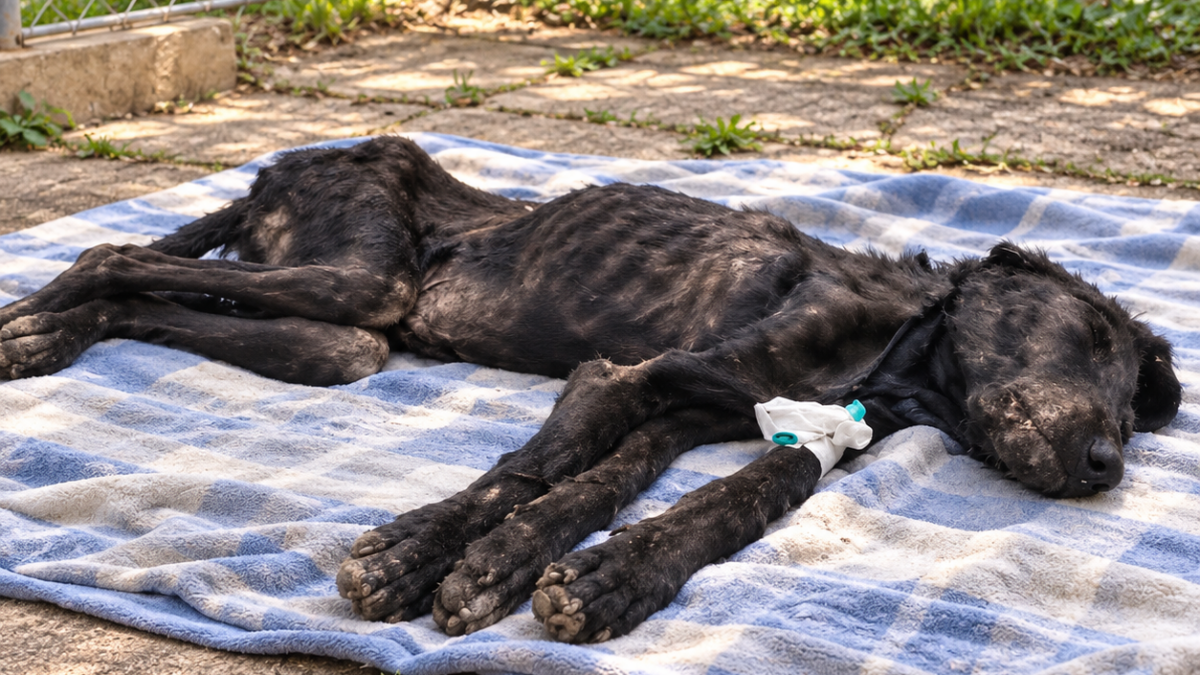
I stared at the blanket.
“Did you see that?”
Emily, the veterinary technician standing beside me, didn’t answer immediately.
Her hand was pressed over her mouth.
Then Bucky’s tail moved again.
Barely half an inch.
But it moved.
Emily laughed softly through tears.
“I saw it.”
Dr. Hannah Cole stepped around the treatment table.
“What happened?”
“He wagged.”
Hannah looked at Bucky.
“Did he?”
“Twice.”
She crouched beside him.
“Well, that’s inconvenient.”
I blinked.
“What?”
Her expression softened.
“Because now you’re going to make all of us emotionally attached.”
Too late.
We already were.
Bucky had been at the clinic for three days.
In those seventy-two hours, almost everything about him had remained uncertain.
His bloodwork showed severe anemia and profound malnutrition. He was dehydrated, fighting multiple infections, and so physically depleted that Hannah had warned us against giving him too much food too quickly.
When people see a starving animal, their first instinct is usually simple.
Feed him.
A lot.
Immediately.
But a body deprived for that long can be dangerous to restart.
So Hannah measured everything.
Small meals.
Carefully timed.
Electrolytes.
Fluids.
Vitamins.
Medication.
Constant monitoring.
His wounds required repeated cleaning, and some damaged tissue had to be removed because it could no longer heal properly.
His ears were another battle entirely.
Years of neglected infection had left them painful and swollen.
“How long was he like this?” I asked Hannah one afternoon.
She removed her gloves.
“I can’t give you an exact timeline.”
“Months?”
“Almost certainly.”
I looked through the glass panel toward Bucky’s treatment area.
“So this didn’t happen because somebody forgot him for a week.”
“No.”
Her voice was quiet.
“You don’t get this degree of muscle loss overnight.”
That sentence stayed with me.
Not overnight.
Bucky had disappeared gradually.
Pound by pound.
Day by day.
And somebody had watched.
That was the thought I couldn’t escape.
The county animal-control officer assigned to the case was named Marcus Reed. He arrived at the clinic on Bucky’s fourth day carrying a folder and a tired expression.
“We identified the property owner,” he told me.
“Was Bucky theirs?”
“We’re working on that.”
“What does that mean?”
“It means the person who owns the house says they haven’t lived there full-time for several months.”
I stared at him.
“And the dog?”
“They claim someone else was supposed to care for him.”
“Who?”
“A relative.”
“Have you talked to the relative?”
“We’re trying.”
I hated the calm way Marcus spoke.
Not because he didn’t care.
I would learn quickly that he cared a great deal.
But his job required precision.
Mine allowed anger.
His didn’t.
“What do they say about the cage?”
“They say Bucky had access to a larger run originally.”
“He didn’t when we found him.”
“I know.”
“No clean water.”
“I know.”
“No food.”
“I documented it.”
“Wounds full of—”
“I know, Rachel.”
The sharpness in his voice stopped me.
Marcus exhaled.
“I was there after you removed him. I saw everything.”
I looked away.
“Sorry.”
“Don’t be.”
He opened the folder.
“I need your photographs from before the cage was disturbed.”
“You’ll have them.”
“And Daniel’s.”
“Yes.”
“Did you see any bowls?”
“One overturned plastic bowl. Bone dry.”
“Shelter?”
“Nothing inside the cage.”
Marcus wrote.
“Did you notice the chain on the back post?”
I frowned.
“What chain?”
He looked up.
“There was a short chain connected to the rear corner.”
My stomach tightened.
“He was chained inside the cage?”
“Not when you arrived?”
“No.”
Marcus closed the folder.
“The clip was broken.”
For some reason, that detail upset me almost more than the cage itself.
I imagined Bucky using whatever strength he once had to pull.
Again and again.
Maybe the clip broke weeks earlier.
Maybe months.
And even after breaking the chain, he had still been inside a cage he could not open.
A freedom of three extra feet.
That was all he had won.
I walked into the treatment room after Marcus left.
Bucky was awake.
His head rested on a folded towel.
I sat beside him.
“You tried, didn’t you?”
His eyes moved toward me.
“You pulled until something broke.”
Nothing.
“I’m sorry nobody came then.”
Bucky closed his eyes.
I stayed anyway.
Over the next few days, his tiny improvements became the rhythm of my life.
Day four: he drank voluntarily.
Day five: he lifted his head when Emily entered.
Day six: he ate three bites from a bowl without assistance.
Day seven: he shifted his own body to reach a warmer part of the blanket.
Things that would mean nothing with a healthy dog became victories.
Hannah wrote his weight on a whiteboard each morning.
Forty-three pounds.
Forty-three point eight.
Forty-four point one.
Bucky should have weighed closer to seventy.
At first, I hated looking at the numbers.
Then I began loving every decimal.
His first real tail wag happened on day eight.
Emily walked in carrying breakfast.
Bucky lifted his head.
His tail moved three times.
Emily nearly dropped the bowl.
“Food,” I said.
She looked offended.
“I thought he loved me.”
“He loves breakfast.”
“He can love both.”
Bucky took four steps that afternoon.
Four.
We counted.
Hannah supported his abdomen with a sling while I walked backward in front of him.
“Come on.”
One paw.
Then the other.
His legs shook.
He paused.
“That’s enough,” Hannah said.
Bucky looked toward me.
Then took another step.
And another.
When his knees began to buckle, Hannah lowered him gently onto a padded mat.
I knelt beside him.
“That was four.”
Bucky breathed hard.
“You walked four steps.”
Hannah smiled.
“Tomorrow we try five.”
We didn’t.
The next day, Bucky had a fever.
One of the infections had worsened.
His appetite disappeared.
He refused water.
By afternoon, he was back on more intensive support.
I sat outside the treatment room staring at the wall.
Daniel brought coffee.
I didn’t touch it.
“He was getting better.”
“He still can.”
“What if yesterday was the best day he gets?”
Daniel sat beside me.
“You don’t know that.”
“Neither do you.”
“No.”
That honesty hurt, but I preferred it.
Hannah came out an hour later.
“We’re changing antibiotics.”
“Is he septic?”
“We’re watching closely for that.”
“Can he handle this?”
“I don’t know.”
That phrase again.
I don’t know.
Animal rescue teaches you how little control compassion actually gives you.
You can arrive.
You can carry.
You can pay.
You can clean wounds.
You can sit through the night.
You can love something desperately.
And sometimes the body still decides differently.
That night, I refused to leave.
Around two in the morning, the clinic was quiet.
Bucky slept beneath a warming blanket.
I sat on the floor beside his kennel.
“You don’t know me,” I whispered.
His ear moved slightly.
“But I need you to do something rude.”
Nothing.
“Stay.”
I laughed softly.
“I know. Very selfish.”
His eyes opened.
“I want to see you annoy somebody someday.”
One slow blink.
“I want you to steal food.”
Another blink.
“Chew a shoe.”
His breathing remained shallow.
“Dig a hole somewhere expensive.”
I rested my forehead against the kennel bars.
“You’ve been good long enough.”
I must have fallen asleep sitting there.
At six, Emily touched my shoulder.
“Rachel.”
I woke instantly.
“What?”
She smiled.
“Look.”
Bucky was sitting up.
Not standing.
Sitting.
On his own.
His fever had come down.
I started crying before I could stop myself.
Emily handed me a tissue.
“You’re terrible at this.”
“At what?”
“Remaining professionally detached.”
“I’m a volunteer.”
“Convenient excuse.”
Bucky looked between us.
Then sneezed.
It was the first remotely normal dog thing I had seen him do.
We both laughed.
His recovery was not dramatic after that.
It was slow.
Painfully slow.
Good days followed bad days.
His ears improved, then one became inflamed again.
His appetite returned, then disappeared after medication upset his stomach.
His wounds began closing.
His coat began growing.
But fear revealed itself only after his body had enough strength to show it.
The first time a metal kennel door slammed somewhere down the hall, Bucky flattened himself against the floor.
His entire body froze.
No barking.
No struggling.
Just stillness.
“Bucky?”
He wouldn’t look at me.
Sophie Grant, a behavior specialist who worked with the rescue, happened to be visiting another dog that day.
She watched from the doorway.
“Don’t reach for him yet.”
“He’s terrified.”
“I know.”
“I should comfort him.”
“Let him see that nothing follows the noise.”
That was harder than it sounded.
We waited.
Thirty seconds.
A minute.
Then Bucky lifted his head.
I sat sideways several feet away.
“Hey.”
His eyes found me.
I placed a treat on the floor.
He stared at it.
Eventually he crawled forward and ate it.
Sophie nodded.
“That’s the work now.”
“What is?”
“Teaching him the difference between then and now.”
I understood what she meant in theory.
Living it was different.
Then had taught Bucky that doors closing meant confinement.
Now needed to mean nothing.
Then had taught him reaching hands might hurt.
Now needed to mean medicine, food, scratching behind the ears.
Then had taught him stillness was survival.
Now needed to teach him curiosity was safe.
That kind of education cannot be rushed.
Three weeks after rescue, Bucky walked outside.
It was a cold, bright morning.
Hannah approved five minutes.
No more.
I clipped a wide harness around him.
When we reached the back door, he stopped.
Sunlight fell across the threshold.
Bucky stared.
I waited.
He leaned forward.
Sniffed.
Then stepped outside.
One paw.
Two.
Four.
All of him.
His face changed.
Dogs experience the world through scent in ways we cannot understand.
Bucky lifted his nose.
Wind.
Grass.
Cars.
Other animals.
A thousand things beyond disinfectant and medicine.
He stood completely still.
Then his tail moved.
Slowly.
I looked at Hannah.
She whispered, “Don’t ruin it.”
“I’m not doing anything.”
“You’re about to cry loudly.”
She knew me too well.
Bucky took several steps toward a patch of grass.
He lowered his nose.
Sniffed.
Then, for the first time since I had met him, he did something so ordinary that it felt extraordinary.
He peed on a bush.
Hannah laughed.
I laughed.
Bucky looked mildly offended.
“That’s a dog,” Hannah said.
Yes.
Not a case.
Not evidence.
Not a victim.
A dog.
The investigation continued while Bucky recovered.
Marcus called me one evening.
“We located the relative.”
“The one who was supposedly caring for him?”
“Yes.”
“What did they say?”
“That Bucky wasn’t their responsibility.”
I almost laughed.
“Apparently everyone agrees on whose responsibility he wasn’t.”
Marcus didn’t respond.
“Sorry.”
“No, that’s basically the problem.”
“What do they claim happened?”
“The property owner says they asked the relative to feed Bucky while they were away. Relative says they agreed to check on the property, not care for the dog.”
“For months?”
“Correct.”
“So nobody thought to ask where Bucky was?”
“We’re documenting communication.”
“Do you believe them?”
“My belief isn’t evidence.”
“Marcus.”
He sighed.
“I believe a dog almost died while multiple adults argued about whose job it was to give him food.”
That was the angriest I had heard him.
It made me feel less alone.
The breakthrough came from a neighbor named Mr. Ellis.
He lived almost half a mile down the road and had assumed the property was empty.
But after local reports about Bucky began circulating, he contacted animal control.
Marcus interviewed him first.
Then asked whether I wanted to hear part of the statement.
“Yes.”
Mr. Ellis had seen a pickup truck visiting the property periodically.
Not daily.
Sometimes once a week.
Sometimes less.
“Owner?”
“Relative.”
I felt cold.
“So someone was going there.”
“Yes.”
“They could see the cage?”
“From parts of the driveway, likely.”
“Did Mr. Ellis ever see Bucky?”
“Once.”
“When?”
“About six weeks before rescue.”
My hand tightened around the phone.
“What condition?”
“He described the dog as thin.”
“Six weeks.”
“Yes.”
“Someone saw him six weeks before we found him.”
“Yes.”
“Still alive.”
“Yes.”
“And nothing happened.”
“No.”
I hung up and walked outside.
I needed air.
Six weeks.
I thought of how much Bucky had changed in three weeks with care.
Three weeks of food.
Medication.
Warmth.
Six weeks in the other direction must have felt endless.
Daniel found me sitting on the curb.
“You okay?”
“No.”
He sat beside me.
“Marcus called?”
I nodded.
“Someone had been checking the property.”
Daniel’s jaw tightened.
“Then they knew.”
“Maybe.”
“Rachel.”
“I know. Evidence.”
He looked at me.
“Not everything needs courtroom language between us.”
So I said what I wanted to say.
“They knew.”
The legal case became stronger.
Messages between the property owner and the relative were eventually obtained.
One said:
CHECK DOG WHEN YOU’RE THERE.
A later reply:
HE’S FINE.
Another, two weeks later:
DID YOU FEED BUCKY?
Response:
LEFT SOME.
The date was almost a month before rescue.
Left some.
Two words.
As though food were an occasional favor.
Another message asked:
WHY DOES HE LOOK SO THIN?
The response:
HE’S ALWAYS SKINNY.
That one made Hannah furious.
“He was not ‘always skinny,’” she said when Marcus showed her the relevant record for veterinary documentation. “His body was consuming itself.”
She prepared a written medical assessment.
Severe malnutrition.
Chronic untreated infection.
Open wounds.
Parasitic complications.
Prolonged neglect.
Pain.
Risk of death.
The language was clinical.
What it described was not.
By the fifth week, Bucky weighed fifty-two pounds.
His coat remained patchy but healthier.
His wounds had mostly closed.
His ears required continued treatment, but the smell of infection was gone.
And his personality was appearing.
First came food theft.
I had asked for it that night when he was sick.
Apparently Bucky had been listening.
Emily left half a turkey sandwich on a low stool.
She turned away.
The sandwich disappeared.
We found Bucky lying on his bed with a piece of lettuce stuck to his nose.
Emily pointed at him.
“Criminal.”
Bucky wagged.
“That is theft.”
More wagging.
I laughed so hard my stomach hurt.
Hannah walked in.
“What happened?”
“Your patient committed a felony.”
“Was it turkey?”
“Yes.”
“Charges dismissed.”
Next came toys.
Bucky ignored balls.
Ignored ropes.
Ignored squeaky animals.
Then someone donated a stuffed green alligator.
Bucky stared at it for ten minutes.
Approached.
Sniffed.
Picked it up.
Carried it to his bed.
That alligator became his.
Nobody touched it without permission.
We named it Gary.
I don’t know why.
Bucky slept with Gary beneath his chin.
He brought Gary to physical therapy.
He once dropped Gary into his water bowl and seemed deeply offended by the resulting situation.
The clinic staff started greeting both.
“Morning, Bucky. Morning, Gary.”
It was ridiculous.
It was perfect.
At six weeks, Bucky moved to a foster home.
Mine.
I had not planned it.
At least that’s what I told everyone.
Daniel disagreed.
“You bought a bed.”
“It’s temporary.”
“You bought a forty-pound bag of dog food.”
“He eats.”
“You installed a gate.”
“Safety.”
“You bought Gary a backup.”
I stared at him.
“You saw that?”
“Rachel.”
“The original might break.”
“You bought an identical stuffed alligator for a toy.”
“Continuity matters.”
Daniel shook his head.
“You’re keeping him.”
“No.”
He smiled.
“Sure.”
The first night at my house, Bucky stood inside the front door for almost five minutes.
He had been in a clinic for weeks.
A home was different.
Different smells.
Different sounds.
Different rules.
I unclipped the leash.
He remained still.
“You can explore.”
His eyes moved toward the hallway.
Then the kitchen.
Then me.
Gary lay near his bed.
I stepped away.
Bucky walked toward the kitchen.
Sniffed a chair.
Returned.
Walked halfway down the hall.
Came back.
His world expanded in small loops.
Before bed, I showed him the back door.
Then the yard.
He stared at the fence.
No cage roof.
No concrete.
Grass under his paws.
He took one careful lap.
Then another.
When he reached the far corner, he turned and looked at me.
I had a sudden irrational fear he might panic.
Try to escape.
Instead, Bucky ran.
Not fast.
His muscles were still rebuilding.
But he ran.
Ten yards.
Stopped.
Turned.
Ran back.
I crouched instinctively.
He reached me and pressed his shoulder against my leg.
I buried my face in his neck.
“Good boy.”
He wagged.
That night, he did not sleep in the expensive bed.
He slept on the floor beside my bedroom door.
The second night too.
On the fourth night, he entered my room.
On the seventh, I woke and found him beside the bed.
On day eleven, he discovered the couch.
That ended the bed discussion permanently.
His fear surfaced unexpectedly.
A broom falling.
A metal gate.
A man raising his voice outside.
Once, Daniel lifted a shovel in the backyard to move soil.
Bucky disappeared.
We found him behind the garden shed.
He was trembling.
Daniel immediately placed the shovel on the ground.
“I’m sorry, buddy.”
Bucky would not approach.
Daniel sat twenty feet away.
For almost an hour.
The next day he returned with chicken.
No shovel.
He sat again.
By the third visit, Bucky approached him.
Trust is sometimes measured in inches.
Two weeks later, Daniel was scratching Bucky behind the ears while Gary lay between them.
“I’m forgiven,” Daniel whispered.
“Don’t get arrogant.”
Bucky rolled onto his back.
Daniel looked smug.
“Looks forgiven.”
“He’s manipulating you for belly rubs.”
“Effective strategy.”
The investigation moved toward charges.
The property owner’s name was Thomas Keller.
His nephew, Jason Keller, was the relative who had been checking the property.
Thomas insisted Jason had accepted responsibility for Bucky.
Jason insisted he had only agreed to “stop by occasionally.”
Their text messages told a messier story.
Neither could fully shift responsibility.
Thomas knew Bucky remained at the house.
Jason knew Bucky was becoming thinner.
Both had opportunities to act.
Neither called a rescue.
Neither took him to a veterinarian.
Neither surrendered him.
Neither asked animal control for help.
Nothing would have stopped them from saying:
I cannot care for this dog.
Please take him.
Those words would have saved Bucky weeks or months of suffering.
They never said them.
I wanted revenge.
I’ll admit that.
Not violence.
Not anything that would make me like them.
But I wanted them to see Bucky.
I wanted them to see what they had nearly erased.
I wanted them to stand in front of the seventy-pound dog he might become and understand that the skeleton inside that cage had never been inevitable.
It had been caused.
Sophie, the behaviorist, challenged me when I told her.
“You want Bucky at court?”
“No.”
“Good.”
“I want them to see photographs.”
“That’s different.”
“I want them ashamed.”
She leaned back.
“And if they aren’t?”
That stopped me.
“What?”
“What if they see the photographs and feel nothing?”
I hated the question.
“Then what?”
“You’ve tied your peace to their conscience.”
I looked toward Bucky.
He was asleep with his head on Gary.
“What am I supposed to do? Forgive them?”
“I didn’t say that.”
“Forget?”
“No.”
“Then?”
“Stop making Bucky’s recovery depend on whether the people who failed him become better people.”
I sat quietly.
Sophie continued.
“Accountability is for the system. Healing belongs to him.”
I knew she was right.
Again.
I hated that too.
By the third month, Bucky weighed sixty-one pounds.
His body no longer looked fragile.
His chest broadened.
Muscle returned to his thighs.
New fur covered the places where wounds had once been.
His ears remained slightly scarred.
One tip folded differently.
I loved that ear.
He started greeting me at the door.
At first with cautious tail wags.
Then full-body wags.
Eventually he developed what Daniel called “the Bucky dance.”
Front paws stamping.
Tail swinging.
Head tossing.
Gary often carried in his mouth.
The first time he barked at the doorbell, I nearly jumped out of my chair.
Bucky froze too.
He looked at me as though surprised by his own voice.
I laughed.
“You did that.”
He barked again.
Then ran behind me.
Brave from cover.
We practiced visitors carefully.
No reaching over his head.
No crowding.
No forcing him to greet.
My sister came first.
Then neighbors.
Then Daniel’s wife.
Bucky learned people could enter and leave without changing his life.
Nobody took his food.
Nobody locked him outside.
Nobody put him in a cage.
Normality accumulated.
One boring experience at a time.
The family who eventually changed everything entered Bucky’s story in late spring.
Their names were Michael and Sarah Bennett.
Their daughter, Emma, was thirteen.
They had recently lost an elderly rescue dog named Molly.
I saw their application before I met them.
Fenced yard.
Veterinary references.
Someone home most afternoons.
No history of surrendering pets.
Experience with nervous dogs.
Everything looked excellent.
I hated them immediately.
Not actually.
But the idea of Bucky belonging to someone else made something twist inside me.
Daniel noticed.
“You’re doing the face.”
“What face?”
“The foster-fail face.”
“I don’t have a face.”
“You absolutely do.”
“He deserves the best home.”
“Yes.”
“My job is unpredictable.”
“Yes.”
“I’m away during rescues.”
“Yes.”
“They have a teenager.”
“Yes.”
“Why are you agreeing with everything?”
“Because you’re trying to convince yourself.”
I glared.
He smiled.
“Meet them.”
So I did.
We arranged the meeting in the rescue center’s quiet garden.
I brought Bucky early.
He sniffed every corner.
Then sat beside me.
Michael, Sarah, and Emma arrived ten minutes later.
I gave them instructions before they entered.
“Don’t approach him directly.”
Emma nodded.
“Don’t stare.”
She nodded again.
“Let him decide.”
“Okay.”
“And if he doesn’t come over today, that doesn’t mean anything.”
Michael smiled.
“We’re not in a hurry.”
Good answer.
They entered.
Bucky stood.
His body tightened.
Emma stopped fifteen feet away.
Then, without asking, she sat on the grass.
Sideways.
Not facing him.
She placed her hands in her lap.
Bucky watched.
Sarah and Michael remained near the gate.
Nobody spoke.
A minute passed.
Then two.
Bucky sniffed the ground.
Moved one step.
Stopped.
Emma did nothing.
He moved again.
Five feet.
Three.
Emma looked down.
Bucky reached her.
Sniffed her sleeve.
Then her knee.
She still didn’t touch him.
I felt my throat tighten.
Finally, Bucky leaned forward.
Placed his head against her knee.
Emma’s eyes filled instantly.
She looked toward me.
“Can I touch him?”
I nodded.
“One hand. Under the chin.”
She moved slowly.
Bucky closed his eyes.
I had watched him learn to stand.
Learn to walk.
Learn to eat.
Learn to sleep.
That simple moment still nearly broke me.
Emma whispered, “Hi, Bucky.”
His tail moved.
Michael turned his face away.
Sarah was crying openly.
Daniel stood beside me.
“Well?”
I whispered, “Shut up.”
The Bennetts visited four more times.
We did not rush.
Bucky walked with Emma.
Sat beside Michael.
Accepted treats from Sarah.
Visited their house.
Explored the yard.
Met the neighbor’s calm older dog through a fence.
Every step went well.
Too well.
The night before the planned adoption, Bucky slept beside my bed.
I sat on the floor.
Gary between us.
“You’re going somewhere tomorrow.”
Bucky looked at me.
“It’s a good place.”
Tail tap.
“You’ll have a yard.”
Another tap.
“Emma.”
His ears lifted at her name.
Traitor.
I laughed.
“You like her.”
He rested his chin on Gary.
I felt tears coming.
“This is why people foster animals and then accidentally own twelve dogs.”
Bucky sighed.
I scratched beneath his chin.
“You don’t owe me anything.”
His eyes remained on mine.
“You know that, right?”
I had carried that thought for months.
Rescued animals do not owe rescuers lifelong gratitude.
They do not owe perfect behavior.
They do not owe healing on our schedule.
And Bucky did not owe me permanence simply because I had met him at his worst.
He deserved the home that fit the rest of his life.
Maybe that was not mine.
The next afternoon, the Bennetts arrived.
Emma brought a new collar.
Blue.
A small tag read:
BUCKY
BENNETT FAMILY
HOME
That last word almost destroyed me.
Home.
We loaded his bed.
Food.
Medication.
Medical records.
Gary.
And, secretly, backup Gary.
Emma found the second toy.
“There are two?”
“Emergency alligator.”
She laughed.
“What emergency requires another alligator?”
“You’ll know when it happens.”
Bucky climbed into their car after Emma.
Then looked back at me.
That look.
I had imagined this moment many times.
I thought I would feel abandoned.
Or proud.
Or shattered.
Instead, I felt all three.
I stepped forward.
Bucky jumped down.
For one irrational second, hope surged.
Maybe he wasn’t ready.
Then he pressed his head against my legs.
I knelt.
He licked my chin.
“You’re okay.”
His tail moved.
“Go home.”
Emma crouched beside him.
Bucky looked between us.
Then walked back to her.
Climbed into the car.
The door closed.
I stood in the driveway until they disappeared.
Then I cried so hard Daniel drove me home.
Three hours later, my phone buzzed.
A photograph.
Bucky asleep on Emma’s bedroom floor.
Gary under one paw.
Message:
He ate dinner, explored the whole house, and just fell asleep. We love him already.
I read it five times.
Then I cried again.
Daniel had been right.
I was terrible at professional detachment.
The legal hearing took place a month later.
By then Bucky had been with the Bennetts long enough that Sarah sent me weekly updates.
Running in the yard.
Sleeping upside down.
Waiting beside the kitchen when Michael cooked.
Sitting outside Emma’s bedroom in the morning.
His weight had reached sixty-eight pounds.
Almost exactly where Hannah wanted it.
I attended the hearing because I had been subpoenaed as one of the rescuers.
Thomas Keller sat on one side.
Jason on the other.
They had separate attorneys.
Even then, they were still blaming each other.
Thomas claimed he believed Jason was caring properly for Bucky.
Jason claimed he was never given adequate food or money.
The prosecutor asked a simple question.
“Did you know the dog remained on the property?”
“Yes,” Jason said.
“Did you see him?”
“Sometimes.”
“Did you notice weight loss?”
“He was thin.”
“Did you seek veterinary help?”
“No.”
“Did you call animal control?”
“No.”
“Did you contact a rescue organization?”
“No.”
“Did you tell Thomas Keller the dog’s condition was dangerous?”
“I told him Bucky was getting skinny.”
The prosecutor displayed the message.
WHY DOES HE LOOK SO THIN?
HE’S ALWAYS SKINNY.
Hannah testified after me.
She was devastating without raising her voice once.
“Could Bucky’s condition have resulted from missing a few meals?”
“No.”
“A week?”
“Not to the degree observed.”
“Did he suffer?”
“Yes.”
“How can you know?”
Hannah looked directly at the judge.
“He had untreated ear infections, open wounds, severe malnutrition, and tissue damage complicated by infestation. Those conditions are painful.”
“Could an ordinary person recognize that he needed help?”
“Yes.”
“How?”
“He looked like he was dying.”
Nothing dramatic followed.
No gasp.
No shouting.
Just silence.
Then photographs were shown.
Bucky on the day of rescue.
Bucky after one month.
Bucky after three months.
The contrast was brutal.
Same dog.
Different care.
That was the evidence I had wanted them to see.
Not because the recovered Bucky erased what happened.
Because he proved what had happened was preventable.
When the photograph of Bucky running in the Bennetts’ yard appeared, Jason stared at it for a long time.
Thomas looked away.
I watched both.
Sophie’s words came back.
What if they feel nothing?
For the first time, it didn’t matter.
Bucky was not there to see them.
He was not waiting for apologies.
He was probably at Emma’s house stealing something from the laundry basket.
The court imposed animal-welfare penalties consistent with the findings, and restrictions were placed on future animal ownership for the period ordered by the court.
There were fines.
Probationary conditions.
Mandatory compliance requirements.
The property was subject to further animal-control oversight.
Neither man walked away pretending nothing had happened.
But there was no applause.
Real accountability often looks disappointingly administrative.
Paperwork.
Orders.
Restrictions.
Dates.
Signatures.
Still, those papers mattered.
They meant another animal could not quietly be left on that property under the same circumstances without consequences.
Outside, a local reporter approached me.
“Do you consider this justice for Bucky?”
I looked at her.
“Part of it.”
“What would complete it?”
I thought of Bucky’s first tail flick.
Emma sitting quietly in the grass.
Gary.
The blue collar.
“Nothing changes what happened to him.”
The reporter waited.
“But he has a family now. He’s healthy. He’s safe. And nobody gets to decide he was disposable anymore.”
That was all I wanted to say.
Then a car pulled into the courthouse parking area.
Sarah was driving.
Emma was in the passenger seat.
I stared.
The rear window lowered.
A brown-and-white head appeared.
“Bucky?”
His ears lifted.
Then the door opened.
Emma stepped out holding his leash.
“I thought you might want to see him afterward.”
I started laughing.
Then crying.
Naturally.
Bucky saw me.
For half a second, he froze.
Then he ran.
Not the cautious walk from the clinic.
Not four trembling steps.
Ran.
His paws struck the pavement so fast that Emma had to jog behind him.
I crouched.
Bucky hit me hard enough to push me backward.
“Hey!”
His tail whipped against my arm.
He licked my face.
Behind us, courthouse doors opened.
People came out.
Attorneys.
Staff.
Thomas.
Jason.
Bucky did not look at them.
Not once.
That became the revenge I had wanted without understanding it.
The men who had left him behind stood only yards away.
Bucky didn’t cower.
He didn’t hide.
He didn’t even acknowledge them.
He had a blue collar.
A healthy body.
A girl holding his leash.
A family waiting beside a car.
And people calling his name with joy.
Whatever power those men had once held over his life was gone.
Completely.
Bucky turned toward Emma.
She called him.
“Come on, Buck.”
He went immediately.
No hesitation.
No backward glance.
I watched Thomas stare at him.
Maybe he felt ashamed.
Maybe he didn’t.
I will never know.
And finally, I didn’t care.
Emma opened the back door.
Bucky jumped inside.
Gary was waiting on the seat.
Of course he was.
Sarah hugged me.
“He’s doing so well.”
“I can see.”
Michael showed me a video.
Bucky sprinting across their yard.
Real sprinting now.
Long strides.
Strong legs.
Tail high.
I watched twice.
Then a third time.
“Send me that.”
“Already did.”
That evening, the Bennetts invited me for dinner.
Bucky met me at the door carrying Gary.
The house smelled like roasted chicken.
Photographs covered a bulletin board near the kitchen.
Emma at school.
Family holidays.
Molly, their previous dog.
And now Bucky.
One photograph showed him sleeping on the couch.
Another with mud across his nose.
Another wearing a ridiculous birthday hat.
I pointed.
“What is that?”
Emma grinned.
“Six-month rescue anniversary.”
“He hates the hat.”
“He got chicken.”
“Then acceptable.”
After dinner, Bucky led me outside.
I say “led” because he repeatedly walked several feet ahead, looked back, then continued until I followed.
The yard was larger than I remembered.
A wooden fence surrounded it.
Trees lined one side.
A patch of dirt near the back looked freshly destroyed.
I pointed.
“Did he dig that?”
Michael nodded.
“Three times.”
I laughed.
Months earlier, sitting beside Bucky at two in the morning, I had begged him to survive long enough to dig an expensive hole.
“You have no idea how happy that makes me.”
Michael looked confused.
Emma understood after I explained.
She knelt beside Bucky.
“You heard her, didn’t you?”
Bucky wagged.
Probably.
The months that followed were wonderfully uneventful.
That may sound like an odd thing to say about a story.
But uneventful was what Bucky deserved.
No emergency.
No courtroom.
No treatment table.
No strangers documenting wounds.
Just life.
Walks.
Meals.
Vet appointments that ended with treats.
Afternoons in the yard.
Car rides.
Sleeping late on Sundays.
Emma sent pictures constantly.
Bucky with a stick too large to carry through the gate.
Bucky wearing Michael’s gardening glove.
Bucky asleep with his feet in the air.
Bucky sitting beneath Sarah’s desk while she worked.
The first snow arrived that winter.
I drove over after Emma sent me a message:
YOU NEED TO SEE THIS.
Bucky had apparently never experienced snow while healthy.
He stepped outside.
Sniffed.
Licked it.
Then exploded.
There is no better word.
He ran circles around the yard.
Leaped.
Buried his face.
Rolled onto his back.
Ran again.
Emma chased him.
Michael threw snow.
Bucky tried to catch it.
I stood near the porch laughing so hard I could barely record.
At one point he stopped at the far end.
His breath rose white in the cold.
For a moment, the image overlapped with another in my mind.
A cold concrete corner.
Bones under skin.
No soft place to lie.
No clean water.
No escape.
Then Bucky ran toward us.
The image disappeared.
That was healing for me too.
Not forgetting the cage.
Having enough new memories that the cage no longer occupied every room in my mind.
A year after his rescue, the clinic held a small gathering.
Nothing public.
Just people who had helped.
Hannah.
Emily.
Marcus.
Daniel.
Sophie.
The Bennetts.
Me.
And Bucky.
Emily brought turkey sandwiches.
“Keep them above table height,” I warned.
Bucky wagged innocently.
Hannah weighed him.
Seventy-one pounds.
She stared at the scale.
Then at Bucky.
“Sir, you have exceeded expectations.”
Bucky leaned against her.
She scratched his ears.
The infections were gone.
His scars remained in a few places.
One patch of fur never completely filled in along his side.
But he was strong.
Marcus arrived late.
He stood near the doorway watching Bucky.
“You haven’t seen him in months,” I said.
“No.”
Bucky approached.
Sniffed his hand.
Marcus crouched.
“Hey, buddy.”
Bucky leaned forward.
Marcus closed his eyes for a second.
“You know,” he said quietly, “when I walked that property after you took him out, I didn’t think he’d survive.”
“Neither did Hannah.”
Hannah heard.
“I said prognosis guarded.”
“You said ‘I don’t know.’”
“Professional language.”
“That was your professional language?”
“Very sophisticated.”
Marcus smiled.
Then he looked toward Emma.
“She did good.”
“Yeah.”
“No.”
He nodded toward me.
“You did.”
I shook my head.
“Everyone did.”
That was true.
Rescue stories often get simplified.
One rescuer.
One dramatic moment.
But Bucky had survived because of a chain of people.
A woman who noticed the yard was too still.
A dispatcher who took the call seriously.
Daniel helping lift him.
Marcus documenting the scene.
Hannah treating him.
Emily spending nights checking his temperature.
Sophie teaching us not to force him.
Donors paying bills.
The Bennetts giving him a future.
Nobody saved Bucky alone.
And maybe that was the opposite of what had nearly killed him.
Neglect had happened because responsibility kept being passed away.
Rescue happened because responsibility kept being accepted.
I wrote that down later.
I still believe it.
Two years after rescue, Emma called me unexpectedly.
Her voice sounded strange.
“Rachel?”
“What happened?”
“It’s Bucky.”
My heart stopped.
“What?”
“He’s okay.”
“Emma.”
“Sorry. He’s okay.”
I sat down.
“You cannot begin phone calls that way.”
“I know.”
“What happened?”
“There’s another dog.”
Of course there was.
A stray had appeared near the edge of their property.
Small.
Terrified.
Wouldn’t come close.
Bucky had noticed her first.
For three days, food disappeared from a bowl Michael left outside.
Then one morning, Emma found Bucky lying near the back fence.
The stray dog sat on the other side.
Neither moved.
“Can you come?” Emma asked.
I drove there.
The dog was a young black mixed breed.
Thin but not dangerously so.
She had no collar.
Bucky remained ten feet away.
Quiet.
Patient.
Every time the stray looked toward him, his tail tapped the ground.
He did not approach.
He did not pressure.
Sophie would have been proud.
Eventually, animal control safely contained the dog.
No microchip.
No owner located.
The Bennetts fostered her temporarily.
Her name became Rosie.
Bucky transformed around her.
When Rosie froze at doorways, Bucky walked through first.
When she hesitated at her food bowl, he ate nearby.
When she hid beneath the dining table during thunder, Bucky lay several feet away.
He never forced her out.
One evening, Emma sent me a photograph.
Rosie sleeping.
Bucky beside her.
Gary between them.
Caption:
He gave her Gary.
I called immediately.
“He did not.”
“He did.”
“The original?”
“Yes.”
“Not backup Gary?”
“Original Gary.”
That was love.
A few weeks later, Rosie found a permanent home with Emma’s aunt.
Bucky seemed depressed for two days.
Then she visited.
He forgave everyone.
His story traveled farther than any of us expected.
Not because we were trying to make him famous.
Someone shared a before-and-after photograph with permission.
The first image showed Bucky in the clinic.
Thin.
Wrapped in blankets.
The second showed him running beside Emma.
People responded strongly.
Many wrote that the first photograph made them angry.
I understood.
But the second photograph mattered more to me.
Anger can motivate action.
Hope keeps people doing the work.
Eventually, the rescue organization used Bucky’s case in education programs about neglect.
Not graphic photographs.
Just enough.
They taught people what to do if they suspected an animal was being denied food, water, veterinary care, shelter, or basic movement.
Call.
Document safely.
Do not trespass unnecessarily.
Do not wait until certainty feels comfortable.
That last part came from the woman who first reported Bucky.
Her name was Linda.
I met her months later.
She apologized.
“I should have called earlier.”
“How much earlier?”
“I noticed the place seemed strange for maybe two weeks.”
“Did you see Bucky?”
“No.”
“Then how could you know?”
“I just keep thinking—”
“Linda.”
She looked at me.
“You called.”
“But—”
“You called.”
I understood her guilt.
Everyone connected to Bucky had some version of it.
If only.
If only sooner.
If only I noticed.
If only I asked.
But guilt cannot travel backward.
Action can only move forward.
Linda’s call saved his life.
That was enough.
Three years after rescue, the old property was sold.
A new family bought it.
They renovated the house.
Removed the outbuilding.
Tore down the old cage.
Marcus told me when demolition happened.
“You want the cage?”
The question shocked me.
“Why would I want it?”
“Evidence retention period is over. Property owner asked whether rescue wanted it for education.”
I pictured the metal bars.
The concrete corner.
Bucky’s eyes.
“No.”
Marcus nodded.
“Good answer.”
“Destroy it.”
“It already was.”
I exhaled.
Something in me loosened.
For years, that cage had existed somewhere.
Even after Bucky left.
Rusting.
Empty.
Holding nothing but memory.
Now it was scrap metal.
I didn’t tell Bucky.
He didn’t need to know.
Around his fourth rescue anniversary, I visited the Bennetts on a warm Saturday.
Emma was seventeen now.
Tall.
Preparing for college applications.
Bucky had gray beginning around his muzzle.
Not much.
Just enough to make me offended by time.
We sat on the porch.
Bucky slept between us.
“You know I barely remember him being skinny anymore,” Emma said.
I looked down.
“I do.”
“Do you wish you didn’t?”
The question surprised me.
I thought about it.
“No.”
“Why?”
“Because somebody should remember.”
She nodded.
“But I’m glad you don’t.”
Emma scratched Bucky’s shoulder.
“To me, he’s just Bucky.”
Exactly.
That was the victory.
Not turning him into a permanent symbol of suffering.
Allowing him to become ordinary.
Just Bucky.
A dog who hated baths.
Loved turkey.
Carried a green alligator.
Dug holes.
Snored.
Followed Emma.
Demanded breakfast.
Barked at delivery trucks.
That was enough.
When Emma left for college two years later, Bucky struggled.
He searched her room.
Waited near the front window.
The Bennetts worried.
Then Emma began video calling.
This did not help.
Bucky heard her voice through the phone and searched behind it.
Eventually she returned for a weekend.
Bucky’s reaction was spectacular.
The Bucky dance became the Bucky earthquake.
He screamed.
I had never heard him make that sound.
Half bark.
Half howl.
All joy.
Emma dropped her bag.
He nearly knocked her over.
Watching them, I remembered their first meeting.
A frightened dog.
A thirteen-year-old girl sitting quietly in grass.
No pulling.
No demand.
He had chosen her then.
Years later, he still did.
That relationship became the emotional center of his life.
And perhaps hers too.
Emma eventually studied veterinary nursing.
When she told me, I laughed.
“Bucky?”
She smiled.
“Mostly.”
“Poor Hannah.”
“What?”
“You’re going to become her.”
“I hope so.”
Hannah was delighted.
“Excellent career choice. Terrible hours.”
Emma later completed part of her training at the very clinic where Bucky had recovered.
On her first day, Hannah showed her the kennel where he had spent those first nights.
“It looked bigger when I was thirteen,” Emma told me later.
“Everything does.”
She stood there for a long time.
Then went home and hugged Bucky.
Years passed.
Bucky slowed.
Not dramatically.
Gradually.
Shorter runs.
Longer naps.
Stairs became harder.
Michael built a ramp.
Emma, now an adult, returned home whenever she could.
Gary had been repaired so many times that almost none of the original stitching remained.
Backup Gary had also become worn.
Sarah joked they should have bought ten.
Bucky’s scars faded beneath gray fur.
His ears never looked perfectly symmetrical.
One still folded.
He remained gentle.
Always gentle.
That was the part that moved me most.
He had known suffering.
But he had never turned it outward.
That is not a moral requirement.
Animals do not need to be gentle to deserve rescue.
Fearful dogs deserve safety too.
Reactive dogs deserve humane treatment.
But Bucky’s softness was part of who he was.
He approached children slowly.
Leaned against elderly visitors.
Waited for nervous dogs.
Maybe his past influenced it.
Maybe not.
I stopped needing every good thing about him to come from suffering.
Sometimes a gentle dog is simply gentle.
On his eighth rescue anniversary, the Bennetts organized another gathering.
Smaller than the first.
Hannah retired from full-time practice by then.
Marcus had been promoted.
Daniel’s hair was mostly gray.
Emily brought turkey sandwiches again.
“Tradition.”
Bucky was lying on a thick outdoor bed.
Emma sat beside him.
Hannah checked his face.
“You’ve become ancient.”
Bucky licked her wrist.
“Flattery will get you nowhere.”
I sat on the other side.
Bucky rested one paw on my shoe.
That old gesture.
Connection.
I looked around at everyone.
“This dog has a ridiculous number of people.”
Sarah smiled.
“He deserves it.”
Maybe.
But deserving had never been the issue.
He should have received basic care even if nobody loved him.
Food.
Water.
Shelter.
Medical attention.
Freedom from prolonged suffering.
Those aren’t prizes.
They are obligations.
Love came later.
Love was the extra.
One evening, years after the courtroom, I ran into Jason Keller at a grocery store.
I almost didn’t recognize him.
Older.
He recognized me.
We stood near the end of an aisle.
For several seconds neither spoke.
Then he said:
“How’s the dog?”
I nearly laughed.
The dog.
“Bucky.”
“Yeah. Bucky.”
“He’s alive.”
Jason nodded.
“I saw pictures once.”
I waited.
“He looked good.”
“He is.”
Another silence.
Then:
“I screwed up.”
I had imagined this moment before.
Many times.
In those fantasies, I gave speeches.
I told him exactly what Bucky endured.
I made him feel every ounce of it.
Reality felt quieter.
“Yes,” I said.
Jason looked down.
“I should’ve taken him somewhere.”
“Yes.”
“I didn’t think he’d get that bad.”
I felt anger rising.
“You saw him losing weight.”
“I know.”
“You knew he needed food.”
“I know.”
“You could have called one number.”
“I know.”
His face changed.
Not defensive.
Just tired.
“I know.”
I could have kept going.
Maybe part of me wanted to.
Then I remembered Sophie.
Do not tie your peace to their conscience.
Jason asked:
“Does he still hate people?”
I stared at him.
“He never hated people.”
That seemed to hit harder than anything else.
“He has a family.”
Jason nodded.
“Good.”
I moved my cart.
“Rachel?”
I turned.
“I am sorry.”
I looked at him for a long moment.
“I’m not the one who needed that apology.”
Then I walked away.
I did not forgive him in the grocery aisle.
I did not feel transformed.
But I also did not spend the rest of the evening shaking with rage.
I went home.
Opened my phone.
Found a recent video Emma had sent.
Bucky sleeping on his back.
Snoring.
I smiled.
That was enough.
As Bucky grew older, every ordinary day became more precious.
One autumn afternoon, I visited and found him in the yard.
He no longer sprinted.
His run had become a lopsided trot.
Emma tossed Gary.
Not far.
Bucky retrieved him.
Slowly.
Proudly.
He brought the toy to me.
I took it.
“You still remember?”
Tail wag.
I threw it five feet.
He followed.
Emma laughed.
“You throw like he’s ninety.”
“He basically is.”
Bucky looked offended.
“Sorry.”
He picked up Gary.
Walked away from me.
Emma pointed.
“You hurt his feelings.”
“Clearly.”
That afternoon we sat beneath a tree while Bucky slept.
I thought about the first time I carried him.
Weightless.
Cold.
Barely responsive.
If someone had told me then that years later I would complain because he refused to return a stuffed alligator, I would not have believed them.
That is the strange thing about rescue.
The dramatic beginning gets remembered.
But the boring middle is the miracle.
Thousands of meals.
Hundreds of walks.
Vet appointments.
Naps.
Mud.
Shed fur.
Chewed toys.
Birthdays.
Vacations.
Ordinary years accumulating until the worst day becomes only one small portion of a much larger life.
Bucky got those years.
That was his revenge.
The people who neglected him had reduced his world to a cage.
His family expanded it again.
The yard.
The neighborhood.
The park.
Emma’s school pickup.
Car trips.
A cabin holiday.
A beach he initially distrusted because waves were apparently suspicious.
He experienced snow.
Rain.
Sunlight.
Soft beds.
Turkey sandwiches.
Gary.
A girl growing into a woman beside him.
Nothing dramatic could punish neglect more completely than that life.
Because neglect had said:
You don’t matter.
Every ordinary day afterward answered:
Yes, he does.
Near the end of Bucky’s life, his favorite place became a rug beside the Bennetts’ back door.
Sunlight reached it every afternoon.
He would lie there for hours.
One winter day, I visited.
Bucky struggled to stand when he saw me.
“Don’t.”
He stood anyway.
Took three slow steps.
Pressed his head against my leg.
The same gesture he had given Emma years earlier.
I sat on the floor.
“Still stubborn.”
Tail tap.
Emma joined us.
Bucky lowered himself between us.
For a while, nobody spoke.
Then Emma said:
“Do you remember when he couldn’t stand?”
“Yes.”
“I don’t.”
I looked at her.
“I’ve seen the pictures. But I don’t really remember him that way.”
“That’s good.”
“Is it?”
“Yes.”
She scratched his white muzzle.
“You remember who he became.”
She looked at me.
“And you?”
“I remember both.”
Bucky sighed.
His eyes closed.
“I think somebody needs to.”
Emma nodded.
That became our unspoken division.
I carried the beginning.
She carried the rest.
When Bucky’s health eventually declined, it was age—not neglect—that weakened him.
That distinction mattered enormously to me.
He was not starving.
Not infected.
Not alone.
His pain was monitored.
His medication adjusted.
Soft blankets supported his joints.
His family watched every change.
Nobody ignored him.
Nobody said someone else would handle it.
Nobody walked away.
Responsibility was everywhere.
The exact opposite of the cage.
On one of his final good afternoons, Emma took him into the yard.
He walked slowly.
Stopped near the old hole he had once dug.
She laughed.
“Remember that?”
Bucky sniffed.
Gary was in her hand.
She placed it on the grass.
Bucky picked it up.
Carried it three steps.
Dropped it.
That was enough.
Emma sat beside him.
I watched from the porch.
Bucky looked around the yard.
His yard.
Then lowered his head into Emma’s lap.
No cage.
No concrete.
No hunger.
No uncertainty about whether anyone would return.
When his time finally came, his family was beside him.
So was Gary.
And because Emma asked me to, so was I.
I will not turn that moment into something dramatic.
He had already survived enough drama.
It was quiet.
Gentle.
Safe.
Emma whispered his name.
Bucky opened his eyes.
His tail moved once.
A faint little flick against the blanket.
Exactly like the third day at the clinic.
I saw it.
Emma saw it.
Hannah, who had come because she loved him too, saw it.
I put my hand over my mouth.
Years collapsed.
The cold clinic.
The blankets.
A skeletal dog.
One tiny tail movement that told us he was still inside that broken body.
And now, at the end of a long life, the same gesture.
Not a plea.
Not fear.
Recognition.
Love.
Goodbye.
Emma bent down.
“You can rest, Buck.”
His eyes closed.
He was surrounded by people saying his name.
That was how he left.
Not unnoticed behind an abandoned house.
Not inside metal bars.
Held.
Known.
Loved.
Months later, Emma called me.
“I want to show you something.”
She drove me to the rescue center.
Behind the building was a new fenced recovery yard.
Grass.
Shade.
Low ramps for weak dogs.
Soft resting platforms.
A plaque stood beside the gate.
I read it.
BUCKY’S YARD
Below:
For the dogs who were overlooked—and for the people who choose to notice.
I couldn’t speak.
Emma stood beside me.
“We raised the money after he died.”
“You did this?”
“A lot of people did.”
Of course.
That was always Bucky’s story.
A lot of people.
One dog almost died because responsibility had been abandoned.
Years later, his name existed on a place built entirely around responsibility.
Dogs recovering from neglect used Bucky’s Yard to feel grass under their feet.
Some could barely walk.
Some were frightened.
Some didn’t trust hands yet.
Volunteers sat with them.
Waited.
Fed them.
Spoke softly.
Every time I visited, I thought of Bucky’s first outdoor walk.
One paw through the clinic door.
Then another.
The world returning.
I once saw a severely underweight shepherd step onto the grass there.
She froze.
A volunteer waited.
The dog sniffed.
Then took one more step.
I had to leave for a minute.
Not because it was sad.
Because I knew what might come next.
Weeks.
Months.
Meals.
Setbacks.
Tail wags.
Maybe a family.
Maybe a stuffed toy with a ridiculous name.
A life.
That is what Bucky left behind.
People sometimes ask me whether I remember the men who neglected him.
Yes.
I remember.
There were legal consequences.
There was accountability.
There were restrictions.
There was an apology I could not accept on Bucky’s behalf.
But when I tell his story now, their names are not the names that matter.
The names I remember are Linda, who made the call.
Daniel, who helped carry him.
Marcus, who documented the truth.
Hannah, who kept him alive.
Emily, who celebrated his first tail wag.
Sophie, who taught us patience.
Michael and Sarah, who opened their home.
Emma, who knelt in the grass and let Bucky decide.
And Bucky.
Especially Bucky.
Because the most satisfying revenge was never watching someone else lose.
It was watching him gain.
Weight.
Strength.
Trust.
Choice.
A yard.
A bed.
A family.
Years.
When people first saw Bucky, they saw ribs.
By the end, people saw his face.
His uneven ears.
His warm brown eyes.
His gray muzzle.
The green alligator he carried everywhere.
They saw a dog who had become completely himself.
Sometimes, late at night, I still think about the moment we opened that cage.
The door swung outward.
Nothing blocked him.
Bucky did not move.
For years I believed the saddest part was that he lacked the strength to walk out.
Now I think there was something sadder.
He did not know yet that an open door could mean freedom.
He had to learn that.
At the clinic.
At my house.
With the Bennetts.
One doorway after another.
Until eventually doors stopped being frightening.
They became ordinary.
The back door opening to a yard.
A car door opening for a ride.
Emma’s bedroom door opening in the morning.
The rescue-center gate opening onto grass.
Bucky spent the first part of his story trapped behind metal.
He spent the rest learning how many doors could open for him.
That is why I no longer remember him primarily as the starving dog in the cage.
I remember the dog who ran.
The first video Michael sent me is still on my phone.
Bucky is in the far corner of the yard.
Emma calls:
“Bucky!”
His head lifts.
For one second he stands perfectly still.
Then he runs.
Straight toward her.
Strong legs.
Healthy body.
Tail high.
No cage.
No chain.
No hesitation.
He reaches Emma and nearly knocks her down.
She laughs.
Bucky spins around.
Runs away.
Then comes back because he can.
That is the difference.
He could leave.
And he could return.
The choice belonged to him.
Someone once left Bucky behind as if his suffering did not matter.
They were wrong.
They were wrong every morning he woke in a warm house.
Every time Emma called his name and his head lifted.
Every time his bowl was filled before he had to wonder whether food would come.
Every time a veterinarian treated pain before it became unbearable.
Every night he stretched across a soft bed.
Every ridiculous game with Gary.
Every hole dug in Michael’s yard.
Every walk.
Every nap.
Every year.
They were wrong when Bucky reached old age.
They were wrong when people cried because he was gone.
They were wrong when a recovery yard was built in his name.
And they were wrong the first morning after his rescue, when we whispered:
“Bucky.”
His eyes opened.
That tiny response had seemed like almost nothing.
Then came the tail flick.
Then food.
Four steps.
Five.
A walk through a clinic door.
Grass.
A foster home.
Emma’s knee.
A blue collar.
A yard.
A run.
A whole life.
That is the ending I hold onto.
Bucky was once so weak that when freedom appeared directly in front of him, he could not stand.
Years later, when Emma called his name from across the yard, he crossed every inch between them at a run.
And nobody ever put him in a cage and forgot him again.


