PART 2: At −33°F, a Homeless Man Refused the Ambulance Until We Saved the Three Puppies Hidden Inside His Coat
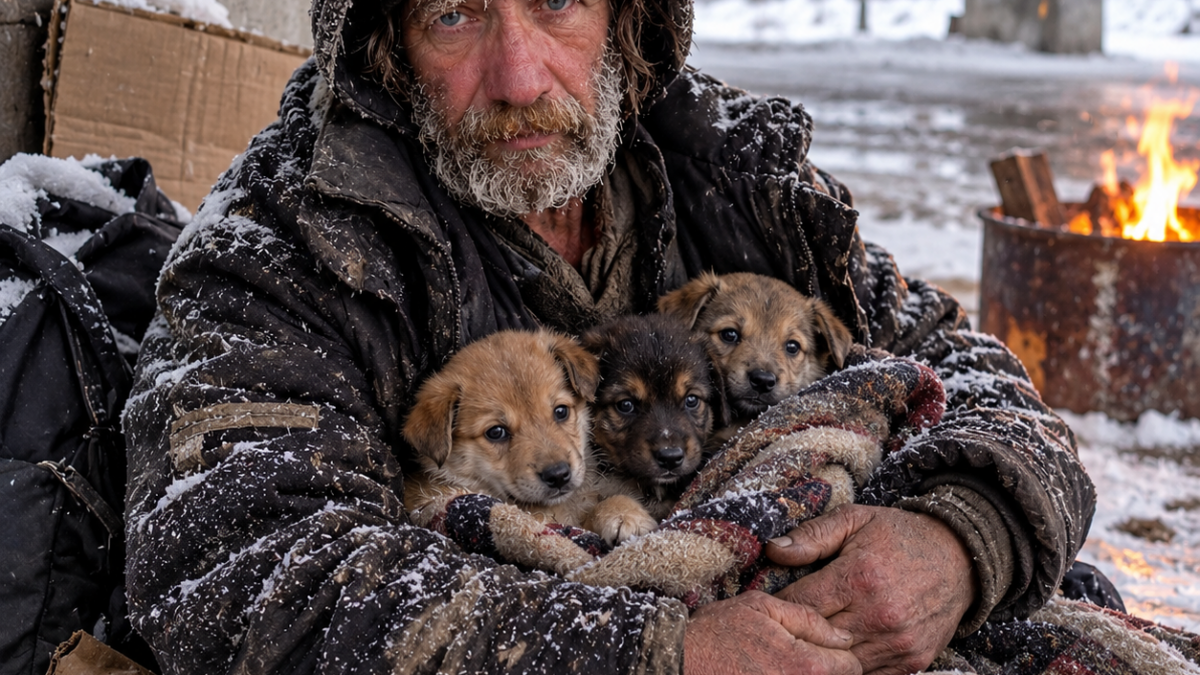
At thirty-three degrees below zero, I found a homeless man barely conscious beneath an abandoned railroad bridge, but when I tried to wrap him in a thermal blanket, he locked both hands over his coat and told me I wasn’t touching him until the three tiny lives hidden against his chest were taken care of first.
I had worked emergency medical calls for twenty years and had seen people protect children, spouses, strangers, and even the last possessions they owned while their own bodies were failing, but I had never watched a man whose fingers were already turning dangerously pale refuse warmth because he believed three abandoned puppies deserved it before he did.
And when we finally opened James’s coat and discovered what he had kept alive through the coldest night our county had experienced in decades, none of us knew those three trembling puppies would uncover another story, reunite a broken family, and force an entire town to decide what kindness was actually worth.
My name is Mara Collins.
I had been a paramedic in Middlsbury for nearly twenty years when the cold came.
People around here liked to exaggerate weather.
A little snow became a blizzard.
A summer storm became the storm of the century.
But that night no one needed to exaggerate anything.
The temperature dropped below thirty degrees under zero before midnight and continued falling.
By morning, the city looked abandoned.
Schools closed.
Businesses locked their doors.
Buses ran limited routes.
The police department, fire station, and emergency management office repeated the same warning on every local channel:
Stay inside unless absolutely necessary.
At temperatures that low, exposed skin could become dangerous quickly.
But warnings like that always carried one assumption.
That everybody had an inside.
Not everybody did.
At 10:38 the next morning, my partner Luis and I were finishing another exposure call when dispatch came through.
“Medic Four, possible hypothermia. Adult male beneath the old Vernton rail bridge. Caller reports conscious but unable to stand.”
Luis looked at me.
“Again.”
We had already transported three people from outdoor encampments that morning.
“Location?”
Dispatch gave us the coordinates.
I knew the bridge.
Old railroad line crossing the Vernton River.
Concrete supports.
A walking trail below.
Wind usually came hard off the water.
“Let’s go.”
The ambulance heater was running full blast.
Even inside, I could feel cold seeping through the door seals.
Luis drove.
I checked our warming supplies.
Thermal blankets.
Chemical heat packs.
Warm IV fluids.
Oxygen.
Nothing unusual.
Another cold-weather call.
That was what I thought.
Eight minutes later, a woman stood near the trail entrance waving frantically.
We stopped.
She ran toward us.
“I’m Rachel. I called.”
“Where is he?”
“Under the bridge.”
“How long has he been there?”
“I don’t know. I walk this trail most mornings when the weather’s decent. Nobody’s supposed to be out here today, but my dog needed exercise. I saw a cart.”
She pointed.
“He tried to stand when I called to him, but he couldn’t.”
Luis grabbed the stretcher.
I took the medical bag.
The wind hit us the moment we left the ambulance.
Even through gloves, scarf, and heavy coat, the cold felt sharp.
Rachel led us down the trail.
Then I saw the cart.
An old folding handcart leaned against one of the bridge supports.
Two plastic bags were tied to it.
Beside the cart sat a man.
His back was against the concrete.
Knees drawn toward his chest.
A gray knit cap covered most of his head.
His beard was rimmed with frost.
The jacket he wore was thick enough for an ordinary winter day.
Not this one.
“Sir?”
His eyes opened.
Slowly.
“My name is Mara. We’re paramedics.”
He nodded once.
“What’s your name?”
“James.”
His voice was rough.
“James, how long have you been out here?”
He didn’t answer.
Luis knelt beside me.
“I’m going to check your pulse.”
James pulled one arm closer to his chest.
“No.”
“James, we need to look at you.”
“I’m okay.”
Nobody who is okay says that while sitting beneath a bridge at thirty-three below.
“Can you stand?”
He tried.
His legs barely moved.
“All right,” I said. “We’re getting you inside the ambulance.”
“No.”
“James.”
He gripped the front of his coat.
“Not yet.”
I thought confusion had started.
Severe cold can alter judgment.
I kept my voice calm.
“What’s wrong?”
“Them.”
“What?”
“Them first.”
I looked at Luis.
Luis looked at me.
“What do you mean?”
James moved one hand toward his zipper.
His fingers were so stiff he couldn’t manage it.
I helped.
The moment the coat opened, I froze.
Three tiny heads were pressed against his chest.
Puppies.
One almost black.
One brown.
One with a white stripe down her face.
They were buried between James’s shirt and the lining of his coat.
All three were trembling weakly.
For several seconds, none of us spoke.
Then James looked at me.
“Still breathing.”
His voice was barely there.
I moved immediately.
“How long have they been inside your coat?”
“Most of night.”
“Where did you find them?”
He pointed toward a cardboard box shoved deeper beneath the bridge.
I turned.
That was when I saw the mother.
Thin.
Still.
Curled beside the box.
I understood without touching her.
James looked away.
“She didn’t make it.”
Luis exhaled slowly.
“James, we need to help you now.”
“The pups first.”
“We’re helping everybody.”
“Promise?”
“I promise.”
He watched me carefully.
Like I had just entered into a contract.
I called dispatch and requested animal control meet us at the hospital.
Luis opened an insulated carrier we kept for small emergency transports.
We wrapped the three puppies together in warmed blankets.
James followed every movement.
“Easy with the brown one.”
“I’ve got him.”
“He’s the smallest.”
“I see.”
“He gets cold faster.”
“I know.”
“Don’t separate them.”
“We won’t.”
Only after all three were inside the carrier did James let us touch him.
His body was frighteningly cold.
We couldn’t move quickly.
Aggressive movement and sudden rewarming can create complications in severe exposure.
We lifted him onto the stretcher.
James twisted his head toward the carrier.
“Where are they going?”
“With us.”
“Same ambulance?”
“For now.”
His eyes closed.
Then opened again.
“Don’t leave them.”
“We won’t.”
That was when he finally stopped resisting.
The ambulance doors shut.
Luis started toward Middlsbury Regional.
I worked on James.
His pulse was slow.
Speech delayed.
Hands pale.
His feet were worse.
But he remained conscious.
Every thirty seconds, he asked about the puppies.
“They okay?”
“They’re breathing.”
“Brown one?”
“Still breathing.”
“Girl with stripe?”
“Still breathing.”
“Black one?”
“Still breathing.”
Eventually I said:
“James, I need you to focus on yourself.”
He smiled faintly.
“Been bad at that a long time.”
Then his eyes drifted closed.
I touched his shoulder.
“James.”
Nothing.
“James.”
His eyes opened again.
“Stay with me.”
He looked at the carrier.
Then at me.
And whispered:
“Tell them I didn’t leave them.”
At the time, I thought he was delirious.
Later, I understood exactly why those words mattered.
PART 2
The emergency department was ready when we arrived.
James went one direction.
The puppies went another.
Animal control officer Denise Parker met us beside the ambulance bay.
She wore a heavy county coat and carried a transport crate.
“Three puppies?”
“Inside.”
“Mother?”
“Still under the bridge. We need recovery.”
“I’ll handle it.”
I caught her arm.
“Call me.”
Denise raised an eyebrow.
“You know that’s not usually how this works.”
“Today it is.”
She looked at my face.
Then nodded.
“I’ll call.”
James’s treatment began immediately.
The emergency physician, Dr. Singh, checked his core temperature and ordered controlled warming.
His fingers were badly affected.
His feet too.
He was dehydrated.
Exhausted.
Blood pressure unstable.
But alive.
That’s the clinical summary.
It doesn’t capture what I remember.
I remember James waking every few minutes.
I remember the same question.
“Puppies?”
I remember nurses answering him even when he drifted off before hearing the response.
I remember him trying to sit up once because nobody had told him whether the brown puppy was still breathing.
I remember having to place a hand on his shoulder.
“James. They’re at Green Valley Veterinary Hospital.”
“All?”
“All three.”
“Alive?”
“Yes.”
Only then did he lie back.
Two hours later, Denise called.
I stepped into the ambulance bay.
“Tell me.”
“All three made it through initial warming.”
My knees almost weakened.
“Condition?”
“Serious. But responding.”
“The brown one?”
“Still the weakest.”
“What about the mother?”
“We recovered her. Vet has her.”
“Chip?”
“They’ll scan.”
“Cause?”
“Exposure likely, but vet will document.”
I looked through the glass doors toward James’s room.
“He needs to hear this.”
“Tell him.”
I went back inside.
James was awake.
“Good news.”
He looked at me.
“All three survived the first few hours.”
His eyes closed.
A tear ran toward his ear.
He didn’t wipe it.
“Good.”
“The vet says the smallest one is still fragile.”
“But alive.”
“Yes.”
“That’s enough.”
I pulled a chair beside his bed.
“James, what happened beneath that bridge?”
He stared at the ceiling.
“Found them.”
“When?”
“Yesterday afternoon.”
“How?”
“Looking for somewhere out of wind.”
“Was that your regular sleeping place?”
“No.”
“Where do you usually stay?”
“Depends.”
“On what?”
“Who runs me off.”
He said it plainly.
Not angry.
Just factual.
James had been without stable housing for five years.
Some nights he found a bed in a shelter.
Other nights shelters were full.
Sometimes he refused them because of rules about belongings.
Sometimes he slept in a church basement.
Sometimes behind a warehouse.
Sometimes nowhere anyone would call a place.
The rail bridge was desperation.
“What did you see when you got there?”
“Box.”
“You heard them?”
“Yeah.”
“Puppies?”
“They were crying.”
“And Rosie?”
I didn’t know her name yet.
James called her “the mama.”
“She was outside the box.”
“Alive?”
He looked down.
“Barely.”
“You tried to help?”
“I put my sleeping bag around her and pups.”
“Did she respond?”
“A little.”
His jaw tightened.
“She was too far gone.”
“Then what?”
“Wind got worse.”
“You couldn’t leave.”
He looked at me as if the answer were obvious.
“They’d freeze.”
“James, you almost froze.”
“But I didn’t.”
“That is not a medical argument.”
He smiled.
“Still true.”
I wanted to be angry.
It would have been easier.
Instead I asked:
“Did you have food?”
“No.”
“Water?”
“Melted snow.”
“Phone?”
He laughed once.
“No.”
“Could you have walked to the road?”
“Tried.”
“And?”
“Legs stopped working.”
He looked toward his bandaged hands.
“So I put the pups in my coat.”
“All night?”
“Yeah.”
“Did you sleep?”
“No.”
“Why not?”
“Kept checking.”
“Checking what?”
“Breathing.”
He demonstrated with his thumb.
“I’d touch their sides.”
“Every few minutes?”
“Felt like it.”
“James.”
He looked at me.
“You understand you could have died.”
He nodded.
“And?”
He stared through the hospital window.
“Maybe.”
“Maybe?”
He shrugged weakly.
“Nobody was waiting for me.”
That sentence hit harder than the cold.
I did not answer immediately.
Then I said:
“Maybe you don’t know that.”
He didn’t respond.
The next morning, Green Valley called.
The puppies were warmer.
Hydration improving.
The black male was strongest.
The white-striped female followed.
The brown male remained fragile but had begun nursing formula.
I told James.
He smiled for the first time.
“Brown one’s stubborn.”
“How do you know?”
“Still here.”
Fair.
By afternoon, the story had begun leaking beyond hospital walls.
A nurse told her husband.
Her husband worked at a hardware store.
Somebody knew Rachel, who had called 911.
Rachel posted online.
Nothing malicious.
Just emotion.
She wrote:
I found a man under the Vernton bridge today. He could barely move from the cold, but he refused to let the ambulance take him until three puppies inside his coat were safe.
The post exploded.
By evening, local reporters called the hospital.
By morning, regional outlets.
Then national pages.
James hated it immediately.
A nurse showed him a headline.
HOMELESS HERO SAVES 3 PUPPIES IN HISTORIC FREEZE
James frowned.
“Why’d they put homeless first?”
I didn’t know what to say.
“They’re describing the situation.”
“Could’ve said man.”
“Yes.”
“They know my name?”
“Some do.”
He handed the phone back.
“I don’t want interviews.”
“Nobody can force you.”
“They offering money?”
“Probably.”
“No.”
“James.”
“No.”
“Why?”
He looked at me.
“Because they’re paying for a story, not me.”
“What if the story helps you?”
“Then what happens after story stops being interesting?”
I didn’t answer.
He had a point.
The puppies continued improving.
On day three, Dr. Hall from Green Valley called with another update.
“We scanned the mother.”
“Chip?”
“Yes.”
“Registered?”
“Yes.”
“Name?”
“Rosie.”
I wrote it down.
“Owner?”
“Wade Mercer.”
The last name made me pause.
Not related to me.
Common enough locally.
“Address?”
She gave it.
Six miles from the bridge.
“Contacted?”
“Yes.”
“And?”
“He says Rosie ran away about a month ago.”
“What about the puppies?”
“Says he didn’t know she was pregnant.”
“Did he ask about them?”
“No.”
“Did he ask about Rosie?”
“Not really.”
“What do you mean?”
“He asked if there were fees.”
I closed my eyes.
“Fees for what?”
“Claiming remains or puppies.”
“Seriously?”
“Yes.”
“What did he decide?”
“He doesn’t want either.”
Something cold moved through me that had nothing to do with weather.
“Send everything to Denise.”
“Already did.”
I went to James.
“We found Rosie’s registered owner.”
He sat up.
“Good.”
“Maybe.”
“What’d he say?”
“Claims she ran away.”
James stared at me.
“You believe him?”
“I don’t know yet.”
“Did he ask about pups?”
“No.”
James looked away.
“Then I know.”
I did not correct him.
The next morning, Denise called before sunrise.
“Meet me at the bridge.”
“Why?”
“Railroad maintenance has cameras.”
I was dressed in seven minutes.
The temperature had risen but remained brutal.
At the bridge, Denise stood with a county investigator and railroad employee.
A small camera was mounted high near a service entrance.
“Coverage?” I asked.
“Thirty-day archive.”
“Rosie was allegedly gone a month.”
“Exactly.”
The railroad company provided the footage by afternoon.
We watched it in a county office.
Time stamp:
1:42 a.m.
Two nights before James found them.
A dark pickup drove slowly down the service road.
Stopped beneath the bridge.
A man stepped out.
He opened the tailgate.
Lifted a cardboard box.
Placed it near the concrete support.
My hands tightened.
Then he opened the passenger door.
Rosie jumped down.
She wagged her tail.
The man said something we couldn’t hear.
Rosie followed him toward the truck.
He pushed her away.
Not hard.
Enough.
Then he entered the truck.
Rosie went to the driver’s door.
Truck moved.
Rosie ran after it.
Ten feet.
Twenty.
Stopped.
Watched.
Then turned.
Walked back toward the box.
Toward her puppies.
Nobody in the room spoke.
The investigator froze the truck.
Partial plate.
Vehicle style.
Color.
Denise checked registration.
Wade Mercer owned a dark green Ford F-150 matching the footage.
I felt sick.
“What happens now?”
“Interview.”
“Today?”
“Yes.”
I wanted to go.
They wouldn’t let me.
Fair.
I wasn’t part of the investigation.
Three hours later, Denise called.
“He admitted it.”
I leaned against the wall.
“Everything?”
“After seeing footage.”
“Why?”
“Landlord didn’t want puppies. Rosie was barking after giving birth. He was tired of dealing with it.”
“And the weather?”
“He says he didn’t realize it would get that cold.”
“Emergency alerts were everywhere.”
“I know.”
“Why not bring them to animal control?”
“Surrender fee.”
I stared at the floor.
“How much?”
“Forty dollars.”
Forty dollars.
James had spent a night beneath a bridge at temperatures that could have killed him because another man did not want to deal with forty dollars and a form.
I closed my eyes.
“What did Wade think would happen?”
“He said somebody would find them.”
“At one in the morning?”
“That’s what he says.”
“During an emergency weather warning?”
“Yes.”
“Did he go back?”
“No.”
I remembered the footage.
Rosie running after the truck.
Then turning back.
“Tell me when charges are filed.”
“I will.”
I told James myself.
He was eating soup when I entered.
“Rosie’s owner didn’t lose her.”
The spoon stopped.
“What?”
“He brought her there.”
James looked at me.
“With the pups?”
“Yes.”
“What time?”
“Middle of the night.”
“Knowing cold was coming?”
“Yes.”
James placed the spoon down carefully.
I expected anger.
He looked devastated.
“She went back to them.”
“What?”
“Rosie.”
He stared at the blanket.
“Bet she chased him first.”
I said nothing.
Then:
“She went back.”
“Yes.”
James covered his face.
I sat beside him.
“She stayed until she couldn’t.”
His shoulders shook once.
Then again.
“I should’ve got there earlier.”
“No.”
“If I’d come one day—”
“No.”
“Mara—”
“Rosie’s death belongs to the person who left her there.”
He looked at me.
“Not you.”
He stared for a long moment.
Then asked:
“Will the man get pups back?”
“No.”
“You sure?”
“Yes.”
He relaxed.
“Good.”
The legal process began quietly.
Charges were filed.
Wade’s name became public.
Then the internet transformed the story into a morality play.
One man with a home abandoned four animals.
One man without a home gave up his own warmth for three of them.
People loved the contrast.
I understood why.
But I also watched James become increasingly uncomfortable.
A television producer called him “the homeless angel.”
He hung up.
A radio station wanted to give him an award.
He refused.
A local church wanted him on stage Sunday.
No.
A national animal organization offered to fly him to New York after discharge.
Absolutely not.
“Why do you hate compliments?” I asked.
“I don’t.”
“Evidence says otherwise.”
James looked at me.
“You know what they don’t put in headlines?”
“What?”
“I drank away ten years of my life.”
I said nothing.
“I lost my job.”
Pause.
“Lost my house.”
Another pause.
“Pushed my daughter away.”
He rubbed his bandaged fingers.
“I ain’t some saint.”
“Nobody asked you to be.”
“Headlines do.”
That was when James told me his life before the bridge.
He had worked twenty-two years at a paper plant.
Maintenance.
Good with machinery.
Married to a woman named Carol.
One daughter, Emily.
A small house.
Old pickup.
Dog once, years earlier.
“Dog?”
“Border Collie.”
“Name?”
“Ranger.”
“What happened?”
“Old age.”
He smiled faintly.
“Best creature I ever knew.”
Then Carol got cancer.
Two years of appointments.
Treatments.
Bills.
James missed shifts.
He drank more.
Carol died.
James’s drinking became worse.
Eventually the plant fired him.
Mortgage fell behind.
House was lost.
Emily tried to help.
“I lived with her six months.”
“What happened?”
“I was terrible.”
“In what way?”
“Angry. Drunk. Ashamed.”
He looked toward the window.
“She had a little boy.”
“Your grandson?”
“Yeah.”
“You know him?”
“Knew him when he was three.”
“How old now?”
“Nine.”
I felt something twist inside me.
“Where does Emily live?”
“Colorado.”
“Do you speak?”
“No.”
“How long?”
“Three years.”
“Do you have her number?”
James didn’t answer.
“James.”
“Memorized.”
Of course.
People don’t memorize numbers they have forgotten.
“Call her.”
“No.”
“Why?”
“She has a life.”
“So?”
“I’m not walking back into it because strangers suddenly think I’m a hero.”
“You’re not.”
He gave me a look.
“Bad wording.”
“I mean you’re not calling because of publicity.”
“Then why?”
“Because you almost died.”
He looked away.
“Maybe she deserves to know.”
“She deserved a better father.”
“Both can be true.”
He went silent.
I didn’t push again.
Two days later, James asked for my phone.
“I changed my mind.”
I handed it over.
He dialed from memory.
I started toward the door.
“Stay.”
I stopped.
Four rings.
“Hello?”
Female voice.
James didn’t speak.
“Hello?”
His mouth opened.
Nothing.
Then:
“Em.”
Silence.
A long one.
“Dad?”
His face changed.
The hardest men can become children in one syllable.
“Yeah.”
“What happened?”
“I’m okay.”
“Where are you?”
“Hospital.”
“What?”
“I’m okay.”
“Why are you in a hospital?”
He looked at me helplessly.
I shrugged.
Tell truth.
“Cold.”
Another pause.
Then Emily said:
“Was that you?”
James frowned.
“What?”
“The puppies.”
He closed his eyes.
“Oh Lord.”
“I saw a photo.”
“Yeah.”
“That’s you?”
“Yeah.”
She started crying.
“So did he.
Then Emily said:
“Of course it’s you.”
James covered his mouth.
Later he told me those four words hurt more than anything.
Not because they were cruel.
Because they reminded him Emily still knew the man he had once been.
Before addiction.
Before shame.
Before streets.
“Can I come?” she asked.
“You don’t have to.”
“I asked if I can.”
James looked at me.
“Yeah.”
Emily arrived two days later.
I wasn’t in the room for their first meeting.
I didn’t belong there.
But I saw her afterward.
Early forties.
Same gray eyes as James.
She came into the hallway crying and laughing at once.
“You Mara?”
“Yes.”
She hugged me before I could react.
“Thank you.”
“For what?”
“For calling him stubborn enough that he finally called me.”
“I did not—”
She pulled back.
“He told me.”
James had apparently exaggerated.
Naturally.
Emily stayed a week.
Their reconciliation was not magical.
There were apologies.
Arguments.
Silences.
Questions James didn’t want.
Questions Emily needed answered.
Why didn’t you call?
Why didn’t you go to treatment?
Why did you choose alcohol over us?
Why did you let me think you were dead some nights?
No puppy story could erase that.
And Emily did not let it.
That was healthy.
The first evening I visited, I heard her say:
“I love you. That does not mean we’re pretending.”
James answered:
“I know.”
“Do you?”
“I’m trying.”
That became their foundation.
Trying.
Meanwhile, the puppies improved enough for a foster placement.
Green Valley arranged an experienced foster family named the Harrisons.
They took all three together.
James named them before they left.
Black male:
Bear.
White-striped female:
Lucy.
Brown male:
Sam.
“Why Sam?” I asked.
“My younger brother.”
“Where is he?”
“Died when we were teenagers.”
“What happened?”
James looked at me.
“River.”
I didn’t ask more.
Some names carry stories people open only when ready.
The Harrisons sent photos every day.
Bear discovering a shoe.
Lucy screaming for food.
Sam asleep in impossible positions.
James learned to use a smartphone.
His first selfie was mostly ceiling.
His second was his thumb.
His third somehow captured one eye.
Emily laughed until she cried.
“Dad, you have to look at the screen.”
“I am.”
“No, you’re looking at the phone like it’s an appliance.”
“It is.”
“Not one you fix.”
“That’s the problem.”
By then, strangers had raised more than seventy thousand dollars for James.
He wanted none of it.
“Shut it down.”
The fundraiser organizer came to the hospital.
A schoolteacher named Ben Wallace.
He had started it after seeing Rachel’s post.
“I didn’t expect this much,” Ben admitted.
James stared at the total.
“People are crazy.”
Ben smiled.
“Maybe kind.”
“Same difference sometimes.”
James agreed to accept help only after a hospital social worker explained the money could be structured.
Not handed over as a giant check.
Housing deposits.
Medical bills.
Identification.
Transportation.
Work clothing.
Treatment support.
Anything leftover could support cold-weather services and animal care.
“Can pups get some?”
“Yes.”
“Rosie too?”
The vet bills associated with her recovery and documentation were already covered, but James wanted a portion of the fund to support animals in emergencies.
“Then okay.”
That decision became another viral story.
James hated that too.
“Every time I do something normal, somebody writes article.”
I laughed.
“Normal?”
“Yeah.”
“You stayed under a bridge all night with three puppies inside your coat.”
“That part maybe less normal.”
The city housing team found James a transitional apartment.
One bedroom.
Small kitchen.
Second-floor unit.
Warm.
When he first walked inside, he didn’t smile.
He stood near the doorway.
Emily carried one of his plastic bags.
The social worker carried another.
That was everything he owned.
Two bags.
They looked tiny inside an empty apartment.
“You don’t like it?” Emily asked.
James shook his head.
“It’s fine.”
“Then what?”
He touched the wall.
“Feels temporary.”
“Lease is six months minimum.”
“Everything’s temporary.”
Emily’s face tightened.
Then softened.
“Stay long enough to make that annoying.”
James laughed.
Good answer.
He didn’t unpack the bags for three days.
Kept them tied beside the door.
A habit from shelters.
Be ready to move.
Eventually Emily opened one.
“What are you doing?”
“Unpacking.”
“No.”
“Why?”
“I know where things are.”
“Your socks should not live in a grocery bag.”
“They’ve been fine.”
She ignored him.
By the end of the afternoon, James had clothes in drawers.
A toothbrush in the bathroom.
A photograph of Carol and Emily on the kitchen shelf.
The apartment began becoming his.
The puppies visited every Sunday.
Bear explored everything.
Lucy stole paper towels.
Sam followed James.
Always.
Room to room.
If James sat, Sam sat.
If James stood, Sam stood.
If he disappeared into the bathroom, Sam waited outside.
“That dog’s got problems,” James said.
Emily smiled.
“Interesting coming from you.”
Sam’s bond with James deepened.
Everyone saw it.
Except James pretended not to.
When the puppies reached adoption age, applications poured in.
Bear received twelve.
Lucy nine.
Sam seventeen.
The Harrisons reviewed them with the rescue.
James didn’t apply.
I asked why.
“Not ready.”
“For what?”
“Dog.”
“You’re with him every weekend.”
“Different.”
“How?”
“He goes back.”
“That’s the point.”
James looked at me.
“You think I should adopt him?”
“Do you want to?”
“Doesn’t matter.”
“Of course it matters.”
“Wanting something ain’t same as being good for it.”
That sentence told me exactly what was happening.
James didn’t believe he deserved Sam.
Emily saw it too.
One evening, she put Sam in James’s lap.
“Dad.”
“What?”
“Stop punishing yourself using the dog.”
He looked stunned.
“I’m not.”
“You are.”
“Sam deserves stability.”
“You have housing.”
“For now.”
“Job interview Monday.”
“Maybe.”
“Recovery meetings.”
He frowned.
“Why you listing my life like a résumé?”
“Because you keep describing yourself like you are still under the bridge.”
The room went quiet.
Emily continued.
“You aren’t.”
James looked at Sam.
Sam licked his chin.
“He’s disgusting.”
“Then don’t adopt him.”
James smiled.
“You trying reverse psychology?”
“No. I’m tired.”
He submitted the application the next day.
Green Valley required the same process as anyone else.
Home check.
Financial plan.
Veterinary references.
Landlord approval.
Backup care.
James was offended.
“I saved him.”
Dr. Hall stared at him.
“And?”
“Feels like that should count.”
“It counts emotionally.”
“What’s that worth?”
“Nothing on this form.”
James laughed.
He passed everything.
On adoption day, Dr. Hall handed him the papers.
“You understand this is a long-term commitment?”
James looked at her.
She smiled.
“Had to ask.”
He signed.
Sam Carter.
James stared at the name on the collar Emily bought.
Then cried.
“Allergies,” he said.
“Inside a clinic?”
“Strong chemicals.”
“Sure.”
Bear went to a family with two teenage boys.
Lucy went home with Dr. Hall.
She had insisted she would not adopt.
Nobody believed her.
The siblings saw one another often.
James started work at Green Valley as a maintenance assistant.
At first twenty hours.
Then twenty-five.
Eventually thirty-two.
He fixed doors.
Shelves.
A dryer.
A broken kennel latch.
One morning, Dr. Hall found him rebuilding a cabinet nobody had asked him to touch.
“What are you doing?”
“Thing’s crooked.”
“It’s been crooked ten years.”
“Exactly.”
She stopped arguing.
James was good at the work.
More importantly, he showed up.
Every shift.
Early.
That became one of the things he was proudest of.
Not the viral rescue.
Attendance.
“One year,” he told me.
“What?”
“Haven’t missed one shift.”
“Congratulations.”
“Used to miss everything.”
He looked down.
“Feels good.”
The court case against Wade moved forward.
His defense initially claimed the animals had not been intentionally endangered.
He had believed someone would find them.
The weather worsened beyond expectations.
Rosie could have walked away.
The puppies were in a box.
Legal arguments.
Technical language.
Then Wade’s attorney made the mistake that changed public opinion.
During a local interview, he suggested the story had become distorted because of James’s popularity.
He said:
“There’s more to this than the viral narrative of an unhoused man saving puppies.”
Technically, he was right.
There was more.
But people heard something else.
That maybe James was unreliable.
That maybe a homeless man was being believed too easily because the story felt good.
Then rumors appeared online.
James had placed the puppies there.
James wanted donations.
James had known about the animals earlier.
I was furious.
James wasn’t.
“Internet says stuff.”
“This is different.”
“Why?”
“Because it’s about your integrity.”
He shrugged.
“People believed worse about me before.”
“What?”
“That I was drunk because I was homeless.”
“Were you?”
“Sometimes.”
I gave him a look.
He smiled.
“See? Complicated.”
The county prosecutor refused to engage publicly.
Instead, at the next hearing, they introduced the entire railroad recording.
Not a thirty-second clip.
Hours.
Wade’s truck arriving.
Box removed.
Rosie left.
Truck gone.
Then darkness.
Rosie pacing.
Cold worsening.
Hours later, James entering alone with his cart.
He didn’t carry a box.
Didn’t carry an animal.
He saw them.
Approached.
Stayed.
By dawn, he was still there.
Then Rachel arrived.
Then us.
The full timeline destroyed the rumor.
Wade eventually accepted a plea agreement.
Probation.
Fines.
Restitution toward veterinary expenses.
Temporary restrictions on animal ownership.
Required educational programming.
Community service.
No dramatic prison sentence.
No theatrical ending.
People online called it too lenient.
James disagreed.
“What would you want?” I asked.
“Can’t answer.”
“Why?”
“Because Rosie is dead either way.”
“You don’t think punishment matters?”
“Course it matters.”
He scratched Sam’s chest.
“But punishment ain’t same as repair.”
“Then what’s repair?”
He looked at me.
“Make it easier for somebody to do right next time.”
That sentence became the beginning of the Rosie Winter Fund.
The fundraiser had money left after James’s housing, medical needs, and the puppies’ care.
James refused to let it become a personal nest egg.
He met with lawyers, city officials, animal rescue groups, and shelters.
The first proposal was simple.
Emergency pet boarding during cold weather.
Then it grew.
Pet food assistance.
Transportation.
Temporary foster placement.
Help with surrender fees.
Basic veterinary assistance.
And eventually the biggest change:
Pet-inclusive emergency warming spaces.
That idea came from James.
“People without housing sometimes stay outside because shelters won’t take dogs.”
City officials knew.
But knowing and fixing are different things.
Insurance concerns.
Sanitation.
Staffing.
Animal behavior.
Liability.
Meetings dragged for months.
James nearly quit.
“People can make anything complicated.”
“Government specialty.”
“Dog needs floor and water.”
“Sometimes dogs bite.”
“So do people.”
“Not helping.”
He appeared before city council.
I sat behind him with Emily.
James wore a button-down shirt.
No tie.
He hated ties.
He gripped the podium.
“My name is James Carter.”
Pause.
“I lived outside five years.”
Another pause.
“I know what happens when it’s freezing and someone tells you the bed is inside but your dog can’t come.”
A councilwoman leaned forward.
James continued.
“Maybe you think dog isn’t worth a life.”
He shook his head.
“To somebody out there alone, that dog may be the reason they still wake up.”
The room became quiet.
“You tell them come inside but leave dog outside, they hear something different.”
He looked at the council.
“They hear: leave your family.”
No one interrupted.
“I stayed under that bridge because three puppies couldn’t save themselves.”
He paused.
“If Sam had been mine then and shelter said I couldn’t bring him in, I’d have stayed outside.”
Sam was waiting with Emily at the back of the room.
James looked toward him.
“You don’t have to understand that choice.”
Then back to the council.
“You just have to decide whether you want people alive.”
Funding passed.
Not instantly.
Not unanimously.
But enough.
The first winter, fifteen people used the pet-inclusive warming center.
Seven dogs.
Three cats.
One rabbit.
A parakeet.
James loved the parakeet story.
“Bird had better coat than half the people.”
The second winter, thirty-two people.
The third, more.
No one pretended the program solved homelessness.
It did something specific.
It removed one barrier to safety.
That mattered.
James and Emily kept rebuilding.
Slowly.
Emily’s son, Noah, was twelve when he visited Texas for the first time.
James had not seen him since he was three.
He cleaned his apartment for two days.
Then cleaned it again.
Sam followed him.
“Stop pacing,” I said.
“I’m not.”
“You’ve moved the same chair four times.”
“Bad spot.”
“It’s still in the same room.”
When Emily’s car arrived, James stood behind the curtain.
“Go outside.”
“No.”
“James.”
“I’ll let them come in.”
“Why?”
He looked terrified.
“What if kid don’t remember me?”
“He probably doesn’t.”
“Helpful.”
“But he can meet you.”
James breathed.
Then opened the door.
Noah stepped out.
Tall for twelve.
Baseball cap.
Backpack.
He looked at James.
James looked at him.
Then Sam ruined the emotional moment by escaping between James’s legs and running toward Noah.
Noah laughed.
“Is that Sam?”
James smiled.
“Yeah.”
Noah crouched.
Sam climbed all over him.
Within thirty seconds, the tension broke.
“Grandpa?”
James’s eyes filled.
“Yeah?”
“Mom says you make terrible pancakes.”
James looked at Emily.
“Betrayal.”
Emily smiled.
“Truth.”
That weekend changed him.
Not magically.
But something settled.
Family photographs appeared.
Noah and James fishing.
Emily asleep on the couch while Sam sat on her.
A messy pancake breakfast.
James began believing he might have a future that included more than repairing the past.
He stayed sober.
There were close calls.
A difficult anniversary of Carol’s death.
An old friend dying.
One night he called me.
“Want drink.”
“Where are you?”
“Home.”
“Sam?”
“Here.”
“Emily?”
“Colorado.”
“Meeting?”
“In forty minutes.”
“Go.”
“Don’t want.”
“Go anyway.”
Silence.
Then:
“You always this annoying?”
“Twenty years professionally trained.”
He went.
The next morning:
didn’t drink
I replied:
Good.
Then:
Sam stole sandwich
Better.
Life became ordinary.
James paid rent.
Complained about utilities.
Worked.
Went to meetings.
Walked Sam.
Visited Bear and Lucy.
Called Emily.
Argued with Emily.
Apologized.
Sometimes she apologized.
He became a grandfather again rather than a ghost in old photographs.
Wade completed his court requirements.
Years later, James received a letter.
Handwritten.
No return address.
James brought it to me without opening.
“You read.”
“No.”
“Why?”
“It’s yours.”
“Could be from Wade.”
“Then definitely yours.”
He opened it.
Read silently.
Then handed it over.
It said:
Mr. Carter, I don’t expect forgiveness. I have thought about that night repeatedly. I told myself I was leaving Rosie somewhere people would find her. The truth is I wanted the problem gone. I didn’t want to pay the fee, didn’t want to explain myself, didn’t want to admit I couldn’t handle the dogs. I convinced myself someone else would fix it. I know Rosie died because of my decision. I know you nearly died because you did what I should have done. I am sorry. — Wade Mercer
I looked at James.
“What do you think?”
He took the letter back.
“Late.”
“Yes.”
“But true.”
“Maybe.”
He folded it.
“You going to respond?”
“No.”
“Why?”
“What would I say?”
“I don’t know.”
He looked at Sam.
“Wade don’t need me to make him feel better.”
He put the letter in a drawer.
Not burned.
Not displayed.
Just stored.
That was enough.
By the fifth anniversary of the freeze, the Rosie Winter Fund had become permanent.
James’s name appeared nowhere on the official program materials.
His choice.
“They wanted to call a room after me.”
“That’s nice.”
“It’s horrifying.”
“Why?”
“I ain’t dead.”
Fair.
He insisted Rosie’s name remain.
“She stayed with her pups.”
That mattered to him.
At Green Valley, a framed photograph of Rosie hung near the staff entrance.
Not tragic.
The vet had managed to find an old microchip-registry photo supplied by the original breeder.
Rosie healthy.
Young.
Standing in grass.
James chose that one.
“Remember her alive.”
Another good decision.
Bear grew huge.
Lucy remained dramatic.
Sam grew lanky and gentle.
Every year the siblings had a birthday gathering.
They didn’t know their actual birthday, so Dr. Hall chose an estimated date.
Cake made for dogs.
Photographs.
Chaos.
Year one, they destroyed a picnic table decoration.
Year two, Bear jumped into a kiddie pool.
Year three, Lucy stole an entire tray of treats.
Year four, Sam refused to wear a hat.
James became the unofficial photographer despite being terrible.
Half his photos were blurry.
Emily bought him a better phone.
Didn’t help.
“Equipment issue,” James insisted.
“Operator issue,” Emily said.
At ten, Bear developed a tumor.
His family pursued treatment.
For a while, it worked.
Then it didn’t.
They called James before the final appointment.
He drove two hours.
Bear lay on a blanket.
Still recognized him.
Still wagged.
James sat beside him.
“Big guy.”
Bear placed his head on James’s knee.
Later James told me:
“First one.”
“What?”
“First pup to leave.”
I understood.
The three fragile lives from his coat had always felt like one story.
Now time was separating them.
Lucy lived until twelve.
Heart disease.
Dr. Hall was with her.
James came.
Sam remained.
At thirteen, he became gray around the muzzle.
At fourteen, arthritis.
Kidney decline.
Slower walks.
James rearranged his entire duplex.
Rugs.
Ramps.
Water stations.
Medication schedule taped to fridge.
He became absurdly careful.
“This pill seven.”
“Yes.”
“Food seven-fifteen.”
“Yes.”
“Other pill eight.”
“James.”
“What?”
“You’ve told me four times.”
“Important.”
“I know.”
Sam still followed him everywhere.
Slower.
Bathroom.
Kitchen.
Porch.
At fourteen, James’s own knees weren’t much better.
They became two old men walking slowly around the block.
Neighbors knew them.
Children waved.
James complained.
“Everybody knows my business.”
“You became community figure.”
“Terrible mistake.”
One morning, Sam refused breakfast.
James called Dr. Hall.
By afternoon, tests confirmed significant progression.
Kidneys failing.
Heart weaker.
Pain increasing.
“We can manage some symptoms,” Dr. Hall said.
“For how long?”
“We don’t know.”
James looked at Sam.
“I don’t want him hurting.”
“We’ll watch quality of life.”
“Don’t sugarcoat.”
“I won’t.”
Three weeks later, Sam could not stand without help.
James called me.
“Come.”
I went.
Dr. Hall was already there.
Emily joined by video because she couldn’t get a flight fast enough.
Noah, now grown, appeared beside her on the screen.
Sam lay beneath the old blanket used when he was a puppy.
James’s hand rested on his chest.
“Remember this spot?” he asked me.
I nodded.
“First night, he fit here.”
He pointed to the center of his chest.
“All three fit.”
“Hard to imagine.”
“Bear took all room.”
I smiled.
“Of course.”
James looked down.
“I kept checking Sam breathing.”
“I remember.”
“Thought he’d stop.”
His voice broke.
“Now I’m checking again.”
I sat beside him.
Sam opened one eye.
James whispered:
“First night, I told him don’t die.”
He swallowed.
“Can’t say that now.”
“No.”
“Wouldn’t be fair.”
That was the hardest part.
James had spent years learning that staying was love.
Now he had to learn that letting go could be love too.
When the time came, Sam’s head rested against James’s chest.
Exactly where he had first survived.
James kept one hand there.
“I’m here.”
Sam’s breathing slowed.
“I’m here.”
Again.
Then stillness.
James didn’t move for a long time.
Finally he whispered:
“We kept each other warm.”
That was all.
No grand speech.
No philosophy.
Just truth.
Six months later, James adopted an eleven-year-old dog named Walter.
He claimed it was temporary.
Then foster.
Then “until someone better comes.”
Nobody believed him.
Walter remained.
When Walter died years later, James swore:
“No more.”
Two months afterward, a twelve-pound terrier named Peanut appeared.
Again:
Temporary.
Peanut still lives with him.
James is seventy now.
I retired from emergency medicine.
Luis moved to Florida.
Denise moved west.
Dr. Hall sold Green Valley but still volunteers.
Emily visits Texas every summer.
Noah brings his own children now.
James’s apartment turned into a small duplex years ago.
Photographs everywhere.
Carol.
Emily.
Noah.
Grandchildren.
Sam.
Bear.
Lucy.
Rosie.
One photograph from the hospital.
James with bandaged hands.
Three puppies on his chest.
I hate that photo.
He looks terrible.
He loves it.
On the twentieth anniversary of the freeze, the city proposed a plaque under the Vernton bridge.
James refused.
“Why there?”
“That’s where it happened.”
“That’s where bad part happened.”
“Where should it go?”
“Warming center.”
They listened.
The plaque went inside the pet-inclusive warming facility.
It read:
THE ROSIE WINTER PROGRAM
Created after one mother dog, three puppies, and one man reminded our community that survival should never depend on being left alone in the cold.
Beneath that:
No one should have to choose between safety and the living being who depends on them.
At the dedication, a reporter asked James whether he had forgiven Wade.
James laughed.
“Why everybody obsessed with forgiveness?”
The reporter looked surprised.
“I suppose because what he did affected your life.”
“It affected dogs.”
“Do you hate him?”
James thought about it.
“No.”
“Why not?”
“Too much work.”
People laughed.
Then James became serious.
“He made choice. Court handled what court could handle. He apologized later.”
“Was that enough?”
“No.”
“What would be enough?”
James looked toward the warming-center doors.
A man entered holding a Chihuahua beneath his coat.
James pointed.
“That.”
The reporter looked confused.
James explained.
“Next person doesn’t leave animal under bridge because they don’t know where to go. That’s enough for me.”
That was James’s revenge.
Not Wade losing everything.
Not humiliation.
Not suffering returned for suffering.
A system changed.
A door opened.
A fee disappeared.
A pet stayed with its person.
Another Rosie didn’t have to freeze beneath another bridge.
Years later, I asked James whether he ever thought about that night.
“Sometimes.”
“What part?”
“Not cold.”
“Really?”
“No.”
“Puppies?”
“Some.”
“What then?”
He looked at me.
“You.”
“Me?”
“You kept saying, ‘I’m here.'”
I didn’t remember.
Apparently in the ambulance, every time James drifted and woke, I told him:
“I’m here.”
Maybe I did.
Paramedics say things automatically.
Stay with me.
You’re okay.
I’m here.
Words meant to anchor somebody in the moment.
James remembered.
“Nobody said that to me in a long time.”
That sentence changed how I remembered the entire rescue.
For years, I told people James saved three puppies.
True.
Then the community helped save James.
Also true.
But perhaps what really happened was simpler.
Everybody stopped walking away at different moments.
Rosie didn’t walk away from her puppies.
James didn’t walk away from Rosie and the puppies.
Rachel didn’t walk past James.
We didn’t leave the puppies.
Green Valley didn’t give up on the brown one when he was weak.
Emily didn’t ignore the phone when her father finally called.
The city didn’t ignore the uncomfortable truth that some people stayed outdoors because their animals couldn’t enter shelters.
James didn’t walk away from sobriety when life became difficult.
He didn’t walk away from Sam when he got old.
And eventually James stopped walking away from himself.
That is the story.
Not hero versus villain.
Not poor man good, housed man bad.
Life is more complicated.
Wade made a terrible decision.
James had made terrible decisions too, years earlier.
The difference was what they did afterward.
Wade hid until evidence forced truth.
James faced truth until a life became possible again.
And eventually Wade faced his own truth too.
Late.
Incomplete.
But real.
People often ask whether I still remember the exact temperature.
Yes.
Thirty-three below.
But the number matters less now.
What I remember most is opening that coat.
Three tiny faces.
James watching me.
His voice weak.
“Them first.”
At the time, I thought he was choosing them over himself.
Now I don’t.
He was insisting none of them be treated as disposable.
Not puppies.
Not their mother.
Not even himself, though it took him longer to believe that last part.
If I could return to that bridge and speak to the James sitting against the concrete, I wouldn’t tell him he would become famous.
He’d hate that.
I wouldn’t tell him strangers would donate money.
He wouldn’t believe me.
I wouldn’t tell him he’d reconcile with Emily.
That might be too painful to imagine.
I wouldn’t tell him he’d work at a veterinary clinic.
Adopt Sam.
Become Grandpa James again.
Stand before city council.
Change winter shelter policy.
Hold an old Sam fourteen years later.
Adopt Walter.
Then Peanut.
I would say only:
“Keep breathing.”
Because the next part is worth seeing.
The story people remember began beneath a bridge.
But James’s life didn’t.
And more importantly, it didn’t end there.
The puppies were the beginning of his return.
Bear went to a family.
Lucy went home with Dr. Hall.
Sam stayed with James.
Emily got her father back slowly, imperfectly, honestly.
Hundreds of people later entered warmth with their animals because James understood something policymakers had overlooked.
And Rosie—who could not survive that first night—became the name on a program that prevented other animals from being left behind.
Sometimes people ask me whether that makes what happened to Rosie meaningful.
I always say no.
Suffering does not need to happen in order for good things to exist.
Rosie deserved to live.
She deserved a warm house.
Food.
Safety.
A human who didn’t decide she was inconvenient.
The good that came later does not justify what happened.
It answers it.
That’s different.
Wade made a choice that said:
Someone else will deal with this.
James made a choice that said:
Then I will.
The community eventually said:
So will we.
That is why the ending satisfies me.
Not because somebody was punished enough.
But because responsibility spread in the opposite direction.
One man abandoned four animals.
Years later, hundreds of people participated in a system designed to keep people and animals together.
One decision caused harm.
Thousands of later decisions created care.
That is how you make the bad choice smaller.
Not by pretending it never happened.
By surrounding it with better ones.
James still has the original coat.
I learned that recently.
I thought it had been thrown away.
It hangs inside a closet.
Old.
Damaged.
One zipper tooth missing.
“Why keep it?” I asked.
James shrugged.
“Warm coat.”
“It nearly froze with you inside it.”
“Still works.”
I touched the worn fabric.
“This is the coat?”
“Yep.”
“The puppies were in here?”
He pointed to the inner lining.
“Bear here.”
“Lucy?”
“Other side.”
“Sam?”
“Middle.”
We stood in silence.
Then Peanut ran into the room carrying a sock.
James sighed.
“Give me that.”
Peanut ran.
I laughed.
James chased him badly because his knees hurt.
Life.
Ordinary.
Ridiculous.
Warm.
Exactly what I wanted for him.
Years ago, beneath that bridge, James believed nobody was waiting for him.
He was wrong.
Emily was.
Even if she was angry.
Even if they hadn’t spoken.
Somewhere in Colorado, his daughter still knew the shape of his face well enough to recognize him in a blurry online photograph.
His grandson had questions.
A future job waited.
Sam waited without knowing his name yet.
A warming center did not exist, but someday people would walk through its doors because of him.
Peanut certainly wasn’t waiting.
Peanut probably wasn’t born.
But life was.
That is the part despair hides.
You cannot see the people, rooms, animals, and ordinary mornings that haven’t arrived yet.
James couldn’t.
Neither could I.
All I could see was a man beneath a bridge.
All he could see were three puppies.
So we worked with what was in front of us.
Sometimes that’s enough.
One breath.
One blanket.
One call.
One person saying:
I’m here.
Then another.
Then another.
Until an entire life is rebuilt from things small enough to fit inside a winter coat.
Years later, James told me there was one part of that first winter he had never described to anyone.
Not to Emily.
Not to Dr. Hall.
Not even to me.
We were sitting on his porch one evening when he finally mentioned it. Peanut was asleep beneath his chair, the sun had dropped behind the neighboring houses, and the heat of a Texas summer still clung to the wooden steps.
James had been quiet for several minutes when he suddenly said, “I heard Rosie crying.”
I turned toward him.
“What?”
“Under the bridge.”
He stared across the yard.
“Before she stopped moving.”
I didn’t interrupt.
James rubbed both hands together, the way he still did when the joints bothered him in cold weather.
“She kept trying to get closer to the puppies. Could barely stand, but every time one of them made noise, she moved.”
His voice became quieter.
“I had the sleeping bag around all four of them at first. I thought maybe she’d warm up.”
I remembered the scene.
The cardboard box.
The frozen concrete.
Rosie lying just outside it when we arrived.
“You never told me she was still conscious.”
“Didn’t see the point.”
“Why tell me now?”
James shrugged.
“Been thinking about her.”
He leaned back.
“She looked at me once.”
“What do you mean?”
“Just looked.”
He swallowed.
“And I told her I had them.”
My throat tightened.
“You told Rosie?”
“Yeah.”
“What exactly?”
James smiled sadly.
“Same thing you kept telling me.”
I already knew.
“I’m here.”
He nodded.
“She stopped trying to stand after that.”
Neither of us spoke for a while.
Peanut shifted beneath the chair.
Cars moved somewhere beyond the houses.
Ordinary life continued.
James looked toward the darkening sky.
“Maybe she understood. Maybe she didn’t.”
“It probably helped you.”
“Maybe.”
He looked down.
“But I like thinking she knew somebody had her babies.”
I understood.
There are things we believe not because they can be proven, but because the alternative serves no useful purpose.
James had carried Rosie with him just as surely as he had carried the puppies.
She had become the invisible fourth life in every photograph.
The one who did not get a second chapter.
That was why the fund carried her name.
That was why James refused every suggestion to rename it after himself.
“That dog did more than me,” he once said.
“She stayed with three babies after being left in the cold. I only showed up at the end.”
I disagreed.
But I stopped arguing.
A few months after that porch conversation, the city contacted James again.
They wanted him to participate in a winter outreach training program.
Not as a mascot.
Not for publicity.
They wanted him to speak directly to emergency personnel, shelter volunteers, police officers, and social workers about what it felt like to live outside during severe weather.
He said no.
Then Emily called him.
I was in his kitchen when the phone rang.
He put it on speaker.
“Dad, Mara says you turned down the city.”
James glared at me.
“You reporting on me now?”
“I mentioned it.”
“Traitor.”
Emily ignored us.
“Why’d you say no?”
“Don’t like speeches.”
“You gave one to city council.”
“One too many.”
“This isn’t about you being inspirational.”
“Good, because I ain’t.”
“It’s about what people miss.”
James stopped joking.
Emily continued.
“You always complain that agencies make rules without asking the people affected.”
“That’s true.”
“So they asked.”
James stared at the table.
“That ain’t fair.”
“What isn’t?”
“You using my own argument.”
“Learned from you.”
He attended.
The training room held nearly sixty people.
James stood in front of a projector with no notes.
His first sentence was:
“If you tell somebody outside to go to a shelter, make sure you’ve checked whether that shelter will actually take them.”
Several people started writing immediately.
James shook his head.
“Don’t write yet. Listen.”
The pens stopped.
He explained transportation.
Some warming centers were miles from encampments.
He explained identification requirements.
People living outside often lost IDs or had them stolen.
He explained bags.
“If everything you own is inside two grocery sacks, somebody telling you to leave the sacks outside isn’t a small request.”
Then pets.
That was where his voice changed.
“If there’s an animal, don’t assume the person will leave it.”
A police officer raised his hand.
“What if the shelter can’t safely accommodate the animal?”
“Then have another plan.”
“What if there isn’t one?”
James stared at him.
“Then that’s the problem you’re supposed to fix before it’s thirty below.”
Silence.
He wasn’t rude.
Just precise.
Another officer asked:
“Did you ever refuse shelter because of rules?”
“Yes.”
“Even knowing the weather was dangerous?”
“Yes.”
“Why?”
James leaned against the table.
“Because when you’ve lost enough things, the few things you still control get bigger.”
He looked around the room.
“My bags looked like trash to people. To me, they were clothes, photographs, my wife’s old Bible, paperwork I needed to replace an ID, and everything else I owned.”
Then he added:
“If Sam had been with me back then, nobody would’ve convinced me to leave him outside.”
The officer nodded slowly.
By the end, nobody was treating James like a viral rescue story.
They were treating him like what he had become.
A person with expertise.
That difference mattered to him.
Afterward, a young paramedic approached.
“I’ve told people to leave bags behind.”
James nodded.
“Probably made sense at the time.”
“I never thought about what might be inside.”
“Now you will.”
No shame.
No lecture.
Just change.
That was always James at his best.
He rarely asked people to feel worse.
He asked them to do better.
The Rosie Winter Program eventually expanded beyond emergency cold snaps.
A pet food pantry opened twice a week.
Local veterinary clinics donated limited appointments.
A boarding partnership gave people entering addiction treatment somewhere safe for their animals for up to thirty days.
That program almost failed during the first year.
Funding ran short.
The city considered cutting it.
James found out on a Thursday.
By Friday, he was angry.
By Monday, he was sitting before another committee.
“You’re going to spend how much on outreach posters?” he asked.
The finance director looked down at the budget.
“Approximately twenty-eight thousand.”
“And temporary animal boarding?”
“Seventeen.”
James leaned toward the microphone.
“So we can afford to print papers telling people to seek help but can’t afford the thing stopping some of them from seeking help.”
The finance director started explaining restricted funding categories.
James listened.
Then said:
“Fix categories.”
Several people laughed.
James didn’t.
“I’m serious.”
So was the woman sitting in the back row.
Her name was Helen Wu.
She owned three veterinary clinics and had quietly attended because one of her employees volunteered with the program.
After the meeting, she approached James.
“How much is the shortfall?”
He told her.
Helen covered it for one year.
Then helped establish a matching grant.
James found out later that people called him a gifted fundraiser.
He hated that description.
“I didn’t raise money.”
“You embarrassed them until money appeared.”
“Different skill.”
The boarding program survived.
During its third year, it took in a shepherd mix named Luna.
Her owner, Carlos, had lived in his car for six months after losing a construction job.
He wanted inpatient treatment for alcohol dependence but refused because Luna couldn’t come.
The boarding program took her.
Carlos entered treatment.
For twenty-eight days, Luna stayed with a foster family.
Carlos called every evening.
The day he finished treatment, James drove Luna to pick him up.
I went along.
Carlos came through the clinic doors carrying one duffel bag.
Luna saw him.
The leash nearly came out of James’s hand.
Carlos dropped to his knees.
Luna climbed into his chest.
Carlos laughed and cried at once.
James looked away.
I knew why.
That reunion was everything he had once feared he didn’t deserve.
Afterward, Carlos shook his hand.
“I would’ve stayed in my car.”
“I know.”
“No, I mean it. I wouldn’t have gone.”
“I know.”
Carlos looked at Luna.
“You saved us.”
James frowned.
“Program did.”
“You helped make program.”
“A lot of people did.”
Carlos smiled.
“You always argue with compliments?”
“Yes.”
“Okay.”
They became friends.
Not dramatic friendship.
Coffee.
Dog walks.
Recovery meetings.
Carlos eventually found steady work.
James helped him repair an old truck.
Carlos helped James replace porch boards.
Neither man liked discussing emotions unless dogs were involved.
Perfect arrangement.
One Saturday, I found them sitting in James’s yard while Sam, already elderly by then, slept between them.
Carlos said:
“Funny.”
“What?”
“My whole life changed because somebody had somewhere for my dog.”
James nodded.
“Mine changed because somebody didn’t.”
That line stayed with me.
Systems can be built from both failures and successes.
The bridge showed us what happened when there was no safe plan.
Carlos showed us what happened when there was one.
The county began tracking outcomes.
People who entered temporary boarding programs were significantly more likely to complete shelter intake, medical treatment, or rehabilitation placements when they knew their animals were safe.
James never cared about statistics.
Until one report showed that more than eighty percent of people reunited with pets after temporary boarding.
He read that part three times.
“Eighty percent?”
“Yes.”
“Actually got animals back?”
“Yes.”
“Not adopted out?”
“Not unless owners chose surrender.”
James sat back.
“Good.”
Why did that number matter so much?
Because James had spent years believing asking for help meant losing everything.
The program proved help could sometimes preserve what mattered.
Then there was the winter of Rachel Cole.
Not the Rachel who found James.
Another Rachel.
Twenty-nine.
Two children.
A Labrador named Scout.
Her husband had died suddenly.
Bills piled up.
She was evicted.
A family shelter had beds for Rachel and the children but couldn’t take Scout.
Without the Rosie program, Rachel planned to sleep in her minivan.
January.
Temperatures forecast below ten.
The boarding team took Scout for twelve days.
Rachel and her children entered shelter.
When Scout returned, the six-year-old boy hugged him and asked:
“You thought we left you?”
James was standing nearby.
He turned away immediately.
I followed.
“You okay?”
“Yeah.”
“No.”
He rubbed his eyes.
“Kid asked dog same thing I wondered about Emily.”
“What?”
“If she thought I left her.”
I said nothing.
James looked through the window where Rachel’s children were playing with Scout.
“I did.”
His voice was quiet.
“Not physically maybe. But I disappeared.”
He later called Emily.
I only know because she told me.
He said:
“I know I apologized before, but I need to say something different.”
“What?”
“I didn’t just lose myself. I left you carrying the loss.”
Emily cried.
Then answered:
“Yes.”
Not:
It’s okay.
Not:
Forget it.
Yes.
Because healing does not require pretending the wound wasn’t real.
James had finally learned that too.
Years later, when Sam’s health began failing, James struggled in a different way.
He had become excellent at helping strangers make difficult decisions about animals.
He became terrible at applying the same compassion to himself.
Sam was fourteen.
His hips hurt.
Kidneys weakening.
Some mornings he refused breakfast.
James kept notebooks.
How much Sam ate.
How far he walked.
How many times he woke at night.
One evening I found James sitting at the kitchen table surrounded by pages.
“What are you doing?”
“Tracking.”
“Tracking what?”
“Good days.”
My heart sank.
He had made columns.
Food.
Walking.
Pain.
Interest.
Sleep.
Tail wag.
“Dr. Hall tell you to do this?”
“Yeah.”
“And?”
James pointed.
“Still more good.”
I looked.
Barely.
“How are you?”
“That ain’t on sheet.”
“It should be.”
“No.”
He looked at Sam sleeping nearby.
“This isn’t about me.”
But it always is partly about us.
That’s why the decision is so hard.
The animal’s suffering and our fear of grief become tangled.
You have to separate them honestly.
Two weeks later, Sam fell outside.
James helped him stand.
Sam walked three steps.
Stopped.
Looked at him.
James called Dr. Hall.
He did not wait another week.
That was growth too.
The James under the bridge had fought desperately for life because the puppies still had life to fight for.
The older James learned that fighting forever is not always kindness.
When Sam’s final morning came, James cooked bacon.
Dr. Hall objected.
“Too much fat.”
James looked at her.
“You planning to extend his diet plan?”
She closed her mouth.
Sam ate three pieces.
Then half an egg.
James smiled.
“Best breakfast he’s had in months.”
Later, when Sam was gone, James wandered around the house touching things.
Leash.
Bowl.
Blanket.
Medication bottles.
At one point he stood in the kitchen holding a half-empty bag of prescription food.
“What am I supposed to do with this?”
His voice broke.
I took the bag.
“I’ll bring it to Green Valley.”
He nodded.
Then sat down.
The absence of an old animal is physical.
Spaces become too large.
Routines suddenly have holes.
At seven, nobody needs medication.
At eight, nobody needs the door opened.
At bedtime, there’s no body circling three times before lying down.
James survived homelessness.
Cold.
Addiction.
Family estrangement.
Public scrutiny.
But grief over Sam brought him to his knees.
That’s not weakness.
Sometimes safety gives people enough room to finally feel loss fully.
James had spent years surviving.
Now he could grieve.
Emily came for a week.
She slept on the couch.
Cooked meals.
Didn’t tell him to cheer up.
One morning, she found him holding Sam’s collar.
“You okay?”
“No.”
“Good.”
James looked offended.
“Good?”
“You always say you’re fine when you’re not.”
She sat beside him.
“So no is progress.”
He laughed.
A month later, he returned to work.
Three months later, he started volunteering at the warming center again.
Six months later came Walter.
Old.
Overweight.
Cloudy eyes.
No applications.
James claimed he was only fostering him because the shelter needed space.
Walter moved into his bedroom the first night.
“Temporary,” James insisted.
Emily called.
“Dad.”
“What?”
“You’re adopting him.”
“No.”
“Send me a picture.”
James did.
Walter was asleep with his head on James’s pillow.
Emily replied:
Congratulations on your new dog.
James swore.
Walter stayed four years.
Those four years were quieter than Sam’s.
No viral story.
No court case.
No city program.
Just an old dog and an old man.
James liked that.
After Walter died, Peanut arrived through a neighbor whose aunt entered nursing care.
Again, James resisted.
Again, he lost.
Peanut was tiny, loud, suspicious, and convinced delivery drivers were criminals.
“Worst dog I’ve ever had,” James said.
Peanut slept under his chin every night.
“Clearly.”
The older James became, the less interested he was in telling his bridge story.
When organizations invited him, he usually declined unless there was a practical purpose.
Training?
Yes.
Fundraising for the warming program?
Maybe.
Inspirational banquet?
No.
Award ceremony?
Absolutely not.
One nonprofit tried to give him a “Humanitarian of the Year” award.
James asked:
“Does it come with money?”
The director hesitated.
“No.”
“Then give plaque to somebody else and put what plaque cost into pet food.”
The director laughed.
James wasn’t joking.
They donated five hundred dollars to the pantry instead.
James considered that a successful award.
By seventy, his hands had started showing the lasting effects of that frozen night.
Cold made them ache.
Two fingertips remained slightly numb.
He complained every winter.
“Puppies owe me.”
“You got fourteen years with Sam.”
“Still owes me.”
Peanut barked.
“You owe me too.”
Peanut barked again.
I once asked whether he regretted staying beneath the bridge.
He answered before I finished.
“No.”
“Even knowing what it did to your hands?”
“No.”
“Even knowing you could have died?”
He looked at me.
“Mara.”
“What?”
“You been asking stupid questions twenty-five years.”
“Professional consistency.”
He smiled.
Then became serious.
“I regret getting to a point where nobody would’ve known I was missing.”
That was different.
He stared at his yard.
“I regret making Emily believe losing me was something she had to prepare for.”
“But the puppies?”
“No.”
“Not even once?”
“No.”
He leaned back.
“If I walked away and found out later they died, I’d have had to live with that.”
He pointed toward his chest.
“This I can live with.”
His damaged fingers.
His memories.
The pain.
He could live with them because they came from a choice aligned with who he wanted to be.
Maybe that’s why rescuing those puppies mattered so much.
Not because one good act erased his failures.
It didn’t.
Because it reminded James that the man he believed was gone still existed.
The father who cared.
The husband Carol had once trusted.
The worker who showed up.
The person who stayed.
One choice gave him evidence against his own hopelessness.
Then he built on it.
Year after year.
Small proof.
Sobriety.
Work.
Rent.
Emily.
Noah.
Sam.
Walter.
Peanut.
The winter program.
A life reconstructed through repetition.
Not miracle.
Repetition.
That is why, when people tell me James’s story proves one heroic moment can change a life, I correct them.
The moment opened a door.
James still had to walk through it.
Again.
Again.
Again.
Some mornings he almost didn’t.
Some weeks he wanted to disappear.
Some apologies were rejected before they were accepted.
Some recovery meetings felt useless.
Some jobs were exhausting.
Some bills scared him.
Some memories never became easy.
And still he continued.
That is less cinematic.
It is also more impressive.
The last time I visited the old Vernton bridge, I went alone.
James refused.
“Seen enough.”
Fair.
The structure had been renovated.
New lighting.
Security cameras upgraded.
The trail was busier.
A small emergency call box stood nearby.
The place no longer looked like the same bridge.
I walked beneath it.
For a moment, I tried to locate the exact concrete support where James had sat.
I couldn’t.
At first that bothered me.
Then I realized it was right.
Places change.
Trauma does not need a permanent monument.
Rosie was remembered elsewhere.
In warmth.
In a program.
In doors that opened.
In animals that stayed with their people.
That was better than preserving one cold patch of concrete forever.
As I walked back toward my car, I saw a woman approaching with a large dog.
She wore an employee badge from the warming center.
I recognized her.
Rachel Cole.
The widow with Scout.
Scout was older now.
Gray muzzle.
Still beside her.
“Mara?”
We stopped.
She smiled.
“Funny seeing you here.”
“What are you doing?”
“Volunteer outreach.”
She held up a backpack.
“Hand warmers. Shelter cards. Dog food vouchers.”
I laughed.
“Of course.”
“What?”
“Nothing.”
She looked beneath the bridge.
“My kids ask about James sometimes.”
“How are they?”
“Good.”
“Scout?”
“Old and spoiled.”
Scout wagged.
Rachel touched his head.
“If the boarding program hadn’t existed, I would’ve slept in the van with the kids.”
“I know.”
“I thought keeping him meant I was being irresponsible.”
“You were trying to keep your family together.”
She nodded.
“James told me that.”
Of course he did.
We stood beneath the bridge where years earlier James had protected three puppies because nobody else had arrived yet.
Now Rachel was carrying resources for strangers she had not met.
Care moving outward.
That was Rosie’s real legacy.
James’s too.
Not one dramatic night.
A chain.
One person stays.
Then another.
Then the person who was helped becomes the person carrying blankets.
That’s how communities change.
Not all at once.
Person to person.
When I told James about seeing Rachel there, he smiled.
“Scout still alive?”
“Yes.”
“Good dog.”
“Rachel’s volunteering.”
He nodded.
“Good.”
“You don’t seem surprised.”
“Why would I?”
“Because she almost needed the program herself.”
James looked at me.
“Exactly.”
Then Peanut climbed into his lap.
James groaned.
“You weigh twelve pounds. Why you feel fifty?”
Peanut settled.
James scratched his ears.
Outside, evening light filled the yard.
Warm.
Safe.
Ordinary.
I thought again of the man beneath the bridge telling me:
Nobody was waiting for me.
He had been wrong.
Not because a crowd secretly stood somewhere expecting him.
Life doesn’t work that neatly.
He was wrong because people can begin waiting for you after you choose to return.
Emily started waiting for his Sunday calls.
Noah waited for Grandpa’s pancakes.
Green Valley waited for James to fix things nobody else noticed.
Sam waited near the door for his footsteps.
The warming center expected him every winter.
I expected him to argue with almost everything I said.
Eventually an entire network of people knew whether James showed up.
That is belonging.
Not being famous.
Being expected.
Being missed when absent.
Having someone notice your chair is empty.
James found that again.
Years after the coldest night of his life, I asked what home meant to him now.
He didn’t answer immediately.
Then he said:
“Somewhere you can leave your stuff and know it’ll still be there when you come back.”
I smiled.
“That’s it?”
“No.”
He looked at Peanut.
“Somebody waiting.”
That was it.
The man who once thought nobody waited for him finally understood home through the exact thing the puppies had needed from him.
Someone staying.
Someone returning.
Someone waiting without fear that every closed door means forever.
And maybe that’s why I still tell this story.
Not because James nearly froze.
Not because three puppies survived.
Not because Wade faced consequences.
Those parts matter.
But the part I carry is simpler.
At thirty-three below, James had almost nothing.
Two bags.
A cart.
A sleeping bag.
A coat.
No roof.
No certainty.
No reason to believe the next day would be better.
Then he found three lives even smaller and more vulnerable than his own.
He could have said:
I don’t have enough.
Instead, he opened his coat.
Made room.
And somehow, years later, the whole city learned to do the same.

