PART 2: An Old German Shepherd Waited on My Balcony for Six Days—Then I Learned Who Had Told Him, “Stay Here. I’ll Come Back.”
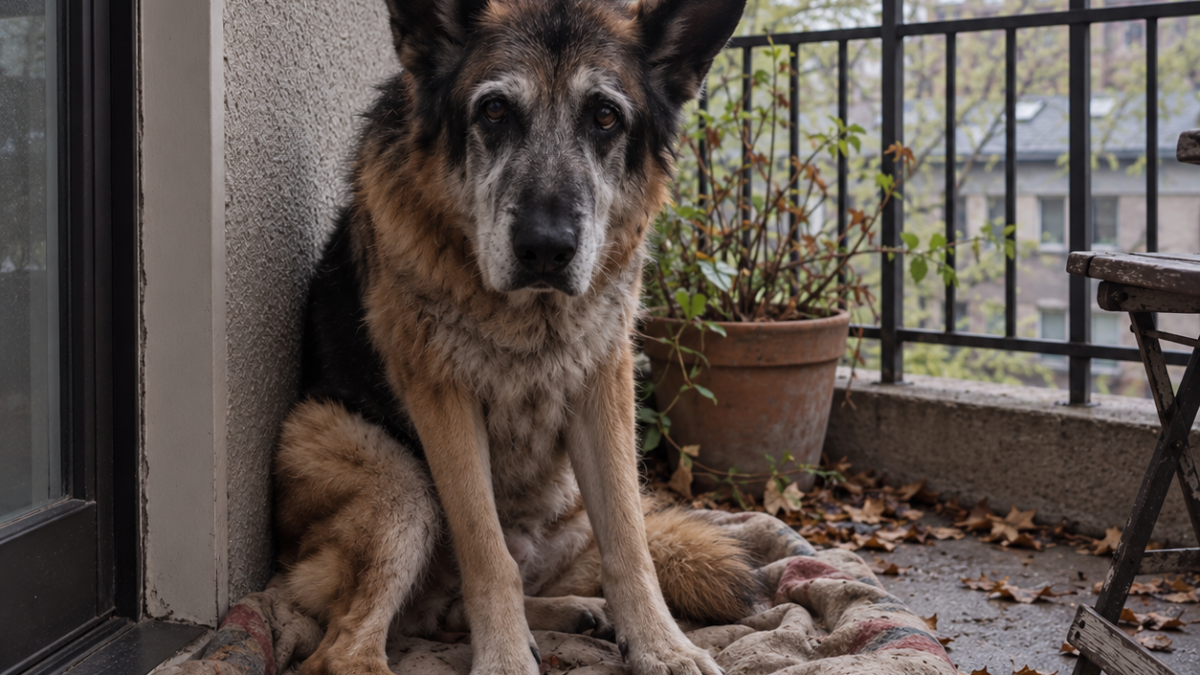
For six straight days, an old German shepherd lay in the same corner of my apartment balcony, barely touching his food, ignoring rain, traffic, and every stranger who tried to coax him away, as though the only thing keeping him there was a promise someone had made before disappearing.
I had spent most of my thirty-two years avoiding big dogs, avoiding complicated people, and building a life so predictable that even my houseplants seemed bored by it, yet every morning I found myself opening the balcony door before I made coffee just to make sure that gray-muzzled stranger had not finally given up and left.
Then, on the sixth night, I discovered a name hidden beneath his worn collar—and when I whispered it, the dog stood for the first time in hours, walked to my front door, and looked back at me as if he had been waiting all week for me to understand where we needed to go.
My name is Hannah Reed. I was thirty-two then, living alone on the outskirts of Portland in a second-floor apartment above a quiet residential street lined with maples, wet sidewalks, and the kind of houses where porch lights seemed to stay on all winter.
I worked at Greenleaf Books, an independent bookstore where I had spent five years shelving novels, recommending mysteries, ordering obscure biographies for retirees, and pretending I enjoyed talking to people more than I actually did.
My life was small.
Not bad.
Just carefully controlled.
Work.
Home.
Microwave dinner.
Books.
Sleep.
Repeat.
I owned six houseplants, three of which were dying despite my best efforts, and I had not dated seriously in almost four years.
I also disliked large dogs.
Not hated.
Feared.
When I was eleven, a loose dog had knocked me down in a park. Nothing terrible happened, but fear is not always proportional to what caused it.
So when I opened my balcony door one cold October morning and saw nearly eighty pounds of aging German shepherd curled against the railing, my first reaction was not compassion.
It was:
“Oh, absolutely not.”
The dog lifted his head.
Gray covered his muzzle and eyebrows. One ear stood upright while the other leaned slightly outward. His coat looked dull from rain, and thin scars traced the edges of both ears.
He watched me.
Calmly.
Then he looked toward the street.
Then back at me.
I stayed inside.
“You’re on the wrong balcony.”
Nothing.
I shut the door.
Five minutes later, guilt won.
I brought water.
The dog drank.
I placed a piece of toast several feet away.
He ignored it.
By noon, he was gone.
I felt relieved.
The next morning, he was back.
Same corner.
Same position.
On day two, I asked every neighbor.
Nobody knew him.
On day three, I posted photographs online.
No response.
Day four, a woman from a local rescue came with a scanner, but the dog moved away before she could get close enough to use it. The moment she left, he climbed the exterior stairs again and returned to my balcony.
Day five brought hard rain.
I put an old blanket beneath him.
He let me touch his head for the first time.
His ears were soft.
His body was colder than it should have been.
“Who are you waiting for?”
His eyes moved toward the road.
That night, I woke at 2:17 and looked outside.
Still there.
On the sixth morning, I made scrambled eggs and sat beside him while he ate a few bites.
I was late for work.
I did not care.
Something had changed.
I no longer wanted him gone.
I wanted an answer.
That evening, while drying his neck with a towel after another burst of rain, my fingers caught beneath the thick fur under his collar.
I froze.
There was a small leather flap sewn against the inside.
Hidden.
I opened it.
Inside was a narrow brass plate.
Two words had been engraved by hand:
**ATLAS — CHARLES BENNETT**
My breath stopped.
I knew that name.
Charles Bennett came into Greenleaf Books almost every Thursday.
Seventy-nine years old.
Retired English teacher.
Always bought one newspaper, one mystery novel, and coffee from the café next door.
I had not seen him in almost a week.
“Charles?”
The dog’s head snapped up.
I stared.
“Charles Bennett?”
Atlas stood.
Walked directly to my apartment door.
Then looked at me.
For six days, he had refused to come inside.
Now he scratched once at the door.
I grabbed my coat.
My keys.
My phone.
Atlas descended the stairs ahead of me.
At the sidewalk, he stopped.
Waited.
Then started walking.
And for the first time in years, I followed something without knowing where it would lead.
PART 2
Atlas did not walk like a lost dog.
That was the first thing I noticed.
Lost dogs wander.
At least that is what I had always imagined.
Atlas moved with purpose.
Slowly, because his hips were stiff and age had shortened his stride, but he never hesitated at intersections. He turned left at Burnside.
Crossed two residential blocks.
Stopped at a pedestrian light.
Waited.
I stood beside him feeling ridiculous.
“Do you know traffic laws too?”
His good ear moved.
Green light.
We crossed.
The rain had slowed to mist.
Portland rain does that—it stops being weather and becomes atmosphere.
Atlas continued.
Half a mile.
Then another.
I called my manager, Denise.
“I’m going to be late tomorrow.”
There was a pause.
“Hannah, it’s seven at night.”
“I know.”
“Are you planning tomorrow’s lateness early?”
“I’m following a German shepherd.”
Longer pause.
“Of course you are.”
“I’ll explain.”
“You better.”
Atlas turned onto Hawthorne Lane.
I knew exactly where we were going before we arrived.
Charles Bennett lived in a small blue bungalow at the end of the block.
He had once pointed it out to me after I gave him a ride home from the bookstore during an ice storm.
I had not thought about that afternoon in nearly a year.
Atlas stopped at the gate.
The house was dark.
Mail filled the box.
A newspaper lay soaked near the porch.
My stomach tightened.
“Charles?”
Nothing.
Atlas walked to the front door.
Sat.
Then looked at me.
## **1. Charles**
I knocked.
No answer.
Again.
“Mr. Bennett?”
Atlas’s tail moved once when I said the name.
I tried calling the number stored in the bookstore customer system.
Straight to voicemail.
I should explain why Greenleaf Books had his number.
Charles ordered too many obscure British crime novels.
We called when they arrived.
I dialed.
From inside the house, faintly:
A phone rang.
That was bad.
I called 911.
The dispatcher asked why I believed something might be wrong.
“His dog has been on my balcony for six days.”
Silence.
Then:
“His dog?”
“Yes.”
“Do you know the resident?”
“Customer from work.”
“Have you seen him recently?”
“No.”
“How old?”
“Seventy-nine.”
“Medical conditions?”
“I don’t know.”
Atlas scratched at the door.
I added:
“And his mail hasn’t been collected.”
That was enough.
## **2. The Police Arrive**
Officer Maya Collins arrived first.
Mid-forties.
Practical voice.
She looked at Atlas.
Then me.
“This is the dog?”
“Yes.”
“He led you here?”
“Yes.”
Maya nodded slowly.
“I’ve heard stranger things.”
A second officer checked windows.
No obvious person inside.
No signs of forced entry.
Maya called Charles’s phone.
We heard it ring again.
She checked dispatch records.
Then frowned.
“What?”
“There was an EMS call at this address six days ago.”
Exactly six.
My skin prickled.
“What happened?”
“I’m checking.”
She radioed.
Waited.
Then:
“Medical emergency. Male resident transported to St. Vincent.”
Relief hit so hard my knees weakened.
“He’s alive?”
“I don’t know his current status.”
“But he left in an ambulance?”
“Yes.”
I looked at Atlas.
Six days.
Same timeline.
“What happened to the dog?”
Maya looked through the call notes.
“No animal transfer logged.”
Atlas sat at the front door.
Waiting.
## **3. The Neighbor Across the Street**
A porch light came on.
An older woman in a red robe waved.
“You looking for Charlie?”
Maya crossed the street.
I followed.
Atlas did too.
The woman introduced herself as Margaret Lewis.
She had lived across from Charles for twenty-two years.
“Ambulance took him Thursday,” she said.
“What happened?”
“He collapsed on the sidewalk.”
“Was Atlas with him?”
Margaret looked at the dog.
“Of course.”
“What happened to Atlas?”
She frowned.
“His son came.”
“What son?”
“Richard.”
I knew Charles had a son.
Barely.
He mentioned him infrequently.
Margaret continued:
“Richard tried putting Atlas in his SUV. Dog refused.”
“What did he do?”
“Got angry. Then left.”
My stomach turned.
“You’re telling me he left Charles’s dog outside?”
“He said someone would pick him up.”
“Did they?”
Margaret looked at Atlas.
“Apparently not.”
Then she said something that made me stop breathing.
“Before the ambulance left, Charlie kept saying something to him.”
“To Atlas?”
“Yes.”
“What?”
Margaret thought.
“Stay.”
My throat tightened.
“He kept saying, ‘Stay, Atlas. Stay here. I’ll come back.’”
The dog looked toward Charles’s house.
Six days.
He had done exactly what he was told.
## **4. Why My Balcony?**
One question remained.
If Charles told Atlas to stay at his house, why had the dog been on my balcony?
Margaret knew part of the answer.
“Richard came back later.”
“When?”
“That evening.”
“With anyone?”
“No.”
“He went inside?”
“Yes.”
“Then?”
“Atlas started barking at him.”
That surprised me.
Atlas had not barked once on my balcony.
Margaret continued.
“They argued.”
“Who?”
“Richard and the dog?”
She smiled despite the situation.
“No. Richard was on the phone.”
She remembered hearing:
“I can’t deal with this dog.”
Then a truck door.
Later, Atlas was gone.
“So Richard took him?”
“Looks like.”
“Then how did he end up at my apartment?”
Margaret shrugged.
That answer came later.
## **5. St. Vincent**
Hospitals do not tell random bookstore employees about patients.
Correctly.
I was nobody.
Not family.
Not emergency contact.
Maya could only confirm Charles had been transferred somewhere after stabilization.
Where?
Protected information.
I called Richard.
Charles had once had a special order delivered through his son, so his number was in our records.
He answered.
“Greenleaf Books.”
“No, this is Hannah Reed.”
Silence.
“Hannah?”
“You know me?”
“My father talks about you.”
My stomach tightened.
“Where is Charles?”
“He’s recovering.”
“Where?”
“That’s private.”
“His dog has been living on my balcony.”
Another silence.
Then:
“You have Atlas?”
The relief in his voice lasted less than a second.
Then something colder replaced it.
“I’ll come get him.”
“Why was he on my balcony?”
“What?”
“You heard me.”
Richard sighed.
“My father gave me your address.”
That sentence stopped me.
“Why?”
“Because he said if something ever happened and Atlas couldn’t stay with him, you’d help.”
I almost laughed.
“I was never asked.”
“He assumed.”
“Why me?”
“You’re the bookstore girl.”
I hated that immediately.
“I’m thirty-two.”
“You know what I mean.”
“No. I don’t.”
Richard’s tone changed.
“Hannah, this is family business.”
“Then why did your family business spend six days on my balcony?”
Silence.
## **6. The Truth About the Balcony**
Richard finally admitted he drove Atlas to my apartment the night Charles was hospitalized.
“How did you know which unit?”
“My dad had it written down.”
“Why?”
“He said you’d once dropped off books when he was sick.”
That was true.
Two winters earlier, Charles had pneumonia.
Denise asked whether I could deliver three special orders because his house was on my route home.
He insisted on paying me back with homemade lemon bread.
I had forgotten giving him my address later when he returned the borrowed tote bag.
Apparently he had not.
Richard continued:
“I thought you’d take the dog.”
“You didn’t knock.”
“I did.”
“I was at work.”
“So I left him on the balcony.”
“Without a note?”
“I was dealing with my father.”
“Without food?”
“There was water.”
“There wasn’t.”
Silence.
Then:
“I thought someone would see him.”
I looked at Atlas.
Someone had.
Eventually.
## **7. “He’ll Wait”**
I asked:
“What did you tell Atlas when you left?”
Richard sounded irritated.
“I don’t remember.”
“Try.”
“Why does it matter?”
“Because he didn’t leave for six days.”
Another silence.
Finally:
“I told him to stay.”
My chest tightened.
“And?”
“I said I’d come back.”
There it was.
I closed my eyes.
“You never did.”
“I had other things to handle.”
“You made a promise to a dog.”
“That sounds ridiculous.”
“No.”
I looked at Atlas curled near Charles’s gate.
“What’s ridiculous is that he kept his side better than you kept yours.”
Richard hung up.
## **8. Finding Charles**
The next morning, Maya called.
Not officially.
Humanly.
“I found out where Charles is.”
I sat up.
“Where?”
“Cedar Hills Rehabilitation Center.”
“Can I visit?”
“Call first.”
“Is he conscious?”
“Yes.”
“How do you know?”
Pause.
“He keeps asking about his dog.”
That was enough.
I took Atlas.
Richard had not come for him.
Good.
## **9. The Rehabilitation Center**
Atlas recognized the building before I did.
Maybe hospital smell.
Maybe nothing.
He became restless in the parking lot.
Inside, the receptionist already knew.
“Atlas?”
I stared.
“How?”
“Mr. Bennett has shown everybody pictures.”
My heart hurt.
A social worker named Emily Hart met us.
“He’s been difficult.”
“Charles?”
She smiled.
“Determined.”
Good.
“What happened?”
“Small stroke after a cardiac episode. Speech affected. Right-side weakness.”
“Will he recover?”
“Some functions already improving.”
“And Atlas?”
Emily’s expression changed.
“Mr. Bennett believes his son placed Atlas with a rescue.”
I looked down.
Atlas stood beside my knee.
“No.”
“I gathered.”
“Did Richard tell him that?”
“Yes.”
My anger returned.
Slow.
Heavy.
## **10. Room 308**
Charles was sitting beside the window.
Thinner.
Gray hair uncombed.
Right arm resting awkwardly.
He looked older than he had six days earlier.
Atlas stopped in the doorway.
Charles turned.
Everything happened in his face first.
His mouth opened.
No sound.
Atlas whined.
Then ran.
Not fast.
Old hips.
Slippery floor.
But he ran.
Charles’s left hand reached out.
Atlas put his head in Charles’s lap.
Charles folded over him.
“Boy.”
The word came rough.
Broken.
But clear.
Atlas trembled.
Charles kept saying it.
“Boy.”
Again.
“Boy.”
I stood in the doorway crying so hard Emily handed me tissues without asking.
## **11. Charles Sees Me**
After several minutes, Charles looked over Atlas’s head.
Saw me.
His eyes widened.
“H-Hannah.”
That surprised me almost as much as the reunion.
“You know me?”
He smiled slightly.
“Books.”
Of course.
I walked closer.
“Your son left Atlas at my apartment.”
Charles’s face changed.
“He told me Atlas was at a rescue.”
I waited.
Charles struggled.
“No.”
One word.
Then:
“Not.”
He pointed at me.
Then Atlas.
“Plan.”
## **12. The Plan**
Communication took time.
A whiteboard helped.
Charles wrote with his left hand.
Messy.
Slow.
He had made an emergency plan for Atlas months earlier.
Primary caregiver:
His neighbor Margaret.
Backup:
A local German shepherd rescue.
Third:
Me.
I stared.
“Why am I on this?”
Charles smiled.
Then wrote:
**You are scared. Still kind.**
I laughed through tears.
“That is an awful qualification.”
He wrote:
**Best kind.**
I had no answer.
Apparently Charles had noticed something I hadn’t.
At the bookstore, a customer once brought a service dog.
I stayed six feet away but moved a display so the dog could pass comfortably.
Another time, I spent twenty minutes finding an animal-rescue memoir for Charles.
Small things.
He had been watching.
## **13. Why Margaret Wasn’t Called**
Richard never contacted her.
Why?
He claimed she was too old.
Margaret was seventy-three, active, and had cared for Atlas during Charles’s vacations.
The shepherd rescue?
Never contacted.
Me?
Dog dropped without explanation.
That was not an emergency plan.
That was avoidance.
Charles understood immediately.
His face hardened.
“Richard.”
Then he wrote:
**House?**
I looked at Emily.
She said:
“There’s another issue.”
Of course there was.
## **14. The House**
Charles owned his bungalow outright.
Developers had been buying properties along Hawthorne Lane because a mixed-use project was planned nearby.
Richard had been pressuring Charles to sell.
Charles had refused.
After the stroke, Richard started telling facility staff that his father would “probably need permanent placement.”
Maybe.
Maybe not.
Then he requested financial documents from Charles’s bank under an old power of attorney.
Not unusual by itself.
The problem:
He also contacted a real estate agent.
## **15. The Offer**
Charles’s house was valued around $540,000.
The offer Richard wanted accepted:
$390,000.
Buyer:
Westline Property Group.
One of its minority investors:
Richard’s brother-in-law.
I stared at the paperwork Emily had flagged.
“That’s convenient.”
Emily said carefully:
“We don’t know whether anything improper occurred. But Mr. Bennett objected.”
Charles tapped the table.
“NO.”
All capitals.
Very clear.
## **16. Charles Was Not Incapable**
Speech was difficult.
Thinking was not.
That distinction became the center of everything.
Richard described his father as “confused.”
Doctors documented otherwise.
Charles knew:
His address.
Bank accounts.
Property value.
Family relationships.
Why he was in rehabilitation.
What the proposed sale meant.
He needed time to communicate.
He did not need someone replacing his decisions.
That difference is enormous.
## **17. The Power of Attorney**
Charles had signed a durable financial power of attorney three years earlier.
Richard was agent.
That sounded powerful.
It was.
But not unlimited.
An agent must act for the principal’s benefit.
Not personal advantage.
And Charles still retained capacity to revoke authority.
He did.
Slowly.
With a lawyer.
His old attorney, Judith Klein, came to the rehab center.
Charles looked at Richard’s paperwork.
Then at Judith.
“End.”
Judith nodded.
“We can do that.”
## **18. Richard Arrives**
He came while I was visiting.
Bad timing.
Or good.
Depends who you ask.
Richard walked into Room 308.
Saw Atlas.
Stopped.
“You brought the dog here?”
Charles’s left hand tightened in Atlas’s fur.
I stood.
Emily entered immediately.
Good.
Witnesses prevent stupid behavior.
Richard looked at his father.
“Dad, we talked about this.”
Charles struggled:
“No.”
“About the house.”
“No.”
“You cannot go back there alone.”
Charles pointed at himself.
Then wrote on the whiteboard:
**MY HOUSE. MY CHOICE.**
Richard sighed.
“You don’t understand the care you need.”
Charles slammed the marker down.
He understood perfectly.
## **19. I Interfere**
I should have remained silent.
I didn’t.
“He understands you sold his dog’s story too.”
Richard turned.
“This has nothing to do with you.”
“Then stop putting things on my balcony.”
Emily almost smiled.
Richard ignored me.
“Dad, I was protecting you.”
Charles wrote:
**FROM WHAT?**
Richard had no good answer.
## **20. The Guardianship Threat**
When Charles revoked the power of attorney, Richard responded by petitioning for guardianship.
That frightened Charles.
If granted broadly, a guardian could make major decisions.
Richard argued:
Stroke.
Mobility.
Medication management.
House safety.
Some concerns were real.
That made the case complicated.
It also made honesty essential.
Charles’s side argued for supported decision-making and limited assistance rather than full guardianship.
His medical team agreed.
## **21. Atlas Comes Home With Me**
Charles could not care for Atlas during rehab.
Margaret offered.
Charles surprised us.
He pointed at me.
“Hannah.”
I nearly choked.
“Why?”
He smiled.
“Balcony.”
“That is not a reason.”
Atlas leaned against my leg.
Traitor.
Charles wrote:
**He chose.**
Technically, Atlas had been abandoned there.
Still.
I took him.
Temporarily.
That word has ruined many people’s plans.
## **22. First Night Inside**
Atlas had spent six days refusing my apartment.
Now he walked in.
Slowly.
Smelled everything.
Kitchen.
Living room.
Bookshelves.
Bedroom door.
Then the balcony.
He stepped outside.
Returned.
I placed a dog bed near the couch.
He slept beside the front door.
Of course.
Waiting behavior does not disappear because the human story changes.
## **23. My Fear of Dogs**
People assume fear vanishes after one emotional moment.
No.
Atlas sneezed behind me on day three and I nearly dropped a bowl.
When he barked at a delivery driver, my whole body froze.
Atlas noticed.
Stopped.
Looked at me.
I felt guilty.
A trainer named Rachel Kim helped.
“Hannah, you’re reading size as danger.”
“I know.”
“Knowing isn’t the same as feeling.”
Exactly.
She taught me body language.
Loose posture.
Stiff posture.
Whale eye.
Lip licking.
Turning away.
Distance.
Choice.
Atlas taught me too.
He never forced contact.
If I backed up, he stayed.
That mattered.
## **24. The Balcony Door**
For weeks, Atlas slept near it.
Sometimes outside.
Sometimes inside.
I kept it open whenever weather allowed.
Choice.
He had been left there.
I wanted the balcony to become a place he entered and exited voluntarily.
Not a waiting room.
## **25. The Real Estate Connection**
Judith investigated the house offer.
The low price wasn’t automatically illegal.
Properties sell below market for many reasons.
But emails became concerning.
Richard wrote to his brother-in-law:
**Once Dad is permanently placed, we can move quickly before he changes his mind again.**
Another:
**The stroke gives us the opening we needed.**
That sentence became important.
Not because it proved a crime by itself.
Because it showed motive.
## **26. Richard’s Other Explanation**
He insisted he meant an “opening” to simplify his father’s life.
Sell property.
Pay for care.
Reduce responsibility.
His attorney argued the below-market price reflected a fast cash sale and repairs.
Possible.
Then independent inspection estimated repairs at under $40,000.
Still a large gap.
The court wanted more information.
So did Charles.
## **27. The Account Transfers**
Judith discovered Richard had reimbursed himself from Charles’s account for:
Travel.
“Property management.”
Consulting.
Home cleanout.
Some legitimate.
Some questionable.
One $8,400 “cleanout” payment went to a company owned by Richard’s friend.
The house had not been cleaned out.
Margaret had photographs.
That looked bad.
## **28. Atlas’s Things**
Richard had removed dog supplies from Charles’s house.
Crate.
Food.
Medication.
Bed.
He claimed he intended to donate them after placing Atlas.
Instead, some were in his garage.
Why?
He had no clear answer.
Atlas’s veterinary medication was there too.
That angered me more than the money.
An old dog with arthritis had gone six days without his medication because someone could not be bothered to follow a plan.
## **29. The Veterinary Visit**
Atlas was eleven.
Arthritis.
Mild kidney changes.
Chronic ear inflammation.
Otherwise stable.
Dr. Sarah Lopez examined him.
“He’s in good shape for his age.”
“He waited outside six days.”
She looked at me.
“Dogs do things we wish they wouldn’t.”
“Because they’re loyal?”
“Because routines are powerful.”
I appreciated that answer.
Not sentimental.
She added:
“And yes, attachment matters.”
Good enough.
## **30. Charles Visits Atlas**
Once Charles could leave rehab with assistance, I brought him to my apartment.
He climbed the exterior stairs slowly.
Atlas waited inside.
The moment Charles appeared, Atlas’s entire body changed.
Tail.
Ears.
Whine.
He pushed through the balcony door so quickly I nearly dropped the leash.
Charles sat.
Atlas pressed against him.
I made coffee.
Then left them alone.
That felt important.
Their relationship existed before me.
## **31. I Overhear Charles**
From the kitchen, I heard him speaking.
Speech still slow.
“Sorry.”
Pause.
“Couldn’t.”
Pause.
“Good boy.”
Atlas’s tail hit the floor.
Charles continued:
“Hannah good.”
I laughed silently.
A glowing character reference.
## **32. Charles’s Wife**
Her name had been Evelyn.
She died four years earlier.
Atlas came into Charles’s life six months after that.
A retired police K-9? No.
Just an owner surrender from a county shelter.
Large.
Older.
Overlooked.
Charles chose him because:
“Both gray.”
That was his explanation.
Margaret told me.
“He went looking for a small beagle.”
Of course.
Nobody goes to shelters and follows the plan.
## **33. The Promise**
Margaret remembered the exact words on the morning Charles collapsed.
Ambulance doors open.
Atlas trying to follow.
Charles pointing at the porch.
“Stay. Stay here, Atlas.”
Then:
“I’ll come back.”
He meant later.
After hospital.
He expected a few hours.
Maybe one night.
Then stroke.
Transfer.
Richard.
Confusion.
Atlas did not know any of that.
Promises have context for humans.
Dogs only have patterns.
## **34. The Court Evaluation**
A neuropsychologist assessed Charles.
I was not present.
Good.
This was not my place.
Results:
Mild processing slowdown after stroke.
Language impairment.
Decision-making capacity intact in major domains.
He could make choices with reasonable support and extra time.
Full guardianship?
Not medically justified.
Richard’s petition weakened.
## **35. The Hearing**
Charles attended.
Wheelchair.
Atlas did not.
Again, no dog as courtroom prop.
I sat in the back because Charles asked.
The judge asked:
“Mr. Bennett, do you want your son managing your finances?”
Charles answered slowly:
“No.”
“Why?”
He took time.
“Trust.”
Pause.
“Broken.”
The courtroom went quiet.
Richard looked down.
## **36. The House Question**
“Do you understand that returning home may require modifications and assistance?”
“Yes.”
“Are you willing to accept help?”
Charles sighed dramatically.
Several people smiled.
Then:
“Yes.”
“What do you want done with your house?”
Charles leaned toward the microphone.
“Keep.”
The judge nodded.
Simple.
## **37. The Decision**
No full guardianship.
Instead:
Professional fiduciary for some financial administration while Charles recovered.
Home-health assessment.
Safety modifications.
Charles retained core decision authority.
Richard removed from financial control.
House sale halted.
The court ordered review of questionable transactions.
That was the first major turn.
## **38. Richard Blames Me**
Outside the courthouse:
“You’re enjoying this.”
I looked at him.
“No.”
“You think you’re some kind of hero because Dad’s dog sat on your balcony.”
“No.”
“You have no idea what caring for an aging parent is like.”
That stopped me.
He was right about one thing.
I didn’t.
Richard continued:
“I’ve handled doctors. Bills. Calls. Emergencies. You walked in during one dramatic week.”
I nodded.
“That’s true.”
He seemed surprised.
Then I added:
“But being exhausted doesn’t give you ownership of his choices.”
His face tightened.
That was the line.
Caregiver burden can be real.
So can abuse of authority.
One does not erase the other.
## **39. I Ask Charles About Richard**
“Was he always like this?”
Charles shook his head.
“Helped.”
“Before?”
“Yes.”
“Good help?”
“Yes.”
That mattered.
Richard had not spent his entire life plotting.
For years, he handled taxes.
Appointments.
Roof repair.
Insurance.
Then the line shifted.
Gradually.
Charles wrote:
**He stopped asking.**
That was the whole tragedy.
## **40. Small Control**
What groceries.
Which doctor.
Whether Charles should drive.
Which contractor.
What bills were “necessary.”
Each choice defensible.
Eventually Richard began treating his father’s preference as an obstacle instead of information.
By the time the house offer appeared, asking permission felt optional.
Control often grows in inches.
## **41. Atlas at Greenleaf Books**
I began bringing Atlas to work on quiet mornings with Denise’s permission.
He slept behind the information desk.
Customers adored him.
I did not.
At first.
Then I started buying treats.
Then a water bowl.
Then a mat.
Denise noticed.
“You hate big dogs.”
“I dislike generalized statements.”
“You bought him a winter coat.”
“He’s old.”
“It has his name embroidered.”
“Discount.”
She stared.
I walked away.
## **42. Charles Returns to the Store**
Three months after the stroke.
Cane.
Slow.
Margaret drove him.
Atlas was behind the counter.
Charles entered.
Atlas stood.
The bookstore went silent.
Customers recognized Charles.
He had been part of Greenleaf for years.
Atlas walked toward him.
No running this time.
Just steady.
Charles touched his head.
“Books.”
I laughed.
“Yes. Still here.”
He bought one mystery novel.
Routine matters.
## **43. The Financial Review**
Most of Richard’s reimbursements had documentation.
Some didn’t.
The questionable amount ended around $31,000.
Not hundreds of thousands.
Not movie money.
Still serious.
An independent review concluded several payments lacked authorization or reasonable support.
Richard agreed to repay a substantial portion as part of civil settlement.
Additional legal costs.
No prison.
No dramatic fall.
Some people would call that unsatisfying.
Charles did not.
He said:
“Money back.”
Then:
“Choice back.”
Those were his priorities.
## **44. The House Offer Dies**
Westline withdrew.
Too much scrutiny.
Charles’s bungalow stayed his.
He eventually installed:
Ramp.
Bathroom rails.
Emergency alert.
Lower shelves.
Part-time aide.
All the things Richard said were impossible.
Expensive?
Yes.
Still Charles’s decision.
## **45. Richard Loses Access**
For six months, Charles did not see him.
Not court ordered.
Personal.
Richard sent messages.
Letters.
Apologies mixed with explanations.
Charles ignored them.
Then one day he asked me:
“Bad son?”
I thought carefully.
“Bad decisions.”
He looked at me.
“Different?”
“Yes.”
That distinction mattered to him.
## **46. The First Apology**
Richard eventually wrote one letter without defending himself.
No “but.”
No “I was stressed.”
No “you don’t understand.”
Just:
**I decided what your future would be and treated your disagreement as evidence that you could not decide for yourself. I was wrong. I told myself I was protecting you when I had started protecting the plan I wanted.**
Charles read it.
Long silence.
Then:
“Better.”
Not forgiven.
Better.
## **47. Atlas’s Anxiety Improves**
He stopped sleeping at my front door.
Moved to the couch.
Then my bedroom doorway.
Then, scandalously, my bed.
One night I woke with his face six inches from mine.
I screamed.
He sneezed.
I considered eviction.
He stayed.
Fear changes through repetition.
Not inspiration.
## **48. The Balcony**
Atlas still used it.
But differently.
He slept in the sun.
Watched squirrels.
Ignored cars.
That was when I knew the waiting had changed.
Same concrete.
Different meaning.
## **49. Charles Comes Over for Dinner**
I cannot cook.
Charles knew.
Still accepted.
Pasta.
Overcooked.
Atlas received plain chicken.
Charles pointed at his bowl.
“Better.”
“I know.”
He smiled.
We talked—slowly—about Evelyn.
About teaching.
About books.
Then Charles asked:
“Why alone?”
I nearly dropped my fork.
“Excuse me?”
He pointed around.
“Alone.”
“I like alone.”
He raised one eyebrow.
Apparently stroke spared judgment.
## **50. My Life Before Atlas**
Charles was right enough to annoy me.
I had made safety into a personality.
No difficult relationships.
No travel unless planned.
No big dogs.
No risks.
My last serious relationship ended because I refused to move to Seattle with him.
Not because Seattle was wrong.
Because change terrified me.
I told myself I liked stability.
Maybe I just liked control.
Atlas had entered my balcony without permission.
Then my house.
Then my life.
Rude.
## **51. Daniel**
A man named Daniel worked in the café next to Greenleaf.
He had asked me out twice over the years.
I said no.
Third time, he asked Atlas.
“Should Hannah have dinner with me?”
Atlas accepted the treat Daniel offered.
Traitor.
I said yes.
One dinner.
Then another.
No grand romance montage.
Just gradual.
Like everything important.
## **52. Charles Approves Too Much**
He saw Daniel picking me up.
Smiled.
I pointed:
“Do not.”
Charles said:
“Good.”
“Not your business.”
“Balcony.”
“What does that mean?”
He just smiled.
Infuriating old man.
## **53. Richard Visits Charles**
After eight months, Charles agreed.
Margaret present.
Professional aide nearby.
Richard arrived.
Atlas was with Charles.
Important detail.
Richard stayed several feet away.
“Hi, Dad.”
Charles nodded.
Richard looked at Atlas.
“Hi.”
Atlas watched.
No growl.
No greeting.
Neutral.
Healthy.
## **54. The Conversation**
Richard apologized in person.
Slowly.
Charles did not make it easy.
“Why dog?”
Richard exhaled.
“I panicked.”
Charles waited.
“I couldn’t take Atlas to my condo.”
Still waiting.
“I knew Hannah was on your list.”
Charles nodded.
“I thought leaving him there solved it.”
“Note?”
Richard looked ashamed.
“No.”
“Food?”
“No.”
“Come back?”
“No.”
Charles’s face tightened.
Richard said:
“I told myself you’d be in rehab long enough that someone else would take over.”
There it was again.
Someone else.
Responsibility passed into air.
## **55. Charles’s Response**
“You said… stay.”
Richard looked confused.
“To Atlas.”
Richard remembered.
His eyes filled.
“Yes.”
“Come back.”
“Yes.”
“You didn’t.”
“No.”
Charles put his left hand on Atlas.
“Dog did.”
That broke Richard.
He started crying.
Charles did not comfort him.
Not cruelly.
He simply allowed the truth to sit.
Sometimes apology needs discomfort.
## **56. Forgiveness Takes Longer**
Charles eventually allowed monthly visits.
Then dinners.
Richard helped with yard work.
Never finances.
That boundary stayed.
Important.
Forgiveness did not mean restoring the exact power that had been misused.
People often confuse those.
Charles didn’t.
## **57. Atlas Goes Home**
At some point, I assumed Charles would take Atlas back permanently.
He didn’t.
His mobility remained limited.
Atlas himself was aging.
Stairs at Charles’s house were difficult.
More importantly, Atlas had settled with me.
Charles saw it.
One afternoon:
“Keep.”
I stared.
“What?”
He pointed at Atlas.
“Keep.”
“No. He’s yours.”
Charles smiled.
“Ours.”
I hated how quickly I cried.
## **58. Shared Custody**
Not legally complicated.
Charles transferred ownership to me with clear paperwork.
But emotionally?
Shared.
Atlas spent afternoons at Charles’s house twice a week.
Sometimes overnights with Margaret helping.
Most nights with me.
He had two homes.
Maybe three if you count Greenleaf.
Better than one waiting place.
## **59. The Pet Trust**
Charles had already created a small pet-care fund.
That surprised me.
Not huge.
Enough for veterinary expenses.
He transferred administration to a professional trustee.
Not Richard.
Smart.
I joked:
“Atlas has better retirement planning than I do.”
Charles wrote:
**True.**
Rude.
## **60. Richard’s Legal Consequences**
The civil settlement finalized.
Repayment.
Accounting costs.
Removal from financial authority.
Formal rescission of the property transaction.
The court did not make him a monster.
Neither should I.
He had crossed serious lines.
He faced serious consequences.
He also spent the next years proving whether he had learned.
That mattered more to Charles than permanent punishment.
## **61. What “Revenge” Looked Like**
People at the bookstore called it karma.
I didn’t.
Richard tried to make decisions while Charles struggled to speak.
Then had to sit in meetings where everyone waited for Charles to finish every sentence.
No interruption.
No substitution.
No “what he means is…”
Nothing.
Charles took thirty seconds.
People waited.
That was justice in its purest form.
His voice mattered again.
## **62. Atlas at the Window**
Sometimes Charles left after visits.
Atlas watched his car.
But did not panic.
He had learned:
People leave.
Some return.
That sounds small.
It isn’t.
## **63. I Learn the Same Thing**
Daniel went on a ten-day trip.
I almost ended the relationship beforehand.
Ridiculous.
Why?
Because absence made me anxious.
Atlas had taught me enough to recognize it.
I did not run.
Daniel returned.
Nothing collapsed.
Therapy helped too.
Yes, actual therapy.
Dogs are useful.
Not substitutes for mental health care.
Important.
## **64. Charles Turns Eighty**
Greenleaf hosted a private birthday breakfast before opening.
Books.
Coffee.
Cake.
Atlas wore a blue bandana.
Hated it.
Richard attended.
Margaret.
Daniel.
Denise.
Charles gave a short speech.
“Thought…”
Long pause.
“Stroke ended life.”
Another pause.
“Wrong.”
He looked at Atlas.
Then me.
“Changed route.”
That was it.
Best speech I’d heard.
## **65. The Old Promise**
After everyone left, I asked:
“Do you remember telling Atlas you’d come back?”
Charles nodded.
“Did you think you would?”
“Yes.”
“Same day?”
“Yes.”
He looked toward the window.
“Life rude.”
I laughed.
Very.
## **66. Charles’s Health Declines**
Two years later, another cardiac event.
Smaller.
No stroke.
But recovery harder.
Atlas was thirteen by then.
Both old.
Both stubborn.
Charles chose to move—not permanently, but voluntarily—into a senior community near my apartment.
That distinction mattered.
His decision.
Not Richard’s.
He sold the bungalow himself.
At market value.
Open listing.
No family deal.
He signed every page.
I attended closing.
Richard did too.
At the end, Charles handed him the pen.
Richard smiled.
“Keeping this?”
Charles:
“No.”
Progress.
## **67. The Bungalow Sale**
Part of proceeds funded Charles’s care.
Part invested.
Part donated later through his estate.
No scandal.
No rushed discount.
A normal transaction.
Normality can be the most satisfying form of repair.
## **68. Atlas Visits the New Apartment**
Ground floor.
Easy access.
Charles kept a bed for him.
Atlas slept there during visits.
Charles called it “his room.”
It was a corner.
Still.
## **69. Margaret Dies**
Stroke.
Eighty.
Peacefully.
Charles lost another old friend.
Atlas sat beside him after the funeral.
I visited.
Charles said:
“Too many.”
People gone.
I knew what he meant.
I sat too.
No solution.
Some pain needs company, not fixing.
## **70. Richard Changes**
He began attending appointments only when Charles asked.
That sounds trivial.
It wasn’t.
He would text:
**Want me there?**
Charles could answer:
Yes.
No.
Later.
Choice.
That was the repair.
## **71. Richard and Atlas**
Over time, Atlas warmed.
First accepted treats.
Then petting.
Eventually lay near Richard’s feet during one visit.
Richard looked at me.
“Does this mean he forgives me?”
“No idea.”
Charles laughed.
Dogs are not judges.
Good.
## **72. Atlas Turns Fourteen**
Old.
Very old for a shepherd.
Arthritis worsened.
Kidney disease progressed.
Hearing faded.
He still knew:
Me.
Charles.
Daniel.
Greenleaf.
Chicken.
Especially chicken.
Some cognitive changes appeared.
Pacing at night.
Standing at wrong door.
We adjusted.
Lights.
Rugs.
Medication.
Routine.
## **73. The Balcony Becomes Hard**
Stairs.
Problem.
I lived second floor.
Atlas began struggling.
Daniel suggested we move.
My old self would have panicked.
Moving?
Change?
No.
Instead:
“Okay.”
That surprised me.
We found a ground-floor rental six blocks away.
Small patio.
No balcony.
I cried the last night.
Not because I loved the apartment.
Because of the concrete corner where Atlas waited.
## **74. Last Night on the Balcony**
I put his old blanket there.
Atlas walked out.
Slowly.
Lay down.
Same corner.
Four years earlier, he had been waiting for Charles and Richard to return.
Now I sat beside him.
No waiting.
Just memory.
I touched his head.
“You ruined my life.”
Tail thump.
“Improved it, apparently.”
Another thump.
## **75. The Move**
Atlas rode with me.
Not a moving truck.
My car.
Daniel drove.
Charles supervised through video call and complained about how we packed books.
He was correct.
I own too many books.
## **76. The Patio**
Atlas accepted it immediately.
Sun.
Grass strip.
No stairs.
Good.
I realized home had moved.
Again.
And survived.
## **77. Charles’s Final Year**
At eighty-three, Charles developed advanced heart failure.
He chose comfort-focused care.
No dramatic fight against the inevitable.
He knew.
Richard knew.
I knew.
Atlas did not.
Or maybe he knew in his own way.
## **78. Charles Asks Me a Favor**
He said:
“When.”
I knew.
“When what?”
He pointed upward.
I hated the implication.
“When I’m gone?”
“Yes.”
“What?”
“Atlas.”
I started crying.
He rolled his eyes.
“Hannah.”
“What?”
“Listen.”
I laughed through tears.
“Fine.”
“Don’t wait.”
I froze.
He touched Atlas’s head.
Then pointed at me.
“Don’t… wait.”
He meant both of us.
Maybe himself too.
## **79. Charles Dies**
Quietly.
At the senior residence.
Richard beside him.
I arrived an hour later.
Too late.
That hurt.
Then I remembered Charles would have hated me turning timing into guilt.
Richard hugged me.
First time.
We stood awkwardly.
Atlas came later.
The staff allowed a private visit.
He smelled Charles’s blanket.
Chair.
Hands no longer there.
Then lay beside the bed.
We waited.
Not six days.
One hour.
Then I called him.
“Atlas.”
He looked.
“Come on.”
He stood.
Followed me out.
That mattered.
## **80. The Funeral**
Small.
English teachers.
Former students.
Bookstore people.
Richard spoke.
He said:
“My father taught me late in his life that helping someone does not mean choosing for them.”
Good.
Accurate.
No self-pity.
Charles would have approved.
Maybe.
He was hard to impress.
## **81. Charles’s Estate**
Clear.
Professional.
No confusion.
The bungalow money already handled.
Small gifts.
Donation to Greenleaf literacy program.
Pet fund for Atlas.
A box for me.
Inside:
Books.
An old fountain pen.
And a note.
**For Hannah, who finally learned big dogs are mostly furniture with opinions.**
I laughed so hard I scared Atlas.
## **82. Richard’s Gift**
Charles left Richard something too.
Not less as punishment.
Not more as reward.
A reasonable inheritance.
That surprised me.
Judith explained:
“Charles updated everything after the dispute.”
I asked:
“Why not cut him out?”
She smiled.
“Because he didn’t want to.”
Simple.
Victims do not owe outsiders the punishment outsiders prefer.
## **83. The Real Revenge**
If someone insists on the word:
Richard wanted to make choices because he believed Charles was too weak to make them.
Charles spent the next years making every important choice himself.
Where to live.
When to sell.
Who cared for Atlas.
Who handled money.
Who visited.
How he died.
What Richard inherited.
That was the answer.
Not destruction.
Agency.
## **84. Atlas After Charles**
He searched for three days.
Not dramatically.
At the door around Charles’s usual visit time.
Looked toward parking lot.
Then slept.
Day four, he didn’t go to the door.
I cried anyway.
Letting go can look like forgetting from the outside.
It isn’t.
## **85. His Cognitive Decline**
At fifteen, Atlas sometimes stood facing corners.
Forgot why he entered rooms.
Barked at shadows.
Vet diagnosed canine cognitive dysfunction.
We managed.
Routine.
Night lights.
Medication.
Patience.
Some days clear.
Some confused.
I learned to meet him where he was.
Maybe Charles had taught me that too.
## **86. The Bookstore**
Atlas retired from Greenleaf.
Too tiring.
Denise gave him an employee badge.
**ATLAS — LOSS PREVENTION**
He had prevented zero thefts.
Once slept through someone dropping an entire display.
Still.
Badge framed.
## **87. Daniel Proposes**
Not because of Atlas.
Though Atlas was present.
Daniel asked in our kitchen.
No restaurant.
No audience.
I said yes.
Atlas slept through the whole thing.
Perfect.
## **88. The Wedding**
Small.
Garden venue.
Atlas attended for twenty minutes.
Blue bandana again.
He still hated it.
Charles’s fountain pen signed our marriage license.
That was enough connection.
No giant memorial.
The dead do not need to dominate happy days to remain loved.
## **89. Atlas’s Last Winter**
Rain.
Portland.
Of course.
He slept more.
Ate less.
Loved warm towels from dryer.
Hated pills.
Still leaned into my hand.
His world shrank.
Patio.
Kitchen.
Bed.
Us.
Enough.
## **90. The Quality-of-Life List**
Dr. Lopez asked:
“What does Atlas still love?”
I listed:
Chicken.
Sun.
Charles’s old blanket.
Me.
Daniel.
Patio.
Slow walks.
“When most of those disappear,” she said, “we talk.”
I knew.
Didn’t want to.
## **91. The Day Chicken Failed**
I put it down.
Atlas smelled it.
Turned away.
My stomach dropped.
Sun?
He stayed inside.
Walk?
Wouldn’t rise.
He still leaned into my hand.
One thing.
Not enough forever.
## **92. The Decision**
No emergency.
No crisis.
I wanted that.
Home.
Before suffering became the only story.
Dr. Lopez agreed.
Daniel took the day off.
Denise came by.
Richard asked whether he could visit.
I said yes.
## **93. Richard’s Goodbye**
He sat on the floor.
Atlas barely lifted his head.
Richard touched him gently.
“You waited longer than I deserved.”
I looked away.
Richard continued:
“I’m sorry I left you there.”
No excuse.
Good.
Atlas closed his eyes.
That was all.
## **94. The Old Blanket**
Charles’s blanket.
The same one Atlas had used at the senior residence.
I spread it on the patio.
Rain had stopped.
Cold sunlight.
Atlas lay on it.
I sat beside him.
Daniel on other side.
Dr. Lopez arrived.
No rush.
## **95. I Remember Day One**
Large dog.
My balcony.
Fear.
“Oh, absolutely not.”
I laughed.
Daniel asked why.
“I was thinking about the first thing I said to him.”
“What?”
“Nothing flattering.”
Atlas’s ear moved.
Maybe hearing.
Maybe reflex.
## **96. What I Told Him**
“You waited enough.”
My voice broke.
That was the sentence.
“You waited for Charles.”
I touched his face.
“Then Richard.”
“Then me.”
Pause.
“No more waiting.”
Atlas breathed slowly.
“You can rest.”
## **97. Goodbye**
The first medication relaxed him.
Head in my lap.
Same gray muzzle, now almost white.
I scratched behind the scarred ears I had been afraid to touch years earlier.
Dr. Lopez waited.
I nodded.
Atlas took one breath.
Another.
Then quiet.
No barking.
No storm.
No balcony.
No promise left unfinished.
## **98. After**
I expected the patio to hurt.
It did.
Then less.
I kept checking the door.
No Atlas.
No nails.
No sigh.
Grief repeats patterns.
But this time I knew something.
Do not wait forever.
Charles had told me.
Atlas had shown me.
## **99. The Blanket Goes to Greenleaf**
Not immediately.
Months later.
We turned a reading corner into a small senior-dog foster event space once a month with a local rescue.
The blanket stayed at home.
Sorry.
Some things I kept.
## **100. The Charles Bennett Fund**
His literacy donation helped create a program delivering books to homebound seniors.
I volunteered.
Of course.
Sometimes I met people with dogs.
Sometimes no one.
The point:
Notice who stopped showing up.
Charles had once been that person.
I had missed it for six days.
Never again if I could help it.
## **101. Richard Volunteers Too**
Different organization.
Caregiver support.
He spoke honestly about burnout and control.
How helping can slide into deciding.
I heard one talk.
He said:
“I thought because I carried more responsibility, I deserved more authority. I was wrong.”
That was growth.
No applause from me.
Still useful.
## **102. The Apartment Building**
Years later, I passed my old building.
The balcony looked tiny.
How had Atlas fit there?
A young couple lived there now.
Plants healthier than mine ever were.
Good.
I did not stop.
Places do their job and release us.
## **103. Why Atlas Chose the Balcony**
People still ask.
He didn’t choose it originally.
Richard did.
Atlas chose to stay.
Important difference.
Richard told him:
Stay.
I’ll come back.
Atlas trusted the words.
Then Charles’s scent on my old tote bag near the door may have helped.
My scent was familiar from the bookstore.
Routine built the rest.
Not magic.
Enough.
## **104. Why I Followed**
Day six.
Not one.
Fear delayed me.
Routine delayed me.
Assumption delayed me.
Then curiosity.
Concern.
Attachment.
People rarely become brave in one moment.
Usually fear gets smaller because something else gets larger.
For me:
Atlas mattered more than fear.
That was all.
## **105. What Charles Saw in Me**
I asked once.
“Why put me on your emergency list?”
He wrote:
**You always make time for old books nobody wants.**
I stared.
“That is your reason?”
Then he added:
**Old dog same.**
I laughed.
Maybe he was right.
## **106. The Books Charles Loved**
Mysteries.
Always mysteries.
He liked stories where clues mattered.
Where truth emerged.
Where people were not always what they first appeared.
Appropriate.
His own story had:
A hidden plan.
A stubborn son.
A waiting dog.
A frightened bookseller.
Too sentimental for Charles.
He would have criticized pacing.
## **107. The Article**
A local paper eventually wrote about Atlas.
Headline:
**German Shepherd’s Six-Day Vigil Leads Woman to Hospitalized Owner**
Fine.
Then social media changed it:
**Hero Dog Saves Owner From Evil Son**
Wrong.
Charles was not trapped in a dungeon.
Richard was not a cartoon villain.
Atlas did not solve financial crimes.
Reality was more complicated.
I corrected when I could.
## **108. Why Accuracy Matters**
Because if you turn Richard into pure evil, you miss the warning.
He began as a son helping his aging father.
Then fatigue.
Fear.
Convenience.
Money.
Control.
Gradually.
The danger is not always obvious villainy.
Sometimes it is believing:
I know better, therefore I get to decide.
That can happen to ordinary people.
## **109. And Charles Was Not Perfect**
Stubborn.
Delayed safety modifications.
Ignored medical advice sometimes.
Kept driving too long.
Refused help.
Could be infuriating.
Capacity includes the right to make choices others dislike.
That is hard.
Still true.
## **110. Atlas Was Not Perfect Either**
Stole sandwiches.
Barked at delivery people.
Hated cats.
Snored.
Occupied eighty percent of bed despite being assigned twenty.
Once ate half a paperback.
Ironically, a dog-training book.
He contained multitudes.
## **111. I Was Not Perfect**
Fearful.
Controlling.
Avoidant.
I followed Atlas on day six, not day one.
I judged Richard too quickly.
Then not quickly enough in other ways.
I made mistakes.
Still got some things right.
That is most lives.
## **112. The Promise**
“Stay here. I’ll come back.”
Richard said it casually.
Atlas treated it as law.
That stayed with Richard.
He once told me:
“I didn’t understand a dog could take words seriously.”
I answered:
“Humans do too.”
Promises matter even when circumstances change.
If you can’t keep one, you communicate.
You do not disappear.
## **113. Charles’s Version of the Promise**
He had said the same thing first.
At the ambulance.
But Charles intended to return.
Richard had the responsibility to bridge the gap.
He didn’t.
That was the failure.
Not that life changed.
That communication stopped.
## **114. My Promise**
On Atlas’s last day, I made one.
Not to him.
To myself.
Do not build a life entirely around avoiding loss.
Because it doesn’t work.
You lose anyway.
Better to have loved something large enough to scare you.
Dog.
Person.
Future.
Whatever.
I am still learning.
## **115. Daniel and Me**
We moved again.
Bought a house.
Ground floor.
Yard.
No dog for two years.
Then a rescue called Greenleaf about a senior shepherd mix.
I said no.
Daniel said:
“Of course.”
One week later, her name was June and she was asleep in our kitchen.
I blame Charles.
## **116. June Is Not Atlas**
Good.
Smaller.
Brown.
Hates rain.
Loves cats.
Does not wait on balconies.
Has terrible manners.
Perfect.
Replacing Atlas would have been impossible.
Loving another dog was not replacement.
Different relationship.
That mattered.
## **117. Richard Meets June**
He laughed.
“You said you were afraid of big dogs.”
“I was.”
“You have another shepherd.”
“Life rude.”
Charles’s phrase.
Richard smiled.
“Dad used to say that.”
“I know.”
## **118. The Street Outside Greenleaf**
Every Thursday, around ten, I still look at the door.
For years, Charles arrived then.
Mystery novel.
Coffee.
Complaint about modern punctuation.
No Charles now.
No Atlas behind the desk.
Still, people come.
New regulars.
Old customers.
Life fills spaces differently.
## **119. The Moment I Keep**
Not the court.
Not Charles’s funeral.
Not Atlas’s last day.
The sixth morning.
Rain.
Balcony.
Atlas looking toward street.
Me sitting beside him with terrible scrambled eggs.
I asked:
“Who are you waiting for?”
He couldn’t answer.
But eventually he showed me.
That was our beginning.
## **120. The Ending I Choose**
If I had to choose one final image for Atlas’s story, it would not be him lying on my balcony in the rain.
It would not be Charles reaching for him from a rehabilitation chair.
It would not be Richard standing in court while his authority was taken away.
It would not even be Atlas’s final afternoon on our patio.
I choose a morning about three years after all of it began.
Charles was living in his senior apartment by then.
His health was stable.
Richard had started visiting again.
Daniel and I had been dating long enough that he kept a toothbrush at my place and pretended that did not count as commitment.
Atlas was old.
Very gray.
Very slow.
I drove him to see Charles.
The apartment door was open.
Charles sat beside the window with coffee.
Atlas walked inside.
Charles said:
“Late.”
I laughed.
“You’re retired.”
“Still late.”
Atlas went to him.
Charles scratched his head.
Then pointed at the dog bed.
Atlas ignored it and lay in the patch of sunlight beside Charles’s chair.
I sat on the couch.
Nobody discussed courts.
Money.
Power of attorney.
Rehabilitation.
Promises.
Abandonment.
Fear.
Nothing.
Charles read.
Atlas slept.
I drank coffee.
At some point Richard arrived.
He knocked.
Charles looked up.
“Come.”
Richard entered.
Atlas opened one eye.
Then closed it.
Normal.
That was the victory.
A man who had nearly lost control of his home chose where he lived.
A son who had tried to decide too much learned to knock.
A dog who had spent six days waiting outside no longer watched doors in panic.
And a woman who had once been afraid to step onto her own balcony sat on the floor beside an eighty-pound German shepherd and rested her hand on his back without thinking about it.
No one was waiting for somebody who had promised to return.
Everyone who mattered was already in the room.
Years later, when Atlas was gone and Charles was gone too, I sometimes woke before sunrise and remembered that first week.
The gray fur in the corner.
The rain.
The untouched bread.
The way Atlas looked toward the street every few minutes as if loyalty alone could pull someone back.
For six days, I thought he was refusing to move because he was stubborn.
I eventually understood he was doing exactly what he believed he had been asked to do.
Wait.
So he waited.
Through cold mornings.
Through rain.
Through strangers.
Through hunger.
Until I finally found his name and said the one word that made him stand.
“Charles.”
Then Atlas walked to the door and looked back at me.
That look changed my life because it contained a question I had spent years avoiding in every other part of it:
**Are you coming or not?**
For once, I did.
I followed him into a story I had not planned, toward people I did not know, through conflict I would normally have avoided, into a kind of love I had spent years convincing myself I didn’t need.
And if there is one thing Atlas taught me, it is this:
Sometimes loyalty means waiting.
Sometimes love means returning.
But sometimes the bravest thing you can do is recognize when the waiting is over, stand up, look back at the frightened person behind you—
and ask them to come with you.

