PART 2: After Eight Hours Under the Rubble, I Found a Dog Shielding a Little Girl—Then He Turned Back Toward the Collapsed Building
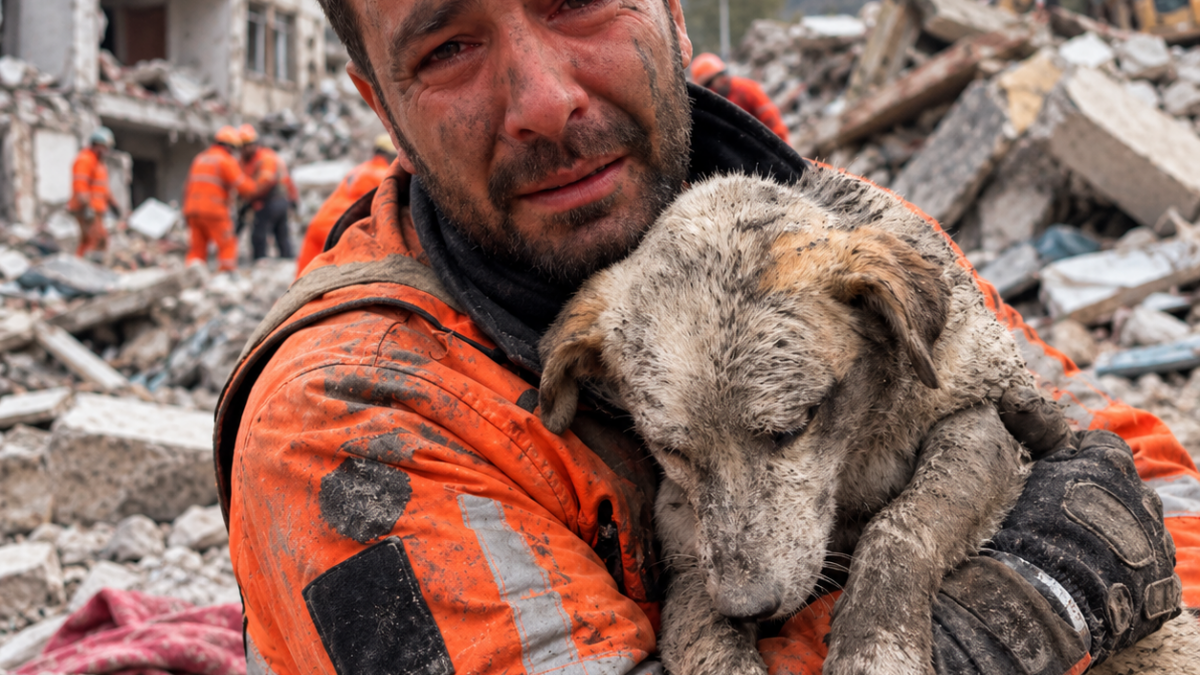
After eight hours crawling through a collapsed apartment building where every sound could mean either another survivor or another section of concrete shifting above us, my gloved hand touched warm fur in a pocket so small I could barely turn my shoulders—and when I aimed my flashlight inside, I realized the dog in front of me was not trapped there by accident.
A little girl was curled beneath his body, sleeping with one hand buried in the dusty fur along his chest, and although the dog was exhausted enough that his legs shook when he stood, he watched every movement we made with the concentration of an animal that had decided long before we arrived that nothing was getting close to that child unless it went through him first.
But after we finally carried both of them into daylight, the dog did not collapse, run for water, or follow the paramedics treating the girl; instead, he turned toward the mountain of broken concrete behind us and stared into it so desperately that I understood our rescue was not finished—and before the investigation ended, that same dog would help expose why the building had come down at all.
My name is Daniel Hayes. I was thirty-nine years old and a lieutenant with Millbrook Urban Search and Rescue when Cedar Court collapsed.
The building was five stories tall, built in the mid-1970s in one of the city’s oldest neighborhoods. Forty-two apartments. Mostly working families, retirees, and people who had lived there long enough to remember when the grocery store across the street was still a movie theater.
The collapse happened at 1:52 Tuesday morning.
Local crews worked through the dark, pulling two survivors from shallow debris pockets before requesting our regional unit.
By the time my team entered the southwest section, more than twelve hours had passed.
We were looking for heat.
Sound.
Movement.
Anything.
The deeper we went, the smaller the spaces became.
Concrete slabs leaned against broken walls at angles no engineer wanted to see. Dust filled everything. We installed temporary supports before moving inches at a time, constantly listening for the low shifting sounds that meant the structure above us was changing.
Jacob Mercer crawled behind me.
Michael Torres handled medical support.
At one point Jacob said, “Daniel, thermal is showing something ahead.”
“Human?”
“Can’t tell.”
We moved another six feet.
Then my hand hit something warm.
It moved.
I froze.
“Hold.”
I shifted my flashlight.
Two eyes reflected back at me.
Dog.
Medium-sized, maybe forty pounds beneath all that gray dust. Dark brown and black coat. One ear upright, one bent slightly forward.
He was lying inside a triangular pocket created by a collapsed beam and a section of interior wall.
At first I thought he was alone.
Then he moved his head.
I saw the child.
A girl, maybe seven or eight.
She was pressed against the lowest section of the void where the dog had positioned his body between her and the broken opening.
“Mia,” Michael whispered after seeing the name bracelet on her wrist.
I reached toward her.
The dog growled.
Not loudly.
Not aggressively.
A warning.
“I know,” I whispered. “You’ve got her.”
His eyes never left my hand.
We worked for the next hour without forcing anything.
Every piece mattered.
One wrong movement could change the void.
The dog stayed beside the girl.
When a saw started nearby, he flinched but did not move.
When Mia finally opened her eyes, she whispered:
“Ranger?”
The dog immediately lowered his head toward her.
That was his name.
“Hey, Mia,” I said. “My name is Daniel. We’re getting you out.”
She looked at me through the dust.
“Don’t leave Ranger.”
“We won’t.”
“Promise?”
“I promise.”
When the final obstruction was cleared, Michael reached Mia first.
Ranger stood.
His entire body shook.
Mia was passed carefully toward the exit.
Ranger tried to follow.
I got one arm beneath him.
“Easy.”
The moment we emerged into daylight, he fought weakly out of my arms and stumbled toward the stretcher carrying Mia.
Then he stopped.
Turned.
And stared back at Cedar Court.
His nose lifted.
His ears came forward.
Then he pulled toward the rubble.
“Ranger.”
He ignored me.
Pulled again.
Not toward Mia.
Not toward safety.
Toward the building.
And then he barked.
Once.
Twice.
Three times.
Jacob looked at me.
“Daniel…”
I was already reaching for my helmet.
Because I had spent enough years around rescue scenes to recognize the difference between panic and purpose.
Ranger wasn’t trying to go back inside because he was confused.
Someone else was still in there.
PART 2
“Get him checked first,” Michael said.
Ranger barked again.
The sound was hoarse.
Weak.
But every time he did it, his body faced the same section of the collapsed building.
Southwest corner.
Closer to what had once been the interior stairwell.
I looked at Mia.
She was already surrounded by medics.
Conscious.
Cold.
Dehydrated.
Terrified, but responsive.
Her mother had not been in the building when it collapsed. We didn’t know that yet. All we knew was that Mia was alive and asking repeatedly whether Ranger was safe.
I looked back at the dog.
His paws were scraped.
One rear leg carried almost no weight.
Dust had worked into his coat and around his eyes.
He had spent at least twelve hours inside the wreckage before we reached him.
Every reasonable part of me knew the dog needed veterinary attention immediately.
Then Ranger pulled again.
Jacob crouched.
“Who’s in there, buddy?”
Ranger stared toward the rubble.
He made a sound lower than a bark.
Almost a whine.
Jacob looked at me.
“You thinking what I’m thinking?”
“I hate when you say that.”
“Somebody’s in there.”
“We don’t use dogs as structural maps.”
“No.”
Ranger pulled again.
“But we listen.”
That part was true.
Everything on a rescue scene is information.
Smell.
Air movement.
A bent pipe.
A cell-phone tone.
A dog refusing to leave.
I called our operations chief.
“We have behavioral indication from the rescued dog toward the old stairwell sector.”
There was a pause.
“Behavioral indication?”
“He is trying to return.”
“Could be owner scent.”
“Exactly.”
“Thermal?”
“Nothing reliable.”
The chief looked toward the broken structure.
A large section of reinforced floor had pancaked across the center. Our initial search had been limited because accessing the stairwell zone required shoring another unstable wall.
He considered.
Then nodded.
“We were going back there anyway.”
That distinction mattered.
Ranger wasn’t ordering a search.
He was making us look harder at an area already on the list.
A veterinary technician from the city’s emergency animal response unit approached with a blanket.
“We need him.”
I handed her the leash.
Ranger planted all four feet.
Three functional ones, really.
“Come on, buddy.”
Nothing.
The technician offered water.
Ranger drank twice.
Then turned back.
“Daniel,” Michael called.
Mia had lifted her head from the stretcher.
“Ranger?”
I walked over.
“He’s right here.”
She looked toward him.
Ranger saw her.
His tail moved.
Mia reached one dusty hand over the stretcher rail.
Ranger approached immediately.
He sniffed her fingers.
Licked them.
Then turned again toward the rubble.
Mia started crying.
“He has to get Walter.”
I stopped.
“Walter?”
She nodded.
“Mr. Walter.”
“Who is Walter?”
“Ranger’s person.”
There it was.
“Where was Walter?”
Mia pointed toward the building.
“Downstairs.”
“Before the collapse?”
“He heard the cracking.”
That word caught me.
“What cracking?”
But Michael touched my shoulder.
“Later.”
He was right.
Mia needed medical care.
Not an interview.
I crouched.
“Did you see Walter after the building fell?”
She shook her head.
“Ranger came through the hole.”
“What hole?”
“He came to me.”
The dog had not been trapped beside Mia when the building collapsed.
He had found her afterward.
That realization changed everything.
“Did Walter send him?”
Mia’s face crumpled.
“He said, ‘Go, Ranger. Find her.’”
I stared at the dog.
Ranger had left his owner.
Moved through collapsed spaces.
Found a child.
Stayed.
Then when rescue arrived, he’d come back out and tried to return.
Not because he couldn’t decide where he belonged.
Because he had unfinished work in both directions.
“What’s Walter’s last name?”
“Briggs.”
I stood.
The emergency registry listed a Walter Briggs.
Apartment 105.
Age sixty-eight.
Building superintendent.
Status:
Missing.
I looked at Jacob.
“Let’s go.”
The next three hours were some of the slowest of my career.
We could not simply follow Ranger inside.
The dog remained with the veterinary team.
But Mia’s information changed our search priority.
Walter had been near the ground-floor stairwell.
We started there.
Acoustic equipment picked up nothing.
Thermal imaging was unreliable because warm pipes and trapped air created false patterns.
We drilled a tiny inspection opening.
Camera.
Concrete.
Dust.
Part of a railing.
No person.
Jacob moved the camera.
“Wait.”
A sound.
Three taps.
Pause.
Then three more.
Everyone froze.
“Kill equipment.”
The saws stopped.
Generators near our sector were reduced.
We listened.
Nothing.
Then:
Tap.
Tap.
Tap.
Jacob closed his eyes.
“That’s him.”
We called.
“Walter! Millbrook Rescue! Can you hear me?”
Silence.
Then one faint tap.
Yes.
It took another two hours to make safe access.
Walter Briggs was trapped beneath what had once been a stair landing.
A steel railing and a broken door had created a partial void around him.
His left leg was pinned.
He was conscious.
Barely.
When I reached him, his first question wasn’t about himself.
“Dog?”
“Ranger?”
His eyes opened wider.
“You found him?”
“Yes.”
“Girl?”
“Alive.”
Walter started crying.
Not loudly.
He turned his face toward the concrete.
“Good boy.”
I crawled closer.
“Walter, we need to work on getting you out.”
“He found her?”
“Yes.”
“I told him.”
“I know.”
Walter gave the smallest laugh.
“He never listens that good.”
Even trapped beneath a building, he made a joke.
That told me something about him.
He remained conscious through most of the extrication.
At one point he asked:
“How long?”
“Long enough.”
“No. How long since collapse?”
“About eighteen hours.”
He closed his eyes.
“Jesus.”
“You stay with me.”
“I’m staying.”
A few minutes later:
“Don’t let them say nobody warned them.”
I thought I’d misheard.
“What?”
Walter turned his head.
“Building.”
“Save your energy.”
“I warned them.”
“Walter.”
“Basement columns. Cracks.”
Jacob and I exchanged a look.
“Who did you warn?”
“Management.”
His speech was becoming weaker.
“Emails.”
“Okay.”
“Engineer came.”
“We’ll make sure investigators know.”
“Don’t let them put this on me.”
I remember that sentence clearly.
Not:
Save me.
Not:
Call my family.
Don’t let them put this on me.
We got Walter out at 9:13 that night.
Ranger was still at the emergency veterinary station in the parking area.
He had been treated for dehydration, paw injuries, and a strained rear leg.
The moment Walter’s stretcher came through the rescue corridor, Ranger stood.
The technician tried to hold him.
I said:
“Let him.”
Ranger limped forward.
Walter heard the tags on his collar.
His eyes opened.
“Ranger?”
The dog reached the stretcher.
Walter’s hand moved weakly.
Ranger shoved his muzzle beneath it.
Walter whispered:
“You did it.”
Ranger licked his fingers.
“You found her.”
The dog leaned closer.
Walter’s eyes closed.
“That’s my boy.”
I had spent eighteen years in fire and rescue by then.
I’ve watched reunions after hurricanes.
House fires.
Car crashes.
Missing-child searches.
There is no professional training for the moment somebody realizes the person—or animal—they love is still alive.
You simply stand there and try not to get in the way.
Walter went to Millbrook General.
Mia went there too.
Ranger went to Green Valley Emergency Veterinary Center.
I went back inside Cedar Court.
Because there were still people missing.
That is the part rescue stories often skip.
One miracle does not end an incident.
We worked another thirty hours in rotating teams.
Some people came out alive.
Others did not.
I won’t turn them into dramatic details.
They were people.
Parents.
Neighbors.
Friends.
They deserve more than being scenery in someone else’s story.
By the time our search phase ended, eleven people had been rescued alive after the initial collapse.
Several others had died.
The city began asking the question that always comes after:
Why?
At first, nobody knew.
Cedar Court had stood for nearly fifty years.
No earthquake.
No explosion.
No major fire.
Residents described a deep cracking sound.
Then part of the ground floor shifted.
One section came down.
Then another.
The building failed within seconds.
A structural investigation began before our equipment was even off-site.
I should have gone home.
My captain ordered me to.
I drove somewhere else.
Green Valley Veterinary Center.
Ranger was asleep in a kennel.
Or I thought he was.
The second I spoke, his ears moved.
“Hey.”
One eye opened.
He tried to stand.
“Don’t.”
He stood anyway.
Limped to the gate.
I crouched.
“You’re as stubborn as Walter.”
Ranger sniffed my hand.
Then pressed his head against the bars.
The veterinarian, Dr. Priya Shah, stood behind me.
“You’re Daniel?”
“Yes.”
“He’s been waiting.”
“For Walter?”
“For anyone who smells like the site, apparently.”
“That sounds healthy.”
“It isn’t unusual.”
I looked at Ranger.
“How bad?”
“Considering what happened? Remarkably good.”
No fractures.
Deep bruising.
Several cuts around his paws.
Muscle strain.
Dehydration.
Dust irritation in his eyes and lungs, but nothing requiring major intervention.
“He needs rest,” she said.
“Does he have family?”
“Walter is his owner.”
“I know.”
“We reached Walter’s daughter.”
“Good.”
“She’s driving in from Virginia.”
I stood.
“Then I’m done.”
Dr. Shah smiled.
“You don’t believe that.”
I looked at her.
“Why would you say that?”
“Because you’ve been crouching in front of a dog kennel for twelve minutes after a forty-hour rescue operation.”
Fair.
I went home.
My house had never seemed so quiet.
I lived alone in a small place on the north side of Millbrook.
Divorced six years.
No children.
My ex-wife remarried.
We were civil.
I had a job that filled every empty space I allowed it to.
That night I showered twice and still smelled concrete dust.
At 3:00 in the morning, I woke because I thought I heard tapping.
Three taps.
Pause.
Three more.
Nothing there.
I sat at the edge of the bed until daylight.
At 7:30, my phone rang.
Unknown number.
“Lieutenant Hayes?”
“Yes.”
“My name is Rebecca Briggs. I’m Walter’s daughter.”
I sat straighter.
“How is he?”
“Stable.”
Relief.
“Good.”
“They said you found him.”
“My team found him.”
“Because of Ranger?”
“Partly.”
She started crying.
“I’m sorry.”
“Don’t apologize.”
“My father said Ranger left him.”
That sounded wrong.
“What?”
“He was conscious long enough to tell me. He heard Mia crying after the collapse. There was a gap Ranger could get through.”
I closed my eyes.
“Walter told him to go.”
“Yes.”
Rebecca laughed through tears.
“Dad said Ranger looked at him like he was insane.”
I could imagine it.
“Then he went.”
“Yes.”
“He found Mia.”
“Yes.”
“And stayed.”
“Yes.”
Rebecca went quiet.
“Dad keeps asking if Ranger came back.”
“He did.”
“What?”
“After Mia was out. He tried to go back into the building.”
Rebecca cried harder.
“Of course.”
Then:
“Can I ask you something?”
“Sure.”
“Can you keep checking on him until Dad is out of intensive care?”
I answered too quickly.
“Yes.”
That was how Ranger entered my life.
Not adoption.
Not yet.
A promise.
Temporary.
I would visit the dog until Walter could.
I stopped at Green Valley after every shift.
Ranger learned the sound of my truck.
By day three, he stood before I entered.
By day five, he carried a rubber toy to the kennel gate.
Dr. Shah said:
“He doesn’t do that for us.”
“He’s manipulating me.”
“Obviously.”
Rebecca visited Ranger too.
She loved him.
But she lived four hours away, had two small children, a cat, and an elderly mother-in-law living with her.
Walter had been independent.
Ranger was his life.
The question nobody wanted to ask was what happened if Walter could not return to his apartment.
That answer became clear after surgery.
Walter’s leg injuries were severe enough that he would need months of rehabilitation.
More importantly, Cedar Court no longer existed.
Every survivor was displaced.
Walter had no home to return to even if he walked out of the hospital the next day.
Rebecca said:
“He can stay with me.”
Walter refused.
“I am not moving into your dining room.”
“You wouldn’t be in the dining room.”
“Your mother-in-law has the guest room.”
“We’ll figure it out.”
“You have too many people.”
Rebecca later told me the argument lasted three days.
Ranger remained at Green Valley.
Then the clinic called.
“We need longer-term placement.”
I knew what was coming.
“Don’t.”
“Daniel.”
“No.”
“You haven’t heard the question.”
“I know the question.”
“Walter asked for you.”
That ended my argument.
Walter looked smaller in the hospital bed.
Gray hair.
Bruising fading.
One leg supported.
Oxygen beneath his nose.
But his eyes were sharp.
“You’re Hayes.”
“Daniel.”
“Dog likes you.”
“He has poor judgment.”
Walter smiled.
“That’s why he lived with me.”
I sat.
“Rebecca said you wanted to talk.”
“Ranger can’t stay at clinic.”
“I know.”
“My rehab facility won’t take dogs.”
“I know.”
“Rebecca’s house is chaos.”
“She says it’s manageable.”
“She lies when she’s worried.”
“Families do that.”
Walter studied me.
“You got dogs?”
“No.”
“Kids?”
“No.”
“Wife?”
“No.”
“Fence?”
I stared.
“You conducting a home inspection?”
“Yes.”
“Small fenced yard.”
“Work hours?”
“Unreasonable.”
“Backup?”
“My teammate Jacob lives ten minutes away.”
Walter nodded.
“Good.”
“No.”
He raised an eyebrow.
“No what?”
“This is not how you give someone a dog.”
“Not giving.”
“Then what?”
“Foster.”
I laughed.
Walter did not.
“Until I’m walking.”
“That could be months.”
“Then months.”
“I know nothing about dogs.”
“Feed him. Walk him. Don’t be stupid.”
“Excellent training program.”
“He’ll teach you.”
I looked away.
Walter’s voice softened.
“Please.”
That did it.
I took Ranger home two days later.
Temporarily.
I said the word so often Jacob threatened to print it on a shirt.
Ranger entered my house at 6:40 in the evening.
He stood in the living room.
Looked left.
Right.
Then at me.
“That’s it.”
Ranger sniffed the couch.
Kitchen.
Hallway.
Bedroom.
Bathroom.
Returned to the living room.
Sat.
I had purchased a large dog bed.
He ignored it.
Of course.
Instead he lay beside the front door.
“That’s not ominous.”
His eyes closed.
At 2:00 in the morning, I woke.
Ranger was standing beside my bed.
“Problem?”
He walked to the bedroom door.
I followed.
He went to the front door.
Outside.
Bathroom break.
Then he stood in the yard staring toward the street.
“Walter isn’t out there.”
Ranger stayed.
Eventually I sat on the porch.
He came beside me.
No dramatic head on my lap.
Just shoulder against my knee.
That was enough.
The first week was difficult.
Sirens made him freeze.
Construction sounds sent him beneath the dining table.
A dropped baking sheet caused him to run into the hallway.
Once, a concrete mixer passed while we were walking.
Ranger stopped so suddenly I nearly fell.
His breathing changed.
Fast.
Shallow.
I crouched.
“Hey.”
Nothing.
The truck continued.
Ranger tried to pull home.
I let him.
At the next veterinary visit, Dr. Shah referred me to a behavior specialist.
Dr. Amelia Brooks explained something that sounded obvious once she said it.
“You cannot explain to Ranger that Cedar Court is over.”
“I’ve tried.”
“I assume your speech was excellent.”
“It was.”
“He still has a nervous system.”
“So what do I do?”
“Predictability.”
Routine.
Distance from triggers.
No forcing him toward sounds he feared.
Reward recovery.
Build safety.
It was very similar to what we did with people after rescue trauma, only Ranger couldn’t tell us which memories were worst.
I started paying attention.
Metal grinding: bad.
Dusty construction sites: bad.
Elevators: terrible.
Children: good.
Especially little girls.
That made sense.
Mia.
She remained hospitalized five days.
Minor fractures.
Dehydration.
A concussion.
But she recovered.
Her mother, Elena Torres, contacted me after hearing I was fostering Ranger.
“Can Mia see him?”
I checked with Walter first.
“Of course.”
Then Dr. Shah.
“As long as Ranger can leave if overwhelmed.”
We met in Green Valley’s quiet consultation room.
Mia entered carrying a stuffed dog.
Ranger smelled her before he saw her.
His entire body changed.
Tail.
Ears.
He moved forward so quickly I had to loosen the leash.
“Mia.”
She dropped to her knees.
“Ranger!”
He climbed into her.
Not on her.
Against her.
Chest pressed to her shoulder.
Tail hitting the floor.
Mia wrapped both arms around him.
Everyone cried except Ranger.
He licked her face.
Mia laughed.
Her mother cried harder.
Then Mia said:
“He kept me warm.”
Elena covered her mouth.
I sat nearby.
“What happened after the building fell?”
Mia looked at Ranger.
“I couldn’t find Aunt Sofia.”
Her aunt had lived in apartment 203.
She had not survived.
Mia’s mother had asked us not to discuss that in detail.
Mia continued:
“I was in the hallway. Then everything moved.”
She remembered darkness.
Dust.
Pain.
She called for her aunt.
No answer.
Then she heard a dog.
“Ranger came through this little space.”
She held her hands about twelve inches apart.
“He pushed with his head.”
“Did you know him?”
“Yes. Mr. Walter walked him every morning.”
Ranger was the unofficial building dog.
Everyone knew him.
“What did he do?”
“He licked me.”
Mia smiled.
“Then I grabbed him.”
She had been freezing.
Ranger lay against her.
When debris shifted, he stood over her.
When she cried, he stayed.
When she fell asleep, he stayed.
Hours.
Until my flashlight found him.
Mia looked at me.
“He didn’t leave.”
That sentence became the heart of every story the media later wanted to tell.
The heroic dog who did not leave.
But the story became more complicated almost immediately.
Cedar Court’s owner, Meridian Residential Group, held a press conference five days after the collapse.
Their CEO, Charles Vane, spoke.
He expressed sympathy.
Promised cooperation.
Called the collapse “an unforeseeable structural event.”
Then a reporter asked whether residents had complained of cracks.
Vane said:
“We have no record of any unresolved structural complaint that would have predicted this event.”
I was watching from the station break room.
Jacob sat beside me.
I stopped eating.
“That’s not what Walter said.”
Jacob nodded.
“Could be Walter’s memory.”
“He mentioned engineer.”
“Could still be incomplete.”
I knew.
We needed investigation.
Not instinct.
Then Vane added:
“Our preliminary information suggests unauthorized modifications in certain first-floor areas may have affected structural performance. We are cooperating with investigators to determine whether tenant or maintenance activity contributed.”
Maintenance.
Walter had been superintendent.
Jacob looked at me.
“That’s him.”
“Not necessarily.”
But my phone rang before I finished.
Rebecca.
“Did you see that?”
“Yes.”
“They’re blaming Dad.”
“They didn’t name him.”
“Everyone in Cedar Court knows who did maintenance.”
“Rebecca—”
“He warned them.”
“I know.”
“No, you don’t.”
Her voice shook.
“He has copies.”
That afternoon, Walter gave investigators access to his personal email.
I wasn’t part of that process.
I learned details later through public records and Walter himself.
The first warning was nine months before the collapse.
Walter had photographed diagonal cracks in a ground-floor corridor and water intrusion around a basement support area.
He emailed Meridian’s regional manager.
Subject:
**Cedar Court — Structural Cracking Needs Review**
The response:
**We’ll send maintenance engineering.**
Three weeks later, a contractor inspected.
Recommendation:
Monitor.
Repair water intrusion.
No evacuation.
At that stage, nobody had evidence of imminent failure.
Important.
The next warning came four months later.
Cracks had widened.
Several apartment doors no longer closed properly.
Walter sent photographs.
This time Meridian hired structural engineer Dr. Laura Bennett.
Her report became central to everything.
She documented movement around several ground-floor supports and recommended immediate temporary shoring plus removal of residents from a limited section until destructive testing could determine the cause.
Not the whole building.
A section.
Meridian installed temporary supports.
Then, according to records, removed them three weeks later after a second contractor said conditions appeared stable.
Dr. Bennett did not sign off on removal.
That was problem one.
Problem two was renovation.
Meridian had been converting two ground-floor storage and office areas into a larger resident lounge and leasing office.
Walls had been removed.
Openings widened.
Plans existed.
But not all work matched plans.
One interior wall scheduled to remain was partially removed.
A contractor later testified that site management told his crew it was “non-structural.”
Investigators eventually found otherwise.
Not the sole reason for collapse.
But relevant.
Problem three:
Water.
A drainage line had leaked for months near part of the foundation.
Walter repeatedly reported it.
Repairs were performed.
Then leaks returned.
Each issue alone might not have brought down Cedar Court.
Together?
The investigators needed months.
Meridian did what companies under investigation often do.
They hired experts.
Lawyers.
Public-relations consultants.
They released statements carefully denying wrongdoing.
That was their right.
Then someone leaked Walter’s employment file.
Not to investigators.
To a local television reporter.
The story said Walter had received two written warnings the previous year for “failure to complete assigned maintenance documentation.”
I was at Walter’s rehab facility when the report aired.
He went completely still.
Rebecca turned off the television.
“What does that mean?” I asked.
Walter stared at the blank screen.
“They’re going to make me the old fool who didn’t do paperwork.”
“Were the warnings real?”
“Yes.”
That surprised Rebecca.
“Dad?”
Walter looked embarrassed.
“First one, I didn’t log smoke-detector replacement right.”
“Second?”
“I refused to close a structural complaint.”
I leaned forward.
“What?”
Walter explained.
Meridian’s digital maintenance system required work orders to be marked open, completed, or referred.
A manager instructed him to close one crack complaint after contractor inspection.
Walter refused because no permanent repair had been made.
His supervisor closed it administratively.
Walter reopened it.
The system flagged the action.
He was written up for failing to follow procedure.
“Do you have proof?”
“Email.”
Of course he did.
Walter saved everything.
He was sixty-eight, but digitally he was more organized than half my department.
The email said:
**Walter, engineering has reviewed the issue. Close ticket 4418 and stop creating duplicate structural requests. Further duplicate entries will be treated as failure to follow reporting procedure.**
Walter had replied:
**I will close it when somebody documents that the cracking and movement are resolved.**
Rebecca stared at him.
“You never told me.”
“What would you do?”
“Tell you to quit.”
“Exactly.”
He smiled faintly.
“I needed insurance.”
The public narrative began changing.
The reporter who had aired the employment warnings received Walter’s emails.
Then Dr. Bennett confirmed publicly that she had recommended temporary shoring and further investigation.
Meridian issued another statement.
They said follow-up engineers had later assessed the risk differently.
That was true.
This was not a simple case where one evil executive read a report saying BUILDING WILL FALL and ignored it.
Reality rarely provides evidence that clean.
Instead there were decisions.
Ambiguous findings.
Budget concerns.
Conflicting opinions.
Delays.
Renovation pressure.
Incomplete repairs.
A building telling people something was wrong in small ways until one night it said it all at once.
Ranger knew none of this.
He spent his days learning my couch.
He discovered that the kitchen was where food appeared.
The bedroom was where humans slept.
The backyard contained squirrels.
Squirrels instantly became more important than structural accountability.
I respected that.
At the end of Walter’s first month in rehabilitation, I brought Ranger to visit.
The facility allowed dogs in a courtyard.
Walter sat in a wheelchair.
Ranger saw him.
Stopped.
Then ran.
He pulled me so hard I nearly lost the leash.
Walter opened both arms.
Ranger pushed his whole body into his chest.
Walter laughed.
Not the weak hospital laugh.
The real one.
“There he is.”
Ranger licked his face.
“Yeah, yeah.”
Walter held him.
Then looked at me.
“You feeding him too much.”
“I am not.”
“He’s fat.”
“He gained three pounds.”
“Fat.”
“Dr. Shah says healthy.”
“Vets lie to foster parents.”
Ranger sat between us.
I felt something uncomfortable.
Jealousy.
Not because Walter had his dog.
Because Ranger belonged with him.
That had always been true.
I was temporary.
I reminded myself.
Then Walter asked:
“He sleep by the door?”
“Yes.”
“First month I had him, same thing.”
“When was that?”
“Five years ago.”
“Where’d you get him?”
“City shelter.”
Ranger had been three.
Owner surrender.
No dramatic history.
Walter chose him because Ranger was the only dog not barking.
“Staff said he was shy.”
Walter smiled.
“He was judging me.”
“Good judge?”
“No. Came home with me.”
We sat.
Eventually Walter said:
“I’m not going back to maintenance.”
“You should focus on walking.”
“I mean ever.”
I looked at him.
“Understandable.”
“Rebecca wants me in assisted apartment near her.”
“That could work.”
“They allow small pets.”
I already knew the problem.
Ranger weighed forty-six pounds.
“Could be exception.”
Walter shook his head.
“Even if they allow him, I can’t manage him.”
“You don’t know that.”
“Daniel.”
“What?”
“I can’t stand without two people.”
“For now.”
“Maybe.”
He watched Ranger.
“Dog needs walks.”
“I can help until—”
“You live four hours from Rebecca.”
Silence.
Walter scratched behind Ranger’s ear.
“He likes you.”
I hated where this was going.
“Don’t.”
“What?”
“Not yet.”
Walter smiled.
“You know what I’m saying.”
“I’m fostering.”
“Temporary.”
“Yes.”
“Sure.”
Same tone Jacob used.
I changed the subject.
“How did Ranger get to Mia?”
Walter’s face softened.
The collapse woke him before impact.
He heard what he described as “a deep snap.”
The hallway floor shifted.
He opened his apartment door.
Ranger ran out.
Then the first major section failed.
Walter fell near the stairwell.
He remembered dust.
Dark.
His leg trapped.
He could hear Mia screaming somewhere beyond a wall.
Ranger remained beside him.
“I kept telling him go.”
“Why?”
“Girl was louder.”
Walter shrugged as if obvious.
“Ranger could fit. I couldn’t.”
“How did he know where?”
“He heard her.”
Walter had pointed toward the sound.
“Go find Mia.”
Ranger hesitated.
Then squeezed through an opening beneath broken drywall.
Walter never saw him again.
Until the stretcher.
“Weren’t you scared he’d get trapped too?”
“Course.”
“Then why send him?”
Walter looked at me.
“What else could I send?”
I had no answer.
Months passed.
The collapse investigation became the biggest story Millbrook had seen in decades.
City council hearings.
Engineering reviews.
Civil lawsuits.
Insurance disputes.
Families demanding answers.
Meridian’s attorney argued the building had passed prior inspections.
Technically true.
The city admitted its inspection program focused mostly on fire, electrical, and habitability issues, not comprehensive structural analysis.
Also true.
The renovation contractor said Meridian’s site manager approved field changes.
Meridian said the contractor exceeded instructions.
Conflicting claims.
Then investigators found a deleted email.
Not because someone hacked anything.
Because corporate email archives retained it.
It had been sent by Meridian regional director Dana Holt to the property manager three weeks before collapse.
Subject:
**Bennett Report / Shoring**
It read:
**We cannot keep losing units indefinitely while everyone debates. Get the follow-up opinion in writing, restore the affected area, and keep the renovation schedule moving. Financing inspection is the 18th. We need the property operating normally.**
No instruction to remove supports improperly.
No instruction to ignore danger.
But it showed pressure.
The financing inspection.
Money.
Schedule.
Then another email from the property manager after the second contractor’s brief visit:
**He says no immediate movement visible. Proceeding with support removal Monday unless corporate objects.**
Dr. Bennett was not copied.
Corporate did not object.
Six days later, a tenant photographed a crack above the ground-floor corridor.
Walter forwarded it.
His supervisor replied:
**Already reviewed. Please stop alarming residents without authorization.**
That sentence became the one everyone remembered.
Please stop alarming residents.
Four days later, Cedar Court collapsed.
Meridian CEO Charles Vane was called before a public investigative hearing.
I watched from home.
Ranger slept beside me.
Vane was asked whether senior management knew an engineer had recommended shoring.
“Yes.”
“Did your company receive that recommendation?”
“Yes.”
“Was the shoring later removed?”
“Yes.”
“Did the original engineer approve removal?”
“Not to my knowledge.”
“Why?”
“Another qualified professional conducted follow-up review.”
“Was that review equivalent in scope?”
Pause.
“I would defer to experts.”
Then Dr. Bennett testified.
Her voice stayed calm.
She explained that a visual follow-up without the additional testing she requested could not determine whether underlying structural deterioration had stabilized.
She had never withdrawn her recommendation.
The second contractor testified next.
He thought he had been called to inspect visible cracking after temporary repairs.
He did not know his comments would be used to justify removing all temporary supports.
“I said I saw no active movement during the visit.”
“Did you certify the structure was safe for unrestricted occupancy?”
“No.”
That changed the room.
Later, the renovation foreman testified that his crew had removed part of a wall after being told updated drawings were coming.
They never came.
Again:
No single smoking gun.
A chain.
Pressure.
Assumptions.
Shortcuts.
Each person believing someone else had verified the next step.
The official engineering report took eleven months.
Its conclusion was devastating.
Long-term water intrusion had weakened critical structural areas.
Renovation work altered load paths beyond approved design.
Temporary shoring recommended after visible distress was removed before the full investigation was completed.
Those conditions combined with existing deterioration to trigger progressive failure.
The collapse was preventable.
That word changed Millbrook.
Preventable.
The city attorney announced charges against several individuals connected to falsified construction documentation and unsafe work practices.
I won’t pretend I followed every count.
There were also civil penalties.
Professional licensing proceedings.
Lawsuits.
Meridian’s regional director resigned.
The property manager lost his position and later entered a settlement in the civil case.
The contractor’s license was suspended pending review.
Meridian itself agreed to a major compensation fund for residents and families while denying some allegations not established in court.
Charles Vane stepped down months later.
People online celebrated as if that were revenge.
Walter did not.
I was with him when the news broke.
He had progressed from wheelchair to walker.
Ranger lay beneath his chair.
“You happy?” I asked.
“No.”
“Not even a little?”
Walter shrugged.
“Man losing job doesn’t rebuild building.”
“He publicly blamed maintenance.”
“That bothered me.”
“A lot.”
“Yeah.”
“So?”
Walter looked at Ranger.
“I wanted my name cleared.”
“It is.”
“Then that’s enough.”
It wasn’t entirely enough.
Not to me.
I had watched Mia sleep beneath a dog because adults above her made a series of decisions they assumed were acceptable.
I had heard Walter tapping from darkness.
I had watched families wait at barricades.
Part of me wanted a simple villain.
Someone I could point to.
Rescue work teaches you something uncomfortable:
Disasters often grow from dozens of normal decisions that look harmless alone.
Deferred repair.
Cheaper opinion.
Schedule pressure.
One missing document.
One person assuming another person checked.
That doesn’t remove responsibility.
It makes responsibility harder.
The city changed its building-safety rules.
Older multifamily buildings of certain types now required periodic structural assessments.
Major renovation permits triggered clearer engineering review.
Residents could submit structural complaints to a central system instead of relying solely on property management.
Temporary shoring could not be removed without documented professional approval when installed for structural distress.
That mattered more to Walter than any executive resignation.
“Next old maintenance guy sends picture of crack,” he said, “somebody has to answer.”
That was his revenge.
A system that could no longer tell him to stop alarming residents.
Mia recovered too.
Children are strange that way.
They can hold terrible memories and still become excited about ice cream twenty minutes later.
Her mother enrolled her in counseling.
Smart.
Mia developed fear of elevators.
Understandable.
She also became obsessed with Ranger.
Every Saturday, if I wasn’t working, she visited.
At first with Elena.
Later with school projects.
Birthday cards.
One Christmas she gave Ranger a red collar.
The tag read:
**RANGER — HERO**
I hated it.
Walter loved it.
“Put it on him.”
“He’ll become arrogant.”
“Already is.”
Ranger wore it.
He looked exactly the same.
By then, my temporary foster arrangement had lasted seven months.
Walter had moved into an assisted-living apartment near Rebecca.
Ranger was allowed to visit.
Not live there.
Walter’s mobility had improved, but not enough for full-time dog care.
One Sunday, Walter asked me to bring paperwork.
“What paperwork?”
“You know.”
“No.”
“Yes.”
“I do not.”
“Adoption.”
I stared.
Ranger lay between us.
“Walter.”
“He’s yours.”
“He is not.”
“Daniel.”
“He watches your car when we leave.”
“He watches sandwiches too.”
“You’re his person.”
Walter smiled.
“So are you.”
That stopped me.
Walter touched Ranger’s head.
“Dogs can have more than one.”
I looked down.
“I feel like I’m taking him.”
“From where?”
“From you.”
“You think ownership paper is relationship?”
“No.”
“Then stop being dumb.”
Classic Walter.
Rebecca stood in the doorway wiping tears.
“Dad has been rehearsing this.”
“Traitor,” Walter said.
She laughed.
He handed me the transfer form.
I did not sign immediately.
“What if your mobility improves?”
“Then I visit.”
“What if you move somewhere that takes dogs?”
“I visit.”
“What if—”
“Daniel.”
“What?”
“I almost died.”
His voice was quiet.
“I spent eight months thinking about what happens when people wait too long to say what they know.”
He looked at Ranger.
“I know this.”
Then at me.
“He has a home.”
That was it.
I signed.
Ranger Hayes.
Jacob mocked me for a month.
“You gave him your last name.”
“That’s how registration works.”
“Sure.”
At the station, someone printed a fake department ID.
**RANGER HAYES
SPECIAL OPERATIONS
PRIMARY SKILL: IGNORING LIEUTENANT HAYES**
I threw it away.
Then retrieved it from the trash later.
Ranger never became a certified search dog.
People assumed he should.
They asked constantly.
“Train him for rescue!”
No.
Ranger had survived rescue.
He did not owe anyone a career.
He came to the station sometimes.
Slept under my desk.
Stole Jacob’s lunch once.
Developed a personal hatred of our floor buffer.
Normal dog things.
That was what I wanted for him.
Not heroism.
Normal.
The first anniversary of the collapse was difficult.
The city held a memorial near the Cedar Court site.
Names were read.
Families gathered.
Survivors came.
Walter attended with a cane.
Mia held Ranger’s leash.
I stood behind them.
When the name Sofia Torres was read, Mia squeezed Ranger’s collar.
He leaned against her.
No command.
Just there.
Then Walter’s former neighbor, Mrs. Greene, came over.
She hugged Ranger before Walter.
“Of course,” Walter complained.
“You’re less handsome.”
“Always rude.”
Mrs. Greene looked at me.
“You the firefighter?”
“One of many.”
“He saved Walter.”
“Ranger helped.”
Walter shook his head.
“Daniel hates verbs like saved.”
“Because teams save people.”
“Dog saved Mia.”
I couldn’t argue that.
The city wanted to install a bronze plaque featuring Ranger.
Walter objected.
“So did I.”
Mia didn’t.
She thought Ranger deserved a statue.
She’s allowed.
In the end, the memorial included no dog statue.
Instead, a small inscription near the children’s garden said:
**COURAGE IS SOMETIMES THE DECISION TO STAY WITH SOMEONE UNTIL HELP ARRIVES.**
That was enough.
Mia planted flowers.
Ranger dug one up.
Hero.
The civil cases continued another two years.
Settlement negotiations were ugly.
Some families wanted trial.
Some wanted closure.
Some needed money immediately for housing and medical costs.
No one choice was morally superior.
Walter joined a group claim.
His settlement paid his medical debt and helped cover assisted-living expenses.
Mia’s mother received compensation into a protected account for Mia’s future care and education.
Meridian eventually sold most of its regional properties.
The company survived in a smaller form under new leadership.
Again, real consequences rarely look like movie endings.
No dramatic empire exploding overnight.
Contracts lost.
Insurance increased.
Executives replaced.
Licenses reviewed.
Millions paid.
Policies changed.
Records made public.
That was accountability.
Then came the part I did not expect.
A former Meridian assistant emailed Walter.
Her name was Nicole Sanders.
She had worked in the regional office.
She apologized for something.
Walter called me.
“Come over.”
“Emergency?”
“No.”
“Then tomorrow.”
“Now.”
I went.
He handed me a printed email.
Nicole had been the employee who processed several of Walter’s maintenance complaints.
She wrote:
**Mr. Briggs, I saw your name in coverage and need to tell you I am sorry. I routed your reports where I was instructed, but I also changed one ticket status from ‘urgent structural’ to ‘engineering follow-up’ because my supervisor told me urgent flags affected our monthly compliance score. I thought it was administrative. I did not understand the consequences. I have already provided this information to investigators.**
Walter read the last lines aloud.
**I don’t expect forgiveness. I only want you to know you did report it. Repeatedly.**
Walter stared at the paper.
“You going to answer?”
“I don’t know.”
“What do you want to say?”
“That she should’ve known.”
“Did you know what would happen?”
He glared.
“Don’t.”
“I’m asking.”
“No. I didn’t know building would fall.”
“Then maybe she didn’t either.”
Walter looked away.
“That supposed to make it okay?”
“No.”
He sat quietly.
Eventually:
“I’ll tell her thank you for telling truth.”
He did.
That was Walter.
Accountability without needing destruction.
I was less evolved.
I wanted to be angry longer.
Ranger helped by requiring dinner at exactly 6:00.
Dogs are excellent at interrupting moral complexity with practical demands.
Years passed.
Cedar Court’s site remained empty for almost three years because lawsuits and ownership issues delayed redevelopment.
Eventually the city acquired part of the property through settlement agreements.
There was debate.
Luxury apartments?
Parking?
Memorial park?
Affordable housing?
The neighborhood residents were clear.
Housing.
People had been displaced.
Build homes.
But build them right.
A new four-story mixed-income apartment building was approved with independent structural review and public reporting.
The project was named Cedar Commons.
I expected survivors to hate it.
Many supported it.
Walter especially.
“You knock bad building down and never build another, what does that prove?”
I reminded him the building had already knocked itself down.
He ignored me.
At groundbreaking, Mia was thirteen.
Tall.
Serious.
Ranger was nine.
Gray beginning around his muzzle.
Walter used a cane.
I had more gray too.
Mia gave a short speech.
She had practiced.
“I don’t remember everything from the collapse,” she said. “Some things I remember too much.”
The crowd became quiet.
“I remember Ranger.”
She looked toward him.
Ranger was sniffing dirt.
Very ceremonial.
“I remember being scared when I couldn’t see anything. Then he came through a hole.”
Her voice shook.
“He couldn’t fix the building. He couldn’t call 911. He just stayed.”
She looked toward the new construction site.
“I think buildings should work the same way people should. They should hold when someone depends on them.”
That line went into every newspaper.
I accused her later of making the adults look bad.
She smiled.
“Good.”
Mia wanted to become an engineer.
At thirteen.
Kids change plans.
Still, Walter nearly burst with pride.
“I made her one.”
“You?”
“My building.”
“Your building collapsed.”
“Still counts.”
Ranger sneezed.
At ten, Ranger’s rear leg began bothering him.
Old injury.
Arthritis.
Dr. Shah prescribed medication.
I bought an orthopedic bed.
Ranger ignored it for a week.
Then used it every night.
At eleven, his hearing started fading.
At twelve, he no longer noticed the station alarm unless he saw people move.
I retired from active rescue when Ranger was twelve.
Not because of him.
My knees.
Shoulder.
Years.
I moved into training and emergency planning.
Less crawling beneath buildings.
More teaching younger people not to make stupid decisions beneath buildings.
Jacob called it promotion to professional complaining.
Accurate.
Ranger came to the training center with me sometimes.
New recruits knew his story.
I hated when they treated him like a museum exhibit.
“Don’t crowd him.”
“He’s Ranger.”
“He’s a dog.”
“But he—”
“Dog.”
That mattered.
Heroism can become another cage if people never let the hero be ordinary afterward.
Ranger liked cheese.
Hated rain.
Stole socks.
Was afraid of vacuum cleaners.
Once barked at a cardboard cutout of the mayor for eight straight minutes.
These facts were as important to me as Cedar Court.
Walter’s health declined around the same time.
Not from the collapse specifically.
Age.
Heart disease.
Complications.
He was seventy-eight when Rebecca called me from the hospital.
“Dad wants Ranger.”
We went.
Hospital made an exception.
Ranger walked into Walter’s room slowly.
Walter opened his eyes.
“There he is.”
Ranger approached the bed.
Put his head beneath Walter’s hand.
Walter smiled.
“Still fat.”
“He is not fat.”
“Liar.”
We stayed an hour.
Rebecca left to get coffee.
Walter looked at me.
“You did okay.”
“With what?”
“Dog.”
“High praise.”
“Don’t get used to it.”
Ranger slept beside the bed.
Walter’s voice softened.
“You remember first time?”
“Hospital?”
“No.”
“Collapse?”
“Yeah.”
He looked at Ranger.
“I heard Mia crying.”
“I know.”
“I almost didn’t send him.”
That was new.
“Why?”
“Scared.”
“Of losing him?”
“Yeah.”
Walter stared at the ceiling.
“Thought, if I keep him here, at least I’m not alone.”
I said nothing.
“Then girl screamed again.”
He swallowed.
“I realized I was asking a dog to make me less afraid while kid was alone.”
His fingers moved through Ranger’s fur.
“So I told him go.”
I had always imagined the decision as immediate.
Heroic.
Simple.
It wasn’t.
Walter had been scared.
He wanted Ranger beside him.
Then chose otherwise.
That made the moment better.
Not worse.
“Ranger came back for you.”
Walter smiled.
“Yeah.”
Then:
“People think courage means you ain’t afraid.”
He shook his head.
“Bunch of nonsense.”
I laughed.
“You practicing speeches now?”
“Dying gives you clichés.”
“Don’t say that.”
“Daniel.”
“What?”
“I am.”
He was right.
Walter died four days later.
Ranger was not there at the end.
Rebecca chose not to call us back in the middle of the night.
For a while I was angry.
Then she said:
“Dad’s last clear conversation was with you and Ranger. I wanted that to be the last dog memory.”
I understood.
Walter was cremated.
Half his ashes went with Rebecca.
The other half were scattered at a lake where he’d fished for thirty years.
Ranger came.
He stood beside the water.
No dramatic behavior.
He sniffed a dead fish and tried to eat it.
Walter would’ve loved that.
After Walter died, Ranger became quieter for a few weeks.
Maybe he sensed absence.
Maybe I projected.
Hard to know.
I didn’t turn it into a mystery.
We walked.
Ate.
Slept.
Routine carried both of us.
Mia was seventeen then.
She came by one afternoon carrying college brochures.
Engineering programs.
She really had kept the plan.
“Structural?”
“Maybe.”
“Don’t pick career because of a trauma.”
“I know.”
“You sure?”
“Yes.”
She scratched Ranger.
“I like math.”
“Terrible reason.”
“You teach rescue.”
“Also terrible.”
She smiled.
Her top choice was North Carolina State.
She got in.
The day the acceptance email arrived, she came to my house before telling half her family.
Ranger was asleep.
She sat on the floor beside him.
“We did it.”
Ranger opened one eye.
Then went back to sleep.
Supportive.
Mia studied civil engineering.
By then, Cedar Commons had opened.
Families moved in.
Independent engineers published annual summaries of structural inspections because the community insisted on transparency.
Maybe excessive.
Maybe not.
Every report was posted publicly.
Walter would’ve printed each one and highlighted it.
Ranger attended the opening.
Mia came home from college.
Elena.
Rebecca.
Jacob.
Me.
A small plaque in the lobby listed Walter Briggs among residents and staff who had raised concerns before the collapse.
Not hero.
Not whistleblower.
Just:
**Walter Briggs — Building Superintendent, whose documented reports contributed to reforms adopted after Cedar Court.**
His name was cleared.
Officially.
That mattered.
I took a photograph and sent it to Rebecca.
She replied:
**Dad would complain the font is too small.**
Correct.
Years later, Charles Vane—the former Meridian CEO—requested to attend a memorial event.
That caused arguments.
Some families said no.
Others didn’t care.
The committee allowed him as a private attendee, no speech.
He came.
Older.
No entourage.
I recognized him.
He recognized Ranger.
After the ceremony he approached me.
“Lieutenant Hayes?”
“Retired.”
“Mr. Hayes.”
“Daniel.”
He looked at Ranger.
“That’s him?”
“Yes.”
“The dog.”
“Yes.”
Ranger sniffed Vane’s shoe.
No moral judgment.
Dogs disappoint people seeking symbolism.
Vane said:
“I’ve wanted to meet you.”
“Why?”
He looked toward Cedar Commons.
“I signed off on regional budgets.”
I waited.
“I didn’t know the specific field decisions at Cedar Court.”
“I know.”
“But I built a system where managers were rewarded for occupancy and cost control.”
He took a breath.
“And I spent a long time telling myself that meant the collapse had nothing to do with me.”
I didn’t rescue him from the discomfort.
“I don’t know what the correct amount of blame is,” he said.
“Neither do I.”
“That surprises me.”
“I’m not an engineer or judge.”
He nodded.
“I am sorry.”
“For me?”
“For everyone.”
I looked at Ranger.
Then at the building.
“Walter wanted the reporting system fixed.”
“I know.”
“It’s fixed better now.”
“Yes.”
“Then keep supporting that wherever you work next.”
He smiled sadly.
“I don’t think anyone wants me managing buildings.”
“Then support it as a citizen.”
That was all.
No shouting.
No dramatic humiliation.
He left.
Mia asked later:
“Was that satisfying?”
“Not really.”
“What would be?”
I looked at Cedar Commons.
“Nothing falling down.”
She laughed.
“Low bar.”
“Important bar.”
Ranger turned fourteen.
His face became almost completely gray.
He slept more.
Walked less.
Stairs became difficult.
I built a ramp to the back porch.
He refused it.
Jacob built another.
Ranger used Jacob’s immediately.
I considered ending the friendship.
At fourteen and a half, Ranger’s heart began failing.
Slowly.
Medication helped.
Then kidneys.
Age collecting its debts.
Dr. Shah had cared for him since the collapse.
When she delivered the diagnosis, she cried before I did.
“You’re supposed to be professional.”
“I am professionally sad.”
Fair.
We managed months.
Good months.
Ranger still ate.
Still walked to the mailbox.
Still recognized Mia when she came home from school.
She was twenty-two now.
Finishing graduate work in structural engineering.
The child Ranger had protected was designing buildings.
That would have been too neat if life had planned it.
Life doesn’t care about symbolism.
People create it afterward.
Mia accepted a job with an engineering firm specializing in existing-building assessment.
The day she told me, Ranger was sleeping on my porch.
She sat beside him.
“I think he did this.”
“No.”
“You did.”
“No.”
“Walter?”
“Maybe.”
She smiled.
“Fine. I did.”
“Better.”
Then she whispered into Ranger’s ear:
“I’m going to inspect the cracks people ignore.”
I looked away.
I was not crying.
Wind.
At fifteen, Ranger stopped climbing onto the couch.
I started sitting on the floor.
At fifteen and three months, he stopped wanting long walks.
At fifteen and five months, breakfast became inconsistent.
I knew.
You always know before you admit it.
Dr. Shah came to the house one Thursday.
Ranger lay on Walter’s old blanket.
Rebecca had given it to us after he died.
His breathing was tired.
Dr. Shah examined him.
Heart.
Gums.
Abdomen.
Joints.
Then looked at me.
“How are his nights?”
“Restless.”
“Eating?”
“Half.”
“Interest?”
“Some.”
“Pain?”
“Controlled mostly.”
“Daniel.”
I hated my name in that tone.
“What?”
“We need to start counting comfort, not days.”
I looked at Ranger.
I had spent my career measuring survival.
Pulse.
Breathing.
Temperature.
Time trapped.
Distance to exit.
But rescue isn’t always keeping a heart beating at any cost.
Sometimes rescue means preventing fear.
Pain.
Exhaustion.
I knew this professionally.
Knowing it personally was different.
Mia came that weekend.
Rebecca too.
Jacob.
Elena.
No crowd.
People who belonged.
Ranger greeted everyone weakly.
When Mia sat, he pushed his head toward her knee.
She covered her face.
“He remembers.”
“Of course.”
“You don’t know that.”
“I don’t care.”
Fair.
Mia lay beside him.
“You stayed with me.”
Ranger breathed slowly.
“You stayed the whole time.”
She touched the white fur around his muzzle.
“I don’t remember Aunt Sofia’s voice anymore.”
Elena started crying.
Mia continued.
“But I remember your breathing.”
That broke all of us.
She remembered darkness.
Dust.
Ranger’s chest rising against her face.
Proof she was not alone.
After Mia left, Ranger slept six hours.
The next morning, he did not eat.
Not chicken.
Not cheese.
Nothing.
I called Dr. Shah.
We chose home.
Afternoon.
Sun through the living-room windows.
Ranger’s favorite place.
I put Walter’s blanket beneath him.
His old red HERO collar beside me.
I had replaced it years ago but kept it.
Jacob arrived first.
He knelt.
“You stole six lunches.”
Ranger’s ear moved.
“Six documented.”
“Eight,” I said.
Jacob looked offended.
“I knew it.”
He touched Ranger’s head.
“Good dog.”
Then left because rescue people understand privacy.
Rebecca video-called.
She cried.
“Dad loved you.”
Ranger’s eyes opened at her voice.
“Thank you for bringing him back.”
That line mattered.
Ranger had brought Walter back too.
In his own way.
Mia came in person.
She wore work boots.
Engineering firm logo on her jacket.
She sat beside him.
“I have an inspection tomorrow.”
I looked at her.
“You should go home.”
“No.”
“You need sleep.”
“So did you after Cedar Court.”
“Terrible argument.”
She smiled.
Ranger’s head shifted toward her.
She whispered:
“I’ll listen when buildings talk.”
Dr. Shah wiped her eyes.
Mia kissed Ranger’s forehead.
Then left before the final moment.
Her choice.
I understood.
I sat on the floor.
Ranger’s head rested across my leg.
The same dog I had pulled from concrete fifteen years earlier.
I thought about that first look.
No pleading.
A demand.
Help her.
Then:
Go back.
Someone else.
Ranger’s entire life seemed built around pointing humans toward what they were supposed to notice.
Mia.
Walter.
Fear.
Cracks.
Silence.
I touched his bent ear.
“You know, I was supposed to foster you.”
His tail moved once.
“Temporary.”
Another breath.
“Walter was a liar.”
Dr. Shah laughed quietly.
I continued.
“You were a terrible rescue dog.”
Ear moved.
“You hated sirens.”
Breath.
“Wouldn’t go near elevators.”
Another.
“Never learned fetch correctly.”
His eyes opened.
I smiled.
“But you knew the important part.”
I leaned closer.
“You knew when somebody needed you to stay.”
Ranger’s breathing slowed.
I thought of Walter.
Go find her.
Ranger went.
I thought of Mia.
He didn’t leave.
I thought of the rubble.
Ranger turning back.
I whispered:
“You don’t have to stay now.”
That was the hardest sentence of my life.
“You did enough.”
His head felt heavy across my leg.
“Walter’s okay.”
My voice broke.
“Mia’s okay.”
I breathed.
“I’m okay.”
That one was partly a lie.
But a useful one.
“You can go off duty.”
Dr. Shah waited.
Then Ranger died at home with my hand on his chest.
No concrete.
No alarms.
No dust.
No one trapped.
Just sunlight.
A blanket.
And the person he’d somehow decided fifteen years earlier was worth trusting.
I sat there for a long time.
Dr. Shah eventually asked if I wanted more time.
“Yes.”
So she gave it.
No rush.
Rescue had taught me urgency.
Ranger taught me when not to use it.
After he was gone, my house became offensively quiet.
The first night, I woke at 2:00 expecting his nails on the hallway floor.
Nothing.
I sat on the porch.
Same place as his first night with me.
For fifteen years I’d said I rescued Ranger.
People said it too.
Local articles.
Department ceremonies.
Mia’s school projects.
But sitting there alone, I realized the sentence had always been incomplete.
I got him out of rubble.
That’s one kind of rescue.
Ranger got me out of a life where every relationship was temporary because temporary felt safer.
After my divorce, I had turned work into a system.
Shift.
Home.
Sleep.
Repeat.
Rescue people.
Don’t need them afterward.
Ranger destroyed that arrangement.
He made Walter my friend.
Mia family.
Rebecca family too.
Jacob more than a teammate.
He made my house somewhere people came.
That was his second heroic act.
No headline.
Much slower.
Months after Ranger died, the city dedicated a structural-safety training center at the fire academy.
They wanted his name on it.
I said no.
Then Mia proposed something better.
Inside the main classroom, above the door, they installed a small plaque:
**THE RANGER PRINCIPLE**
**WHEN SOMETHING KEEPS POINTING YOU TOWARD A PROBLEM, STOP CALLING IT AN INCONVENIENCE AND LOOK CLOSER.**
I approved.
It wasn’t really about the dog.
It was about Cedar Court.
Walter’s repeated reports.
Residents’ photographs.
Engineer’s warning.
Ranger turning toward the rubble.
Signals ignored.
Signals finally heard.
New recruits asked me about it.
I told the story.
Not the viral version.
The real one.
The building did not collapse because one cartoon villain pushed a button.
It collapsed because warning signs passed through systems that treated delay as normal.
And people died.
The lesson was not:
Never make mistakes.
Impossible.
The lesson was:
When uncertainty involves safety, convenience cannot be the deciding vote.
Mia sometimes taught those sessions with me.
Engineer and rescuer.
She would show photographs of cracks.
Water damage.
Improper renovation.
Then say:
“Buildings rarely keep secrets forever.”
I would add:
“Neither do dogs.”
She hated that joke.
I used it every time.
Cedar Commons stood for years without significant issue.
Inspection reports stayed public.
Residents learned how to report concerns.
Other cities adopted parts of Millbrook’s older-building ordinance.
Not because Ranger wrote policy.
Because people responded after catastrophe.
Would I rather none of it happened?
Of course.
Good outcomes do not justify terrible beginnings.
Mia deserved an ordinary childhood.
Walter deserved an ordinary retirement.
Ranger deserved never to crawl through rubble.
Families deserved their loved ones.
The reforms don’t make the collapse worth it.
They make ignoring it afterward unacceptable.
That difference matters.
Five years after Ranger died, Mia became licensed as a professional engineer.
She brought the certificate to my house.
I was retired completely by then.
Older.
Slower.
No dog.
Not yet.
She placed the certificate on my kitchen table.
“Walter would’ve framed this crooked.”
“He did everything crooked.”
“Ranger would’ve eaten it.”
“He only ate important papers.”
She laughed.
Then became serious.
“I got assigned Cedar Commons annual review.”
I stared.
“You?”
“Yes.”
“You requested that?”
“No.”
“Good.”
“Why?”
“Conflict with your personal history.”
“My firm cleared it. I’m not lead.”
“Still.”
She smiled.
“You taught me too well.”
“Obviously.”
The first inspection found nothing serious.
A drainage seal needed repair.
One door frame had minor movement from normal settlement.
No danger.
Mia sent me the summary.
I read every page.
Then called.
“Page fourteen.”
“What?”
“Photo label wrong.”
Silence.
“You’re not an engineer.”
“I have eyes.”
She corrected it.
Walter would have been proud.
Another three years passed before I adopted again.
People expected another heroic dog.
No.
I went to Millbrook Animal Services on a Wednesday.
Asked for:
“Old dog nobody is asking about.”
The employee brought me a twelve-year-old Beagle mix named Howard.
Howard had one good eye.
Bad teeth.
No interest in heroism.
He sniffed me.
Then walked away.
Perfect.
“Does he like sirens?”
“No idea.”
“Collapsed buildings?”
The employee stared.
“Please ignore me.”
I adopted him.
Howard never saved anyone.
He did steal an entire loaf of bread once.
He slept sixteen hours a day.
Refused rain.
Loved Mia.
Hated Jacob.
Normal.
Exactly right.
People said:
“Ranger sent him.”
No.
Ranger was a dog, not a celestial adoption coordinator.
Howard came from the county shelter.
Reality is good enough.
Still, the first night Howard slept beside my bedroom door, I remembered Ranger.
Not painfully.
Not only.
Grief had changed shape.
That’s what time does when you’re lucky.
It doesn’t erase.
It makes room.
The final official legal matter connected to Cedar Court ended almost six years after the collapse.
A professional licensing board issued its last disciplinary decision.
By then, most people had stopped following.
No cameras.
No headlines.
I read it anyway.
One sentence stayed with me:
**Public safety obligations cannot be subordinated to schedule, occupancy, or financial convenience when material structural uncertainty remains unresolved.**
Dry.
Bureaucratic.
Perfect.
Walter would have loved it.
I printed the page.
Placed it beside the fake department ID with Ranger’s name.
Two forms of documentation.
One serious.
One ridiculous.
Both belonged.
When I think about revenge now, I think people misunderstand it.
Revenge makes you picture someone losing what they love.
I don’t.
The people who made bad decisions at Cedar Court faced consequences.
Some lost jobs.
Some paid penalties.
Some lost professional licenses.
The company paid settlements.
The city changed rules.
Those things mattered.
But the ending that satisfied me was simpler.
Mia walks into old buildings for a living and people listen when she points at cracks.
Cedar Commons publishes inspection reports.
Maintenance workers can escalate structural complaints without a manager erasing them from a dashboard.
Temporary supports cannot quietly disappear because a financing inspection is inconvenient.
That is revenge against the failure itself.
Make it harder to happen again.
Ranger would not understand any of that.
He understood:
A child is crying.
Go.
A man is trapped.
Go back.
Someone is afraid.
Stay.
Maybe we make morality too complicated.
Years after Cedar Court, I asked Mia what she remembered most clearly.
I expected Ranger.
She surprised me.
“Your flashlight.”
“What?”
“When you found us.”
She looked at me.
“It came through the dust first.”
I remembered.
“And then your voice.”
“What did I say?”
“You said, ‘I’ve got you.’”
I did not remember saying it.
Rescuers say things automatically.
She did.
Then Mia added:
“But I believed you because Ranger didn’t growl anymore.”
That stunned me.
Ranger had judged us.
Once he decided we were help, Mia believed us.
A dog gave my words credibility.
“That’s insulting.”
Mia smiled.
“Accurate.”
Then she said:
“I remember Ranger’s heart.”
“What?”
“When I slept.”
Her voice became quiet.
“My ear was against him.”
Beat.
Beat.
Beat.
“I couldn’t see anything, but I could hear that.”
She looked away.
“I think that’s why I wasn’t alone.”
That became the detail I carried most.
Not Ranger standing heroically above a child.
Not the newspapers.
Not the court.
A heartbeat in darkness.
No speech.
No promise.
Just something alive beside you.
Sometimes that’s all a person needs to make it to morning.
I have the original red HERO collar now.
Mia gave it back after Ranger died.
It hangs beside my garage door.
Howard wore his own collar.
No need to inherit someone else’s legend.
Every so often a young firefighter visits and sees the tag.
“Is that Ranger’s?”
“Yes.”
“The Cedar Court dog?”
“Yes.”
They usually want the story.
I tell them.
Then I ask:
“What did Ranger do after he got out?”
Most say:
“Led you back to Walter.”
Correct.
Then:
“What did Walter do before the collapse?”
Fewer know.
“He reported cracks.”
“Yes.”
“More than once?”
“Yes.”
Then I tell them:
“The dog was not the first warning.”
That is the lesson.
Ranger’s behavior became impossible to ignore because it was dramatic.
Barking at rubble.
Pulling against a leash.
But before that, there were photographs.
Emails.
Doors sticking.
Cracks.
Water.
An engineer’s report.
Quiet signals.
The kind humans are good at explaining away.
Ranger’s gift wasn’t that animals know more than engineers.
They don’t.
His gift was that he refused to stop pointing.
Sometimes safety depends on people being willing to do the same.
Walter did.
Dr. Bennett did.
Residents did.
Eventually investigators did.
And then the city did.
The first time I touched Ranger, he was covered in concrete dust and standing over a child.
The last time I touched him, he was gray-faced and lying on a clean blanket in my living room.
Between those two moments were fifteen years.
That’s the part headlines never fit.
Fifteen years of meals.
Vet bills.
Walks.
Mud.
Walter visits.
Mia visits.
Station lunches stolen.
Squirrels chased.
Rain avoided.
A couch slowly destroyed.
Ordinary life.
I would not trade those ordinary years for the dramatic beginning.
The dramatic beginning nearly killed him.
The ordinary years were the reward.
People called Ranger a hero until the day he died.
I called him a terrible roommate.
He preferred that.
If I could go back to the moment beneath Cedar Court when my flashlight first found his eyes, I wouldn’t tell myself:
You’re about to meet a hero.
I’d say:
That dog is about to change your address book.
Your schedule.
Your furniture.
Your understanding of loyalty.
And one day, much sooner than you want, he is going to leave you with a house full of silence and a lifetime of people you would never have known without him.
Then I’d crawl forward anyway.
Because rescue is not only pulling someone from danger.
That was the lesson I misunderstood at the beginning.
You can remove a body from rubble in minutes.
The rest takes years.
You help a child sleep again.
Help an old man clear his name.
Help a dog learn that a concrete truck is not another collapsing building.
Help a neighborhood trust walls again.
Help a city admit that paperwork can be a form of safety.
Help yourself understand that loving something always creates the possibility of losing it.
And you choose it anyway.
Eight hours after I entered Cedar Court, I put my hands around a dusty dog and carried him toward daylight.
I thought that was the rescue.
It wasn’t.
It was only the moment Ranger and I stopped being strangers.
Everything important came after.

