PART 2: After 16 Hours, We Found the Missing 7-Year-Old Alive—Then He Whispered, “I’m Not Leaving Without the Dog”
PART 2
For several seconds, nobody answered him.
The forest had gone strangely quiet around us.
No radios.
No boots moving through brush.
No one calling coordinates.
Just eight adults staring at a shivering seven-year-old boy who should have been asking for his mother, a blanket, food, or home.
Instead, he was worried about a dog.
I crouched lower.
“Léo, listen to me. Two members of my team are with him right now.”
His eyes widened.
“They found him?”
“Yes.”
“He’s not alone?”
“No.”
That changed his face.
Only slightly.
But I saw it.
Some terrible weight he had carried through the night loosened.
“Did you give him water?”
“They did.”
Léo shut his eyes.
A tear rolled down one cheek.
“Good.”
The medic beside me, Isabelle, touched my shoulder.
“Marc, we need to move.”
I nodded.
Léo had been exposed to cold for almost sixteen hours.
His body temperature was low.
His hands trembled uncontrollably.
The scratches on his arms were minor, but dehydration and exhaustion were obvious.
He needed medical evaluation.
I turned back to him.
“We are going down now.”
His expression changed immediately.
“The dog—”
“Listen.”
I kept my voice calm.
“You don’t have to choose between going home and helping him.”
He stared at me.
“We’re going to help both of you.”
“You promise?”
That word is dangerous in rescue work.
I had spent years training younger volunteers never to use it carelessly.
Don’t promise a missing person will be found.
Don’t promise someone isn’t injured.
Don’t promise an outcome you cannot control.
But I looked into Léo’s exhausted face.
And I said it anyway.
“I promise we won’t leave him tied to that tree.”
Léo studied me as if he were deciding whether adults were still trustworthy.
Then he nodded.
We radioed the command post.
“Subject located alive.”
Even after nineteen years, those words never became ordinary.
The reply came instantly.
“Repeat?”
“Léo located. Conscious. Mild hypothermia suspected. Preparing evacuation.”
Behind the radio traffic, I heard cheering.
Someone at the command post started crying.
Then another voice broke through.
His mother.
They hadn’t intended to put her on the radio.
But somehow she had grabbed one.
“Léo?”
The boy looked at me.
I handed him the microphone.
“Mom?”
The sound that came back through the speaker was impossible to describe.
Not a word at first.
Just a mother hearing her child’s voice after believing for an entire night that she might never hear it again.
“Baby.”
Léo started crying harder.
“I’m okay.”
“Where are you?”
“They found me.”
“I love you.”
“I love you too.”
Then, because he was seven and apparently had already decided the priorities for the entire rescue operation, he added:
“Mom, there’s a dog.”
Every one of us looked at the ground.
His mother was silent.
“A what?”
“A dog.”
“Léo, sweetheart, just come back.”
“He needs help.”
“We’ll help him.”
“Promise?”
His mother didn’t hesitate.
“I promise.”
Only then did Léo let us place him on the evacuation stretcher.
We started downhill.
During the descent, he kept asking questions.
“Is the dog big?”
“Yes.”
“Is he brown and black?”
“Yes.”
“Does he still have the chain?”
“For now.”
“Did he drink?”
“Yes.”
“Did he stand up?”
I didn’t answer that one immediately.
Because the truth was no.
Julien had radioed that the shepherd remained too weak to stand.
Léo noticed the pause.
“He’s really sick, isn’t he?”
“He needs a veterinarian.”
“Is he going to die?”
I hated that question.
Children ask things adults spend their lives avoiding.
“I don’t know.”
He turned his face away.
Then he whispered, “He saved me.”
I thought I had misheard.
“What?”
Léo looked back at me.
“He saved me.”
The words stayed in my mind all the way down the mountain.
At the campground, Léo’s parents were waiting.
His mother, Claire, ran before we had fully stopped the stretcher.
She dropped to her knees and wrapped herself around him.
His father, Antoine, stood behind her with both hands covering his face.
I had seen reunions before.
Some families screamed.
Some laughed.
Some collapsed.
Antoine simply put one hand on his son’s hair and kept saying the same thing.
“You’re here.”
Again.
And again.
“You’re here.”
Paramedics moved Léo into the ambulance.
Claire tried to climb in after him.
Then Léo suddenly sat forward.
“The dog.”
The medic gently pushed him back.
“Easy.”
He looked at his father.
“Dad, they have to get him.”
Antoine glanced at me.
“What dog?”
I stepped closer.
“We found a severely neglected German shepherd chained about eight hundred meters below where Léo was located.”
Claire stared at me.
“What does that have to do with him?”
“We don’t know yet.”
Léo answered from inside the ambulance.
“I heard him crying.”
Every head turned.
Claire climbed inside.
“What do you mean?”
Léo hugged the thermal blanket around himself.
“Yesterday.”
The medic paused.
We all listened.
“I heard a dog.”
“When?”
“When everybody was making dinner.”
Claire’s face went white.
“Léo…”
“I thought he was hurt.”
“So you walked into the woods?”
Léo nodded.
“How far?”
“I don’t know.”
“You left without telling us?”
His eyes filled.
“I thought I would come right back.”
Claire turned away and covered her mouth.
There was no anger in her face.
Not then.
Only the terror of realizing how small a decision can become enormous.
Léo continued.
“I heard him again. He was crying.”
He pointed toward the mountain.
“I kept following.”
Antoine leaned against the ambulance door.
“And you found him?”
“Yes.”
“What happened?”
“He was tied up.”
Léo’s voice grew smaller.
“There wasn’t any water.”
“Did you touch him?”
“Yes.”
Every adult around the ambulance tensed.
An unknown German shepherd.
Starving.
Chained.
Possibly frightened or defensive.
But Léo didn’t understand why we were alarmed.
“He was nice.”
“What did you do?” I asked.
“I gave him my juice.”
Claire looked at him.
“You had juice?”
“A little box from lunch.”
He shrugged.
“I poured it in my hand.”
Just as Julien had done with water hours later.
“And then?”
“I tried the chain.”
“Could you open it?”
“No.”
He looked ashamed.
“It had a lock.”
“Then what?”
“I went to get help.”
That explained the distance.
He hadn’t stayed beside the dog.
He had tried to return.
But instead of retracing his route downhill toward the campground, he had climbed in the wrong direction.
“I couldn’t find the trail.”
His voice trembled.
“It got darker.”
Claire reached for him.
“I kept hearing the dog bark.”
“From behind you?”
He nodded.
“I thought he was calling me.”
Then he said something that made every person listening go silent.
“When I walked toward the big rocks, he started barking really loud.”
I looked at Antoine.
Then at the mountain.
“What rocks?”
“The ones with the hole.”
We had found Léo beneath a rocky overhang.
Just beyond it, perhaps fifty yards farther east, the terrain dropped sharply into a ravine.
A seven-year-old moving through darkness could easily have walked straight toward it.
“What did you do when the dog barked?”
“I stopped.”
“Why?”
“He sounded scared.”
“So?”
“I went the other way.”
I felt cold despite the morning sun.
The dog had been chained hundreds of meters away.
He could not have seen exactly where Léo was.
But sounds carry strangely in mountain forests.
Maybe the shepherd heard branches snapping.
Maybe he sensed movement in a direction associated with danger.
Maybe it was coincidence.
I don’t know.
I will never pretend to know.
But Léo believed the dog had warned him.
And the fact remained that the boy stopped before moving deeper toward dangerous terrain.
“I found the rock place,” he continued. “I stayed there.”
“All night?” Isabelle asked.
Léo nodded.
“Were you afraid?”
He looked offended by the question for almost a second.
Then honest.
“Yes.”
“What did you do?”
“I talked to him.”
Claire frowned.
“To the dog?”
“I could hear him sometimes.”
So through the night, separated by hundreds of meters of dark forest, a lost child and an abandoned dog had called to each other.
The shepherd barked.
The boy answered.
Neither could reach the other.
But neither was completely alone.
The ambulance left for the hospital.
I watched until it disappeared.
Then I turned around.
Julien’s voice came through my radio.
“Marc?”
“Go.”
“Animal rescue is still twenty minutes out.”
“How is he?”
“Breathing. Took more water.”
“Any improvement?”
A pause.
“He tried to lift his head.”
It wasn’t much.
But after seeing the dog an hour earlier, it sounded enormous.
“I’m coming.”
I had been awake almost twenty-two hours.
My boots were wet.
My knees hurt.
Every rational part of me should have stayed at the command post.
Instead, I turned back toward the mountain.
Three volunteers followed.
No one needed to ask why.
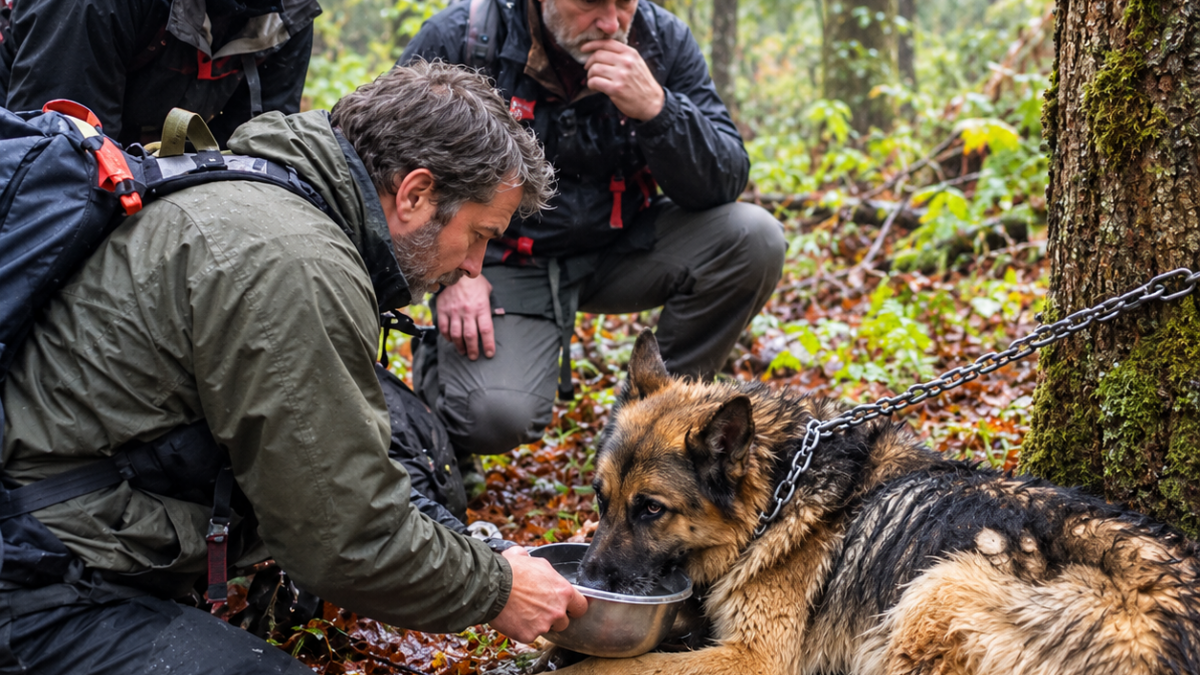
When we reached the tree again, Delphine was sitting beside the shepherd.
She had taken off her fleece jacket and tucked it around his body.
Julien held the dog’s head carefully.
His eyes met mine.
“Still here.”
The shepherd’s eyes opened.
Closer now, I could see scabs along his neck where the collar had rubbed.
The chain was thick enough for livestock.
A heavy padlock connected it to an iron ring around the tree.
Someone had not tied this dog temporarily.
Someone had made sure he could not leave.
Delphine whispered, “Look at his paws.”
The pads were torn.
Claw marks marked the dirt around the trunk.
He had tried to dig.
The circular ground around the tree had been stripped almost bare.
He had walked the same desperate radius so many times that he had carved a path into the earth.
“How long?” I asked.
Julien shook his head.
“No idea.”
A veterinary rescue team arrived eighteen minutes later.
Dr. Camille Renard led them.
She had worked with our group before after livestock accidents and injured search dogs.
The moment she saw the shepherd, her expression hardened.
“How long has he been like this?”
“We don’t know.”
She knelt.
The dog flinched when she touched his ribs but didn’t growl.
“Male. Adult. Maybe five or six.”
She checked his gums.
“Severely dehydrated.”
Heart.
Temperature.
Eyes.
Skin.
Then the collar.
“We need bolt cutters.”
A firefighter had brought them.
The chain snapped with a metallic crack.
I expected the dog to react.
He didn’t.
Freedom meant nothing to an animal too weak to stand.
Camille started fluids.
Then she scanned his shoulder.
The microchip reader beeped.
Everyone looked at her.
“He’s chipped.”
Julien exhaled.
“So we have an owner.”
Camille checked the number twice.
“Maybe.”
She called the registry.
The first surprise came quickly.
The dog had a name.
Orion.
The second surprise was worse.
His registered owner lived less than nine kilometers away.
A man named Gérard Vautrin.
One of the gendarmes at the scene stiffened when he heard it.
“You know him?”
The officer nodded slowly.
“Local hunting association.”
Julien looked around at the empty woods.
“Was he hunting with the dog?”
The gendarme stared at the chain.
“Not like this.”
Orion was carried down on a rescue tarp.
He weighed less than thirty kilograms.
A healthy shepherd his size should have weighed far more.
At the road, Camille loaded him into her vehicle.
“Where are you taking him?”
“My clinic.”
“Will he make it?”
She looked through the open rear door.
“I don’t know.”
Before she shut it, Orion raised his head approximately two inches.
His eyes moved past all of us.
Toward the mountain.
Maybe I imagined it.
But I thought of Léo.
“He’s looking for the boy,” Delphine whispered.
None of us laughed.
By afternoon, Léo was stable.
Mild hypothermia.
Dehydration.
Scratches.
No fractures.
No serious head injury.
Doctors expected a full physical recovery.
The police interviewed him only briefly.
Then they let him sleep.
Orion’s situation was more uncertain.
Camille called me at six that evening.
“Kidneys are stressed but functioning.”
“And?”
“He’s anemic. Malnourished. Multiple pressure sores. Old untreated injury to the left rear leg.”
“Can you save him?”
“I think so.”
I sat down.
Those three words were the best thing I had heard since “subject located alive.”
“But Marc…”
“What?”
“This wasn’t one bad day.”
I already knew.
“How long?”
“The neglect? Weeks, minimum. Possibly longer.”
“What about the tree?”
“I can’t tell how long he was chained there.”
“Could it have been one night?”
She was silent.
“No.”
The dirt around that trunk had already told us the same thing.
Orion had been waiting for someone long before Léo heard him.
The next morning, Gérard Vautrin was questioned.
His story was simple.
Orion had run away.
Three weeks earlier.
He said he had searched.
He said someone must have stolen the dog, chained him, and abandoned him.
He sounded outraged.
Then the gendarmes asked why he had never reported Orion missing.
He said he assumed the dog would return.
They asked why Orion’s old leather collar had been replaced with a heavy industrial collar.
He didn’t know.
They asked whether he recognized the chain.
He said no.
At first, there was nothing dramatic.
No confession.
No sudden breakdown.
Just a man shrugging through questions.
Then a photograph appeared.
A hiker had passed near that section of forest nine days earlier.
He had taken a landscape photograph.
In the background, barely visible between trees, was a man.
And beside the man was a German shepherd.
Investigators enlarged it.
The quality was poor.
But the jacket color was visible.
So was a white utility vehicle parked on an old forestry track.
Gérard owned a white utility van.
Still circumstantial.
Then they checked a wildlife camera maintained by forestry officials almost two kilometers away.
Nine days earlier, Gérard’s van had entered the restricted track.
Forty-three minutes later, it left.
No dog visible in the passenger seat.
The next morning, police returned to his property with authorization.
They found a spool of the same chain in an outbuilding.
They found matching padlocks.
And behind the shed they found Orion’s old dog bowl.
Gérard changed his story.
He said Orion had become difficult.
Aggressive.
He said the dog had attacked livestock.
He said he had taken him into the woods temporarily because he was trying to decide what to do.
The veterinary records showed no history of aggression.
Neighbors described Orion differently.
Gentle.
Quiet.
Once used for hunting, but increasingly left outside as Gérard lost interest.
One neighbor told investigators she had complained twice after seeing Orion without water during summer.
Another had offered to take him.
Gérard refused.
“That’s my dog,” he had reportedly said.
Those words would matter later.
Because ownership carries responsibility.
It doesn’t grant permission for cruelty.
Three days after the rescue, Léo was discharged from the hospital.
His first request was not to return to the campground.
It was to see Orion.
Claire called me.
“Do you think the veterinarian would allow it?”
I called Camille.
She hesitated.
“He’s fragile.”
“So is the boy.”
Another pause.
“Bring him.”
Léo arrived carrying a blue blanket.
His mother carried a bag of dog treats he wasn’t allowed to give Orion yet.
His father carried nothing.
Antoine looked like he hadn’t slept since the disappearance.
Camille met us outside.
“Léo?”
The boy nodded.
“He can’t play.”
“I know.”
“He may not stand.”
“I know.”
“And don’t give him food unless I say.”
Léo held up both hands.
“I won’t.”
Camille led us inside.
Orion lay in a large recovery kennel.
An IV line was attached to one front leg.
His coat had been partially clipped around wounds.
He looked smaller than he had beneath the tree.
Vulnerable.
Léo stopped at the door.
Orion’s eyes opened.
For several seconds, neither moved.
Then the dog’s ears shifted.
Barely.
Léo whispered, “Hi.”
Orion lifted his head.
Camille inhaled sharply.
He had done it before.
But not quickly.
Not like that.
Léo stepped closer.
“It’s me.”
Orion tried to stand.
His rear legs failed.
Léo burst into tears.
“No, no. Stay.”
He dropped to his knees outside the kennel.
“Don’t get up.”
Orion crawled forward.
One paw.
Then another.
Until his nose touched the bars.
Léo pushed his fingers through.
Orion smelled them.
Then licked his hand.
Claire turned away.
Antoine covered his face.
Camille pretended to check the IV pump.
I stood by the wall and failed completely at pretending anything.
Léo pressed his forehead against the kennel bars.
“I came back.”
Orion licked him again.
“I told you.”
The boy stayed forty minutes.
Before leaving, he unfolded the blue blanket.
“It was mine.”
Camille smiled.
“We can put it beside him.”
“So he knows.”
“Knows what?”
“That somebody’s coming back.”
Camille’s face changed.
She took the blanket.
“I think he already knows.”
Orion survived the first week.
Then the second.
Slowly, his appetite returned.
His kidney values improved.
He gained two kilograms.
Then four.
The first time he walked ten steps without assistance, Camille sent Léo a video.
Léo watched it sixteen times.
His mother told me.
By then, the story had spread through the region.
Missing child found alive.
Abandoned dog discovered during rescue.
Local owner investigated.
Reporters called.
Claire refused interviews at first.
So did Antoine.
They didn’t want their son’s worst night turned into entertainment.
I understood.
But rumors filled the silence.
Some people accused Gérard before charges had even been filed.
Others defended him.
People said the dog was aggressive.
People said Léo had invented parts of the story.
One social media post claimed our rescue team had staged the chained dog for donations.
That one made Julien furious.
“We should answer.”
“No.”
“They’re saying we planted him.”
“No.”
“Marc—”
“Police are investigating.”
“So we let people lie?”
“We let evidence work.”
I believed that.
Most days.
Then someone threw a dead rabbit over Camille’s clinic fence.
No note.
No message.
Just the body.
Camille called the police.
A week later, one of her employees found the words LIAR painted on the clinic’s side door.
That changed things.
Gérard denied involvement.
Police had no evidence connecting him.
But tension in the town increased.
The hunting association suspended him while the investigation continued.
He blamed everyone.
The veterinarian.
The rescue team.
Léo’s family.
He told a local café owner that “people cared more about one useless dog than a man’s reputation.”
The café owner later repeated the comment to police.
When Antoine heard, I thought he would explode.
“He said what?”
We were standing outside Camille’s clinic.
“Antoine.”
“My son nearly died because that man chained an animal in the middle of nowhere.”
“We don’t know that.”
“What?”
“We know Léo went into the woods because he heard Orion.”
“Exactly.”
“But blaming Gérard for Léo getting lost is legally and morally more complicated.”
Antoine stared at me.
“Marc, if that dog hadn’t been there—”
“Léo wouldn’t have followed him.”
“Yes.”
“Maybe.”
“Maybe?”
“And if Orion hadn’t barked?”
Antoine stopped.
I continued.
“Your son says the barking kept him away from the ravine.”
His anger collapsed into something more painful.
“That dog is the reason he disappeared.”
“Maybe.”
“And maybe the reason he survived.”
Antoine looked through the clinic window.
Orion was sleeping inside.
“How am I supposed to feel about that?”
“You don’t have to decide.”
But Antoine did decide one thing.
He wanted Orion.
When the authorities began looking for a long-term foster placement pending the legal case, Antoine and Claire applied.
Claire was cautious.
“Are we doing this because Léo feels guilty?”
“He doesn’t feel guilty,” Antoine said.
“He might.”
Léo was listening from the kitchen.
“I don’t.”
Both parents turned.
Léo looked at them.
“I promised him.”
Claire crouched.
“Honey, bringing a dog home isn’t just keeping a promise.”
“I know.”
“He needs medicine.”
“I know.”
“He may be scared.”
“I know.”
“He might never be able to do everything other dogs do.”
Léo frowned.
“Neither can Grandpa.”
Antoine coughed to hide a laugh.
Claire did not succeed.
“That’s different.”
“Why?”
No one had a good answer.
The foster assessment took two weeks.
Their yard was checked.
Their schedule reviewed.
Camille explained Orion’s rehabilitation.
Slow feeding.
Joint care.
Medication.
Trust building.
No off-leash exercise.
No pressure around food.
Léo listened more carefully than most adults.
On the day Orion was finally cleared to leave the clinic, he walked out wearing a new red harness.
He still moved awkwardly.
His rear leg dragged slightly.
His ribs were less visible.
His fur had begun to shine again.
Léo waited outside.
Orion saw him.
The shepherd stopped.
Then his tail moved.
Once.
Twice.
Then faster.
Léo crouched.
Orion walked toward him.
Not ran.
He couldn’t.
But I had never seen determination look more like running.
He reached the boy and pressed his head into Léo’s chest.
Léo wrapped both arms around his neck.
Camille cried openly this time.
No pretending.
Claire signed the foster papers.
Antoine loaded the dog bed into their car.
And I stood beside Julien watching the two survivors leave together.
Julien said, “You realize this is the strangest search we’ve ever done.”
“Not even close.”
He looked at me.
“What beats this?”
I thought for a moment.
“Ask me in ten years.”
The criminal investigation lasted months.
Longer than people expected.
That frustrated everyone.
Especially Antoine.
“Why isn’t he in court yet?”
“Because cases take time.”
“They have photographs.”
“Yes.”
“They have the chain.”
“Yes.”
“The dog.”
“Yes.”
“My son’s statement.”
“Yes.”
“What else do they need?”
“Enough evidence that doesn’t fall apart when a defense attorney touches it.”
Antoine hated that answer.
But it was true.
Then police found something unexpected.
Not about Orion.
About the forest.
Near the area where he had been chained, forestry officers discovered illegal wire snares.
Six of them.
One contained animal remains.
Another had been recently disturbed.
The investigation widened.
Gérard had hunted legally for years.
But the snares were illegal.
So was trapping in that protected section.
He denied knowing anything.
Then one of the padlocks found on his property matched the manufacturer and purchase batch of the lock used on Orion.
Still not enough by itself.
But the combination of evidence grew.
Wildlife camera footage.
The hiker’s photograph.
Chain.
Padlocks.
Veterinary testimony.
Neighbors.
Gérard’s changing statements.
Then came the strongest piece.
A receipt.
Eleven days before Léo disappeared, Gérard had purchased twenty meters of galvanized chain and three brass padlocks from an agricultural supply store.
The clerk remembered him because he had complained about the price.
Security video confirmed it.
His attorney argued the chain could have been used for anything.
That was true.
Then police compared the cut end of the chain remaining in Gérard’s shed with the section removed from Orion’s tree.
The manufacturing pattern aligned.
The physical break points did not prove they had once been one continuous piece beyond all doubt.
But investigators didn’t need one magical clue.
Real cases rarely have them.
They had a pattern.
And eventually, Gérard was formally charged with aggravated animal neglect and abandonment, along with separate wildlife offenses related to the illegal snares.
He still insisted he had intended to return.
“For what?” Julien said when we heard. “His birthday?”
I didn’t laugh.
Because part of me kept thinking about the empty bucket.
How many mornings had Orion opened his eyes beneath that tree?
How many engines had he heard in the distance?
How many times had he pulled at the chain when footsteps disappeared?
There is a particular cruelty in making an animal wait for a person who knows he is waiting.
The trial began almost nine months after the rescue.
By then, Orion weighed thirty-seven kilograms.
His coat was thick again.
The wounds around his neck had healed, leaving a pale scar beneath the fur.
His rear leg would never be perfect.
But he could walk.
Run short distances.
Climb the three steps to Léo’s front porch.
And steal roast chicken from kitchen counters.
According to Claire, the last problem proved he was fully recovered.
Léo did not attend most of the trial.
His parents didn’t want him sitting through photographs and testimony.
But his recorded statement was included.
I testified.
So did Julien.
Camille described Orion’s condition.
She used clinical words.
Severe dehydration.
Advanced malnutrition.
Chronic pressure lesions.
Muscle wasting.
Untreated orthopedic injury.
Prolonged exposure.
Then the prosecutor asked one question.
“In your professional opinion, could this condition have developed during a single night?”
Camille looked directly at the court.
“No.”
“A few days?”
“No.”
“How long?”
“Weeks of inadequate care at minimum. Some injuries were older.”
Gérard stared at the table.
Camille continued.
“This animal did not become thin because he got lost.”
The room was silent.
“He became thin while someone was responsible for feeding him.”
That sentence appeared in newspapers the next day.
Gérard’s attorney argued there was no proof his client had intended for Orion to die.
The prosecutor answered:
“Intent to kill is not the charge.”
That mattered.
Because people often imagine cruelty must involve violence.
Sometimes cruelty is quieter.
A chain.
An empty bucket.
Driving away.
Not coming back.
The wildlife charges were handled separately, but evidence from the forest damaged Gérard’s credibility.
The court found him guilty of abandoning and severely neglecting Orion.
He received a suspended custodial sentence under the applicable legal framework, substantial fines and costs, an animal ownership ban, and liability for much of Orion’s veterinary care.
Some people said the punishment wasn’t enough.
Antoine was one of them.
“At least put him in a cage for a month.”
Claire looked at him.
“Would that help Orion?”
“No.”
“Léo?”
“No.”
“Then what would?”
Antoine didn’t answer.
I understood his anger.
But the part of the judgment that mattered most to Léo came later.
Gérard permanently lost legal ownership of Orion.
The court authorized the dog’s transfer to the Martin family.
When Claire told Léo, he didn’t understand.
“He already lives here.”
“Yes.”
“But now…”
She knelt in front of him.
“Now nobody can take him back.”
Léo stared at her.
“Ever?”
“Not to Gérard.”
The boy turned toward Orion.
The dog lay beside the fireplace chewing a rubber toy.
Léo walked over.
He sat on the floor.
Then he whispered something into Orion’s ear.
Claire heard it.
She told me later.
“I kept my promise.”
A month after the court decision, something happened that finally broke through Antoine’s anger.
The hunting association contacted the family.
Not Gérard.
The association.
Its president asked to visit.
Antoine nearly refused.
Claire convinced him.
Three men arrived carrying an envelope.
Inside was money raised by local hunters for the mountain rescue group and the animal clinic.
Antoine looked confused.
The association president, an older man named Luc Bernard, said:
“What Gérard did was not hunting.”
Nobody spoke.
“He embarrassed all of us.”
Luc looked toward Orion.
“That dog worked beside hunters for years. He deserved retirement, not a chain.”
Then he crouched several feet away.
Orion watched him.
Luc didn’t reach out.
He waited.
Eventually, Orion stood.
Walked forward.
Smelled his hand.
Then returned to Léo.
Luc nodded.
“Smart dog.”
Léo smiled.
After they left, Antoine held the envelope.
“I thought they were coming to defend him.”
Claire said, “You expected a fight.”
“I’ve been expecting one for nine months.”
She touched his arm.
“You can stop.”
That was the real revenge, I think.
Not seeing Gérard convicted.
Not the fines.
Not the headlines.
Not watching someone who had dismissed a dog lose the legal right to own another one.
It was watching Orion become healthy in full view of everyone who had been told he was worthless.
It was seeing a boy who had almost frozen in the woods grow up beside the animal he refused to abandon.
It was replacing that empty bucket beneath the tree with a stainless-steel water bowl beside a warm kitchen.
But our story wasn’t finished.
One year after the search, Léo asked to return to the mountain.
Claire said no immediately.
“No.”
“Mom.”
“No.”
“I want to see it.”
“No.”
Antoine remained quiet.
Claire looked at him.
“Don’t.”
“I didn’t say anything.”
“You’re thinking.”
“I usually do.”
“He’s eight.”
“He was seven when it happened.”
“That’s not helping.”
Léo stood between them.
“I want Orion to see he’s not there anymore.”
Claire’s face changed.
“What?”
“The chain.”
Léo looked toward Orion.
“He thinks we might leave him.”
By then, Orion had developed one behavior that rehabilitation had not erased.
Whenever the family packed the car, he became anxious.
Not normal dog excitement.
Real anxiety.
Pacing.
Panting.
Standing between the humans and the door.
If someone carried luggage outside without him, Orion sometimes whined.
Camille believed he remembered being transported before his abandonment.
They worked on it gradually.
Short drives.
Positive routines.
Returning home.
But Léo had created his own explanation.
“He thinks cars mean someone leaves him.”
Claire crouched.
“We don’t know what he thinks.”
“I do.”
Maybe he did.
Maybe children understand abandoned animals in ways adults overcomplicate.
Eventually, Claire agreed to return under one condition.
I came with them.
So did Julien.
We chose a clear spring morning.
No press.
No ceremony.
Just the family, Orion, two rescuers, and a backpack full of water.
The walk from the old forestry track took forty minutes.
Orion moved slowly but steadily.
As we approached the location, his behavior changed.
His ears lowered.
His steps became shorter.
Léo noticed.
“It’s okay.”
Orion stopped.
The tree stood ahead.
The chain was gone.
Police had removed it as evidence.
But the scar around the trunk remained.
A pale ring where metal had cut bark.
Orion stared.
Then stepped backward.
Léo sat down immediately.
“We don’t have to go closer.”
Orion looked at him.
“See?”
The boy pointed.
“No chain.”
The dog remained still.
“No bucket.”
Léo opened his backpack.
He removed a collapsible bowl.
Poured fresh water.
Placed it on the ground.
Orion drank.
Léo smiled.
“This one is full.”
Claire started crying.
Antoine turned toward the trees.
Julien pretended to inspect his boots.
I had become used to grown men pretending not to cry around that dog.
Orion finished drinking.
Then something remarkable happened.
He walked toward the tree.
Slowly.
Nobody followed.
He smelled the base.
The bark.
The disturbed soil.
Then he raised one leg and urinated directly on the trunk.
Julien burst out laughing.
Antoine laughed next.
Then Claire.
Even I couldn’t help it.
Léo looked delighted.
“That’s what you think of it?”
Orion trotted back toward him.
For the first time, that tree became associated with laughter.
We continued uphill.
Toward the rocky overhang where we had found Léo.
The boy walked more slowly as we approached.
His memories were not as simple as Orion’s.
He remembered cold.
Darkness.
Branches that looked like hands.
Every sound becoming enormous.
“That’s it,” he said.
The rock shelter looked smaller in daylight.
Most frightening places do.
Léo stood beneath it.
“This is where I slept.”
Claire touched the stone.
“You didn’t sleep much.”
“No.”
He pointed downhill.
“I could hear him.”
Orion lifted his head.
Léo sat beside him.
“When you barked, I talked.”
His father asked, “What did you say?”
Léo shrugged.
“I told him stupid stuff.”
“What kind of stupid stuff?”
“My school.”
Julien smiled.
“I’m sure the dog appreciated the academic update.”
“I told him about Mathis cheating at soccer.”
“Important intelligence.”
“And I told him Mom would find us.”
Claire covered her mouth.
Léo looked at her.
“I knew you would.”
She hugged him.
This time he didn’t complain.
Then we walked toward the edge of the ravine.
Not too close.
I showed Antoine where the ground dropped away.
His face went pale.
“That close?”
“Yes.”
He looked at Léo.
The boy was throwing a stick for Orion behind us.
“You never told me.”
“You didn’t need the picture in your head.”
Antoine stared into the ravine.
“If the dog hadn’t barked…”
I didn’t let him finish.
“We don’t know.”
He nodded.
“I know.”
Then, after a moment:
“But I’m going to believe it anyway.”
I understood.
People need stories about how they survived.
Sometimes the exact physics matter less than gratitude.
We returned to the campground before sunset.
The owners had placed a small emergency information board near the trail entrance.
It included child-safety guidance.
Stay in sight.
Tell an adult before leaving.
Carry a whistle.
Stop moving if lost.
Find shelter.
Respond to searchers.
Léo read it.
Then frowned.
“They forgot one.”
“What?”
“If you hear a dog crying, get an adult.”
Julien laughed.
The campground owner didn’t.
He added it.
Two years passed.
Léo turned nine.
Orion turned approximately eight.
Nobody knew his exact birthday, so Léo chose the date of their reunion.
“That’s not his birthday,” Antoine said.
“It is now.”
Every year they celebrated with a dog-safe cake.
Every year Orion received more toys than any animal required.
And every year, on the anniversary of the search, Léo left one blue blanket at Camille’s clinic.
For another frightened animal.
When I asked why, he said:
“Because Orion had mine.”
At age ten, Léo joined a junior nature program.
At eleven, he learned basic first aid.
At twelve, he told me he wanted to join mountain rescue when he grew up.
His mother overheard.
“No.”
Léo sighed.
“Mom.”
“No mountains.”
“You live beside mountains.”
“Then rescue people somewhere flat.”
I laughed so hard she glared at me.
But Léo’s relationship with Orion changed as the boy grew.
At seven, he had protected the dog.
At nine, they were inseparable.
At eleven, Orion began slowing.
The old rear-leg injury caused arthritis.
Long walks became shorter.
Stairs became difficult.
Léo learned to notice.
He never pulled the leash.
Never rushed him.
If Orion stopped, Léo stopped.
One winter afternoon, I visited the family.
Snow covered the yard.
Orion lay beside the fireplace.
His muzzle had turned gray.
Léo sat beside him doing homework.
“You know dogs can’t solve fractions,” I said.
“He’s better than Dad.”
Antoine shouted from the kitchen.
“I heard that.”
Orion lifted his head.
Then dropped it again.
I sat beside Léo.
“He looks good.”
“He’s getting old.”
The boy said it quietly.
“Yes.”
“I don’t like it.”
“No.”
“How old were you when you started rescue?”
“Twenty-six.”
“Did you ever have a dog?”
“Yes.”
“What happened?”
“She got old.”
Léo waited.
Children always wait past the point adults hope they’ll stop.
“And?”
“She died.”
His pencil stopped.
“Were you there?”
“Yes.”
“Did it hurt?”
“Yes.”
He looked at Orion.
“Then why do people get dogs?”
I thought about that question for a long time.
“Because the ending isn’t the whole story.”
He looked unconvinced.
“You knew Orion might not live as long because of what happened to him.”
“Yes.”
“Would you still have wanted us to take him?”
“Yes.”
“Why?”
I nodded toward the dog.
“Because look at him.”
Orion was asleep beside a fire.
Warm.
Fed.
Safe.
Loved.
“That’s why.”
Léo understood.
Not completely.
Nobody understands that completely.
Three years later, Orion’s health declined.
He was around eleven or twelve.
Maybe older.
His heart remained good, but his hips became painful.
Medication helped.
Then helped less.
One morning he couldn’t stand without assistance.
Camille adjusted treatment.
He improved for several months.
Then one autumn week, he stopped finishing meals.
Claire called me.
“We’re close.”
I knew what she meant.
I went to the house.
Orion lay in the yard beneath a maple tree.
Léo was fourteen.
Tall now.
His voice deeper.
But when he looked up at me, I saw the seven-year-old beneath the rocky ledge again.
“He’s tired.”
I sat beside him.
“Yes.”
“He still drinks.”
“Yes.”
“He still looks at me.”
“Yes.”
“Maybe he’s not ready.”
“Maybe.”
Léo’s jaw tightened.
“I promised I wouldn’t leave him.”
“You haven’t.”
“If we…”
He couldn’t say it.
So I did.
“Helping him die peacefully isn’t leaving him.”
His eyes filled.
“It feels like it.”
“I know.”
“He stayed alive in that forest.”
“Yes.”
“He waited.”
“Yes.”
“What if he wants to keep waiting?”
I looked at Orion.
The dog lifted his head.
Léo immediately moved closer.
Orion rested his muzzle on the boy’s leg.
“Then listen to what he’s telling you now.”
Léo stroked the gray fur.
Camille came to the house the next afternoon.
Orion could no longer get into the car comfortably, so she brought everything with her.
The family chose the living room.
The same blue blanket Léo had given Orion years earlier had been washed hundreds of times but still existed.
Faded.
Thin.
Claire placed it beneath him.
Antoine sat on one side.
Claire on the other.
Léo held Orion’s head.
I stayed near the doorway.
I had not planned to remain.
Léo asked me to.
“You found us.”
So I stayed.
Camille explained every step.
No surprises.
No rushing.
Orion received medication that made him sleepy.
His breathing slowed.
Léo bent close.
“Hey.”
Orion’s eyes opened once.
“I came back.”
The same words he had spoken through kennel bars years earlier.
His voice broke.
“And I stayed.”
Orion’s tail moved.
Barely.
Once.
Then again.
Léo smiled through tears.
“You don’t have to wait anymore.”
Orion closed his eyes.
Camille waited.
Then gave the final medication.
He died with Léo’s hand beneath his cheek.
No chain.
No empty bucket.
No cold forest.
His people around him.
The boy who had heard him crying was the last voice he heard.
For a long time, nobody moved.
Then Antoine whispered:
“He saved our son.”
Claire shook her head.
“They saved each other.”
Léo looked at them.
“No.”
His face was wet.
“We all did.”
I thought that was probably the truest answer.
Orion was cremated.
Léo kept his old red harness.
The family buried the worn metal ID tag from his first life beneath the maple tree.
Not the ashes.
Those stayed inside.
Léo wanted the old tag outside because, as he put it:
“That dog doesn’t live there anymore.”
At the tree, they placed a small stone.
No dramatic inscription.
Just:
ORION
HE CAME HOME
Years later, Léo did exactly what his mother had once forbidden.
He joined a volunteer search-and-rescue youth program.
Not full operational rescue at first.
Training.
Navigation.
First aid.
Radio work.
Tracking.
Claire blamed me.
I accepted responsibility.
At eighteen, he qualified for field support.
His first major search involved an elderly hiker who had failed to return before nightfall.
I was nearing sixty by then.
Too old, according to my knees.
Still young enough, according to my stubbornness.
Léo stood beside me at the command post.
Full rescue jacket.
Radio clipped to his chest.
He was taller than I was.
“Scared?” I asked.
“No.”
“Liar.”
He smiled.
“A little.”
“Good.”
“Why good?”
“Fear makes you check twice.”
His team deployed.
Three hours later, they found the hiker with an injured ankle.
Alive.
When Léo radioed the message, his voice shook.
“Subject located.”
For one second, I was back in the Vercors forest.
Seven-year-old boy.
Thermal blanket.
Scratched arms.
A question none of us expected.
Is the dog okay?
After the rescue, Léo came back to command.
“You crying?”
“No.”
“You are.”
“Wind.”
“We’re indoors.”
“Mountain wind is persistent.”
He laughed.
Then his expression softened.
“I thought about Orion.”
“I know.”
“How?”
“Because I did too.”
Léo looked toward the dark mountain.
“If I hadn’t heard him…”
“Don’t.”
He looked at me.
“You always stop people from saying that.”
“Yes.”
“Why?”
“Because the life you have is built from what happened, not what almost happened.”
He thought about it.
“So I shouldn’t wonder?”
“Wonder all you want.”
“And?”
“Just don’t live there.”
He nodded.
That was advice I had needed myself.
For years, people called Orion a hero.
I never objected.
But I always tried to tell the story carefully.
He didn’t lead rescuers to Léo.
He wasn’t a trained search dog.
He didn’t break his chain and guide us through the forest.
Real life is usually less cinematic and more extraordinary.
A starving dog survived long enough for a child to hear him.
A child cared enough to follow the sound.
The child became lost.
The dog barked through the darkness.
The boy heard him.
The boy stayed beneath shelter instead of wandering farther.
Searchers found the dog.
Then found the boy.
And when adults were finally ready to carry Léo home, the seven-year-old refused to forget the creature still waiting beneath a tree.
That is enough.
More than enough.
I have coordinated hundreds of searches.
Some ended with families celebrating.
Some did not.
You remember all of them.
But whenever someone asks me which one changed me most, I think of that morning.
7:14.
Julien’s voice over the radio.
“I found something.”
The dog beneath the tree.
The empty bucket.
The chain.
Then fifty-eight minutes later, Léo beneath the rock.
Alive.
Cold.
Terrified.
And worried about someone weaker than himself.
Adults like to believe courage is something we teach children.
That morning, a child taught it to us.
He had spent sixteen hours lost in a mountain forest.
He had every right to think only about himself.
Instead, his first question was about a starving dog.
Years later, when Orion was old and safe beside a fireplace, I asked Léo if he remembered what he had been thinking when he refused to leave without him.
He laughed.
“I don’t know.”
“You said you promised him.”
“I remember that.”
“Why did that promise matter so much?”
Léo looked at Orion.
Then back at me.
“Because everybody had already left him once.”
I never forgot that answer.
Gérard left him.
Maybe others failed to notice before that.
A system took time to respond.
But eventually, someone stayed.
Julien stayed beside the tree.
Delphine stayed.
Camille stayed through the nights when Orion’s kidneys could have failed.
Claire and Antoine opened their home.
And Léo stayed for the rest of Orion’s life.
That is the part of the story I carry with me.
Not the chain.
Not the trial.
Not even the mountain.
The staying.
Because rescue is rarely one dramatic moment.
Sometimes it is sixteen hours of searching.
Sometimes it is cutting a chain.
Sometimes it is pouring water into your palm.
Sometimes it is a veterinarian returning to work at midnight.
Sometimes it is a frightened family learning how to care for a traumatized dog.
And sometimes it is a seven-year-old boy looking at exhausted adults and refusing to go home until they understand that saving one life does not make another life disposable.
We went into those woods looking for Léo.
We found him.
But we also found Orion.
And in the years that followed, I stopped thinking of that as a distraction from the rescue.
It was part of the rescue.
Maybe the most important part.
Because the boy came home.
The dog came home.
The man who abandoned him was held accountable.
The people who loved them learned to live without fear.
And years later, the little boy who once waited beneath a rock returned to the mountains wearing a rescue jacket of his own.
The first time I watched him disappear into the trees with a search team, Claire stood beside me.
She folded her arms.
“This is your fault.”
“Probably.”
“If he comes back with a dog…”
I smiled.
She pointed at me.
“Don’t.”
Three hours later, Léo returned.
No dog.
Just the missing hiker he had helped bring safely home.
Claire cried anyway.
So did I.
And somewhere in the center of everything that young man had become was one cold night when he was only seven years old, calling through a dark forest to a chained German shepherd he refused to forget.
We had spent sixteen hours trying to save Léo.
But the first words he gave us after we found him were not about himself.
They were about Orion.
“I’m not leaving without the dog.”
And in the end, he never really did.

