PART 2: A Wounded Bear Led Him to Gold—Then Southern California’s Biggest Gold Rush Swallowed an Entire Valley
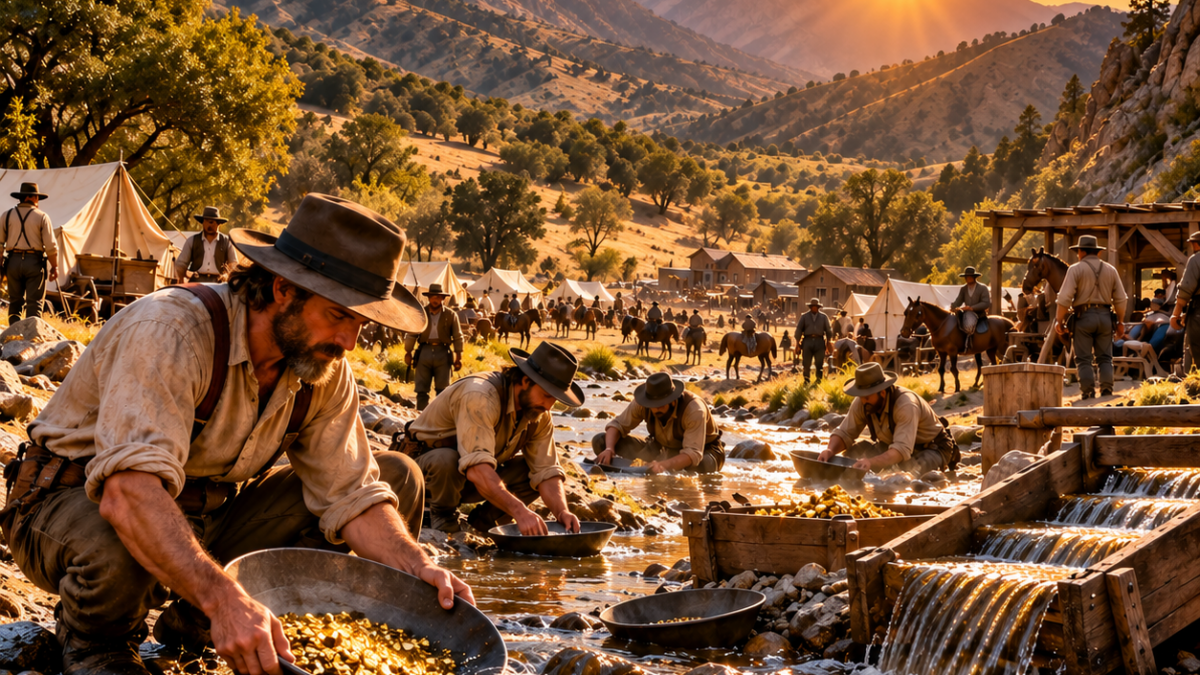
**A wounded bear ran across a forgotten mountain ridge in 1860, and the men chasing it had no idea they were seconds away from unleashing the biggest gold rush Southern California had ever seen.**
**Within weeks, a silent valley became a roaring town of miners, gunshots, saloons, mills, graves, and men willing to kill for a few ounces of yellow metal.**
**But standing there more than a century later, surrounded by pine trees and silence, I realized the most chilling part of the story wasn’t how quickly people came—it was what the valley eventually did to everything they built.**
The first thing that struck me about the mountains north of Big Bear Lake was how peaceful they were.
Not peaceful in the way a city park feels peaceful, with traffic somewhere beyond the trees and voices drifting from a nearby trail. This was a deeper kind of silence. The kind that made me lower my voice without knowing why.
I had started near the Big Bear Discovery Center with a Gold Fever Trail guide in my hand and about fifteen miles of mountain road ahead of me.
On paper, it sounded simple.
Follow the dirt road.
Stop at the numbered markers.
Look at some old mining sites.
Visit the remains of Southern California’s largest gold rush.
But the farther I drove from the paved road, the less it felt like a sightseeing trip.
The forest seemed to close behind me.
Big Bear Lake disappeared between the trees. The road narrowed. Gravel snapped beneath the tires. Pines crowded the slopes, and every turn carried me farther from restaurants, cabins, traffic, and the comfortable modern world I had left behind.
Then I remembered something that changed the way I saw the landscape.
In the 1850s, these mountains still belonged to grizzly bears.
Not the black bears people occasionally see around California today.
California grizzlies.
Huge, dangerous animals capable of turning a hunting trip into a fight for survival.
And one of those bears was the reason I was driving into this valley.
His name was Billy Hulcom.
Years before he reached these mountains, Hulcom had come west chasing the same dream that had pulled thousands of men across deserts, oceans, and mountain passes.
Gold.
He searched for years.
He failed for years.
By the time he reached the San Bernardino Mountains, fortune had not made him rich. Instead, his ability with a rifle had made him useful.
Other prospectors needed meat.
Hulcom could shoot.
So while other men searched creeks and hillsides for gold, he hunted bears to keep their camp supplied with food.
There is something almost cruelly ironic about that.
He had spent years chasing gold and finding almost none.
Then one day in May 1860, he stopped chasing gold.
He chased a bear instead.
According to the account later attributed to Hulcom, he and a companion named Ben Shoto wounded a grizzly and followed it across the mountains.
I tried to imagine them coming over the ridge.
Sweating.
Armed.
Watching the brush for movement.
Wondering whether an injured grizzly might suddenly turn and charge.
Then they looked down.
Below them was a valley few outsiders had seen.
To them, it must have seemed untouched.
Empty.
Waiting.
But it was not empty.
The Serrano people had known these mountains for thousands of years before prospectors arrived, and the coming rush would transform their world as violently as it transformed the landscape itself.
Hulcom and Shoto descended.
Somewhere near a seasonal stream, on May 4, 1860, they saw something in the rock.
Quartz.
And inside it—
gold.
Not a legend.
Not a rumor.
Not another false hope after years of disappointment.
Real gold.
I stood near the ridge more than 160 years later and stared into the quiet valley.
Wind moved through the pine needles.
Nothing else moved.
And that was when the real weight of the story hit me.
Because Hulcom had not simply discovered gold.
He had unknowingly lit a fuse.
Three days later, the men carried some of their discovery back toward civilization.
The secret escaped.
By late May, roughly a hundred miners were already pushing into the mountains.
By June, there were hundreds.
By July, the valley was exploding with prospectors.
A place that had been quiet only weeks earlier suddenly rang with axes, shovels, horses, shouting men, gunfire, hammers, saws, and the relentless pounding of machines.
Thousands of claims would eventually be filed.
Trees would fall.
Pits would be dug.
Rock would be shattered.
A town would rise almost directly on top of the discovery.
And men who had arrived dreaming about freedom would soon learn that gold had a price no one had mentioned.
As I drove deeper into the valley, I began to understand something.
The gold rush had not simply happened here.
It had attacked this place.
And for a few violent years, the valley seemed to surrender.
But only for a few years.
Because the mountains were going to take it all back.
PART 2
The first visible scar I found in the valley did not look dramatic.
It was a hole.
That was it.
A large depression in the earth surrounded by forest.
If I had driven past without the trail guide, I might never have understood what I was looking at.
But that hole told the first chapter of what happened after the discovery.
Placer mining.
When people imagine gold mining, they often picture men walking into dark tunnels carrying lanterns and pickaxes.
Here, much of the early mining was different.
Gold that had already broken free from surrounding rock collected among gravel and sand. Because gold was heavier than much of the surrounding material, miners could use water to wash away lighter dirt and separate what they wanted.
It sounds almost simple.
It was not.
Men tore into the ground.
They redirected water.
They shoveled earth day after day.
They searched every promising depression and stream bed.
And once one miner found something, ten more appeared.
Standing beside the old placer workings, I tried to remove the modern forest from my imagination.
No mature pine trees.
No quiet trail.
No peaceful mountain drive.
Instead I pictured mud.
Canvas tents.
Smoke.
Mules.
Cursing.
Men bent over water channels from sunrise until darkness.
Some of them had traveled thousands of miles because they believed one lucky week might change their family’s future forever.
Others were running from something.
Debt.
Failure.
The law.
A broken marriage.
A ruined business.
A past they hoped no one in the mountains would ask about.
Gold rushes attract dreamers.
They also attract predators.
And Hulcom Valley was about to discover the difference.
As more prospectors arrived, a settlement began taking shape.
They called it Belleville.
Today there is so little left that it takes effort to picture it.
Back then, it was impossible to ignore.
Stores appeared.
Blacksmiths worked beside roaring fires.
Butchers sold meat.
Saloons poured whiskey.
Men crowded around gambling tables.
Cabins rose where there had been trees.
Most people still lived in tents, crude shacks, or dugouts, but Belleville was becoming a real community at astonishing speed.
One day the valley had been wilderness.
A few months later, it had streets.
That speed mattered.
Because buildings could be raised faster than laws.
A saloon could open faster than a courthouse.
A man could buy a revolver faster than anyone could create a functioning justice system.
And the gold did not just bring opportunity.
It brought desperation.
I stopped at a site associated with a famous establishment remembered as Two Gun Bill’s.
The original saloon had been closer to town, and little remained at the marked site I visited.
A few pieces of wood.
Scattered debris.
Almost nothing.
I actually laughed when I first saw it.
After miles of mountain driving, the “historic remains” looked like the sort of thing most people would step over without noticing.
But the longer I stood there, the less funny it felt.
I imagined a night in Belleville.
Lantern light leaking through the cracks of crude wooden buildings.
Music from a dance hall.
Glasses striking a bar.
Coins hitting a table.
A man celebrating because he had found enough gold to pay every debt he owed.
Another man watching him from across the room.
Waiting.
A chair scraping backward.
A voice getting louder.
Someone reaching beneath a coat.
Then—
a gunshot.
Silence for half a second.
Another shot.
Men diving behind tables.
A woman screaming.
Outside, nobody even surprised anymore.
That was the world the gold created.
Hulcom himself was later associated with an account claiming gunfire could be heard at all hours. He described ordinary miners living among violence and suggested dozens of men were murdered during Belleville’s first two years.
Some old mining stories grow larger every time they are repeated.
Maybe every number cannot be proven.
Maybe some legends are exaggerated.
But the Hangman’s Tree was not invented simply because storytellers needed something dramatic.
The valley really did gain a reputation for lawlessness.
And as I approached the area associated with that tree, the story stopped feeling like an adventure about finding treasure.
It started feeling like a warning.
Gold does something strange to human beings.
A man can live his entire life satisfied with a modest house, enough food, and a few dollars in his pocket.
Then show him a neighbor who found a fortune overnight.
Suddenly “enough” becomes failure.
That was Belleville.
Thousands of men surrounded by the possibility that the next shovel of dirt could make them rich.
Imagine waking every morning knowing the man fifty yards away might strike a vein worth more than you would earn in twenty years.
Imagine watching someone who arrived after you buy better equipment, better food, better clothes.
Imagine working until your hands split open while another man walked into town with a pouch heavy enough to buy half the saloon.
Jealousy needed only a spark.
The valley supplied gunpowder.
Yet the most relentless sound in Belleville was not gunfire.
It was machinery.
At the site of Jonathan Tibbitz’s Grasshopper Quartz Mill, I found piles of rock tailings scattered across the landscape.
Again, the modern scene looked almost insignificant.
Rock.
Dirt.
Trees.
But in the gold rush years, a five-stamp mill operated in this area.
A steam engine powered heavy iron stamps.
Up.
Down.
Up.
Down.
Hour after hour.
Day after day.
Crushing gold-bearing rock.
I stood there listening to the wind and tried to replace it with the sound Belleville would have heard.
BOOM.
BOOM.
BOOM.
BOOM.
BOOM.
Twenty-four hours a day.
Men shouting over machinery.
Teams moving ore.
Steam hissing.
Metal striking stone.
The valley that had been quiet for generations suddenly shook beneath human ambition.
And that was when another detail became impossible for me to ignore.
Nearly every tree I was looking at had grown after the rush.
The miners had stripped the valley.
Think about that.
I stood surrounded by forest, yet the landscape itself was evidence of destruction.
The trees made the place beautiful.
They also hid the crime scene.
For a few years, men treated the valley as if anything standing between them and gold was disposable.
Trees.
Rock.
Streams.
Silence.
Even other men.
But mountains work on a different clock.
People measure wealth in days and years.
Mountains measure victory in centuries.
The miners believed they were conquering Hulcom Valley.
The valley was simply waiting.
I continued toward the center of Belleville.
The Hangman’s Tree marker came first.
The original tree no longer stood.
Only a stump remained in the general area.
I looked at it and imagined what justice must have meant in a place where official law arrived too slowly.
Maybe some of the men who died there were dangerous criminals.
Maybe some were victims of rough frontier justice.
History does not always preserve enough detail to separate legend from truth.
But the tree became a symbol.
A warning.
A place where the gold rush’s promise collided with its brutality.
I thought about the people arriving every week.
A young man stepping down from a mule with everything he owned tied behind the saddle.
He sees tents stretching across the valley.
He smells smoke.
He hears the stamp mill.
Someone points him toward an open patch of ground.
“First time up here?”
“Yeah.”
“You got a claim?”
“Not yet.”
“Then keep one hand on your shovel and the other where you can reach your gun.”
Maybe the newcomer laughs.
The older miner doesn’t.
“You think I’m joking?”
The young man looks toward town.
A fight spills out of a saloon.
Two men are shouting.
Someone else watches without moving.
“No,” he says quietly. “I guess you’re not.”
That was the contradiction of Belleville.
Every newcomer arrived imagining gold.
Many found mud.
Some found nothing.
Some found violence.
A few found fortunes.
And everybody believed tomorrow might change everything.
That belief kept them there.
It is one of the most powerful forces in human history.
Hope.
But hope becomes dangerous when it refuses to accept evidence.
By late May 1860, about one hundred miners had reached the valley.
By June, around three hundred.
Eventually the number swelled so dramatically that Belleville rivaled San Bernardino in size.
At its peak, roughly fifteen hundred people lived there.
Fifteen hundred.
I looked across an open area that now seemed capable of holding little more than trees, brush, and silence.
Then I tried to put fifteen hundred lives back into it.
A blacksmith swinging his hammer.
A storekeeper counting flour sacks.
A child chasing another child between tents.
A miner washing blood from his knuckles.
A woman sewing beneath weak lamplight.
A drunk asleep behind a saloon.
A mule refusing to move.
A gambler promising himself one final hand.
A man writing a letter home:
*I think I’m close.*
Perhaps that was the most common lie in every gold camp.
I think I’m close.
Close to the vein.
Close to the strike.
Close to enough money.
Close to going home.
Close.
Always close.
Belleville even developed stories grand enough to match its ambition.
One story claims the settlement nearly became the San Bernardino County seat, losing by only two votes.
It is a wonderful piece of frontier folklore.
The problem is that county historians say there is no evidence such an election actually happened.
That did not surprise me.
Gold rush towns manufacture legends almost as quickly as they manufacture graves.
People want history to be cleaner than it was.
They want heroes.
Villains.
Lost elections.
Hidden treasure.
Gunfights at noon.
But the real story of Belleville does not need exaggeration.
The truth is already extraordinary.
A bear led two men into a valley.
They found gold.
Within weeks, hundreds followed.
Within months, a town existed.
Within a few years—
almost everything was gone.
That is more dramatic than any legend.
And the destruction began almost immediately after success.
The easy gold became harder to find.
That is the part of gold rush history that photographs rarely capture.
At first, excitement feeds itself.
Someone discovers a rich pocket.
News spreads.
A merchant arrives.
Then another.
More miners follow.
Equipment improves.
Investment increases.
Everyone points to growth as proof that greater prosperity is coming.
But the rush is already consuming its own foundation.
The easiest deposits disappear first.
The shallow ground is worked.
The obvious gravel is washed.
The richest accessible quartz is attacked.
Now every ounce requires more labor.
More equipment.
More money.
More risk.
Eventually the valley is not paying men to stay.
Men are paying the valley for permission to keep hoping.
That is when desperation changes character.
A successful miner can be generous.
A desperate miner becomes suspicious.
Someone steals tools.
Someone jumps a claim.
Someone accuses someone else of cheating.
A card game goes wrong.
A debt is not paid.
A rumor begins.
“There’s a rich vein north of the creek.”
“Who told you?”
“Doesn’t matter.”
“You believe him?”
“I believe he bought a new mule.”
By sunrise, twenty men are digging.
By sunset, they hate one another.
By the next morning, the vein proves worthless.
No one apologizes.
This was the revenge gold took on those who worshiped it.
It made men believe ownership and happiness were the same thing.
Then it kept moving just beyond their reach.
I walked toward the area where Hulcom’s original discovery had been made.
A seasonal stream crossed the landscape.
It was dry when I saw it.
Nothing about it looked capable of changing history.
But somewhere near there on May 4, 1860, a little gold exposed in quartz had changed the future of the entire valley.
I crouched near the ground.
For a ridiculous second, I looked for a glint.
I knew better.
But that is the power of the story.
More than 160 years later, even a visitor who had no intention of mining could feel the temptation.
What if?
What if one piece remained?
What if everyone else had missed it?
What if a flash of yellow appeared beneath one ordinary stone?
That thought made me understand the miners more than any history book could.
Gold does not need to speak loudly.
It whispers one sentence.
*Maybe you’ll be the one.*
And human beings do the rest.
I imagined Hulcom standing near that stream after years of failure.
Maybe he stared at the quartz without breathing.
Maybe Shoto leaned closer.
“Billy.”
“I see it.”
“Is that—”
“I see it.”
Neither man moves.
Years of disappointment sit between them and that glitter.
“How much?”
Hulcom shakes his head.
“Enough.”
“Enough for what?”
He looks up.
And perhaps that was the question nobody could answer.
Enough for what?
Enough to change their lives?
Enough to attract hundreds of people?
Enough to destroy the quiet?
Enough to build Belleville?
Enough to kill men?
Enough to erase a way of life that existed before them?
Enough to strip the forest?
Enough to become history?
Yes.
It was enough for all of that.
But not enough to last.
The gold had another trick waiting.
Winter.
By 1862, only two years after the discovery, the rush was already weakening.
Think about how fast that is.
Some people spend longer renovating a house than Belleville spent becoming one of the most important mining communities in Southern California and beginning its collapse.
The easy gold had diminished.
Claims disappointed their owners.
Men left.
Businesses lost customers.
Then the winter of 1862 arrived.
The mountains stopped negotiating.
Snow does not care how much gold you found yesterday.
Cold does not care how important your saloon was in July.
A blizzard does not recognize property lines.
Imagine Belleville under snow.
The stamp mill slows.
Trails disappear.
Supplies become harder to move.
Canvas tents sag under accumulation.
Firewood becomes survival.
Men who once argued about claims now worry about getting through the night.
A merchant opens a crate and realizes there is less food than he thought.
A miner looks at the snow outside his shack.
“We can wait it out.”
His partner shakes his head.
“With what?”
“We’ve got flour.”
“For how long?”
Silence.
“What about the claim?”
“What about staying alive?”
That was the valley’s answer to human ambition.
For two years, men had cut down trees, blasted rock, diverted water, dug pits, and treated the mountains like a vault they had the right to break open.
Then the mountains changed the weather.
And people fled.
By 1864, Belleville was essentially dead.
Four years.
That is all.
Four years from discovery to near disappearance.
Standing there, I felt something I had not expected to feel.
Sadness.
Not because the gold rush ended.
It had brought too much destruction for nostalgia to be simple.
I felt sad because places like Belleville are filled with unfinished human sentences.
A home someone planned to improve.
A business someone believed his children might inherit.
A friendship that ended suddenly.
A grave nobody visits.
A letter that never reached its destination.
A claim somebody swore would become rich next week.
A person who told his family, “I’ll be back when I’ve made enough.”
Then never returned.
That was why Ross’s grave affected me more than I expected.
Very little is known about Ross.
According to the guide, he was killed while cutting down a tree and buried where he fell.
No grand legend.
No famous gunfight.
No fortune.
A tree killed him.
That was his surviving story.
I followed the trail toward the grave.
At one point the path split, and for a moment I wasn’t certain which direction to take.
Then I saw the fenced area.
Someone had cared enough to mark the place.
The original fence had not survived intact, and parts of it had eventually been preserved elsewhere.
The grave itself had been vandalized over the years.
There was no dramatic monument waiting for me.
Just a lonely patch of mountain ground.
Pine cones covered it.
The irony was so dark I actually laughed.
A man killed by a tree, buried beneath trees, his grave now covered by what the trees continued to drop.
Then the humor faded.
Who was Ross?
Did he have a wife somewhere?
Children?
Parents waiting for a letter?
Did someone in 1860 know exactly what his laugh sounded like?
Did anyone keep waiting after he was already under the ground?
History had forgotten almost everything about him.
Gold rush stories celebrate the men who struck it rich.
But for every name carved onto a plaque, there were hundreds like Ross.
Men who came.
Worked.
Suffered.
Died.
And disappeared almost completely from memory.
I stood beside his grave and thought about a letter that might never have existed but easily could have.
*Dear Mother,*
*The mountains are beautiful. Work is difficult, but there is gold here. Tell everyone I will come home when I have enough.*
How many mothers received letters like that?
And how many never received the next one?
Gold did not simply create fortunes.
It created absences.
Across the road stood another strange reminder that life in the valley had not been entirely about dramatic discoveries and violence.
The Pygmy Cabin site.
An unusually small cabin once stood there. Stories offered different explanations for its size. Maybe the builder hurried to finish before bad weather. Maybe he simply wanted to return to prospecting.
Years later, the tiny structure even served as a barber shop.
That detail made me smile.
A barber shop.
In a landscape remembered for grizzly bears, hangings, gunfire, mines, and gold, somebody still needed to sit in a chair and say, “Take a little off the sides.”
That ordinary detail mattered.
Because Belleville was not a movie set.
It was a place where people tried to live.
They ate.
They shaved.
They repaired clothes.
They got sick.
They fell in love.
They got lonely.
They argued.
They made bad decisions.
They dreamed about leaving.
Some probably dreamed about staying.
Then the valley made the decision for them.
The Pygmy Cabin survived far longer than Belleville itself before burning in November 1983.
Only the fireplace remained.
Another building returned to absence.
Another human attempt at permanence defeated by time.
From there, the road changed.
Up to that point, the dirt route had been relatively manageable.
After Belleville, it became rougher.
The climb out of the valley felt appropriate.
The easy part of the journey was over.
So was the easy gold.
I shifted into a slower pace as rocks grew larger beneath the tires.
The drop beside the road became more serious.
The valley fell away behind me.
That was when I thought about Billy Hulcom returning in 1875.
Fifteen years after the discovery.
Imagine that.
A man comes back to the place that made his name.
He remembers thousands of people.
Noise.
Hammers.
Whiskey.
Gunshots.
Smoke.
Arguments.
Mules.
Stamp mills.
Now he finds remnants.
A few camps survive.
But the great rush is gone.
Nature has already begun covering the evidence.
I wondered what he felt.
Pride?
Regret?
Disbelief?
Maybe all three.
If I had been him, I think the silence would have been unbearable.
He had discovered something that changed the valley forever.
Yet the valley was proving that “forever” was a word humans used carelessly.
I imagined Hulcom standing alone, looking toward the place where Belleville had once roared.
A younger prospector approaches.
“You Billy Hulcom?”
He nods.
“The Billy Hulcom?”
“That depends who’s asking.”
The young man smiles.
“They say you started all this.”
Hulcom looks across the quiet ground.
“No.”
“But you found the gold.”
“I found some rock.”
“You became famous.”
Hulcom does not answer.
The young man gestures toward the fading camps.
“Must feel strange.”
Now Hulcom looks at him.
“Strange isn’t the word.”
“What is?”
He turns back toward the valley.
“Temporary.”
That was the word I kept thinking about.
Temporary.
Fortunes.
Towns.
Claims.
Saloons.
Reputations.
Even gold rushes.
Temporary.
The mountain was not.
My next stop was a hard-rock mine.
This was closer to the image most people carry when they hear the word “mine.”
A dark opening driven into solid rock.
Instead of washing loose gravel for placer gold, miners followed gold-bearing quartz into the hillside.
That changed everything.
Now they had to break the mountain itself.
Excavate rock.
Haul it out.
Crush it.
Process it.
And every stage required labor and machinery.
The trail guide described the staggering difficulty of bringing heavy equipment into this mountain district.
One early mill boiler reportedly required twenty-seven days to travel from Los Angeles to the mining area.
Twenty-seven days.
I had reached these places in a vehicle in a fraction of that effort, and I was still complaining about rough roads.
Imagine moving a massive boiler by animal power.
No highway.
No modern truck.
No hydraulic equipment.
Every steep grade becomes a problem.
Every narrow passage becomes a calculation.
Every broken wheel becomes disaster.
Men must have stood beside those loads and cursed the mountain.
“Pull!”
The animals strain.
The wheels shift inches.
“Again!”
A rope tightens.
Someone shouts.
“Watch that side!”
A wheel slides toward the edge.
Men throw their weight against the load.
For a terrible second, the machine seems ready to roll backward and crush everything behind it.
Then it stops.
Twenty-seven days of that.
All to reach a valley whose great boom would barely survive a few years.
That fact almost felt cruel.
But gold creates a strange form of mathematics.
People calculate potential profit before they calculate suffering.
If a vein might contain enough money, twenty-seven days becomes reasonable.
If it might make you rich, danger becomes investment.
If someone else is getting richer, caution starts looking like cowardice.
I walked toward the mine entrance.
Tailings spread across the slope.
Every piece of broken rock outside had once been inside the mountain.
That sounds obvious until you see the piles.
Then you understand the amount of human effort represented by what looks like rubble.
Someone drilled it.
Someone broke it.
Someone loaded it.
Someone moved it.
Someone processed it.
Someone hoped.
The entrance itself was low and dark.
I normally dislike old mines for good reason.
Collapsed rock.
Bad air.
Unstable ceilings.
Unknown animals.
Darkness has a way of making every rational warning louder.
This particular tunnel was considered accessible, but stepping inside still changed my breathing.
Daylight narrowed behind me.
The temperature shifted.
Sound changed.
My footsteps came back from the walls.
The ceiling forced me to crouch in places.
Ahead, the tunnel divided.
Two branches ended relatively quickly.
One continued deeper.
I called into the darkness.
No growl.
No movement.
Just my own voice returning.
I kept going.
Every few feet, I thought about the miners.
No electric headlamps.
No modern safety gear.
No emergency rescue team waiting outside.
They entered because the rock might contain gold.
Swing.
Strike.
Drill.
Blast.
Clear.
Repeat.
Imagine spending ten hours underground and emerging with lungs full of dust, muscles shaking, and no guarantee that anything you had broken contained enough gold to justify the effort.
Then returning tomorrow.
And the next day.
And the next.
This was where the revenge of the valley became physical.
The easy gold had invited them.
The deeper gold punished them.
A miner could see gold-bearing quartz and still lose money extracting it.
That is one of the great misunderstandings about mining.
Gold in the ground is not the same as wealth.
If recovering one hundred dollars of gold costs one hundred and twenty dollars, you have not discovered treasure.
You have discovered an expensive rock.
Eventually that reality killed rushes like this one.
The region did not necessarily become completely empty of gold.
It became empty of gold that could be profitably reached with the available technology and economics.
There might still be gold under your boots.
That does not mean you can afford to own it.
I reached the end of the main tunnel.
A couple hundred feet of mountain stood between me and daylight.
I turned off my light for only a moment.
Complete darkness.
Not nighttime darkness.
Not a bedroom with curtains closed.
Total absence.
I imagined a miner alone there in the 1860s.
His candle flickers.
He has spent months chasing a vein that grows thinner every week.
His partner wants to abandon the claim.
His money is almost gone.
He has written home claiming success because he cannot bear to admit failure.
He strikes the rock.
Once.
Twice.
Again.
His partner calls from behind him.
“Enough, Tom.”
“One more foot.”
“You said that yesterday.”
“One more foot.”
“There’s nothing here.”
“You don’t know that.”
“I know we’re broke.”
Tom swings harder.
“You leave if you want.”
“I’m not leaving you buried in a mountain.”
“Then help me.”
“With what money?”
Tom finally turns.
His face is dirty.
His eyes are furious.
“It’s here.”
“You don’t know that.”
“It has to be.”
“No, it doesn’t.”
That sentence destroys him.
Because the entire gold rush depends on refusing to believe it.
It has to be here.
It has to work.
I have come too far.
I have spent too much.
I cannot stop now.
That is not just mining psychology.
That is human psychology.
We confuse persistence with wisdom because giving up feels like admitting every sacrifice was wasted.
But sometimes stopping is the only way to save what remains.
Many men in these mountains learned that too late.
When I stepped back into daylight, I felt relief.
The forest looked brighter than before.
The air felt cleaner.
Yet my journey was not finished.
The roughest road came next.
The track climbed along the mountainside with a steep drop to one side.
The Mojave Desert began appearing in the distance.
The view was extraordinary.
The road demanded attention.
Beauty and danger existed together.
That seemed appropriate for everything I had learned about the gold rush.
The mountains were beautiful enough to make people believe they were blessed.
Dangerous enough to remind them they were guests.
Eventually I reached the final major stop.
Gold Mountain.
Also associated with the Lucky Baldwin Mine.
Below lay the former site of another mining settlement that eventually became known as Doble.
Once again, I looked across a landscape where almost nothing visible suggested the level of activity that had taken place there.
The last major gold discovery in the area came in 1873.
Two brothers, Barney and Charlie Carter, were traveling toward another mine when they camped near Baldwin Lake.
They saw something shining on the mountain.
That sentence sounds like the opening of a legend.
They climbed.
They found gold.
But they made a choice different from the fantasy most people associate with prospectors.
They sold their claim.
Elias “Lucky” Baldwin bought it for $30,000.
That was serious money.
And Baldwin did what wealthy investors do when they believe a resource can be developed at scale.
He expanded.
By 1876, around 180 men were working the mine.
A settlement grew below.
Again.
The pattern repeated.
Discovery.
Excitement.
Labor.
Buildings.
Population.
Investment.
Hope.
Then decline.
The town later known as Doble eventually faded as mining weakened.
By 1903, it was virtually a ghost town.
I stood near remnants of later mining operations, including structures from attempts to revive extraction decades after the original rush.
That fascinated me.
Every generation seemed to look at the abandoned mountain and say the same thing.
*They missed something.*
Maybe the old miners lacked technology.
Maybe prices had changed.
Maybe new equipment could reach ore the previous generation could not profitably process.
Maybe this time would be different.
Men returned.
Machines returned.
Hope returned.
Then silence returned.
Every time.
That was the mountain’s final victory.
Not that it contained no gold.
It contained just enough gold to keep calling people back.
Enough to make abandonment feel premature.
Enough to feed another dream.
Enough to make someone say, “Those fools gave up too soon.”
Then the mountain charged its price again.
Labor.
Capital.
Time.
Risk.
Lives.
When people could no longer pay, it kept the rest.
Looking across the slope, I began thinking about the entire journey as one long act of revenge.
Not revenge in the human sense.
The valley had no anger.
The mountain had no memory.
Nature did not sit in judgment of miners.
But there was something poetic about what happened.
Men arrived believing gold gave them power.
They stripped trees.
Cut roads.
Dug pits.
Blasted tunnels.
Built saloons.
Raised mills.
Fought over claims.
Killed one another.
Named towns.
Drew property lines.
Declared ownership.
Then winter came.
The gold became harder to reach.
Businesses failed.
Miners left.
Buildings collapsed.
Fire consumed what remained.
Trees returned.
Roads vanished.
Graves lost names.
Even the Hangman’s Tree became a stump.
The valley did not need to destroy the men in one dramatic moment.
It simply outlived them.
That is the most complete revenge anything can take against arrogance.
Outlasting it.
I thought again about the Serrano people who had known this region long before outsiders arrived hunting gold.
For prospectors, the valley looked like an undiscovered opportunity.
But “undiscovered” is often a word used by newcomers who do not recognize the people already there.
The gold rush changed more than the economic history of Southern California.
It disrupted a landscape with an older human story.
That truth complicated the romance.
We love gold rush stories because they seem to promise transformation.
A poor man can become rich.
A nobody can become famous.
A forgotten valley can become important overnight.
But transformation always has a cost.
Sometimes the people paying it are not the people collecting the gold.
I sat for a while looking across the mountains.
No stamp mill pounded.
No gunshots rolled through Belleville.
No mule train strained up the road.
No miner shouted that he had made a strike.
The loudest sound was wind.
After everything, the valley had recovered its first language.
Silence.
And suddenly I understood why the absence of ruins had bothered me earlier.
I had wanted more evidence.
More walls.
More machinery.
More buildings.
Something dramatic enough to justify the stories.
At the first stops, I had almost joked about the lack of remains.
A hole in the ground.
A few boards.
A can.
A pile of rocks.
But now I realized the emptiness was the most important artifact.
Belleville had once been large enough to rival one of the region’s established communities.
Now a visitor could stand where its streets had been and struggle to prove a town existed at all.
That disappearance was not disappointing.
It was the ending.
Human beings build things because we need to believe they will last.
A house.
A company.
A fortune.
A reputation.
A town.
We attach our names to land and buildings because naming something feels like defeating time.
Belleville.
Gold Mountain.
Lucky Baldwin Mine.
Hulcom Valley.
But names do not stop decay.
Money does not stop snow.
Gold does not stop death.
And ambition does not make a mountain care.
I thought about Billy Hulcom one final time.
He came west searching for fortune.
For years, he failed.
Then while hunting a wounded bear, he found the thing that thousands of men wanted more than almost anything else.
Gold.
His discovery put his name into history.
Yet the valley that carried his name became famous not because prosperity lasted there.
It became famous because prosperity vanished.
That felt almost unfair.
Imagine spending years wanting one thing.
Finally receiving it.
Then watching what it does.
Did Hulcom ever wonder whether he would have been happier if the bear had escaped in another direction?
If he had crossed a different ridge?
If sunlight had not hit the quartz at exactly the right angle?
History often turns on moments that looked meaningless when they happened.
A bear runs.
Two men follow.
One man glances down.
A rock shines.
A civilization of tents, mills, stores, saloons, roads, graves, and dreams appears.
Then disappears.
All because of a few seconds on an ordinary day in May.
By the time I began heading back, late light had changed the color of the mountains.
The shadows grew longer.
The Mojave stretched beyond the ridge.
The rough road still demanded concentration, but emotionally the journey felt different now.
On the way in, I had been searching for the gold rush.
On the way out, I understood I had actually been searching for what the gold rush left behind.
Those are not the same thing.
Gold rush history is usually told at the moment of arrival.
Men running.
Claims being staked.
Gold pans flashing in streams.
Businesses opening.
Fortunes being made.
But the more revealing story begins after the crowd leaves.
Who stayed?
Who was buried?
Who lost everything?
What happened to the buildings?
What happened to the forest?
What happened when the money stopped?
In Hulcom Valley, the answer surrounded me.
Nature returned.
Trees grew where tents had stood.
Needles covered old workings.
Rain softened scars.
Snow buried roads.
Wood rotted.
Metal rusted.
Fire erased structures.
People forgot names.
The mountain closed over the noise.
It did not happen quickly enough for one miner to watch the whole process.
That is why people underestimate nature.
We expect revenge to arrive dramatically.
A storm.
A collapse.
A flood.
A fire.
But the most powerful forces do not need dramatic timing.
Give a forest a century.
Give rain a century.
Give frost a century.
Give roots a century.
Then come back and show me your empire.
I passed the remains of Belleville again.
For a moment, I stopped.
I did not see ruins anymore.
I saw people.
Not ghosts.
People.
A blacksmith named Jed Van Dusen working near his forge.
His family becoming part of the settlement’s identity.
His wife making an American flag for the community’s first Fourth of July celebration.
Their daughter Belle, whose name became connected to the town.
I imagined that celebration.
After months of dirt, labor, violence, and uncertainty, people gather.
Someone raises the handmade flag.
For one day, Belleville does not feel like a temporary camp.
It feels like a home.
A child looks up.
“Is this town going to stay forever?”
An adult laughs.
“Forever is a long time.”
“But are we staying?”
He looks around.
Cabins.
Smoke.
Businesses.
Men everywhere.
Why wouldn’t they?
“Yeah,” he says. “I think we are.”
That imagined answer hurt more than I expected.
Because no one standing there could know how little time remained.
Within a few years, most would be gone.
The Fourth of July flag would outlive the boom in memory.
Belleville itself would become a historical plaque.
That is what made the story emotional for me.
Not the gold.
The certainty.
People always believe the world they are living in is more permanent than it is.
A thriving business feels permanent on the day customers line up outside.
A marriage feels permanent at a wedding.
A town feels permanent while buildings are going up.
A fortune feels permanent while the money is still coming in.
Belleville was full of people who mistook momentum for permanence.
Then reality collected its debt.
I walked near the old town site one last time.
There was no crowd.
No saloon door swinging open.
No gambler shouting.
No blacksmith hammering iron.
No steam engine.
No stamp mill.
No prospector racing through town with a gold sample in his hand.
Just wind through trees that had not even existed when Belleville lived.
That detail stayed with me.
The miners cut down the forest.
The forest returned.
The miners did not.
I placed my hand against the bark of one pine.
It was younger than the gold rush.
Yet it felt older than everything humans had tried to build there.
I thought of Ross.
I thought of the anonymous dead.
I thought of miners underground striking stone because quitting felt impossible.
I thought of merchants watching customers disappear.
I thought of the Serrano whose homeland changed around them.
I thought of the Carter brothers choosing to sell their claim instead of betting their lives on extracting it.
I thought of Lucky Baldwin employing 180 men on another mountain that would eventually fall silent too.
Then I thought about the bear.
The animal at the beginning of everything.
The wounded grizzly that never knew men were following it toward a discovery that would reshape the mountains.
According to the story, the bear eventually died.
Hulcom and Shoto did not recover it until days later.
By then, the meat had spoiled.
The entire hunt had failed in the most literal sense.
They went into the mountains to bring back food.
They lost the bear.
And came back with gold.
For anyone else, that would sound like impossible luck.
But after seeing the full story, I was no longer sure “luck” was the right word.
The gold gave Hulcom what he had spent years chasing.
Then it summoned thousands of strangers.
The valley was stripped.
Men fought.
Men died.
A town rose.
A town collapsed.
More discoveries created more camps.
Those camps collapsed too.
Decades later, people returned with newer machinery to chase what previous generations had left behind.
Again and again, the mountain let them believe there was still one more fortune waiting.
Eventually almost everyone disappeared.
The grizzly disappeared too.
California’s last credible grizzly sighting came decades after Hulcom’s discovery, and the animals that once ruled these mountains were gone.
That may be the darkest symmetry in the entire story.
The miners changed the valley.
The wider world changed the wilderness.
Species vanished.
Communities vanished.
Towns vanished.
Only the mountain remained.
As I drove down the final stretch, civilization slowly returned.
The road improved.
Buildings appeared.
Traffic increased.
Big Bear Lake came back into view.
Within a short distance, I had moved from a landscape that felt almost forgotten into a living mountain community.
People were eating, shopping, driving, laughing.
Most probably had no idea that only a few miles away, another town had once believed it had a future just as real as theirs.
I did not find gold that day.
I found something better.
Perspective.
Gold has always fascinated human beings because it resists decay.
Iron rusts.
Wood rots.
Paper burns.
Gold can survive.
Maybe that is part of the reason we value it so much.
We want to own something time cannot easily destroy.
But the irony of Hulcom Valley is that the gold survived while the people chasing it did not.
Some of it is probably still beneath those mountains.
Locked in quartz.
Buried under earth.
Waiting.
But Belleville is gone.
The miners are gone.
The saloons are gone.
The stamp mills are gone.
The violence is gone.
The fortunes are gone.
Even the dreams are gone except for what history managed to record.
The thing everyone wanted most became the thing that mattered least.
And the supposedly empty valley won.
That was the ending I had not expected when I began the drive.
I thought I was visiting the birthplace of Southern California’s biggest gold rush.
Instead, I visited its grave.
Yet it did not feel tragic in the way I expected.
There was something satisfying about seeing the forest standing again.
Something almost merciful about the silence.
The valley had endured greed, violence, axes, blasting, machinery, winter, abandonment, repeated attempts at revival, and more than a century of people searching through its remains.
Still it survived.
Not untouched.
Never untouched.
But alive.
The miners had spent years asking one question.
“How much gold is left?”
Standing there, I found myself asking another.
“How much of us will be left?”
A hundred years from now, what will survive from the things we are fighting over today?
Our houses?
Our companies?
Our arguments?
Our status?
Our money?
Maybe.
Maybe not.
But the mountains will probably still be there.
Wind will still move through the trees.
Snow will still fall.
Water will still search for the lowest ground.
Roots will push through whatever we abandon.
That was Hulcom Valley’s final revenge.
It never had to fight the people who tried to conquer it.
It simply waited until they were gone.
And perhaps that is why the valley felt so quiet when I left.
Not empty.
Quiet.
There is a difference.
Empty means nothing happened.
Quiet means the noise ended.
And in those mountains, an unbelievable amount of noise had ended.
The pounding of stamp mills.
The crack of rifles.
The shouting of miners.
The creak of wagons.
The roar of saloons.
The arguments over claims.
The celebrations after strikes.
The curses after failures.
The desperate promise whispered by men who refused to leave:
“One more day.”
“One more tunnel.”
“One more pan.”
“One more chance.”
All of it had stopped.
The valley had heard every promise.
It had buried every argument.
It had watched fortunes arrive and disappear.
And now, more than a century later, it asked for nothing.
As I reached the paved road again, I looked back toward the mountains.
Somewhere beyond those ridges was the seasonal stream where a little flash of gold changed Southern California history.
Somewhere nearby were the graves of people whose names had nearly vanished.
Somewhere beneath the rock, there may still have been gold no one could profitably reach.
And somewhere in that silent forest, trees were growing over the places where men once believed they were building something permanent.
I finally understood the lesson the valley had been trying to show me all day.
Billy Hulcom went into those mountains looking for a bear and found gold.
Thousands followed the gold looking for freedom.
Some found wealth.
Some found violence.
Some found graves.
Almost all of them eventually left.
But the valley stayed.
It absorbed the wounds.
It covered the scars.
It grew another forest.
And after men had spent years tearing the mountains apart trying to possess what was hidden inside them, the mountains took back the only thing that had ever truly belonged to them.
The silence.
I drove away without looking for another glint in the dirt.
For the first time all day, I did not care whether there was still gold beneath my feet.
I already knew who had won.

