PART 2: A Woman Screamed That Her Little Dog Was Still Inside the Sinking Truck—Then My Partner Jumped Into the Black Water
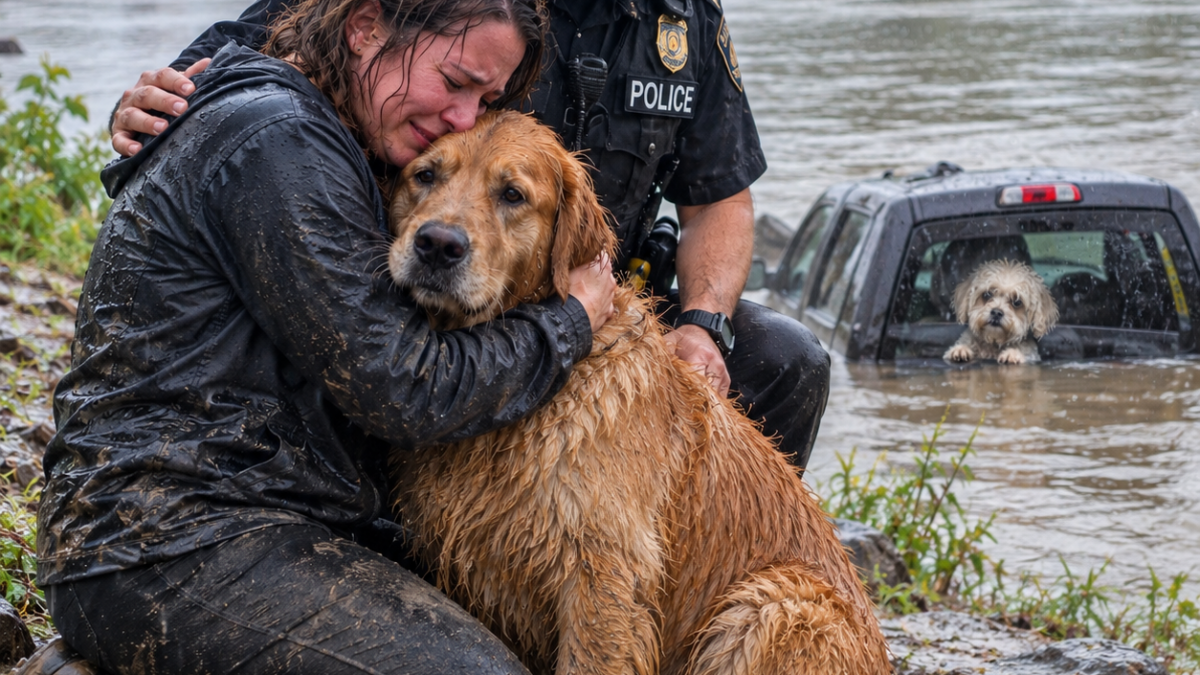
A woman was standing at the edge of a flooded river screaming that her little dog was still trapped inside the pickup sinking beneath the dark water, and before I could finish asking where the animal was, my partner ripped off his duty belt and ran straight into a current cold enough to make a person lose strength in minutes.
I watched the roof of that truck disappear inch by inch while the woman clutched the only dog she had managed to save, begging us not to let the second one vanish with the vehicle, and I remember thinking that we had reached the scene at exactly the kind of moment when being ten seconds early or ten seconds late could change an entire life.
I thought the river would be the hardest thing we faced that morning, but what happened after my partner reached the submerged cab—and what we learned about that stretch of road in the days that followed—made me realize the rescue was only the beginning.
My name is Ethan Cole, and at the time I had been working emergency response for a little over eleven years.
My partner that morning was Jake Miller.
Jake was the kind of person who could spend half a shift complaining about weak station coffee and then become completely calm the instant something went wrong.
We had worked together long enough that conversation in the truck rarely mattered.
Sports.
Weather.
Food.
Bills.
Who had forgotten to refill the coffee.
That morning was like that.
Nothing felt unusual.
The storm from the previous night had passed, but the river beside the county road was still high.
Brown water moved fast between the trees.
Branches floated downstream.
The road was wet, though traffic was light.
I remember Jake looking out the window and saying, “That river’s ugly today.”
I answered, “So is your coffee.”
He looked at the paper cup.
“Fair.”
Those were the last normal words either of us said for a while.
Less than two miles later, I heard screaming.
Not the excited sound of someone calling across a field.
Not anger.
Panic.
I hit the brakes.
A woman stood near the riverbank.
Her clothes were soaked.
One arm held a small wet dog tight against her chest.
The other pointed toward the water.
Jake and I were out of the vehicle almost before it stopped moving.
“What happened?” I shouted.
She turned toward us.
Her face had almost no color.
“My dog!”
“You have him.”
“No!”
She pointed.
“Another one. My other dog is in the truck.”
Only then did I see the pickup.
Most of it was already underwater.
The river had swallowed the front half entirely.
Only part of the roof and rear section remained visible.
“Anybody else inside?” I asked.
“No. No people. Just him.”
“What kind of dog?”
“Bichon Frise. Small. White.”
She grabbed Jake’s arm.
“Please.”
Jake looked at me.
There are moments when partners have entire conversations without words.
The water was fast.
Cold.
Visibility almost nonexistent.
Going in was dangerous.
Not going in meant watching the truck disappear with a living animal inside.
I reached for the rescue line in our vehicle.
Jake stripped off his duty belt and outer jacket.
“Ethan.”
“I’ve got you.”
“Line.”
“Coming.”
The woman cried:
“His name is Toby.”
Jake looked toward the truck.
“Where was he?”
“Back seat. His carrier came loose. I couldn’t reach him.”
“Window open?”
“I don’t know.”
“Doors locked?”
“I don’t know!”
The truck shifted.
Water climbed higher over the roof.
Jake didn’t ask another question.
He moved down the bank.
The first step into the river nearly turned him sideways.
I secured the line around him.
“Don’t fight the current.”
“I know.”
“Jake.”
He looked back.
“Don’t become my second rescue.”
He gave me the smallest nod.
Then pushed deeper.
The woman stood beside me shaking.
The dog in her arms trembled just as hard.
“What happened?” I asked while watching Jake.
“The truck slid.”
“From the road?”
“Yes.”
“I tried to brake. It just went sideways.”
She started crying again.
“I got Molly out. I went back for Toby, but the water came in so fast.”
“You did what you could.”
“No, I left him.”
“You survived.”
“I left him.”
I didn’t answer.
Because out in the river, Jake had just reached the disappearing truck.
And then the roof slipped completely beneath the surface.
PART 2
For one second, all I could see was Jake.
Then he disappeared too.
The woman beside me screamed.
“Where is he?”
“Stay back.”
“Where is he?”
“I need you to stay back.”
I gripped the rescue line with both hands.
The current pulled.
Hard.
Jake had gone underwater beside the truck.
Five seconds.
Ten.
Fifteen.
Time behaves differently during a rescue.
A second can become something physical.
Heavy.
Sharp.
I watched the rope.
Movement.
Then Jake surfaced.
He gasped.
“Can’t get the rear door!”
“Come back!”
He shook his head.
“No!”
He sucked in a breath and disappeared again.
The woman said:
“Oh God.”
I tightened my grip.
“Come on, Jake.”
The current shifted him downstream.
Then the line pulled sharply.
I fed him a little slack.
He was working around the passenger side.
I could see bubbles.
Nothing else.
The truck was now completely submerged except for a small part of the bed.
I heard sirens in the distance.
Someone else had called.
Good.
But they weren’t there yet.
This was ours.
Jake surfaced again.
“Window!”
“What?”
“Rear window cracked!”
“Can you reach him?”
“I heard something.”
That changed everything.
He heard the dog.
Alive.
Jake went back under.
## THE WOMAN’S NAME
The woman finally told me her name between sobs.
Laura Bennett.
The dog in her arms was Molly.
Toby’s littermate.
Both six years old.
She had driven that road hundreds of times.
She said a sheet of water crossed the pavement after the storm.
When she braked, the rear tires lost traction.
The pickup slid.
Hit the shoulder.
Then the shoulder gave way.
The truck dropped down the bank.
Straight into the river.
“I opened my door before it went under,” she said.
“Molly came out?”
“I grabbed her.”
“Toby?”
“His carrier rolled.”
Laura closed her eyes.
“I reached back, but the truck moved again. Water came in. I couldn’t breathe.”
“You had to get out.”
“I should’ve gone back.”
“No.”
“I should’ve.”
“No.”
She looked at me.
“You don’t understand.”
I pointed toward Jake.
“Yes, I do. And if you had gone back and gotten trapped too, he’d be trying to save three lives right now.”
She said nothing.
Molly pressed her wet face into Laura’s chest.
## THE GLASS
Jake surfaced a third time.
This time he had his rescue tool in his hand.
“Glass!”
“What?”
“I’m breaking the rear window.”
“Watch your hands.”
He disappeared.
A few seconds later, I heard nothing.
Of course.
The river swallowed sound.
Then Jake surfaced coughing.
“Got it.”
“Dog?”
“Still inside.”
“Jake, you’re getting cold.”
“I know.”
“Come out. Fire’s almost here.”
He looked toward the submerged truck.
Then back at me.
“He’ll be gone by then.”
Before I could answer, he took another breath.
And went under.
## WHAT I COULD NOT SEE
Later, Jake told me what happened inside the cab.
At the time, I knew none of it.
He found the broken window by touch.
The water was dark enough that he couldn’t see more than inches.
He reached inside.
Seat.
Fabric.
A loose strap.
Then fur.
Toby had been pushed upward by an air pocket near the ceiling before the truck fully submerged.
By the time Jake found him, that pocket was almost gone.
The dog was wedged between the rear seat and the side panel.
Jake grabbed him.
Toby fought.
Not because he didn’t want help.
Because terrified animals don’t understand rescue.
Jake’s glove slipped.
He lost the dog.
Reached again.
Caught the harness.
Then the carrier strap wrapped around his wrist.
For several seconds, Jake was attached to the vehicle by the same mess trapping Toby.
He couldn’t surface.
He tore at the strap.
Nothing.
Pulled harder.
Still caught.
Then he remembered the cutting hook on his vest.
He found it by touch.
Cut once.
Missed.
Twice.
The strap separated.
Jake pulled Toby against his chest and kicked toward the broken window.
His shoulder struck the frame.
The opening felt smaller on the way out.
Then the current took them both.
## THE ROPE MOVES
On shore, the rescue line suddenly jerked downstream.
I thought I’d lost him.
“Jake!”
I pulled.
Not hard enough to drag him underwater.
Just enough to maintain tension.
Then a head appeared.
Jake.
And something white pressed against his chest.
“He’s got him!” I shouted.
Laura made a sound I have never forgotten.
Half scream.
Half sob.
“TOBY!”
Jake was thirty feet downstream now.
The current kept carrying him.
I pulled the line.
He kicked.
Another responder reached the shore and grabbed the rope behind me.
Then another.
Together we brought Jake toward shallower water.
He stumbled.
Recovered.
The white bundle in his arms didn’t move.
“Give me the dog.”
Jake shook his head.
“Bank first.”
Two firefighters entered shallow water and helped him.
When Jake finally reached shore, he dropped to his knees.
He placed Toby on a dry rescue blanket.
The dog was limp.
Laura tried to rush forward.
I stopped her.
“Give us room.”
“Is he breathing?”
I checked.
Nothing obvious.
“Come on, Toby.”
Jake began helping clear the airway.
We started resuscitation appropriate for the dog while another responder contacted the nearest emergency veterinary hospital.
Laura knelt several feet away.
Molly struggled in her arms.
“Please,” she whispered.
Not to us.
To Toby.
Or God.
Or the river.
I don’t know.
## ONE BREATH
There was no dramatic movie moment.
No sudden leap to his feet.
Toby coughed.
A weak sound.
Then nothing.
We continued.
Another cough.
A shallow breath.
Jake looked at me.
“There.”
“I know.”
Toby pulled another.
Weak.
Irregular.
But his own.
Laura broke down completely.
I looked at her.
“He’s breathing.”
“He’s alive?”
“He’s breathing.”
“Is he okay?”
That question.
Always the impossible one.
“I don’t know yet.”
## JAKE
Only after Toby had begun breathing did I look at Jake properly.
His lips were pale.
His hands shook violently.
His right shoulder had a shallow cut from the broken window.
“Sit.”
“I’m fine.”
“Sit.”
“I’m fine.”
“Jake.”
He looked at me.
Then sat.
A firefighter wrapped him in a thermal blanket.
“Cold?”
“No.”
He was visibly shaking.
“That’s a lie.”
“Dog first.”
“The dog is breathing. Now sit.”
I had worked with him long enough to know when arguing was useful.
This was one of those times.
## THE RACE TO THE VET
A police cruiser escorted Laura while I drove her and Toby toward the emergency veterinary clinic.
Jake went with another unit to get checked for cold exposure and the cut on his shoulder.
He protested.
Lost.
Molly sat in Laura’s lap.
Toby lay wrapped beside us with oxygen support.
Every few seconds Laura looked at him.
“Is he breathing?”
“Yes.”
Ten seconds.
“Still?”
“Yes.”
Another twenty.
“Still?”
“Yes.”
I finally said:
“Laura, I’m going to keep watching him. You don’t have to ask every ten seconds.”
She nodded.
Then asked thirty seconds later.
“Still?”
“Yes.”
I understood.
Fear needs repetition.
## THE VETERINARY TEAM
The clinic was ready.
Toby disappeared through swinging doors.
Laura stood in the lobby holding Molly.
Wet clothes.
Bare feet.
Mud on her legs.
She looked completely lost.
A receptionist brought blankets.
Another staff member took Molly for a quick assessment.
She was cold but otherwise stable.
Then Laura looked at me.
“Where’s your partner?”
“Hospital.”
Her eyes widened.
“Because of me?”
“No.”
“Because of Toby.”
“Because he went into a freezing river.”
“I need to know he’s okay.”
“So do I.”
## JAKE’S FIRST WORDS
My phone rang.
Jake.
“You’re supposed to be getting checked.”
“I am.”
“You sound terrible.”
“How’s the dog?”
“Breathing. Vet has him.”
“Awake?”
“Not yet.”
Pause.
“Laura?”
“Here.”
“Tell her I’m fine.”
“You’re at a hospital.”
“I’m still fine.”
“You cut yourself climbing through submerged glass.”
“Scratch.”
“You’re impossible.”
He laughed weakly.
Then became serious.
“Let me know.”
“I will.”
## TOBY’S CONDITION
The veterinarian came out forty minutes later.
Dr. Hannah Brooks.
“Laura Bennett?”
Laura stood.
“I’m Laura.”
Dr. Brooks sat with her instead of making her stand.
“Toby has severe aspiration risk from the river water. His body temperature is low, and we’re supporting his breathing.”
“Will he live?”
“We don’t know yet.”
Laura closed her eyes.
“Is he suffering?”
“He’s sedated and being treated.”
“What happens now?”
“We warm him carefully, support oxygen, monitor his lungs, and watch for complications.”
“Can I see him?”
“Not yet.”
Laura nodded.
Then whispered:
“Please don’t let him be alone.”
Dr. Brooks looked directly at her.
“He isn’t.”
## MOLLY WAITS
Molly refused food.
Wouldn’t lie down.
She sat facing the treatment-room doors.
Laura sat beside her.
Every time those doors opened, Molly stood.
Not dramatic.
Not frantic.
Just watching.
Waiting.
That was almost harder.
After three hours, Dr. Brooks allowed Laura to see Toby briefly.
Molly could not enter the treatment area, so I stayed with her.
The moment Laura disappeared through the doors, Molly pressed against my leg.
I looked down.
“You’ve had a terrible morning too.”
She stared at the door.
“Yeah.”
## THE FIRST NIGHT
Toby remained hospitalized.
Laura refused to leave at first.
Dr. Brooks finally convinced her.
“You need dry clothes.”
“I can stay.”
“You need food.”
“I’m not hungry.”
“Your dog may need you tomorrow.”
That worked.
Laura looked at Toby through the glass.
Then at Molly.
“Call me for anything.”
“We will.”
She turned to me.
“Can you take me back to my car?”
“It’s in the river.”
She blinked.
Shock makes obvious facts disappear.
“Right.”
“I’ll drive you.”
## THE ROAD AGAIN
On the way back toward town, we passed the accident site.
Fire crews were still there.
A tow company waited downstream.
The river had completely swallowed the pickup.
Only markers showed where it had gone in.
Laura turned away.
“I hate that road.”
I slowed.
The shoulder looked damaged.
Not just from the truck.
A section of earth had slumped away.
Water ran across the pavement from an overflowing drainage ditch.
There were no warning signs.
No cones.
Nothing.
I noticed Jake’s earlier words:
That river’s ugly today.
Something about the scene bothered me.
## THE FIRST REPORT
At the station, I completed our incident report.
Times.
Weather.
Water conditions.
Vehicle position.
Rescue actions.
Dog removed.
Partner exposure.
Everything.
Then I wrote one additional note:
**Significant shoulder erosion and standing water observed at roadway edge; no temporary hazard warning present at time of arrival.**
Not because I expected consequences.
Because details matter.
I had learned that long before.
## JAKE RETURNS
Jake came back that evening.
Dry clothes.
Bandage on shoulder.
Medical clearance.
He walked into the station like nothing happened.
Mike from the next crew clapped.
Jake hated it.
“Stop.”
“You swam into a river for a dog.”
“Stop.”
“You broke into a submerged truck.”
“Technically the window was already damaged.”
“You broke it.”
“Details.”
I handed him coffee.
He stared.
“This is terrible.”
“Welcome back.”
Then his face changed.
“Toby?”
“Still alive.”
“That’s all?”
“For now.”
He nodded.
“Good enough.”
## 2:13 A.M.
Laura called me at 2:13 in the morning.
I thought something had happened.
“Toby opened his eyes.”
I sat up.
“What?”
“The vet called. He opened his eyes.”
I smiled in the dark.
“That’s good.”
“They said he isn’t out of danger.”
“I know.”
“But he opened his eyes.”
“That’s good, Laura.”
Then she started crying.
“I didn’t know who else to call.”
I looked at the clock.
“Jake will be offended you called me first.”
That made her laugh through tears.
Exactly what she needed.
## JAKE’S REACTION
At 5:45, Jake walked into the station.
I said:
“Toby opened his eyes.”
He stopped.
“Seriously?”
“Two thirteen.”
“Why didn’t you text me?”
“You were sleeping.”
“You always text me about sports.”
“This seemed more important.”
“Exactly.”
He shook his head.
But he smiled.
## DAY TWO
Toby’s lungs were still the biggest concern.
River water can cause serious respiratory complications.
Dr. Brooks warned us that early improvement did not guarantee an uncomplicated recovery.
Laura spent the day at the clinic.
Molly remained beside her.
At noon, Toby became more alert.
At four, he tried to lift his head.
By evening, he responded to Laura’s voice.
She stood behind the glass.
“Toby?”
His head moved.
Barely.
Laura covered her mouth.
Molly, outside the room, began whining.
The veterinarian eventually allowed a carefully controlled reunion through an open kennel area.
Molly approached slowly.
Sniffed.
Toby’s tail moved.
Once.
Laura sank into a chair.
“I can’t do this.”
Dr. Brooks smiled.
“You’re doing it.”
## WHAT REALLY HAPPENED ON THE ROAD
Two days after the accident, a county safety investigator called our station.
He wanted to discuss my note.
“Was the shoulder already compromised when you arrived?”
“Yes.”
“Could the crash have caused it?”
“Some of it.”
“Some?”
“There was obvious runoff erosion extending beyond the tire path.”
“Any barricades?”
“No.”
“Warning sign?”
“No.”
“Flood advisory signs?”
“No.”
He thanked me.
I almost forgot about it.
Then Laura called.
“Someone from the county contacted me.”
“Road investigation.”
“Why?”
“Apparently that section had drainage issues.”
My stomach tightened.
“What do you mean?”
She read from an email.
There had been two prior complaints about standing water during heavy storms.
One three months earlier.
Another the previous year.
Maintenance had been scheduled.
Not completed.
This did not automatically mean the county caused the crash.
Driving conditions still mattered.
Speed mattered.
Weather mattered.
But it meant the road had a known vulnerability.
Laura became angry.
“They knew.”
“Known drainage issues isn’t the same as knowing your truck would go into the river.”
“They knew water crossed the road.”
“Yes.”
“And did nothing.”
“Maybe they did temporary work.”
“Did you see anything?”
No.
I hadn’t.
## I STOPPED HER
Laura wanted to post everything immediately.
Names.
Emails.
Photos.
I told her not to.
She became angry with me.
“You work for the county.”
“I work emergency services. Different department.”
“You’re defending them.”
“No.”
“Then why are you telling me to stay quiet?”
“I’m telling you to be accurate.”
“They almost got Toby killed.”
“Laura.”
She flinched.
I continued more gently.
“You survived. Molly survived. Toby is still fighting. Jake survived. If there was negligence, let evidence prove it.”
She stared at me.
“What if they bury it?”
“Then documentation matters even more.”
She sat down.
“I hate how calm you are.”
“I’m not calm.”
“You’re acting calm.”
“That’s my job.”
## TOBY STANDS
On day four, Toby stood.
For three seconds.
Then sat.
Laura recorded it.
No music.
No dramatic caption.
Just Toby.
White fur still damp-looking around his face from bathing and treatment.
Small body.
Unsteady legs.
Standing.
Jake watched the video six times.
“He’s tiny.”
“He’s a Bichon.”
“He felt heavier underwater.”
“Everything feels heavier underwater.”
Jake looked away.
I knew what he was thinking.
The strap.
The window.
The moment he almost couldn’t surface.
He hadn’t talked much about it.
## JAKE’S NIGHTMARES
He called me one night.
“Can’t sleep.”
“You want me to pretend that’s unusual?”
“Funny.”
Silence.
Then:
“I lost him.”
“What?”
“In the truck.”
My chest tightened.
“When?”
“When I first grabbed him.”
I waited.
“The harness slipped. I couldn’t see. I thought he’d gone deeper into the cab.”
“But you found him.”
“I know.”
“Jake.”
“What if the strap hadn’t cut?”
There it was.
The question every rescuer eventually carries.
What if.
“If the strap hadn’t cut, we’d have a different story.”
“That’s helpful.”
“It’s true.”
“I was stuck.”
“I know.”
“I couldn’t get my arm free.”
“I know now.”
He breathed.
“I thought about letting go of the dog.”
That mattered.
Not because he had done anything wrong.
Because he was ashamed of a survival thought.
“You should have.”
Silence.
“What?”
“If the choice was both of you or one of you, you should have let go.”
“I didn’t.”
“I know.”
“Would you have?”
“I don’t know.”
Honest answer.
He was quiet.
Then I said:
“You don’t have to turn surviving into guilt.”
He laughed once.
“Since when are you a therapist?”
“Since our insurance became terrible.”
That helped a little.
## DAY SIX
Toby ate.
A few bites.
Soft food.
Laura cried.
Dr. Brooks laughed.
Molly tried to steal the bowl.
Normal life was returning.
Tiny pieces at a time.
Toby still coughed occasionally.
Still tired quickly.
Still needed monitoring.
But every day added another ordinary thing.
Drink.
Eat.
Stand.
Walk.
Bark.
The first bark surprised everyone.
A sharp little sound from the kennel.
Laura looked around.
“Was that him?”
Toby barked again.
Dr. Brooks smiled.
“Apparently he has complaints.”
Good.
Complaining animals are often moving in the right direction.
## THE TRUCK COMES OUT
A recovery team finally pulled the pickup from the river.
It was badly damaged.
Laura went to the storage yard to collect personal items.
She asked Jake and me to come.
I almost said no.
Jake said yes.
So I went.
The rear window was shattered.
The inside was filled with silt.
One carrier lay twisted behind the seat.
The strap Jake had cut still hung from the frame.
He stared.
Laura stood beside him.
“That’s what caught you?”
Jake nodded.
She touched the cut end.
Then looked at him.
“You could’ve died.”
Jake shrugged.
“Didn’t.”
She started crying.
He looked uncomfortable.
“Laura.”
“I don’t know how to thank you.”
“Don’t.”
“What?”
“Don’t make it something you owe.”
“You saved my dog.”
“Then let him have a good life.”
She stared at him.
“That’s it?”
“That’s plenty.”
## HOME
Toby was discharged on day eight.
Not cured.
Recovering.
Medication.
Restricted activity.
Follow-up.
Respiratory monitoring.
But home.
Laura carried him through her front door.
Molly danced around her feet.
Toby looked exhausted.
She placed him on a blanket.
Molly immediately lay beside him.
I watched from the doorway.
Jake stood beside me.
“Now we leave.”
“Yeah.”
Neither of us moved.
Laura smiled.
“You’re both terrible at leaving.”
True.
## THE FIRST NIGHT AT HOME
Laura texted at 10:40.
Photo.
Toby asleep.
Molly’s head across his back.
Caption:
**Both breathing. Both home.**
I showed Jake.
He looked at it longer than necessary.
“Good.”
That became his standard response.
Good.
Never dramatic.
Always enough.
## THE COUNTY INVESTIGATION
The road investigation continued.
Engineers found that a drainage culvert had been partially blocked by debris before the storm.
Runoff crossed the road.
Repeated saturation weakened the shoulder.
A prior maintenance request had indeed been logged.
Work had been delayed.
Again, none of this proved Laura had no responsibility.
She had been driving in severe post-storm conditions.
But the infrastructure had contributed to the danger.
The county temporarily closed the lane.
Installed barriers.
Cleared drainage.
Reinforced the shoulder.
Added high-water warning signs.
Then came the difficult part.
Responsibility.
## THE MEETING
Laura asked me to attend a public safety meeting.
I didn’t want to.
Conflict of interest.
I went as a private witness with approval from my supervisor.
The room was packed.
Residents had stories.
Standing water.
Near misses.
Complaints.
One older man said:
“I’ve called three times about that shoulder.”
Another woman:
“We slow to ten miles an hour every storm.”
The road manager, Thomas Reed, looked exhausted.
He wasn’t a villain.
That mattered.
He explained budgets.
Storm damage.
Backlogged maintenance.
Staff shortages.
All real.
Laura stood.
“My truck ended up in the river.”
Silence.
She continued.
“I made mistakes too.”
That surprised me.
“I should have slowed earlier. I should have treated the water like ice.”
She looked toward the officials.
“But I didn’t know the ground under the shoulder had been washing away for months.”
No shouting.
No dramatic accusations.
More powerful that way.
Then Jake spoke.
He had not planned to.
“I went into that river.”
Everyone turned.
“My job involves risk. But unnecessary risk created by a known hazard is different.”
Thomas Reed looked down.
Jake continued.
“I don’t want a medal. I want the next person not to need a rescue.”
That line changed the room.
## THE DECISION
The county approved a larger safety project.
Improved drainage.
Reinforced bank protection.
Reflective hazard markers.
High-water closure protocol.
Automatic inspection after severe rainfall.
Funding.
Boring things.
Beautiful things.
No revenge movie.
No villain dragged away.
But something changed.
The road that had almost swallowed two dogs and a woman became harder for the next accident to happen on.
That mattered more than humiliation.
## LAURA’S SETTLEMENT
Months later, Laura reached a civil settlement related to vehicle damage and documented road conditions.
I won’t pretend I understand all the legal details.
She didn’t become rich.
The truck was replaced.
Veterinary bills were covered in part.
Some other losses were addressed.
More importantly to her, the county formally documented the maintenance failure.
She called Jake.
“Justice.”
Jake said:
“Toby swimming yet?”
She laughed.
“No.”
“Then we’re not done.”
## THE RIVER FEAR
Toby became afraid of water.
Not drinking water.
Large bodies of it.
The first time Laura walked him near a pond months later, he froze.
Molly continued.
Toby backed away.
Laura didn’t pull him.
Didn’t force him.
Good.
She sat on a bench.
Molly lay down.
Toby remained several feet back.
Eventually he approached Laura.
They went home.
That became their routine.
Small exposures.
No pressure.
## JAKE VISITS
Laura invited us for dinner.
Toby saw Jake.
Stopped.
Jake crouched.
“Hey, submarine.”
I punched his shoulder.
Laura laughed.
Toby approached.
Sniffed Jake’s hand.
Then climbed into his lap.
Jake froze.
“Don’t.”
“What?”
“Don’t make this emotional.”
Nobody said anything.
Toby curled against him.
Jake stared at the ceiling.
Laura cried.
I took a picture.
He threatened me afterward.
## THE PHOTO
That photo became famous at our station.
Jake, pretending to be miserable.
Tiny white dog asleep on him.
I printed it.
Placed it in his locker.
He removed it.
I printed another.
This continued for months.
Eventually he surrendered.
The photo stayed.
## SIX MONTHS
Toby’s lungs recovered well.
No lasting major respiratory limitations.
His energy returned.
He and Molly resumed normal walks.
Laura changed vehicles.
Added secured carriers.
Emergency window tools.
Seat restraints.
She became almost obsessive about travel safety.
I understood.
Trauma often turns into preparation.
Sometimes too much.
But preparation can be healthy when it restores control.
## THE RIVERBANK CEREMONY
No official ceremony.
Laura asked us to meet near the repaired road on the six-month anniversary.
I thought it was unnecessary.
Went anyway.
The river was low.
Clearer.
Calm.
Nothing like that morning.
Toby stayed far from the edge.
Molly explored.
Laura stood beside the new barrier.
“There.”
“What?”
“That’s where we went over.”
Jake looked.
Hard to imagine now.
Reinforced shoulder.
New drainage.
Sign.
Safe.
Laura touched the barrier.
“The river didn’t win.”
Jake said:
“Road crew did.”
Typical.
## THE SECOND RESCUE
About a year later, another storm hit.
Same road.
High water warning activated.
County closed the section before conditions became dangerous.
A driver complained online.
Detour added twenty minutes.
Someone responded:
**Better twenty minutes late than underwater.**
Laura sent me the screenshot.
No caption.
Didn’t need one.
That’s what accountability looked like.
A closed road.
A driver annoyed.
Everyone alive.
## TOBY’S FIRST STEP INTO WATER
It happened almost two years later.
At a lake.
Not river.
Calm shoreline.
Warm day.
Molly walked in immediately.
Toby stayed on dry ground.
Laura sat.
No forcing.
Toby approached.
One paw.
Stopped.
Another.
Water covered his feet.
He backed out.
Then returned.
Laura didn’t react.
That mattered.
If she celebrated too loudly, she might make the moment bigger than he wanted.
By the end of the afternoon, Toby stood ankle-deep.
That was enough.
## THE NEXT SUMMER
Toby swam.
Short distance.
Maybe six feet.
After a floating toy Molly dropped.
Laura recorded it.
When I watched, I didn’t see the submerged truck.
At first.
Then I did.
But the image didn’t dominate.
Toby paddled.
Reached the toy.
Turned.
Came back.
Different water.
Different choice.
That was recovery.
Not erasing memory.
Creating new ones.
## JAKE WOULD NOT WATCH
I sent him the video.
No response.
Called.
“You see it?”
“No.”
“Why?”
Silence.
Then:
“I can’t.”
I understood.
“Okay.”
Three days later, he texted:
**Watched it. Good.**
That was Jake.
## WHAT THE RESCUE DID TO HIM
Years passed before he told me.
He had nearly left emergency services after the incident.
Not because of fear.
Because of the opposite.
He worried he had become too comfortable with risk.
“What do you mean?”
“I didn’t think.”
“That’s sometimes required.”
“Sometimes.”
He looked at me.
“But I had no cold-water gear. No dive equipment. Visibility zero.”
“You had a line.”
“Because you got it.”
“Yes.”
“If you hadn’t?”
“But I did.”
He shook his head.
“That’s not planning.”
He was right.
## THE TRAINING CHANGE
Jake pushed for improved water-rescue training.
Not because everyone should jump into rivers.
The opposite.
Better scene evaluation.
Throw bags.
Cold-water PPE availability.
Vehicle-water incident protocols.
Pet rescue considerations.
When animals are trapped, people take dangerous risks trying to save them.
Recognizing that matters.
The department approved updated training.
Jake became one of the instructors.
I never let him forget he became “the safety guy” after doing the least safe thing imaginable.
He hated me.
## THE DEMONSTRATION
During training, Jake stood beside a pool.
New recruits watched.
He held up a rescue line.
“Heroics are what you do when planning has failed.”
One recruit asked:
“Didn’t you swim into a river for a dog?”
Everyone knew.
Jake stared at him.
“Exactly.”
Laughter.
Then he became serious.
“I got lucky enough to learn from it.”
That line stayed.
## LAURA’S LIFE
Laura eventually moved farther from the river.
Not because of fear alone.
New job.
New house.
Fenced yard.
Molly aged first.
Toby remained playful.
The two dogs slept together constantly.
Laura still kept secured carriers in the vehicle.
Always.
## MOLLY
Molly developed heart disease at eleven.
Medication helped.
Toby became calmer around her.
Their dynamic changed.
Molly had been the confident one after the accident.
Now Toby waited when she slowed.
Animals trade roles as they age.
## THE LAST RIVER WALK WITH MOLLY
Laura invited us.
Same repaired road.
Safe trail nearby.
Molly moved slowly.
Toby stayed beside her.
At the river overlook, Molly sat.
Toby sat.
Laura took a photograph.
Jake refused to pose.
I forced him.
The resulting photo:
Laura.
Two old dogs.
Jake looking uncomfortable.
Me smiling too much.
River behind us.
Not dark.
Not dangerous.
Just water.
## MOLLY’S GOODBYE
Molly died peacefully at home the next year.
Laura called.
Toby searched for her.
For several days.
Then slept in Molly’s bed.
Laura asked:
“Do you think he remembers the river?”
I said:
“I think he remembers Molly.”
More useful answer.
## TOBY ALONE
Toby surprised us.
He became more outgoing after grief softened.
He greeted people.
Wanted longer walks.
Became obsessed with a neighbor’s golden retriever.
He had spent most of his life as half of a pair.
Now he developed differently.
Still Toby.
Just more of him visible.
## THE WHITE FACE
Bichons age quietly until suddenly they don’t look young anymore.
Toby’s eyes became slightly cloudy.
His hearing faded.
He slept more.
Laura sent pictures.
I always looked at his face and saw the wet bundle Jake brought out of black water.
That image never disappeared.
But eventually it became only one frame among thousands.
That’s the goal.
## TEN YEARS AFTER
Ten years after the rescue, the county invited Jake to a road-safety event.
They unveiled an updated flood-response system for several river roads.
Sensors.
Remote gates.
Warning lights.
Automated alerts.
Not all because of Laura’s crash.
But that incident was listed among the events that accelerated the project.
Jake stood beside me.
“This is weird.”
“What?”
“Being proud of gates.”
“Age.”
He laughed.
Laura attended.
Toby did too.
Old.
Small.
Carried part of the way.
## THE NEW SIGN
One sign near the river read:
**ROAD MAY CLOSE DURING HIGH WATER — DO NOT ENTER FLOODED ROADWAY**
Simple.
Obvious.
Necessary.
Laura touched it.
“I wish that had been here.”
Jake answered:
“Now it is.”
Sometimes that’s all accountability can do.
Can’t fix before.
Can change after.
## TOBY’S LAST YEARS
Kidney disease.
Arthritis.
Dental issues.
Normal old-dog problems.
Every diagnosis made Laura laugh sadly.
“Normal.”
She loved that word.
Because once, Toby’s medical chart was:
Cold exposure.
Near-drowning.
Respiratory risk.
Emergency.
Now?
Old dog.
Normal.
## THE LAST SWIM
Toby’s final swim wasn’t dramatic.
He was thirteen.
Lake.
Warm water.
Life jacket.
Laura held a handle.
He paddled slowly.
Maybe twenty seconds.
Then back to shore.
She dried him.
He slept in the sun.
She sent Jake the video.
He responded:
**Good.**
Of course.
## THE CALL
Years after the original rescue, Laura called me again.
Different tone.
Quiet.
“It’s time.”
I knew.
Toby had stopped eating.
Kidneys failing.
No crisis.
Just age.
She had scheduled a home veterinarian.
“Can you come?”
“Yes.”
“Jake too?”
“I’ll ask.”
He didn’t hesitate.
## THE LAST MORNING
Toby lay on a blanket near Laura’s couch.
White fur.
Thin body.
Old eyes.
No river.
No cold.
No panic.
Jake knelt.
“Hey, submarine.”
Toby’s tail moved.
Once.
Jake looked away.
Laura smiled through tears.
“He remembers you.”
Maybe.
Maybe voice.
Maybe smell.
Maybe kindness.
Doesn’t matter.
## THE BLUE COLLAR
Laura had kept the collar Toby wore the day of the accident.
Cleaned.
Stored.
She placed it beside his bed.
“I couldn’t throw it away.”
Jake touched it.
“Don’t.”
“What?”
“Don’t make his last day about the river.”
She froze.
Then nodded.
She moved the collar aside.
Good decision.
Toby’s life had become much larger than the thing that almost ended it.
## GOODBYE
The veterinarian arrived.
Explained everything.
Laura held Toby.
Jake sat on one side.
I sat on the other.
Toby was calm.
His breathing slowed.
Laura whispered:
“You came home.”
That sentence broke me.
Not:
You survived.
Not:
You were rescued.
You came home.
Because that had been the point.
## AFTER TOBY
Laura sent us one photograph weeks later.
Not from the river.
Not recovery.
Toby and Molly asleep together on a couch years earlier.
Caption:
**This is how I want to remember them.**
Exactly.
## JAKE’S LOCKER
When Jake retired, I opened his locker.
The photo of him holding Toby was still there.
The one I had taped up as a joke.
Edges curled.
Color faded.
“You kept it.”
“No.”
“It’s literally in your locker.”
“Someone kept putting it back.”
“For fourteen years?”
“Persistent vandal.”
I laughed.
He took the photo home.
## HIS RETIREMENT SPEECH
Jake hated speeches.
So naturally everyone made him give one.
He talked about calls.
Partners.
Mistakes.
Luck.
Then he said:
“People still ask about the dog.”
Everyone laughed.
He smiled.
“He lived long enough to become old.”
Silence.
“That’s the only medal I ever needed.”
I had to look away.
## THE ROAD’S FINAL MEANING
I still drive that road sometimes.
The shoulder is solid now.
Drainage works.
Flood gates stand nearby.
Trees along the river have changed.
The exact spot is harder to identify.
Good.
Danger shouldn’t be preserved for nostalgia.
The river continues.
Cars continue.
People continue.
That’s the strange thing about places where something almost ended.
They become ordinary again.
Maybe they should.
## THE REVENGE PEOPLE EXPECTED
People occasionally asked whether someone got fired over the road.
No.
Whether anyone went to jail.
No.
Whether Laura “destroyed the county.”
No.
Real accountability is usually less entertaining.
Maintenance procedures changed.
Funding increased.
Hazards documented.
Road redesigned.
Claims settled.
Emergency training improved.
Warnings became automatic.
People had to admit:
We knew enough to do better.
Then do better.
That’s revenge against negligence.
Not suffering.
Correction.
## THE RIVER DIDN’T WIN
If you want the emotional revenge, it’s easier.
The river took Laura’s truck.
It almost took Toby.
Years later, Toby chose to swim.
That doesn’t mean he defeated nature.
Nature doesn’t care.
But fear stopped owning water.
That’s a victory.
## WHAT I LEARNED
Emergency response teaches you to prioritize human life.
Correctly.
But animals are woven into human decisions more deeply than manuals sometimes acknowledge.
Laura almost went back into a sinking vehicle for Toby.
Jake went into a river for him.
People do dangerous things for animals they love.
So planning for pets is human safety too.
Car restraints.
Emergency tools.
Evacuation plans.
Rescue protocols.
Not sentimental extras.
Safety.
## LAURA’S TALK
Laura later volunteered with a local preparedness group.
She told people:
“Secure your pets.”
“Carry emergency window tools.”
“Never drive through water you cannot assess.”
“Don’t assume your vehicle will protect you once it’s moving with water.”
She always added:
“And if something happens, don’t turn one emergency into three.”
She meant herself.
The guilt had taken years to loosen.
## HER FINAL LETTER TO JAKE
After Toby died, Laura wrote Jake a letter.
He showed me once.
One paragraph:
**For years I believed the worst thing I ever did was climb out of that truck without Toby. Eventually I understood that climbing out gave you someone on shore who could tell you where he was. If I had stayed, you might have been looking for both of us. Thank you for giving me enough years with him to understand that surviving wasn’t abandoning him.**
Jake folded the letter.
“She’s better with words than you.”
“Everyone is.”
## IF I COULD GO BACK
I would return to that morning.
The road.
The scream.
Laura soaking wet.
Molly in her arms.
Truck disappearing.
Jake dropping his belt.
I’d grab his shoulder before he entered.
Not to stop him.
To say:
“Use the line.”
Because details matter.
Then I’d tell Laura:
“You are going to hate yourself for getting out.
“Don’t.
“You did what survival required.
“Jake is going to reach Toby.
“He is going to get trapped for several seconds and never tell you until later.
“Toby won’t breathe normally when they reach shore.
“Then he will.
“He’ll spend days in a hospital.
“He’ll stand.
“He’ll eat.
“He’ll come home.
“He’ll become afraid of water.
“Don’t force him.
“One day he’ll put one paw into a lake.
“Years later he’ll swim again.
“Molly will grow old beside him.
“Then she will go first.
“Toby will keep living.
“He’ll become gray.
“He’ll develop boring old-dog problems.
“You’ll complain about medication costs.
“Be grateful for every complaint.
“The county will fix this road.
“Not perfectly.
“Not dramatically.
“But enough that another storm will close it before another car slides off.
“Jake will turn his worst decision into better training.
“I’ll spend years making fun of him for becoming the safety instructor.
“And one day, long after this river stops being the center of your life, you will hold Toby at home while he leaves peacefully from age.
“That is the ending.
“Not this.”
## IF I COULD TALK TO JAKE UNDERWATER
I’d say:
“The strap is going to catch you.
“Don’t panic.
“The cutter is on your vest.
“Left side.
“You will think you lost Toby.
“You haven’t.
“Your hand will find the harness again.
“You’ll hit your shoulder on the window.
“Keep moving.
“Ethan has the rope.
“You aren’t alone.”
Maybe that is what every rescuer needs to know.
Someone has the rope.
## THE ROPE
I kept the original rescue line for years after it was retired from service.
It hung in a storage room.
Dirty despite cleaning.
Frayed from use.
Eventually equipment staff threw it out.
I was strangely angry.
Then embarrassed.
It’s rope.
Tools are meant to be used and replaced.
Meaning lives in people, not equipment.
Still, I remember the weight of it in my hands.
Jake underwater.
Unknown.
That line was the only physical connection between us.
Maybe that’s why I think about it.
Rescue is often a rope.
One person goes into the dark.
Another stays where they can pull.
Neither role works alone.
## THE LAST TIME I SAW LAURA
Years later, I saw her at a grocery store.
No dogs.
She looked older.
So did I.
We talked beside frozen vegetables.
Life is glamorous.
She had adopted again.
Not a Bichon.
A senior mixed-breed dog named Nora.
“Why senior?”
“Because apparently I enjoy veterinary bills.”
Fair.
“Water dog?”
“No.”
“Good.”
She smiled.
Then:
“I still have Toby’s picture with Jake.”
“Which one?”
“The lap one.”
“Everyone has that picture.”
“Jake hates it.”
“That’s why everyone has it.”
We laughed.
Then she hugged me.
Not for the rescue.
Not specifically.
For years.
History.
All of it.
## THE NEW DOG
Nora hated car rides.
Laura spent months helping her.
Short trips.
Treats.
No force.
The woman who once thought survival meant action at any cost had become incredibly patient.
Trauma taught her slowness.
Not the lesson anyone would choose.
Still valuable.
## THE FINAL BENCH
Near the repaired river road, a small overlook was built as part of a later trail project.
No memorial.
Laura didn’t want one.
Good.
Instead, there is a bench facing the river.
Jake and I sometimes sit there after retirement.
He complains about his shoulder when weather changes.
“You’d think being heroic would come with better joints.”
“You weren’t heroic.”
“Good.”
“You were reckless.”
“Better.”
We watch the water.
Sometimes a dog walks past.
Jake always looks.
Never admits it.
## THE QUESTION
People ask:
“Would he do it again?”
I asked Jake once.
He stared at the river.
“No.”
I was surprised.
Then he added:
“I’d do it better.”
That’s the right answer.
Training.
Gear.
Line.
Backup.
But if a tiny dog were disappearing underwater again?
We both knew.
Some decisions are made before philosophy finishes talking.
## THE REAL ENDING
The real ending isn’t Jake carrying Toby out of the water.
That’s the climax.
Not the ending.
The ending is Toby old.
Dry.
Warm.
Sleeping on Laura’s couch.
The road repaired.
The flood gates functioning.
Jake teaching recruits not to repeat his method.
Laura telling strangers to secure their dogs properly.
Molly having years with her brother.
A civil report acknowledging a known drainage problem.
A small white dog learning water can also mean play.
Those are endings.
Plural.
Good rescues have many.
## EPILOGUE
That morning began with screaming.
That’s what I remembered for years.
Laura’s voice.
Toby’s name.
The river.
Jake disappearing.
The rope pulling hard.
Now, when I think about the story, I hear something else first.
A bark.
Toby’s first real bark in the veterinary hospital.
Small.
Annoyed.
Alive enough to complain.
That sound told me the river had lost its claim on him.
Not forever.
Nothing owns forever.
But for that day.
Then another.
Then another.
Until days became years.
Toby wasn’t supposed to become an old dog in the version of the story we feared on that riverbank.
But he did.
He became old enough to lose Molly.
Old enough to hate pills.
Old enough to need a life jacket.
Old enough for Laura to carry him instead of rescue him.
Old enough for the emergency to become something that had happened a long time ago.
That is what survival is supposed to become.
History.
The river remained.
The road remained.
The scar on Jake’s shoulder remained.
But none of them got to define Toby forever.
His life did that.
He swam.
He slept.
He barked at delivery drivers.
He stole Molly’s treats.
He rode in a properly secured carrier that Laura checked approximately seventeen times before every trip.
He grew gray.
And when his final day came, nobody was screaming his name beside dark water.
Laura whispered it in a warm room.
Jake touched his head.
I sat nearby.
Toby closed his eyes surrounded by the people who had spent years knowing exactly how close they’d once come to never having him there at all.
If you want revenge, that’s the only kind worth remembering.
The accident nearly reduced Toby’s life to one terrible morning.
Instead, he answered it with years.
The river almost became his ending.
It became one chapter.
And the little white dog who once disappeared beneath black water lived long enough to make the rescue feel small compared with everything that came after.
For a long time after Toby was gone, Laura could not drive that road alone.
She had driven it hundreds of times before the accident.
Afterward, even when the shoulder had been reinforced, the drainage repaired, and new warning systems installed, her hands tightened around the steering wheel every time the river appeared through the trees.
The strange thing was that she could stand beside the water without panicking.
She could walk the trail.
She could sit on the overlook bench.
But driving?
That was different.
The truck had slipped.
The road had moved beneath her.
The river had come closer faster than her mind could understand.
So for years, she took the longer route whenever heavy rain was forecast.
Nobody blamed her.
Not Jake.
Not me.
Certainly not after everything.
Then one autumn afternoon, maybe six months after Toby died, she called.
“I’m going to drive it.”
“What?”
“The road.”
“Why are you calling me?”
“Because if I change my mind, you’ll make fun of me.”
“Correct.”
She laughed.
“I’m serious.”
“So am I.”
There was silence.
Then:
“Can you meet me at the beginning?”
I did.
Jake came too.
He pretended he had happened to be nearby.
Nobody believed him.
Laura arrived in her newer SUV.
Nora, her senior rescue dog, sat secured in the back.
Laura rolled down the window.
“You two are ridiculous.”
Jake leaned against my truck.
“You called him.”
“I called Ethan.”
“Ethan called me.”
“Because you’re nosy.”
“Correct.”
Laura looked toward the road.
The river was low that day.
No storm.
No standing water.
Clear weather.
Every safety indicator said ordinary.
But trauma doesn’t read road reports.
“You don’t have to do it,” I said.
She looked at me.
“I know.”
That mattered.
Not:
You should.
Not:
It’s safe now.
Not:
Get over it.
Just:
You don’t have to.
Laura took a breath.
Then drove.
I followed.
Jake followed me.
We moved slowly.
At the curve where the accident had happened, Laura’s brake lights came on.
For one second, I thought she would stop.
Then she continued.
Past the reinforced shoulder.
Past the flood gate.
Past the warning sign.
Past the place where the truck had disappeared.
She kept going.
At the next turnout, she pulled over.
I stopped behind her.
Jake behind me.
Laura got out.
She was crying.
Not badly.
Just enough.
Nora looked through the window, confused.
Jake said:
“Well?”
Laura wiped her face.
“It looks smaller.”
“What?”
“The place.”
I understood.
Places of trauma grow inside memory.
They become enormous.
Then sometimes you return and see:
A curve.
A shoulder.
Trees.
Water.
Not harmless.
But real-sized again.
Laura laughed through tears.
“I spent years thinking that stretch was half a mile long.”
Jake nodded toward it.
“Maybe two hundred yards.”
“I hate that.”
“Memory’s dramatic.”
“Says the man who still won’t watch water-rescue videos.”
Jake glared.
Fair.
That day changed something.
Laura never loved the road.
She didn’t need to.
But she stopped letting it choose her route every time.
That was enough.
A few months later, she was invited to speak at a county preparedness event.
She almost declined.
“I’m not an expert.”
“You’re an expert in one thing,” I said.
“What?”
“What panic feels like when your animal is trapped.”
She became quiet.
“That’s not a credential.”
“No. It’s perspective.”
She went.
Her talk was short.
No dramatic video.
No photos of the truck underwater.
She stood in front of maybe forty people and said:
“I made it out because my door opened before the vehicle fully submerged. I got one dog out. I could not reach the other. For years, I believed that meant I had failed him.”
The room went silent.
Then:
“I didn’t fail him by surviving. I gave rescuers information they needed. I stayed on shore. I did not turn one emergency into two.”
Jake sat in the back row.
He looked down at the floor.
Laura continued.
“Secure your animals when you travel. Carry an emergency window tool where you can actually reach it. Don’t drive through standing water because you think you know the road. And if you survive an accident but cannot save everyone yourself, staying alive is not abandonment.”
That last sentence hit harder than anything.
Afterward, a woman approached her.
“My cat is always loose in the car.”
Laura didn’t scold.
“Mine were in carriers.”
“What went wrong?”
“One carrier came loose.”
The woman frowned.
“So even that wasn’t enough?”
“Safety isn’t one thing. It’s layers.”
That became Laura’s message.
Not fear.
Preparation.
Not certainty.
Layers.
A month later, the county distributed pet-travel safety cards through local veterinary clinics.
Secure carriers.
Harnesses.
Seat-belt attachment points.
Emergency contact information.
Window tools.
Never enter moving floodwater.
Basic.
Almost boring.
Good.
Boring prevention is beautiful when you’ve seen what happens without it.
Jake’s training program grew too.
He became irritatingly passionate about water-rescue protocols.
Throw.
Reach.
Row.
Go only with proper equipment.
Scene safety.
Cold-water exposure.
Entrapment risk.
Vehicle stabilization.
He made recruits practice cutting tangled straps underwater in a controlled pool.
The first time I watched, I understood immediately.
Toby.
The harness.
Jake’s wrist.
The trapped strap.
He had built an entire drill around the moment that had almost prevented him from surfacing.
One recruit finished the exercise and pulled off his mask.
“That was awful.”
Jake nodded.
“Good.”
The recruit laughed nervously.
“Good?”
“You’ll remember it.”
Another asked:
“Did this actually happen to you?”
Jake paused.
“Close enough.”
I stood at the back.
After class, I said:
“You never tell them the whole story.”
“No.”
“Why?”
“Because then they listen to the hero part.”
He made quotation marks with his fingers.
“I want them to listen to the mistake part.”
That was one of the smartest things he ever said.
Trauma can become ego if you’re not careful.
People call you brave.
You begin defending the dangerous choice because praise is attached to it.
Jake refused that.
He saved Toby.
True.
He also entered cold, moving water without ideal equipment.
True.
Both can exist.
That honesty made him a better instructor than any medal would have.
Years later, one of his former recruits called him.
A vehicle had gone into floodwater in another county.
Dog reported inside.
The responding crew did not immediately enter.
They stabilized.
Used equipment.
Deployed a tethered rescuer in proper thermal gear.
Dog recovered.
No rescuer injured.
The former recruit said:
“We heard your voice telling us not to create another victim.”
Jake told me about the call as if it were nothing.
I knew better.
“You proud?”
“No.”
“Liar.”
He shrugged.
“A little.”
That was legacy.
Not Toby’s photo.
Not the viral rescue.
A crew somewhere making a better decision because somebody who once got lucky refused to pretend luck was procedure.
Laura kept Toby’s ashes in a small wooden box for about a year.
Then she changed her mind.
“I don’t want all of him on a shelf.”
She asked if we would come to the lake.
The same lake where Toby had eventually learned to swim again.
Warm day.
No wind.
Jake immediately said:
“We’re not putting him in water.”
Laura laughed.
“Relax.”
She scattered a small portion near the shoreline.
Not into deep water.
Into grass near the place where Toby had first stepped in voluntarily.
She kept the rest.
No grand speech.
No ceremony.
Just Laura kneeling and saying:
“You got to choose this water.”
That line stayed with me.
The river had taken choice.
The lake had given it back.
One paw.
Then another.
Years later, rest.
That was enough symbolism even for Jake.
He didn’t make fun of it.
Much.
Nora, Laura’s later rescue dog, never became a swimmer.
She hated water.
Absolutely.
Would walk around puddles.
Refused wet grass if another option existed.
Laura loved that about her.
“Not everything needs to be healed into liking water,” she told me.
Exactly.
We are too eager to make recovery look dramatic.
The dog afraid of water eventually swims.
The person afraid of the road eventually drives it.
Nice stories.
But real recovery also allows preferences.
Maybe Toby swam because he rediscovered water safely.
Maybe another dog never does.
Both can be okay.
Nora taught Laura that too.
The county road project eventually expanded farther downstream.
Better barriers.
Improved culverts.
Vegetation management.
Automatic closure gates.
People complained about taxes.
Of course.
One resident wrote in the newspaper:
All this because one woman couldn’t control her truck?
Laura read it.
For years, that sentence would have destroyed her.
Instead, she shrugged.
“People need simple villains.”
“You okay?”
“Yeah.”
“Really?”
She nodded.
“I made mistakes. The road had failures. Both are true.”
That was growth.
Responsibility without self-destruction.
I wish more people could reach that place.
The county released a final infrastructure report years after the incident.
It included the accident as one data point among several flooding events.
No drama.
No names.
Just:
Drainage failure contributed to shoulder instability.
Maintenance backlog increased risk.
Post-incident mitigation reduced hazard.
I read that sentence three times.
This was the “revenge” people never get excited about.
A line in a report.
Funding.
Inspection schedules.
Maintenance accountability.
Nobody screaming.
Nobody ruined.
A system admitting:
This could have been better.
Then becoming better.
The road wasn’t perfect afterward.
No road is.
But the next major storm brought closure before water crossed the vulnerable section.
Drivers complained.
Detour.
Traffic.
Twenty extra minutes.
Everyone got home.
That’s success.
A boring inconvenience where tragedy had once been possible.
Years after Toby’s death, Laura visited the emergency veterinary clinic where he had been treated.
Dr. Brooks was still there.
Older.
More gray hair.
Same calm voice.
Laura brought a framed picture.
Toby and Molly asleep together.
Not the recovery picture.
Dr. Brooks smiled.
“Good choice.”
“I almost brought the hospital photo.”
“No.”
“I know.”
They stood together looking at the dogs.
Dr. Brooks said:
“You know, we still use Toby’s case sometimes for training.”
Laura looked surprised.
“Why?”
“Near-drowning management. Aspiration risk. Delayed complications.”
Laura’s face changed slightly.
Dr. Brooks noticed.
“But the training ends with the follow-up.”
“What follow-up?”
“Long-term recovery.”
That mattered.
Medical training often ends when the patient leaves.
But Toby’s story had years after discharge.
Swimming.
Aging.
Kidney disease.
Normal life.
Dr. Brooks said:
“New staff need to remember that the goal isn’t getting through one night. It’s getting the patient back to a life.”
Laura smiled.
“His life was mostly stealing Molly’s bed.”
“Excellent outcome.”
Exactly.
Jake eventually retired from full-time emergency response.
He hated retirement.
For about six weeks.
Then discovered fishing.
Ironically, near water.
“Thought you hated rivers,” I said.
“I hate swimming in them.”
Fair distinction.
He kept teaching occasionally.
One day, I found him at the river overlook with a group of young responders.
No uniforms.
Informal mentorship.
He pointed toward the current.
“What do you see?”
One recruit answered:
“Fast water.”
“More.”
“Debris.”
“More.”
“Cold exposure.”
“More.”
“Limited visibility.”
Jake nodded.
Then:
“What do you not see?”
Silence.
He answered:
“What’s under it.”
Vehicle.
Wire.
Branches.
Fences.
Straps.
Unknowns.
He had learned that underwater beside Toby.
Now others learned it from shore.
Much better.
I retired later than Jake.
Emily said it was because I was stubborn.
Correct.
On my final shift, we drove past the repaired road.
Different partner by then.
Young paramedic named Carlos.
He knew the story.
Everyone did.
He slowed.
“That’s the Toby spot, right?”
I groaned.
“It’s a county road.”
“The Toby spot.”
“Don’t call it that.”
“Why?”
“Because the road existed before Toby and will exist after.”
Carlos nodded.
Then smiled.
“Still the Toby spot.”
Young people are unbearable.
At the station that evening, they gave me a framed photograph.
Not the rescue.
Thank God.
Toby and Molly at the river overlook years later.
Laura between them.
Jake looking miserable in the background.
Me grinning.
Underneath:
SOME CALLS END WHEN THE UNIT CLEARS.
SOME KEEP GOING.
That got me.
Because it was true.
We had technically cleared that call within hours.
Reports completed.
Equipment cleaned.
Vehicle recovered later.
Case closed.
But it kept going.
Veterinary hospital.
Road investigation.
Training changes.
Flood protocol.
Laura’s guilt.
Jake’s nightmares.
Toby’s fear of water.
Molly aging.
Toby swimming.
Years.
Some calls don’t end when paperwork does.
They change shape.
Laura eventually moved again.
Farther inland.
No river nearby.
Coincidence, she insisted.
I didn’t argue.
She adopted another old dog after Nora died.
Then another.
Never puppies.
“I don’t have puppy energy.”
Fair.
One was a nearly deaf terrier named Sam.
Terrible passenger.
Good house dog.
Every pet traveled secured.
Always.
She checked the attachment points twice.
Sometimes three times.
Trauma became ritual.
But no longer panic.
One afternoon, she sent me a photo.
Sam asleep in a carrier.
Caption:
Toby taught me better.
That’s another kind of legacy.
Not a memorial.
A properly clipped car restraint.
Years after the rescue, Jake and I returned to the overlook without planning it.
We had been driving back from lunch.
He said:
“Stop.”
So I did.
We sat.
River moving below.
Ordinary.
He rubbed his right shoulder.
“Still hurts?”
“Weather.”
“You’re old.”
“So are you.”
Silence.
Then:
“Do you ever think I shouldn’t have gone in?”
I knew this question had never fully left him.
“Professionally?”
“Yeah.”
“Probably.”
He nodded.
“Personally?”
I looked at the river.
“I don’t know.”
“Useless.”
“It’s honest.”
He laughed.
Then became quiet.
“I don’t regret Toby.”
“I know.”
“I regret how much depended on luck.”
That was it.
The mature version of the memory.
Not:
I wish I hadn’t saved him.
Not:
I’d do exactly the same.
Something more useful.
I wish the same good outcome had required less luck.
That’s what training changes were for.
That’s what gear was for.
That’s what road improvements were for.
That’s what preparation is.
Making good outcomes depend less on miracle and more on systems.
Jake pointed toward the water.
“You still have that photo?”
“The lap one?”
“Yeah.”
“Obviously.”
“Delete it.”
“No.”
He sighed.
“You’re a bad friend.”
“Historical preservation.”
We sat there laughing like idiots.
That’s how some trauma ends.
Not erased.
Integrated.
A story you can eventually make fun of without disrespecting what happened.
Laura joined us at the overlook once, years later.
She brought the old photograph of Toby after recovery.
Not sure why.
She held it beside the river.
“Look at him.”
Toby young.
White fur.
Bright eyes.
No gray.
She smiled.
“I spent years thinking this place almost took everything.”
Jake looked at her.
“Didn’t.”
“No.”
Then she said something I’ve never forgotten.
“It took a truck.”
We laughed.
Because yes.
A truck.
Metal.
Insurance.
Replaceable.
For a long time, Laura’s mind had remembered:
The river almost took Toby.
The river almost took Molly.
The river almost took me.
All true.
But years later, with everyone safely in the past, she could finally reduce the event to what was actually lost that day.
A vehicle.
Everything else came home.
That reframing took years.
Worth it.
One spring, the river flooded higher than it had on the original accident day.
The automated gates closed early.
County alerts went out.
Road blocked.
News crews filmed brown water covering part of the low shoulder.
I watched from home.
No vehicles.
No screaming.
No rescue.
I called Jake.
“You seeing this?”
“Yeah.”
“Pretty boring.”
“Beautiful.”
Exactly.
The storm passed.
Road reopened after inspection.
Nothing happened.
Nothing is sometimes the best outcome professionals create.
No hero.
No viral video.
No dog pulled from a truck.
Just prevention working.
Laura texted:
This is what I wanted.
Me too.
By then, Toby had been gone for years.
Molly longer.
Yet the best thing connected to their story was an event in which nobody knew their names.
Drivers stopped at gates because procedure told them to.
That’s how lessons become systems.
Eventually, Toby’s original collar disappeared from Laura’s memory.
Not literally.
She had stored it in a box after his last day.
One move later, she couldn’t find the box.
She called upset.
“I lost his collar.”
“You have pictures.”
“I know.”
“You have ashes.”
“I know.”
“You have twelve years of him.”
“I know.”
Silence.
“It’s still bothering you.”
“Yes.”
Two weeks later, she found the box.
Wrong closet.
She laughed.
“I thought I was overreacting.”
“You were.”
“Thank you.”
“That’s what friends are for.”
Then she said:
“I think I could lose it now.”
“What?”
“I don’t want to. But I could.”
That distinction mattered.
Objects once feel like the final container of memory.
Then memory expands.
The collar becomes one thing.
Not the thing.
That’s grief healing.
The same happened to the rescue photo in Jake’s locker.
Eventually the paper cracked.
He scanned it.
Kept the file.
Threw the original away.
I was shocked.
“You?”
“It’s paper.”
“Who are you?”
“Retired.”
Fair.
One day, a local journalist contacted us about doing a ten-year retrospective.
I declined.
Jake declined faster.
Laura thought about it.
Then agreed only if the story focused on prevention.
The article’s headline was not:
HERO SAVES DOG FROM SINKING TRUCK.
Thank God.
It was:
A DECADE AFTER RIVER RESCUE, ROAD AND RESPONSE CHANGES SHOW WHAT CAME NEXT
Good headline.
Boring enough to be useful.
It mentioned Toby.
Briefly.
Then drainage.
Flood gates.
Pet restraints.
Water-rescue training.
Laura’s preparedness work.
Jake’s instructor role.
That’s the version I preferred.
The dramatic rescue got attention.
The boring aftermath made future rescues less necessary.
Near the end of the interview, the reporter asked Laura:
“If you could relive that morning, what would you change?”
She thought for a long time.
“Everything before the truck entered the river.”
Not:
I would go back for Toby.
Not:
I would rescue him myself.
Before.
Secure the carrier differently.
Slow sooner.
Stop before the water.
Pay attention to storm conditions.
Prevention.
Then the reporter asked Jake:
“And you?”
“Better equipment.”
“You wouldn’t enter?”
Jake smiled.
“I would want more options before that became the only one.”
Perfect.
Then me.
“What would you change?”
I thought.
“Nothing after we arrived.”
The reporter looked surprised.
“Why?”
“Because we documented what we saw.”
That small note about the shoulder mattered.
If I had omitted it?
Maybe engineers still investigated.
Probably.
But documentation creates accountability.
I had learned through years of emergency work that memory fades.
Reports remain.
Details matter.
Photograph the condition.
Write the hazard.
Record the time.
Not because every event becomes litigation.
Because systems learn through evidence.
Toby taught us that too.
Laura eventually stopped speaking publicly.
She didn’t want the accident to become her identity.
Good.
She moved on.
Volunteered elsewhere.
Gardened.
Adopted old dogs.
Complained about vet bills.
Lived.
That’s the best ending for survivors.
Eventually, people stop introducing you by what nearly happened.
Jake became “the guy who fishes too much.”
I became “the retired medic who still thinks everyone is dehydrated.”
Laura became “the woman with senior dogs.”
Toby became, in most family conversations, simply:
Toby.
Not the river dog.
Not the rescue dog.
Just Toby.
That’s when I knew the story had truly healed.
The emergency lost its title.
Sometimes people still send me old rescue clips online.
Different dogs.
Different floods.
Different vehicles.
They ask:
“Would you do what Jake did?”
I never answer yes.
I never answer no.
I say:
“The goal is to never make that the first option.”
Assess.
Call trained rescue.
Use gear.
Use lines.
Don’t enter moving water casually.
Because once you’ve watched a person disappear beneath dark water, you stop romanticizing courage.
Courage is valuable.
Preparation is better.
Still, I know why people love the video version of rescue.
Somebody runs toward danger.
Saves something small.
Returns.
Everyone cries.
Simple.
Real life continued for fourteen years.
That’s harder to fit into a clip.
Jake had nightmares.
Laura had guilt.
Toby feared water.
The road had paperwork.
Departments had budget meetings.
Training changed.
Dogs aged.
People retired.
That’s the full story.
Less dramatic.
More meaningful.
If I could choose one final image, it wouldn’t be Toby swimming.
Not even the old-dog goodbye.
I would choose the road during a later flood.
Gate closed.
No traffic.
Brown water beyond it.
A driver waiting impatiently.
Nothing happening.
Because that driver had no idea why the gate existed.
No idea a woman once screamed beside that river.
No idea a little white dog had been trapped inside a submerged pickup.
No idea Jake had gone underwater and almost become trapped by a strap.
No idea I had written one extra line in a report.
They simply saw:
ROAD CLOSED.
And turned around.
That is what rescue should aspire to become.
Not a better rescue.
No rescue needed.
Still, when I close my eyes, I sometimes return to that first morning.
Laura.
Molly.
Dark water.
Jake’s jacket on the ground.
The truck sinking.
The line in my hands.
Then the jerk.
Movement.
Jake surfacing.
White fur against his chest.
Toby not moving.
Then one cough.
One breath.
Another.
Everything after came from those breaths.
The hospital.
The first bark.
The first meal.
The repaired road.
The lake.
The old gray face.
Years.
That’s why I no longer call what happened a miracle.
Miracles feel finished.
This wasn’t.
It was a beginning.
A terrible beginning to a much longer chapter.
Toby’s greatest victory was not being pulled from the river.
It was surviving long enough for the river to stop being the most interesting thing about him.
He became a brother to Molly.
A picky eater.
A cautious swimmer.
An old dog with kidney problems.
A reason Laura checked every car restraint twice.
A photograph in Jake’s locker.
A case in veterinary training.
A footnote in county infrastructure reform.
Then eventually?
Memory.
Warm memory.
Not panic.
That’s enough.
More than enough.
The river almost wrote the last line.
Instead, it got one paragraph.
Toby got the rest.

