PART 2: A Stray Dog Followed Me for Six Days—On the Seventh, I Realized an Unmarked Police Car Was Following Him Too
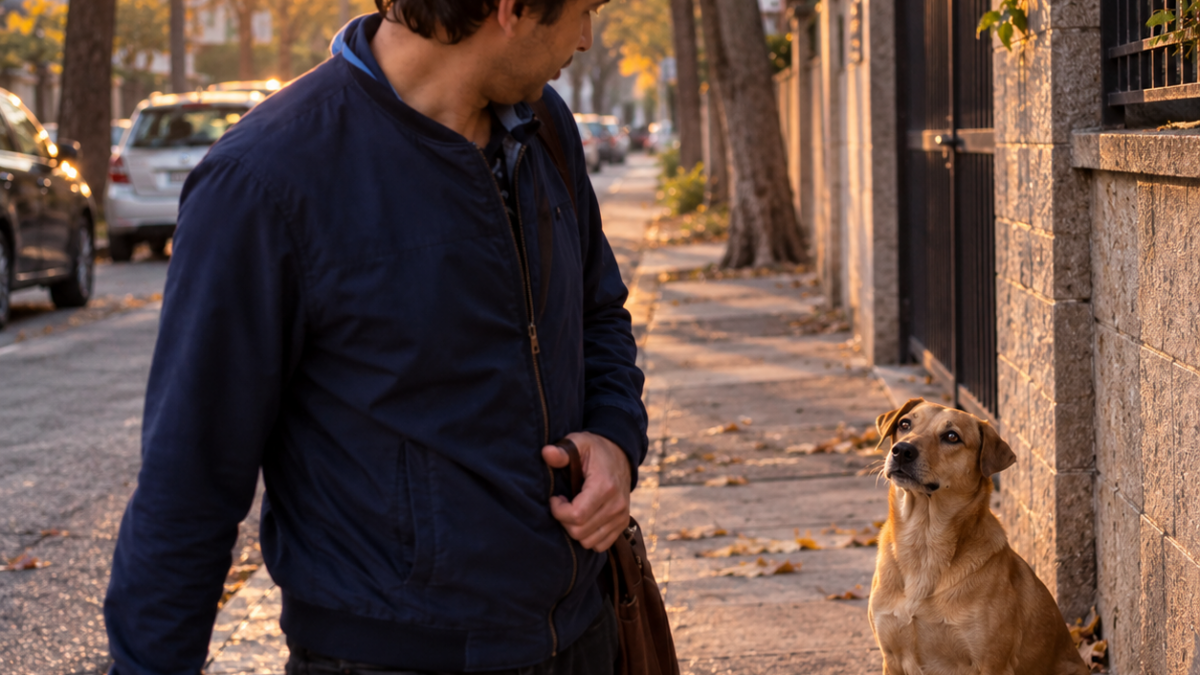
For six days, a large sand-colored dog followed me everywhere I went, keeping the same careful distance behind me from my apartment to work and back again, and no matter how many times I changed my route, left early, stayed late, or tried to send him away, he was always waiting when I stepped outside.
By the fifth night, I had stopped asking why the dog was watching me and started wondering what kind of animal could lie beneath my streetlight until morning, refuse to approach my neighbors, and then rise the instant my apartment door opened as if my daily routine had somehow become the only thing he trusted.
Then, on the seventh evening, I noticed a black sedan with hidden blue lights matching every turn I made—and when the dog stopped in the middle of the sidewalk and stared directly at that car instead of following me, I realized for the first time that maybe he had never been following me at all.
My name is Ethan Cole. I was thirty-six years old then, living alone in a second-floor apartment on the east side of Columbus, Ohio, and working as an estimator for a commercial construction company about twenty minutes away on foot.
My life was uncomplicated.
Work.
Coffee.
Microwave dinners.
Baseball on television.
Sunday calls with my mother.
I was not lonely enough to admit I was lonely, which is a very specific condition men in their thirties become surprisingly good at maintaining.
The dog appeared on a Monday.
He was sitting beside the steps when I left at 7:10 in the morning.
Large.
Maybe seventy pounds.
Sand-colored coat with darker fur around the muzzle and ears. He looked like some combination of German shepherd and Belgian Malinois, though I am no expert.
He did not look starved.
He did not look friendly either.
Not unfriendly.
Watchful.
I walked around him.
“Morning.”
His eyes followed me.
I reached the end of the block.
He stood.
Then followed.
Five or six paces behind.
I stopped.
He stopped.
“Go home.”
He tilted his head.
I continued.
So did he.
By the time I reached work, he was still there.
Our security guard, Pete, looked over my shoulder.
“You bring a dog?”
“No.”
“Dog brought you?”
“Apparently.”
The animal sat outside the entrance.
At lunch, still there.
At five thirty, he followed me home.
The second morning, he was waiting again.
On Wednesday, I left forty minutes early.
He was downstairs.
Thursday, I took the alley behind the building.
He appeared two blocks later.
Friday, I threw half a bagel toward a vacant lot.
He looked at it.
Then looked at me.
Didn’t touch it.
My neighbor, Martha Jennings, watched from her porch.
“That dog has adopted you.”
“No, he hasn’t.”
“He sleeps under your window.”
“He’s confused.”
“So are most men. Somebody still marries them.”
“Good morning, Martha.”
By Saturday, I had stopped telling him to leave.
He stayed outside the grocery store while I shopped.
Waited outside the laundromat.
Followed me to the pharmacy.
That night, I stood at my window and looked down.
There he was beneath the streetlight.
Head between his paws.
Facing my building.
I felt something uncomfortable moving under my ribs.
Not fear.
Responsibility.
On Sunday evening—the seventh day—I was walking home with the dog behind me when I noticed the black sedan.
Three buildings back.
Engine running.
No markings.
Dark windows.
I sped up.
The car moved.
I stopped.
It stopped.
The dog stopped too.
But he wasn’t watching me.
He was staring at the sedan.
His body changed.
Head higher.
Ears forward.
Tail still.
Then blue lights flashed behind the windshield.
Once.
Twice.
My stomach dropped.
The rear door opened.
A woman in plain clothes stepped out.
She held up both hands.
“Mr. Cole?”
The dog moved in front of me.
Not attacking.
Blocking.
The woman froze.
Her eyes went to him.
Then back to me.
“Please don’t run.”
“I wasn’t planning to.”
A second officer got out.
The woman pointed carefully at the dog.
“Do you know him?”
“No.”
“How long has he been following you?”
“Six days.”
Her face changed.
“What?”
“Who is he?”
The dog looked at her.
Then at me.
Then, strangely, down toward the old canvas messenger bag hanging from my shoulder.
The woman saw it.
Every bit of color seemed to leave her face.
“Where did you get that bag?”
I looked down.
A faded tan canvas bag I had bought at a thrift shop nine days earlier for twelve dollars.
“What does my bag have to do with this?”
She stepped closer.
Slowly.
“Mr. Cole…”
Her voice dropped.
“That bag belonged to the man this dog has been trying to find for almost three months.”
And suddenly the dog’s six-day obsession with me made terrible, perfect sense.
PART 2
I looked from the woman to the dog and then down at the bag.
It had cost me twelve dollars.
That was the first stupid thought my brain produced.
Twelve dollars.
Canvas.
Two brass buckles.
A worn leather strap.
A dark stain near one corner.
I had bought it because my old laptop bag split at the seam the previous weekend and the thrift store around the corner had a rack of used luggage.
That was it.
No mystery.
No fate.
No dead man’s treasure.
Just a bag.
The dog stepped toward me and pushed his nose against the canvas.
Then inhaled deeply.
The woman watched.
“He’s not following you,” she said.
I swallowed.
“He’s following this?”
“Yes.”
“Whose is it?”
She hesitated.
“My name is Detective Sarah Mitchell. That’s Detective Owen Price.”
The man beside the car nodded.
“And the dog?”
Sarah looked at him.
“His name is Duke.”
The dog’s ears moved.
That was the first time I saw a clear reaction to a word.
“Duke?”
His tail moved once.
My skin prickled.
Sarah continued.
“He belonged to a retired police detective named Alan Mercer.”
“Belonged?”
I heard the word.
Past tense.
Sarah corrected herself.
“Belongs.”
“Where is Alan?”
“That’s complicated.”
Of course it was.
Nothing about the previous six days had suggested simplicity.
## **1. The Dog They Couldn’t Catch**
Sarah explained that Duke was not an active police dog.
He had never officially served.
Alan Mercer had been a detective for thirty-one years, mostly fraud and property crimes. He retired at sixty-eight and adopted Duke from a rescue two years later.
Duke was already around five when Alan took him.
Smart.
Protective.
Suspicious of strangers.
Extremely attached to Alan.
Three months earlier, Alan disappeared from his usual life almost overnight.
Not “missing” in the traditional sense.
His nephew, Craig Mercer, told neighbors Alan suffered a medical event and was moved into long-term care.
The house was cleared.
Duke was supposedly transferred to a private rescue.
Except the rescue had no record of him.
Then Duke began appearing around Alan’s old neighborhood.
Police and animal services tried catching him.
He vanished.
Two weeks later he appeared again.
Then disappeared.
“He’s been surviving on his own?” I asked.
“Partly,” Sarah said. “Several people have been feeding him.”
“And you’ve been following him?”
“We started monitoring sightings because Alan’s situation is part of an open investigation.”
I looked at the sedan.
“You could have just told me.”
“We didn’t know who you were.”
“You ran my name?”
“Yes.”
“Great.”
“You have no criminal history.”
“Comforting.”
Owen almost smiled.
Sarah didn’t.
She pointed to the bag.
“What thrift store?”
“Second Chance on Broad Street.”
“When did you buy it?”
“Last Saturday.”
Duke appeared Monday.
Sarah nodded slowly.
“That explains the timing.”
## **2. Alan Mercer**
“Where is he?” I asked again.
Sarah looked toward Duke.
“Alive.”
That mattered.
“Then what’s complicated?”
“His nephew says Alan has severe cognitive impairment and cannot communicate reliably.”
“Does he?”
“We have reasons to question that description.”
Something in her tone told me there was far more.
I said:
“And the bag?”
“We think it came from Alan’s house.”
“How?”
“Craig cleaned out much of the property after Alan was moved.”
“Donated his belongings?”
“Some.”
“Without Alan?”
Sarah’s expression hardened.
“That’s part of what we’re trying to establish.”
I looked at Duke.
He had sat down beside me.
Not touching.
Watching the bag.
Six days.
He had been following his owner’s smell.
Not me.
Oddly, that hurt.
Then I immediately felt stupid for being hurt.
A week earlier, I didn’t even know this dog existed.
## **3. Why the Police Had Not Simply Taken Duke**
I asked the obvious question.
“If you knew who he was, why didn’t you just catch him?”
Owen answered.
“Because every attempt made him run.”
“Tranquilizer?”
“Not justified for a healthy dog unless necessary.”
“Trap?”
“Tried.”
“He avoided it?”
“Every time.”
I looked down.
“Smart?”
Sarah nodded.
“Alan spent his career training himself to notice patterns. Apparently Duke learned a few things.”
Duke yawned.
Unimpressed by his reputation.
“What happens now?”
Sarah pointed at the bag.
“We’d like to document it.”
“Are you taking it?”
“If you voluntarily allow us to examine it.”
I hesitated.
Not because I cared about the bag.
Because the whole situation had suddenly made ordinary objects feel dangerous.
“What are you looking for?”
“We don’t know.”
That answer did not help.
## **4. Duke Refused to Leave Me**
Animal control arrived.
Duke took one look at the vehicle and moved behind me.
Not ideal.
An officer crouched.
Treat.
Soft voice.
Nothing.
He tried the slip lead.
Duke backed away.
Sarah said:
“Ethan?”
“What?”
“Can you walk him toward the vehicle?”
“He isn’t my dog.”
“He trusts you enough not to leave.”
“He trusts my bag.”
“Then your bag is invited too.”
Fair.
I walked toward the animal-control van.
Duke followed.
Three feet.
Then stopped.
He would not climb inside.
We tried for twenty minutes.
Finally I opened the rear door of Sarah’s unmarked sedan.
Duke stepped in.
Apparently law enforcement sedans were acceptable.
Nobody understood why.
Sarah looked at me.
“You coming?”
“Where?”
“Animal clinic. We need his chip verified and a health check.”
I glanced toward my apartment.
Then at Duke.
The same animal I had spent three days trying to lose.
“Fine.”
## **5. The Microchip**
Duke’s chip confirmed everything.
Registered owner:
**Alan Joseph Mercer.**
Emergency contact:
**Craig Mercer.**
Secondary contact:
**Sarah Mercer.**
Sarah the detective noticed the name.
“Who’s Sarah Mercer?”
She checked records.
Alan’s daughter.
Deceased six years earlier.
The dog was around nine.
Older than I expected.
The veterinarian found:
Weight slightly low.
Mild dehydration.
Arthritis.
Worn paw pads.
Ear infection.
Otherwise remarkably healthy.
“Someone’s been feeding him,” the vet said.
Sarah nodded.
“Neighborhood people.”
Duke stayed near my chair.
Every few minutes he smelled the bag.
I finally put it on the floor.
He lay beside it.
The sight was so simple it hurt.
He wasn’t attached to me.
He was sleeping beside the last familiar scent he could find.
## **6. Second Chance Thrift**
The store manager remembered the donation.
Huge batch.
Furniture.
Clothes.
Boxes.
Books.
Household goods.
Delivered by a man in a gray pickup approximately ten days earlier.
Name on donation receipt:
Craig Mercer.
That changed Sarah’s entire posture.
“Can we see the receipt?”
The manager printed it.
Source address:
Alan’s house.
My bag had been his.
No question now.
The dog had probably smelled it on me from the first morning.
Maybe the canvas retained Alan’s scent.
Maybe Duke recognized a familiar combination of leather, laundry soap, old paper, whatever lives invisibly inside objects long after humans stop noticing.
## **7. I Wanted to Return the Bag**
“Give it to Duke,” I said.
Sarah looked confused.
“The bag?”
“It’s Alan’s.”
“We can’t give property to a dog.”
“You know what I mean.”
Sarah smiled for the first time.
“We need to photograph it first.”
Fine.
They took pictures.
Exterior.
Interior.
Pockets.
Nothing unusual.
Receipts?
No.
Documents?
No.
A handful of old pencil shavings in one corner.
That was it.
I almost felt disappointed.
Then Duke started pawing at the bottom.
## **8. The False Seam**
At first we thought he wanted to lie on it.
Then he kept scratching the same corner.
The veterinarian moved the bag.
Duke followed.
Sarah examined the inside.
“Wait.”
The bottom lining looked normal.
Except one seam did not match the others.
Hand-stitched.
Newer thread.
She did not cut it immediately.
Evidence procedures.
Photographs.
Consent.
Bag into a clean room.
I signed a form giving permission to open the seam because technically I now owned the thrift-store purchase.
Twenty minutes later, Sarah returned carrying a small brass key and a folded piece of paper sealed in plastic.
I stared.
“You’re kidding.”
“No.”
“What’s the paper?”
She unfolded it carefully.
One line.
Numbers and letters.
**BRYANT STORAGE — B14**
Below it:
**If Craig moves me, call Mitchell. Do not trust the first story.**
Sarah went completely still.
“Mitchell?”
I looked at her.
“You.”
She nodded.
“I knew Alan.”
## **9. Why Alan Trusted Sarah**
Sarah had been a junior detective under Alan years earlier.
He trained her.
She described him as infuriating.
Meticulous.
Stubborn.
Impossible to rush.
The kind of detective who would spend three hours explaining why a missing receipt mattered.
After retirement, he occasionally called her about scams targeting older neighbors.
Three months earlier, Alan called once.
Said he had concerns about financial decisions Craig was making “on his behalf.”
He promised details.
Never called back.
Two days later, Craig informed police Alan suffered a serious stroke and was moved to private care.
Sarah attempted contact.
Craig produced medical privacy paperwork and said Alan couldn’t speak.
Nothing illegal about family limiting access to a recovering relative.
Not automatically.
But Sarah remained uneasy.
Then a social worker anonymously reported concerns that Alan seemed mentally sharper than Craig represented.
Internal elder-services investigators became involved.
That was why the black sedan existed.
Not because I had committed anything.
Because Duke might be the only living thing left freely moving between pieces of Alan’s old life.
## **10. Bryant Storage**
Unit B14 was rented under Alan Mercer’s name.
Paid six months in advance.
The facility manager allowed access only after Sarah obtained the appropriate legal authorization.
I did not go inside.
Not then.
I went home.
For the first time in seven nights, the streetlight outside my apartment was empty.
Duke stayed at the veterinary clinic.
I told myself that was good.
He was safe.
Still, the window looked wrong.
Ridiculous how quickly something becomes part of your life.
At 11:40 p.m., Sarah called.
“We found documents.”
I sat up.
“What kind?”
“Financial records.”
“About Craig?”
“Yes.”
Then:
“And something else.”
“What?”
“Alan left a video.”
## **11. Alan’s Video**
I did not see it immediately.
Police showed it later after attorneys cleared what could be shared.
Alan sat at a wooden desk.
Same tan messenger bag beside him.
Duke lying behind his chair.
Date stamp:
Four months earlier.
Alan looked healthy.
Tired.
But completely coherent.
He said:
> “My name is Alan Mercer. I am recording this because my nephew has begun telling people I’m no longer competent to handle my affairs. That is false.”
He described the situation without drama.
Craig had begun managing some bills after Alan underwent heart surgery.
Reasonable.
Then he noticed transfers.
Property-tax payments made twice.
Cash withdrawals he did not authorize.
A home-equity inquiry he did not request.
Most troubling:
A draft purchase agreement transferring Alan’s house to a limited company controlled by Craig and another investor for significantly below market value.
Alan confronted him.
Craig claimed it was estate planning.
Alan said no.
Then he began keeping copies outside the house.
Storage unit B14.
## **12. Alan’s Warning**
The video continued:
> “Craig is my sister’s son. He has helped me. I do not want anyone turning him into a monster because of this recording. I want the truth documented. If I become unable to decide, follow the legal documents I signed with my attorney, not whatever someone says I wanted.”
Then:
> “If I remain able to decide, ask me.”
Simple.
That line became everything later.
**Ask me.**
## **13. Where Was Alan?**
The records in the storage unit gave investigators enough to move faster.
Alan was not in long-term memory care as Craig had implied.
He was at a rehabilitation center outside Dayton.
Nearly an hour and a half away.
Stroke?
Yes.
But milder than described.
Speech affected.
Right-side weakness.
Cognition?
Preliminary notes said intact.
Sarah arranged through the proper channels to speak with him.
I had no reason to be there.
Duke did.
That became complicated.
## **14. Duke’s Visit**
The rehab center initially said no animals.
Then the physician approved a controlled visit.
Sarah called me.
“Duke won’t load into animal control.”
I laughed.
“Still?”
“He loaded into my sedan once. Apparently that privilege expired.”
“What do you want from me?”
Silence.
I knew.
“No.”
“Ethan.”
“He doesn’t care about me. He cares about the bag.”
“Bring the bag.”
“You’re manipulating me.”
“Yes.”
I went.
## **15. The Drive to Dayton**
Duke rode in the back seat of my car with the messenger bag beside him.
I had never owned a dog.
I spent the entire drive checking the mirror like he might disappear.
He mostly slept.
At one point he raised his head.
Smelled the air through the cracked window.
Then rested his chin on the bag.
I said:
“We’re going to see him.”
Ear moved.
“Alan.”
Both ears lifted.
I had learned.
I said it again.
“Alan.”
Duke sat up.
For the next twenty minutes, he did not lie down.
## **16. Room 117**
Alan was thinner than in the video.
Silver hair.
Right hand curled slightly.
Wheelchair near window.
His left hand held a paperback mystery novel.
That detail made him suddenly human.
Not a case.
Not a victim.
A man reading.
Sarah entered first.
“Alan?”
He looked up.
Recognition.
His expression changed.
“Mit…chell.”
Sarah almost cried.
Then I entered with Duke.
The book fell.
Duke froze.
For perhaps two seconds, nothing happened.
Then he made a sound I will never forget.
Not a bark.
Not a whine.
Something between.
He pulled the leash out of my hand.
Crossed the room.
Put his head directly into Alan’s chest.
Alan folded over him.
His left arm came around Duke’s neck.
“Boy.”
Duke’s whole body shook.
Alan kept touching him.
Ear.
Neck.
Shoulder.
As though verifying each piece.
“Boy.”
Again.
The room stopped.
## **17. Alan Sees the Bag**
After several minutes, Alan looked past Duke.
Saw me.
Then saw the messenger bag.
His eyes widened.
“Mine.”
I walked closer.
“Yes.”
He pointed.
“Where?”
“Thrift store.”
Alan closed his eyes.
A long, exhausted expression.
“Craig.”
Sarah nodded.
“We found B14.”
Alan’s eyes opened.
Sharp.
“Good.”
One word.
Perfectly clear.
## **18. What Really Happened**
With speech therapy support and a communication board, Alan explained.
He suffered a stroke at home.
Craig found him.
Called 911.
Good.
Everything after became more complicated.
While Alan was hospitalized, Craig began describing the stroke as catastrophic.
He told neighbors Alan would never return.
He told the rehab staff Alan had long-standing confusion.
Medical records did not support that.
He also produced a power of attorney Alan had signed years earlier.
But the document was limited.
It allowed bill payment and routine financial management during incapacity.
Not transfer of major property to Craig.
Not sale of the house for personal benefit.
Not disposal of personal belongings without necessity.
Not unilateral placement decisions while Alan retained capacity.
## **19. Duke’s Disappearance**
Alan had asked:
“Dog?”
Repeatedly.
Craig told him Duke was safe with a rescue.
False.
Craig initially took Duke to a private boarding kennel.
Then stopped paying after two weeks.
The kennel called.
Craig said surrender the dog.
The kennel refused without proper ownership documentation.
Before the dispute finished, Duke escaped during an outdoor transfer.
That was how he became “stray.”
Craig never reported the escape to Alan.
## **20. Why Craig Cleared the House**
His explanation:
Security.
Preventing theft.
Preparing for eventual sale.
But records showed he had already contacted a buyer connected to one of his business partners.
The house was worth approximately $430,000.
Draft sale price:
$305,000.
Craig argued extensive repairs justified the discount.
Independent inspection later estimated necessary repairs closer to $28,000.
The numbers did not make the deal automatically criminal.
They made it deserving of scrutiny.
The storage records supplied more.
## **21. The Transfers**
Over eighteen months, Craig reimbursed himself approximately $41,000 from Alan’s accounts.
Some legitimate.
Roof repair coordination.
Medical transportation.
Tax assistance.
Groceries.
Others poorly supported.
“Consulting.”
“Property management.”
“Administrative time.”
Payments to a company Craig partly owned.
Alan denied authorizing many of them.
The police investigation became financial.
Slow.
Paper-heavy.
Nothing like television.
That was better.
Facts survived boredom.
## **22. The Bag Was Not the Biggest Evidence**
Everyone online later focused on the secret pocket.
The key.
The dramatic dog.
In reality, the strongest evidence was boring.
Emails.
Bank records.
Property drafts.
Attorney notes.
Medical assessments.
Dated correspondence.
The bag merely preserved the route to them.
Duke merely preserved the bag’s meaning long enough for someone to notice.
That was enough.
## **23. Why Duke Followed Me**
The veterinarian behaviorist explained it later.
Probably scent.
Alan carried that bag daily.
Sweat.
Home smell.
Duke’s hair embedded in the lining.
Maybe food residue.
Leather.
Laundry detergent.
Thousands of molecules invisible to me.
I bought it.
Carried it through Duke’s territory.
He found the smell of his person attached to a stranger.
So he followed.
Why not grab the bag?
Why keep distance?
Because I was unfamiliar.
He wanted the scent.
Did not trust the man carrying it.
Makes sense.
By day five, I had become part of the scent pattern.
Then part of the routine.
## **24. I Was Slightly Offended**
I told Sarah:
“So he didn’t actually like me.”
She laughed.
“He slept outside your building six nights.”
“For the bag.”
“He could have stolen it.”
“He’s polite.”
“Ethan.”
“What?”
“You’re jealous of a canvas bag.”
I was.
A little.
Duke heard none of this.
He was with Alan.
Where he belonged.
## **25. Alan Could Not Take Duke Home Yet**
That was the next problem.
Alan needed at least two more months of rehabilitation.
His home was tied up in legal review.
Duke needed somewhere stable.
The kennel that originally held him declined because of the previous escape.
A shepherd rescue offered foster placement.
Alan listened.
Then pointed at me.
I actually looked behind myself.
“No.”
Alan smiled.
“Yes.”
His speech was improving.
Unfortunate.
Sarah asked:
“Would you consider fostering him?”
“I work full time.”
“So do millions of dog owners.”
“I live in an apartment.”
“Pets allowed?”
“Yes.”
“You already know his routine.”
“I know that he ignores bread.”
Sarah looked at Alan.
Alan looked at Duke.
Duke looked at the bag.
I lost.
## **26. Foster**
Temporary.
Everyone said temporary.
I bought:
Dog bed.
Food.
Bowls.
Leash.
Arthritis supplements.
Ear medication.
Two toys.
Duke used none of the toys.
Ignored the bed.
Slept beside the messenger bag.
My apartment suddenly contained seventy pounds of quiet judgment.
The first night, I went to the bathroom at 2:00 a.m.
Duke stood instantly.
Followed.
“Relax.”
He followed back.
When I lay down, he stationed himself at my bedroom door.
I understood then.
He wasn’t just following a scent anymore.
He was afraid people disappeared.
## **27. The First Week**
Duke waited outside my office.
That could not continue.
Pete, our security guard, loved him.
Our company owner did not.
So I hired a dog walker.
Duke refused to leave with her.
Day two:
Same.
Day three, I walked with them for ten minutes.
Then turned back.
Duke tried following me.
The walker stopped.
Waited.
Treats.
Eventually Duke continued.
We built gradually.
Trust is slow when abandonment has happened more than once.
## **28. Alan Calls**
Speech therapy improved Alan’s ability to use the phone.
First call:
“Ethan.”
“Yes?”
“Dog.”
“He’s alive.”
Pause.
“Good?”
“Yes.”
Duke heard Alan’s voice through speakerphone.
Stopped.
Walked over.
Pushed his nose against the phone.
Alan laughed.
It was rough.
Uneven.
Beautiful.
“Boy.”
Duke whined.
We started video calls after that.
## **29. Craig Learns About Me**
I met Craig accidentally.
Outside the courthouse after a preliminary hearing.
He knew who I was because of the bag.
“You’re the thrift-store guy.”
Great title.
“Yes.”
“You inserted yourself into my family.”
I stared.
“Your family’s dog inserted himself into me.”
Bad sentence.
Craig almost laughed despite himself.
Then:
“You have no idea what caring for my uncle was like.”
I had heard versions of this before from stories.
But his exhaustion looked real.
That complicated my anger.
“How long were you helping him?”
“Six years.”
“Bills?”
“Everything.”
“Appointments?”
“Yes.”
“House?”
“Yes.”
“Did he make it easy?”
Craig laughed.
“No.”
That sounded honest.
## **30. Caregiver Fatigue**
Craig explained.
Alan resisted help.
Would forget appointments occasionally.
Kept driving after doctors recommended limiting it.
Refused to simplify accounts.
Called Craig at midnight over minor things.
Some claims were confirmed by neighbors.
Alan was not a perfect old man.
Important.
Vulnerability does not make people saints.
Craig had helped.
For years.
Then something changed.
Maybe exhaustion.
Maybe entitlement.
Maybe money.
Usually more than one thing.
## **31. The Line He Crossed**
I asked:
“When did you stop asking?”
Craig’s face changed.
“What?”
“When did helping become deciding?”
He stared at me.
“You sound like Mitchell.”
“Probably because she has better questions.”
He walked away.
But the question remained.
Later, Craig admitted during a deposition that after Alan’s heart surgery, he began believing he “knew what was practical.”
Practical became permission.
That was the line.
## **32. Alan’s Capacity Evaluation**
Craig petitioned for guardianship.
His attorney argued the stroke plus prior concerns showed Alan could not safely manage major decisions.
Alan’s attorney requested independent neuropsychological evaluation.
Results:
Language impairment.
Moderate physical limitations.
Some slowing.
But comprehension strong.
Reasoning intact.
Understanding of finances intact.
Ability to communicate preferences intact with extra time.
The evaluator wrote:
**Communication difficulty should not be mistaken for inability to decide.**
That sentence became central.
## **33. The Guardianship Hearing**
I attended only because Alan asked.
Duke did not.
Animals should not be props in court.
Alan wore a navy blazer.
Wheelchair.
Left hand steady.
Judge asked:
“Mr. Mercer, do you understand why your nephew filed this petition?”
“Yes.”
“Do you believe you need help?”
Alan paused.
“Yes.”
Craig looked surprised.
Then the judge asked:
“What kind?”
Alan answered slowly.
“Help.”
Pause.
“Not control.”
The entire case could have ended on that sentence.
## **34. The Decision**
No broad guardianship.
Instead:
Supported decision-making plan.
Professional fiduciary for certain complex financial tasks while the investigation continued.
Home health evaluation.
Independent attorney.
Craig removed from unilateral control.
Alan retained decision authority.
The house could not be sold without Alan’s express approval.
He did not approve.
## **35. Craig’s “Revenge”**
After losing financial control, Craig became angry.
Not violent.
Legal.
He challenged expenses.
Questioned Alan’s new fiduciary.
Claimed Sarah had prejudiced the investigation because of her old relationship with Alan.
Some concerns were reviewed.
Good.
Oversight should work both ways.
Sarah stepped back from direct financial case leadership to avoid appearance issues.
Another detective took over.
That made the case stronger, not weaker.
## **36. The Financial Outcome**
Months later, after a forensic audit, the picture was more nuanced than either side wanted.
Approximately $22,000 in Craig’s reimbursements were well supported.
Around $8,000 were questionable but arguably related to actual caregiving expenses.
Roughly $11,000 lacked adequate authorization or documentation.
The proposed property deal created a separate conflict-of-interest issue.
Craig ultimately agreed to:
Repay disputed funds.
Cover part of Alan’s legal/accounting costs.
Withdraw from the property transaction.
Resign from financial authority.
Accept a civil order limiting future handling of Alan’s assets.
An administrative count involving a false statement on one property form resulted in a fine and probationary compliance conditions.
No dramatic prison sentence.
No total ruin.
Truth was enough.
## **37. Alan’s View**
I asked him:
“Is that enough?”
He had returned to Columbus by then, living in a short-term accessible apartment while his house was renovated.
He thought.
Then:
“Money.”
Pause.
“Back.”
“Some.”
“House?”
“Yours.”
“Dog?”
I looked at Duke beside him.
“Yours too.”
Alan smiled.
“Enough.”
He never wanted Craig destroyed.
He wanted his choices back.
## **38. Duke’s Reaction to Craig**
Craig eventually visited Alan.
Duke was there.
Craig stopped at the door.
Duke’s body stiffened.
No bark.
No growl.
Craig did not approach.
Good.
Alan said:
“Sit.”
Craig did.
They talked.
Slowly.
Painfully.
Duke lay between them.
Not as a symbolic judge.
Just because that was where the rug was.
## **39. Craig Apologizes**
His first apology was terrible.
“I was under pressure.”
Alan stared.
“I was trying to keep you safe.”
Still staring.
“You weren’t making rational choices about the house.”
Alan pointed toward the door.
Visit over.
Second apology came two months later.
Better.
“I made decisions because I was tired of arguing.”
Pause.
“I told myself that because I was the one doing the work, I deserved to decide.”
Alan listened.
Craig continued:
“I was wrong.”
No “but.”
That mattered.
## **40. Alan’s Answer**
He said:
“Ask.”
Craig looked confused.
Alan repeated:
“Ask me.”
Two words.
The entire conflict.
Craig cried.
Alan did not immediately forgive him.
Good.
Trust should not return faster than truth.
## **41. Duke Starts Choosing Me**
During all this, Duke lived with me.
“Temporary.”
Month one.
Month two.
Month three.
He stopped sleeping beside the messenger bag.
Started sleeping beside my couch.
Then my bedroom door.
One evening I came home late.
Duke heard my key.
For the first time, I heard his tail hitting the floor before I entered.
I opened the door.
He stood.
Walked toward me.
Not the bag.
Me.
I looked down.
“Seriously?”
Tail.
That moment mattered more than I expected.
## **42. The Bag Becomes Ordinary**
I kept using it.
After police returned it.
The hidden seam repaired.
Duke eventually stopped smelling it every day.
Then almost entirely.
Scent fades.
Memory changes.
One afternoon I considered replacing it.
Didn’t.
Not because it was evidence.
Because it was a good bag.
Alan would have approved the practicality.
## **43. Alan Comes Home**
Six months after the stroke, renovations finished.
Ramp.
Bathroom rails.
Lower kitchen storage.
Monitoring system.
Part-time aide.
Alan returned.
Duke came with us.
When the car reached Alan’s street, Duke stood.
Whined.
I opened the door.
He ran up the walkway.
Stopped at the porch.
Looked back.
Alan was moving slowly with a cane.
Duke waited.
That detail stayed with me.
He could have gone inside.
He waited for his person.
Alan reached the porch.
“Home.”
Duke entered beside him.
## **44. I Assumed My Job Was Done**
I handed Alan the leash.
“Congratulations.”
He looked at me.
“Where?”
“What?”
He pointed at Duke.
Then me.
“Shared.”
I laughed.
“No.”
Duke walked over and leaned against my leg.
Betrayal.
Alan smiled.
“Shared.”
Apparently I had joint custody.
No legal form.
Just reality.
## **45. The New Routine**
Duke spent weekdays with me when Alan had therapy or appointments.
Weekends often with Alan.
Sometimes reversed.
The dog developed two beds.
Two sets of bowls.
Two neighborhoods.
One messenger bag.
He adapted.
That was the point.
A dog who once attached himself to one disappearing scent learned home could have more than one address.
## **46. My Mother Meets Duke**
My mother had spent six days hearing about “that weird dog.”
When she finally met him:
“Oh, he’s gorgeous.”
“He’s manipulative.”
Duke leaned into her.
She fed him turkey.
Within ten minutes:
“Why don’t you get a bigger apartment?”
Traitors everywhere.
## **47. Martha Was Insufferable**
My neighbor Martha saw Duke enter my apartment officially.
“I told you.”
“You told me he adopted me.”
“Yes.”
“He was following a bag.”
“Details.”
“He belonged to somebody else.”
“Yet here he is.”
I stopped arguing.
Never debate retired women with porch chairs.
They have time.
## **48. The News Story**
A local reporter got hold of the unusual details.
Headline:
**Stray Dog Follows Man Carrying Missing Owner’s Bag, Helps Reopen Elder Financial Case**
Reasonably accurate.
Then social media turned it into:
**Hero Dog Exposes Corrupt Nephew**
Too simple.
Craig was not “corrupt” in some grand criminal-network sense.
He was a caregiver who crossed financial and ethical lines.
That distinction matters because the warning applies to ordinary people.
Control can grow out of resentment and exhaustion as easily as greed.
## **49. Alan Corrects the Reporter**
Reporter asked:
“Did Duke save you?”
Alan answered:
“No.”
Reporter looked disappointed.
Alan continued:
“People.”
Then pointed toward Duke.
“Dog bothered them.”
I laughed.
That was Alan’s version.
Duke annoyed enough people until the right ones looked closer.
Fair.
## **50. Sarah’s Version**
Sarah said:
“The key mattered.”
“The dog found the key?”
“No. The dog found the bag.”
“The bag found the key?”
“I found the key.”
“So you’re the hero?”
She stared.
“I will arrest you for wasting my time.”
“You can’t.”
“Probably not.”
We became friends.
Not close.
Enough.
## **51. Alan’s Past**
I learned more about him.
Widower.
Daughter died from cancer six years earlier.
No other children.
Craig was his sister’s son.
Alan had practically helped raise him.
That explained why the betrayal hurt differently.
Not just money.
History.
Craig had once been the boy Alan taught to drive.
The young man Alan helped through college.
The nephew trusted with power of attorney.
People who hurt us are often people who once helped us.
That makes stories harder.
And truer.
## **52. Craig’s Past**
He had spent six years helping Alan through:
Heart surgery.
Medication.
Insurance.
Home repairs.
Driving restrictions.
Grief.
Then his own marriage started failing.
His business struggled.
Caregiving intensified.
None excused the unauthorized decisions.
But context mattered.
Craig began attending a caregiver-support program as part of rebuilding.
Not court ordered.
His choice.
Good.
## **53. Alan Does Not Restore the Power**
Important.
Forgiveness eventually started.
Financial authority never returned.
Alan kept the professional fiduciary.
Craig asked once:
“You don’t trust me?”
Alan answered:
“Not with money.”
Craig nodded.
Painful.
Healthy.
Boundaries are not cruelty.
## **54. Duke’s Arthritis**
At ten, arthritis worsened.
Ramps.
Medication.
Weight control.
He hated medication.
Loved cheese.
The veterinarian suggested hiding pills in a tiny amount.
Duke learned to eat the cheese and spit the tablet onto the floor.
I admired the engineering.
Alan laughed so hard his speech disappeared for thirty seconds.
## **55. Alan’s Speech Improves**
Not fully.
He still paused.
Searched.
But words returned.
One afternoon:
“Ethan.”
“Yes?”
“Bag.”
“What?”
“Ugly.”
I stared.
“You carried that thing for years.”
He smiled.
“Still ugly.”
I almost returned it permanently.
## **56. The Bag Story**
Alan explained why he had hidden the key there.
He knew Craig had access to his desk.
Bank safe-deposit box too obvious.
Storage key inside a sewn lining in the bag he carried everywhere felt safer.
“Why not give it to Sarah?”
“Thought…”
Pause.
“Time.”
He thought he had time.
Humans build half our regrets around that assumption.
## **57. Why He Did Not Call Police Immediately**
Another question.
Why collect evidence instead of reporting?
Alan was not sure Craig intended theft.
At first.
Some reimbursements might be explainable.
He wanted to confront family privately.
Give Craig a chance.
Then stroke came first.
Timing changed everything.
Not every hidden file means conspiracy.
Sometimes people are just trying to avoid destroying a family until facts become clear.
## **58. Craig’s Third Apology**
Almost a year later.
Alan invited him for dinner.
I was there only because Duke was staying with me afterward.
Craig said:
“I kept telling myself you would eventually agree.”
Alan responded:
“So you acted before.”
“Yes.”
“Why?”
Craig looked down.
“Because I wanted agreement less than I wanted the outcome.”
Alan was quiet.
Then nodded.
That was the most honest sentence Craig ever said.
## **59. Repair**
They did not become what they were before.
Maybe impossible.
They became something new.
Monthly dinner.
Occasional appointments.
Craig did yard work only if asked.
Alan said no frequently.
Craig learned to hear no without treating it as confusion.
That was repair.
## **60. I Change Too**
Duke disrupted my life.
Walk before work.
Walk after work.
Vet.
Food.
Schedule.
Fur.
I started talking to neighbors because everyone knew him.
Martha introduced me to half the block.
I joined weekend hiking groups because Duke needed exercise.
Then discovered I enjoyed people in controlled doses.
My life expanded.
Annoying.
## **61. Julia**
Julia Chen lived two buildings over.
We had exchanged maybe five words in three years.
Duke loved her.
Because she carried chicken.
One evening:
“Your dog is cute.”
“Not technically mine.”
Duke stood leaning against my legs.
She raised an eyebrow.
“Sure.”
We started walking together.
Then coffee.
Then dinner.
No magical romance because dog.
Just opportunity.
Duke created movement.
People met in movement.
## **62. Alan Approves**
Too much.
He met Julia.
Later:
“Good.”
“Stop.”
“Marry.”
“We’ve had four dates.”
He shrugged.
“Efficient.”
This from the man who hid keys inside bags.
## **63. Duke’s Eleventh Birthday**
Estimated.
Nobody knew exact date.
We chose the day Alan adopted him.
Party:
Alan.
Me.
Sarah.
Julia.
Martha.
Craig.
Yes, Craig.
Duke wore no hat because I respect dignity.
Martha put one on him anyway.
Photos exist.
I deny them.
## **64. Craig Gives Duke a Gift**
Orthopedic bed.
Expensive.
Duke smelled it.
Walked away.
Slept on the old rug.
Alan laughed.
“Justice.”
Craig accepted defeat.
## **65. The House**
Two years later, Alan decided the house really was too much.
Important:
**Alan decided.**
Not Craig.
He sold it at full market price.
Moved into an independent-living community ten minutes from me.
Craig helped pack.
Before touching anything, he asked.
Every box.
At one point Alan said:
“You can stop asking about socks.”
Progress.
## **66. The Messenger Bag Returns to Alan**
I offered.
He looked at it.
Then shook his head.
“Yours.”
“Why?”
“Dog chose.”
“Again with this.”
He smiled.
I kept it.
## **67. Duke Chooses My Apartment More**
Independent living allowed dogs.
But Alan tired more easily.
Duke’s needs increased.
One evening Alan said:
“Keep him.”
I thought he meant overnight.
He meant permanently.
“No.”
“Yes.”
“He’s your dog.”
Alan touched his own chest.
Then mine.
“Ours.”
Same word years later.
I lost again.
Duke officially transferred to me, with Alan listed as secondary caregiver.
Paperwork caught up to reality.
## **68. The Pet Fund**
Alan insisted on paying part of Duke’s veterinary care.
I refused.
He transferred money anyway through his fiduciary.
I returned it.
He transferred again.
This continued until Julia said:
“You realize you’re arguing with a retired fraud detective about moving money?”
I stopped.
Good point.
## **69. Alan’s Health**
Heart failure progressed slowly.
Not crisis.
Years.
Medication.
Appointments.
Good months.
Bad.
He remained mentally sharp.
That became almost a running joke after so many people had once claimed otherwise.
At eighty-one, he beat me at chess every week.
Speech slower.
Mind faster.
Humiliating.
## **70. Craig’s Redemption**
I dislike that word when it arrives too easily.
But Craig changed.
He volunteered for a nonprofit helping family caregivers with respite planning.
He told his story without making himself a victim.
“I crossed a line because I decided exhaustion entitled me to control.”
That line helped people.
He did not ask Alan to praise him for it.
Good.
## **71. The Financial Restitution Ends**
Final repayment completed.
Alan received the last transfer.
He showed me the statement.
“Done.”
“How do you feel?”
He shrugged.
“Old.”
Fair.
Then:
“Better.”
Enough.
## **72. Duke Turns Twelve**
Muzzle gray.
Hearing weaker.
Still followed me everywhere.
But now distance:
One pace.
Not five or six.
He had closed the gap.
That detail did something to me.
The dog who once followed because he distrusted me now followed because proximity felt safe.
## **73. I Marry Julia**
Three years after Duke appeared.
Small wedding.
Duke present.
Alan in front row.
Craig too.
Sarah came late because detective work ignores ceremonies.
Martha cried loudly.
Duke slept through vows.
At reception he stole a piece of chicken.
Tradition.
## **74. Alan’s Toast**
Speech still limited.
He stood anyway.
Raised glass.
“Dog…”
Pause.
“Followed bag.”
Everyone laughed.
“Bag…”
He pointed at me.
“Followed idiot.”
More laughter.
Then:
“Idiot found wife.”
Julia laughed hardest.
Alan sat.
Best toast.
## **75. Duke’s Heart**
At thirteen, heart murmur became heart disease.
Medication.
No long hikes.
Short walks.
Rest.
Dr. Patel—different Dr. Patel than anyone else in the world, apparently every story needs one—explained quality of life.
I hated the conversation.
Alan listened more calmly.
He had practiced endings.
I had not.
## **76. The First Scare**
Duke collapsed briefly after a walk.
Recovered.
Emergency vet.
Medication adjustment.
Alan arrived using his walker.
“You okay?” he asked Duke.
Then me.
I lied.
“Yes.”
Alan stared.
“Bad liar.”
Retired detective.
Of course.
## **77. Alan’s Final Winter**
His own heart declined.
He moved to assisted living within the same community.
His choice.
Craig handled logistics under Alan’s direction.
Every single step documented.
There is something beautiful about a family learning from paperwork.
## **78. Duke Visits**
Once a week.
Duke walked slowly beside Alan’s wheelchair.
Residents loved him.
One woman called him “the detective dog.”
Alan corrected:
“Bag dog.”
Duke accepted both.
## **79. The Last Conversation About Craig**
Alan said:
“Good now.”
“Craig?”
“Yes.”
“You forgive him?”
Long pause.
“Enough.”
That was Alan’s style.
Not complete absolution.
Enough to live.
Enough to stop bleeding.
## **80. Alan Dies**
At eighty-three.
Peacefully.
Craig beside him.
Sarah visited earlier.
I was driving Duke there when Craig called.
“You don’t have to rush.”
I knew.
We arrived twenty minutes too late.
For years, I blamed no one.
Not myself.
Not traffic.
Not time.
I had learned.
Duke entered Alan’s room.
Smelled the bed.
Blanket.
Hands.
Then stood still.
Craig sat on one side.
I on the other.
Duke lay down between us.
We stayed an hour.
Then I said:
“Come on.”
Duke looked once toward the bed.
Then stood and followed me.
## **81. Alan’s Will**
Clear.
Of course.
No surprises.
Craig received a reasonable share.
Charities.
Sarah got Alan’s old service watch.
I received:
The messenger bag.
Already mine.
Typical Alan.
And a note.
**You paid twelve dollars. I think you overpaid.**
I laughed in the lawyer’s office.
Then cried.
Below it:
**Thanks for following him back.**
That line I kept.
## **82. Duke After Alan**
For two weeks, he reacted to every silver sedan.
Alan had driven one.
Then less.
Then stopped.
He did not forget.
He adapted.
Difference.
## **83. The Bag Finally Breaks**
Strap snapped.
Four years after all this.
Julia said:
“Throw it away.”
I looked horrified.
“Evidence.”
“It’s canvas.”
“Historic canvas.”
We repaired it.
Karim—wrong story, ignore Karim. Our local leather repairman, Miguel—replaced the strap.
Duke smelled it afterward.
No reaction.
Alan’s scent was long gone.
That hurt.
Then I realized Duke now associated the bag with me.
That helped.
## **84. Duke’s Final Year**
Fourteen.
Arthritis severe.
Heart disease controlled until it wasn’t.
Hearing nearly gone.
Eyes cloudy.
Still knew:
Me.
Julia.
Martha.
Craig.
Chicken.
Bag.
Home.
Good enough.
## **85. Craig Visits Duke**
He came with no gift.
Better.
Sat on floor.
Duke walked slowly over.
Craig touched his shoulder.
“I gave you a hard time.”
Duke leaned.
Craig cried.
No symbolic forgiveness.
Dogs do not sign moral documents.
He simply accepted a familiar hand.
## **86. The Quality-of-Life Calendar**
Green.
Yellow.
Green.
Yellow.
Then reds.
Less food.
Harder breathing.
No interest in walks.
Trouble standing.
I had promised myself I would not make him stay because I feared goodbye.
Promises are easy before the moment.
Hard inside it.
## **87. Sarah Tells Me the Truth**
“You’re doing what Craig did.”
I stared.
“What?”
“Deciding what you want and calling it what he needs.”
That hurt.
She apologized immediately.
“I’m sorry.”
“No.”
I looked at Duke.
“No. You’re right.”
Not exactly the same.
But enough similarity to matter.
Love can become control from good motives too.
That lesson came full circle.
## **88. Home Goodbye**
We scheduled at-home euthanasia.
Not because of one catastrophic emergency.
Because good days had become rare.
Julia took off work.
Craig came earlier.
Martha brought chicken.
Duke ate three bites.
Excellent.
Sarah visited in plain clothes.
No police sedan.
I joked:
“You stalking us?”
“Still.”
## **89. The Bag**
I placed it beside Duke’s bed.
Habit.
He smelled it.
Then placed his head on my leg instead.
That was the final answer to a question I hadn’t realized I still carried.
Years earlier:
Bag.
Now:
Me.
I cried immediately.
Julia understood.
## **90. What I Told Him**
“You picked the wrong guy.”
Tail moved.
“You know that?”
Another tiny movement.
“You could’ve followed anyone.”
I touched his gray face.
“But you found me.”
Then corrected myself.
“No.”
“You found him.”
Alan.
The bag.
The evidence.
The route home.
Then somehow, after all that, Duke found a second life with me.
## **91. Goodbye**
The veterinarian gave the first medication.
Duke relaxed.
Head heavy on my leg.
Julia held his paw.
I kept one hand on his shoulder.
Outside, a car passed.
Duke did not lift his head.
No need.
Nobody he loved was arriving late.
Everyone who mattered was already there.
The final medication came.
One breath.
Another.
Then stillness.
I stayed.
Longer than necessary.
Maybe necessary is the wrong word.
## **92. The Empty Streetlight**
That night I looked from my window.
Same place Duke slept six nights years earlier.
Empty.
I expected grief to feel like the first week.
It didn’t.
Different.
Back then, emptiness meant uncertainty.
Now it meant completion.
Painful.
But known.
## **93. The Bag Goes Into My Closet**
For months.
I stopped carrying it.
Not because it hurt.
Because I didn’t need the story on my shoulder every day.
Eventually I used it again.
Work.
Groceries.
Ordinary.
Objects deserve ordinary lives too.
## **94. Craig and Me**
We were never close friends.
We stayed in touch.
Coffee once or twice a year.
He continued caregiver work.
Sometimes spoke to families about power of attorney.
His central line:
“Help is not ownership.”
Alan would have approved.
Probably corrected grammar first.
## **95. Sarah Retires**
At her retirement dinner, she mentioned the case.
Called it “the stupid bag case.”
I objected.
“It was a distinguished bag.”
She said:
“It smelled like an old man and dog.”
“History has a smell.”
“Please stop talking.”
Friendship.
## **96. What the Case Changed**
The county expanded procedures around:
Independent capacity assessment.
Financial conflicts involving agents under power of attorney.
Temporary pet care when older adults are hospitalized.
None because of one heroic dog alone.
Cases accumulate.
Policies change slowly.
Duke’s story became one example.
That mattered.
## **97. The Pet-Care Program**
Alan’s estate left money to create emergency pet fostering for hospitalized seniors.
Small fund.
Practical.
If it had existed earlier, Duke might never have ended up loose.
That was the point.
Good legacies reduce the chance somebody needs a heroic rescue story later.
## **98. The First Dog Helped**
Old beagle.
Owner hospitalized after pneumonia.
Temporary foster for nineteen days.
Then home.
Sarah texted me the reunion photo.
Caption:
**No secret bag required.**
I laughed.
## **99. People Wanted a Better Villain**
Whenever the story circulated, strangers wanted Craig to be worse.
They invented things.
Said he caused Alan’s stroke.
False.
Said he planned to steal the entire estate.
Not proven.
Said police chased him across state lines.
Ridiculous.
The true warning is stronger.
Craig loved Alan.
Helped him.
Then started believing help entitled him to authority.
Ordinary people can cross lines gradually.
That is worth paying attention to.
## **100. People Wanted Duke to Be More Magical**
They said:
Duke knew where the evidence was.
No.
He knew the smell of his person.
He pawed at the bag because it mattered to him.
Maybe he smelled Alan strongest near the seam.
Maybe chance.
Either explanation is enough.
Dogs do not need legal strategy to be extraordinary.
## **101. What Duke Actually Did**
He refused to give up on a familiar scent.
Six days.
That persistence made me notice.
The police noticed me because they noticed him.
The bag led to the key.
The key led to records.
The records gave Alan his own voice back in a system already starting to speak around him.
That is a remarkable chain without inventing anything supernatural.
## **102. The “Revenge” Ending**
If you want revenge, here is the only version I believe in.
Craig tried to turn Alan’s “no” into an inconvenience.
Eventually every important person in the room learned to wait until Alan finished speaking.
Craig tried to make the house sale inevitable.
Alan sold years later on his own terms.
Craig assumed Duke could simply be surrendered and forgotten.
Duke became the thread that reopened every question.
Craig once held financial authority.
He ended by asking permission before moving a box.
No humiliation necessary.
Control reversed.
Truth restored.
That was enough.
## **103. My Life Before Duke**
Small.
Predictable.
I told myself I liked it.
After Duke:
Marriage.
Friends.
Dog hair.
Long walks.
Neighbors.
Courtrooms I never expected.
Hospitals.
Goodbyes.
Responsibility.
More pain.
Also more life.
I cannot recommend mystery dogs as personal-development strategy.
Too expensive.
## **104. Martha’s Final Opinion**
She still lives downstairs.
Still believes she predicted everything.
“He adopted you.”
“He followed the bag.”
“He stayed with you.”
“Eventually.”
“Therefore I was right.”
Logic impossible.
I buy her coffee anyway.
## **105. Julia and I Adopt Again**
Two years after Duke.
Older shepherd mix named Rosie.
Nine.
One ear crooked.
I said no initially.
Julia ignored me.
Martha celebrated.
Rosie does not follow me.
She follows Julia.
Justice.
## **106. Rosie Hates the Bag**
Barks at it.
No reason.
Maybe bad fashion sense.
Alan would agree.
## **107. The Photograph**
My favorite picture of Duke is not from the investigation.
Not the secret key.
Not Alan’s reunion.
It was taken three years later.
Duke asleep on my couch.
Alan in the armchair.
Me at the kitchen table.
No one looking at camera.
Ordinary afternoon.
That is what every dramatic story should earn.
Boring days afterward.
## **108. The First Morning Revisited**
Sometimes I remember Monday.
Duke at the apartment steps.
Watching me.
What if I had called animal control immediately?
Maybe still okay.
What if I had taken another route permanently?
He probably would have found someone else carrying the scent?
Maybe.
Alternate histories are useless.
He followed.
I eventually paid attention.
Enough.
## **109. The Seventh Day**
The black sedan used to be the part I told most dramatically.
Blue lights.
Hidden police.
Duke staring.
Me wondering whether I was somehow under investigation.
Now it feels almost funny.
Sarah later said:
“You looked guilty.”
“I was carrying groceries.”
“You looked like you were about to run.”
“I thought undercover police were following me.”
“They were.”
“Exactly.”
## **110. What I Thought the Message Was**
That seventh day, when Duke looked from the car to me and back, I thought he was warning me.
Maybe.
More likely he recognized Sarah’s vehicle from previous attempts to approach him.
Maybe he distrusted it.
Maybe he was simply deciding where to move.
Human beings love assigning sentences to animals.
Duke did not need words.
His choices were enough.
## **111. The Choice That Mattered**
At the end of the first night with me, I removed the messenger bag from the floor and placed it on a chair.
Duke stood.
Looked at the bag.
Then looked at me.
For a while.
Eventually he lay down beside my bedroom door.
I didn’t understand then.
Maybe that was the first moment he began separating the smell of someone he had lost from the person standing in front of him.
Maybe.
Or the floor was cold.
Both can be true.
## **112. The Last Time I Saw Alan**
A week before he died.
He was tired.
Duke beside his wheelchair.
Alan pointed at him.
“Good dog.”
Then at me.
“Okay man.”
I laughed.
“Only okay?”
He smiled.
“Improved.”
That was the highest compliment I ever received from him.
## **113. Alan’s Last Lesson**
After everything, I once asked:
“Why did you keep collecting evidence instead of confronting Craig sooner?”
Alan answered:
“Love.”
I thought he meant he loved Craig.
He did.
Then:
“Hope.”
He hoped he was wrong.
That is another reason family exploitation can be difficult to address.
The person being harmed may also love the person crossing boundaries.
Simple narratives fail there.
## **114. Duke’s Last Lesson**
He taught the opposite.
When one route stopped working, he kept moving.
He did not understand why Alan disappeared.
He just kept following what remained.
Scent.
Bag.
Routine.
Eventually people.
That is not a bad model for grief.
Follow what remains until life becomes recognizable again.
## **115. The Messenger Bag Today**
Still in my closet.
Canvas faded.
New strap.
Hidden seam visible if you know where to look.
Nothing inside.
No key.
No note.
Usually receipts.
Pens.
One dog treat because Rosie occasionally cooperates with bribery.
Ordinary again.
I like that.
## **116. The Streetlight**
Still outside my old apartment, though I moved after marrying Julia.
Martha sent me a photo when the city replaced it.
Caption:
**Duke’s hotel renovated.**
I laughed.
Then saved the photo.
## **117. When People Ask If Duke Saved Alan**
I say:
Not alone.
A social worker questioned the story.
Sarah kept looking.
Alan planned ahead.
The storage manager preserved records.
Lawyers did their jobs.
Doctors assessed capacity.
Financial investigators followed transactions.
Duke carried one thread through all of it.
That is enough.
## **118. When People Ask If Duke Saved Me**
I usually say no.
Then Julia looks at me.
Martha looks at me.
Sarah laughs.
Maybe he did not save me.
He interrupted me.
Sometimes that is close.
## **119. The Story Everyone Remembers**
A stray dog followed a man for six days.
Police followed on the seventh.
Secret key inside a bag.
Old detective.
Bad nephew.
Mystery solved.
That is the clean version.
The real version is slower.
A dog smelled someone he loved on a stranger’s belongings.
A stranger became curious.
A detective paid attention.
An old man was given enough time to speak.
A nephew was forced to face what “help” had become.
A family repaired partially.
A dog grew old in two homes where nobody made him wait alone again.
I prefer the real version.
## **120. The Ending I Choose**
The best ending happened long before Duke died.
Alan was eighty-one.
Duke was twelve.
I had been married to Julia for six months.
Craig and Alan were speaking again, carefully.
The financial case was over.
No reporters.
No hearings.
No black sedans.
I went to Alan’s independent-living apartment on a Sunday afternoon.
The messenger bag was over my shoulder.
Duke was with me.
Alan opened the door.
Duke walked inside.
No dramatic reunion because he had seen Alan three days earlier.
He went straight to his water bowl.
Alan looked at my bag.
“Still ugly.”
I said:
“You gave it character.”
He sat.
We watched baseball.
Craig arrived twenty minutes later.
He knocked.
Waited.
Alan said:
“Come in.”
Craig entered carrying groceries.
“Need anything?”
Alan answered:
“No.”
Craig nodded.
Did not argue.
Put the groceries away.
Julia joined us later.
Duke fell asleep in the middle of the floor where everyone had to step around him.
At one point I looked around the room and understood how far we had come.
The dog who once spent six days following a scent because his person had disappeared no longer watched the door.
Alan no longer had people speaking for him.
Craig no longer confused helping with owning.
I no longer lived a life carefully designed so nothing unexpected could attach itself to me.
Nobody was chasing anyone.
Nobody was monitoring anybody from a black sedan.
Nobody was looking for hidden evidence.
We were just watching a terrible baseball game while an old dog snored.
That is the part I want remembered.
Not the mystery.
Not the police.
Not the money.
The ordinary afternoon that came afterward.
Because six days after Duke first appeared outside my apartment, I believed he was a strange dog who refused to leave me alone.
On the seventh, I thought he was warning me about the police.
I was wrong both times.
Duke was doing something simpler.
He had lost the person who made his world make sense.
Then he found one object carrying that person’s scent.
So he followed it.
Five paces behind.
Never too close.
Never far enough to lose it.
Until I finally stopped trying to send him away and paid attention.
Years later, when Duke was old and his breathing had slowed on our living-room floor, the messenger bag lay beside his bed.
He smelled it once.
Then turned his head away from it and rested his muzzle in my lap.
That was when I understood the final part of the story.
The bag had brought him to me.
Alan had given us a reason to stay connected.
But eventually Duke no longer needed the scent of the person he had lost to know where home was.
He already knew.
And this time, when he closed his eyes, nobody was disappearing.
We were all there.

