PART 2: A Little Boy Heard Crying Beneath the Road—Then We Found Bruno Tied in a Sewer and Barely Alive
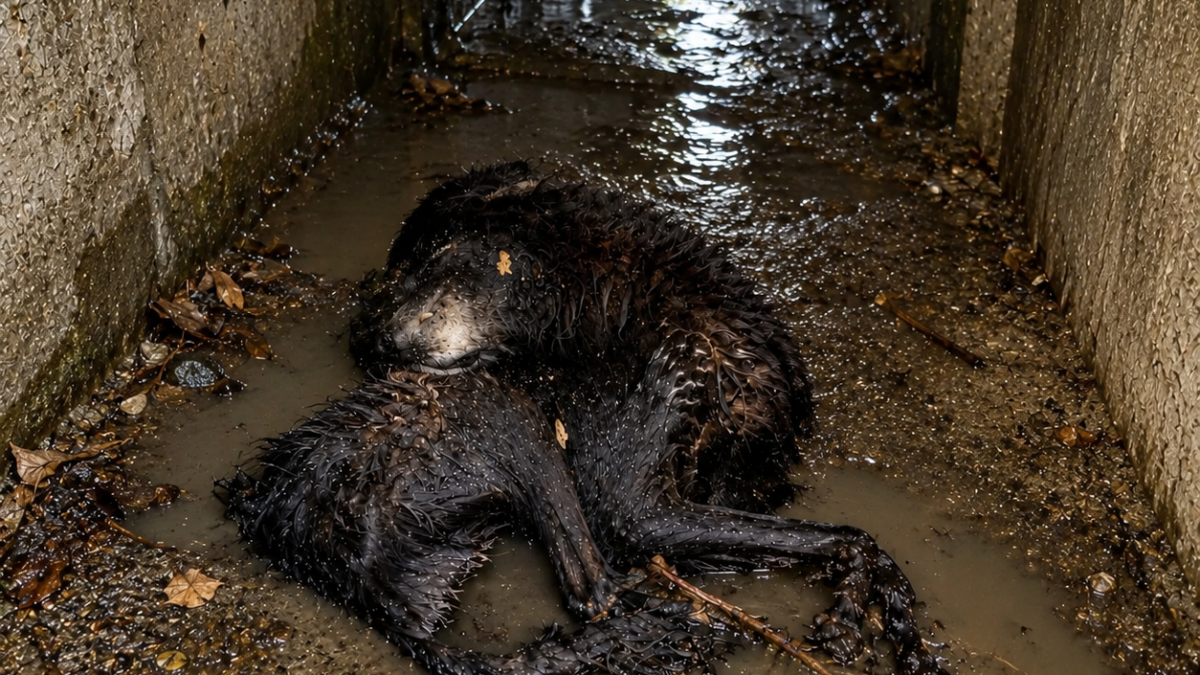
PART 2
We did not lift him the way we normally carried an injured dog.
The scream had changed everything.
Until we knew what was happening inside his body, every movement had to be deliberate.
Our veterinary technician, Rachel, climbed into the canal with a rigid transport board while I supported the dog’s head.
“Don’t cut all the rope yet,” she told me.
I looked at her.
“It’s strangling his movement.”
“I know, but some of it may be stabilizing whatever is injured. We remove only what prevents us from transferring him.”
That made my stomach tighten.
A rope that had been used to restrain him might now be the only thing keeping his damaged body from shifting.
We cut one loop around his chest.
Another near his back leg.
The dog whimpered.
Rachel stopped immediately.
“Easy.”
I whispered the same word over and over, though nothing about the situation was easy.
Above us, Noah’s mother held him against her side.
The boy refused to leave.
His father had tried.
“Noah, let’s wait in the car.”
“No.”
“You don’t need to see this.”
“He needs someone here.”
His father glanced down at us.
I expected him to insist.
Instead he crouched beside his son.
“Then we stay.”
I will always respect him for that.
We slid the transport board beneath the dog inch by inch.
Each movement brought a tremor.
Sometimes a whine.
Once another short cry.
But no biting.
No snapping.
No attempt to fight us.
That frightened me almost as much as the injuries.
Even gentle dogs defend themselves when pain becomes unbearable.
This one seemed too exhausted to waste energy on defense.
When we finally secured him to the board, Rachel looked up.
“Ready.”
Four of us lifted.
The dog was lighter than he should have been.
Far lighter.
His ribs pressed against his wet coat.
His hip bones showed.
Ticks clustered around his ears and neck.
The rope had rubbed raw places into his skin.
As we carried him toward the van, Noah stepped closer.
“Is he going to die?”
No adult likes answering that question.
Especially not to a child.
I crouched beside him while the others loaded the dog.
“We’re going to do everything we can.”
“That’s not what I asked.”
His father started to intervene.
I raised a hand gently.
Noah deserved honesty.
“I don’t know yet.”
His mouth trembled.
I continued.
“But he heard you.”
Noah stared at me.
“If you hadn’t stopped today, we might never have found him.”
The boy looked toward the van.
“He was so loud.”
I thought about all the cars that had probably passed that road.
All the engines.
All the tires.
All the people.
Maybe Bruno had cried before.
Maybe Noah had simply been the first person to listen.
I put my hand on his shoulder.
“You did something important.”
Noah wiped his face.
“Tell him I’m sorry I can’t come.”
“I will.”
We left for the clinic.
Rachel sat in the back with the dog while I drove.
Every pothole made me flinch.
From behind me came the sound of his breathing.
Fast.
Shallow.
Uneven.
Rachel checked his gums.
“Pale.”
“How pale?”
“Too pale.”
“Blood loss?”
“Could be. Could be anemia. Could be shock.”
“He drank.”
“That’s good.”
“He tried to stand.”
“That tells us he wants to.”
I gripped the wheel.
“His back legs collapsed.”
“I saw.”
“What does that mean?”
“Daniel, drive.”
That was her way of telling me the answer could wait until somebody with imaging equipment had looked inside him.
So I drove.
At the clinic, Dr. Elena Vasquez was waiting.
She took one look at him and started issuing instructions.
“Temperature.”
“IV access.”
“Blood glucose.”
“Full blood panel.”
“Neurologic assessment once he’s stable enough.”
“Get those ropes photographed before anything else is removed.”
That last instruction surprised me.
“Why?”
She looked at me.
“Because if someone tied him like that, this may become evidence.”
Police had arrived at the canal shortly after we left.
They had photographed the location.
Now the rope mattered too.
We worked around it until every knot and placement had been documented.
Only then did Dr. Vasquez cut the final loops away.
The dog did not even lift his head.
His temperature was dangerously low.
His dehydration was severe.
His gums were pale.
He had dozens of ticks, some swollen large from feeding.
A technician began removing them one at a time while another cleaned the wounds beneath the rope.
Then Dr. Vasquez tried to help him shift position for the neurologic exam.
The dog cried sharply.
His eyes moved strangely.
His head tilted.
One front leg pushed, but his body seemed unable to coordinate with itself.
Dr. Vasquez stopped.
“What?”
I asked it too quickly.
She checked his pupils.
Then his reflexes.
Then repositioned his head.
“Something neurologic is happening.”
“Spine?”
“Possibly. Brain injury is also possible.”
My stomach dropped.
“How?”
“I need imaging and a more complete exam.”
Hours later, we had the first real picture of what Bruno had survived.
Yes, Bruno.
That became his name before midnight.
Rachel suggested it.
“He needs something strong.”
I looked through the glass at the dog.
“Bruno.”
He did not respond.
“Bruno it is.”
The scans showed no spinal fracture requiring emergency surgery.
That was our first piece of good news.
The neurologic findings, however, strongly suggested traumatic brain injury.
There were signs consistent with blunt-force trauma.
His balance was badly affected.
His coordination was compromised.
His body could feel commands from his brain, but those commands were not traveling cleanly.
Dr. Vasquez stood with me beside the images.
“Could he have gotten this from falling into the canal?”
“Possibly, but the pattern concerns me.”
“Because of the rope?”
“Because of everything together.”
She pointed to one area.
“His head trauma appears older than a few minutes. There’s swelling and neurologic dysfunction that don’t fit a simple slip we just caused moving him.”
“Someone hit him?”
“I can’t tell you exactly how it happened.”
“But you think he suffered a blow.”
“I think blunt trauma is very likely.”
I looked through the window.
Bruno was receiving fluids.
His body was wrapped in warming blankets.
I remembered the isolated road.
The ropes.
The knots.
The way his legs failed.
“This wasn’t somebody abandoning a dog.”
Dr. Vasquez said nothing.
I continued.
“Somebody hurt him first.”
“I can document injuries. Police will determine what they can prove.”
I hated that answer because it was correct.
For the next forty-eight hours, we focused on keeping Bruno alive.
His dehydration began improving.
His blood values were poor but not beyond recovery.
He was loaded with ticks, and we treated him carefully because his body was already under so much stress.
We cleaned him thoroughly.
When the water ran from his fur, it carried dirt, dried blood, and the smell of the canal with it.
Underneath, he looked even thinner.
Rachel ran her hand gently along his neck.
“You must have been out there a long time.”
Bruno stared at her.
Then he smelled the food bowl.
Everything changed.
His head lifted.
Not much.
Enough.
Rachel laughed.
“Oh, you’re hungry.”
We had to control the meal.
A starving, severely dehydrated dog cannot simply be handed unlimited food without thought.
So we started small.
Bruno apparently considered this a personal insult.
He ate the portion.
Then stared at the empty bowl.
Then at Rachel.
Then back at the bowl.
“That’s all for now.”
Bruno made a low sound.
Not quite a bark.
Almost a complaint.
I laughed for the first time since the canal.
“There he is.”
Rachel smiled.
“Apparently he has opinions.”
That became the first glimpse of the dog buried underneath the trauma.
Food.
Bruno loved food.
Not casually.
Not politely.
He loved it with the intensity of a dog who had learned that meals were not guaranteed.
Every tray woke him.
Every rustle of a food bag brought his head up.
The first time he smelled roasted chicken, his tail moved.
Barely an inch.
We celebrated like fools.
“You see that?”
Rachel pointed.
“He wagged.”
“Do it again.”
Bruno stared at the chicken.
“He’s focused.”
“Fair.”
Food gave us a way into his mind.
During neurologic rehabilitation, he often refused to cooperate until somebody produced a treat.
Then suddenly he discovered ambition.
“Bruno, sit.”
His body would sway.
His legs would fold.
He would struggle.
Then his eyes would lock on the piece of chicken.
The determination came back.
But before rehabilitation could truly begin, police needed to understand what happened.
The drainage canal gave them little.
No nearby houses.
No obvious witnesses.
The road had been mostly abandoned since a new bypass opened years earlier.
There were tire tracks, but dozens of vehicles still used the area occasionally.
The rope was common utility rope, sold everywhere.
No identification.
No collar.
No microchip.
For the first few days, the case looked impossible.
Then Noah’s father called me.
“I remembered something.”
“What?”
“There was a truck.”
“At the canal?”
“No. Earlier.”
He explained that when his family had turned onto the service road, they passed an old dark-green pickup coming the other direction.
He had not thought anything of it.
The road was public.
But the truck had mud on the rear tailgate and one brake light out.
“Do you remember the driver?”
“Man. Maybe forties. Baseball cap.”
“Anything else?”
“No.”
That was thin.
Very thin.
Still, I passed it to the investigator, Detective Aaron Wells.
He called Noah’s father directly.
Then he asked whether their vehicle had a dash camera.
It did.
That mattered.
The camera had captured the green pickup.
Not the driver’s face clearly.
But the truck was visible.
So was a partial plate.
Detective Wells called me the next afternoon.
“Don’t get excited.”
Whenever someone says that, excitement becomes inevitable.
“What did you find?”
“We have a possible vehicle.”
“Possible?”
“Partial plate narrows it.”
“Owner?”
“We’re working on it.”
“Was he at the canal?”
“We know a matching vehicle was leaving the road before the family arrived.”
“That sounds pretty strong.”
“It sounds interesting.”
“Interesting?”
“Daniel, I need evidence, not feelings.”
I sighed.
“You and Dr. Vasquez would get along.”
“I’ll take that as a compliment.”
While police investigated, Bruno entered the slowest battle of his life.
Standing.
It sounds so simple.
Dogs stand all day.
They rise from beds.
Walk to bowls.
Scratch at doors.
Shift their weight.
Most of us never notice the thousands of tiny neurologic instructions required.
Bruno’s brain and body no longer communicated normally.
When he tried to rise, one leg often crossed strangely beneath him.
His head tilted.
His balance failed.
He knew what he wanted to do.
His body could not organize it.
That frustrated him.
You could see it.
During the first week, we supported his chest and hips with a sling.
“Come on, Bruno.”
Rachel held a treat.
His front legs pushed.
His back legs trembled.
He rose perhaps three inches.
Then collapsed.
I caught him.
“Easy.”
He looked at the treat.
Rachel smiled.
“Still interested.”
“Always.”
Another attempt.
Another collapse.
Dr. Vasquez watched.
“Don’t exhaust him.”
“He wants to keep going.”
“That doesn’t mean we let him.”
Bruno looked offended when we stopped.
His meals became exercises.
We positioned him so he had to engage muscles safely.
A raised bowl helped him practice head control.
Supported sitting forced his body to relearn balance.
Every tiny improvement mattered.
Day eleven, Bruno held a sitting position for seven seconds.
I timed it.
Rachel laughed.
“You’re using a stopwatch?”
“Yes.”
“That’s unhealthy.”
“Seven seconds.”
“Very impressive.”
The next day he made nine.
Then six.
Recovery was not a straight line.
That drove me crazy.
One morning Bruno seemed stronger.
That afternoon he could barely coordinate his front legs.
I called Dr. Vasquez.
“He’s getting worse.”
“No. He’s tired.”
“He was better this morning.”
“Brains heal inconsistently.”
“How long?”
She gave me the answer every rescuer hates.
“We don’t know.”
Weeks passed.
No miracle.
No sudden movie scene where Bruno woke up and ran down a hallway.
Real recovery was much less dramatic and much more exhausting.
Day nineteen, he sat for thirty seconds.
Day twenty-three, he bore weight on all four legs for four seconds while supported.
Day thirty, he managed to pull himself forward several feet using mostly his front legs.
We cheered.
Then he vomited after therapy and terrified us.
One step forward.
Half a step back.
Some nights I went home wondering whether we were asking too much.
Then I would return the next morning.
Bruno would smell breakfast.
His eyes would brighten.
His tail would move.
And he would try again.
No one had told him recovery was taking too long.
Humans worry about calendars.
Dogs care about the next good thing.
Meanwhile, the police investigation finally moved.
The partial plate led to a green pickup registered to a man named Travis Cole, forty-six, who lived roughly twelve miles away.
He had previously owned a brown mixed-breed dog.
That detail reached Detective Wells through an animal-control database after an old complaint surfaced.
A neighbor had reported the dog repeatedly roaming loose.
The complaint included a photograph.
Detective Wells showed it to me.
I stared.
The coat was longer.
The body healthier.
But the white patch on the chest was unmistakable.
“Bruno.”
“We believe so.”
“Believe?”
“We need veterinary confirmation and distinctive markings.”
I enlarged the image.
One ear had a small notch.
Bruno had the same notch.
My hands went cold.
“That’s him.”
Detective Wells nodded.
“We think it’s him.”
“Go arrest the guy.”
“It doesn’t work that way.”
“Why?”
“Because previously owning the dog and driving the road does not prove he tied him up and dumped him.”
“What about the head injury?”
“Evidence of abuse. Not identity.”
“The rope?”
“Common.”
“The truck?”
“Places him nearby.”
“So what are you waiting for?”
“A case that survives defense counsel.”
I looked away.
Again.
Evidence.
Patience.
Procedure.
All the things justice requires when anger wants speed.
Detective Wells continued.
“We interviewed Cole.”
My attention snapped back.
“What did he say?”
“That the dog ran away weeks earlier.”
“Did he report him missing?”
“No.”
“Put up signs?”
“No.”
“Contact shelters?”
“No.”
“What name did he call him?”
“Buster.”
I looked through the rehabilitation-room window.
Bruno was trying to reach a bowl.
“Of course he had a name.”
“We asked when he disappeared. His timeline is inconsistent.”
“How inconsistent?”
“First he said two weeks. Then a month.”
“And the truck?”
“He says he was driving that road looking for scrap metal.”
“Convenient.”
“Maybe. Maybe true.”
“Do you believe him?”
Detective Wells leaned back.
“My beliefs don’t convict people.”
I respected him.
I also wanted to shake him.
Instead I asked, “What would?”
He smiled slightly.
“Something tying him to the rope, the injury, or the dumping.”
Something came.
Not from police.
From a mechanic.
Travis Cole’s truck had been serviced two days after Bruno’s rescue.
The repair shop replaced a damaged rear brake light.
Exactly the one Noah’s father remembered.
That only strengthened the vehicle identification.
Still not enough.
Then a teenage employee at a convenience store recognized Bruno’s old photograph after the local humane society released a carefully worded request for information.
The boy told police that Travis had regularly arrived with the dog loose in the back of the green pickup.
“He yelled at him a lot,” the teenager said.
One week before the rescue, the teenager saw Bruno limping badly.
Travis allegedly shoved him into the truck when the dog hesitated to jump.
Still circumstantial.
Still not the final link.
Then came the rope.
A search warrant allowed police to examine the green pickup and a shed at Cole’s property.
Inside the shed were several lengths of identical rope.
Again, same brand alone meant little.
But one cut end became important.
Forensic examiners compared the severed fibers from the rope on Bruno with a longer coil recovered in the shed.
The physical characteristics and cut pattern strongly suggested they had once been part of the same length.
Detective Wells called me.
“Now can I get excited?”
He paused.
“A little.”
“What happened?”
“We have probable cause.”
I sat down.
“You’re arresting him?”
“We’re presenting the case.”
“What changed?”
“The rope.”
My throat tightened.
“What about whoever hit Bruno?”
“That remains part of the allegation. We have veterinary evidence consistent with blunt-force trauma, but we may never prove what object caused it.”
“Is abandoning him tied in a canal enough?”
“It’s substantial.”
“When?”
“I’m not discussing operational details.”
“You enjoy saying that.”
“More than you enjoy hearing it.”
Three days later, Travis Cole was arrested on animal-cruelty and abandonment charges.
People at the rescue celebrated.
I didn’t.
Not immediately.
I went into Bruno’s room.
He was lying on a thick mattress chewing slowly on a stuffed food toy.
His back legs still did not work properly.
His head still tilted.
Five weeks had passed.
Justice had moved faster than healing.
I sat beside him.
“They found him.”
Bruno kept chewing.
“The man who had you before.”
Nothing.
“They think they can prove he left you there.”
Bruno finally looked at me.
Then shoved the toy against my shoe because food had become trapped inside.
I laughed.
“You know what? You’re right.”
The arrest was important.
Bruno did not need to build his life around it.
We didn’t either.
The court would handle Travis.
Our job was Bruno.
At two months, Bruno could sit without support for nearly a minute.
At nine weeks, he began pushing fully onto all four feet while suspended lightly in the therapy sling.
His legs shook.
His paws sometimes knuckled underneath.
Rachel would reposition them.
“Feel the floor, Bruno.”
He stared at the treat.
“Always bribery,” I said.
“Motivation.”
“Bribery.”
“Therapeutic motivation.”
Bruno stood.
Ten seconds.
Fifteen.
Twenty.
His whole body trembled.
Then he collapsed safely into the sling.
Rachel kissed his head.
“That was twenty-three.”
I checked my stopwatch.
“Twenty-five.”
“You’re counting the wobble.”
“Wobbling counts.”
By the third month, we had stopped thinking of him as fragile.
He was still disabled.
Still recovering.
But fragile was no longer the right word.
Stubborn fit better.
Greedy.
Opinionated.
Affectionate.
Absurdly patient with children.
Especially Noah.
The boy came to visit after his parents asked whether it would be appropriate.
I hesitated.
Bruno’s story had affected him deeply.
But Dr. Vasquez thought seeing recovery might help.
When Noah entered the rehabilitation room, Bruno was lying on a mat.
The boy stopped.
“That’s him?”
I smiled.
“That’s him.”
“He looks bigger.”
“He gained twelve pounds.”
Noah approached carefully.
“Can I touch him?”
“Let him smell you.”
Noah held out his hand.
Bruno sniffed.
Then licked his fingers.
The boy’s face changed.
The fear I remembered from the canal disappeared.
“Hi, Bruno.”
His voice broke anyway.
He knelt.
“I heard you.”
Bruno licked him again.
Noah laughed.
His father turned away for a moment.
I pretended not to notice.
Then Noah saw the rehabilitation harness.
“What’s that?”
“It helps him stand.”
“Can he?”
“Almost.”
“I thought he tried in the sewer.”
“He did.”
Noah looked at Bruno.
“Try again.”
We positioned him.
Rachel supported the sling.
Bruno pushed upward.
His front legs straightened.
His hind legs followed unevenly.
He stood.
Noah’s eyes widened.
Bruno wobbled.
But he remained upright.
Ten seconds.
Twenty.
Thirty.
Rachel loosened her support slightly.
Forty.
Bruno shifted one paw.
The room went silent.
Then his other paw adjusted.
He was standing mostly by himself.
Not walking.
Not yet.
But standing.
After three months.
Noah covered his mouth.
“He did it.”
Rachel’s eyes filled.
“He did.”
I crouched beside Bruno, ready if he fell.
He looked at us as if he could not understand why four adults and one child were crying over something as ordinary as standing.
Then he smelled the chicken in Rachel’s hand and ruined the emotional moment by trying to lunge for it.
His legs collapsed.
Everyone laughed.
That was Bruno.
His milestones always ended with food.
The legal case developed at the same time.
Travis denied deliberately injuring Bruno.
His attorney argued the dog had been difficult, aggressive, and prone to escaping.
That last claim angered me.
Bruno had been gentle from the first moment.
But behavior after trauma does not necessarily prove past behavior.
So we were careful.
Dr. Vasquez testified only to what she had observed.
“Did Bruno show aggression?”
“No.”
“Can you state he had never been aggressive in his previous home?”
“No.”
“Can you state whether aggression would justify tying an injured dog and leaving him in a drainage canal?”
The defense attorney objected before she could answer.
The judge sustained it.
The prosecution did not need the answer.
Everyone in the room already understood.
The strongest evidence remained physical.
The rope.
The truck.
The timeline.
The prior ownership.
The absence of any missing-dog report.
The testimony that Bruno had been seen injured shortly before he disappeared.
The veterinary assessment that the brain injury likely predated rescue.
And then came one more witness.
Travis’s former girlfriend.
She had moved out several months before Bruno was found.
After seeing news coverage, she contacted investigators.
According to her statement, Travis had become increasingly angry with Bruno after the dog began having accidents inside the house.
Bruno had been struck before.
She claimed she saw Travis hit the dog with a wooden handle during one argument.
She had begged him to stop.
She had later left the relationship.
“Why didn’t she report it then?” one volunteer asked angrily.
I understood the question.
I also understood enough about fear not to ask it the same way.
Detective Wells explained that her statement required corroboration.
But it changed the case.
The possibility of repeated abuse became stronger.
When shown photographs of the rope, she recognized it from Travis’s shed.
Then she identified the old collar found in the pickup as Bruno’s.
The case now held.
That was the phrase Wells used.
“We have a case that holds.”
I remembered every earlier conversation.
Finally.
The prosecutor offered a plea arrangement that included a felony animal-cruelty conviction under the applicable charge, jail time, probation, restitution for a portion of Bruno’s medical care, and a lengthy prohibition on possessing animals.
Travis initially refused.
So the case moved toward trial.
That brought the anger back.
I wanted him to see Bruno.
Not because I wanted to shame him for entertainment.
I wanted him to understand that the dog he had discarded was alive.
The prosecutor warned me not to turn the courtroom into theater.
“I won’t.”
“You’re emotionally involved.”
“Of course.”
“That’s fine. Just answer what you actually know.”
“I will.”
The trial date was set for the fifth month after Bruno’s rescue.
By then, something else was happening.
Bruno was beginning to walk.
Not normally.
Not yet.
But truly walk.
The first time happened during an afternoon therapy session.
Rachel held the sling loosely.
I stood six feet away with chicken.
“Bruno.”
His head turned.
“Come on.”
He pushed upright.
Balanced.
One front paw moved.
Then a back paw followed awkwardly.
He paused.
Rachel held her breath.
“Again.”
Another step.
Then another.
The sling remained slack.
He was doing it.
“Bruno.”
I backed up.
“Come on, buddy.”
Four steps.
Five.
His body swayed.
His head tilted.
But he kept going.
Six.
Seven.
Then he reached me.
I forgot the chicken.
Bruno did not.
He shoved his nose into my hand.
I started laughing and crying at the same time.
Rachel yelled for Dr. Vasquez.
“She walked?”
A technician ran in.
“He.”
“What?”
“Bruno’s a he.”
“I know. I’m crying. Grammar is gone.”
Dr. Vasquez came in.
“What happened?”
Rachel pointed.
“He walked.”
Dr. Vasquez smiled.
Not her cautious medical smile.
A real one.
“Show me.”
We reset.
Bruno stared at the chicken.
“Okay,” I said. “Do it again.”
He did.
Not perfectly.
Not gracefully.
But he walked.
Five months after a little boy heard him crying beneath a road, Bruno crossed a rehabilitation room under his own power.
When he reached me, I knelt and wrapped my arms around him.
His tail wagged against my leg.
“You stubborn animal.”
Rachel wiped her face.
Dr. Vasquez laughed.
“He has a long way to go.”
“I know.”
Balance training.
Muscle rebuilding.
Coordination.
Endurance.
Months more work.
But none of us cared about how long the road remained.
Bruno had taken steps on it.
I sent Noah’s family the video.
His mother replied less than a minute later.
Noah had watched it six times.
Later that evening he called.
“Daniel?”
“Hey.”
“He walked.”
“He did.”
“Does he remember me?”
“I think so.”
“When can I see him?”
“Soon.”
“Can I bring hamburgers?”
“No.”
“Why?”
“Because Rachel will kill both of us.”
There was a pause.
“What about chicken?”
“Approved.”
The trial began two weeks later.
I hated leaving Bruno that morning.
Not because he needed me.
Because I needed him.
I wore a dark jacket.
Detective Wells met me outside the courthouse.
“You ready?”
“No.”
“Good.”
“How is that good?”
“People who feel too ready usually talk too much.”
“That sounds aimed at me.”
“It is.”
Inside, Travis sat beside his attorney.
I had seen photographs.
Never him in person.
He looked ordinary.
That always bothers people.
We want cruelty to have a face we can recognize from a distance.
Usually it doesn’t.
Usually cruelty wears normal clothes.
Pays bills.
Waits in grocery lines.
Knows how to smile.
The prosecutor began with the canal photographs.
Not graphic ones.
Just enough.
The location.
The ropes.
Bruno’s position.
Then body-condition photographs.
Dr. Vasquez testified.
She described the dehydration.
Tick burden.
Neurologic dysfunction.
Traumatic brain injury.
The prosecutor asked, “Could the dog stand when admitted?”
“No.”
“Did he attempt?”
“Yes.”
“What happened?”
“His balance and coordination failed.”
“Did he respond painfully to movement?”
“Yes.”
“What was your opinion regarding the neurologic injury?”
“It was consistent with significant trauma, including blunt-force trauma.”
“Could you determine the exact object?”
“No.”
“Could that condition reasonably arise from simply being tied in a canal for a few hours?”
“It would not explain all findings.”
The defense challenged her.
“Doctor, you cannot say my client struck this dog.”
“No.”
“You cannot say the dog did not fall.”
“No.”
“You cannot date the injury to an exact minute.”
“No.”
The attorney looked toward the jury.
“Then much of this is speculation.”
Dr. Vasquez remained calm.
“My diagnosis is not speculation.”
He turned back.
“But the cause?”
“The mechanism is consistent with blunt trauma.”
“From many possible sources.”
“Yes.”
“Thank you.”
He sat down.
I worried.
Courtrooms reduce emotional certainty into narrow facts.
That is necessary.
It can also feel maddening.
Then the forensic specialist testified about the rope.
The matching construction.
The fibers.
The cut characteristics.
Not an absolute fingerprint.
But strong physical consistency with the coil from Travis’s shed.
The convenience-store teenager testified.
Noah’s father testified about the truck.
Dash-camera footage played.
Green pickup.
Damaged brake light.
Road.
Time stamp.
Then Travis’s former girlfriend took the stand.
She looked terrified.
I understood instantly why she may not have spoken earlier.
Her hands shook.
The prosecutor asked about Bruno.
She called him Buster.
“Was he aggressive?”
“No.”
“Did he have behavioral problems?”
“He sometimes had accidents. He chewed things when left alone.”
“How did the defendant respond?”
She looked toward Travis.
Then down.
“He got angry.”
“How angry?”
Silence.
The prosecutor waited.
“Did you ever see him hit the dog?”
“Yes.”
“With what?”
“Once with his hand. Once with a wooden handle.”
The courtroom became still.
“Did you intervene?”
“Yes.”
“What happened?”
“He told me to mind my own business.”
“Why did you leave the relationship?”
The defense objected.
The judge limited the question.
The prosecutor shifted.
“Did you recognize the rope recovered from the defendant’s shed?”
“Yes.”
“How?”
“He used it around the property all the time.”
“And the collar found in his pickup?”
“That was Buster’s.”
The defense attacked her credibility.
Suggested bitterness after the breakup.
Suggested she wanted revenge.
She cried once.
Then steadied herself.
“I don’t want revenge.”
“Yet you came forward after seeing him arrested.”
“I came forward after I saw the dog.”
“Months after leaving.”
“Yes.”
“So you had plenty of time.”
She looked at him.
“I was afraid.”
The attorney paused.
“Of the dog?”
“No.”
That single answer changed the room.
She did not elaborate.
She didn’t need to.
When it was my turn, I described the rescue.
The crying.
The rope.
The first scream.
The water.
Bruno trying to stand.
The defense attorney asked, “You did not witness my client at the canal.”
“No.”
“You did not see anyone strike Bruno.”
“No.”
“You were not present when the dog was tied.”
“No.”
“So all you can testify to is what you found afterward.”
“Yes.”
He nodded as if satisfied.
Then I added, “But what I found afterward was still alive.”
The prosecutor looked at me.
The judge did too.
The defense attorney frowned.
I stopped there.
That was enough.
No speech.
No accusation beyond what I knew.
Alive.
That was the fact I cared about most.
The trial lasted several days.
The jury deliberated for hours.
Those hours felt longer than five months of rehabilitation.
I sat in the hallway with Rachel and Detective Wells.
Rachel kept checking her phone for updates from the clinic.
“Bruno ate?”
“Of course.”
“Walking?”
“Ten minutes this morning.”
“Good.”
Wells watched us.
“You two realize most witnesses aren’t checking a dog’s lunch during deliberations.”
“Most witnesses don’t have Bruno.”
The bailiff finally called us back.
The verdict came.
Guilty on the principal animal-cruelty charge.
Guilty on abandonment.
Additional lesser findings followed.
Rachel gripped my hand.
I felt no explosion of joy.
Just pressure leaving my chest.
Travis stared forward.
At sentencing weeks later, the judge described the evidence as showing deliberate disregard for the life of a dependent animal.
There was jail time.
Probation.
Restitution.
A prohibition on possessing animals for years under the court order.
Mandatory anger-management and behavioral counseling.
The court also authorized animal-control monitoring if he ever became eligible to own an animal again.
It was accountability.
Real.
Documented.
Enforceable.
Some people wanted more.
Some always will.
When reporters asked if I thought the punishment was enough, I refused to turn suffering into arithmetic.
“Bruno cannot be unhurt,” I said. “The sentence cannot give him back the months he lost. What matters now is that the abuse is on record, he cannot simply take another dog tomorrow, and Bruno gets to live somewhere safe.”
The most important consequence happened outside the courthouse.
Travis was escorted toward a vehicle.
For a moment, he saw us.
I was holding my phone.
On the screen was a photograph of Bruno standing.
Healthy enough to support himself.
Tail up.
Travis’s eyes stopped on it.
I didn’t say anything.
Neither did he.
I had imagined that moment.
Imagined telling him every terrible thing I thought.
Instead I simply held the photograph.
That was enough.
The dog he had allegedly treated as disposable was alive.
Walking.
Loved.
He had failed to erase Bruno.
That felt more satisfying than any insult I could have delivered.
Back at the clinic, Bruno greeted me like nothing important had happened.
He sniffed my jacket.
Then walked past me toward the food cabinet.
“Court went well,” I told him.
No response.
“You’re legally vindicated.”
He sat badly.
“Very powerful.”
He stared at the cabinet.
“Chicken?”
Tail wag.
There was Bruno’s legal philosophy.
Chicken first.
Everything else optional.
His rehabilitation continued for another several months.
Walking returned before graceful walking.
That distinction mattered.
At first Bruno moved with a wide stance.
His back legs sometimes swung outward.
His head remained slightly tilted.
Uneven surfaces confused him.
Stairs were difficult.
Turning too fast caused him to stumble.
We introduced obstacles slowly.
Foam pads.
Low rails.
Different textures.
Short slopes.
Every new surface asked his brain to calculate balance again.
Some days he became frustrated.
He would bark.
Sit.
Refuse.
Rachel would cross her arms.
“You done?”
Bruno looked away.
“Fine.”
She would start to leave.
Bruno stood.
I laughed.
“He hates being ignored.”
“Excellent therapeutic tool.”
We learned not to rescue him from every stumble.
That was difficult for me.
My instinct was to catch him.
Dr. Vasquez corrected me.
“He needs safe failure.”
“I hate those words.”
“He has to learn where his body is.”
“What if he falls?”
“Then we make sure he falls safely.”
So I watched Bruno wobble.
Trip.
Correct.
Try again.
Sometimes loving an injured animal means helping.
Sometimes it means resisting the urge to help too much.
The biggest breakthrough came outside.
Six months after rescue, we took Bruno to a fenced grassy field.
He had walked short distances on grass before.
This was different.
Open space.
No therapy room.
No walls.
No harness for most of it.
No food held directly in front of him.
Rachel opened the gate.
Bruno stepped through.
He smelled everything.
Grass.
Wind.
Trees.
Other dogs somewhere far away.
For a full minute he forgot us.
Then he began walking.
Slowly.
Head tilted.
Tail moving.
He made a wide circle.
Stumbled.
Recovered.
Kept going.
Twenty yards.
Thirty.
I followed several feet behind.
He looked back.
I stopped.
“Go.”
He turned forward.
And kept walking.
That day I understood what recovery really meant.
It wasn’t making Bruno look exactly as he had before.
We did not even know what he had looked like before trauma.
Recovery meant giving him enough strength and confidence to move through the world as the dog he was now.
A slight head tilt.
A funny back-leg swing.
A tendency to drift when excited.
Fine.
He was moving.
He was choosing direction.
Nobody had tied him.
Nobody was throwing him anywhere.
His body belonged to him again.
At seven months, adoption conversations began.
I hated them.
I had become too attached.
Everyone knew.
Rachel especially.
“You’re going to fail.”
“At what?”
“Fostering boundaries.”
“I’m not fostering him.”
“You emotionally are.”
“I’m a professional.”
“You cried when he stood.”
“So did you.”
“Yes, but I admit I’m compromised.”
I considered taking Bruno home myself.
I truly did.
But my house already held two senior dogs, one reactive foster, and stairs Bruno still found difficult.
Wanting him was not the same as being his best home.
That lesson hurt.
We reviewed applications.
Many people loved the story.
That was not enough.
Bruno needed someone patient.
Someone comfortable with neurologic quirks.
Someone who would not expect perfect walking.
Someone who understood that his love of food needed management.
Someone who would keep up with follow-up care.
Then came Marissa Grant.
Fifty-four.
Worked as a librarian.
Lived alone in a one-story house.
Large fenced yard.
Previous experience with a senior dog who had vestibular disease.
Excellent veterinary references.
No stairs except one low porch step.
When I called, I asked the question I had started asking every applicant.
“Why Bruno?”
She answered without hesitation.
“Because I think I can give him the kind of boring life he needs.”
I smiled.
“Explain.”
“No drama. No pushing him to be inspirational. Same breakfast time. Same walking route until he’s comfortable. Rugs where he needs traction. Veterinary follow-ups. A couch. Probably too many snacks.”
That was a good answer.
“But you’ve seen his story?”
“Yes.”
“You’re not adopting him because you feel sorry for him?”
“No.”
“Why not?”
“Pity burns out. Routine lasts.”
I wrote that down.
Pity burns out.
Routine lasts.
Marissa visited.
Bruno smelled her bag first.
Of course.
“What’s in there?”
“Turkey.”
I looked at her.
“You bribed him.”
“I believe in relationship-building.”
Rachel laughed from behind me.
“I like her.”
Bruno loved her within four minutes.
Maybe five.
He sat against Marissa’s leg while she scratched his chest.
Then he tried to climb into her bag.
“Boundaries,” I said.
Marissa nodded seriously.
“Clearly something we will both need to work on.”
She visited again.
Then again.
We did a home assessment.
Her house was almost perfect for him.
Non-slip runners.
Wide hallways.
Secure fence.
A sunny back room.
One old golden retriever named Lucy belonged to her sister and visited often.
We arranged a meeting.
Bruno tried too hard to impress Lucy.
He walked fast.
Lost balance.
Fell sideways.
Lucy stared at him.
Bruno stood and pretended nothing happened.
I laughed.
“He has pride.”
Marissa nodded.
“So do I. We’ll fall privately.”
The adoption trial started two weeks later.
I drove Bruno there.
He stood in the back of the rescue van, staring out the window.
That road trip felt different from the first.
No rope.
No dirty water.
No trembling body on a board.
Bruno was wearing a bright blue harness.
His medical records filled a folder.
His food occupied half my cargo area because apparently I was sending him to war.
Marissa opened the front door.
“Welcome home, Bruno.”
I hated how quickly the words made me emotional.
He entered slowly.
Sniffed the hallway.
Kitchen.
Living room.
Then the yard.
He stood in the grass.
Wind moved through his coat.
Marissa stayed several feet away.
No pressure.
Bruno walked to the fence.
Turned.
Came back.
Then discovered the food bowl.
That solved most concerns.
For the first week, I called too often.
Day one.
“How is he?”
“Sleeping.”
“Eating?”
“Daniel.”
“Right. Stupid question.”
Day two.
“How did the night go?”
“He woke once, walked into the laundry basket, got angry at it, then went back to bed.”
“Normal.”
Day three.
“Any falls?”
“One.”
“Bad?”
“He stood up before I reached him.”
“Good.”
Day five.
“Does he seem anxious?”
“He seems angry that dinner is forty minutes away.”
“Excellent.”
Day seven, Marissa sent a photograph.
Bruno asleep on his side across the couch.
All four paws relaxed.
Head tilted against a pillow.
The message read:
“I believe the couch has been transferred into his name.”
That was the moment I knew.
He was home.
The adoption became official after a month.
No ceremony could match what Noah did.
His family came to the shelter for the paperwork celebration.
When Bruno saw the boy, he walked toward him immediately.
Noah was taller now.
Months had passed.
He knelt.
“Hey, Bruno.”
Bruno pushed his head into the boy’s chest.
Noah hugged him.
Then he started crying.
Again.
But these tears were different.
His mother knelt beside him.
“You okay?”
Noah nodded.
“I just remembered the sewer.”
Marissa touched his shoulder.
“He won’t ever go back there.”
The boy looked at her.
“You promise?”
“Yes.”
Simple.
Absolute.
That was the promise all of us had been working toward.
Noah gave Bruno a small tag for his collar.
On one side:
BRUNO
On the other:
YOU WERE HEARD
I had to walk away for a minute after reading it.
Because that was the whole story.
Bruno survived because somebody heard him.
Not a trained rescuer.
Not a police officer.
Not a veterinarian.
A child.
An eight-year-old boy who heard crying and refused to keep moving.
Months later, the city repaired part of the drainage canal.
Workers installed safer barriers and warning fencing after local officials reviewed the site.
Noah’s family attended a small community meeting about abandoned animals and reporting cruelty.
The boy barely spoke.
He didn’t enjoy attention.
When someone called him a hero, he shook his head.
“I just heard him.”
That humility stayed with me.
Adults like to turn courage into something dramatic.
Sometimes courage is simply refusing to ignore a sound everyone else has learned to walk past.
Bruno’s new life became wonderfully ordinary.
Marissa took him on slow morning walks.
He loved sniffing mailboxes.
He liked pet-supply stores because they contained the two things he valued most: food and people who carried food.
He became suspiciously skilled at convincing cashiers he had not eaten in weeks.
“Do not believe him,” Marissa would say.
Bruno would tilt his head.
Cashier: “Poor baby.”
Marissa: “He had breakfast forty minutes ago.”
Bruno received treat.
Victory.
He loved car rides.
That surprised us.
Some dogs associate vehicles with abandonment.
Bruno associated Marissa’s car with parks, the veterinarian who gave him cookies, and errands.
He rode with his nose near the cracked window, taking in smells.
Sometimes his balance still failed when the car turned.
Marissa bought him a supportive travel harness.
He adapted.
He adapted to everything.
One year after the rescue, we met at the same grassy field where Bruno had first walked freely.
Noah came.
Rachel.
Dr. Vasquez.
Detective Wells.
Marissa.
Even Noah’s parents.
Bruno arrived wearing his blue harness.
He had filled out beautifully.
His head still tilted slightly.
His gait would never be perfect.
Nobody cared.
We released him inside the fenced field.
He walked.
Then trotted.
Then, for perhaps ten seconds, he ran.
Not smoothly.
Not like an athletic young dog.
His back legs moved with that familiar uneven rhythm.
But he ran.
Noah shouted.
“Bruno!”
Bruno turned too fast.
Lost balance.
Rolled onto his side.
Everyone gasped.
Then Bruno jumped up.
Shook himself.
Kept going.
The entire field erupted in laughter.
“That,” Dr. Vasquez said, “is Bruno.”
Fall.
Stand.
Continue.
Detective Wells stood beside me.
“You know what I remember?”
“What?”
“The first time you called me after we found the truck.”
“You told me not to get excited.”
“You were unbearable.”
“I was advocating.”
“You called me four times in one day.”
“Persistent advocacy.”
He smiled.
Then his expression became serious.
“The case changed procedure at our department.”
“How?”
“Animal-cruelty calls involving abandonment sites now trigger earlier evidence-preservation steps. Photos, rope, containers, vehicle tracks. We learned from it.”
I looked at Bruno.
“So something else came from this.”
“Yes.”
That mattered.
Bruno’s suffering should never have happened.
But if the case improved how the next animal was handled, then pain had at least forced a system to learn.
Marissa joined us.
“He’s going shopping later.”
Detective Wells blinked.
“The dog?”
“He likes hardware stores.”
I stared at her.
“You’ve created a monster.”
“He was already food-motivated.”
“Hardware stores don’t sell dog treats.”
“Ours does.”
“Of course it does.”
Bruno returned and leaned against my leg.
I scratched his neck.
The scar beneath his fur was faint now.
The rope marks had disappeared almost completely.
The brain injury left the most visible reminder.
Head tilt.
Uneven step.
Sometimes a tremor when tired.
But I stopped seeing those things as damage.
They were simply Bruno.
That evening Noah asked me a question.
“Do you think he remembers the sewer?”
I looked at Bruno.
“I don’t know.”
“I hope not.”
“Me too.”
Noah thought for a while.
“But maybe he remembers me.”
“I think he does.”
“How?”
“Because he always walks to you.”
Noah smiled.
Then his face became serious.
“When I heard him, I was scared.”
“I know.”
“I wanted my dad to drive away.”
That surprised me.
“You did?”
“For one second.”
“Why?”
“I thought if we looked, it would be something bad.”
I understood.
“Then why did you stop him?”
Noah shrugged.
“Because it was already bad for Bruno even if I didn’t look.”
That sentence came from a child.
I have repeated it to adults ever since.
Ignoring suffering does not make suffering smaller.
It only makes the witness more comfortable.
Noah chose discomfort.
Bruno got a life.
Years passed.
Bruno remained one of the rescue’s most famous former residents, though he had no idea.
People recognized him occasionally during Marissa’s errands.
“Is that Bruno?”
Marissa would smile.
“Yes.”
The person would crouch.
Bruno would approach, usually because he believed fame should involve snacks.
Some asked to see the walk.
Marissa hated that.
“He’s not a circus act.”
I agreed.
Bruno did not owe anyone a demonstration of survival.
He had already proven enough.
He became simply a dog.
That phrase sounds small.
It is not.
For animals who survive terrible things, becoming “simply a dog” is the goal.
Not symbol.
Not victim.
Not evidence.
Not viral story.
Dog.
Sleep.
Eat.
Walk.
Smell grass.
Get annoyed by baths.
Beg for food.
Choose favorite people.
Grow old.
Bruno got all of it.
His first birthday with Marissa was approximate because nobody knew his exact date.
She chose the anniversary of his adoption.
Noah came.
He brought a bag of approved treats.
Bruno wore a paper crown for eleven seconds.
Then ate part of it.
Rachel yelled.
Marissa laughed.
Dr. Vasquez removed the wet cardboard from his mouth.
“Still neurologically questionable.”
“He’s fine,” I said.
“He’s eating paper.”
“He spent five months relearning to walk. Let him have hobbies.”
The party photograph stayed on my desk for years.
Bruno surrounded by people.
Mouth open.
Tail blurred from wagging.
No canal.
No rope.
No fear.
Sometimes I looked at that photograph after difficult rescues.
It reminded me that the animal in front of you today is not necessarily the animal you will see six months later.
Bodies change.
Brains heal.
Trust grows.
Stories turn.
Not always.
We lose animals too.
Anyone who rescues long enough carries names they could not save.
That is why Bruno mattered so much.
He showed us what persistence could build.
Five years after his rescue, Bruno began slowing down.
Not because of the original injury alone.
Age.
His muzzle whitened.
Arthritis joined his neurologic issues.
Long walks became shorter.
Marissa adjusted.
Ten minutes instead of thirty.
Flat routes.
More rest.
Rugs through the house.
A ramp into the car.
I visited one afternoon and found Bruno sleeping near a window.
He opened his eyes when I entered.
His tail moved.
“Hey, sewer dog.”
Marissa frowned.
“Don’t call him that.”
“It’s affectionate.”
“He has a name.”
Bruno pushed himself upright.
Slow.
Unsteady.
But upright.
He walked toward me.
The head tilt seemed more pronounced with age.
I knelt.
“There’s my boy.”
He leaned against my chest.
For a moment, I remembered his body in the canal.
Unable to stand.
Trying anyway.
I closed my eyes.
Marissa noticed.
“You’re doing the memory thing.”
“What memory thing?”
“The sad face.”
“I don’t have a sad face.”
“You absolutely do.”
I looked at Bruno.
“I was remembering when he couldn’t do this.”
“He still falls sometimes.”
“He stands again.”
“That he does.”
Bruno smelled my pocket.
“I have nothing.”
He stared.
“Traitor,” Marissa told me.
“I didn’t know this was a food inspection.”
“It always is.”
Age did not soften Bruno’s appetite.
If anything, he became more strategic.
He learned exactly which neighbors carried treats.
He dragged Marissa toward their houses.
One elderly man named Frank sat outside every afternoon.
Bruno would stop at his gate.
Frank would say, “You fed that dog today?”
Marissa: “Twice.”
Frank: “Looks starved.”
Bruno received biscuit.
Everyone conspired against her.
She loved it.
The legal case receded into history.
Travis eventually completed his sentence and supervision.
Under the ownership restriction, he could not lawfully keep animals during the ordered period.
Animal control followed up more than once after tips.
Nothing suggested Bruno or another dog returned to his possession during that time.
That gave me peace.
Not because punishment satisfied me.
Because prevention did.
The best part of accountability was not seeing someone suffer.
It was knowing another animal had one less path into the same nightmare.
Years later, Detective Wells retired.
At his small retirement gathering, he found me.
“Still rescuing?”
“Unfortunately.”
He laughed.
“Bruno?”
“Old. Spoiled. Food obsessed.”
“So successful rehabilitation.”
“Extremely.”
He raised his glass.
“To the kid who heard him.”
I nodded.
“To Noah.”
Noah was a teenager by then.
Tall.
Quiet.
He volunteered occasionally at adoption events.
Not because anyone pressured him.
He simply kept showing up.
One day I asked why.
“You know you’re allowed to have hobbies that don’t involve traumatized animals.”
He smiled.
“I play soccer.”
“Good.”
“I just like helping too.”
“Because of Bruno?”
“Probably.”
He looked across the room where Bruno was lying near Marissa.
“When I was little, I thought helping meant being the person who went into the sewer.”
“No.”
“I know that now.”
“What does it mean?”
“Sometimes hearing something and getting the right person.”
Exactly.
Rescue is a chain.
Noah heard.
His parents stopped.
Emergency workers came.
We lifted.
Veterinarians treated.
Police investigated.
Witnesses spoke.
A jury listened.
Therapists worked.
Marissa adopted.
Remove one link and the outcome might change.
People ask who saved Bruno.
The answer is everyone who refused to become the missing link.
When Bruno was around twelve—our best estimate—his health started declining more quickly.
His neurologic condition had been stable for years, but age reduced the strength he used to compensate.
He stumbled more.
Some mornings, standing took several attempts.
Marissa called.
“I’m scared we’re going backward.”
We met at Dr. Vasquez’s clinic.
The same clinic.
Different Bruno.
Healthy weight.
Gray muzzle.
Bright eyes.
Dr. Vasquez examined him carefully.
“This isn’t the old injury worsening dramatically.”
“What is it?”
“Age. Arthritis. Muscle loss. He’s relying on a neurologic system that was already working harder than normal.”
“Can we help?”
“Yes.”
Medication.
Physical therapy again, gentler this time.
Short exercises.
Support harness when needed.
Bruno looked personally offended by the return of rehabilitation.
Rachel, older too, walked into the room.
“Remember me?”
Bruno stared.
She held chicken.
Tail wag.
“He remembers.”
I laughed.
“Selective memory.”
The same dog who had once learned to stand with Rachel learned how to age with her.
There was something beautiful about that.
We adapted his home.
More rugs.
Raised food station.
Supportive bedding.
No slippery floors.
A rear-support harness for bad days.
Bruno still insisted on walks.
Even when they became one block.
Then half a block.
Then simply the yard.
He wanted smells.
We gave him smells.
One spring morning, Marissa called me very early.
“Daniel.”
I sat up.
“What happened?”
“He fell last night.”
“Is he hurt?”
“No fracture.”
“Then what?”
“He couldn’t get up.”
My chest tightened.
“What did the vet say?”
“That we need to start thinking.”
Nobody in rescue wants that phrase.
Start thinking.
It means the question is approaching.
Not “Can we save him?”
We already did.
The new question is harder.
“Can we let him go before love becomes selfish?”
I drove to Marissa’s.
Bruno lay on his bed.
He lifted his head.
His tail moved.
I sat beside him.
“You’ve been causing trouble again.”
He licked my hand.
Marissa had been crying.
“I’m not ready.”
“No one is.”
“He still eats.”
Of course he did.
Bruno would probably have negotiated snacks during the apocalypse.
“He still enjoys the yard,” she said.
“Then today is not necessarily the day.”
She looked at me.
“How do I know?”
I remembered all the families I had counseled through this.
Then found myself unable to use any of my own advice.
“Good days and bad.”
“I know.”
“Pain.”
“I know.”
“Interest in food.”
“This dog would eat through the gates of heaven.”
I laughed.
So did she.
Bruno looked hopeful.
“No food.”
His ears dropped.
That helped.
For several months, we monitored.
Good days still outnumbered bad.
Then they became equal.
Then something changed.
Bruno stopped trying to stand for breakfast.
That frightened all of us.
Food had been his reason for everything.
Dr. Vasquez came to the house.
She examined him.
Bruno tolerated it quietly.
Afterward, we sat in the kitchen while he rested.
“He’s not in crisis right now,” she said.
“But?”
“But his quality of life is narrowing.”
Marissa looked toward the living room.
“Is he suffering?”
“Some discomfort we can manage. Some frustration we can’t.”
“What would you do?”
Dr. Vasquez hated that question.
We all do.
But she answered honestly.
“I would choose a good day before the worst day chooses for me.”
Marissa cried.
I stared at the table.
The dog who had been denied every choice at the beginning of his story would be given one final gift.
No panic.
No canal.
No cold.
No fear.
A peaceful goodbye before suffering became everything again.
We chose three days later.
Noah came.
He was seventeen now.
Tall enough that I had to look up at him.
When he entered, Bruno’s tail moved.
Noah knelt.
“Hey.”
He pressed his forehead to Bruno’s.
“I heard you once.”
His voice broke.
Everyone in the room cried.
Marissa gave Bruno chicken.
Too much chicken.
No one cared.
He ate slowly.
Dr. Vasquez arrived near sunset.
We took Bruno outside.
He loved evenings.
Marissa placed a thick blanket beneath a maple tree.
Bruno lay on it.
I sat to one side.
Noah on the other.
Rachel came too.
The rescue chain reunited.
Not everyone.
But enough.
Dr. Vasquez gave the first medication.
Bruno relaxed.
His breathing slowed.
Marissa held his head.
“You were supposed to be boring,” she whispered.
I smiled through tears.
“He tried.”
“No, he didn’t.”
Bruno licked her wrist weakly.
Then his eyes drifted closed.
I thought about the canal.
The same body shaking in dirty water.
The same dog screaming when touched.
The same dog trying to stand while his legs collapsed.
Three months to stand.
Five months to walk.
Years to grow old.
That was the victory.
Not the courtroom.
Not the guilty verdict.
Not any newspaper story.
Age.
Gray fur.
Arthritis.
A full life long enough for ordinary decline.
Dr. Vasquez looked at Marissa.
She nodded.
The final medication went in.
Bruno took one slow breath.
Then another.
No struggle.
No fear.
His body became still beneath all our hands.
Noah cried openly.
So did I.
Marissa pressed her face into Bruno’s neck.
“He never has to fall again.”
That sentence nearly destroyed me.
We stayed until the sun disappeared.
Years earlier, darkness had fallen while Bruno lay trapped beneath concrete.
This time darkness came while he lay on a soft blanket surrounded by people who knew his name.
That difference was everything.
Marissa chose cremation.
A portion of his ashes went beneath the maple tree.
Another small portion she kept.
Noah asked for nothing except the old collar tag he had given Bruno years earlier.
YOU WERE HEARD.
Marissa handed it to him.
He held it in his palm.
“I’m keeping this forever.”
“I know.”
The shelter later created a small fund in Bruno’s name.
Not a giant campaign.
Nothing dramatic.
It paid for emergency diagnostic care for animals found injured in public places when ownership was unknown.
The first dog helped by the fund was a shepherd hit by a vehicle.
The second was a cat found with a broken pelvis.
Noah helped organize a school fundraiser for it.
Years later, whenever someone asked why he cared so much, he said:
“Because once I heard something everyone else missed.”
That was Bruno’s legacy.
People sometimes wanted the darker story.
They asked about Travis.
How long he served.
Whether he apologized.
Whether we ever confronted him.
Whether he regretted it.
I understood the curiosity.
But I eventually stopped giving those questions much space.
Travis had already occupied too much of Bruno’s beginning.
He did not deserve Bruno’s ending.
If there was revenge in this story, it was not vengeance.
It was contradiction.
Someone treated Bruno like his life meant nothing.
Bruno answered by living long enough to matter deeply to dozens of people.
Someone tied him so he could not move.
Bruno spent years walking wherever he wanted.
Someone left him thirsty in dirty water.
Bruno became a dog who demanded fresh water and then ignored it in favor of stealing from garden sprinklers.
Someone hurt his head badly enough that standing took three months.
Bruno eventually walked into pet stores, parks, libraries, and hardware stores like he owned them.
Someone left him where they believed nobody would hear him.
A child heard him.
Then an entire community did.
That is the revenge I remember.
Not pain returned for pain.
Life returned for cruelty.
After Bruno died, I drove back to the old service road once.
Only once.
The canal had been partially rebuilt.
There was new fencing.
Warning markers.
The place looked smaller than I remembered.
I stood at the edge.
Years earlier, looking down had made me feel helpless.
Now I could almost hear Bruno’s old cries.
I imagined Noah’s small voice.
“There’s a dog down there.”
I looked at the concrete.
“Not anymore.”
That was all I said.
Then I left.
I had no need to make that place sacred.
Bruno’s important places came later.
Marissa’s couch.
The grassy field.
The clinic room where he walked.
The maple tree.
Those were his places.
Not the sewer.
People often think survival stories belong to the place where suffering happened.
They don’t.
They belong to wherever life continued.
Bruno’s life continued for years.
That is why when someone asks me what I remember most, I do not say the rope.
I do not say the ticks.
I do not say the brain injury.
I do not say the trial.
I remember the first time he stood.
The room going silent.
His trembling legs.
Noah whispering, “He did it.”
I remember the first walk.
Seven uneven steps toward chicken.
I remember his ridiculous pride after falling in the grass.
I remember Marissa calling because he had stolen her couch.
I remember his blue harness.
The hardware-store treats.
The old men who pretended he was starving.
I remember gray around his muzzle.
A body that lived long enough to become old.
That is the Bruno I carry.
Not the dog waiting to die beneath a road.
The dog who kept trying to stand.
Even when standing looked impossible.
Maybe that is why his story stayed with so many of us.
Every person reaches a moment when something feels bigger than the strength they have left.
Grief.
Illness.
Loss.
Fear.
Loneliness.
Bruno had no speech for any of that.
He simply tried again.
His legs failed.
He tried again.
His balance failed.
He tried again.
Five months passed.
He tried again.
Years later, his aging body began failing for a different reason.
And when trying was no longer kind, we finally told him he could stop.
There is love in both things.
Helping someone continue.
And knowing when they no longer need to.
The first day, I whispered:
“Come on, Bruno. Try.”
The last day, I whispered:
“You did enough.”
Both were true.
Noah is an adult now.
He still has Bruno’s tag.
The last time I saw him, he pulled it from his wallet.
The metal was scratched.
The words still readable.
YOU WERE HEARD.
He told me he planned to study veterinary medicine.
I laughed.
“You know that’s years of school.”
“I know.”
“Debt.”
“I know.”
“People will call at ridiculous hours.”
“I know.”
“Animals will pee on you.”
He smiled.
“Already happened.”
I looked at the tag.
“Bruno did this?”
“Partly.”
“What’s the other part?”
Noah shrugged.
“I think I want to be the person who comes after somebody hears the crying.”
I had to look away.
Because that is how rescue multiplies.
One dog.
One child.
One sound.
Years of consequences.
Somebody once put Bruno in a place designed to make him disappear.
Instead, his life reached farther than the person who abandoned him could ever have imagined.
A police procedure changed.
A child chose a career.
A medical fund was created.
Other animals received care.
A woman named Marissa got years with a dog who stole her furniture.
A group of exhausted rescuers learned that neurologic recovery could take months and still be worth every day.
And me?
I learned never to mistake a body that cannot rise for a spirit that has stopped trying.
I learned that survival can look ridiculous.
Messy.
Wobbly.
Slow.
Sometimes survival takes three months just to stand.
Sometimes five months to walk.
Sometimes the dog falls immediately afterward because he turned too quickly toward food.
It still counts.
Especially then.
Bruno never walked perfectly.
That stopped mattering long before his rehabilitation ended.
Perfect was never the goal.
Free was.
Safe was.
Loved was.
Alive long enough to grow old was.
He achieved every one.
And whenever I pass a drainage grate now and hear water moving underneath the road, I remember the boy standing beside the concrete wall, crying so hard he could barely speak.
I remember asking him later why he made his father stop.
His answer remains the simplest explanation for everything that followed.
“It sounded like someone needed help.”
That was enough.
It should always be enough.
Bruno cried.
Noah heard him.
And the dog someone had tried to erase got years of life after the darkness.
That is how his story ends.
Not tied.
Not trapped.
Not defeated.
Walking slowly through a sunny yard toward the people who loved him, his head tilted slightly, his tail moving, and someone already waiting with a treat because Bruno had taught all of us one final rule:
If you survive something impossible, you have earned the right to be spoiled.

