PART 2: A Homeless Man Died on a Frozen Bench—His Cat Waited There for 63 Days Until His Body Gave Out
PART 2
He was awake.
The city was quiet at that hour, the streets mostly empty except for an occasional delivery truck and the hiss of tires on frozen pavement.
The cat was sitting inside the cardboard box.
Exactly as he had the day before.
Facing the bench.
I put down fresh food.
He sniffed it, took several bites, then returned to his position.
“You need a name,” I said.
He blinked.
At that point, nobody knew what the homeless man had called him.
The man had carried no identification when he died.
No phone.
No emergency contact card.
No family photograph tucked into his wallet.
In fact, according to what we eventually learned, there wasn’t much of a wallet at all.
A transit card.
A few coins.
A folded receipt.
That was about it.
No relative ever came to claim his body.
No friend contacted the authorities.
Nobody seemed to know where he had lived before becoming homeless or what had happened that pushed him onto the street.
It was as if the city had swallowed his entire history.
But every person who worked near the bus depot knew one thing.
He had loved that cat.
The laundromat owner told me she’d watched them together for almost three years.
“He’d get food from the church program on Thursdays,” she said one morning. “Didn’t matter what they gave him. Chicken, tuna, ham, whatever. The cat ate first.”
“Always?”
“Always.”
She handed me a paper cup of coffee.
“Once I gave him ten dollars. Told him to get himself something hot.”
“What did he do?”
“Bought cat food.”
She gave a humorless little laugh.
“I got mad at him.”
“Why?”
“I told him, ‘You need food too.'”
“What did he say?”
She looked toward the orange cat.
“He said, ‘He can’t ask anybody. I can.'”
That sentence stayed with me.
He can’t ask anybody.
I can.
I had spent thirty-seven years as a nurse.
I had worked emergency rooms, medical-surgical floors, long-term care, and for the final twelve years of my career, hospice.
I had heard people say extraordinary things when they knew they were dying.
I had watched families reconcile beside hospital beds.
I had watched others walk away.
I had watched people with almost nothing share what little they had.
And people with everything complain that they hadn’t been given enough.
But there was something about that homeless man’s simple explanation that cut through me.
The cat couldn’t ask.
So he had asked for him.
And when somebody finally offered the man warmth, he had refused because the warmth came with a condition.
Abandon the one creature who had stayed with you.
People later called that decision foolish.
I heard it more than once.
“He should’ve gone to the shelter.”
“He could’ve gotten another cat.”
“He chose the street.”
Those words made me furious.
Not because they were entirely false.
Technically, he had made a choice.
But people said it as if he had been choosing between comfort and discomfort.
He hadn’t.
He had been choosing between a bed and loyalty.
Those are not the same thing.
A few days after the first storm, I contacted the city shelter myself.
I explained the situation.
“There’s an orange tabby living beside the bus depot park,” I said. “His owner died.”
The woman on the phone paused.
“Is the cat contained?”
“No.”
“Can you bring him in?”
“He doesn’t let anyone pick him up.”
“Then animal control would need to handle that.”
“They already tried once.”
“Then they’ll try again.”
I looked through my apartment window toward the falling snow.
“He’s not feral.”
“I didn’t say he was.”
“He needs someone patient.”
“Ma’am, we have protocols.”
That word.
Protocols.
After decades in hospitals, I knew that word intimately.
Protocols were important.
Protocols saved lives.
Protocols prevented mistakes.
But protocols could also become convenient walls people hid behind when compassion required extra work.
“What happens if they catch him?” I asked.
“If there’s room, he’s evaluated.”
“If there’s room?”
“We’re over capacity.”
“So what does that mean?”
Another pause.
“It means I can’t promise placement.”
I understood what she wasn’t saying.
I thanked her and hung up.
For the next several days, I tried different organizations.
Rescue groups.
Church volunteers.
Foster networks.
Anyone who might know someone willing to help.
Everybody was full.
Everybody had emergencies.
Everybody had a reason.
Most of those reasons were legitimate.
That almost made it worse.
There wasn’t a villain standing beside the bench laughing at the cat.
There was simply a collection of systems that had no space for him.
No space for his owner.
No exception for the bond between them.
No line in the paperwork labeled: This animal is waiting for the only person he has ever trusted.
So the cat stayed outside.
And I kept coming.
Every morning at six.
Sometimes the laundromat owner was there.
Sometimes a man from a nearby bakery brought scraps of plain cooked chicken.
A college student began leaving bottled water.
Someone replaced the first cardboard box after it became soaked.
Then somebody else wrapped a plastic tarp over the second one to block the wind.
A man who worked maintenance at the bus depot found a piece of foam insulation and slid it underneath.
Without ever organizing anything officially, a tiny network formed around that cat.
We didn’t know one another well.
Some of us never learned one another’s names.
But we all knew his schedule.
He slept in the box when the wind became unbearable.
He drank just after dawn.
He ate very little during the day.
At sunset, he almost always climbed onto the bench.
And whenever a man in a brown coat approached from the direction of the bus depot, the cat stood.
Every single time.
The first time I noticed it, my heart nearly stopped.
A man came down the sidewalk wearing a brown canvas jacket.
The cat sprang from the bench.
His entire body changed.
Tail lifted.
Ears forward.
He ran six or seven feet.
Then stopped.
The man wasn’t his person.
The cat stood there for several seconds.
Then walked slowly back.
No sound.
No dramatic cry.
No confusion anyone could see.
He simply climbed onto the bench again.
That was worse.
The second snowstorm arrived nine days after the first.
This one was brutal.
The wind came hard from the northwest, pushing snow sideways across the park.
Temperatures dropped into the single digits.
Seven degrees overnight.
The kind of cold that found every opening in your clothing.
I woke at 4:30 that morning and couldn’t go back to sleep.
I lay in bed thinking about him.
At 5:05, I got dressed.
My daughter had given me strict instructions after I retired.
No driving on icy roads.
No unnecessary risks.
No acting like I was twenty-five just because I had spent my career taking care of people who thought they were invincible.
I ignored all of that.
At 5:35 I was scraping ice from my windshield.
At 5:52 I was parking beside the laundromat.
The park looked abandoned.
Snow had nearly buried the legs of the bench.
For one horrible second, I couldn’t see the box.
Then I spotted it.
Partially covered.
I crossed the street too quickly and almost fell.
“Hey,” I called.
Nothing.
I crouched beside the box.
Two orange eyes opened in the darkness.
“Oh, thank God.”
He was curled tightly against the thermal blanket.
I reached in.
He hissed.
Not loudly.
But enough to warn me.
“All right.”
I pulled back.
“I’m not touching you.”
He looked miserable.
His fur was damp.
The tips of his ears looked pale.
There was ice stuck to one side of his tail.
I had brought a microwavable heating pad wrapped in towels.
I placed it near him.
The cat sniffed it.
Then pressed one paw against the warmth.
I watched his eyes close.
“That’s it,” I whispered.
“Just stay there.”
For twenty minutes, I sat beside him in the snow.
I talked about nonsense.
My old hospital.
My daughter.
The fact that I hated winter.
The fact that I had once owned a cat when I was a child.
I don’t know why I talked.
Maybe because silence felt wrong.
Maybe because I was hoping the sound of a human voice still meant safety to him.
When dawn began lightening the street, he came out of the box.
He climbed directly onto the bench.
The seat was covered in snow.
He sniffed it.
Then looked toward the bus station.
I felt something inside me snap.
“He’s gone.”
The cat’s ears twitched.
“He’s gone, sweetheart.”
My voice broke.
“He didn’t leave you.”
That mattered to me.
I needed to say that part.
“He didn’t leave you.”
I sat beside the bench.
“He would have taken you if he could.”
The cat looked at me for half a second.
Then turned away.
That morning, I cried all the way home.
The following weeks became colder.
And he became thinner.
At first, it happened slowly enough that we could pretend it wasn’t serious.
His ribs became easier to feel beneath his fur.
His shoulders narrowed.
His coat lost its shine.
He stopped finishing the food we brought.
Then he began coughing.
A dry little sound.
One morning I found discharge crusted around his nose.
Another day he favored his rear left paw.
When I looked closer, I could see a crack in one of the pads.
The frozen ground was injuring him.
I started calling veterinary clinics.
“What if I can get him into a carrier?” I asked.
“We’ll examine him.”
“What if I can’t?”
Silence.
One veterinarian offered a humane trap.
We tried it.
The cat refused to enter.
We put tuna inside.
Chicken.
Warm sardines.
Nothing.
He circled the trap suspiciously and returned to the bench.
The problem wasn’t simply catching him.
It was that he had built his entire existence around one location.
Every attempt to move him triggered panic.
Once, a volunteer managed to close a carrier behind him.
He screamed.
Not hissed.
Not growled.
Screamed.
He threw his body against the plastic wall until blood appeared near his nose.
We opened it immediately.
He bolted straight back to the bench.
After that, nobody wanted to force him unless his condition became critical.
Looking back, perhaps we waited too long.
That thought still bothers me.
But love doesn’t make every decision clear.
Sometimes caring for an animal means respecting its fear.
Sometimes it means overriding that fear.
Knowing when to do which is the terrible part.
By the fifth week, I had started calling him Bench in my own head.
I never told anyone at first.
It seemed almost cruel.
But eventually the name stuck.
“How’s Bench today?” the bakery worker would ask.
“Did Bench eat?”
“Bench was coughing last night.”
The name wasn’t meant to reduce him to the place.
It was simply the only place we knew him.
And the place he refused to abandon.
During the seventh week, a local reporter noticed him.
She had gone to the laundromat for a completely unrelated story about a water-main break.
The owner pointed across the street.
“You want a real story?”
The reporter saw the cat.
She began asking questions.
Two days later, Bench’s photograph appeared online.
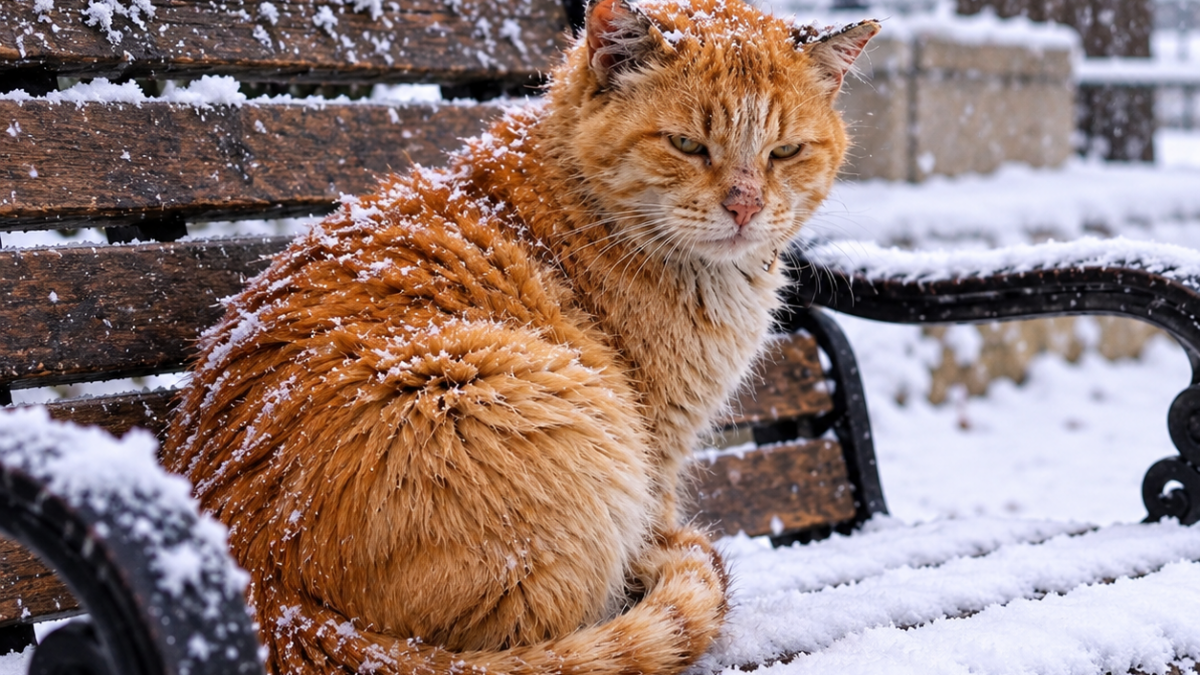
The image showed him sitting on the snowy seat, orange fur bright against the gray morning.
The headline was something like:
CAT WAITS WEEKS AT BENCH AFTER HOMELESS OWNER DIES.
People reacted immediately.
Some cried.
Some offered money.
Some accused the city of cruelty.
Some blamed the shelter.
Some blamed us for not simply grabbing him.
And, predictably, some blamed the dead man.
That angered me more than anything.
“He should’ve surrendered the cat.”
“He chose homelessness.”
“He was irresponsible.”
I read those comments until my hands shook.
Finally, I closed the article.
The next morning, the reporter met me at the park.
“People want to know why nobody helped sooner,” she said.
I looked at Bench.
“People did help.”
“But he’s still here.”
“Yes.”
“Why?”
“Because helping isn’t always the same as fixing.”
She waited.
I pointed toward the box.
“That cat doesn’t understand death the way you and I understand it. He knows one thing. The person he trusted disappeared from this spot. So every instinct he has is telling him to remain where that person last existed.”
“Couldn’t someone sedate him?”
“Possibly.”
“Then why not?”
“Because until recently he was eating, drinking, moving, defending himself and returning here voluntarily. We were trying to find a solution that didn’t traumatize him further.”
The reporter lowered her notebook.
“Do you think he’s grieving?”
I looked at the bench.
“I think anybody who says animals don’t grieve has never watched one wait.”
That quote ended up in the article.
I wasn’t proud of it.
I wasn’t trying to sound profound.
I was tired.
I was angry.
I was scared.
Because by then I knew Bench was getting worse.
The public attention created pressure.
A rescue organization from another county offered to take him if we could capture him safely.
A veterinarian volunteered treatment at reduced cost.
People donated heated shelters.
Food.
Blankets.
But Bench’s behavior didn’t change.
The world had suddenly noticed him.
He was still waiting for one man.
Around the fifty-fifth day, I began seeing changes that frightened me.
He no longer stood every time someone in a brown coat passed.
Sometimes he only lifted his head.
His eyes looked sunken.
His gait became slow.
He stopped grooming his chest.
His fur clumped together.
When he coughed, his entire body tightened.
I called the veterinarian again.
“He can’t continue like this.”
“Can you bring him tomorrow?”
“I don’t think I can wait until tomorrow.”
“Then bring him today.”
I took a carrier to the park.
Bench saw it immediately.
He backed under the bench.
I crouched several feet away.
“Please.”
He stared at me.
“You don’t know me well enough to trust me.”
The wind lifted loose snow across the pavement.
“But I’m asking anyway.”
He didn’t move.
I waited almost an hour.
Eventually he entered the cardboard shelter.
I approached slowly.
The second my hand touched the box, he shot out the opposite side.
He ran twenty feet.
Then stopped because he was too exhausted to continue.
I could have grabbed him.
Maybe.
But when I moved toward him, he stumbled backward and hissed.
His eyes were terrified.
I stopped.
I hated myself for stopping.
I hated myself for frightening him.
I hated a city where a dying animal could become a symbol before he became a patient.
That evening I called the rescue coordinator.
“Tomorrow,” I said. “We’re doing this tomorrow. Even if we have to trap him.”
She agreed.
But Bench made the decision for us.
On the sixty-third morning, I arrived just before six.
There had been no new snow.
The sky was clear.
The temperature was fourteen degrees.
I crossed the street carrying warm food.
From twenty feet away, I knew something was wrong.
Bench wasn’t on the bench.
He wasn’t sitting inside the box.
He was lying flat.
I dropped the food.
“Bench?”
Nothing.
I ran.
His body was stretched on the blanket.
His eyes were half open.
His breathing was shallow.
I reached inside.
For the first time in sixty-three days, he didn’t hiss at me.
Didn’t pull away.
Didn’t fight.
That terrified me more than any aggression could have.
“Oh, no.”
I touched his side.
He was freezing.
“Bench.”
His head moved slightly.
“Come on.”
I slipped one hand beneath his chest.
The other under his hips.
He weighed almost nothing.
That is the detail I remember most clearly.
The nothingness of him.
This cat had once been large.
Broad-headed.
Heavy-shouldered.
Now he felt like a winter coat with bones inside it.
I wrapped him in my coat.
He made one weak sound.
“I’m sorry.”
I stood.
“I’m sorry, but you’re done waiting.”
He didn’t resist.
I carried him to my car.
The laundromat owner came running outside.
“What happened?”
“He’s crashing.”
“Is he alive?”
“Yes.”
“Where are you taking him?”
“The clinic.”
She opened the passenger door for me.
Bench lay against my chest.
His head rested beneath my chin.
And for one unbearable second, I understood exactly how his owner must have held him during those winter nights.
I could almost see them.
The man sitting against the back of the bench.
Coat zipped around the cat.
One body keeping the other alive.
“Go,” the woman said.
I drove.
I don’t remember stopping at lights.
I don’t remember the streets.
I remember talking.
“Stay awake.”
Bench’s eyes remained half closed.
“You’ve waited long enough.”
His breathing rattled.
“Do you hear me?”
I was crying.
“You did your job.”
That sentence came from somewhere deep inside me.
“You stayed.”
His paw moved against my sleeve.
“He knows.”
I swallowed.
“Wherever he is, he knows.”
At the veterinary clinic, a technician met me at the door.
One look at Bench and she took him immediately.
“What happened?”
“Exposure. Malnutrition. Respiratory infection. Maybe frostbite.”
“How long has he been outside?”
“Nine weeks.”
She stared at me.
“Nine weeks?”
“His owner died.”
They rushed him into the treatment area.
I stood in the lobby holding my coat.
There was orange fur stuck to the fabric.
A receptionist handed me a clipboard.
“Are you the owner?”
I opened my mouth.
Nothing came out.
Owner.
That word felt wrong.
“No.”
“Who is?”
“Nobody.”
She looked down at the form.
“We need a responsible party.”
I stared through the door where Bench had disappeared.
“I am.”
It happened that simply.
Not adoption.
Not yet.
Just responsibility.
But in retrospect, that was probably the moment he became mine.
The veterinarian came out twenty minutes later.
Her face was serious.
“He’s extremely underweight.”
“How bad?”
“Just over six pounds.”
I closed my eyes.
Bench should have been close to twelve.
“He is severely dehydrated. His body temperature is dangerously low. He has an upper respiratory infection, and I’m concerned about frostbite on both ears.”
“Can you save him?”
“We’re going to try.”
That answer frightened me.
Not yes.
We’re going to try.
She continued.
“The pad on his rear left paw is cracked deeply. It looks like repeated exposure to frozen ground. His lungs sound congested, but I don’t hear obvious signs of pneumonia yet. That’s good.”
“What do you need from me?”
“For now?”
She glanced toward the treatment room.
“Let us work.”
I sat in the waiting room for three hours.
The laundromat owner arrived.
Then the reporter.
Then two volunteers.
Nobody had called the reporter, but by then the story had traveled.
“Is he going to make it?” she asked.
“I don’t know.”
At noon, the veterinarian returned.
“We’ve stabilized his temperature.”
I stood.
“He’s responding to fluids.”
“Can I see him?”
“For a minute.”
Bench was inside a heated enclosure.
An IV line ran into one front leg.
His face looked impossibly small.
The tips of both ears were dark.
His eyes opened when I entered.
“Hey.”
One ear twitched.
“I’m still here.”
He closed his eyes.
For the first time since I’d met him, he was warm.
The veterinarian kept him hospitalized.
That first night was difficult.
He refused food.
The second morning he developed a fever.
The infection had taken hold deeply after weeks of exposure.
He needed antibiotics.
Fluids.
Nutritional support.
Pain control.
The damaged ear tissue had to be monitored.
For three days, every phone call from the clinic made my heart jump.
On the fourth day, the veterinarian called at 7:12 a.m.
“He ate.”
I sat on the edge of my bed.
“How much?”
“Not much.”
“How much?”
“About a tablespoon of food.”
I started laughing.
Then crying.
The veterinarian laughed too.
“I thought you’d want to know.”
“Yes.”
“He ate on his own.”
That tablespoon became our first victory.
On day five, he ate twice.
On day six, he stood long enough to walk to the other side of his enclosure.
On day seven, he hissed at a technician.
She called me personally.
“Your cat just threatened me.”
I smiled for the first time in weeks.
“That’s wonderful.”
“I’ve never had anyone so happy about being hissed at.”
“He only hisses when he has enough energy.”
“Then congratulations. He’s furious.”
The frostbite damage was permanent.
The tips of both ears could not be saved.
The veterinarian explained that dead tissue would eventually cause infection if left untreated.
Bench needed surgery.
I signed the consent paperwork.
By then donations from people who had followed his story had covered most of his medical expenses.
Some envelopes contained five dollars.
Some twenty.
One had three hundred.
A child mailed twelve dollars in crumpled bills with a note that said:
FOR THE ORANGE CAT.
I kept that note.
I still have it.
The surgery shortened both ears slightly.
When Bench woke, his face looked different.
The old torn left ear was now even shorter.
His right ear matched it.
But he was alive.
That was all I cared about.
His recovery took four weeks.
I visited almost every day.
At first he ignored me.
Then he began watching when I entered.
Around the second week, I brought the thermal blanket from the cardboard box.
The clinic had washed it.
When I placed it beside him, he sniffed it for almost a minute.
Then stepped onto it.
He kneaded the fabric once.
Twice.
Then lay down.
I sat on the floor outside his enclosure.
“You remember.”
He looked at me.
I wondered what the blanket smelled like to him.
Snow?
The bench?
The man’s coat?
Me?
Maybe all of it.
Maybe grief has a scent.
Toward the end of the third week, he let me touch his head.
Just once.
My fingers brushed the fur between his shortened ears.
He froze.
So did I.
Then he closed his eyes.
I didn’t move my hand.
We stayed that way for maybe ten seconds.
It felt longer.
The veterinarian was standing behind me.
“I think you’ve been selected.”
I smiled.
“I haven’t asked him.”
“You might want to.”
I looked at Bench.
“What do you think?”
He opened one eye.
“Want to come home with me?”
Nothing.
“I have heat.”
His eye closed.
“Food.”
No response.
“A bed.”
Still nothing.
“A window.”
Both eyes opened.
The veterinarian laughed.
“There it is.”
The adoption became official the morning he was cleared for discharge.
The paperwork asked for his name.
I wrote BENCH.
The receptionist glanced at it.
“You’re keeping that?”
“Yes.”
“You don’t want something happier?”
I looked through the glass at him.
“No.”
She raised an eyebrow.
“It isn’t a sad name.”
It wasn’t.
Not anymore.
Bench wasn’t just the place where he had nearly died.
It was the place where someone had once chosen him over warmth.
It was the place where loyalty had been proven twice.
First by a man.
Then by a cat.
I took him home that afternoon.
My apartment was small.
Second floor.
Two bedrooms.
One bathroom.
Living room facing the street.
I had bought everything.
Litter box.
Beds.
Food dishes.
Scratching post.
Toys.
A heated mat.
A ridiculous cat tree that took me two hours to assemble because the instructions appeared to have been written by someone who hated furniture.
I opened the carrier in the living room.
Bench remained inside.
I sat ten feet away.
“You can take your time.”
Five minutes passed.
Ten.
Then one orange paw appeared.
He stepped out.
Sniffed the carpet.
Walked toward the kitchen.
Returned.
Inspected the hallway.
Then he noticed the window.
Bench climbed onto the sill.
He sat.
And stared outside.
For three hours.
He didn’t sleep.
Didn’t eat.
Didn’t explore.
He simply watched the street.
I didn’t close the curtains.
That night he slept beneath the window.
The next night he did the same.
On the third night, he climbed onto my bed briefly, walked across my legs, then returned to the window.
For the first two months, it became a ritual.
Every evening around sunset, Bench went to the living room.
Climbed onto the sill.
And watched.
Sometimes for an hour.
Sometimes three.
The first few times the front door opened unexpectedly, he leaped up.
Once my daughter came in using her spare key.
Bench shot from the bedroom so fast he slid on the floor.
He reached the hallway.
Saw her.
Stopped.
Then walked away.
My daughter looked at me.
“Was he expecting someone?”
“Yes.”
She didn’t ask who.
She knew.
People liked to tell me he was adjusting.
Maybe he was.
But I never believed he was simply looking outside because he enjoyed the view.
Bench was keeping watch.
It was the responsibility he had understood for years.
Stay close.
Watch.
Wait.
Don’t leave.
I refused to take that away from him.
So the curtains remained open.
Meanwhile, the article about Bench kept spreading.
First locally.
Then across the state.
People wanted to know how a man had died on a bench after refusing indoor shelter because his cat couldn’t accompany him.
That question became louder than anyone expected.
The agency that had offered him a bed released a statement.
They explained that health regulations and facility policy prohibited animals except qualified service animals.
They said staff had repeatedly encouraged him to accept services.
They said they had followed procedure.
Everything in the statement may have been technically true.
That did not stop people from being furious.
A woman called me from the organization.
She sounded exhausted.
“I know you’re upset.”
“I’m not the person you need to apologize to.”
“We aren’t apologizing. I’m trying to explain.”
“Then explain it.”
“We cannot simply bring unvaccinated animals into a congregate shelter.”
“I understand.”
“There are allergy concerns. Bites. Fleas. Disease transmission.”
“I understand all of that.”
She paused.
“Then what are you asking us to do?”
I looked at Bench asleep beneath my window.
“I’m asking why the only choices were separate them or leave both of them outside.”
Silence.
“We didn’t have another option.”
“Then build another option.”
“That requires funding.”
“Then ask for funding.”
“It’s more complicated than that.”
“It always is.”
My voice sharpened.
“It was complicated when he was alive too.”
She didn’t answer.
I continued.
“He wasn’t asking for a luxury room. He was asking not to abandon the only family he had.”
“Ma’am—”
“And now he’s dead, and that cat nearly died in the exact same place.”
I stopped.
I hadn’t planned to say that.
The woman on the line became quiet.
When she finally spoke, her tone had changed.
“I’m sorry.”
I looked out the window.
“So am I.”
That could have been the end of it.
But it wasn’t.
The reporter kept investigating.
She found records showing other homeless residents had refused shelter because they couldn’t bring animals.
A man with an elderly Chihuahua had slept in his car during a freeze.
A woman with two cats had stayed under an overpass.
A veteran had avoided emergency housing because his dog did not meet the legal definition of a service animal.
Suddenly Bench’s story wasn’t only about Bench.
It was about a gap everybody had known existed and nobody had been forced to look at closely.
Public meetings became crowded.
People demanded a solution.
Not reckless policies.
Not animals running loose in dormitories.
A real solution.
Temporary kennels.
Partnerships with veterinary groups.
Pet-friendly emergency rooms during extreme cold.
Off-site foster placements where owners could visit.
Something.
Anything.
The first meeting I attended was ugly.
One official said the city didn’t have the money.
A woman in the audience shouted, “Then stop pretending you offered that man shelter!”
The room erupted.
The chairman banged his gavel.
I hated the noise.
I hated what the discussion was becoming.
So when public comments opened, I stood.
My legs shook.
I hadn’t spoken in front of a city board since my nursing union days.
“My name isn’t important,” I said. “Most of you know me as the woman who adopted Bench.”
The room quieted.
“I want to make one thing clear. This isn’t about blaming a shelter employee who followed a rule. It isn’t about pretending animal restrictions exist for no reason.”
Several officials looked relieved.
Then I continued.
“It’s about what happens when everybody follows the rule and somebody still freezes outside.”
Nobody moved.
“The man who died was offered a bed.”
I looked around the room.
“On paper, that sounds like help.”
A woman in the second row lowered her head.
“But the actual offer was this: come inside and leave behind the one living creature that has slept against your chest for three years.”
I paused.
“Would you call that an easy choice?”
No one answered.
“He made his choice.”
I nodded.
“And he died.”
The room was completely silent.
“Then the cat made his.”
I felt my throat tighten.
“And he nearly died too.”
I placed a photograph of Bench on the table.
It had been taken at the clinic.
Six pounds.
Shortened ears.
IV line.
“That is what our gap in policy looked like.”
The chairman stared at the photo.
“I don’t want revenge,” I said.
That was true.
At least not the kind people imagined.
“I don’t want anyone fired because the internet is angry. I don’t want threats. I don’t want people harassing shelter workers.”
I looked directly at the board.
“But I do want this to become expensive enough, embarrassing enough, and public enough that nobody can pretend there isn’t a problem anymore.”
That sentence made the newspaper the following morning.
And strangely, that became the closest thing to revenge I ever wanted.
Not punishment.
Change.
Within two months, donations began arriving for a pilot program.
A veterinary nonprofit agreed to provide temporary vaccinations and health checks.
A local boarding facility offered six emergency kennels during severe-weather alerts.
A church donated space for additional crates.
The city allocated funding for transportation.
It wasn’t perfect.
It didn’t solve homelessness.
It didn’t guarantee that every person with an animal would accept shelter.
But the next winter, when temperatures dropped below fifteen degrees, people with pets had an option that hadn’t existed before.
Stay together.
Or stay close enough that neither had to feel abandoned.
The policy had no man’s name attached to it.
No cat’s name either.
But everyone knew why it existed.
The shelter director eventually visited my apartment.
I almost didn’t let her in.
She stood in the hallway holding a small bag of cat treats.
“Bench can’t eat those,” I said.
She looked embarrassed.
“Oh.”
“His stomach’s still sensitive.”
“I can take them back.”
I opened the door wider.
“Come in.”
Bench was on the windowsill.
The woman stopped when she saw him.
Pictures had not prepared her for the ears.
They were permanently shortened.
She stared for several seconds.
“He looks better.”
“He is.”
“Can I pet him?”
“Probably not.”
She kept her distance.
Bench glanced at her once, then returned to the window.
“I’m the one who spoke to you on the phone,” she said.
I looked at her.
Months had passed, but I remembered the voice.
“Protocols.”
She nodded.
“I said that.”
“You did.”
She sat on the edge of a chair.
“I’ve thought about that conversation a lot.”
I didn’t say anything.
“We really were full.”
“I know.”
“We really couldn’t take him.”
“I know.”
“We really didn’t have a legal way to let the man bring him inside.”
“I know.”
Her eyes filled with tears.
“That somehow makes it worse.”
I understood what she meant.
A villain would have been easier.
You can fire a villain.
Punish a villain.
Point to the villain and say: there.
That’s the problem.
But there had been no single cruel person.
Just rules.
Buildings.
Budgets.
Liability.
Capacity.
Paperwork.
And one man with a cat standing outside all of it.
“I’m sorry,” she whispered.
Bench turned.
For some reason, he jumped down from the sill.
He walked toward us.
The woman froze.
Bench sniffed her shoe.
Then her pant leg.
She didn’t move.
He walked away.
She began crying harder.
“He doesn’t even know.”
“No,” I said.
“He doesn’t.”
That was mercy, I thought.
Animals remember pain.
They remember safety.
They remember people.
But they don’t sit around constructing arguments about institutional failure.
Bench didn’t care about city meetings.
He didn’t care about policies.
He didn’t care who had apologized.
He had already survived the only thing that mattered to him.
Losing his person.
Six months after the man’s death, I walked through the park and stopped.
The bench was gone.
City renovations had started that week.
Several old benches were removed.
New pavement was going in.
Landscaping.
Lighting.
I stood where Bench had waited.
There was nothing there.
No plaque.
No sign.
No flowers.
Nothing identifying the place.
For a moment, I was furious.
After everything, shouldn’t there have been something?
The reporter later asked whether I wanted to campaign for a memorial.
I said no.
At first she seemed surprised.
“Why not?”
I thought about it.
Because I had learned something from Bench.
Memorials are for people who need proof that something happened.
Bench did not need proof.
Neither did I.
The man’s life didn’t become meaningful because someone engraved his name on metal.
The trouble was, we didn’t even know his full name with certainty.
His body had eventually been identified through old records, but the family trail ended years earlier.
No relatives came.
No service filled a church.
No obituary made people stop over breakfast.
For most of the city, he disappeared quietly.
But not completely.
Every time a person entered emergency winter shelter with a dog in one of those newly funded kennel spaces, part of him remained.
Every time an outreach worker said, “You don’t have to leave your animal,” part of him remained.
And every time Bench curled against my left side at night, part of him remained there too.
Bench took months to become comfortable indoors.
The first thunderstorm sent him beneath my bed.
The first time I wore a brown winter coat, he followed me through the apartment.
When I picked up my keys, he became frantic.
He stood at the door.
Meowed.
Paced.
That was when I understood another layer of what he’d experienced.
People had disappeared before.
His person had left one morning and never returned.
From Bench’s point of view, doors were dangerous.
Coats were dangerous.
Leaving was dangerous.
So I built routines.
“Store,” I would say before leaving for groceries.
Then I came back.
“Doctor.”
Then I came back.
“Daughter.”
Then I came back.
I don’t know whether he understood the words.
But he understood repetition.
I leave.
I return.
I leave.
I return.
I leave.
I return.
For Bench, trust wasn’t built through treats.
It was built through coming back.
After about a year, something changed.
I opened the front door after visiting my daughter.
Bench was asleep on the couch.
He lifted his head.
Saw me.
And did not run toward the door.
I stood there holding my purse.
“Well.”
He yawned.
“You finally believe me.”
That night, for the first time, he slept beside me until morning.
Left side.
Facing the window.
He still sleeps that way.
Always on my left.
Always with his body angled toward the glass.
He is older now.
Approximately eight.
Maybe nine.
Nobody knows his exact age.
The scar across his nose has faded slightly.
His coat is thick again.
He weighs almost twelve pounds.
His ears will always carry the winter.
The tips never grew back.
Sometimes children ask what happened.
I tell them frostbite.
Adults often ask the longer question.
“Is that the cat?”
Yes.
That cat.
The one from the bench.
Bench became famous for a while.
Then, as all stories do, his faded from public attention.
There were new headlines.
New tragedies.
New animals needing rescue.
New people needing help.
That’s normal.
The world moves.
Bench never cared about being remembered by strangers.
He only cared about one person remembering to return.
Sometimes, in December, I still walk past the old park.
The renovated area is cleaner now.
Brighter.
There are new benches.
Not the same one.
People sit with coffee.
Teenagers wait for buses.
Workers eat lunch.
Nobody knows exactly where the old bench stood unless they were there before.
I know.
I always stop for a moment.
Not long.
Just long enough to remember.
I picture the man sitting there with a large orange cat beneath his coat.
Maybe he had made mistakes.
Almost certainly.
Everybody does.
Maybe there were opportunities he refused.
Maybe relationships he damaged.
Maybe choices that helped put him on the street.
I don’t know.
His life should not be romanticized simply because he died poor.
Homelessness isn’t noble.
Cold isn’t poetic.
Hunger isn’t freedom.
But whatever else was true about that man, one thing remains beyond dispute.
When someone offered him warmth in exchange for abandoning the creature that depended on him, he said no.
He stayed.
And Bench remembered.
For sixty-three days after the man disappeared, Bench stayed too.
Through one snowstorm.
Then another.
Through seven-degree nights.
Through hunger.
Frostbite.
A respiratory infection.
A cracked paw.
Through the slow disappearance of his own strength.
He waited.
I once asked the veterinarian whether cats understand death.
She gave me the scientific answer first.
Animals process absence differently.
They can recognize that another animal or person is no longer present.
They may search.
Vocalize.
Lose appetite.
Change routines.
Become withdrawn.
Then she looked at Bench.
“But nobody can tell you exactly what he believed.”
That’s true.
I don’t know whether Bench thought the man was alive.
I don’t know whether he expected to see him coming from the bus station.
I don’t know whether he understood that something terrible had happened.
But I know what he did.
He remained where love had last been.
Maybe that’s all grief is at first.
Remaining where love used to be because you haven’t yet learned how to carry it somewhere else.
Bench eventually learned.
Not quickly.
Not cleanly.
He brought part of that bench into my apartment with him.
He brought the watching.
The fear of doors.
The need to sleep facing the window.
The panic when someone left.
I never tried to erase those things.
They belonged to him.
And to the man.
People sometimes tell me I saved Bench.
I don’t like that.
I carried him to a veterinarian.
Doctors saved his body.
Donors paid for treatment.
Volunteers fed him.
The laundromat owner watched him.
A community built his shelter.
A rescue group found space.
There was no single savior.
And Bench himself fought harder than any of us.
But if I did one thing for him, it was simple.
I stayed long enough for him to learn that someone could leave and still come back.
That mattered more than I understood.
Years after his rescue, I received a letter.
No return address I recognized.
Inside was a handwritten note from a man who said he had once slept at the same shelter that had turned away Bench’s owner because of the cat.
He owned a small dog.
After the policy changes, outreach workers had offered him temporary boarding during a dangerous cold snap.
He accepted.
He entered shelter.
His dog stayed three blocks away in one of the partner kennels.
He visited every morning.
The man eventually entered transitional housing.
Then permanent housing.
He still had his dog.
At the bottom of the page, he had written:
I DON’T KNOW THE MAN WHO DIED.
BUT TELL HIS CAT I GOT TO KEEP MINE.
I read that sentence three times.
Then I sat at my kitchen table and cried harder than I had cried in years.
That was the ending I had wanted without knowing it.
Not punishment.
Not somebody losing a job.
Not a city official being humiliated.
That.
A man stayed alive.
A dog stayed with him.
Because another man hadn’t.
Because another cat had waited.
I placed the letter beside Bench.
He sniffed the paper.
Then sat on it.
“Of course,” I said.
He began washing one paw.
“You have no idea what you’ve done, do you?”
He looked at me.
Maybe he didn’t.
Or maybe animals understand impact differently too.
I later showed the letter to the shelter director.
She read it silently.
When she reached the final line, she covered her mouth.
“This is why we changed it,” she whispered.
“Yes.”
She folded the page carefully.
“Do you forgive us?”
The question surprised me.
I thought for a long time.
“I don’t think I’m the one who gets to forgive you.”
She nodded.
“Fair.”
“But I think you did what you’re supposed to do after getting something wrong.”
She looked at me.
“You changed.”
That was enough.
Human beings like revenge because it feels clean.
Someone hurts you.
You hurt them back.
The balance is restored.
But real life rarely works that way.
Nothing we did could punish the cold.
Nothing could force December to return the man.
No lawsuit could give Bench back those sixty-three days.
No public apology could restore the pieces of his ears that frostbite took.
No angry crowd could make an empty bench stop being empty.
The only revenge available to us was refusing to let the same thing happen quietly again.
So we made noise.
We embarrassed people who preferred comfortable explanations.
We asked ugly questions in public meetings.
We put photographs on tables.
We forced officials to defend rules that had once sounded reasonable until everyone saw the cost.
Then we helped them build better rules.
That was our revenge against indifference.
We made it harder.
Harder to look away.
Harder to say, “That’s policy,” and end the conversation.
Harder to offer help that required someone to abandon the only family they had left.
Bench never knew any of this.
He didn’t need to.
His life became very small again, in the best possible way.
Breakfast at six.
Sunlight on the bedroom floor.
The sound of birds outside.
Afternoon naps.
Dinner.
The living-room window.
My bed.
Sometimes my daughter brings him a new toy.
He ignores it.
Sometimes she brings the cardboard box it arrived in.
Bench climbs inside immediately.
“Of course,” she says.
He likes boxes.
But I never use the kind of thin cardboard box he had in the park during winter.
I know that’s irrational.
He probably doesn’t connect them.
I do.
The original thermal blanket remains folded in a closet.
I tried replacing it several times.
He always found the old one.
Eventually, I stopped trying.
It lies at the bottom of his favorite bed now.
The fabric is worn.
Some stains never completely came out.
One corner has a small tear.
To anyone else, it is trash.
To Bench, it smells like history.
One night, years after his rescue, I woke around two.
The bedroom was cold because I had forgotten to close the window properly.
Bench wasn’t beside me.
I found him in the living room.
Sitting on the sill.
Snow had started falling outside.
Large flakes.
Soft and slow.
The street was turning white.
Bench stared through the glass.
For a moment, I was back in that park.
Sixty-three mornings.
The empty bench.
The cardboard box.
The orange cat facing the same direction.
I sat beside him.
“Do you remember?”
He didn’t look at me.
Snow fell beneath the streetlights.
“I do.”
I reached out.
Bench leaned his head against my hand.
His shortened ear brushed my fingers.
We stayed like that.
No sound except the heater and the faint noise of tires outside.
After a while, Bench turned away from the window.
He jumped down.
Walked toward the bedroom.
Stopped in the hallway.
Then looked back at me.
I smiled.
“I’m coming.”
He waited.
Not for long.
Only until I stood.
Then he walked ahead of me.
That difference meant everything.
Years earlier, Bench had waited because someone wasn’t coming.
Now he waited because he knew I was.
I followed him into the bedroom.
He jumped onto the mattress and circled twice.
Then he settled onto his usual spot on my left side.
Facing the window.
I pulled the blanket over myself.
My hand rested against his back.
He began to purr.
The sound was low.
Steady.
Alive.
Sometimes people ask whether I think Bench eventually stopped waiting for the homeless man.
I don’t know.
I don’t think love works like that.
You don’t stop waiting because someone new arrives.
You don’t erase one bond to make room for another.
You learn to hold both.
Maybe part of Bench will always remain on that bench in December.
Maybe some part of me will too.
But that isn’t tragedy.
Not anymore.
Because the story did not end with the empty seat.
It did not end when the city removed the bench.
It did not end with frostbite.
Or six pounds on a veterinarian’s scale.
Or a cardboard box buried in snow.
It continued every morning Bench woke in warmth.
Every night he slept beside me.
Every time I opened the front door and came back through it.
Every time another homeless person accepted shelter without surrendering an animal.
Every time an outreach worker used the program created after his story.
Those were the parts nobody saw in the original photograph.
Those were the victories.
Small.
Quiet.
Real.
The homeless man never knew what his decision would cause.
He never knew strangers would argue about him.
He never knew policies would change.
He never knew a reporter would write about his cat.
He probably died believing the world had forgotten him.
Maybe most of it had.
But Bench hadn’t.
And sometimes being remembered by one living creature is more than some people receive in an entire lifetime.
There is still no plaque in the park.
No statue.
No engraved name.
No marker telling strangers that a man once slept there because the only shelter available to him required leaving his cat behind.
Most people walk through without knowing.
They step across the place where the cardboard box sat.
They wait for buses.
Check their phones.
Drink coffee.
Keep moving.
That’s all right.
Not every meaningful place needs a sign.
Some stories survive differently.
In altered policies.
In changed habits.
In people who decide not to look away next time.
In a shortened pair of orange ears.
In an old thermal blanket.
In a cat sleeping on the left side of an old nurse’s bed.
Sometimes, late at night, I look at Bench and imagine the man holding him beneath that brown coat.
I wonder what he would think if he could see him now.
Fed.
Warm.
Safe.
Annoyingly spoiled.
I imagine telling him:
You don’t have to worry.
He made it.
He waited for you as long as his body could.
And when he couldn’t wait anymore, somebody carried him inside.
I think that would matter to him.
I hope it would.
Because I want him to know something too.
Bench never abandoned him.
Not when the snow came.
Not when hunger hollowed out his body.
Not when the cold damaged his ears.
Not when strangers offered food.
Not when the city kept moving around him.
For sixty-three days, he stayed beside the last place they had been together.
Nobody trained him to do that.
There was no reward.
No command.
No leash keeping him there.
He stayed because, for three years, one man had been his entire world.
And when that world disappeared, Bench guarded the place where it had vanished.
That kind of loyalty cannot be taught.
It can’t be purchased with treats.
It doesn’t come from comfort.
It comes from the deepest kind of trust: the knowledge that when everyone else has passed you by, one person remained.
That homeless man had been invisible to thousands of people.
To Bench, he was everything.
And when the man was gone, Bench did what love had taught him.
He stayed.
He watched.
He waited.
Until his body could no longer do it.
Then, finally, he let someone carry him away.
And years later, when the snow falls outside my window and Bench lifts his head toward the glass, I sometimes wonder whether he still sees that old park in his mind.
Whether he remembers the coat.
The bench.
The man’s hands.
The footsteps he kept expecting.
I will never know.
But I know what happens next.
Bench looks away from the window.
He turns toward me.
And eventually, he sleeps.
Because the greatest mercy in his story was never that he forgot the man he loved.
He didn’t.
The mercy was that after spending sixty-three days waiting for someone who could never return, Bench finally learned that he could love someone else without betraying the person who came before.
And I learned something from him too.
Loyalty is not proven when staying is easy.
It is proven when staying costs you something.
The man proved it when he chose a freezing bench over a warm bed that would not admit his cat.
Bench proved it when he remained on that same bench through snow, hunger, sickness, and cold.
And our city, finally ashamed of what both of them had endured, proved something only when we changed the rules so the next person would not be forced to make the same choice.
That may not look like revenge.
But to me, it was better.
The system that had once told a desperate man, “Your cat cannot come,” eventually had to make room for people like him.
Not because powerful people suddenly became kind.
Because one orange cat refused to leave an empty bench.
Today, Bench sleeps safely beside me.
His ears are shorter.
His body carries scars.
He still faces the window.
But when my front door opens, he no longer assumes everyone he loves is disappearing.
He watches.
He waits.
And then he relaxes.
Because now he knows something he didn’t know during those sixty-three winter days.
Sometimes, the person who leaves actually comes home.
And this time, I always do.

