PART 2: A Four-Pound Calico Kept a Blind 15-Year-Old Cat Alive at -14°F—Then Refused to Leave Him
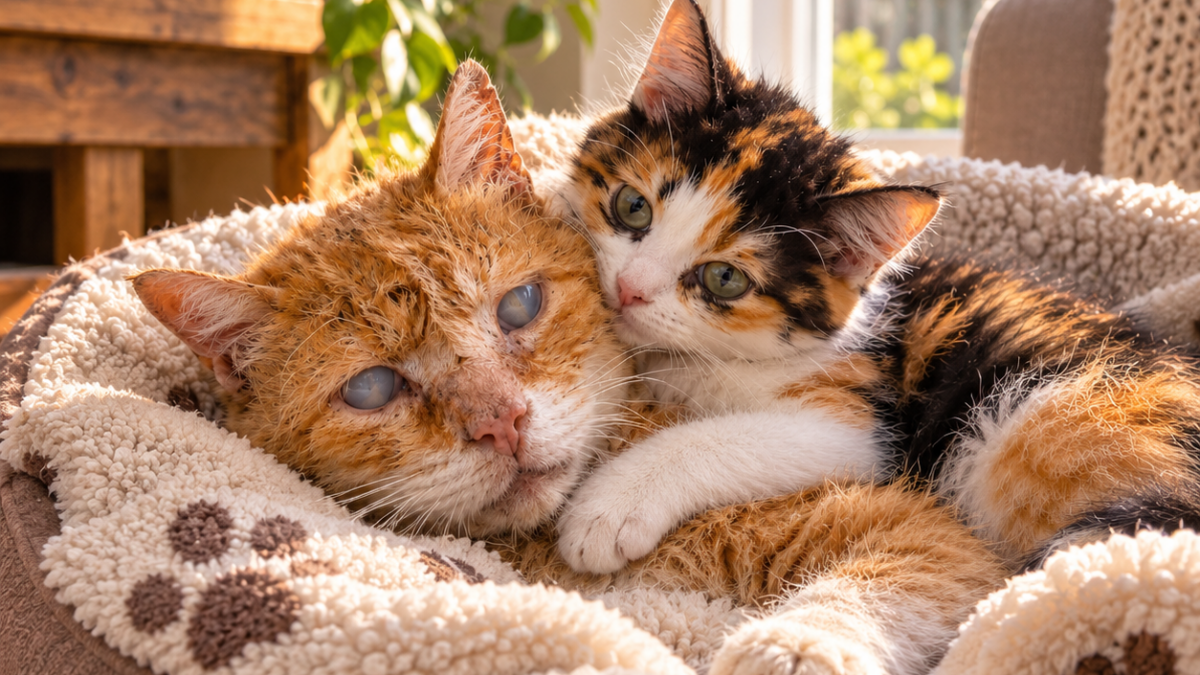
I drove ninety minutes through a Vermont snowstorm for two cats I had never met because one of them had already spent days proving she would rather freeze beside her blind companion than leave him alone.
She weighed barely four pounds, yet somehow she had been carrying the responsibility for an old ginger cat who could not see, could barely stand, and might not have survived another night outside.
When I finally walked into the shelter and saw them together, I understood that taking only one of them was never going to be an option.
I first learned about them early on a Saturday morning.
The snow had been coming down since before sunrise, and I was sitting at my kitchen table with a cup of coffee when my phone lit up with a post from a Vermont rescue organization I followed.
Normally, I would have read it, felt sad for a few minutes, and continued with my day.
That morning was different.
The photograph stopped me.
A tiny calico cat was pressed against an elderly orange-and-white cat inside a shelter enclosure.
She was so small that almost half of her body disappeared beneath his.
His eyes were cloudy.
His face looked tired in a way that immediately told me he was old.
Her body curved around him as though she had decided her only job in the world was to stay as close as possible.
The caption explained that rescuers had found them beneath an abandoned farm trailer during one of the coldest stretches of winter.
The temperature had dropped to around fourteen degrees below zero.
The ginger cat was estimated to be at least fifteen years old.
He was completely blind.
Severely dehydrated.
Dangerously weak.
His kidney function was badly compromised, and he could barely move on his own.
The calico was younger and physically stronger, but only barely.
She weighed around four pounds.
Her paws showed cold-related injuries.
Her claws were worn from digging through frozen ground.
She was hungry, exhausted, and still recovering from exposure.
Yet somehow the ginger cat was alive.
The rescuers soon began understanding why.
The two had apparently been sheltering beneath the trailer together.
A barn sat roughly forty yards away.
Tracks in the snow suggested the calico had been traveling between the two places.
Back and forth.
Back and forth.
The rescue believed she had been finding scraps of food and carrying or leaving them near the older cat, close enough that he could locate them by smell.
She had searched for water.
She had returned to him after every trip.
Forty yards across frozen ground.
Then forty yards back.
For an animal weighing barely four pounds, in that temperature, it might as well have been miles.
The story became harder to read.
When rescuers crawled beneath the trailer, the calico was wrapped tightly around the old cat.
She did not run.
She would not willingly move away from him.
When one responder reached toward her, she grabbed the edge of his heavy glove and held on.
Not because she wanted to attack anyone.
She seemed terrified that they were separating her from the one animal she had spent every ounce of strength protecting.
So they stopped trying to move them individually.
They carried both cats out together.
At the shelter, veterinary staff immediately began warming and treating them.
The old ginger cat was in much worse condition than anyone had first realized.
A veterinarian reportedly said that had he remained outside much longer, his body might not have been able to keep going.
The little calico had not cured him.
She had not restored his sight.
She had not made him young.
But she had done the one thing available to her.
She had stayed.
I read the story twice.
Then a third time.
My coffee went cold.
There was one line that kept pulling me back.
**They are not biologically related.**
I do not know why that mattered so much.
Maybe because it removed the simplest explanation.
She was not protecting her kitten.
He was not protecting his sister.
There was no family connection anyone could identify.
Somewhere before rescuers found them, two homeless cats had simply become each other’s family.
The shelter hoped to keep them together if possible.
I looked again at the photograph.
The old ginger cat was sleeping.
The calico was awake.
Watching.
Still doing her job.
I put my phone down.
Then picked it up again.
By 8:17 that morning, I was calling the shelter.
By 8:30, I was pulling on my winter coat.
And by nine, despite snow thickening across the roads, I was driving north.
I had not asked which one was younger.
I had not asked which one would be easier.
I had not asked whether someone could adopt the calico without the senior cat.
There was only one question I cared about.
“Can they stay together?”
The woman at the shelter had been quiet for a second.
Then she said, “That’s what we’re hoping.”
I tightened my hand around the steering wheel.
“Good.”
Because I already knew what I was going there to say.
PART 2
The drive should have taken a little over an hour.
It took nearly ninety minutes.
Snow covered the highway faster than the plows could clear it, and I spent most of the trip gripping the steering wheel while my windshield wipers worked at full speed.
Several times, I asked myself what I was doing.
I had not planned to adopt cats that weekend.
Certainly not two.
Definitely not a medically fragile fifteen-year-old blind cat.
My house was quiet.
Predictable.
I had room, yes.
I had experience with cats, yes.
But experience is not the same thing as being prepared for a senior animal whose medical needs were still being evaluated.
There would be veterinary care.
Possible medication.
Special food.
Monitoring.
Maybe difficult decisions sooner than I wanted to imagine.
And then there was the calico.
She had survived the same cold.
Her paws needed treatment.
She was underweight.
She was exhausted.
Whatever she had been through had left her deeply attached to the ginger cat.
I could turn around.
The thought occurred more than once.
Another adopter might come.
The rescue would take care of them.
I did not need to reorganize my life because of a photograph on my phone.
Then I remembered the tracks described in the rescue report.
Forty yards.
There.
Forty yards back.
Again.
Again.
I kept driving.
When I reached the shelter, snow covered the parking lot.
A woman in a dark blue jacket met me near the entrance.
“You’re Ellen?”
“Yes.”
“I’m Claire. We spoke on the phone.”
She looked past me toward the weather.
“You really drove through that?”
“I’ve made worse decisions.”
She laughed.
“Come inside.”
The shelter smelled like laundry detergent, dry food, and warm air.
Dogs barked from somewhere in the back.
A phone rang at the front desk.
People moved with the focused energy of a place that always had something needing attention.
Claire did not take me toward the regular adoption area.
Instead, she led me down a quieter hallway.
“They’re in medical holding.”
“How’s the old one?”
She slowed.
“Better than when he arrived.”
That was not exactly reassuring.
“But?”
“He has a long way to go.”
I nodded.
“And the calico?”
“She barely leaves his side.”
Claire stopped outside a glass-fronted room.
“Before you go in, I want you to understand something.”
“Okay.”
“The story online has gotten a lot of attention.”
“I figured.”
“We’ve had messages from people who want the calico.”
My stomach tightened.
“Only her?”
“Some.”
I looked through the glass but could not see the cats yet.
“And Holden?”
Claire raised an eyebrow.
“You already know his name?”
“The post said staff were considering Holden.”
“It stuck.”
“What happens to him?”
“We’re trying very hard not to separate them.”
Trying.
The word bothered me.
Claire must have noticed.
“Senior special-needs animals are harder to place.”
“I know.”
“People see the younger cat and think she’s easier.”
“I understand.”
“Do you?”
Her question was not hostile.
It was responsible.
She needed to know I was not standing there because the story had made me emotional for ten minutes.
So I answered honestly.
“I understand that the old cat may have ongoing medical costs.”
“Yes.”
“He may never regain much strength.”
“Possibly.”
“He’s blind.”
“Yes.”
“He may need special food, medication, and more frequent veterinary visits.”
“Yes.”
“And he may not have years.”
Claire studied my face.
“No one can promise that.”
I nodded.
“Then I’m not asking for a promise.”
Her expression softened.
“I just want to meet both.”
She opened the door.
The room was warm.
Very warm.
There were blankets on the floor, a low-sided litter box, food dishes, and a padded bed along one wall.
The first thing I saw was orange fur.
Holden.
He was lying on his side beneath a fleece blanket.
He looked even older in person.
His body was narrow.
His hips showed.
His face had the delicate, slightly sunken look of an animal who had lost too much weight.
His eyes were cloudy and unfocused.
Then I saw Parish.
She was curled against his stomach.
Small.
Much smaller than I expected.
Her calico markings were beautiful beneath the roughness of her coat.
Orange.
Black.
White.
Her front paws were wrapped in light protective bandaging.
The second I entered, her head came up.
Her eyes locked on me.
Holden barely moved.
Parish moved enough for both of them.
Her body tightened.
Her ears shifted slightly outward.
She did not run.
She positioned herself closer to Holden.
Claire whispered:
“That’s what she does.”
I sat on the floor several feet away.
“Hi.”
Parish stared.
Holden’s nose lifted.
His ears turned toward my voice.
Because he could not see me, every sound mattered.
I spoke again.
“Hi, old man.”
His head moved a fraction.
Parish watched.
I did not reach.
Five minutes passed.
Claire remained near the door.
“What should I do?”
“Nothing.”
I smiled.
“I’m good at that.”
“Let’s see.”
Ten minutes.
Parish relaxed slightly.
Holden shifted beneath the blanket.
The moment he moved, Parish immediately looked down at him.
She touched her nose to the top of his head.
Then she looked back at me.
That gesture nearly broke me.
It was not dramatic.
She simply checked.
He moves.
She checks.
That was apparently their language.
Claire told me more about the rescue while we sat there.
A neighbor had reported movement around the abandoned trailer after noticing tracks in the snow.
The property had not been actively used for some time.
Responders arrived expecting perhaps one stray animal seeking shelter.
Instead, they found two.
Holden was barely responsive.
Parish was curled around him so tightly that at first the rescuer could not clearly see where one cat ended and the other began.
“When they tried to reach Holden,” Claire said, “she grabbed onto the responder’s glove.”
“Hard?”
“Enough to make her point.”
I looked at Parish.
She was four pounds of determination.
“Did she try to hurt anyone?”
“No.”
“Just wouldn’t leave?”
“Exactly.”
They ultimately moved both cats together.
A carrier large enough for both.
Blankets around them.
No forced separation.
At the clinic, when Holden was taken a short distance for examination, Parish became frantic.
So staff adjusted.
Whenever medically possible, she stayed where she could smell or hear him.
“That helped both of them,” Claire said.
“How?”
“He settles when she’s close.”
“And she settles when she can find him.”
I watched them.
Two animals building safety out of each other.
“What do you know about before the trailer?”
“Very little.”
“Owners?”
“None located.”
“Same household?”
“Could be.”
“Related?”
“No evidence.”
“Maybe they just met outside?”
“Possible.”
I smiled slightly.
“That’s almost worse.”
“Why?”
“Because then she chose all this.”
Claire looked toward Parish.
“Yes.”
Maybe.
We could not know exactly how animals conceptualized their relationship.
But the behavior was undeniable.
They sought each other.
Stayed close.
Parish had expended scarce energy supporting Holden.
Blood relation was irrelevant to the care happening in front of me.
I spent forty minutes in that room before Parish moved toward me.
Not far.
One step.
Then another.
She sniffed the air.
Holden remained on the bed.
I held one finger low.
Parish approached within twelve inches.
Stopped.
No closer.
“That’s enough,” I whispered.
I lowered my hand.
She returned to Holden.
Claire smiled.
“She likes you.”
“You have low standards.”
“So does Parish right now.”
I laughed.
Then Holden made a sound.
Barely a meow.
More like a dry little breath.
Parish immediately pressed against him.
I felt my throat tighten.
“How bad is his kidney function?”
Claire’s smile disappeared.
“Concerning.”
“Can he recover?”
“Some of the problem may be dehydration and the stress his body has been under. We need time.”
“So you don’t know.”
“No.”
“How old?”
“Minimum estimate around fifteen.”
“Could be older?”
“Yes.”
I looked at Holden.
His entire life had happened somewhere before me.
Fifteen winters.
Maybe sixteen.
Maybe more.
He had been somebody’s kitten once.
He had seen once, perhaps.
Or maybe he had been blind for years.
We did not know.
Street animals arrive with missing chapters.
You inherit the present.
That is all.
Claire sat beside me.
“There’s something else.”
“What?”
“We’re not doing same-day adoption while Holden is unstable.”
“Good.”
She looked surprised.
“You’re not disappointed?”
“I drove here in a snowstorm, Claire. I can drive back.”
“We need to know whether his condition stabilizes enough for placement.”
“And Parish?”
“She stays with him.”
“Good.”
“You’re serious about both?”
I looked at her.
“Yes.”
She nodded slowly.
“All right.”
That was how it began.
Not with a carrier leaving the building.
With a promise.
I would come back.
I drove home alone.
For the next four days, I called the shelter morning and evening.
Sometimes I worried I was annoying them.
Probably I was.
Day one:
Holden eating small amounts.
Temperature stable.
Fluids continuing.
Parish eating better.
Day two:
Holden slightly more alert.
Kidney values still concerning.
Parish’s paws improving.
Day three:
Holden stood on his own for several seconds.
I cried when Claire told me.
“You’re crying?”
“No.”
“You sound like you’re crying.”
“It’s dry air.”
“Of course.”
Day four:
Holden ate a full small meal.
Parish tried to steal part of it.
That made me laugh.
“There she is.”
“What?”
“A normal cat.”
Claire laughed too.
“The medical team says if Holden continues this direction, we can talk about home care.”
I had already prepared.
Of course I had.
I spent those four days turning my spare bedroom into an elderly blind-cat recovery suite.
That was not what I called it officially.
But that was what it became.
I lowered everything.
Bed on the floor.
Food and water consistently positioned.
Low-sided litter box.
Soft rugs to provide tactile landmarks.
No clutter.
No furniture likely to shift.
A heating pad approved for pets, set safely beneath part of the bedding so Holden could move away if he became too warm.
I read about caring for blind cats.
Consistency.
Sound cues.
Scent.
Texture.
Never assume blindness means helplessness.
Let them map the environment.
Do not constantly carry them from place to place.
Speak before touching.
I read about kidney disease.
Then I stopped because the internet is extremely good at terrifying people.
I waited for Holden’s actual veterinary instructions.
Parish needed her own setup.
Food.
Litter.
Bed.
But I knew she would probably ignore half of it if Holden was nearby.
I bought two cat beds anyway.
Then a larger one.
Then blankets.
Then another blanket because apparently I lost all financial discipline within seventy-two hours.
My sister called.
“What are you doing?”
“Preparing.”
“For two cats?”
“Yes.”
“You haven’t adopted them.”
“Technical detail.”
“Didn’t you say the old one is very sick?”
“Yes.”
There was a pause.
“You know this might hurt.”
I sat down.
That was the first time anyone said it aloud.
Of course I knew.
A fifteen-year-old cat with compromised kidneys and recent severe exposure did not come with promises.
I might get months.
Weeks.
Maybe less.
I stared at the bed I had made.
“Yes.”
My sister’s voice softened.
“Then why?”
I thought about Parish.
Forty yards.
Back and forth.
“She didn’t leave him.”
My sister said nothing.
“If a four-pound cat can decide he’s worth staying for, I think I can handle being scared.”
That was my answer.
The next afternoon, Claire called.
“Come get your cats.”
My heart jumped.
“Both?”
“Both.”
I arrived with the biggest carrier I owned.
The shelter insisted I take a larger one.
“They ride together,” Claire said.
“Of course.”
Holden looked different.
Still thin.
Still weak.
Still blind.
But awake.
When I spoke, his face turned toward me.
“Hi, old man.”
Parish immediately looked up.
I opened the carrier.
They were transferred carefully.
Parish moved directly against Holden.
One body beside another.
The carrier door closed.
Claire handed me a folder.
“Medications.”
I took it.
“Diet.”
Another page.
“Follow-up schedule.”
More paper.
“Signs we want you to call about immediately.”
I looked at the stack.
“I’m adopting a small hospital.”
Claire laughed.
“Pretty much.”
Then she became serious.
“Ellen.”
“Yes?”
“Holden’s doing better, but…”
“I know.”
She did not need to finish.
I knew.
She crouched beside the carrier.
“Parish.”
The calico looked toward her.
“Take care of him.”
I almost corrected her.
We would take care of him now.
Parish had already done enough.
But looking at the way she pressed herself against his body, I knew she had no intention of retiring from the job.
The drive home was slow.
I talked almost constantly.
Not because Parish needed conversation.
Because Holden could orient to my voice.
“You’re going to hear a lot of noise.”
His ears moved.
“My heater is terrible.”
Parish shifted.
“You’re going to a house.”
Holden lifted his nose.
“I should warn you, I have rules.”
Parish looked toward the carrier door.
“Actually, I suspect you won’t respect them.”
That prediction proved correct.
When I opened the carrier inside the spare room, Parish emerged first.
Of course.
She stepped out.
Sniffed.
Looked around.
Then turned back.
Holden remained inside.
Parish went to him.
Touched his face.
Then stepped out again.
It took Holden almost ten minutes to follow.
He moved slowly.
Front paw.
Pause.
Another.
His whiskers worked ahead of him.
His nose moved constantly.
The new room was an invisible landscape.
I sat near the wall.
“Take your time.”
Parish stayed beside him.
Holden reached the edge of the textured rug.
Stopped.
Sniffed.
Then continued.
He found the bed.
Mostly by accident.
His front paws bumped the soft edge.
He climbed in.
Parish climbed in immediately after him.
I stared at the two individual beds sitting unused across the room.
“Good purchase, Ellen.”
Parish began washing Holden’s ear.
Holden settled.
That first night, I slept badly.
Every two hours, I woke and went to the doorway.
Were they warm?
Breathing?
Had Holden eaten?
Was Parish okay?
At 3:10 a.m., I found them exactly as they had been when I went to bed.
Parish curled against Holden.
Her nose near his shoulder.
I sat outside the room.
“You know you don’t have to do that anymore.”
Parish opened her eyes.
“There are blankets.”
She stared.
“Heating.”
Nothing.
“Humans.”
She closed her eyes.
“Fine.”
I returned to bed.
The first week was built around Holden.
Meals.
Medication.
Hydration.
Monitoring.
Rest.
Veterinary calls.
Parish’s care too, but she recovered faster.
Her paws healed.
Her appetite returned with astonishing enthusiasm.
She gained weight.
She discovered toys.
For the first few days, she seemed almost confused by them.
I rolled a soft ball.
She watched it.
The ball stopped.
Parish looked at me.
“It’s entertainment.”
She looked at Holden.
“Don’t ask him.”
Then she touched the ball.
It rolled.
She jumped backward.
I laughed.
Thirty seconds later, she attacked it like it had personally insulted her.
That was the beginning of Parish becoming young again.
Until then, everything I knew about her had been responsibility.
Cold.
Food.
Water.
Holden.
Survival.
Now she played.
The first time she ran across the room after a toy, I had to look away because I was crying.
No four-pound animal should have to spend every ounce of energy keeping someone else alive.
She was allowed to be silly.
She was allowed to chase felt mice.
She was allowed to eat enough that her ribs became harder to feel.
She was allowed to sleep because she was tired from playing rather than from cold.
Holden’s recovery was slower.
Much slower.
Some mornings felt encouraging.
He ate well.
Walked several laps around the room.
Found his bed without difficulty.
Other mornings, he seemed tired again.
I learned not to treat every good day as proof of permanent recovery or every quiet day as disaster.
Senior animals do not owe us a straight upward line.
Holden’s body had lived for at least fifteen years.
It deserved patience.
We returned to the veterinarian after a week.
His hydration was better.
Body temperature normal.
Some blood values improved.
Others remained concerning.
“He has chronic changes,” the veterinarian explained.
“So this isn’t something that disappears.”
“No.”
I nodded.
“Is he comfortable?”
“That’s what matters most.”
“Yes.”
“For now, I believe he is.”
“For now.”
The phrase frightened me.
Then I looked at Holden.
He was standing on the exam table.
Parish was in the carrier beside him.
The moment Holden vocalized, Parish answered.
One little sound.
Then another.
The veterinarian smiled.
“She keeps track of him.”
“Constantly.”
Parish pressed her face against the carrier door.
I laughed.
“She’s going to file a complaint.”
“Let’s put him back before she does.”
Once Holden was beside her, Parish relaxed immediately.
That became their pattern at appointments.
Whenever possible, same carrier.
Same blanket.
Same room.
If staff needed Holden elsewhere, Parish stayed with something carrying his scent.
We worked around the bond instead of treating it like an inconvenience.
At home, Holden began mapping more of the house.
I opened access slowly.
First the hallway.
Then living room.
Parish acted like his guide, though I hesitate to romanticize every movement.
Sometimes she clearly followed him.
Other times he followed her sounds.
Sometimes they simply happened to be going the same direction because the kitchen contained food.
Still, there were moments impossible to ignore.
If Holden seemed disoriented, Parish often appeared.
She would brush against him.
Make a soft sound.
Move.
Holden followed.
Was she consciously guiding him?
I cannot prove that.
But she was part of his map.
That was certain.
My house became their territory.
Holden discovered the warm bed by the window.
He could not see the view.
That did not matter.
Sunlight warmed the cushion.
He found that.
Every afternoon around two, if the winter sun appeared, Holden made his slow way toward the bed.
Parish followed.
She usually had ten other comfortable options.
She chose him.
Same position as beneath the trailer.
Body against his side.
Sometimes wrapped along his back.
Sometimes nose beneath his chin.
I would stand in the doorway remembering the rescue photograph.
Same closeness.
Different world.
That difference meant everything.
Under the trailer, Parish’s body heat had been one of the few things between Holden and the cold.
In my house, she did not need to save him from winter.
She simply wanted to be there.
Need had become choice.
That was the beginning of their real happy ending.
Holden gained weight slowly.
A few ounces became a celebration.
I kept a chart on the refrigerator.
My sister visited one afternoon.
She saw it.
“Are you graphing your cat?”
“Don’t judge me.”
“Three ounces?”
“Three excellent ounces.”
Holden was asleep in the window bed.
Parish sprawled over him.
My sister looked toward them.
“So that’s the calico?”
“Yes.”
“She looks bigger.”
“She is.”
“Four pounds?”
“Not anymore.”
My sister walked closer.
Parish lifted her head.
“Careful.”
“I know.”
“Let her approach.”
My sister sat.
Parish watched.
After a minute, she got down from the bed.
Walked toward my sister.
Sniffed her boot.
Then returned to Holden.
My sister smiled.
“I’ve been inspected.”
“Approved, apparently.”
She looked at Holden.
“He really can’t see anything?”
“No.”
“Poor thing.”
Holden lifted his head.
Found his food bowl by smell.
Walked directly to it.
Started eating.
My sister laughed.
“He doesn’t look concerned.”
“That’s something I’m learning.”
Blind did not mean broken.
Old did not mean finished.
Medically fragile did not mean incapable of enjoying life.
Holden had limitations.
Real ones.
We accommodated them.
We did not need to turn those limitations into his entire identity.
He was also stubborn.
Loved soft food.
Hated medication hidden in soft food after he discovered the trick.
Loved the heated bed.
Preferred drinking from one specific bowl even though I put three around the house.
Would stand in the kitchen and complain if dinner seemed late.
Blind cat.
Perfect internal clock.
He had personality.
The healthier he became, the more of it appeared.
One morning, I was forty seconds late with breakfast.
Holden produced the loudest meow I had heard from him.
I stopped.
Parish looked at him.
He meowed again.
I started laughing.
“Where did that come from?”
Another meow.
“Excuse me?”
Parish joined him.
Suddenly I had a choir.
“All right.”
Food arrived.
Silence.
I shook my head.
“You nearly froze under a trailer and now you’re leaving negative restaurant reviews.”
Holden ate.
Parish stole a bite from his bowl.
He nudged her away.
That made me happier than almost anything.
The old cat could object.
He could want.
He could defend his dinner from a four-pound thief.
That was life.
Not heroic.
Ordinary.
I wanted ordinary for them.
People who followed the shelter page continued asking for updates.
With permission, I occasionally sent photographs.
Holden in the window.
Parish beside him.
Parish playing.
Holden asleep.
People responded emotionally.
Some called Parish an angel.
Others called the bond a miracle.
I understood the impulse.
But at home, the story became less symbolic.
Parish knocked over water.
Holden refused medication.
Parish climbed curtains once.
Exactly once, because the curtain rod nearly came down with her and scared both of us.
Holden woke me at 4:00 a.m. by yelling because he had somehow walked into the bathroom and wanted the door opened wider.
They were cats.
That was the best part.
They no longer needed to be symbols of suffering.
They had enough safety to become annoying.
I loved every complaint.
The shelter story had described Parish as starving and exhausted.
Three months later, Parish was slightly round.
The veterinarian used the phrase:
“Let’s watch her weight.”
I nearly hugged him.
“What?”
“Nothing.”
He looked confused.
I smiled.
The cat who had once spent her calories crossing frozen ground now had enough calories to require moderation.
That was the kind of problem I wanted.
Holden’s kidney disease remained.
We managed diet.
Hydration.
Medication.
Regular checks.
Good days.
Harder days.
I began measuring time differently.
Not in years.
Appointments.
Seasons.
Snow melted.
Spring arrived.
Holden was still here.
The first warm day, I opened a screened window.
Parish immediately jumped onto the sill.
Holden followed her sound.
He climbed onto the bed beneath the window.
Fresh air entered.
Holden lifted his nose.
He smelled spring.
I watched his face.
We often assume sight is the primary way an animal experiences beauty.
Holden reminded me otherwise.
Wind.
Smell.
Warmth.
Birdsong.
The texture of a blanket.
Parish’s body beside his.
He had a world.
Different from mine.
Not empty.
One evening, I sat by the window with them.
Parish was grooming Holden’s head.
“Do you ever get tired?”
She continued.
“You kept this man alive outside.”
More grooming.
“Now you clean him.”
Holden moved his head away.
Parish grabbed the side of his face gently and resumed.
I laughed.
“He has rights.”
She ignored me.
Holden eventually gave up.
That was their relationship.
Devotion with no respect for personal grooming preferences.
Months passed.
Their story settled.
Then something happened I had not anticipated.
Parish began leaving Holden more often.
At first, it worried me.
She slept in another room.
Played downstairs while he remained by the window.
Spent an afternoon on my bed.
I called Claire.
“I think something’s wrong.”
“What?”
“Parish isn’t staying beside Holden constantly.”
A pause.
Then Claire laughed.
“What?”
“Ellen.”
“What?”
“That might be good.”
I felt stupid.
Of course.
Parish had spent so long believing she needed to monitor Holden constantly.
Now she was learning he could be safe even when she was elsewhere.
Someone else would feed him.
Give medication.
Maintain warmth.
Check him.
She could go play.
She could sleep somewhere else.
She could leave the room and expect him to still be there when she returned.
That realization hit me harder than I expected.
Parish was retiring from survival.
The little cat who crossed forty yards through brutal cold could finally walk away from Holden for an hour without fearing he would disappear.
And she always came back.
Sometimes at night.
Sometimes when he called.
Sometimes simply because she wanted the warm window bed too.
She no longer carried all responsibility.
That was healing.
For both of them.
Holden also became more independent.
He memorized the house.
I learned never to rearrange important furniture without helping him remap.
He knew the hallway.
Kitchen.
Living room.
His beds.
His bowls.
The sound of my footsteps.
The sound of Parish running, which was much faster and less dignified.
When confused, he stopped.
Listened.
Then continued.
Watching him navigate changed the way I thought about disability.
My instinct had been to help constantly.
Pick him up.
Move him.
Guide him.
Sometimes help is necessary.
Sometimes excessive help steals confidence.
Holden wanted to move.
So I let him.
I blocked genuine dangers.
Then trusted him with the rest.
He bumped into things occasionally.
Adjusted.
Learned.
One day he walked from the bedroom to the living-room window bed without touching a single wall.
I followed several feet behind like an anxious parent.
When he climbed into the bed, I whispered:
“You did it.”
Holden turned his blind face toward me.
Then went to sleep.
No interest in my applause.
Parish arrived five minutes later.
Climbed beside him.
There they were.
Again.
By autumn, Holden had been with me almost ten months.
The veterinarian was pleased.
Not because he was cured.
He was not.
Because he was stable.
That word became beautiful.
Stable.
Eating.
Comfortable.
Maintaining weight.
Hydrated with support.
Interested in his routine.
Sleeping well.
Engaging.
Parish thriving.
I began believing we might get more time.
That belief frightened me because hope creates something to lose.
Then I remembered Parish.
She had not refused to love Holden because he was fragile.
She had loved him harder.
I could do the same.
Winter returned.
The first snowfall stopped me.
I stood at the window watching white accumulate over the yard.
Behind me, Holden was asleep in the heated bed.
Parish was on the couch.
I thought about the trailer.
Minus fourteen.
Frozen ground.
Forty yards.
I walked toward Parish.
Sat beside her.
She opened one eye.
“You never have to do that again.”
She stretched.
“You know that?”
No response.
I scratched her cheek.
“You don’t ever have to be that brave again.”
That became something I thought about often.
We celebrate courage in rescued animals.
But courage is expensive.
Parish’s bravery was beautiful because it kept Holden alive.
But the better outcome was creating a life where she did not need that bravery every day.
Warmth.
Food.
Care.
Routine.
Courage could retire.
That is what home should do.
Holden’s health remained stable through most of winter.
Then spring came.
His appetite became less reliable.
At first, small changes.
Leave a little food.
Sleep longer.
Walk more slowly.
I wrote everything down.
Called the veterinarian.
Tests.
Adjustments.
Support.
Some improvement.
Then another decline.
Holden was old.
Very old.
And his kidneys had already been compromised when rescue found him.
We had known this day would come.
Knowing did not help.
Parish seemed to notice changes before I did.
She stayed closer again.
Not frantic.
Just near.
If Holden slept, Parish slept within reach.
If he walked toward water, she followed slowly.
She stopped initiating rough play around him.
Again, I cannot tell you what she understood.
I can only tell you what she did.
She stayed.
One evening in May, Holden refused dinner.
I sat beside him.
“Hey.”
His head lifted toward my voice.
“Your girlfriend is going to steal that if you don’t eat.”
Parish was lying beside him.
She did not move toward the food.
That frightened me almost as much as Holden refusing it.
I called the veterinarian.
We went in the next morning.
The conversation was quiet.
Compassionate.
Honest.
Holden’s tired body was reaching a point where treatment could support only so much.
I hated every word.
“Is he uncomfortable?”
“We’re concerned that he may be.”
“What can we do?”
We discussed options.
Comfort.
Quality of life.
Short-term supportive care.
Signs to watch.
The veterinarian never rushed me.
Never gave false promises either.
I appreciated both.
I looked toward the carrier.
Parish’s face was pressed near Holden.
Fourteen months.
That was how long it had been since I brought them home.
Fourteen months that once seemed unlikely.
Fourteen months of warm beds.
Full bowls.
Spring air.
Summer sun.
Autumn leaves through an open screened window.
A second winter spent indoors.
Fourteen months where Holden never needed to wonder whether Parish was nearby.
And Parish never needed to dig through frozen ground for him again.
Was it enough?
No amount of time feels enough once you love someone.
But it was real.
We returned home.
For the next few days, I focused on comfort.
Holden’s favorite bed.
Soft food when he wanted it.
Water close.
My voice.
Gentle touch.
Parish.
Especially Parish.
She refused to leave his side for long.
I stopped trying to encourage her elsewhere.
She could decide.
One night, I slept on the floor nearby.
Parish was curled against Holden.
I woke around three.
The room was silent except for breathing.
I looked toward them.
Same position.
Same promise.
I’m still here.
I began crying.
Quietly.
I did not want to disturb them.
Parish lifted her head anyway.
She looked toward me.
Then back at Holden.
There was something devastating about that.
She had spent their hardest winter ensuring he would not be alone.
Now, inside a warm house, she was doing exactly the same thing.
The context had changed.
Her commitment had not.
When Holden’s time finally came, it was peaceful and handled with veterinary guidance focused on his comfort.
I will not turn that moment into spectacle.
He deserved dignity.
What matters is that he was warm.
He was not beneath an abandoned trailer.
He was not thirsty.
Not cold.
Not lost in darkness with no one responding.
I was there.
Parish was there.
He knew our voices.
Our smells.
The bed beneath him.
The little body beside him.
Fourteen months earlier, rescuers had worried that he might not survive another day or two outside.
Instead, he was given fourteen months of home.
That is the part I hold.
After Holden was gone, Parish stayed beside his bed.
At first, I expected her to move after a few minutes.
She did not.
An hour.
Two.
She remained.
I placed food nearby.
She ignored it.
Water.
No interest.
She sat beside the bed and looked at the place where Holden had been.
My chest hurt.
“Parish.”
Her ear moved.
“Sweetheart.”
Nothing.
That first night, she remained nearby.
The next morning, she was still there.
I called Claire.
“I don’t know what to do.”
“Has she eaten?”
“No.”
“Drunk?”
“Very little.”
“We need to make sure she stays medically safe.”
“I know.”
“She may need time.”
“How much?”
“There isn’t a schedule.”
Of course.
There never is.
For two days, Parish kept returning to Holden’s bed.
She did not spend every second there.
But nearly.
She smelled the blanket.
Curled beside it.
Waited.
I did not pretend to know whether she understood death the way humans do.
But she understood absence.
That was enough.
And absence was not new to her.
I remembered the shelter’s rescue story.
Parish had refused to leave Holden beneath the trailer.
Now there was nowhere for him to follow.
That realization broke me.
On the second evening, I sat beside her.
I did not try to move her.
I simply sat.
After twenty minutes, Parish stood.
Walked toward me.
Stopped.
Then climbed into my lap.
She had never been a dedicated lap cat.
She preferred Holden.
That was fine.
But that night, she curled into me.
I wrapped one arm around her.
“You kept your promise.”
Tears fell onto her fur.
“You stayed.”
Parish pressed her face into my sweater.
“You don’t have to save him anymore.”
Her body was tense.
Then slowly, gradually, she relaxed.
“You can stay with me.”
That became our new beginning.
Grief changed Parish.
For a while.
She searched.
Not frantically.
But she checked Holden’s places.
Window bed.
Hallway.
Heated pad.
The corner near the kitchen.
Sometimes she would stop and call.
A small sound.
I answered every time.
“I’m here.”
Maybe that was for me as much as her.
Parish had spent so much of her life orienting toward Holden that his absence changed the map of the house.
I tried not to overinterpret every behavior.
She was eating again.
Drinking.
Sleeping.
Playing occasionally.
Those were good signs.
Still, she became more interested in where I was.
If I went upstairs, she followed.
If I closed a door, she waited outside.
If I sat on the couch, she appeared.
The four-pound protector had lost the animal she spent so long protecting.
Now she had to learn a different identity.
Not nurse.
Not guard.
Not companion to a blind elder.
Just Parish.
That took time.
I realized I barely knew who Parish was without Holden.
That sounds strange after fourteen months.
But their bond had defined so much.
Then her personality started expanding again.
She liked paper bags.
Hated the vacuum.
Loved chicken more than fish.
Enjoyed sitting inside empty boxes that were clearly too small.
Would chase a string for ten minutes, then pretend she had never been interested.
She adored the windowsill Holden had used.
At first, seeing her there alone hurt.
Then it began feeling right.
One afternoon, she lay in the sun.
Exactly where Holden had slept.
She stretched.
Rolled onto her side.
Closed her eyes.
I looked at the empty space beside her.
Then looked back at Parish.
Not every empty space needs to be filled.
Some become part of the landscape.
Holden remained in our home through habits.
I kept his old bed.
For months.
Parish sometimes used it.
I kept one blanket permanently.
I eventually donated the others to the shelter.
That was harder than expected.
Claire met me at the door.
“You okay?”
“No.”
“Good answer.”
I handed her the blankets.
“They should help somebody.”
“They will.”
I looked into the lobby.
New cats.
New emergencies.
New people making impossible decisions.
Life did not stop because Holden’s did.
That hurt.
Also comforted me.
Claire took me to the medical room where I had first met them.
It was occupied by another elderly cat.
Black-and-white.
Recovering from something entirely different.
I stood outside the glass.
For a moment, I saw orange fur.
Then the present returned.
“Do you regret it?” Claire asked.
“What?”
“Taking Holden.”
I turned.
“No.”
“Even knowing it would be fourteen months?”
I almost laughed.
“Especially knowing.”
She nodded.
“People sometimes hesitate with senior animals because they know time might be short.”
“I understand.”
“What would you tell them?”
I thought about it.
“I’d tell them short isn’t the same as small.”
Claire became quiet.
Fourteen months.
On a calendar, not much.
Inside a life?
Hundreds of meals.
Hundreds of nights warm.
Hundreds of mornings hearing Parish nearby.
Rain.
Sun.
Snow.
Windows.
Beds.
Veterinary care.
Touch.
Names.
Belonging.
Short was not small.
That became Holden’s lesson.
I went home.
Parish met me at the door.
She smelled the shelter on my clothes.
Then looked up.
“Don’t worry.”
I picked her up only after she leaned toward me.
“I’m not bringing anyone home.”
She squirmed.
“Today.”
I put her down.
Parish walked toward the window.
Life continued.
People who had followed their rescue story eventually learned Holden was gone.
Messages came.
Hundreds.
Some from strangers.
Others from people who had followed him since the first shelter post.
People thanked Parish.
As though she could read.
Some wrote that she was heroic.
Others said their bond proved animals understand love.
I could not claim to know what Parish understood.
I could say what she did.
She crossed frozen ground.
Returned.
Stayed close.
Shared warmth.
Monitored Holden.
Refused easy separation.
Slept beside him every night after adoption.
Stayed when his body weakened.
Waited beside his bed afterward.
Whatever word humans choose, the behavior was real.
Love.
Bond.
Attachment.
Loyalty.
Instinct.
Maybe several things at once.
The label mattered less than the life.
Parish never needed our interpretation.
She had Holden.
That was enough.
I also began thinking differently about the word “hero.”
People called Parish a hero because of what she endured.
But I did not want suffering to be what made her valuable.
Parish was valuable when she was digging through frozen ground.
She was equally valuable years later while knocking a roll of paper towels onto my kitchen floor.
Her worth did not require sacrifice.
That mattered to me.
I wanted the rest of her life to be ordinary enough that nobody would call it heroic.
Eat.
Sleep.
Play.
Complain.
Be warm.
That was the goal.
The best revenge against the winter under that trailer was not another dramatic act.
It was boredom.
Safety so dependable it became boring.
Parish achieved that beautifully.
By her second full year in my home, she was almost unrecognizable from the shelter photograph.
Healthy weight.
Glossy coat.
Paws healed.
Strong.
Loud.
She had become very confident about meal service.
At 6:00 a.m., I would feel one paw on my face.
“Parish.”
Tap.
“No.”
Tap.
“It is Sunday.”
Tap.
“You survived minus fourteen degrees. Surely you can survive six more minutes.”
Tap.
Apparently not.
I would get up.
Breakfast.
Parish ate.
Then jumped onto Holden’s old window bed.
Sunlight.
Nap.
A brutal life.
I loved it.
When my sister visited, Parish stole her chair.
My sister stood.
Parish jumped into the warm spot.
“That was immediate.”
“She learned from experience.”
“What experience?”
“Humans warm furniture.”
My sister tried another chair.
Parish stayed.
We laughed.
This was the cat who once spent energy hauling survival across forty yards of winter.
Now she manipulated humans into preheating seats.
That was justice.
That was the “revenge” I wanted.
Cold lost.
Hunger lost.
Fear lost.
The world that had asked too much of her no longer got to make demands.
Parish’s biggest problem became whether breakfast contained enough gravy.
Perfect.
Years later, I still kept the first rescue photograph.
It lived in a drawer for a long time because looking at it hurt.
Eventually, I framed it.
Not prominently.
Beside another photograph.
The first:
Parish curled around Holden under shelter blankets shortly after rescue.
The second:
Holden asleep in the warm window bed, Parish stretched beside him, both completely relaxed.
Same cats.
Same physical closeness.
Different meaning.
The first photograph said:
We have only each other.
The second said:
We have each other, and now we have more.
Food.
Warmth.
Medicine.
Humans.
Home.
That difference was the entire purpose of rescue.
Not breaking their bond.
Expanding the safety around it.
I sometimes wondered what might have happened if the shelter had decided separation would make adoption easier.
Parish was younger.
More adoptable.
Holden expensive.
Old.
Blind.
Medically fragile.
The practical argument could have been made.
Two homes instead of waiting for one willing to take both.
I was grateful they resisted.
Because their relationship was not an inconvenience to solve.
It was part of their well-being.
Could Parish eventually have adapted separately?
Maybe.
Could Holden have lived with another calm cat?
Possibly.
But why force an unnecessary loss onto two animals already carrying enough?
That became something I spoke about carefully whenever people asked.
Keeping bonded animals together is not always possible in every situation.
But when the bond is strong, shelters and adopters should at least recognize it as meaningful information, not sentimentality.
Parish had already communicated clearly.
She wanted Holden.
I believed her.
The decision gave Holden fourteen months with his chosen companion.
And gave Parish the ability to finish what she had begun outside.
Stay beside him until the end.
I would not take that away.
Years after Holden’s passing, Parish still occasionally slept with part of her body pressed against something.
A pillow.
My leg.
A folded blanket.
Maybe that was simply how she liked sleeping.
Maybe it had nothing to do with Holden.
But every time, I remembered them.
One body against another.
Warmth shared.
I stopped seeing the position as sad.
It was part of her.
One night during another Vermont winter, the temperature dropped sharply.
Not minus fourteen.
Still cold.
Wind rattled the windows.
I checked the heat.
Parish was asleep in my bed.
She had climbed beneath the blanket.
Only her head visible.
I stood in the doorway.
“Comfortable?”
One eye opened.
The heater hummed.
Snow struck the glass.
I thought about the old trailer.
Somewhere out there were probably animals still finding shelter where they could.
That thought could become overwhelming.
You cannot save every life yourself.
Trying to carry everything leads nowhere useful.
But Holden and Parish had taught me the value of the life in front of you.
The rescuers could not fix every winter.
They crawled under one trailer.
I could not adopt every senior cat.
I took two animals.
Parish could not warm every creature outside.
She warmed Holden.
Small acts are not meaningless because they are small.
To the one receiving them, they can be the whole world.
I began supporting the rescue more actively.
Not dramatically.
Monthly donation.
Transport sometimes.
Supplies.
I learned that shelters needed the boring things most.
Litter.
Cleaning products.
Food.
Money for veterinary bills.
Reliable foster homes.
Not every act needs a snowstorm.
Parish’s story had begun dramatically.
Its legacy in my life became practical.
Show up.
Pay attention.
Help within your ability.
Do not confuse inability to help everyone with permission to help no one.
That was enough.
One winter, the rescue asked whether they could use Parish and Holden’s story in a fundraiser focused on senior and special-needs animals.
I agreed with conditions.
No sensationalizing Holden’s decline.
No portraying Parish as suffering forever.
Show the home photos too.
Show who they became.
The final piece included one line I loved:
**Holden did not need forever. He needed someone willing to make the time he had safe.**
That was it.
People often think adoption is a promise of decades.
Sometimes it is.
Sometimes it is fourteen months.
Sometimes four years.
Sometimes weeks.
The length does not determine the value.
If an animal needs a home today, the home matters today.
Holden’s last year mattered.
He did not know he was supposed to be disappointed by its length.
He knew warmth.
Food.
Parish.
My voice.
That was enough.
Parish eventually became a senior cat herself.
That realization stunned me.
The four-pound calico had gray appearing through parts of her coat.
She slept more.
Jumped less.
The veterinarian began saying:
“For a cat her age…”
I hated that phrase.
I had used it with Holden too.
History repeating in gentler form.
Parish was healthy overall.
Regular monitoring.
Normal age-related changes.
No crisis.
Still, time had become visible.
I looked at her sometimes and saw two versions.
Tiny protector.
Old lady stealing my pillow.
Both Parish.
All one life.
When cold weather came, I became absurdly protective.
Extra blanket.
Check thermostat.
Heated bed.
My sister laughed.
“She has more heating options than you do.”
“Correct.”
“Do you think she remembers the trailer?”
“I don’t know.”
Animals do not give us autobiographical interviews.
Maybe her body remembered cold.
Maybe not.
It did not matter.
She would never have to test that memory.
One night, the heating system made a strange noise.
I immediately got out of bed.
Parish did not.
I checked the thermostat.
Fine.
I went back.
She was stretched out across my pillow.
“You realize I just performed an emergency inspection for you.”
She purred.
“No gratitude.”
Perfect.
Safe enough not to care.
That became one of my favorite definitions of success.
Years earlier, every environmental change might have mattered to Parish because survival depended on constant awareness.
Now the furnace made a noise and she slept.
Her nervous system had learned this house kept working.
I kept working.
Food appeared.
Heat returned.
Home remained.
That trust was something I never took lightly.
I thought often about how easy it would have been to interpret Parish’s early behavior as merely instinct.
Maybe some of it was.
Animals have social behaviors.
Heat-seeking behaviors.
Attachment patterns.
Survival strategies.
But saying “instinct” does not make behavior less extraordinary.
Humans also have instincts.
We still care about what people choose to do with them.
Parish repeatedly expended energy she barely had on Holden.
The important fact was not whether she philosophically understood sacrifice.
The fact was that her behavior helped keep another animal alive.
That deserved respect without requiring us to turn her into a human.
I eventually became comfortable saying:
I do not know what Parish thought.
I know what Parish did.
Sometimes facts are powerful enough.
Forty yards.
Back.
Again.
Four pounds.
Minus fourteen degrees.
One blind senior.
One small cat returning.
One rescue team finally arriving.
Then fourteen more months.
Those numbers told their own story.
On the anniversary of Holden’s passing, I used to feel heavy all day.
Years later, it softened.
I would place one of his photographs near the window.
Parish sometimes sat beside it.
Not because she understood the photograph.
Probably because the window was warm.
I liked that better.
Life does not need to perform remembrance on cue.
I remembered for both of us.
One May morning, exactly years after that difficult month, Parish climbed into the old window bed.
The sun was strong.
She circled.
Lay down.
I sat on the floor beside her.
“Your old man loved this place.”
Parish closed her eyes.
“He was very handsome.”
No response.
“Terrible kidneys.”
Her ear moved.
“Excellent yelling voice.”
Parish purred.
I smiled.
“I miss him too.”
Maybe she did.
Maybe not in the same way.
But we both carried the consequences of having known him.
That is enough to share.
Eventually, people stopped referring to Parish as “the cat from the trailer.”
I was glad.
She became just Parish.
At the veterinary clinic:
“Parish is here.”
At home:
“Parish, get off the counter.”
At my sister’s house:
“Is Parish coming?”
A normal name.
Normal cat.
The extraordinary beginning receded.
That was healthy.
Survivors deserve identities larger than the circumstances they survived.
I never wanted Parish to spend her life as a four-pound symbol of suffering.
She became a healthy older cat with extremely specific preferences about blankets.
Much better.
One afternoon, a neighbor came over and saw the two photographs.
She knew none of the story.
“Are those the same cats?”
“Yes.”
She pointed.
“Why is the little one always lying on the big one?”
I laughed.
“Long story.”
I told her.
Not every detail.
Enough.
At the end, she looked at Parish sleeping nearby.
“That little cat did all that?”
I nodded.
“She kept going back?”
“That is what the rescue evidence suggested.”
“For a cat that wasn’t even family?”
I looked at Parish.
“They were family by the time anyone found them.”
That answer surprised me.
But it felt right.
Family is not always biology.
Humans know that.
Animals may show it differently, but bonds still form.
Holden and Parish were family in the only sense that mattered to their lives.
They acted like losing the other mattered.
They sought closeness.
Safety.
Familiarity.
Blood tests cannot measure that.
Behavior can.
My neighbor looked at Parish.
“She must have loved him.”
“That’s the word I use.”
I no longer felt the need to defend it.
Love is a human word.
We use human language to describe the world because that is what we have.
As long as we remain humble about what we can and cannot know, the word can still carry truth.
Parish stayed.
That was love enough for me.
As Parish entered her later senior years, mobility became a little harder.
I put small steps beside my bed.
She ignored them for three days.
Then began using them at night when she thought I was asleep.
“Caught you.”
She froze halfway up.
“I won’t tell anyone.”
She continued.
Her pride remained intact.
I adjusted the house the way I once had for Holden.
Lower access.
Stable furniture.
Warm beds.
More veterinary monitoring.
It felt familiar.
This time, I was less afraid.
Holden had trained me.
Parish had too.
Care is not panic.
Observe.
Adapt.
Ask professionals.
Focus on comfort.
Do not turn every change into catastrophe.
My younger self could have used that lesson.
One evening, Parish came into the living room while I was reading.
She stopped beside Holden’s old bed.
The bed had been replaced years earlier, but I still thought of the location as his.
Parish sniffed.
Then walked toward me.
Climbed onto the couch.
Pressed her body against my leg.
I rested my hand lightly on her back.
For several minutes, neither of us moved.
I remembered the first photograph again.
Her little body against his.
Now mine was the warm body beside hers.
Relationships shift.
The giver becomes receiver.
The one who stayed for someone else eventually deserves someone to stay for them.
That became my promise to Parish.
When her age eventually asked more of me, I would stay.
Not because she owed Holden fourteen months.
Not because she was heroic.
Because she was Parish.
That was enough.
Years before, she had kept one old cat company through the darkest part of his life.
Now I could give her the same simple gift.
You will not be alone.
That promise sounds small.
It is not.
Some things cannot be fixed.
Holden’s sight could not be restored.
His age could not reverse.
His kidneys could not become young.
Parish’s early winter could not be erased.
Eventually, her own aging could not be stopped.
But presence remains available long after solutions run out.
That may have been the deepest lesson the two of them gave me.
When there is nothing left to solve, you can still stay.
Sit beside the bed.
Put a hand nearby.
Speak.
Be known.
Do not disappear simply because you cannot repair everything.
Parish had understood that better than I did.
Forty yards into the cold.
Forty yards back.
Again.
Again.
No cure for Holden.
Only food.
Water.
Warmth.
Presence.
She kept doing what was possible.
That is love stripped of performance.
Do what is possible.
Stay.
The emotional revenge in their story became clearer to me with time.
The cold tried to reduce their lives to survival.
They got home.
Blindness tried to limit Holden’s world.
He built a new one from sound, smell, touch, warmth, and Parish.
Old age meant his future would be short.
Fourteen months became full.
Parish’s exhaustion had made her life all responsibility.
She learned to play.
Hunger had once controlled both of them.
Eventually, they became picky.
Fear said cling because tomorrow is uncertain.
Home taught Parish she could leave the room and return later.
Loss said Holden’s story ended beneath a trailer.
Instead, it ended after more than a year of being known by name.
No villain needed punishment.
The circumstances lost.
That was enough revenge for me.
I sometimes imagine a ledger.
Not literal.
One side:
Minus fourteen.
Cold paws.
Empty stomach.
Frozen ground.
Blindness.
Weakness.
Forty yards.
Then the other side:
Fourteen months.
Hundreds of meals.
Warm windows.
Medication.
Blankets.
Sunlight.
Parish.
Home.
You cannot erase the first column.
But you can keep adding to the second.
That is rescue.
Not rewriting what happened.
Building so much after it that the worst chapter stops being the whole book.
Parish and Holden taught me that.
Their story never became less sad.
It became larger than the sadness.
That is different.
Even now, when people hear about the trailer, their faces change.
Then I show them the window photograph.
“Look at this too.”
Because rescue stories need the after.
Not only suffering.
If all we remember is how badly an animal looked when found, we accidentally trap them in that moment forever.
Holden deserved to be remembered as more than the old blind cat under a frozen trailer.
He yelled for breakfast.
He loved warm sunlight.
He learned the hallway.
He nudged Parish away when she stole his food.
He purred when I rubbed the side of his face.
He became annoyed at medication.
He slept deeply.
He lived.
Parish deserved more too.
She knocked things over.
She became chubby enough for a veterinarian to discuss portion control.
She bullied blankets into the correct position.
She woke me early.
She loved paper bags.
She aged.
She became ordinary.
Those details are not less important than the rescue.
They are proof it worked.
When I think of Holden now, I rarely picture the shelter room.
I picture the window.
Sun on orange fur.
Parish curled beside him.
Holden asleep.
Completely defenseless.
Safe enough to be defenseless.
That is the image.
When I think of Parish, I do not picture the bandaged paws.
I picture an older calico stretched across my pillow, irritated because I am trying to use it too.
Success.
Sometimes people ask whether I believe Parish knew she had saved Holden.
No.
At least not in the way the question usually means.
She did not need a story about herself.
She did not need recognition.
She needed Holden alive.
Then, later, she needed breakfast.
Animals can be wonderfully practical.
The story mattered to us.
The life mattered to her.
I prefer it that way.
That is why I removed the old rescue article from the refrigerator after a few months.
I had printed it early on.
Eventually, I realized I did not need Parish seeing anything, of course—but *I* needed to stop seeing her through the rescue story every morning.
I replaced it with a photograph of both cats asleep upside down on a blanket.
No context.
Better.
The emergency had ended.
Our identity did not need to remain emergency-shaped.
I wish more people understood that about rescue.
Celebrate survival.
Then let them live.
Years after Holden, I once watched Parish sleep through a thunderstorm.
Loud thunder.
Windows shaking.
Parish did not move.
I smiled.
This cat had once lived beneath a trailer in a brutal winter.
Now weather happened outside.
That was all.
Outside.
There was a roof.
Glass.
Heat.
Me.
Her body no longer needed to negotiate with the elements.
I think I watched her for twenty minutes.
Nothing happened.
That was the beauty.
Nothing happened.
No rescue.
No emergency.
No test of loyalty.
Just sleep.
The most satisfying chapter of Parish’s life was the one nobody would share online because it was too ordinary.
Morning.
Food.
Nap.
Sun.
Play.
Dinner.
Bed.
Again.
Again.
Again.
That was the life she had earned.
Not because she was a hero.
Because she was alive.
And every living thing deserves the chance for ordinary peace when we can responsibly provide it.
One winter anniversary, the temperature dropped below zero.
I checked the weather app.
Then looked at Parish.
She was tucked beneath a heated blanket with only one ear visible.
I laughed.
“Look at you.”
The ear moved.
“Very brave.”
Nothing.
“Tiny wilderness survivor.”
A paw emerged and stretched.
“You’d last twelve seconds outside now.”
Parish opened one eye.
I smiled.
Good.
She had forgotten how to suffer efficiently.
Exactly what I wanted.
The world sometimes praises survivors for remaining capable of hardship.
I preferred Parish’s softness.
Her expectation of comfort.
Her refusal to tolerate a cold room.
That was healing.
We do not save someone so they can prove they would survive the same thing again.
We save them so maybe they never have to.
That became the line I carried.
Parish no longer needed to prove anything.
Neither did Holden during his final fourteen months.
No heroism.
Just home.
Eventually, Parish’s own senior years taught me the final side of the promise.
Her body slowed.
We adjusted.
She slept more.
I spent more evenings beside her.
The first time she needed me to place food closer because she seemed too tired to cross the room, I thought of Holden.
Not with panic.
With tenderness.
Roles had reversed.
Once Parish had brought food within reach of a blind old cat.
Now I moved a bowl within reach of her.
“Look at us.”
She ate.
“Full circle.”
Parish did not care about symbolism.
Thank goodness.
She cared about dinner.
I stayed beside her.
Whatever time we had, I understood what to do with it now.
Do not count too much.
Do not borrow grief.
Watch comfort.
Call the vet.
Keep the room warm.
Let good days be good.
And when solutions become smaller, do not underestimate presence.
Parish had taught me that before I ever met her.
I was simply finally old enough to understand.
The shelter post had described a cat keeping another cat alive.
That was true.
But over the years, I came to see their story differently.
Parish did not only keep Holden alive until rescue arrived.
She preserved the possibility of everything that came after.
One more morning gave him the chance to be found.
Being found gave him the chance to receive treatment.
Treatment gave him the chance to come home.
Home gave him the chance for fourteen more months.
Every trip through the snow was a bridge toward a future Parish could not possibly know existed.
She did not need to know.
She only needed to make the next trip.
That idea changed how I live.
We rarely know what our small acts lead to.
A phone call.
Stopping.
Bringing food.
Driving ninety minutes.
Offering a foster room.
Giving medicine.
Sitting beside someone.
We want certainty before effort.
Life rarely gives it.
Sometimes you do the next possible thing.
Then another.
A future appears.
Holden’s future appeared one day at a time.
Parish’s too.
Mine, strangely, did as well.
I had thought I was driving into a snowstorm to adopt two cats.
I was also driving toward a different understanding of love.
Not dramatic love.
Persistent love.
Love that does not require optimism.
Parish did not know Holden would survive.
She returned anyway.
That is the part I cannot forget.
We often stay when we believe staying will fix something.
What about when it may not?
Can we still stay?
Parish did.
Then, years later, when Holden could not be fixed, I understood what she had been teaching from the beginning.
Presence is not failure just because it does not produce a cure.
Sometimes being there is the entire job.
Holden’s last days did not need a miracle.
They needed comfort.
Familiarity.
Parish.
Me.
He had those.
That was success too.
Today, when I tell their story, I never begin with tragedy if I can help it.
I begin with size.
Four pounds.
That makes people smile.
Then I tell them what those four pounds carried.
Not Holden physically.
Responsibility.
Attention.
Persistence.
Enough warmth to help another life hold on.
Then I tell them about the window.
Because every hard beginning deserves its window scene.
Holden lying in sunlight.
Parish beside him.
No frozen ground.
No forty-yard journeys.
No urgency.
Just two cats sleeping.
That is where I want the story to stay.
If there is a final message in everything Parish taught me, it is not that animals are better than people.
Not that suffering is noble.
Not that love always saves everyone.
It does not.
Holden still aged.
His kidneys still declined.
Parish could not stop time.
Neither could I.
The lesson is smaller and more useful.
You do not have to solve everything to matter.
Parish could not make Holden see.
She could bring food.
She could not make his body young.
She could share warmth.
She could not promise he would live.
She could refuse to abandon him.
The rescuers could not erase the winter.
They could crawl beneath the trailer.
The veterinarians could not give Holden endless years.
They gave him treatment.
I could not guarantee a happy ending.
I could give them a home.
Each of us did the part available.
Together, it became enough.
That is how compassion usually works.
Not one miracle.
Many limited acts overlapping.
One person notices tracks.
Another crawls under a trailer.
Someone drives the rescue vehicle.
A veterinarian treats.
A shelter keeps two animals together.
A stranger sees a photograph.
She drives ninety minutes.
A four-pound cat curls beside an old blind cat again that night.
The chain holds.
That is the miracle, if you need one.
People choosing not to break the chain.
I still have Holden’s name tag.
Simple.
Orange.
I keep it beside the photograph of the window.
Parish’s tag is still on her collar in the later years.
Sometimes when she walks past, I hear the small sound.
Click.
Click.
A living sound.
I once thought their story was about Parish saving Holden.
I was wrong.
Or at least incomplete.
It was about what happens when care moves from one being to another.
Parish cared for Holden.
Rescuers cared for both.
The shelter cared enough not to split them just because that was easier.
I cared for them at home.
Holden gave Parish companionship.
Parish gave me perspective.
Then, when Holden was gone, I cared for Parish through her grief.
Years later, she would trust me to care for her aging body too.
Care moves.
That is family.
Not necessarily blood.
Not necessarily species.
Not necessarily forever.
But real.
Holden and Parish were not siblings.
No DNA test needed to explain their bond.
They had chosen closeness.
And once you have watched one animal repeatedly position herself beside another through cold, illness, recovery, sleep, and finally goodbye, biological language begins to feel beside the point.
He was hers.
She was his.
Then they were mine.
And I was theirs.
That was family enough.
People sometimes want endings to feel triumphant.
Holden’s death can make this story sound less triumphant.
I disagree.
The triumph was never defeating death.
Nobody does.
The triumph was defeating loneliness.
Holden’s body eventually reached its natural limit.
But after rescue, he never faced that limit alone.
That is enormous.
He had fourteen months in which blindness did not isolate him.
Age did not make him disposable.
Medical needs did not make him unwanted.
He belonged.
Parish made sure of it before I ever arrived.
Then we continued together.
If I could return to the morning I saw that shelter post, I would still get in the car.
Knowing everything.
The veterinary bills.
The worry.
The shortness of fourteen months.
Parish’s grief.
My grief.
All of it.
I would still drive through the snow.
Because pain at the end did not make the love in the middle a mistake.
It proved there had been something worth losing.
I would walk into the medical room.
Sit on the floor.
Wait for Parish to decide I was tolerable.
Look at Holden.
And when Claire asked whether I understood what I was taking on, I would give exactly the same answer.
“I want them both.”
No hesitation.
Not because I am unusually selfless.
I am not.
Because once I understood their story, separating them felt like asking Parish to surrender the one thing she had spent all her strength preserving.
I could not do that.
So we went home together.
One blind old ginger cat.
One exhausted calico.
One human making promises she did not yet fully understand.
It worked.
Not perfectly.
Nothing real does.
But enough.
More than enough.
Holden got fourteen months.
Parish got years of safety.
I got a house that would never feel quite as empty again.
And the battered little bond beneath that trailer survived the one thing winter could not freeze.
Choice.
Parish kept choosing him.
Then I chose them.
And once they were home, I understood something I still believe.
Love does not always look like saving someone.
Sometimes there is no cure to offer.
Sometimes the years are already limited.
Sometimes the body is tired.
Sometimes all you can do is make the distance between suffering and comfort a little shorter.
Forty yards shorter.
One bowl closer.
One warm body nearer.
One night less alone.
That counts.
It counted for Holden.
He could not see Parish crossing the snow.
He could not watch her leave for the barn or return.
But he could smell her when she came back.
Feel her curl beside him.
Hear her breathing.
Know, in whatever way cats know these things, that the small warm body had returned again.
Again.
Again.
Until human hands finally reached beneath the trailer.
And when those hands came, Parish refused to let them take only him.
That may always be my favorite part.
Not because it is dramatic.
Because it tells you everything.
If you’re taking him, you’re taking me.
So we did.
The rescue took both.
The shelter kept both.
I adopted both.
Life eventually took Holden where Parish could not follow.
But not until she had kept her promise as long as any living creature possibly could.
She stayed.
And even after he was gone, everything she had done remained written into the fourteen months he received.
Warmth.
Food.
Safety.
Home.
Time.
Parish could not give Holden forever.
Neither could I.
What we gave him was something more realistic and, in its own way, just as precious.
We gave him the rest of his life.
And not one day of it had to be spent alone.

